


Air India is one of the best aircraft brands in India. In this blog, we will look at the SWOT analysis of Air India along with its deep details including finance, market position, and much.
About Air India
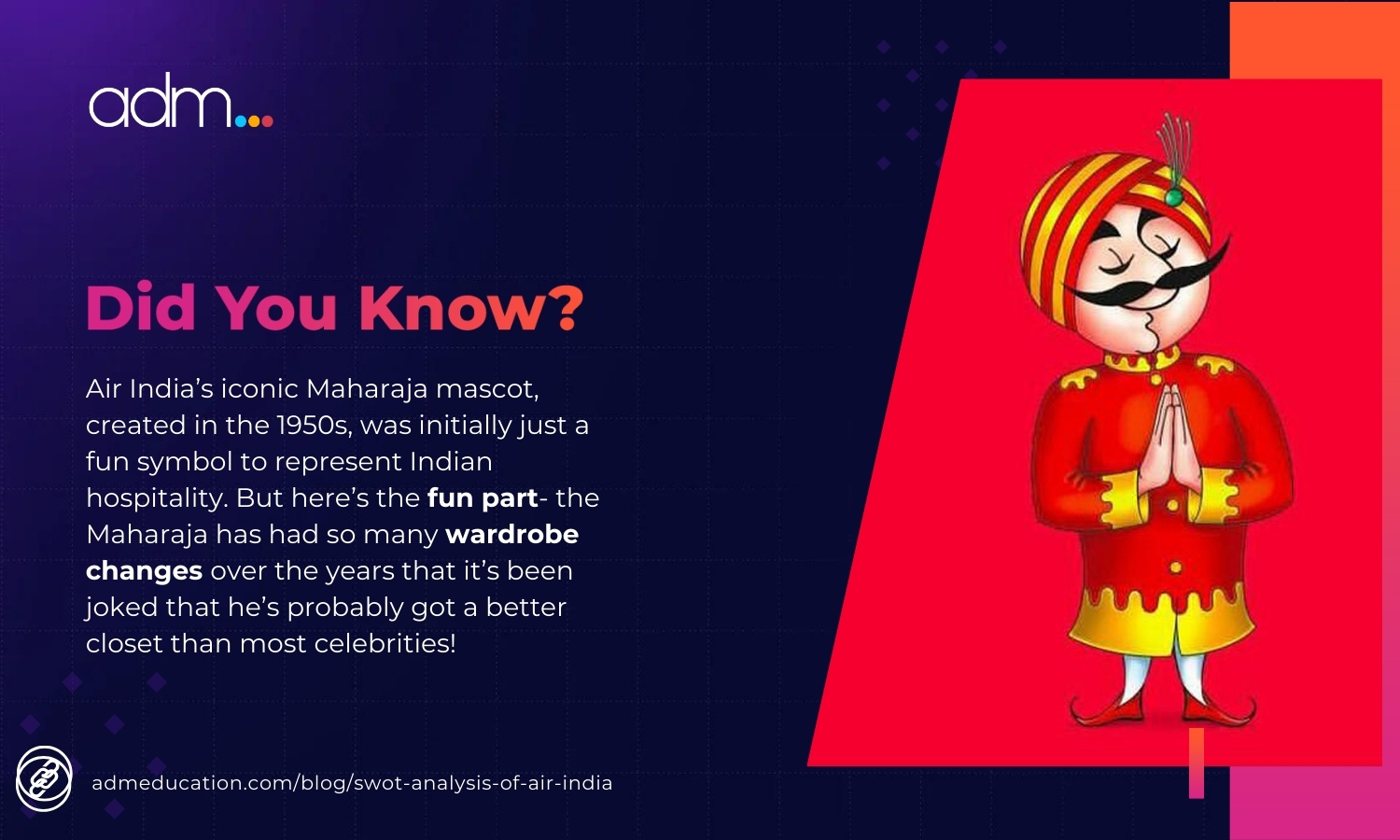
Air India is a rich brand name in the aviation industry in India. It has a very iconic Maharaja mascot, which is put on its logo. The brand holds a comprehensive domestic and worldwide network that spans different regions of the globe. The company has a very historic importance as well as an expanded reach. Recently, the Government of India made the airline’s private features and operational effectiveness.
Air India at a Glance
| Founders | J. R. D. Tata |
| Chairman | N. Chandrasekaran |
| Year of Establishment | 29 July 1946 |
| Annual Revenue (as of FY22) | ₹313.77 billion |
| Total assets (as of FY24) | ₹11381 crore |
| Origin | India |
| Total no. of employees | 19,000 |
SWOT Analysis of Air India
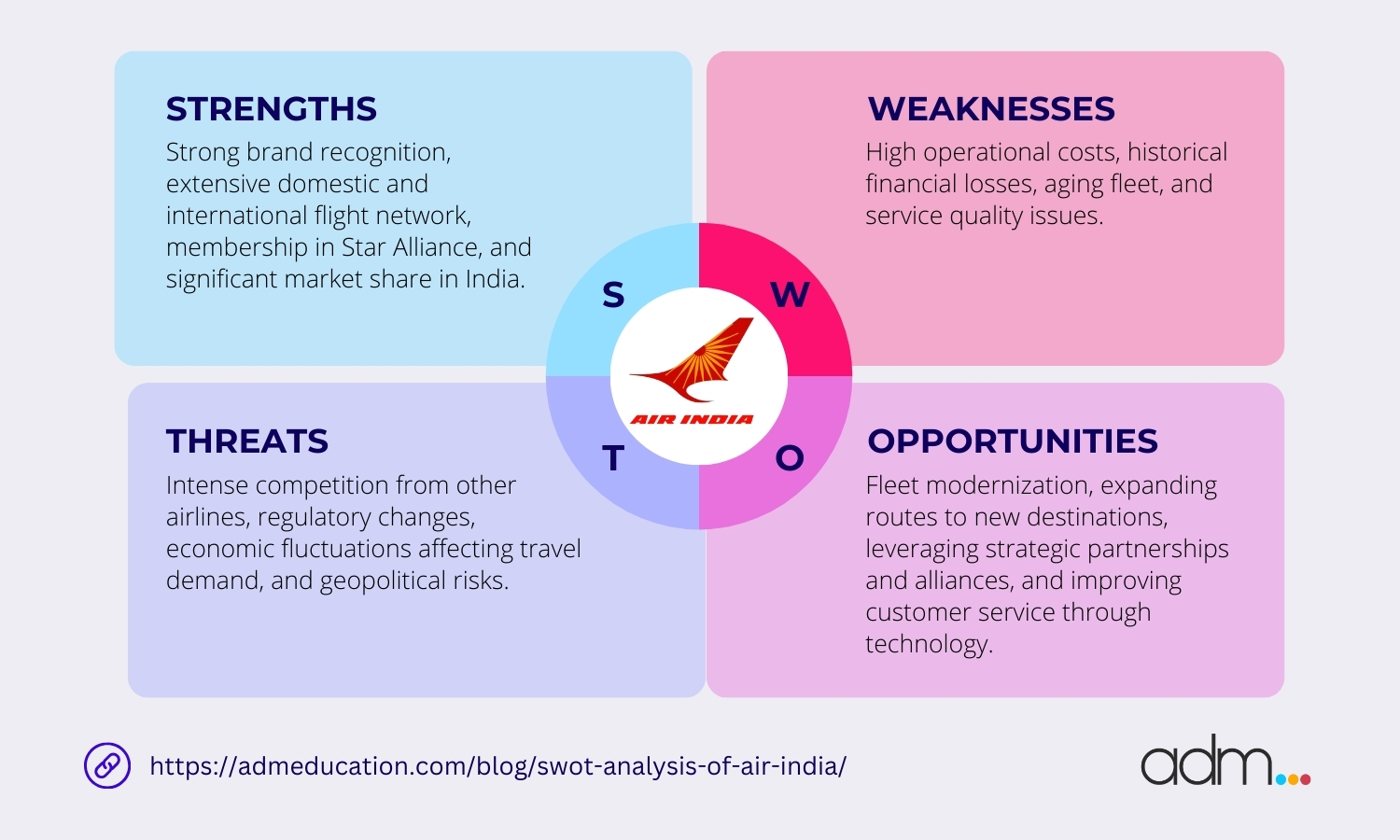
The SWOT analysis of Air India will give insightful information about the company’s strengths, opportunities, drawbacks, and threats in detail.
Strengths of Air India
Air India has the following strengths –
-
Strong brand position
Air India is a popular company with having rich heritage and recognition across the globe. It has a very long history and is one of the biggest strengths of India bringing a lot of credibility and trust in customers.
-
Expanded network
Air India has a broad range of International and domestic networks that have different destinations. This reach helps the company so a wide range of customers and seize a huge market share.
-
Star alliance collaboration
Air India is a member of the Star Alliance which gives it plenty of benefits including enhanced connectivity. Due to this Air India can also partner with other airlines smoothly. Star Alliance membership helps the expansion of the brand across the globe and offers passengers additional features and a seamless travel experience.
-
Government back
Air India is a state airline and has great access to Government support as well as resources. This is the biggest strength for the brand as it is very essential for financial stability and operational expansion during tough times.

Weaknesses of Air India
Air India lags below weaknesses –
-
Financial issues
Air India confronted continuous financial stability issues that included high depth levels and current losses. These challenges affect the brand’s ability to invest in modernization service enhancements and innovative marketing strategies.
-
Old fleets
Air India flight has a lot of older aircraft having great maintenance costs and worst customer service. Old aircraft create an impact on the competitiveness and the airline’s image.
-
Operational concerns
Air India is getting criticized for unproductive operations. The problems in these operations include cancellations, delays, or customer service reviews. These issues may erase the rest of customers as well as loyalty with time.
-
Management issues
Constant fluctuations in management and leadership also result in efficient production and operations in the organization. This kind of instability may lead to the company’s capacity to bring long-term profitable plans.
Opportunities for Air India
Here are the opportunities for Air India in the aviation industry –
-
Market surge
The aviation market in India is witnessing quick growth. It is because of disposable incomes and the increasing number of middle-class households. Easily capitalized on this trend by expanding the domestic roots as well as improving the service offerings.
-
Strategic collaborations
Expanding the agreements as well as alliances with different airlines helps the company of passengers a great number of options as well and network system smart collaborations may also help share operation risk as well as cost related to the brand.
-
Modernization of fleets
Air India can invest in the latest and fuel-effective aircraft that will improve the efficiency of the aircraft and also reduce the cost. It may also enhance the customer experience to a greater extent. Modern fleet aids aircraft in computing with the other competitors.
-
Digital transformation
With the help of the latest digital technology, Air India can enhance its booking systems along with functions and customer services. These changes will help provide customers with a seamless traveling experience. Moreover, innovations including online chicken customization services may also attract technology-savvy passengers.
Threats of Air India
Air India should be aware of these threats to grow ahead –
-
Severe competition
The aviation sector in India is highly competitive with reduced careers and international airlines are taking a huge number of market share. The intense competition in the aviation industry is pressuring the company to enhance price profitability as well as market standards.
-
Economic fluctuations
The global as well as local economic fluctuations are also impacting the customer demands operation prices and fuel costs unexpectedly. Compliance with the related regulations may also require additional investment as well as some changes in business practices.
-
Regulatory issues
Fluctuations in the regulations as well as rules in the industry also pose a major threat to Air India. Also, the fluctuations in the environmental policies as well as tax structures impact the profit margins of the company. Compliance with the recent regulations may also need some investment as well as adjustment in organizational practices.
-
Pandemic disruptions
The COVID-19 pandemic has completely transformed the aviation industry’s requirements and growth and also led to the worldwide health crisis. Any health or climate-related emergencies may bring travel restrictions, operation issues, and changed passenger demands.
Top Competitors of Air India
The top 5 competitors of Air India include –
Indigo: This is the biggest airline in India and usually works on a low-cost model. It is well known for its popular and punctual services and competes directly with Air India in the aviation industry.
SpiceJet: It is another economical carrier in India competing directly with Air India on different country-wise routes.
Vistara: Vistara is a full-service aircraft company that runs on domestic as well as Global levels.
Go First: It is also another economical airline competing with Air India on country-wise routes.
Emirates: It is also a leading global aircraft company based out of Dubai. It is very well known for premium services as well as an expanded global network that attracts a whole lot of customers worldwide.
Conclusion
Air India has a very broad Global and domestic network that has made it a strong position in the aviation industry. The brand faces a number of challenges regarding financial operation and status. The biggest strength of the brand is its collaboration with the Star Alliance which brings a lot of opportunity for the airline to grow in the market. It also holds a number of opportunities like improving its fleet.
The major threats the company faces include changing fuel prices and reducing carriers and economic issues. However, addressing these major issues and capitalizing on market opportunities are very essential for the company to build long-term growth and sustainability in the aviation market.