

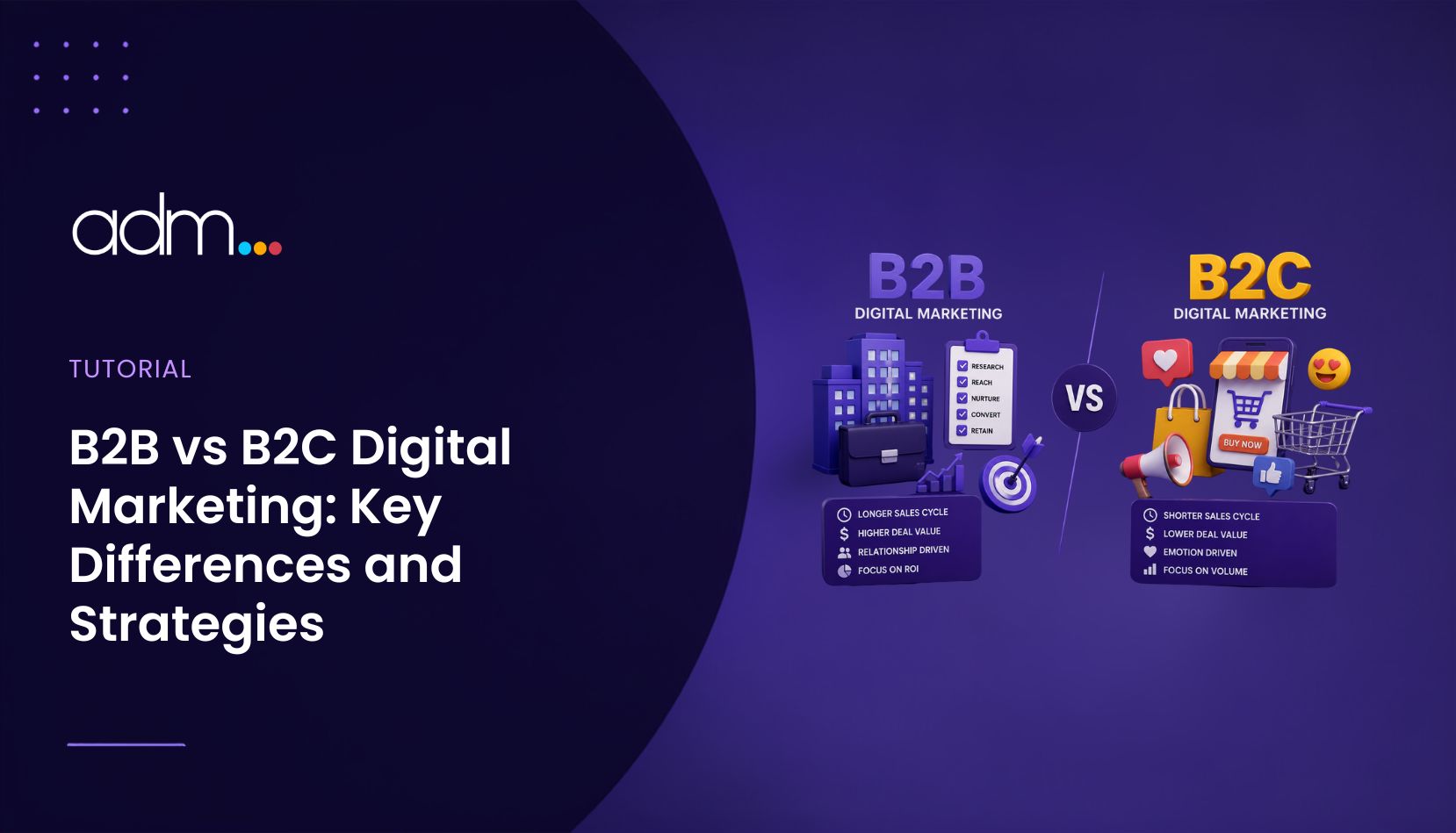
A procurement manager at a 200-person logistics company is comparing three CRM vendors right now. IT’s been looped in. So has finance. A VP who hasn’t answered an email in eleven days is somehow still part of the decision. Meanwhile, somebody three time zones away just saw a pair of sneakers on Instagram at midnight, tapped buy, and now owns them. The ad hadn’t even finished playing.
Same internet. Probably the same phone too. Totally different marketing problem.
That’s B2B vs B2C in one sentence. Not better, not worse, just two different machines running on two different kinds of fuel. One runs on patience and proof. The other runs on speed and feeling. Swap the playbooks and watch both of them fail, no matter how big the budget is or how slick the creative looks.
This is the long version. Where the two split, what works on each side, where they quietly overlap, how B2B2C blends them together, how it all plays out differently depending on the industry, and a glossary at the end for anyone who needs the jargon decoded in one place.
What Is B2B Marketing?
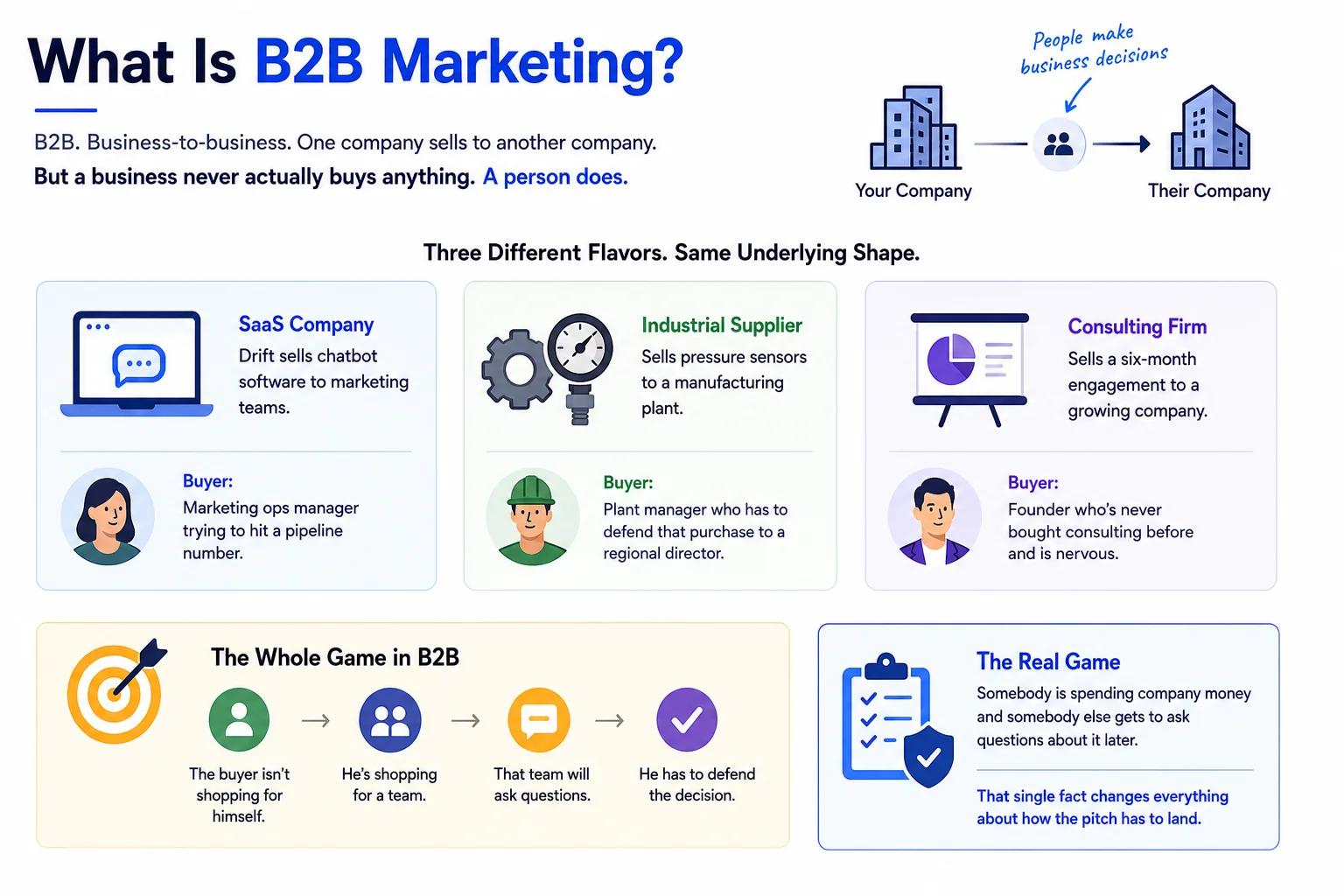
B2B. Business-to-business. Sounds simple, right? One company sells to another company. Except here’s the part nobody says out loud: a business never actually buys anything. A person does. Some person with a boss to answer to, a budget they didn’t even set, and a Slack channel full of opinions they now have to manage before they can say yes to anybody.
Look at three different flavors of this. A SaaS company like Drift selling chatbot software to marketing teams, where the buyer’s a marketing ops manager trying to hit a pipeline number. An industrial parts supplier selling pressure sensors to a plant manager who has to defend that purchase to a regional director next quarter. A consulting firm selling a six-month engagement to a founder who’s never bought consulting before and is nervous about getting burned. Three completely different products, three completely different buyers, but the same underlying shape, somebody is spending company money and somebody else gets to ask questions about it later.
That last part is the whole game in B2B. The buyer isn’t shopping for himself. He’s shopping on behalf of a team that’ll grill him on it. That single fact changes everything about how the pitch has to land, and it’s the thread that runs through every section below.
What Is B2C Marketing?
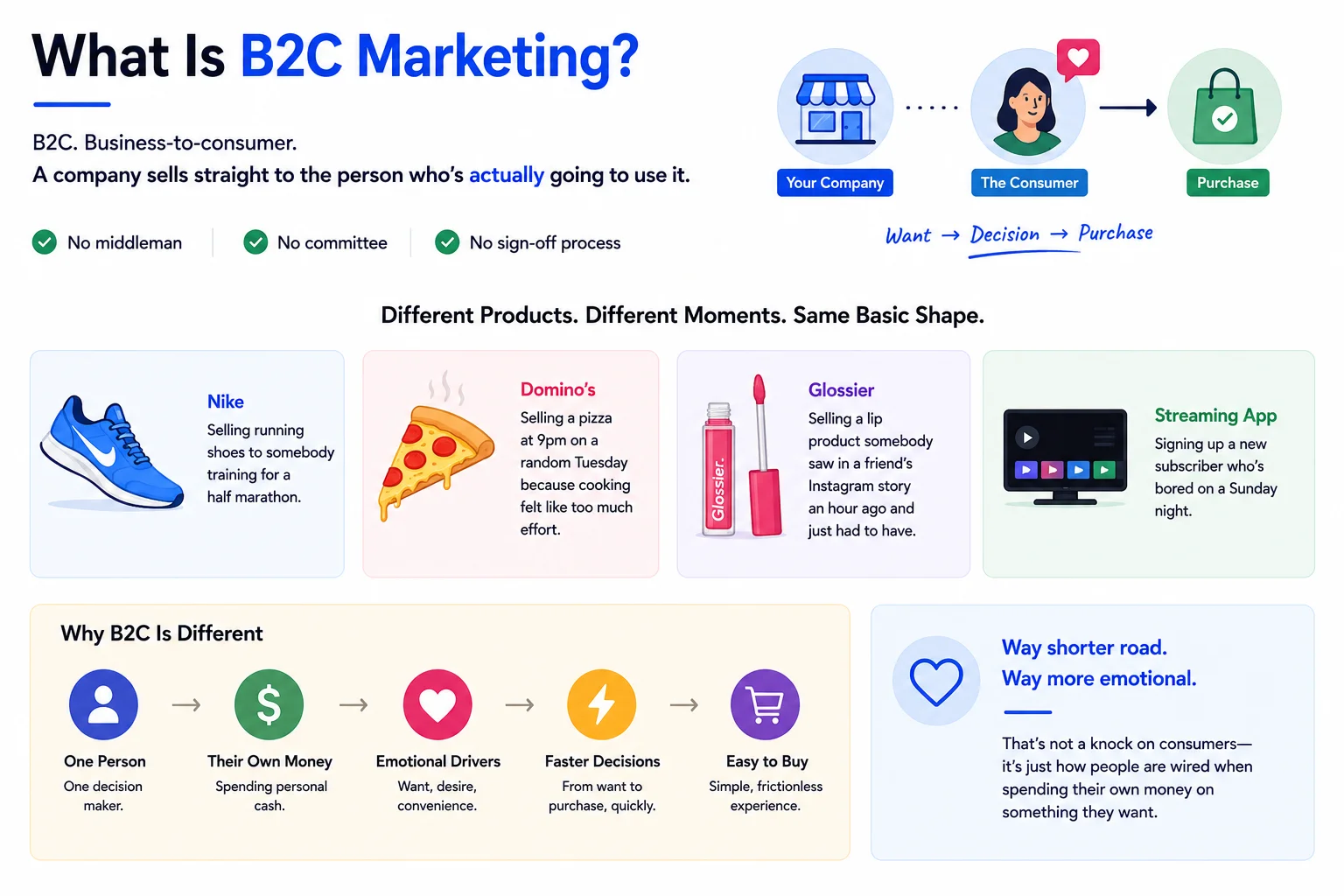
B2C. Business-to-consumer. A company sells straight to the person who’s actually going to use the thing, wear the thing, eat the thing. No middleman, no committee, no internal sign-off process standing between the want and the purchase.
Nike selling running shoes to somebody training for a half marathon. Domino’s selling a pizza at 9pm on a random Tuesday because cooking felt like too much effort. Glossier selling a lip product somebody saw in a friend’s Instagram story an hour ago and just had to have. A streaming app signing up a new subscriber who’s bored on a Sunday night. Different categories, different price points, same basic shape underneath, one person, their own money, and a decision that mostly lives in their own head.
Way shorter road than the B2B version. Way more emotional too. And honestly, that’s not a knock on consumers, it’s just how people are wired when they’re spending their own cash on something they want, not something a finance department needs to sign off on.
B2B vs B2C at a Glance
Before going section by section, here’s the cheat sheet. Screenshot this one, it’s the table worth coming back to.
| Dimension | B2B | B2C |
|---|---|---|
| Buyer | A team or committee, often several people | One individual |
| Sales cycle | Weeks to months, sometimes a year or more | Minutes to days |
| Decision driver | Logic, ROI, risk reduction | Emotion, convenience, price |
| Average order value | Higher, often recurring or contract-based | Lower, usually one-off or subscription |
| Purchase frequency | Infrequent, high-stakes | Frequent, low-stakes |
| Primary channels | LinkedIn, SEO, email, webinars | Instagram, TikTok, paid social, marketplaces |
| Content formats | Case studies, whitepapers, demos | Short video, reviews, user-generated content |
| Tone of voice | Direct, evidence-led, calm | Energetic, visual, personal |
| Key metrics | Pipeline value, lead quality, CAC payback | Conversion rate, AOV, ROAS |
| Relationship model | Long-term, account-managed | Transactional, loyalty-driven |
Everything below is just an explanation of why every one of those rows looks the way it does, and what to actually do about it.
Core Differences Between B2B and B2C Digital Marketing
Every difference in that table traces back to one root cause: who’s deciding, and what’s actually on the line for them. Walk through each angle and the same pattern shows up again and again.
Target Audience and Buyer Behavior
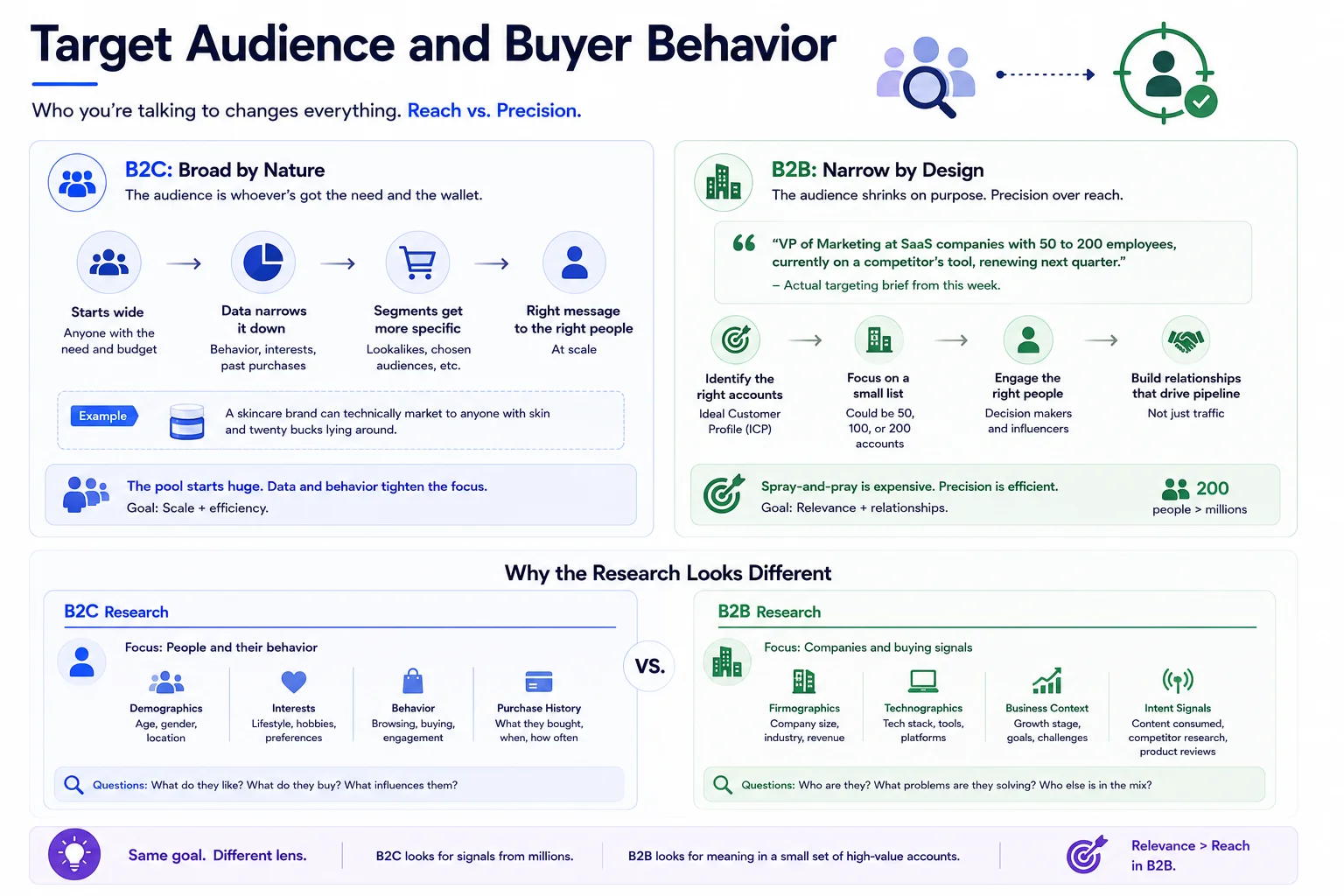
In B2C, the audience is whoever’s got the need and the wallet. Broad. Sometimes huge. A skincare brand can technically market to anyone with skin and twenty bucks lying around. Targeting gets sharper once the data kicks in, sure, but the pool starts wide open and narrows from there based on behavior, interests, and past purchases.
B2B flips that completely. The audience shrinks on purpose. Forget “marketers” as a target, the real brief looks more like: VP of Marketing at SaaS companies with 50 to 200 employees, currently on a competitor’s tool, renewing next quarter. That’s not an exaggerated example, that’s an actual targeting brief somebody wrote this week. Account-based marketing exists because B2B doesn’t need reach. It needs precision aimed at a list that might only have 200 names on it. Spray-and-pray works fine when the audience is millions wide. It’s a waste of budget when the audience is two hundred people who all work at companies that fit one narrow profile.
This is also why the research itself looks different. A B2C team studies demographics, interests, and shopping behavior. A B2B team studies firmographics, company size, industry, tech stack, growth stage, alongside intent signals like who’s been reading competitor reviews lately. Different questions entirely, even though both teams would call it “audience research” on a slide.
Sales Cycle and Decision-Making Process
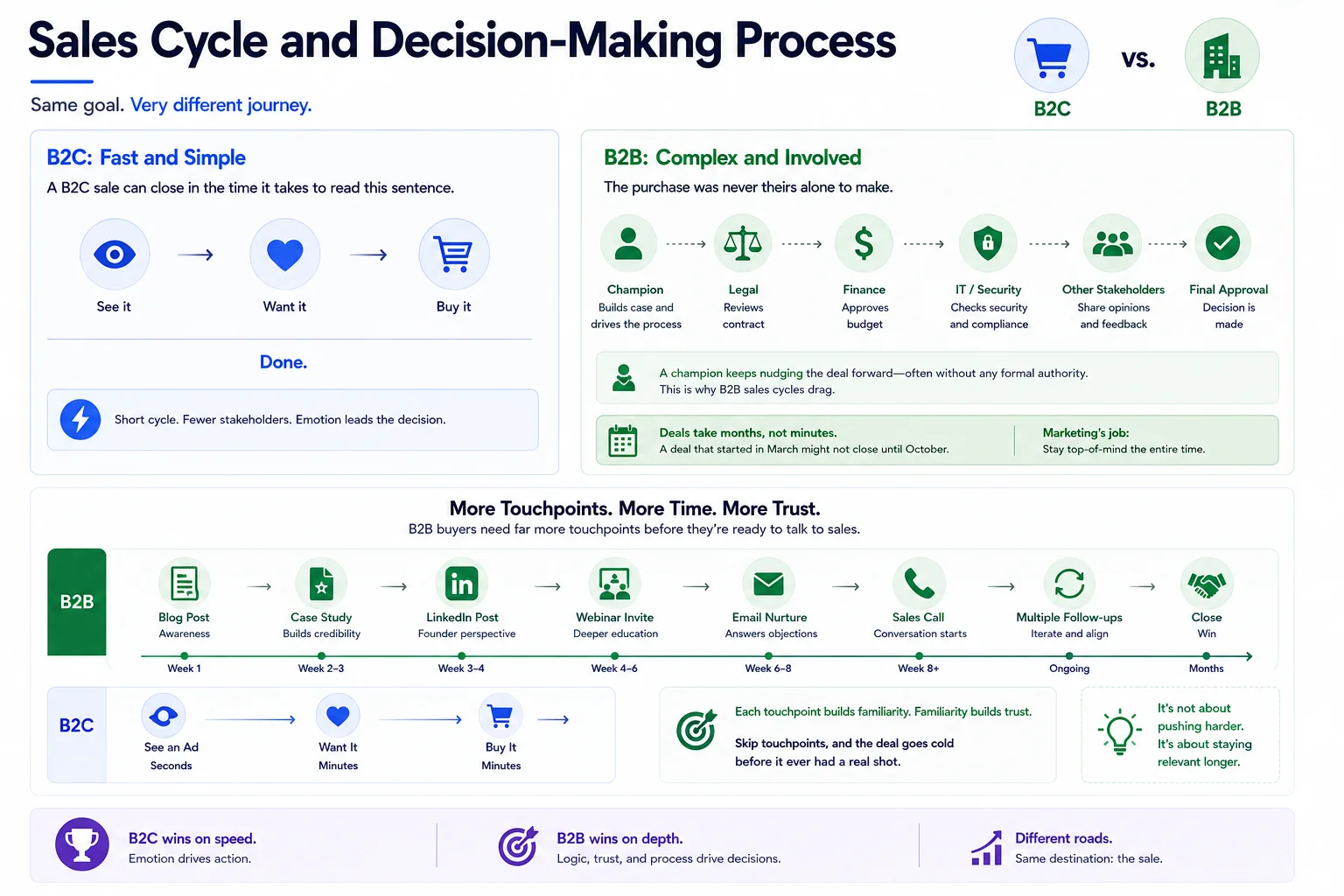
A B2C sale can close in the time it takes to read this sentence. See it, want it, buy it. Done.
B2B doesn’t move like that. And nope, it’s not because B2B buyers are slow people, it’s because the purchase was never theirs alone to make. Legal reviews the contract. Finance signs off on the spend. IT checks the security questionnaire. Somewhere in the middle of all that, a champion inside the company has to keep nudging the deal forward even when nobody’s paying them to care. That’s why B2B sales cycles drag, sometimes painfully, and why nurture isn’t some buzzword on a B2B team’s whiteboard. It’s the actual job. A deal that started in March might not close until October, and the marketing team’s entire role during that gap is making sure the brand doesn’t get forgotten.
This stretch also means a B2B buyer needs far more touchpoints before they’re ready to talk to sales than a B2C buyer ever does. One ad rarely does the job. It’s a blog post, then a case study, then a LinkedIn post from the founder, then a webinar invite, then finally a sales call, stacked over weeks. Skip a few of those touchpoints and the deal goes cold before it ever had a real shot.
Content Strategy and Messaging Tone
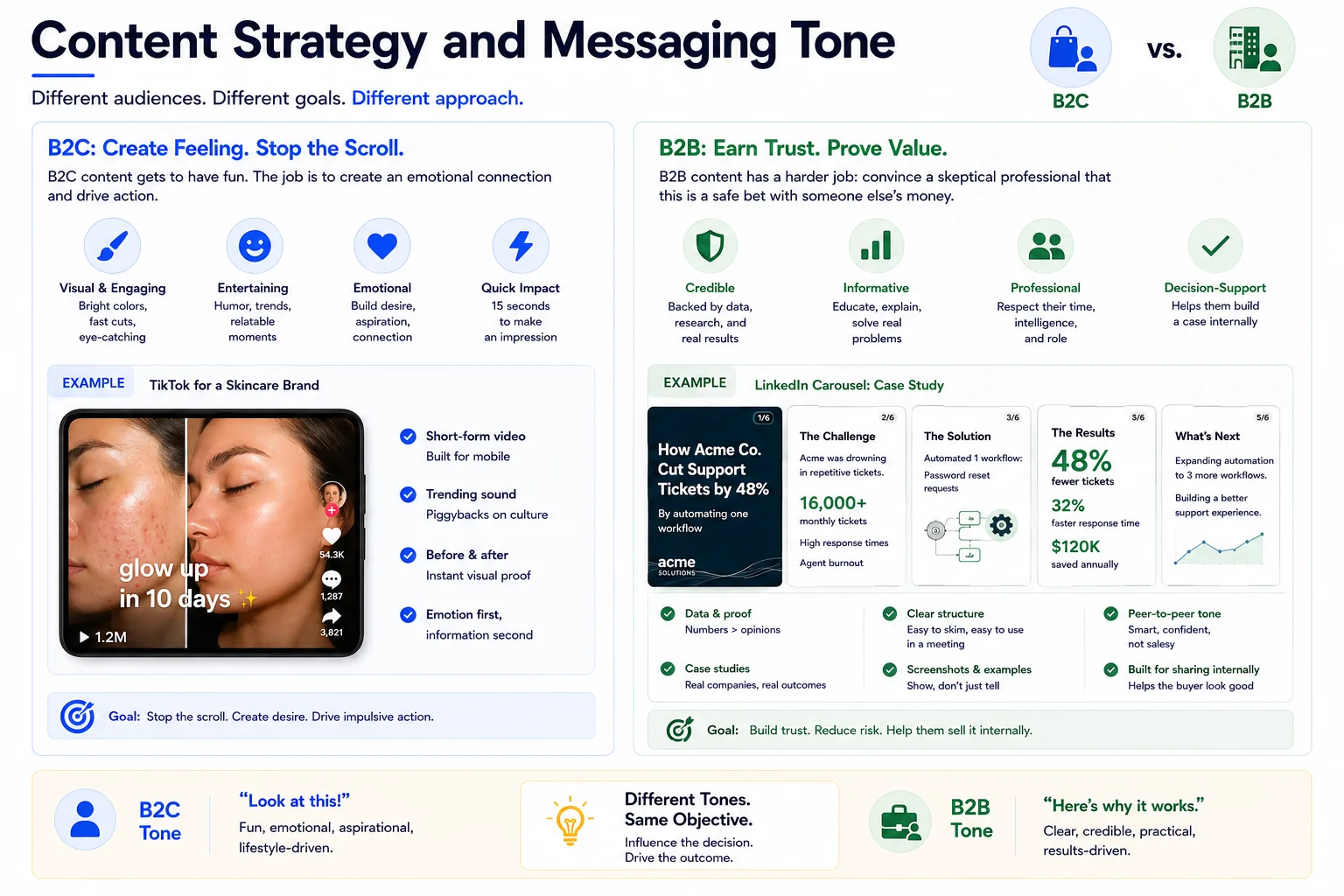
B2C content gets to have fun. Bright colors, fast cuts, a joke in the caption nobody asked for but everyone enjoys. The job there is to stop the scroll and create a feeling. Not defend a position with a spreadsheet. Picture a fifteen-second TikTok for a skincare brand, no narration needed, just a satisfying before-and-after and a trending sound.
B2B content has a harder job: convince a skeptical professional this is a safe bet with somebody else’s money. That means case studies, comparison pages, claims backed by something real, and a tone that sounds like a smart peer instead of a hype reel. Picture a LinkedIn carousel walking through how a company cut support tickets by automating one workflow, screenshots included. Nobody’s forwarding a “GAME CHANGING!!” email to their CFO. They’re forwarding something they can quote in a meeting without getting laughed out of the room. The tone doesn’t need to be boring, plenty of B2B brands prove that wrong every day, but it does need to earn trust before it earns a click.
Marketing Channels and Platforms
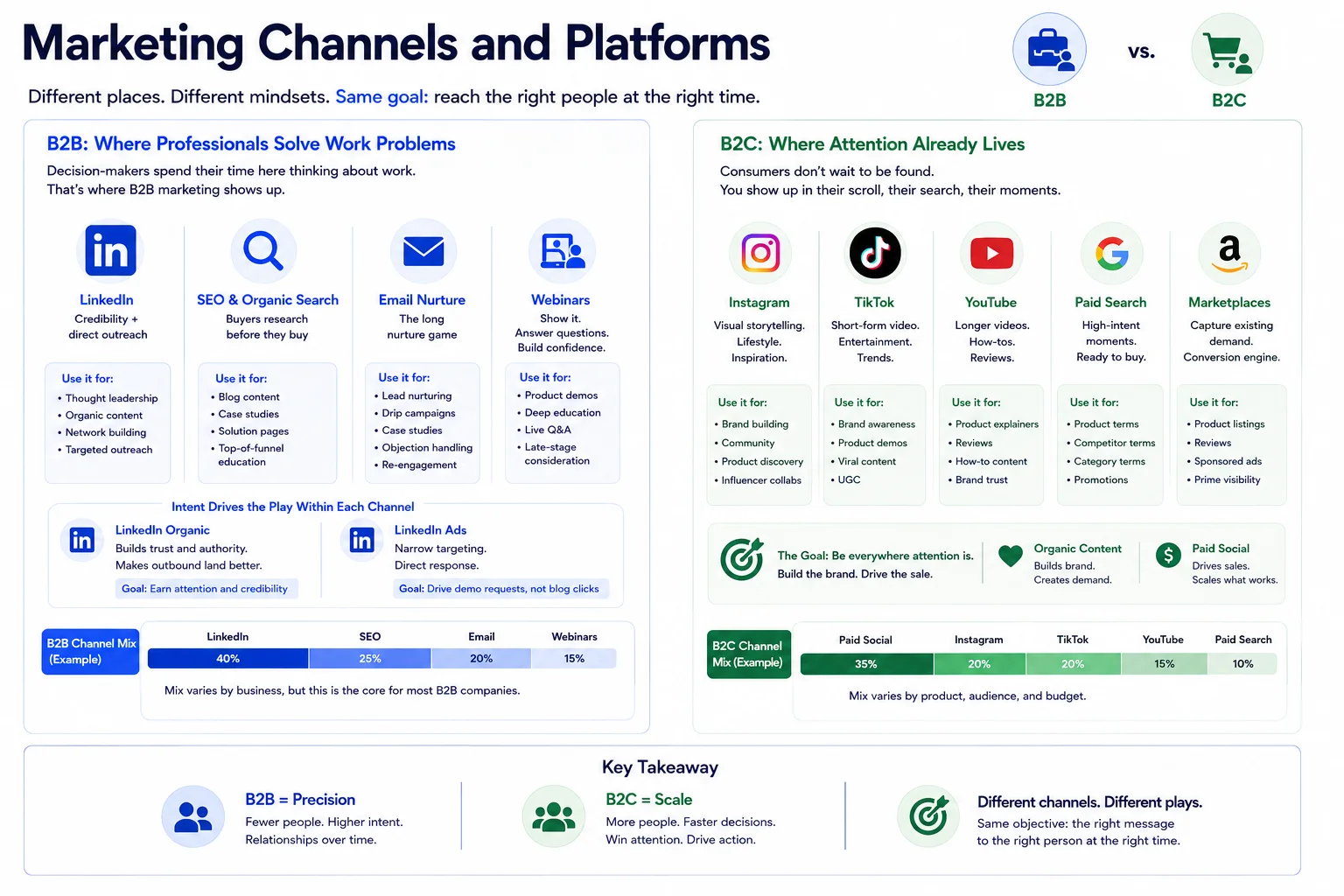
LinkedIn earns its reputation in B2B for a reason. It’s where the actual decision-makers spend their working hours thinking about work problems. Stack that with SEO, since most buyers research hard before ever talking to sales, plus email nurture and the occasional webinar, and that’s most of a B2B channel mix right there:
- LinkedIn for credibility and direct outreach
- SEO and organic search for buyers already researching
- Email for the long nurture game
- Webinars for the moment they’re ready to see it actually work
Within each of those, the use case shifts depending on intent too. LinkedIn organic content builds the kind of trust that makes a cold outbound message land better later. LinkedIn ads target a much narrower list and usually point straight at a demo request, not a blog post.
B2C lives somewhere louder. Instagram, TikTok, YouTube, paid search for the high-intent moments, marketplaces like Amazon for the rest. The goal isn’t to wait around for someone to search a category term, it’s to be wherever attention already is, scrolling, swiping, half paying attention to something else. Organic content there builds the brand. Paid social does the heavy lifting on actual sales.
Pricing and Value Communication
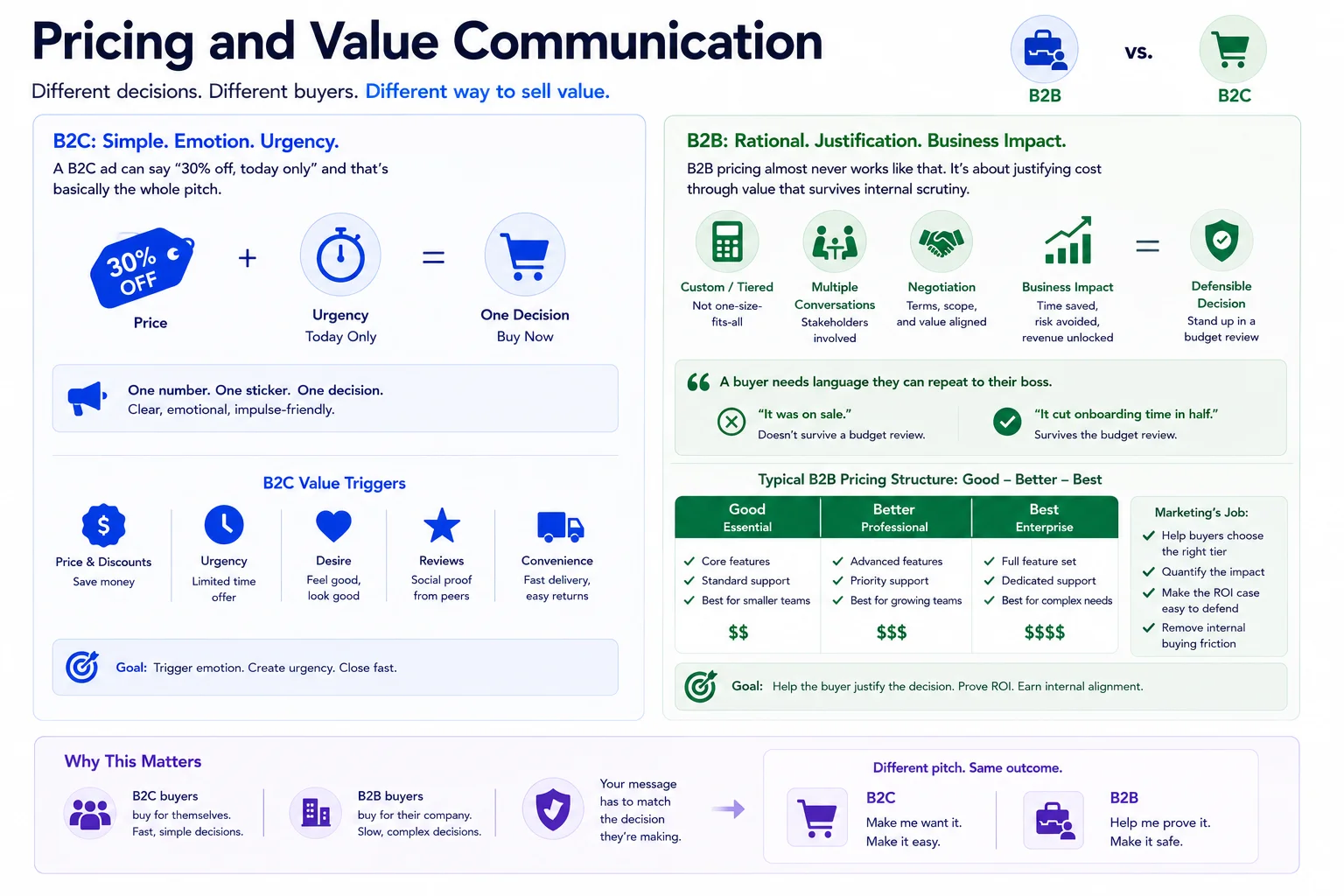
A B2C ad can say “30% off, today only” and that’s basically the whole pitch. Price plus urgency, done deal. One number, one sticker, one decision.
B2B pricing almost never works like that. It’s custom, tiered, sometimes negotiated over three separate calls, and the messaging has to justify cost differently, around time saved, risk avoided, revenue unlocked. Most B2B software runs the classic good-better-best tier structure, where the actual job of marketing isn’t selling a single price, it’s helping the buyer figure out which tier fits and then defending why it’s worth it. A buyer needs language he can repeat to his boss to defend the spend. “It was on sale” doesn’t survive a budget review. “It cut onboarding time in half” might. The pitch has to survive a meeting the salesperson isn’t even in the room for.
Customer Relationship and Retention
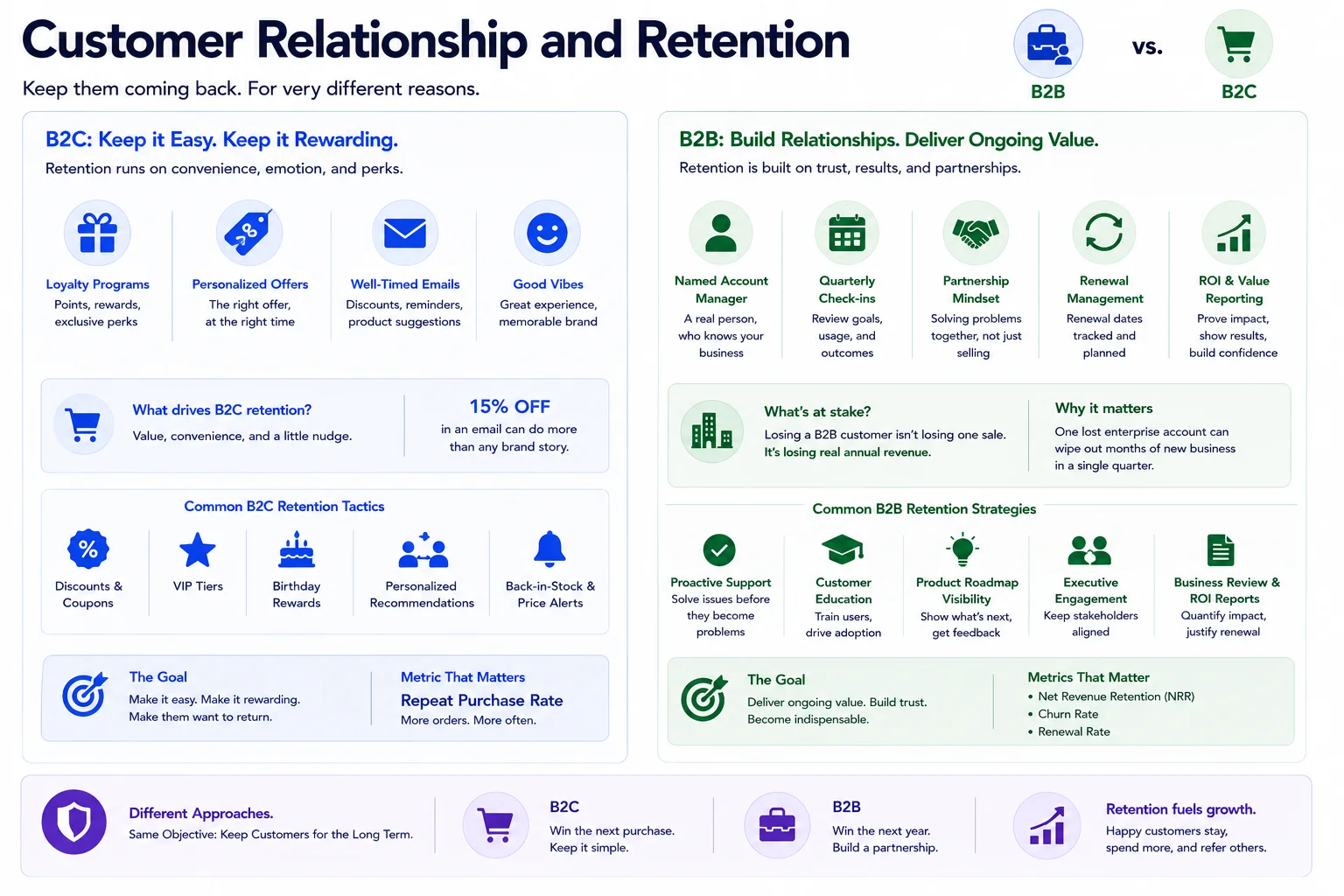
B2C retention runs on points, perks, good vibes. Loyalty programs, personalized offers, the stuff that makes somebody want to come back without really thinking too hard about why. A well-timed email with a 15% off code does more for retention here than any amount of brand storytelling.
B2B retention is a completely different animal. There’s usually a named account manager, a quarterly check-in, a renewal date circled in red, and a relationship that looks more like a partnership than a transaction. Losing a B2B customer isn’t losing one sale. It’s losing a contract worth real annual revenue, which is exactly why churn gets watched like a hawk on that side of the fence. One lost enterprise account can wipe out months of new business work in a single quarter, which is also why account managers exist as a dedicated role in B2B in a way they almost never do in B2C.
Metrics and KPIs That Matter
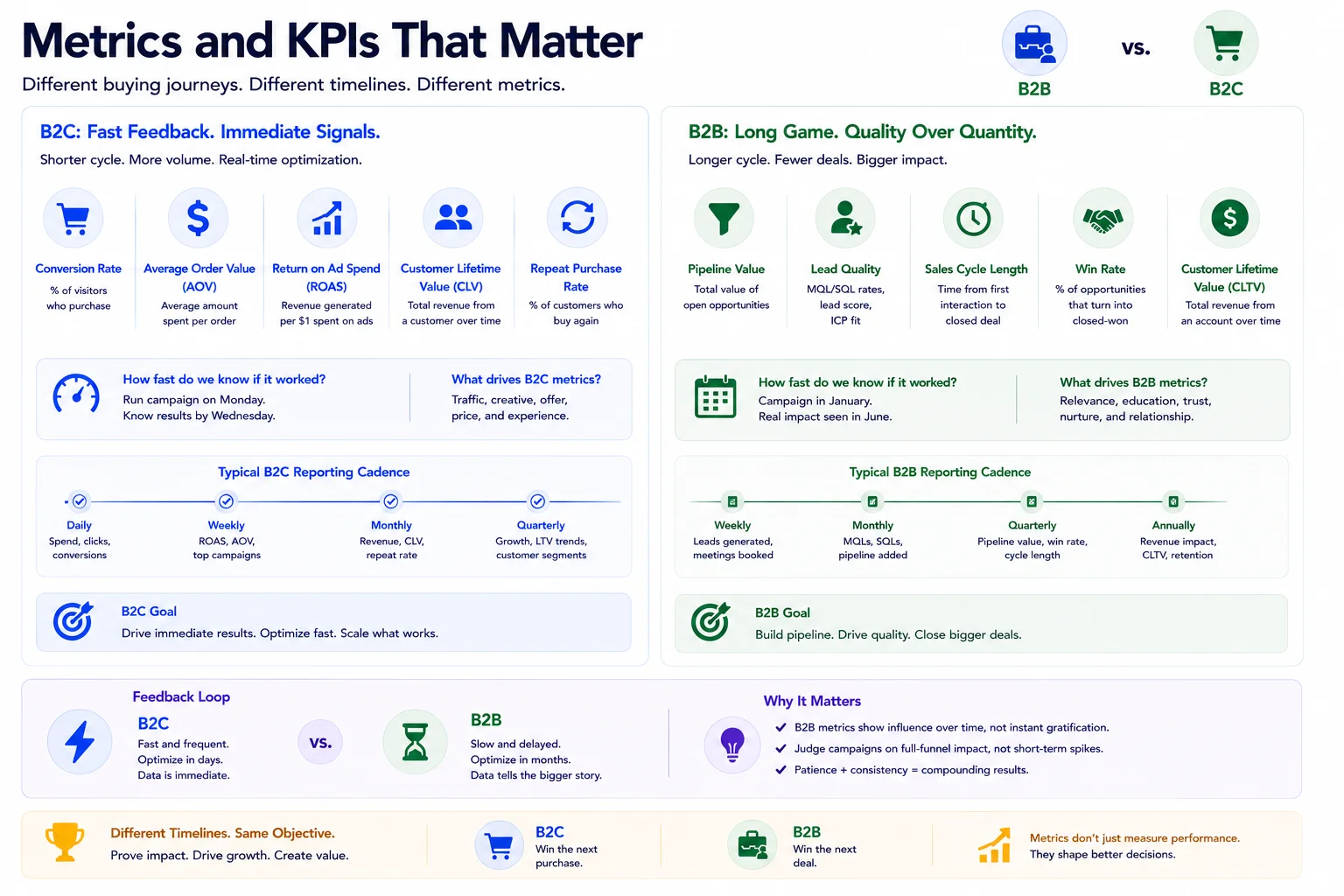
A B2C marketer checks conversion rate, average order value, and return on ad spend before the coffee’s even finished brewing. Fast, clean feedback loop. Run a campaign on Monday, know if it worked by Wednesday.
A B2B marketer is staring at pipeline value, lead quality, and how long it took a lead to turn into a closed deal. Slower, messier feedback loop. A campaign run in January might not show its real impact until a deal closes in June. That lag changes how patient a B2B team has to be with its own numbers, whether they like it or not, and it’s also why B2B marketers get asked to justify spend more often than their B2C counterparts. The math just takes longer to show up, and a leadership team that doesn’t understand that gap tends to kill good campaigns too early.
Budget Allocation and Spend Patterns
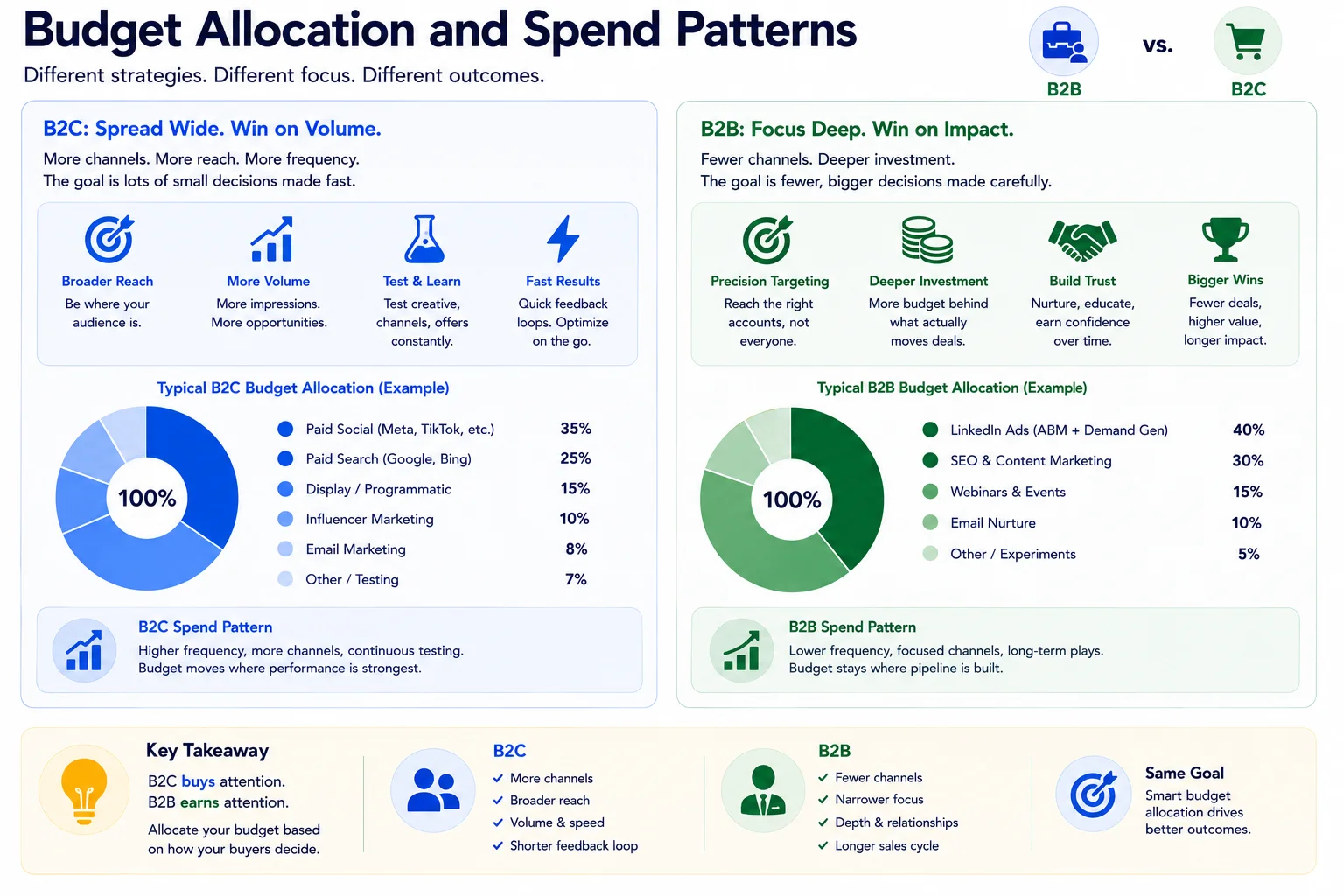
B2C budgets spread wide. More channels, more frequency, more impressions, because the win condition is volume, lots of small decisions made fast. A B2C team might run active campaigns across six or seven channels at once, testing creative constantly.
B2B budgets concentrate. Fewer channels, deeper investment in each one, because the win condition is fewer, bigger decisions made carefully. A B2B team often puts the bulk of its budget behind two or three channels, LinkedIn, SEO, and maybe one event or webinar series, rather than chasing reach everywhere at once. Dumping money into broad social reach to land one large enterprise deal usually burns cash for nothing. A tightly targeted LinkedIn campaign paired with one strong case study tends to do more, even on a smaller total budget.
Martech Stack and Tooling
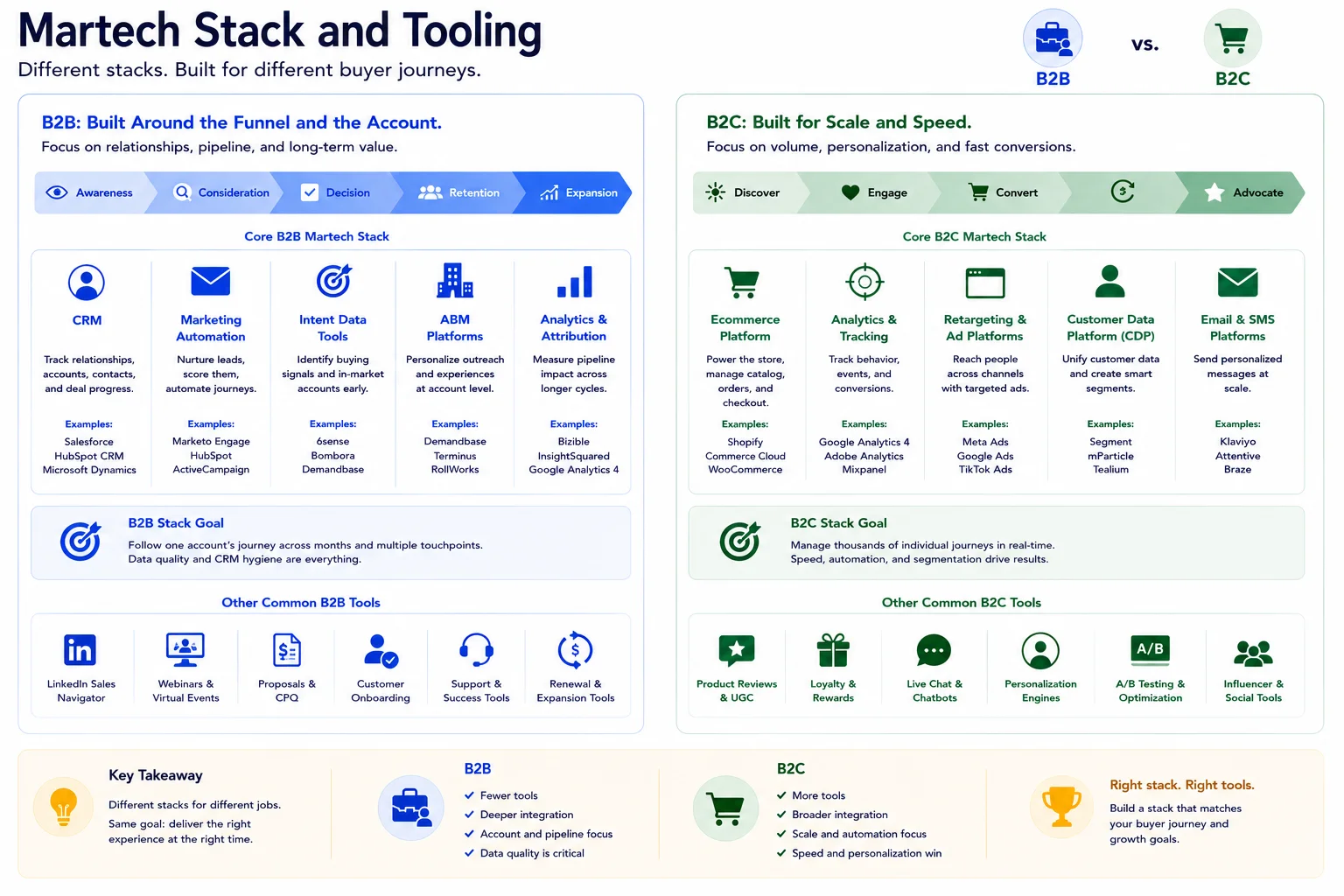
A B2B stack gets built around the funnel and the account:
- CRM to track the relationship over time
- Marketing automation to keep the nurture running
- Intent data tools to catch buying signals early
- ABM platforms to personalize outreach at the account level
The whole point is following one buyer’s journey across months and a dozen touchpoints. A B2B team will obsess over CRM hygiene the way a B2C team obsesses over pixel tracking, because that data is the entire memory of the relationship.
A B2C stack leans toward ecommerce platforms, retargeting pixels, and customer data tools built for scale. Makes sense, the job there is managing thousands of fast-moving individual journeys at once, not one long account history. A B2C marketer cares less about who exactly someone is and more about what segment they fall into and what they’re likely to do next.
B2B Marketing Strategies That Actually Work
Knowing the difference is one thing. Acting on it is what actually moves revenue.
Account-Based Marketing (ABM)
Instead of casting a wide net, pick the accounts actually worth winning and go after them directly. Personalized outreach, custom landing pages, sometimes even direct mail. Slower to set up than a generic campaign, sure, but it converts the right accounts instead of just impressing the wrong ones. A campaign aimed at fifty named accounts will usually outperform one aimed at fifty thousand random impressions, because every touchpoint actually means something to the person seeing it. The trick is resisting the urge to scale it too fast. ABM works because it’s narrow, the second it gets stretched across a thousand accounts it stops being ABM and just becomes a slower, more expensive version of regular outbound.
LinkedIn and Thought Leadership Content
This is where B2B buyers actually live during work hours. Posting genuinely useful takes, not recycled motivational quotes nobody asked for, builds the kind of trust that gets a cold message opened later instead of deleted on sight. The brands that win here aren’t the loudest, they’re the ones that consistently say something a buyer actually wants to read. Founder-led content tends to outperform brand-page content too, people engage with people, not logos, even on a platform built for work. A founder posting an honest take on a hard lesson learned usually beats a polished company announcement, hands down.
SEO and Long-Form Educational Content
B2B buyers do their homework before a salesperson ever enters the picture. Ranking for the stuff they’re already typing into Google, comparison terms, how-to guides, pricing breakdowns, puts a brand in front of them before the competitor even gets a shot. By the time sales gets involved, a buyer who found the brand through a useful piece of content is already halfway sold. Comparison pages in particular do quiet, consistent work here, because buyers searching “X vs Y” are often days away from a decision, not months.
Case Studies, Whitepapers, and Proof-Driven Assets
A buyer needs ammunition to defend the purchase internally. One strong case study with real numbers does more work than any clever tagline ever could. Vague claims get questioned in the meeting. Specific outcomes get forwarded straight to the boss, screenshot and all. The best case studies don’t just say a result happened, they walk through the actual problem first, so the next reader sees themselves in it before they even get to the outcome.
Email Nurture Sequences for Long Sales Cycles
Nobody buys enterprise software off a single email, not once, not ever. A nurture sequence keeps showing up with something useful, an insight, a relevant case study, a webinar invite, so the brand’s still top of mind whenever the buyer finally circles back ready to act. The goal isn’t to push every email toward a sale. It’s to be the name they remember when the timing finally lines up, which sometimes means sending genuinely helpful content with no pitch attached at all.
Webinars and Product Demos
Live or recorded, this is the moment a buyer actually watches the thing work, asks questions, and pictures it solving their specific mess. It’s also a solid lead-qualification filter. Anyone who shows up for a 45-minute demo is usually serious about this, which is more than can be said for someone who just downloaded a PDF and vanished. Recorded versions keep paying off long after the live event too, sitting on a landing page doing quiet work for months.
B2C Marketing Strategies That Actually Work
Short-Form Video and Social-First Content
TikTok and Reels reward fast, native-feeling content over anything that looks like a polished ad. A brand that looks like it actually gets the platform, not just posts on it, walks away with more attention. The ones that try to make a TikTok look like a TV commercial usually get scrolled past in under a second. The winning formula is usually a hook in the first two seconds, no exceptions, no slow build.
Influencer and Creator Partnerships
People trust a face they recognize more than a brand they don’t. A well-matched creator partnership does something a banner ad just can’t, it makes a product feel like a tip from a friend instead of an interruption. The match matters more than the follower count, a smaller creator with the right audience usually beats a huge one with the wrong fit, and the content usually performs better when it doesn’t look like a paid placement at all.
Retargeting and Cart-Abandonment Campaigns
Most people don’t buy on the first visit. Nope, they browse, they leave, they get distracted by something else entirely. Retargeting brings them back with a reminder, sometimes a small nudge like free shipping, right when they’re closest to actually deciding. It’s not annoying when it’s timed well, it just feels like the brand noticed. The mistake is hitting someone with the same ad fifteen times in a row, which flips from helpful reminder to genuine irritation fast.
Loyalty Programs and Personalized Offers
Repeat customers cost less to keep than new ones cost to find. Points, early access, offers that feel tailored instead of copy-pasted, all of it keeps people coming back instead of wandering off to a competitor the next time they get an ad for something similar. The strongest loyalty programs make someone feel like a regular, not just a rewards number.
Conversion-Optimized Landing Pages and Checkout
In B2C, friction kills sales, full stop. A confusing checkout, a slow-loading page, one extra form field nobody needed, any of it can lose a customer who was seconds away from buying. Speed and clarity aren’t nice extras here. They’re the entire game, and most lost revenue in B2C dies quietly at the checkout page, not the ad. A one-click checkout option alone can rescue sales that a slow multi-step form would have lost.
User-Generated Content and Social Proof
Real photos, real reviews, real people actually using the product beat polished studio shots almost every time. It’s proof the brand isn’t just talking about itself in a vacuum, and shoppers know the difference between a staged photo and a real one even if they couldn’t explain how. A product page with a wall of honest, slightly messy reviews usually converts better than one with only five-star polish.
Where B2B and B2C Marketing Overlap
For all the differences, worth saying plainly: both sides are still marketing to people, not logos, not wallets. A procurement manager checks reviews before a big purchase the same way somebody checks reviews before buying headphones. Trust still matters. Story still matters. Nobody, in any business model, wants to feel sold to.
Both sides are also leaning harder into personalization and first-party data, mostly because cookies got unreliable and customers got tired of generic messaging. And both are running into the same shift, people research things personally long before they ever research them professionally. Somebody reads reviews for a vacuum the same way they read reviews for a project management tool. The format changes. The instinct doesn’t.
There’s also a brand-building piece that gets ignored on both sides too often. B2B marketers sometimes act like brand doesn’t matter because the buyer’s “rational,” and B2C marketers sometimes act like nothing but performance ads matter because the buyer’s “impulsive.” Both assumptions are lazy. A trusted brand name closes B2B deals faster and gets clicked more in B2C ads, for the exact same reason, people default to what feels familiar when they’re under pressure to decide. Strip the brand out of either side and the performance numbers usually drop, even if nobody can point to the exact line item that explains why.
B2B2C and Hybrid Marketing Models
Not every business fits neatly in one box. B2B2C is when a company sells to a business, which then sells, or delivers value, to an end consumer. Two examples make this click faster than any definition will.
First, the software case. A white-label LinkedIn automation tool sold to marketing agencies, who then turn around and run campaigns for their own clients. The software company never talks to that final consumer directly, but the consumer’s experience, in this case the client of the agency, still rides on how well that tool actually performs. Second, the marketplace case. A wholesale platform like Faire connects independent retailers with brands, the platform sells to the retailer, the retailer sells to the shopper walking into the store. Same B2B2C shape, completely different industry.
In both cases, the messaging has to work on two levels at once. The agency or retailer needs B2B logic: ROI, reliability, support that actually responds. But they also need the tool or product to deliver something their own customers will genuinely like, which means the end-user experience can’t be an afterthought tacked on at the end. Mess up either layer and the whole chain snaps. A flashy B2B pitch means nothing if the agency’s clients end up hating the product six weeks in, and a great end-user experience means nothing if the business in the middle never agrees to carry it in the first place.
This is also where a lot of B2B2C companies get their marketing org structure wrong. Treating it as one marketing team with one message usually produces something too soft for the business buyer and too stiff for the end consumer. The companies that handle it well tend to split the responsibility, one set of assets aimed squarely at convincing the business partner, a separate set built to support whatever experience shows up downstream.
How B2B vs B2C Plays Out by Industry
The differences above don’t show up the same way in every industry. Some sectors run almost entirely on one model. Others run both at once, with one team talking to institutions and another talking to individuals, sometimes without ever comparing notes.
SaaS and Software
Most SaaS marketing is straight B2B: LinkedIn, SEO, demos, a sales-assisted close for anything above a certain price point. But the free-trial, self-serve tier of a lot of SaaS products borrows heavily from B2C, fast signup, frictionless onboarding, an experience built for one person clicking around at 11pm without ever talking to a salesperson. A tool like Canva or Notion sells to individuals the same way a consumer app would, then layers a real B2B sales motion on top once a team or company wants to upgrade. That blend is becoming the norm, not the exception, and it means a lot of modern SaaS marketing teams run two playbooks side by side without always calling it that.
Ecommerce and Retail
The classic B2C playbook lives here, paid social, retargeting, fast checkout, influencer partnerships. But there’s a growing B2B layer underneath retail too, wholesale platforms, bulk ordering portals, brands selling directly to other retailers before a single consumer ever sees the product on a shelf. A brand running both arms has to talk two completely different languages depending on which side of the business is doing the talking, and the team running paid social for the consumer side usually has almost nothing in common with the team handling wholesale accounts.
Healthcare and Wellness
This industry runs both models at full volume, often inside the same company. A consumer buying supplements or booking a telehealth appointment is a B2C decision, fast, personal, sometimes emotional. A hospital system buying scheduling software or a clinic purchasing equipment is pure B2B, slow, multi-stakeholder, compliance-heavy. The messaging that gets a consumer to book an appointment would get laughed out of a hospital procurement meeting, and vice versa, and the regulatory layer on the B2B side adds a whole extra round of approvals that consumer marketing never has to deal with.
Education and EdTech
Same split shows up here. Parents and students enrolling in a course or program make a decision that’s part B2C, emotional, time-sensitive, often compared against a handful of other options in a short window. But a school district or university buying a learning management system or curriculum license is a textbook B2B sale, RFPs, committee approval, budget cycles tied to the academic calendar. A company selling into both sides of education needs genuinely separate strategies, not one watered-down message trying to do both jobs badly. The institutional side often takes a full academic year just to move from first conversation to signed contract, while the consumer side might convert in a single sitting.
Common Mistakes Brands Make When They Mix Up B2B and B2C Marketing
This is where things go sideways more often than anyone wants to admit. Look at what actually happens:
- A B2B company runs a flash sale with countdown timers and exclamation-point urgency, the exact playbook that works for a clothing brand, then wonders why a procurement team didn’t bite. Urgency tactics built for impulse buyers don’t move a committee that needs three internal approvals first, and if anything it makes the offer look less trustworthy, not more.
- A B2C brand writes a product description like a whitepaper, jargon-heavy, feature list after feature list, when the customer just wanted to know if it’ll make their skin less dry. Nobody scrolling Instagram on a Tuesday night wants a spec sheet, they want a reason to care in one sentence.
- Teams pick channels because they’re trendy instead of where the buyer actually is. Heavy TikTok spend for an industrial equipment company rarely makes sense, no matter how slick the content looks, because that buyer isn’t scrolling TikTok to make a five-figure decision, they’re checking LinkedIn during a coffee break.
- Plenty of B2B teams still measure success on likes and shares instead of pipeline. A post can rack up a thousand likes and produce zero qualified leads. That’s not a win. That’s a vanity metric wearing a costume, and it tends to survive way longer than it should because it feels good to report.
- B2B brands strip out every ounce of personality because “professional” got confused with “boring.” That’s how every homepage in a category ends up reading like it was written by the same exhausted committee, same stock photos, same “streamline your workflow” copy. A B2B buyer is still a human being who appreciates a brand that sounds like it has a pulse, and the ones that keep a bit of personality usually stand out simply because almost nobody else bothers.
How AI Is Changing B2B and B2C Marketing in 2026
AI’s reshaping both sides, just pulling in different directions. On the B2C side, it’s mostly personalization at scale, recommending the right product to the right person at the right moment, generating creative that shifts based on who’s actually looking at it, predicting what somebody’s likely to buy next before they’ve even searched for it. A product recommendation engine that used to need a whole data science team can now run with a fraction of the setup.
On the B2B side, AI’s mostly speeding things up. Sales teams use it to scan intent signals and figure out which accounts are genuinely in-market right now instead of guessing off a hunch. Marketers use it to draft first versions of case studies, outreach sequences, landing page copy, faster than before, though the smart teams still have a human check everything before it ships. A generic AI-sounding pitch in front of a skeptical buyer backfires fast, and buyers are getting better at spotting it, which means the brands that stand out are the ones using AI for speed while still putting real judgment into the final version.
Honest read on the whole thing: AI’s changing the speed of both sides, not the fundamentals underneath them. A B2B buyer still needs proof and time. A B2C buyer still needs to feel something in two seconds flat. AI just changes how fast a team can get there, and how much busywork gets stripped out along the way.
Which Approach Fits Your Business? A Quick Framework
Worth asking a few honest questions before locking in a strategy:
- Who’s actually making the purchase decision, one person or a group?
- How long does that decision usually take, minutes or months?
- Is the buyer justifying this to themselves, or to a boss who’s going to ask hard questions about it?
- What’s the order value, the kind of spend somebody decides on a whim, or the kind that needs a business case built around it?
Answer those honestly and the model usually becomes obvious. A high-ticket, multi-stakeholder, slow-decision product needs B2B thinking. A low-ticket, single-decision, fast-emotion product needs B2C thinking.
And if the honest answer is “a bit of both,” that’s not a problem to solve, that’s just a B2B2C business, and the section above on hybrid models is the actual playbook. Don’t try to force one strategy to cover two completely different buyers. Build two strategies instead, and let them talk to each other where it makes sense, sharing brand assets without sharing messaging wholesale.
Quick Glossary: B2B and B2C Marketing Terms Worth Knowing
A handful of terms that show up constantly in this space, defined in one line each:
- ABM (Account-Based Marketing): Targeting specific named accounts directly instead of casting a wide net.
- CAC (Customer Acquisition Cost): What it actually costs to win one new customer, all marketing and sales spend included.
- AOV (Average Order Value): The average amount spent per order or transaction.
- ROAS (Return on Ad Spend): Revenue generated for every dollar spent on advertising.
- Lead nurture: The ongoing process of staying in front of a potential buyer until they’re ready to act, common in long B2B cycles.
- Intent data: Signals showing a person or company is actively researching a solution, used to spot in-market buyers early.
- Churn: The rate at which customers stop buying or cancel a subscription.
- B2B2C: A business model where a company sells to another business, which then delivers value to an end consumer.
- Pipeline velocity: How fast deals move through the sales funnel from first touch to closed deal.
- CLV (Customer Lifetime Value): The total revenue expected from one customer over the entire relationship, not just the first purchase.
Conclusion
None of this is about crowning a winner between B2B and B2C. They’re built for different buyers solving different problems on different timelines, and the strategy has to bend to match the buyer, not the other way around. The brands that get this wrong usually aren’t bad at marketing. They’re just running the wrong playbook for the room they’re actually standing in, or trying to run one playbook for two different rooms at once. Get clear on who’s deciding and what’s actually on the line for them, look at which industry pattern fits the business, and honestly, most of the rest of the strategy just follows from there.
Frequently Asked Questions
What is the main difference between B2B and B2C marketing?
B2B sells to a group of decision-makers using logic and proof over a long sales cycle. B2C sells to one person using emotion and convenience over a short one. Everything else in this guide is really just an expansion of that one sentence.
Can a business use both B2B and B2C marketing strategies?
Yeah, especially in B2B2C setups where a company sells through another business to reach an end consumer. The messaging just has to work on both levels at once, which usually means two separate strategies running in parallel rather than one trying to cover both.
Which is harder, B2B or B2C marketing?
Neither, honestly. They’re hard in different ways. B2B takes patience and proof, often over a sales cycle that drags for months. B2C takes speed and constant attention, with a window to convert that can close in seconds. Trying to run one with the other’s playbook is usually what makes things feel impossible.
What channels work best for B2B vs B2C?
B2B leans on LinkedIn, SEO, email, and webinars. B2C leans on Instagram, TikTok, paid social, and marketplaces. Both use email, just for different reasons, nurture in B2B, retention and offers in B2C.
How long is a typical B2B sales cycle compared to B2C?
B2B cycles often run weeks to months, sometimes over a year for the bigger enterprise deals. B2C cycles can wrap up in minutes, sometimes seconds if the price point is low enough.
What is B2B2C marketing?
It’s when a business sells to another business, which then delivers value to an end consumer. The original company has to satisfy both the business buyer and whatever experience shows up at the end of that chain, which is harder than it sounds since the two audiences want completely different things.
Do B2B and B2C marketing use different metrics?
Yep. B2B tracks pipeline value, lead quality, and deal velocity. B2C tracks conversion rate, average order value, and return on ad spend. The B2B feedback loop is usually a lot slower too.
Is content marketing more important for B2B or B2C?
Both need it, just in different shapes. B2B leans on case studies and educational content built to support a long decision. B2C leans on short video and social proof built to spark a fast one.
How does AI affect B2B vs B2C marketing differently?
In B2C, it mostly drives personalization and predictive recommendations at scale. In B2B, it speeds up research, intent tracking, and first-draft content production, while a human still needs to check the final version before it goes out.
What’s the biggest mistake brands make confusing the two?
Using urgency and impulse tactics on a B2B buyer who needs proof and approval first, or burying a B2C customer in jargon and data when they just wanted a quick, simple answer.
Does B2B vs B2C marketing differ by industry?
Yes, quite a bit. Some industries, like SaaS or industrial equipment, run almost entirely on B2B logic. Others, like consumer retail, run almost entirely on B2C logic. And industries like healthcare and education often run both at once, sometimes through entirely separate teams that rarely compare notes.
What is the difference between B2B and B2C sales versus marketing?
Marketing builds awareness and trust before a purchase decision. Sales closes the deal. In B2C, those two often happen almost simultaneously, the ad is the marketing and the checkout is the sale. In B2B, there’s usually a long gap between the two, with marketing nurturing a lead for weeks or months before sales ever gets involved.
How does pricing strategy differ between B2B and B2C?
B2C pricing is usually fixed and public, with discounts used to create urgency. B2B pricing is often custom, tiered by company size or usage, and negotiated, with the value pitch built around long-term ROI rather than a one-time discount.
Can a small business run both B2B and B2C marketing at once?
It can, but it takes discipline. Trying to blend both audiences into one generic message usually satisfies neither. The businesses that pull it off treat them as two separate strategies running in parallel, not one strategy stretched to cover both.