


Most businesses find out their marketing isn’t working the hard way. Sales slow down, someone in a leadership meeting asks “so what’s the ad spend actually doing for us,” and nobody has a clean answer. That’s usually the moment a digital marketing audit gets mentioned for the first time, and usually it’s mentioned in a slightly panicked tone.
Here’s the thing though. An audit isn’t a punishment or a sign something’s broken. It’s just a proper look at what’s happening across your website, your SEO, your ads, your social, your email, all of it, measured against what you actually set out to do. Most businesses never do this until they’re forced to. The ones that do it on purpose, on a schedule, tend to catch problems while they’re still cheap to fix.
This guide walks through the whole process. Not a theory of what an audit should be, but the actual steps, in order, the way you’d run one for a real business this week. By the end you’ll have a framework you can use yourself, hand to your team, or use to judge whether an agency’s version of an “audit” is worth what they’re charging for it.
What Is a Digital Marketing Audit (and What It Isn’t)
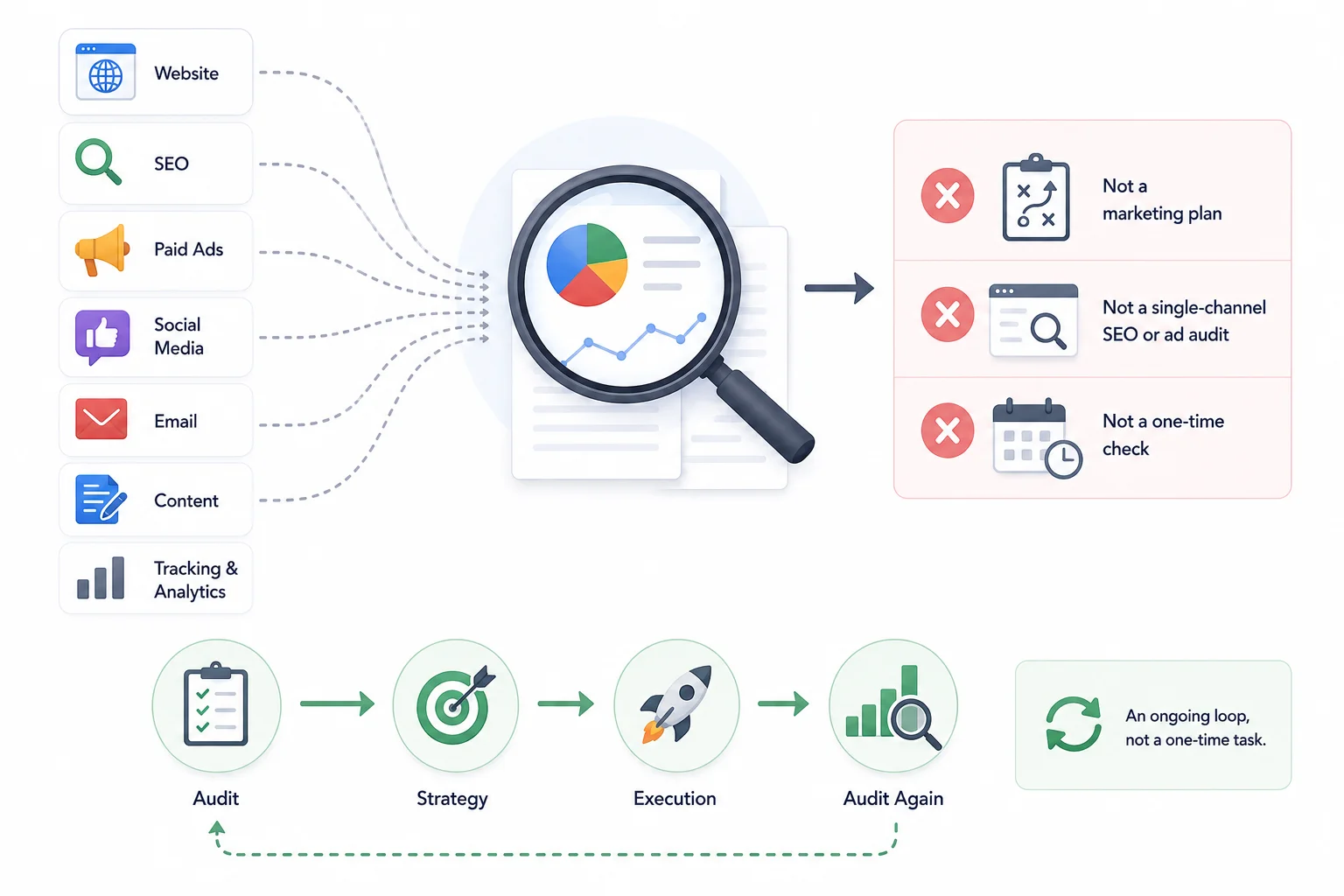
A digital marketing audit is a structured look at every digital channel a business uses, checked against the business goals, not against some generic industry checklist. Website, SEO, paid ads, social, email, content, tracking, all of it, pulled apart and looked at honestly.
The word doing the heavy lifting there is “honestly.” Most internal audits fail at this part. The person running the audit is often the same person who built the campaigns being audited, and nobody wants to write “this hasn’t worked in eight months” about their own work. That’s not a character flaw, it’s just human. It’s why a lot of businesses eventually bring in outside eyes, even if they do everything else in-house.
It also helps to be clear about what an audit is not. It’s not a marketing plan. A plan tells you what to do next. An audit tells you where you stand right now, which is a different question and has to come first, otherwise the plan is a guess dressed up as a strategy. It’s also not the same as a single-channel SEO audit or an ad account review. Those are pieces of it, sure, but a full digital marketing audit looks at how all the pieces work together, or don’t.
And it’s not a one-time thing. Think of it as a loop: audit, then strategy, then execution, then audit again to see if the strategy actually worked. Businesses that treat it as a box to check once and forget about are the same ones asking the panicked question in the leadership meeting eighteen months later.
Why Businesses Need to Audit Their Digital Marketing Regularly
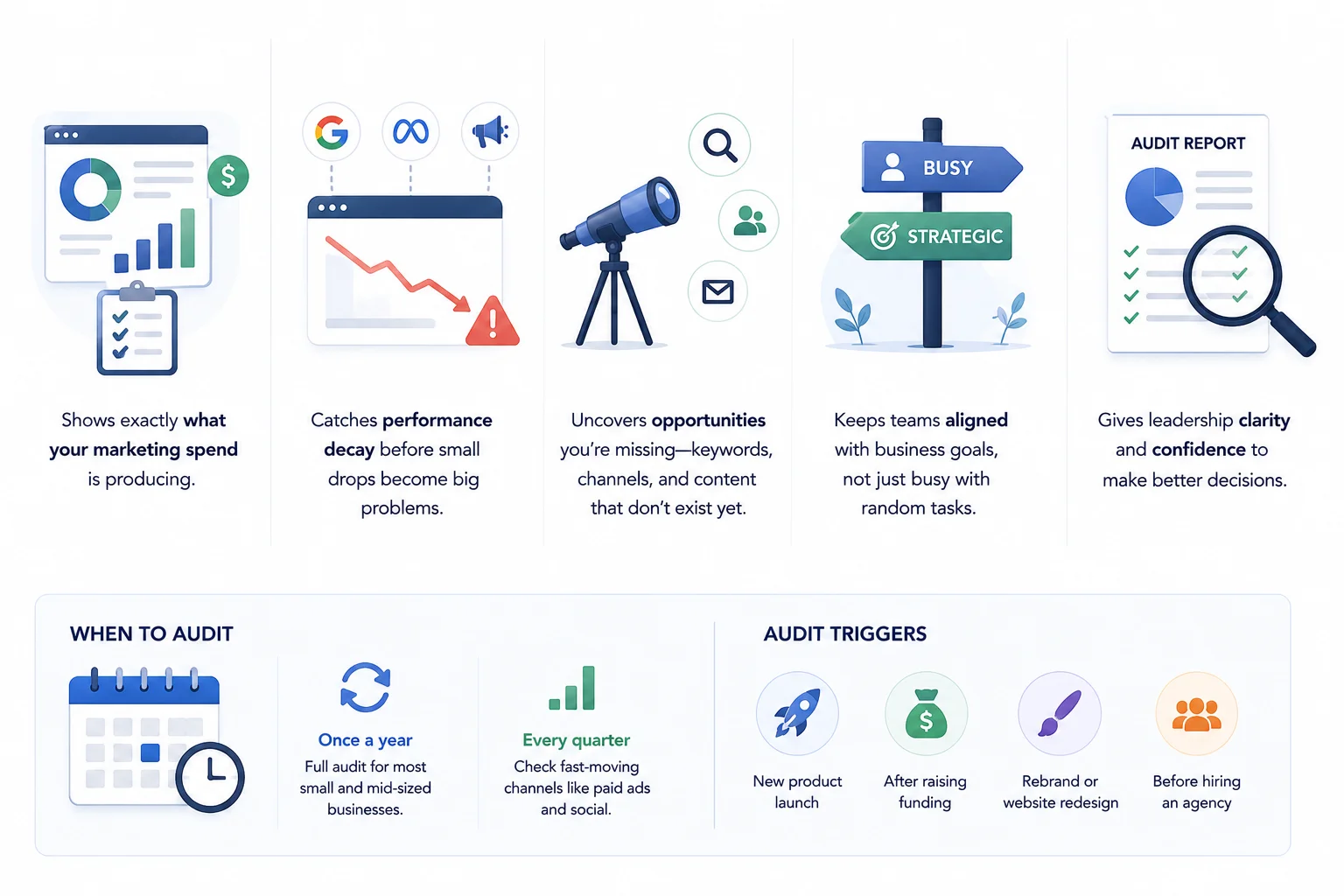
Nobody budgets money without wanting to know where it went. That’s really the root of why audits matter. When a founder or a board asks what the marketing spend is producing, “trust me, it’s working” doesn’t hold up. Numbers do. An audit is how you get the numbers.
There’s also the decay problem. Channels don’t stay still. Google changes how it ranks pages, Meta changes how ads get delivered, an algorithm update tanks organic reach overnight for reasons nobody outside the platform fully understands. A campaign that was performing fine six months ago can be quietly losing money right now and nobody would know unless someone went looking. Audits are how you catch that before it becomes a pattern instead of a blip.
Then there’s the stuff that isn’t underperforming, it’s just missing. Keywords competitors rank for that you don’t even have a page for. A social platform your audience is clearly on that you’ve never touched. An email flow that should exist and simply doesn’t. You can’t fix a gap you haven’t found, and gaps don’t announce themselves in a weekly performance report because there’s nothing in that report to look at.
And honestly, a lot of marketing teams are just busy without being strategic. Everyone’s shipping campaigns, everyone’s hitting deadlines, and none of it is tied back to what the business is actually trying to achieve this quarter. An audit forces that reckoning. It’s uncomfortable sometimes, but it’s the good kind of uncomfortable.
On timing: full audits once a year is a reasonable baseline for most small and mid-sized businesses. Faster-moving channels like paid ads and social deserve a check every quarter, because those platforms shift too fast to wait twelve months. And there are trigger moments that call for one regardless of schedule, like launching a new product, closing a funding round, going through a rebrand, or before you hire an agency and need to know what you’re actually paying them to fix.
Before You Start: Setting Objectives and Baseline KPIs
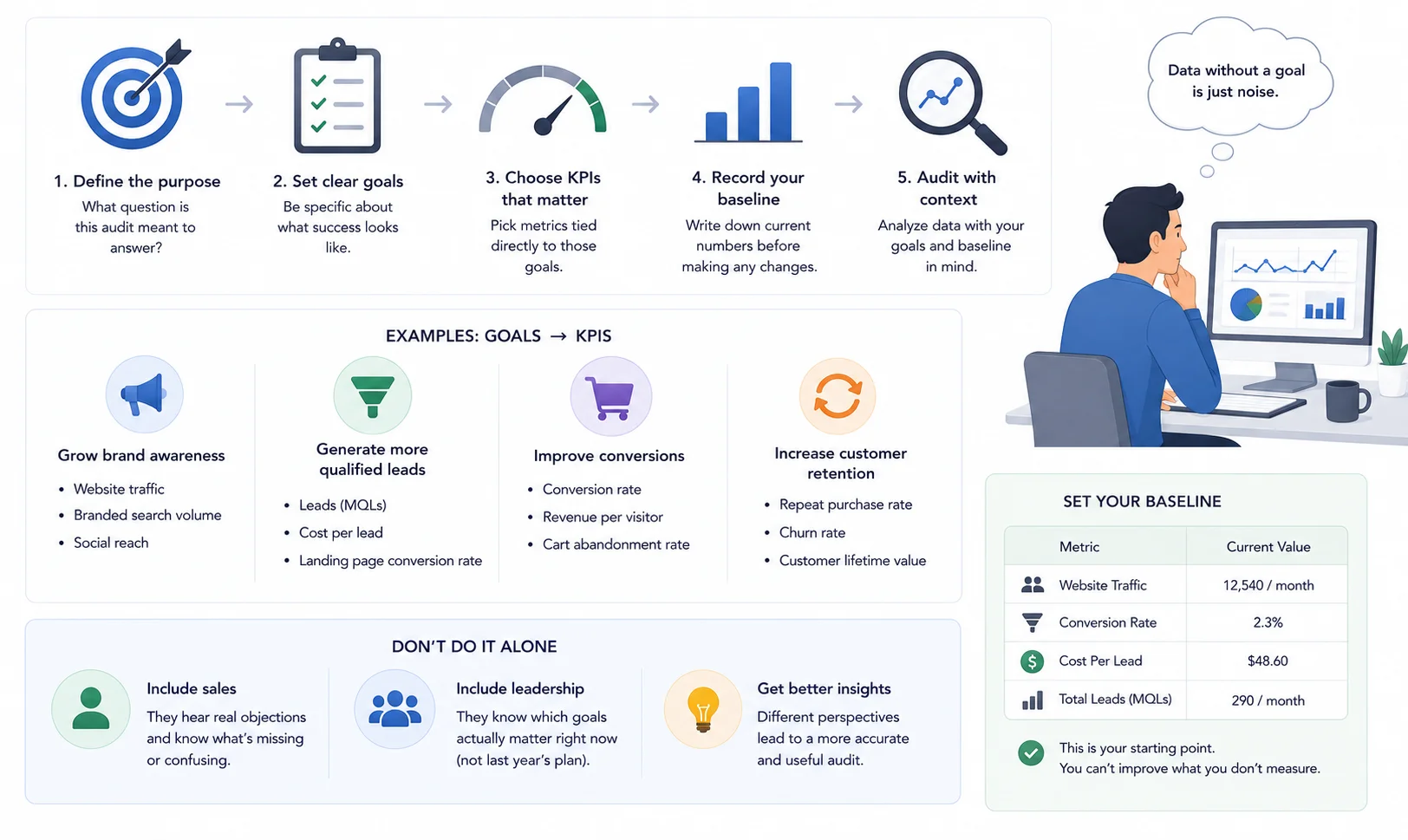
Here’s a mistake almost everyone makes the first time they try this. They open Google Analytics and just start looking at numbers. Traffic’s up, bounce rate’s fine, conversions are flat, okay, now what. Without a goal attached, none of that data means anything. It’s just numbers floating around with nothing to measure them against.
So before touching a single tool, get specific about what the audit is supposed to answer. Is the business trying to grow brand awareness? Get more qualified leads? Improve the conversion rate on existing traffic? Retain customers longer? These are different problems with different KPIs, and an audit built around the wrong ones will hand you a very tidy report that answers a question nobody asked.
This is also where a lot of audits go sideways in a subtler way, what’s sometimes called channel myopia. It’s easy to get pulled into judging each channel by its own internal metrics, like judging Instagram by Instagram’s engagement rate, without stepping back to ask whether that channel is actually moving the business goal. A channel can look great on its own scoreboard and still be irrelevant to what the company needs. Tie every KPI you pick back to a business objective, not a platform’s dashboard.
Once the goals and KPIs are set, write down where things stand right now. Current traffic, current conversion rate, current cost per lead, whatever applies. This baseline is what you’ll compare against after changes get made. Skip this step and six months from now you’ll have no real way to know if anything improved, you’ll just have a feeling, and feelings aren’t proof.
One more thing worth saying here. Don’t run this audit in a silo. Pull in someone from sales, because they hear directly from prospects about what’s confusing or missing on the website. Pull in leadership too, because they know which goals actually matter this year versus which ones are leftover from last year’s plan. A marketing-only audit misses half the picture every time.
Building Your Audit Toolkit
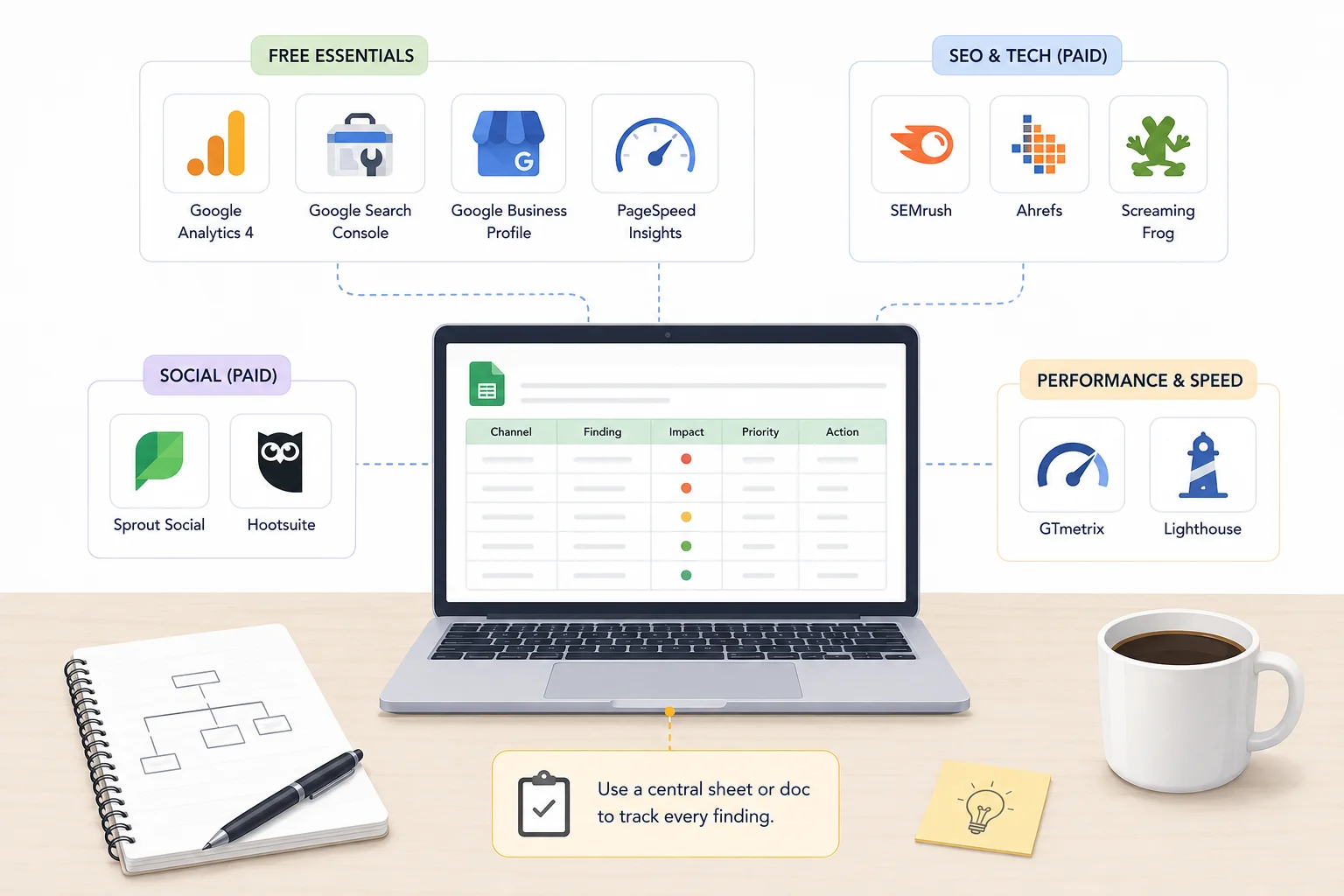
You don’t need an expensive stack to run a solid audit. Google Analytics 4 and Google Search Console cover a huge amount of ground for free, traffic, behavior, indexing issues, search performance, all in there. Google Business Profile is essential if the business has any local footprint. For site speed, PageSpeed Insights or GTmetrix will tell you plainly whether your site is fast enough or not.
Beyond that, paid tools like SEMrush or Ahrefs are worth it if you’re doing keyword and backlink research at any real depth, and Screaming Frog is genuinely useful for crawling a site and catching technical issues nobody would find by clicking around manually. For social, something like Sprout Social or Hootsuite makes pulling multi-platform data far less painful than checking six apps separately.
None of this is mandatory though. What actually matters more than the tool list is setting up a central place to log everything before you start, a single spreadsheet or doc where every finding lands in one place. Run the audit channel by channel without a central log and you’ll end up with scattered notes in six different tabs that never get compared against each other, which defeats half the point of doing this in the first place.
The Digital Marketing Audit Framework: Step-by-Step
This is the actual work. Each channel gets its own pass below, what to check, what tools to use, what red flags mean trouble, and where the quick wins usually hide. Go through these in order, or skip around based on where the business’s biggest question marks are, but don’t skip any of them entirely. The gaps you don’t check are exactly where the surprises live.
Website & Technical SEO Audit
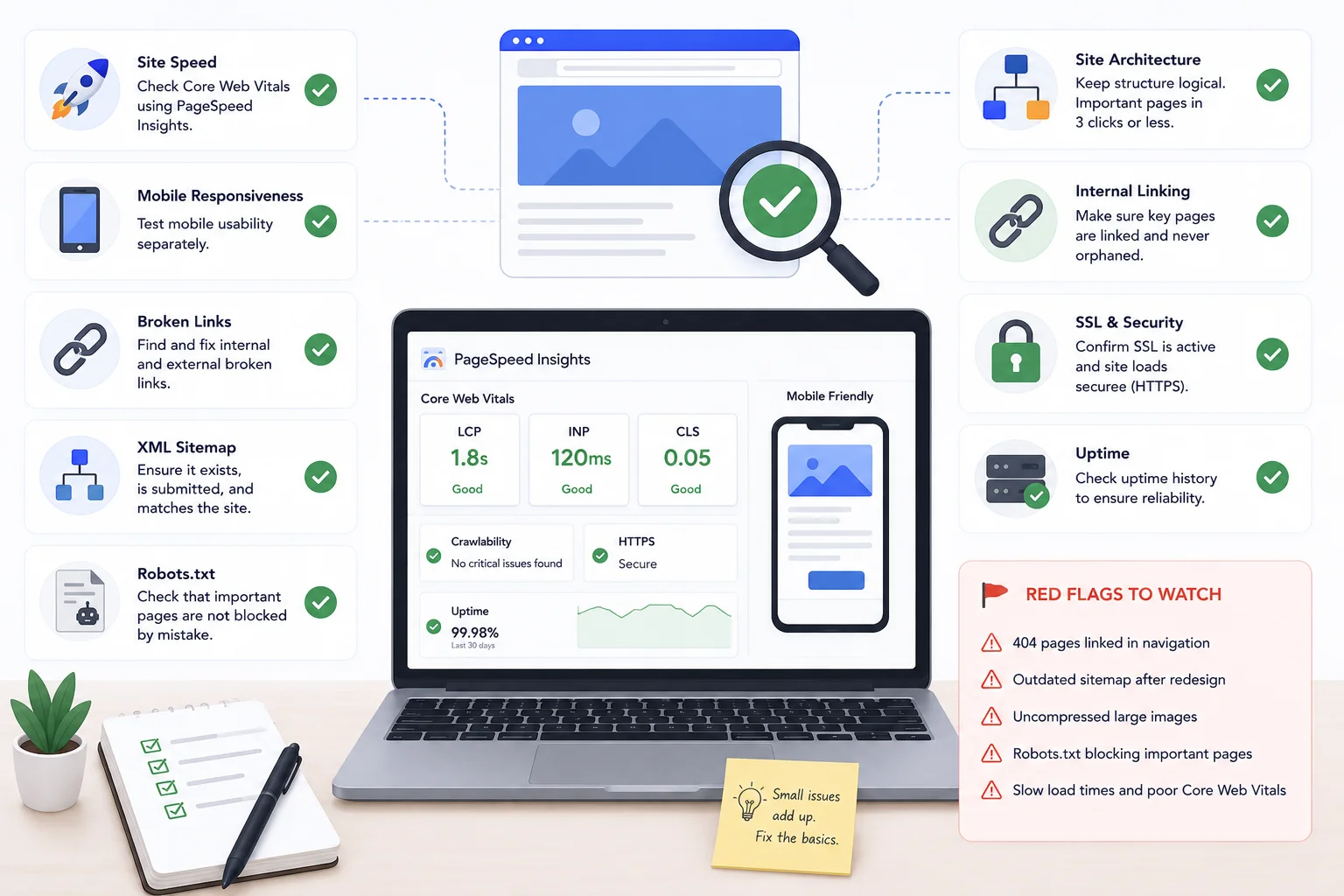
Start here because everything else in digital marketing eventually points back to the website. Ads, social, email, all of it drives traffic somewhere, and if that somewhere is broken, none of the upstream work matters.
Site speed is the first thing to check, and it’s not a nice-to-have. You already know this from your own browsing habits. A page that takes forever to load gets closed, no one waits around anymore. Run the homepage and a few key landing pages through PageSpeed Insights and look at Core Web Vitals specifically, not just an overall score, because those specific metrics are what actually affect ranking and user experience.
Mobile responsiveness needs its own check, separate from desktop. More traffic comes in on phones than most business owners assume, and a site that looks fine on a laptop can be a mess on mobile, buttons too small, text overflowing, forms that are painful to fill out with a thumb.
- Check for broken links, both internal and external, using Screaming Frog or Search Console’s coverage report
- Confirm the XML sitemap exists, is submitted to Search Console, and actually matches the live site structure
- Check robots.txt isn’t accidentally blocking pages that should be indexed
- Review site architecture, is the structure logical, can a visitor get from the homepage to any important page in three clicks or less
- Look at internal linking, are important pages actually linked to from elsewhere on the site, or sitting orphaned
- Confirm SSL is active and the site loads as secure, and check uptime history if that data’s available
Red flags here are usually easy to spot once you’re looking. Pages returning 404s that still show up in navigation. A sitemap that hasn’t been updated since a redesign two years ago. Images that are five megabytes each because nobody compressed them before uploading. These aren’t dramatic problems individually, but they add up to a site that search engines and visitors both struggle to trust.
On-Page & Content SEO Audit
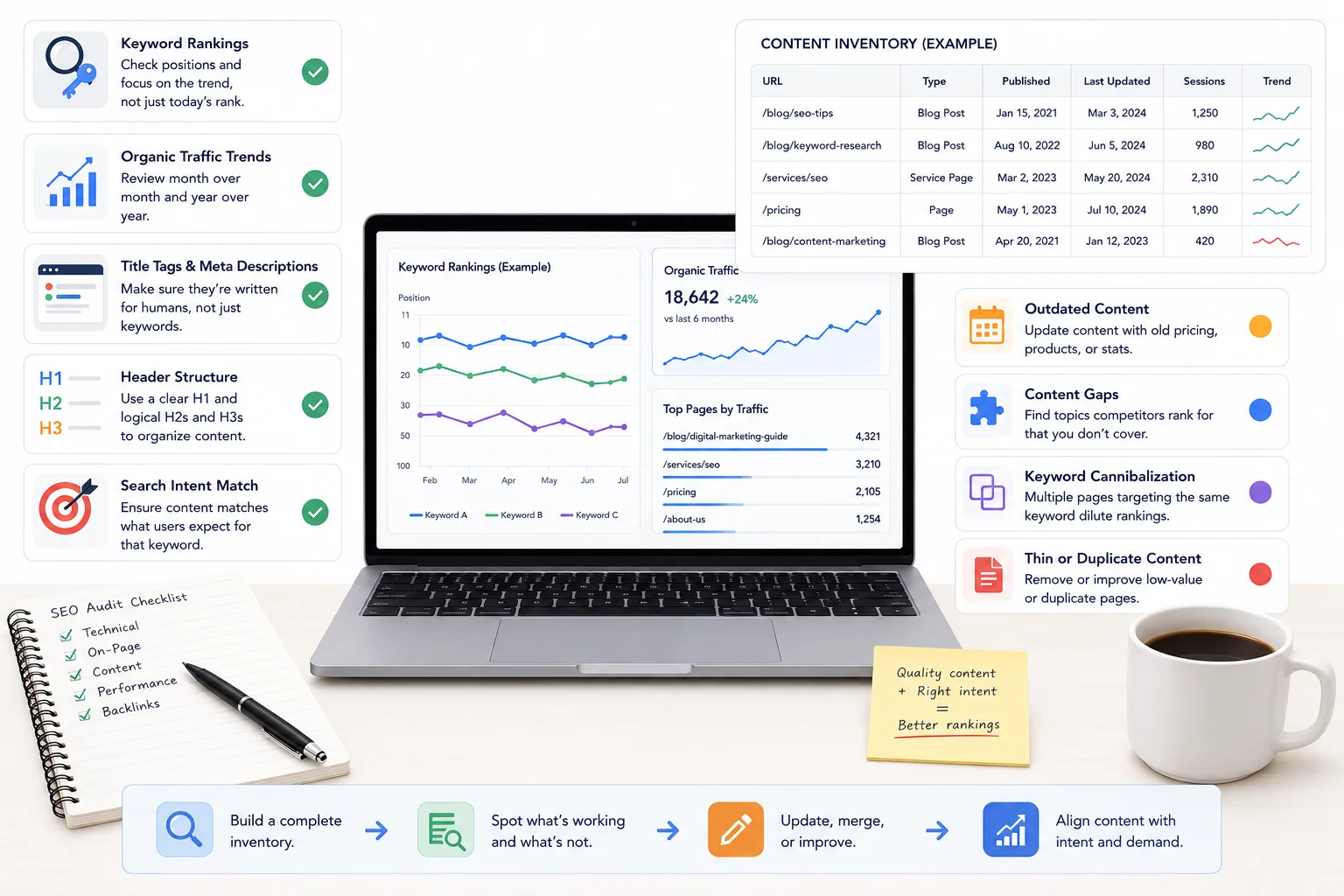
Once the technical foundation checks out, move to what’s actually on the pages. Pull keyword rankings from Search Console or a tool like SEMrush and look at the trend line, not just where things sit today. A keyword that’s slowly sliding down the rankings over six months is a different problem than one that’s been stable in position eight the whole time.
Look at organic traffic trends too, month over month and year over year if the data goes back that far. Flat traffic on a growing site is a warning sign even if nothing looks “wrong” in isolation, because it usually means content isn’t keeping pace with what people are actually searching for.
- Review title tags and meta descriptions across key pages, are they written for humans or just stuffed with keywords
- Check header structure, is there a clear H1, are H2s and H3s used to organize content logically or just scattered around
- Assess whether existing content actually matches search intent, a page targeting “pricing” that never mentions price is a mismatch no amount of optimization fixes
- Run a full content inventory, list every blog post and page, when it was published, when it was last updated, and how it’s performing
- Flag outdated content that references old pricing, old products, or stats that have aged out
- Check for content gaps, topics competitors rank for that you have no page addressing at all
- Look for keyword cannibalization, multiple pages competing for the same search term and splitting the ranking potential between them
- Check for thin or duplicate content, pages with barely any substance or content copied across multiple URLs
The content inventory step is the one people skip because it’s tedious, and it’s also the one that surfaces the most useful findings. You’ll almost always find posts from years ago still ranking and driving traffic that nobody has looked at since publishing, sitting right next to newer content that’s technically better written but getting no traffic at all because it’s targeting the wrong intent.
Off-Page SEO & Backlink Audit
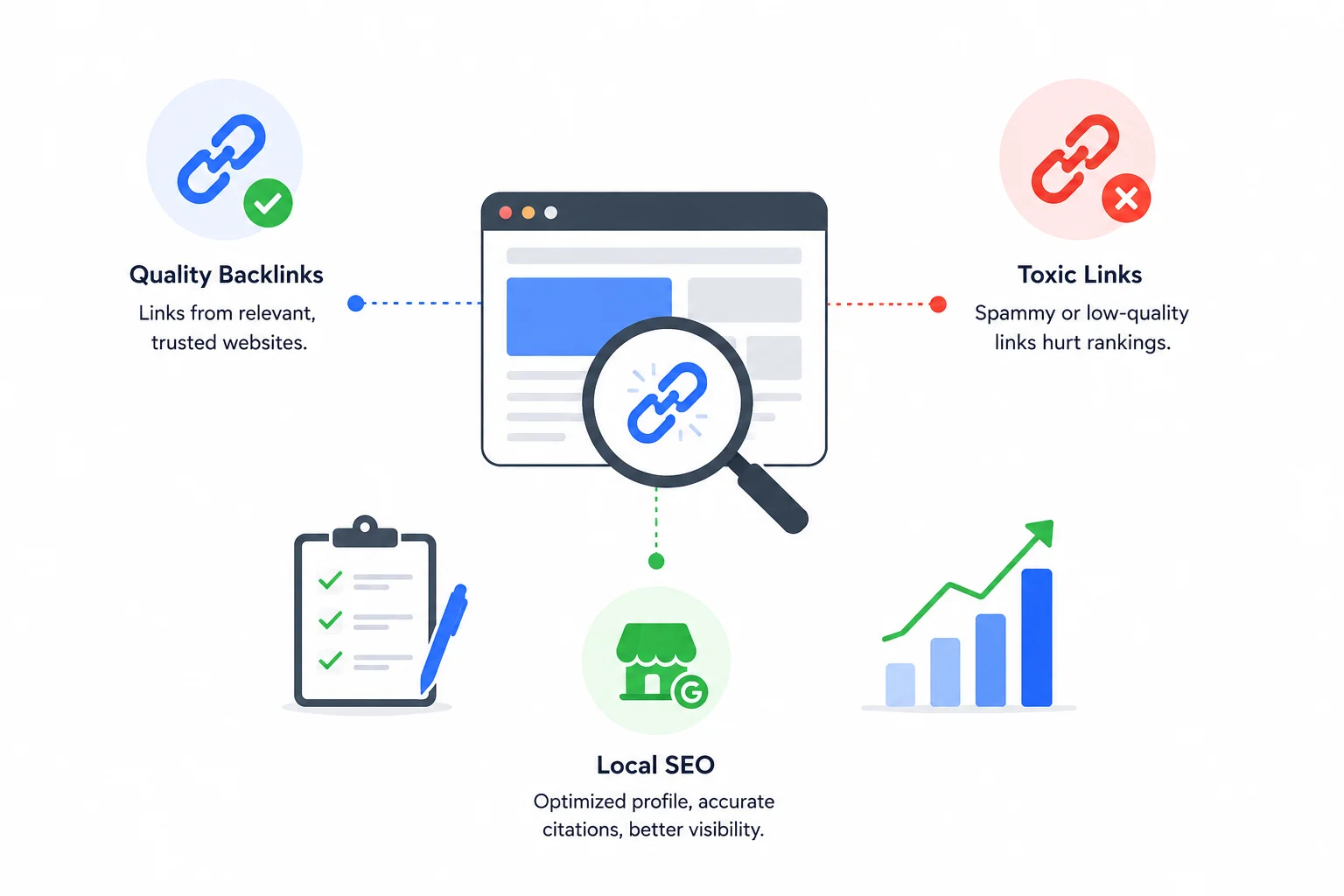
This is the part of an audit that gets rushed the most, mostly because backlink data feels less actionable than on-page fixes. But a weak or toxic backlink profile can quietly hold a site back no matter how good the content is.
Pull the backlink profile through Ahrefs, SEMrux, or Search Console’s own links report and look at quality before quantity. A hundred links from spammy, unrelated directories are worth less than five links from sites actually relevant to the industry. If there’s a cluster of obviously low-quality or spammy links, especially ones that look like they came from an old link-buying scheme, that’s worth flagging for cleanup through a disavow if it’s severe enough.
For businesses with a physical location or service area, this is also where local SEO gets checked. Google Business Profile optimization matters here, is the listing claimed, is the category correct, are photos and hours current. Citation consistency matters too, meaning the business name, address, and phone number need to match exactly across every directory it’s listed on. Inconsistent NAP data across the web is a small thing that adds up to confused local rankings.
Paid Media Audit (PPC & Paid Social)
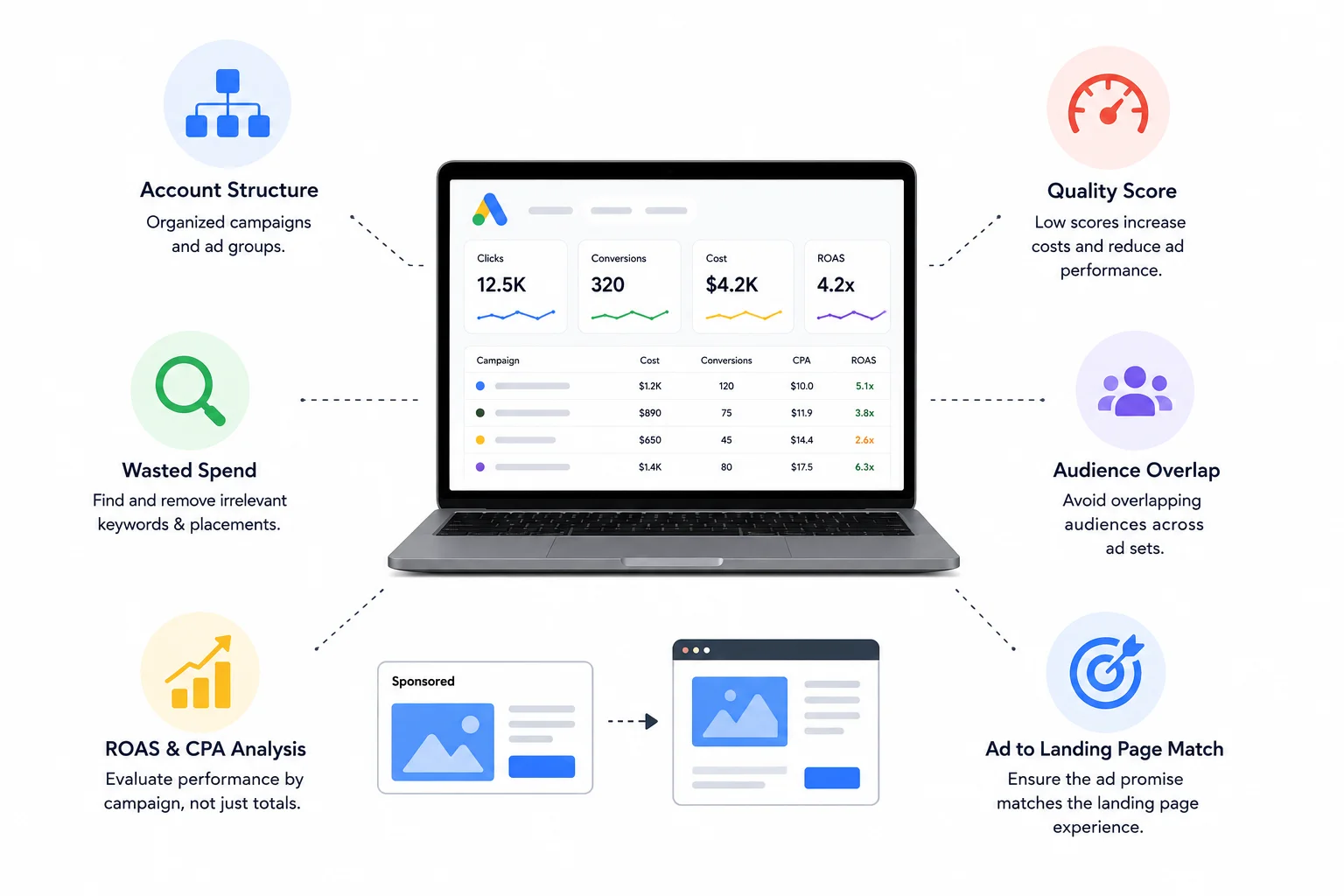
Paid media audits tend to reveal the most obvious waste, because unlike organic channels, every dollar is trackable in real time. Start with campaign structure and account hygiene. Is the account organized logically by campaign and ad group, or is everything dumped into one broad campaign that makes it impossible to tell what’s actually working.
- Check for wasted spend, irrelevant keywords still triggering ads, broad match terms pulling in traffic nowhere near the target audience
- Review Quality Scores on Google Ads, low scores usually mean ad relevance or landing page experience is off, and it’s also quietly inflating cost per click
- Look for audience overlap in paid social campaigns, where multiple ad sets are competing against each other for the same people and driving up costs artificially
- Break down ROAS and CPA by individual campaign, not just the account total, because a strong overall number can be hiding one campaign that’s bleeding money while another carries it
- Check ad creative against the landing page it sends traffic to, if the ad promises one thing and the landing page delivers something else, that mismatch is killing conversion rate no matter how good the targeting is
That last point is worth sitting with. A lot of paid media problems don’t actually live inside the ad platform at all. The ad’s doing its job getting the click, and then the landing page loses the person the ad just paid to bring in. If conversion rates are weak, don’t just tweak the campaign settings, go look at what’s actually happening after the click.
Social Media Audit
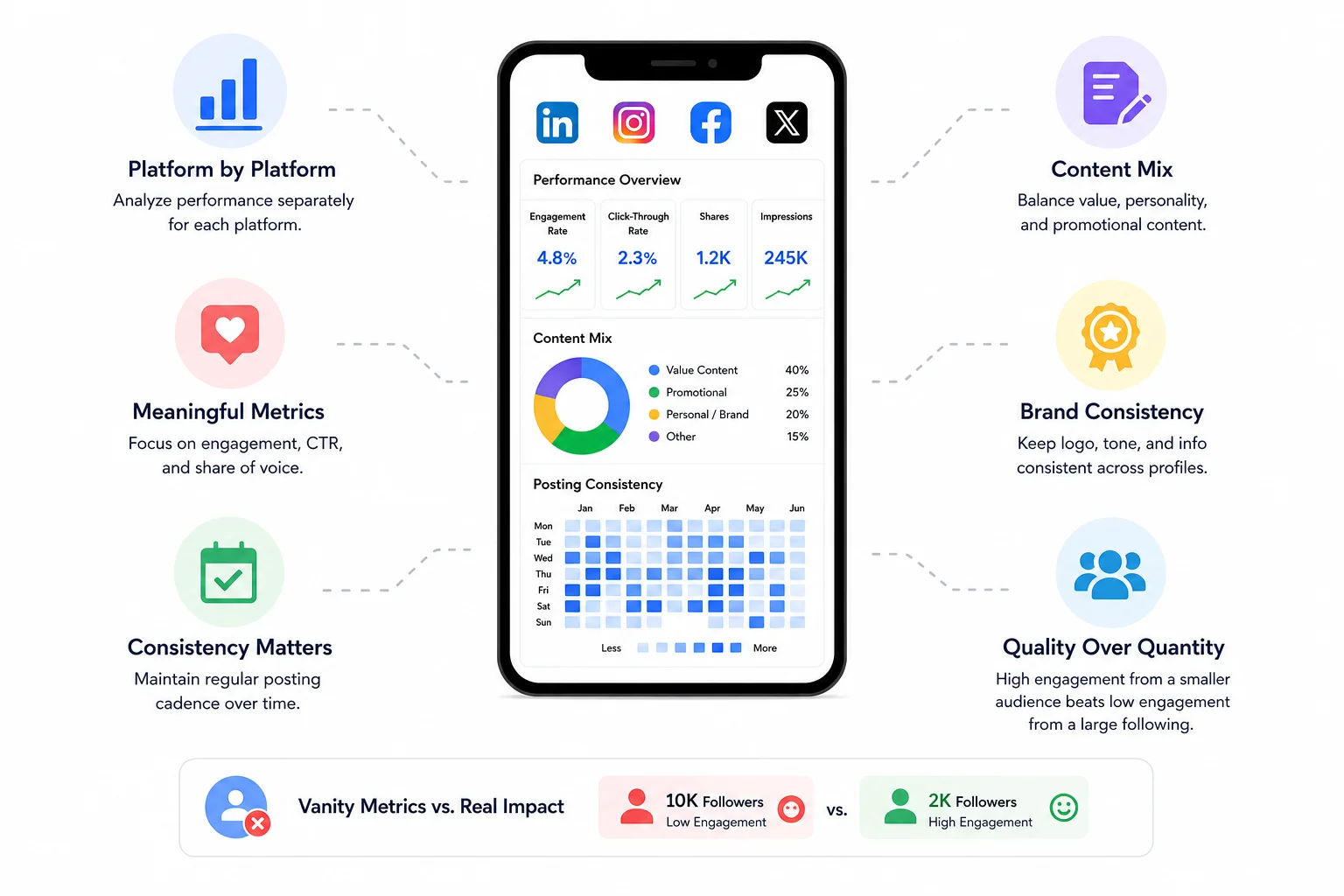
Every platform has to be judged on its own terms here, because they don’t do the same job. LinkedIn and Instagram serve completely different purposes for most businesses, and grading them against each other is a waste of time.
- Pull performance data platform by platform, don’t average everything into one social score
- Separate vanity metrics from meaningful ones, follower count and likes don’t tell you much on their own, but engagement rate, click-through rate, and share of voice actually connect to whether the content is working
- Review content mix, is it all promotional, or is there a real balance of value, personality, and product
- Check posting cadence and consistency over the last six to twelve months, gaps of weeks or months at a time hurt more than people assume
- Look at brand consistency across profiles, same logo, same tone, same bio information, or does each platform look like it belongs to a different company
Follower count especially deserves some pushback as a metric. A page with ten thousand followers and barely any engagement isn’t performing better than a page with two thousand followers and an audience that actually comments and shares. Anyone still reporting follower growth as the headline metric in 2026 is measuring the wrong thing.
Email Marketing Audit
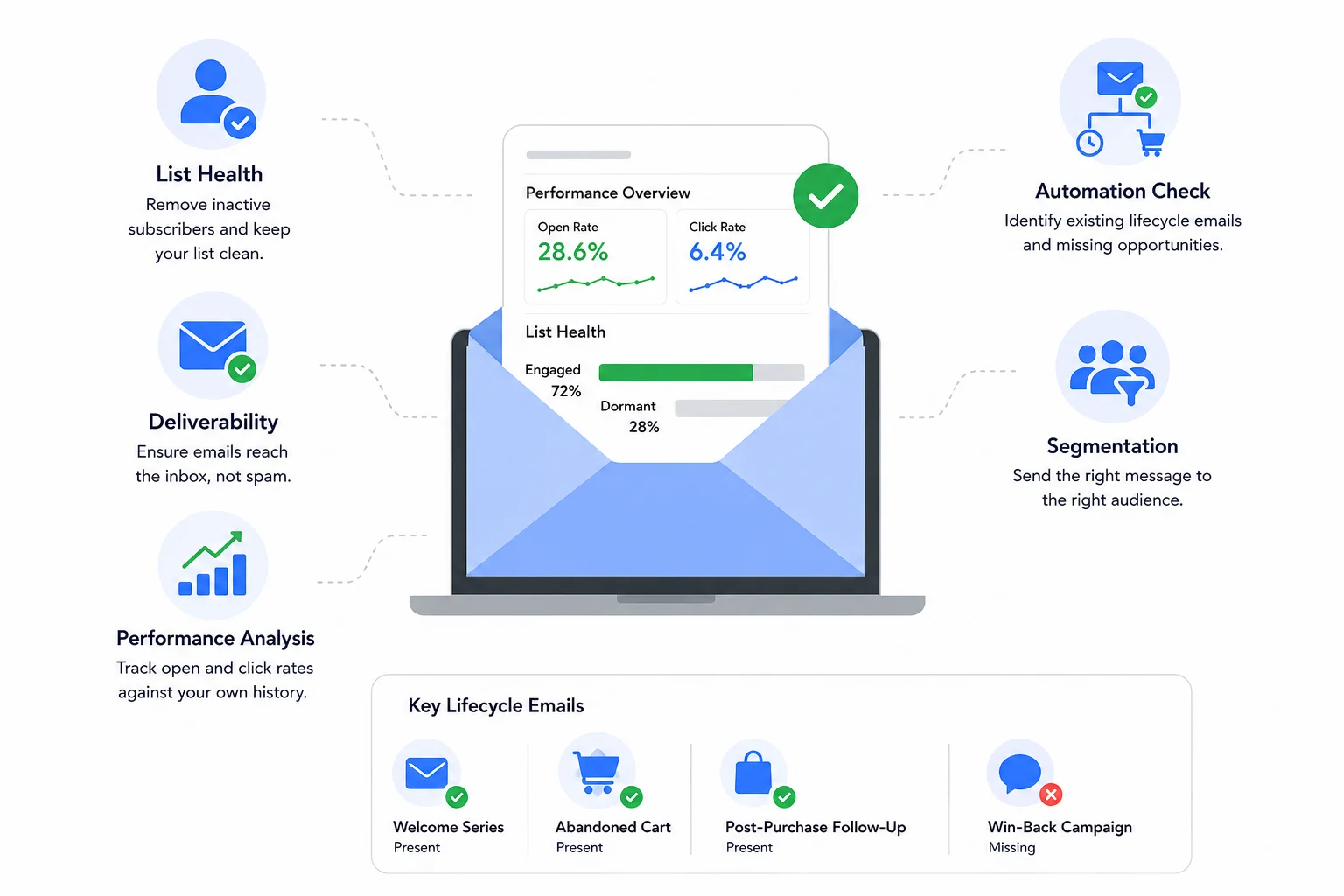
Email gets treated like an afterthought in a lot of audits, which is a mistake, because it’s usually one of the highest ROI channels a business has and it’s also one of the easiest to let quietly rot.
- Check list health, how many subscribers are actually engaged versus sitting dormant, and whether the list has been cleaned recently
- Look at deliverability, are emails landing in the inbox or getting buried in spam or promotions folders
- Compare open and click rates against the business’s own historical performance, that’s a more honest benchmark than a generic industry number
- Confirm which automated lifecycle emails exist, welcome sequences, abandoned cart, post-purchase follow-up, and which ones are just missing entirely
- Review segmentation, is every subscriber getting the same blast regardless of where they are in the customer journey, or is the list actually split by behavior and interest
A dormant, unengaged chunk of a list dragging down open rates for everyone is one of the more common findings here, and it’s an easy fix once it’s spotted. The bigger finding, more often than not, is a missing automation. A business with no abandoned cart email or no welcome sequence is leaving money on the table in a way that’s completely fixable in a week, not a quarter.
Conversion & UX Audit
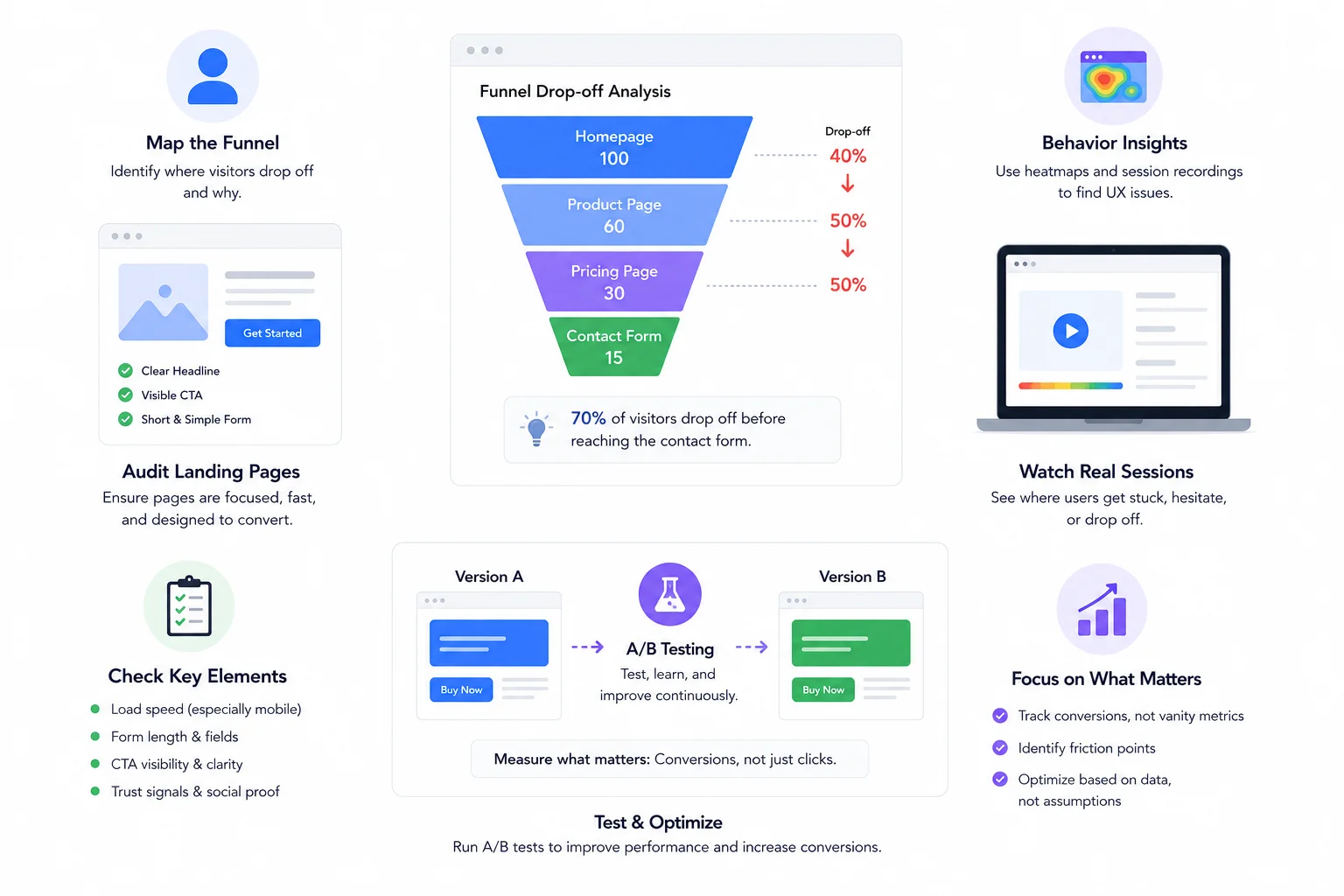
This section connects almost everything else. Traffic and clicks don’t matter if people land on the site and leave without doing anything.
- Map the funnel and look for where drop-off is highest, is it the homepage, the pricing page, the checkout, the contact form
- Audit landing pages specifically, are forms too long, are CTAs clear and visible without scrolling, does the page load fast on mobile
- If heatmaps or session recordings exist through a tool like Hotjar, watch a handful of real sessions, nothing surfaces UX problems faster than watching an actual person get stuck
- Check whether any A/B testing has happened recently, and if the answer is no, that itself is a finding worth flagging
Funnel drop-off analysis in particular tends to be the single most useful thing in this whole section. Knowing that 70 out of 100 visitors leave before ever reaching the contact form tells you exactly where to focus, instead of guessing which part of the site “feels off.”
Analytics & Tracking Audit
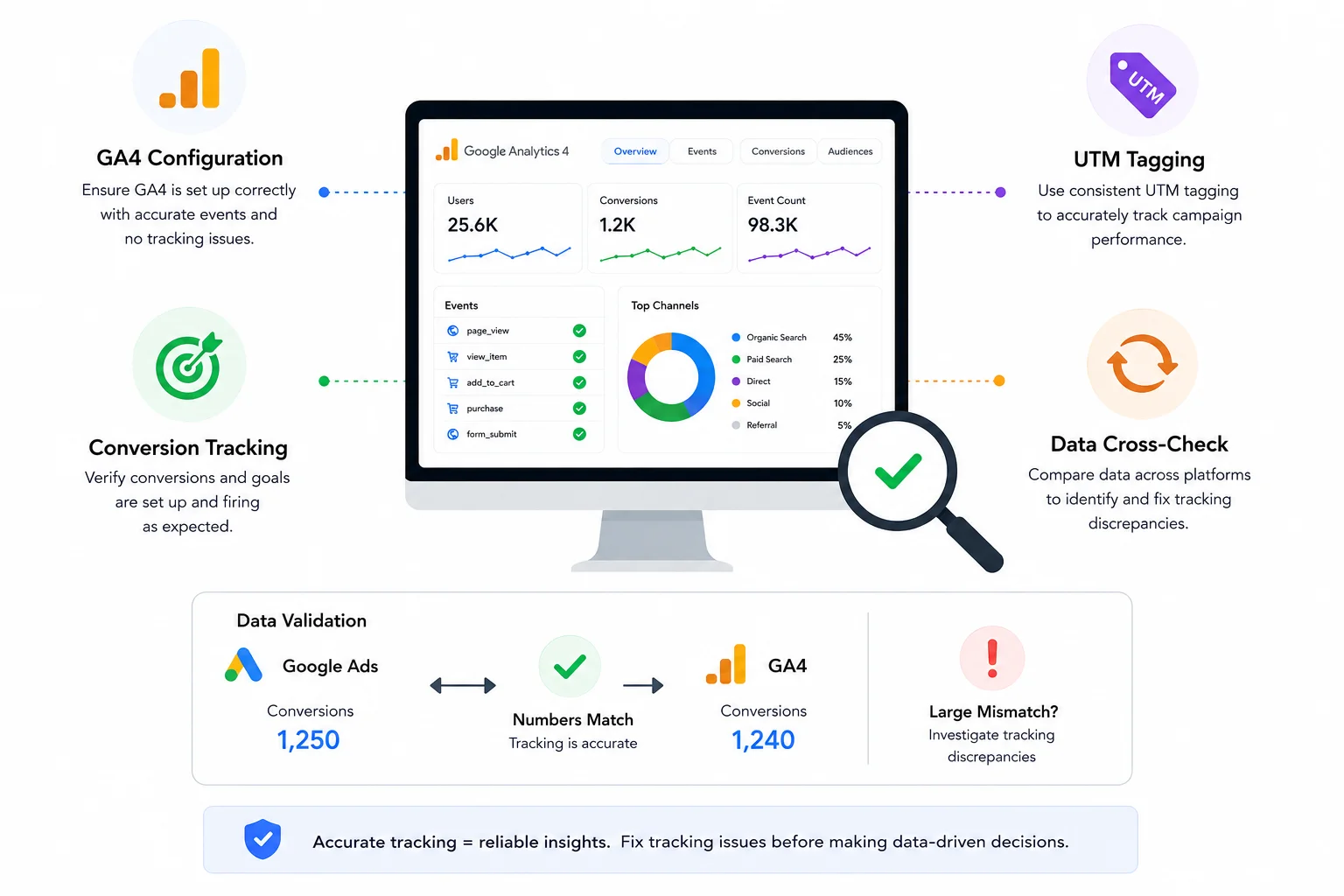
Here’s the section most audits skip entirely, and it’s honestly the one that should come first in terms of importance, because everything above is only as trustworthy as the tracking underneath it.
- Confirm GA4 is configured correctly, events firing properly, no duplicate tracking, no gaps in historical data
- Check that conversion tracking and goals are actually set up and firing, not just installed and forgotten
- Review UTM tagging discipline across campaigns, inconsistent or missing UTMs make it impossible to tell which channel actually drove a conversion
- Cross-check numbers between platforms, does Google Ads reported conversions roughly match what GA4 shows, big mismatches usually point to a tracking problem, not a performance problem
It’s genuinely common to run this check and discover that half the “insights” from earlier in the audit were built on shaky data. If tracking is broken, fix that before drawing any conclusions from the rest of the audit, because otherwise you’re optimizing based on numbers that were never accurate to begin with.
AI Search & Generative Engine Visibility (GEO)
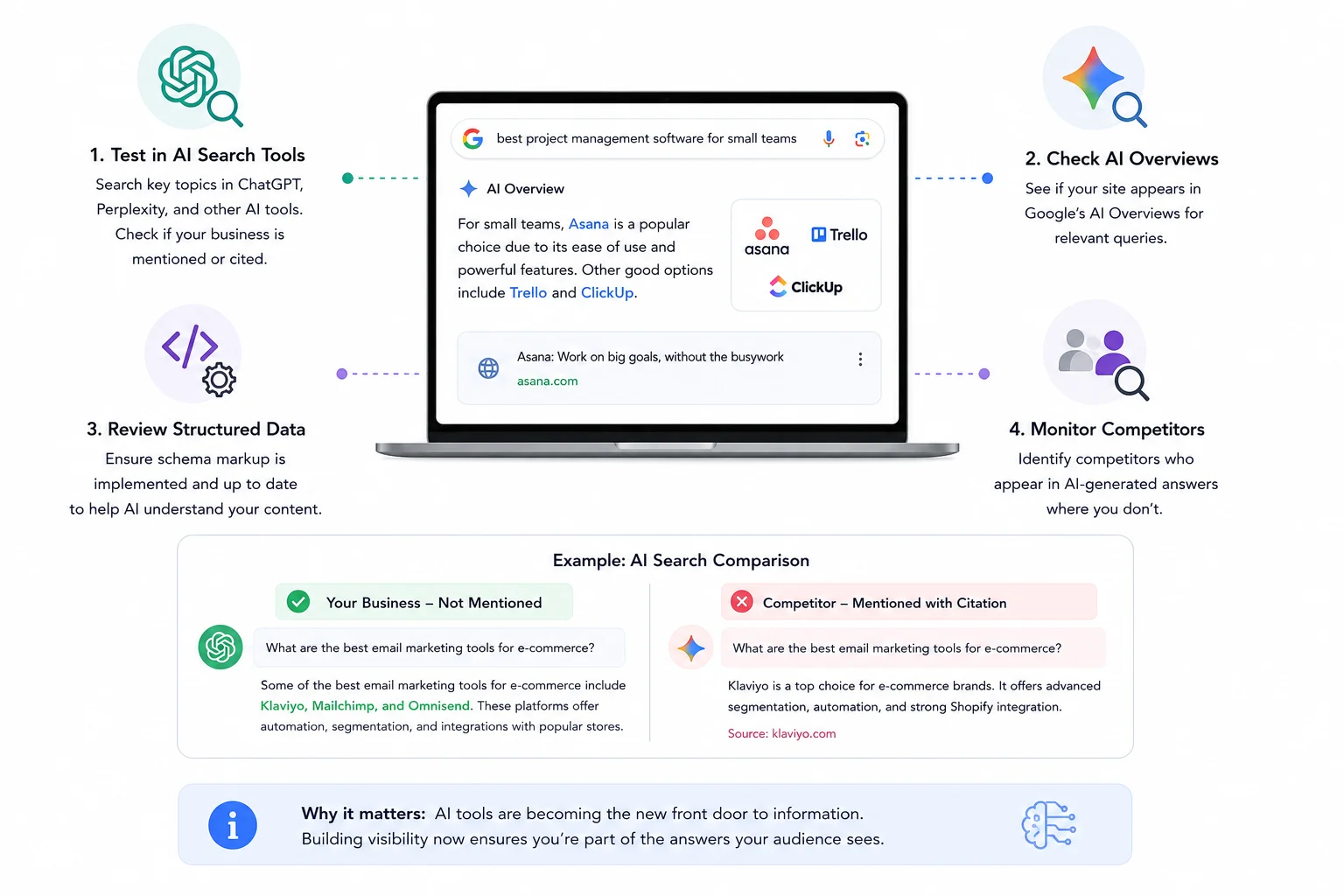
This is newer territory and most audit guides still don’t cover it, but it’s becoming impossible to ignore. People are increasingly getting answers directly from AI Overviews, ChatGPT, and Perplexity instead of clicking through to a website at all. That changes what “visibility” even means.
- Search a handful of the business’s core topics and questions directly in ChatGPT or Perplexity and see whether the business gets mentioned, cited, or ignored entirely
- Check whether the site shows up in Google’s AI Overviews for relevant queries
- Review structured data and schema markup, this is one of the clearer levers for improving how AI systems understand and represent a page
- Note which competitors are showing up in AI-generated answers where your business isn’t
Nobody has this fully figured out yet, and any audit guide claiming otherwise is overselling it. But treating this as an emerging channel worth tracking now, rather than waiting until it’s obviously mainstream, puts a business ahead instead of playing catch-up later.
Online Reputation & Reviews Audit
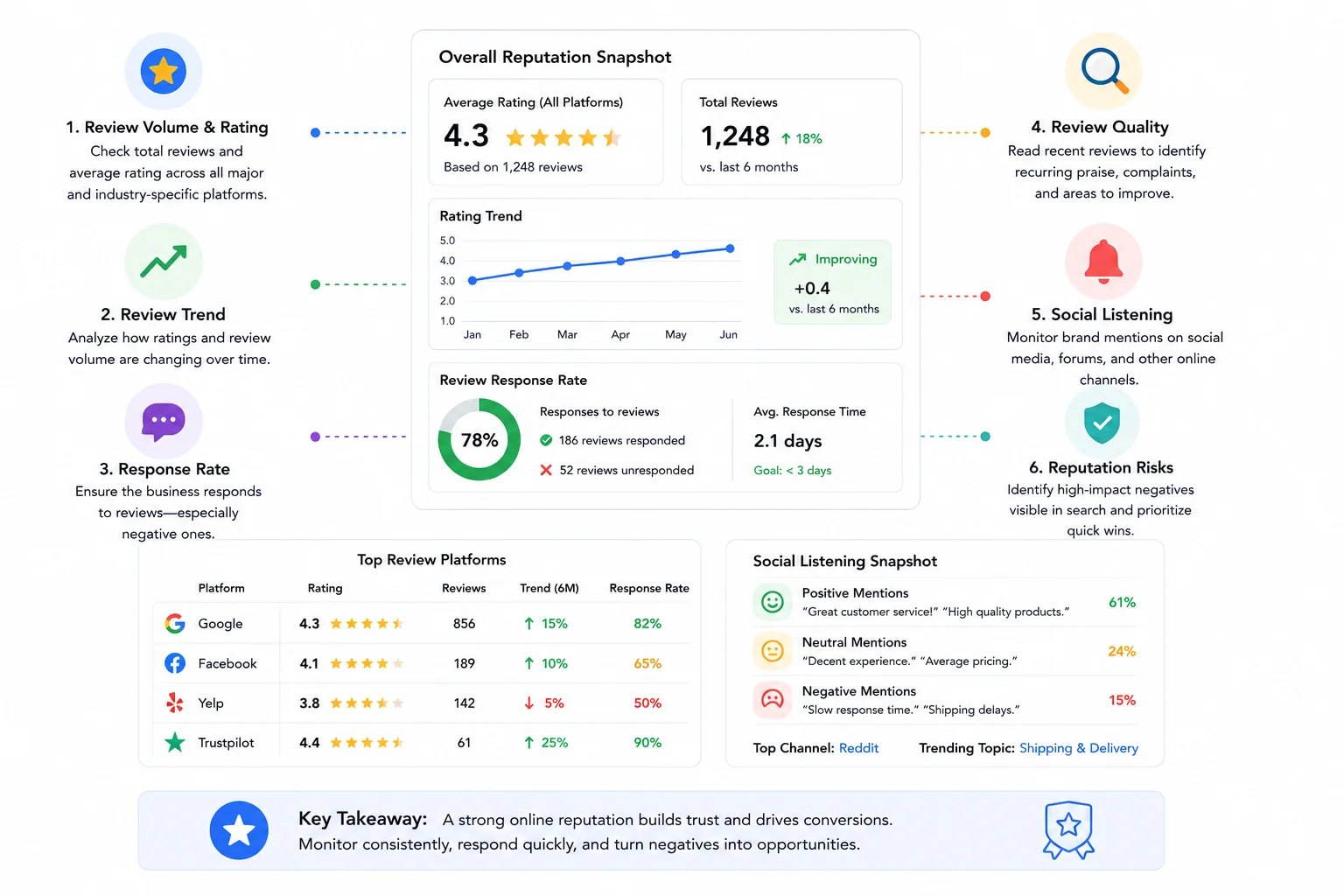
Reviews and reputation don’t always get filed under “marketing,” but they absolutely function as one. A prospect who’s ready to buy will often check reviews as the last step before converting, and a weak review presence can undo everything the rest of the funnel did right.
- Check review volume and average rating across Google and any industry-specific platforms relevant to the business
- Look at the trend over time, is the rating improving, declining, or stagnant
- Review response rate, is the business actually responding to reviews, especially negative ones, or letting them sit unanswered
- Do a quick social listening pass for brand mentions outside of formal reviews, forums, comment sections, anywhere the brand comes up unprompted
An unanswered negative review sitting at the top of search results for over a year is more damaging than most businesses realize, and it’s also one of the cheapest things on this entire list to fix.
Competitive Benchmarking
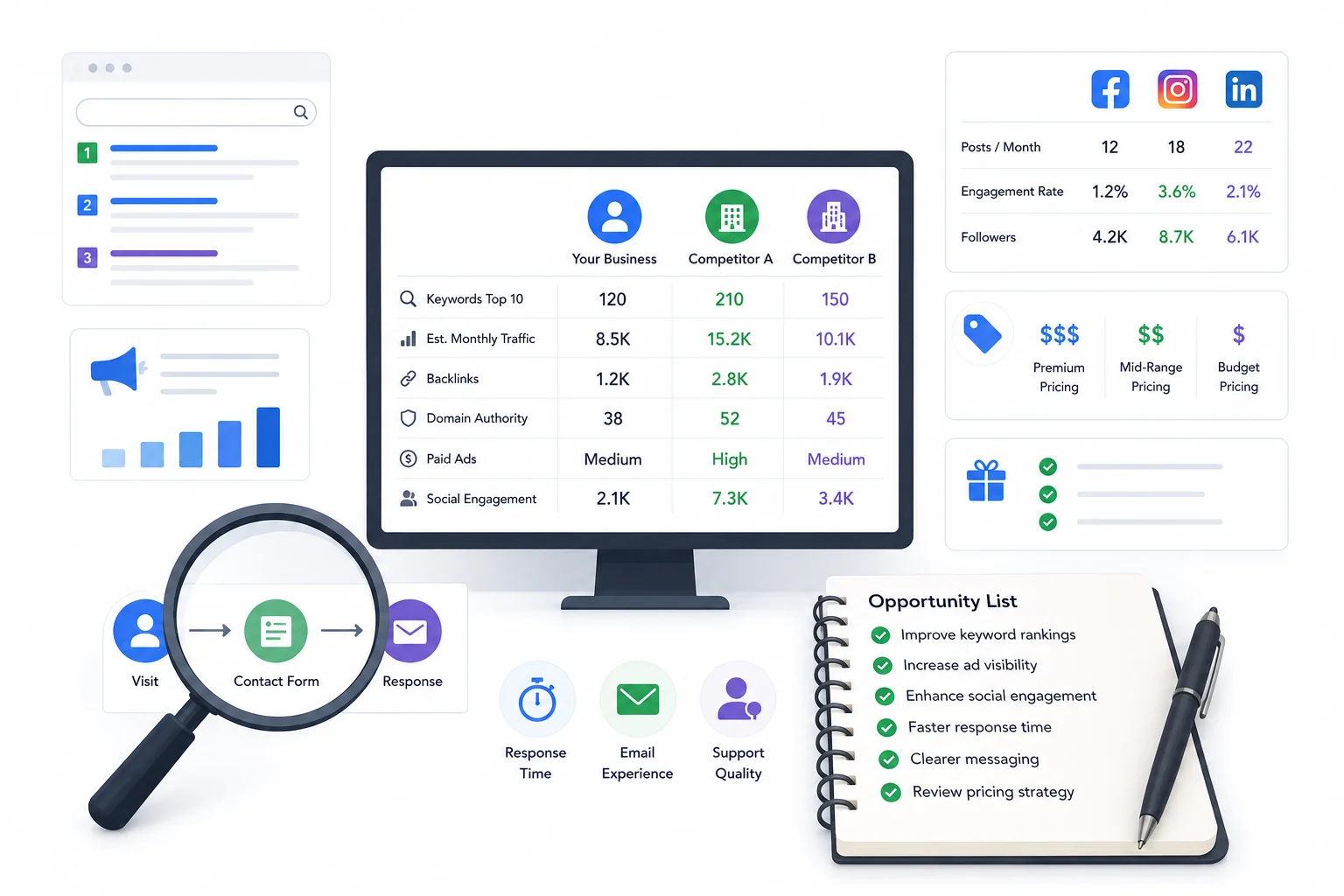
An audit that only looks inward is missing half the story. Numbers don’t mean much in isolation. A 3% conversion rate sounds fine until you find out the two closest competitors are converting at 5%, and suddenly it’s not fine at all.
Competitive benchmarking doesn’t require anything sneaky or expensive, most of what you need is publicly available. Compare keyword positioning to see who’s actually outranking who on shared terms. Look at visible signals of ad spend, are competitors clearly running aggressive paid campaigns or barely advertising at all. Check social presence side by side, who’s posting more consistently, who’s actually getting engagement versus just posting into the void.
Messaging is worth a close look too. Read through a competitor’s homepage and service pages and ask honestly whether they’re saying something you’re not, or offering something you already do but never bothered to mention. Pricing comparisons matter as well, who’s charging more, who’s bundling services, who’s running constant promotions versus holding a firm price.
The most underrated piece of competitive benchmarking is walking through a competitor’s actual customer journey yourself. Fill out their contact form. See how long it takes to hear back. Sign up for their email list and see what they send. This kind of hands-on comparison surfaces friction points and opportunities that no spreadsheet of metrics will show you.
Every gap found here should turn into a line item on the opportunity list, not just an interesting observation. A competitor comparison that doesn’t lead anywhere actionable was a waste of the time it took to run.
Turning Audit Findings Into a Prioritized Action Plan
This is where most audits actually fall apart, and it’s rarely the audit itself that’s the problem. Plenty of businesses do the hard work of gathering findings and then produce a forty-page document that sits in a shared drive untouched. Findings without prioritization are just a list of problems, and a list of problems isn’t a plan.
The fix is a simple impact versus effort framework. For every finding from the audit, ask two questions. How much would fixing this actually move the needle on the business goal, and how much time or budget would it take to fix. Something with high impact and low effort, like fixing a broken conversion tracking event or adding a missing abandoned cart email, goes to the top of the list without much debate. Something with low impact and high effort gets parked, maybe permanently.
From there, build the roadmap in three horizons. Quick wins that can happen in the next thirty days, the fixes that are cheap and fast and build momentum early. Mid-term fixes over the next one to three months, things like a content overhaul or a paid campaign restructure that take real work but aren’t massive undertakings. And longer-term strategic shifts for the quarter and beyond, things like a full website redesign or entering a new channel, that need proper planning and buy-in before they start.
When it comes time to present this to stakeholders, skip the jargon entirely. Nobody in a leadership meeting needs to hear about Core Web Vitals or Quality Scores. They need to hear “the website is losing roughly a third of visitors on the pricing page, and fixing that alone should move the conversion rate meaningfully.” Tie every recommendation straight back to the objectives set before the audit started, because that’s the thread that makes the whole thing make sense to someone who wasn’t in the weeds with you.
This is also the natural handoff point into a full strategy. The audit tells you where things stand and what’s broken. The strategy takes that list and turns it into a coordinated plan for where the business goes next. They’re two different documents doing two different jobs, and trying to combine them usually waters down both.
Digital Marketing Audit Checklist (Recap)
A condensed version to pull up quickly once the full audit is underway.
- Website: check speed, mobile responsiveness, broken links, sitemap, and internal linking
- On-page SEO: review rankings, titles, meta descriptions, content inventory, and search intent match
- Off-page SEO: check backlink quality, local citations, and Google Business Profile
- Paid media: review account structure, wasted spend, Quality Scores, and ad-to-landing-page alignment
- Social media: assess platform-by-platform performance, engagement over vanity metrics, and posting consistency
- Email marketing: check list health, deliverability, automations, and segmentation
- Conversion and UX: map funnel drop-off and audit key landing pages
- Analytics and tracking: confirm GA4 and conversion tracking are set up correctly before trusting any other numbers
- AI search visibility: check how the business shows up in AI Overviews and AI chat tools
- Reputation: review volume, rating trend, and response rate across review platforms
- Competitive benchmarking: compare keywords, ad presence, social activity, messaging, and pricing against direct competitors
- Prioritization: sort every finding by impact versus effort before building the action plan
When to Do It Yourself vs Bring in an Agency
There’s no universal right answer here, it depends on scope and how much objectivity the business actually needs. A single-channel review, like checking whether the Google Ads account is wasting spend, is well within reach for most internal teams with a bit of guidance. Smaller businesses with limited budgets often start here, and that’s a completely reasonable place to start.
Where it gets harder is a full, multi-channel audit that needs to be genuinely unbiased. That’s a lot to ask of a team auditing its own work, both in terms of time and in terms of honesty about what isn’t working. An outside perspective doesn’t have anything riding on protecting a campaign’s reputation, which tends to produce a more useful, more uncomfortable, more accurate report.
There’s also a bandwidth question that gets overlooked. Even a motivated internal team is usually juggling this alongside the actual day-to-day marketing work, which means the audit stretches out over months instead of getting done properly in a couple of focused weeks. If a business is at a point where it genuinely needs clarity fast, whether that’s before a big budget decision or after bringing on new leadership, an outside audit tends to get there faster and with fewer blind spots. That’s the situation where working with an outside team, like the audit and Fractional CMO work done here at Tattvam Media, tends to make more sense than trying to force it through internally.
Conclusion
A digital marketing audit isn’t glamorous work. It’s spreadsheets, login credentials, and a lot of cross-checking numbers that don’t always agree with each other at first. But it’s also the difference between a business that’s guessing and one that actually knows where its money is going and what to do about it.
Run through this framework honestly, even the parts that are uncomfortable, and it’ll surface things a normal week of marketing never would. Then don’t let the findings sit in a document nobody opens again. Prioritize them, act on the quick wins first, and put the next audit on the calendar before this one is even finished. That’s really the whole game. Not one perfect audit, just a habit of checking in on the truth regularly enough that nothing gets to fester for a year before anyone notices.
FAQs
How long does a digital marketing audit take?
It depends on the size of the business and how many channels are in play, but a thorough audit typically takes anywhere from a couple of weeks to about a month when done properly, not rushed through in a weekend.
How often should I audit my digital marketing?
A full audit once a year is a reasonable baseline for most businesses, with lighter quarterly check-ins on faster-moving channels like paid ads and social media.
What’s the difference between an SEO audit and a digital marketing audit?
An SEO audit is one piece of a full digital marketing audit. It only looks at organic search, rankings, technical SEO, and content. A full digital marketing audit covers SEO plus paid media, social, email, conversion, analytics, and reputation together.
Do I need an agency to do a digital marketing audit?
Not always. Smaller, single-channel audits are manageable in-house. Full, multi-channel audits benefit from an outside perspective, mainly because it’s hard to objectively grade your own team’s work.
What tools do I need for a digital marketing audit?
Google Analytics 4, Google Search Console, and Google Business Profile cover most of the essentials for free. Tools like SEMrush, Ahrefs, and Screaming Frog add depth for keyword research, backlinks, and technical crawling if the budget allows.
How much does a professional digital marketing audit cost?
It varies widely based on business size, number of channels, and how deep the audit goes, so it’s worth getting a direct quote based on your specific scope rather than assuming a flat number applies.