

Here’s the thing nobody tells new marketers on day one: almost nobody who lands on your website is ready to buy. Not today, maybe not this month, maybe not for another six weeks. They’re reading, comparing, half-convinced, still Googling things at 11pm trying to figure out if they even have the problem they think they have. And yet so much marketing content gets written for the tiny sliver of people who showed up with a credit card already out. That mismatch, writing for the buyer who doesn’t exist yet instead of the one actually sitting on your page, is the whole reason TOFU, MOFU, and BOFU exist as a framework. Not as jargon to throw around in a meeting to sound smart, but as a practical way to stop guessing and actually match what you say to where someone genuinely is in their head.
This post breaks down what each stage of the funnel really means, what to publish at each one, how to measure whether any of it is working, and why the tidy diagram everyone draws on a whiteboard doesn’t really match how people behave anymore. It covers the stages one by one, then zooms out to show why buyers loop around instead of marching down in a straight line, walks through how different industries actually build this out, and flags the mistakes that quietly sink most funnel strategies before anyone notices. If you’re building a funnel from scratch, or auditing one that already exists and just isn’t converting the way it should, this is written for you.
What Is the Digital Marketing Funnel?
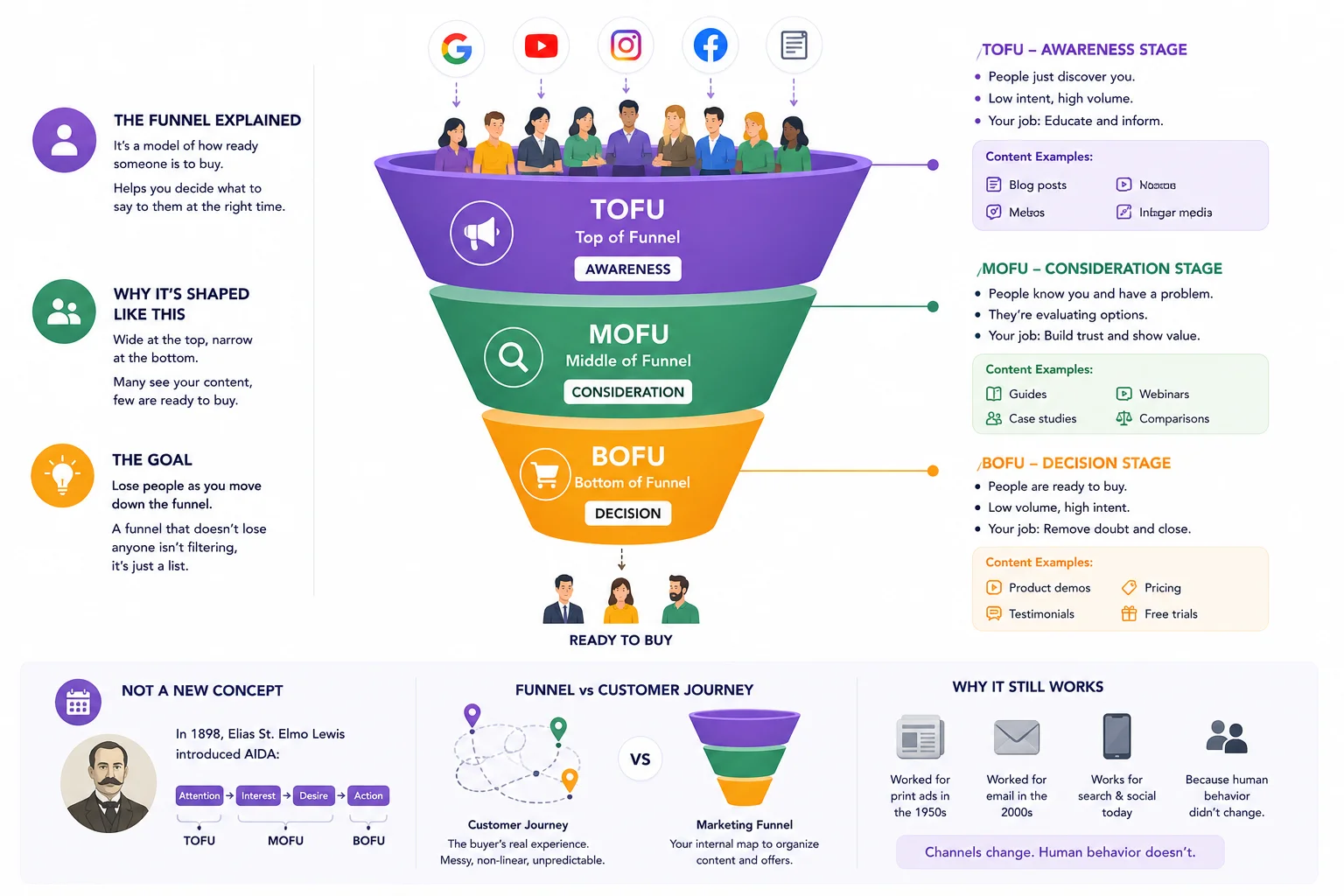
Forget the pipe metaphor for a second, because it trips more people up than it helps. The funnel isn’t a literal tunnel someone physically walks through from one end to the other. It’s a model of how ready someone is to buy, and it exists to help you decide what to say to them depending on that readiness. That’s really it. Strip away all the diagrams and slide decks and it comes down to one question: is this person ready to hear a sales pitch, or would that pitch actively push them away right now.
The idea isn’t new either, even though it gets talked about like some fresh invention every year. Back in 1898, a guy named Elias St. Elmo Lewis came up with something called AIDA, standing for Attention, Interest, Desire, Action. That’s basically the great-grandparent of the funnel sitting in front of you right now. Attention became what marketers now call TOFU. Interest and Desire got folded together into MOFU. Action became BOFU. Marketers just gave it a snappier acronym over a hundred years later and slapped it onto blog posts, landing pages, and email sequences. Same bones, newer paint.
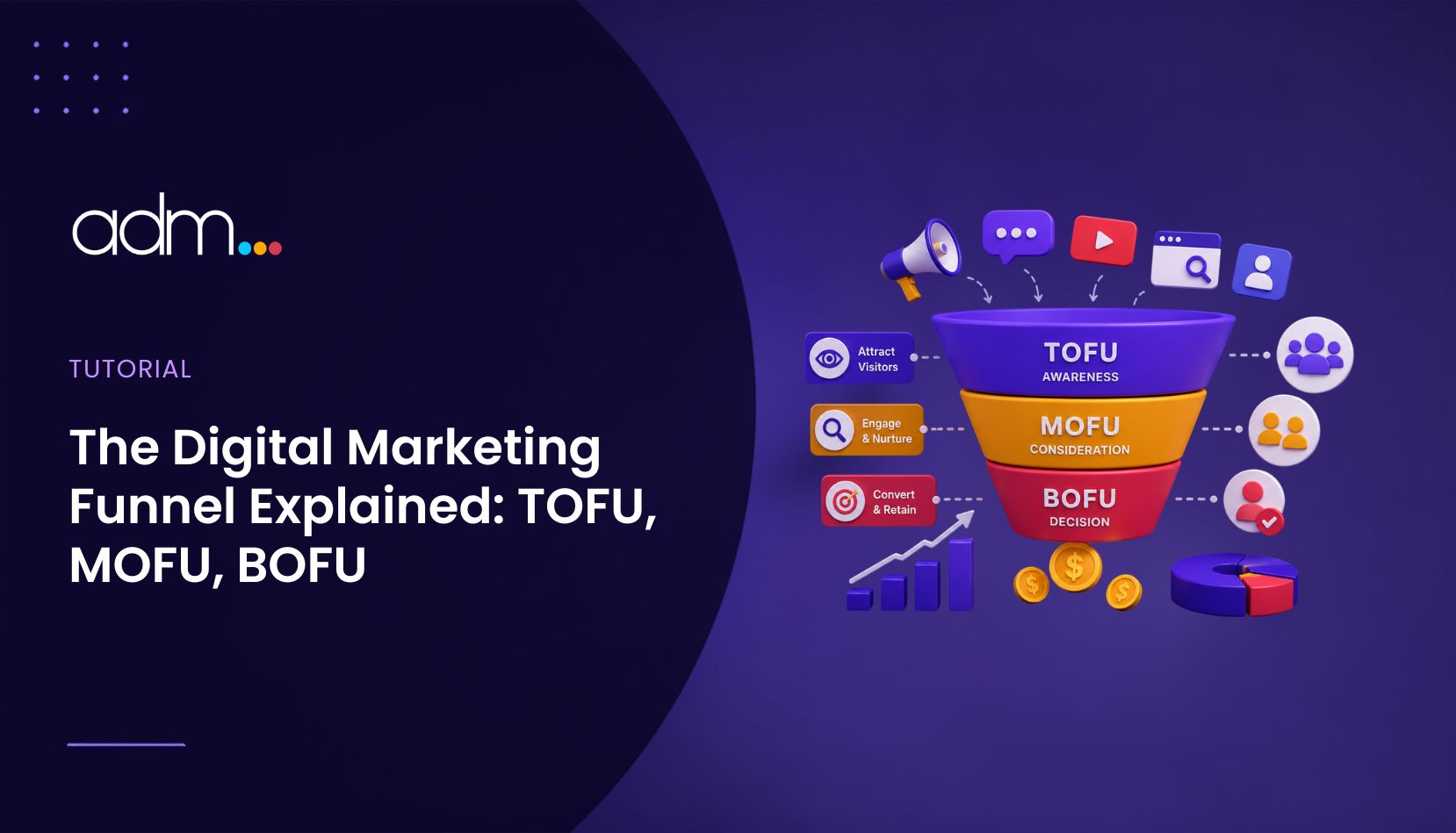
TOFU, MOFU, and BOFU are shorthand for Top of Funnel, Middle of Funnel, and Bottom of Funnel. TOFU is the awareness stage. MOFU is the consideration stage. BOFU is the decision stage. Three words, three moods, three completely different jobs for your content to do.
The shape matters too, and it’s not just there for decoration. Wide at the top, narrow at the bottom. That represents a real, unavoidable tradeoff: at the top of the funnel you get a lot of people looking at your stuff, but almost none of them have real buying intent yet. At the bottom you get way fewer people, but the ones still there are actually close to pulling the trigger. You lose people as you move down the funnel, and that’s fine, that’s genuinely the point. A funnel that doesn’t lose anyone isn’t filtering, it’s just a list.
One distinction that trips people up constantly, including plenty of experienced marketers: the funnel and the “customer journey” get used interchangeably, but they’re not the same thing. The customer journey is what the buyer actually lives through, messy, non-linear, full of dead ends and detours and moments where they forget about you for two weeks and come back. The funnel is how your marketing team organizes content and offers around that mess, trying to impose some order on it. One is lived experience. The other is your internal map trying to make sense of that experience. Keep that separation clear in your head, because it matters a lot later on when talking about why the funnel doesn’t behave as cleanly as the textbook diagram suggests it should.
It also helps to think about why this framework survived over a century of marketing trends coming and going. Plenty of frameworks get invented, get hyped for a few years, then quietly disappear once the next buzzword shows up. TOFU, MOFU, BOFU stuck around because it maps to something genuinely true about how people make decisions, not something specific to any one channel or platform. It worked for print ads in the 1950s, it worked for early email marketing in the 2000s, and it still works now with search and social and everything in between, because the underlying human behavior it describes, moving from not knowing to knowing to deciding, hasn’t actually changed. The channels changed. The behavior underneath them didn’t.
TOFU: Top of the Funnel (Awareness Stage)
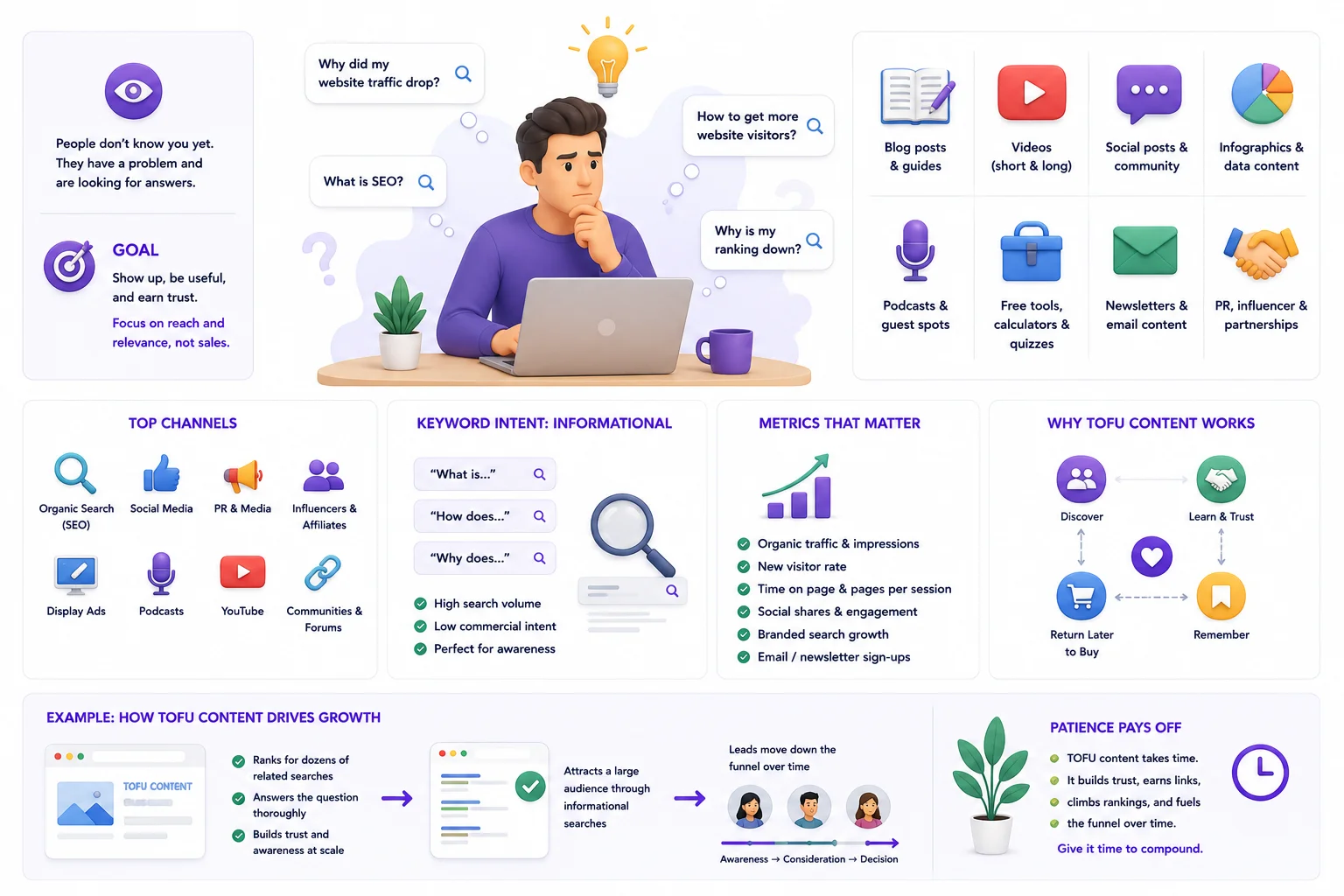
Picture someone who just noticed their website traffic dropped off a cliff and has no idea why yet. They don’t know your product exists. They probably don’t even know the category of solution they need, whether that’s an SEO fix, a technical issue, or something totally unrelated they haven’t considered. All they know is something’s wrong, and they’re typing frantic questions into Google trying to make sense of it. That’s a TOFU prospect, and honestly, that’s most of the internet on any given day.
The goal at this stage isn’t to sell anything. It’s to show up, be genuinely useful, and earn a sliver of trust before anyone ever asks for money. Judging TOFU content by how many sales it generates is easily the most common mistake teams make, and it quietly kills good content strategies before they ever get a fair shot to work. TOFU’s job is reach and relevance, not revenue. If a team keeps killing off blog posts because they didn’t lead to a demo request within thirty days, that team is measuring the wrong thing, full stop.
What actually belongs at this stage:
- Blog posts and guides that answer broad “what is,” “how to,” and “why” questions people are genuinely searching for
- Short-form and long-form video, whether that’s YouTube explainers, Reels, or Shorts depending on where the audience actually hangs out
- Organic social posts and real engagement in communities, not just broadcasting into the void and hoping someone notices
- Infographics and visual content built around real, checkable data rather than made-up stats dressed up in a nice template
- Podcasts, and getting invited onto other people’s podcasts as a guest to reach an audience that already trusts the host
- Free tools, calculators, and quizzes people can actually use without handing over an email address first
Channel-wise, this is where organic search and SEO carry the heaviest load, since that’s where most people start when they don’t know a brand exists yet. Alongside that, social media platforms, PR, influencer or affiliate partnerships, some amount of display advertising, and podcasts all play a role. None of these are asking for a sale, and none of them should be. They’re asking for five minutes of someone’s attention and trying to make those five minutes worth it.
Keyword intent at TOFU leans heavily informational. Think “what is,” “how does,” “why does,” “examples of.” These queries pull in a ton of search volume but almost no commercial intent whatsoever, and that’s exactly right for this stage. You’re not supposed to be pitching a product to someone typing “what is a marketing funnel” into a search bar. You’re supposed to be the clearest, most genuinely useful answer they come across, the one they remember later when they’re ready to actually buy something.
Metrics that actually tell you something meaningful at TOFU:
- Organic traffic and impressions
- New visitor rate, meaning the share of people who’ve never been to the site before
- Time on page and pages per session, since those hint at real engagement rather than a quick bounce
- Social shares and engagement
- Branded search growth over time, since more people searching your brand name directly means the awareness is sticking
- Email or newsletter sign-ups pulled straight from content, since that’s a small but real signal someone wants more
Here’s a simple way to see the difference TOFU content actually makes in practice. A SaaS company writes a genuinely useful, in-depth “how to fix declining website traffic” guide. That post has a real shot at ranking for dozens of related searches, because it actually answers the question thoroughly instead of dancing around it. Now compare that to the same company’s product page targeting a similar rough topic. The product page almost never ranks for that broad informational query, because it isn’t built to answer a question, it’s built to sell something. Google can tell the difference between the two intents pretty reliably. So can readers, honestly, and they’ll bounce off a sales pitch disguised as an answer faster than almost anything else.
There’s also a patience problem worth mentioning here. TOFU content takes time to pay off, and that’s uncomfortable for a lot of teams working under quarterly pressure. A blog post published today might not pull any real traffic for months, and even once it does, that traffic isn’t going to convert into pipeline overnight. It sits there, quietly building trust, getting shared, getting linked to, slowly climbing rankings, until eventually it starts feeding the stages below it. Teams that abandon TOFU content after six weeks because “it’s not working” are usually just judging it on a timeline it was never going to meet. Give it room to actually compound.
MOFU: Middle of the Funnel (Consideration Stage)
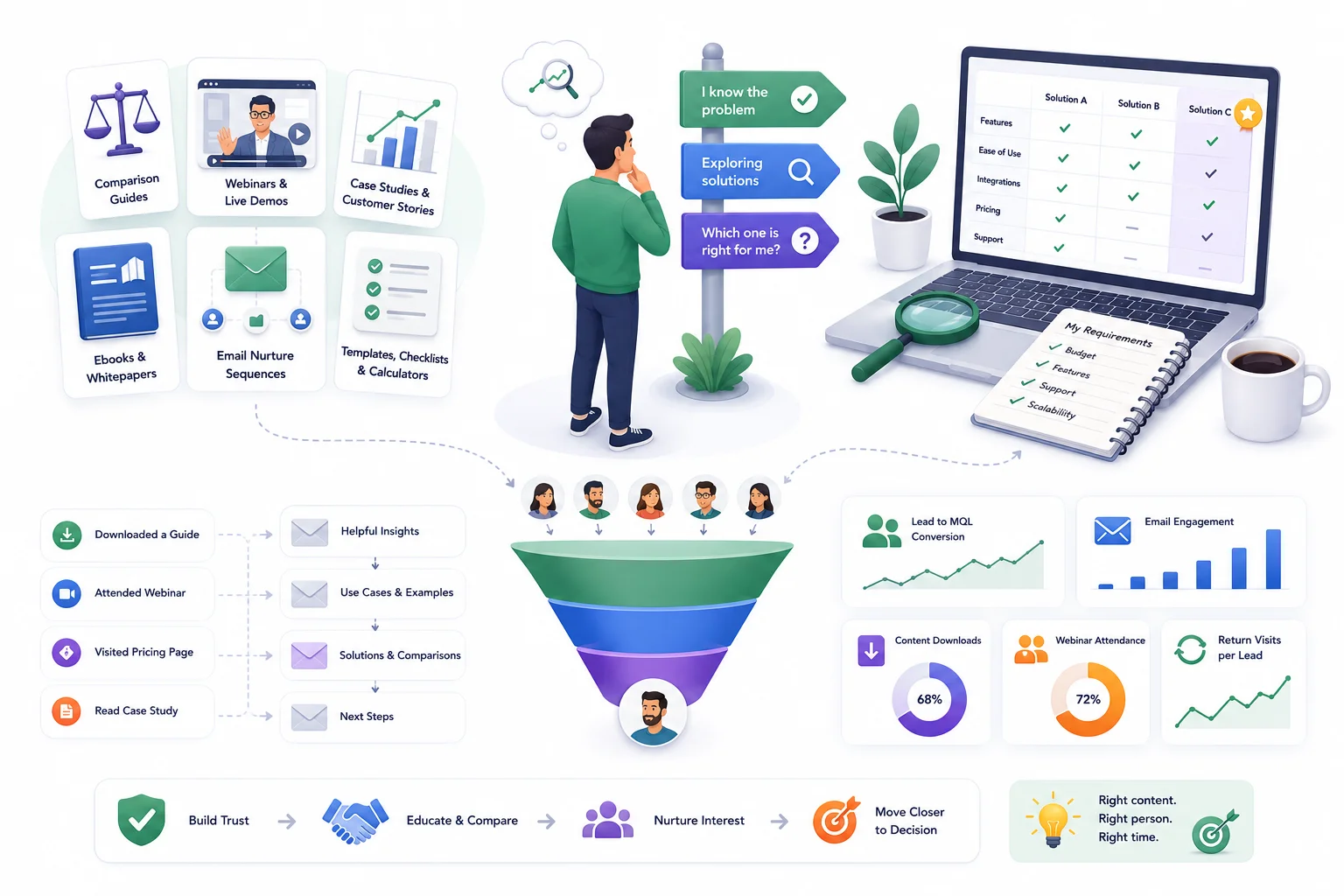
Now picture that same person from the last section a few weeks later. They’ve figured out their traffic drop wasn’t a technical glitch, it was an SEO problem tied to a Google algorithm update. They’ve named the problem now. And that shift, from “something’s wrong with me” to “okay, I know what this is, now what fixes it,” is the entire difference between TOFU and MOFU. It’s a small shift on paper and a massive one in terms of what content actually helps.
Honestly, MOFU is the stage most brands quietly neglect, and it’s not even close. Everyone loves pumping out TOFU content because it’s fun to write and easy to measure in a traffic chart every month. Everyone loves BOFU because that’s where the money conversation actually happens and sales keeps asking for more of it. MOFU sits stuck in the middle getting ignored by both camps, and that’s exactly where a lot of genuinely promising leads quietly go cold and never come back. If a team has ever looked at a decent stream of inbound leads that just never seem to convert into anything real, there’s a solid chance the MOFU content connecting those leads to a decision is thin, generic, or just doesn’t exist yet.
What belongs here:
- Comparison guides that compare solutions to each other, not vendors yet. Think “SEO vs paid ads for lead gen,” not “Ahrefs vs Semrush,” since the reader hasn’t picked a category winner in their head at this point, let alone a specific brand
- Webinars and live product demos that walk through real use cases instead of a generic feature tour
- Case studies and customer stories with actual specifics in them, real numbers, real timelines, not vague “results may vary” language
- Ebooks, whitepapers, and gated long-form guides that go deeper than a blog post reasonably can
- Email nurture sequences segmented by what someone actually did on the site, not a one-size-fits-all drip that treats every subscriber the same
- Lead magnets like templates, checklists, and calculators that people genuinely want to use, not just download and forget
Keyword intent shifts noticeably here too, moving toward commercial-investigation terms. Things like “best,” “vs,” “alternative to,” “for [specific use case],” and “review.” These aren’t casual, idle searches. Someone typing “best CRM for small agencies” already understands they need a CRM. They’re narrowing down a category, not still learning what a CRM even does.
Metrics worth paying attention to at this stage:
- Lead-to-MQL conversion rate
- Email engagement on nurture sequences specifically, opens and clicks, not just raw list size
- Content downloads
- Webinar attendance, and more importantly how much of it people actually stick around for rather than dropping off ten minutes in
- Return visits per lead, which is a decent proxy for genuine interest building over time
One thing worth saying plainly about nurture sequences, because it gets ignored constantly: segment them by behavior, not by a generic fixed timeline everyone falls into. Someone who downloaded a detailed pricing comparison guide is in a very different headspace than someone who casually skimmed one blog post once and left. Sending both people the exact same three-email drip is lazy, and honestly, most readers can tell it’s lazy immediately. Over-emailing at this stage, especially with content that doesn’t match where someone actually is, is one of the fastest ways to get unsubscribed before that person ever gets close to buying anything.
There’s a trust-building piece to MOFU that’s easy to underrate too. This is the stage where a brand stops being a stranger and starts becoming a name someone actually recognizes and half-trusts. That doesn’t happen from one comparison guide. It happens from a pattern, a webinar attended, an email opened and actually read, a case study that felt relevant to their specific situation rather than generic. MOFU content works best when it feels like it was written for the exact scenario the reader is in, not a broad audience that happens to include them somewhere in the middle of it. Specificity is what separates a MOFU piece that gets forwarded to a colleague from one that gets closed and forgotten in ten seconds.
BOFU: Bottom of the Funnel (Decision Stage)
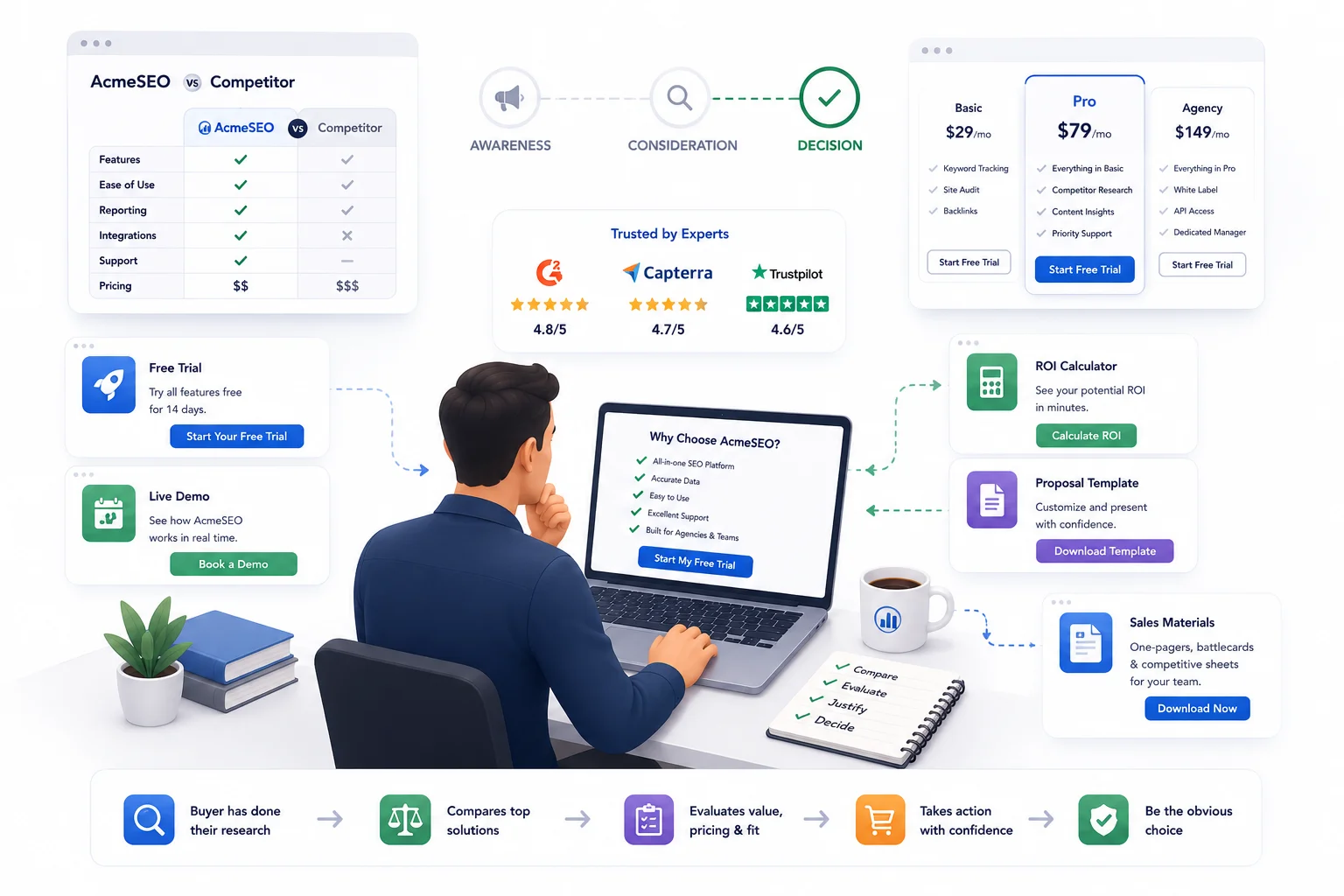
This is the person who’s already done the homework, and there’s usually a lot of it. They know the problem cold. They know the category of solution. They’ve probably got two or three vendors sitting open in browser tabs somewhere, quietly comparing notes in their head or in a spreadsheet nobody sees but them. What they need from a brand at this point isn’t more education. They need a clear, specific reason to pick that brand over the other tabs still open, and they usually need it fast, because indecision at this stage tends to fizzle out into nothing happening at all.
Content that fits here:
- Direct product or vendor comparison pages, the classic “[Brand] vs [Competitor]” format that shows up exactly when someone searches for that comparison
- Pricing pages that are actually clear and upfront, not vague “contact us for a custom quote” pages that hide real numbers behind a form
- Free trial and demo offers that make the next step obvious and low-friction
- Testimonials, reviews, and third-party proof from places like G2 or Capterra, since buyers trust other buyers more than they trust a brand’s own claims
- ROI calculators and proposal templates that help someone build the internal case for buying, especially in B2B where they often have to convince someone else too
- Sales-assisted materials like one-pagers and competitive battlecards, so the sales team isn’t improvising answers to hard comparison questions on the spot
Keyword intent turns fully transactional at this point. “Pricing,” “demo,” “free trial,” “buy,” “[brand] vs [competitor].” Search volume drops off a cliff compared to TOFU and MOFU terms, which makes sense, because way fewer people are at this stage of the journey at any given moment. But conversion rate on this traffic tends to be way higher, because the person searching has already decided they want to buy something. They just haven’t decided who from yet, and that’s the exact question a good BOFU page needs to answer.
Metrics that matter most here:
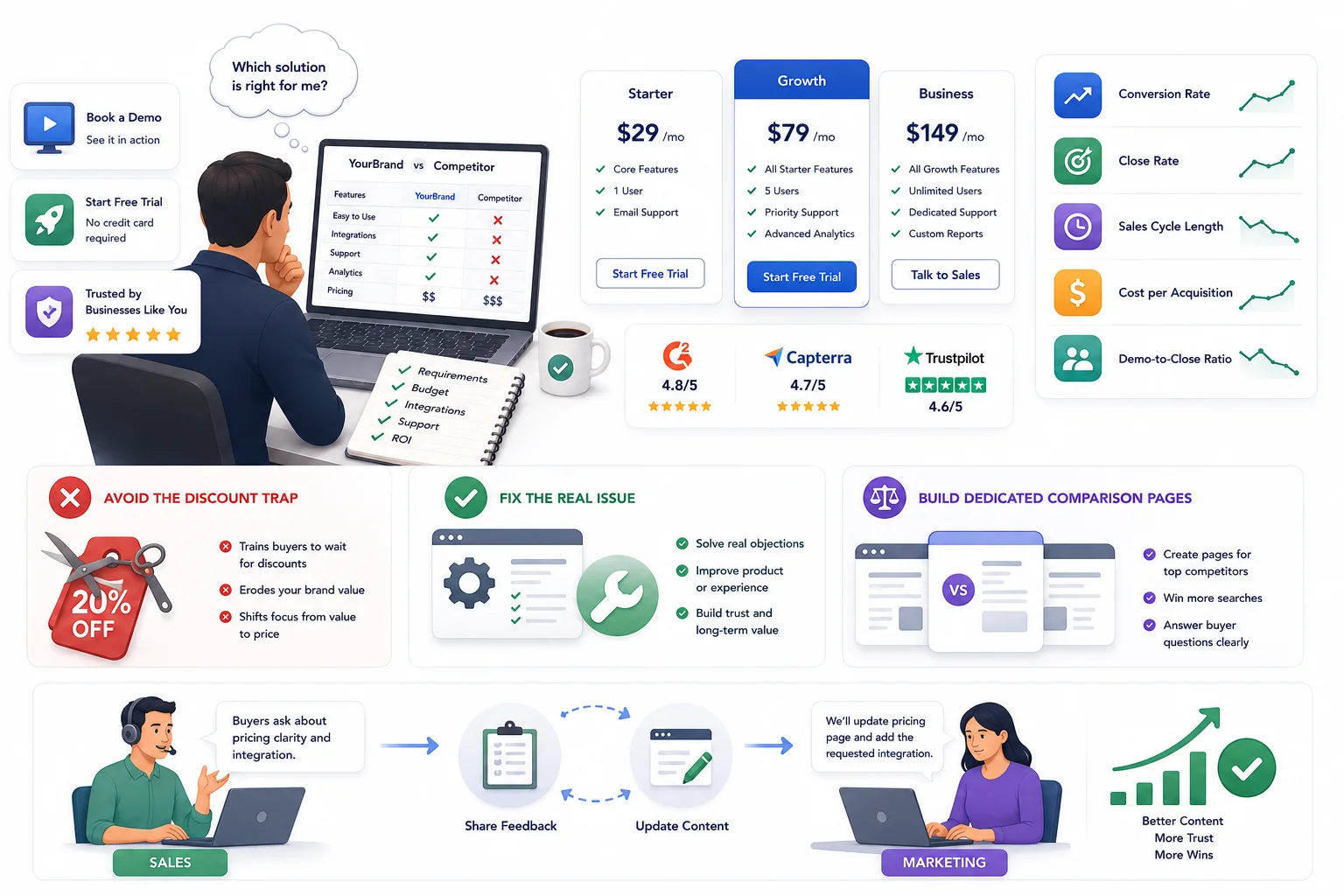
- Conversion rate
- Close rate
- Sales cycle length
- Cost per acquisition
- Demo-to-close ratio
A common failure mode at BOFU worth calling out directly and bluntly: reaching for a discount the moment a deal looks shaky. It works in the short term, sure, it usually gets the deal across the line. But it trains buyers to sit back and wait for the next promo instead of buying when they’re actually ready, and it quietly trains the sales team to lead with price cuts instead of value every single time an objection comes up. If the actual objection is real friction, something like a confusing pricing page or a missing integration someone needs, fix that root problem directly. Don’t paper over it with 20% off and call it solved, because the same objection just resurfaces with the next prospect.
Also worth noting: one weak “why choose us” page trying to cover every possible competitor at once genuinely isn’t enough anymore. Brands that actually win competitive BOFU searches build a real, dedicated comparison page for every serious competitor they run into regularly, not one vague catch-all page trying to speak to everyone. It’s more work, no question. But it’s also the entire difference between showing up when someone searches “[your brand] vs [competitor]” and getting completely skipped because that competitor built the page and the other brand didn’t bother.
Sales and marketing need to actually talk to each other at this stage, and that sounds obvious but it’s shockingly rare in practice. Marketing builds the BOFU content, but sales is the one hearing the real objections every single day on calls. If sales keeps hearing the same pushback about a missing feature or a confusing onboarding step, that feedback needs to make its way back into the BOFU content, not just get vented about in a Slack channel and forgotten. The best comparison pages and pricing pages usually come out of that loop, not out of a marketer guessing what a buyer might be worried about.
TOFU vs MOFU vs BOFU: Side-by-Side Comparison
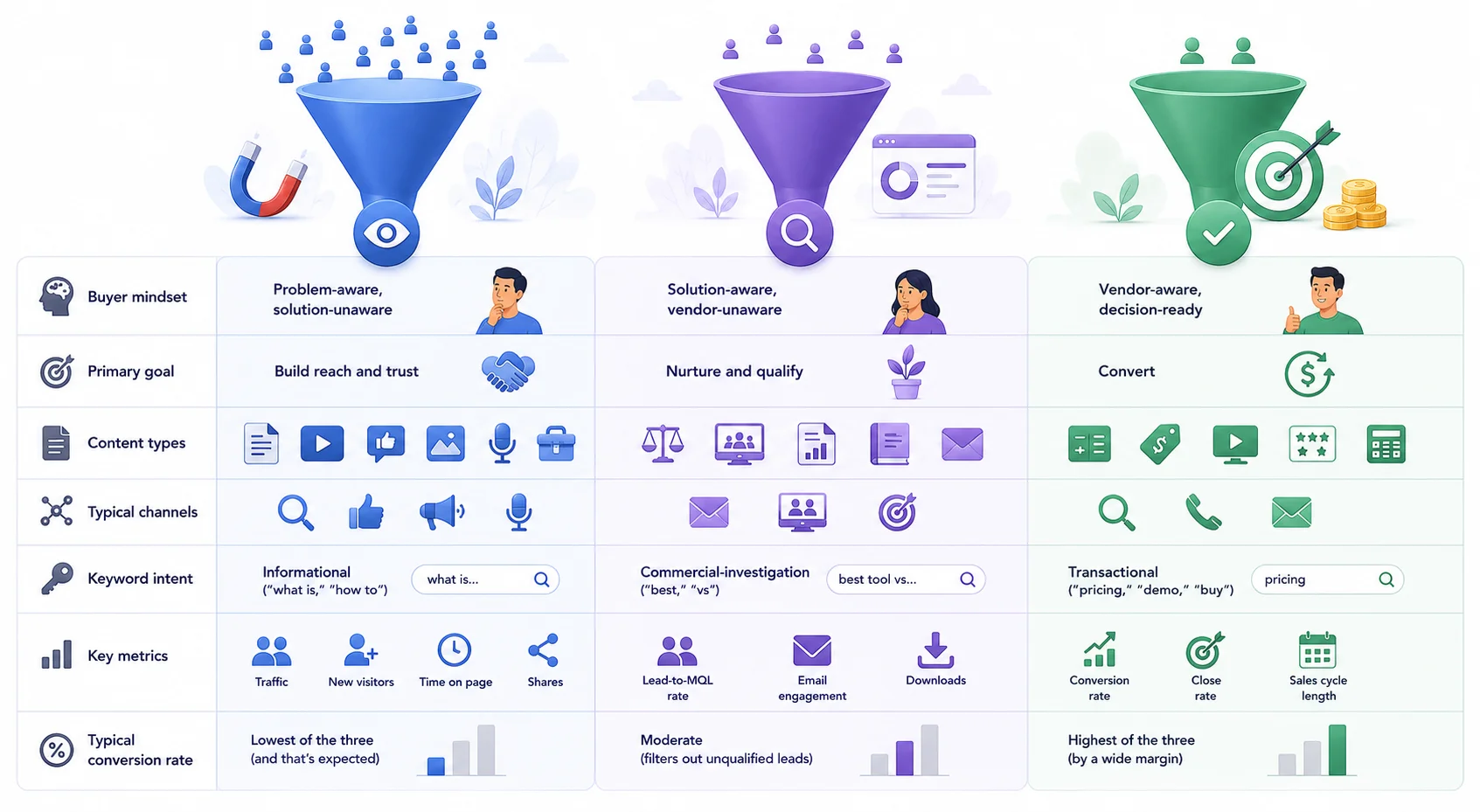
Sometimes it just helps to see the whole thing laid out in one place without scrolling back through paragraphs to piece it together. Here’s the snapshot version, the kind of thing worth screenshotting and pinning somewhere for reference.
| TOFU | MOFU | BOFU | |
|---|---|---|---|
| Buyer mindset | Problem-aware, solution-unaware | Solution-aware, vendor-unaware | Vendor-aware, decision-ready |
| Primary goal | Build reach and trust | Nurture and qualify | Convert |
| Content types | Blog posts, video, social, infographics, podcasts, free tools | Comparison guides, webinars, case studies, ebooks, nurture emails | Comparison pages, pricing pages, demos, reviews, ROI calculators |
| Typical channels | Organic search, social, PR, podcasts | Email, webinars, retargeting | Paid search, sales outreach, email |
| Keyword intent | Informational (“what is,” “how to”) | Commercial-investigation (“best,” “vs”) | Transactional (“pricing,” “demo,” “buy”) |
| Key metrics | Traffic, new visitors, time on page, shares | Lead-to-MQL rate, email engagement, downloads | Conversion rate, close rate, sales cycle length |
| Typical conversion rate | Lowest of the three, and that’s expected, not a failure | Moderate, since this stage filters out people who were never really qualified | Highest of the three by a wide margin |
Why the Funnel Isn’t Actually Linear Anymore
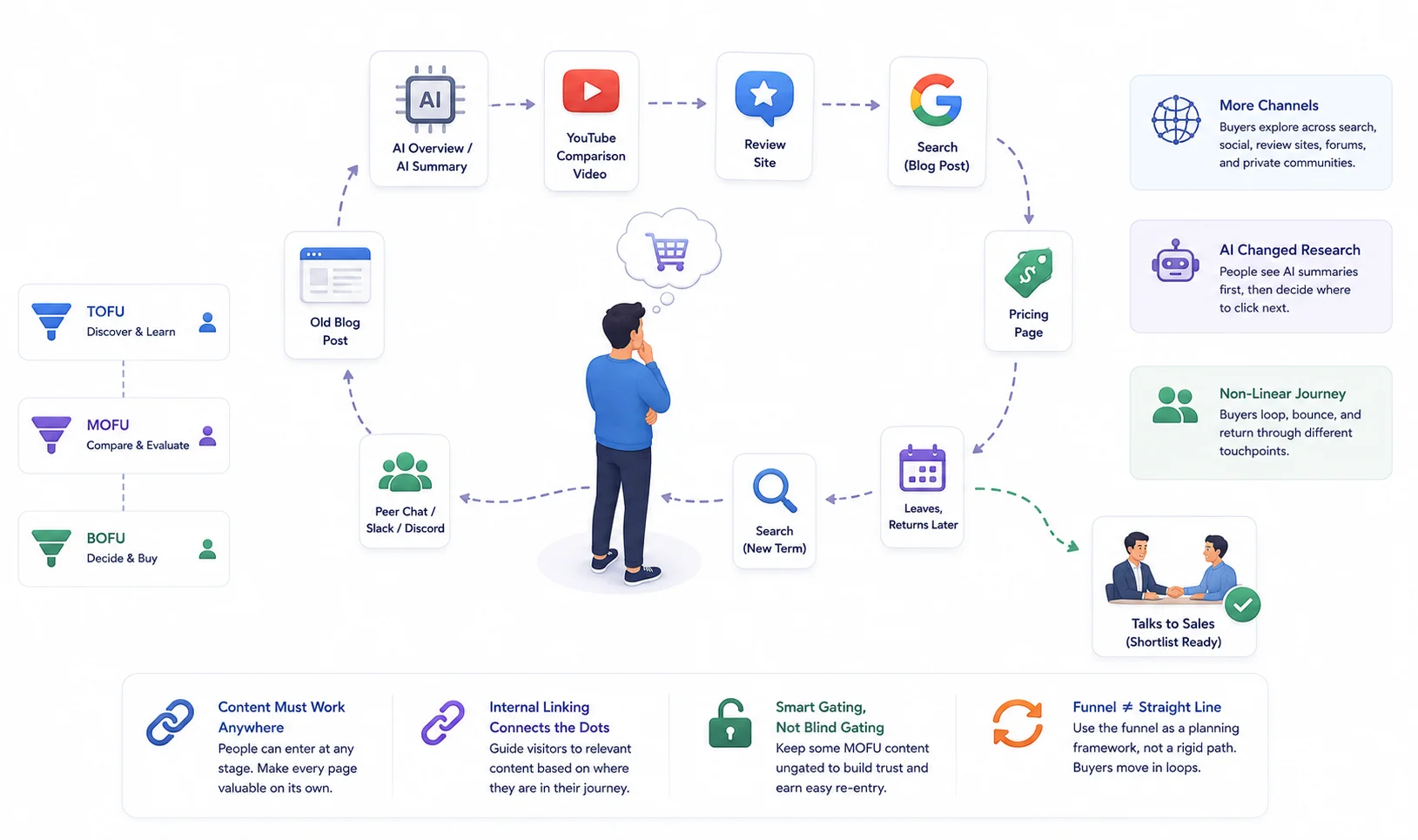
Okay, here’s where the tidy diagram genuinely starts falling apart, and it’s worth saying plainly that most guides on this topic glance right past it.
Nobody actually moves through TOFU, then MOFU, then BOFU in one clean, straight line anymore, if they ever really did. Somebody might stumble onto a brand through an AI-generated summary while researching something else entirely unrelated. Then they’ll watch a comparison video on YouTube from a completely different, unaffiliated source. Then check a review site for a second opinion. Then land on one of the brand’s older blog posts through an unrelated search. Then go check the pricing page just out of curiosity. Then disappear for two weeks doing nothing at all. Then come back through a completely different search term entirely. By the time this person actually talks to sales, they might already have a shortlist and a fairly formed opinion, and none of that happened in the neat, sequential order the funnel diagram implies it should.
Why did this happen? A few things stacked up over the last several years. There are just way more channels and touchpoints available now than there used to be. People research across search engines, social platforms, review sites, and what marketers have started calling “dark social,” which is basically anything happening in private Slack groups, WhatsApp chats, or Discord servers where absolutely nobody on the marketing side can track a single click or attribute a single conversion back to its source.
And then there’s AI, which has changed research behavior more in the last couple of years than almost anything before it. Search increasingly starts with a synthesized, summarized answer pulled together from multiple sources before someone ever clicks through to an actual website. That means people are arriving at a brand’s own content already partway informed, sometimes with opinions half-formed by an answer engine that pulled from five sources the brand had zero control over and possibly never even heard of.
What does this mean in practice for anyone actually building this stuff? It means content can’t assume a clean, predictable entry point anymore. Someone might land on a BOFU pricing page as their literal first touchpoint with a brand, having already done all their MOFU-style comparison research somewhere else entirely before ever showing up. Content needs to work regardless of where someone happens to walk in, which is exactly why internal linking and deliberate cross-stage content mapping matter more now than gatekeeping people through some rigid, forced sequence ever will.
It also means gating decisions deserve a second look. A lot of brands instinctively gate their best MOFU content behind a form, assuming that’s the only way to capture a lead. But if someone’s going to loop back around anyway, sometimes through a search, sometimes through a link someone shared in a private chat, an aggressive gate just means that piece of content never gets seen by the exact audience it was written for in the first place. Some of the best-performing MOFU content today sits ungated, doing its job of building trust in public, with the gate reserved for something genuinely worth the trade, like a detailed template or a live demo slot.
None of this means the funnel is dead, or that the framework stopped mattering, despite what some hot takes floating around might claim. It still matters, a lot, for planning content and for measuring whether any of it is working. What it means is that the buyer’s actual path looks a lot more like a loop than a straight line these days, and treating the funnel as a strict rulebook instead of a flexible planning tool is exactly where a lot of otherwise solid strategies quietly go sideways.
How to Map Content to Each Funnel Stage: A Practical Framework
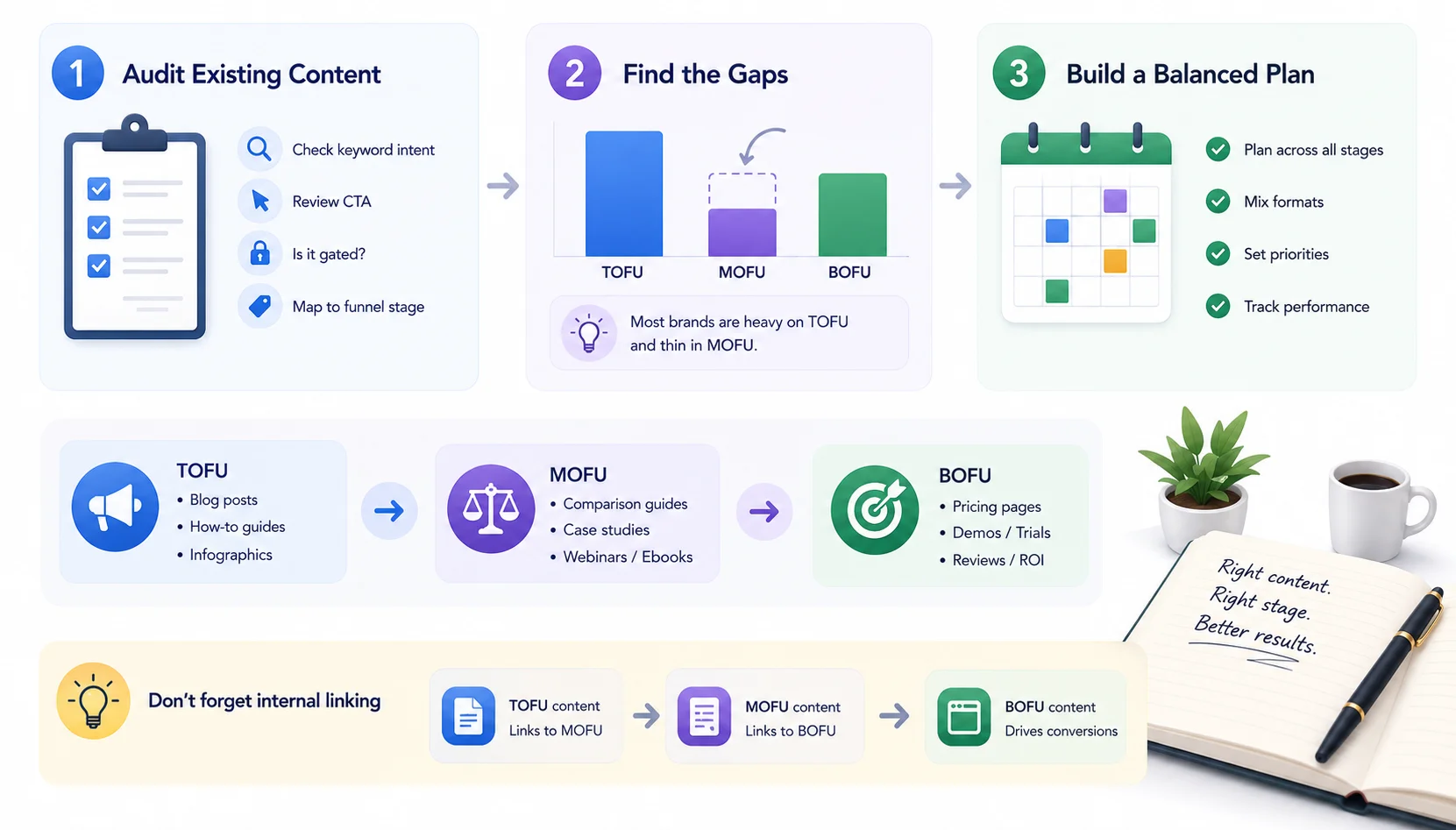
This part is less about theory and more about actually sitting down and doing the work. Three steps, nothing fancy, nothing that requires new software.
First, audit what’s already out there. Go through every single piece of content and tag it by stage. Use the intent signals already covered throughout this post: what keyword intent does the piece target, what’s the call to action actually asking for, is it gated behind a form or freely available. A gated ROI calculator is clearly BOFU. An ungated “what is” blog post is clearly TOFU. Most content sorts itself pretty quickly once someone actually sits down and looks at it through this lens instead of guessing.
Second, find the gaps. Almost every brand that actually runs this kind of audit finds roughly the same pattern showing up: heavy on TOFU because it’s the easiest and most enjoyable content to churn out, decent on BOFU because sales keeps asking loudly for more of it, and genuinely thin on MOFU because nobody on the team really owns that middle stretch. This gap is usually visible by comparing traffic numbers against downstream conversion, broken out by individual URL. If a page pulls in solid traffic but almost nothing downstream from it ever converts into a lead or a sale, that’s often a clear sign there’s no real MOFU bridge connecting that traffic to anything further along.
Third, build a content calendar that deliberately balances all three stages, instead of just chasing whatever topic happens to have the best search volume that particular month. It’s tempting to keep cranking out TOFU content because the traffic numbers look great sitting in a monthly report. But traffic without a clear path forward is really just a vanity metric wearing a nicer outfit.
One more piece that ties this whole framework together and gets skipped constantly: internal linking. TOFU posts should link out to relevant MOFU comparison guides. MOFU guides should link forward toward BOFU pricing or demo pages. This sounds obvious written out like this, but plenty of blogs genuinely don’t do it, leaving the reader to go find the next logical step entirely on their own, which most people, being honest, simply won’t bother doing without a nudge.
A quick gut check that helps this whole process: pull up any piece of content and ask what happens the moment someone finishes reading it. If the honest answer is “nothing, they close the tab,” that’s a signal the piece is missing its next step. It doesn’t need a hard sell tacked onto the end. It just needs a genuine, relevant next thing to read or do, matched to roughly one stage further down than where the content itself sits.
Funnel Content by Industry: Quick Examples
Generic advice is easy to hand out and hard to actually use. Here’s what this looks like in a handful of different types of businesses, stripped of the vague theory.
SaaS. TOFU here usually looks like practical “how to” workflow content, the kind that genuinely solves a real problem without mentioning the product itself for the first several hundred words. MOFU is feature comparison pages and free-trial-gated templates, giving someone a genuinely useful resource in exchange for an email address and a slightly bigger commitment than just reading a blog post. BOFU is the pricing page, the demo request form, and often a dedicated migration guide for people currently on a competitor’s tool and weighing whether switching is worth the hassle.
E-commerce. TOFU shows up as gift guides and UGC-style content, the kind of thing people actually share with friends instead of scrolling past. MOFU is buying guides, size or fit comparisons, and reviews that help someone narrow down between three nearly identical products they’re stuck choosing between. BOFU is the product page itself, plus cart abandonment offers and genuinely time-limited discounts, not the fake “sale ends today” banner that’s mysteriously been sitting on the site for six straight months.
Professional services, agencies, and education platforms. TOFU tends to be educational blog content and webinars that establish some real credibility before anyone’s asked to sit through an actual pitch. MOFU is case studies built around real numbers and downloadable frameworks people can genuinely apply on their own before ever talking to anyone. BOFU is the consultation booking page and proposal templates that make the very next step completely obvious rather than leaving someone unsure what to do next.
B2B and enterprise. TOFU here leans into industry research and genuine thought leadership, the kind of content that gets shared around internally at a prospect’s company before anyone from procurement is even looped in yet. MOFU is ROI calculators and analyst-style comparisons that help build an internal business case. BOFU is RFP support content, dedicated vendor comparison pages, and custom demos built specifically around the exact use case a prospect brought up in an earlier conversation, rather than a generic walkthrough that ignores what they actually said they needed.
Education and online learning platforms. TOFU here often looks like free study guides, career advice content, and “how to choose a course” style posts that help someone still figuring out what they even want to learn. MOFU is curriculum comparisons, instructor credentials, sample lessons, and reviews from past students who took the exact course being considered. BOFU is enrollment pages built around clear outcomes, payment plan details, and sometimes a free trial module that lets someone experience the actual teaching style before committing money to the full program.
Worth pointing out across all of these: the exact same content type can sit in a completely different stage depending on the industry. A case study is MOFU for a professional services firm trying to build trust, but that same case study format can slide toward BOFU for an enterprise buyer who needs it specifically to justify the purchase internally to a finance team. Stage isn’t fixed to format. It’s tied to what the reader needs from that piece of content at that specific moment, which is exactly why a blind template applied across every industry rarely works as well as people hope it will.
Tools for Managing Each Funnel Stage
No need to turn this section into a shopping list of specific software names, but it helps to know what category of tool fits where, and why. For TOFU, that’s SEO and content tools, the kind that help with keyword research, content briefs, and tracking organic performance over time so a team can actually tell whether that awareness-stage content is working. For MOFU, marketing automation and email platforms carry most of the weight, handling segmented nurture sequences built around actual behavior instead of a generic timed drip that treats every lead identically regardless of what they’ve actually shown interest in. For BOFU, CRM and sales enablement tools matter most, keeping track of exactly where a deal stands and giving the sales team the comparison sheets and battlecards they need right in the moment, not scrambling to find something useful mid-call. And running across all three stages at once, analytics and attribution tools are what let a team actually see how traffic showing up at the top eventually turns into real revenue at the bottom, instead of measuring each stage like it exists in its own isolated little bubble disconnected from everything else.
The temptation with tools is always to buy more of them, assuming a new platform will fix a funnel problem that’s actually a strategy problem. It rarely works that way. A brand-new marketing automation tool doesn’t write better MOFU content on its own, and a fancier attribution dashboard doesn’t fix a funnel that has no MOFU content to attribute anything to in the first place. Get the strategy and the content right first. Let the tools handle the execution and the measurement once there’s actually something worth measuring.
How to Measure Funnel Performance End to End
Measuring each stage in complete isolation misses the entire point of having a funnel in the first place. A blog post that pulls in a ton of traffic but never feeds anything meaningful downstream isn’t really doing its job, even if the traffic chart looks fantastic sitting in a monthly report handed up to leadership. The real question worth asking isn’t “did this post get traffic,” it’s whether that TOFU traffic eventually shows up as real MOFU engagement, and further down the line, as actual BOFU revenue.
This is where the idea of full-funnel or multi-touch attribution comes into the picture. Instead of crediting the last click before a sale, which usually ends up being some BOFU page getting an unfair, outsized amount of credit for a decision that was really shaped weeks earlier, the goal is to connect the dots across every touchpoint someone actually had along the way. Marketing mix modeling works at a broader level too, helping quantify how different channels and campaigns each contribute across the whole funnel rather than treating the last touch as the only one that mattered.
The practical takeaway here is setting KPIs specific to each individual stage instead of holding every single piece of content to the same identical standard. Traffic and engagement for TOFU. Lead quality and nurture engagement for MOFU. Conversion and close rate for BOFU. Judge each stage by what it’s actually supposed to accomplish, and stop grading a blog post by the exact same yardstick used for a pricing page, because they were never built to do the same job.
It’s also worth building in a regular cadence for actually reviewing this, not just setting it up once and forgetting about it. A quarterly look at how each stage is performing, and more importantly how they’re feeding into each other, catches problems long before they show up as a quiet dip in closed deals six months later with no obvious explanation. By the time revenue drops, the actual cause usually happened way further up the funnel, weeks or months earlier, and got missed because nobody was watching that connection closely enough at the time.
Glossary of Funnel Terms
TOFU: Top of Funnel, the awareness stage where prospects first learn about a problem or a brand.
MOFU: Middle of Funnel, the consideration stage where prospects evaluate different solutions against each other.
BOFU: Bottom of Funnel, the decision stage where prospects choose a specific vendor to actually buy from.
MQL: Marketing Qualified Lead, someone who’s shown enough real engagement to be considered a genuine prospect by marketing’s own standards.
SQL: Sales Qualified Lead, someone vetted and ready to be handed off directly to a sales team for a real conversation.
Lead nurture: The ongoing process of building trust with a lead over time through targeted, relevant content and communication.
Lead magnet: A free resource, like a template or checklist, offered in exchange for someone’s contact information.
Conversion rate: The percentage of people who take a desired action out of the total number who had the opportunity to take it.
Attribution: The process of figuring out which touchpoints or channels actually contributed to a conversion happening.
Funnel leakage: The drop-off of prospects at any given stage before they ever make it to the next one.
Dark social: Sharing and discussion that happens in untrackable private spaces, like messaging apps and closed communities, that marketing teams simply can’t see into.
Conclusion
At the end of the day, this whole framework comes down to one simple idea: match what gets said to where someone actually is, instead of writing the exact same pitch for everyone who happens to land on a site. TOFU, MOFU, and BOFU aren’t three separate campaigns running off in parallel, disconnected from each other. They’re one connected system, and the real skill here isn’t memorizing the acronym, it’s honestly figuring out where the gaps sit in a specific funnel. For most brands, that gap sits right in the middle, quietly starving otherwise decent leads of the trust-building content they genuinely need before anyone’s ready to have a real conversation about pricing.
Buyers don’t move in a straight line anymore, and pretending they do just because a diagram on a slide says so is exactly how good strategies quietly stall out without anyone noticing why. Treat the funnel as a planning tool that helps build content and offers deliberately, not as a rigid rulebook that assumes everyone walks in through the front door and exits neatly out the back in perfect order. Build for the loop instead of the line, and the rest of it tends to follow naturally from there.
Frequently Asked Questions
What do TOFU, MOFU, and BOFU stand for?
Top of Funnel, Middle of Funnel, and Bottom of Funnel. They map onto the awareness, consideration, and decision stages of a typical buyer’s journey, each one requiring a genuinely different kind of content and message.
What’s the difference between the marketing funnel and the customer journey?
The customer journey is what the buyer actually lives through, messy and non-linear and full of detours. The funnel is how a marketing team organizes content and offers around that experience, trying to bring some order to it. One is lived experience. The other is an internal framework trying to make sense of that experience from the outside.
Can one piece of content work for more than one funnel stage?
Sometimes, yes. Formats like an in-depth webinar or a genuinely comprehensive guide can span more than one stage if they’re deliberately built with that in mind from the start. But most content tends to work best when it’s built for one specific stage and one specific intent, rather than trying to be everything to everyone and ending up doing none of it particularly well.
How do you know which stage a lead is in?
Look at actual behavior, not guesses or assumptions based on job title alone. What content did they engage with, what call to action did they respond to, how many touchpoints have they had with the brand so far. Someone who downloaded a basic “what is” guide is in a very different headspace than someone who just requested a pricing quote.
Is the funnel model still relevant with AI-driven search?
Yes, but the path through it looks noticeably different than it used to. Buyers loop between stages instead of moving in one straight line, and they often arrive already partway informed thanks to AI-generated answers pulling from sources outside the brand’s control. The stages themselves still matter enormously for planning and for measurement. It’s the strict, linear journey they used to represent that doesn’t really hold up the way it once did.