


Somebody at an agency once tries to rank a client’s site for “digital marketing.” Big term, huge volume, feels like the obvious target. Six months later, nothing moves. Meanwhile a competitor with a fraction of the domain authority is sitting on page one for “digital marketing audit checklist for small ecommerce brands” and quietly pulling in leads every week. Same industry. Same starting point, more or less. Completely different outcome.
That’s not luck. That’s the difference between chasing head terms and understanding long-tail keywords. Most people have heard the phrase. Fewer actually get why it works, and even fewer use it right. Ask around and you’ll get some version of the same half-answer: “oh yeah, longer keywords, easier to rank.” True, sort of, but it’s missing basically everything that makes the strategy actually work in practice.
This piece breaks down what a long-tail keyword actually is (not the definition you’ve probably been given), why it pulls in traffic that converts better, and how to actually build a strategy around it instead of just nodding along when someone mentions it in a meeting.
What Is a Long-Tail Keyword, Actually?
Here’s where almost every article on this topic gets it wrong from the first paragraph. They’ll tell you a long-tail keyword is a “longer phrase,” usually three to five words or more. That’s not true, and it’s kind of a lazy way to explain something that actually matters.
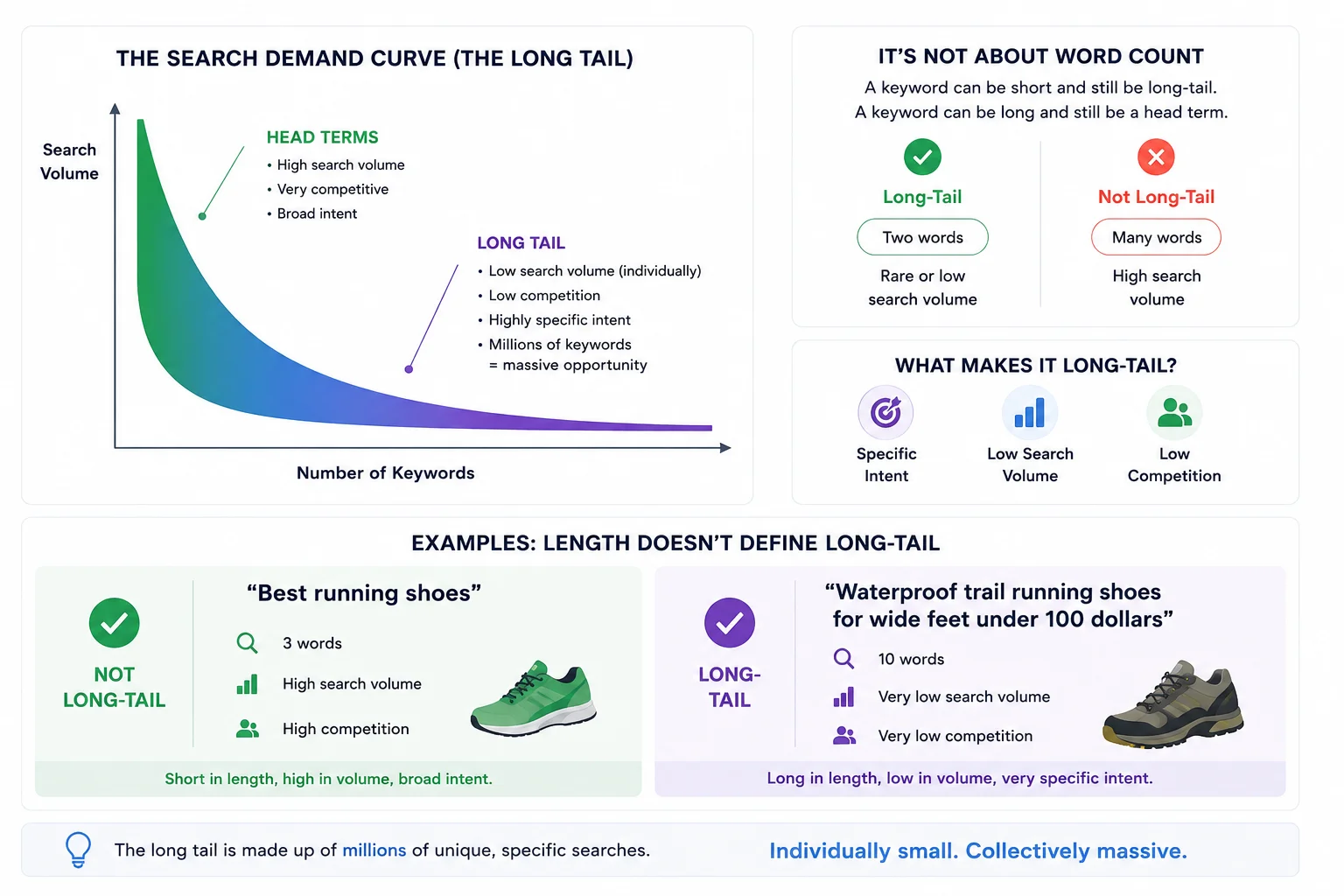
A long-tail keyword isn’t defined by how many words it has. It’s defined by search volume and specificity. A keyword can be two words long and still be long-tail if barely anyone searches it. A keyword can be six words long and still be a head term if it happens to get slammed with traffic. Length is just a side effect that shows up often, not the rule itself.
Think about the classic comet shape. If you plotted every search query on a graph by volume, you’d get a short, thick head on one side. That’s where terms like “shoes” or “insurance” or “weather” live. Massive volume, brutal competition, vague intent. Is someone searching “shoes” trying to buy shoes, research shoe brands, or find the Wikipedia page for footwear? Nobody knows. Google doesn’t know either, honestly, which is why it stuffs that kind of query with a mix of everything.
Then the graph tapers off into this long, thin tail that stretches out forever. Individually, each of those queries gets almost nothing. Ten searches a month. Three searches a month. Sometimes one. But there are millions of them, and stacked together, they make up the overwhelming majority of what people actually type into a search bar. That’s the long tail.
Here’s a quick gut check that kills the word-count myth for good. “Best running shoes” is three words and gets a ton of searches. That’s not long-tail, that’s a mid-tier term with real competition behind it. “Waterproof trail running shoes for wide feet under 100 dollars” is a mouthful, sure, but it also gets almost no volume and almost no competition. That’s long-tail. Not because it’s long. Because it’s specific and unpopular in isolation.
Laid out side by side, the pattern’s easier to see:
| Type | Example | Search Volume | Competition | Searcher Intent |
|---|---|---|---|---|
| Head term | “shoes” | Very high | Extremely high | Vague, could mean anything |
| Mid-tail | “running shoes” | High | High | Getting clearer, still broad |
| Long-tail | “best running shoes for flat feet” | Low to moderate | Low to moderate | Specific, closer to a decision |
| Long-tail | “waterproof trail running shoes for wide feet under 100 dollars” | Very low | Very low | Extremely specific, ready to buy |
The term itself comes from Chris Anderson’s book “The Long Tail,” which was really about markets and demand curves, not search engines specifically. He was writing about things like Amazon selling a handful of obscure books that nobody would ever stock in a physical store, and how all those obscure titles added up to real revenue once you stopped needing shelf space to justify carrying them. Someone took that shape and applied it to keyword research, and it stuck because the shape actually fits. That’s it. No deeper mythology needed.
One more thing worth clearing up here, because it trips people up constantly. Long-tail doesn’t mean low value. It means low individual volume. Those are not the same thing, and treating them as the same thing is how a lot of content teams end up ignoring keywords that would’ve been worth targeting from day one. A ten-search-a-month keyword tied to someone actively trying to buy something can be worth more to a business than a ten-thousand-search-a-month keyword tied to someone just browsing out of curiosity. Volume tells you how many people are looking. It doesn’t tell you what they want, and it definitely doesn’t tell you what they’re worth.
The Three Types of Long-Tail Keywords

Most articles treat long-tail keywords like one big undifferentiated bucket. Find some long phrases, target them, done. That’s leaving a lot on the table, because not all long-tail keywords behave the same way, and lumping them together means treating totally different opportunities with the exact same playbook.
There are really three flavors worth knowing.
Definitional long-tail. These exist because most people don’t know the technical or industry term for something, so they search around it instead. Someone doesn’t know the phrase “PPC quality score,” so they search “why is my Google ads cost per click so high.” Someone doesn’t know “structured data markup,” so they search “how to get stars under my search result.” These are gold for anyone writing educational content, because you’re not fighting the exact-term crowd. You’re catching people before they even know the vocabulary.
Underserved long-tail. Real demand exists, sometimes more than you’d expect, but almost nobody has bothered to target it well. Maybe the content that does exist is thin, outdated, or written by someone who clearly didn’t understand the topic. This is the sweet spot for newer sites or smaller businesses, because the competition isn’t just low, it’s often bad. You don’t need to out-write a giant, you just need to actually answer the question properly.
Emergent long-tail. This one’s newer, and it’s the category most blogs from a few years back completely miss because it didn’t really exist yet in its current form. As people search more conversationally, especially through AI tools and voice search, entirely new phrasings show up that didn’t have search volume history a year or two ago. “What’s the difference between long-tail keywords and negative keywords in Google Ads” is the kind of query that barely existed as a distinct search pattern before people got comfortable typing full questions instead of fragments. This category is growing fast, and it rewards content written in a natural, question-answering style over content stuffed with fragment keywords.
Knowing which type you’re dealing with changes how you write the content. Definitional keywords need you to define things clearly and early. Underserved keywords need you to just be thorough where competitors were lazy. Emergent keywords need natural, conversational phrasing that mirrors how someone would actually ask the question out loud.
It’s also worth noticing that these three types don’t stay in their lane forever. A keyword can start out emergent, barely any search history, mostly showing up in AI chat logs and forums, and within a year or two turn into a real, trackable term with actual monthly volume once enough people start asking the same thing. Someone who’s watching that shift early, instead of waiting for a keyword tool to confirm it exists, gets a real head start on content nobody else has written yet. That’s the whole game with long-tail research, honestly. Catching demand before it’s obvious, not after.
Why Long-Tail Keywords Drive More Traffic (Despite Lower Volume)
Okay, so here’s the part that trips people up. How does a keyword with ten searches a month “drive more traffic” than one with ten thousand? On paper that sounds backwards. It’s not, once you look at what’s actually happening.
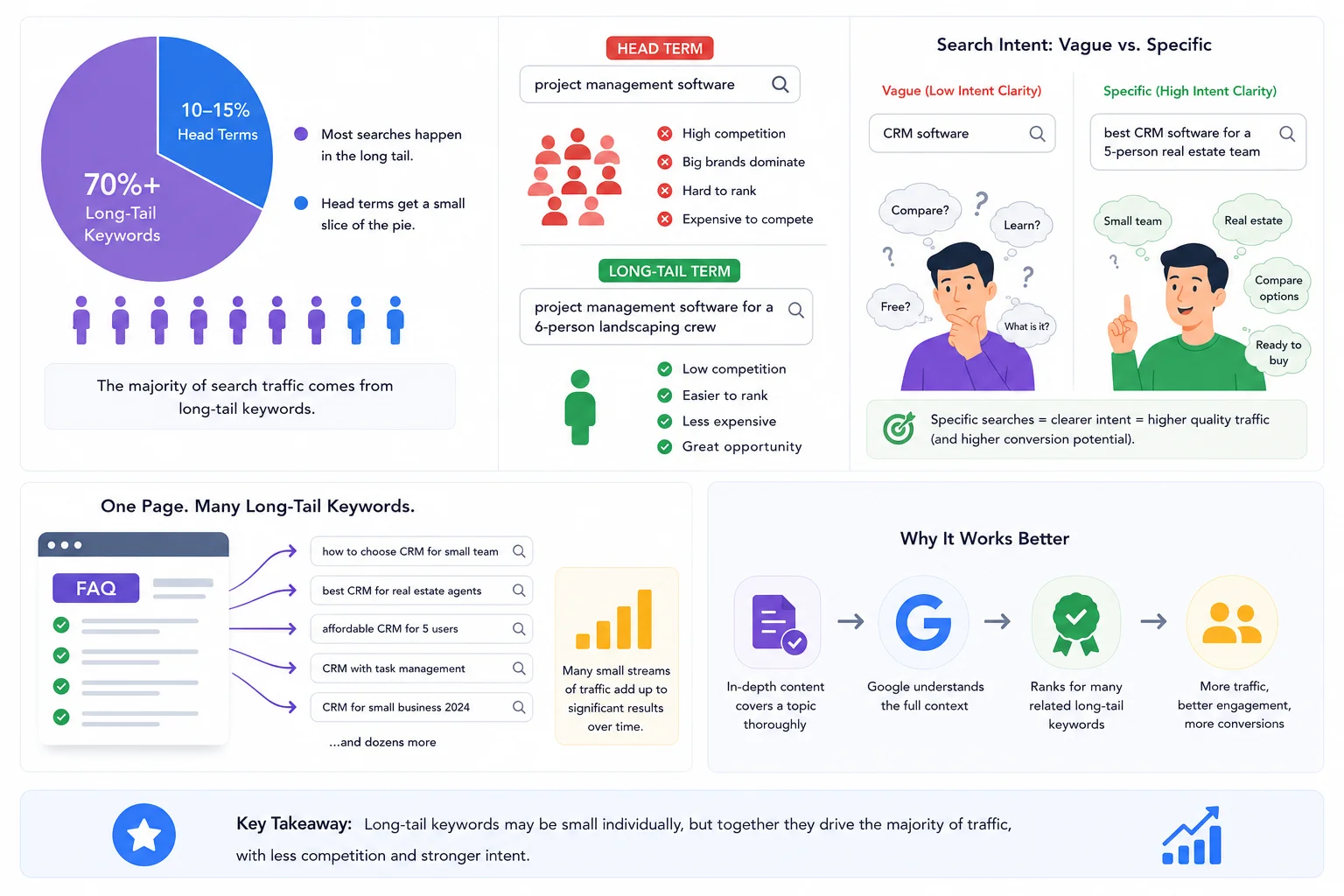
Start with the math. Multiple independent studies on search behavior land in roughly the same place: somewhere around seventy percent or more of all search queries fall into the long-tail category. Head terms, the big flashy ones everyone wants to rank for, only account for a small slice of total search volume, somewhere in the ten to fifteen percent range. That means the majority of the internet’s search traffic isn’t happening on the terms everyone’s fighting over. It’s scattered across an enormous number of specific, low-volume searches that nobody’s paying attention to.
So if you only chase the head terms, you’re fighting the whole industry for a shrinking slice of the pie, and you’re ignoring the much bigger slice that’s sitting there mostly untouched.
Then there’s competition, and this isn’t just “less competition” as some vague comfort. There’s a real mechanical reason for it. Fewer sites bother targeting long-tail terms because each individual keyword looks too small to be worth the effort. Nobody wants to write a whole article for a term that gets eight searches a month. So most competitors skip it. That means the sites that do bother end up with a much easier path to ranking, because the bar to beat is low or sometimes just doesn’t exist yet.
Look at what actually happens when a big brand and a small business go after the same head term. The big brand has years of backlinks, a huge domain, probably a whole team dedicated to content. A small business trying to outrank them on “project management software” is basically throwing money into a fire. But that same small business writing “project management software for a 6-person landscaping crew” isn’t competing with the big brand at all anymore, because the big brand never bothered writing that page. Nobody told them to. It didn’t look worth their time. That gap is exactly where smaller sites make their money.
Intent is the other half of this. A broad search like “CRM software” could mean a hundred different things. Someone comparing options. Someone doing research for a college paper. Someone who heard the term in a meeting and wants to know what it means. A search like “best CRM software for a 5-person real estate team” tells you almost everything you need to know about who’s searching and what they want. That specificity is what makes long-tail traffic so much more valuable per visitor, even though there’s less of it per keyword.
And here’s a practical example that shows how this stacks up without needing one giant keyword. A well-built FAQ page, or a filter page on an ecommerce site, or a solid comparison article, naturally ends up ranking for dozens, sometimes hundreds, of long-tail variations at once. Nobody planned to target all of them individually. They just happen because the content genuinely covers the topic in depth. One page, dozens of small streams of traffic, all adding up.
Honestly, this is the part that changes how a smart content plan gets built in the first place. Instead of writing one page and hoping it ranks for one keyword, the better move is writing one thorough page that happens to answer fifteen related questions along the way. Google notices that. It rewards pages that clearly know what they’re talking about across a whole topic, not just pages that repeat one phrase a bunch of times and call it done.
Long-Tail Keywords and Conversion Rate
This deserves its own section because burying it as a bullet point under “why long-tail matters” undersells it. Traffic volume is one thing. Whether that traffic actually does anything for the business is a completely separate question, and long-tail keywords tend to win on both fronts differently.
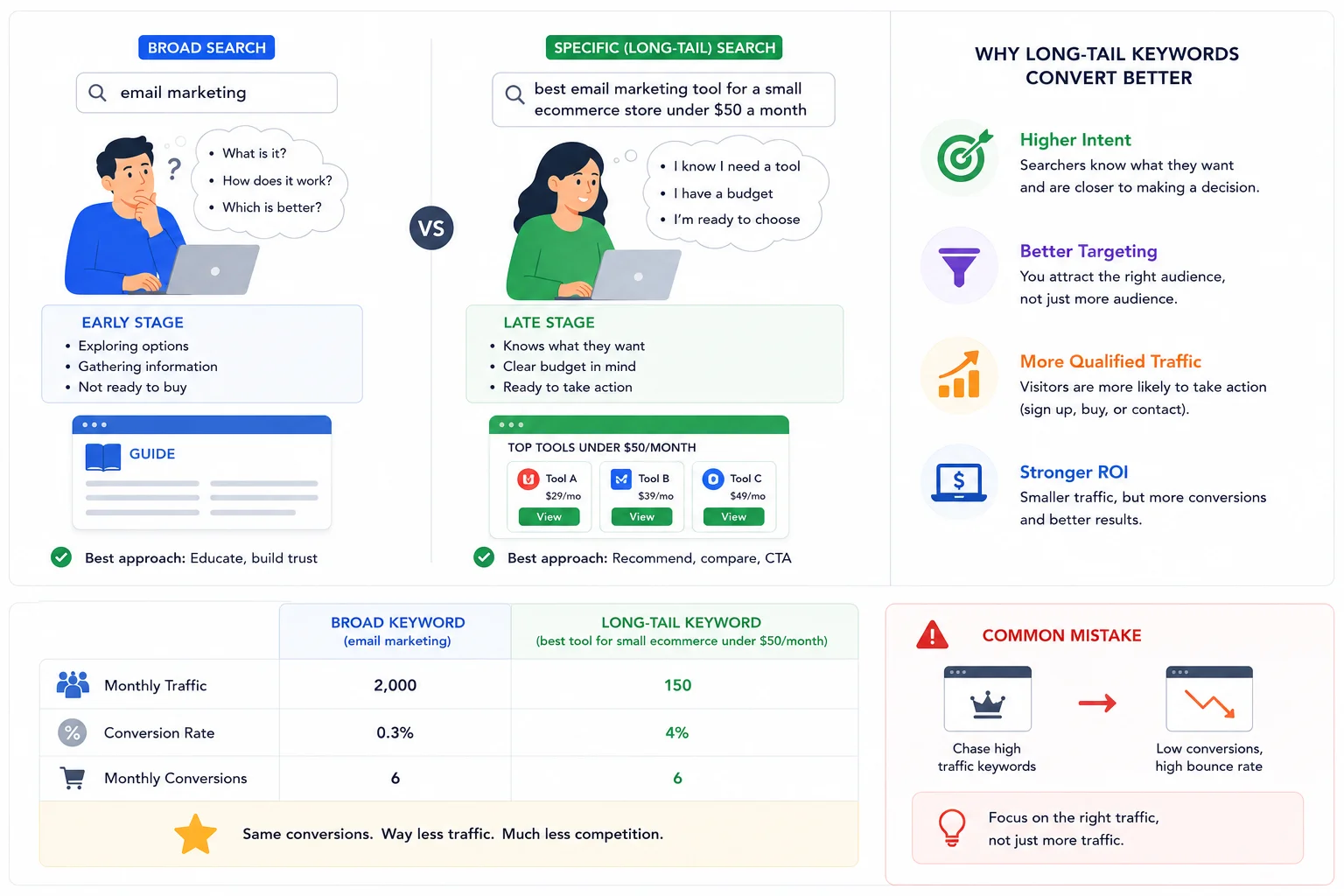
The logic comes down to buying stage. Someone searching a broad term is usually early. They’re exploring, comparing categories, sometimes just curious. Someone searching a specific term has usually already done some of that exploring in their head. They know what they want, or close to it, and they’re looking for confirmation or a way to actually get it.
Here’s where a lot of sites shoot themselves in the foot. They rank for a broad term, get a flood of visitors, and then wonder why almost nobody converts. The mismatch is the problem. If someone searches “email marketing” and lands on a page trying to sell them a $200-a-month tool, most of them bounce. They weren’t ready for that. They were still figuring out what email marketing even involves.
Now flip it. Two searchers, two completely different mindsets. One searches “email marketing,” and honestly, the best thing you can do for them is educate, not sell. The other searches “best email marketing tool for a small ecommerce store under $50 a month,” and that person is basically raising their hand. They’ve already decided they want a tool. They’ve got a budget ceiling in mind. Show them a comparison, a clear recommendation, a straightforward CTA, and you’re speaking directly to where they already are.
This is exactly why long-tail traffic tends to matter so much for ecommerce, SaaS free trials, service businesses, and anything involving a lead form. A visitor who typed a specific, intent-loaded phrase into Google is doing half your sales job for you before they even land on the page. Broad traffic might look good in an analytics dashboard. Specific traffic is what actually shows up in the revenue numbers.
There’s a trap worth naming here too. It’s tempting to look at a broad keyword’s traffic number and get excited, then look at a long-tail keyword’s traffic number and feel underwhelmed, without ever checking what either group of visitors actually did once they landed. A page pulling in 2,000 visits a month with a 0.3 percent conversion rate is producing six conversions. A page pulling in 150 visits a month with a 4 percent conversion rate is producing six conversions too, with a fraction of the traffic and, usually, a fraction of the competition it took to get there. Same outcome, wildly different amount of effort required to get it. That’s the whole argument in one comparison.
Long-Tail Keywords in Paid Search
Most content on this topic barely touches paid search, which is a little wild considering how directly long-tail thinking applies to running ads. If anything, the case for long-tail keywords is even more obvious once money’s involved, because you can watch the cost differences happen in real time inside a Google Ads account.
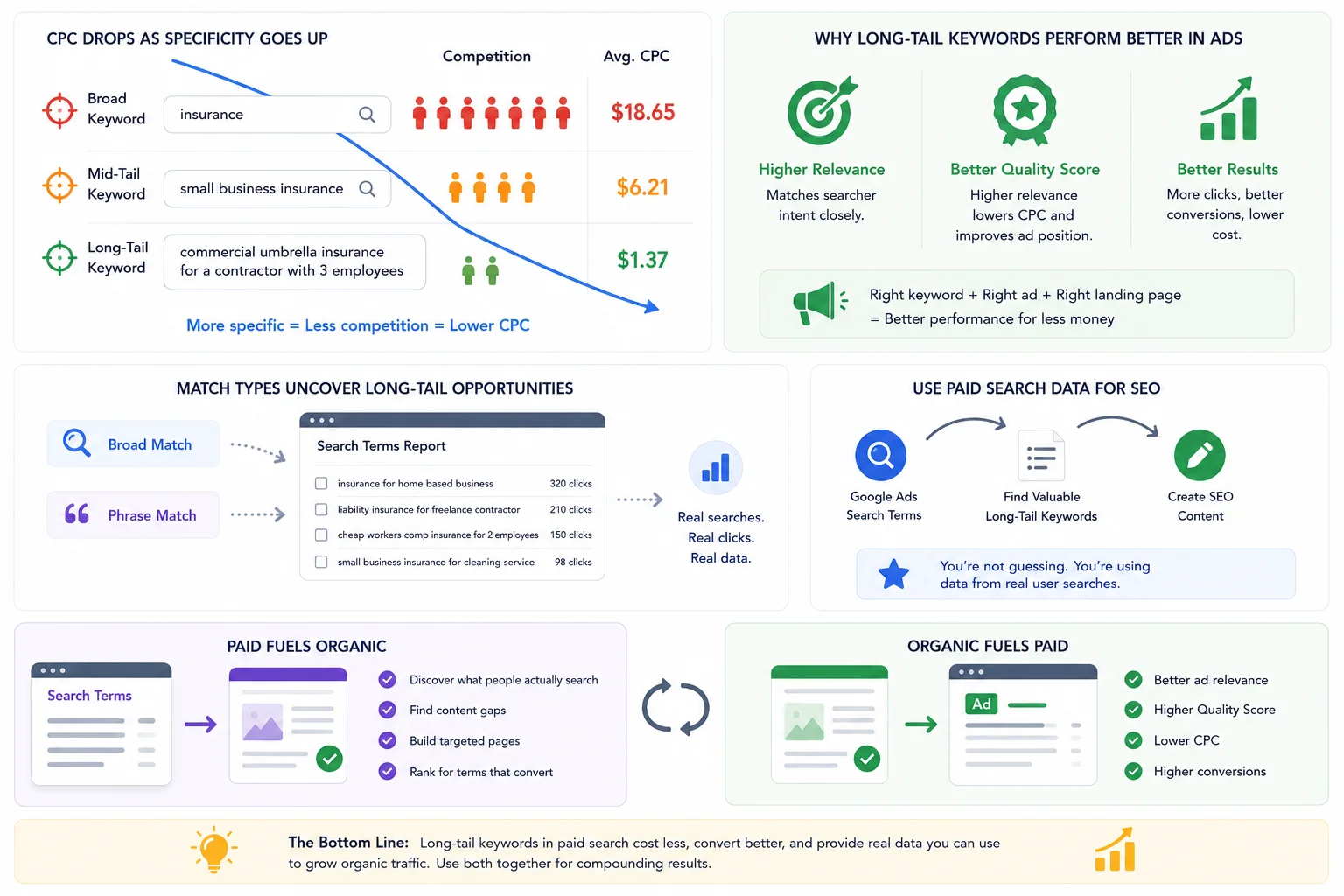
Cost per click drops as specificity goes up, and it’s not subtle. A broad term like “insurance” gets bid on by every insurance company with a marketing budget, so the auction price gets pushed sky high. A specific term like “commercial umbrella insurance for a contractor with 3 employees” has maybe a handful of advertisers even bothering to target it, if that. Less competition in the auction means a lower cost per click, plain and simple. Nobody’s outbidding you for a phrase they don’t even know exists as a keyword opportunity.
Quality Score plays into this too. Google rewards ads and landing pages that closely match what someone’s actually searching for. A specific keyword paired with a landing page built around that exact intent tends to score better on relevance, which lowers the cost to show up and can improve ad position without needing to outbid everyone else. Broad, generic keywords paired with a broad, generic landing page rarely score as well, because the match between intent and content is weaker.
Match types matter here too. Broad match and phrase match campaigns naturally surface a flood of long-tail search terms nobody explicitly bid on, because Google’s matching them to related queries. This is actually useful, not just a source of wasted spend if you’re paying attention. Pull the search terms report regularly and you’ll find real, live long-tail phrases that actual people are typing right now, complete with impression and click data proving demand exists.
Here’s a tactic that almost nobody talks about, and it’s genuinely one of the more useful crossovers between paid and organic: mine the Google Ads search term report as a long-tail keyword research tool for your SEO content plan. That report shows exactly what people search before they see your ad. If a phrase is showing up there with decent volume and it’s not something you’re actively targeting on the content side, that’s a gap. Paid search data is basically free keyword research that’s already been validated by real user behavior, and it feeds straight back into building a stronger organic content plan.
There’s a compounding effect worth pointing out too. Every long-tail keyword an SEO team pulls from organic content also tends to make paid campaigns cheaper and sharper, and it works the other way just as well. A campaign running for a few months builds up a search term report full of real phrases, real click-through rates, and real conversion data. That’s not a hypothesis about what people might search. That’s proof. Handing that list to whoever’s writing content means they’re not guessing at what to cover; they’re building around demand that’s already been measured in an ads account. Most agencies also incorporate these insights into SEO reporting to connect paid and organic performance, making it easier to identify trends, justify strategy, and highlight measurable growth. Most agencies keep these two functions in separate silos, which is a waste, because the overlap between them is where a lot of the easiest wins are sitting.
Long-Tail Keywords and AI Search
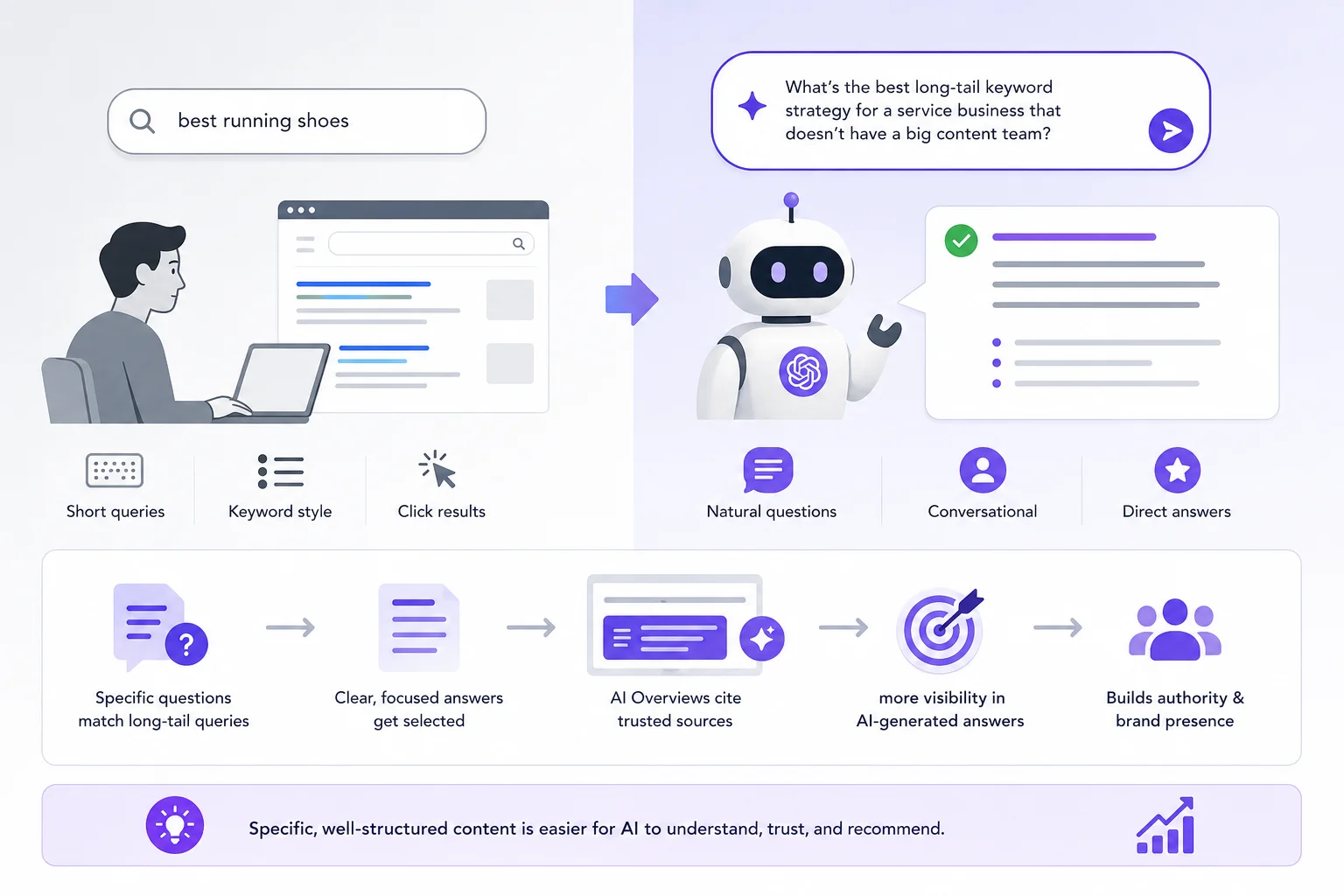
This is the part of the conversation that’s shifting fast, and treating it as a footnote the way a lot of older articles do just doesn’t hold up anymore. AI Overviews and AI chat tools didn’t kill long-tail keywords. If anything, they made them more important, not less.
Think about how people actually type into ChatGPT or ask Google’s AI features a question versus how they used to type into a plain search box. Old-school search behavior trained people to type fragments. “Best running shoes.” “Cheap flights Delhi.” Short, clipped, keyword-style. AI tools invite the opposite. People type full, natural, specific questions, because the tool is built to actually understand and answer them. “What’s the best long-tail keyword strategy for a service business that doesn’t have a big content team” is a completely reasonable thing to type into an AI chat window. Nobody would’ve typed that into Google in 2015.
That shift plays directly into long-tail territory. Conversational, specific queries are exactly the shape of query that long-tail content has always been built to answer.
There’s also a structural shift happening in what gets rewarded. Ranking for a term used to mean showing up on a results page and getting a click. Now, a growing share of the game is about being the source that actually gets cited or pulled into an AI-generated answer. That favors content that answers one specific question clearly and directly, way more than it favors a broad, sprawling page trying to cover everything about a topic in a vague way. Specific, well-structured, question-and-answer style content is naturally suited to being extracted and used by these systems, because it’s already shaped like an answer instead of a wall of general information.
This isn’t a trend worth waiting out or hedging around. Search behavior is already moving this direction, and long-tail thinking happens to line up almost perfectly with where it’s headed.
There’s a slightly uncomfortable side to this worth being honest about. Getting cited inside an AI answer doesn’t always send a click back to the site the way a normal search result did. Someone gets their answer right there in the chat window and moves on. That’s a real shift, and it’s changing how some businesses think about what a “win” even looks like in search. But the flip side is that broad, generic content is getting squeezed out of that space entirely, while specific, well-answered long-tail content is exactly what these systems reach for when they need a reliable source. Being invisible to that layer of search isn’t really an option going forward, so building content that’s structured to be understood and pulled cleanly, clear headers, direct answers, no fluff before the point, matters more now than it did when the only goal was a blue link and a click.
How to Find Long-Tail Keywords
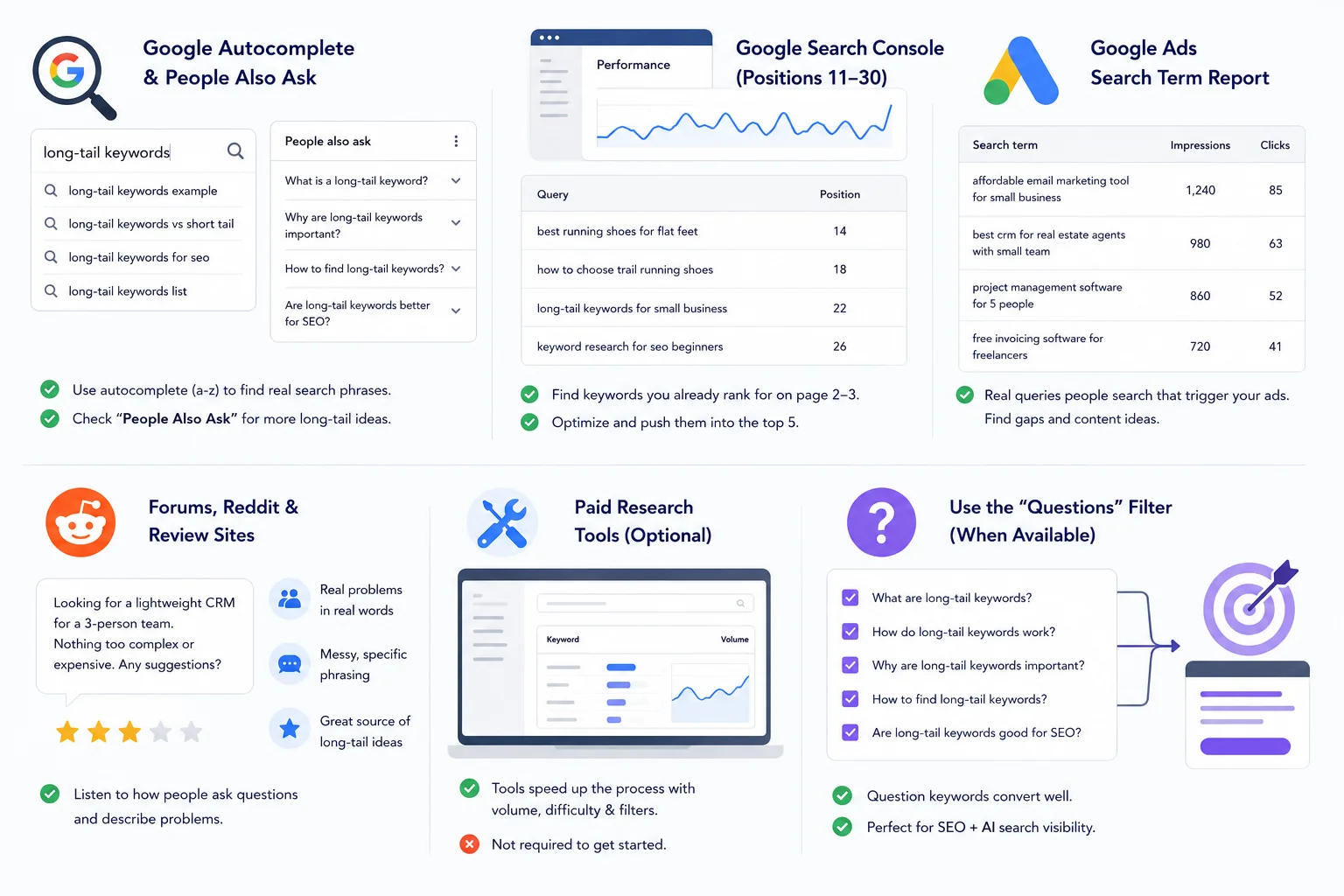
Enough theory. Here’s where to actually go looking, and none of this requires an expensive tool subscription to get started, though tools help once you’re scaling this up.
- Google autocomplete and “People Also Ask.” Start typing a broad term into Google and watch what it suggests. Those are real queries, based on real search behavior, served up for free. Try typing the same starting phrase with a letter after it, “long-tail keywords a,” then “long-tail keywords b,” and so on down the alphabet. It sounds tedious, and honestly it kind of is, but it surfaces phrasing patterns that never show up in a standard keyword tool. The “People Also Ask” boxes on a results page are another goldmine, and they often reveal exactly the kind of definitional or underserved long-tail phrasing worth targeting. Click into a few of those boxes too, because expanding one often loads a few more related questions underneath it.
- Google Search Console, positions 11 to 30. This one gets mentioned in passing a lot, but it deserves more attention than it usually gets. Go into the Performance report, sort by position, and scroll to where you’re ranking on page two or three. Those are keywords your site already has some relevance for, according to Google, but hasn’t fully earned a top spot on yet. That’s about as close to a sure thing as keyword research gets, because the demand and partial relevance are already proven. A page sitting at position 14 for a decent-volume long-tail term usually just needs a stronger, more thorough answer to push into the top five, not a total rebuild.
- Google Ads search term reports. Already covered above, but worth repeating here as a research source in its own right. If you’re running any paid campaigns at all, this report is sitting there with real, validated long-tail phrases people are already searching. Sort by impressions or clicks and look for phrases that aren’t already a dedicated keyword in the account. Those are usually the most interesting ones.
- Forums, Reddit threads, review sites. People don’t write in keyword-tool language on Reddit. They write in real, messy, human phrasing, which is often exactly how long-tail searches look. Scan threads related to your niche and pull out the specific phrasing people use to describe their problems. Review sites work the same way, especially the middle-of-the-road reviews, the three-star ones where someone explains exactly what almost worked and what didn’t. That kind of specific frustration turns into great long-tail content.
- Paid research tools as a category. Tools like this can speed up the process significantly, especially for surfacing volume data and filtering by difficulty, but they’re not mandatory to get started. They’re an accelerant, not a requirement. If budget’s tight, lean harder on Search Console and Ads data first, since both are already sitting inside accounts most businesses already have.
- The “Questions” filter, wherever it’s available. Long-tail keywords phrased as actual questions tend to convert well and line up naturally with how AI search engines pull answers. If a research tool has a questions filter, it’s worth checking regularly, because that phrasing style is only becoming more relevant, not less.
How to Prioritize and Cluster Long-Tail Keywords
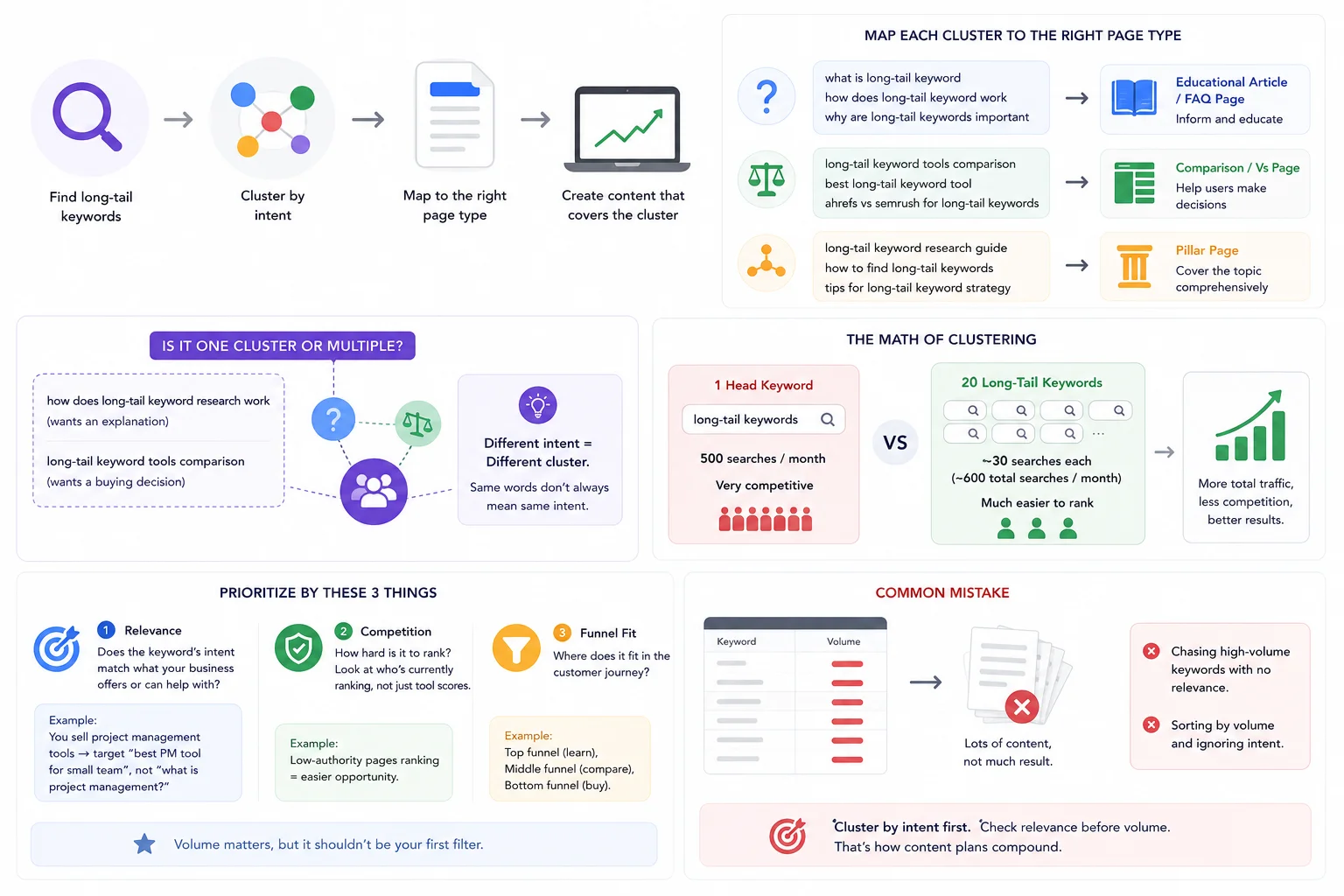
Finding keywords is the easy part. Most people stop right there, which is honestly the biggest strategic mistake in this whole process. Targeting one long-tail keyword per page doesn’t scale, and it wastes a huge amount of the actual opportunity sitting in front of you.
The better approach is clustering by intent, not just by topic. Grouping keywords by topic alone can still leave you with a mess, because two keywords about the same topic can reflect completely different intent. “How does long-tail keyword research work” and “long-tail keyword tools comparison” are both about long-tail keywords, sure, but one wants an explanation and the other wants a buying decision. Group by what the person actually wants to walk away with, not just by shared vocabulary.
Once clustered, map each group to the right page type. A cluster full of “what is” and “how does” questions belongs on an educational article or an FAQ page. A cluster full of comparison-style queries belongs on a comparison page or a versus-style article. A cluster covering a whole topic broadly, with dozens of related sub-questions, is a strong candidate for a pillar page like this one, something built to rank for the main term while naturally absorbing dozens of long-tail variations underneath it.
A quick way to sanity-check the mapping: read the cluster of keywords out loud and ask what a single searcher would actually want to see after typing any one of them. If the answer changes wildly from keyword to keyword within the same cluster, it’s probably not one cluster, it’s two or three that got lumped together by accident. This happens a lot with keyword tools that group purely by shared words. “Long-tail keyword tool,” “long-tail keyword tool free,” and “long-tail keyword tool vs Ahrefs” look related on the surface, but the third one wants a comparison, not a how-to guide, and forcing it onto the same page as the first two usually means neither intent gets served particularly well.
Here’s the math that makes clustering worth the effort. Say there’s a single keyword getting 500 searches a month, but it’s brutally competitive and realistically out of reach for a while. Compare that to a cluster of twenty related long-tail keywords, each getting about 30 searches a month, adding up to roughly 600 total. Individually, none of those twenty keywords look impressive. Together, on one well-built page, they can outperform the single big keyword, and they’re dramatically easier to actually rank for because almost nobody’s bothered to target them individually.
Prioritization comes down to three things, roughly in this order. Does the keyword’s intent actually match something the business offers or can genuinely help with. How much competition exists for it, based on a real look at who’s currently ranking, not just a difficulty score from a tool. And does it fit somewhere useful in the funnel, whether that’s early education or a bottom-of-funnel decision point. Volume matters, but it shouldn’t be the first filter. A high-volume keyword with zero business relevance is a waste of a content slot no matter how tempting the number looks.
Worth saying plainly: this is where most content plans quietly fail. Someone builds a spreadsheet with two hundred keywords, sorted by volume, and starts writing down the list top to bottom. Six months in, there’s a pile of content and not much to show for it, because half those keywords never had any real business relevance to begin with, they just looked big. Clustering by intent first and checking relevance before volume is slower to set up but it’s the difference between a content plan that compounds and one that just produces word count.
Using Long-Tail Keywords in Content Without Keyword Stuffing
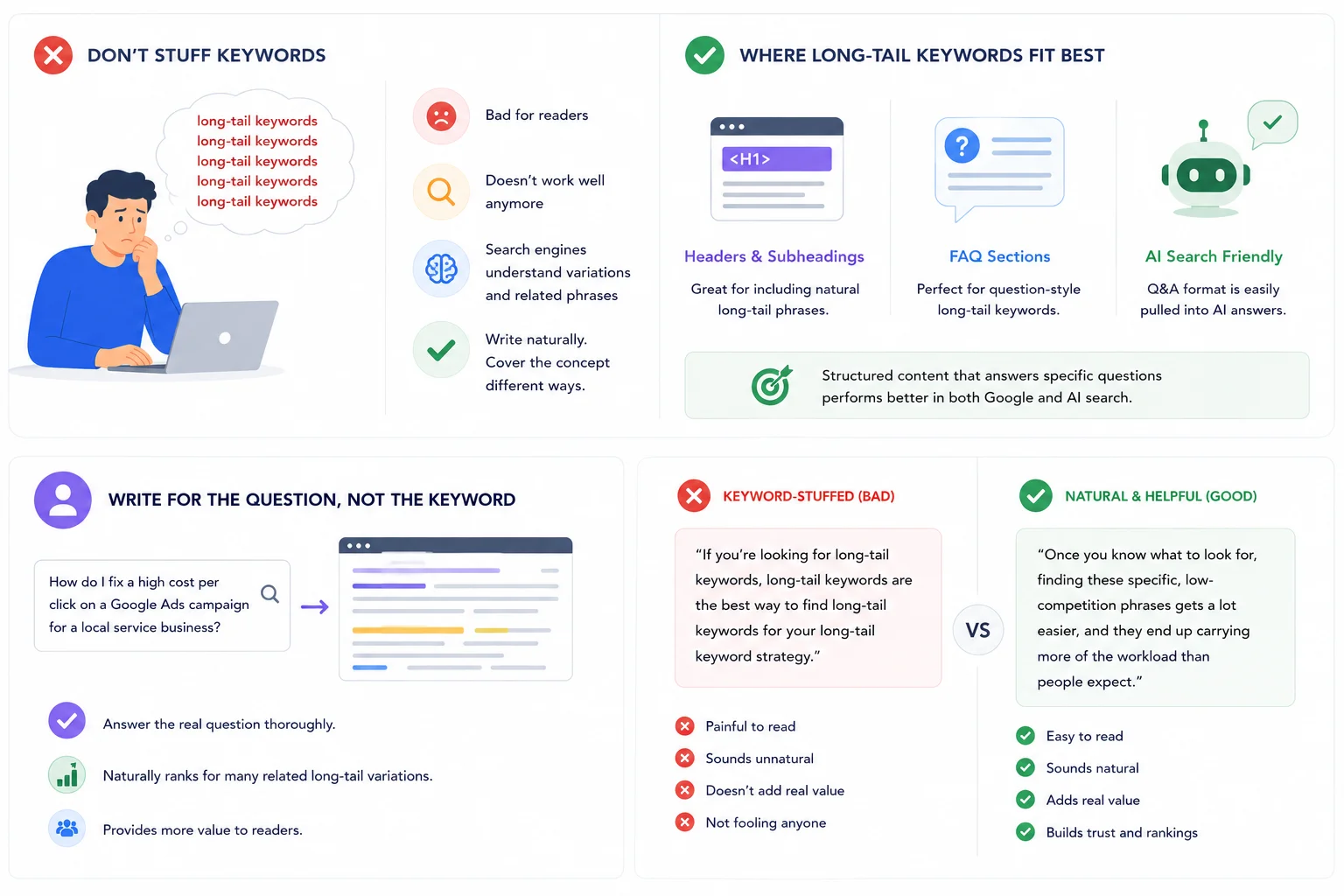
Here’s a mistake that used to be way more common but still shows up constantly. Someone finds a great long-tail keyword and then tries to jam the exact phrase into the content five or six times, word for word, like Google’s still running an algorithm from 2009.
That approach doesn’t just look bad to a reader, it doesn’t even work particularly well anymore. Search engines have gotten a lot better at understanding variations, synonyms, and related phrasing without needing the exact string repeated over and over. Write naturally, use the concept in a few different ways throughout the piece, and the coverage happens without the content sounding like it was written by a keyword-stuffing bot.
Long-tail phrasing tends to belong most naturally in headers, subheadings, and FAQ-style sections, because those spots are already structured like direct questions and answers. That’s also exactly the format AI search tools tend to favor when pulling content into their responses, so it does double duty.
The better mental model is this: write for the actual question someone’s asking, not for the keyword string sitting in a spreadsheet. If the content genuinely and thoroughly answers “how do I fix a high cost per click on a Google Ads campaign for a local service business,” it’s going to naturally pick up a long list of related long-tail phrasings without anyone forcing a single one of them in. Chasing the real question does more for keyword coverage than chasing the keyword itself ever will.
A quick side-by-side makes the difference obvious. A stuffed version might read something like, “If you’re looking for long-tail keywords, long-tail keywords are the best way to find long-tail keywords for your long-tail keyword strategy.” That’s painful to read and it’s not fooling anyone, algorithm or human. A natural version says something like, “Once you know what to look for, finding these specific, low-competition phrases gets a lot easier, and they end up carrying more of the workload than people expect.” Same idea. Actually readable.
Conclusion
Long-tail keywords aren’t the fallback option for sites that can’t compete for the big terms. That framing gets it backwards. They’re where most of the actual search behavior lives, where intent is clearest, and where a smaller site or a newer domain has a genuine shot at ranking without waiting years to build authority. The head terms get all the attention in meetings because the volume number looks impressive on a slide, but the tail is where the traffic actually adds up and where it actually converts.
Whether it’s organic content, paid campaigns, or the growing pull of AI-driven search, all three reward the same underlying skill. Understanding specific intent better than the competition does, and building something that actually answers it. That’s not a trick or a hack. It’s just paying attention to what people are actually asking, instead of guessing at what they might be interested in.
None of this requires a massive budget or a huge content team to start. It requires actually looking at the data that’s already sitting in Search Console and Google Ads, being willing to write for ten searches a month instead of holding out for ten thousand, and being honest about whether a keyword actually connects to something real the business offers. Do that consistently, and the traffic shows up. Slower than chasing a viral head term might feel, sure, but it sticks around, and it converts a lot better once it arrives.
Frequently Asked Questions
Is a long-tail keyword always more than three words?
No. Length is common but not the actual definition. A short phrase with low search volume can still be long-tail, and a longer phrase with high volume isn’t.
Do long-tail keywords really convert better than short-tail keywords?
Generally, yes, because the searcher’s intent is clearer and often closer to a decision point. That said, conversion still depends on whether the content or offer actually matches what the searcher wants.
How many long-tail keywords should one page target?
There’s no fixed number, but a well-built page built around a cluster of related, intent-matched long-tail phrases usually outperforms a page trying to force one narrow keyword by itself.
Can long-tail keywords work for a brand-new website with no authority?
Yes, and it’s often the fastest realistic path to early traffic. Lower competition means a newer site has a real shot at ranking, instead of trying to compete directly against established sites for high-volume head terms.
Does AI search make long-tail keywords less important?
The opposite. Conversational, specific queries are exactly what AI-driven search tools are built to handle, which makes long-tail, question-style content more relevant, not less.