

Picture this. Someone’s car breaks down on a Tuesday afternoon in a city they don’t live in. They don’t call a friend for a recommendation because there’s no friend to call. They pull out their phone, type “mechanic near me,” and pick from whatever Google shows them in the next ten seconds. Three businesses show up with a map. One of them gets the call. The other two just lost a customer they never even knew existed.
That’s local SEO in a nutshell. Not some abstract ranking game, just the difference between being the business that gets found and the one that doesn’t. And honestly, most business owners still treat it like an afterthought, something you set up once and forget about, like a fax machine nobody unplugs. That’s a mistake. Local search is where real money changes hands, right now, today, for businesses that show up when it counts.
“46% of all Google searches have local intent. Nearly one in every two searches typed into Google is someone looking for something nearby, right now.”
This guide walks through exactly how local search ranking works, what actually moves the needle, and what’s mostly noise. No fluff, no vague “boost your visibility” nonsense. Just the mechanics, laid out the way they actually work, with real numbers behind the claims instead of borrowed confidence.
What Local SEO Actually Is
Local SEO is the process of getting your business to show up when someone searches for something near them. That’s the plain version. But the mechanics behind it are genuinely different from regular SEO, and that’s where a lot of business owners get tripped up, usually after paying someone to “do SEO” for six months with nothing to show for it.
Regular SEO cares about matching content to intent, wherever the searcher happens to be sitting. Write a great guide on “how to fix a leaky faucet,” and it can rank in Chicago, Mumbai, or Sydney, because location genuinely doesn’t matter to that searcher. Local SEO flips that entirely. The whole point is location. When someone searches “emergency plumber Colorado Springs,” they’re not looking for a DIY tutorial. They want a real person to physically show up at their house in the next hour.
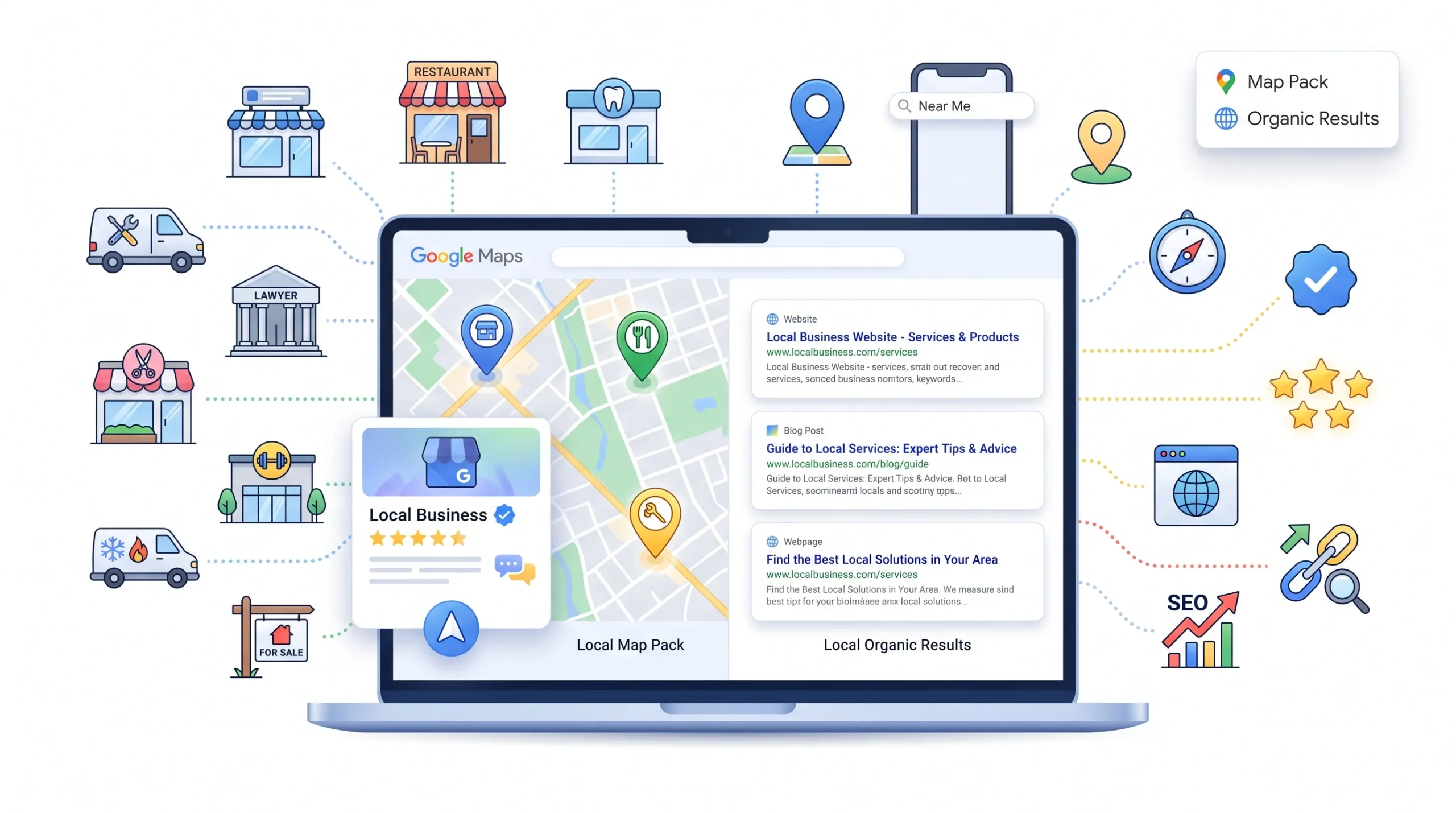
Here’s the part that trips a lot of people up: local SEO isn’t one ranking system, it’s two running side by side, and treating them as one thing is where most local SEO efforts quietly fail.
| Ranking Surface | What It Is | What Drives It |
|---|---|---|
| Map Pack (Local Pack) | The 3 business listings with a map, shown above regular results | Google Business Profile completeness, proximity, reviews |
| Local Organic Results | Regular search listings, filtered by geographic relevance | On-page content, backlinks, site authority, technical SEO |
Both matter. Both have different rules. A business can dominate the Map Pack and barely show up in organic results, or the reverse. Anyone telling you it’s “just one thing to optimize” hasn’t actually looked closely at how these two results behave differently on the same search.
Who actually needs this? Any business tied to a physical location or a defined service area. Restaurants, dentists, plumbers, law firms, gyms, salons, HVAC companies, real estate agents, you name it. If a customer has to physically reach you, or you have to physically reach them, local SEO isn’t optional. If you’re running a purely digital product with no geographic tie at all, most of this playbook doesn’t apply. Different game, different rules.
Why Local SEO Matters for Your Business
Paid ads work. Nobody’s arguing otherwise. But paid traffic stops the exact second the budget runs dry. Local SEO compounds instead. A well-built Google Business Profile and a steady flow of reviews keep working for you months and years later, without a daily spend attached to it.
“76% of people who search for a local business on their phone visit that business within 24 hours. 28% of those visits end in a purchase.”
That single stat should change how any local business thinks about its online listing. This isn’t someone browsing for inspiration three months out. This is someone who’s already decided they need a service today, and they’re choosing between whoever shows up in front of them.
The intent behind local searches is sharper too, and that’s the part people consistently underestimate. Someone typing “pest control near me” isn’t window shopping. There are ants in the kitchen right now. That urgency means faster conversions, and it often means whoever shows up first simply wins the business without a second thought. Nobody scrolls to page two when they need a plumber in the next twenty minutes.
There’s a competitive angle here that’s easy to ignore until it costs real money. If competitors already show up in the map pack and a business doesn’t, that business is invisible by default in the exact moment someone was ready to buy. And if competitors haven’t caught on yet, that’s the opening. Getting ahead while the competition is still asleep on this is a lot easier than catching up once they wake up and start investing.
A few reasons local SEO consistently outperforms other channels for location-based businesses:
- It targets people already close enough to actually become a customer, so almost none of the traffic is wasted on people outside the service area
- It captures people at the exact moment of need, not weeks before they’re ready to decide
- It builds credibility through reviews and citations that keep compounding, unlike an ad that stops the moment spending stops
- It costs a fraction of paid search for the same visibility once the foundational work is done
How Google Actually Ranks Local Businesses
The Three Core Ranking Factors
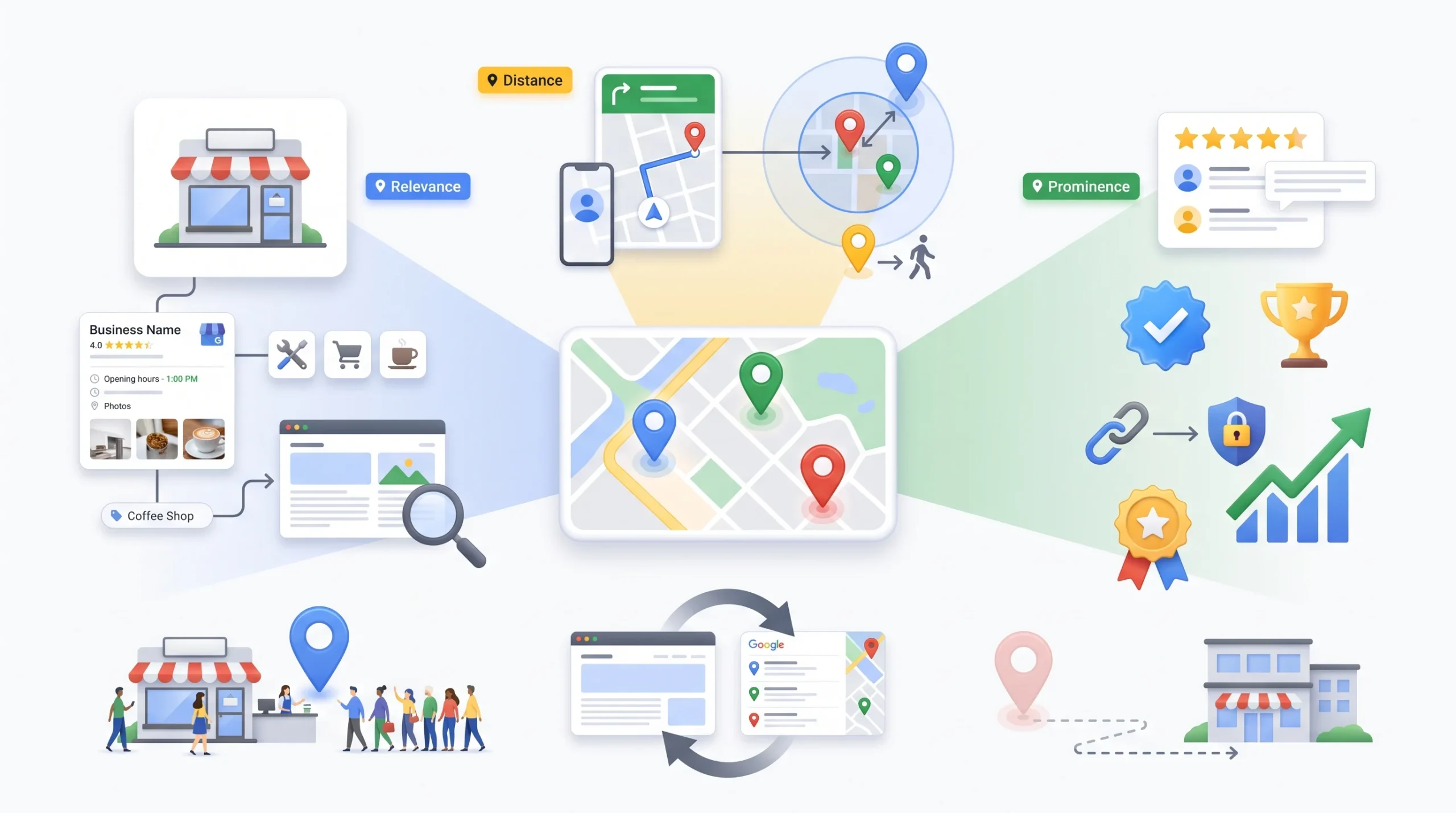
Google has said plainly that local ranking comes down to three things: relevance, distance, and prominence. Not exciting, not a secret formula, but it’s the actual mechanism, and every tactic covered later in this guide eventually traces back to one of these three.
| Factor | What It Means | What Influences It |
|---|---|---|
| Relevance | How well the business matches the search | Category selection, business description, services listed, on-page content |
| Distance | Physical distance between business and searcher | Business address, service area settings (fixed, not something SEO can change) |
| Prominence | How well-known and trusted the business is | Reviews, backlinks, citations, general online and offline recognition |
Relevance is how well your business matches what someone searched for. This is exactly why category selection matters so much, and why a complete, detailed business profile helps Google understand precisely what you actually do instead of guessing.
Distance is exactly what it sounds like: how far the business is from the person searching, or from the location mentioned in the search itself. There’s no clever workaround here. It’s physics, not marketing.
Prominence is essentially your reputation, online and off. Reviews, backlinks, general recognition all feed this. A well-known local landmark or a business with genuine buzz behind it gets a prominence boost that a brand-new, anonymous storefront simply hasn’t earned yet.
Debunking the “SEO Will Beat Proximity” Myth
Here’s something a lot of local SEO content won’t say plainly, probably because it’s not a great sales pitch: if a business is 30 miles from the searcher and a competitor is 5 miles away, no amount of on-page optimization is pushing that business above the closer one for that particular search. Distance is a hard constraint. SEO can influence relevance and prominence, but it cannot erase geography. Anyone promising a package that overrides proximity for every search is overselling what’s actually possible. Better to know that going in than get disappointed three months into a campaign that was never going to close that gap.
How Local Pack Ranking Differs from Organic Local Ranking
The Map Pack leans heavily on Google Business Profile completeness, review signals, and proximity. Local organic results behave more like traditional SEO: on-page content quality, backlinks, overall site authority, and technical health. Same business, two genuinely different games, and a smart strategy plays both instead of picking one and hoping it covers everything else by accident.
Google Business Profile: The Foundation
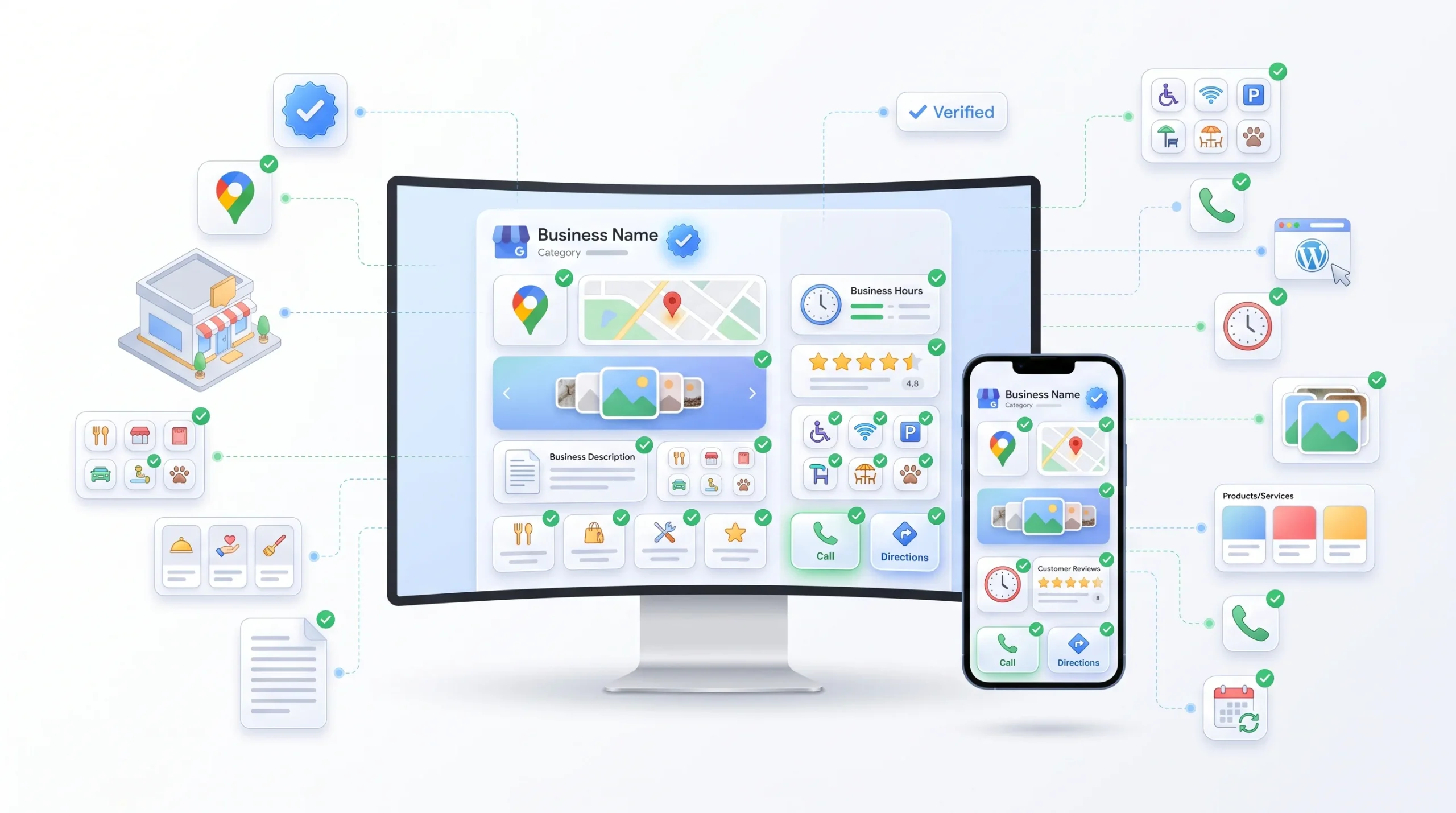
If there’s one section of this guide worth sitting down and actually doing properly today, it’s this one. Google Business Profile, GBP for short, is the single biggest lever for local ranking, full stop. An incomplete or inaccurate profile is, hands down, the most common reason small businesses just don’t show up, and it’s usually the easiest one to fix.
Claiming and Verifying Your Profile
Sounds obvious, but plenty of businesses either never claimed their profile or left an old employee’s email sitting as the account owner for years after that person left the company. Claim it, verify it through Google’s process (postcard, phone, or email, depending on business type), and make sure whoever’s actually running marketing has real access to it. Losing access to an unverified or improperly claimed profile turns into a genuine nightmare to recover later.
NAP Consistency (Name, Address, Phone)
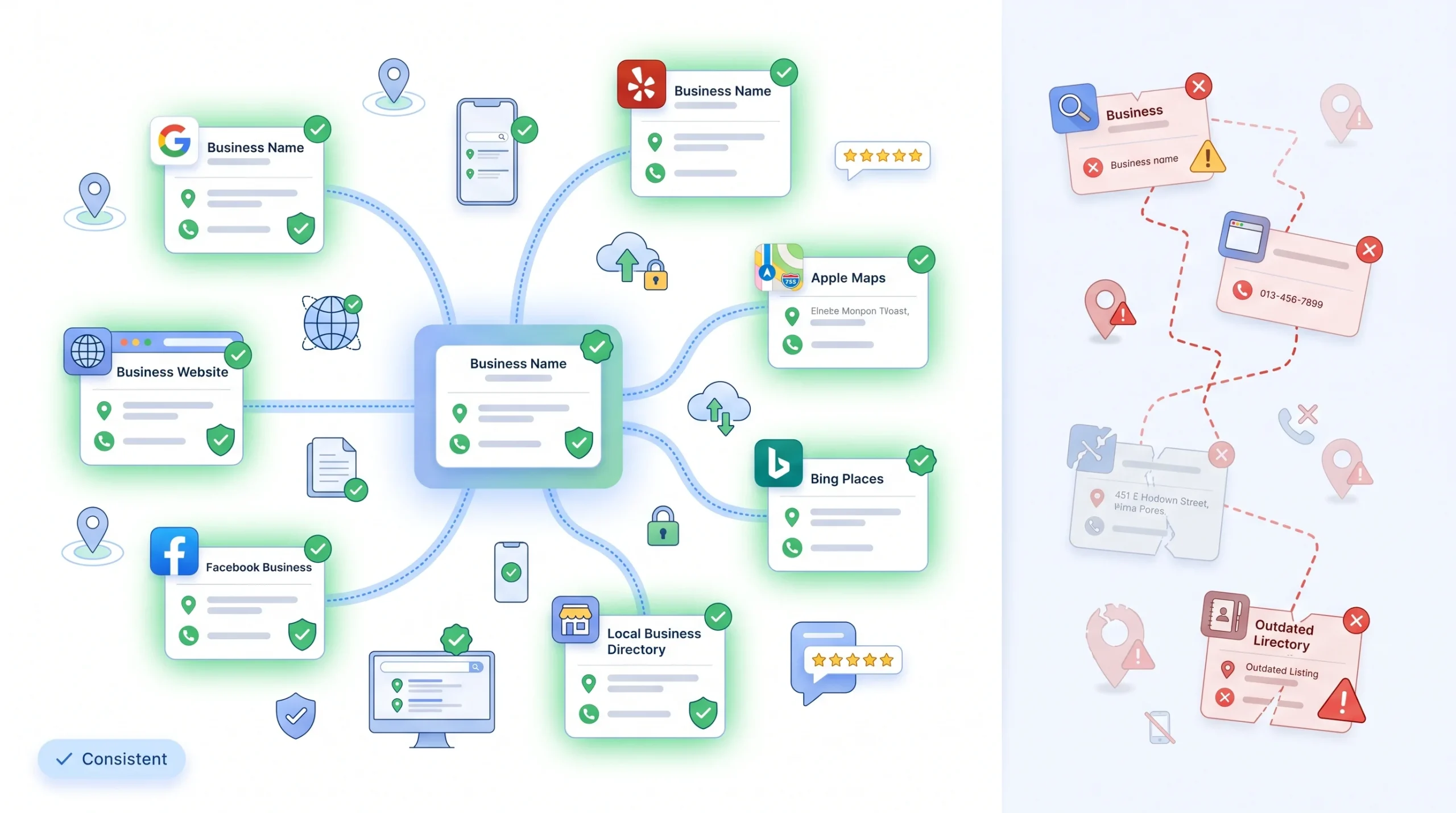
NAP stands for Name, Address, Phone number, and getting this wrong quietly tanks rankings without any obvious warning sign showing up. If a business is listed as “Smith’s Plumbing LLC” on the website, “Smith Plumbing” on Yelp, and an old address on Yellow Pages, Google has a harder time confirming this is one stable, legitimate business rather than three different ones. Consistency across every platform where the business appears isn’t a nice-to-have. It’s foundational trust-building for the algorithm, and it costs nothing but a bit of cleanup time.
Choosing Your Categories
This one gets skipped constantly, and it really shouldn’t be. The primary category is arguably the single strongest relevance signal a business controls directly. A business listed simply as “Restaurant” competes with every restaurant in the city. A business listed as “Thai Restaurant” outranks the generic listing for Thai food searches specifically, because it’s a far more precise match to what the searcher typed.
- Pick the most specific primary category available, not the broadest one that technically fits
- Add secondary categories for genuine additional services offered, but don’t pad the list with categories that don’t really describe the business
- Revisit categories periodically. Google adds new, more specific categories over time, and an old profile might be missing a better option that simply didn’t exist when it was first set up
Business Description, Attributes, and Services List
The description is where the business gets to talk in plain language about what it does, who it serves, and what actually makes it worth choosing over the place next door. Skip the copy-paste corporate language here. Write it the way you’d explain the business to a new neighbor over the fence. Attributes (things like “wheelchair accessible” or “outdoor seating”) and a fully filled-out services list round out the relevance signals Google is pulling from behind the scenes.
Photos and Visual Content
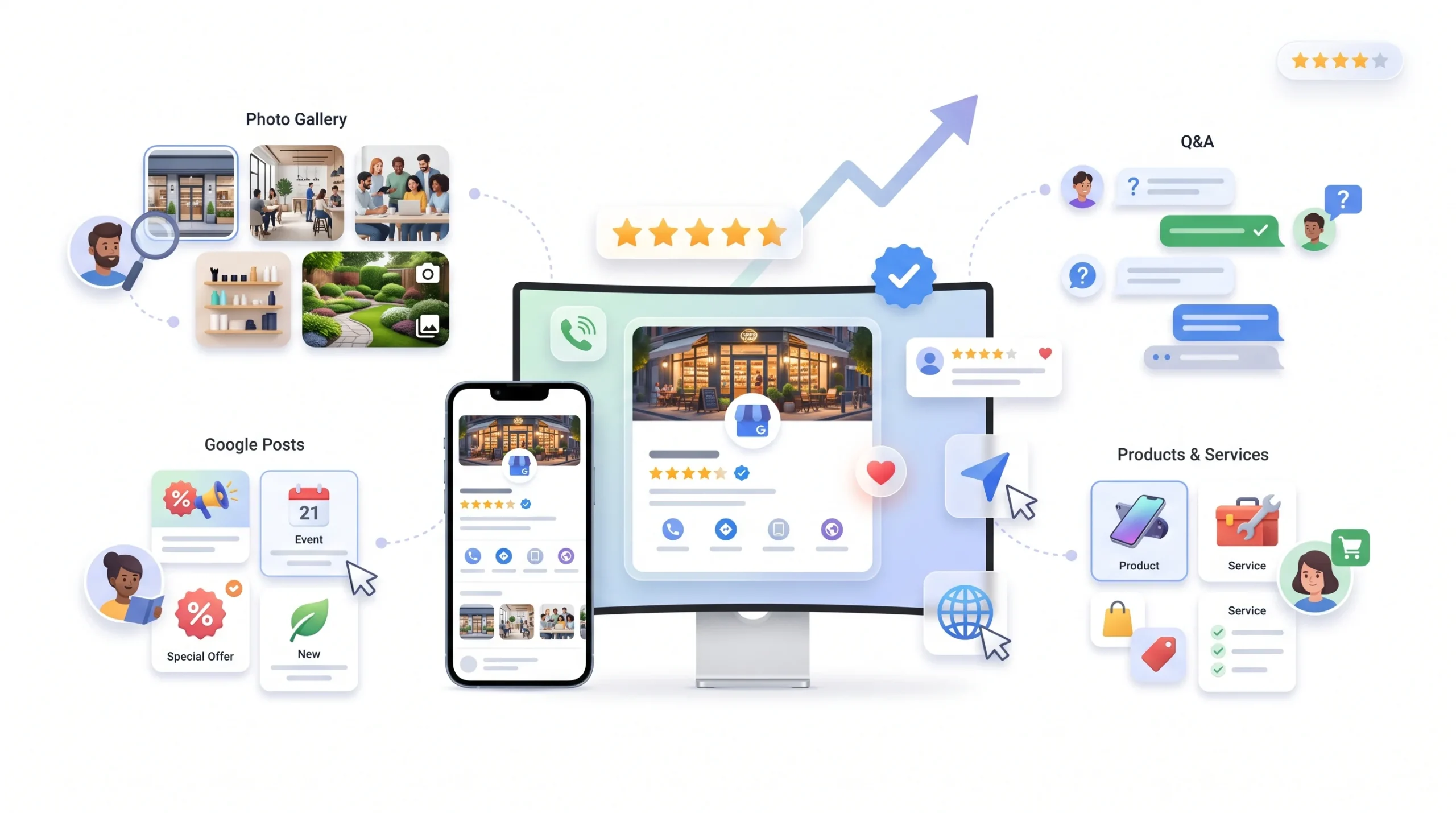
Photos aren’t decoration, they’re a direct engagement driver, and the data backs this up clearly.
“Businesses with more than 100 photos on their Google Business Profile receive 520% more calls and 2,717% more direction requests than the average business.”
Those aren’t small numbers. Upload real photos: the storefront from outside, the inside on a normal Tuesday, the team actually working, the product or the completed job. Update them regularly. A profile with photos from three years ago quietly signals stagnation, whether or not that’s a fair read of the actual business.
Google Posts
Posts function a lot like a mini social feed inside the GBP listing. Offers, events, updates, new arrivals, all of it. It’s a low-effort way to tell Google, and the searcher, that the business is active and paying attention rather than running on autopilot. Businesses that post consistently look more alive in the listing than ones that set it up once and never touched it again.
Q&A Section Management
The Q&A section on GBP is public, and anyone can post a question or an answer, including people with zero affiliation to the business. Left unmonitored, a listing can end up with outdated or flat-out wrong answers sitting right at the top for months. Seed it with the real, common questions customers actually ask, and answer them accurately yourself. Check back periodically. It’s easy to forget this section exists until something wrong shows up in it during a bad week.
Products/Services Showcase
For retail businesses especially, showing actual in-store products through GBP lets searchers see what’s available before they even click through to the website. Service businesses can list specific offerings with pricing where that makes sense. Either way, it gives Google more concrete detail to match against real searches, and gives the searcher a reason to trust the listing enough to actually click it.
Common GBP Mistakes That Suppress Rankings
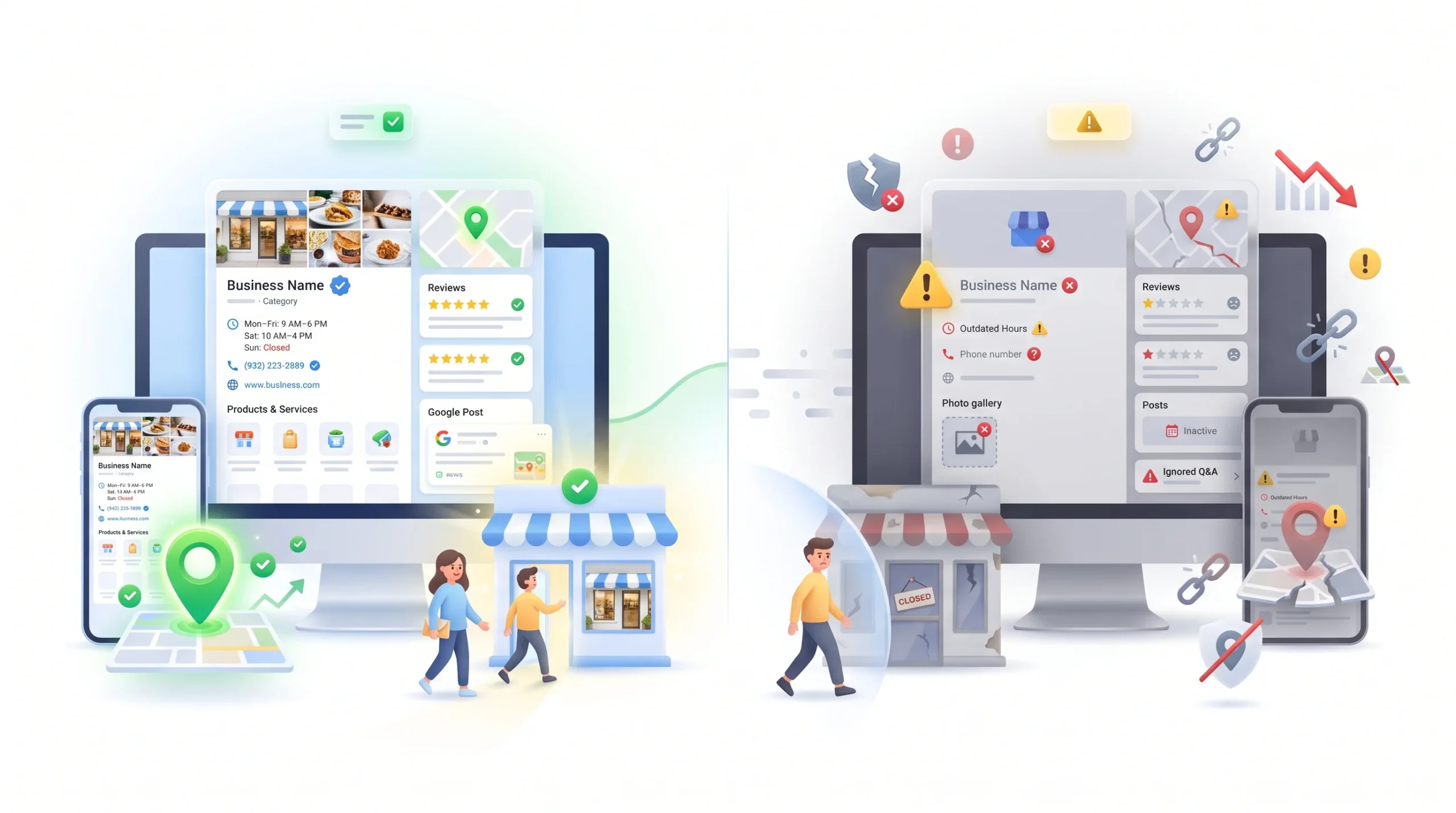
- Keyword-stuffing the business name field, adding something like “Best Chicago Plumber 24/7” to the actual registered name, which violates Google’s guidelines directly and risks suspension
- Leaving hours outdated, especially around holidays, which frustrates customers who show up to a closed door
- Ignoring suggested edits from random users that quietly introduce wrong information into the listing
- Using a PO box or virtual office address for a business type that actually requires a real physical location
- Letting the profile sit completely untouched for months at a time, no posts, no new photos, no activity at all
Reviews: The Trust and Ranking Engine
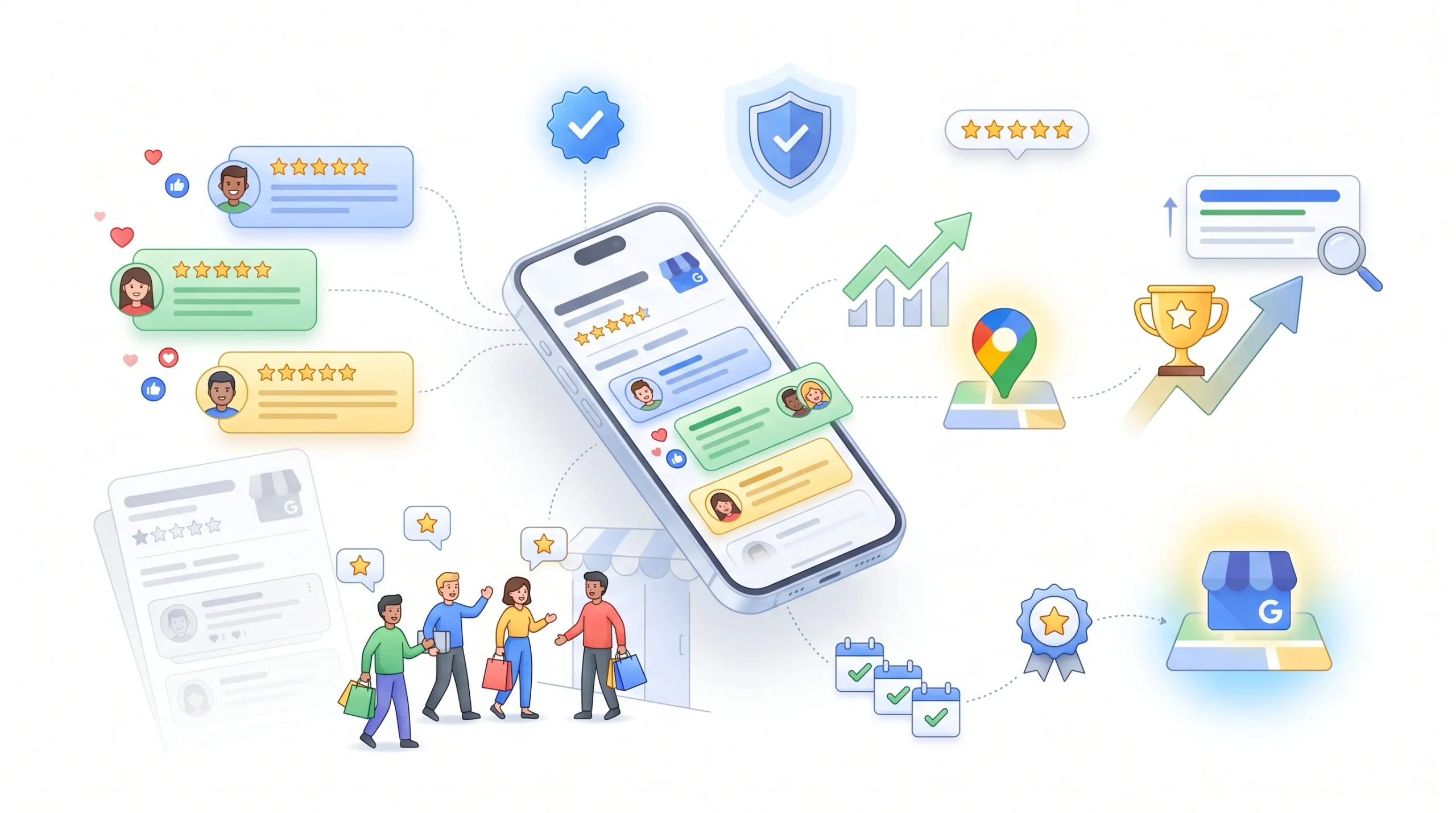
Reviews aren’t just social proof anymore, they’re a direct ranking input built into the algorithm itself. Google’s own guidance points to quality, quantity, and recency as review signals that feed straight into local ranking. That’s not marketing spin, that’s how the system is actually built.
Why Reviews Influence Both Rankings and Conversions
A business with 200 reviews averaging 4.7 stars is going to beat a business with 8 reviews and no recent activity, most of the time, even before factoring in anything else at all. Recency matters just as much. A pile of five-star reviews from three years ago with nothing since doesn’t carry the same weight as steady, consistent reviews coming in every month. It tells Google, and the customer reading the listing, that the business is currently operating and currently good, not just good once.
“87% of consumers use Google to evaluate local businesses, and they trust its reviews more than any other single source online.”
That’s a huge amount of trust concentrated in one place. Ignoring the review section of a GBP listing is, functionally, ignoring the single most trusted piece of marketing real estate a local business has access to.
How to Build a Consistent Review-Generation System
Random, occasional review requests don’t really work. What works is a repeatable system that runs whether anyone remembers to think about it that day or not.
- Ask right after the moment of service or purchase, when satisfaction is highest and freshest in the customer’s mind
- Make it frictionless: a direct link that drops the customer straight into the review box, not a multi-step process that loses people halfway through
- Use the channel customers already respond to, whether that’s a text message, an email follow-up, or a QR code sitting right on the receipt
- Train staff to ask naturally in person, as part of the normal interaction, not as an awkward scripted afterthought tacked on at the register
Responding to Reviews
Responding to reviews, both good and bad, is itself a signal of an active, engaged business. A thoughtful, calm response to a negative review often does more for trust than ignoring it ever could. Potential customers read how a business handles criticism just as closely as they read the criticism itself, sometimes more closely.
What Not to Do
- Review gating (only asking happy customers to leave reviews while quietly filtering unhappy ones through a private feedback form) directly violates Google’s policies
- Buying or incentivizing fake reviews risks the entire profile getting suspended, wiping out years of built-up trust in one bad decision
- Retaliating publicly against a negative reviewer, even an unfair one, almost always backfires and looks worse to anyone reading it later
Local Citations and NAP Consistency Across the Web
What Citations Are and Why They Matter for Prominence
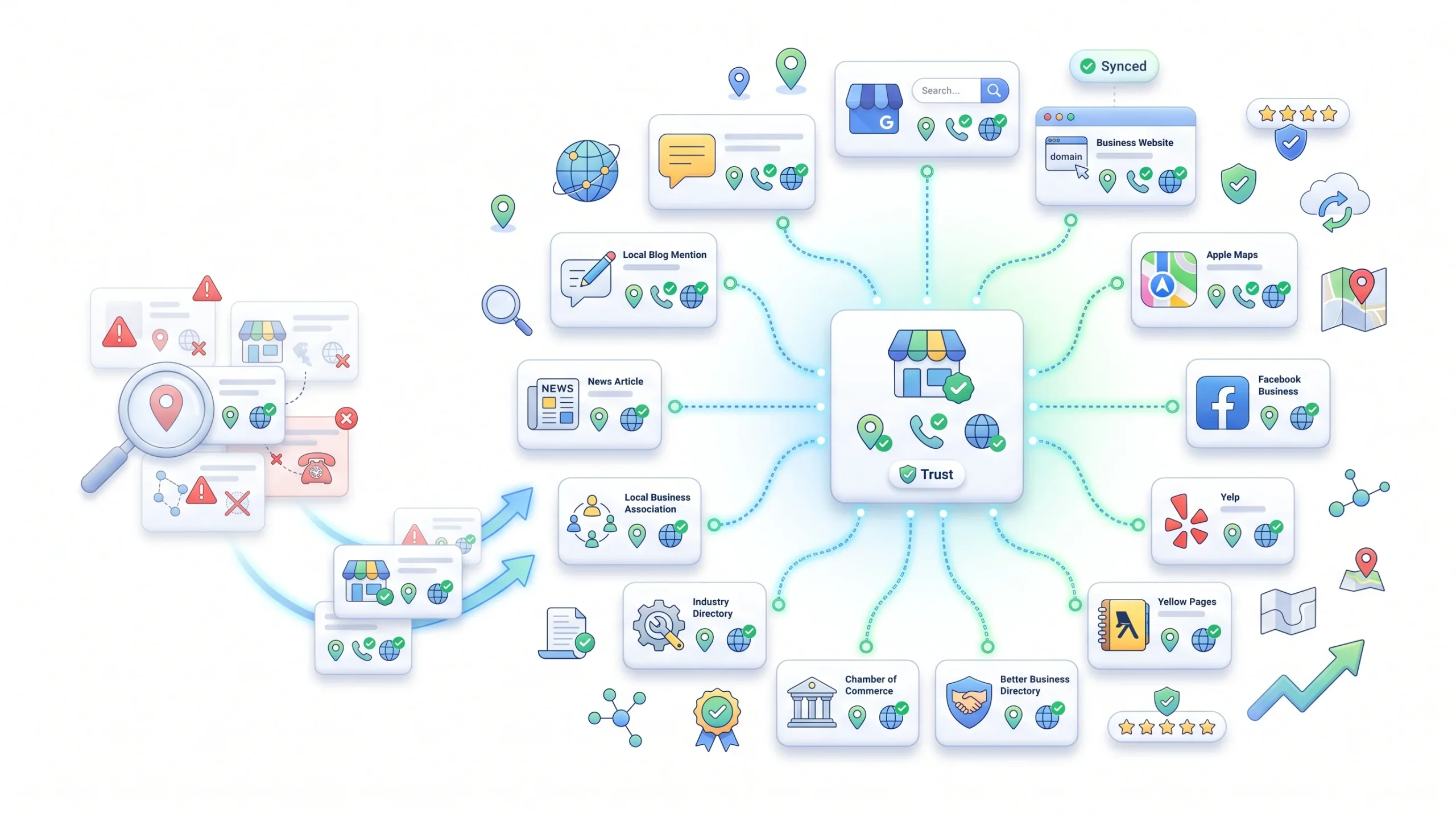
A citation is any online mention of a business name, address, and phone number, whether or not it links back to the site. Yelp, Yellow Pages, industry directories, the local Chamber of Commerce page, all of these count. Citations feed directly into the prominence factor because they act like corroborating evidence that a business is real, stable, and genuinely located where it claims to be.
Structured vs. Unstructured Citations
Structured citations live in a defined directory format, like a Yelp listing with dedicated fields for name, address, and phone number. Unstructured citations show up in less formal places, like a local news article mentioning the business by name and location inside a regular sentence. Both count toward prominence, but structured citations are far easier to audit and manage at scale, which is why most cleanup work focuses there first.
| Citation Type | Examples | Best For |
|---|---|---|
| Data Aggregators | Sources that feed info out to dozens of smaller directories at once | Fast, broad NAP consistency across the web |
| Industry Directories | Legal directories, healthcare directories, trade associations | Relevance within a specific industry |
| Local Directories | Chamber of Commerce, local business associations, community sites | Local prominence and geographic relevance |
| General Directories | Yelp, Yellow Pages, BBB | Broad visibility and consumer trust |
Auditing and Cleaning Up Inconsistent Listings
Old addresses, outdated phone numbers, duplicate listings left over from a rebrand years ago, these pile up quietly over time and nobody notices until rankings start slipping for no obvious reason. Periodically search the business name across major directories and fix or remove anything inconsistent. It’s not glamorous work, but it’s foundational, and skipping it undercuts everything else built on top of it.
On-Page Local SEO for Your Website
Location Pages: When and How to Build Them
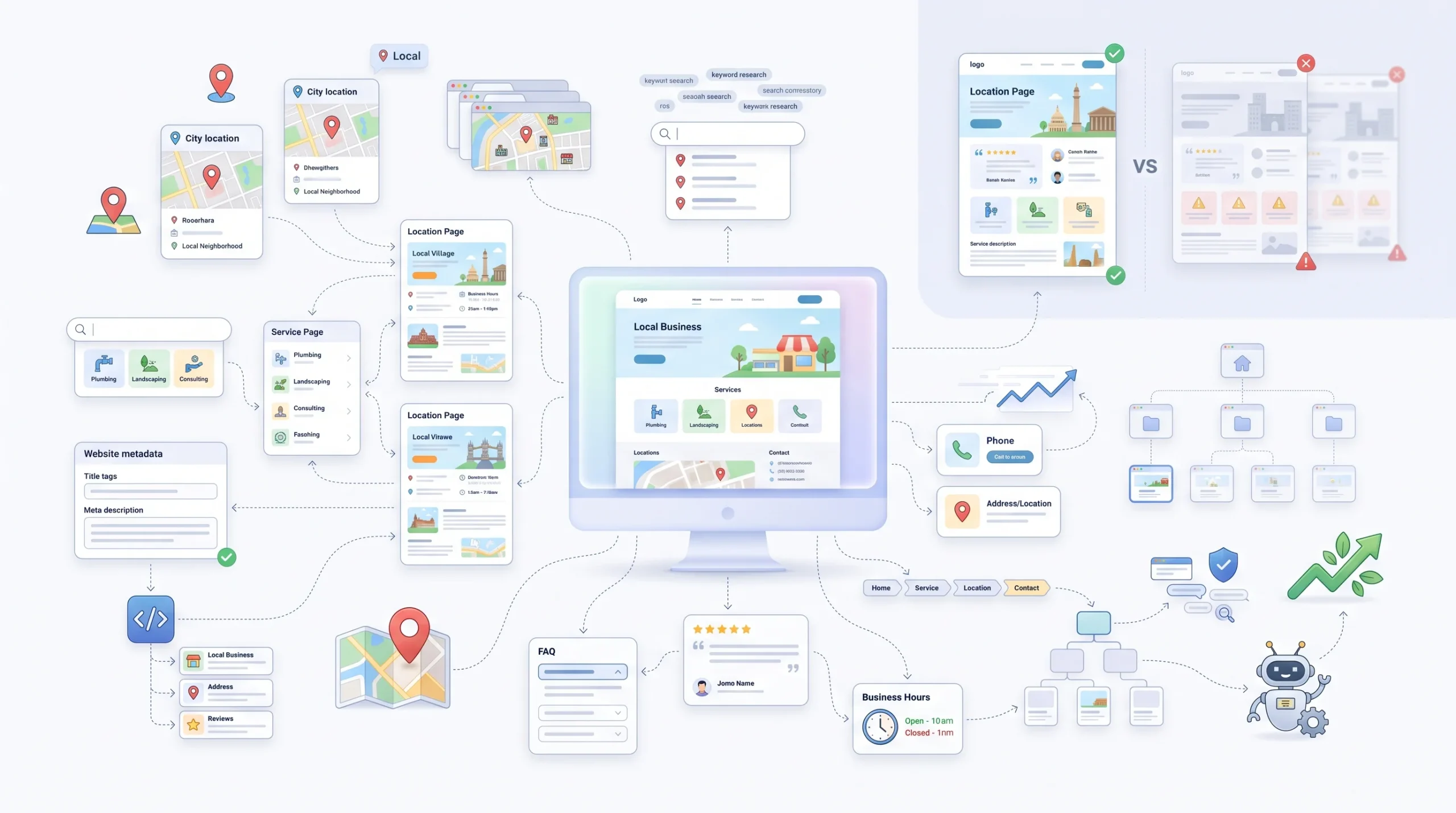
A single-location business generally needs one strong, detailed page about that location, not a dozen thin variations pretending to be different pages. Multi-location or service-area businesses are a different story entirely, each location or service area genuinely deserves its own dedicated page. The trap here is copying the same template across ten cities and swapping the city name at the top. Google has seen that exact pattern a thousand times over, and it doesn’t reward it. Each page needs real, specific detail: which services are actually offered there, local landmarks or neighborhoods served, and ideally testimonials specific to that particular location rather than generic ones reused everywhere.
Local Keyword Research and Intent Matching
Local keyword research isn’t complicated, but it does take actually looking at what shows up rather than guessing. Search “[service] + [city]” and study the results closely. What language keeps repeating in competitor map pack descriptions? “Near me” searches, long-tail phrases like “24-hour emergency electrician in [city],” these all reveal real intent that generic keyword tools sometimes completely miss. The goal is matching the words real people actually type into the search bar, not the polished phrasing a business prefers to use about itself internally.
Title Tags, Meta Descriptions, and Header Structure for Local Pages
Title tags and meta descriptions on location pages should include the service and the city, written the way a person would naturally search, not stuffed awkwardly with keywords. Header structure should reflect a clear hierarchy: one main H1 covering the location and service together, subheadings breaking down specific offerings, service areas, or FAQs relevant specifically to that location.
LocalBusiness Schema Markup
Schema markup doesn’t directly boost rankings on its own, but it helps search engines understand exactly what they’re looking at, and it can make listings richer inside search results, showing star ratings, hours, and price range directly on the results page. Key properties worth including: business name, address using proper structured formatting, phone number, hours of operation, geographic coordinates, price range, and accepted payment methods. Add this to the homepage and to each individual location page, then validate it through Google’s testing tools to confirm it’s actually implemented correctly rather than silently broken.
Internal Linking Between Location Pages and Core Service Pages
Location pages shouldn’t sit as orphaned pages disconnected from the rest of the site. Link from the homepage or a locations hub page down to each specific location page, and link back up from location pages toward the core service pages that explain the offering in more depth. This helps both search engines and actual visitors navigate the site logically instead of hitting a dead end after landing on a single page.
Technical and Mobile Considerations
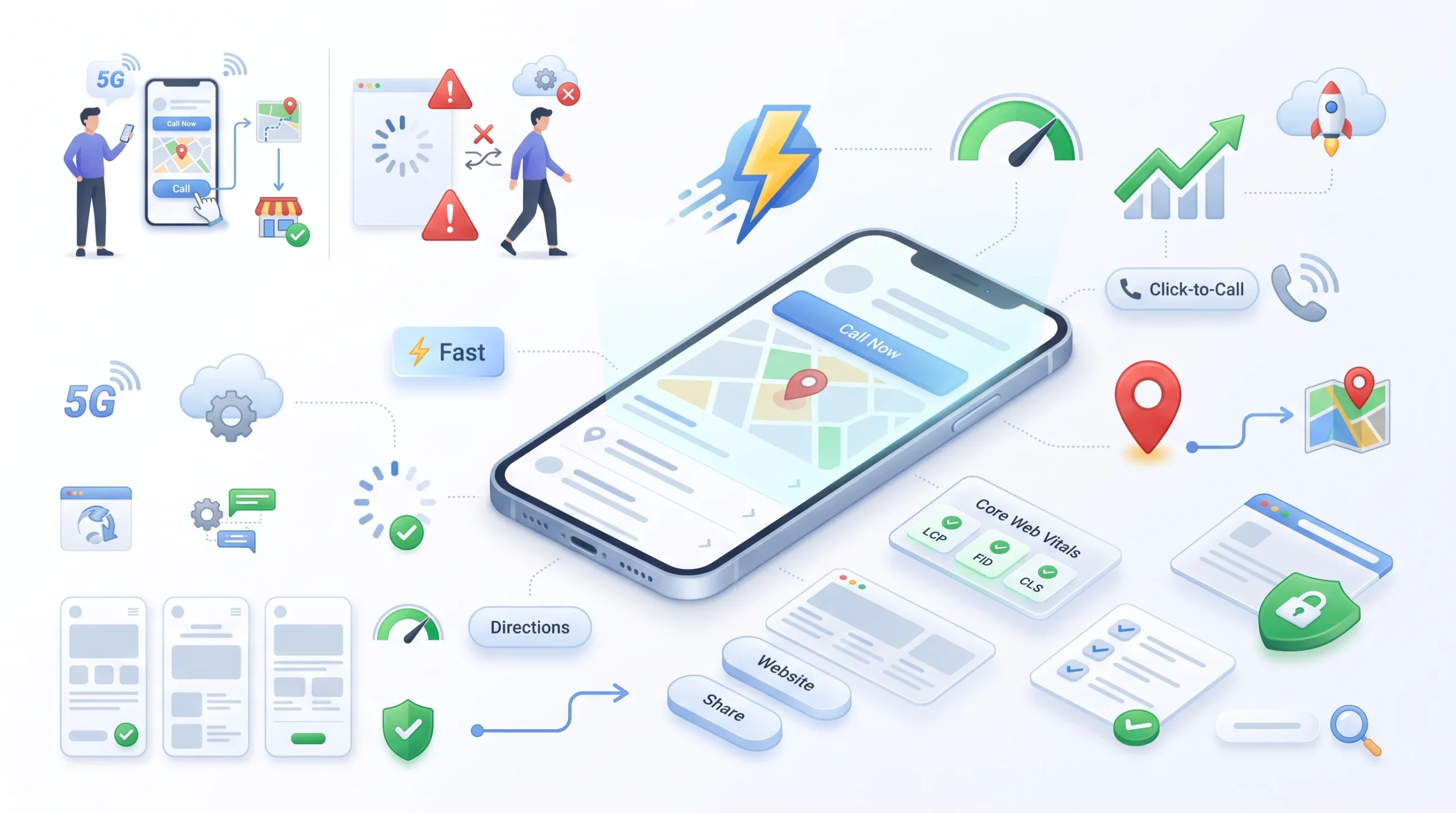
Most local searches happen on a phone, in the moment, often while someone’s already out and about running errands. That changes what “good technical SEO” actually means in this context.
“Every extra second of load time on mobile increases bounce rate by 32%. Speed isn’t a nice-to-have here, it’s the difference between getting the call and losing it to a faster competitor.”
- Page speed on mobile networks matters enormously, since a slow-loading page during a moment of urgency just pushes people to the next result
- Click-to-call functionality needs to be obvious and actually working, not buried three menus deep in a navigation nobody wants to dig through
- The address should be tappable and drop straight into Maps or Apple Maps with one tap, not require copying and pasting into a separate app
- Text needs to be readable without pinching to zoom, which sounds basic but plenty of older sites still get this wrong today
- Core Web Vitals apply here just like anywhere else, but the stakes are higher for local businesses, since mobile-first indexing means Google is primarily judging the mobile version of the site, not the desktop one that might look perfectly fine
Local Link Building
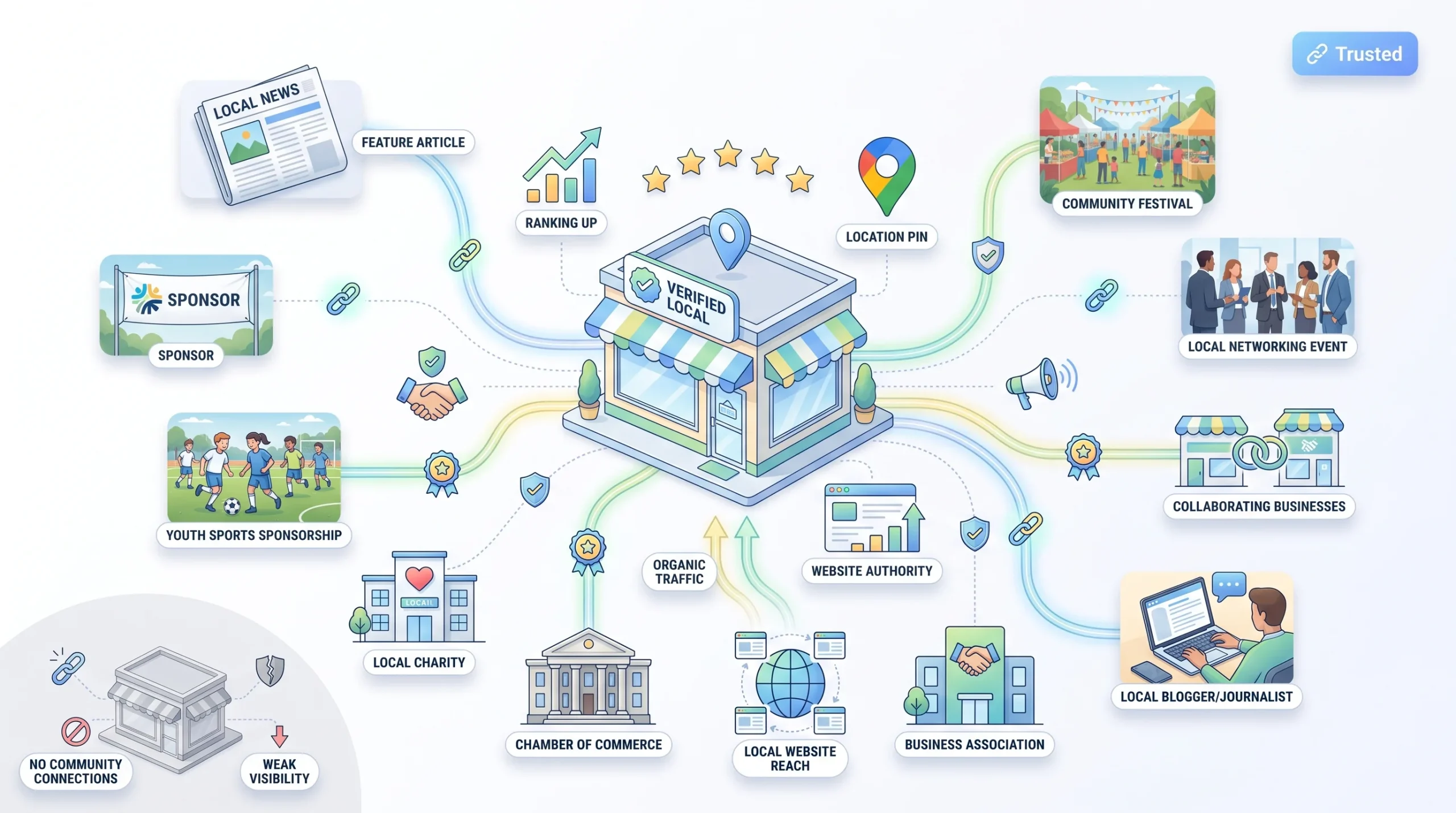
A link from the local newspaper covering a community event a business sponsored carries real weight for local rankings, sometimes more than a link from a much bigger national site with higher general authority. That’s counterintuitive to anyone used to thinking about link building purely in terms of domain authority numbers, but it tracks with how local prominence genuinely works under the hood.
- Sponsor local events, youth sports teams, or community causes that naturally generate coverage and a backlink
- Partner with complementary local businesses for joint promotions or shared content
- Pitch local journalists directly with genuinely useful, community-relevant angles, not generic press releases that land in a hundred other inboxes
- Get listed and linked from local business associations and community organizations already active in the area
Local Content Marketing
Content built specifically around the local area does double duty. It earns local citations and links, and it signals topical, geographic relevance that a generic blog post never really achieves. A “Best Coffee Shops to Work From in [City]” style post, or coverage of a local event the business actually participated in, gives the site something genuinely worth linking to, which a purely service-focused page usually doesn’t provide.
The trick is balance. All local content with nothing else leaves core service pages thin and underdeveloped. All service content with nothing local misses an easy relevance and authority boost sitting right there for the taking. A mix, weighted toward whatever the business’s actual customer base responds to and searches for, tends to work best over time.
Local SEO for Multi-Location and Service-Area Businesses
Multi-location businesses face a different set of headaches entirely. Each location generally needs its own GBP listing, tied to its own unique address, without duplicating content or accidentally cannibalizing another location’s rankings in the process.
Service-area businesses, companies that travel to the customer rather than the other way around, have a specific GBP setting built for exactly this situation. The physical address can be hidden from public view while still defining a service radius or a list of areas actually served. Getting this setting wrong, leaving an address visible when it shouldn’t be, or failing to clearly define the service area, creates real confusion for both Google and the person searching.
Scaling location pages across dozens of cities without falling into thin, duplicate content is genuinely hard work. It takes real, location-specific detail on every single page, not a quick find-and-replace job on the city name and calling it done.
Local SEO in the Age of AI Search
Search doesn’t look the same as it did even two years ago. AI Overviews inside Google, along with tools like ChatGPT and Perplexity, are increasingly part of how people find local businesses, especially for research-heavy queries before someone commits to a final choice.
Nobody has a fully settled answer yet on exactly how these systems weigh local signals specifically, and it would be dishonest to pretend otherwise. But the signals that already matter today, consistent citations, structured schema markup, a strong and recent review profile, are reasonable bets to keep mattering here too, since these tools tend to pull from the same underlying data sources that search engines already trust and rely on. The practical move right now is doubling down on the fundamentals covered in this guide, rather than chasing a separate “AI SEO” strategy that doesn’t fully exist as a distinct discipline yet.
How Long Local SEO Takes and What to Expect
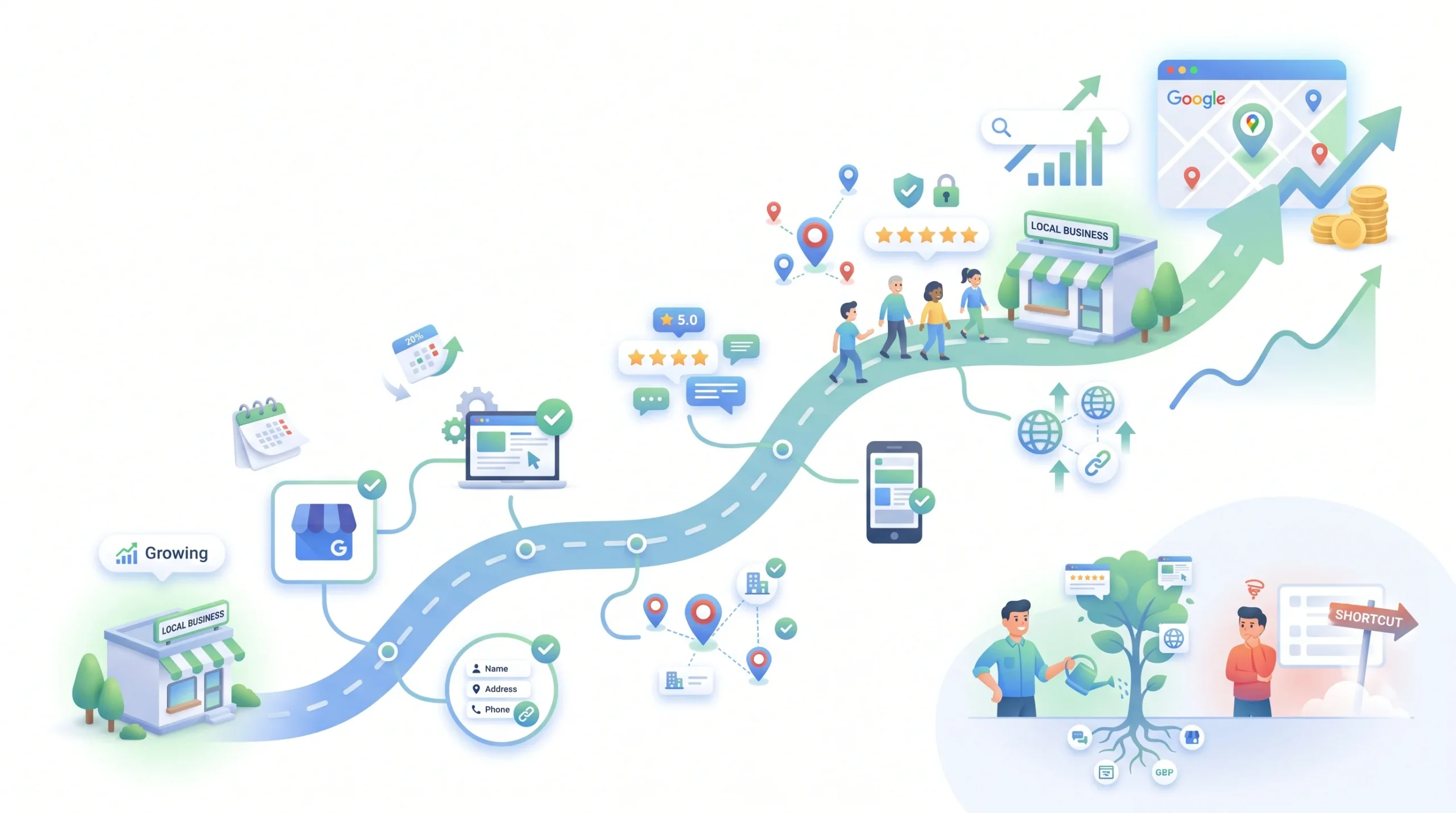
Anyone promising page-one rankings in 30 days is either lying outright or using tactics that will get the site penalized somewhere down the line. The honest timeline sits somewhere between 3 to 6 months before meaningful movement shows up, sometimes faster, sometimes slower depending on the starting point.
| Factor | Faster Results | Slower Results |
|---|---|---|
| Competition Level | Low-competition niche or small town | Highly competitive industry in a major city |
| Site Authority | Established domain with existing backlinks | Brand-new domain with no history |
| Investment Level | Consistent, ongoing optimization effort | Sporadic, one-time setup with no follow-through |
Early on, most of the work is unglamorous: fixing NAP inconsistencies, auditing the site technically, filling out the GBP properly, researching keywords carefully. Nothing dramatic happens during this phase, and that’s completely normal. It’s foundation work, not the visible payoff yet.
Conclusion
Go back to that person standing on the side of the road, phone in hand, searching for a mechanic. That exact moment repeats itself thousands of times a day, across every industry, in every city, all over the world. Local SEO is just the discipline of making sure a business is the one that shows up in that moment, not the one that gets scrolled past and forgotten five seconds later.
None of this is a one-time setup. It’s ongoing, a little unglamorous most days, and it compounds slowly rather than exploding overnight in some dramatic way. But businesses that treat it as a real, continuous part of how they operate tend to keep winning that moment, again and again, while competitors who ignore it keep quietly wondering where their customers went.
FAQs
What’s the difference between local SEO and regular SEO?
Regular SEO targets anyone searching for a topic regardless of where they are. Local SEO specifically targets searches where location is the point, and it involves ranking factors, like Google Business Profile and physical proximity, that regular SEO never has to deal with at all.
How long does local SEO take to show results?
Generally 3 to 6 months for meaningful movement, though competition level, existing site authority, and how much consistent effort goes in all shift that timeline in either direction.
Do I need a website if I have a Google Business Profile?
A GBP alone can generate calls and visibility, but a website adds organic ranking opportunities, credibility, and a place to build out location pages, service details, and content that GBP alone simply can’t hold.
How many reviews do I need to rank in the map pack?
There’s no magic number. What matters more is a steady, recent flow of reviews with a solid average rating, rather than hitting some arbitrary count once and stopping.
Can I rank in a city where I don’t have a physical location?
It’s difficult for the Map Pack specifically, since proximity is a hard ranking factor. Service-area businesses can extend reach through GBP’s service-area settings, but a business with zero physical or service presence in a city faces a steep uphill climb there regardless of optimization effort.
Is local SEO worth it for service-area businesses without a storefront?
Yes. GBP has dedicated settings built exactly for this kind of business, and reviews, citations, and on-page content all still apply the same way they would for a storefront.
How often should I post on Google Business Profile?
Consistency matters more than raw frequency. A steady rhythm, even once every week or two, signals more genuine activity than a burst of ten posts followed by three months of complete silence.
Does schema markup directly improve rankings?
Not directly. It helps search engines understand the page content more precisely and can improve how a listing appears in search results, which indirectly supports click-through rate and overall trust.