

Somebody scrolls past a post. A second, maybe less, and they’ve already decided if the brand behind it is worth their time. Not because they read a value proposition. Not because they checked a features list. They decided because of how the thing sounded. One brand sounds like a person who gets them. Another sounds like it was written by a committee that met for four hours to approve the word “excited.” Same industry, sometimes the same product, completely different reaction.
That gap is social media brand voice, and most businesses either ignore it or handle it so loosely that five different people end up writing five different versions of the same company. One week the account sounds warm and funny. Next week it sounds like a press release. Nobody planned that. It just happened because nobody wrote down what the brand actually sounds like, or worse, somebody wrote it down once and nobody ever looked at it again.
Here’s what this guide actually does. It walks through what a brand voice is and isn’t, why it matters more on social than almost anywhere else, and then gets into the real mechanics: finding the voice that’s already true to the company, picking the right words to describe it, translating personality into actual sentences, adjusting for platforms without losing the thread, writing it all down so a team can use it, keeping it consistent when more than one person (or an AI tool) is writing, and fixing it when it goes sideways. By the end, there should be enough here to actually write from, not just think about.
What a Brand Voice Actually Is (and Isn’t)
Brand voice gets thrown around a lot, and half the time it’s used interchangeably with tone, or messaging, or “the vibe.” Those are three different things, and mixing them up is exactly why so many brands end up sounding inconsistent even when everyone on the team thinks they’re following the same playbook.
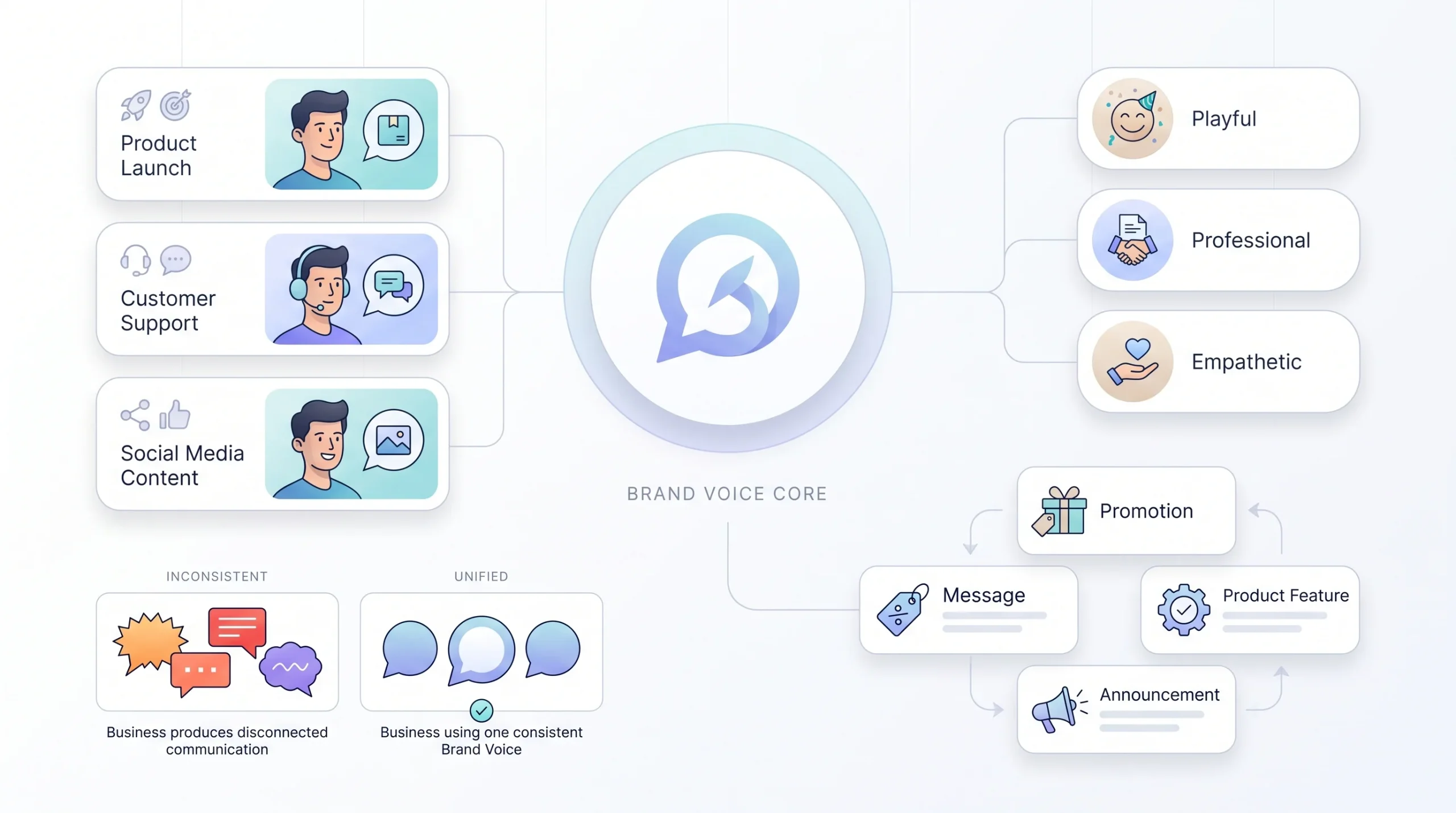
Brand voice is the personality behind everything a brand writes. It’s the thing that stays the same whether the post is celebrating a launch or apologizing for downtime. Think of it as the equivalent of someone’s personality in real life. A witty friend is still witty at a funeral, they just dial it back. They don’t become a different person.
Tone is how that personality gets expressed in a specific moment. Same witty friend, different volume depending on the room. A brand with a playful voice might crack a joke in a product announcement and go quiet and direct in a customer complaint response. That’s tone doing its job. Voice didn’t change. The situation did.
Messaging is a different animal entirely. Messaging is what gets said, the actual claims and offers and talking points. “Free shipping over fifty dollars” is messaging. So is “built to survive a decade of daily use.” Voice is how those points get delivered, not what the points are. A brand can change its messaging every single week (new promo, new feature, new campaign) and its voice should barely move.
Here’s the table that makes this click:
| Element | Definition | Changes by platform or situation? | Example |
|---|---|---|---|
| Voice | The brand’s core personality | No, stays constant | Witty, direct, warm |
| Tone | How that personality shows up in a specific moment | Yes | Playful in a meme, calm in a complaint reply |
| Messaging | The actual points being made | Yes, shifts by campaign or goal | “Free shipping over $50” vs. “Built to last a lifetime” |
Why does this matter as a business asset and not just a creative preference? Because recognition is built on repetition, and repetition only works if the thing being repeated actually stays the same. A brand that sounds different every week isn’t building anything. It’s just posting. The brands people remember, the ones that get quoted, screenshotted, sent to friends in group chats, have one thing in common. Somebody could hide the logo and readers would still know whose post it was.
There’s a trust angle here too, and it’s easy to underrate. People don’t trust brands the way they trust other people, not by default anyway. Trust gets built through repeated, predictable behavior, and voice is one of the few places a brand behaves the same way every single time, assuming it’s actually managed properly. A follower who’s seen a brand sound calm and clear through a product issue, a launch, and a random Tuesday meme is learning something about that brand without ever opening an “about us” page. That’s the same mechanism that makes someone trust a specific friend’s restaurant recommendations over a stranger’s, just running at a much bigger scale.
There’s a cost side too, and it barely gets mentioned anywhere. A brand without a defined voice spends more time stuck in approval loops, not less. Every caption turns into a subjective argument about what “sounds right,” because there’s no shared reference point to argue from. A defined voice, even an imperfect one, cuts that argument down to almost nothing. Either the draft matches the guide or it doesn’t. That’s a faster, cheaper way to run a content team than relitigating tone on every single post.
Voice is who you are. Tone is how loud you’re being about it right now.
Why Brand Voice Matters More on Social Media Than Anywhere Else
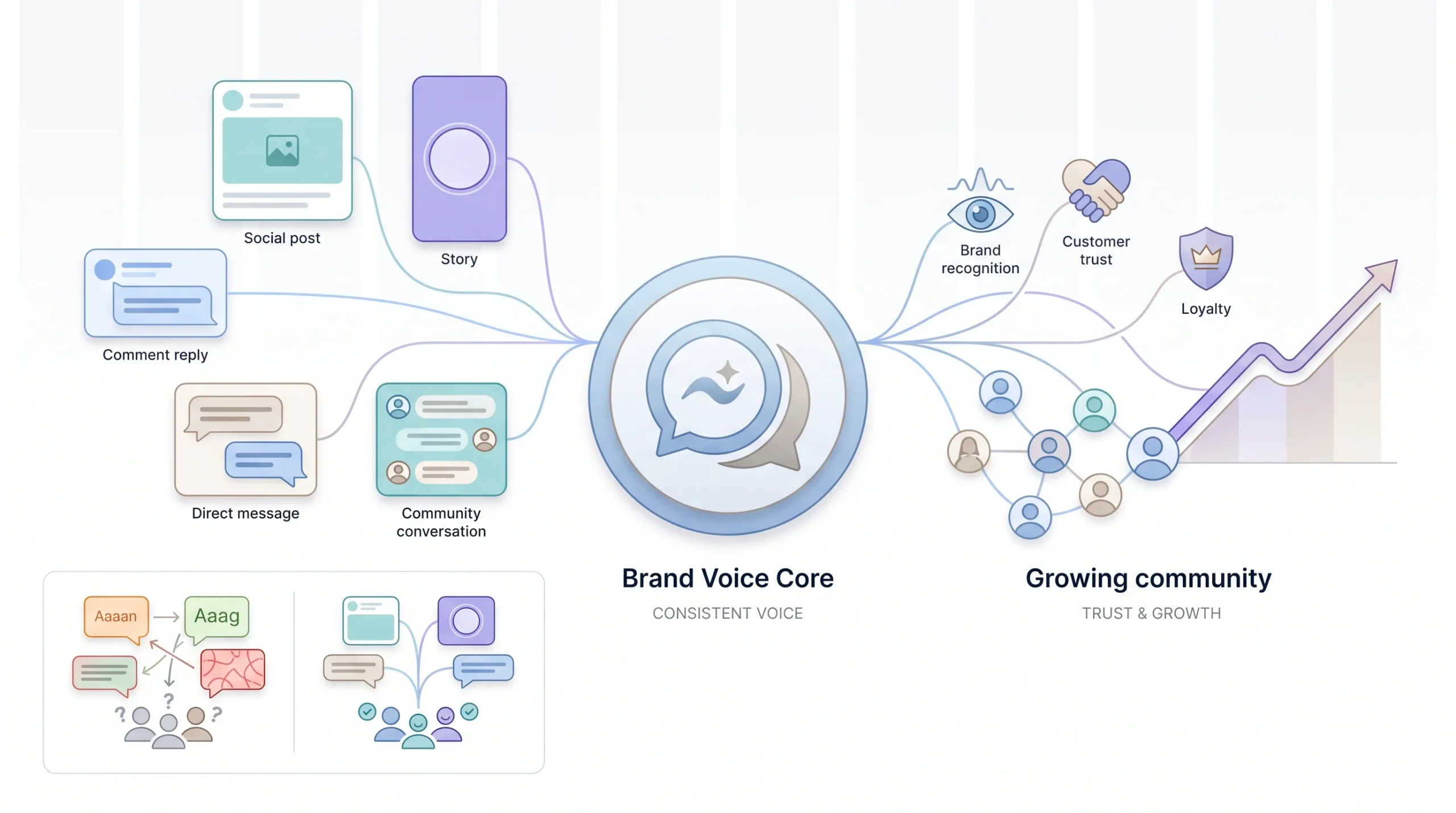
A website gets built once and maybe revisited every few months. Social media gets posted to daily, sometimes several times a day, by whoever happens to be running the account that week. That’s the first reason voice matters so much more here. There’s more surface area for inconsistency to sneak in, and it sneaks in fast.
Social is also live in a way nothing else in a brand’s communication is. A reply to a comment goes out in real time, often written under pressure, sometimes by someone who’s never even seen the brand voice guide because nobody handed it to them. That reply is just as public as the original post. Comment sections and DMs are voice in action just as much as the caption is, and honestly, they’re often the moments that reveal whether a brand’s voice is real or just something written in a document nobody follows.
Then there’s the algorithm problem. Platforms reward content that gets real reactions, comments, shares, the kind of engagement that happens when something actually lands with a person. Generic corporate voice doesn’t get that reaction. It gets scrolled past. Nobody screenshots a caption that reads like a press release. People screenshot the post that made them laugh, or the reply that was surprisingly honest, or the caption that said the quiet part out loud. That’s voice doing the heavy lifting that no ad spend can replace.
And for a lot of people, social media is the first contact point with a brand, before the website, before the product page, sometimes before they even know what the company sells. A fast-food brand’s playful back-and-forth with followers on social has made people who’ve never eaten there feel like they already know the personality. A calm, plain-spoken productivity tool’s account builds trust before anyone’s opened the app, just by consistently sounding like a person who respects their time. An outdoor gear brand’s understated, no-nonsense captions do more to signal “these people actually go outside” than any product description could. None of that happens by accident. It happens because someone decided what the brand sounds like and stuck with it, post after post, for years.
Compare that to a website. Somebody lands on a homepage, reads for maybe fifteen seconds, and leaves. There’s no ongoing relationship there, no accumulation. Social is the opposite. A follower sees the same account dozens of times over months, sometimes daily, and every single one of those touches either reinforces a consistent impression or chips away at it. That repetition is exactly why small inconsistencies matter so much more on social than they would buried in a press release nobody rereads. On a website, a stray off-brand paragraph might sit unnoticed for years. On social, an off-brand post is live within seconds and gone from view within minutes, but the impression it leaves sticks around a lot longer than the post itself does.
There’s also a competitive angle worth naming directly. Most categories are crowded enough now that product differences alone don’t do much work anymore. Two SaaS tools solve the same problem. Two skincare brands use nearly identical ingredients. Two coffee shops down the street from each other serve the same roast. Voice becomes one of the few remaining levers that’s actually free to pull and genuinely hard for a competitor to copy, because copying tone without copying the underlying personality just reads as hollow. A brand can steal a color palette in an afternoon. Stealing a voice that’s built on years of specific, consistent choices is a lot harder to fake.
Step 1: Find Your Voice at the Source (Mission, Values, Audience)
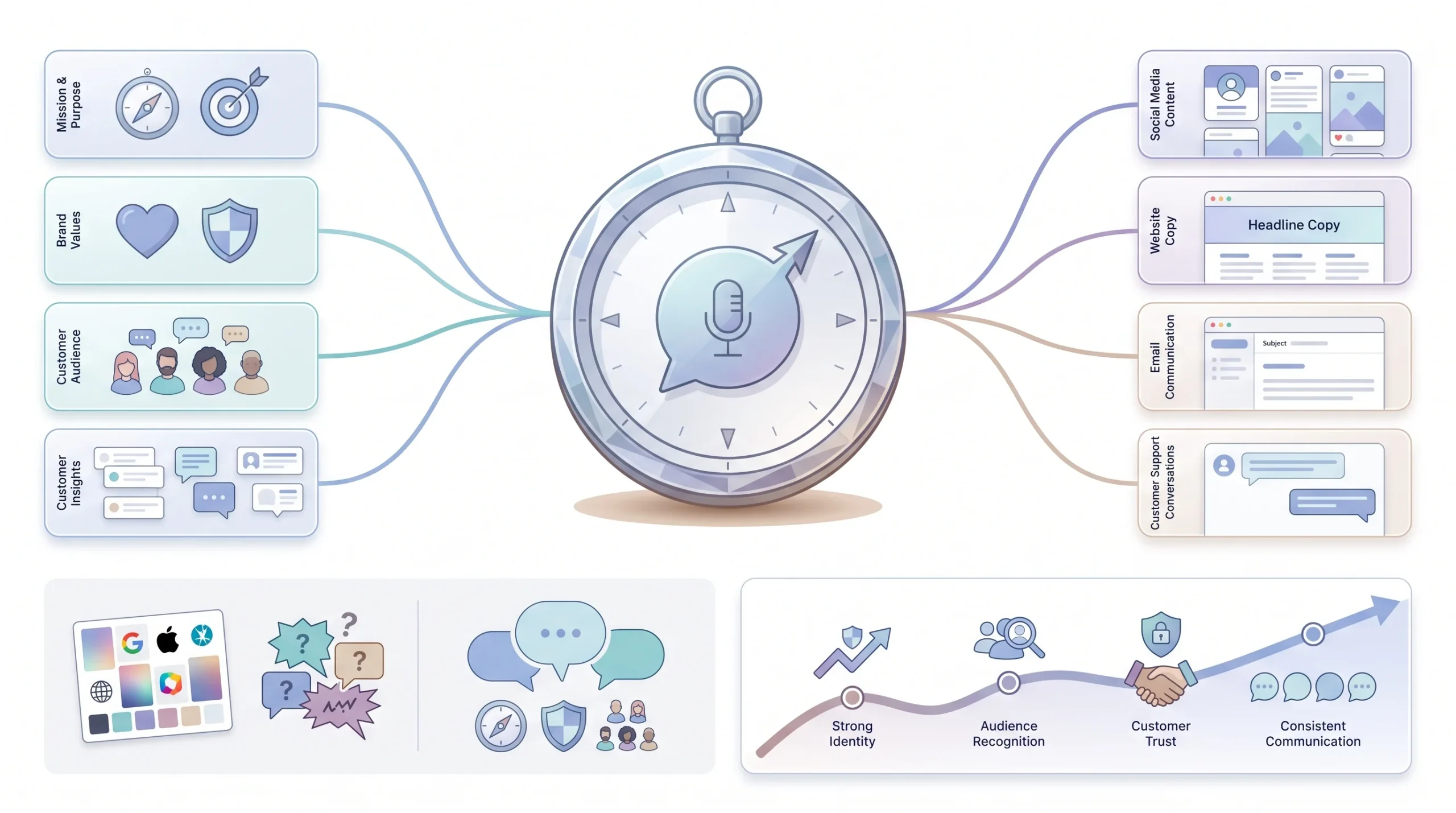
This is the step most guides rush through with a single line like “know your audience” and move on. That’s not enough. Getting the source right is what makes everything downstream actually work, and skipping it is why so many brand voices feel like a costume instead of a personality.
Start with why the company exists, not with a list of adjectives. Adjective lists feel productive but they’re backwards if there’s no foundation under them. A company that exists to make budgeting less stressful for people who’ve never trusted a spreadsheet is going to sound different from one that exists to help serious traders squeeze out another half percent of return, even if both companies could technically claim “helpful” as an adjective. Mission first, vibe second.
Then look at the actual audience, not the imagined one. There’s a real difference between who a brand thinks it’s talking to and who’s actually following, commenting, and DMing. Pull up the last few months of comments. What questions keep coming up? What jokes land? What gets ignored? That’s real data sitting right there, free, and most brands never even scroll through it before deciding how they want to sound.
Look at what’s already worked. Every brand with more than a few months of posting history has some content that outperformed the rest. Go find it. Not the post the team was proudest of, the post that actually got shared and commented on. There’s almost always a personality pattern hiding in there, some flash of the voice that’s already true, that just hasn’t been named and repeated on purpose yet.
Competitors are worth a look too, not to copy them but to find the gap. If every brand in a category sounds loud, salesy, and hyped up about everything, calm and matter-of-fact suddenly stands out just by contrast. That’s not a creative trick, that’s just basic positioning applied to how something sounds instead of what it sells.
There’s a shortcut worth mentioning here that gets skipped constantly: talk to the people actually answering customer support tickets or DMs. They hear the unfiltered version of how customers talk about the brand every single day, complaints, compliments, confused questions, all of it. That’s a completely different data set than what a marketing team sees in analytics dashboards, and it’s often the most honest read on how the brand is actually perceived versus how it hopes to be perceived. A support team hearing “you guys always make this so easy” repeated fifty times a month has just handed over a voice attribute for free.
It’s also worth being honest about what doesn’t work at this stage, because a lot of brands get this step wrong in a specific way. They start with a mood board of brands they admire and try to reverse-engineer a voice from admiration instead of from anything true about their own company. That’s how a serious, technical B2B company ends up trying to sound like a scrappy Gen Z skincare brand, and it falls apart within a month because there’s nothing underneath it holding it up. Inspiration is fine. A voice built entirely from someone else’s personality isn’t a voice, it’s an impression, and impressions are exhausting to maintain because they’re not actually true.
Here’s a worksheet worth actually sitting down with:
| Question | Why it matters |
|---|---|
| If your brand were a person at a party, how would they talk? | Forces a personality answer instead of a marketing answer |
| What do your best customers say about you unprompted? | Reveals the voice your audience already associates with you |
| What’s the one thing your brand should never sound like? | A clear boundary is often more useful than a positive trait |
| Which of your last 20 posts felt most “you”? Why? | Finds a real, working example instead of a hypothetical one |
That last question is the one people skip and it’s the most useful one on the list. Theory is easy. Pointing at an actual post and saying “that one, that’s us” is where the real work starts.
Run through this worksheet with more than one person if possible, ideally someone from marketing and someone from customer-facing work, support, sales, whoever actually talks to real customers. Different roles inside the same company often describe the brand’s personality slightly differently, and those gaps are worth noticing before locking anything in. If the marketing team says “bold and confident” and the support team says “patient and reassuring,” that’s not a contradiction to smooth over quietly. That’s useful information about which parts of the personality actually show up consistently and which ones are aspirational.
Don’t invent a personality. Find the one that’s already true and say it louder.
Step 2: Choose Your Voice Attributes
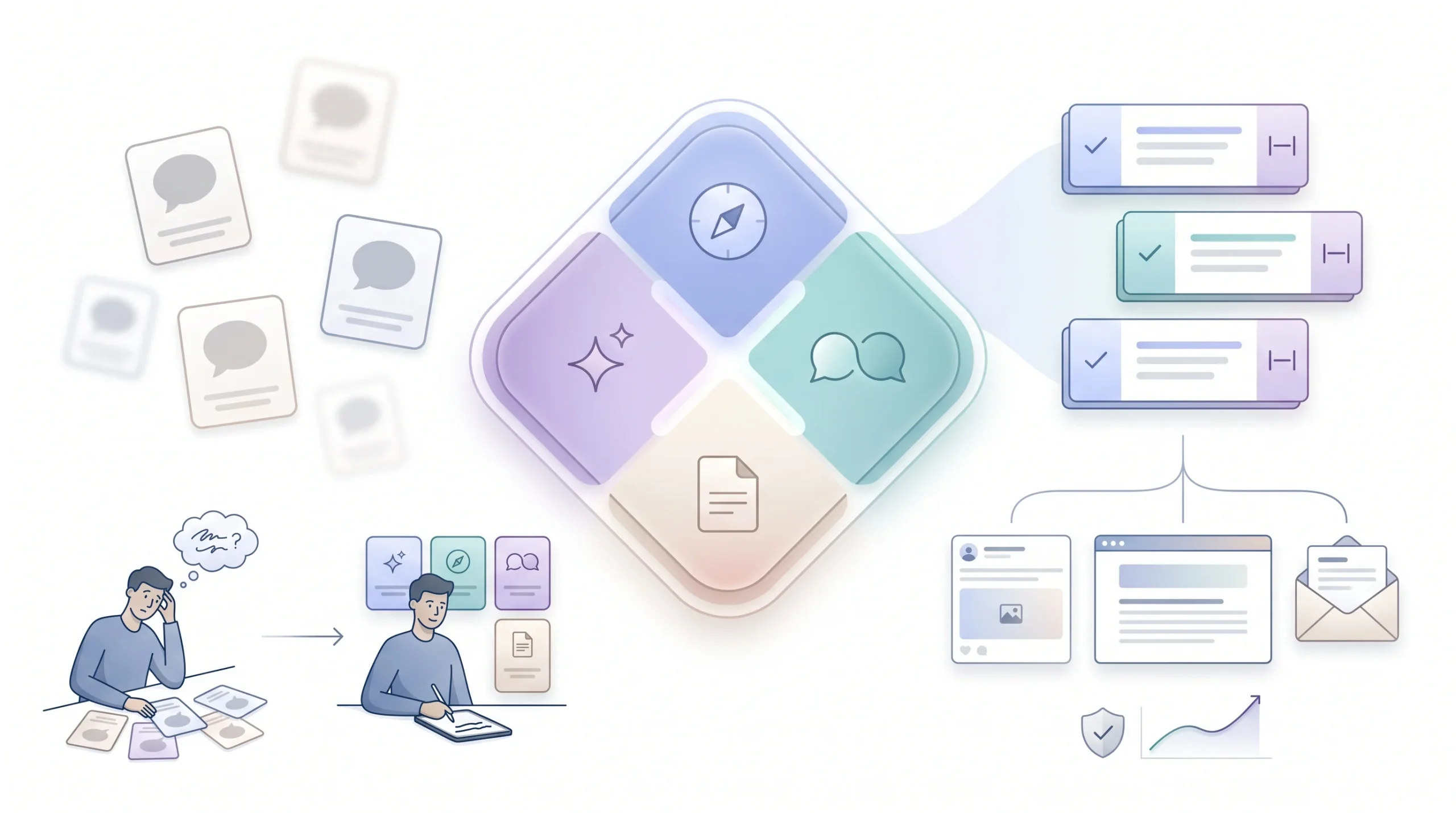
Once the source is clear, it’s time to name the thing. Three to five adjectives is the range that actually works. Fewer than that and the voice feels flat, one note stretched across every post. More than five and nobody on the team can hold it all in their head while writing, which means it just gets ignored.
The bigger problem isn’t the number though. It’s that most brands pick adjectives so generic they could belong to literally anyone. “Friendly.” “Professional.” “Fun.” Sure, but so is every other brand in the category claiming the exact same words. Generic adjectives don’t give a writer anything to actually do differently. They’re decoration, not direction.
The fix is pairing each adjective with a second, sharper layer, and running what’s basically an opposite test. For every trait chosen, write down what it does not mean. That boundary is often more useful for a writer sitting down to draft a caption than the trait itself.
| Generic (avoid) | Specific (use instead) | What it clarifies |
|---|---|---|
| Friendly | Warm but never saccharine | Rules out overly cutesy, forced-cheerful language |
| Professional | Direct and confident, no hedging | Rules out corporate softness and vague qualifiers |
| Fun | Playful with a wink, not goofy | Rules out slapstick humor that undercuts credibility |
| Helpful | Practical, gets to the point fast | Rules out long-winded, over-explained answers |
Notice the pattern. Each specific version has a built-in limit. “Warm but never saccharine” tells a writer exactly where the line is. “Friendly” alone tells them nothing except a vague direction to be nice, and everyone’s definition of nice is different. That ambiguity is where inconsistency creeps back in even after a team thinks they’ve solved the problem.
Step 3: Translate Personality into Actual Language Choices
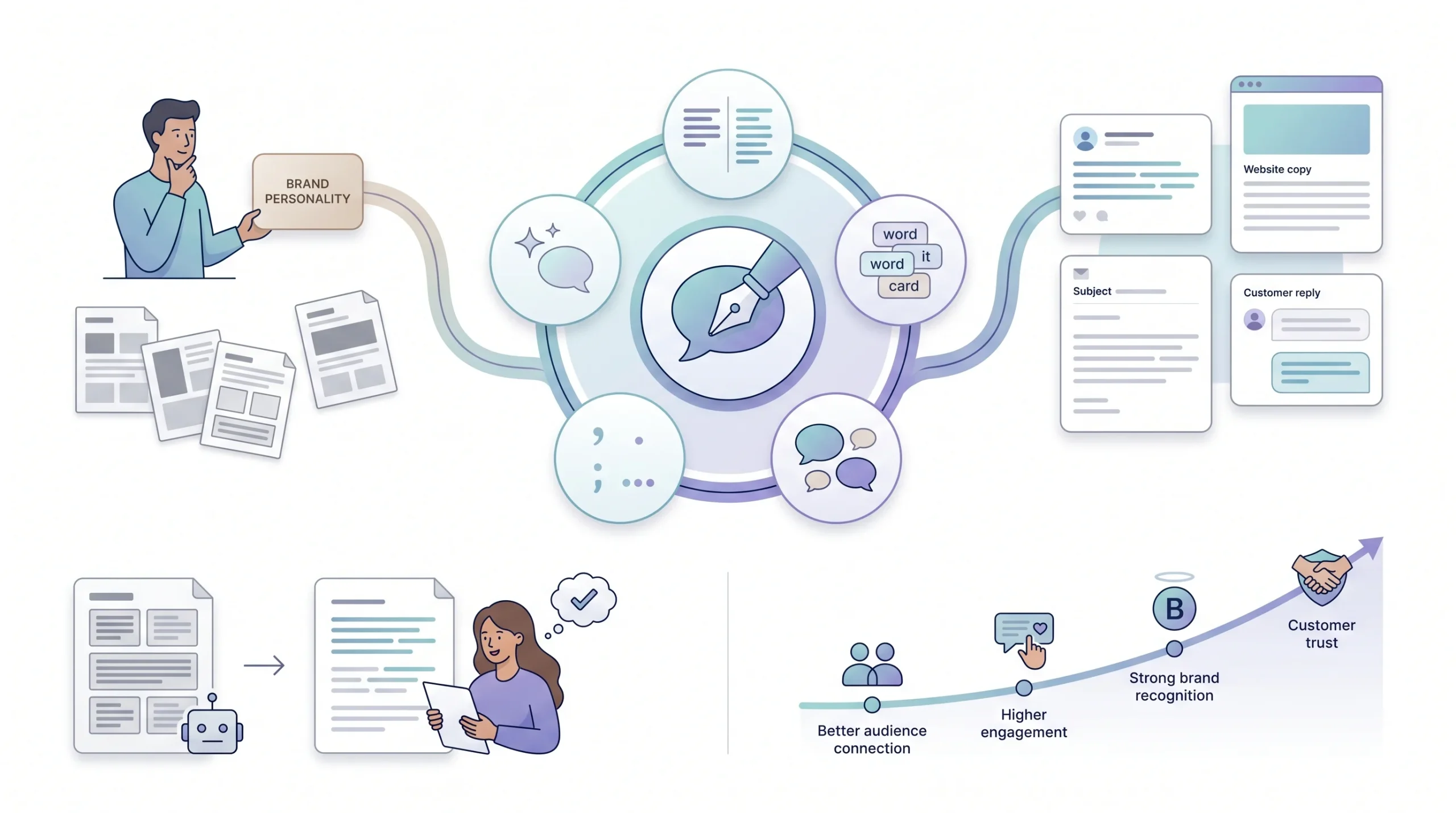
Here’s where most brand voice content stops short. Plenty of guides will tell a brand to “be witty” or “sound human” and then just move on, as if adjectives magically turn into sentences on their own. They don’t. This is a craft with actual mechanics, and skipping it is why so many brand voice documents look great on paper and fall apart the second someone tries to write a caption from them.
Sentence length and rhythm matter more than most people give them credit for. A voice that’s meant to feel punchy and energetic should actually read that way, short sentences, fast pacing, not buried inside long, winding paragraphs that contradict the personality on paper. A voice meant to feel thoughtful and expert can afford longer sentences that take their time. Mixing both, short then long then short again, is usually what makes writing feel human instead of like it’s following a formula.
Punctuation habits are part of the voice too, and they’re one of the fastest ways to spot inconsistency. Does the brand use exclamation points, or does that feel forced? Emoji, or none at all? Ellipses for a trailing, casual thought, or does that feel sloppy for this brand? These aren’t small details. A single stray exclamation point on an account that’s otherwise dry and understated is enough to make a reader do a double take.
Vocabulary level is next. Some brands sound best using plain, everyday words a twelve-year-old would understand. Others earn trust by using industry terms confidently, because their audience is made up of people who’d find oversimplified language patronizing. Neither is wrong. What’s wrong is switching between the two depending on who happened to write that day’s post.
Point of view matters too. First person singular, “I built this because,” feels personal and works well for founder-led or small brands. First person plural, “we’re rolling this out,” feels more like a team behind the brand. Third person, referring to the brand by name, tends to feel more corporate and distant, which is sometimes exactly right and sometimes exactly wrong depending on what the brand’s trying to be.
Humor deserves its own decision, made on purpose instead of by accident. Some brands should be funny. Some absolutely should not, and forcing jokes into a serious, expert-positioned brand just undermines the credibility that took years to build. If humor is part of the voice, decide what kind. Dry and understated is different from silly and over the top, which is different again from self-deprecating. Pick one lane.
And then there’s the list of words that need to just go. “Synergy.” “Unlock.” “Elevate.” “In today’s fast-paced world.” These phrases show up in brand copy across every industry because they sound like they mean something without actually saying anything. A sentence built from filler like that could belong to any company on earth, which means it doesn’t really belong to any of them.
Worth digging into humor a little more, because getting it wrong is one of the fastest ways to torch a voice that was otherwise working. Dry humor relies on understatement, saying something mildly funny in a completely flat delivery and letting the reader do the work of noticing it’s a joke. Self-deprecating humor works when a brand is confident enough to poke fun at its own quirks without it reading as insecurity. Silly, over-the-top humor leans on exaggeration and absurdity, and it works great for brands built entirely around fun but reads as unserious fast for anyone trying to also project expertise. None of these are interchangeable. Picking the wrong one, or worse, rotating between all three depending on who’s writing that day, is one of the quickest ways a voice starts to feel unstable.
One more habit worth building early: read everything out loud before it goes out. Not silently. Actually out loud, in a normal speaking voice. Sentences that look fine on a screen often reveal themselves as stiff, over-formal, or just plain weird the second they’re spoken. If a line sounds like something nobody would ever actually say to another person, that’s the signal to rewrite it, no matter how clean it looked in the draft.
Here’s what that looks like applied, side by side:
| Generic corporate version | Voice-applied version (example: warm and direct brand) |
|---|---|
| “We are excited to announce our newest product offering.” | “New thing just dropped. Here’s why we made it.” |
| “Please do not hesitate to reach out with any questions.” | “Got questions? We’re right here.” |
| “Our team is committed to delivering exceptional value.” | “We build things we’d actually want to use ourselves.” |
Read the left column out loud. Nobody talks like that to a friend. Read the right column out loud. That’s the whole test, honestly. If a sentence wouldn’t survive being said across a table to someone the brand actually cares about, it needs a rewrite.
If a sentence could belong to any brand, it doesn’t belong to yours.
Step 4: Adapt Voice by Platform Without Losing It
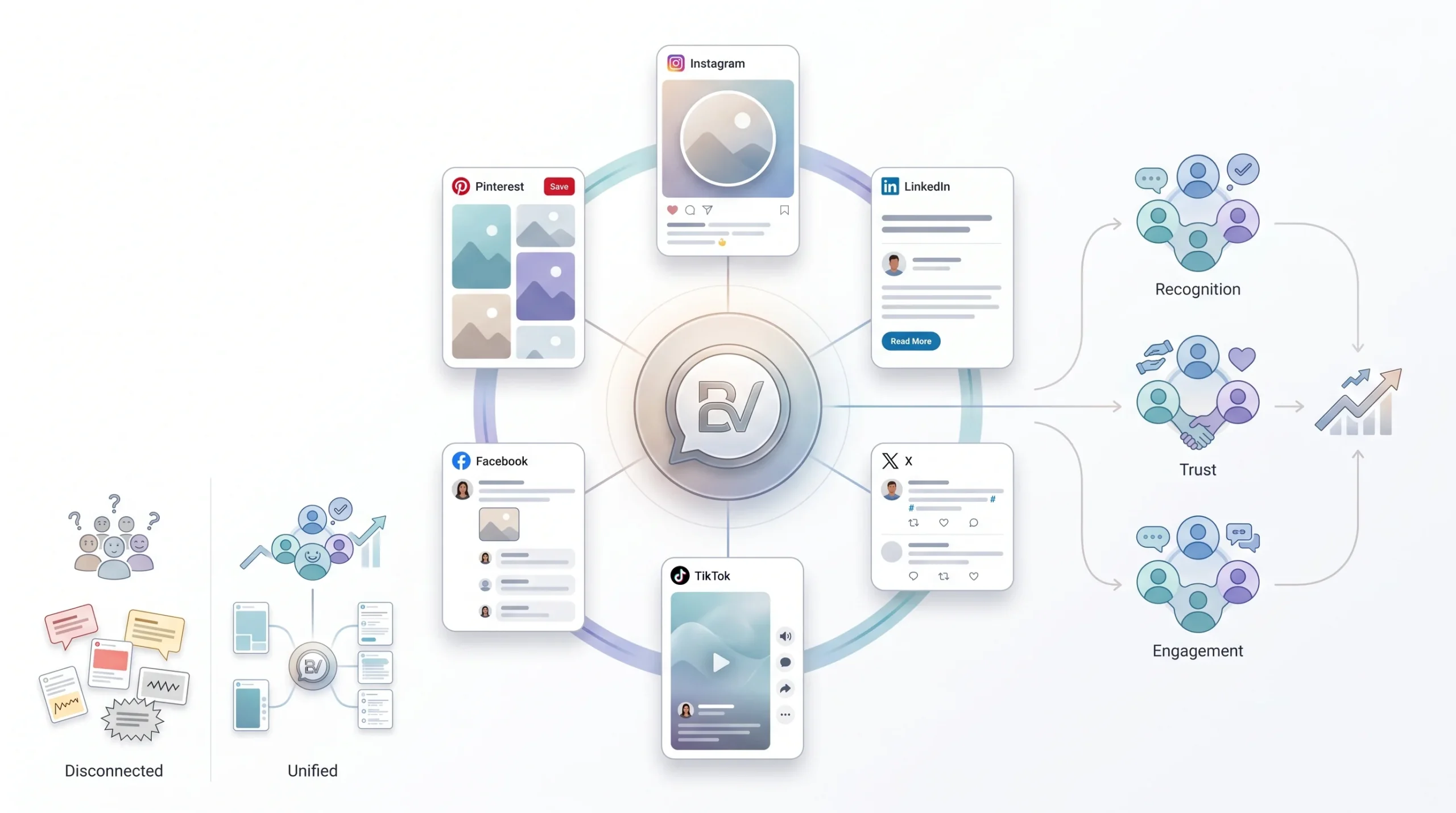
This is the part where a lot of guides give one bullet point per platform and call it done. That’s not nearly enough, because platform adaptation is where most brands accidentally break their own voice without realizing it.
The core rule first, because everything else depends on it. Voice stays constant. Tone, format, and pacing shift. A brand that’s warm and direct on Instagram should still be warm and direct on LinkedIn. What changes is how formal the delivery is, how long the caption runs, whether a trend or meme format gets used, and the ratio of visual to text.
The most common mistake here is chasing a trend that doesn’t actually fit the brand, just because it’s working for everyone else that week. A serious, expert-positioned brand jumping into a silly meme trend usually reads as forced, and audiences pick up on that instantly. The fix isn’t avoiding trends altogether. It’s filtering every trend through the existing voice before deciding whether it’s worth using at all.
Here’s the full breakdown across the platforms most brands are actually managing:
| Platform | Typical tone shift | Format notes | Voice risk to avoid |
|---|---|---|---|
| Visual-first, conversational captions | Short captions, strong hook in the first line | Over-explaining under a strong image | |
| More polished, still human | Slightly longer, story or insight-driven | Sliding into stiff corporate-speak | |
| X (Twitter) | Fast, reactive, opinionated | Short, punchy, real-time | Trying too hard to sound edgy for its own sake |
| TikTok/Reels | Playful, trend-aware, fast-paced | Hook in the first two seconds, casual delivery | Forcing a trend that doesn’t actually fit the brand |
| Warmer, community-oriented | Slightly longer captions, more direct CTAs | Sounding like an ad in every single post | |
| Aspirational, descriptive | Keyword-rich, benefit-led descriptions | Losing personality inside pure SEO copy |
Look at LinkedIn specifically for a second, because it’s the platform where voice most often quietly disappears. A brand that’s playful and casual everywhere else suddenly puts on a suit the moment it’s writing for LinkedIn, and the result sounds like a completely different company. That’s not adapting tone. That’s abandoning voice because the platform feels more “professional,” and it’s one of the most common ways brands accidentally build a split personality without ever meaning to.
Worth calling out too: format constraints on a platform aren’t the same thing as voice constraints, and mixing those two up causes a lot of unnecessary second-guessing. A short caption on X isn’t short because the brand suddenly got less warm. It’s short because the platform rewards brevity and a five-paragraph post gets ignored regardless of how good the writing is. Keep that distinction clear and platform adaptation stops feeling like compromising the voice and starts feeling like just picking the right format for the room.
It also helps to think about what each platform’s audience actually showed up expecting. Someone scrolling LinkedIn during a work break is in a different headspace than someone half-watching Reels on the couch at 11pm. Same brand, same values, same underlying personality, but the pacing and delivery earn attention differently depending on what mode the reader is already in. Fighting that context instead of working with it is a common reason otherwise solid content underperforms on a specific platform even when the writing itself is fine.
Your voice doesn’t change when you switch platforms. Your outfit does.
Step 5: Write It Down: The Brand Voice Guide
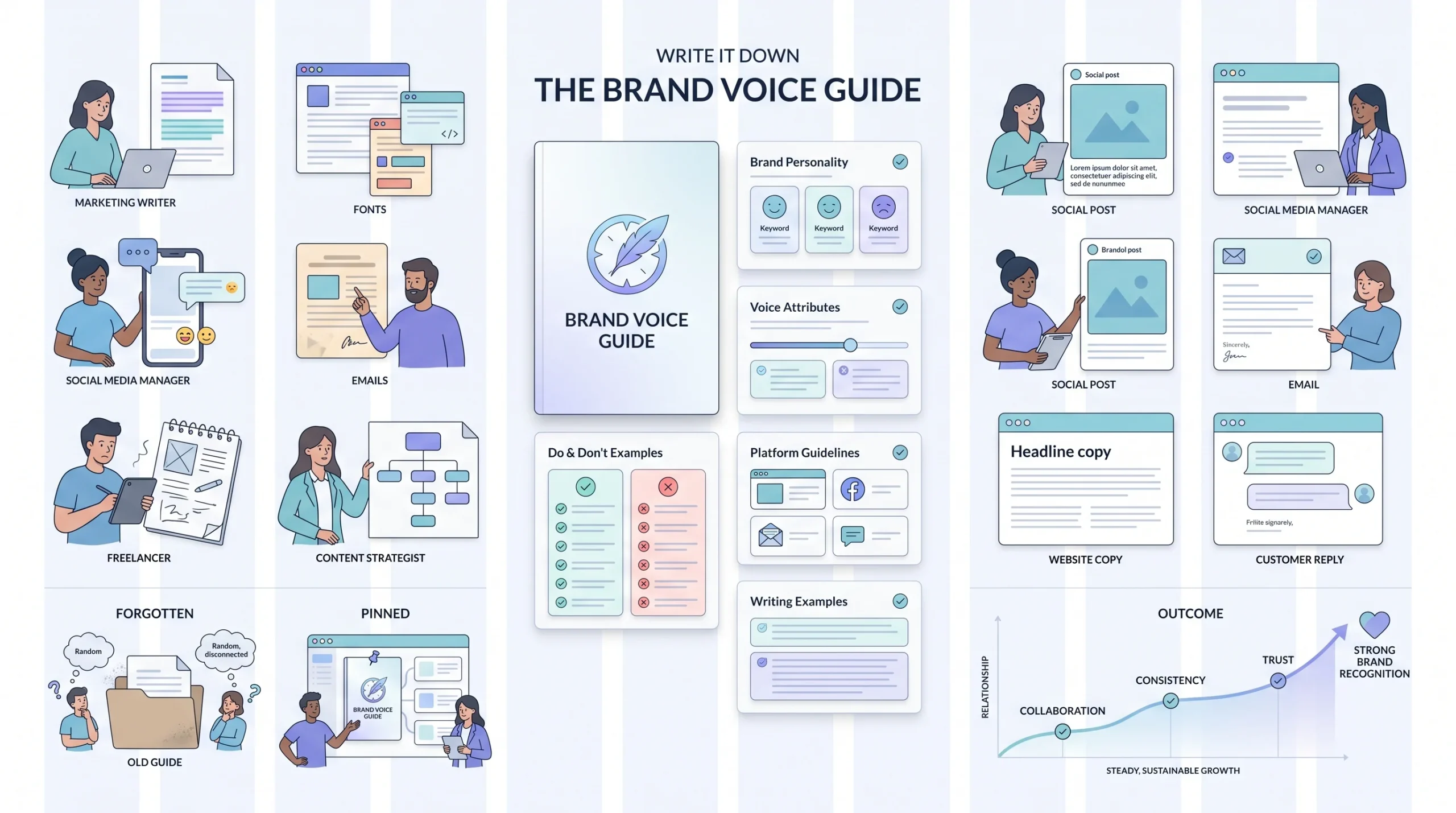
An undocumented voice survives exactly as long as it takes for a second person to start writing for the brand. The moment there’s more than one writer, or a freelancer gets brought in, or an agency takes over the account, an undocumented voice starts drifting immediately. Nobody’s being careless. There’s just nothing written down to check against.
The guide doesn’t need to be long. It needs to be usable. A one to two page document with concrete examples beats a forty page brand bible that sits in a shared drive unopened. Length isn’t the goal. Clarity is.
What actually needs to be in it: a one-line personality summary that captures the brand as if it were a person, the three to five core adjectives with their opposite-test definitions from earlier, a set of do’s and don’ts with real examples, quick notes on how tone shifts per platform, a short list of words the brand should never use, and a handful of before-and-after sample rewrites pulled from actual posts.
| Section | What goes here |
|---|---|
| One-line personality summary | A single sentence describing the brand as a person |
| Core adjectives (3-5) | Each with a one-line definition and an opposite test |
| Do’s and don’ts | 5-8 concrete examples of on-voice vs. off-voice lines |
| Platform notes | Quick tone shifts per platform, one to two lines each |
| Words to avoid | A short banned-words list specific to the brand |
| Sample rewrites | 3-4 before/after examples pulled from real posts |
The sample rewrites section deserves extra attention because it’s usually the part that actually gets used day to day. Adjectives are abstract. A side-by-side rewrite of an actual caption, before and after, is something a writer can reference in thirty seconds without having to interpret anything. That’s the difference between a guide that sits unused and one that actually shapes what gets published.
Where the guide lives matters more than it sounds like it should. A document buried three folders deep in a shared drive gets opened once, during onboarding, and never again. Pin it somewhere writers actually work, at the top of the content calendar, in the tool used to draft captions, wherever the actual writing happens. A guide that requires someone to go looking for it is a guide that’s already losing the fight against habit and deadline pressure.
It’s also worth building in a short section on context a document alone can’t fully capture: what to do when a post needs to react to something happening in the news or culture in real time. Voice guides are usually written calmly, in advance, with time to think. Real-time reactive posts get written fast, under pressure, sometimes by whoever happens to be near a laptop when something starts trending. A quick gut-check line in the guide, something as simple as “when reacting to news, default to calm over clever,” saves a lot of regret later.
Keeping Voice Consistent Across a Team (and AI Tools)
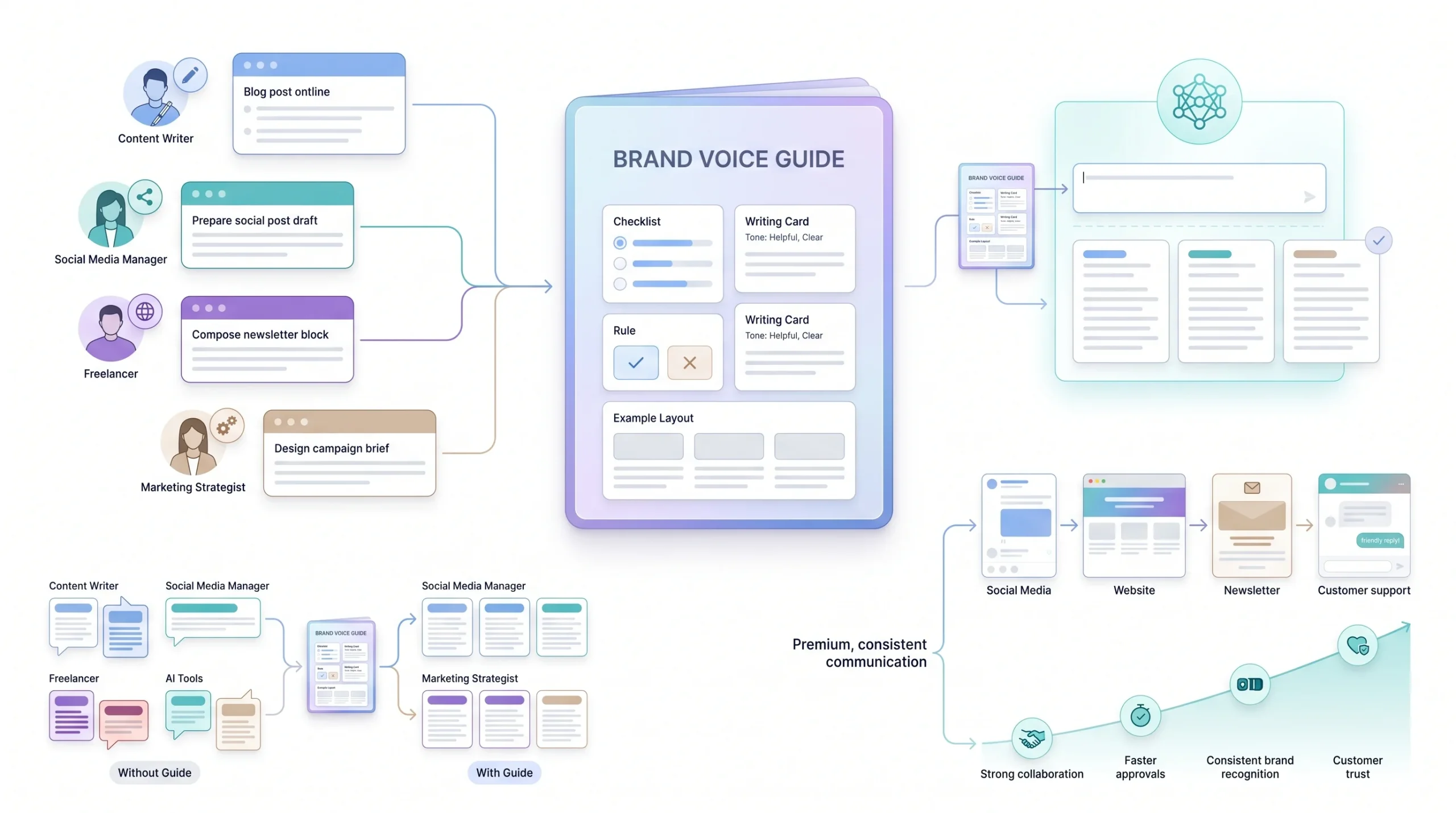
A voice guide solves the documentation problem. It doesn’t automatically solve the people problem, or the newer problem of AI tools flattening everything into the same generic style regardless of what brand it’s supposedly writing for.
Training a new writer starts with the guide, but the guide alone isn’t enough. Pair it with real examples of posts that worked and posts that missed, and walk through why. Reading a definition of “warm but never saccharine” is one thing. Seeing an actual caption that crossed that line, and understanding why it crossed it, sticks a lot better.
A lightweight review step before anything goes live catches most drift before it becomes public. This doesn’t need to be a heavy approval chain that slows everything down. Even a quick second pair of eyes checking a draft against the do’s and don’ts table catches the kind of small inconsistencies that are hard to notice when someone’s been staring at their own draft for twenty minutes.
AI tools are where this gets genuinely tricky right now, and it’s worth being honest about it instead of pretending the problem doesn’t exist. Left on their own, most AI writing tools default to a kind of smooth, generic, slightly over-explained style that sounds fine but sounds like nobody in particular. That’s the opposite of what a brand voice is supposed to do. The fix isn’t avoiding AI tools altogether. It’s feeding the actual voice guide, adjectives, opposite tests, and do’s/don’ts directly into the prompt, and then treating whatever comes out as a first draft that gets edited against that same table, never as something ready to publish as-is.
Voice drift doesn’t usually happen in one dramatic moment. It happens slowly, post by post, especially once a team gets comfortable and stops checking the guide. Periodically pulling the last few months of posts and reading them back to back against the original guide is one of the few reliable ways to catch that slow drift before it becomes the new normal.
There’s also a specific failure mode worth naming with AI tools that’s easy to miss. Two different writers, each prompting an AI tool separately with roughly the same brand voice instructions, will often get back subtly different results, different sentence rhythms, different word choices, different levels of formality. That’s because the model is filling in gaps the prompt didn’t cover, and it fills them in with whatever’s statistically common rather than whatever’s actually true to the brand. The fix is being far more specific in the prompt than feels necessary. Include actual example sentences, not just adjectives. Include the banned words list explicitly. Include one or two real posts that nailed the voice and ask the tool to match that pattern specifically, not a general description of it.
Agencies and freelancers add another layer worth planning for directly. Anyone writing for the brand who isn’t on the internal team should get the guide before they write a single word, not after their first draft gets sent back with confused feedback. Handing over the guide late is one of the most common, most avoidable causes of wasted revision cycles.
AI can write in your voice. It can’t decide what your voice is. That part’s still on you.
When Voice Goes Wrong (Troubleshooting and Recovery)
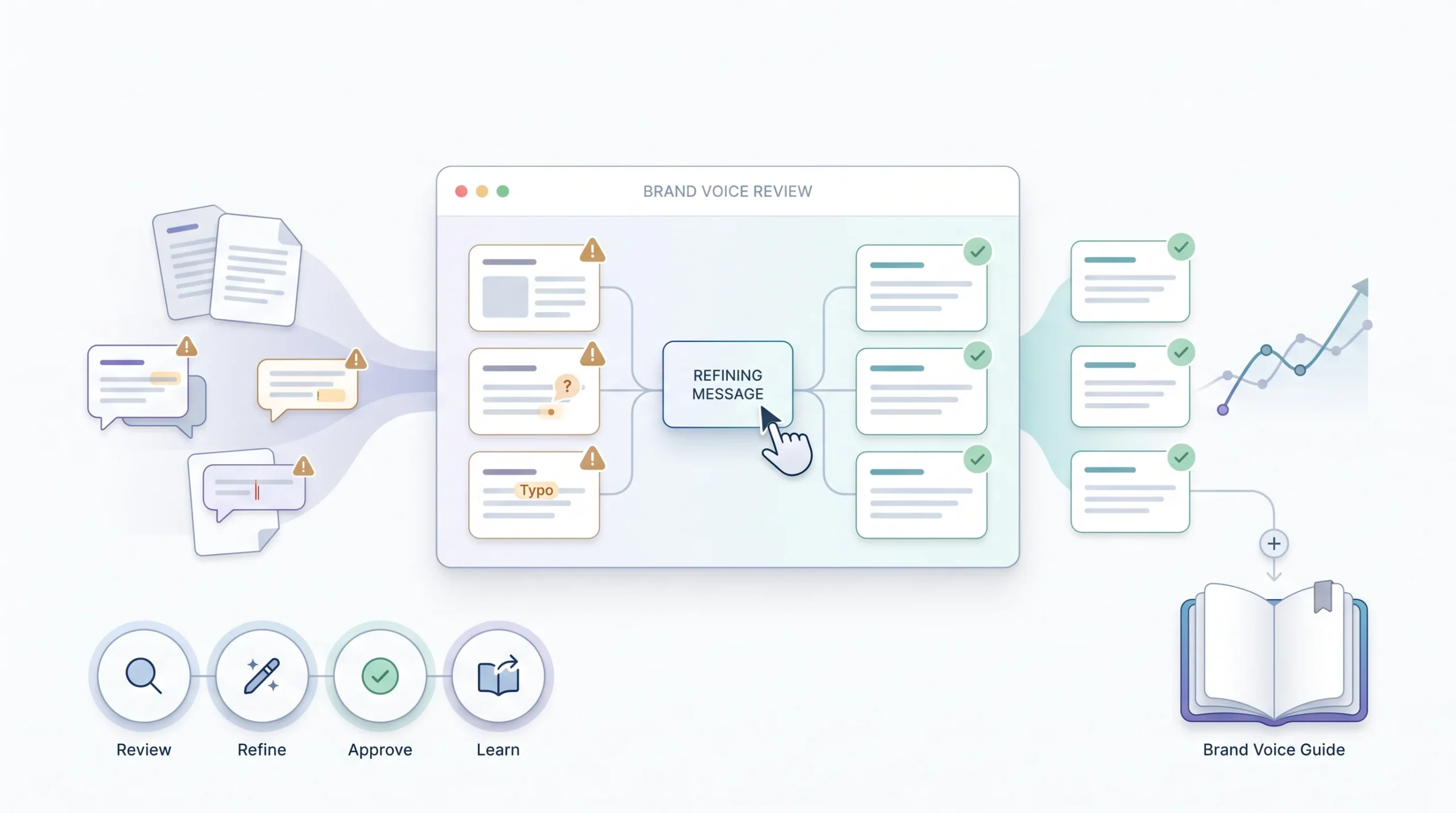
Even with a documented guide and a trained team, voice slips sometimes. What matters is catching it and knowing how to respond, because an off-brand moment handled badly does more damage than the original slip.
A few signals are worth watching for. Posts start feeling interchangeable with what competitors are putting out, like the brand’s voice has quietly worn down to the same generic tone everyone else uses. Engagement drops even though posting frequency hasn’t changed, which often means the content has gotten safer and more forgettable without anyone deciding that on purpose. And maybe the clearest signal of all: the team keeps asking “does this sound like us?” before hitting publish. That question shouldn’t need to be asked constantly. If it is, the guide has stopped doing its job, either because it’s too vague or because nobody’s actually referencing it anymore.
| Signal | Likely cause | Fix |
|---|---|---|
| Posts feel like they could be from any brand | Adjectives are too generic | Re-run the opposite test and get more specific |
| Different platforms sound like different brands | No shared root voice, only platform tone | Rebuild from the one-line personality summary |
| Team constantly asks “does this sound like us?” | Guide is undocumented or too vague | Add concrete do’s/don’ts and sample rewrites |
| Engagement quietly declining over months | Voice has drifted toward safe and generic over time | Audit the last 90 days of posts against the original guide |
When an actual off-brand post goes out and gets noticed, the instinct is often to overexplain or apologize at length. Usually the better move is correcting quickly, without turning the correction into its own overblown moment. If the off-brand post revealed something real, maybe the guide had a gap nobody noticed until it became public, that’s worth fixing in the document itself so the same mistake doesn’t repeat.
Voice should also be allowed to evolve on purpose as a brand or its audience matures. That’s different from drifting by accident. A brand that started scrappy and irreverent might genuinely need to sound a little more grounded five years in, not because it lost its personality but because the audience and the stakes changed. The difference between evolution and drift is intention. One is a decision. The other is what happens when nobody’s paying attention.
It’s worth planning for the genuinely bad scenario too, not just the mildly off-brand caption. An off-brand post that goes properly viral for the wrong reasons, gets screenshotted and mocked, or worse, comes across as tone-deaf against something serious happening in the news, needs a different response than a quiet correction. That situation calls for a short, direct acknowledgment, said plainly, without turning it into a lengthy explanation that just keeps the story alive longer than it needed to be. Long, defensive statements almost always read worse than a short, honest one. Say what happened, say what’s changing, move on. Dragging it out in the name of thoroughness usually backfires.
And after the dust settles on any real slip, it’s worth treating it as data rather than just an embarrassment to move past quickly. What made the post feel off-brand in the first place? Was it a genuine one-off mistake, or does it point to a gap in the guide that’s likely to cause the same problem again in six months? Feeding that answer back into the actual document is the difference between a mistake that gets fixed once and one that quietly repeats every year or so under slightly different circumstances.
Conclusion
Go back to that first second someone spends scrolling past a post. That’s the whole stakes of this guide in one moment. Nobody’s reading a mission statement in that second. They’re reacting to how something sounds, and that reaction happens whether or not a brand has ever thought about its voice on purpose.
None of this is a one-time project that gets finished and filed away. A voice guide gets tested every single time someone hits publish, and it either holds up or it doesn’t. The brands that stay recognizable over years aren’t the ones with the fanciest brand bible sitting in a drive somewhere. They’re the ones who actually check their posts against a real, specific, opposite-tested description of who they are, over and over, long after the initial excitement of “defining the voice” has worn off.
This work also doesn’t sit in isolation. It connects straight into content pillars, platform strategy, and the broader marketing funnel a brand is running. Get the voice right and everything downstream, the captions, the replies, the ad copy, gets easier to write and faster to approve, because there’s finally something real to check it against.
FAQs
What is a social media brand voice?
It’s the consistent personality behind everything a brand posts, comments, and replies with, so the brand sounds like the same “person” no matter who on the team is actually writing that day.
What’s the difference between brand voice and brand tone?
Voice stays constant. Tone is how that voice flexes depending on the platform, the moment, or the situation, like a celebratory launch post versus a calm response to a complaint.
How many brand voice adjectives should I choose?
Three to five. Fewer feels one-note, more becomes too much for a team to actually hold in their head while writing.
Does my brand voice need to change for every platform?
No. The voice stays the same everywhere. What shifts is tone, pacing, and format, more polished on LinkedIn, faster on X, more playful on TikTok.
How is brand voice different from brand messaging?
Messaging is what gets said, the actual claims and offers. Voice is how it gets said, regardless of what that week’s message happens to be.
How long should a brand voice guide be?
One to two pages. A short document with concrete examples gets used. A long one gets opened once and forgotten.
Can I use AI tools and still keep a consistent brand voice?
Yes, but only if the tool is fed the actual voice guide and do’s/don’ts directly in the prompt, and every draft gets edited against that same guide instead of published as-is.
How often should a brand voice guide be updated?
Every six to twelve months at minimum, or sooner if the audience, product, or market shifts in a meaningful way.
What are the signs my brand voice has drifted?
Posts start feeling interchangeable with competitors, engagement quietly declines despite steady posting, or the team keeps second-guessing whether a draft “sounds like us.”
Should a brand voice be different from the founder’s personal voice?
It can start there, especially for small or solo-led brands, but it needs to be written down and repeatable so it survives beyond one person doing all the writing.
What’s an example of words a brand should avoid?
Filler like “synergy,” “unlock,” “elevate,” or “in today’s fast-paced world.” These phrases sound like they mean something without actually saying anything specific.
Is brand voice only relevant to social media?
No. It should carry into email, customer support, website copy, and ads too. Social just tends to be where inconsistency shows up first, since it’s public and posted in real time.