

Most content teams spend almost all their time writing, designing, and editing, then hit publish and quietly move on to the next thing. That’s the whole problem in one sentence. Somewhere along the way, distribution turned into an afterthought, something you do for twenty minutes after the “real work” is done. Post it on LinkedIn, maybe schedule a tweet, done. Except that’s not distribution. That’s just telling people something exists once and hoping it’s enough.
It isn’t enough. A piece of content that took two weeks to research and write deserves more than a single social post that fifty people scroll past. Content distribution strategy is simply the plan for how that content actually reaches the people who need it, across the channels you own, the ones you earn, and the ones you pay for. Not a vague intention. An actual plan, built before you even finish writing.
Here’s a number worth sitting with: most content marketing teams spend somewhere close to 80% of their time and budget on creation and maybe 20% on getting it in front of people. Flip that ratio, or even just balance it out closer to fifty-fifty, and the same amount of content starts pulling a lot more weight. Not because the writing suddenly got better. Because more people actually saw it.
This guide walks through what distribution really means, the three channels every piece of content can move through, how to build a process where distribution isn’t bolted on at the end, how to squeeze more value out of everything you create, and how to actually tell if any of it is working. No fluff, no theory for the sake of theory. Just what actually moves the needle.
What Content Distribution Actually Means
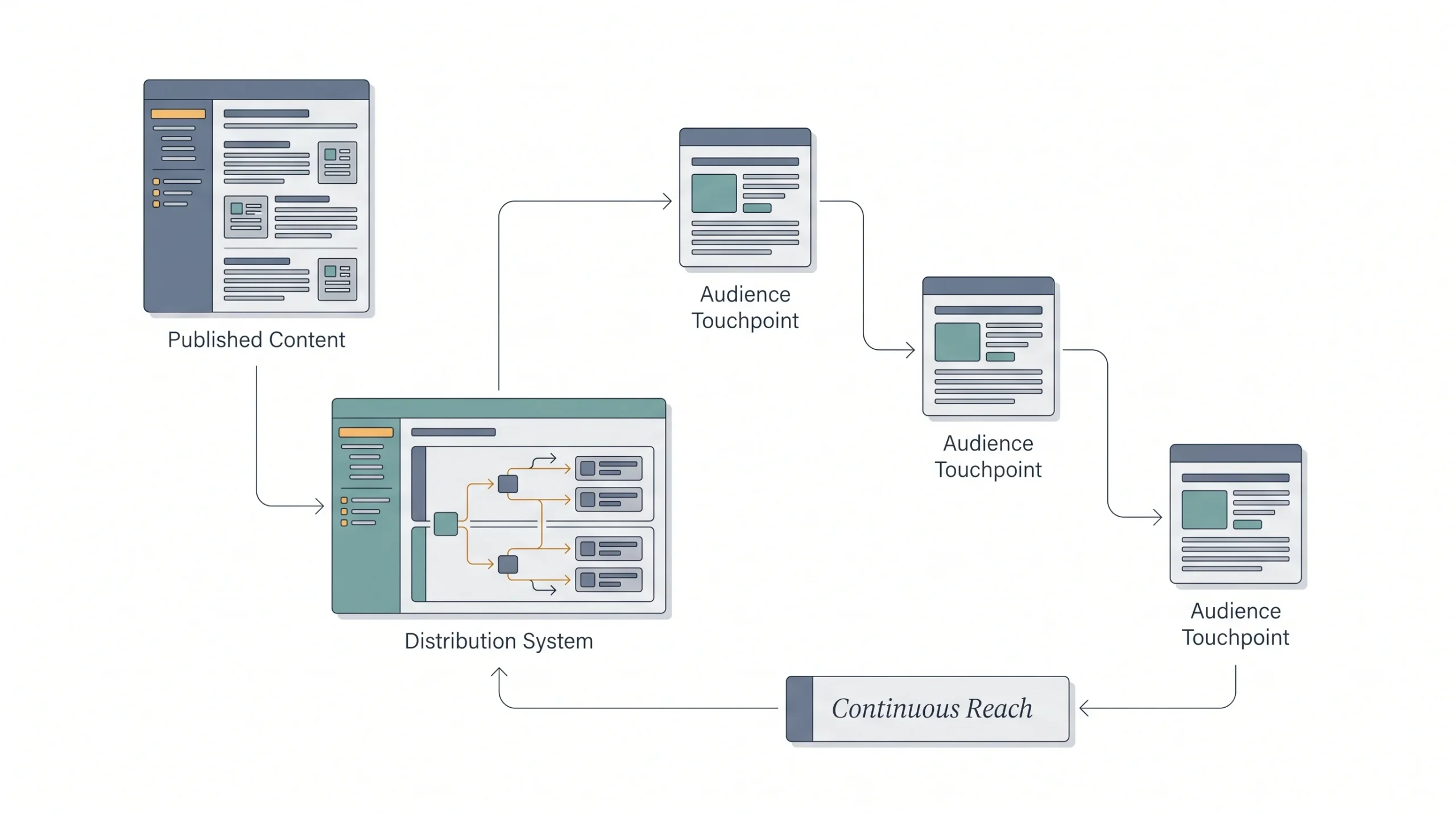
Here’s the confusion that trips up almost everyone starting out: distribution and promotion get used like they’re the same thing. They’re not. Promotion is one tactic inside distribution, not the whole strategy. Posting your blog link on Twitter is promotion. Deciding which five channels your content will move through, in what order, with what format changes for each one, and who’s responsible for making that happen, that’s distribution.
Think about it this way. If creation is building the product, distribution is everything that gets that product into someone’s hands. A brilliant blog post nobody sees might as well not exist. It’s not going to rank on its own, it’s not going to get shared on its own, and it’s definitely not going to walk into someone’s inbox by accident. Someone has to move it there, deliberately, over and over, across more than one channel.
There’s also a timing piece people miss. Distribution isn’t a single event on publish day. It’s closer to a series of pushes spread out over weeks or months. A blog post might get its first push the day it goes live, a second push two weeks later once early performance data comes in, and a third push a few months down the line when it gets refreshed with new numbers. Most content never gets that second or third push, because nobody planned for one. It gets one shot, and then it’s forgotten.
Most content doesn’t fail because it’s bad. It fails because nobody planned for anyone to find it. Honestly, that’s the uncomfortable truth behind a lot of “our content isn’t performing” conversations. The content is often fine. The plan to get it seen just never existed.
A blog post with no distribution plan is a message in a bottle. It might wash up somewhere. It probably won’t.
That’s not meant to be dramatic. It’s just true. Teams pour hours into research, structure, editing, design, and then treat the actual reach of that content like an afterthought, something to figure out once it’s already live. Flip that ratio and the results change fast, usually faster than most teams expect.
The Three Channels: Owned, Earned, Paid
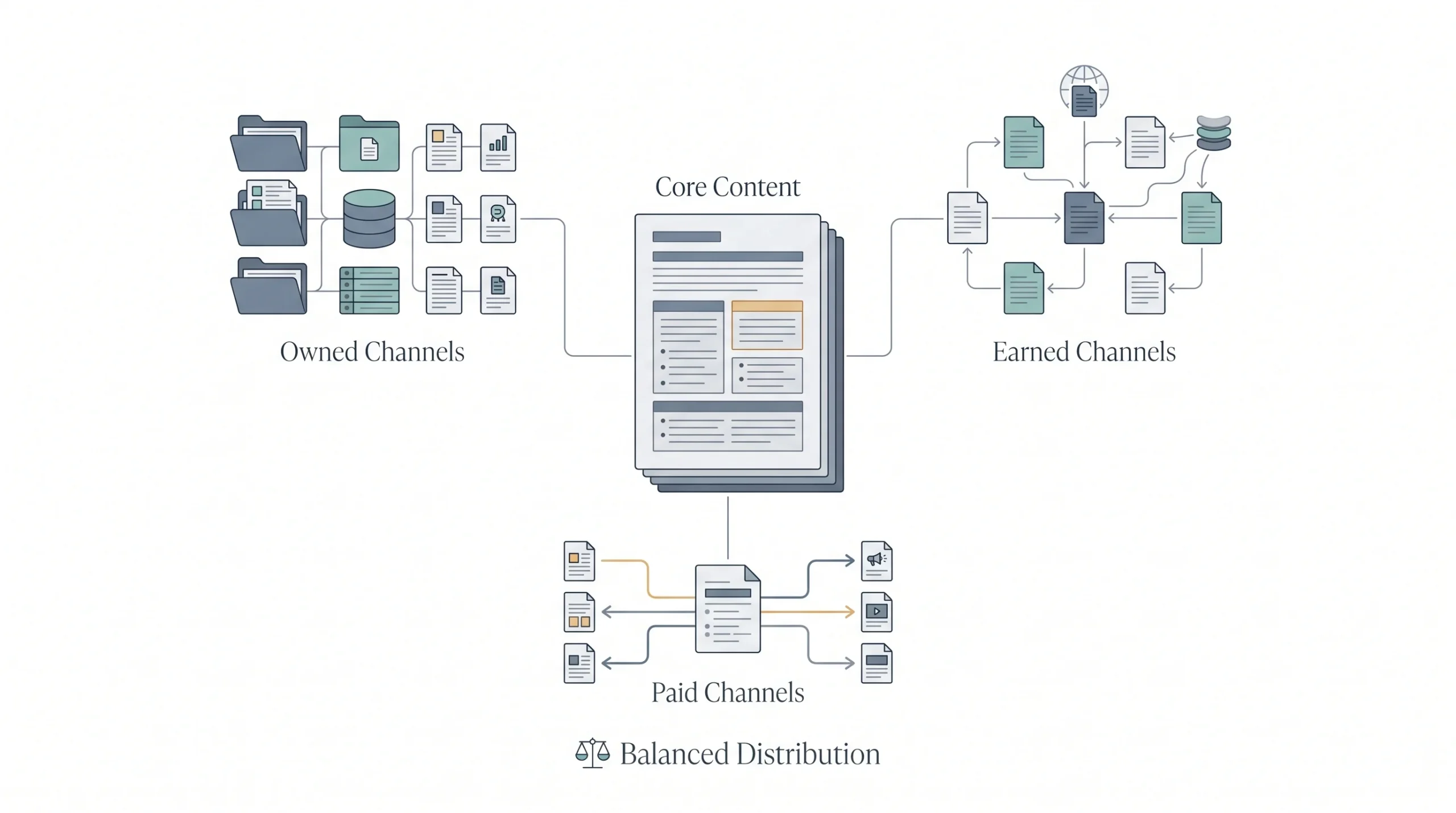
Every distribution channel falls into one of three buckets. This part isn’t new, most people in marketing have heard “owned, earned, paid” a hundred times, maybe enough times that it stopped meaning anything. But knowing the categories exist and knowing how to actually use them well, together, on purpose, are two very different skills. Most teams lean hard on one and basically ignore the other two, usually without realizing they’re doing it.
| Channel Type | Examples | Cost | Speed | Control | Best For |
|---|---|---|---|---|---|
| Owned | Website, blog, email list, YouTube channel | Low (mostly time) | Slow to build | High | Long-term SEO, compounding traffic |
| Earned | PR, guest posts, backlinks, shares, mentions | Free but effort-heavy | Unpredictable | Low | Credibility, reaching new audiences |
| Paid | PPC, social ads, sponsored content, boosted posts | Direct spend | Fast | High | Launches, deadlines, testing messaging |
Owned channels: the foundation nobody wants to build slowly
Owned channels are the ones you control outright. Your website, your blog, your email list, your YouTube channel if you run one. Nobody can change the algorithm on your own email list. Nobody can suddenly decide your blog isn’t eligible for reach anymore, the way a platform can quietly throttle organic reach on a whim. That’s the whole appeal of owned media. It’s yours, permanently, and nobody’s rewriting the rules on you overnight.
The catch is that owned channels are slow. An email list doesn’t build itself in a week, and organic search traffic takes months, sometimes closer to a year for a genuinely competitive keyword, to show up in any meaningful way. That slowness is exactly why so many teams skip investing here and chase faster wins elsewhere instead. Social feels more immediate. Paid feels more immediate. Owned media asks for patience most teams don’t feel like they have.
Which is a mistake, because owned channels are the only ones that compound. A blog post ranking on page one of Google in year two is still bringing in traffic without anyone lifting a finger that week. Try saying that about a social post from eighteen months ago. Nobody’s finding that tweet again unless they go looking for it specifically. The blog post, on the other hand, just keeps sitting there in search results, working quietly in the background.
Earned channels: harder to control, worth more when it lands
Earned media is anything you didn’t pay for and don’t fully control, but that still puts your content in front of new people. Someone links to your article because it’s genuinely useful to their readers. A journalist quotes your research in a piece they’re writing anyway. A guest post lands on a site with an audience you don’t have yet, and some percentage of that audience clicks through to check out who wrote it.
Here’s the honest part most guides skip: earned media is unpredictable, and it should stay that way in your expectations. Nobody can promise a backlink. Nobody can promise a journalist responds to a pitch, even a genuinely good one. That unpredictability is uncomfortable for anyone trying to build a neat quarterly plan, but pretending earned media works on a schedule just sets people up for disappointment.
What earned media does really well, when it lands, is credibility. When someone else’s audience sees your name attached to something on a site they already trust, that trust transfers a little, almost like a borrowed introduction. That’s worth more than a hundred impressions from an ad, even if it’s a lot harder to plan around or predict. A single well-placed mention on a site your audience already respects can do more for long-term brand trust than months of paid impressions ever will.
Paid channels: fast, but only as good as what’s underneath it
Paid distribution buys you speed. PPC ads, sponsored social posts, boosted content, all of it gets your content in front of people today instead of in six months. That’s genuinely useful for launches, webinars, or anything sitting on a hard deadline where waiting for organic growth just isn’t an option.
But here’s where a lot of budget gets wasted, and it happens constantly.
Paid distribution doesn’t fix bad content. It just gets bad content in front of more people, faster.
If the content itself isn’t earning attention on its own, isn’t getting clicks or shares when it’s posted for free, throwing ad spend at it just accelerates how quickly people scroll past it. Money doesn’t change how compelling something is. It just changes how many people get the chance to decide they’re not interested. Paid works best as an amplifier for something that’s already proving itself organically, not as a substitute for content that isn’t landing on its own merits.
Building a Distribution-First Content Process
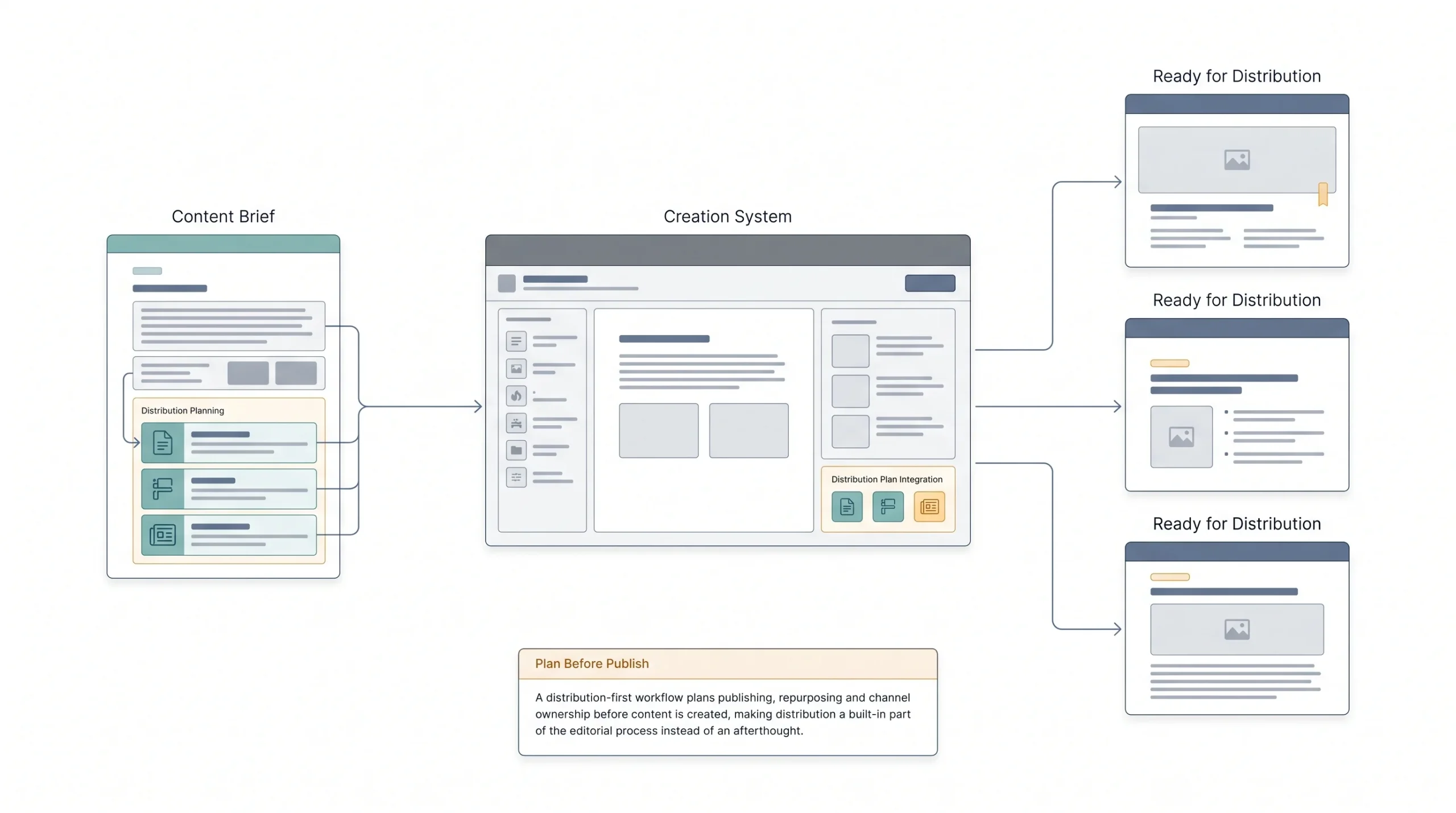
Here’s where most teams get the order backwards. Content gets written, edited, published, and then somebody asks “okay, how do we get this out there.” That question needs to get asked before a single word gets written, not after the content is already sitting live on the site with nowhere to go.
A distribution-first process means every content brief includes a distribution plan alongside it. Not as a separate document that shows up three weeks later once someone remembers to write one. Same brief, same document, same planning session. Which channels is this going to, what format changes does each one need, who owns making that happen, and when does each push actually go out.
If a blog post is going to become five LinkedIn posts and a newsletter segment, the writer should know that going in, because it genuinely changes how the piece gets structured. A post built with repurposing in mind naturally has clearer sections that can stand alone, stronger quotes that pull out cleanly without needing extra context, and data points formatted in a way that translates easily into a graphic or a single social post. A post written with zero thought for what comes after publishing usually doesn’t have any of that. Everything’s tangled together, and whoever repurposes it later has to do double the work untangling it first.
Different content types naturally fit different channels, and it helps to map that out before creation starts instead of guessing afterward once the piece is already done.
| Content Type | Natural Distribution Fit |
|---|---|
| Long-form blog or pillar post | SEO, email newsletter, LinkedIn article, repurposed threads |
| Data or research report | PR outreach, LinkedIn carousel, gated download, backlink bait |
| How-to or tutorial | YouTube, Pinterest, Reddit communities, email series |
| Case study | Sales enablement, LinkedIn, retargeting ads |
Once that mapping exists, distribution stops being a scramble and starts being a checklist that was already half-built before the content even shipped. It also removes a lot of the “wait, who’s supposed to post this” confusion that happens when distribution gets figured out on the fly, usually a day or two after the piece went live and momentum already started fading.
There’s a real ownership problem hiding underneath all of this too. Ask most teams who’s responsible for distribution and the honest answer is usually “everyone and no one.” The writer assumes marketing will promote it. Marketing assumes the writer will share it on their own network. Nobody assumes it’s specifically their job, so it ends up being nobody’s job, and the piece gets one lonely social post before everyone moves on. A distribution-first process fixes that by naming an owner for each channel right there in the brief, the same way a writer gets named for the actual content. No ambiguity, no assuming someone else has it covered.
Repurposing: Getting More Mileage From One Piece of Content
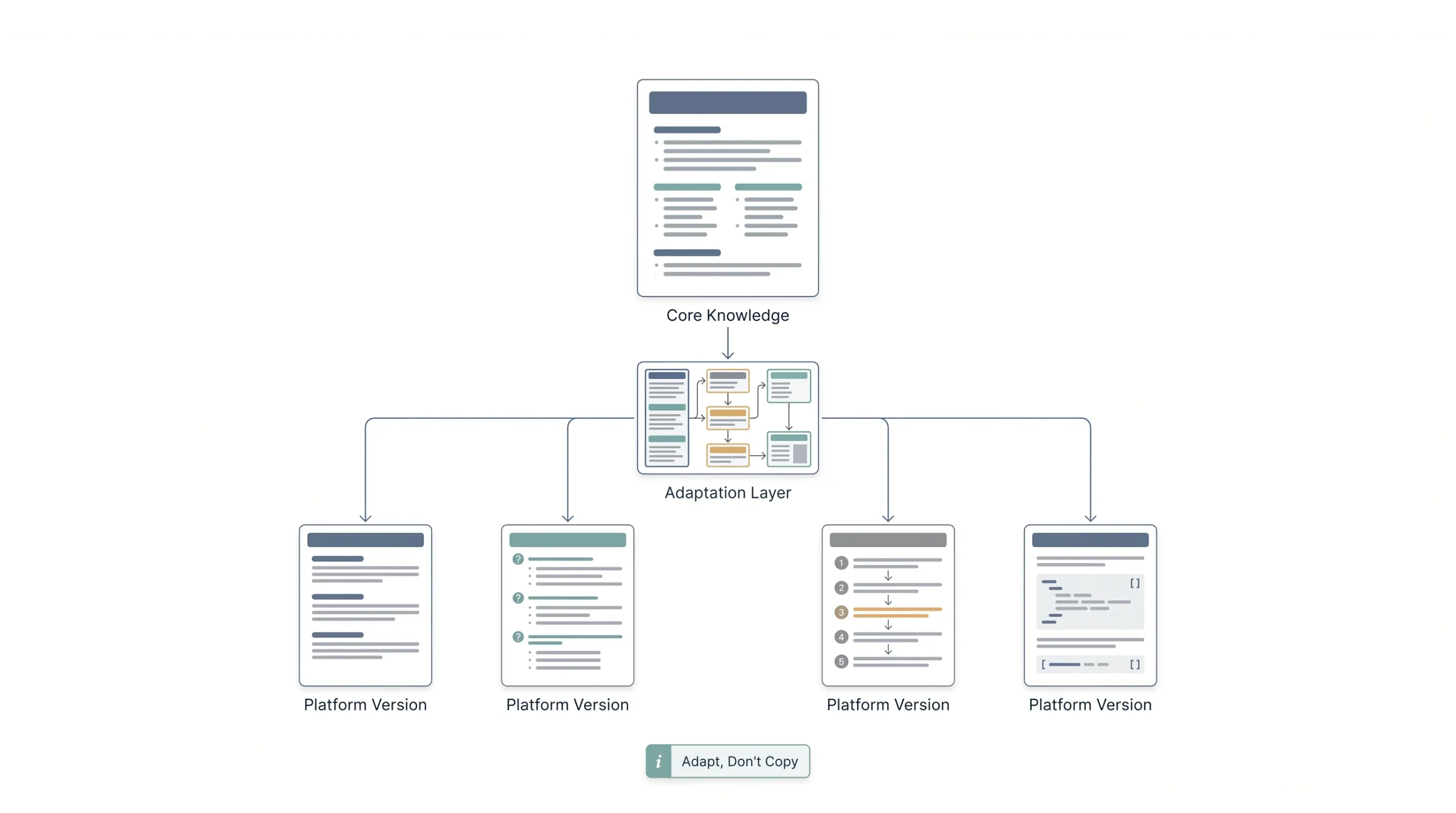
One well-researched blog post can become a lot more than a blog post. That same research, those same insights, can turn into a handful of social posts, a newsletter section, a short video script, maybe an infographic if the data supports it visually. This is the “one piece, many formats” model, and it’s genuinely one of the highest-leverage moves in a content plan, because the expensive part, the research, the thinking, the structuring of ideas, is already done. Everything after that is reformatting, which takes a fraction of the time original creation does.
Take a 2,000-word guide on, say, email segmentation. That one piece can spin out into a five-post thread breaking down the main points one at a time, a single LinkedIn post pulling out the most surprising stat from the piece, a shorter version condensed for the newsletter list, and a script for a two-minute explainer video walking through the core idea. Same core ideas, four different formats, four different audiences reached, without writing anything from scratch. Some of those audiences overlap with the blog’s readers. Some of them, especially on platforms the brand doesn’t already dominate, are brand new.
A simple repurposing matrix makes this easier to plan instead of improvising it after the fact, scrambling to figure out what to post once the blog is already three days old and losing momentum.
| Source Content | Repurposed Into |
|---|---|
| Long-form blog post | Twitter/X thread, LinkedIn post, newsletter excerpt, short video script |
| Research report | Infographic, data-driven social posts, PR pitch angle |
| Webinar recording | Blog recap, YouTube clips, quote graphics |
| Customer case study | Sales one-pager, LinkedIn testimonial post, retargeting ad copy |
The mistake to watch for here is treating repurposing like copy-paste. Taking a paragraph straight out of a blog post and dropping it into a LinkedIn caption isn’t repurposing, it’s just relocating text from one place to another. Every platform has its own rhythm and its own reading behavior. What works in a blog, longer sentences, more context, room to build an argument slowly, doesn’t automatically work in a feed people are scrolling through in half a second between other things competing for their attention.
Repurposing isn’t recycling. If it reads like a copy-paste job, the platform’s algorithm, and your audience, will notice.
Good repurposing respects the platform it’s landing on. A LinkedIn post pulled from a blog needs its own hook, its own pacing, maybe a line break structure that makes it easy to skim on mobile. A tweet thread needs each individual post to make sense mostly on its own, since not everyone reads a thread start to finish, and plenty of people land on tweet number four with zero context from the ones before it. Skip that adaptation step and the repurposed content underperforms, then someone concludes “repurposing doesn’t work for us,” when really, it just wasn’t done properly in the first place.
There’s a timing piece to repurposing that’s easy to miss too. Not every derivative piece needs to go out the same week as the original. Spacing repurposed content out over a month or two, instead of dumping everything the week of publish, gives the source material multiple separate moments to reach people who missed it the first time around. A blog post’s LinkedIn version might go out on day one, the newsletter excerpt a week later, and the short video a few weeks after that, once there’s been time to actually produce it properly instead of rushing it out alongside everything else.
Channel-by-Channel Distribution Tactics
This is the part where the specifics matter more than the theory. Every channel behaves differently, rewards different formats, and needs a slightly different approach. Generic advice that works everywhere usually ends up working nowhere in particular.
SEO and organic search
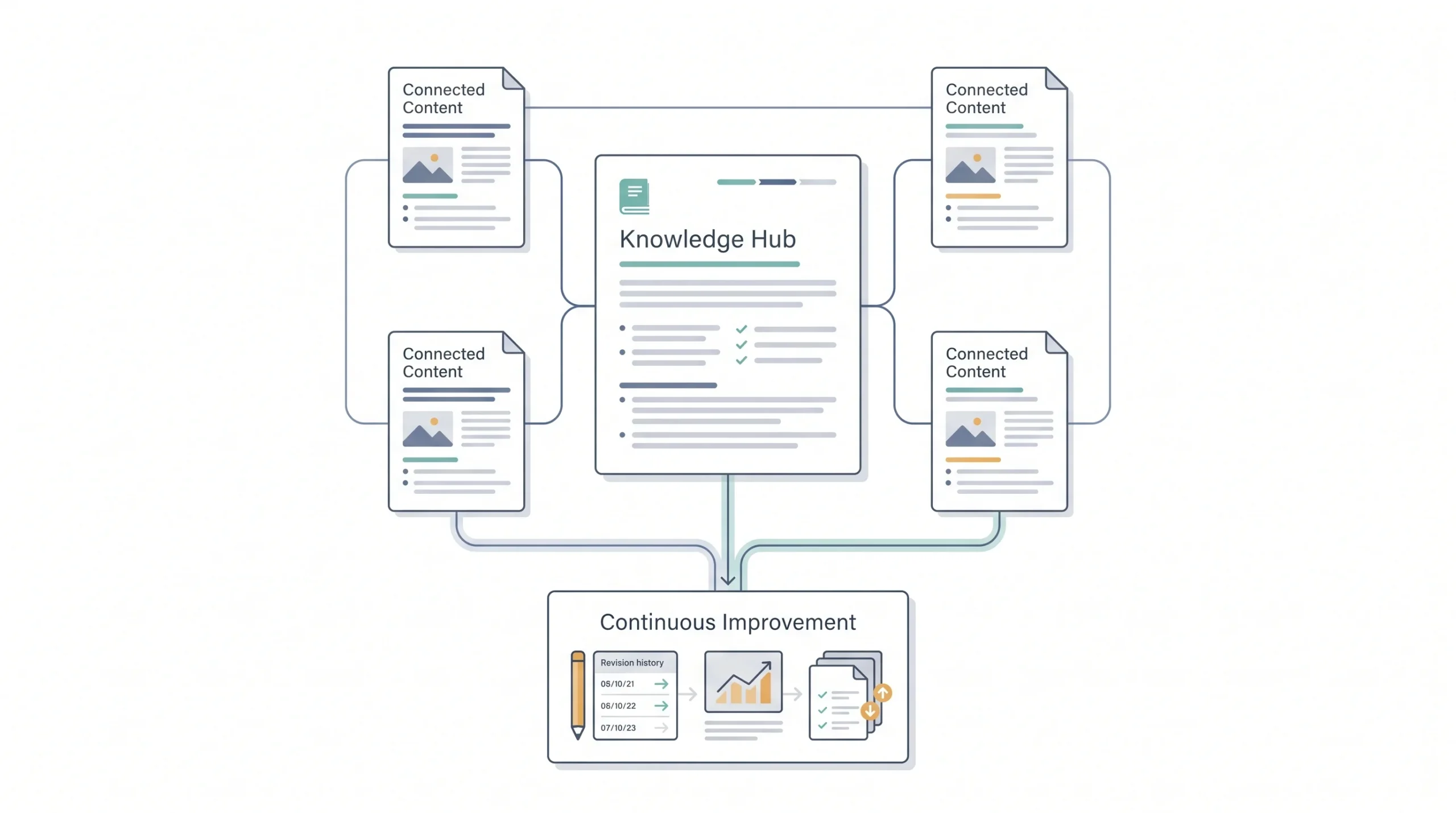
Search is still the channel that keeps working long after everything else has stopped pulling in new traffic. But it needs actual structure behind it, not just publishing and hoping something ranks eventually. Internal linking matters more than most people give it credit for, connecting new posts to older relevant ones so search engines, and readers, can find related content easily instead of hitting a dead end after one article and leaving the site entirely.
Keyword clustering, grouping related topics under one pillar page instead of writing scattered one-off posts that never reference each other, helps build topical authority instead of a pile of disconnected articles competing against each other for the same handful of keywords. A pillar page like this one, with cluster posts branching off into more specific subtopics and linking back up to the pillar, tells search engines this site actually knows the subject in depth, not just one lucky article that happened to rank once.
And refreshing older content, updating stats, fixing outdated advice, adding new sections that reflect how the topic has evolved, often gets faster results than publishing something brand new, because that page already has some ranking history and backlinks built up. A refresh can move a page from position eight to position three in weeks. A brand new post starting from zero authority might take months to get anywhere close, if it gets there at all.
None of this works without patience, though. SEO is the slowest channel on this whole list to show results, and that’s exactly why it gets deprioritized so often when a team is under pressure to show numbers by next quarter. But it’s also the channel that keeps paying off two, three, four years after a post first goes live, quietly bringing in traffic while everyone’s attention has already moved on to newer content.
Email newsletter
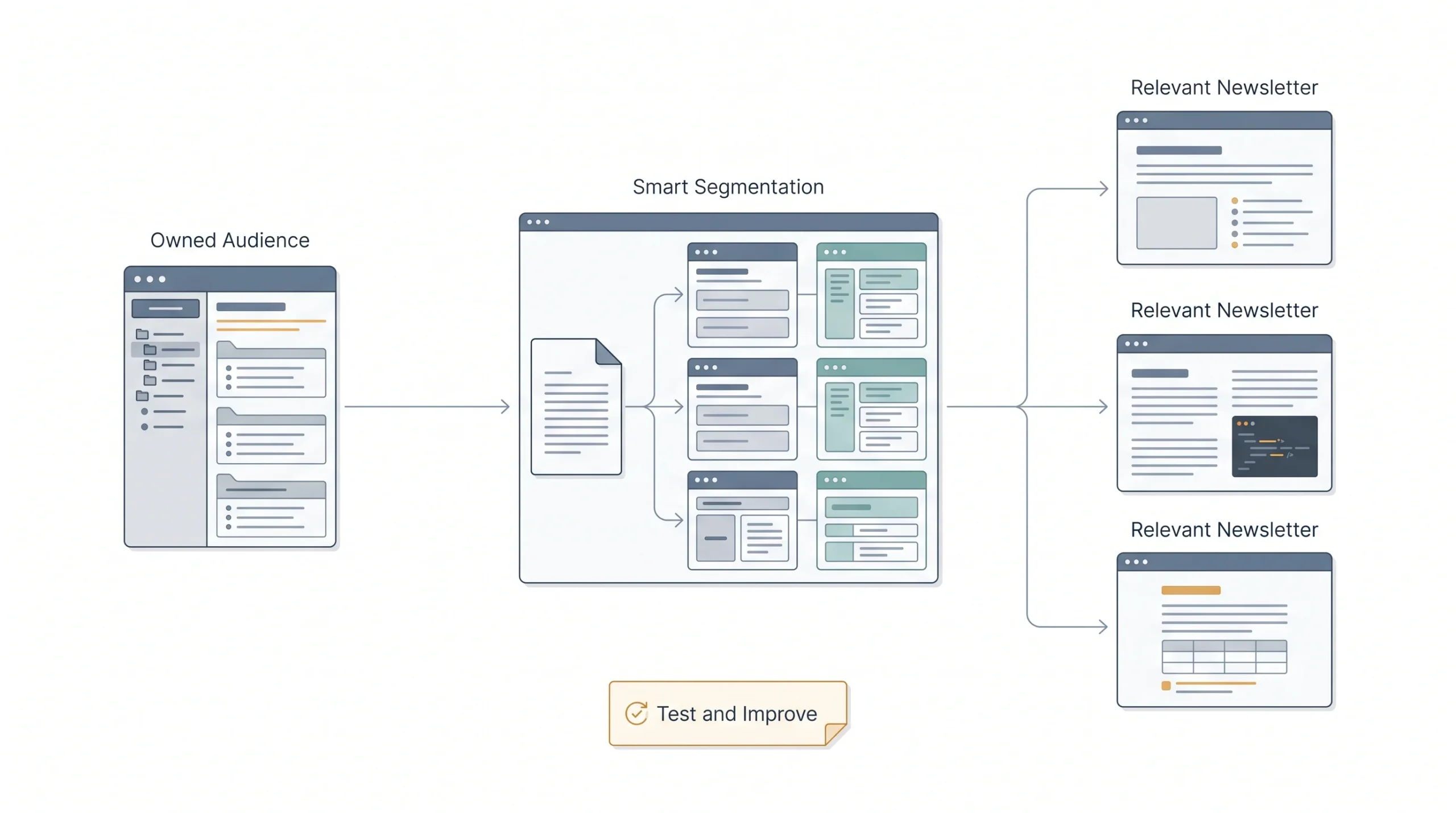
Email doesn’t get the same hype as social platforms, but it’s arguably the most reliable owned channel there is, because nobody controls the list except the brand that built it. No algorithm decides whether subscribers see the email that week. It either lands in the inbox or it doesn’t, and that’s mostly within the sender’s control, assuming deliverability basics are handled properly.
Segmentation is what separates a newsletter that gets read from one that gets ignored and eventually unsubscribed from. Sending relevant content to the right subset of a list, instead of blasting everyone with everything regardless of what they actually signed up for, keeps open rates healthy and keeps the list from quietly decaying over time. A list split by interest, industry, or where someone is in their journey with a brand can send three different versions of the same newsletter and get noticeably better engagement on each one than a single one-size-fits-all blast would.
Send timing matters too, though it’s more about testing what a specific audience responds to than following generic “best time to send” advice that seems to change depending on whichever blog post someone happens to read that week. A B2B audience checking email on a work laptop behaves completely differently than a consumer audience scrolling on their phone in the evening, and no generic rule accounts for that difference. The only real way to know is testing send times against an actual list and watching what the open and click data says over a few weeks, not guessing based on averages pulled from someone else’s audience.
Social media, organic
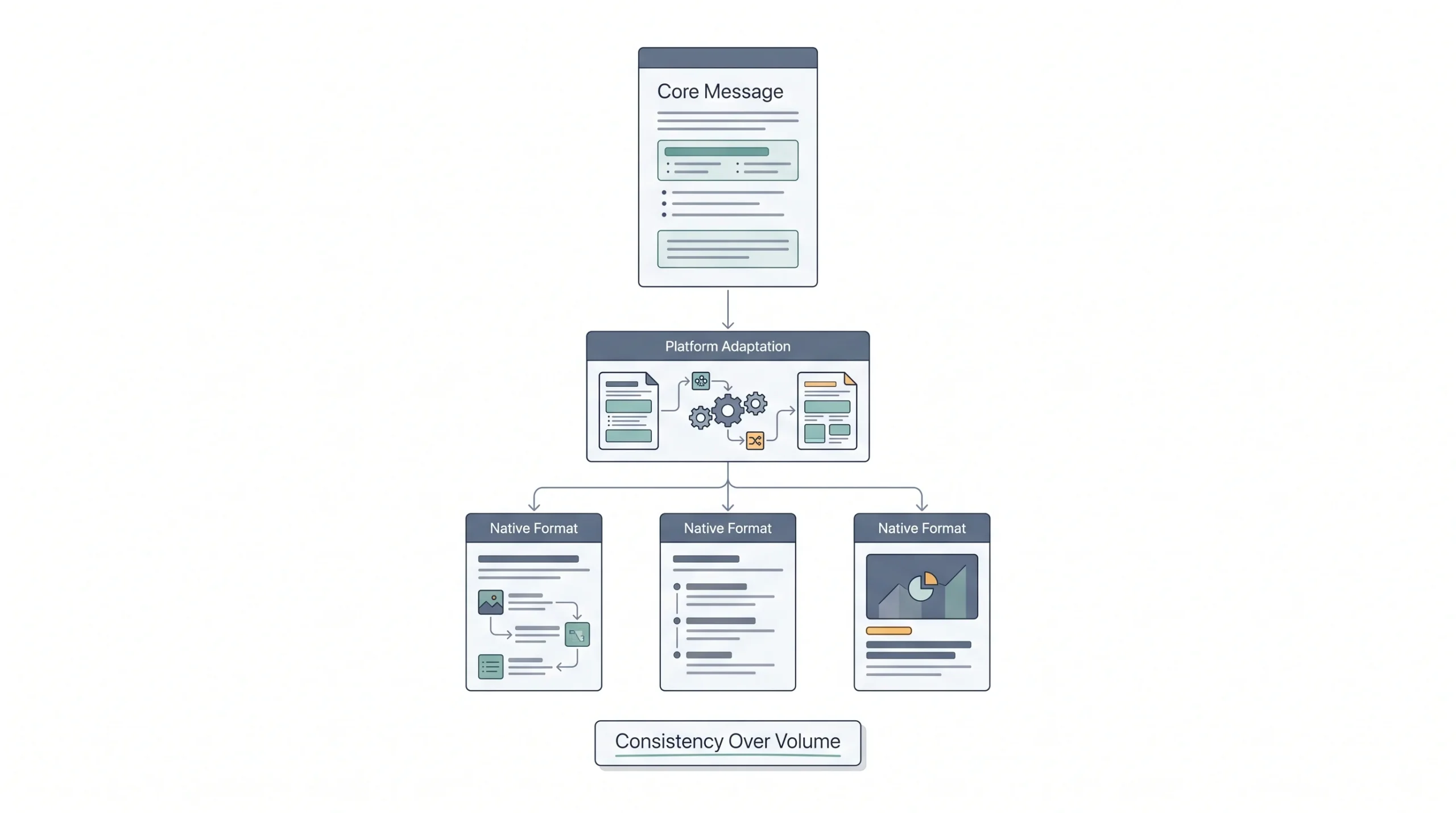
Generic advice like “post more” doesn’t actually help anyone, and honestly it’s the kind of advice that sounds true without being useful. What matters is platform-specific behavior, because the same content performs completely differently depending on where it lands. LinkedIn rewards posts that spark discussion in the comments, not just links out to another site, since the platform itself tends to suppress reach on posts that send people away from LinkedIn. Twitter/X rewards threads that deliver value inside the platform itself, again not just a headline with a link tacked on. Instagram is visual first, so a beautifully designed carousel outperforms a plain text screenshot every time, because the format itself is built around visual scrolling, not reading dense paragraphs.
Treating every platform the same way, same copy, same format, same posting time, copy-pasted across all of them, is one of the fastest ways to underperform on all of them at once. It’s tempting because it’s efficient. It’s also usually a waste of the effort that went into writing the post in the first place.
Posting frequency matters here too, but not in the “post constantly” way it usually gets framed. Consistency beats frequency almost every time. A brand posting three genuinely useful times a week, every week, tends to outperform one posting daily with filler content just to hit a number, because audiences notice quality dropping a lot faster than they notice a slightly lower posting frequency. The algorithm rewards engagement, not volume, and filler content rarely earns much engagement no matter how often it goes out.
Communities and forums
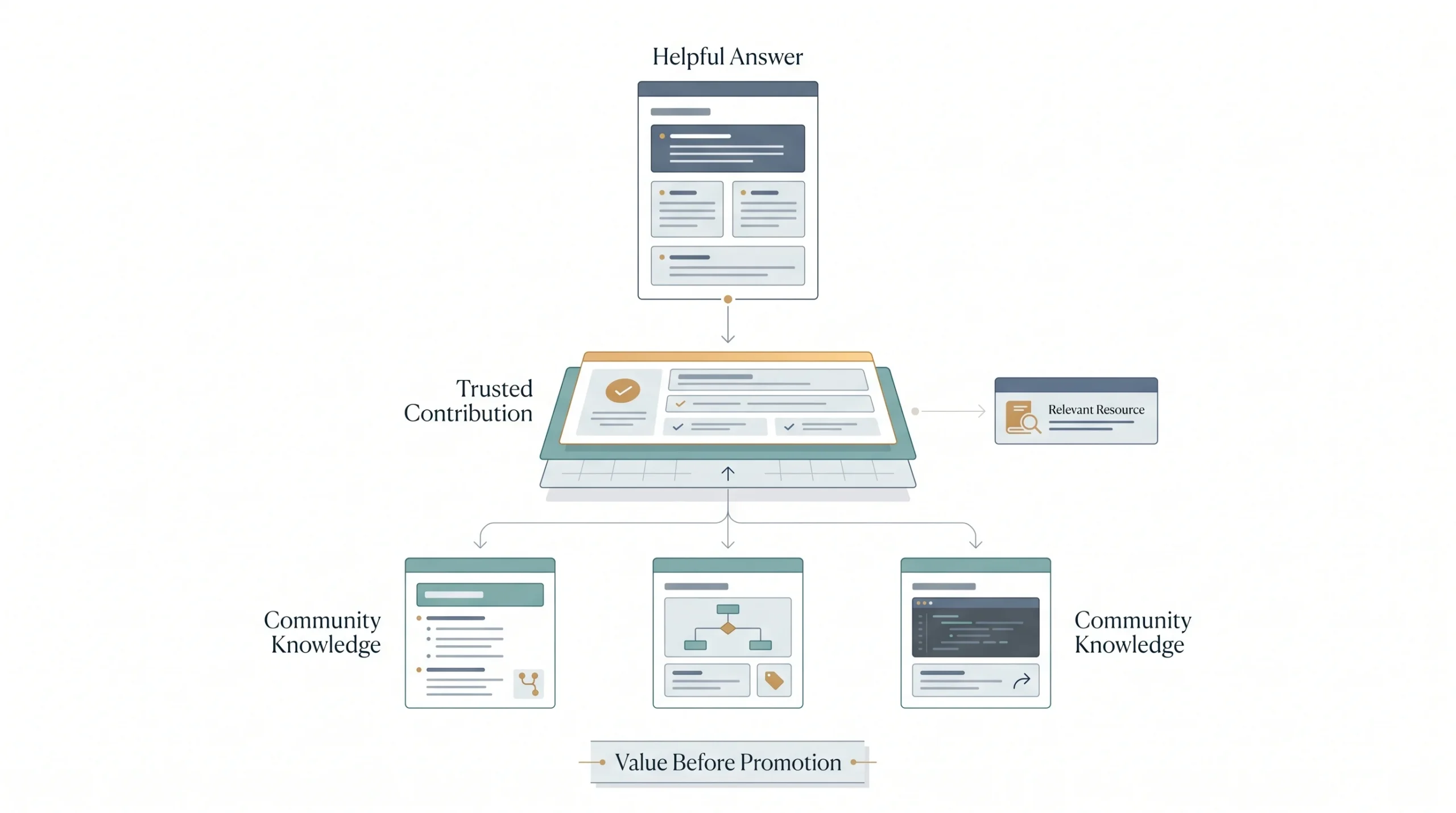
This one gets skipped constantly, and it really shouldn’t. Reddit threads, niche Slack and Discord communities, Quora questions sitting there with genuine search volume behind them, these are places where genuinely engaged, high-intent audiences already exist, actively looking for answers to specific problems. The catch is that these spaces punish anything that smells like an ad, almost instantly and often publicly.
Dropping a link with no context gets removed by moderators or ignored by the community, sometimes both. What actually works is showing up as someone who knows the topic well, answering the actual question being asked in full, and only linking out when it genuinely adds value to the conversation that’s already happening, not as the whole point of showing up. It’s slower than posting a link and walking away, but it builds a kind of trust that a cold link drop never will.
Guest posting and syndication
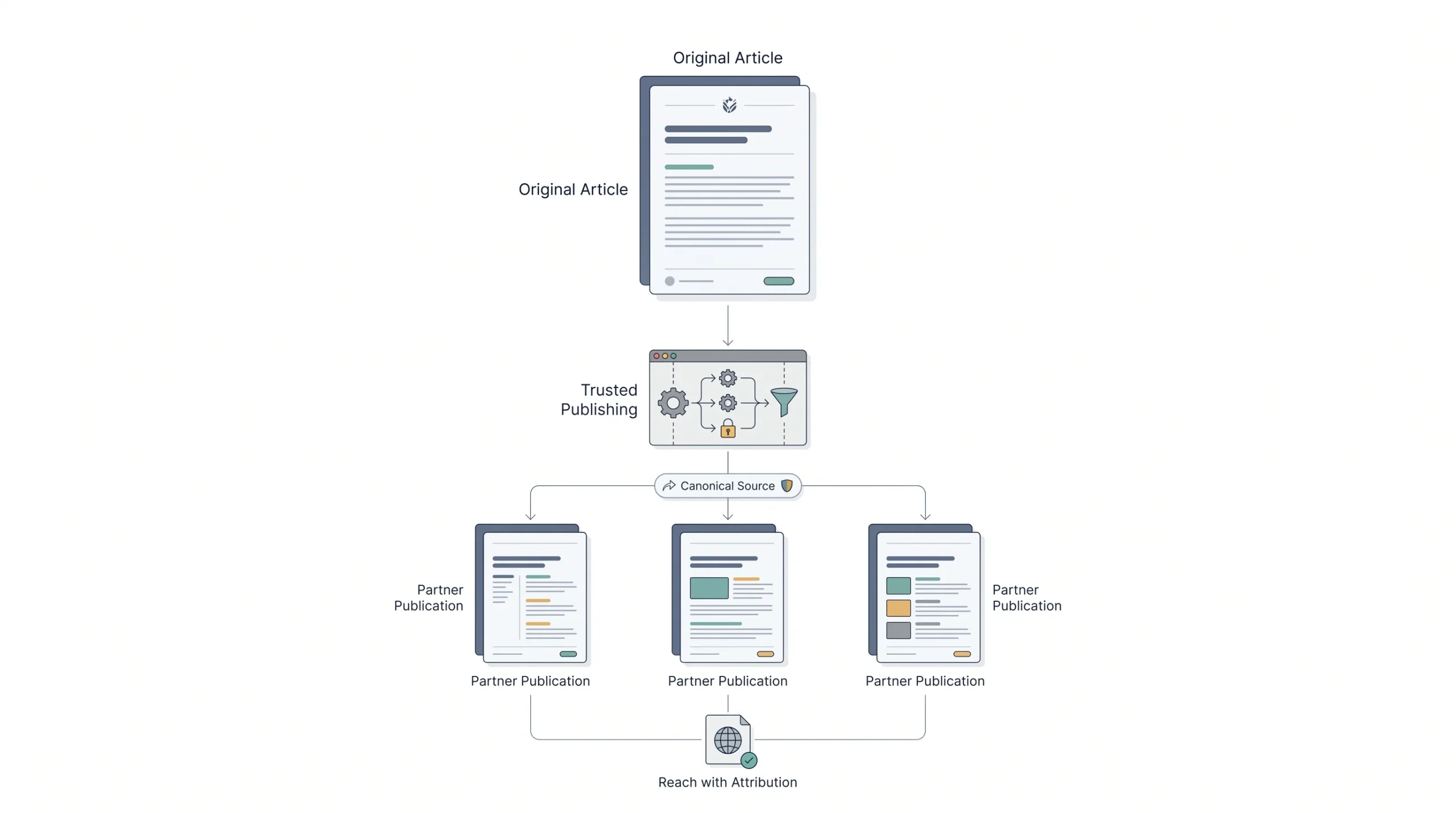
Publishing on someone else’s platform, whether that’s a full guest post written specifically for their site or syndicating an existing article with permission, puts content in front of an audience that doesn’t already know the brand exists. Picking the right publications matters a lot more than picking a lot of them. One well-placed guest post on a site with a relevant, engaged audience beats five guest posts scattered across random blogs that barely get read.
Syndication comes with one real risk worth knowing about going in: duplicate content. If the same article lives on two different domains, search engines need to know which one is the “real” version, the one that should get credit in search results. That’s what canonical tags are for, telling search engines to point ranking credit back to the original source even when the same content appears elsewhere with permission. Skipping that step can quietly hurt the original piece’s own ranking, sometimes without anyone noticing until traffic on the original starts dropping for no obvious reason.
Pitching a guest post also works a lot better with a specific angle than a generic offer to “write something.” Editors get flooded with vague pitches every week, “I’d love to contribute a piece on marketing,” and most of those go straight to the trash without a second look. A pitch with a clear headline, a specific argument, and a reason that particular publication’s audience would care about it stands out immediately, because it shows the effort of actually reading what that publication already covers instead of sending the same generic offer to fifty sites at once.
Influencer and partner amplification
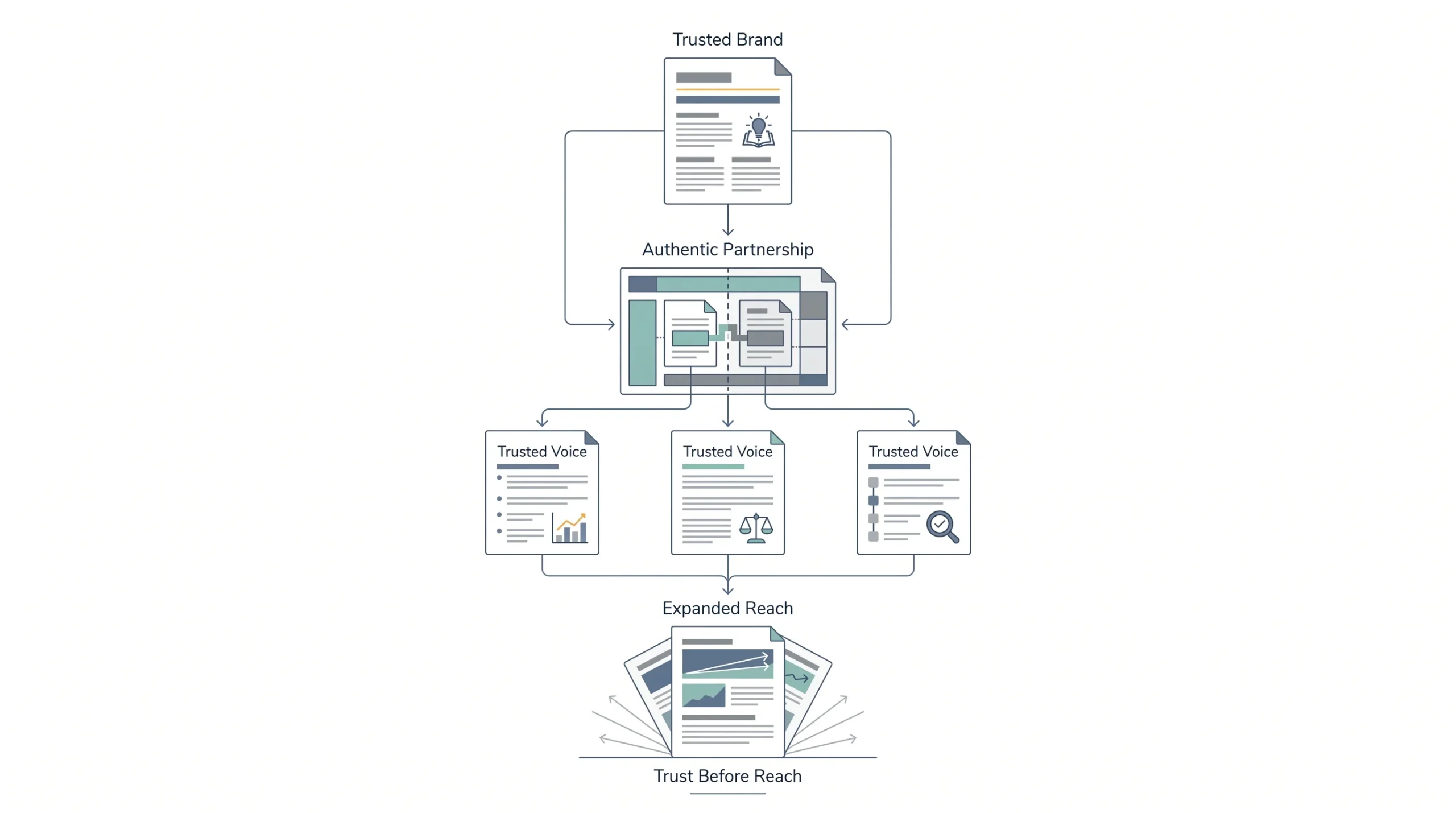
Not every brand needs a big-name influencer partnership, and honestly, most don’t have the budget for one anyway, nor does it always make sense even with the budget available. Micro-influencers, people with smaller but genuinely engaged audiences in a specific niche, often deliver better results per dollar spent than a huge account with broad, disengaged followers who barely interact with anything that account posts.
For smaller brands, this channel works best as a genuine partnership, not a one-off transaction where money changes hands for a single post and that’s the end of it. Someone who actually uses and likes what’s being offered will talk about it in a way that reads as real, because it is real, and audiences can usually tell the difference between a genuine recommendation and a paid script being read off a brief.
Paid amplification
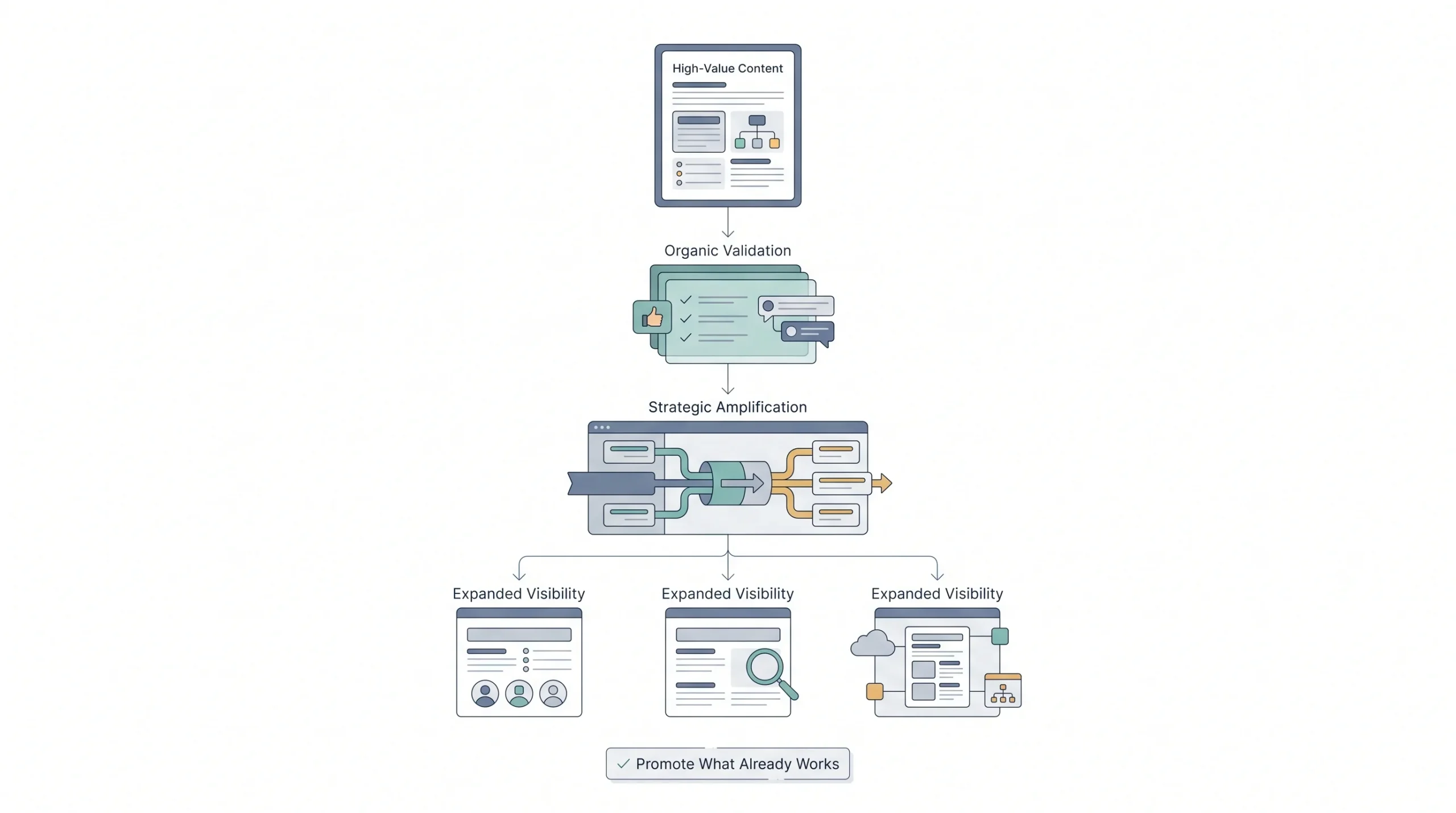
Paid works best when it’s pointed at content that’s already proving itself organically, content with real engagement, real shares, real signs that people find it useful without any spend behind it yet. A blog post getting solid engagement and shares on its own is a good candidate for a paid push, because the data already shows people want it, before a single rupee or dollar gets spent boosting it further.
Throwing budget at content that’s underperforming organically, hoping money somehow fixes the underlying problem, usually just burns spend without changing the outcome in any meaningful way. It just means more people see something that wasn’t working in the first place, faster.
Employee advocacy
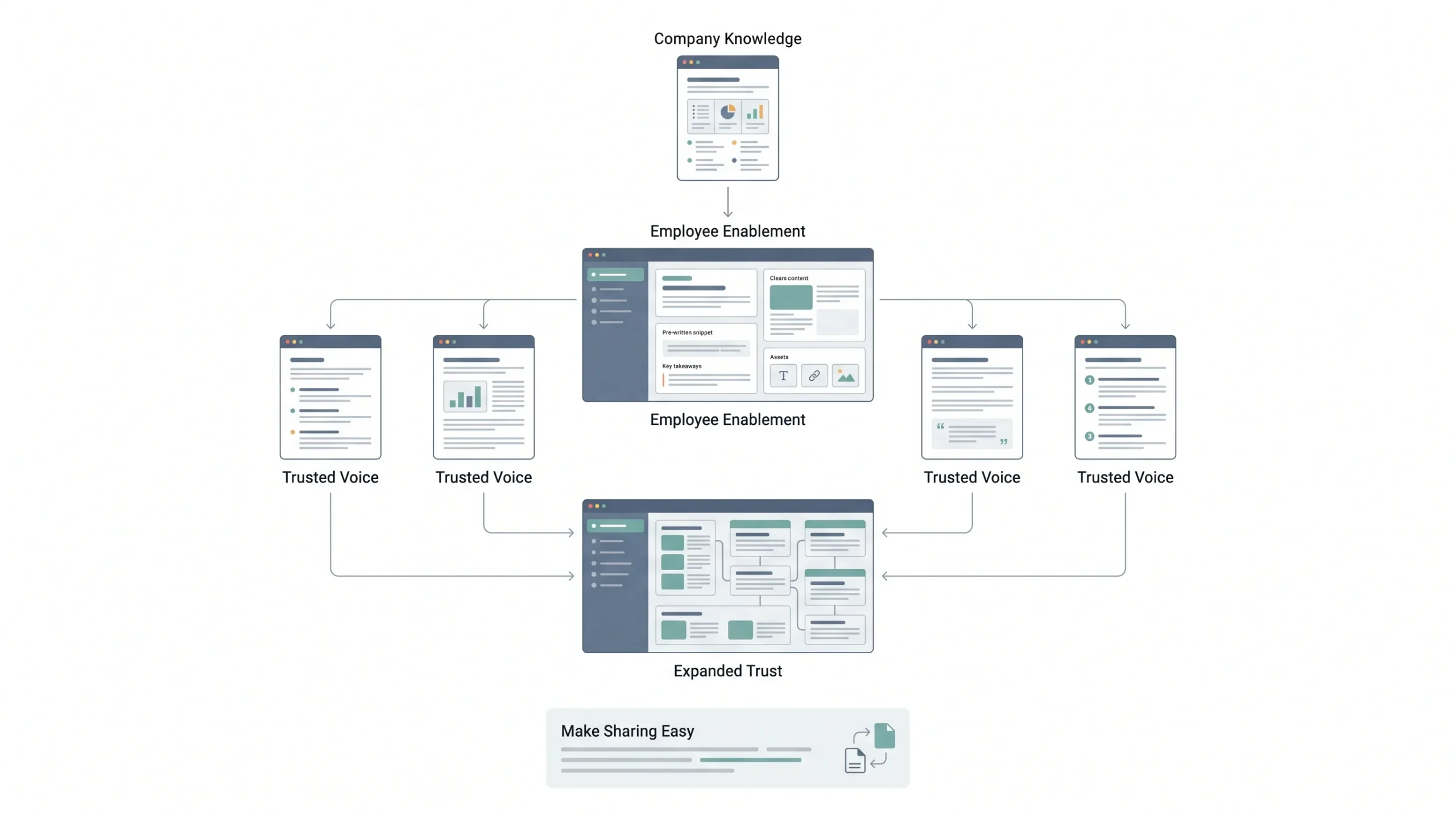
This one is close to free and almost nobody uses it well, which is a genuine missed opportunity. Employees sharing company content on their own personal networks reaches people the brand account never would on its own, because personal accounts tend to carry more trust and often get more engagement than a company page posting the same thing.
It takes almost no budget to set up, just a system for making it easy, sending employees a ready-to-share version of the post or a simple heads-up when something new goes live, instead of assuming they’ll stumble across it themselves and think to share it unprompted. Most people are happy to share something their company published if it’s genuinely good and it takes them ten seconds to do it. Very few people go looking for content to share on their own initiative.
| Channel | Time Investment | Cost | Typical ROI Timeline |
|---|---|---|---|
| SEO/organic | High upfront | Low | Months |
| Medium | Low | Weeks | |
| Organic social | Medium to high | Low | Weeks to months |
| Paid ads | Low to medium | High | Days |
| PR/guest posts | High | Low to medium | Months |
| Communities | Medium | Low | Weeks |
Building a Distribution Calendar
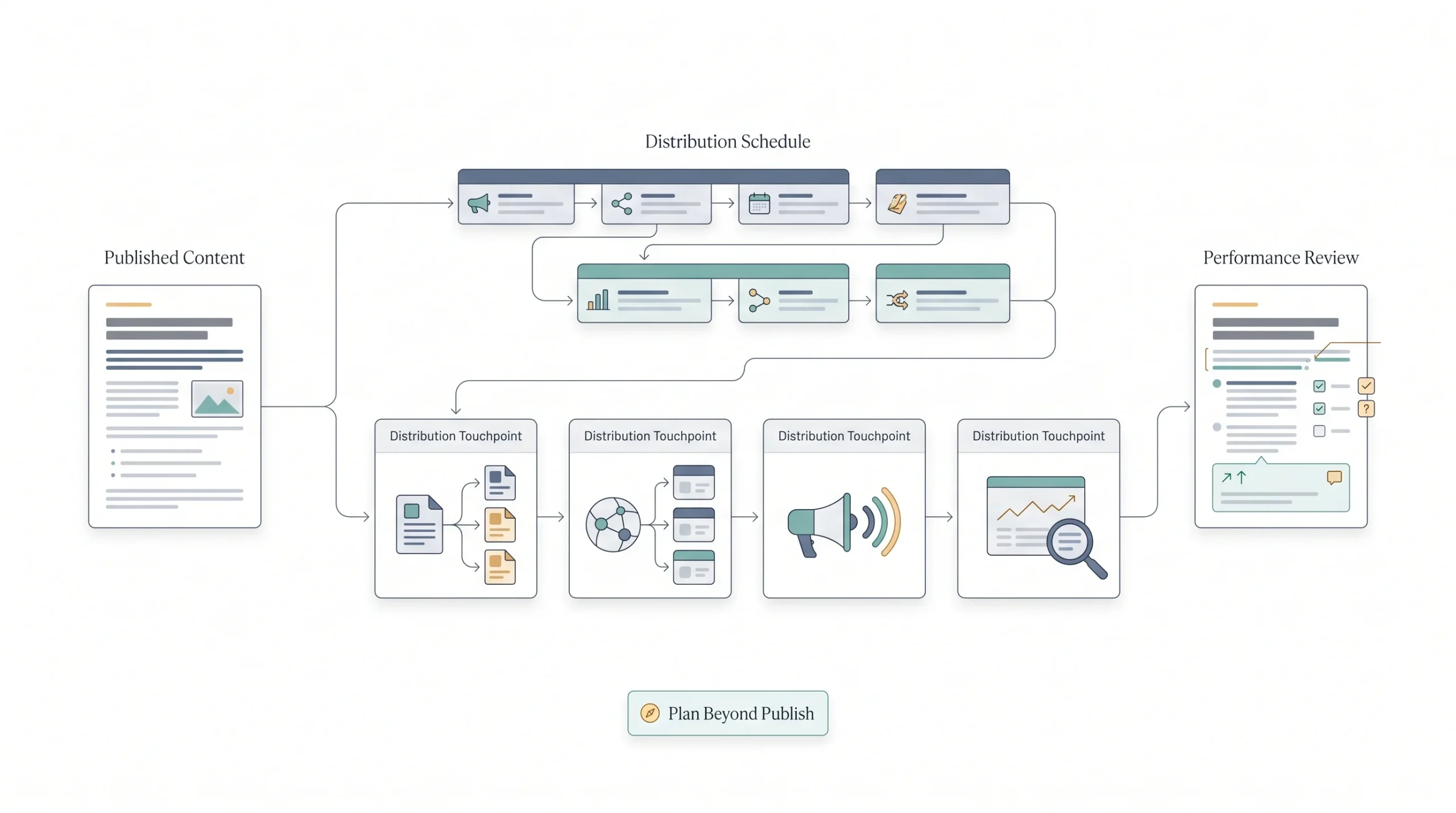
A content calendar and a distribution calendar sound like the same thing. They’re not, and mixing them up is exactly why a lot of teams think they’re planning distribution when they’re really just planning publish dates. A content calendar tracks when something goes live. A distribution calendar tracks everything that happens after it publishes: the repurposing slots scheduled for the following weeks, the paid amplification windows tied to specific budget, who owns promoting it on which channel, and when each channel gets its own version of the content.
A content calendar that only tracks publish dates isn’t a distribution calendar. It’s a to-do list.
The other thing worth being honest about is cadence. Planning twenty social posts and two blog posts a week sounds ambitious on paper, and it might even look impressive in a strategy deck, but for a five-person team, it’s a fast route to burnout, and burnout leads to rushed, low-quality output across the board, which then hurts every channel it touches at once. A smaller, sustainable volume that actually gets shipped well, on time, with real thought behind each piece, beats an ambitious schedule that quietly falls apart by week three when everyone’s exhausted and cutting corners just to keep up.
Matching output to the size of the team actually running it isn’t a limitation to apologize for. It’s just realistic planning, and realistic plans tend to survive contact with an actual busy week a lot better than aspirational ones do.
A useful distribution calendar also has room for the second and third pushes mentioned earlier, the ones most teams forget to schedule at all. Blocking out a slot two or three weeks after a piece goes live to check how it’s performing, and then deciding whether it’s worth a second promotional push or a small paid boost, turns distribution into an ongoing decision instead of a one-time event that happens and is immediately forgotten. That single habit, revisiting content instead of abandoning it after week one, is often the difference between a piece that fades and one that keeps earning its keep months later.
Budget Allocation Across Channels
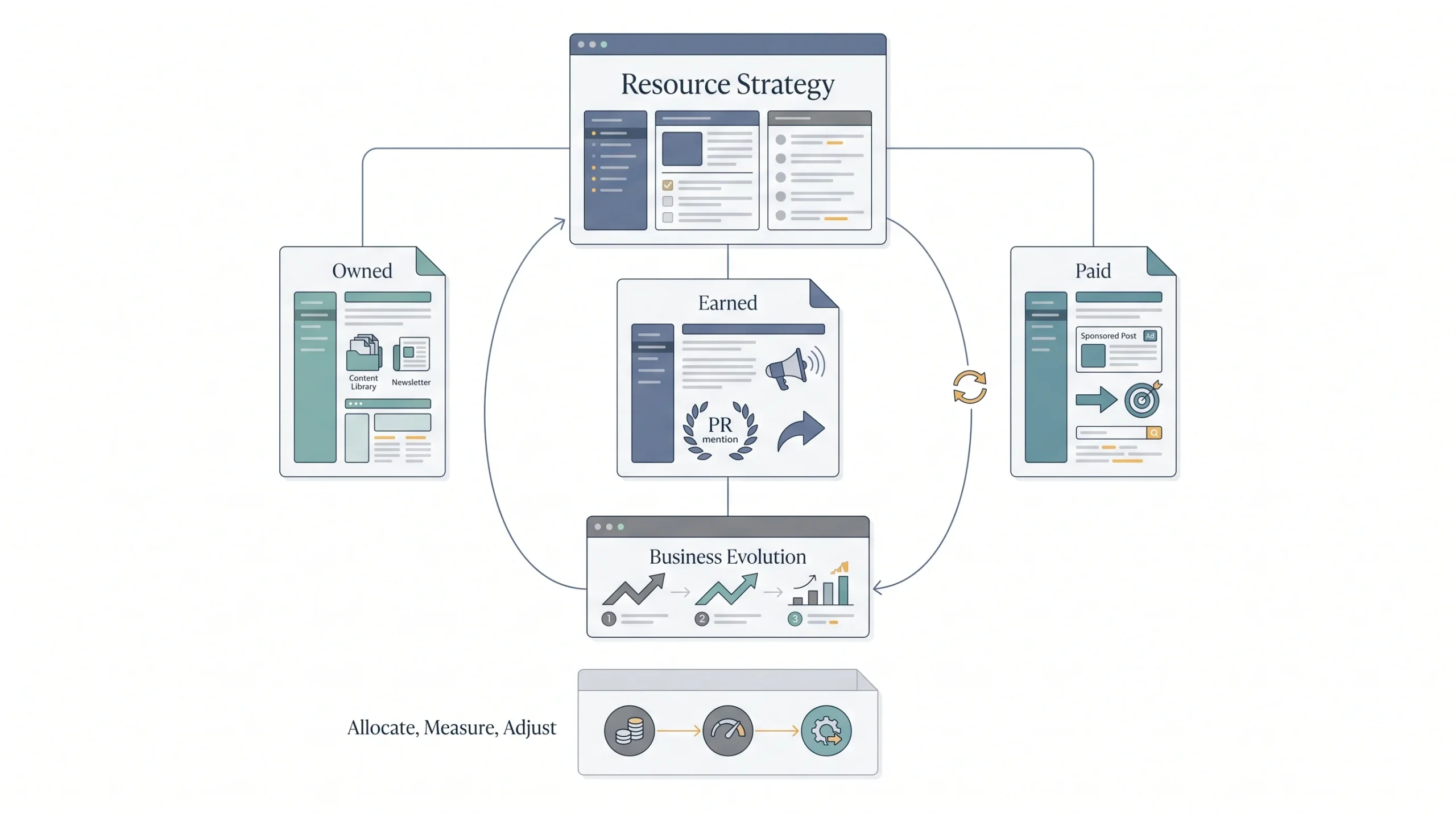
Nobody has infinite budget or infinite hours, so the real question isn’t “should we use owned, earned, and paid channels.” Obviously all three help. The real question is “how much of our limited time and money goes to each one,” and that split depends a lot on where the business actually is right now, not where it hopes to be in two years.
An early-stage brand with more time than money tends to lean heavily on owned and earned channels, building the foundation slowly and deliberately, since paid spend without an established audience or proven messaging often just burns cash testing things that haven’t been validated yet. An established brand with more resources and an existing audience can afford to lean harder into paid, using it to accelerate reach on content that’s already proven itself organically. A product launch or ecommerce push often needs a much heavier paid tilt simply because the timeline is short, there’s a specific date things need to happen by, and there’s no time to wait for organic growth to catch up naturally.
| Business Stage | Owned | Earned | Paid |
|---|---|---|---|
| Early-stage/startup | 50% | 30% | 20% |
| Established brand | 40% | 20% | 40% |
| Ecommerce/product launch | 30% | 15% | 55% |
These aren’t fixed rules carved in stone, more like a reasonable starting point to adjust from. The actual right split depends on the specific business, the specific audience, and how much runway there actually is to be patient while owned and earned channels slowly build up momentum.
It’s also worth revisiting this split every few months instead of setting it once and forgetting about it. A brand that started as an early-stage startup leaning heavily on owned and earned media might find, a year later, that they’ve got enough proven content and enough budget freed up to start shifting more toward paid, accelerating reach on the pieces that have already shown they work. Sticking rigidly to whatever split made sense at launch, long after the business has changed, usually just means leaving performance on the table that a slightly different allocation would have captured.
Measuring Distribution ROI
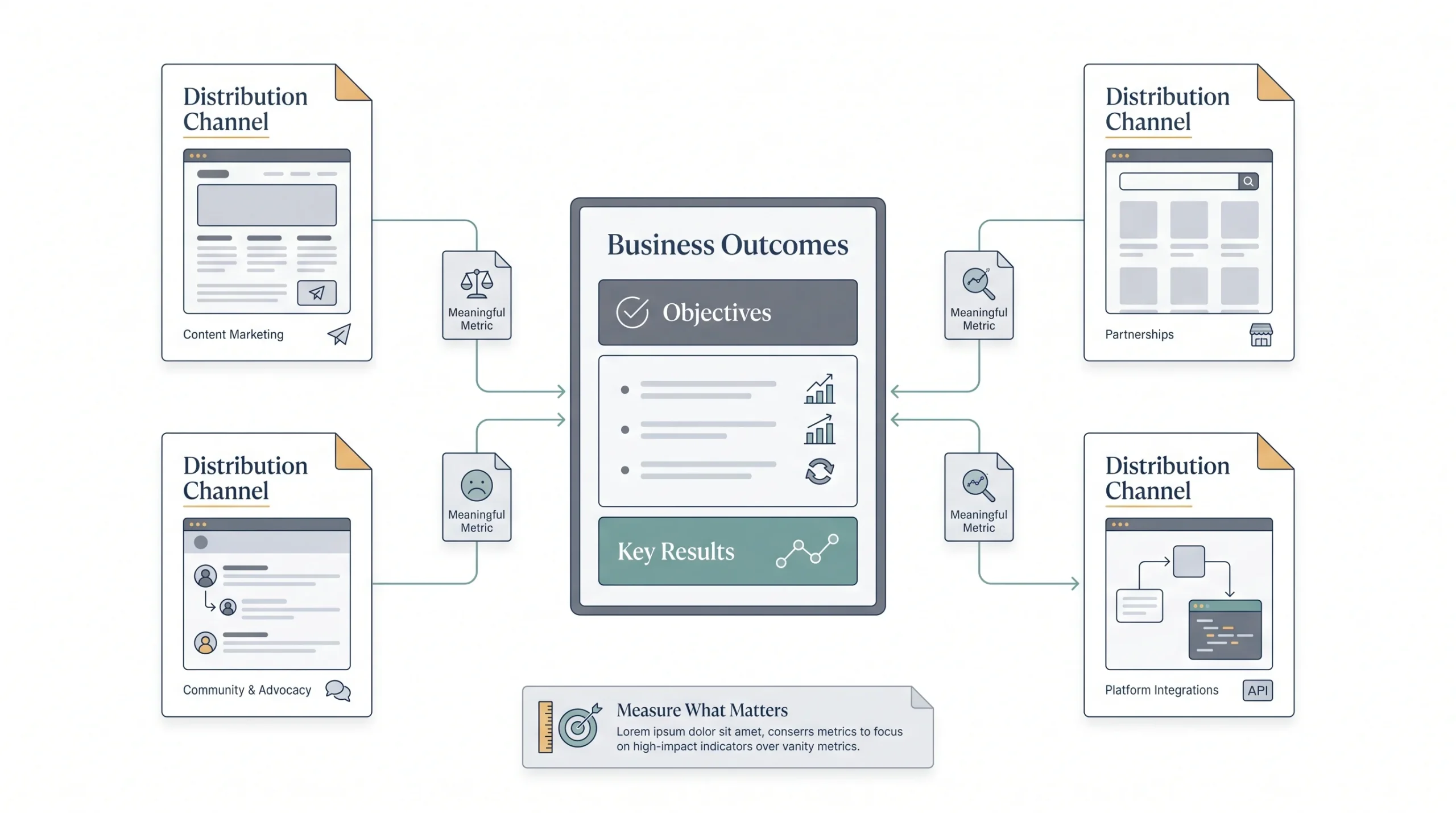
Views and impressions get treated like they mean something on their own, and mostly, they don’t. A post can get ten thousand impressions and drive exactly zero business results, and a team can still walk away from that thinking it performed well because the number looked big on a dashboard. Numbers without context are just numbers sitting there looking impressive.
The better approach is tying every channel back to a specific outcome that actually matters to the business, not a vanity metric that just looks good in a slide deck during a monthly review. Traffic is a reasonable starting point, but traffic that doesn’t convert into anything, no signups, no replies, no movement further down the funnel, isn’t worth celebrating on its own no matter how large the number is. What matters more is what that traffic actually does next, whether it signs up for something, replies to a follow-up email, or shows up again weeks later further along in the buying process.
| Channel | Primary Metric | Secondary Metric |
|---|---|---|
| SEO | Organic traffic growth | Keyword rankings |
| Click-through rate | List growth | |
| Social | Engagement rate | Referral traffic |
| Paid | Cost per conversion | Click-through rate |
| PR/guest posts | Referring domains | Direct traffic lift |
None of these metrics matter in isolation, and comparing them across channels directly usually leads to the wrong conclusion. What matters is whether each channel is doing the specific job it was assigned to do in the first place. If a channel’s whole purpose is building credibility over time, judging it purely on traffic volume that same month is measuring the wrong thing entirely, and it’ll almost always look like it’s “underperforming” compared to a paid channel built for speed, even when it’s doing exactly what it was supposed to do.
Attribution makes this even messier, and it’s worth being upfront about that instead of pretending there’s a clean answer. Someone might discover a brand through a guest post, follow them on social for a few weeks without clicking anything, then finally convert after clicking a retargeting ad or opening an email months later. Which channel gets the credit for that conversion depends entirely on which attribution model gets used, and different models will tell completely different stories about the exact same customer journey. First-click attribution credits the guest post. Last-click credits the email or the ad. Neither one is wrong, and neither one is the full picture on its own. That’s exactly why leaning on a single metric per channel, tracked consistently over time, tends to be more useful in practice than chasing a perfect multi-touch attribution model that most teams don’t have the data infrastructure to actually run properly anyway.
Common Content Distribution Mistakes
A handful of mistakes show up again and again, across teams of every size, in nearly every industry.
Spray-and-pray distribution, posting on every possible platform without any real strategy behind which ones actually matter for the specific audience being targeted, spreads effort so thin that nothing gets done well anywhere. Treating distribution as a launch-day-only activity means content gets one push and then quietly disappears from anyone’s radar, when the best-performing pieces are often the ones that get revisited and repromoted weeks or even months later, sometimes performing better the second or third time around than they did on day one. Skipping repurposing entirely leaves value on the table that already exists inside content that’s already been researched, written, and paid for once. And chasing whatever the latest algorithm change favors on rented platforms while ignoring owned channels means building a business on ground that can shift under it at any moment, with zero warning and zero say in the matter.
More platforms isn’t more reach. It’s more places to be mediocre at once.
There’s a subtler version of this same mistake worth calling out too: measuring every channel against the same yardstick. Comparing a paid campaign’s cost-per-click directly against an SEO post’s traffic, as if they’re competing in the same race, misses the point of having multiple channels in the first place. Each one is built to do something different, on a different timeline, and judging all of them by the same fast metric usually ends with owned and earned channels getting cut for “underperforming,” when really they were just never given the time they needed to start paying off.
Tools That Help
A handful of tool categories make distribution easier to actually execute instead of just plan out on paper and never quite get to. Scheduling tools handle the mechanical part of posting content across multiple social platforms at the right times without someone manually logging into five different accounts every single day just to hit publish. Repurposing tools help turn long-form content into shorter formats faster, cutting down the time between “blog post is done” and “social posts are actually ready to go out the door.” Analytics tools tie it all together, showing which channels are actually driving results worth repeating and doubling down on, and which ones are quietly wasting time and budget without anyone noticing until someone finally pulls the numbers together. None of these tools replace an actual strategy sitting behind them. They just make executing one a lot less painful and a lot less manual. Handing a team scheduling software without a distribution plan just means the wrong content gets posted more efficiently. The tool speeds up whatever process already exists, good or bad. It doesn’t build the process for anyone.
Conclusion
Distribution isn’t the thing that happens after the real work is done. It is the real work, just as much as writing and editing ever were, maybe more so given how much content gets published and quietly ignored every single day across every industry. Content that never reaches anyone might as well not exist, no matter how well it’s written or how much research went into it.
Building a plan before creation even starts, understanding what owned, earned, and paid channels each actually do well and where each one falls short, squeezing more value out of every piece through genuine repurposing instead of copy-paste shortcuts, and tracking results against outcomes that actually matter instead of vanity numbers that look nice in a report, that’s what separates content that quietly disappears within a week from content that keeps working long after it was first published.
None of this needs to happen all at once either. Trying to fix every channel, every process, and every metric in the same month usually just creates a different kind of overwhelm. Start with one channel, get it working properly, understand it deeply, then build outward from there one channel at a time. That’s a far better plan than spreading thin across everything at once and hoping something sticks somewhere. It usually does, eventually. Just not on the timeline most people hope for going in.
FAQs
What’s the difference between content distribution and content promotion?
Promotion is one tactic. Distribution is the whole plan. Sharing a link on social media is promotion, it’s a single action on a single channel. Distribution is deciding upfront which channels a piece of content will move through, what format changes each one needs, who’s responsible for making that happen, and when each push actually goes out. Promotion lives inside distribution. Distribution doesn’t live inside promotion.
How much of a content budget should actually go toward distribution?
There’s no universal number, but a rough rule worth aiming for is closer to fifty-fifty between creation and distribution, not the eighty-twenty split most teams default to without meaning to. That doesn’t have to mean cash spend either. A lot of distribution costs time more than money, things like repurposing, community engagement, and outreach for guest posts. The point isn’t hitting an exact percentage, it’s noticing if distribution is getting close to zero attention and fixing that.
Which channel should a small team with limited resources focus on first?
Owned channels, almost always. Specifically the blog and email list, since neither one depends on an algorithm deciding whether people see the content. It’s slower to build than jumping straight into paid ads, but it’s the only channel that keeps compounding without needing constant new spend just to maintain the same reach. Once that foundation is actually working, earned and paid channels become a lot more effective too, since there’s something solid to point people back to.
How long does it usually take to see results from a content distribution strategy?
Depends heavily on the channel. Paid can show results within days. Email and social usually show something within a few weeks. SEO is the slow one, often three to six months before a competitive keyword starts moving, sometimes longer depending on how crowded that topic already is. That’s exactly why judging every channel against the same short timeline is a mistake. A channel built for the long game will always look like it’s underperforming next to one built for speed, even when both are doing exactly what they’re supposed to.
Is repurposing content across multiple platforms actually worth the extra effort?
Yes, and it’s usually one of the highest-leverage things a content team can do, because the expensive part, the research and the original thinking, is already finished. The effort that’s left is mostly reformatting, which takes a fraction of the time the original piece did. The catch is that lazy repurposing, straight copy-paste from one platform to another, tends to underperform and gives repurposing a bad reputation it doesn’t deserve. Done properly, with each format adapted to how that specific platform actually gets used, it’s worth every bit of the extra time.
What’s a realistic content and distribution cadence for a small team?
Whatever the team can actually sustain without burning out, which is almost always smaller than what feels ambitious on paper. A five-person team publishing two solid blog posts a week with a proper distribution plan behind each one will usually outperform a team stretching itself across five posts and twenty social updates a week that nobody has time to promote properly. Smaller volume, done well and distributed properly, beats a bigger volume that quietly falls apart under its own weight.
How can a brand tell if its distribution strategy is actually working?
By checking whether each channel is hitting the specific goal it was assigned, not by comparing every channel against the same generic metric like traffic or impressions. A guest post is doing its job if it builds credibility and earns a mention or a link, even if it doesn’t send a flood of direct traffic. A paid campaign is doing its job if it hits a cost-per-conversion target, even if the raw traffic number looks smaller than an organic post. Judging every channel by the same yardstick is one of the most common reasons teams misread their own results.
Does content distribution strategy work the same way for B2B and B2C brands?
The core principles hold for both, owned, earned, and paid still apply either way, but the channel mix usually looks pretty different. B2B tends to lean more on LinkedIn, email, and search, since buying decisions are slower and more research-driven. B2C often leans harder into visual platforms like Instagram and paid social, since purchase decisions happen faster and more impulsively. The framework doesn’t change. Which channels get the most weight inside that framework usually does.