

Look, if you’ve spent any time in a B2B sales or marketing role over the last few years, you’ve probably heard someone declare cold email dead. Usually it’s the same person who also told you SEO was dead in 2019 and that nobody reads long-form content anymore. Here’s the thing though — cold email isn’t dead. It’s just gotten a lot harder to do badly and get away with it.
In 2026, inboxes are more crowded than ever, spam filters are smarter, and the average buyer gets pitched dozens of times a week before lunch. So yeah, blasting the same generic template to 10,000 people and hoping 2% reply? That strategy died a while back. But cold email itself, the actual practice of reaching out to someone who hasn’t heard of you yet with something genuinely relevant? That’s still one of the highest-ROI channels available to any business that sells to other businesses.
Here’s a number that gets thrown around a lot: cold email can return somewhere between $36 and $40 for every dollar spent when it’s done right. Compare that to paid ads, where costs per click keep climbing and platforms keep changing the rules on you. Cold email doesn’t have that problem. You own the channel. Nobody can shut off your access to your own outbound list the way a platform can throttle your organic reach overnight.
There’s also this persistent myth that cold email is basically spam with better manners. It’s not, and honestly, conflating the two is part of why so many campaigns fail. Spam is unsolicited, irrelevant, and sent at scale with zero thought. Cold email, when it’s done properly, is targeted, relevant, and respects the fact that you’re interrupting someone’s day. There’s a real difference, and the businesses that get that difference are the ones still booking meetings from cold outreach in 2026.
AI has changed this game in a big way too. Not in the “let a robot write your emails and hope for the best” sense — that approach actually backfires more often than it helps. But in the sense that AI now lets small teams do the kind of research and personalization that used to take an army of SDRs. You can pull buying signals, recent company news, hiring trends, and tech stack data in seconds. The teams winning right now aren’t the ones sending more emails. They’re the ones sending fewer, smarter emails to people who are actually a good fit.
What You Will Learn in This Guide
- What cold email marketing actually is, and how it’s different from spam or regular email marketing
- Why cold email still works in 2026, backed by real numbers
- How AI, intent data, and multichannel outreach have reshaped the playbook
- The psychology behind emails that actually get replies
- A step-by-step framework for building a cold email strategy from scratch
- Everything you need to know about deliverability, including SPF, DKIM, and DMARC
- How to write subject lines, openers, and CTAs that don’t get ignored
- Personalization techniques that go beyond “Hi {{firstname}}”
- Follow-up sequences and timing that actually convert
- The best tools for prospecting, verification, automation, and analytics
- Ready-to-use templates for different industries
- Metrics that actually matter versus vanity metrics
- Common mistakes that tank deliverability and reply rates
- Legal and compliance basics, explained without the legal jargon
- Real campaign examples and what made them work
- A checklist you can run through before hitting send
Cold email marketing still works in 2026, but the bar has moved. Volume alone doesn’t cut it anymore. What works now is tight targeting, real personalization, solid deliverability practices, and follow-up sequences that don’t quit after one email. AI helps you do the research faster, but the actual writing still needs a human touch, or it reads exactly like what it is — a mail merge.
What is Cold Email Marketing?
Cold email marketing is the practice of sending unsolicited but targeted emails to people who haven’t interacted with your business before, with the goal of starting a conversation, not making an immediate sale. That distinction matters a lot. You’re not trying to close a deal in the first email. You’re trying to get a reply.
The word “cold” throws people off sometimes. It doesn’t mean impersonal or generic. It means the recipient doesn’t know you yet. That’s it. A cold email can still be deeply researched, specific to that one person’s situation, and genuinely useful to them. In fact, the best cold emails read like they were written for an audience of exactly one person, because they were.
Cold Email vs Email Marketing vs Spam vs Sales Outreach
People mix these terms up constantly, so let’s untangle them.
Email marketing is sending emails to people who opted in. They gave you their email address, maybe through a newsletter signup or a free trial. You have permission. Cold email doesn’t have that permission upfront — you’re reaching out first, based on research that says this person is likely to care about what you offer.
Spam is neither targeted nor permitted. It’s mass email sent with no regard for relevance, usually harvested from scraped lists, often selling something sketchy. If you’re sending the same message to everyone with an email address in a given industry with zero personalization, you’re edging into spam territory even if your product is legit.
Sales outreach is a broader category that includes cold email, but also cold calling, LinkedIn messages, and direct mail. Cold email is one channel inside a sales outreach strategy, not the whole thing.
Is Cold Email Legal?
Yeah, it is — as long as you follow the rules. In the US, CAN-SPAM allows business-to-business cold email as long as you include an accurate sender name, a real subject line, a physical address, and a working opt-out mechanism. In Europe, GDPR is stricter and generally expects you to have a legitimate business interest in reaching out, plus an easy way to opt out. Canada’s CASL has its own requirements around implied consent for B2B outreach. We’ll get into the specifics later in this guide, but the short version is: permission-based mass marketing rules don’t apply to cold B2B outreach the same way, but you still need to play by the rules that do apply.
Example scenario: Say you run a small agency that helps e-commerce brands cut their ad spend. You find a Shopify store owner who’s clearly running expensive Google Ads based on public ad library data, and you send them a short, specific note about what you noticed and how you might help. That’s cold email done right. Compare that to buying a list of 50,000 random emails and blasting “Grow Your Business Today!!!” to all of them. Same channel, completely different outcome, and only one of these is going to land you in someone’s spam folder for good.
Why Cold Email Still Works in 2026
Honestly, the reason cold email still works comes down to attention. Buyers have gotten really good at tuning out ads. They skip them, block them, or scroll right past. Cold calls get screened by voicemail and caller ID apps that flag unknown numbers as “Spam Risk” before the phone even finishes ringing. LinkedIn messages get buried under connection requests and promotional noise.
Email is different. People still check it constantly, often multiple times an hour, because it’s tied to actual work. A decision-maker might ignore a banner ad without a second thought, but they’ll at least glance at a subject line sitting in their inbox. That glance is your opening.
The ROI Argument
Paid advertising costs keep climbing every year as more businesses compete for the same ad inventory. Cold email doesn’t have that same inflation problem. Your biggest costs are your time, a decent tool stack, and maybe a virtual assistant or two for list building. Compare that to running Google or LinkedIn ads where cost-per-click in competitive B2B niches can run into double digits per click, with no guarantee of a qualified lead at the end of it.
Who Cold Email Works Best For
- SaaS companies trying to get in front of specific job titles at target accounts
- Agencies looking to book discovery calls with businesses that fit a specific profile
- Recruiters sourcing candidates or clients who aren’t actively browsing job boards
- Consultants who need a steady flow of qualified conversations, not just inbound leads
- Manufacturers and B2B suppliers targeting procurement or operations leads at specific companies
If your buyer has a job title, a company, and a reason to care about what you sell, cold email can reach them. That covers a massive chunk of B2B.
Cold Email vs Email Marketing vs Spam
Let’s put this side by side, because seeing it laid out makes the distinction click faster than reading about it in paragraphs.
| Factor | Cold Email | Email Marketing | Spam |
|---|---|---|---|
| Audience | Researched, targeted prospects | Opted-in subscribers | Random, scraped, or purchased lists |
| Consent | No prior consent, but legitimate interest | Explicit opt-in | None |
| Goal | Start a conversation | Nurture, sell, retain | Trick or exploit |
| Personalization | High, ideally 1:1 | Segmented, not always 1:1 | None |
| Scale | Low to moderate volume | Can be very high volume | Very high volume |
| Deliverability | Requires careful management | Generally easier, list is warm | Poor, gets blocked fast |
| Legal Compliance | CAN-SPAM, GDPR business interest | Opt-in laws, easier compliance | Illegal in most cases |
| Example | “Noticed you’re hiring 3 SDRs — here’s how we cut ramp time in half” | Monthly newsletter to subscribers | “MAKE $5000 A WEEK FROM HOME” |
The pattern here should be obvious. The closer you get to spam, the worse your results get and the bigger the legal and reputational risk. The closer you stay to genuine, researched outreach, the better your numbers look across the board — replies, meetings booked, and how long your sending domain stays healthy.
How Cold Email Marketing Has Changed in 2026
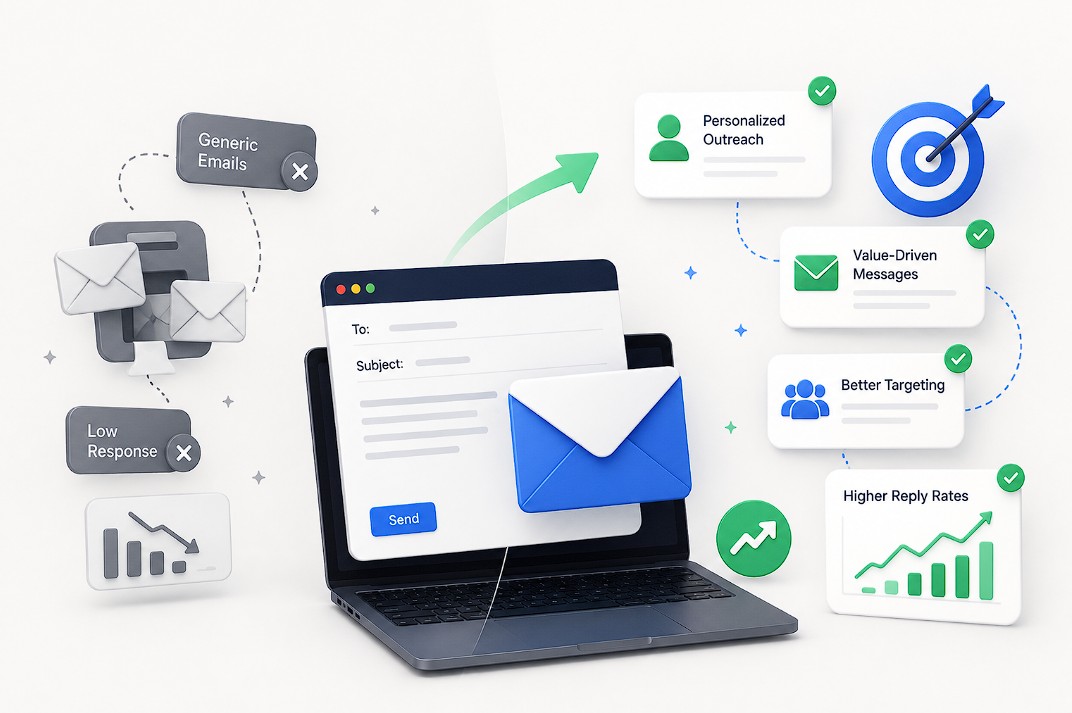
If you were doing cold email five years ago and you’ve picked it back up now, you’re going to notice things look pretty different. The tactics that used to work — generic templates, high volume, spray and pray — just don’t cut it anymore. Here’s what’s actually shifted.
AI-Powered Personalization
AI tools can now pull in company news, funding announcements, hiring activity, and even recent LinkedIn posts to build context for an email in seconds. What used to take an SDR 15 minutes of manual research per prospect can now happen automatically. The catch is that AI-written openers can sound stiff or oddly generic if you don’t edit them. The winning move is using AI to gather the research, then writing (or heavily editing) the actual message yourself.
Hyper-Segmentation
Instead of one big list getting one big campaign, teams are breaking prospects into much smaller, tighter segments. Same industry, same company size, similar pain point — but each segment gets messaging tailored to their specific situation. Smaller segments mean higher relevance, and higher relevance means better reply rates.
Intent-Based Outreach
Tools now track buying signals like someone visiting your pricing page anonymously, engaging with a competitor’s content, or searching for solutions like yours. Reaching out when someone shows actual intent beats cold-cold outreach every time, because the timing does half the work for you.
Multi-Touch, Multi-Channel Campaigns
Email alone is less effective in isolation than it used to be. The campaigns performing best in 2026 combine email with a LinkedIn touch, sometimes a short voice note, sometimes even a quick video. It’s not about doing more work — it’s about showing up in more than one place so your name feels familiar by the third or fourth touch.
Human-Written, AI-Assisted Copy
There’s a growing backlash against fully AI-generated cold emails. People can smell them now — the overly polished tone, the slightly-off phrasing, the “I hope this finds you well” energy. The emails getting replies in 2026 read like a real person wrote them, even if AI helped with research or a first draft.
Better Deliverability Practices as Standard
Domain warming, dedicated sending domains, and proper authentication used to be “advanced” tactics. Now they’re table stakes. Inbox providers have gotten aggressive about filtering anything that looks even slightly spammy, so the technical setup matters as much as the copy does.
The Psychology Behind High-Converting Cold Emails
People don’t reply to emails because the offer is good. They reply because something about the email triggers a reaction — curiosity, recognition, or a sense that ignoring it might cost them something. Understanding that shift changes how you write.
Curiosity
An email that raises a question in the reader’s mind without fully answering it tends to get more opens and replies. Something like “Noticed something odd about your checkout flow” makes someone want to know what you noticed. Curiosity works because unresolved questions are uncomfortable, and replying (or at least opening) resolves that discomfort.
Relevance
If the email could have been sent to literally anyone, it gets ignored by everyone. Relevance means referencing something specific to that person’s company, role, or recent activity. It signals you actually looked at them before hitting send, which is rarer than it should be.
Reciprocity
People feel a mild obligation to respond when you’ve given them something first — a useful observation, a quick resource, a piece of information they didn’t have. Even something small, like pointing out a competitor’s move they might not have noticed, can trigger this.
Authority
Mentioning a relevant credential, a recognizable client, or a specific result builds trust fast. You don’t need to brag. A single line like “we’ve helped three companies in your space cut CAC by 20%+” does more work than a paragraph of self-promotion.
Social Proof
People trust decisions other people like them have already made. If you can say “teams at similar-sized companies are already doing X,” that’s often more persuasive than any feature list.
Simplicity
Complicated emails get skimmed and skipped. Simple, clear emails get read all the way through. If your email needs a second read to understand what you’re asking for, it’s too complicated.
Trust
Trust builds cumulatively, sentence by sentence. Overpromising, vague claims, or anything that sounds too good kills trust instantly. Specific, modest, verifiable claims build it.
Personal Connection
A tiny detail — referencing a podcast appearance, a recent post, a shared connection — signals this isn’t a mail merge. It’s a small thing, but it changes how the whole email is read.
How to Build a Winning Cold Email Strategy
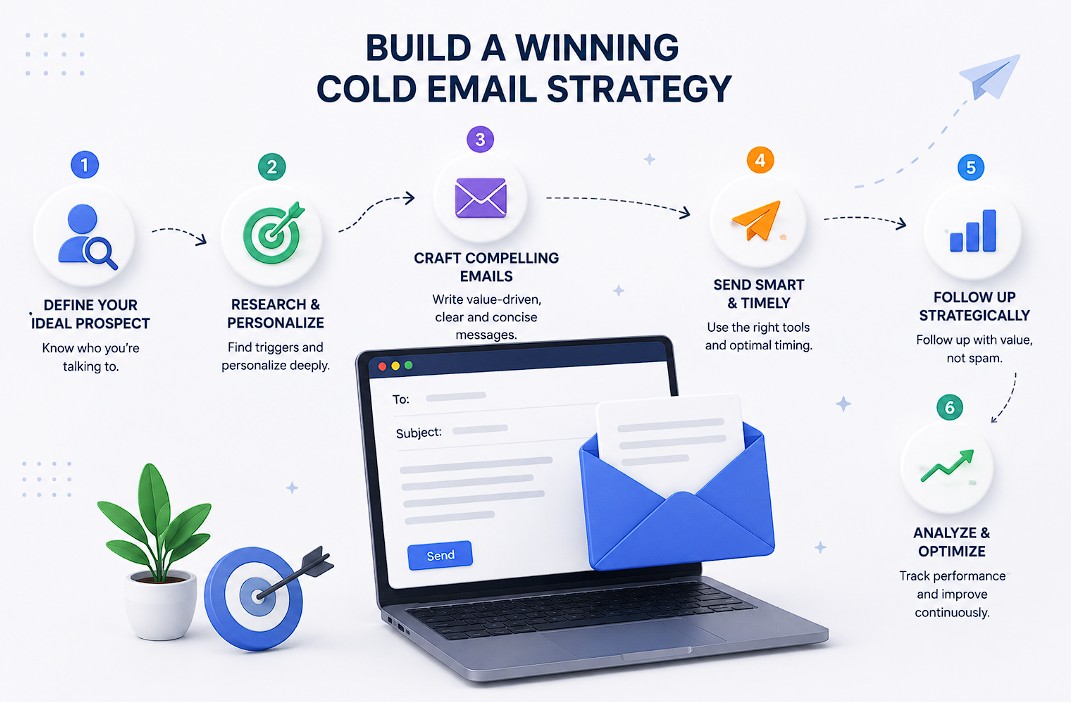
Cold email without a strategy behind it is just noise. Here’s the framework that actually holds up.
Step 1: Define Your Goal
Before you write a single email, get clear on what “success” looks like. Are you trying to book meetings? Drive demo signups? Land partnerships? Source recruiting candidates? Generate direct sales? Your goal shapes everything downstream — your messaging, your CTA, even who you target. A campaign built to book a 15-minute call needs a very different ask than one built to close a sale directly through email.
Step 2: Identify Your ICP (Ideal Customer Profile)
Your ICP is the specific type of company and person most likely to buy from you and get real value out of it. Nail this down using:
- Industry — which verticals actually need what you offer
- Company size — headcount or revenue range where your solution fits best
- Revenue — are you targeting bootstrapped startups or funded mid-market companies
- Geography — time zones and regions matter for both compliance and follow-up timing
- Pain points — the specific problems your product or service solves
Skipping this step is the single biggest reason cold email campaigns flop. You end up emailing people who were never going to buy, no matter how good your copy is.
Step 3: Build Your Prospect List
Once your ICP is clear, go find the actual people who fit it. Common sources include:
- LinkedIn, using Sales Navigator or manual search filtered by title and company
- Company websites, particularly “About” or “Team” pages for smaller companies
- Business directories and databases specific to your industry
- Google Search combined with specific search operators
- Industry events, conference attendee lists, and speaker rosters
Quality beats quantity every time here. A tight list of 200 well-matched prospects will outperform a sloppy list of 5,000 almost every time.
Step 4: Verify Email Addresses
Before you send a single email, run your list through a verification tool. Bad or outdated addresses bounce, and high bounce rates hurt your sender reputation fast — sometimes badly enough to tank deliverability for weeks. Verification isn’t optional anymore. It’s a required step, not a nice-to-have.
Step 5: Segment Your Prospects
Break your verified list into smaller groups based on shared traits:
- Industry
- Job role
- Company size
- Technology used
- Specific pain points
Each segment gets its own version of your message, tailored to what that group specifically cares about. A CFO and a VP of Engineering at the same company need completely different framing, even if you’re pitching the same product.
Cold Email Deliverability in 2026
This might be the single most important section in this whole guide, and it’s the one people skip most often because it’s not as fun as writing subject lines. But none of your copywriting matters if your emails never make it to the inbox.
Domain Warming
If you’re sending from a new domain or a domain that hasn’t sent much email before, you need to warm it up gradually. Start with a small volume of emails per day and increase slowly over a few weeks. Jumping straight to high volume on a fresh domain is one of the fastest ways to get flagged as spam by inbox providers.
Email Authentication: SPF, DKIM, and DMARC
These three records tell inbox providers your emails are legitimately coming from you and haven’t been tampered with.
SPF (Sender Policy Framework) lists which servers are allowed to send email on behalf of your domain. Without it, inbox providers have no way to confirm the email actually came from where it claims.
DKIM (DomainKeys Identified Mail) adds a digital signature to your emails that proves the content wasn’t altered in transit. It’s a cryptographic handshake that builds trust with receiving servers.
DMARC (Domain-based Message Authentication, Reporting, and Conformance) tells inbox providers what to do if an email fails SPF or DKIM checks, and gives you reporting on any spoofing attempts against your domain.
Setting all three up correctly used to be optional. Now, major inbox providers require them for any meaningful sending volume, or your emails get filtered straight to spam regardless of how good your copy is.
Sending Limits and Inbox Placement
Even with a warmed-up, authenticated domain, there are practical daily sending limits you should respect — usually somewhere in the range of 30-50 emails per inbox per day when you’re using regular email accounts rather than dedicated sending infrastructure. Push past that and you risk tripping spam filters.
Bounce Management
Keep a close eye on your bounce rate. Anything consistently above 2-3% is a signal something’s wrong, either with your list quality or your sending reputation. High bounce rates get reported to spam databases and can get your domain blacklisted.
Email, Domain, and IP Reputation
Every domain and IP address you send from builds a reputation over time based on how recipients interact with your emails — opens, replies, deletes without opening, spam reports. Bad reputation follows the domain, so protecting it is an ongoing job, not a one-time setup task.
Dedicated Domains for Outreach
A lot of teams now use separate domains specifically for cold outreach, keeping their main company domain protected for regular business email. If your outreach domain runs into deliverability trouble, it doesn’t drag down your primary domain’s reputation with it.
Deliverability Checklist:
- ✓ SPF record configured
- ✓ DKIM record configured
- ✓ DMARC policy set
- ✓ Domain warmed gradually over 2-4 weeks
- ✓ Sending volume within daily limits
- ✓ Bounce rate monitored and kept under 3%
- ✓ List verified before every send
- ✓ Dedicated sending domain in use
How to Write Cold Emails That Get Replies
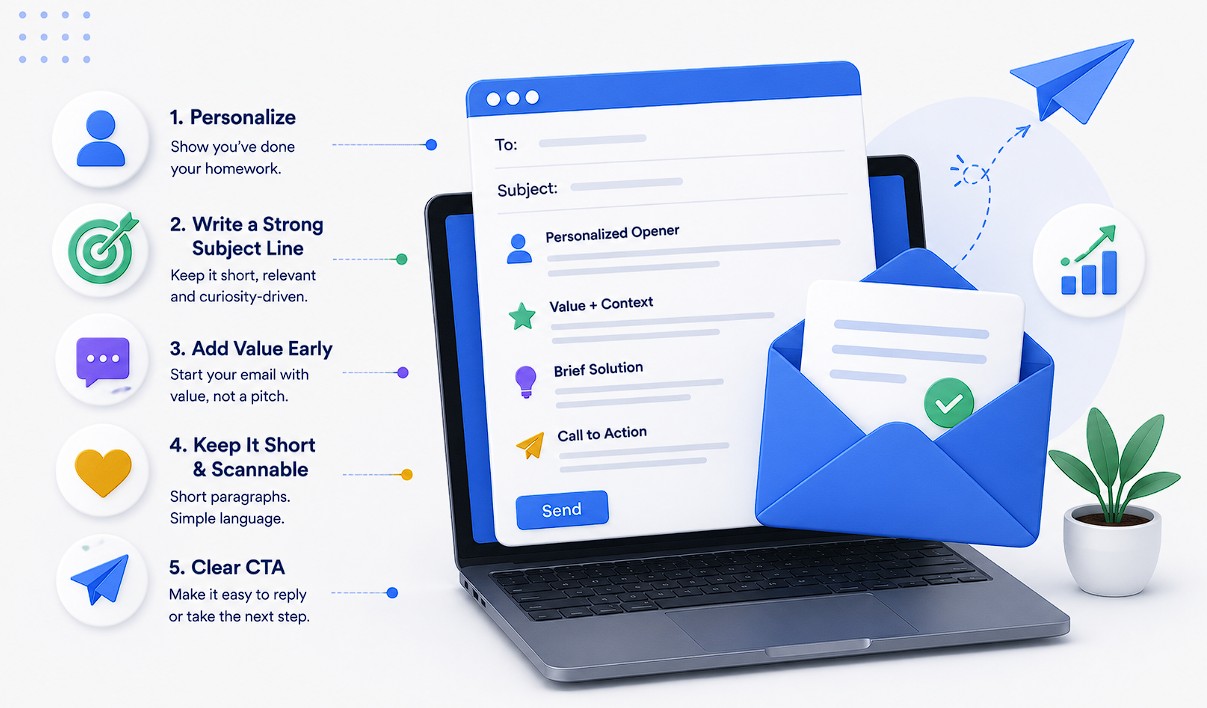
Now for the part everyone actually wants to read: the writing itself.
Subject Line
Your subject line has one job — get the email opened. Keep it short, specific, and low-hype. Something like “quick question about your onboarding flow” beats “Increase Your Conversions Today!” nearly every time, because it sounds like it came from a person, not a marketing department.
Opening Line
Skip the “I hope this email finds you well” filler entirely. Open with something that shows you actually did your homework — a specific detail about their company, a recent announcement, something you noticed about their product or website.
Hook
Right after the opener, connect that detail to a pain point they likely have. This is where you show you understand their world, not just their name and title.
Value Proposition
Explain, briefly, why this matters to them specifically. Not a feature list. Not your company’s mission statement. Just: here’s what this could mean for you.
Social Proof
A short mention of a relevant client, a specific result, or a case study builds credibility fast. Keep it to one line. This isn’t the place for a full case study.
Call to Action
Make the ask small and easy to say yes to. “Worth a quick 15-minute call?” beats “Let’s schedule a comprehensive discovery session to explore synergies.” Low friction, low pressure.
Signature
Keep it professional but simple. Name, role, company, maybe a link. No need for five different social icons and three taglines.
Bad Example:
“Hi there, I hope this email finds you well! I wanted to reach out because we help companies like yours leverage cutting-edge solutions to drive growth. Would love to schedule a call to discuss synergies!”
Good Example:
“Hey Priya — saw you just posted about scaling your support team to handle the Q3 growth spike. We helped a similarly sized team cut first-response time by 40% without adding headcount. Worth a quick 15-minute call to see if it’d work for you too?”
Annotated breakdown: The good example opens with a real, specific detail. It connects that detail directly to a likely pain point. It includes one concrete number instead of vague claims. And the ask is small and easy to answer.
Personalization That Actually Works
Personalization exists on a spectrum, and most people stop at the shallow end.
Basic Personalization
This is just name and company — “Hi John” and mentioning “at Acme Corp.” It’s better than nothing, but it’s also the bare minimum, and most recipients can tell instantly that it’s templated.
Intermediate Personalization
This layer references role, industry, or recent news specific to the company. “Since you’re leading growth marketing at a Series B fintech” shows you looked at more than just a name field in a spreadsheet.
Advanced Personalization
This is where replies actually happen. Referencing tech stack, recent hiring activity, funding announcements, a LinkedIn post they wrote, a podcast appearance, or a product launch shows a level of attention that’s hard to fake and easy to appreciate.
AI Personalization
AI tools can now scan and summarize a prospect’s recent activity across multiple sources in seconds, which used to take real manual digging. The mistake teams make is letting AI write the final sentence too. Use it to gather the raw material, but write the actual connection yourself — that’s the part that has to sound human.
Cold Email Follow-Up Strategy
Here’s a stat that should change how you think about follow-ups: a huge share of replies come after the first email, not from it. If you’re only sending one email and moving on, you’re leaving most of your results on the table.
Why Follow-Ups Matter
People are busy. They mean to reply and forget. Your first email might land at a bad moment. A follow-up isn’t annoying if it’s short, adds a little new value, and isn’t just “just bumping this up.”
Recommended Sequence
Email 1 → Email 2 → Email 3 → Email 4 → Break-up email
Timing
- Day 1: Initial email
- Day 3: First follow-up, short and light
- Day 6: Second follow-up, adds new angle or value
- Day 10: Third follow-up, brief check-in
- Day 15: Break-up email, giving them a graceful way to say “not now”
Example follow-up (Day 3): “Hey, just floating this back up in case it got buried. Still think this could help with [specific pain point] — happy to send more info if useful.”
Example break-up email (Day 15): “Haven’t heard back, so I’ll assume the timing’s not right. I’ll leave this here in case things change — feel free to reach out whenever.”
Cold Email Automation Without Losing Personalization
Automation and personalization aren’t opposites, but they can become opposites fast if you’re not careful.
Automation Tools
Sequencing tools let you queue up multi-step campaigns that send automatically based on timing and recipient behavior — did they open, click, or reply.
AI in Automation
AI can dynamically insert personalized snippets pulled from research data into each email, so even automated sends feel individually written rather than obviously templated.
Variables and Conditional Logic
Modern tools support conditional branches — if someone opens but doesn’t reply, they get one follow-up; if they click a link, they get a different one. This lets your sequences adapt without you manually managing every single prospect.
Behavior-Based Campaigns
Instead of a fixed schedule, some campaigns trigger based on actual behavior — a website visit, a content download, an email open. This keeps outreach timely instead of arbitrary.
Human Review Still Matters
No matter how good your automation gets, someone should be spot-checking sends, especially for higher-value accounts. A single embarrassing personalization error — wrong company name, wrong industry — can undo all the trust you were trying to build.
Best Cold Email Tools for 2026
There’s a genuinely overwhelming number of tools out there now, so it helps to think in categories rather than trying to find one tool that does everything.
Prospecting Tools
These help you find and build lists of the right people — pulling contact info, company data, and firmographic details based on your ICP criteria.
Email Verification Tools
These check whether an email address is real and deliverable before you send, cutting bounce rates significantly.
Deliverability Tools
These monitor your sender reputation, inbox placement rates, and authentication status, flagging issues before they tank your campaigns.
Automation Platforms
These handle sequencing, follow-ups, and multi-step campaigns, often with built-in AI personalization features.
AI Writing Assistants
These help draft and refine copy, generate subject line variations, and personalize openers at scale — though again, the final polish should be human.
Analytics Tools
These track open rates, reply rates, meeting bookings, and pipeline generated from your campaigns, tying outreach activity back to actual revenue.
| Category | What It’s Best For | Pricing Model | Pros | Cons |
|---|---|---|---|---|
| Prospecting | Building targeted lists | Per-credit or subscription | Fast list building, rich data | Data can be outdated, needs verification |
| Verification | Cutting bounce rates | Per-email or subscription | Protects sender reputation | Adds a step to your workflow |
| Deliverability | Monitoring sender health | Subscription | Early warning on issues | Requires ongoing attention |
| Automation | Running sequences at scale | Per-seat subscription | Saves manual work, scales follow-ups | Can feel robotic if misused |
| AI Writing | Drafting and personalizing | Subscription or usage-based | Speeds up research and drafting | Needs human editing |
| Analytics | Measuring what’s working | Often bundled with automation tool | Ties outreach to revenue | Can be overwhelming without clear KPIs |
Cold Email Templates
Templates are a starting point, not a finish line. Use them as a skeleton, then personalize heavily before sending.
SaaS Template
“Hey [Name], noticed [Company] is scaling [department/team]. We built [Product] specifically to help teams like yours handle [pain point] without adding headcount. Worth a quick look?”
Agency Template
“Hi [Name], came across [Company]’s recent [campaign/launch/hire] — nice move. We specialize in helping [industry] companies improve [specific metric]. Happy to share a couple of ideas specific to your situation if useful.”
Freelancer Template
“Hey [Name], I help [industry] businesses with [specific service]. Saw [specific detail about their business] and had a thought on how you might improve [related outcome]. Want me to share it?”
Consultant Template
“Hi [Name], I work with [type of company] on [specific problem]. Given [specific context about their business], thought this might be relevant. Open to a quick chat?”
Recruitment Template
“Hi [Name], I’m working on a search for [role] and your background in [specific skill/experience] caught my eye. Open to hearing more, even if just to compare notes?”
Partnership Template
“Hey [Name], we work with a similar audience to [Company] and thought there might be a natural fit for us to collaborate. Would you be open to a short call to explore it?”
Link Building Template
“Hi [Name], I read your piece on [specific topic] — solid breakdown of [specific point]. I put together a resource on [related topic] that could be a useful addition for your readers. Mind if I share it?”
PR Outreach Template
“Hi [Name], I saw your recent coverage of [topic]. We’ve got a story that fits well with what you cover — happy to share more details if you’re interested.”
Event Invitation Template
“Hey [Name], we’re hosting [event] on [date], and given your work in [industry/role], thought it’d be relevant. Would you like the details?”
Follow-Up Template
“Hey, just bumping this back up in case it got buried. Still think [specific benefit] could be useful for [Company] — happy to send more info.”
Break-Up Template
“Haven’t heard back, so I’ll go ahead and close this out on my end. If timing changes down the line, feel free to reach out.”
Cold Email Metrics That Matter
Not every number in your dashboard deserves your attention. Some matter a lot. Others are mostly noise.
Open Rate
This tells you if your subject line is working, but with privacy changes across inbox providers, open tracking has gotten less reliable. Treat it as a loose signal, not gospel.
Reply Rate
This is a much stronger indicator of relevance. If people are replying — even to say “not interested” — your targeting and messaging are landing.
Positive Reply Rate
This narrows it down further: how many of those replies are actually interested, versus polite declines. This is closer to a true measure of campaign quality.
Bounce Rate
High bounce rates signal list quality problems and directly threaten your sender reputation. Keep this low, ideally under 2-3%.
Spam Complaints
Even a small number of spam complaints can hurt your deliverability disproportionately. Watch this closely.
Meetings Booked
For most B2B campaigns, this is the number that actually matters to the business. Everything upstream — opens, replies — exists to serve this outcome.
Conversion Rate
What percentage of booked meetings turn into actual deals or next steps? This connects your outreach effort to real business results.
Pipeline Value and Revenue Generated
The ultimate measure. Track how much pipeline and closed revenue traces back to your cold email efforts specifically.
Benchmark ranges vary by industry, but generally: reply rates in the 5-15% range are solid for well-targeted B2B campaigns, positive reply rates of 1-5% are reasonable, and bounce rates should stay under 3%.
Cold Email Compliance and Legal Best Practices
GDPR
If you’re emailing contacts in the EU, GDPR generally requires a legitimate business interest for reaching out and an easy opt-out mechanism. Keep your outreach genuinely relevant to the recipient’s role, and always include a clear way to unsubscribe.
CAN-SPAM
In the US, this law requires accurate sender information, a non-deceptive subject line, your physical business address, and a working opt-out link, honored within 10 business days.
CASL
Canada’s law leans on implied consent for B2B outreach in many cases, but still requires identification information and an unsubscribe option.
Consent and Legitimate Interest
You don’t always need explicit opt-in for B2B cold outreach, but you do need a reasonable basis for believing the recipient would be interested, tied to their role and industry.
Opt-Out Links
Always include one, and always honor it quickly. This isn’t just about compliance — it protects your sender reputation too.
Data Collection and Privacy
Be thoughtful about where you’re sourcing contact data from and how you’re storing it. Respect data privacy regardless of what the letter of the law technically requires.
Ethical Outreach
Beyond the legal minimum, just don’t be pushy or misleading. Long-term reputation matters more than any single campaign.
Real-World Cold Email Campaign Examples
Example 1: Agency Booking Meetings
A small digital marketing agency targeted e-commerce brands running inefficient ad campaigns, identified through public ad data. Their emails referenced specific spend patterns and a rough estimate of potential savings. This worked because the personalization was based on something verifiable and specific, not a guess.
Example 2: SaaS Product Launch
A SaaS company launching a new feature targeted existing free-trial users who hadn’t converted, along with a cold list of companies matching their best customer profile. They tied the outreach to a specific, timely trigger — the new feature launch — which gave a natural, non-pushy reason to reach out.
Example 3: Freelancer Landing Clients
A freelance copywriter targeted small business owners with outdated website copy, referencing specific weak points on their actual site. This worked because it was hyper-specific and demonstrated the freelancer’s skill within the outreach itself.
Example 4: Consultant Generating Leads
An operations consultant targeted companies showing signs of rapid hiring growth, a strong signal of operational strain. Referencing that specific growth signal made the outreach feel timely rather than random.
Advanced Cold Email Strategies for 2026
Intent Data
Tools that track which companies are actively researching solutions like yours let you prioritize outreach toward prospects already in a buying mindset, rather than cold-cold contacts.
AI Prospect Scoring
AI models can score your list based on likelihood to convert, using historical data on which types of prospects have responded well before, letting you focus effort where it counts.
Signal-Based Outreach
Triggers like a new executive hire, a funding round, or a product launch give you a timely, relevant reason to reach out that goes beyond generic targeting.
Website Visitor Tracking
Identifying anonymous visitors to your site (within legal limits) and following up when they show interest can dramatically improve reply rates, since there’s already some awareness.
LinkedIn Engagement as a Signal
If someone’s actively engaging with content in your space, that’s a much warmer entry point than a completely cold contact.
Personal Video Emails
A short, personalized video attached to a cold email stands out dramatically in a crowded inbox and can boost reply rates, though it takes more time per prospect.
Voice Notes
A brief voice message adds a human touch that’s hard to fake and can differentiate your outreach from an inbox full of text.
Micro-Personalization
Small, specific details — even something as minor as referencing the exact tool they use — go further than broad industry-level personalization.
Account-Based Marketing (ABM)
Instead of targeting individuals, ABM targets a whole account with coordinated multi-person, multi-channel outreach, aligning sales and marketing around a shorter list of high-value accounts.
Omnichannel Outreach
Combining email, LinkedIn, and sometimes phone or direct mail into a single coordinated sequence increases the odds of getting noticed, since not everyone responds to the same channel.
Predictive Follow-Ups
AI models can predict the best day and time to send a follow-up based on a prospect’s past engagement patterns, squeezing more performance out of the same sequence.
Cold Email Marketing Checklist
Before you launch your next campaign, run through this:
- ✓ ICP clearly defined
- ✓ Prospect list verified for deliverability
- ✓ Sending domain properly warmed
- ✓ SPF record configured
- ✓ DKIM record configured
- ✓ DMARC policy set
- ✓ Personalized opening line for each segment
- ✓ Clear, low-friction CTA included
- ✓ Follow-up sequence scheduled
- ✓ Analytics and tracking enabled
- ✓ A/B tests set up for subject lines and openers
Conclusion
Cold email marketing isn’t disappearing in 2026. It’s evolving, and the businesses still winning with it are the ones who took the time to adapt rather than the ones clinging to what worked five years ago. Success now depends on relevance, real personalization, solid deliverability practices, and outreach that respects the person on the other end of the inbox.
Start with a focused campaign instead of trying to boil the ocean. Test your subject lines, your openers, your CTAs. Watch your numbers and adjust based on what the data actually tells you, not what you assumed going in. And remember that the strongest results come from combining human judgment with AI-assisted research, not from automating the whole process and hoping it works itself out. The tools have gotten better. The fundamentals — relevance, respect, and genuine value — haven’t changed at all.
Frequently Asked Questions
Is cold email marketing still effective in 2026?
Yes, cold email marketing remains effective in 2026, especially for B2B companies. It’s evolved to require more personalization and better deliverability practices, but businesses doing it right still see strong reply rates and pipeline generation.
Is cold emailing legal?
Yes, cold emailing is legal in most jurisdictions for B2B outreach as long as you follow relevant laws like CAN-SPAM, GDPR, or CASL, which generally require accurate sender info and an opt-out option.
What’s the difference between cold email and spam?
Cold email is targeted and researched, sent to people who fit a specific profile with a legitimate reason for the outreach. Spam is unsolicited, irrelevant, and sent in bulk with no personalization or consent basis.
How many cold emails can I send per day?
Most experts recommend staying around 30-50 emails per inbox per day on a properly warmed domain to avoid triggering spam filters and protect your sender reputation.
What is a good cold email reply rate?
Reply rates of 5-15% are generally considered solid for well-targeted B2B cold email campaigns, though this varies by industry and how tightly targeted your list is.
What should a cold email subject line include?
Keep it short, specific, and conversational. Avoid hype words, exclamation points, or anything that sounds like marketing copy. Reference something specific whenever possible.
How long should a cold email be?
Aim for under 150 words. Cold emails that are too long get skimmed or ignored entirely, especially on mobile.
Should I use AI to write cold emails?
AI is useful for research and drafting, but the final email should have a human edit. Fully AI-generated emails often sound stiff or generic, which hurts reply rates.
How many follow-ups should I send?
Most effective sequences include 3-4 follow-ups after the initial email, spread out over about two weeks, ending with a break-up email.
What are the best cold email tools?
The best stack usually combines a prospecting tool, an email verification tool, a deliverability monitoring tool, and an automation platform, often with AI assistance for personalization.
Can cold emails generate B2B leads?
Yes, cold email remains one of the most effective channels for generating qualified B2B leads when the targeting and personalization are done well.
How do I avoid spam folders?
Set up SPF, DKIM, and DMARC, warm your domain gradually, keep your list verified, watch your bounce rate, and avoid spammy language or excessive links in your emails.
Should I use one domain or multiple domains?
Many teams use a separate domain specifically for cold outreach to protect their main business domain’s reputation, especially at higher sending volumes.
How do I measure campaign success?
Track reply rate and positive reply rate as your primary indicators, then follow the funnel down to meetings booked, conversion rate, and ultimately pipeline value and revenue.
What industries benefit most from cold email marketing?
SaaS, agencies, recruiting, consulting, and B2B manufacturing tend to see strong results, since these industries usually have clear buyer profiles and identifiable pain points to target.