

Ten years ago, running a PPC account meant sitting inside the platform for hours, adjusting bids keyword by keyword, checking search terms every morning, and manually deciding how much a click was worth based on gut feeling and a spreadsheet. That world is mostly gone now. AI in paid advertising has taken over the job of deciding, in milliseconds, how much to bid on a single auction, which audience is worth showing an ad to, and which creative variant is likely to convert a specific person at a specific moment. Nobody could do that manually at scale, and honestly, nobody should try anymore.
The reason this shift happened isn’t because marketers got lazy. It happened because the auction itself got too complex for a human brain to keep up with. Google runs billions of ad auctions a day. Meta serves ads across Facebook, Instagram, Messenger, and Audience Network, each with its own inventory and user behavior patterns. Every auction involves dozens of signals: device type, time of day, location, past purchase behavior, browsing history, even how fast someone scrolled past a similar ad last week. A human managing bids manually is working with maybe five or six data points. The algorithm is working with hundreds, updated in real time, for every single impression.
That’s the honest starting point for understanding AI in paid advertising. It’s not a magic switch that makes campaigns profitable. It’s a system that processes more signals than a person can, and makes a prediction based on those signals, then adjusts as new data comes in. Automated bidding and smart campaigns are the two most visible ways this shows up inside ad platforms, and both get talked about constantly, often without much clarity on what they actually do differently.
What You Will Learn in This Guide
This guide walks through what AI actually does inside a paid advertising account, how automated bidding decides what to pay for a click or conversion, how smart campaigns differ from automated bidding strategies, and how platforms like Google Ads, Meta, Microsoft, LinkedIn, and Amazon each apply AI differently. It also covers the honest limitations nobody likes to talk about, a practical setup process, common mistakes that waste budget, and the metrics that actually matter once automation takes over the day-to-day bidding decisions.
What Is AI in Paid Advertising?
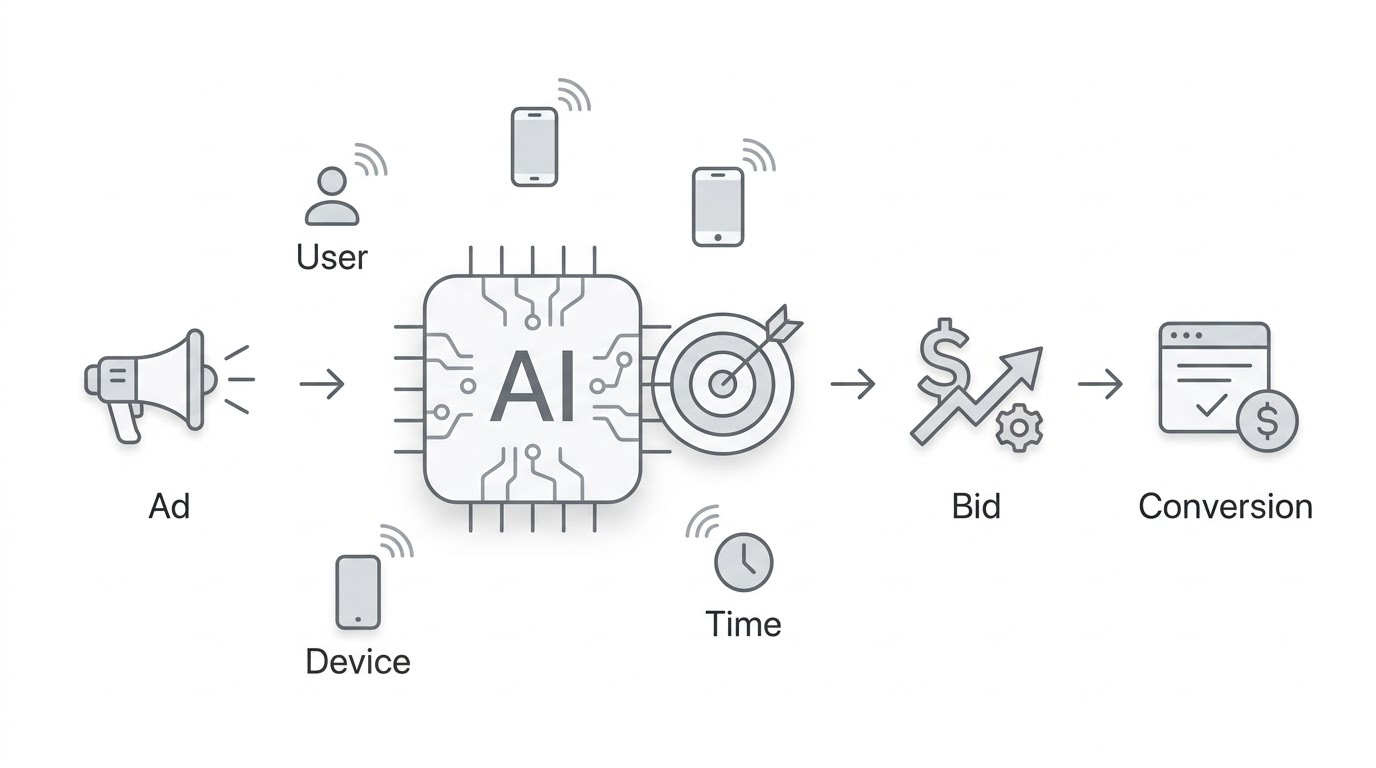
AI in paid advertising refers to machine learning systems inside ad platforms that predict outcomes like clicks, conversions, and conversion value, then use those predictions to make real-time decisions about bidding, targeting, budget allocation, and creative delivery. Instead of a human setting a fixed rule (“bid $2 for this keyword between 9am and 5pm”), the algorithm looks at each individual auction and decides what that specific impression is worth based on the likelihood it turns into a result you actually want.
Strip away the buzzwords and AI in paid advertising is really just pattern recognition applied to advertising data at a scale humans can’t match. The system looks at millions of past auctions, notices what combinations of signals led to a conversion, and builds a model that predicts the probability of that outcome happening again. That prediction feeds directly into a bid or a targeting decision. It’s statistics, not sentience. Traditional PPC optimization relied on rules a person wrote: raise bids on high performing keywords, pause low performing ones, adjust by day-part. AI-powered optimization replaces static rules with a model that updates continuously, adjusting for context that a fixed rule could never account for, like the fact that a user searching at 11pm on mobile converts differently than the same person searching at noon on desktop.
How AI Makes Advertising Decisions
The process generally follows a loop: Data flows in, gets converted into signals, the model generates a prediction, that prediction drives a decision, the ad gets delivered, and the resulting conversion data (or lack of it) feeds back into the model to refine future predictions. Signals used in that loop include search query text, device, geographic location, time of day, demographic data where available, prior interactions with your brand, conversion history tied to the account, and behavior on your website through pixel or tag data. None of this is exotic. It’s the same data marketers have always cared about. The difference is the model is weighing all of it simultaneously for every auction instead of a human glancing at a report once a week.
AI vs Rule-Based Automation
People confuse these two constantly, so it’s worth being blunt about the difference. Rule-based automation, the kind PPC managers have used for over a decade, follows predefined “if this, then that” logic. If CPA exceeds $50, lower the bid by 10%. That’s static and reactive; it only responds after the fact. AI-powered automation instead builds a predictive model that adjusts before the outcome happens, using dynamic decisions based on many more variables than a rule could realistically hold. Rule-based systems are limited to the variables a human thought to include. AI systems pick up on variables and combinations of variables that a person would never think to test manually, which is honestly the real advantage here, not speed.
Why AI Is Particularly Useful for PPC
PPC auctions happen in real time, thousands of times per minute across a large account, and each one involves a slightly different mix of competitors and user intent. Manually adjusting every one of those auctions isn’t just tedious, it’s mathematically impossible past a certain scale. AI in paid advertising exists because the volume of data and the speed of decision making required in a live auction environment outpaced what a human team could reasonably manage. That’s the honest reason platforms pushed automation so hard. It’s not because marketers wanted to give up control. It’s because the alternative stopped being feasible once accounts grew past a certain size.
How AI-Powered Paid Advertising Works
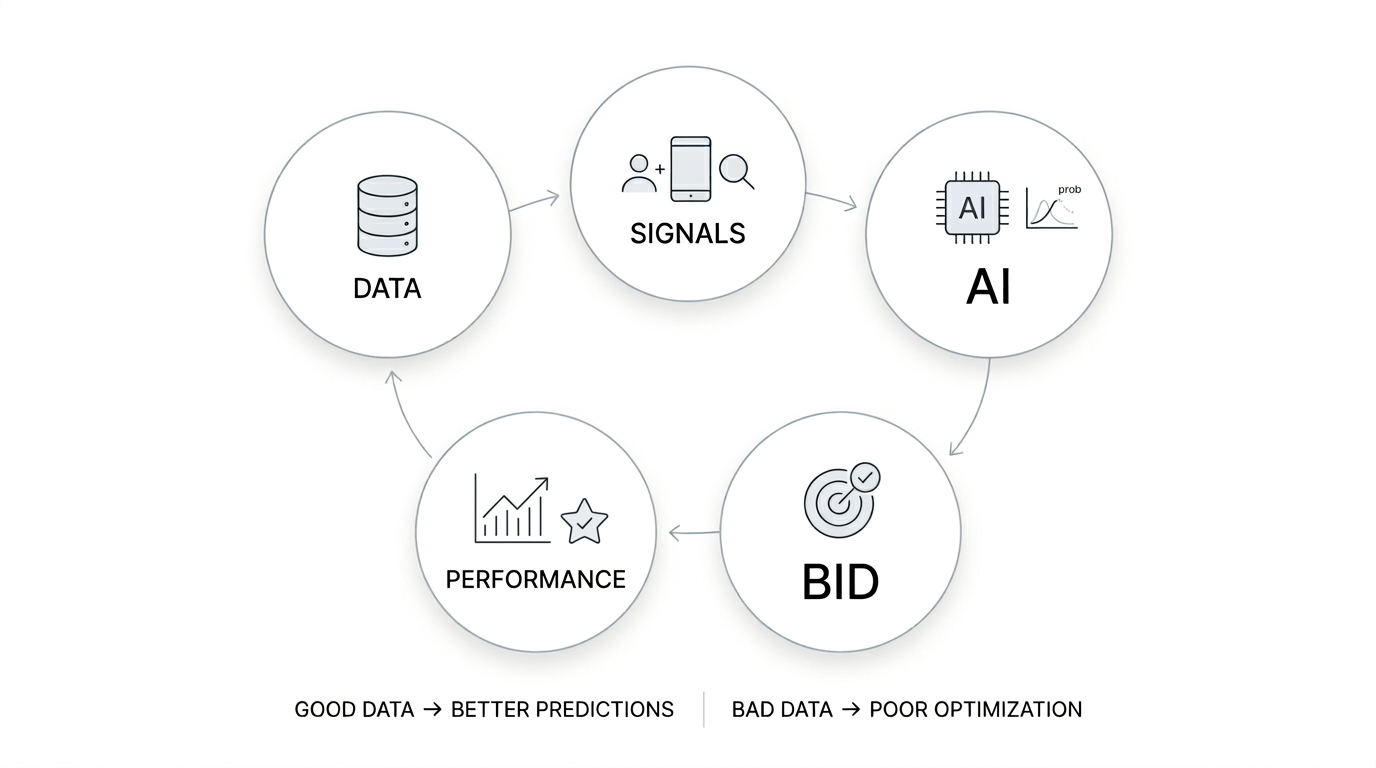
Understanding the mechanics behind AI-powered paid advertising helps you trust it less blindly and use it more effectively. It starts with data collection, moves through predictive modeling, and ends in a feedback loop that keeps refining itself as long as you keep feeding it clean data.
Data Collection
Every platform collects a mix of first-party data (what happens on your site or app through pixels and conversion tags), platform-level behavioral data (what users do across the platform itself, like what they’ve clicked, watched, or purchased), and contextual data (what the ad content is about, what page it’s showing on, what query triggered it). Google Ads pulls from Search, YouTube, Display Network, and Gmail behavior. Meta pulls from Facebook and Instagram engagement patterns plus off-platform conversion data through the Conversions API. The quality and completeness of this data collection directly determines how good the resulting predictions are, which is why weak tracking setups produce weak automated results no matter how advanced the algorithm is.
Audience and Intent Signals
Beyond raw data collection, platforms build layered signals that describe intent. Search intent comes from the actual query text and how specific or broad it is. Browsing behavior captures what pages someone visited and how long they stayed. Engagement signals include likes, saves, shares, and video watch time. Purchase history feeds directly into value-based bidding models. Demographic signals like age range and general location add context, and contextual signals describe the environment the ad will appear in, like a news article about running shoes versus a general entertainment feed. None of these signals work in isolation; the model weighs them together.
Predictive Modeling
This is the part people call “AI” most often, even though it’s really applied statistics. The model estimates a probability of conversion for each auction, an expected conversion value if the campaign uses value-based bidding, a likelihood of engagement for awareness objectives, and in more advanced setups, a potential customer value that looks beyond the immediate transaction. Google’s Smart Bidding, for example, evaluates hundreds of contextual signals per auction to generate these probabilities, then translates that probability into an actual bid amount within milliseconds.
Real-Time Decision Making
Here’s the part that trips people up: two users searching the exact same keyword at the exact same time can trigger completely different bids. Say two people search “waterproof hiking boots” at 8pm on a Tuesday. One of them has visited your site three times this month and abandoned a cart with hiking boots in it. The other has never heard of your brand. The algorithm predicts a much higher conversion probability for the first user, so it bids more aggressively to win that auction, while bidding conservatively (or not at all) on the second. A manual bidding strategy applied to that same keyword would bid identically for both, missing the obvious value difference between the two users.
Continuous Learning
The feedback loop is what makes this system improve over time instead of staying static. Impression leads to click, click leads to a landing page visit, that visit either converts or doesn’t, and all of that data flows back into the model to sharpen future predictions. This is why campaigns generally perform better after a few weeks of consistent data than they do in the first 48 hours. The model hasn’t seen enough outcomes yet to make confident predictions, so early bidding tends to be more conservative or more erratic until enough conversion data accumulates.
AI Does Not “Know” Your Business Automatically
This is the section most guides skip, and it’s the one that actually matters. The algorithm has no idea what a “good” customer looks like for your business unless your conversion tracking tells it. If you’re tracking form submissions as conversions but half of those submissions are spam or unqualified leads, the AI will happily optimize toward getting you more spam. Quality of input data matters more than almost anything else in this entire process. Conversion tracking accuracy matters. Clearly defined business objectives matter. And a poorly structured campaign, one that mixes unrelated products or services into a single ad group, can still produce weak results even with automated bidding turned on, because the algorithm can’t fix a structural problem, it can only optimize within the structure you gave it.
What Is Automated Bidding?
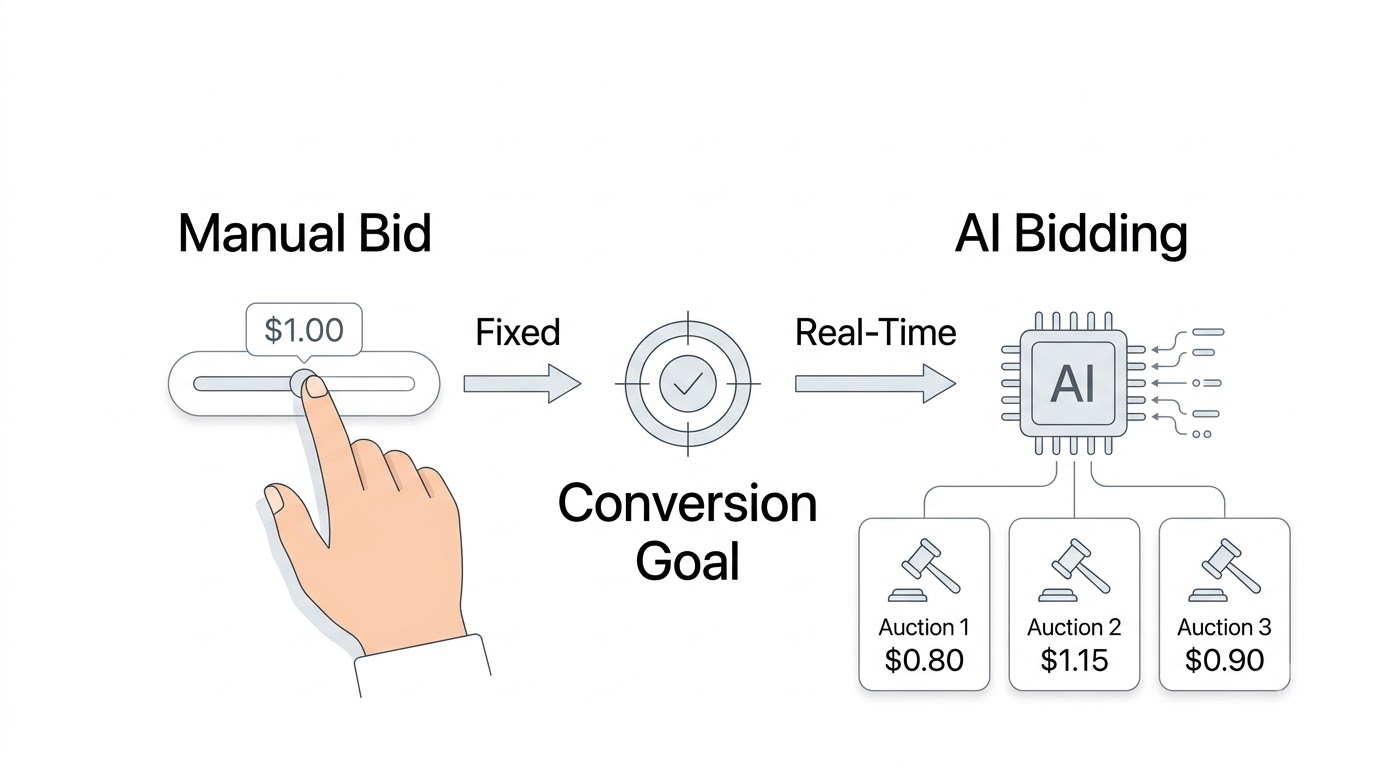
Automated bidding is a bidding method where the ad platform’s algorithm sets bid amounts for each individual auction based on the likelihood of achieving your stated goal, instead of a human manually setting and adjusting bid amounts for keywords, placements, or audiences. It’s the specific mechanism inside AI-powered advertising that decides how much money to put behind each impression.
Automated bidding means telling the platform what outcome you want (a conversion, a click, a specific return on ad spend) and letting the algorithm decide the bid for every auction that could produce that outcome. Manual CPC, by contrast, means a human sets a maximum bid per keyword or ad group and that number stays fixed until someone changes it. The reason platforms pushed advertisers toward automated bidding isn’t purely commercial. Algorithms genuinely can factor in more real-time context than a static manual bid ever could, and that context often changes the value of an auction meaningfully.
How Automated Bidding Works
The mechanics are pretty consistent across platforms. A user enters an auction by triggering a search or qualifying for ad placement. The platform evaluates every signal available at that moment, the algorithm generates a prediction of how likely that specific auction is to convert, a bid gets calculated and submitted into the auction on your behalf, your ad either wins or loses that auction, and the result, win or lose, click or no click, conversion or no conversion, becomes new training data for future predictions. This entire sequence happens in well under a second.
Why Manual Bidding Becomes Difficult at Scale
Manual bidding isn’t broken for small accounts with a handful of keywords and low traffic. It becomes genuinely difficult once you’re managing thousands of auctions across different devices, locations, and times of day, each with a different conversion probability. A keyword that converts at 4% on desktop in the morning might convert at 1.5% on mobile at midnight. Setting one manual bid for that keyword ignores that variance entirely. Add in constantly shifting competition, where competitors raise and lower their own bids throughout the day, and manual bidding starts losing efficiency simply because a human can’t monitor and adjust fast enough to keep pace.
Automated Bidding vs Manual Bidding
| Factor | Manual Bidding | Automated Bidding |
|---|---|---|
| Bid adjustments | Set and changed by a human | Calculated by the algorithm per auction |
| Speed | Limited to how often someone checks the account | Real-time, within each auction |
| Scale | Manageable for small accounts | Handles thousands of auctions simultaneously |
| Signals used | Limited to what a human tracks manually | Hundreds of contextual signals per auction |
| Control | High, but reactive | Shared with the algorithm, more predictive |
| Workload | High, ongoing manual adjustment | Lower, but requires strategic oversight |
Major Automated Bidding Strategies Explained
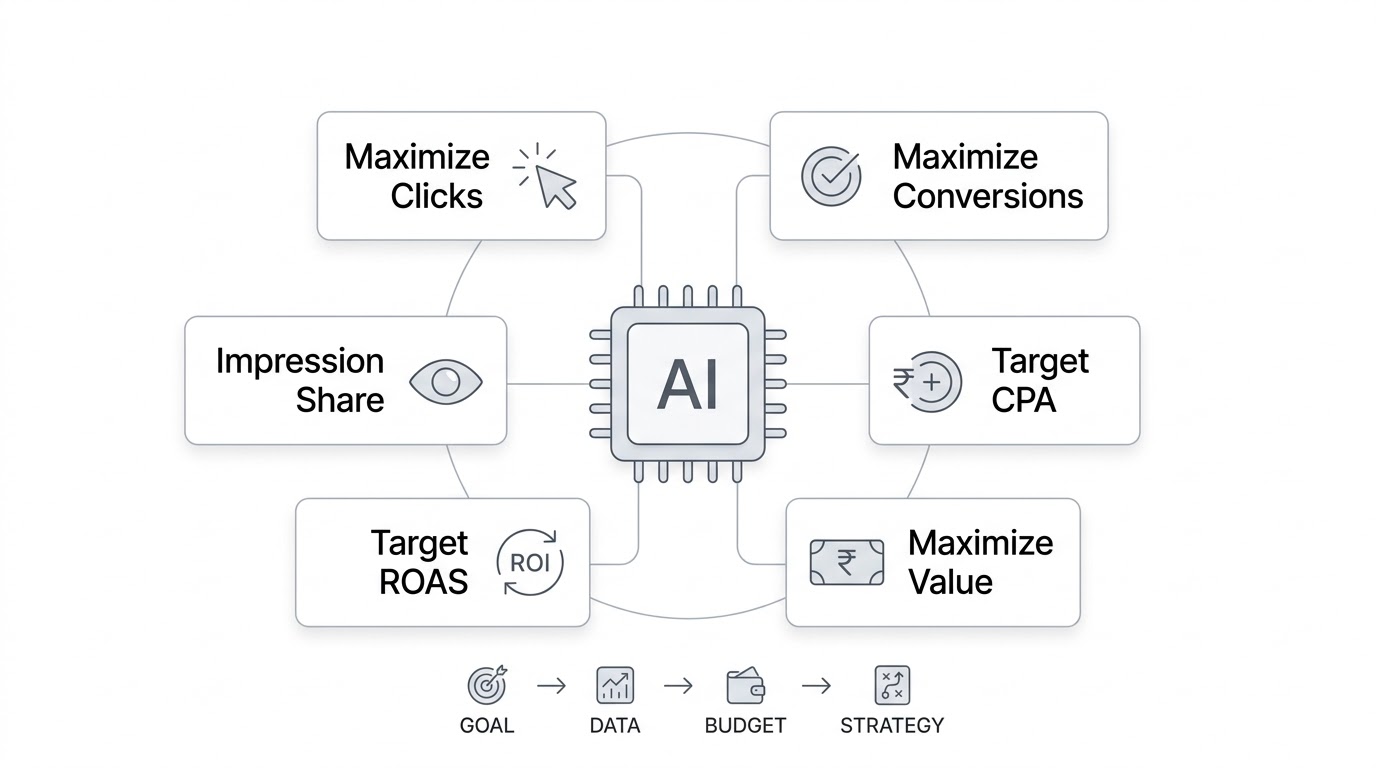
This is the section that actually decides how your budget gets spent, so it deserves real attention instead of a quick skim. Each strategy tells the algorithm to optimize toward a different outcome, and picking the wrong one for your business stage is one of the most common reasons automated bidding underperforms.
Maximize Clicks
Maximize Clicks tells the algorithm one simple objective: get as many clicks as possible within your daily budget, without regard to conversion likelihood. It works by predicting which auctions are likely to result in a click and bidding accordingly, without factoring in downstream conversion behavior at all. This strategy makes sense for brand-new campaigns that don’t have enough conversion data yet for a conversion-based strategy to work well, for pure traffic or awareness objectives where clicks themselves are the goal, and for testing new landing pages or offers where you want volume first. The obvious limitation is that it doesn’t care whether those clicks convert, so it can burn budget on curious browsers who were never going to buy anything.
Maximize Conversions
Maximize Conversions shifts the algorithm’s focus from clicks to actual conversion events, spending your budget to generate as many conversions as possible without a specific cost target. This only works well when conversion tracking is accurate and there’s enough historical conversion data for the model to learn from, usually a minimum of 15 to 30 conversions in the past 30 days as a rough benchmark. It suits lead generation campaigns where every form fill matters, eCommerce campaigns focused on transaction volume, and any conversion-focused campaign where cost efficiency matters less than total volume. Without clean tracking, this strategy will happily chase whatever event you told it to chase, even a low-quality one.
Target CPA
Target CPA tells the algorithm to aim for a specific cost per acquisition, meaning it will try to get you conversions at or around that dollar amount rather than just maximizing raw volume. CPA stands for cost per acquisition, essentially how much you’re willing to pay for one conversion. If your target CPA is set at ₹500, the system looks for conversion opportunities that fit within that economic boundary and adjusts bids up or down auction by auction to hit that average. Set the target too aggressively low compared to what the market actually supports, and the algorithm will simply restrict how much it spends, sometimes barely spending your budget at all, because it can’t find enough auctions that fit your target.
Maximize Conversion Value
There’s a real difference between chasing conversion quantity and chasing conversion value, and this strategy is built around the second one. Maximize Conversion Value tells the algorithm to prioritize higher-value transactions over sheer conversion count, which matters enormously for eCommerce businesses selling products across a wide price range. A $15 accessory and a $400 jacket both count as one conversion under a quantity-based strategy, but they’re worth very different amounts to the business. This strategy requires accurate revenue data flowing back into the platform through your conversion tracking, otherwise it has nothing meaningful to optimize toward.
Target ROAS
Target ROAS builds on conversion value by adding a specific return target. ROAS stands for return on ad spend, the ratio between revenue generated and money spent on ads. A target ROAS of 500% means the advertiser wants roughly ₹5 in tracked conversion value for every ₹1 spent on ads. The algorithm optimizes bidding to hit that ratio on average across the campaign, spending more aggressively on auctions predicted to generate high-value conversions and pulling back on ones unlikely to hit the target. This only works with accurate, consistent revenue tracking. If your revenue data is inflated, missing, or inconsistent, Target ROAS will make decisions based on garbage numbers and the results will reflect that.
Target Impression Share
Not every bidding goal is about conversions. Target Impression Share focuses purely on visibility, telling the algorithm to bid whatever it takes to achieve a specific share of available impressions, whether that’s absolute top of page, top of page, or anywhere on the page. This gets used heavily for brand campaigns, where a company wants to dominate search results for its own name or category terms regardless of immediate conversion outcomes, and for competitive defense, where a brand wants to make sure it consistently outranks competitors bidding on similar terms.
Enhanced and Algorithm-Assisted CPC Concepts
Before platforms moved fully to automated bidding, there was a middle-ground approach: enhanced CPC, where a human still sets a base manual bid but the algorithm adjusts it up or down within a range based on predicted conversion likelihood. This was essentially a bridge between full manual control and full automation, and it’s still relevant for understanding how the industry got here. Most platforms have since pushed advertisers toward fully automated strategies, but the underlying logic, letting the algorithm nudge a human-set number based on context, still shows up in some hybrid tools today.
Choosing the Right Automated Bidding Strategy
The decision framework here is simpler than most guides make it sound. Start with your actual business goal (awareness, leads, sales, or revenue). Check what data you already have available, since some strategies need conversion history to function well. Look at your conversion volume; low-volume accounts should generally start with Maximize Conversions before moving to a target-based strategy once there’s enough data. Then factor in your actual business economics, meaning what CPA or ROAS your margins can realistically support. That sequence, goal, data, volume, economics, is what should determine the bidding strategy, not whichever one looks the most sophisticated.
What Are Smart Campaigns?
Smart campaigns are ad campaign types that automate multiple layers of campaign management simultaneously, not just bidding. Where automated bidding strategies handle one piece of the puzzle (how much to bid), smart campaigns hand the algorithm control over targeting, placement, creative combinations, and budget allocation all at once.
Definition of Smart Campaigns
A smart campaign, in the general sense used across platforms, is a campaign type built specifically to minimize manual setup and ongoing management by letting the algorithm make most of the tactical decisions. Instead of building separate ad groups for different audience segments, writing individual ad copy for each, and manually adjusting budgets between them, an advertiser feeds the system a set of assets (headlines, images, descriptions) along with a goal, and the platform figures out the rest. Google’s Performance Max and Meta’s Advantage+ campaigns are the two most well-known examples of this category.
Smart Campaigns vs Automated Bidding
This distinction gets muddled constantly, so it’s worth stating plainly. Automated bidding is primarily about bid optimization, deciding how much to pay for each auction. Smart campaigns are broader campaign automation, covering targeting, placement, creative selection, and budget distribution in addition to bidding. Every smart campaign uses some form of automated bidding underneath it, but not every automated bidding strategy exists inside a smart campaign. You can run automated bidding inside a traditional, manually structured Search campaign while still controlling your own keywords, ad groups, and targeting.
What Smart Campaigns Can Automate
The scope here is genuinely broad. Targeting gets automated based on the assets and conversion signals provided, without the advertiser manually selecting audiences. Bidding follows whatever goal-based strategy is selected. Placement decisions determine where ads show, across Search, Display, YouTube, Discover, Gmail, or Shopping, without manual placement selection. Audience selection happens algorithmically based on signals rather than manually built audience lists. Creative combinations get tested automatically across headline, description, and image variations. Budget allocation shifts dynamically between different parts of the campaign based on what’s performing. And reporting gets consolidated into performance summaries that reflect the campaign as a whole rather than granular keyword-level data.
Who Should Use Smart Campaigns?
Smart campaigns genuinely make sense for small businesses without a dedicated PPC team, since the setup and management overhead is dramatically lower than a fully manual account structure. Beginners benefit because there’s less room to make structural mistakes that tank performance. Businesses with limited PPC expertise get a reasonable starting point without needing to learn keyword match types, negative keyword lists, and bid adjustment logic from scratch. And advertisers with straightforward objectives, like “get more online sales” without complex segmentation needs, tend to do fine letting the algorithm handle the details.
Who May Need More Control?
Large advertisers running complex, high-spend accounts often find smart campaigns too much of a black box, since the reduced visibility into exactly which searches or placements are driving results makes it harder to diagnose problems. Advanced PPC teams that have built sophisticated audience segmentation strategies over years tend to get better results maintaining that granular control. Businesses with complex funnels, multiple products with different margins and customer journeys, often need the segmentation that smart campaigns intentionally simplify away. And any business requiring granular testing, isolating one variable at a time to understand exactly what’s driving performance, will find smart campaigns frustrating because they bundle so many variables together automatically.
Smart Campaigns Across Major Advertising Platforms
AI in paid advertising doesn’t look identical across every platform, and understanding the differences matters if you’re running budget across more than one channel. Each platform has built its automation around the type of data it collects best.
Google Ads
Google’s automation centers on Smart Bidding strategies (Target CPA, Target ROAS, Maximize Conversions, Maximize Conversion Value) layered underneath Performance Max, its flagship smart campaign type that spans Search, Display, YouTube, Discover, Gmail, and Shopping inventory from a single campaign. Google’s AI-powered targeting leans heavily on search intent and first-party conversion signals fed through Google Ads conversion tracking or Google Analytics. Responsive ad formats, like Responsive Search Ads and Responsive Display Ads, let the algorithm test combinations of headlines and descriptions automatically rather than requiring a fixed, single version of an ad. This combination makes Google’s system particularly strong for capturing high-intent search demand, since it has more direct query-level data than platforms built around social feeds.
Microsoft Advertising
Microsoft’s automated bidding follows a similar logic to Google’s, with Target CPA, Target ROAS, and Maximize Clicks style strategies available, but it operates on a smaller overall data pool since Bing and the Microsoft Search Network see less search volume than Google. Audience signals come from Microsoft’s own ecosystem, including LinkedIn profile data in some targeting options, which gives it a genuinely different demographic and professional targeting angle than Google can offer. AI-assisted optimization here tends to lag slightly behind Google’s in sophistication simply due to smaller training data volume, but for B2B and professional audiences specifically, the LinkedIn data integration is a real differentiator worth considering as part of a cross-platform strategy.
Meta Ads
Meta’s approach to AI leans heavily on audience and creative signals rather than search intent, since there’s no search query to work from on Facebook or Instagram. Machine-learning-driven delivery decides which specific users within a target audience actually see an ad, optimizing for the people most likely to take the desired action. Advantage+ campaigns represent Meta’s version of a fully automated smart campaign, bundling automated audience expansion, creative optimization across multiple asset combinations, and budget optimization across ad sets into one streamlined structure. Advantage+ Shopping campaigns specifically have become a default recommendation for eCommerce advertisers on the platform, since Meta’s algorithm tends to find efficient audiences faster than manually built lookalike or interest-based targeting once conversion data is flowing well.
LinkedIn Ads
LinkedIn’s automation is more limited in scope compared to Google or Meta, reflecting its smaller ad inventory and higher cost-per-click environment. Automated bidding options include Maximum Delivery (similar to Maximize Clicks or Conversions logic) and manual bidding with algorithmic assistance. Audience targeting on LinkedIn remains more manually controlled than other platforms, built around firmographic and professional data like job title, company size, and industry, which is honestly LinkedIn’s biggest strength since no other platform has that depth of B2B targeting data. Optimization goals focus on lead generation, website conversions, or engagement depending on campaign objective, and B2B-specific considerations, like longer sales cycles and multiple decision-makers, mean LinkedIn’s algorithm has less immediate conversion data to learn from compared to a fast-purchase eCommerce environment.
Amazon Ads
Amazon’s automated bidding is built entirely around purchase intent, since every user on the platform is already in a buying mindset by definition. Product advertising through Sponsored Products, Sponsored Brands, and Sponsored Display all offer automated bidding options that adjust based on predicted likelihood of purchase. Conversion and purchase signals here are uniquely strong because Amazon has direct transaction data, not just conversion tracking through a pixel, which gives its algorithm a level of certainty about outcomes that other platforms have to infer indirectly. Retail-focused optimization means Amazon’s AI is particularly good at predicting which specific product listing will convert a given searcher, since it’s optimizing within a closed retail environment rather than an open web.
Platform Comparison Table
| Platform | AI Focus | Major Automation Areas | Best For |
|---|---|---|---|
| Google Ads | Search and conversion intent | Bidding, targeting, campaign structure | Search and performance marketing |
| Meta Ads | Audience and creative signals | Delivery, audience expansion, creative | B2C and social commerce |
| Microsoft Ads | Search, cross-platform data | Bidding and optimization | Search, professional audiences |
| LinkedIn Ads | Professional and firmographic data | Bidding and delivery | B2B lead generation |
| Amazon Ads | Purchase intent | Bidding and product ads | eCommerce and retail |
AI-Powered Campaign Optimization
Beyond bidding itself, AI touches nearly every operational layer of a campaign once it’s live. Understanding where the algorithm is making decisions helps you know where to look when something isn’t performing the way you expected.
Budget Optimization
Platforms increasingly offer campaign-level budget optimization, where instead of a human manually splitting budget across ad sets or ad groups, the algorithm shifts spend dynamically toward whichever segment is performing best in real time. Meta’s Campaign Budget Optimization (CBO) and Google’s shared budgets both work this way. Campaign-level decisions tend to outperform rigid ad-set-level manual splits because the algorithm can react to performance shifts within hours instead of waiting for a weekly manual review, though this comes at the cost of losing granular control over exactly how much each segment gets.
Audience Optimization
AI identifies high-value users by comparing behavioral patterns of people who’ve already converted against the broader pool of users the platform has data on. Audience expansion features, like Google’s Optimized Targeting or Meta’s Advantage detailed targeting, take a seed audience you’ve defined and widen it algorithmically based on similarity to your existing converters. Lookalike and similar audience concepts work on the same underlying logic: find people who resemble your best customers across dozens of behavioral and demographic dimensions, not just the two or three a human would think to check manually.
Placement Optimization
Where an ad appears matters as much as who sees it, and AI handles this decision by predicting which placement (Feed, Stories, Reels, Search partner sites, Display Network) is most likely to produce the desired outcome for a given user. Cross-placement optimization means the algorithm isn’t locked into showing the same ad in the same spot for everyone; it shifts placement mix dynamically based on where a specific user is most likely to engage, which is something a manually managed campaign with fixed placement settings simply can’t replicate at the same speed.
Creative Optimization
AI tests combinations of headlines, images, videos, and descriptions against each other continuously, identifying which specific pairing performs best for which audience segment rather than assuming one “winning” ad works universally. This happens through dynamic creative optimization, where the system mixes and matches assets you’ve uploaded and tracks performance of each combination separately. The practical implication is that you need to supply enough creative variety for the algorithm to actually have something meaningful to test; a single headline and one image gives it almost nothing to optimize.
Performance Prediction
Before a campaign even launches or right after minor changes are made, platforms increasingly show predicted performance estimates, projected reach, expected conversion volume, or forecasted cost per result, based on historical data from similar campaigns. These predictions aren’t guarantees, they’re statistical estimates built from comparable accounts and campaign types, and treating them as guaranteed outcomes rather than rough forecasts is a mistake that trips up newer advertisers constantly.
AI in Ad Targeting and Personalization
Targeting used to mean picking an audience once and leaving it alone. AI turned targeting into something that adjusts continuously based on who’s actually responding, which changes how personalization works at a fundamental level.
Behavioral Targeting
Behavioral targeting uses a person’s past actions, pages visited, products viewed, content engaged with, to predict what they’re likely to be interested in next. This is the foundation most retargeting and lookalike audience strategies are built on, and it tends to be the most accurate targeting method available because it’s based on demonstrated behavior rather than assumed interest.
Contextual Targeting
Contextual targeting places ads based on the content surrounding them rather than data about the specific user viewing it, showing a running shoe ad on a fitness article, for example. This method has gained relevance again as privacy regulations restrict how much behavioral data platforms can collect and use, making context a more reliable signal in some environments than it used to be.
Intent-Based Targeting
Intent-based targeting focuses specifically on signals that indicate someone is close to making a decision, like a specific high-intent search query or having added a product to cart without completing checkout. This is generally the highest-converting targeting method because it’s capturing people who’ve already expressed a concrete need, not just a general interest area.
Predictive Audiences
Predictive audiences are algorithmically built groups of users the platform believes are likely to convert soon, based on patterns learned from past converters, even if those specific users haven’t shown obvious purchase intent yet. Google’s Predictive Audiences feature inside Performance Max is a direct example, identifying users the system predicts are moving toward a purchase decision based on subtle behavioral patterns a human wouldn’t catch.
Dynamic Personalization
The same advertiser can and often does deliver completely different messaging to different segments within the same campaign. A new visitor might see a broad brand-introduction ad, a returning visitor who browsed a specific product category sees a message about that category, a high-intent user who abandoned a cart sees a direct offer or reminder, and an existing customer sees a loyalty or repeat-purchase message. This kind of layered personalization happens automatically once dynamic creative and audience signals are set up correctly, without a human manually building separate campaigns for each segment.
Benefits of AI-Based Targeting
The practical upside here is real: better relevance, since ads reach people whose behavior actually matches the intent behind the message, greater scale, since the system can personalize for millions of users simultaneously in ways no team could manage manually, faster optimization, since underperforming segments get deprioritized automatically instead of waiting for a weekly manual review, and potentially improved conversion efficiency, though that last one depends entirely on data quality and campaign setup, not just the presence of AI.
AI and Creative Optimization in Paid Advertising
Creative has become one of the biggest performance levers in an automated environment, mostly because bidding and targeting are increasingly handled by the algorithm, leaving creative as one of the few areas where a marketer still has direct, meaningful control.
AI-Generated Ad Variations
Platforms now generate variations of headlines, descriptions, images, and even short videos automatically based on the assets you provide, testing combinations to find what resonates with different audience segments. Google’s Responsive Search Ads can auto-generate headline combinations from your landing page content if you don’t provide enough manual variations, and Meta’s Advantage+ creative tools can adjust cropping, add catalog details, or generate text variations from a base asset.
Dynamic Creative Optimization
Dynamic creative optimization systems test combinations of creative assets against each other in live traffic, tracking which specific pairing of image, headline, and description performs best for which segment, then shifting delivery weight toward the winning combinations automatically. This removes the need for a human to manually build and compare dozens of ad variations one at a time, though it does require feeding the system enough distinct creative assets to actually have meaningful combinations to test.
AI for Ad Copy Testing
Testing different hooks, calls to action, and value propositions used to require setting up separate ad variations and manually comparing performance over weeks. AI-driven testing does this continuously and automatically, identifying which specific messaging angle works for which audience-specific segment far faster than manual A/B testing ever could, since it’s running dozens of comparisons simultaneously rather than one test at a time.
Human Creativity vs AI Creativity
Here’s the honest limitation nobody selling AI tools wants to emphasize: the algorithm can test and optimize combinations of what you give it, but it can’t invent your brand voice, your positioning against competitors, your actual offer, or the customer insight that makes a piece of messaging land emotionally. AI can tell you which headline performed better among the options you provided. It can’t tell you the headline you never thought to write. Marketers still need to supply the strategic input, the algorithm just tests and scales it faster than a human ever could alone.
Benefits of Using AI in Paid Advertising
There’s a genuine list of advantages here, and it’s worth being specific rather than vague about what actually improves.
Faster Optimization
Campaigns adjust within hours or even minutes based on incoming performance data, rather than waiting for a weekly or monthly manual review cycle. This speed matters most in fast-moving categories or during high-competition periods like holiday shopping, where a manual team simply can’t react quickly enough to shifting auction dynamics.
Better Scalability
An algorithm can manage thousands of simultaneous auctions across multiple campaigns and audience segments without needing proportionally more human headcount. This is the single biggest reason large advertisers rely on automated bidding, since manually scaling a PPC operation to match algorithmic capacity would require an enormous team.
Real-Time Decision Making
Bids, budget allocation, and creative delivery all adjust live based on current auction conditions rather than decisions made once and left static for days or weeks. This responsiveness is genuinely hard to replicate manually, even for a skilled and attentive PPC manager.
Efficient Use of Advertising Data
AI processes far more signals per decision than a human reasonably can, factoring in device, time, location, and behavioral history simultaneously for every single auction rather than picking one or two variables to focus on manually.
Reduced Manual Work
Tasks that used to consume hours of daily bid management time get handled automatically, freeing up marketer time for strategy, creative development, and analysis instead of repetitive tactical adjustments.
Potentially Improved Conversion Efficiency
Under the right conditions, clean tracking, realistic targets, sufficient data volume, automated bidding can find efficiency gains a manual approach would miss, since it’s testing far more granular combinations of context than a human bidding strategy realistically could.
Better Budget Allocation
Budget shifts dynamically toward whatever is currently performing best, rather than staying locked into a fixed split decided once and rarely revisited.
More Accurate Audience Predictions
Predictive models identify patterns in converter behavior that inform more accurate targeting than manually built audience segments based on assumed demographics or interests.
Faster Experimentation
Testing new creative, audience, or bidding approaches happens continuously in the background rather than requiring a formal, separately scheduled test each time.
Improved Operational Efficiency
Combined, all of the above reduces the operational overhead required to run a well-performing paid advertising program, letting smaller teams manage larger, more complex accounts than would otherwise be possible.
It’s worth being direct about a caveat most guides gloss over: none of this guarantees lower CPC or higher ROAS automatically. Results depend heavily on data quality, campaign structure, the actual offer being advertised, the accuracy of conversion tracking, competitive intensity in your category, and the underlying business economics behind your product or service. AI amplifies whatever foundation you give it, good or bad.
Limitations and Risks of AI in Paid Advertising
A genuinely useful guide on AI in paid advertising has to cover where this technology falls short, because plenty of campaigns burn budget precisely because someone assumed automation would fix problems it was never built to fix.
Poor Data Produces Poor Optimization
The algorithm can only learn from the data you feed it. If your conversion tracking is inaccurate, incomplete, or misaligned with actual business value, the system optimizes toward the wrong outcome with total confidence, because it has no way of knowing the data is flawed.
Conversion Tracking Problems
Broken pixels, duplicate conversion counting, or conversions that don’t reflect real revenue events are some of the most common reasons automated bidding underperforms. A campaign optimizing toward a conversion event that’s firing twice per actual purchase will systematically overpay, and the algorithm has no built-in way to detect that on its own.
Reduced Manual Control
Handing bidding and targeting decisions to an algorithm means giving up granular control over exactly which auctions you win or lose. For advertisers who want precise, auditable control over every dollar spent, this trade-off can feel uncomfortable, and in some cases it genuinely limits the ability to react to specific business situations quickly.
Algorithm Learning Periods
New campaigns or campaigns that undergo major changes go through a learning phase where performance can be inconsistent while the model gathers enough data to make confident predictions. Judging a campaign’s success during this window, often the first one to two weeks, tends to produce misleading conclusions.
Budget Waste From Incorrect Objectives
Selecting the wrong bidding strategy or conversion goal, optimizing toward form submissions instead of qualified leads, for example, means the algorithm will efficiently deliver more of the wrong outcome. Efficient optimization toward the wrong goal is still a waste of budget, just a very fast one.
Over-Automation
Removing all human oversight and letting every decision run on autopilot removes the ability to catch obvious mistakes, like a campaign accidentally targeting the wrong country or a creative asset that’s technically performing well but damages brand perception in ways the algorithm has no way to measure.
Lack of Transparency
Smart campaigns in particular offer limited visibility into exactly which search terms, placements, or audience segments are driving results, since the platform bundles this data at a higher level than traditional manual campaigns. This makes diagnosing underperformance genuinely harder than it used to be.
Creative Fatigue
Even algorithmically optimized creative eventually wears out as the same audience sees it repeatedly, and performance degrades over time regardless of how well the initial optimization worked. AI can identify fatigue happening through declining performance metrics, but it can’t produce fresh creative concepts on its own to fix it.
Privacy and Data Concerns
Increasing privacy regulation (GDPR, CCPA, Apple’s App Tracking Transparency) has reduced the volume and granularity of data available to ad platforms, which directly impacts how well predictive models can perform. This trend is only getting more restrictive, not less, and it’s changing how much platforms can rely on individual-level behavioral data going forward.
Platform Dependency
Relying heavily on one platform’s AI systems creates a dependency where changes to that platform’s algorithm, policies, or available data can significantly impact performance overnight, with little advance warning and limited ability to control the outcome.
The concept worth remembering here: automation without a clear strategy behind it doesn’t fix mistakes, it scales them faster. A poorly structured campaign with automated bidding turned on will waste budget more efficiently than the same campaign run manually, not less.
AI Learning Periods: What Marketers Need to Know
This gets misunderstood constantly, and it causes a lot of premature panic when campaigns get shut down or changed before they’ve had a fair shot to perform.
What Is the Learning Phase?
The learning phase is the period after a campaign launches or undergoes a significant change where the algorithm doesn’t yet have enough data to make confident, stable predictions. Performance during this window tends to be more volatile, sometimes worse, sometimes better, than what the campaign will settle into once the model has learned enough.
Why Algorithms Need Conversion Data
Predictive models require a meaningful sample size of conversion events before they can reliably distinguish signal from noise. A campaign with only three or four conversions doesn’t give the algorithm enough information to confidently identify what combination of signals actually drove those results versus what happened by chance.
What Can Disrupt Learning
Several things reset or extend the learning phase unnecessarily: major budget changes, especially sudden large increases or decreases, targeting changes that alter the pool of users the campaign can reach, changes to which conversion events are being tracked, and campaign restructuring, like merging or splitting ad groups, which resets the historical data the algorithm was using.
How Long Should You Wait Before Judging Performance?
Most platforms recommend at least one to two weeks, or enough time to accumulate 30 to 50 conversions, before drawing firm conclusions about a bidding strategy’s performance. Judging results based on the first three or four days of data, especially for a new campaign, almost always leads to premature and often wrong conclusions about whether a strategy is working.
How to Avoid Constantly Resetting Campaign Learning
The practical fix here is discipline: batch changes together instead of making small edits every day, avoid touching budget or targeting during an active learning phase unless something is genuinely broken, and give a strategy a fair, predetermined evaluation window before deciding whether to change it. Constantly tinkering with a campaign in learning mode is one of the most common self-inflicted performance problems in accounts run by anxious marketers checking results too frequently.
How to Set Up an AI-Powered Paid Advertising Campaign
This is the practical, step-by-step part. Skipping steps here is exactly how accounts end up with automated bidding that never performs the way it’s supposed to.
Step 1: Define the Business Objective. Decide clearly whether the goal is leads, sales, revenue, traffic, or awareness before touching the platform, since every downstream decision depends on this.
Step 2: Establish Conversion Tracking. Set up tracking for primary conversions (the main action you care about), secondary conversions (supporting actions worth watching), revenue values where applicable, and make sure attribution settings actually reflect your real sales cycle length.
Step 3: Define Your Economics. Calculate the maximum acceptable CPA your margins can support, an estimate of customer lifetime value, a realistic target ROAS based on your actual product economics, and your average order value if running eCommerce.
Step 4: Select the Campaign Type. Choose between a traditional manually structured campaign, a hybrid approach, or a fully automated smart campaign based on how much control your business genuinely needs.
Step 5: Select the Bidding Strategy. Match the bidding strategy to your data volume and objective using the decision framework covered earlier, don’t default to whatever the platform recommends first.
Step 6: Build Audience and Targeting Signals. Feed the system relevant seed audiences, customer lists, or conversion signals it can use as a starting point, even in automated campaigns.
Step 7: Prepare Creative Assets. Supply enough headline, description, image, and video variety for the algorithm to actually have meaningful combinations to test.
Step 8: Set Budget. Set a realistic starting budget that gives the algorithm enough volume to exit the learning phase within a reasonable timeframe.
Step 9: Launch. Turn the campaign live and resist the urge to touch it constantly in the first few days.
Step 10: Allow Sufficient Learning Time. Give the campaign the one to two week window discussed earlier before making judgment calls.
Step 11: Analyze Performance. Look at business-level outcomes, not just platform metrics, once enough data has accumulated.
Step 12: Optimize Strategically. Make deliberate, spaced-out adjustments based on clear evidence rather than reacting to daily fluctuations.
How to Optimize AI-Powered Campaigns Without Over-Managing Them
There’s a real skill in knowing when to leave a well-performing automated campaign alone versus when something genuinely needs fixing.
Don’t Change Campaigns Every Day
Daily tinkering is one of the fastest ways to sabotage automated bidding, since every meaningful change can partially reset the learning process. Set a weekly or biweekly review cadence instead of checking and adjusting constantly.
Focus on Business-Level Metrics
Platform-reported conversions and cost figures don’t always match actual revenue and profit. Cross-reference platform data against your CRM, sales data, or actual bank account before deciding a campaign is or isn’t working.
Monitor Conversion Quality
Volume alone doesn’t tell the whole story. Check whether the leads or sales an automated campaign is generating are actually the kind of customer your business wants, not just the kind that’s easiest to acquire cheaply.
Check Search Terms and Audience Signals
Even in automated campaigns, reviewing what search terms or audience segments are triggering delivery helps catch irrelevant traffic the algorithm might be chasing simply because it technically fits the conversion pattern it learned.
Evaluate Creative Performance
Regularly review which creative assets are actually being served most often and whether they still reflect your current offers, pricing, and brand positioning, since outdated assets can keep running long after they should have been refreshed.
Monitor Budget Distribution
Check where budget is actually flowing across campaigns or ad sets periodically, especially in campaign budget optimization setups, to make sure spend isn’t concentrating entirely on one segment at the expense of others that matter strategically.
Test One Major Variable at a Time
Changing bidding strategy, budget, and creative all at once makes it impossible to know which change actually caused a performance shift. Isolate variables when testing, even though it’s slower.
Use First-Party Data Where Appropriate
Feeding platforms your own customer data, through Customer Match lists, Conversions API, or similar tools, gives the algorithm better raw material to learn from than relying purely on platform-collected behavioral data.
Review Algorithmic Recommendations Critically
Platforms constantly suggest changes, broader targeting, higher budgets, different bidding strategies, inside the ad interface. These suggestions are optimized for platform revenue as much as advertiser performance, so evaluate each one against your own data before applying it blindly.
A useful mental framework to keep coming back to: Observe, Diagnose, Hypothesize, Test, Measure, Scale. Skipping straight from observing a problem to making a change without diagnosing the actual cause is how most bad optimization decisions happen.
Key Metrics to Measure AI Advertising Performance
Automation changes what you should be watching, shifting attention away from granular keyword-level metrics toward broader business outcomes.
CTR
Click-through rate measures how often people who see your ad actually click it, and it’s still a useful early signal for creative relevance, even though it’s no longer the primary metric that matters in an automated environment.
CPC
Cost per click tells you the average price paid per click, which is worth monitoring for cost trends but shouldn’t be the primary success metric once conversion-based bidding strategies are active.
Conversion Rate
The percentage of clicks that result in a conversion remains one of the clearest indicators of whether your landing page and offer are actually working, independent of how well the bidding algorithm is performing.
CPA
Cost per acquisition tells you what you’re actually paying per conversion, and comparing this against your predetermined maximum acceptable CPA is the most direct way to judge whether a campaign is economically viable.
ROAS
Return on ad spend measures revenue generated relative to ad spend, and it’s essential for eCommerce and revenue-focused campaigns specifically.
Conversion Value
Total tracked value from conversions, useful for understanding not just how many conversions happened but how much they were worth in aggregate.
Impression Share
The percentage of available impressions your ads actually captured, which matters most for visibility-focused campaigns and understanding whether budget constraints are limiting reach.
Customer Acquisition Cost
A broader metric than platform-reported CPA, factoring in all costs associated with acquiring a customer, not just ad spend, giving a more accurate picture of true profitability.
Lifetime Value
The total revenue expected from a customer over their entire relationship with your business, which matters enormously when judging whether a higher upfront CPA is actually worth it.
Profitability
The metric that actually matters at the end of the day, factoring in margins, operational costs, and everything else beyond raw ad platform numbers.
Here’s the important point most people miss: ROAS alone isn’t enough to judge campaign success. A campaign showing a strong ROAS on paper can still be unprofitable if margins are thin, customer service costs eat into the value of each sale, return rates are high, or lifetime value turns out to be lower than expected. Treating platform ROAS as the final word on profitability is one of the most common mistakes in performance marketing.
AI Advertising Example: From Manual PPC to Automated Optimization
A hypothetical online furniture retailer helps make this concrete rather than abstract.
Initial situation: The business runs a monthly ad budget of ₹1,00,000 through manually managed Search campaigns, adjusting bids by hand across multiple product categories, sofas, dining sets, office furniture, with inconsistent conversion rates ranging from under 1% for high-consideration items like sofas to over 4% for smaller accessories.
AI implementation: The team improves conversion tracking to capture actual revenue values per transaction instead of a flat “purchase” event, switches from manual CPC to a value-based automated bidding strategy, feeds the system first-party customer data through Customer Match, tests a wider set of creative assets across product categories, and enables campaign budget optimization to let spend shift dynamically toward the best-performing categories.
What changed: Bidding decisions moved from a human checking the account twice a week to real-time, per-auction adjustments based on predicted conversion value. Budget started flowing more heavily toward accessories and mid-priced items that converted more reliably, while high-consideration items like sofas received more conservative bidding given their lower conversion probability, though still targeted specifically for users showing strong purchase intent signals.
What data was required: Accurate revenue tracking per transaction, a clean customer list for Customer Match, and enough historical conversion volume across categories for the algorithm to differentiate performance patterns between product types.
Which decisions became automated: Individual bid amounts per auction, budget distribution across product categories, and creative combination testing all moved to the algorithm.
Which decisions remained with the marketer: Setting the overall target CPA and ROAS thresholds, deciding which product categories to include or exclude from automated campaigns, writing the actual ad copy and creative concepts, and making the strategic call on how aggressively to scale budget based on business capacity to fulfill orders.
This example isn’t meant to prove automated bidding guarantees better results, it’s meant to show what actually changes operationally and where human judgment still matters even after automation takes over the tactical execution.
Automated Bidding vs Smart Campaigns vs Manual Campaigns
| Feature | Manual Campaign | Automated Bidding | Smart Campaign |
|---|---|---|---|
| Bid management | Set and adjusted by a human | Calculated by the algorithm | Calculated by the algorithm |
| Targeting | Manually selected | Mixed, human-defined with algorithmic delivery | Largely automated |
| Creative optimization | Manually built and compared | Limited, varies by platform | Automated combination testing |
| Budget optimization | Manually distributed | Partially automated | More fully automated |
| Control | High | Medium | Lower |
| Complexity | High | Medium | Low |
| Best for | Advanced marketers with specific needs | Performance marketers wanting bid efficiency with structural control | Beginners and small businesses |
Manual campaigns still make sense when precise, auditable control over spend matters more than convenience, common in highly regulated industries or accounts with very specific segmentation needs. Automated bidding fits performance-focused marketers who want algorithmic bid efficiency while keeping control over campaign structure, keywords, and audience definitions. Smart campaigns suit advertisers who’d rather hand over most tactical decisions in exchange for lower management overhead, accepting reduced visibility and control as a fair trade-off.
Best Practices for AI-Powered Paid Advertising
Start with a clear business goal before selecting any bidding strategy or campaign type, since every downstream decision depends on that starting point. Build reliable conversion tracking that reflects actual business value, not just platform-defined default events. Give algorithms sufficient data, generally a minimum of 15 to 30 conversions in the trailing 30 days, before expecting stable, predictable performance. Use realistic bidding targets based on actual market conditions and business economics rather than aspirational numbers. Provide strong creative assets, since the algorithm can only optimize combinations of what you actually give it. Use first-party data responsibly, feeding platforms accurate customer information while respecting privacy regulations and customer expectations. Monitor profitability rather than vanity metrics like impressions or CTR alone. Test systematically, isolating one variable at a time instead of changing multiple things simultaneously and guessing at causation. Keep human oversight active, reviewing performance regularly and questioning automated recommendations rather than accepting every suggestion by default. Scale only after establishing stable performance over a meaningful evaluation window, rather than increasing budget aggressively on early, unproven results.
The Future of AI in Paid Advertising
The trajectory here points toward more automation, not less, but the shape of that automation is shifting in specific, identifiable directions.
Increasingly Automated Campaign Creation
Platforms are moving toward generating entire campaign structures, not just optimizing bids within an existing one, based on a website URL or product feed with minimal manual setup required.
Generative AI for Creative Production
Text and image generation tools are increasingly built directly into ad platforms, letting advertisers generate creative variations without needing a separate design or copywriting process for every test.
Predictive Customer Acquisition
Systems are getting better at predicting long-term customer value at the point of acquisition, not just immediate conversion likelihood, shifting optimization toward genuinely profitable customers rather than just cheap ones.
Value-Based Optimization
The shift from volume-based to value-based bidding strategies is accelerating across every major platform, reflecting a broader industry move toward optimizing for actual business outcomes over raw conversion counts.
Greater Integration of First-Party Data
As third-party tracking capabilities shrink due to privacy regulation, platforms are building deeper integrations for advertisers to feed in their own customer data directly, making first-party data infrastructure a genuine competitive advantage.
AI-Powered Marketing Agents
Emerging tools are moving toward autonomous agents that can execute multi-step campaign management tasks, adjusting budgets, pausing underperforming creative, or reallocating spend across channels, with less direct human input at each individual step.
Cross-Channel Optimization
Future systems are likely to optimize budget allocation across entire marketing channels, not just within a single platform, making decisions about whether a dollar is better spent on Google Search or Meta based on real-time performance comparison.
More Autonomous Campaign Management
The overall direction is toward systems that require strategic input up front (goals, budgets, brand guidelines) and handle increasingly more of the tactical execution without ongoing manual intervention.
Will AI replace PPC marketers? Routine execution, bid adjustments, basic reporting, standard creative testing, will keep getting automated. Strategic thinking won’t. Human understanding of customers, competitive positioning, brand voice, and business economics is becoming more important, not less, precisely because the tactical work is increasingly handled by the machine.
How Marketers Should Prepare for AI-Driven Advertising
The skill set that matters is shifting, and marketers who adapt early tend to end up managing bigger, more complex accounts rather than getting displaced by automation.
Develop these skills: Data analysis, since interpreting what the algorithm is doing and why matters more than manually executing tactics. Conversion tracking, because setup and troubleshooting expertise directly determines automation quality. Marketing strategy, the layer AI genuinely can’t replace. Customer research, understanding who actually buys and why. Creative strategy, since creative remains one of the few fully human-controlled levers. Experimentation, structuring valid tests in an automated environment. Attribution, understanding how credit gets assigned across an increasingly complex customer journey. Business economics, knowing margins, lifetime value, and true acquisition costs well enough to set realistic targets. And AI literacy generally, understanding what these systems can and can’t do well enough to use them effectively instead of either blindly trusting or completely distrusting them.
Shift in role: The old path went from campaign operator to bid manager to manual optimizer. The path forward looks more like strategist to data interpreter to experiment designer to business growth manager, someone who sets direction and evaluates results rather than executing every tactical decision by hand.
Frequently Asked Questions
What is AI in paid advertising?
AI in paid advertising refers to machine learning systems that predict outcomes like clicks and conversions, then use those predictions to automatically adjust bidding, targeting, budget allocation, and creative delivery in real time, rather than relying on fixed, manually set rules.
How does AI improve PPC campaigns?
AI processes far more signals per auction than a human can track manually, device, location, time, behavior, and prior conversions, and adjusts bids and targeting instantly based on that context, which can improve efficiency when tracking and campaign structure are set up correctly.
What is automated bidding?
Automated bidding is a system where the ad platform’s algorithm sets the bid for each individual auction based on predicted likelihood of achieving your stated goal, instead of a human manually setting and adjusting fixed bid amounts.
What is Smart Bidding?
Smart Bidding is Google’s specific set of automated bidding strategies, including Target CPA, Target ROAS, Maximize Conversions, and Maximize Conversion Value, that use machine learning to set bids for each auction based on conversion or conversion value likelihood.
Are smart campaigns better than manual campaigns?
Neither is universally better; smart campaigns reduce management overhead and suit beginners or straightforward objectives, while manual campaigns offer more granular control and transparency, which advanced advertisers with complex segmentation needs often still prefer.
Does automated bidding increase conversions?
Automated bidding can improve conversion efficiency when conversion tracking is accurate and there’s sufficient historical data, but it doesn’t guarantee more conversions on its own, results depend heavily on data quality, targets set, and overall campaign structure.
How long does AI bidding take to learn?
Most platforms recommend allowing one to two weeks, or roughly 30 to 50 conversions, before a bidding strategy stabilizes enough to judge performance accurately, since the algorithm needs sufficient data to make confident predictions.
What data does AI use for ad optimization?
AI uses search query data, device and location signals, time of day, demographic information where available, prior interactions with your brand, website behavior, and conversion history to build predictions that inform bidding and targeting decisions.
Can AI manage an entire advertising campaign?
AI can handle bidding, targeting, placement, and creative combination testing largely on its own within a smart campaign structure, but strategic decisions like setting business objectives, defining budget ceilings, and writing core creative concepts still require human input.
Should small businesses use AI-powered advertising?
Yes, generally, since small businesses often lack the time or expertise to manage granular manual bidding, and smart campaigns or automated bidding strategies typically offer a reasonable starting point without requiring deep platform expertise.
Is automated bidding suitable for beginners?
Automated bidding is generally more beginner-friendly than manual bidding since it removes the need to understand complex manual adjustment logic, though beginners still need to set up accurate conversion tracking and realistic targets for it to work well.
What is the difference between Smart Bidding and smart campaigns?
Smart Bidding refers specifically to Google’s automated bidding strategies focused on bid optimization, while smart campaigns is a broader term for campaign types, like Performance Max or Advantage+, that automate targeting, placement, and creative in addition to bidding.
Can AI reduce advertising costs?
AI can improve efficiency under the right conditions, but it doesn’t guarantee lower costs automatically, results depend on competition levels, data quality, campaign structure, and how realistic the bidding targets are relative to actual market conditions.
Can AI replace PPC managers?
AI is automating routine execution tasks like bid adjustments and basic creative testing, but strategic work, setting business objectives, interpreting results, understanding customers, and making creative and positioning decisions, still requires human judgment that current AI systems can’t replicate.
What are the risks of AI-powered advertising?
Key risks include poor optimization from inaccurate conversion tracking, reduced visibility and control over granular decisions, extended or repeatedly disrupted learning phases from frequent changes, and over-reliance on automation without the strategic oversight needed to catch structural problems.
Conclusion: AI Is the Engine, Strategy Is the Driver
AI in paid advertising has genuinely changed how campaigns get managed, from bidding decisions made auction by auction to broader smart campaigns that automate targeting, creative, and budget allocation together. Automated bidding lets algorithms make real-time decisions no human team could match at scale, and smart campaigns extend that automation across nearly every tactical layer of a campaign. None of this works well on its own though. Automation amplifies whatever foundation it’s given, clean tracking and a clear strategy produce genuinely strong results, while broken tracking and unclear objectives just get wasted faster and more efficiently than they would manually.
The businesses getting real value out of AI in paid advertising right now aren’t the ones that turned on every automated feature and walked away. They’re the ones treating automation as a tool that handles the auction-level math while marketers stay focused on the decisions that actually require judgment: what the business objective is, whether the tracking data is trustworthy, what the creative should say, and whether the numbers coming back actually mean the business is profitable. The goal was never to automate everything. It’s to automate the decisions machines genuinely handle better, and keep humans responsible for the ones that need context, creativity, and real business judgment.