
Somewhere around 2023, half the marketing teams I know started quietly panicking. Not out loud, obviously. Nobody wants to be the person who says “wait, is my job about to disappear” in a Slack channel. But you could feel it. Every content meeting had that one moment where someone would say “well, we could just have ChatGPT write it” and the room would go a little quiet.
A few years later, the panic has mostly settled into something more useful: actual usage patterns. AI copywriting tools are everywhere now. Marketers use them to draft product descriptions before breakfast. Freelancers use them to beat writer’s block at 11pm before a deadline. Agencies use them to produce fifteen ad variations in the time it used to take to write three. And yet, weirdly, the demand for genuinely good human writers hasn’t gone away. If anything, the writers who are actually excellent at their craft are busier than ever, just doing different work than they used to.
That contradiction is the whole story here. AI copywriting tools are not a passing trend, and they’re also not the end of human writing. Both of those things are true at the same time, and this article is about untangling exactly where the line sits, tool by tool, task by task, so you’re not guessing.
Here’s what you’ll learn in this guide:
- How AI copywriting tools actually work, not the marketing version of how they work
- A real breakdown of the top 5 tools people are using right now, and what each one is actually good for
- Where AI genuinely beats human writers, and where it falls flat on its face
- Why some AI-generated content ranks fine on Google and some gets buried
- A workflow that combines AI speed with human judgment, instead of pretending you have to pick one
- Whether copywriting as a career is actually at risk, and which parts of it are
Can AI copywriting tools replace human writers? Short answer: they can replace a lot of the repetitive writing tasks that used to eat up a writer’s day, but they can’t replace the parts of the job that require original thinking, real expertise, brand judgment, and accountability for what gets published. The businesses getting the best results aren’t choosing AI or humans. They’re using AI to produce and humans to think.
What Are AI Copywriting Tools?
AI copywriting tools are software applications, usually built on top of large language models, that generate marketing and sales text from a prompt. You type in what you want, give it some context, and it produces a draft in seconds instead of the twenty minutes it might take a human to get past the blank page.
Definition of AI Copywriting
At its core, AI copywriting software uses generative AI, specifically large language models trained on massive amounts of text, to predict and produce natural-sounding language based on patterns it learned during training. This isn’t magic. It’s a prediction engine that’s gotten very good at guessing what word should come next based on everything that came before it, which turns out to be enough to produce coherent, often persuasive copy. Prompt-based writing is the interface layer on top of that: you describe what you want in plain language, and the model does the heavy lifting of turning that description into finished text.
How AI Copywriting Tools Actually Work
The basic workflow looks like this: prompt, then context, then generation, then editing, then human review, then final copy. That sounds simple, but the quality of the output depends almost entirely on what happens before generation, not after.
You give the tool instructions. Good instructions include your target audience, your brand voice, examples of past content, and sometimes competitor references. The tool takes all of that context and generates an output based on statistical patterns from its training data plus whatever you fed it. Then comes iteration, where you refine the prompt, ask for a different angle, or tell it to make the tone punchier. Most people skip straight from generation to publishing, and that’s exactly where things go wrong. The tool did its job. The human just didn’t finish theirs.
What Can AI Copywriting Tools Write?
This is genuinely the fun part, because the list is longer than most people realize. AI copywriting tools can produce blog posts, ad copy for Facebook and Instagram, LinkedIn posts, Google Ads headlines and descriptions, product descriptions, full email campaigns, cold sales emails, landing page copy, general website copy, headlines, meta descriptions, calls to action, video scripts, and video descriptions.
The catch is that “can write” and “writes well” are two different claims. A tool can absolutely generate a product description for a pair of running shoes in four seconds. Whether that description makes anyone want to buy the shoes is a separate question entirely, and it depends heavily on the quality of the prompt and the amount of real product detail you feed it.
Why AI Copywriting Tools Have Become So Popular
None of this happened because marketers suddenly decided AI was cool. It happened because the economics of content production got brutal, and AI copywriting tools showed up right when businesses needed a way out of that math.
Faster Content Production
Look at the traditional process: research, then outline, then draft, then edit, then rewrite. That’s five distinct stages, and each one used to take real hours, especially for anyone trying to produce something more substantial than a tweet. Now compare that to the AI-assisted version: research, prompt, draft, human edit. Two stages just got collapsed into one, and the draft stage that used to take an hour now takes a few minutes.
That time savings compounds fast when you’re producing content at any real volume. A team publishing twenty pieces a month feels this difference in a way a team publishing two pieces a month never will.
Lower Content Production Costs
Freelance writers typically charge anywhere from $50 to $500+ per piece depending on expertise and length. Agencies charge more, often with markup for account management and strategy on top of the writing itself. In-house teams cost salary, benefits, and management overhead whether or not they’re producing content that week.
AI subscriptions run somewhere between $20 and $100 a month for unlimited or near-unlimited generation. Scaling from ten pieces a month to a hundred pieces a month with a freelancer means paying ten times as much. Scaling the same way with an AI tool often costs the same subscription fee. That math is exactly why so many small businesses and lean marketing teams adopted these tools first.
Overcoming Writer’s Block
This one gets underrated because it sounds soft, but it’s genuinely one of the most useful things AI copywriting tools do. They function as a brainstorming partner when you’re staring at a blank page with a deadline in three hours. Ask for ten headline options and you’ll usually get at least two or three worth building on, even if none of them are publish-ready as written.
ChatGPT, for example, is positioned by OpenAI as a tool for brainstorming, drafting, revising and refining written work rather than simply generating finished copy. That framing matters. It’s not being sold as a replacement writer. It’s being sold as a thinking partner that happens to type fast.
Creating Multiple Variations
Ask a human writer for ten different headline options for the same landing page and you’ll probably get five genuinely different angles and five variations on the same idea, because humans get tired and start repeating themselves after a while. Ask an AI tool for ten headlines and you’ll get ten distinct outputs in under a minute, sometimes across five different tones. That’s useful for A/B testing ad copy, testing different audience segments with different messaging, or just seeing a wider range of angles before you commit to one direction.
Top 5 AI Copywriting Tools
This is the section people usually skip straight to, so let’s not waste time. Here’s how the major players stack up against each other before we get into the individual breakdowns.
| Tool | Best For | Key Strength | Ideal User |
|---|---|---|---|
| Jasper | Marketing copy | Brand-focused marketing workflows | Marketers and teams |
| ChatGPT | Versatile writing | Brainstorming, drafting, and editing | Writers and marketers |
| Copy.ai | GTM and marketing workflows | AI-assisted content and workflow automation | Marketing and sales teams |
| Writesonic | SEO and content marketing | AI-assisted content production at scale | SEO professionals and marketers |
| Grammarly | Editing and rewriting | Improving existing copy | Professionals and writers |
1. Jasper
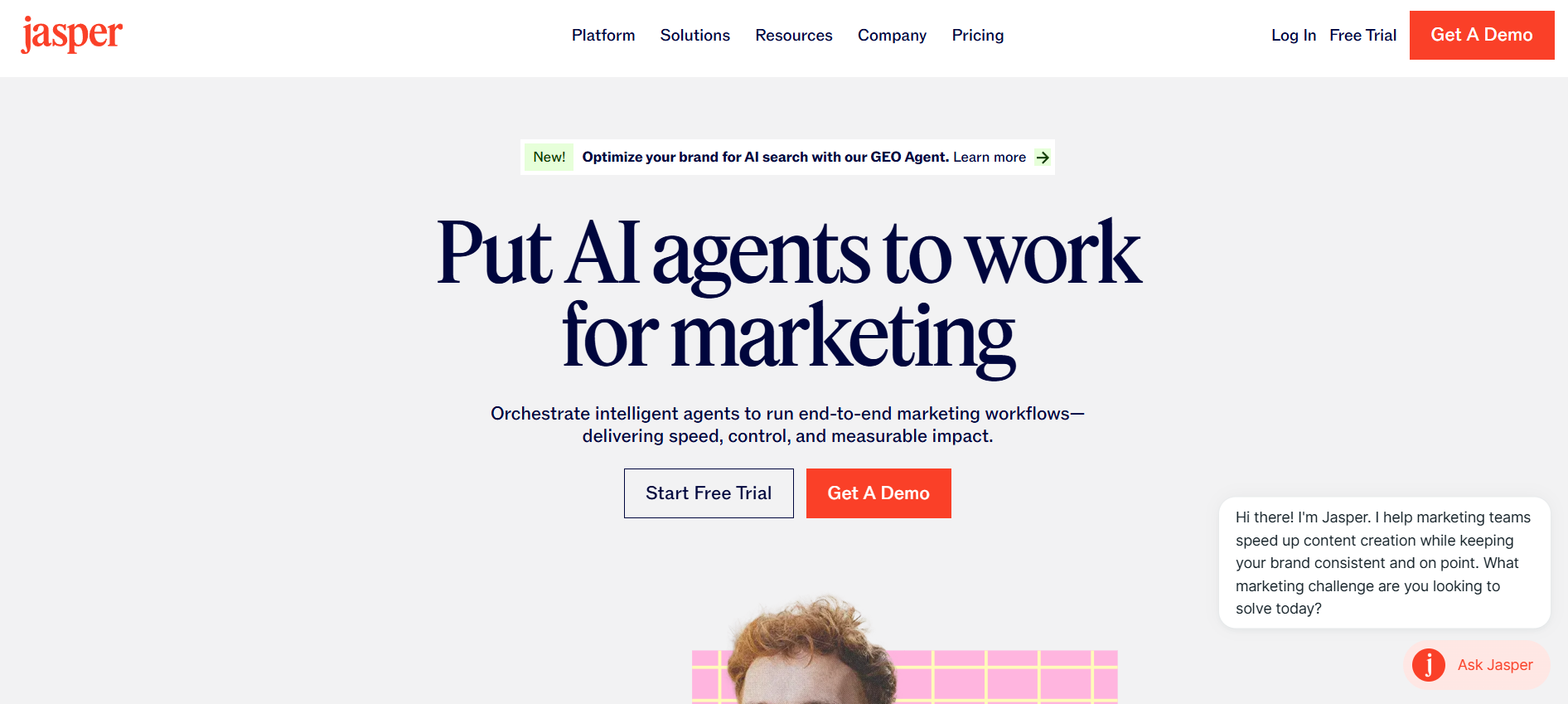
Jasper positions itself as a marketing-first AI platform rather than a general writing assistant, and that distinction shows up in how the product is built. It currently promotes copywriting workflows, dozens of content templates, brand voice settings, and a wide collection of marketing-specific applications aimed at teams rather than solo writers.
Key features include marketing templates for specific formats like ad copy and landing pages, brand voice settings that keep output consistent across a whole team, style guide integration, rewriting tools, brainstorming modes, and built-in collaboration features so multiple team members can work from the same brand context.
Best use cases are ad copy, landing pages, full marketing campaigns, brand messaging documents, social media captions, and email marketing sequences. The brand voice feature specifically is what separates Jasper from a lot of general-purpose tools, because it lets a marketing team feed the tool examples of their actual voice and get output that sounds less generic as a result.
The main tradeoff is cost. Jasper sits at a higher price point than most competitors, which makes sense for a team producing content daily but is hard to justify for a solo freelancer or a business publishing once a month. Best for marketing teams that need scalable, brand-consistent copy across multiple channels at once.
2. ChatGPT
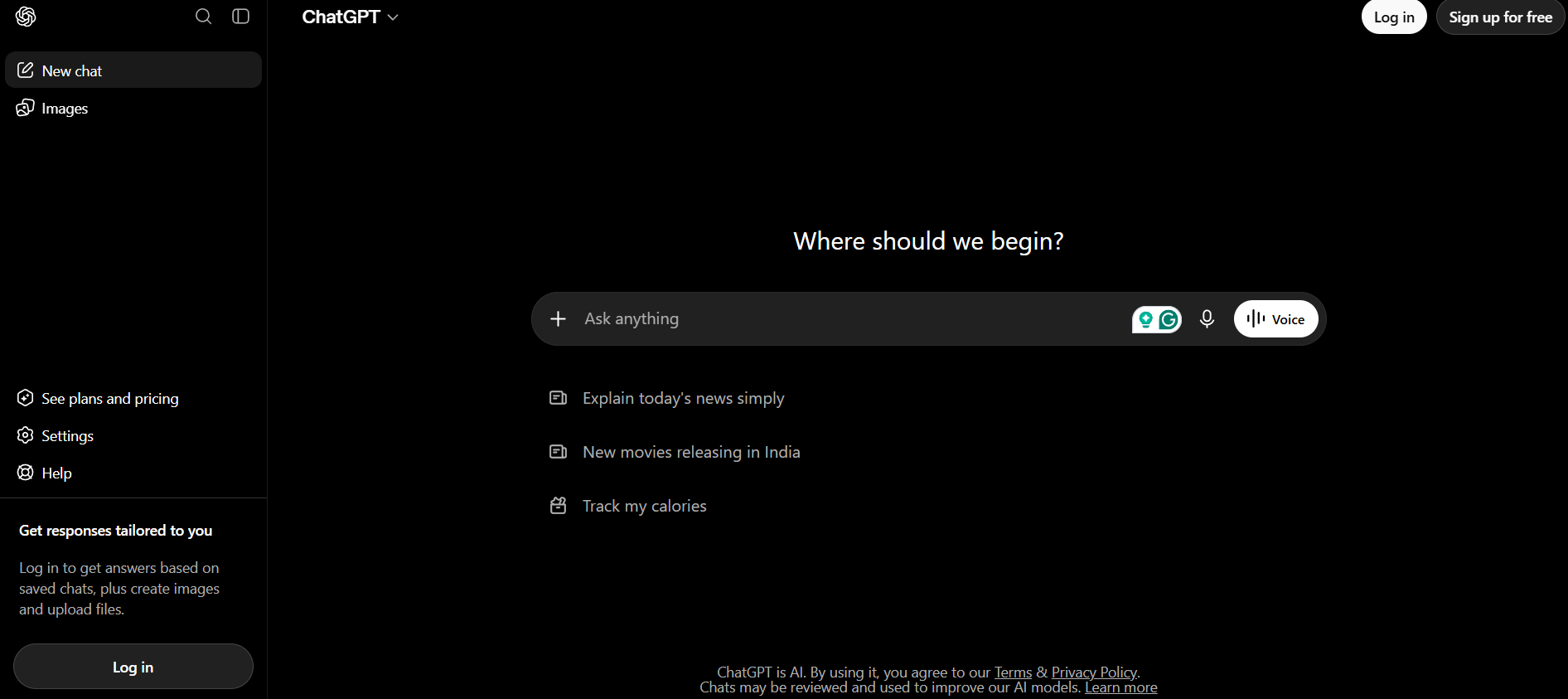
ChatGPT isn’t a copywriting tool in the narrow sense. It’s a general-purpose assistant that happens to be excellent at copywriting among about fifty other things, which is exactly why so many writers default to it first.
Key copywriting capabilities include brainstorming from scratch, outlining longer pieces, drafting full sections, rewriting for tone, adjusting formality up or down, editing for clarity, summarizing long source material, repurposing one piece of content into five different formats, and writing audience-specific messaging when you give it real detail about who you’re talking to.
OpenAI’s current writing guidance describes a workflow of plan, then draft, then revise, then package, while emphasizing the importance of context, constraints, and human review at every stage. That’s a meaningfully different pitch than “type a prompt, get finished copy,” and it lines up with how the best writers actually use the tool.
Best use cases are blog content, social media captions, email copy, early-stage ad concepts, sales copy drafts, content briefs, and repurposing existing content into new formats. Best for writers, marketers, freelancers, and businesses that want one flexible tool instead of five specialized ones.
3. Copy.ai
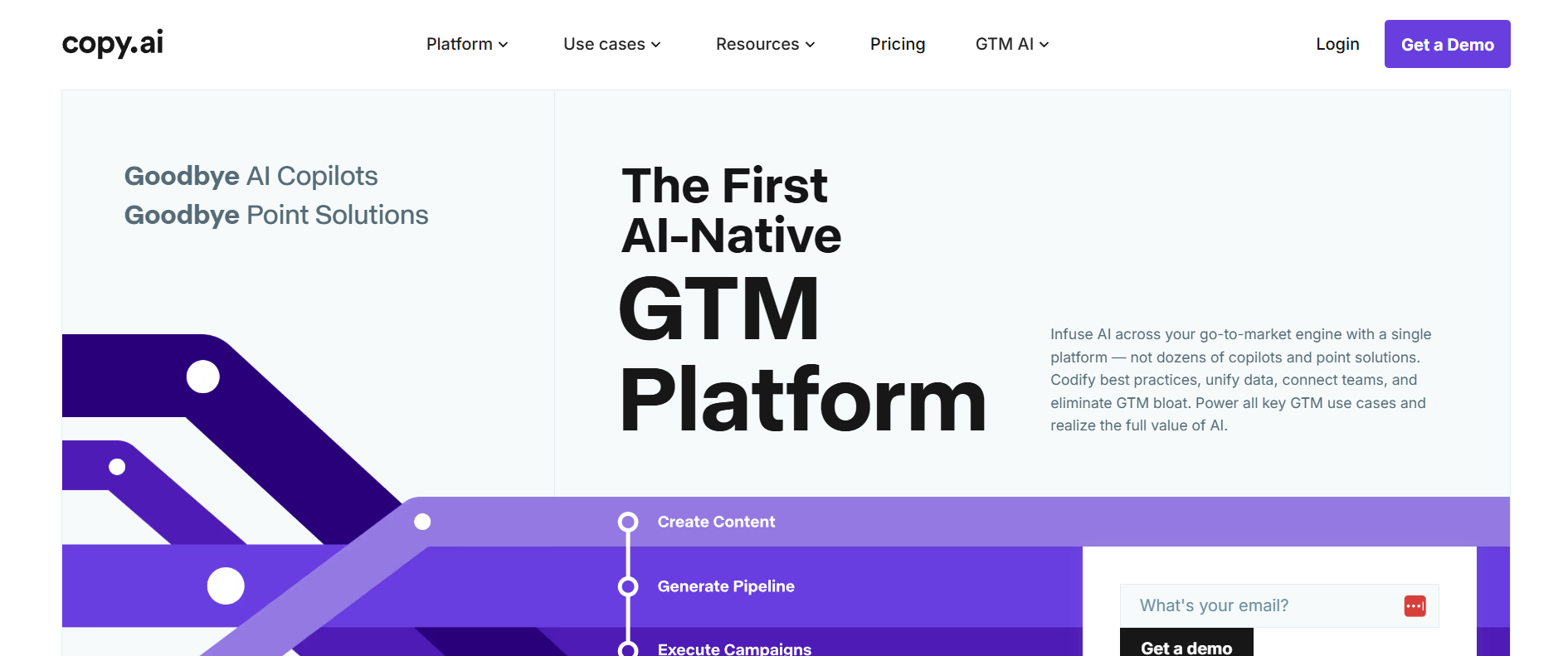
Copy.ai has shifted its positioning over the past couple of years away from simple copy generation and toward broader go-to-market workflow automation, which is worth knowing before you sign up expecting a straightforward blog post generator.
Key features to look at include marketing content generation, sales copy tools, workflow automation that chains multiple AI actions together, content repurposing across formats, team collaboration features, and brand consistency controls similar to what Jasper offers.
Best use cases are sales emails, marketing campaigns, product messaging, social content, and full go-to-market workflows where content generation is one piece of a larger sales and marketing motion. Best for marketing and sales teams looking to build repeatable systems instead of one-off content pieces.
4. Writesonic
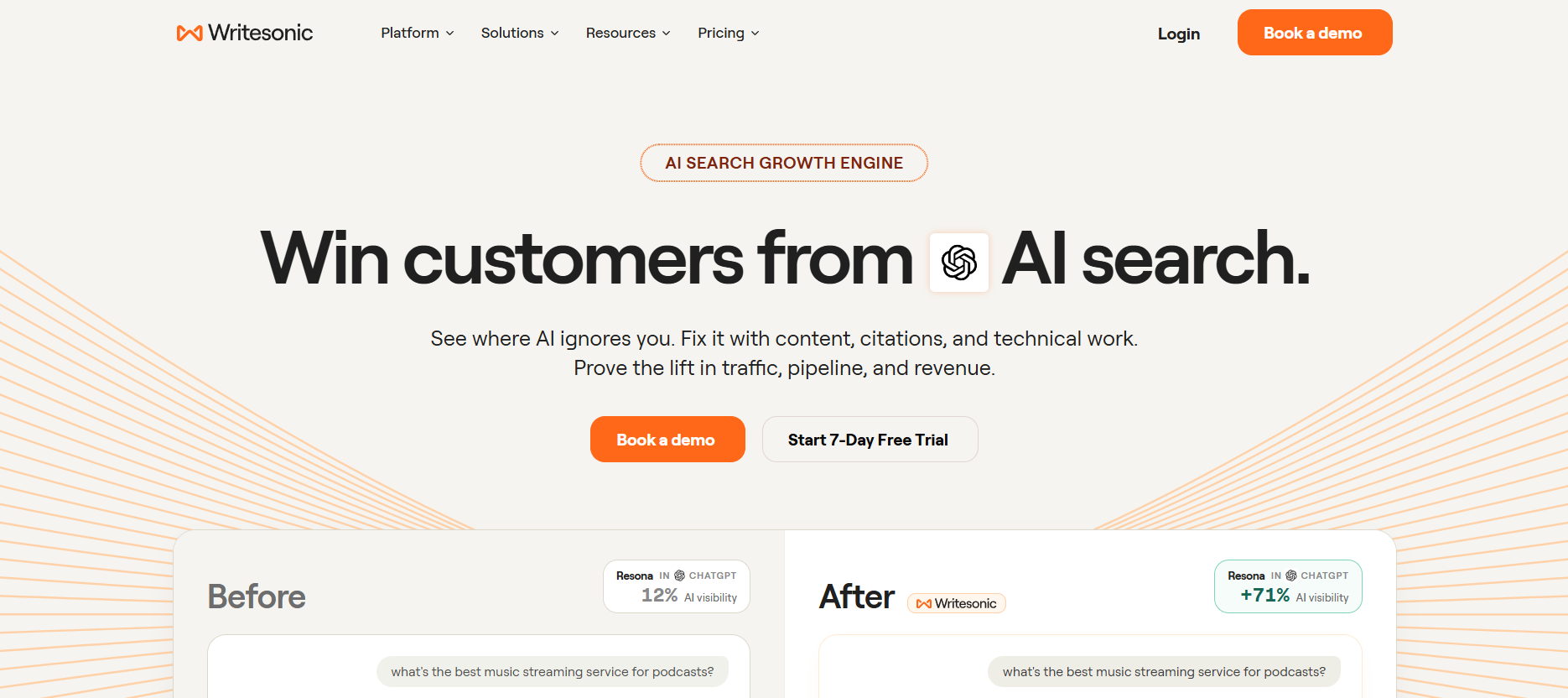
Writesonic leans hard into content production at volume, particularly for teams whose main goal is publishing SEO content regularly rather than crafting individual pieces of brand copy.
Key features include AI article generation from a topic or outline, content creation tools built around SEO structure, on-page optimization suggestions, marketing copy templates, and repurposing tools for turning long-form content into shorter formats.
Best use cases are SEO articles, blog content at scale, product descriptions for ecommerce catalogs, general marketing copy, and website content. Best for SEO professionals and content marketers who need to produce a meaningful volume of content without hiring a full writing team.
5. Grammarly
Grammarly doesn’t need to be crammed into the same box as the article generators on this list, and honestly it shouldn’t be. Its value isn’t in writing from a blank page. It’s in making whatever draft you already have, whether a human wrote it or an AI did, noticeably better.
Its current generative AI capabilities include composing new text from a prompt, rewriting existing text for tone or clarity, ideation support, and contextual suggestions that go well beyond basic spell check into structural and tone-level feedback.
Key features include grammar and mechanics checking, full rewriting and paraphrasing tools, tone adjustment sliders, generative drafting, and writing suggestions that adapt based on the type of document you’re working in. Best use cases are editing AI-generated drafts before publishing, improving human-written copy that feels flat, business emails, internal communication, marketing copy polish, and final proofreading before anything goes live. Best for writers and marketers who already have a draft and want it sharper, not for anyone starting from zero.
AI Copywriting Tools Comparison: Which One Should You Choose?
Picking the wrong tool for your situation is probably the single most common mistake I see, and it usually comes down to people choosing based on hype instead of matching the tool to the actual job.
| If You Need… | Consider |
|---|---|
| Marketing-focused AI with brand voice control | Jasper |
| General-purpose writing across many formats | ChatGPT |
| Marketing and GTM workflow automation | Copy.ai |
| SEO and content production at scale | Writesonic |
| Editing and polishing existing drafts | Grammarly |
Best AI Copywriting Tool for Marketers
If you’re running campaigns across multiple channels and need brand consistency without babysitting every output, Jasper’s brand voice controls make it the strongest fit. It’s built for exactly that repeated-use, multi-channel scenario rather than one-off writing tasks.
Best AI Copywriting Tool for SEO
Writesonic edges out the others here because its templates and workflows are structured specifically around content that needs to rank, not just content that needs to sound good. That said, ChatGPT with a well-built SEO prompt gets you 80% of the way there for free.
Best AI Copywriting Tool for Small Businesses
ChatGPT wins on pure flexibility per dollar. A small business rarely needs five specialized tools when one general assistant, used well, covers website copy, emails, and social posts without adding another subscription to the pile.
Best AI Copywriting Tool for Agencies
Copy.ai or Jasper, depending on whether the agency’s priority is workflow automation across many clients or brand-voice consistency within each client account. Agencies juggling ten client voices at once genuinely benefit from the structured brand controls both tools offer.
Best AI Copywriting Tool for Freelancers
ChatGPT again, mostly because of cost and flexibility. Freelancers rarely need the team collaboration features baked into Jasper or Copy.ai, and paying for those unused features eats into margin that a freelancer can’t really afford to lose.
Best AI Copywriting Tool for Editing
Grammarly, no real competition here. It’s purpose-built for the editing layer of the process in a way none of the drafting tools are, and pairing it with any of the drafting tools above closes the loop nicely.
What Can AI Copywriting Tools Do Better Than Humans?
Let’s be honest about where AI genuinely wins, because pretending it doesn’t is its own kind of dishonesty.
Produce Content Quickly
A human writer producing a solid 800-word blog post is doing well to finish in ninety minutes including research. An AI tool produces a comparable first draft in under two minutes. That speed gap isn’t close, and pretending otherwise doesn’t help anyone make a real decision about their workflow.
Generate Multiple Ideas Simultaneously
Need fifteen headline variations for a split test? AI tools spit those out in one request without getting fatigued or defaulting back to the same three ideas, which is a very real limitation human writers run into after the fifth or sixth variation on a tight deadline.
Handle Repetitive Copywriting Tasks
Product descriptions for a 400-SKU ecommerce catalog. Meta descriptions for eighty blog posts that never got them. Ad variation after ad variation for the same core offer. This is the exact category of work AI tools excel at, because the task genuinely doesn’t require much original thought, just consistent execution against a template.
Repurpose Existing Content
One solid blog post can become a LinkedIn post, an email, an Instagram caption, a short X post, an ad angle, and a few FAQ entries, and AI tools do that reformatting work in minutes instead of the half day it used to take a human to manually adapt the same content across five formats.
Maintain Consistent Formatting
AI doesn’t get lazy on formatting toward the end of a long content batch the way a tired human writer sometimes does. Headers, bullet structure, and CTA placement stay consistent across fifty pieces just as reliably as they do across five.
Work Around the Clock
No timezone issues, no waiting until Monday morning, no “I’ll get to it after this client call.” A prompt at 2am on a Sunday gets the same quality output as one submitted at 10am on a Tuesday.
Reduce the Cost of Producing First Drafts
This is really the summary point of everything above. AI is often strongest at production efficiency rather than original strategic thinking, and that’s not a knock on the technology. It’s just an accurate description of what it’s actually good at, and businesses that understand that distinction get far more value out of these tools than businesses expecting them to think strategically on their own.
Where Human Writers Still Have The Edge Over AI Copywriting Tools
This is the part that gets glossed over in a lot of “AI vs human” content, and it’s honestly the most important section in this whole article.
Original Ideas and Creative Judgment
AI can remix and recombine ideas it’s seen before at genuinely impressive speed. What it can’t do is decide what’s actually worth saying in the first place. Humans determine what matters, why it matters right now, what deserves to be challenged rather than repeated, and what’s culturally relevant in a way that a training dataset from a year or two ago simply won’t catch.
Genuine Personal Experience
A writer who’s actually run a failed ad campaign can write about ad campaigns differently than a model that’s read ten thousand articles about ad campaigns. First-hand experience, real interviews with real customers, personal opinions formed through actual work, and stories about specific failures carry a texture that generated text just doesn’t have, because none of it actually happened to the thing producing it.
Emotional Intelligence
Empathy, humor that actually lands, cultural context that avoids an awkward misstep, and sensitivity around a genuinely difficult topic all require a kind of judgment that’s hard to fake. AI can produce text that sounds empathetic. Whether it reads as genuinely empathetic to a real human reading it in a real emotional state is a much harder bar to clear, and it misses that bar more often than the marketing around these tools would suggest.
Subject-Matter Expertise
This matters most in fields where being wrong has real consequences: finance, healthcare, legal, technical B2B products, and scientific content. A generalist AI model trained broadly across the internet doesn’t have the depth a specialist writer with ten years in medical device marketing has, and in these fields that depth gap shows up fast to anyone who actually knows the subject.
Brand Judgment
Humans understand when something technically correct is still wrong for the brand. A joke that’s genuinely funny but completely off-brand for a serious B2B software company is exactly the kind of mistake AI tools make constantly, because they don’t actually know what your brand is supposed to feel like, they only know what you told them in a prompt.
Fact-Checking and Accountability
AI-generated text can still contain outright errors, confidently stated. And when something published under your company’s name turns out to be wrong, there’s no AI tool you can hold accountable for it. A human writer or editor takes responsibility for what gets published. That accountability chain matters more than people give it credit for, especially in regulated industries.
Strategic Thinking
A writer isn’t merely producing words on a page. They’re solving a specific problem: what should we say, to whom exactly, why does it matter to that person right now, and what should happen after they read it. That’s a strategic question before it’s ever a writing question, and it’s the part AI genuinely cannot do on its own, no matter how good the prompt is.
AI Copywriting Tools vs Human Writers: Complete Comparison
| Factor | AI Copywriting Tools | Human Writer |
|---|---|---|
| Speed | Excellent | Moderate |
| Cost per draft | Low | Higher |
| Original experience | Limited | Strong |
| Brand understanding | Context-dependent | Strong |
| Emotional nuance | Moderate | Strong |
| Scalability | Excellent | Limited |
| Fact judgment | Needs verification | Stronger |
| Creativity | Strong at ideation | Strong at original concepts |
| Consistency | Excellent | Variable |
| Strategic thinking | Limited | Strong |
| Editing | Strong | Strong |
| Accountability | None | High |
The speed and scalability rows are exactly why every marketing team eventually tries AI copywriting tools. The strategy, accountability, and original experience rows are exactly why the smart ones don’t stop there. Notice the editing row is the one place both sides score equally well, which is honestly the strongest argument for using AI to draft and a human to edit, since that combination plays to both sides’ actual strengths instead of forcing one side to do the other’s job.
Can AI Copywriting Tools Really Write Better Than Humans?
The honest answer avoids a simple yes or no, because the real answer depends entirely on which task you’re asking about.
When AI Can Outperform Average Writing
For grammar accuracy, structural consistency, raw speed, formatting, basic clarity, and generating variations, AI copywriting tools genuinely outperform an average or inexperienced writer. That’s not an insult to junior writers, it’s just a fact about what these tools were built to optimize for, and mechanical consistency is one of them.
When Experienced Writers Outperform AI
Brand storytelling that actually connects, original thought leadership built on real expertise, expert commentary grounded in years of hands-on experience, investigative content that requires actual reporting, personal stories, and complex, multi-layered persuasion all consistently favor an experienced human writer over an AI tool, and the gap here isn’t close.
The Average Writer vs Expert Writer Distinction
This is the real competitive angle worth paying attention to. AI is putting genuine pressure on commodity writing, the kind that any reasonably competent writer could produce without much specialized knowledge. At the same time, it’s increasing the value of writers who bring real expertise, original research, a genuinely unique perspective, actual interviews, real proprietary data, sharp strategy, and a distinctive brand voice that can’t just be prompted into existence. If your writing skill set is “I can produce grammatically correct paragraphs,” that skill is worth less than it was three years ago. If your skill set includes deep expertise no model was trained on, you’re in a stronger position than ever.
The Biggest Problems With AI-Generated Copy
None of this is a knock on the tools themselves. It’s just what happens when people skip the human review step that the tools were always designed to need.
Generic Writing
AI-sounding content has a recognizable fingerprint at this point: generic introductions that could apply to any topic, repetitive transitional phrases, predictable three-point structures, an excessive pile of adjectives doing very little work, and conclusions that summarize without actually saying anything new. Once you’ve noticed the pattern, you can’t unsee it.
Hallucinations and Factual Errors
Language models can generate statistics, quotes, and claims that sound completely confident and are simply wrong. This is well documented and it’s exactly why every factual claim in AI-generated copy needs a human check before publishing, no exceptions, especially for anything involving numbers, dates, or claims about a competitor.
Lack of First-Hand Experience
AI doesn’t have genuine customer conversations to draw from unless you explicitly feed it real transcripts or notes. Left on its own, it fills that gap with generic, plausible-sounding customer language that doesn’t actually reflect how your real customers talk about your product.
Repetitive Ideas
A model trained on existing patterns tends to reproduce those same patterns back, which means AI-generated content across an entire industry often converges on similar angles, similar hooks, and similar structures. That’s a real problem if your entire competitive strategy is differentiation.
Weak Differentiation
If every business in your space is prompting the same tool with roughly the same instructions, everyone ends up publishing suspiciously similar content. This is already happening in commodity content categories, and it’s a genuine reason to treat AI output as a starting point rather than a finished product.
Loss of Brand Voice
Without detailed brand context fed into the prompt every single time, AI defaults to a kind of flat, professional-sounding middle ground that doesn’t actually sound like anyone’s brand in particular. It’s competent. It’s also forgettable.
Over-Reliance on AI
Publishing AI output without any editing pass at all is where quality actually collapses, not because the AI is bad, but because the entire system was designed assuming a human review step that got skipped. Teams that fall into this habit see quality degrade over a few months without always understanding why.
Can Content From AI Copywriting Tools Rank on Google?
This question comes up constantly, and the honest answer is more nuanced than either the AI-optimists or the AI-skeptics want it to be.
AI-Generated Content Isn’t Automatically Low Quality
There’s a real distinction between AI-assisted content, where a human directs, edits, and adds genuine value, and mass-produced low-value content, where nobody ever touches the raw output before hitting publish. Google’s guidance has consistently focused on content quality and usefulness rather than how the content was produced, which means the production method alone isn’t the deciding factor.
What Actually Matters for SEO
Search intent match, originality, factual accuracy, demonstrated expertise, genuinely helpful information, sensible internal linking, a decent user experience, and evidence of first-hand experience with the topic all matter far more than whether a human or an AI typed the first draft. Content that checks these boxes tends to perform regardless of origin.
Why Human Editing Matters for SEO
Human review is what adds the things that actually separate ranking content from buried content: original examples pulled from real work, expert insight that couldn’t have come from a general training dataset, real data, genuine opinions, actual case studies, and first-hand experience that reads as credible because it is.
AI Content vs AI-Assisted Content
Think of it as a spectrum: AI-only content on one end, human-assisted AI content in the middle, and human-led AI workflows on the far end, where a human sets strategy and direction and AI handles production support. The strongest approach, and the one that actually tends to rank and hold its position over time, is generally the third one.
Does AI Copy Sound Robotic?
Sometimes. And when it does, it’s usually fixable, but only if someone bothers to fix it.
Why AI Copy Can Sound Repetitive
Models generate text by predicting the statistically likely next word based on patterns from training data, which naturally pulls output toward familiar, well-worn phrasing rather than anything genuinely surprising. That’s not a bug exactly, it’s just how the underlying mechanism works, and it’s why unedited AI copy often feels safe to the point of being forgettable.
Signs of Generic AI Writing
The tells are pretty consistent once you know what to look for: overused phrases, repetitive sentence structures that never vary in length or rhythm, empty claims without any backing, generic conclusions that could belong to any article on the topic, an oddly high number of headings for the actual content depth, a lack of concrete examples, and the total absence of an original point of view.
How Writers Can Make AI Content Sound Human
Add genuine personal experience wherever it’s relevant. Swap in original examples instead of generic ones. Use the actual language real customers use, not the polished version AI defaults to. Add a real opinion instead of staying neutral on everything. Cut unnecessary filler ruthlessly. Vary sentence length on purpose. Include specific, verifiable details instead of vague generalities. Fact-check every claim before it goes live. And manually rewrite the opening and closing paragraphs, since those are the two spots where generic AI phrasing shows up most and matters most for how the whole piece lands.
The Best Human + AI Copywriting Workflow
Here’s a seven-step framework that actually works in practice, not just on a slide deck.
Step 1: Human Defines the Strategy
Before any prompt gets typed, a human needs to nail down the audience, the objective, the actual search intent behind the content, the specific offer, the core message, and the call to action. Skip this step and every following step just amplifies a bad starting point faster.
Step 2: Research
This means real customer interviews, genuine competitor research, actual search data, real reviews, relevant Reddit or community discussions, and internal business data that no AI model has access to. This is the step that gives your content something a competitor’s AI-only draft simply can’t have.
Step 3: AI Brainstorming
Now bring in the AI tool, specifically for angles, headline options, hooks, questions the audience might have, and possible content structures. This is exactly the kind of task AI genuinely excels at, and it’s a much better use of the tool than asking it to write the whole thing unsupervised.
Step 4: Human Creates the Content Brief
Define the main argument, the key supporting points, which examples will actually be used, which sources back up any claims, and the brand voice guidelines the draft needs to follow. A detailed brief here dramatically improves what comes out of step five.
Step 5: AI Creates the First Draft
This is where tools like ChatGPT, Jasper, Copy.ai, or Writesonic actually earn their subscription fee, turning a solid brief into a full first draft in minutes instead of hours.
Step 6: Human Editing
Improve accuracy, inject originality the AI couldn’t provide on its own, restore or strengthen the brand voice, add real storytelling, sharpen the persuasion, and swap in better examples where the AI’s were generic or slightly off.
Step 7: Final Quality Control
Check every fact, check grammar, check the SEO fundamentals, check every link works, check every claim can actually be backed up, confirm brand consistency, and make sure the CTA is clear before anything goes live.
How to Use AI Copywriting Tools Without Replacing Your Writers
This section is really about protecting the thing that makes your content worth reading in the first place, while still getting the speed benefits AI offers.
Give Writers AI as an Assistant
Frame the tool as something that works for your writers, not something that replaces them. That framing shift alone changes how a team actually adopts these tools, and it tends to reduce the quiet resentment that builds up when writers feel like they’re training their own replacement.
Automate Repetitive Tasks
Hand AI the genuinely repetitive work: routine product descriptions, standard meta descriptions, and basic email variations. Free up your human writers’ time for the work that actually needs their judgment.
Keep Humans Responsible for Strategy
Strategy decisions, meaning what to say and why, should never get fully delegated to an AI tool. Keep a human accountable for that layer no matter how good the drafting tool gets.
Create Brand Voice Guidelines
A written brand voice document, one that spells out tone, vocabulary to avoid, and real example sentences, makes every AI output meaningfully better and gives your writers a shared reference point too.
Build Reusable Prompts
Instead of reinventing a prompt from scratch every time, build a library of tested prompts for your most common content types. This alone saves a surprising amount of time across a team.
Establish Editorial Review
No AI-generated content should go live without a human editorial pass. This should be a hard rule, not a suggestion, especially once your team starts moving fast.
Measure Outcomes Rather Than Word Count
Track conversion rate, click-through rate, engagement, organic traffic, leads generated, revenue attributed, and email response rate instead of how many pieces got published. Volume without results is just noise with a nicer dashboard.
How Different Professionals Should Use AI Copywriting Tools
The right approach genuinely depends on your role, and treating every professional the same way here misses the point.
For Freelance Writers
Use AI for research support, outline generation, brainstorming, and editing assistance. Keep the final copy, client strategy, and your distinctive voice entirely human, since that voice is exactly what clients are paying for in the first place.
For SEO Professionals
Use AI for content briefs, topic cluster mapping, outlines, first drafts, and meta descriptions at scale. Keep search intent analysis, original insights, SEO strategy, and quality control firmly in human hands.
For Marketing Agencies
Use AI for content production at volume, variation testing, repurposing across formats, and workflow automation across multiple client accounts. Keep campaign strategy, brand positioning, and client communication human, because that’s where the actual trust relationship lives.
For Small Businesses
AI can genuinely help a business without a dedicated content team produce website copy, email campaigns, social content, and product descriptions that would otherwise never get written at all. But anything that counts as important business messaging, meaning anything customer-facing that represents a real promise or claim, should still get a human review before it goes live.
How Much Can AI Copywriting Tools Save Compared to Hiring Human Writers?
The economics here are real, but they’re not as simple as “AI is cheaper, full stop.”
Traditional Model
An in-house writer, a freelancer, or an agency each come with their own cost structure, but they share one thing in common: cost scales roughly linearly with volume, and quality control is baked into the process by default since a professional writer is producing the work directly.
AI-Assisted Model
An AI subscription plus a writer or editor plus a human review step. This tends to land somewhere in the middle on cost while producing volume closer to the AI-only end of the spectrum, which is exactly why it’s become the dominant model for teams that have scaled past what a single freelancer can handle.
AI-Only Model
This has the lowest apparent production cost on paper and the highest real risk around quality control, brand consistency, and factual accuracy. It looks cheapest in a spreadsheet and often costs the most in reputation damage or wasted ad spend on copy that doesn’t convert.
The key point worth remembering here: the cheapest content isn’t necessarily the most profitable content. Weigh cost against conversion rate, brand trust, actual search visibility, the customer experience your copy creates, and how much editing time you’re really spending to fix AI output after the fact. Sometimes the “cheap” option ends up costing more once you add up the cleanup work.
Are AI Copywriting Tools Going to Replace Copywriters?
Some jobs within copywriting are genuinely more exposed to this than others, and pretending the risk is evenly distributed isn’t honest.
Jobs Most Vulnerable to Automation
Basic product descriptions, simple social media posts, routine email variations, basic ad copy variations, simple rewrites, and commodity SEO content that requires no real expertise are all squarely in the danger zone. These tasks were already somewhat mechanical before AI showed up, which is exactly why AI handles them so well now.
Jobs Less Vulnerable
Brand strategists, creative directors, genuinely expert writers with real subject-matter depth, thought leadership writers, technical writers working in specialized fields, interview-based journalists, conversion strategists, and editorial leaders who set direction across a whole content operation remain far harder to automate, because the actual value they provide isn’t the typing, it’s the judgment behind it.
The Copywriter’s Role Is Changing
The job is shifting from “person who writes words” to “person who develops messages that achieve business outcomes.” That’s not a downgrade. It’s arguably a more valuable position than the old one, since it puts the writer closer to strategy and further from being interchangeable with a template.
Will The Best Writers Still Matter in an AI-First World?
If anything, AI is raising the ceiling on how much a genuinely excellent writer is worth, not lowering it.
The skills that matter going forward include critical thinking, real research ability, interviewing skills, storytelling craft, brand strategy, data interpretation, prompting skill as a genuine craft in its own right, sharp editing, AI workflow design, and deep subject-matter expertise that a general model simply hasn’t been trained on. When everyone can generate grammatically correct words in seconds, the ability to generate genuinely valuable ideas is what actually separates one writer from another. That’s always been somewhat true. AI just made it obvious.
How to Choose the Best AI Copywriting Tools for Your Business
A few practical questions cut through most of the decision paralysis here.
Consider Your Content Volume
Publishing five pieces a month versus fifty a month points toward very different tools. High volume favors dedicated production tools like Writesonic. Low volume often works fine with a general tool like ChatGPT.
Consider Your Primary Use Case
Marketing copy, SEO content, and general writing each have a tool on this list that fits best. Match the tool to the dominant use case, not to whichever one your competitor happens to be using.
Check Brand Voice Features
If consistency across a team matters to you, prioritize tools with real brand voice settings, like Jasper or Copy.ai, rather than a general assistant you’d have to re-prompt with brand context every single time.
Evaluate Editing Capabilities
Some tools draft well but edit poorly, or vice versa. Know which stage of the process you actually need the most help with before you commit to a subscription.
Consider Team Collaboration
Solo use and team use call for genuinely different features. A shared workspace, permission controls, and version history matter a lot more once more than one person is touching the same content.
Review Integrations
Check whether the tool connects to your CMS, your email platform, or your project management system. A tool that requires constant copy-pasting between apps loses a lot of its time-saving value.
Consider Data and Privacy Requirements
If you’re in a regulated industry or handling sensitive client information, check each tool’s data retention and training policies carefully before feeding it anything confidential.
Calculate Total Cost
Factor in the subscription price plus the human editing time still required, not just the sticker price on the pricing page. A cheaper tool that needs twice the editing time isn’t actually cheaper.
Test Actual Outputs
Run the exact same prompt across two or three tools before committing to any of them. The differences in output quality are often more noticeable in a real side-by-side test than in any comparison article, including this one.
Common Mistakes When Using AI Copywriting Tools
Most of the bad reputation AI copywriting gets traces back to a handful of avoidable habits.
Publishing the first output without any editing pass is the single most common mistake, and it’s the one most responsible for the “AI-sounding” reputation these tools have picked up.
Using vague prompts and expecting specific, high-quality results is a close second. “Write a blog post about marketing” produces exactly the generic content you’d expect from that level of instruction.
Not providing brand context means every output defaults to a generic professional tone that sounds like it belongs to no one in particular.
Skipping fact-checking is genuinely risky, especially for any content involving statistics, dates, or claims about competitors, since AI-generated errors tend to sound just as confident as accurate statements.
Trying to make AI replace expertise it simply doesn’t have leads to content that reads fine on the surface and falls apart under any real scrutiny from someone who actually knows the subject.
Using AI for everything, including tasks that genuinely need a human’s judgment, spreads quality thin across an entire content library instead of concentrating human effort where it matters most.
Focusing on quantity over quality turns AI into a content mill instead of a genuine productivity tool, and search engines and readers both notice the difference eventually.
Ignoring customer language in favor of whatever generic phrasing the AI defaults to means your copy stops sounding like it’s actually talking to your real audience.
Removing human personality entirely from the editing process is how a brand’s voice slowly disappears from its own content without anyone quite deciding to let that happen.
Measuring productivity by word count instead of actual business outcomes rewards exactly the wrong behavior and tends to produce a lot of content that technically exists and does nothing useful.
Conclusion
Not completely, and probably not anytime soon. AI copywriting tools can replace repetitive writing, basic first drafts, endless variations, and routine editing tasks. What they can’t replace is strategy, original thinking, real subject-matter expertise, brand voice that actually feels human, emotional nuance, storytelling built on genuine experience, and the accountability that comes with a real person putting their name behind published work.
The winning model isn’t AI versus humans. It’s human strategy, AI production, human editing, in that order. Businesses that treat AI copywriting tools as a fast, tireless assistant rather than a replacement writer are the ones actually getting ahead right now. If you’re deciding how to bring these tools into your own workflow, start there: let AI handle the draft, and keep a human firmly in charge of everything that draft is supposed to accomplish.
Frequently Asked Questions
What is the best AI copywriting tool?
There’s no single best tool, it genuinely depends on your use case. Jasper wins for brand-consistent marketing teams, ChatGPT wins for general flexibility, Writesonic wins for SEO content at scale, and Grammarly wins specifically for editing rather than drafting from scratch.
Can AI completely replace copywriters?
No, not for high-value strategic and creative writing. AI can replace repetitive, low-complexity writing tasks, but strategy, original expertise, brand judgment, and accountability for what gets published still require a human in the process.
Is AI copywriting better than human copywriting?
It depends entirely on the task. AI tends to win on speed, consistency, and producing variations. Humans tend to win on original thinking, emotional nuance, and expertise. Neither one is universally better, they’re better at different things.
What is the best AI tool for writing marketing copy?
Jasper is generally the strongest fit for marketing-specific copy because of its brand voice controls and marketing templates, though ChatGPT works well too when you provide detailed brand context in every prompt.
Can AI write SEO content?
Yes, AI tools can produce SEO-structured content, but human research, editing, and fact-checking remain important for that content to actually rank and hold its position. AI-only content without any human review tends to underperform over time.
Is AI-generated content original?
Not in the way human original thought is original. Generative models produce text by recombining patterns learned from existing content, which means genuinely original ideas, real data, and first-hand perspective still need to come from a human adding to the draft.
Can Google detect AI-written content?
Google has focused its public guidance on content quality and usefulness rather than specifically detecting AI authorship. Well-edited, genuinely useful AI-assisted content can rank fine. Low-effort, unedited AI content tends to underperform, but that’s a quality issue, not strictly a detection issue.
Is AI copywriting worth paying for?
For most businesses producing content regularly, yes. The time savings on first drafts alone usually justify a $20 to $100 monthly subscription. For a business publishing once a month, a free tier of a general tool like ChatGPT is often enough.
What is the difference between AI writing and AI copywriting?
AI writing is a broader category covering any AI-generated text, including essays, stories, and general content. AI copywriting specifically refers to persuasive writing designed to drive a specific action or business outcome, like a sale, a signup, or a click.
Should businesses replace writers with AI?
Generally no. A blanket replacement strategy tends to backfire through quality drops, brand voice erosion, and factual errors. An AI-assisted workflow, where AI handles production and humans handle strategy and editing, consistently outperforms an AI-only approach.
How much does an AI copywriting tool typically cost?
Most tools fall somewhere between $20 and $100 per month for individual or small team plans, with enterprise pricing running higher for larger teams needing advanced collaboration and brand controls. Several tools, including ChatGPT, offer usable free tiers as well.
Do I need to disclose that content was written with AI assistance?
There’s no universal legal requirement in most industries as of now, though this varies by region and by platform policy. Regardless of legal requirements, being transparent about your process tends to build more trust with your audience than staying quiet about it.