
Somewhere right now, a 20 year old is scrolling through fifteen different YouTube videos trying to figure out where to even start with digital marketing. One video says learn SEO first. Another says paid ads is where the real money is. A third one is trying to sell a ₹15,000 course promising a job in 30 days. Nobody’s actually laying out the path in order, with real numbers, real timelines, and an honest picture of what happens after you learn the basics.
That’s the gap this digital marketing career roadmap is trying to close. Not another “10 skills you need” listicle. An actual roadmap, the kind you’d get if you sat down with someone who’s been in this field for years and asked them, straight up, “okay, where do I even begin.” It covers what digital marketing actually is, why it’s worth betting a career on right now in India, the different paths you can take inside it, and a month by month breakdown of what to learn and when. Salary numbers are real, not rounded up to sound exciting. Tools are grouped by category because the specific app you use today will probably get replaced in two years anyway.
This is written for students figuring out their first move, people switching careers mid-way, freelancers who want more structure, and small business owners who want to understand what they’re actually hiring for. Whichever bucket you’re in, the roadmap below works the same way. Read it in order once, then come back to whichever phase you’re actually in.
What Is Digital Marketing, Really?
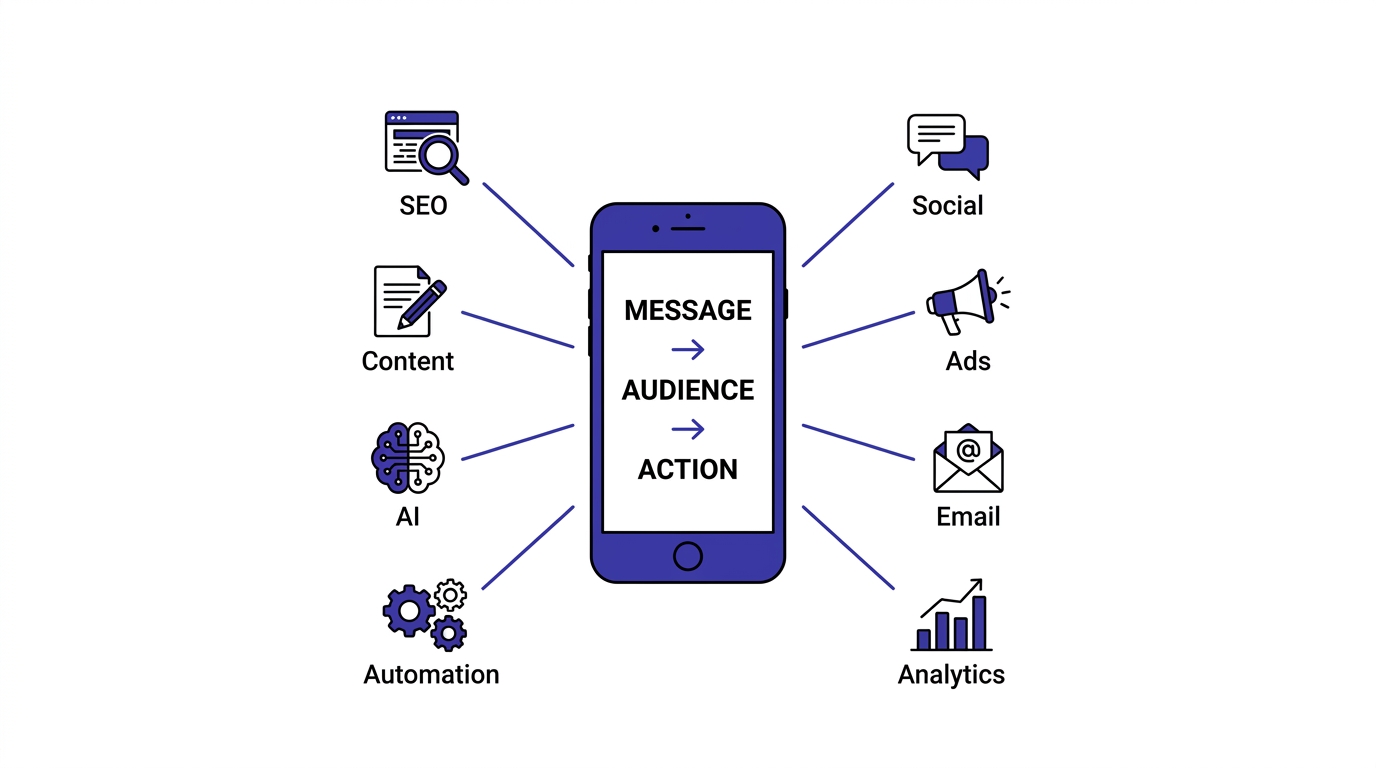
Strip away the buzzwords and digital marketing is just this: getting the right message in front of the right person on the internet, and then getting them to do something about it. That’s it. Everything else, every tool, every platform, every three-letter acronym you’ll come across, is just a method for doing that one thing better.
Here’s where most beginners get confused. They think “digital marketing” is one job, like “accountant” or “electrician.” It’s not. It’s more like “engineering.” Nobody just says “I’m an engineer” and leaves it there. You’re civil, or mechanical, or software, or electrical, and each of those is basically a different career with different daily work, different tools, and different people you work with. Digital marketing works the same way. Someone doing SEO all day and someone running Meta ad campaigns all day are both “digital marketers” on paper, but their actual jobs barely overlap.
Traditional marketing used to mean billboards, newspaper ads, TV spots, and cold calls. That world hasn’t disappeared, but it’s shrunk fast, especially in India. Digital ad spending crossed television spending for the first time recently, now claiming the bigger share of total ad budgets in the country. Part of that is cheap mobile data changing the game over the last several years, part of it is UPI making online transactions frictionless, and part of it is that smaller towns and cities are now online in a way they simply weren’t a decade ago. Businesses go where the eyeballs are, and the eyeballs moved to phones.
This roadmap is going to walk through the core disciplines that make up the digital marketing field, one by one: search engine optimization (SEO), content marketing, social media, paid advertising, email marketing, analytics, marketing automation, and where AI tools fit into all of it now. Don’t worry about memorizing that list. By the end of this guide you’ll understand each one well enough to know which one you actually want to go deep into.
Worth remembering: Digital marketing isn’t a single job title. It’s a career family, like engineering. Pick a lane eventually. Trying to master all of them at once is how people burn out in month two.
Why You Need a Digital Marketing Career Roadmap in India Right Now
Let’s talk numbers, because vague optimism doesn’t help anyone make a career decision.
India’s digital advertising market grew close to 29% in a single financial year recently, and the broader digital marketing industry is projected to keep growing at somewhere between 20% and 30% annually over the next several years. That’s not a slow, steady climb. That’s an industry expanding faster than almost anything else in the Indian economy right now. Government pushes like Digital India, cheaper public Wi-Fi, and 5G rollout are dragging smaller markets online at a pace nobody predicted five years ago. India now has somewhere north of 900 million internet users, and a huge chunk of that growth is happening well beyond the usual big-city bubble.
Why does that matter for someone deciding on a career? Because growing industries hire. Constantly. And unlike a lot of “hot” careers, digital marketing doesn’t gatekeep you at the door with a mandatory degree. Nobody’s checking if you have a B.Tech or an MBA before letting you run a Google Ads campaign. What they’re checking is whether you can actually do the work. That’s rare in India’s job market, and it’s the single biggest reason this field is worth taking seriously if you don’t come from a background that opens doors automatically.
There’s also the flexibility angle, which matters more than people give it credit for. Someone can work for a company or client based anywhere without ever relocating. A freelancer can juggle three different D2C brand clients at once from a laptop. Try doing that in most traditional careers. And it’s not just tech companies hiring digital marketers anymore. Real estate builders need lead generation. Hospitals need local SEO. Solar energy companies need brand awareness campaigns. Education institutes need enrollment funnels. Every single industry that wants customers needs someone who understands how to reach them online, which means the demand isn’t tied to one sector’s ups and downs.
Now, the honest part, because this guide isn’t here to oversell you. The entry-level layer of this field, the “I can post on Instagram and write basic captions” layer, is genuinely crowded. Every college has students who took a three-month course and now call themselves digital marketers. That layer pays poorly and gets more competitive every year. The way out of that crowd isn’t hustling harder at the same generic skills. It’s specializing, which is exactly what the rest of this roadmap is built around.
Career Paths Inside Digital Marketing
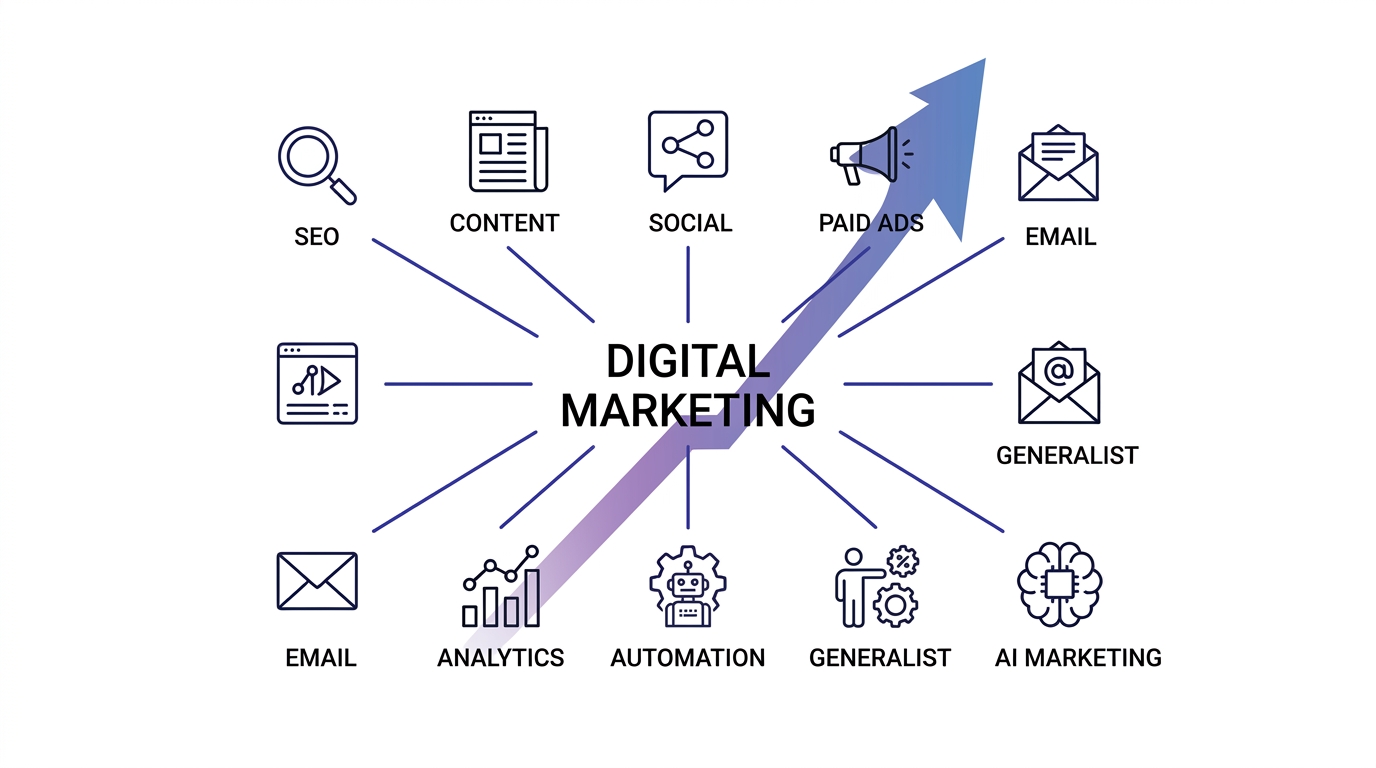
This is the section most roadmaps rush through with a bullet list and move on. That’s a mistake, because picking the wrong lane early costs you months, sometimes years. So let’s actually walk through what each path looks like day to day, not just what it’s called.
SEO Specialist. The job here is getting a website to show up when people search for something on Google. Sounds simple. It’s not. You’re dealing with keyword research, on-page optimization, technical site health, backlink building, and increasingly, how to get cited by AI answer engines, not just ranked in blue links. This role rewards patience. Results take months to show, not days, and if you need instant feedback loops to stay motivated, this might frustrate you. But if you enjoy puzzle-solving and don’t mind playing a long game, SEO specialists who get genuinely good at technical SEO are hard to find and well compensated for it. Career ceiling: SEO Executive to SEO Manager to Head of Organic Growth.
Content Marketer / Strategist. This is the writing and storytelling side. Blog posts, video scripts, case studies, whitepapers, whatever format the brand needs to build trust before someone buys. Good content marketers understand that nobody wants to read an ad, so the job is figuring out what people actually want to read or watch, and threading the brand’s message through that naturally. If you’re a strong writer or communicator who also likes strategy, not just execution, this path has real depth to it. Ceiling: Content Writer to Content Strategist to Head of Content or Brand.
Social Media Manager. Platform-native thinking is the whole game here. What works on Instagram Reels doesn’t work on LinkedIn. What gets engagement on X won’t land the same way on a WhatsApp broadcast. This role moves fast, trends shift weekly, and you need a genuine pulse on internet culture, not just scheduling posts on a calendar. It’s a great entry point because the barrier to starting is low, but the ceiling for someone who actually understands platform algorithms and community building is much higher than people assume. Ceiling: Social Media Executive to Social Media Manager to Head of Social/Community.
Performance Marketer / Paid Ads Specialist. This is where the money moves fastest, literally. You’re managing ad budgets on Meta, Google, and increasingly programmatic platforms, and you’re judged almost entirely on numbers: cost per acquisition, return on ad spend, conversion rate. There’s no hiding behind “creative vision” here. Either the campaign made money or it didn’t. This role suits people who are comfortable with risk, enjoy testing and iterating fast, and don’t take a failed campaign personally. It also tends to pay the best of any specialization in the field right now, because the impact on revenue is direct and measurable. Ceiling: Performance Marketing Executive to Performance Marketing Manager to Head of Growth.
Email Marketing Specialist. Underrated, honestly. Email still converts better than almost any other channel when it’s done right, and most companies do it badly. This role blends copywriting with automation logic, building funnels that nurture a lead from “just browsing” to “ready to buy” without a human manually sending each message. Detail-oriented people who like systems thinking tend to do well here. Ceiling: Email Marketing Executive to Lifecycle Marketing Manager.
Marketing Analyst / Data Specialist. Someone has to make sense of all the numbers everyone else is generating. This role lives inside GA4, spreadsheets, and dashboards, figuring out what’s actually working and what’s just noise. If you like Excel more than you like Canva, this is probably your lane. It’s also one of the most future-proof paths in the field, because data literacy only gets more valuable as more decisions get automated. Ceiling: Marketing Analyst to Senior Analyst to Head of Marketing Analytics.
Marketing Automation Specialist. The technical backbone role. Setting up the workflows, triggers, and integrations that let a business run email sequences, lead scoring, and CRM syncing without someone manually pushing buttons every day. This one requires the most technical comfort of the group, tools like HubSpot, Zapier, or custom API work show up here regularly. Harder to break into as a total beginner, but extremely sticky once you’re in, because businesses hate ripping out automation systems once they’re built.
Digital Marketing Generalist. Most people’s first actual job. Agencies especially love hiring generalists because client work is unpredictable, one week you’re writing captions, the next you’re setting up a Google Ads campaign. This role is genuinely great for the first six to twelve months of a career because it shows you the whole field before you specialize. The mistake is staying a generalist too long. Generalist salaries plateau fast, usually somewhere in the ₹6 to ₹7 lakh per annum range, while specialists keep climbing well past that.
Emerging: AI-Augmented Marketer / Growth Marketer. This one didn’t really exist as a distinct role a couple years ago. It’s showing up now in job descriptions that combine traditional marketing skill with comfort using AI tools for content generation, campaign optimization, and increasingly, basic coding or prompt-engineering for marketing workflows. Companies paying premium salaries in 2026 are specifically looking for people who pair a core specialization, usually SEO or performance marketing, with fluency in AI-assisted workflows.
Career Paths at a Glance
| Path | Core Skill | Best For | Entry Difficulty |
|---|---|---|---|
| SEO Specialist | Search & content strategy | Patient, analytical thinkers | Medium |
| Content Marketer | Writing & storytelling | Strong writers/communicators | Low |
| Social Media Manager | Trend awareness, design sense | Creative, fast-paced learners | Low |
| Performance Marketer | Numbers, budgets, testing | Data-driven, comfortable with risk | Medium-High |
| Email Marketing Specialist | Copywriting + automation | Detail-oriented | Medium |
| Marketing Analyst | Data interpretation | Excel/analytics-minded | Medium-High |
| Automation Specialist | Tools + workflows | Technical, systems thinkers | High |
Worth remembering: If you genuinely don’t know which path fits, don’t overthink it. Spend six months as a generalist first. You’ll naturally start gravitating toward whichever discipline you keep wanting to go deeper into, and that’s your answer.
Core Skills Every Digital Marketer Needs Before Specializing
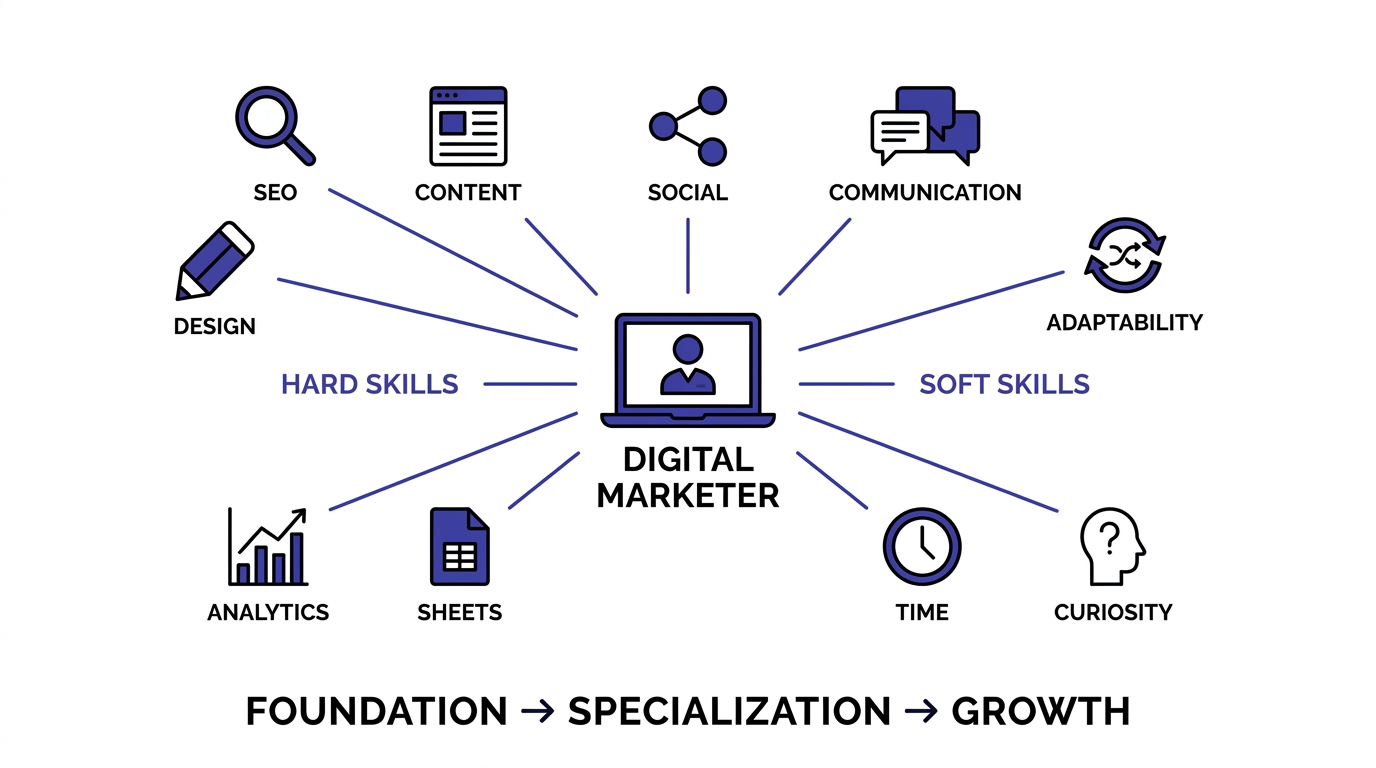
Before picking a lane, everyone needs a baseline. This is the part beginners either skip entirely, which hurts them later, or get stuck on forever, trying to master every single foundational skill before moving forward. Neither approach works. The goal here is functional literacy across the basics, not mastery.
Foundational hard skills that every path builds on:
- Basic SEO literacy, understanding how search engines rank content, even if you never become an SEO specialist
- Content writing fundamentals, clear, direct writing that doesn’t sound like a corporate brochure
- Social media platform fluency, knowing how each major platform actually behaves, not just having accounts on all of them
- Basic design sense, Canva-level competence, not professional graphic design
- Analytics reading, being able to open GA4 and understand what the numbers are telling you
- Spreadsheet proficiency, Excel or Google Sheets, because every specialization eventually involves organizing data
None of these need to be expert-level on day one. What they need to be is functional. A performance marketer who can’t write a basic ad headline is going to struggle, even though copywriting isn’t their main job. An SEO specialist who can’t read a spreadsheet of keyword data is stuck before they start.
The soft skills matter just as much, arguably more, and they get talked about far less:
- Client and stakeholder communication, being able to explain why a campaign is or isn’t working, in plain language, to someone who isn’t a marketer
- Adaptability, this field’s tools and platform algorithms change every few months, and people who get attached to “the way things worked before” fall behind fast
- Basic project and time management, juggling multiple deliverables without everything slipping
- Curiosity and a self-learning habit, genuinely the most important trait on this list, because nobody’s roadmap, including this one, will stay accurate forever
Worth remembering: Recruiters in this field care less about how many certificates you have and more about whether you can explain why a campaign worked, not just report that it did. That distinction separates people who get promoted from people who stay stuck executing instructions.
The Beginner Phase: Months 0 to 6
Every phase in this roadmap follows the same structure, so you can compare where you are against where you should be. The beginner phase has one job: build foundational literacy across every discipline before locking into a specialization. Resist the urge to specialize too early here. You genuinely can’t know if you’ll enjoy performance marketing until you’ve at least tried setting up a small ad campaign yourself.
What to actually learn in this window: SEO basics, content writing fundamentals, social media fundamentals, basic design using Canva, GA4 setup and navigation, and enough WordPress knowledge to publish and edit a basic website. That’s a full plate for six months, and that’s intentional. This is the widest part of the funnel.
Resources at this stage should mostly be free or very low-cost. Google’s own free training programs cover Ads and Analytics fundamentals solidly. YouTube has genuinely excellent channels teaching SEO, content strategy, and paid ads basics, often better than paid courses, if you’re willing to sift through and find the good ones. Structured, project-based programs help here too, especially if self-directed learning isn’t your style, since they force you through the fundamentals in order instead of letting you skip around.
Here’s the part most beginners skip: practice projects with zero budget. Start a niche Instagram page about something you actually care about, cooking, fitness, local events, whatever, and treat it like a real brand. Start a personal blog and practice writing and basic SEO on it. Reach out to a local shop or small business near you and offer to manage their social media for free, purely for the experience and the portfolio piece. None of this needs to be impressive yet. It needs to exist.
A realistic time commitment here is two to three hours a day if you’re doing this alongside college or a job. Less than that and six months turns into a year. More than that and you risk burning out before you’ve even specialized.
Month-by-Month Beginner Checklist
| Month | Focus | Milestone |
|---|---|---|
| 1 | Fundamentals of SEO + content | Publish 2 practice blog posts |
| 2 | Social media + Canva design | Run a personal/niche Instagram page |
| 3 | GA4 + website basics | Set up analytics on a test site |
| 4 | Email marketing basics | Build a simple newsletter funnel |
| 5 | Intro to paid ads | Run a small test campaign (own budget or simulator) |
| 6 | Portfolio building | Package 3-4 projects into a portfolio |
By the end of month six, you should be able to explain, in your own words, what each core discipline involves, have at least three or four small projects to show for it, and have a rough sense of which direction you want to specialize in next. If you’re still completely unsure at this point, that’s fine too. Some people need the intermediate phase’s real client exposure before it clicks.
The Intermediate Phase: Months 6 to 18
This is where the roadmap splits based on what you chose. The goal of this phase is twofold: go genuinely deep into your chosen specialization, and start earning, whether that’s through freelance gigs, an internship, or a first full-time role.
If SEO is the path, months 6 to 18 mean getting properly comfortable with keyword research tools, understanding the difference between on-page, off-page, and technical SEO, and learning how topic clusters and content pillars work together to build authority for a site over time. If performance marketing is the path, this is when Meta Ads Manager and Google Ads stop being intimidating interfaces and start being tools you can actually run a real budget through, alongside learning how to read and act on the metrics that matter, not just watch impressions climb.
Whatever specialization gets chosen, nobody works in a vacuum. An SEO specialist still needs enough content sense to know if a piece of writing will actually rank. A performance marketer still needs basic design literacy to know if an ad creative will convert. This cross-skill layer doesn’t need deep expertise, but it needs to exist, because pure tunnel vision on one skill makes you harder to work with and slower to catch obvious problems outside your lane.
This is also usually the point where paying for tools starts making sense, not because free tools stop working, but because the paid versions unlock depth that actually changes outcomes. SEO tools for competitive keyword research, proper design software beyond Canva’s free tier, scheduling tools that handle multiple client accounts, and ad platforms themselves, which aren’t free but are where the real budget management experience comes from.
The bigger shift in this phase is building actual client or portfolio work that has stakes attached. Cold outreach to small local businesses works better than people expect, especially in smaller markets where a lot of businesses still have zero digital presence and would genuinely benefit from even basic help. Structured project-based learning programs, if available, force this kind of real-world application faster than self-teaching alone. Freelance platforms are another entry point, though the competition there is steep and rates start low.
Landing that first real job or first paying client at this stage comes down to a narrower set of things than beginners expect. Recruiters and clients at this level aren’t looking for someone who knows everything. They’re looking for someone who can independently own a small, defined piece of work and show a result, even a modest one, rather than someone who just executed instructions handed to them line by line.
Worth remembering: Treat your first three to five clients as portfolio-building, not income-building. Charge fairly, don’t work for free out of desperation, but prioritize getting a genuine case study out of each project over squeezing maximum income from it. The case study is what gets you the next, better-paying client.
The Advanced Phase: 18+ Months and Beyond
Somewhere past the eighteen-month mark, the job starts changing shape. Up to this point, most of the work has been execution: run this campaign, write this content, optimize this page. The expert phase is about moving from execution to strategy, from being handed tasks to owning outcomes.
What “expert” actually looks like in practice: owning full campaign strategy instead of just running the parts someone else designed, thinking across channels instead of just your one specialization, forecasting and managing real budgets, and often, managing people or client relationships directly. This is a genuinely different skill set than the one that got someone to this point, and it trips up a lot of talented specialists who assumed strong execution alone would carry them upward indefinitely. It doesn’t. At some point, strategic thinking and people skills matter as much as channel expertise.
From here, the path usually forks. One direction leads toward leadership inside a company or agency: Team Lead, then Manager, then eventually Head of Marketing or CMO territory. The other leads toward independence: Agency Owner or Freelance Consultant, where instead of climbing a ladder inside someone else’s structure, you’re building your own client base and calling your own strategic shots.
The advanced skill set at this stage typically includes marketing automation at a strategic level (not just executing workflows someone else designed, but architecting them), conversion rate optimization, which is a discipline in its own right, advanced analytics and attribution modeling to understand which channels actually deserve credit for a sale, and increasingly, using AI tools to optimize campaigns faster than manual iteration ever allowed.
There’s also a part of reaching expert level that feels almost unrelated to the actual marketing work but ends up mattering a lot: building a personal brand. A strong LinkedIn presence, writing about your own work and thinking publicly, occasionally speaking at events or on podcasts, all of it. This isn’t vanity. At the expert level, a lot of the best opportunities don’t come from applying to job postings. They come from someone seeing your work publicly and reaching out first.
And the learning never actually stops, even once “expert” is reached. What separates people who stay relevant from people who plateau at this stage isn’t more certificates. It’s staying plugged into industry newsletters and communities, and being willing to test new platforms and tools early, before they’re proven, instead of waiting until everyone else has already figured them out.
Tools You’ll Actually Use at Each Stage of the Roadmap
Naming specific tools in a guide like this is a little risky, because the exact apps in fashion today will probably shift in a year or two. What doesn’t shift as fast is the category of tool each discipline needs. So here’s the breakdown organized by function, with beginner-friendly and advanced-tier options for each.
Tools by Category and Career Stage
| Category | Beginner Tools | Advanced Tools |
|---|---|---|
| SEO | Google Search Console, Ubersuggest | Ahrefs/SEMrush, Screaming Frog |
| Design | Canva | Figma, Adobe Suite |
| Analytics | GA4 (free) | GA4 + Looker Studio, GTM |
| Social Scheduling | Meta Business Suite | Buffer, Hootsuite |
| Mailchimp free tier | Klaviyo, HubSpot | |
| Paid Ads | Meta Ads Manager, Google Ads | Advanced bid strategy dashboards |
| Automation/AI | ChatGPT/Claude, Canva AI | Zapier, custom GPT workflows |
A quick word on the AI row specifically, because it’s the newest and most misunderstood category. AI tools have gone from a novelty to table stakes in this field faster than almost anything else. Nobody’s getting hired in 2026 purely because they know how to prompt ChatGPT. What’s actually valuable is knowing how to use AI to speed up the boring parts of the job, first drafts, data summarization, basic creative variations, so more time goes toward strategy and judgment, the parts AI still can’t do well. Treat AI tools as a category to get fluent in early, not a specialization on their own.
Certifications Worth Getting (and Ones That Aren’t Worth Your Time)
This section is going to be more opinionated than the rest, because most certification guides just list every credential that exists without telling you which ones actually move the needle. That’s not useful. Here’s the honest breakdown.
High-value, get these regardless of specialization: Google’s Skillshop certifications, covering Google Ads and Analytics, are free, widely recognized, and genuinely respected by employers and clients across India. HubSpot Academy’s certifications, also free, cover inbound marketing, content marketing, and email marketing thoroughly enough that even people who never touch HubSpot’s actual software get value from the coursework itself. There’s no real argument against earning both. They cost nothing but time.
Situational, worth it only once you’ve specialized: Meta Blueprint certification covers Facebook and Instagram advertising specifically, and unlike Google and HubSpot’s offerings, it isn’t free, exams typically run somewhere between $99 and $150 each, and the credential needs annual renewal. If performance marketing on Meta platforms is genuinely your specialization, it’s a solid, respected credential worth the cost. If you’re still a generalist figuring things out, skip it for now and revisit once you’ve committed to a lane. The same logic applies to platform-specific certifications generally, LinkedIn Marketing Labs, Semrush Academy’s SEO toolkit, and similar, they’re worth pursuing once you know which discipline you’re doubling down on, not before.
Here’s the thing certification guides rarely say out loud: at the mid-to-senior level, certifications matter far less than documented results. Nobody’s hiring a Performance Marketing Manager purely because they have a Meta Blueprint badge. They’re hiring based on traffic growth percentages, ROAS improvements, and cost-per-acquisition reductions the candidate can actually point to and explain. Certificates open early doors. Results keep them open.
That’s also exactly where structured, project-based learning earns its place over passive certificate collecting. A course that has you actually run a campaign, write real content, or optimize an actual GA4 setup, the kind of hands-on structure programs like ADM Education are built around, builds the portfolio and the story behind the results, not just another badge sitting unused on a LinkedIn profile.
Salary Expectations in India by Experience Level
Most roadmap content either avoids salary numbers entirely or throws out one vague range and calls it done. That’s not helpful for someone actually trying to plan a career. So here’s a grounded breakdown, based on how the market actually looks in India right now.
At the fresher stage, zero to one year of experience, a Digital Marketing Executive role typically pays somewhere between ₹2.5 and ₹3.6 lakh per annum, which works out to roughly ₹20,000 to ₹30,000 a month. Bigger cities and roles that involve live campaign management or performance marketing specifically tend to land at the higher end of that range, sometimes pushing toward ₹4 to ₹5.5 lakh per annum at agencies and startups actively competing for talent.
Move into the one to three, and three to five year experience band, and the range widens considerably, mostly because pay starts tracking skill depth and ownership rather than just years served. The average mid-level digital marketing salary sits somewhere around ₹6.5 to ₹9 lakh per annum, but two people with the identical job title, Digital Marketing Manager, can genuinely be sitting at ₹6 lakh and ₹18 lakh respectively. The difference almost always comes down to whether someone owns revenue outcomes directly, or just manages channel-level metrics without connecting them to business results.
At senior and leadership levels, five-plus years in, the numbers climb further, generally somewhere in the ₹12 to ₹28 lakh per annum range depending on specialization, company type, and city. Performance marketing consistently pays the highest ceiling among specializations right now, with Performance Marketing Managers averaging somewhere around ₹12.65 lakh per annum and top earners at the 90th percentile reaching close to ₹24.5 lakh.
City size matters, but maybe not in the way people assume. Larger cities generally lead across performance marketing, growth, and analytics-heavy roles, partly because of startup density creating a wider range of high-paying opportunities. Some cities lean more toward brand marketing, advertising, and BFSI-adjacent roles. But smaller markets aren’t locked out of strong income, especially through remote work and freelancing, where geography stops being the ceiling on what someone can earn. A freelancer working with clients across India or internationally can genuinely out-earn someone stuck in a low-paying in-house role at a large company, regardless of where they’re based.
Approximate Salary Ranges by Experience Level (India)
| Experience Level | Typical Range (Annual) | Location Premium | Freelance/Remote Potential |
|---|---|---|---|
| Fresher (0-1 yr) | ₹2.5-3.6 LPA | Up to ₹5.5 LPA at agencies/startups | ₹5,000-20,000/project |
| Intermediate (1-3 yrs) | ₹6-9 LPA | 15-30% above base in larger cities | ₹20,000-60,000/month |
| Specialist (3-5 yrs) | ₹9-15 LPA | Higher in startup hubs | ₹60,000-1,50,000/month |
| Manager/Expert (5+ yrs) | ₹12-28 LPA | Performance marketing tops the range | Highly variable, no real ceiling |
These numbers move around depending on which report or platform you’re pulling from, and they’ll keep shifting as the market grows. Treat them as a realistic planning range, not a guarantee, and always check current data before making a major decision based on a specific figure.
Freelance vs Agency vs In-House vs Startup: Where Should You Work?
This decision gets treated like a personality quiz online, but it’s really about what kind of learning environment and pace suits you at each stage of your career, and that answer often changes over time.
Agency work is usually the fastest way to build genuine breadth. You’re touching multiple clients across different industries, which means exposure to more problems, more strategies, and more failure-and-recovery cycles than almost any other environment offers this early. The tradeoff is intensity. Agency hours can be demanding, deadlines stack up, and client demands don’t always respect your learning curve. But for someone genuinely early in their career, the sheer variety of experience gained here is hard to replicate anywhere else.
In-house, brand-side work flips that tradeoff. You go deep on one business instead of wide across many. You understand a single brand’s audience, voice, and goals intimately, and you get to see the long-term results of strategies you helped build, something agency work rarely allows since clients come and go. It’s generally more stable and less chaotic than agency life, but the skill breadth grows slower, since you’re not constantly exposed to different industries and problems.
Startups are their own category entirely. High ownership, high chaos, and often, wearing far more hats than your actual job title suggests. A “social media manager” at an early-stage startup might end up touching email marketing, basic paid ads, and even customer support messaging, simply because there’s no one else to do it. This suits people who genuinely enjoy ambiguity and don’t need a rigid structure to feel productive. It doesn’t suit people who want clear boundaries around their role early in a career.
Freelance and consulting work looks like freedom from the outside, and eventually it can be, but it’s really running a small business, not just doing marketing work independently. Beyond the actual marketing skill, freelancing demands sales ability to land clients, basic financial literacy to manage invoicing and irregular income, and enough client management skill to handle expectations without a company’s brand or HR structure backing you up. This is not where most people should start. It’s where people should graduate to, once the craft itself is solid.
Worth remembering: Freelancing looks like freedom from the outside, but it’s really running a small business. Learn the craft inside a team first. Freelance once you actually know what you’re doing, not before.
How to Build a Digital Marketing Portfolio With Zero Experience
This is the part where most beginners freeze up, because the classic career trap shows up immediately: every job wants experience, but nobody gives you experience without a job. Digital marketing has a genuine workaround for this, and it’s the single most practical section in this entire guide.
Personal projects count as real portfolio pieces, more than people give them credit for. A blog you’ve written and optimized for search, a niche Instagram page you’ve grown from zero, a small YouTube channel, any of these demonstrate real, applicable skill, even without a client’s name attached to them. Treat them seriously. Track the metrics. Document what worked and what didn’t.
Volunteer or trade work is another legitimate route into a portfolio. Reach out to local businesses, NGOs, or family-run shops and offer to manage their social media or run a small SEO cleanup for free, purely in exchange for the experience and the resulting case study. Most small business owners genuinely have no digital presence and would welcome the help. This isn’t exploitation if it’s framed correctly and kept time-bound. It’s a fair trade, your early-stage skill for their willingness to be a test case.
Simulated campaigns fill gaps that real client work can’t always cover yet. Google’s certification programs include practice ad accounts where you can genuinely run mock campaigns and analyze results without spending real money. Building out a mock case study, “here’s how I would approach this brand’s SEO strategy,” complete with keyword research and a content plan, shows strategic thinking even without an actual client attached.
Presenting a thin portfolio confidently is its own skill. When results aren’t there yet because the work is genuinely new, lean on process over outcome. Explain the thinking behind a decision, what was tested, what was learned, rather than pretending a small personal project generated business-changing results it didn’t. Recruiters and clients can tell the difference between genuine reflection and inflated claims, and the former builds far more trust.
Where to actually host all of this matters less than people stress over. A simple personal website, a well-organized Notion page, or even the featured section of a LinkedIn profile all work fine. The content matters far more than the platform it’s hosted on.
Common Mistakes Beginners Make (and How to Avoid Them)
Some of these mistakes show up so consistently across beginners that they’re worth calling out directly, not just implying through the rest of this guide.
Trying to learn every discipline at once, instead of building the foundation first and then specializing, is probably the single most common trap. It feels productive because there’s constant activity, watching videos, bookmarking articles, starting five different “courses,” but it rarely converts into actual, demonstrable skill in anything.
Chasing certificates instead of building proof of work comes a close second. A LinkedIn profile with twelve certification badges and zero actual projects tells a hiring manager almost nothing useful. A profile with two solid case studies, even small ones, tells them everything they need to know.
Ignoring analytics and data literacy because it feels too technical is a mistake that catches up with people later, usually right around the point they’re trying to move from executor to strategist and realize they can’t actually read the numbers well enough to make a real recommendation.
Undercharging as a freelancer, often out of a mix of low confidence and genuine financial pressure, leads straight to burnout. Taking on too much work at rates that don’t sustain the effort involved isn’t hustle, it’s a fast track to resentment toward work that should otherwise be enjoyable.
Not adapting to platform and algorithm changes is a quieter mistake, but a real one. Treating whatever worked in 2023 as a permanent playbook, instead of a snapshot of a moment that’s already passed, is how people plateau in a field that fundamentally never stops moving.
And finally, comparing your own timeline to someone else’s instead of tracking your actual progress. Someone else landing a ₹10 lakh package eighteen months into their career says nothing about whether your own eighteen-month mark is on track. Different starting points, different specializations, different market conditions. Track your own trajectory against your own starting line.
How to Actually Get Hired in Digital Marketing
Knowing the field and getting hired in it are two different skills, and this guide would be incomplete without addressing the second one directly.
Most digital marketing roles in India get posted on LinkedIn, Naukri, and directly on agency career pages, but a genuinely large share of hiring, especially at the entry and mid level, happens through referrals and direct outreach rather than formal applications sitting in a stack of two hundred resumes. Building even a small network inside the field, through LinkedIn engagement, local meetups, or course communities, pays off disproportionately compared to the effort involved.
Tailoring a resume or portfolio for this field specifically means leading with metrics, not tasks. “Increased organic traffic by 40% over four months” says infinitely more than “wrote blog content and managed SEO.” Recruiters in this field are scanning for evidence of impact, not a list of responsibilities that sound identical across a hundred other resumes.
Cold outreach genuinely works for landing that first internship or role, more than most people expect. A short, specific message to a hiring manager or agency founder, referencing something specific about their actual work rather than a generic “I’d love to work with you,” gets responses far more often than blind applications through a portal.
Interview prep looks different at each level. Fresher interviews tend to test foundational understanding and genuine curiosity, whether the candidate actually understands why something works, not just that it does. Specialist-level interviews get more technical, expect to walk through a real campaign or project in detail. Manager-level interviews shift toward strategic thinking and how a candidate has handled ambiguity, conflicting priorities, or a campaign that genuinely failed.
LinkedIn deserves a specific mention here, because most people treat it as a static resume instead of an active tool. Posting about actual work, sharing genuine opinions on industry shifts, and engaging with other people’s content consistently does more for visibility in this field than a polished but silent profile ever will.
Staying Relevant: Why This Field Never Stops Changing
Here’s the part that’s worth being upfront about: this field genuinely has no finish line. That’s not meant as a scare tactic, it’s just the honest shape of the work. Someone who was an “expert” in digital marketing in 2018 and stopped actively learning since would be genuinely behind today, not because they got worse at the job, but because the job itself changed underneath them.
Algorithm updates, platform changes, and now AI-driven shifts in how search and content discovery work are constant, not occasional. Search engine optimization itself is evolving into something closer to answer engine optimization, where the goal isn’t just ranking in blue links anymore but getting cited directly inside AI-generated answers. That’s a genuinely new skill layer that didn’t exist in this form a couple years ago, and it won’t be the last one.
Staying current doesn’t require chasing every trend the moment it appears. It means having a few reliable inputs, industry newsletters, practitioner communities, a handful of people worth following who actually do the work rather than just talk about it, and revisiting fundamentals periodically, because platforms evolve but the underlying principles of good marketing, understanding an audience, communicating clearly, testing instead of assuming, tend to hold up longer than any specific tool or tactic.
Conclusion
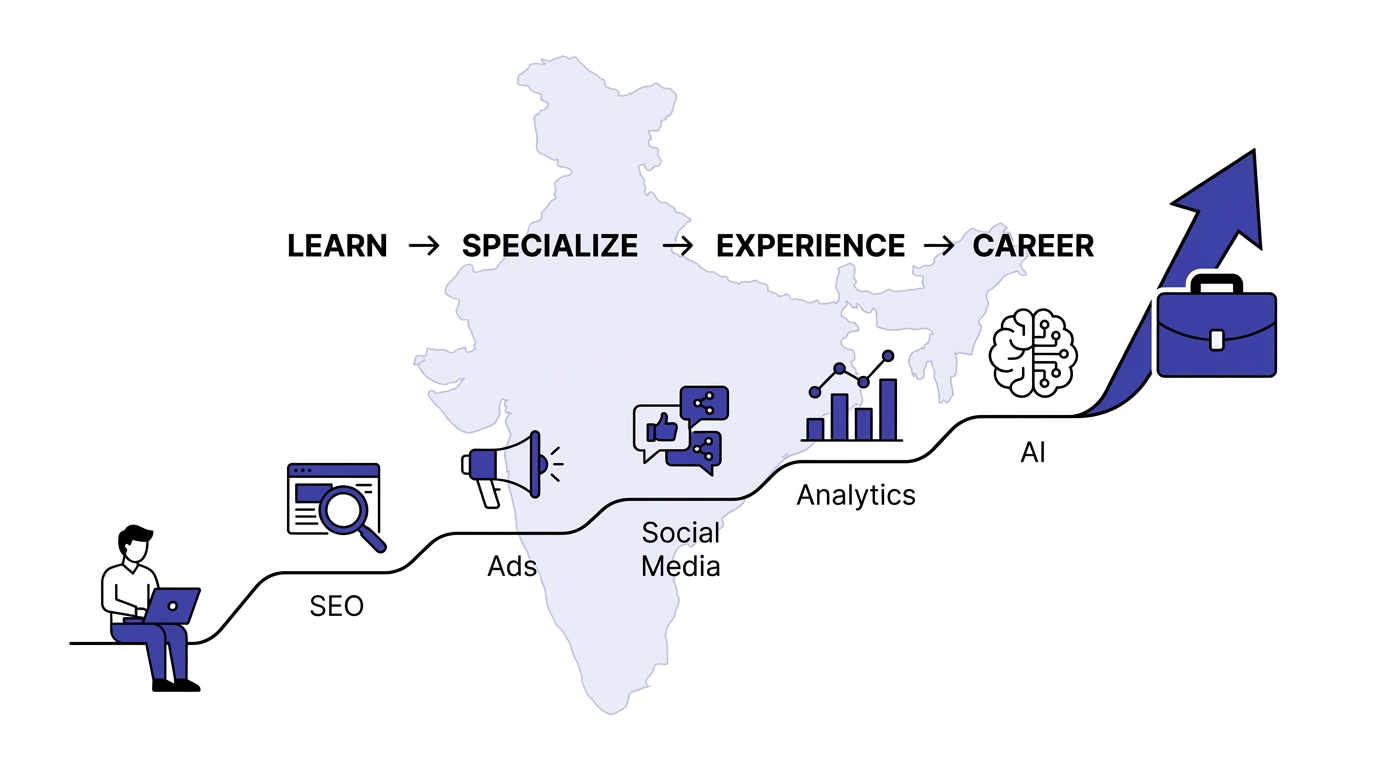
Strip away all the tools, platforms, and acronyms, and this digital marketing career roadmap really comes down to three stages: build a broad foundation, pick a lane and go deep, then shift from executing tasks to owning strategy. Nobody walks this path in a perfectly straight line. People switch specializations mid-way, take longer in one phase than another, or discover their real strength somewhere they didn’t expect. That’s normal, not a sign of doing it wrong.
What matters more than following this guide exactly is starting somewhere concrete instead of staying stuck in research mode indefinitely. If a structured, project-based path sounds like it would actually get you moving faster than piecing things together alone, ADM Education’s courses are built around exactly the hands-on, portfolio-first approach this entire roadmap points toward. But whether that’s the route or not, the real first move is smaller than it feels. Pick one tool from the tools table above, the one tied to the specialization that interests you most, and go set it up today. Not next week. Today.
Frequently Asked Questions
Is digital marketing a good career choice in India right now?
Yes, and the numbers back it up. India’s digital advertising industry is growing at somewhere between 20% and 30% annually, and digital ad spend has already overtaken television as the largest chunk of total ad budgets in the country. Businesses across every industry, not just tech, need people who understand how to reach customers online, which means demand isn’t tied to one sector’s ups and downs.
Do I need a degree to start a digital marketing career?
No formal degree is required. This is one of the few fields in India where a strong portfolio and demonstrable skill genuinely matter more than a specific educational background. That said, foundational learning still matters. Skipping structured learning entirely and hoping raw hustle covers the gap usually backfires.
How long does the full digital marketing career roadmap actually take?
Roughly six months to build foundational literacy, another twelve months to specialize and start earning, and eighteen months onward to move from execution into strategy and leadership. That’s the realistic version, not the “get a job in 30 days” version some short courses promise.
Which digital marketing skill is the most in-demand right now?
Performance marketing, meaning paid ads on platforms like Meta and Google, currently commands the highest salaries and the steepest demand, because the impact on revenue is direct and measurable. SEO and analytics skills are close behind, especially as AI-driven search changes how content gets discovered.
Can I learn digital marketing for free?
Largely, yes. Google’s Skillshop certifications and HubSpot Academy’s courses are free and genuinely respected by employers. YouTube has strong free content on SEO, content strategy, and paid ads fundamentals. Paid, structured programs speed things up and add real project work, but they aren’t the only path in.
Should I start freelancing or take a job first?
Take a job or internship first, ideally at an agency, where the pace and variety of client work builds skill faster than freelancing alone can. Freelancing looks like freedom, but it’s really running a small business, and it works far better once the actual craft is solid.
What is the realistic starting salary for a digital marketing fresher in India?
Most fresher roles pay somewhere between ₹2.5 and ₹3.6 lakh per annum, roughly ₹20,000 to ₹30,000 a month. Roles involving live campaign management or performance marketing can start higher, sometimes reaching ₹4 to ₹5.5 lakh per annum at agencies and startups actively competing for talent.
Is it too late to switch careers into digital marketing?
No. The field doesn’t gatekeep based on age or prior background the way many traditional careers do. What matters is whether someone can demonstrate real skill through a portfolio, and that’s buildable at any stage, whether someone is switching from an unrelated field or restarting after a gap.
Which certifications actually help a digital marketing career?
Google’s Skillshop certifications and HubSpot Academy’s certifications, both free, are worth earning regardless of specialization. Meta Blueprint is valuable but only once performance marketing on Meta platforms is an actual specialization, since it costs money and needs annual renewal. Beyond the early stage, documented results matter far more than certificate count.
How do I build a portfolio if I’ve never worked with a real client?
Personal projects count. A blog, a niche social media page, a small newsletter, all of these demonstrate real skill if treated seriously and tracked properly. Volunteer work for local businesses or NGOs in exchange for experience is another legitimate route, along with simulated campaigns through platforms like Google’s own certification programs.
What comes after reaching an expert level in digital marketing?
Two general directions open up. One is leadership inside a company or agency, moving from Manager toward Head of Marketing or CMO. The other is independence, building an agency or a freelance consulting practice. Either way, the shift at this stage is from owning tasks to owning strategy and outcomes.
Does AI replace the need for a digital marketing career roadmap?
No, but it changes what the roadmap needs to include. AI tools have become table stakes for speeding up drafts, data summarization, and basic creative variations. What AI doesn’t replace is strategic judgment, understanding an audience, and knowing which numbers actually matter, which is exactly why the fundamentals in this roadmap still hold.