

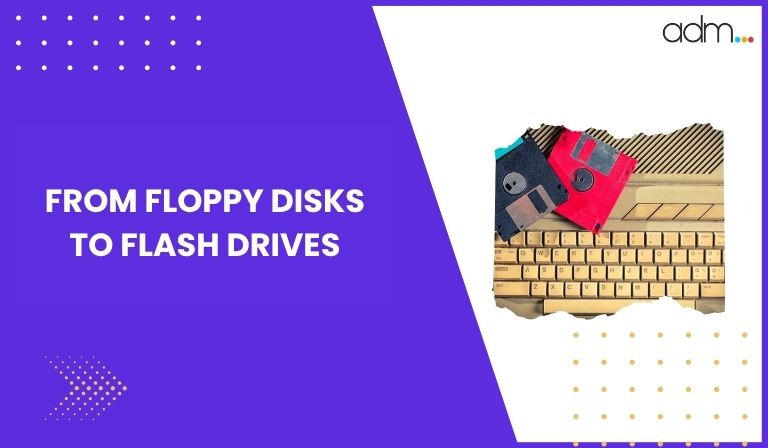
In the early days of personal computing, saving a document wasn’t just a click away—it was a careful, deliberate act. You’d slide a floppy disk into a drive, hear the satisfying whir of the machine, and watch as a few kilobytes of precious data transferred onto a magnetic disk barely larger than your palm. Fast forward a few decades, and now we carry terabytes of data in our pockets or store entire archives in the cloud. The journey from floppy disks to flash drives—and beyond—is a fascinating story of technological innovation, shrinking hardware, and ever-growing capacity.
The evolution of data storage mirrors the story of computing itself: faster, smaller, smarter, and infinitely more connected. What began as a means to preserve small amounts of information has become a foundation of the digital age, shaping how we work, create, and share.
The Birth of Digital Storage
Before computers could store data electronically, information was kept in physical form—on paper, film, or punched cards. Early computing pioneers in the 1940s and 1950s relied on punch cards and magnetic tape to store information.
Punch cards, first popularized by Herman Hollerith for the 1890 U.S. Census, contained data represented by holes punched in specific positions. Each card could store about 80 characters, meaning large programs or datasets required boxes of them. They were reliable but cumbersome—a single misplaced card could throw off an entire program.
Magnetic tape emerged in the 1950s as a more efficient solution. IBM’s early computers, like the IBM 701, used reels of tape to record data magnetically. This innovation allowed for sequential data access and far greater capacity than punch cards. However, tapes were still large and best suited for mainframes, not personal computers.
The Floppy Disk Revolution
In the 1970s, a new form of storage would bring data portability to the masses: the floppy disk. Developed by IBM in 1971, the first floppy disk was a massive 8-inch flexible magnetic disk capable of holding just 80 kilobytes. Despite its limited capacity, it revolutionized data storage by making it easy to transfer files between computers.
Soon, smaller formats followed. The 5.25-inch floppy, introduced later in the decade, became a standard for early personal computers like the Apple II and IBM PC. By the early 1980s, it could hold up to 360 kilobytes—a generous amount at the time.
Then came the 3.5-inch floppy disk, introduced by Sony in 1982. With its rigid plastic case and sliding metal shutter, it offered durability and style. By the mid-1990s, the 1.44 MB floppy had become the universal symbol of data saving—so much so that its image still lives on as the “save” icon in modern software.
Floppy disks were simple, tangible, and even a little romantic in hindsight. They made data feel physical—something you could hold, label, and organize. For many, inserting a floppy into a drive was the first act of computing independence.
Hard Drives: The Age of Magnetic Mastery
While floppies ruled personal computing, hard disk drives (HDDs) quietly evolved into the workhorses of data storage. The first hard drive, IBM’s RAMAC 305 in 1956, was the size of a refrigerator and stored a modest 5 megabytes—about one MP3 song today.
Hard drives used the same magnetic principle as floppy disks but with rigid platters spinning at high speed. Over the decades, engineers found ways to pack more data into smaller spaces. By the 1980s, desktop PCs featured hard drives that could hold tens of megabytes; by the 1990s, gigabytes became the norm.
The hard drive’s combination of speed and capacity made it indispensable. It wasn’t just a storage device—it became the backbone of personal computing. Entire operating systems, games, and multimedia could live on a single drive.
Still, hard drives had limitations: moving parts, fragility, and heat. They were powerful, but they weren’t built for the mobile, high-speed future that was on the horizon.
Optical Storage and the Rise of the CD and DVD
The 1990s introduced another breakthrough: optical storage. Instead of relying on magnetism, optical discs used lasers to read and write data encoded as microscopic pits on the disc surface.
The Compact Disc (CD), originally developed for music, quickly became a favorite medium for software and data. A single CD could hold 650 to 700 megabytes—roughly 450 times more than a floppy disk. For the first time, users could install programs, back up files, and even burn their own discs with ease.
Then came the Digital Versatile Disc (DVD) in the late 1990s, offering 4.7 gigabytes per disc. DVDs revolutionized video storage, software distribution, and even home backups.
Optical media represented an important shift: storage was no longer just about capacity but also convenience and permanence. Discs were portable, durable, and relatively cheap. Stacks of jewel cases filled offices and homes, a visual archive of the digital era’s growth.
The Flash Drive and the USB Revolution
By the early 2000s, a new hero entered the scene: the flash drive. Compact, rugged, and reusable, it rendered floppies and CDs nearly obsolete overnight.
Flash memory—a type of non-volatile storage that retains data without power—had been around since the 1980s, but it wasn’t until the advent of the USB (Universal Serial Bus) standard that it found its perfect partner. The first USB flash drives hit the market around 2000, with capacities starting at 8 MB.
Compared to floppy disks, they were smaller, faster, and infinitely more reliable. No more scratching, snapping, or accidental formatting. By the mid-2000s, USB drives could hold multiple gigabytes, and their prices plummeted as capacity soared.
They became cultural icons in their own right—giveaways at events, secure backup devices, and even status symbols when manufacturers added sleek designs or encryption features.
Memory Cards and the Portable Era
As mobile technology advanced, storage had to shrink even further. Enter the memory card—tiny, high-capacity flash storage designed for digital cameras, smartphones, and tablets.
Formats like CompactFlash, Secure Digital (SD), and microSD cards dominated the early 2000s. Suddenly, photographers and videographers could shoot thousands of images without swapping rolls of film. Gamers could save progress on portable consoles. Data became mobile, and storage adapted to fit into increasingly compact devices.
Even today, SD and microSD cards remain staples of digital storage, though their roles are shifting as cloud technology takes over.
Solid-State Drives: Speed Without Limits
As computing power grew, users demanded faster access to their data. Traditional hard drives, with their spinning disks and moving heads, had physical limitations. The solution came in the form of Solid-State Drives (SSDs)—storage built entirely on flash memory, with no moving parts.
Introduced in the late 2000s, SSDs delivered blistering read/write speeds, quiet operation, and improved reliability. Though initially expensive, they quickly became the new standard in laptops and high-performance desktops.
Today, SSDs are everywhere, from ultrathin laptops to gaming consoles. They’ve made boot times nearly instant and data access seamless. The mechanical clatter of old hard drives has been replaced by silent efficiency.
The Cloud and the Age of Invisible Storage
The latest stage of data storage evolution isn’t physical at all—it’s virtual. The rise of cloud computing has changed the way we think about storage entirely.
Rather than relying on local drives, users now upload data to remote servers managed by tech giants and accessed through the internet. This shift has made data more flexible and accessible from anywhere in the world. Files sync automatically across devices, collaboration happens in real time, and physical limitations feel almost irrelevant.
Yet, cloud storage isn’t the end of the story—it’s a new chapter. Behind the scenes, massive data centers with rows of SSDs and spinning drives still make it all possible. The infrastructure may be invisible, but the principles remain the same: store, access, and protect information efficiently.
From Megabytes to Terabytes—and Beyond
To put this evolution into perspective:
- In 1980, the average floppy held 1.44 MB—enough for a few text documents.
- By 2000, a CD could hold 700 MB—enough for hundreds of photos or songs.
- By 2010, flash drives offered 64 GB or more.
- Today, portable SSDs can store 4 TB or higher, with cloud services offering virtually limitless capacity.
Each leap forward has transformed how we interact with technology. As storage grew, so did our ambitions—music, photography, film, gaming, and software all expanded to fill the space available.
A Look Back—and Ahead
There’s something nostalgic about those early days of storage—the click of a floppy drive, the shimmer of a CD under the light, the thrill of labeling a new USB stick. Vintage computing enthusiasts still treasure these relics, preserving them as part of our digital heritage. Even professional stock photos of floppy disks or retro data setups capture that sense of innovation and curiosity that defined computing’s early years.
Looking ahead, emerging technologies like DNA data storage and quantum storage are poised to redefine what’s possible once again. DNA strands, for example, can theoretically store billions of terabytes in a single gram—nature’s own hard drive.
But no matter how advanced storage becomes, one truth remains constant: every innovation builds on the last. From the punch card to the flash drive, each step in the journey represents our drive to preserve knowledge and make it accessible to all.
Conclusion: The Legacy of Data Storage
The story of data storage is the story of progress itself—a quest to make information permanent, portable, and personal. Each format, from the floppy to the cloud, tells a chapter of human ingenuity.
As technology races forward, it’s easy to forget how far we’ve come. But every time you back up a file, upload a photo, or plug in a USB drive, you’re participating in a legacy that began decades ago—with spinning reels, blinking lights, and a dream of capturing data forever.
