

Look, most brands are still sending the same email to everyone on their list and wondering why open rates keep sliding. You’ve probably seen it yourself. A newsletter lands in your inbox that has nothing to do with what you actually bought or clicked last week, and you delete it without a second thought. That’s the old way of doing email marketing, and honestly, it’s not working anymore.
Here’s the thing. Inboxes are more crowded than ever. People get 100+ emails a day, and their patience for generic blasts is basically gone. So then what actually moves the needle? AI email marketing. Not as a buzzword, but as a practical shift in how campaigns get built, sent, and optimized. Instead of guessing what a segment wants, AI looks at real behavior, browsing patterns, purchase history, even the time someone usually checks their phone, and builds emails around that.
This guide walks through what AI email marketing actually is, how it works under the hood, why personalization matters more than it used to, and how you can build a strategy that doesn’t just sound smart in a slide deck but actually drives revenue. We’ll get into the tools, the mistakes people make, the metrics worth tracking, and where this whole space is heading next.
What You Will Learn in This Guide
- What AI email marketing actually means and how it’s different from the automation you’re already using
- How machine learning, predictive analytics, and generative AI work together inside a campaign
- Why personalization has become a make-or-break factor for open and click rates
- The specific types of personalization you can apply, from subject lines to send times
- Which customer data points actually matter for AI to do its job well
- How to segment your audience the smart way, not just by age and location
- A rundown of the top AI email marketing platforms and how they compare
- Step by step, how to actually build an AI-driven email strategy from scratch
- Common mistakes that quietly wreck campaigns, and how to avoid them
- The metrics that tell you if any of this is actually working
- Where privacy and compliance fit into all this, because it matters more than people admit
- What’s coming next as agentic AI starts taking over more of the campaign work
What Is AI Email Marketing?
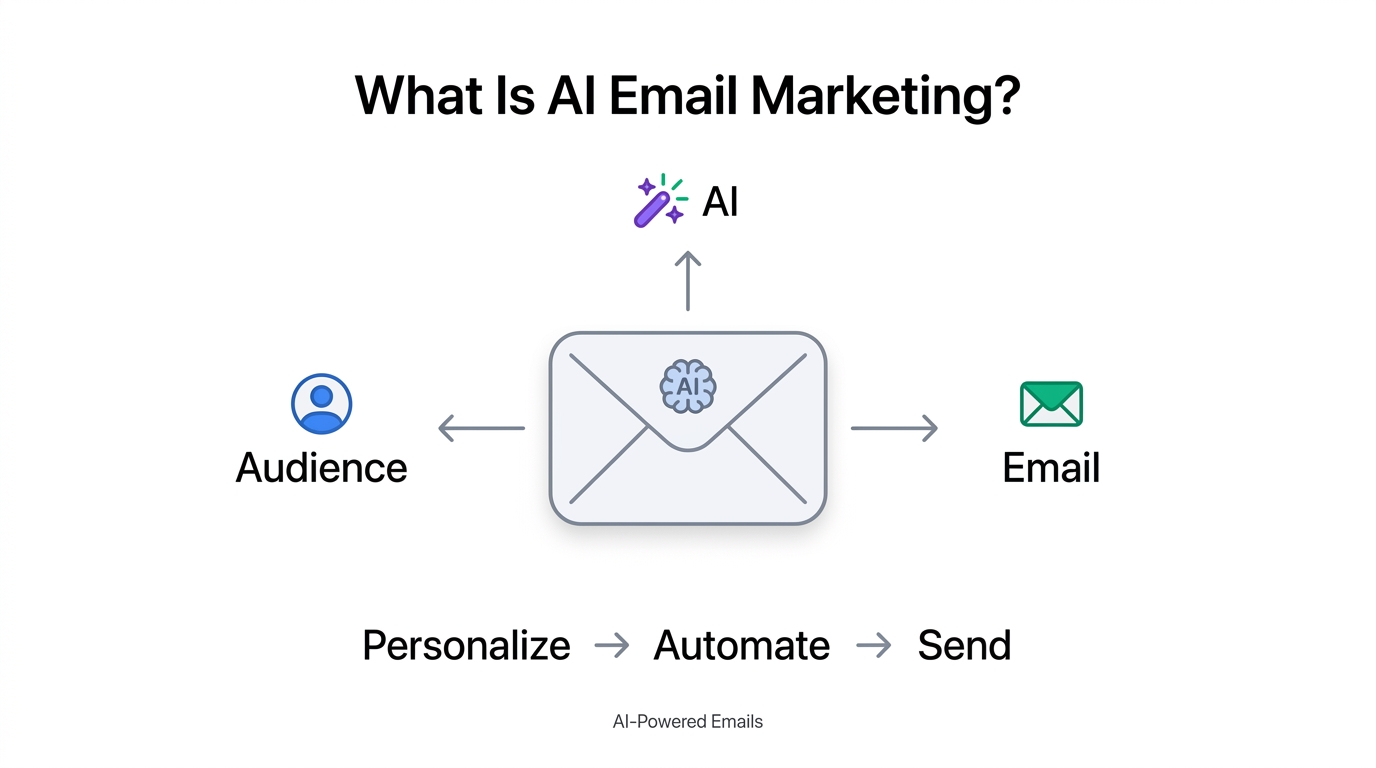
AI email marketing is the practice of using machine learning and generative AI tools to plan, write, personalize, send, and optimize email campaigns automatically, based on real customer data instead of static rules. Instead of a marketer manually deciding who gets what email and when, the AI makes that call using patterns it’s picked up from actual behavior.
How AI Is Different from Traditional Email Marketing
Traditional email marketing relies on fixed rules. If someone’s in Segment A, they get Email A, no exceptions. AI email marketing throws that rigid structure out. It constantly re-evaluates each subscriber based on new signals, so the same person might get a different email today than they would have gotten last week, because their behavior changed.
Why AI Is Becoming Essential in Modern Email Campaigns
Honestly, it comes down to scale. A human marketer can maybe manage a handful of segments well. AI can manage thousands of micro-segments at once, adjusting content, timing, and offers for each one without anybody manually touching a spreadsheet. That kind of granularity just wasn’t possible before, and now that it is, ignoring it puts you behind.
The Evolution of Email Marketing with Artificial Intelligence
Email marketing started as basically digital mail merge, first name tags and not much else. Then came automation platforms with triggers and workflows. Now we’re in a phase where AI doesn’t just trigger a pre-written email, it writes the content, picks the images, predicts the best send time, and learns from every open and click to get sharper next time.
How AI Works in Email Marketing
Machine Learning
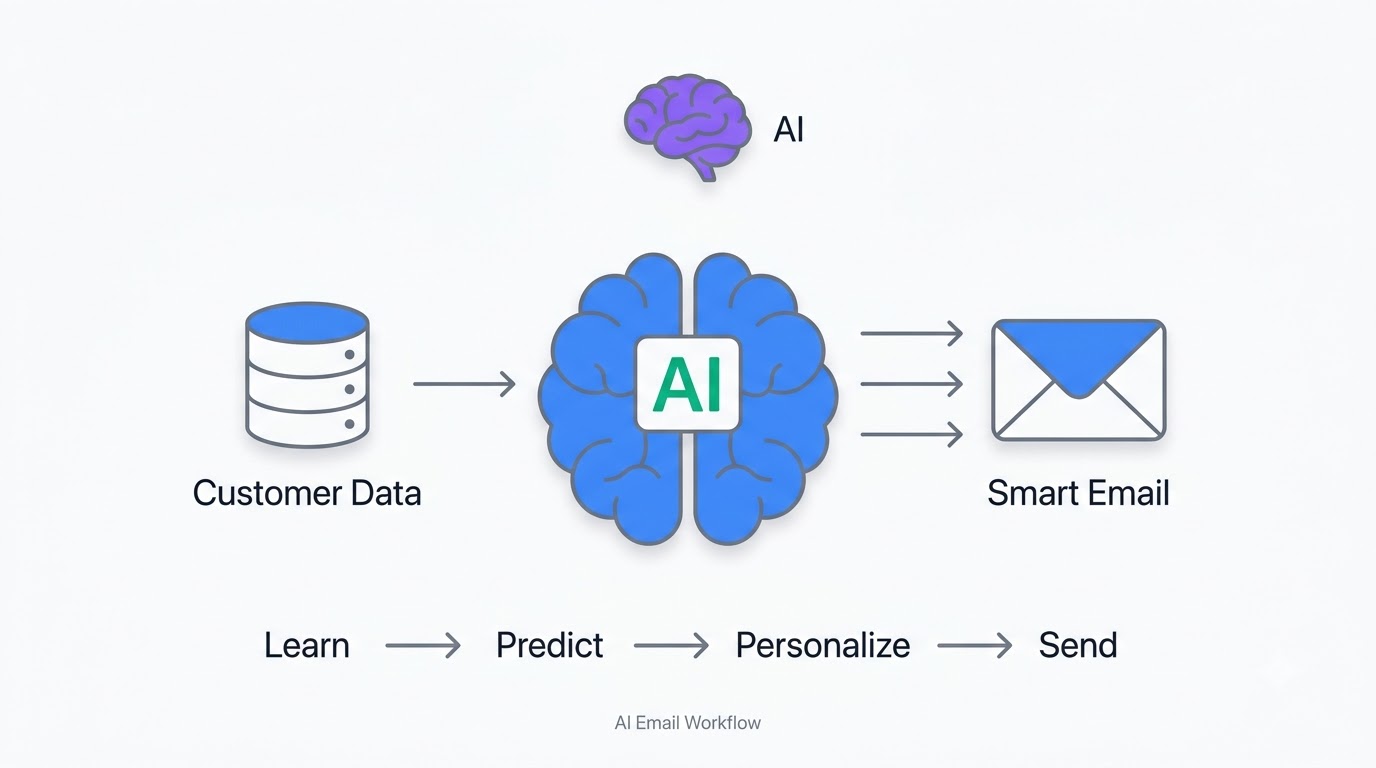
Machine learning is the engine behind most AI email tools. It looks at historical data, who opened what, who clicked, who bought, who unsubscribed, and finds patterns that a human would take forever to spot manually. Over time, the model gets better at predicting what a specific subscriber is likely to respond to, and adjusts campaigns accordingly.
Predictive Analytics
Predictive analytics takes those patterns and turns them into forecasts. It can estimate the probability that a subscriber will buy in the next 7 days, or the likelihood someone’s about to churn. Marketers use these scores to decide who gets a nudge email, who gets a discount, and who just gets left alone for now.
Natural Language Processing (NLP)
NLP is what lets AI tools read and understand text, not just numbers. It analyzes subject lines, email copy, and even customer replies to figure out sentiment and intent. That’s how AI can tell if a subject line sounds too salesy or if a customer support reply signals frustration that should pause a promotional send.
Generative AI
This is the part most people have actually seen in action. Generative AI writes subject lines, body copy, product descriptions, and even full email drafts based on a prompt or a data profile. It’s not perfect out of the box, it still needs editing, but it cuts drafting time down dramatically.
Behavioral Analysis
Behavioral analysis tracks what people actually do, not what they say they want. Clicks, scroll depth, time spent on a product page, items added to cart and abandoned. AI stitches all of that together to build a live picture of intent that updates every time the subscriber interacts with your brand.
Customer Data Platforms (CDPs)
A CDP is basically the memory bank that AI pulls from. It unifies data from your website, app, CRM, and support tools into one subscriber profile. Without a decent CDP, your AI tool is working with partial information, and partial information means weaker personalization, no matter how good the algorithm is.
AI Decision Engines
Decision engines are what actually pull the trigger. They take the predictions and behavioral data and decide, in real time, what content block to show, what offer to include, and when to hit send. This is the layer that turns raw data into an actual email landing in someone’s inbox.
Why Personalisation Matters More Than Ever
Modern Customer Expectations
People expect brands to remember them now. Not in a creepy way, but in the way a good local shop owner remembers your usual order. When an email ignores everything a company already knows about you, it feels lazy, and lazy doesn’t convert. That’s just where customer expectations have landed.
Problems with Generic Email Campaigns
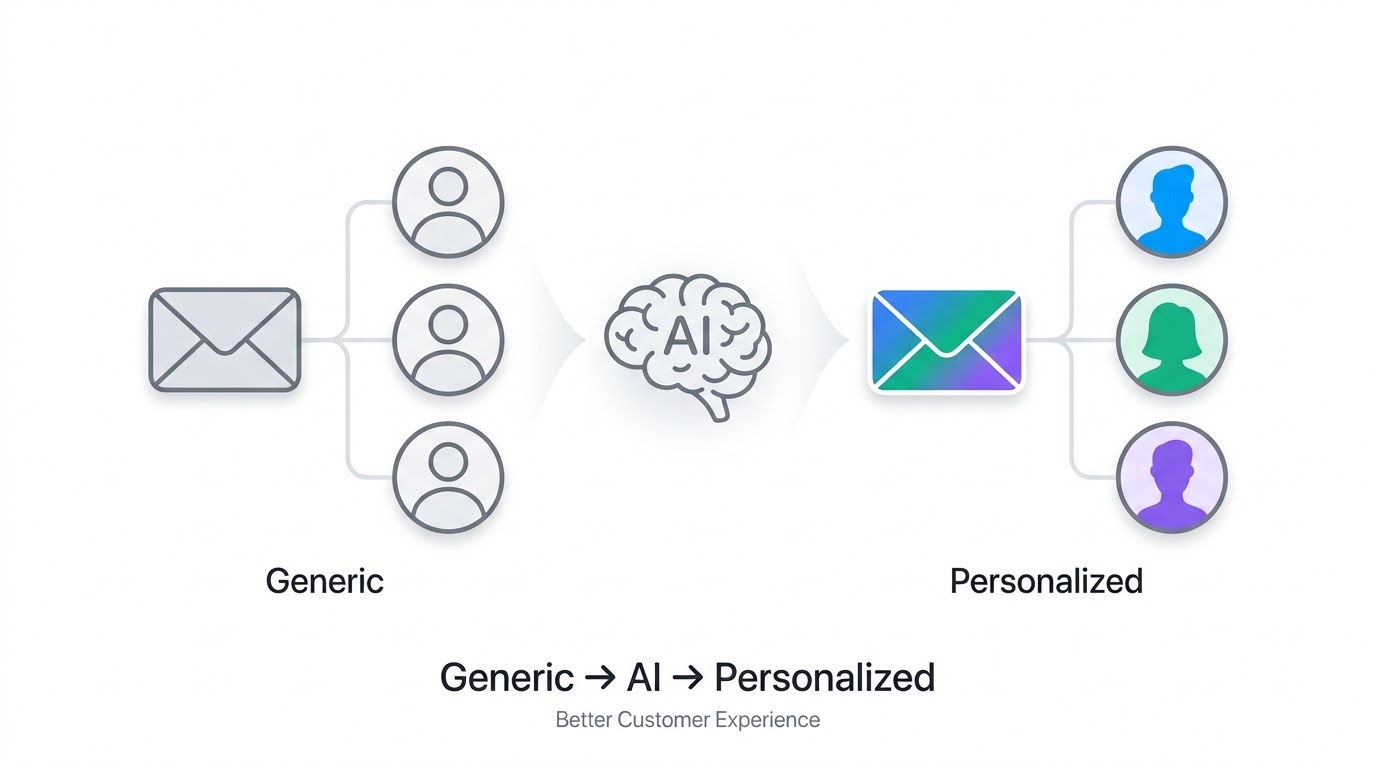
Generic campaigns waste attention. You send the same discount to a loyal repeat buyer and a first-time visitor who bounced off your homepage, and neither message really lands. Worse, generic blasts tend to get reported as spam more often, which quietly damages your sender reputation over time.
Business Benefits of Personalized Emails
Higher Open Rates
Personalized subject lines, ones that reference a product category someone browsed or a past purchase, consistently pull higher open rates than generic ones. It’s not magic, it’s just relevance. People open what feels like it’s actually meant for them.
Better Click Rates
Once someone opens the email, personalized content inside keeps them engaged longer and gets more clicks. Showing a product recommendation based on browsing history beats a generic “check out our bestsellers” block almost every time.
Increased Conversions
Personalized emails move people further down the funnel because the content matches where they actually are in their buying journey. Someone who abandoned a cart needs a different nudge than someone who just signed up for a newsletter.
Improved Customer Retention
When emails consistently feel relevant, subscribers stick around longer instead of unsubscribing out of irritation. Retention isn’t just about the product anymore, it’s about whether your communication feels worth keeping in the inbox.
Higher Customer Lifetime Value
Personalized upsells and cross-sells, sent at the right moment, quietly add up over a customer’s lifecycle. It’s not one big win, it’s dozens of small relevant touches that add revenue over months and years.
Statistics Showing the Impact of Email Personalization
Plenty of research over the past few years has shown personalized emails outperform generic ones on nearly every metric marketers care about, open rate, click-through rate, and revenue per email included. The exact numbers shift depending on industry and list quality, but the direction is consistent. Relevance wins, every time it’s been tested.
Benefits of AI Email Marketing
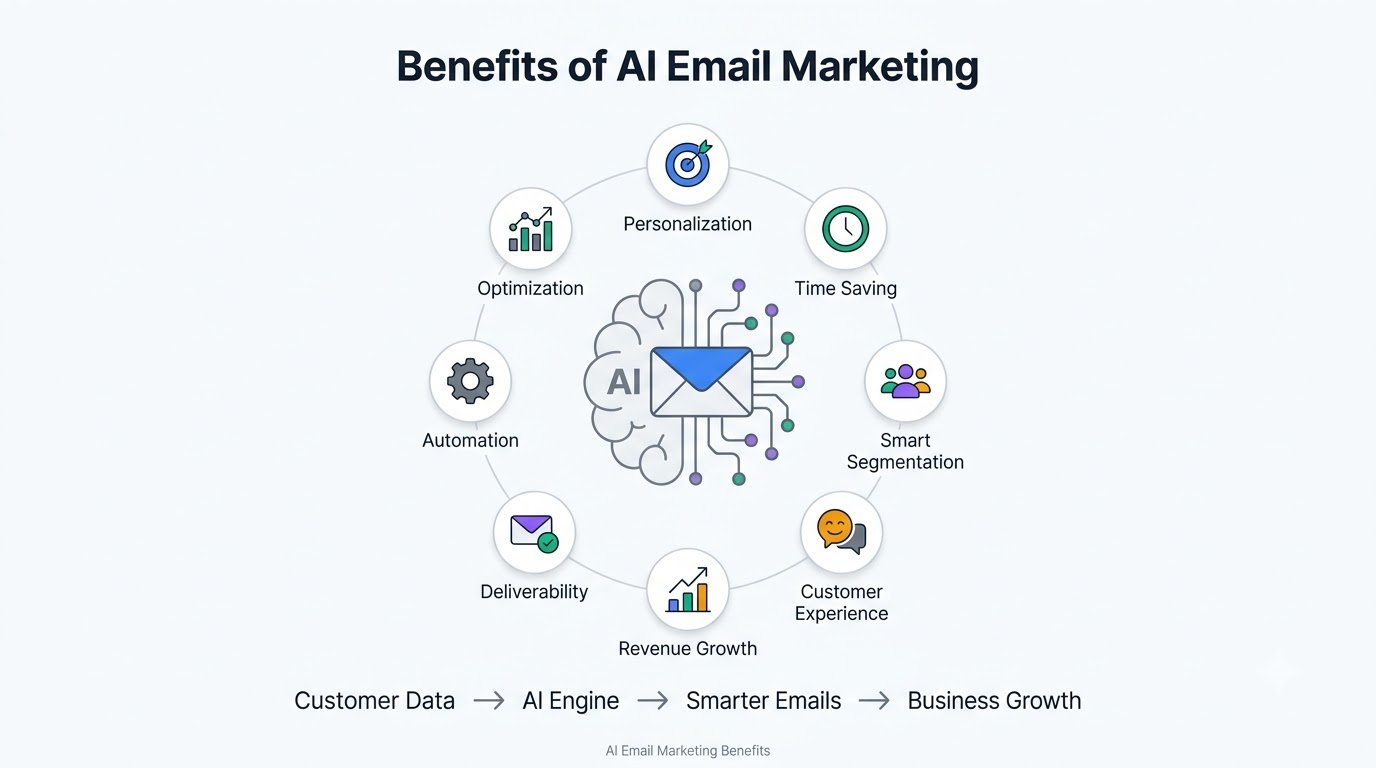
Hyper-Personalization
AI can personalize far beyond a first name. It can tailor product recommendations, images, pricing, and even the tone of the copy for each individual subscriber, at a scale no human team could manage manually across a list of even a few thousand people.
Time Savings
Marketers spend way less time building individual campaigns because AI handles the segmentation, the drafting, and a lot of the testing automatically. That frees up the team to focus on strategy and creative direction instead of manually building fifteen versions of the same email.
Better Audience Segmentation
AI doesn’t just segment by demographics. It builds dynamic segments based on real-time behavior, so someone can move from “browsing” to “high intent” automatically the moment their activity changes, without anyone manually updating a list.
Improved Customer Experience
When emails feel timely and relevant instead of random, the whole relationship with a brand feels smoother. Customers stop seeing email as noise and start seeing it as something actually useful, which changes how they engage with every future send.
Increased Revenue
More relevant emails mean more conversions, and more conversions mean more revenue per send. Brands that lean into AI personalization consistently report stronger email-driven revenue compared to campaigns built on static segments and one-size-fits-all copy.
Better Deliverability
AI tools can predict which emails are likely to land in spam and adjust content, sending patterns, or list hygiene before it becomes a problem. That proactive approach protects your sender reputation, which affects every single campaign you send after.
Reduced Manual Work
A lot of the repetitive grunt work, building A/B tests, tagging segments, scheduling sends, gets automated. That doesn’t mean marketers become obsolete, it means they spend their time on things that actually require human judgment.
Continuous Campaign Optimization
AI doesn’t just set a campaign and forget it. It keeps learning from every send, adjusting future campaigns based on what worked and what didn’t, so performance tends to improve over time instead of staying flat.
Traditional Email Marketing vs AI Email Marketing
| Factor | Traditional Email Marketing | AI Email Marketing |
|---|---|---|
| Audience Segmentation | Static, rule-based lists | Dynamic, behavior-driven micro-segments |
| Content Creation | Manually written by marketers | AI-assisted or fully generated drafts |
| Subject Lines | Written once, tested manually | Generated and optimized per subscriber |
| Send Time | Fixed schedule for everyone | Predicted optimal time per individual |
| Personalization | First name, maybe location | Deep behavioral and purchase-based |
| Automation | Basic triggers and workflows | Predictive, self-adjusting workflows |
| Analytics | Reports reviewed manually | Real-time insights and forecasting |
| Customer Journey | Same path for entire segment | Personalized path per subscriber |
| Optimization | Periodic manual A/B tests | Continuous automated optimization |
| ROI | Harder to isolate and improve | Easier to track and compound over time |
| Human Effort | High, lots of manual setup | Lower, focused on strategy and review |
| Scalability | Limited by team size | Scales without proportional headcount |
Honestly, looking at this table, the gap isn’t small. Traditional email marketing still works, don’t get me wrong, but it caps out fast once your list grows past a few thousand contacts. AI removes that ceiling.
AI Personalization vs Traditional Personalization
Rule-Based Personalization
Rule-based personalization uses simple if-then logic. If a customer is in California, show California-specific content. If they bought shoes, recommend socks. It works, but it’s rigid, and it doesn’t adapt when customer behavior shifts outside the rules someone originally wrote.
Dynamic AI Personalization
Dynamic AI personalization doesn’t rely on fixed rules at all. It continuously reads new data and adjusts content in real time. So if a customer’s interest suddenly shifts from shoes to bags, the AI picks that up on its own and adapts the next email without anyone reprogramming anything.
Which One Performs Better?
In pretty much every comparison, dynamic AI personalization outperforms rule-based setups, especially as list size grows. Rule-based systems get harder to maintain as you add more rules, while AI systems actually get smarter as they process more data. That’s the core difference.
Real Business Examples
Retail brands using dynamic AI personalization for product recommendations have seen noticeably higher click-through rates on those recommendation blocks compared to static “you might also like” sections. SaaS companies using predictive lead scoring in their nurture emails report shorter sales cycles because the right message reaches the right lead at the right stage.
Types of AI Personalization in Email Marketing
Personalized Subject Lines
AI generates and tests multiple subject line variations for different subscriber segments, picking the one most likely to get opened based on past behavior. It’s not just inserting a name, it’s adjusting tone, urgency, and framing per person.
Dynamic Email Copy
The body of the email itself can change per recipient. One subscriber might see copy focused on price savings, another might see copy focused on quality or exclusivity, depending on what’s actually motivated them to buy before.
Personalized Product Recommendations
Recommendation engines analyze browsing and purchase history to suggest items each subscriber is statistically more likely to buy. This is the same logic behind “customers who bought this also bought” sections, just applied inside email instead of on a website.
Dynamic Images
Some AI tools swap out images based on the recipient, showing different product colors, different models, or even localized imagery depending on region. It sounds small, but visual relevance affects engagement just as much as copy does.
Personalized Offers
Instead of one blanket discount code for everyone, AI can assign different offers based on predicted price sensitivity. A loyal high-spend customer might not need a discount at all, while a hesitant first-timer might need one to convert.
AI-Based Email Layouts
Layouts can shift based on what format a subscriber tends to engage with more, whether that’s image-heavy design or text-focused copy. AI tracks engagement patterns and rearranges content blocks accordingly for each send.
Behavioral Personalization
This ties email content directly to actions someone just took, like browsing a category, watching a product video, or downloading a resource. The follow-up email reflects that specific behavior instead of a generic newsletter template.
Location-Based Personalization
Weather, local events, currency, and even language can all shift based on a subscriber’s location. A retailer might promote rain jackets to subscribers in a region currently getting hit with storms, while showing sun hats to another region entirely.
Purchase History Personalization
Past purchases inform what gets recommended next, when a replenishment reminder should go out, and even what loyalty tier messaging applies. It’s one of the strongest personalization signals because it’s based on actual money spent, not just interest.
Device-Based Personalization
Emails can be optimized differently for mobile versus desktop opens, adjusting layout and even content length. Someone who mostly opens on mobile might get shorter, punchier copy compared to someone who reads primarily on desktop.
Weather-Based Email Personalization
Retail and travel brands especially use real-time weather data to trigger relevant campaigns. A sudden heatwave might trigger a push for cooling products, while a cold snap triggers a different set of recommendations entirely.
Lifecycle-Based Personalization
New subscribers, active customers, and lapsed customers all need different messaging. AI tracks where someone sits in the lifecycle and adjusts tone, offers, and frequency accordingly instead of treating everyone like a fresh lead.
Customer Data AI Uses to Personalise Emails
Browsing Behavior
Pages visited, categories explored, time spent per page. This data shows interest before a purchase even happens, giving AI an early signal to work with.
Purchase History
What someone bought, how often, and at what price point. This is one of the most reliable indicators of future buying behavior available to any marketing system.
Cart Activity
Items added and abandoned reveal near-purchase intent. Cart data is gold for AI because it shows exactly where someone hesitated, which helps shape the follow-up message.
Search History
What people search for on your site, even if they never click through, tells AI what they’re curious about, which can shape future recommendation content.
Website Engagement
Time on site, scroll depth, pages per session. These signals help AI gauge overall interest level, separate from any single product or category.
Email Engagement
Opens, clicks, and reply behavior over time build an engagement score AI uses to decide send frequency and content type for each subscriber.
Demographics
Age, gender, and other basic profile data still play a role, though they’re weighted far less heavily than behavioral signals in most modern AI models.
Geographic Location
Region affects everything from currency to shipping messaging to seasonal relevance, making it a useful, if secondary, personalization input.
Device Usage
Whether someone reads on mobile, desktop, or tablet shapes both design decisions and content length for optimal engagement.
Customer Lifetime Value
A running estimate of how much revenue a customer is expected to generate helps AI prioritize who gets premium attention versus standard nurture sequences.
Loyalty Status
Tier level, points balance, and membership duration all feed into how AI tailors offers and messaging tone for that subscriber.
Customer Support Interactions
Recent support tickets or complaints can pause promotional sends temporarily, since blasting a discount code at someone who just had a bad experience tends to backfire.
AI-Powered Email Segmentation Strategies
Predictive Segmentation
Predictive segmentation groups subscribers based on forecasted future behavior, not just past actions. AI might place someone in a “likely to churn” segment based on declining engagement patterns, even before that person consciously decides to unsubscribe.
Behavioral Segmentation
This groups people by what they actually do, browsing patterns, click habits, purchase frequency, rather than static demographic traits. It tends to be a stronger predictor of future engagement than age or location ever was.
Intent-Based Segmentation
Intent segmentation looks at signals that suggest someone’s close to buying, like repeated visits to a product page or comparing multiple items. These subscribers often get more direct, conversion-focused messaging than someone just browsing casually.
Lifecycle Segmentation
Subscribers get grouped by where they sit in their relationship with the brand, new, active, at-risk, lapsed, and messaging adjusts to match that stage instead of treating everyone the same regardless of tenure.
Engagement Segmentation
This separates highly engaged subscribers from those who rarely open emails, allowing different send frequencies and content styles for each group instead of blasting everyone at the same cadence.
RFM Analysis
Recency, Frequency, and Monetary value scoring is a classic segmentation method AI has supercharged. It ranks customers based on how recently they bought, how often, and how much, then tailors campaigns to each tier.
Value-Based Segmentation
High-value customers often get different treatment entirely, more personalized service, earlier access to sales, and less generic promotional noise, because losing a high-value customer costs a lot more than losing an occasional buyer.
Churn Prediction
AI models flag subscribers showing early signs of disengagement before they actually unsubscribe or stop buying. That gives marketers a window to intervene with a win-back offer or a re-engagement sequence before it’s too late.
Lookalike Audience Modeling
AI can identify patterns among your best customers and find other subscribers or prospects who share similar traits, helping target campaigns toward people statistically more likely to convert.
How AI Personalises Every Stage of the Customer Journey
Awareness Stage
At this stage, AI focuses on educational content and brand introduction, tailored to whatever topic or interest first brought someone into contact with your brand, whether that’s a blog post, an ad, or a referral.
Consideration Stage
Emails here lean into comparison content, case studies, or product details relevant to what the subscriber has been browsing, helping move them from curious to genuinely interested without pushing too hard too fast.
Purchase Stage
This is where urgency and offer-based messaging kick in, often personalized based on predicted price sensitivity, cart contents, and how close AI thinks someone is to actually completing a purchase.
Onboarding
New customers get sequences tailored to what they just bought or signed up for, helping them get value quickly instead of receiving the same generic welcome series as everyone else.
Retention
Ongoing engagement emails reflect actual product usage or purchase patterns, keeping the relationship active without spamming people who are already satisfied and don’t need constant nudging.
Upselling
AI identifies natural upgrade paths based on usage or purchase data, timing upsell emails for when a customer is statistically most likely to be receptive, not just on a fixed schedule.
Cross-Selling
Complementary product suggestions get personalized based on what someone already owns, following the same logic as in-store product pairing but applied at individual scale across the whole list.
Loyalty Programs
Point balances, tier status, and reward reminders get tailored per subscriber, making loyalty communication feel like a genuine account update rather than another generic marketing email.
Win-Back Campaigns
Lapsed customers get targeted sequences based on why AI predicts they went quiet, whether that’s price sensitivity, a past bad experience, or simple inactivity, rather than one blanket “we miss you” email.
AI Email Marketing Use Cases
Welcome Email Series
AI adjusts the welcome sequence based on how someone signed up, what content or product first caught their attention, and how engaged they are right out of the gate.
Abandoned Cart Emails
These get triggered automatically when someone leaves items behind, often with AI deciding whether a reminder alone is enough or whether an incentive is needed to bring that person back.
Browse Abandonment
Even without a cart, browsing behavior can trigger a follow-up email showing the exact products someone looked at, keeping that interest warm before it fades entirely.
Product Recommendation Emails
Standalone emails built entirely around personalized recommendations, often outperforming generic promotional sends because every item shown is relevant to that specific subscriber’s history.
Promotional Campaigns
Even broad sales campaigns get personalized at the individual level, adjusting which products get featured and what messaging angle gets used for each subscriber segment.
Transactional Emails
Order confirmations and shipping updates increasingly include personalized cross-sell content, turning a routine email into an extra revenue opportunity without feeling pushy.
Re-engagement Campaigns
AI identifies exactly which subscribers have gone quiet and crafts targeted sequences to win their attention back before they churn entirely off the list.
Customer Feedback Emails
Timing and framing of review requests get personalized based on purchase type and predicted satisfaction, improving response rates compared to blanket feedback requests.
Subscription Renewal Emails
Renewal reminders get tailored based on usage patterns, sometimes including personalized upgrade suggestions if the data suggests a customer would benefit from a higher tier.
Birthday and Anniversary Emails
These milestone emails often see strong engagement, and AI can personalize the offer inside based on that customer’s typical purchase behavior rather than a flat discount for everyone.
Lead Nurturing Campaigns
In B2B especially, AI adjusts nurture sequences based on lead scoring, moving high-intent leads toward sales-focused content faster than lower-intent ones.
B2B Sales Outreach
Sales teams increasingly use AI to personalize outbound email sequences based on company data, role, and past engagement, making cold outreach feel a lot less cold.
AI Features That Improve Email Campaign Performance
AI Subject Line Generator
These tools generate multiple subject line options based on your content and past performance data, often testing several variations automatically to find what resonates with different segments.
AI Copywriting
Generative AI drafts body copy based on prompts, brand voice guidelines, and subscriber data, giving marketers a starting point that still needs a human editing pass before it goes out.
AI CTA Optimization
Call-to-action wording, color, and placement get tested and adjusted based on what’s historically driven the most clicks for similar subscriber segments.
Predictive Send Time Optimization
Instead of one blast time for everyone, AI predicts the individual moment each subscriber is most likely to open an email and schedules accordingly.
AI Spam Detection
Tools scan copy and formatting for patterns known to trigger spam filters, flagging risky language or structure before a campaign goes out to the whole list.
Inbox Placement Prediction
Some platforms estimate whether an email is likely to land in the primary inbox, promotions tab, or spam folder, letting marketers adjust before sending.
AI Image Selection
AI can pick which product images or visuals are statistically more likely to drive engagement based on past performance data across similar campaigns.
AI Email Design
Layout suggestions and design adjustments get generated based on what formats have performed best historically, speeding up the design process considerably.
Dynamic Content Blocks
Sections of an email can change per recipient without building entirely separate email versions, saving significant production time for marketing teams.
Predictive Product Recommendations
These engines constantly update which products to feature based on real-time behavior, not a static list decided weeks in advance.
How Generative AI Creates Better Email Content
Writing Personalized Copy
Generative AI can draft copy tailored to a subscriber’s interests and purchase history, though it still needs human review to make sure the tone actually matches the brand.
Creating Subject Lines
AI generates dozens of subject line variations in seconds, giving marketers options they might not have thought of manually, especially for tone and angle variety.
Preview Text Optimization
The preview text next to a subject line matters more than people realize, and AI helps craft that snippet to complement the subject line rather than repeat it.
Product Descriptions
For catalogs with thousands of items, AI-generated product descriptions save enormous time compared to writing each one manually, while still keeping tone consistent.
Promotional Content
Sale announcements and offer copy can be generated and adjusted per segment quickly, letting marketers run more campaigns without a proportional increase in workload.
Follow-Up Emails
AI drafts follow-up sequences based on how someone responded, or didn’t respond, to a previous email, adjusting tone and urgency accordingly.
Multilingual Email Generation
For global brands, AI can generate localized copy in multiple languages simultaneously, though nuance and cultural fit still benefit from a native speaker’s review.
Brand Voice Consistency
Modern AI tools can be trained on existing brand copy to maintain consistent tone across thousands of personalized email variations, which used to be a real challenge at scale.
AI Email Automation Workflows
Trigger-Based Automation
These workflows fire based on specific actions, a signup, a purchase, a cart abandonment, sending the right email automatically without manual intervention every time.
Behavioral Automation
Rather than a single trigger, behavioral automation reacts to patterns over time, like a subscriber’s browsing habits shifting toward a new product category.
Predictive Automation
This uses forecasted behavior, like predicted churn risk, to trigger proactive emails before a problem actually happens rather than reacting after the fact.
Event-Based Automation
Emails tied to specific dates or events, like a subscription renewal date or a product restock, get sent automatically at the right moment.
Customer Lifecycle Automation
Entire sequences adjust automatically as a customer moves from new to active to at-risk, without a marketer manually moving them between lists.
Lead Scoring Automation
In B2B contexts, leads get scored automatically based on engagement, and that score determines what content and cadence they receive next.
Sales Follow-Up Automation
Sales teams get automated reminders and personalized follow-up drafts based on prospect engagement, helping close deals that might otherwise slip through the cracks.
Best AI Email Marketing Tools
Features to Compare Before Choosing
AI Writing
Check whether the platform’s AI copywriting actually produces usable drafts or just generic filler text that needs a full rewrite anyway.
Personalization
Look at how deep the personalization actually goes, beyond just first name insertion, into dynamic content and product recommendations.
Predictive Analytics
Some platforms offer genuine predictive scoring for churn and purchase likelihood, while others just call basic segmentation “predictive” for marketing purposes.
Segmentation
Strong platforms let you build dynamic, behavior-based segments that update automatically rather than static lists you have to manually refresh.
Automation
Check how flexible the workflow builder is, and whether it supports the kind of multi-step, condition-based journeys your business actually needs.
Integrations
Your email tool needs to connect cleanly with your CRM, ecommerce platform, and analytics stack, or the AI won’t have enough data to work with.
Pricing
Pricing models vary widely, some charge per contact, others per send volume, and AI features are often locked behind higher tiers.
Reporting
Good reporting goes beyond opens and clicks into revenue attribution and AI prediction accuracy, so you can actually judge if the tool is working.
Top AI Email Marketing Platforms
Mailchimp
Mailchimp has built out AI-driven subject line suggestions and predictive send time features on top of its long-standing automation tools, making it a solid entry point for smaller teams already familiar with the platform.
Klaviyo
Klaviyo leans heavily into ecommerce data, using purchase and browsing history to power detailed segmentation and product recommendation blocks, which makes it a favorite among online retailers specifically.
ActiveCampaign
ActiveCampaign combines CRM functionality with predictive sending and lead scoring, making it a strong pick for businesses that want marketing and sales automation working off the same data.
HubSpot
HubSpot’s AI tools tie into its broader CRM ecosystem, offering personalization based on the full customer record rather than just email engagement history alone.
Brevo
Brevo, formerly Sendinblue, offers AI-powered send time optimization and segmentation tools at a price point that tends to appeal to smaller and mid-sized businesses.
Omnisend
Omnisend focuses specifically on ecommerce, with AI-driven product recommendations and cart recovery flows built to integrate tightly with major online store platforms.
Iterable
Iterable is built for cross-channel personalization, using AI to coordinate messaging across email, SMS, and push notifications based on a unified customer profile.
Customer.io
Customer.io gives technical teams granular control over behavioral triggers and data-driven personalization, appealing especially to SaaS companies with complex product usage data.
Campaign Monitor
Campaign Monitor offers straightforward AI-assisted content suggestions and segmentation, aimed at teams that want solid personalization without an overly complex interface.
MailerLite
MailerLite keeps things simpler and more affordable, with AI writing assistance and basic behavioral automation suited to smaller lists and leaner marketing teams.
How to Build an AI Email Marketing Strategy
Define Campaign Goals
Before touching any tool, get clear on what you actually want, more revenue per send, better retention, lower unsubscribe rates. Vague goals lead to vague AI setups that don’t really move anything.
Collect High-Quality Customer Data
AI is only as good as the data feeding it. Messy, incomplete, or outdated customer records will produce weak personalization no matter how advanced the algorithm behind it is.
Choose the Right AI Tool
Pick a platform based on your actual business type and data complexity, not just brand recognition. A small DTC brand and an enterprise SaaS company need very different tools.
Build Customer Segments
Start with a handful of meaningful behavioral segments rather than trying to build fifty micro-segments on day one. You can always get more granular once the basics are working.
Create Dynamic Content
Build modular content blocks that can swap in and out based on subscriber data, rather than writing entirely separate emails for every possible variation.
Design Automated Journeys
Map out the key triggers and decision points for your automated flows, welcome series, abandoned cart, win-back, before letting AI optimize the details within them.
Test Everything
Even with AI running the show, test subject lines, send times, and content variations regularly. AI improves faster when it has more test data to learn from.
Measure Performance
Track results beyond just opens and clicks, look at actual revenue attribution and how each campaign contributes to broader business goals over time.
Continuously Optimize with AI
Let the system keep learning and adjusting, but review its decisions periodically to make sure it’s actually aligned with where your business wants to go.
AI Email Marketing Best Practices
Start with First-Party Data
Rely on data customers have directly given you, purchases, signups, preferences, rather than third-party data that’s becoming harder to access and less reliable anyway.
Keep Human Oversight
AI drafts and predictions still need a human checking tone, accuracy, and brand fit before anything goes out. Full autopilot is risky, especially early on.
Personalize Beyond the First Name
Real personalization goes into content, offers, and timing, not just a mail-merge tag at the top of the email. First name alone doesn’t move metrics much anymore.
Focus on Customer Intent
Pay attention to what behavior actually signals about intent, not just surface-level demographic data, since intent is a much stronger predictor of conversion.
Use Predictive Analytics
Lean on churn and purchase predictions to prioritize where your attention and budget go, rather than treating every subscriber the same regardless of predicted value.
Optimize Send Frequency
Let AI adjust how often each subscriber gets emailed based on their engagement level, since blasting a disengaged subscriber too often just accelerates unsubscribes.
Maintain Brand Voice
Even with AI-generated copy, keep a consistent brand tone across every variation, or the personalization ends up feeling disjointed and inconsistent.
Respect Customer Privacy
Be transparent about what data you’re using and why. Trust, once broken over privacy concerns, is hard to rebuild with an email list.
Test Every Campaign
Don’t assume AI got it right on the first try. Regular testing keeps performance improving instead of plateauing after the initial setup.
Monitor AI Decisions Regularly
Check in on what the AI is actually deciding, which segments it’s building, what content it’s generating, to catch any weird patterns before they affect performance.
Common AI Email Marketing Mistakes to Avoid
Over-Personalization
There’s a line between relevant and creepy. Referencing exact browsing behavior too explicitly can make subscribers uncomfortable rather than impressed, so some subtlety matters.
Poor Data Quality
Feeding AI incomplete or duplicate data leads to weird, inaccurate personalization that actually damages trust rather than building it.
Ignoring Privacy Regulations
Skipping proper consent processes or ignoring regional privacy laws isn’t just risky legally, it actively undermines the trust your personalization strategy depends on.
Blindly Trusting AI
AI predictions aren’t infallible. Marketers who never question the system’s decisions sometimes miss obvious errors that a quick human review would’ve caught.
Sending Too Many Emails
Even with great personalization, too much frequency burns out subscribers. Relevance doesn’t cancel out fatigue if the volume is genuinely excessive.
Weak Segmentation
Building broad, shallow segments defeats the purpose of using AI in the first place. The value comes from granularity, not just automation for its own sake.
Using AI Without Clear Objectives
Adopting AI tools without a clear strategy behind them usually just means automating confusion faster. Clarity has to come before automation, not after.
Not Measuring ROI
Some teams implement AI tools and never circle back to measure whether they’re actually delivering more revenue than the previous manual approach.
AI Email Marketing Metrics You Should Track
Open Rate
Still a useful top-of-funnel signal, though it’s gotten less reliable since Apple’s Mail Privacy Protection changed how opens get tracked on many devices.
Click-Through Rate (CTR)
CTR tells you whether your content and offers are actually compelling enough to act on, beyond just curiosity that leads to an open.
Click-to-Open Rate (CTOR)
This isolates content performance from subject line performance, showing how engaging the email itself is once someone’s already opened it.
Conversion Rate
The percentage of recipients who complete a desired action, purchase, signup, download, tied directly to a specific email campaign.
Revenue Per Email
A direct measure of how much revenue each email sent generates on average, one of the clearest indicators of actual business impact.
Bounce Rate
High bounce rates signal list quality problems and can hurt deliverability across your entire sending domain if left unaddressed.
Unsubscribe Rate
A spike here usually signals content, frequency, or relevance problems, and it’s worth investigating rather than ignoring as normal churn.
Spam Complaint Rate
Even a small percentage of spam complaints can seriously damage sender reputation, so this metric deserves close attention regardless of list size.
Deliverability Rate
The percentage of emails actually reaching the inbox rather than getting filtered or bounced, foundational to every other metric on this list.
Customer Lifetime Value
Tracking how email engagement correlates with long-term customer value helps justify investment in more sophisticated personalization efforts.
Email Engagement Score
A composite score combining opens, clicks, and other signals to give a single view of how engaged a subscriber currently is.
AI Prediction Accuracy
Checking how often AI’s predictions, like churn risk or purchase likelihood, actually turn out correct helps you trust or question the system appropriately.
Privacy, Ethics, and Compliance in AI Email Marketing
GDPR Compliance
For any brand dealing with European subscribers, GDPR sets strict rules around consent, data usage, and the right to be forgotten, all of which directly affect how AI can use customer data for personalization.
CAN-SPAM Requirements
In the US, CAN-SPAM requires clear opt-out mechanisms and honest subject lines, rules that still apply even when AI is generating the content automatically.
Consent-Based Marketing
Building your list through genuine opt-in, rather than purchased lists or shady sign-up tactics, keeps both compliance and engagement quality higher over time.
First-Party Data Strategy
Relying on data customers willingly share, rather than scraped or third-party sources, tends to produce both better compliance standing and better personalization accuracy.
Data Security
Customer data powering AI personalization needs proper security measures, since a breach doesn’t just violate trust, it can trigger serious legal consequences too.
Ethical AI Usage
Using AI to genuinely help customers find relevant products is different from using it to manipulate people into purchases they don’t actually want or need.
Transparency in Personalization
Being upfront that personalization is happening, even in a light touch way, tends to build more trust than pretending the emails are just naturally coincidental.
Avoiding Algorithmic Bias
AI models can accidentally reinforce biased patterns from historical data, so it’s worth periodically auditing who’s getting excluded from good offers or content, and why.
Real-World Examples of AI Email Marketing
eCommerce Brand Personalization
Online retailers commonly use AI to power product recommendation emails based on browsing and purchase history, often seeing meaningfully higher click-through rates on those recommendation blocks compared to generic promotional content.
SaaS Lead Nurturing
Software companies use AI-driven lead scoring to prioritize which prospects get sales-focused emails versus continued educational nurture content, shortening the path from trial signup to paid conversion.
B2B Account-Based Email Marketing
For B2B teams targeting specific companies, AI personalizes outreach based on company size, industry, and past engagement, making account-based campaigns feel far more tailored than generic cold outreach.
Retail Product Recommendation Engine
Retail brands rely on recommendation engines within emails to surface items customers are statistically likely to want next, based on both their own history and similar customers’ behavior.
Travel Industry Personalized Offers
Travel companies use AI to personalize destination suggestions and pricing based on past bookings, search behavior, and even seasonal timing relevant to each subscriber.
Streaming Platform Recommendation Emails
Streaming services send personalized content recommendation emails based on viewing history, a strategy that’s become one of the more recognizable examples of AI personalization in everyday inboxes.
The Future of AI Email Marketing
Agentic AI in Marketing
Agentic AI systems are starting to handle entire campaign workflows with minimal human input, from drafting to sending to analyzing results and adjusting the next send automatically.
Autonomous Campaign Optimization
Future systems are likely to run continuous optimization loops without needing a marketer to manually review and approve every single change along the way.
Predictive Customer Journeys
AI will increasingly map out an individual’s likely path through the customer lifecycle in advance, adjusting touchpoints proactively rather than reactively.
Real-Time Personalization
Content that updates the moment an email is opened, based on the latest available data, is becoming more common, rather than personalization frozen at send time.
AI Voice and Interactive Emails
Interactive elements, and even voice-based content, are starting to appear in more advanced email campaigns, pushing beyond static text and images.
Multimodal Email Experiences
Combining text, image, and interactive elements generated together by AI is becoming more feasible, creating richer email experiences than what’s typical today.
AI + Customer Data Platforms
Tighter integration between AI engines and CDPs means personalization will keep getting sharper as unified customer profiles become more complete and accurate.
Privacy-First AI Personalization
As regulations tighten and third-party data dries up, expect more innovation around personalizing effectively using only first-party, consented data.
Conclusion
AI email marketing isn’t about replacing marketers, it’s about giving them the ability to personalize at a scale that simply wasn’t possible manually. From subject lines to send times to product recommendations, the technology touches nearly every part of a campaign now.
Look, none of this works without decent data and a human still paying attention to what the AI is actually doing. But get those two things right, and AI email marketing genuinely changes what’s possible for a marketing team, no matter how small.
Frequently Asked Questions
What is AI email marketing?
AI email marketing uses machine learning and generative AI to personalize, automate, and optimize email campaigns based on real subscriber behavior instead of static, one-size-fits-all rules.
How does AI personalize email campaigns?
It analyzes data like browsing history, purchase behavior, and engagement patterns, then adjusts subject lines, content, offers, and send times individually for each subscriber based on that data.
Is AI email marketing suitable for small businesses?
Yes, many affordable platforms now offer AI features at entry-level pricing tiers, making personalization accessible even for smaller lists and leaner marketing budgets.
Which AI email marketing tool is best?
It really depends on your business type. Ecommerce brands often lean toward Klaviyo or Omnisend, while B2B and SaaS companies tend to prefer ActiveCampaign or HubSpot.
Can AI improve email open rates?
Yes, personalized subject lines and predictive send time optimization both tend to improve open rates compared to generic, one-time-scheduled campaigns.
Does AI replace email marketers?
No, it handles repetitive tasks and data analysis, but strategy, brand voice, and creative judgment still need human input and oversight.
Is AI email marketing GDPR compliant?
It can be, as long as the underlying data collection and usage practices follow GDPR consent requirements. The AI itself doesn’t override compliance obligations.
How much does AI email marketing cost?
Pricing varies widely by platform and list size, ranging from affordable monthly plans for small businesses to enterprise pricing for larger, more complex setups.
What data does AI use for personalization?
Browsing behavior, purchase history, cart activity, engagement patterns, demographics, and location are among the most common data points AI relies on.
How do I start using AI in email marketing?
Start by cleaning up your customer data, picking a platform that fits your business size, and building a few core behavioral segments before layering in more advanced automation.