

Look, most marketing teams are still driving while staring in the rearview mirror. They pull last month’s campaign report, see what worked, and try to repeat it. That’s not a strategy, that’s guessing with extra steps. And honestly, it used to be fine. Customers were more predictable, channels were fewer, and competition wasn’t quite as brutal. Not anymore.
Here’s the thing. A customer today browses your site on their phone during lunch, abandons the cart, gets an ad on Instagram that evening, opens an email the next morning, and finally buys three days later from a completely different device. If you’re only looking at what already happened, you’re always a step behind. Predictive analytics flips that. Instead of asking “what happened,” it asks “what’s likely to happen next, and what should we do about it.”
This is where things get interesting. Companies like Amazon aren’t guessing which products to show you. Netflix isn’t randomly picking which show thumbnail to display. They’re running models that predict, with pretty solid accuracy, what you’re going to want before you even know it yourself. And no, you don’t need Amazon’s budget to start doing this. Small ecommerce brands, SaaS startups, even local businesses are using predictive tools now, some of them baked right into tools like Klaviyo or HubSpot that marketers already use every day.
The adoption numbers back this up too. Marketing teams that use predictive analytics report noticeably better campaign ROI compared to teams that don’t, and a growing share of CMOs now list predictive capability as one of their top three technology priorities. That’s not a fad, that’s a shift in how marketing decisions get made.
So what’s this guide actually going to cover? We’re going deep. Not just definitions, but how the whole thing works under the hood, which models get used and where, real examples from real brands, tools you can actually go try today, and the mistakes that trip people up when they first attempt this. By the end, you should be able to walk into a meeting and actually explain what predictive analytics means for your specific business, not just repeat a buzzword.
What You Will Learn in This Guide
- What predictive analytics actually means, in plain language and in technical terms
- How predictive analytics is different from the reporting and dashboards you’re already used to
- The exact step-by-step process behind how predictions get made
- The different types of predictive analytics used across marketing functions
- The models and algorithms that power these predictions, explained without the jargon overload
- Real applications across ecommerce, email, social, SEO, PPC, SaaS, and B2B
- The genuine benefits, backed by how brands are actually using this stuff
- The challenges nobody puts in the sales deck, and how to deal with them
- How predictive analytics relates to AI and machine learning, since people mix these up constantly
- Which industries and brands are already deep into this
- Tools you can start using, from enterprise platforms to open source
- A practical implementation roadmap
- Best practices and common mistakes, so you don’t have to learn them the hard way
What Is Predictive Analytics in Marketing?
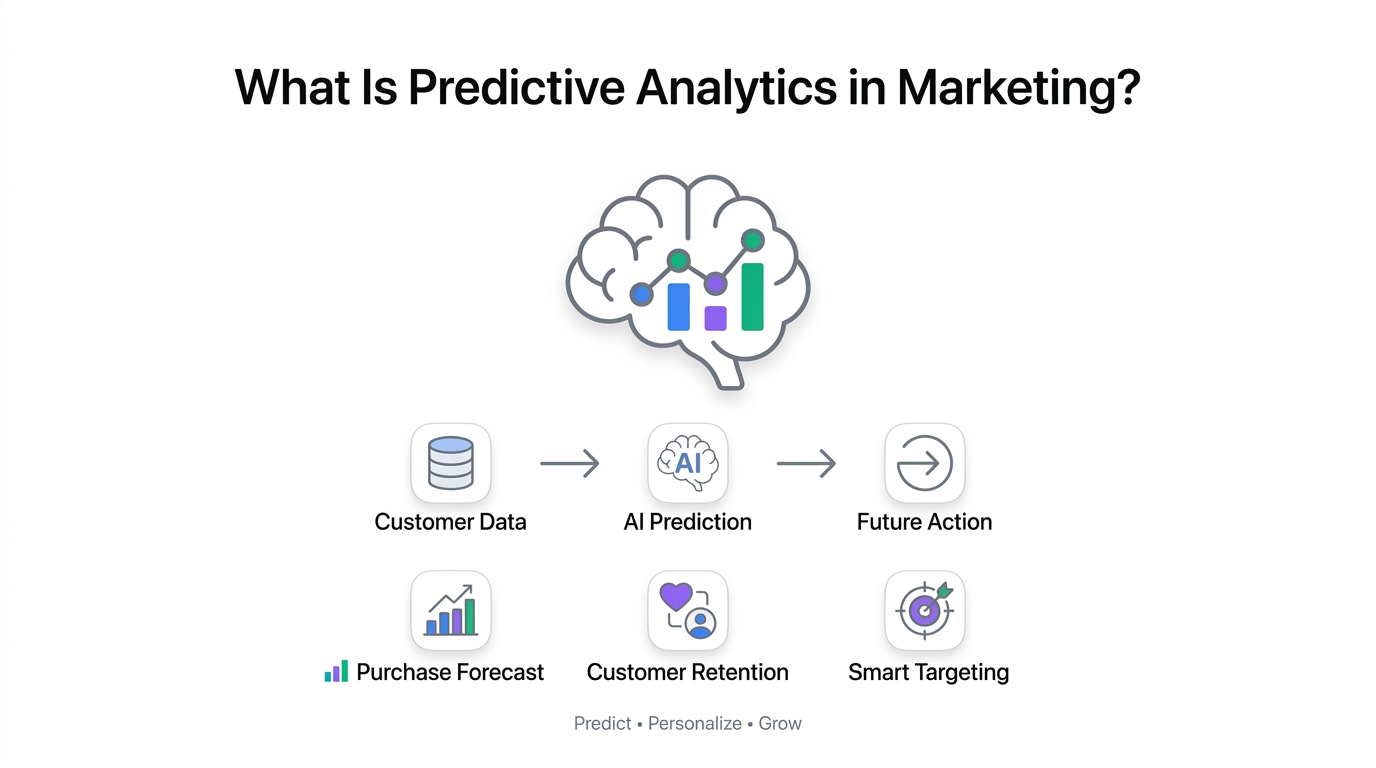
Predictive analytics in marketing is the practice of using historical data, statistics, and machine learning to figure out what a customer is likely to do next. Not what they did last quarter. What they’re going to do next week, next month, or the next time they open your app. It sounds fancy, but the core idea is something humans have always done, just informally. A good salesperson who’s been at it for twenty years can often tell when a customer is about to walk away without buying, just from body language and tone. Predictive analytics does the same thing, except it uses data instead of gut feeling, and it can do it for a million customers at once instead of one at a time.
The Technical Definition
More formally, predictive analytics is a branch of advanced analytics that uses statistical algorithms and machine learning techniques to identify the likelihood of future outcomes based on historical data. In a marketing context, that historical data includes purchase history, browsing behavior, email engagement, social interactions, demographic data, and more. The output isn’t a guess, it’s a probability score. A churn model doesn’t just say “this customer might leave,” it says “this customer has a 78% chance of not renewing in the next 30 days.” That number is what makes it actionable.
Predictive Analytics vs Traditional Marketing Analytics
Traditional marketing analytics tells you what already happened. Predictive analytics tells you what’s coming. That’s really the whole difference, but it’s worth breaking down because there are actually four stages of analytics maturity, and most teams are stuck in the first two.
Historical analytics is just raw data sitting in a spreadsheet or dashboard, unprocessed and unexplained. Descriptive analytics summarizes that data into something readable, like “we had 12,000 website visitors last month.” Diagnostic analytics goes a step further and explains why something happened, like figuring out that traffic dropped because a landing page broke on mobile. Predictive analytics is the next level up, forecasting what’s likely to happen based on patterns in that historical and diagnostic data. And beyond that sits prescriptive analytics, which doesn’t just predict an outcome but recommends the specific action to take because of it.
Here’s a simple comparison. A traditional marketer looks at a report and says, “last month’s campaign performed well.” A predictive marketer looks at the same data plus behavioral signals and says, “next month’s campaign will likely generate 18% higher conversions among Segment A if we shift budget toward retargeting.” See the difference? One is a summary. The other is a decision you can actually act on before the money gets spent.
Why It Matters Today
Customer behavior has gotten messier, and honestly, more expensive to get wrong. Acquisition costs on platforms like Meta and Google have climbed steadily for years, so wasting ad spend on the wrong audience segment hurts a lot more than it used to. At the same time, customers expect a level of personalization that’s basically impossible to deliver manually once you’re dealing with more than a few thousand people. Predictive analytics is what makes that personalization scalable, and that’s exactly why it’s stopped being a “nice to have” and become something marketing teams are expected to use.
How Predictive Analytics Works in Marketing
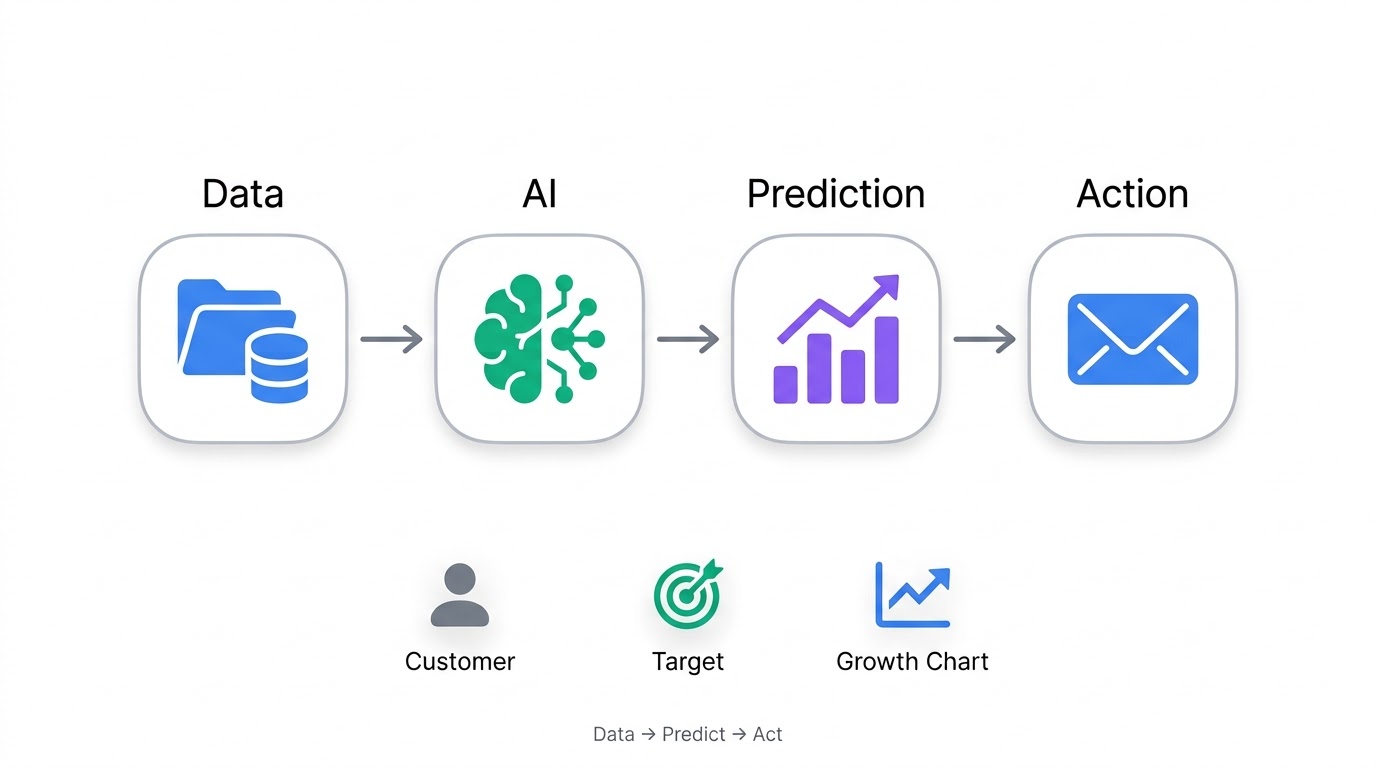
People assume this is some kind of black box magic. It’s really not. It’s a process, and once you see the steps laid out, it stops feeling mysterious and starts feeling like something your team could actually build toward.
Step 1 — Data Collection
Everything starts with data, and marketing teams usually have way more of it than they realize. CRM systems hold purchase history and customer profiles. Website analytics tools track browsing behavior, time on page, and drop-off points. Social media platforms provide engagement data. Email marketing tools log opens, clicks, and unsubscribes. POS systems capture in-store purchases. Mobile apps track usage patterns. Customer support tickets reveal friction points. Surveys capture direct feedback. Ad platforms show what messaging actually converts. The trick isn’t collecting more data, it’s connecting data that’s currently sitting in separate silos so a model can actually see the full customer picture.
Step 2 — Data Cleaning
This is the unglamorous part nobody talks about at conferences, but it’s where most predictive projects actually succeed or fail. Missing values need to be handled, whether that means filling gaps or excluding incomplete records. Duplicate entries, like the same customer showing up under two different email addresses, need to get merged. Formatting has to be made consistent, since a date field with three different formats will confuse any model trying to learn from it. And data normalization scales everything into comparable ranges so one variable, like annual revenue, doesn’t drown out a more subtle but equally important variable, like number of support tickets filed. Skip this step and your predictions will be garbage no matter how sophisticated the model is.
Step 3 — Pattern Identification
Once the data is clean, the next job is spotting patterns humans would probably miss on their own. This means looking at customer behavior over time instead of in isolated snapshots, figuring out buying cycles for different segments, noticing seasonal trends that repeat year over year, tracking purchase frequency to identify your most valuable repeat customers, and flagging cart abandonment patterns that hint at friction in the checkout flow. A lot of this pattern work used to require a dedicated data analyst poring over spreadsheets for days. Now it happens automatically, in minutes, across millions of data points.
Step 4 — Machine Learning Models
This is where the actual prediction engine gets built, and don’t worry, we’re not diving into equations here. Regression models predict a numeric outcome, like how much a customer is likely to spend next quarter. Classification models sort customers into categories, like “will churn” or “won’t churn.” Clustering groups customers with similar behavior together, even when nobody told the model what those groups should look like in advance. Decision trees make predictions by following a series of yes-or-no splits, similar to a flowchart. Neural networks handle more complex, nonlinear patterns that simpler models can’t capture, especially useful with large volumes of behavioral data. Random forest combines a bunch of decision trees together to get a more stable, accurate prediction than any single tree could produce alone.
Step 5 — Predictions
Once trained, the model starts spitting out actual, usable predictions. Purchase probability tells you how likely a specific customer is to buy in a given window. Churn likelihood flags who’s at risk of leaving. Customer lifetime value estimates how much revenue a customer will generate over their entire relationship with your brand. Best products surfaces what a specific customer is most likely to want next, which is exactly how “customers also bought” recommendations work. Best time to send emails predicts the exact hour a specific person is most likely to open and engage, rather than blasting everyone at 9am because that’s when the marketing calendar says to.
Step 6 — Marketing Actions
None of this matters if it doesn’t turn into action. Marketers take these predictions and use them to trigger retention campaigns for high churn-risk customers, adjust ad spend toward segments with higher purchase probability, personalize email send times per individual, build custom product recommendation blocks, and set lead scoring thresholds so sales teams focus energy where it actually pays off. The prediction is the insight. The marketing action is where the insight turns into revenue.
Why Predictive Analytics Is Important in Modern Marketing
Customer behavior just isn’t linear anymore, and honestly it probably never really was, we just didn’t have the tools to see the mess clearly. People research on one device, get influenced by a friend’s Instagram story, compare prices on a third-party site, then buy from wherever’s most convenient at that exact moment. Trying to market to that kind of behavior with static, one-size-fits-all campaigns is basically throwing spaghetti at the wall.
The benefits are pretty concrete once you actually put predictive analytics to work. Decision making speeds up because you’re not waiting for a campaign to fully play out before adjusting course, you’re adjusting based on early signals. ROI improves because ad spend stops going toward people unlikely to convert. Personalization gets sharper because recommendations and messaging are based on actual predicted intent, not broad demographic guesses. Forecasting becomes more reliable, which matters enormously for inventory planning and budget allocation. Marketing waste drops since campaigns target people with real purchase probability instead of blasting everyone. Customer experience improves because people start seeing offers and content that actually feel relevant to them instead of generic. And retention gets a real boost because churn risk gets caught early enough to actually do something about it.
Companies using predictive analytics in a serious, structured way tend to report double-digit improvements in campaign conversion rates compared to teams still relying purely on historical reporting. That’s not a small edge. In a market where acquisition costs keep climbing, that edge is often the difference between a profitable customer relationship and a break-even one.
Types of Predictive Analytics Used in Marketing
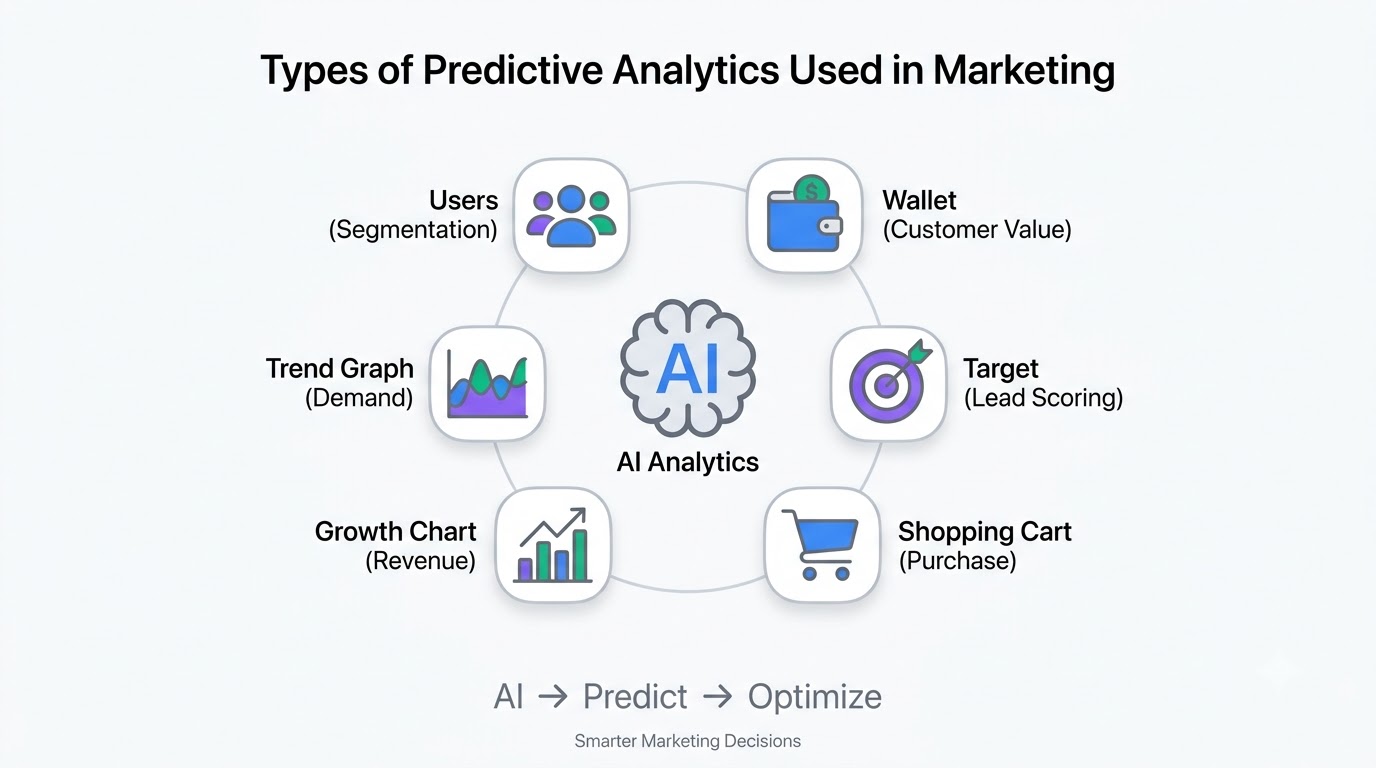
There isn’t just one flavor of predictive analytics, there are several, each solving a different marketing problem.
Customer segmentation groups people based on predicted behavior patterns rather than just static demographics, so you end up with segments like “likely to buy premium” instead of just “age 25-34.” Customer lifetime value prediction estimates the total revenue a customer will generate over time, which completely changes how much you’re willing to spend acquiring them. Churn prediction flags customers at risk of leaving before they actually cancel, giving you a window to intervene.
Product recommendation predicts which specific items a customer is most likely to want next, the engine behind most “you might also like” sections. Lead scoring ranks prospects by their likelihood to convert, so sales teams stop wasting time on cold leads. Purchase propensity modeling estimates how likely someone is to buy within a specific timeframe. Cross-selling prediction identifies complementary products a customer is likely to add to their order.
Upselling prediction flags customers likely to upgrade to a higher tier or premium version. Customer acquisition forecasting estimates how many new customers you’ll gain given current spend and channel mix. Campaign performance prediction forecasts how a campaign will likely perform before it fully launches, based on early signals and historical patterns. Demand forecasting predicts product or service demand ahead of time, critical for inventory and staffing. Revenue forecasting projects future revenue based on current pipeline, trends, and seasonality.
Each of these solves a genuinely different business question, and most mature marketing teams end up using several of them together rather than picking just one.
Predictive Analytics vs Traditional Marketing Analytics
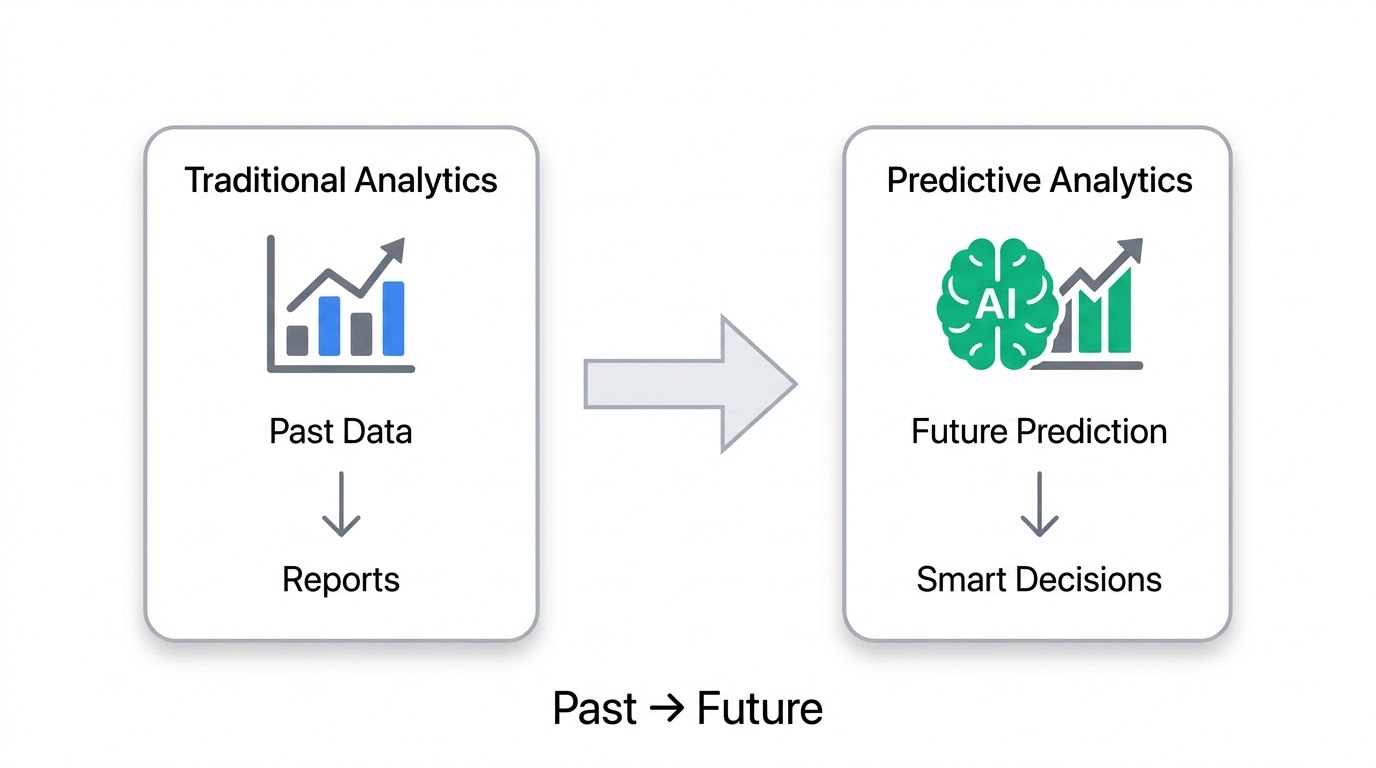
Here’s a side by side that makes the difference obvious.
| Factor | Traditional Analytics | Predictive Analytics |
|---|---|---|
| Goal | Explain what happened | Forecast what will happen |
| Data Used | Historical performance data | Historical data plus behavioral signals |
| Insights | Descriptive summaries | Probability-based forecasts |
| Technology | Dashboards, spreadsheets | Machine learning models |
| Time Focus | Past | Future |
| AI Usage | Minimal to none | Core to the process |
| Accuracy | Reflects the past accurately | Estimates the future with a margin of error |
| Automation | Mostly manual review | Often automated and continuously updated |
Neither one replaces the other, honestly. You still need traditional analytics to understand your baseline. Predictive analytics just adds a forward-looking layer on top of it.
Core Components of Predictive Analytics
A few building blocks make the whole system work, and it’s worth knowing what each one actually contributes.
Data is the raw fuel, and without enough of it, or without clean enough data, none of the rest matters. Algorithms are the mathematical logic that finds patterns in that data. Machine learning is the broader technique that lets those algorithms improve automatically as more data comes in, rather than needing to be manually reprogrammed. Artificial intelligence is the umbrella field that machine learning sits under, giving systems the ability to make decisions that used to require a human. Statistical models provide the mathematical foundation for measuring relationships and probabilities within the data. Business rules layer human judgment and domain knowledge on top of the raw model output, so predictions actually make practical sense. Visualization turns complex model output into charts and dashboards that a marketing manager can actually read without a statistics degree. Decision systems are what actually trigger the action, whether that’s an automated email, an ad bid adjustment, or a flag sent to a sales rep.
Key Predictive Analytics Models Used in Marketing
Regression Models
Regression predicts a continuous number, like predicted revenue or expected order value. In marketing, it’s commonly used to forecast how much a specific customer segment will spend next quarter based on past spending patterns. The advantage is it’s simple to interpret and explain to non-technical stakeholders. The limitation is it assumes a fairly straightforward relationship between variables, which doesn’t always hold true when customer behavior gets complicated.
Classification Models
Classification sorts customers into categories rather than predicting a number. Churn prediction is the classic example, sorting customers into “will churn” or “won’t churn” buckets. It’s great for yes-or-no business decisions, like whether to send a retention offer. The downside is it can oversimplify situations that are actually more of a spectrum than a binary choice.
Time Series Forecasting
This model type looks specifically at data over time to predict future values, which makes it perfect for things like seasonal demand forecasting or predicting website traffic during a holiday sale. Its strength is capturing trends and seasonality accurately. Its weakness is it can struggle when there’s a sudden, unprecedented shift in behavior that doesn’t match historical patterns, like what happened during the pandemic.
Decision Trees
A decision tree makes predictions through a series of branching yes-or-no questions, similar to a flowchart. Marketers like it because it’s easy to visualize and explain, for example showing exactly why a lead got scored as high priority. The tradeoff is a single decision tree can overfit to the training data pretty easily if it’s not carefully controlled.
Random Forest
Random forest builds many decision trees and combines their outputs, which smooths out the weaknesses of any individual tree. It’s commonly used for lead scoring and churn prediction because it tends to be more accurate and stable than a single tree. The tradeoff is it’s harder to explain exactly why it made a specific prediction, since you’re now looking at hundreds of trees instead of one.
Gradient Boosting
Gradient boosting builds trees sequentially, where each new tree tries to correct the mistakes of the previous ones. It tends to produce very high accuracy and gets used a lot in advanced lead scoring and propensity modeling. The catch is it requires more computing power and careful tuning, or it can overfit just as easily as a single decision tree.
Neural Networks
Neural networks are loosely modeled on how the brain processes information, using layers of interconnected nodes to find complex, nonlinear patterns. They shine with large volumes of behavioral data, like predicting product recommendations across millions of browsing sessions. The downside, and it’s a real one, is they’re basically a black box. You get accurate predictions but very little insight into why the model made that specific call.
Bayesian Models
Bayesian models update probability estimates as new data comes in, which makes them useful for situations where customer behavior is constantly shifting, like real-time bidding in programmatic advertising. They handle uncertainty well. The limitation is they require a reasonably solid starting assumption, and a poor one can skew results.
Clustering
Clustering groups customers with similar characteristics or behaviors without being told in advance what those groups should look like. It’s the backbone of a lot of customer segmentation work, discovering segments a marketing team might never have thought to define manually. The tradeoff is the resulting clusters aren’t always intuitive or easy to label in a way that makes business sense.
Association Rules
Association rules find relationships between items, most famously the “customers who bought X also bought Y” pattern. It’s widely used for cross-selling and bundling recommendations. It works well with transactional data specifically, but doesn’t translate as cleanly to behavioral or engagement data outside of purchases.
Real-World Applications of Predictive Analytics in Marketing
Ecommerce
Ecommerce is honestly where predictive analytics feels most obvious to the average person, because you see it every time you shop online. Product recommendations show you items based on predicted preference, not just “popular items.” Dynamic pricing adjusts prices based on predicted demand, competitor pricing, and even the time of day. Inventory forecasting predicts what’s going to sell so warehouses stock the right amount instead of either running out or sitting on dead stock.
Email Marketing
Predictive models forecast open rates before a campaign even sends, based on subject line patterns and past engagement. They estimate click-through rate potential, identify the best send time on a per-subscriber basis rather than a blanket schedule, and predict conversion probability so the highest-intent subscribers get prioritized messaging or offers.
Social Media Marketing
On social platforms, predictive analytics forecasts engagement levels for a piece of content before it’s even published, based on historical performance of similar posts. It flags content likely to trend based on early engagement velocity, and predicts audience growth trajectories so teams can plan content calendars around expected momentum rather than guessing.
SEO
SEO teams use predictive models to forecast organic traffic based on current ranking trajectories and search volume trends. They predict future rankings for target keywords based on competitor movement and content changes. They forecast search demand ahead of a season or trend, and identify seasonal keywords early enough to build content before the demand spike actually hits.
PPC Advertising
Paid media teams predict cost per click and cost per acquisition before scaling a campaign’s budget, which prevents nasty surprises. They forecast return on ad spend to decide where extra budget should go, and predict conversion rate shifts as audiences and creatives get adjusted, which helps avoid burning budget on fatigued ad creative.
Content Marketing
Content teams use predictive models to estimate a piece’s viral potential before publishing, based on topic, format, and historical performance of similar content. They track content decay, predicting when a piece of content’s traffic and relevance will start dropping off so it can get refreshed in time. And they forecast user engagement patterns to decide what topics and formats to prioritize next.
Mobile Marketing
App marketers predict retention, meaning how likely a user is to keep using the app after install, which directly informs onboarding strategy. They predict in-app purchase likelihood to time offers correctly, and predict the best moments to send push notifications so they land when a user is actually likely to engage instead of getting ignored or triggering an uninstall.
SaaS Marketing
SaaS teams predict free-to-paid conversion likelihood during a trial period, which lets them intervene with the right nudge at the right moment. They predict user activation, meaning whether a new signup is likely to actually start using the core product feature that correlates with long-term retention. And they forecast expansion revenue, predicting which existing customers are likely to upgrade or add seats.
B2B Marketing
In B2B, predictive analytics identifies sales-ready leads so reps spend time on prospects who are actually close to a decision instead of chasing cold leads. It predicts deal closure probability, which helps sales leadership forecast revenue more accurately. And it forecasts pipeline growth, giving marketing a clearer picture of whether current lead generation efforts are on track to hit revenue targets months down the line.
Benefits of Predictive Analytics in Marketing
Better personalization happens because messaging and offers get built around predicted intent instead of broad guesses, so a customer browsing running shoes sees running gear, not a random discount banner.
Improved customer experience follows naturally, since people stop getting bombarded with irrelevant offers and start seeing things that actually match what they want. Increased conversions come from targeting people who are statistically more likely to buy in the first place, rather than spreading budget evenly across everyone.
Better lead quality means sales teams spend their time on prospects with a real shot at closing instead of cold names on a spreadsheet. Better customer retention happens because churn risk gets flagged early enough that a win-back offer or check-in email can actually make a difference.
Reduced acquisition cost comes from spending ad budget on audiences with higher predicted conversion likelihood instead of blindly targeting everyone in a broad demographic. Better ROI is really just the sum of all of the above, since every dollar is working harder. Smarter budgeting comes from knowing in advance which channels and campaigns are likely to perform, so budget shifts before money gets wasted, not after.
Improved forecasting gives leadership a much more reliable revenue and demand picture to plan around. Better inventory planning avoids both stockouts and excess inventory sitting in a warehouse depreciating in value. And competitive advantage comes from simply moving faster and smarter than competitors still relying purely on last month’s report.
Challenges and Limitations
It’s not all smooth sailing, and honestly, anyone who tells you predictive analytics is plug-and-play is selling you something.
Poor data quality is the number one killer of predictive projects. If your CRM has duplicate records and half-filled fields, no model is going to save you. The fix is investing in data cleaning and governance before jumping into modeling.
Privacy regulations like GDPR in Europe, CCPA in California, and DPDP in India put real limits on what customer data you can collect and how you can use it. The solution here is building predictive systems around first-party, consented data from the start, rather than trying to retrofit compliance later.
High initial cost is real, especially for enterprise platforms with big licensing fees. Smaller teams can offset this by starting with predictive features already built into tools they already use, like Klaviyo or HubSpot, instead of jumping straight to a custom enterprise build.
Skilled talent required is a genuine bottleneck, since building custom models needs data science expertise most marketing teams don’t have in-house. The workaround is leaning on out-of-the-box predictive features in existing marketing platforms until the team either hires or trains that expertise.
AI bias creeps in when training data reflects historical inequalities or blind spots, and the model just learns to repeat them. Regular audits of model outputs across different customer segments help catch this before it causes real damage.
Overfitting happens when a model gets too good at explaining past data and loses the ability to generalize to new situations. Using proper validation techniques, like testing on data the model hasn’t seen, helps keep this in check.
Data silos, where customer data is scattered across disconnected tools, block models from seeing the full picture. Integrating data sources through a customer data platform or similar tool solves this, though it takes real effort to set up.
Model drift happens when customer behavior shifts over time and the model’s predictions get less accurate because it was trained on outdated patterns. Regular retraining schedules keep models aligned with current reality instead of stale assumptions.
Lack of integration between predictive tools and the rest of the marketing stack can leave predictions sitting in a dashboard nobody actually acts on. The fix is making sure predictions feed directly into the tools marketers use daily, like triggering an automated email flow rather than just appearing in a report.
Predictive Analytics vs AI vs Machine Learning
People throw these three terms around like they’re interchangeable, and they’re really not.
| Factor | Predictive Analytics | Artificial Intelligence | Machine Learning |
|---|---|---|---|
| Purpose | Forecast future outcomes | Simulate human-like decision making | Learn patterns from data automatically |
| Input | Historical and behavioral data | Any data type, including text, image, voice | Structured or unstructured training data |
| Output | Probability scores and forecasts | Decisions, actions, generated content | Trained models that improve with data |
| Marketing Use | Churn prediction, lead scoring | Chatbots, content generation, automation | Powers the models behind predictions |
| Examples | CLV prediction, demand forecasting | Conversational AI assistants | Random forest, neural networks |
Think of it this way. Artificial intelligence is the broad field of making machines act intelligently. Machine learning is one method within AI, where systems learn from data instead of being explicitly programmed. Predictive analytics is a specific application, mostly built using machine learning techniques, focused on forecasting outcomes. So predictive analytics sits inside machine learning, which sits inside AI. Not three separate things, more like nested layers.
Industries Using Predictive Analytics
Retail uses it constantly for inventory forecasting, pricing, and personalized recommendations. Healthcare applies predictive models to patient outreach and appointment no-show predictions. Finance leans on it heavily for credit risk scoring and fraud detection, which overlaps closely with marketing risk models.
Insurance uses predictive analytics for premium pricing and customer churn prevention. Manufacturing applies it to demand forecasting and supply chain planning. Education uses it to predict student engagement and course completion likelihood, which mirrors customer retention modeling closely. Travel and hospitality forecast booking demand and dynamic pricing, especially around seasonal spikes. Telecommunications was actually one of the earliest adopters of churn prediction, given how competitive that market has always been.
Real estate uses predictive models to forecast property value trends and buyer interest. Media companies predict content performance and audience retention. Automotive brands forecast demand cycles and use predictive maintenance data to inform marketing outreach around service reminders.
How Major Brands Use Predictive Analytics
Amazon runs one of the most sophisticated predictive systems in the world. It powers product recommendations, forecasts demand to keep warehouses stocked appropriately, manages inventory logistics, and adjusts pricing dynamically based on predicted demand and competitor movement.
Netflix built its entire content strategy around a recommendation engine that predicts what you’ll want to watch next, and it also predicts viewing patterns that inform decisions about which shows to renew or cancel.
Spotify uses predictive modeling to power its music recommendations, most visibly in features like Discover Weekly, which is essentially a personalized prediction of songs you’re statistically likely to enjoy based on listening history.
Starbucks uses predictive analytics for location planning, analyzing foot traffic and demographic data to decide where new stores are likely to succeed, and also personalizes offers through its loyalty app based on predicted purchase behavior.
Uber predicts rider demand across different times and locations, which directly feeds into its surge pricing model, adjusting prices in real time based on predicted supply and demand imbalances.
Airbnb uses predictive analytics to help hosts set pricing based on forecasted demand for specific dates and locations, and forecasts booking demand to help guide its own marketing spend decisions.
Coca-Cola uses predictive models for sales forecasting across different regions and seasons, and applies consumer insight modeling to guide product development and marketing campaigns.
Walmart applies predictive analytics heavily to inventory optimization, forecasting exactly what products need restocking at specific store locations before shelves actually go empty.
Predictive Analytics Tools for Marketers
Enterprise Platforms
Salesforce Einstein builds predictive capabilities directly into the Salesforce ecosystem, covering lead scoring and opportunity forecasting. It’s best for larger sales-driven organizations already invested in Salesforce, though pricing sits on the higher end and the learning curve isn’t small.
Adobe Analytics offers predictive attribution and customer journey forecasting, well suited to enterprise marketing teams, though it comes with a steep price tag and requires real technical investment to configure properly. SAS is one of the most established names in statistical analytics, strong for complex modeling, but it’s expensive and generally requires dedicated data science staff to use well. IBM SPSS is widely used in academic and enterprise research settings for statistical modeling, reliable but showing its age compared to newer, more marketing-native tools.
Oracle Analytics and SAP Analytics Cloud both integrate predictive features into broader enterprise resource planning ecosystems, making sense for large organizations already running on those platforms, though they’re overkill for smaller teams.
Business Intelligence Tools
Microsoft Power BI includes predictive visualization features and integrates well with other Microsoft tools, making it accessible for teams already in that ecosystem, with a much friendlier price point than the enterprise platforms above. Tableau offers strong data visualization with some predictive forecasting capability, popular for its clean interface, though its predictive features are less advanced than dedicated modeling platforms. Looker, now part of Google Cloud, focuses on data exploration and modeling with solid integration into the broader Google ecosystem, well suited for data-driven teams comfortable working close to raw data.
Marketing Platforms
HubSpot includes predictive lead scoring built right into its CRM, genuinely useful for small to mid-sized teams that don’t want to build custom models from scratch. Klaviyo, especially popular with ecommerce brands, offers predictive analytics for customer lifetime value and churn risk directly inside its email and SMS platform. ActiveCampaign includes predictive sending features that optimize email timing automatically. Mailchimp has added predictive demographics and send-time optimization for smaller marketing teams. Google Analytics 4 includes built-in predictive metrics, like purchase probability and churn probability, available to any business already using GA4, which is most of them.
AI Platforms
Google Vertex AI, Microsoft Azure AI, and AWS SageMaker are cloud platforms built for teams that want to build fully custom predictive models rather than relying on out-of-the-box features. These require real technical expertise but offer the most flexibility and scalability for teams with the resources to use them properly.
Open Source
Python and R remain the two dominant programming languages for building predictive models from scratch, both backed by massive communities and extensive documentation. TensorFlow and Scikit-learn are widely used libraries within Python specifically, with Scikit-learn being friendlier for classic machine learning models and TensorFlow better suited for deep learning and neural network work. These options cost nothing beyond the time and expertise required to use them, making them popular with startups and data science teams that want full control.
How to Implement Predictive Analytics in Marketing (Step-by-Step)
Getting started doesn’t need to be overwhelming if you follow it in order.
Step 1: Define business goals. Get specific about what you’re trying to predict and why. “Reduce churn by 15% in six months” is a goal you can build toward. “Use AI in marketing” is not.
Step 2: Collect data. Pull together data from every relevant source, CRM, website analytics, email platform, and anywhere else customer behavior gets recorded.
Step 3: Choose KPIs. Decide upfront what success actually looks like, whether that’s churn rate, conversion rate, or customer lifetime value, so you know what the model needs to move.
Step 4: Clean data. Fix missing values, remove duplicates, and standardize formatting before any modeling begins. Skipping this step wastes everything that comes after it.
Step 5: Select predictive model. Match the model type to the business problem, regression for numeric predictions, classification for yes-or-no outcomes, clustering for segmentation.
Step 6: Train the model. Feed the cleaned historical data into the chosen model so it can start learning the patterns that connect inputs to outcomes.
Step 7: Validate accuracy. Test the model against data it hasn’t seen before to make sure it actually generalizes and isn’t just memorizing the training set.
Step 8: Deploy. Put the model into an actual marketing workflow, whether that’s triggering emails, adjusting ad bids, or flagging leads for sales.
Step 9: Monitor continuously. Track how the model’s predictions hold up against real outcomes over time, since accuracy tends to degrade as customer behavior shifts.
Step 10: Optimize campaigns. Use what the model reveals to keep refining targeting, messaging, and timing, treating this as an ongoing loop rather than a one-time project.
A simple visual workflow here helps a lot, something like a horizontal flowchart moving from data collection through cleaning, modeling, deployment, and monitoring, looped back into optimization, would make this whole process easier to explain to a non-technical stakeholder in a single glance.
Best Practices for Successful Predictive Marketing
Use high-quality first-party data whenever possible, since it’s more accurate, more compliant with privacy regulations, and genuinely reflects your specific customers rather than a generic third-party dataset.
Start with a clear business objective instead of building a model first and figuring out what to do with it later, that backwards approach almost always leads to wasted effort. Continuously retrain models on fresh data, because customer behavior shifts and a model trained a year ago is going to drift out of alignment with reality.
Validate predictions regularly against actual outcomes, not just once at launch, to catch accuracy issues before they cause real damage. Combine human expertise with AI rather than blindly trusting model output, since domain knowledge catches things a purely statistical model might miss.
Ensure data privacy compliance from the design stage, not as an afterthought bolted on later. Align marketing and sales teams around shared predictive insights, especially for lead scoring, so both teams are working off the same signals instead of conflicting priorities. Track model performance using actual business KPIs, like revenue or retention, not just abstract model accuracy metrics that don’t translate to real outcomes.
Test predictions with A/B experiments to confirm the model’s recommendations genuinely outperform the old approach before rolling it out fully. And scale gradually across channels, proving the model works in one area before expanding it everywhere at once.
The Future of Predictive Analytics in Marketing
Generative AI and predictive analytics are starting to merge, where predictive models identify what a customer needs and generative AI creates the actual content or message to deliver it, all in real time.
Real-time personalization is moving from a nice-to-have to an expectation, with predictions updating instantly as a customer interacts with a site or app rather than being recalculated in a nightly batch job. Predictive customer journeys are getting mapped out end to end, forecasting not just a single action but the entire likely path a customer will take across multiple touchpoints.
Hyper-personalized omnichannel marketing is stitching together predictions across email, social, web, and in-store into one coherent experience instead of siloed channel-by-channel guesses. Autonomous marketing campaigns are starting to adjust themselves in real time, shifting budget and creative without waiting for a human to review a weekly report. Privacy-first predictive modeling is becoming necessary as third-party cookies phase out and regulations tighten, pushing models to rely more heavily on consented first-party data. Federated learning allows models to learn from data across multiple sources without that data ever actually leaving its original location, which helps address privacy concerns directly.
Edge AI is bringing prediction processing closer to the device itself, like a phone or in-store kiosk, reducing latency and reliance on constant cloud connectivity. Cookieless predictive targeting is becoming essential as third-party tracking disappears, forcing marketers to build predictive audiences from first-party signals instead. Digital twins for customer behavior are emerging as a way to simulate how a customer segment might respond to a campaign before it ever actually launches.
Predictive analytics is also showing up inside conversational AI, where a chatbot doesn’t just answer a question but predicts what the customer actually needs next in the conversation. And explainable AI is gaining traction as businesses demand to understand why a model made a specific prediction, not just accept the output blindly, especially as regulations increasingly require that transparency.
Conclusion
Predictive analytics isn’t some futuristic concept anymore, it’s already running quietly behind most of the marketing you interact with every single day, from the product recommendations on your favorite shopping app to the email that somehow lands in your inbox at exactly the right moment. The core idea is simple even if the technology underneath isn’t. Instead of reacting to what already happened, marketers use data and machine learning to anticipate what’s coming next, and then act on that before the moment passes.
Getting there depends on a few things that actually matter more than the fancy algorithm itself. Clean, reliable data. The right model matched to the right business question. And a willingness to keep testing, retraining, and adjusting rather than treating this as a one-time setup. Businesses of every size can use this, whether that means a small ecommerce brand leaning on Klaviyo’s built-in churn predictions or an enterprise team building custom models in Python. Scale doesn’t determine whether you can start, it just determines how sophisticated your starting point looks.
As privacy regulations tighten and third-party data disappears from the picture, predictive analytics built on first-party, consented data is going to become less of a competitive edge and more of a baseline requirement just to keep up. So don’t wait for the perfect dataset or the perfect budget. Look at what your team is already sitting on, pick one specific, measurable use case, whether that’s churn prediction or send-time optimization, and start there. Build the habit of testing and refining as you go. That’s genuinely how every brand mentioned in this guide got started too, one focused use case at a time, not a company-wide predictive overhaul on day one.
Frequently Asked Questions
What is predictive analytics in marketing?
It’s the use of historical data, statistics, and machine learning to forecast what customers are likely to do next, like whether they’ll buy, churn, or engage with a specific offer, so marketing decisions can be made proactively instead of reactively.
How does predictive analytics work?
It works by collecting and cleaning customer data, identifying patterns in that data, training a machine learning model on those patterns, and then using that trained model to generate probability-based predictions that guide marketing actions.
What is an example of predictive analytics in marketing?
A classic example is an ecommerce brand predicting which customers are likely to abandon their cart and automatically sending them a reminder email before they actually leave, based on browsing behavior patterns from similar past customers.
What are the benefits of predictive analytics?
The main benefits include better personalization, higher conversion rates, reduced acquisition costs, improved customer retention, more accurate forecasting, and smarter budget allocation across marketing channels.
Is predictive analytics the same as AI?
Not exactly. Predictive analytics is a specific application that typically uses machine learning, which itself is a subset of artificial intelligence. AI is the broader field, while predictive analytics is one focused use case within it.
What data is required for predictive analytics?
It typically requires historical customer data, including purchase history, website behavior, email engagement, demographic information, and any other data that reflects past customer actions relevant to the outcome being predicted.
Which industries use predictive analytics?
Retail, healthcare, finance, insurance, manufacturing, education, travel, telecommunications, real estate, media, and automotive industries all use predictive analytics, though the specific application varies by industry.
What tools are used for predictive analytics?
Common tools include Salesforce Einstein, Adobe Analytics, HubSpot, Klaviyo, Google Analytics 4, Microsoft Power BI, and open source options like Python and R for teams building custom models.
Can small businesses use predictive analytics?
Yes, and many already do without realizing it. Tools like Klaviyo, HubSpot, and Google Analytics 4 include built-in predictive features that don’t require a data science team to use effectively.
What are the limitations of predictive analytics?
Limitations include dependency on data quality, privacy regulation constraints, the cost and talent required for advanced implementations, risk of model bias, and the fact that predictions are probabilities, not guarantees.
How does predictive analytics improve customer retention?
It flags customers showing early signs of disengagement or churn risk, giving marketing teams a window to intervene with targeted retention offers or outreach before that customer actually leaves.
What is predictive lead scoring?
It’s a method of ranking sales leads based on their predicted likelihood to convert, using historical data about which lead characteristics and behaviors have led to closed deals in the past.
How does predictive analytics support personalization?
By predicting individual customer preferences, purchase timing, and likely interests, it allows marketing teams to tailor content, offers, and messaging to each customer rather than using one-size-fits-all campaigns.
How is predictive analytics different from business intelligence?
Business intelligence generally focuses on reporting and understanding past and current performance, while predictive analytics specifically focuses on forecasting future outcomes using statistical and machine learning models.
What trends will shape predictive marketing in the future?
Key trends include the merging of generative AI with predictive modeling, real-time personalization, privacy-first modeling as cookies phase out, and growing demand for explainable AI that shows why a prediction was made.