
Most businesses don’t have a channel problem. They have a focus problem.
They sign up for Instagram, start a LinkedIn page, run a few Google Ads, launch a blog, try TikTok for a week because someone said it’s the future, and then wonder why six months later nothing is actually growing. The channels aren’t broken. The strategy of doing everything halfway is.
There’s data behind this. Teams that build genuine depth in 3 to 5 channels consistently outperform businesses spreading resources across 10 or more. The gap isn’t small. It shows up in traffic, leads, and revenue. The problem is most people don’t know which 3 to 5 channels they should actually be in, so they default to “all of them” and end up strong on none.
That’s what this guide is for. Not a list of every channel that exists. A real breakdown of what each one delivers, what it costs, who it’s right for, and who it’s wrong for. Then a decision framework to figure out which ones fit your business, your budget, and where you actually are right now.
Here’s what you’ll find:
- What digital marketing channels are and why the owned vs. rented distinction matters more than anything else
- A breakdown of all 8 core channels, including the parts most guides skip
- How B2B and B2C channel stacks look completely different, and why
- The five factors that should drive your channel selection
- A stage-by-stage priority map from pre-launch to established brand
- A step-by-step system for building a channel strategy that actually holds together
- A full comparison table you can reference any time
What Are Digital Marketing Channels? (And Why the Definition Matters)
Digital marketing channels are the ways businesses reach potential customers online. That sounds obvious, but how you categorize them makes a big difference to how you think about building a strategy.
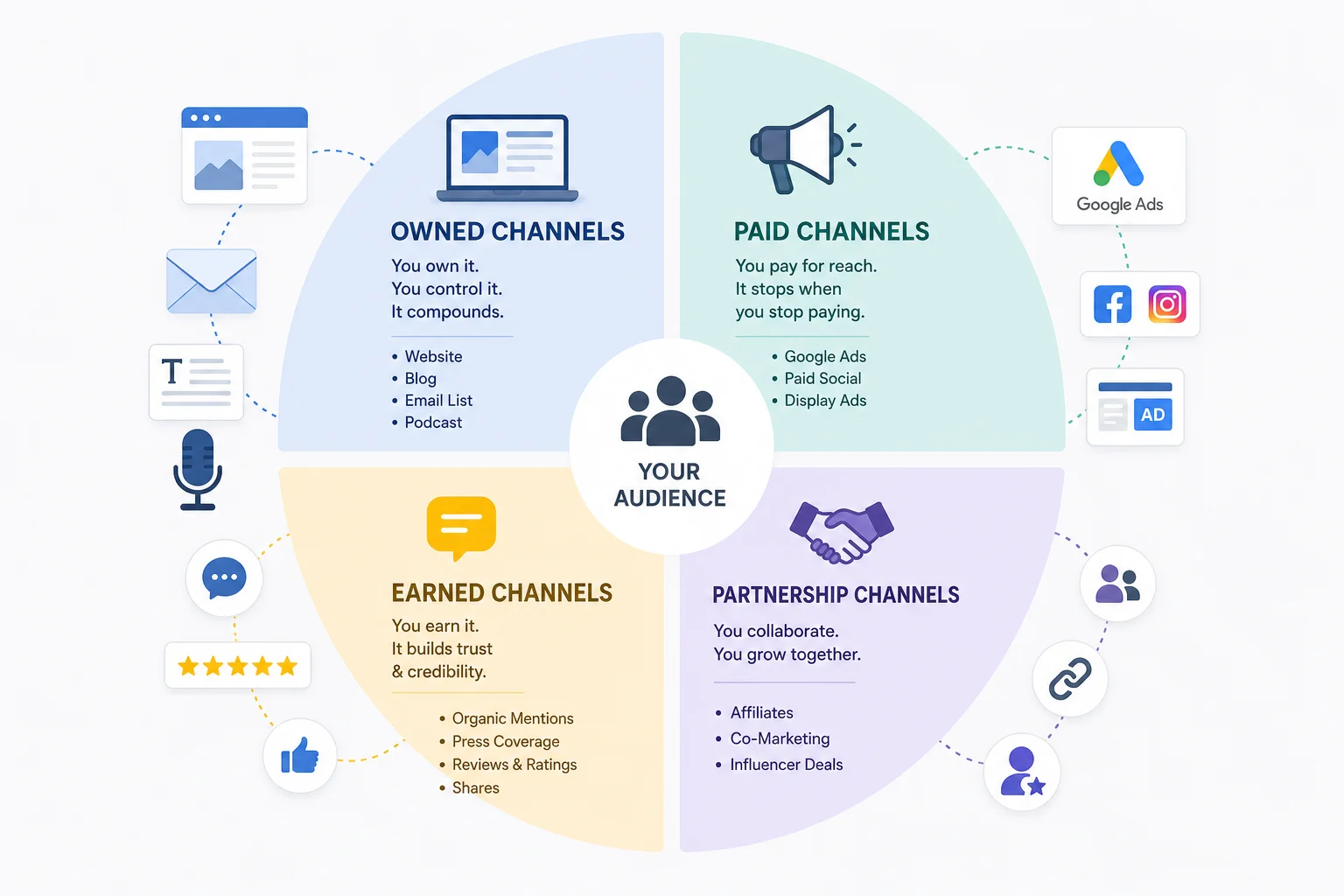
There are four broad categories, split by ownership and payment model:
- Owned channels: your website, email list, blog, podcast, any platform where you control the asset entirely
- Paid channels: Google Ads, paid social, display, anything where reach requires ongoing spend
- Earned channels: organic mentions, press coverage, reviews, shares, third-party credibility you didn’t buy
- Partnership channels: affiliates, co-marketing, influencer deals, arrangements with other companies or creators
The most important distinction in that list is owned vs. rented. It changes everything about how you prioritize.
Owned channels are assets. They compound over time. A blog post you publish today can still drive leads in three years. An email list you build now belongs to you regardless of what any platform decides to do with its algorithm. Nobody can take it from you or price you out of it overnight.
Rented channels are different. Paid ads work until you stop paying. Organic social reach has been declining on most platforms for years because the platforms want you to pay for reach. Even the biggest accounts on Instagram and Facebook have seen their organic numbers drop. The channel you built your brand on can throttle your reach on a Tuesday and there’s nothing you can do about it.
That’s not an argument against rented channels. It’s an argument for not betting everything on them.
The retention math here is worth knowing: omnichannel brands see 89% customer retention on average, while single-channel brands sit at around 33%. That’s not because omnichannel brands are smarter. It’s because customers encounter them in multiple places and stay because of it.
Owned vs. Rented at a Glance
| Owned Channels | Rented / Paid Channels |
|---|---|
| Website / Blog | Google Ads (PPC) |
| Email List | Paid Social Ads |
| SEO Content | Sponsored Content |
| Podcast | Influencer Placements |
With that framing established, here’s what each major channel actually delivers in practice.
The 8 Core Digital Marketing Channels Explained
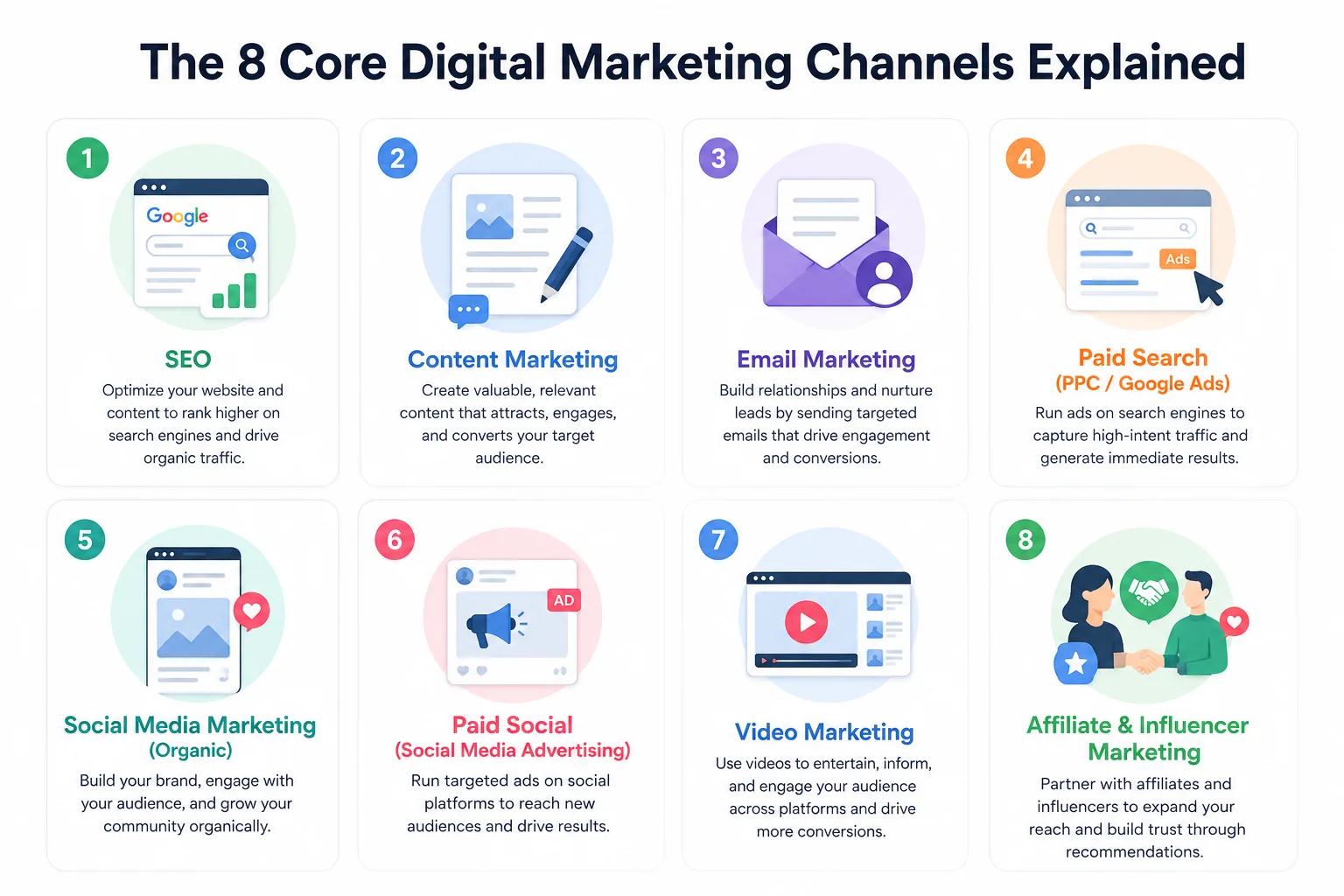
This isn’t a rundown that lists channels and moves on. Each one covers what it is, what it actually delivers, what it costs in time and money, what good execution looks like, and who it’s right for. Including who it’s wrong for, which most guides skip entirely.
1. SEO (Search Engine Optimization)
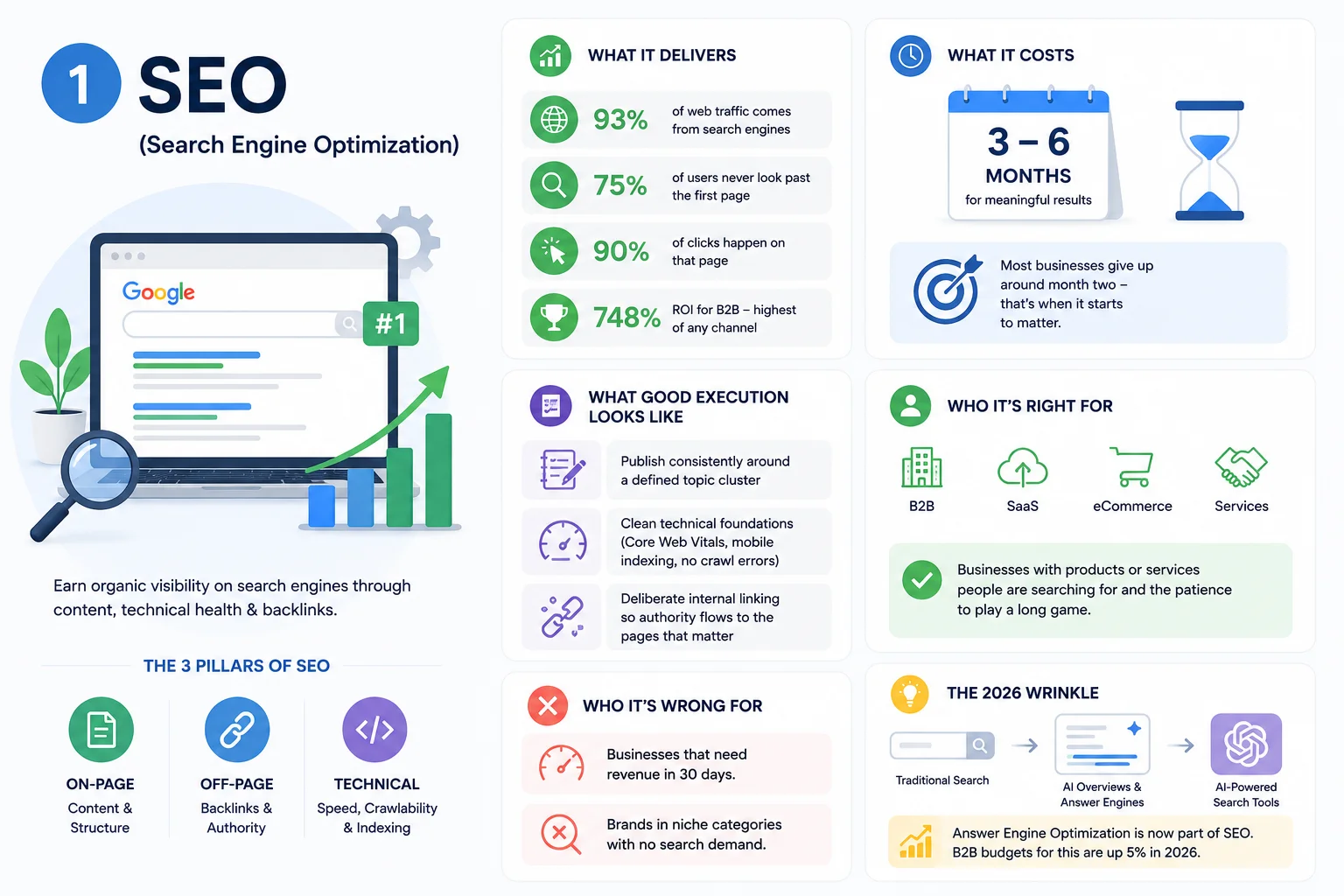
SEO is earning organic visibility on search engines through content, technical site health, and backlinks from other websites that point to yours. Three pillars: on-page (content and structure), off-page (backlinks and authority), and technical (speed, crawlability, indexing). This post isn’t the place to go deep on how each works. The cluster post on SEO covers that. But here’s what you need to know about it as a channel.
What it delivers
93% of web traffic comes from search engines. 75% of users never look past the first page of results, and 90% of clicks happen on that page. If you’re not there, you’re basically invisible to anyone who doesn’t already know your name.
For B2B specifically, SEO delivers a 748% ROI. That’s the highest of any B2B channel. 49% of marketing professionals say organic search delivers the best overall ROI of any channel they use. And 93% of B2B marketers planned to maintain or increase their SEO budgets in 2026.
Those aren’t numbers you can ignore.
What it costs
Time, mostly. Content production, technical audits, and link building are expensive even if the resulting traffic is “free.” Budget 3 to 6 months before you see meaningful results. Most businesses that give up on SEO quit around month two, which is exactly when the work starts to matter.
What good execution looks like
- Publishing consistently around a defined topic cluster, not random posts about whatever seems interesting
- Clean technical foundations: Core Web Vitals, mobile indexing, no crawl errors
- A deliberate internal linking strategy so your authority flows to the pages that matter
Who it’s right for
Any business with a product or service people are searching for and the patience to play a long game. Especially strong for B2B, SaaS, eCommerce, and service businesses.
Who it’s wrong for
Businesses that need revenue in 30 days. Also brands in genuinely niche categories where no search demand exists for what they sell. If nobody’s searching for it, SEO can’t help you find them.
The 2026 wrinkle
B2B search priorities now include Answer Engine Optimization. AI-powered search tools like Google’s AI Overviews and ChatGPT are changing how organic traffic lands. Optimizing for featured snippets and structured answers is part of the SEO job now, not an optional add-on. B2B budgets for this specifically are up 5% in 2026. It’s not replacing traditional SEO but it’s added to what good SEO looks like.
2. Content Marketing
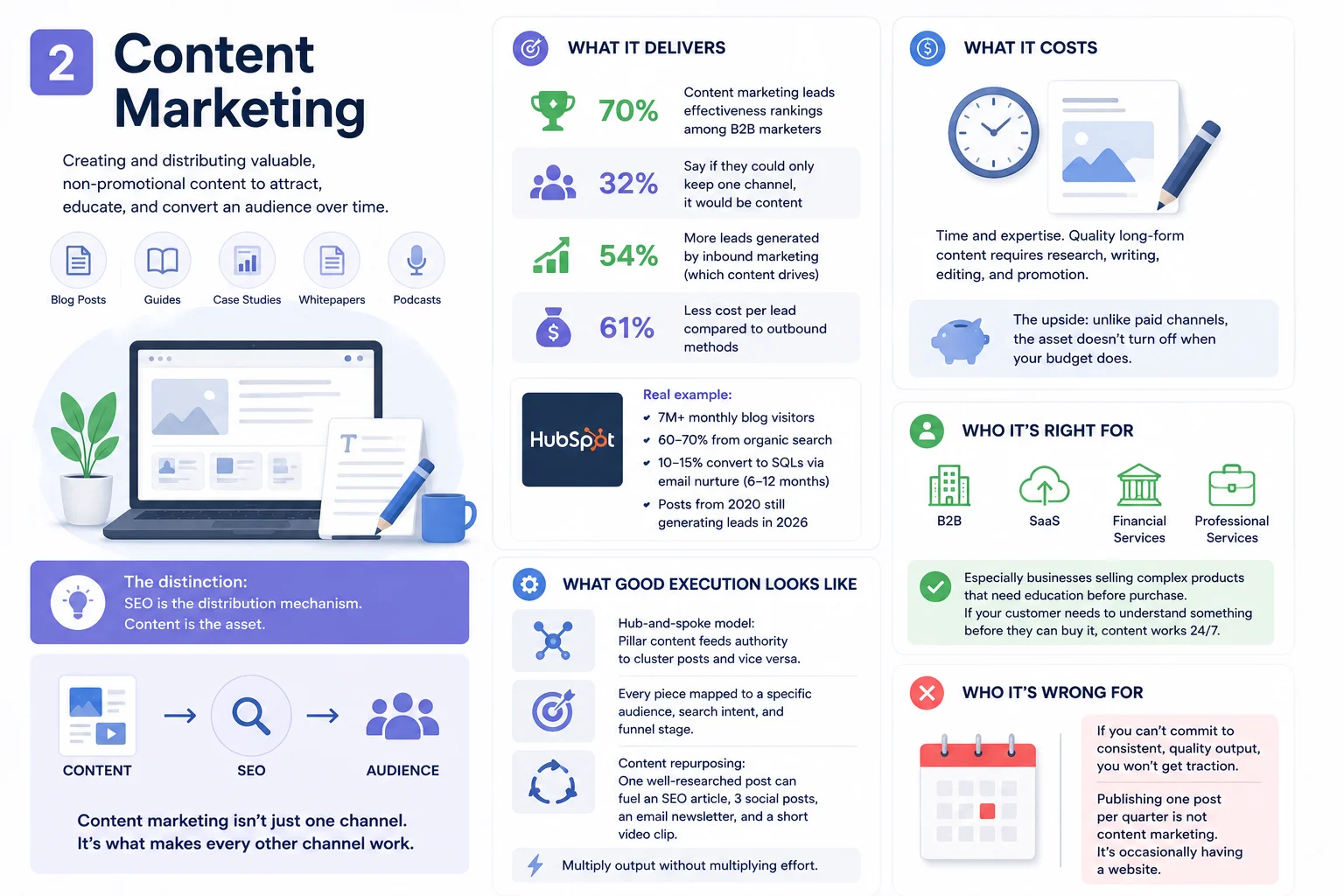
Content marketing is creating and distributing valuable, non-promotional content to attract, educate, and convert an audience over time. Blog posts, guides, case studies, whitepapers, podcasts. The distinction between content marketing and SEO matters: SEO is the distribution mechanism, content is the asset. Content marketing isn’t just one channel. It’s what makes every other channel on this list work.
What it delivers
Content marketing leads effectiveness rankings among B2B marketers at 70%. 32% say if they could only keep one channel, it would be content. Inbound marketing (which content drives) generates 54% more leads than traditional outbound methods, and those leads cost 61% less.
Here’s a real example that shows the compounding effect. HubSpot drives over 7 million monthly blog visitors. 60 to 70% of that comes from organic search. They convert 10 to 15% of those visitors into sales-qualified leads through email nurture over 6 to 12 months. And posts they published in 2020 are still generating leads in 2026. Six years of returns from the same content investment.
What it costs
Time and expertise. Quality long-form content requires research, writing, editing, and promotion. The upside is that unlike paid channels, the asset doesn’t turn off when your budget does.
What good execution looks like
- A hub-and-spoke model where pillar content feeds authority to cluster posts and vice versa
- Every piece mapped to a specific audience, search intent, and funnel stage
- Content repurposing: one well-researched post can fuel an SEO article, three social posts, an email newsletter, and a short video clip. That’s how you multiply output without multiplying effort
Who it’s right for
Every business, honestly. But especially those selling complex products that need education before purchase. B2B, SaaS, financial services, professional services. If your customer needs to understand something before they can buy it, content is doing that work 24 hours a day.
Who it’s wrong for
Nobody is fundamentally wrong for content marketing. But if you can’t commit to consistent, quality output, you won’t get traction. Publishing one post per quarter is not content marketing. It’s occasionally having a website.
3. Email Marketing
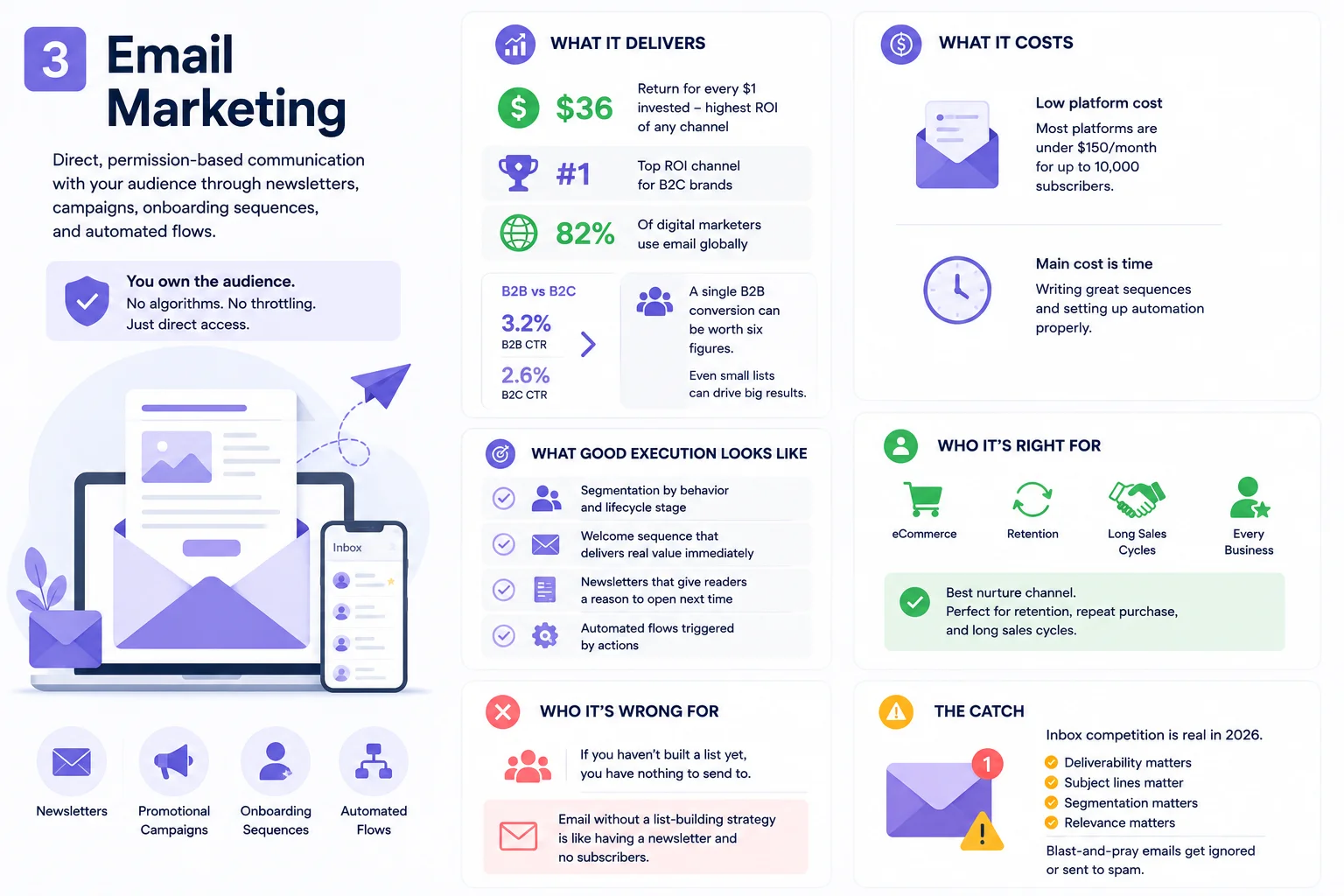
Email is direct, permission-based communication with an opted-in list through newsletters, promotional campaigns, onboarding sequences, and automated flows. The channel where you own the audience completely. No algorithm controls your reach. No platform can decide to throttle your distribution next Tuesday.
What it delivers
$36 return for every $1 invested. That’s the highest measured ROI of any digital marketing channel, confirmed across multiple independent studies. For B2C brands, email is the number one ROI channel. 82% of digital marketers use it globally.
In B2B, email click-through rates (3.2%) actually outperform B2C (2.6%). And a single B2B conversion, like a booked demo or a signed contract, can be worth six figures. That math makes email worthwhile even at modest list sizes.
What it costs
Low. Most email platforms are under $150 per month for lists up to 10,000 subscribers. The main cost is time: writing quality sequences and setting up automation properly.
What good execution looks like
- Segmentation by behavior and lifecycle stage, not “all subscribers”
- A welcome sequence that delivers real value immediately
- Newsletters that don’t just push promotions, they give readers a reason to open next time
- Automated flows triggered by actions: signup, purchase, inactivity, browsing behavior
Who it’s right for
Every business with customers or leads. Especially businesses focused on retention, repeat purchase, or long sales cycles. Email is the best nurture channel that exists, and it’s not close.
Who it’s wrong for
Nobody in theory. But if you haven’t built a list yet, you have nothing to send to. Email without a list-building strategy is like having a newsletter and no subscribers.
The catch
Inbox competition is real in 2026. Deliverability, subject line quality, and segmentation are now the baseline, not a competitive advantage. Blasting your entire list with the same promotional email is the fastest way to get ignored, or filtered straight to spam.
4. Paid Search (PPC / Google Ads)
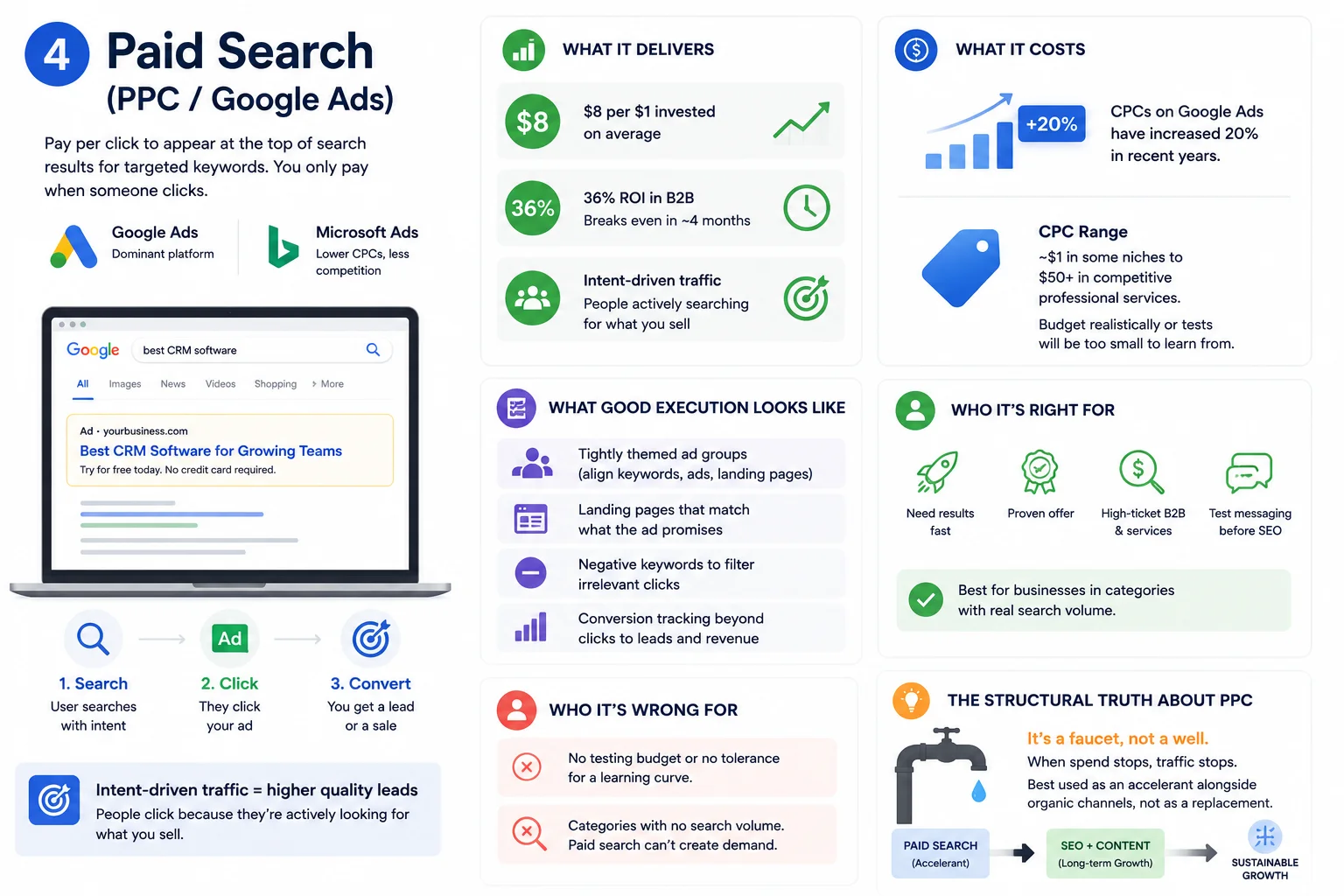
Paid search means paying per click to appear at the top of search engine results for targeted keywords. You only pay when someone clicks. Google Ads is the dominant platform. Microsoft Ads (Bing) is the overlooked option with lower cost-per-clicks and less competition in most categories, worth considering especially for B2B.
What it delivers
Google Ads returns approximately $8 per $1 invested on average. In B2B specifically, PPC delivers a 36% ROI but breaks even in roughly four months, making it the fastest channel for short-term pipeline. The traffic is intent-driven: people clicking your ad are actively searching for what you sell, which is a fundamentally different kind of audience than someone scrolling through their social feed.
What it costs
Cost per click on Google Ads has increased 20% in recent years as competition has intensified, especially in categories like legal, financial services, and SaaS. CPC ranges from about $1 in some niches to over $50 per click in competitive professional services verticals. Budget needs to be realistic about this or you’ll run tests too small to learn from.
What good execution looks like
- Tightly themed ad groups where keywords, ads, and landing pages all align
- Landing pages that actually match what the ad promises
- Negative keyword lists to filter irrelevant clicks before they drain budget
- Conversion tracking that goes beyond clicks into actual leads and revenue
Who it’s right for
Businesses that need results fast, have a proven offer, and operate in a category with real search volume. High-ticket B2B and service businesses where one closed deal justifies significant ad spend. Also useful for testing messaging before committing to SEO investments.
Who it’s wrong for
Businesses with no testing budget and no tolerance for a learning curve. Also brands in categories where nobody searches for the solution, because if search volume doesn’t exist, paid search can’t create it.
The structural truth about PPC
It’s a faucet, not a well. The moment spend stops, traffic stops. Every competitor who keeps spending stays visible while you disappear. PPC is best used as an accelerant alongside organic channels, not as a replacement for them.
5. Social Media Marketing (Organic)
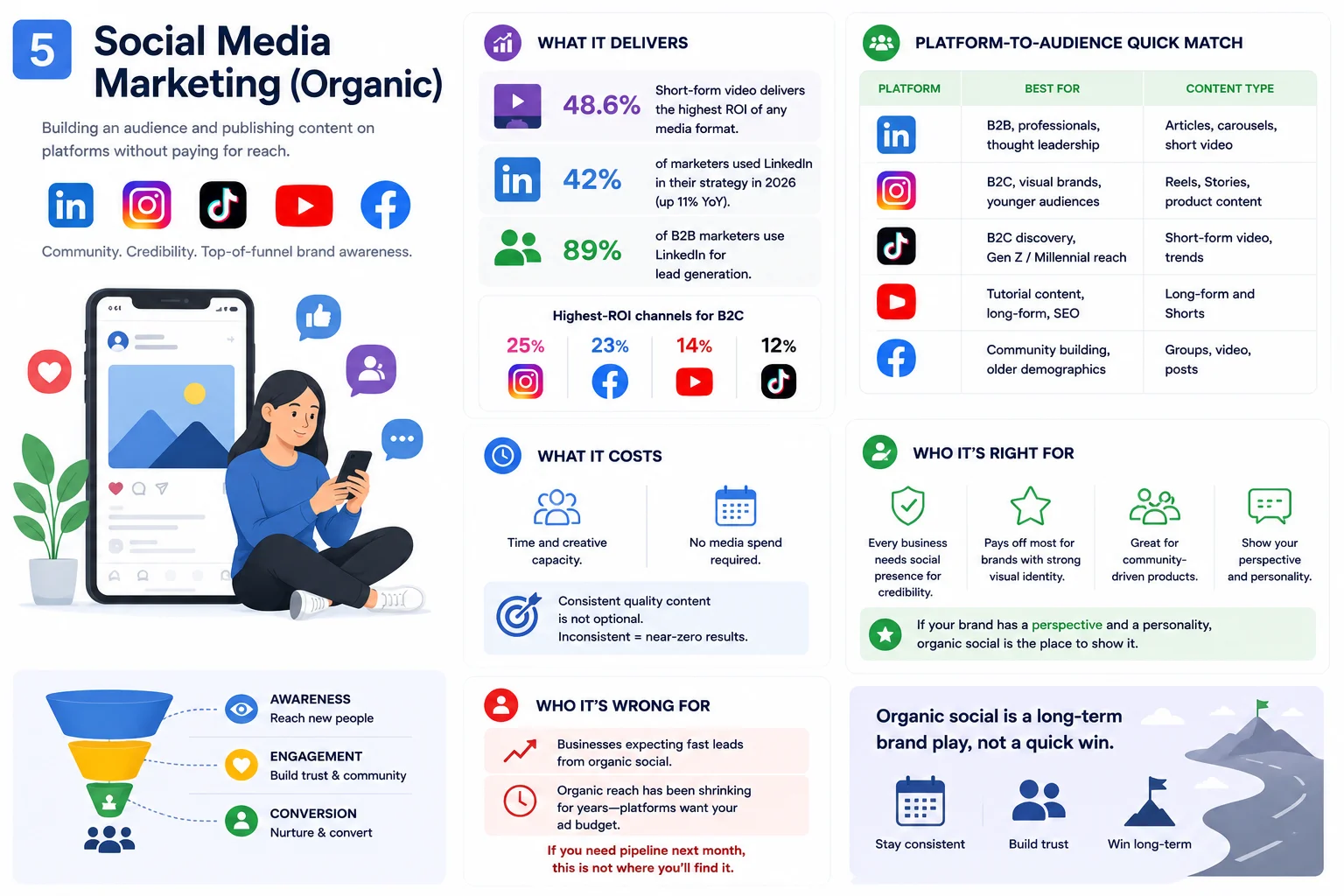
Organic social is building an audience and publishing content on platforms like LinkedIn, Instagram, TikTok, YouTube, and Facebook without paying for reach. It’s about community, credibility, and top-of-funnel brand awareness.
What it delivers
Short-form video delivers the highest ROI of any media format, with 48.6% of marketers ranking it in their top three for performance. LinkedIn specifically: 42% of marketers used it as part of their strategy in 2026, up 11% from the previous year. 89% of B2B marketers use LinkedIn for lead generation.
For B2C, Instagram is the highest-ROI social channel at 25% of marketers, followed by Facebook at 23%, YouTube at 14%, and TikTok at 12%.
What it costs
Time and creative capacity. No media spend required, but consistent quality content is not optional. Inconsistent organic social produces near-zero results.
Platform-to-Audience Quick Match
| Platform | Best For | Content Type |
|---|---|---|
| B2B, professionals, thought leadership | Articles, carousels, short video | |
| B2C, visual brands, younger audiences | Reels, Stories, product content | |
| TikTok | B2C discovery, Gen Z / Millennial reach | Short-form video, trends |
| YouTube | Tutorial content, long-form, SEO | Long-form and Shorts |
| Community building, older demographics | Groups, video, posts |
Who it’s right for
Every business needs some social presence just for credibility. Active investment pays off most for brands with strong visual identity, frequent content to share, or community-driven products. If your brand has a perspective and a personality, organic social is the place to show it.
Who it’s wrong for
Businesses expecting fast leads from organic social. Organic reach on most platforms has been shrinking for years because platforms want your ad budget. Organic social is a long-term brand play. If you need pipeline next month, this is not where you’ll find it.
6. Paid Social (Social Media Advertising)
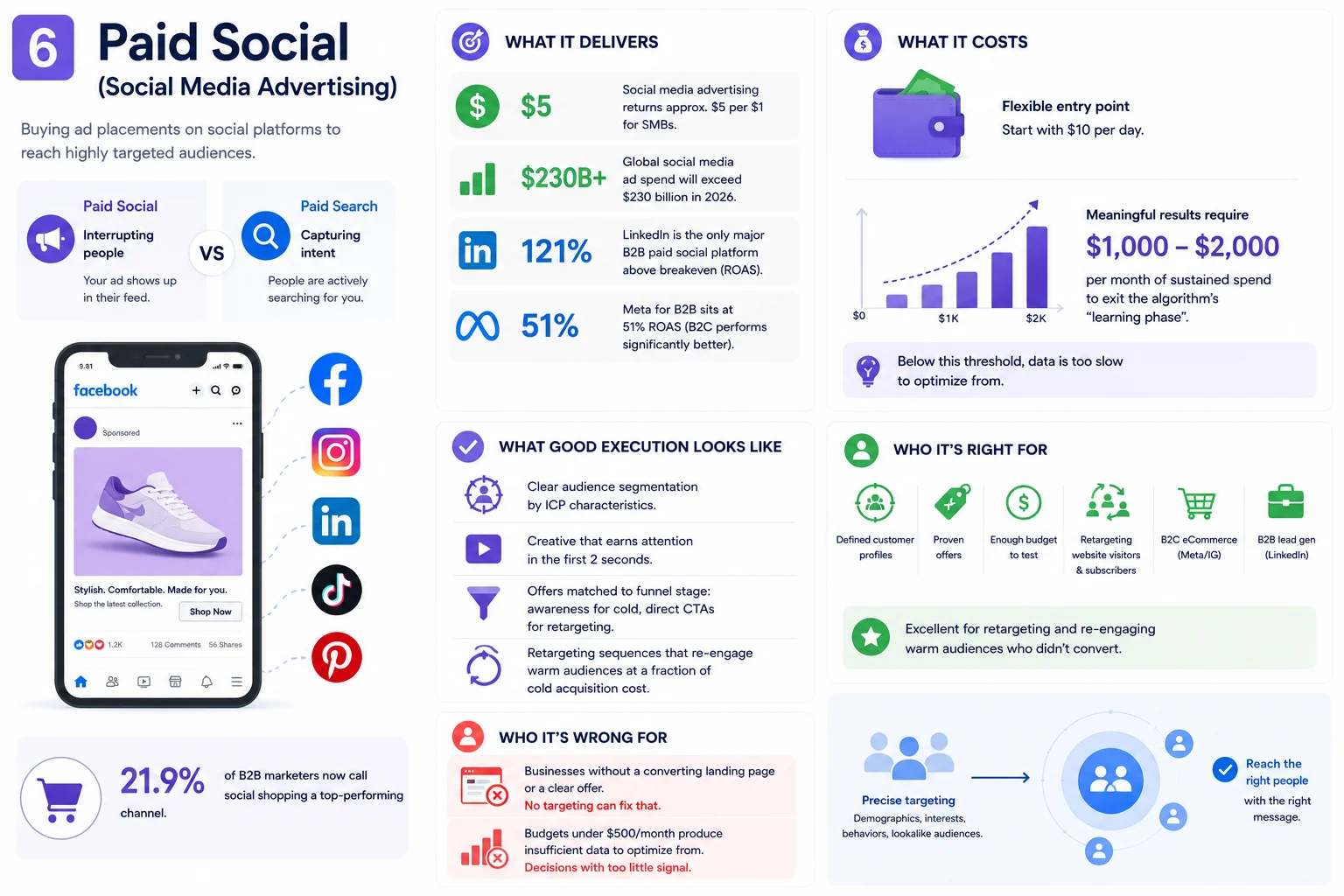
Paid social is buying ad placements on platforms like Meta (Facebook and Instagram), LinkedIn, TikTok, and Pinterest to reach precisely targeted audiences by demographics, interests, behaviors, or lookalike profiles. The key difference from paid search: you’re interrupting people, not capturing active intent. They weren’t searching for you. Your ad showed up in their feed.
What it delivers
Social media advertising returns approximately $5 per $1 for small and mid-sized businesses. Global social media ad spend will exceed $230 billion in 2026. LinkedIn specifically is the only major B2B paid social platform above breakeven, at a 121% ROAS. Meta for B2B sits at 51% ROAS, though B2C campaigns on Meta typically perform significantly better.
One number worth paying attention to: 21.9% of B2B marketers now call social shopping a top-performing channel. That’s not just a B2C thing anymore.
What it costs
Flexible entry point. You can start with $10 per day. But meaningful data and actual results typically require $1,000 to $2,000 per month of sustained spend to exit the algorithm’s “learning phase” on most platforms. Below that threshold, you’re often collecting data too slowly to optimize from.
What good execution looks like
- Clear audience segmentation by ICP characteristics, not just broad demographic targeting
- Creative that earns attention in the first two seconds before the scroll moves on
- Offers matched to funnel stage: awareness-level content for cold audiences, direct CTAs for retargeting
- Retargeting sequences that re-engage warm audiences at a fraction of cold acquisition cost
Who it’s right for
Businesses with defined customer profiles, proven offers, and enough budget to actually test. Excellent for retargeting website visitors and email subscribers who didn’t convert the first time. B2C eCommerce on Meta and Instagram. B2B lead gen on LinkedIn.
Who it’s wrong for
Businesses without a converting landing page or a clear offer. If the landing page doesn’t work, no targeting in the world fixes that. Also, budgets under $500 per month will produce insufficient data to optimize from. You’ll be making decisions with too little signal.
7. Video Marketing
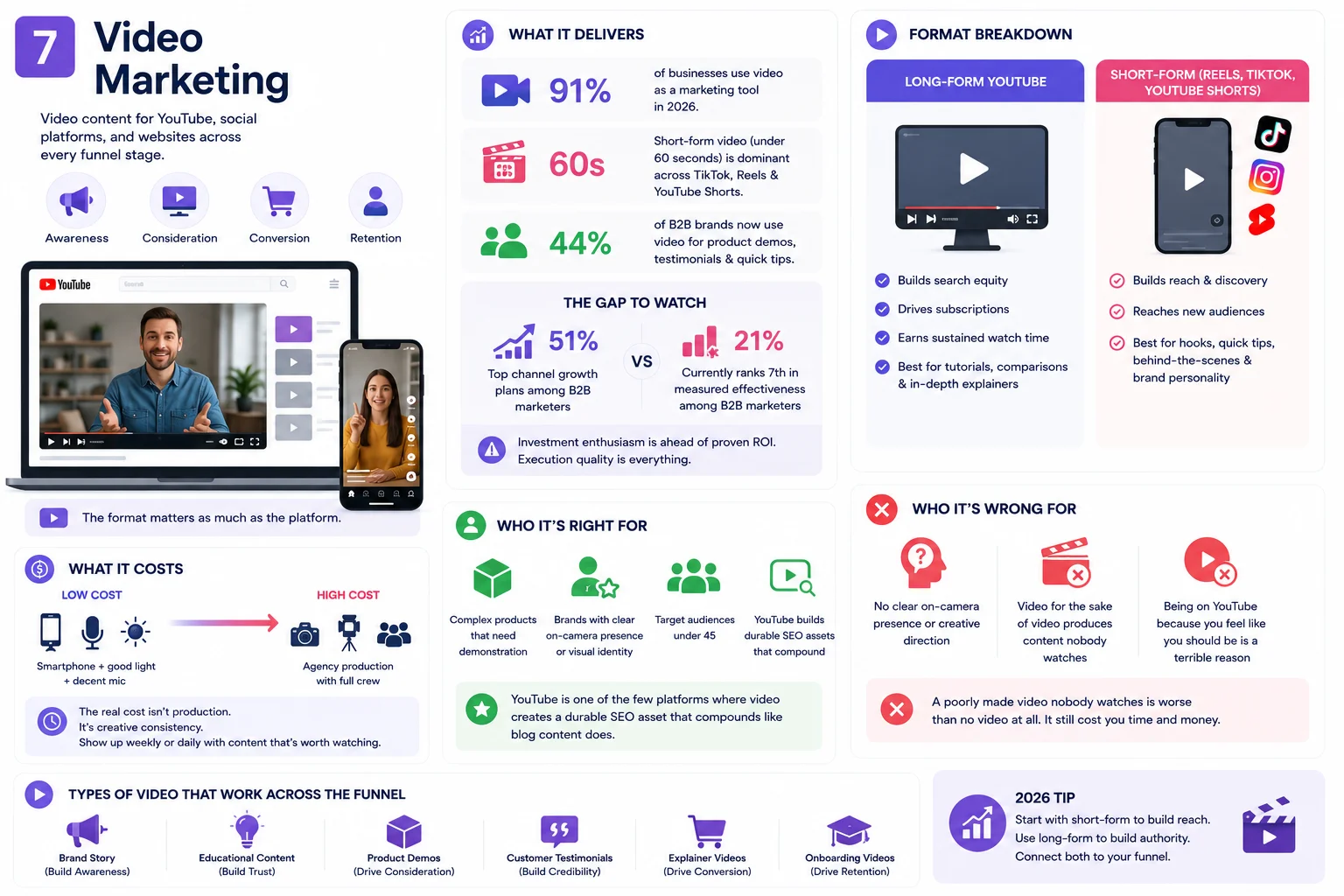
Video is content created for YouTube, social platforms, or embedded on websites and landing pages. It works across every funnel stage: brand awareness, product demos, customer testimonials, post-purchase onboarding. The format matters as much as the platform.
What it delivers
91% of businesses use video as a marketing tool in 2026. Short-form video (under 60 seconds, vertical, optimized for sound-off viewing) is dominant across TikTok, Instagram Reels, and YouTube Shorts. 44% of B2B brands now use it for product demos, customer testimonials, and quick tips.
Here’s the gap worth flagging honestly: video tops channel growth plans at 51% among B2B marketers, but it currently ranks 7th in measured effectiveness at 21%. Investment enthusiasm is running well ahead of proven ROI. That doesn’t mean video is overhyped, it means execution quality matters more than just having video. A poorly made video nobody watches is worse than no video at all because it still cost you time and money.
Format breakdown
Long-form YouTube builds search equity, drives subscriptions, and earns sustained watch time. Best for tutorials, comparisons, and in-depth explainers where depth is the product. Short-form Reels, TikTok, and YouTube Shorts build reach and discovery with new audiences. Best for hooks, quick tips, behind-the-scenes, and brand personality.
What it costs
Production ranges from near-zero (smartphone, good natural light, a decent microphone) to significant (agency production with full crew). The real cost isn’t production. It’s creative consistency. Showing up weekly or daily with content that’s worth watching is the actual work.
Who it’s right for
Complex products that need demonstration. Brands with a clear on-camera presence or strong visual identity. Businesses targeting audiences under 45. YouTube in particular is one of the few platforms where video creates a durable SEO asset that compounds like blog content does.
Who it’s wrong for
Businesses without a clear on-camera presence or creative direction. Video for the sake of video produces content nobody watches. Being on YouTube because you feel like you should be is a terrible reason to be on YouTube.
8. Affiliate & Influencer Marketing
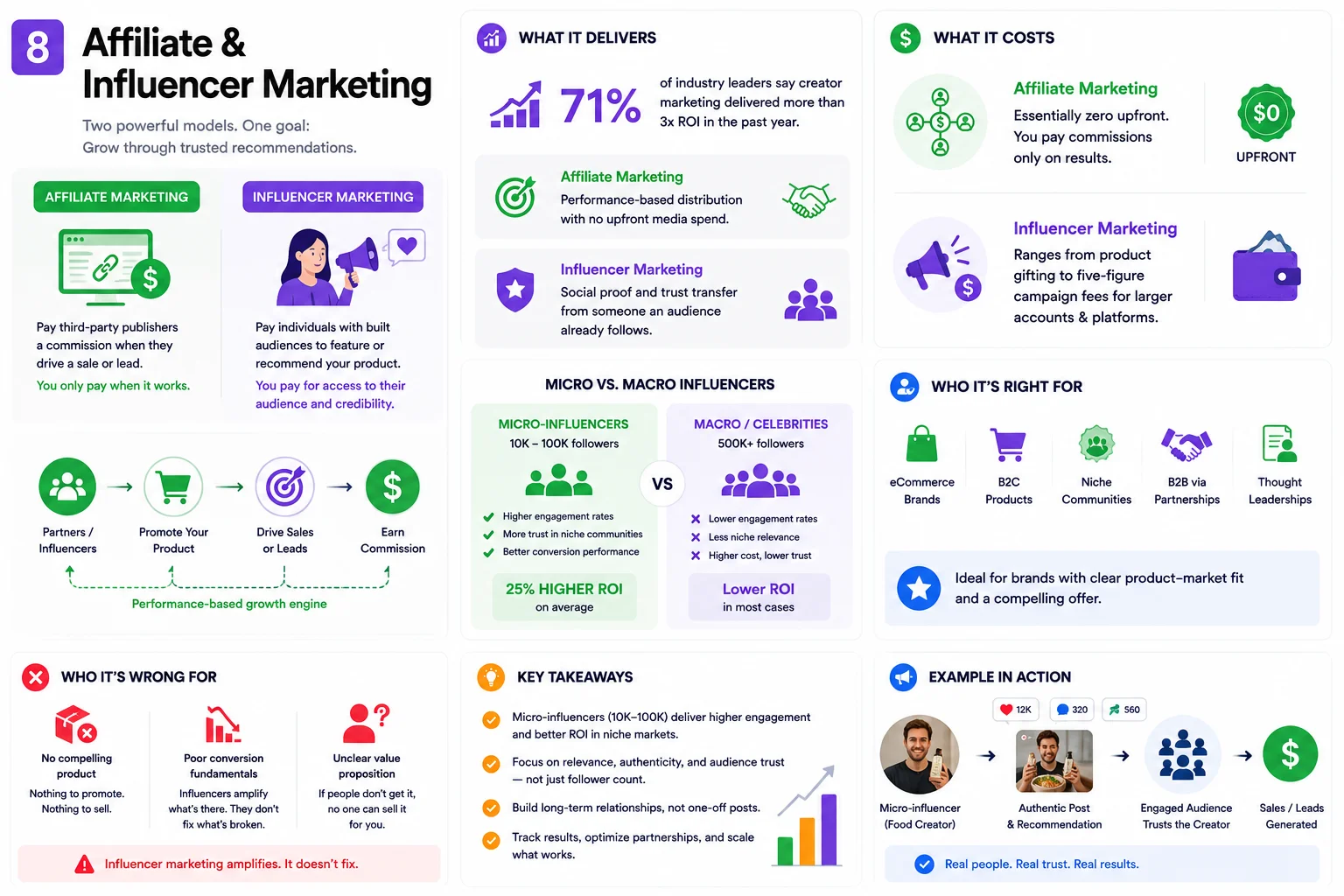
Two related but distinct models. Affiliate marketing pays third-party publishers a commission when they drive a sale or lead. You only pay when it works. Influencer marketing pays individuals with built audiences on social, YouTube, or podcasts to feature or recommend your product. You pay for access to their audience and their credibility.
What it delivers
71% of industry leaders say creator marketing delivered more than 3x ROI in the past year. The core value proposition for affiliates is performance-based distribution with no upfront media spend. For influencers, it’s social proof and trust transfer from someone an audience already follows.
The micro vs. macro influencer question comes up constantly and the answer is almost always micro. Micro-influencers (10,000 to 100,000 followers) drive higher engagement rates and generate more trust in specific niches than celebrity-tier accounts. Micro-communities generate 25% higher ROI on average. A 50,000-follower food creator with a highly engaged audience in your product category will outperform a 2-million-follower general lifestyle account almost every time.
What it costs
Affiliate: essentially zero upfront. You pay commissions on results. Influencer: ranges from product gifting at the low end to five-figure campaign fees for larger accounts and platforms.
Who it’s right for
eCommerce and B2C brands with clear product-market fit. B2B can work with it through thought leadership partnerships, co-marketing with industry publications, or LinkedIn creator collaborations.
Who it’s wrong for
Businesses without a compelling product or a clear value proposition. This is the most important thing to understand about influencer marketing: it amplifies what’s already there. It doesn’t fix a conversion problem. If your product doesn’t convert organically, paying an influencer to send traffic to it won’t change that.
B2B vs. B2C: Why Your Business Model Determines Your Channel Stack
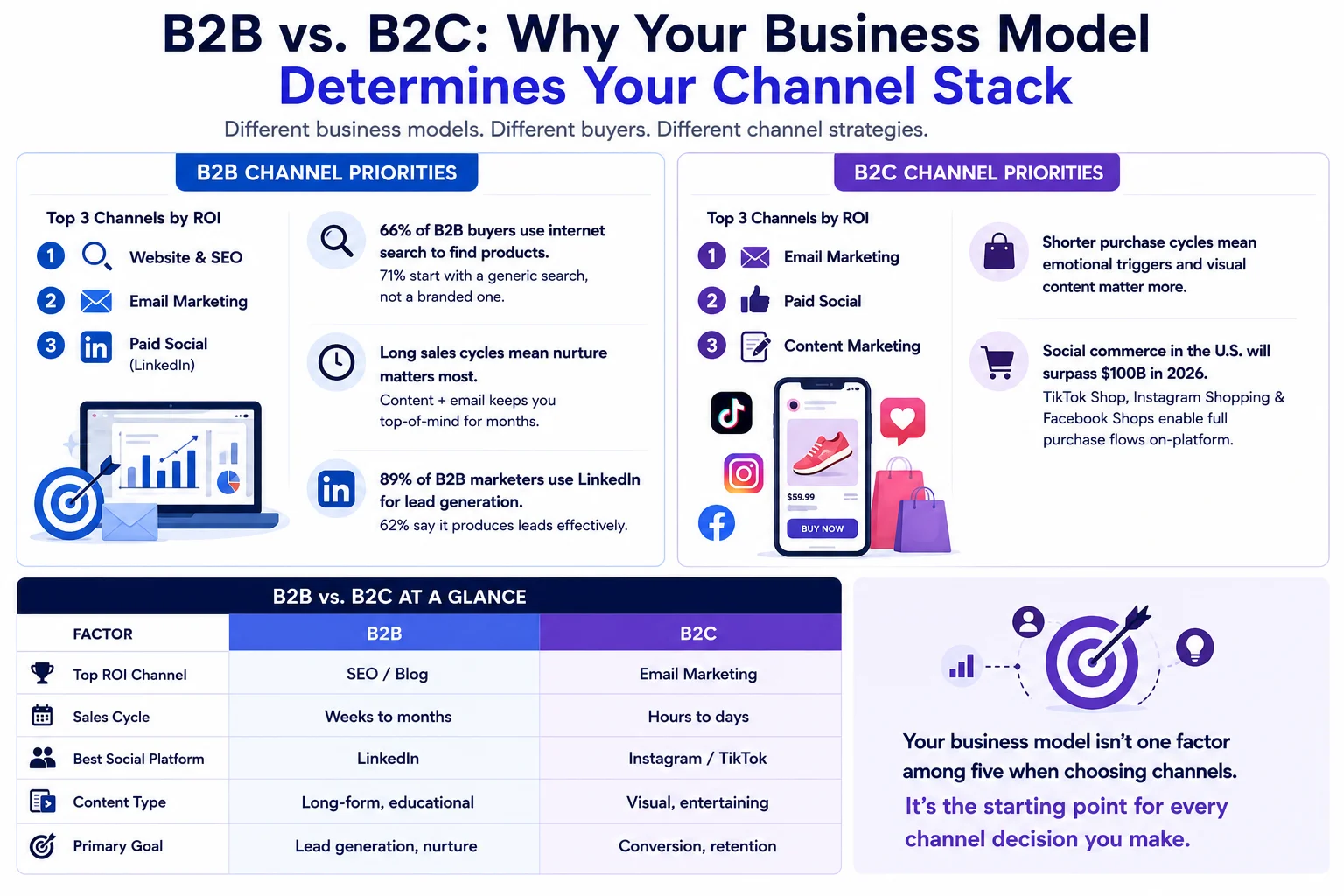
This section exists because the channel decisions for a B2B SaaS company and a D2C skincare brand are almost completely different. Treating them the same is one of the most common mistakes in marketing strategy.
B2B Channel Priorities
For B2B, the top three channels by ROI are website and SEO, email marketing, and paid social, in that order.
The reason SEO sits at the top is worth understanding properly. 66% of B2B buyers use internet search to find products. 71% start with a generic search, not a branded one. That means SEO captures demand before buyers even know your brand name exists. You’re not trying to win against competitors you already know. You’re winning visibility before the buyer has decided who to consider.
Long sales cycles mean nurture matters more than conversion volume. A B2B deal that takes four months to close can’t be forced with a single ad impression. Content plus email is how you stay present across that entire timeline. 89% of B2B marketers use LinkedIn for lead generation, and 62% say it produces leads effectively.
B2C Channel Priorities
For B2C, the top three channels by ROI are email marketing, paid social, and content marketing.
Shorter purchase cycles mean emotional triggers and visual content matter more. Social and video do the heavy lifting. Social commerce in the US is projected to surpass $100 billion in 2026, with TikTok Shop, Instagram Shopping, and Facebook Shops enabling full purchase flows without leaving the platform. For many product categories, social media is the entire purchase funnel compressed into a single surface.
B2B vs. B2C at a Glance
| Factor | B2B | B2C |
|---|---|---|
| Top ROI Channel | SEO / Blog | Email Marketing |
| Sales Cycle | Weeks to months | Hours to days |
| Best Social Platform | Instagram / TikTok | |
| Content Type | Long-form, educational | Visual, entertaining |
| Primary Goal | Lead generation, nurture | Conversion, retention |
Your business model isn’t one factor among five when choosing channels. It’s the starting point for every channel decision you make.
How to Choose the Right Digital Marketing Channels for Your Business
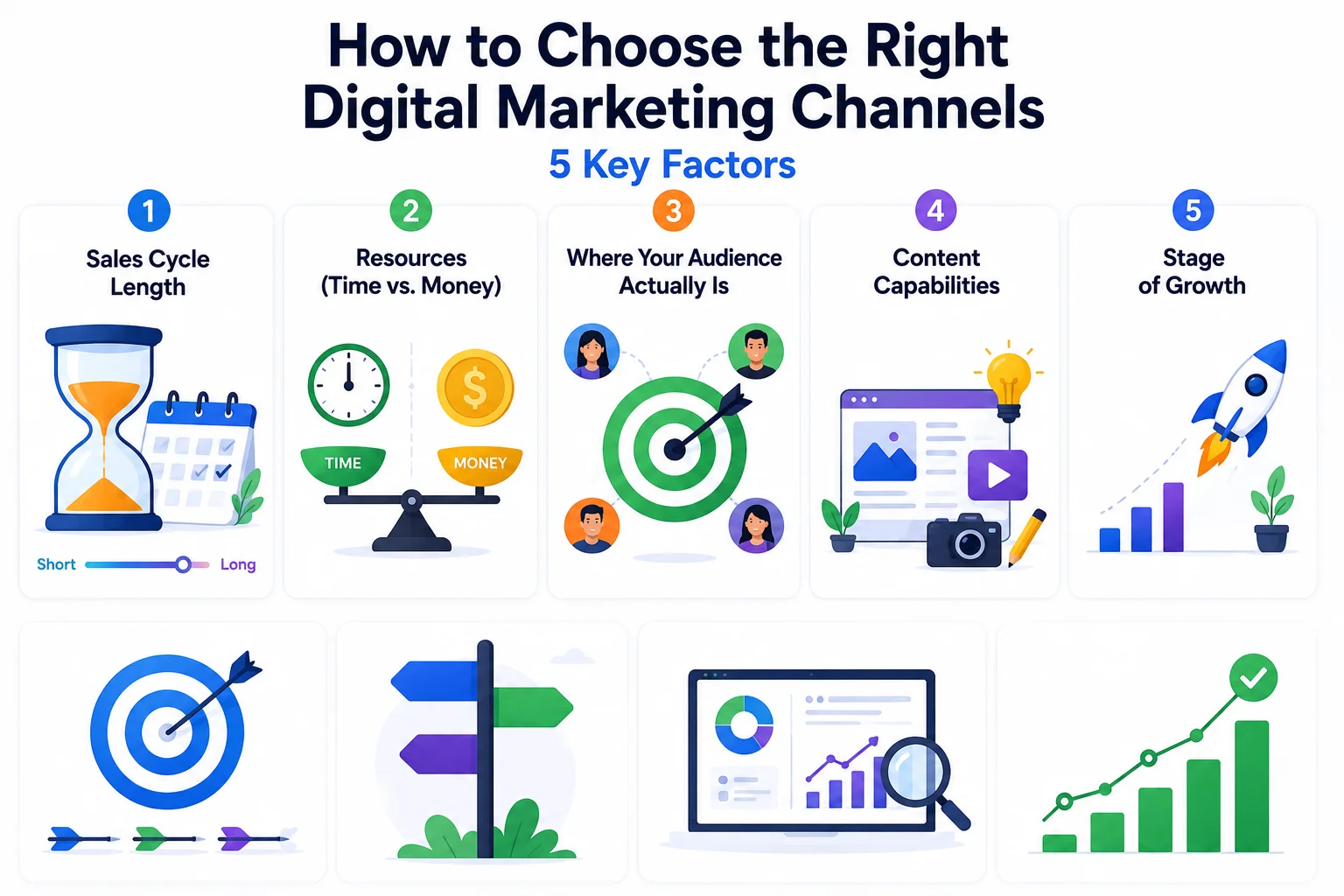
The wrong question is “which channel is best?” The right question is “which channel is best for my business, at this stage, with these resources?”
Here are the five factors that actually determine the answer.
Factor 1: Your Sales Cycle Length
Short sales cycles (impulse purchases, low-ticket items, quick decisions) favor paid social, email, and influencers. You need reach and emotional pull more than you need sustained nurture.
Long sales cycles (enterprise deals, complex products, professional services) favor SEO, content, email nurture sequences, and LinkedIn. These are the compounding channels that keep you visible across a four-to-six month decision timeline. Paid search supplements by capturing high-intent demand mid-funnel when buyers are actively comparing options.
Factor 2: Your Resources (Time vs. Money)
Different channels have radically different resource profiles:
- High time, low money: SEO, organic social, content marketing
- High money, low time: paid search, paid social
- Balanced, relatively low on both: email marketing
A useful framework here is the 3-3-3 rule: three core messages, three primary channels, three measurable outcomes. It exists specifically to prevent the channel sprawl that kills most marketing strategies. If you can’t name your three channels and what success looks like for each, you don’t have a strategy yet.
Factor 3: Where Your Audience Actually Is
Don’t go where the audience is largest in absolute terms. Go where your specific audience is most active and most receptive. The full LinkedIn user base is 1 billion people, but if your buyers don’t use it for professional research, it’s irrelevant to you.
How to find this: check existing analytics for which referral sources already drive engaged traffic. Survey your best customers about where they discovered you. Look at where competitors have active, engaged followings (not just large ones). High follower count with low engagement is a warning sign, not a model to copy.
Factor 4: Your Content Capabilities
This is the most honest conversation most businesses avoid. Can your team consistently produce long-form written content? Are you comfortable on camera? Do you have design resources for visual social? These aren’t aspirational questions. They’re operational ones.
Channel selection has to account for what you can sustain, not what sounds exciting. The best channel for your business is the one you can actually show up for consistently. An underexecuted channel is worse than no channel because it still costs time while delivering nothing.
Factor 5: Your Stage of Growth
Early-stage businesses face the temptation to be everywhere at once. Resist it. Pick the two channels most likely to reach your ideal customer and build genuine competence in those first. Expansion comes after proof, not before.
The audit principle is simple: look at where your best existing customers actually came from. Double down on those channels. Then, once they’re producing consistent results, expand to one adjacent channel. Sequentially, not simultaneously.
Channel Priority by Business Stage
The right channels at year one are different from the right channels at year three. Here’s how to sequence investment as the business grows.
| Stage | Primary Channels | Secondary Channels | Logic |
|---|---|---|---|
| Pre-launch / Early | SEO foundation + email list building + 1 social platform | None | Build owned assets before spending on paid |
| Growth (0 to $500K revenue) | SEO + content + email | 1 paid channel for testing | Compound organic while validating paid economics |
| Scaling ($500K to $2M) | SEO + email + paid search | Paid social + video | Add paid at scale once unit economics work |
| Established ($2M+) | Full channel mix | Affiliate / influencer | Diversify, optimize attribution, expand reach |
Depth before breadth at every stage. Teams excelling in 3 to 5 channels consistently outperform those diluting effort across 10 or more.
One more thing worth saying directly: resist the urge to add a new channel every time one isn’t working. The issue is rarely the channel itself. It’s almost always execution depth or time horizon. Businesses quit SEO at month three. They pause email sequences after two campaigns. They stop paid social before the algorithm has enough data to optimize. The channel gets blamed for a commitment problem.
How to Build Your Digital Marketing Channel Strategy (Step-by-Step)
This is the section most competing pillar pages skip. Listing channels is easy. Turning that into an actual operating strategy is the work. A real digital marketing strategy answers four things: who you’re targeting, where you’ll reach them and why, what assets you need at each stage of the funnel, and how you’ll measure outcomes that connect to revenue. Everything else is execution detail.
Step 1: Audit What’s Already Working
Before adding anything new, understand what you already have. Pull 12 months of analytics data. Identify which channels are already driving traffic, leads, and conversions, even if they’re not being actively managed. Compare key metrics across Google Analytics, your CRM, and any ad platforms you’re running. Look for where the numbers don’t align across tools. That misalignment is usually where the real friction lives. Start from reality, not from what you wish was working.
Step 2: Define One Primary Goal
You can only choose channels, messaging, and KPIs once you know what you’re actually trying to accomplish. One primary goal for the next 6 to 12 months. Not five goals. One. Volume, lead quality, retention, or CAC reduction.
Be specific. A business trying to reduce customer acquisition costs should double down on owned channels. A business trying to scale volume fast needs paid media plus conversion rate optimization. These require different channels, different content, and different metrics. Trying to optimize for all of them simultaneously means optimizing for none of them.
Step 3: Pick Your Primary Channel Stack (Max 3)
Based on business model, growth stage, resource profile, and where your audience actually is, commit to two or three channels. Not seven. Not “we’ll try everything and see what sticks.” Two or three, executed with genuine depth and consistency over a meaningful time horizon.
When channel expansion feels tempting, ask whether the current two or three are producing consistent, measurable results first. If the answer is no, add execution depth before adding channels.
Step 4: Set Channel-Specific KPIs
Each channel needs its own success metric tied to a business outcome, not a vanity metric. Here’s what that looks like by channel:
- SEO: organic sessions, keyword rankings in target positions, leads from organic traffic
- Email: open rate, click-through rate, conversion rate, revenue per email sent
- Paid search: ROAS, cost per lead, customer acquisition cost
- Social: reach, engagement rate, click-through to website
Impressions and follower counts are not KPIs. If a metric doesn’t connect to pipeline or revenue, it’s decorative.
Step 5: Build the Content Engine That Feeds All Channels
Content isn’t one channel on this list, it’s the infrastructure that makes every other channel work. SEO needs content. Email needs content. Paid social needs creative. Organic social needs posts. Video is content. The content engine is what runs everything else.
Assign clear ownership within your team. When everyone is responsible for a channel, nobody truly is. One person or one agency should own each channel’s performance and reporting. Shared accountability is just a polite term for unclear accountability.
Step 6: Review, Measure, and Expand
Commit to a 90-day review cadence. At each review, cut what’s not moving and deepen what is. Only add a new channel once current channels are producing consistent, measurable results. The sequence is always: prove, then scale; prove, then expand.
The Channel Mix That Actually Works (Owned, Paid, Earned)
Picking individual channels is one thing. Building a system where they reinforce each other across the full customer journey is what separates a stack from a strategy.
Buyers don’t move through a linear funnel anymore. They discover your brand through a Google search, follow on Instagram, read a blog post, and then convert three weeks later via an email offer. Treating each channel in isolation means you’re measuring a fraction of the real customer journey and missing how your customers actually behave.
The three-layer model:
- Owned (SEO, email, blog): Your compounding foundation. Builds the asset base over time. Slowest to start, most durable long-term. Nobody can take it away.
- Paid (PPC, paid social): Your accelerant. Turns on and off with budget. Best used to amplify proven content and capture demand you know already exists.
- Earned (influencers, PR, affiliates, reviews): Your amplifier. Third-party credibility that money can’t fully replicate. It has to be earned.
The integration principle that makes this work: SEO should inform what you spend on paid. Sales objections should shape what content you create. Customer success insights should influence your email flows and retention marketing. Channels operating in silos produce results that don’t compound. Channels feeding each other produce results that do.
The retention stat comes back here: omnichannel brands achieve 89% customer retention versus 33% for single-channel brands. The math on building a connected channel system is pretty clear.
Digital Marketing Channels at a Glance: Full Comparison Table
A reference table covering all eight channels across the dimensions that matter most for decision-making.
| Channel | Cost Level | Time to Results | ROI Potential | Difficulty | Best For |
|---|---|---|---|---|---|
| SEO | Low to Medium | 3 to 9 months | Very High (748% B2B) | High | Long-term organic growth |
| Content Marketing | Low to Medium | 3 to 12 months | High | Medium | Authority, lead nurture |
| Email Marketing | Low | Immediate (list needed) | Highest ($36 per $1) | Medium | Retention, conversion |
| Paid Search (PPC) | High | Days | Medium to High ($8 per $1) | Medium | Intent capture, fast results |
| Organic Social | Low | 6 to 18 months | Medium | Medium | Brand, awareness, community |
| Paid Social | Medium to High | Days to Weeks | Medium ($5 per $1) | Medium | Targeting, retargeting |
| Video Marketing | Medium | 3 to 12 months | High (format-dependent) | High | Demos, brand, YouTube SEO |
| Affiliate / Influencer | Low to High | Weeks | High (3x+ for creators) | Low to Medium | eCommerce, B2C, reach |
One thing the table doesn’t capture: the channels that take longest to show results are often the highest priority ones. SEO and email consistently rank as the two most powerful channels in measured ROI. They’re underinvested in precisely because they require patience that most businesses struggle to sustain. That’s the actual competitive advantage. Most competitors quit before the channel compounds.
Conclusion
The channel isn’t the strategy. The system is.
Every business that tries to be everywhere ends up strong nowhere. The ones that actually compound pick two or three channels aligned to their model, their audience, and their real operational capacity. Then they build genuine depth before they expand. That’s it. That’s the whole game.
The decision framework comes down to three moves. Start where your audience is already searching (SEO) or already gathering (one social platform). Build the owned asset that no algorithm or platform change can take away from you (your email list). Add paid media to accelerate what’s already proven, not to rescue what isn’t working.
Every cluster post linked throughout this guide goes deeper on whichever channel you’ve decided to prioritize. Start there.
Frequently Asked Questions
What is the most effective digital marketing channel?
No single channel wins for every business. Email delivers the highest measured ROI at $36 for every $1 invested. Organic search is the number one ROI channel for 49% of marketing professionals across all business types. The right answer depends on whether you’re B2B or B2C, what stage you’re at, and what resources you have.
How many digital marketing channels should I use?
Two to three primary channels executed with real depth will outperform six channels executed inconsistently. Start focused. Expand once you have proof of traction. Most businesses that plateau are spread too thin, not too focused.
Which digital marketing channels are best for B2B?
The top ROI-driving channels for B2B in 2026 are website, blog, and SEO; email marketing; and paid social, in that order according to HubSpot’s State of Marketing research. LinkedIn is the dominant social platform for B2B lead generation, with 89% of B2B marketers using it for that purpose.
Which digital marketing channels are best for B2C?
For B2C, the top channels by ROI are email marketing, paid social media, and content marketing. Instagram is the highest-performing social platform for B2C, with Facebook second. Social commerce (TikTok Shop, Instagram Shopping) is growing fast and compressing the purchase funnel for many product categories.
Is SEO or PPC better?
70% of B2B marketers believe SEO generates more sales than PPC over the long term. PPC delivers faster results but requires continuous spend and stops the moment budget stops. SEO builds an asset you own. The real answer is that they serve different purposes: PPC for speed and intent capture, SEO for compounding organic authority. Used together, they complement each other across different timeframes.
How long does it take to see results from digital marketing?
Depends entirely on the channel. Paid channels (PPC, paid social) can produce traffic and leads within days. SEO and content marketing take 3 to 9 months before meaningful organic results appear. Email produces results as soon as you have an engaged list to send to.
What digital marketing channels work for small businesses with limited budgets?
SEO, content, and email are the highest-ROI channels with the lowest ongoing cost. Start with one social platform relevant to your audience. Add paid only once you have a proven offer and positive unit economics. Running paid ads to an offer that doesn’t convert without ads won’t fix the conversion problem.
What is the difference between owned, paid, and earned media?
Owned media is what you control entirely: website, email list, blog. Paid media is what you buy access to: ads. Earned media is third-party exposure you didn’t pay for directly: press coverage, reviews, organic shares, influencer mentions. A strong channel strategy uses all three working together, not competing for the same budget.
How do I measure which digital marketing channel is working?
Set channel-specific KPIs tied to business outcomes, not vanity metrics. Use UTM parameters on all links to track source-level traffic in Google Analytics. Connect marketing data to your CRM to see which channels produce not just traffic and leads, but actual revenue. If you can’t trace a channel to closed deals, you’re measuring the wrong things.
Should I invest in new channels like TikTok or AI search ads?
TikTok is no longer a new channel. 57% of brands use it as of 2026, up from 33.9% in 2025. 35% cite high ROI. New channels are worth testing once your core stack is producing consistent results. Don’t abandon proven channels to chase novelty. Every new platform requires a ramp-up period before it produces anything, and that ramp-up costs time and money you’d otherwise be putting into channels that already work.