

Most businesses don’t fail at marketing because they picked the wrong platform. They fail because they started posting, running ads, and writing blogs before they figured out what they were actually trying to do. They’re busy. Impressively busy. And after six months they look at the numbers and nothing has moved.
That’s not a content problem or an ad budget problem. That’s a strategy problem. More specifically: there was no strategy.
This guide is a step-by-step walkthrough for building a digital marketing strategy from zero. Not from a template downloaded at 2am. Actually from scratch, starting with the uncomfortable questions first. Whether you’re a startup that’s been winging it, a small business owner who finally wants to get serious, or a marketing team that inherited a mess, this is where to start.
What Is a Digital Marketing Strategy (And What It’s Not)
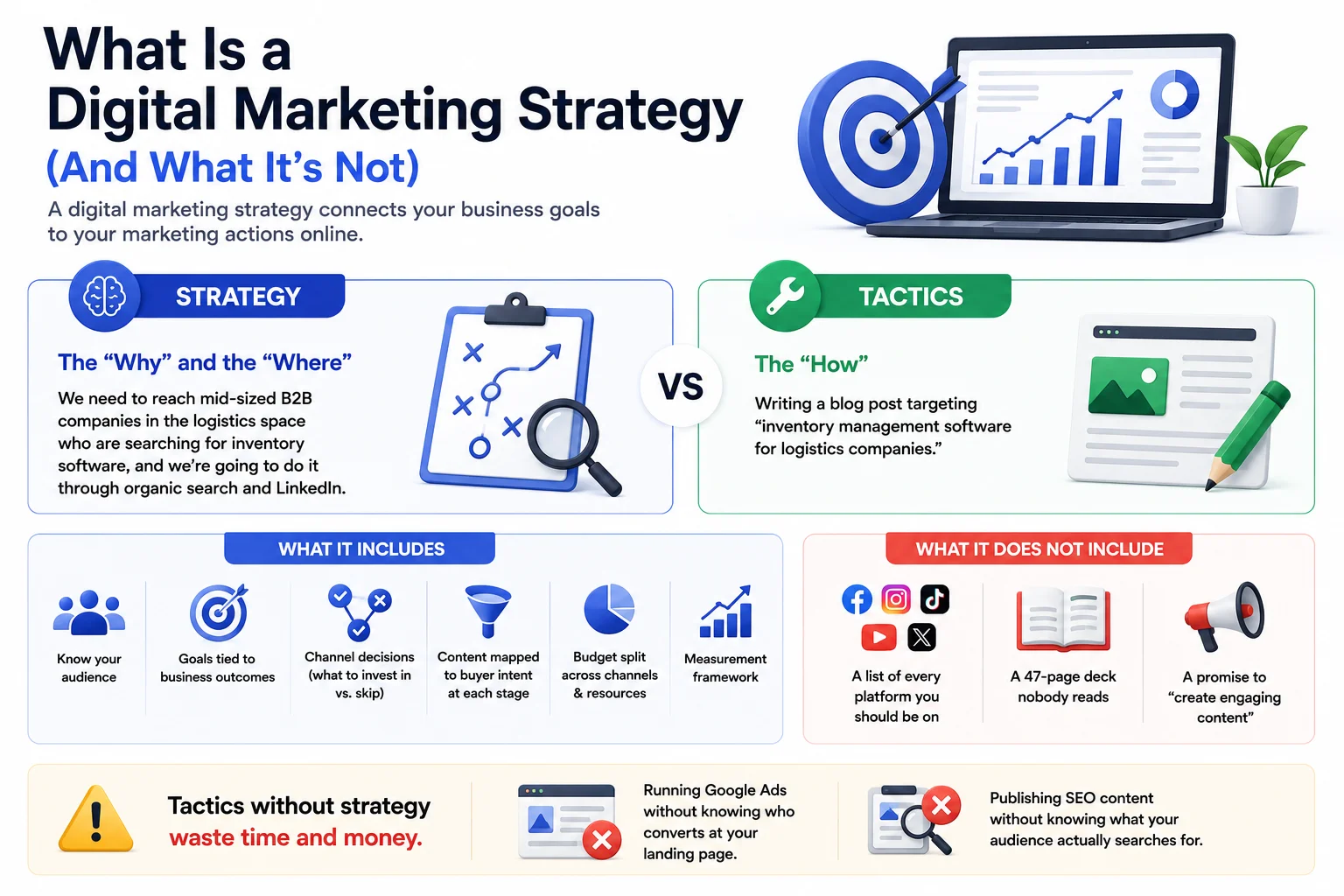
A digital marketing strategy is the plan that connects your business goals to your marketing actions online. That’s it. It’s not your Instagram posting schedule. It’s not your content calendar. Those are tactics, and tactics without a strategy are just busywork.
Here’s the difference in plain terms: strategy is the “why” and the “where.” Tactics are the “how.” A strategy says “we need to reach mid-sized B2B companies in the logistics space who are searching for inventory software, and we’re going to do it through organic search and LinkedIn.” The tactic is writing a blog post targeting “inventory management software for logistics companies.”
What a real digital marketing strategy includes:
- A clear definition of who you’re trying to reach and what you know about them
- Specific goals tied to business outcomes (revenue, leads, retention)
- A decision on which channels to invest in and which to skip
- A content plan that maps to buyer intent at each stage of the funnel
- A budget split across channels and resources
- A measurement framework that tells you if any of it is working
What it doesn’t include: a list of every platform you should be on, a 47-page deck nobody reads, or a promise to “create engaging content.” Businesses that treat those things as strategy are the ones wondering why they’re six months in and nothing has changed.
The other thing worth saying: tactics without strategy don’t just fail, they actively waste money. Running Google Ads without knowing who converts at your landing page. Publishing SEO content without knowing what your audience actually searches for. Both are real things that happen constantly, at companies of all sizes.
How Digital Marketing Strategy Has Changed in 2026
| What Marketers Did Before | What Works Now |
|---|---|
| Keyword stuffing to rank | Topical authority across a content cluster |
| Vanity metrics (followers, impressions) | Revenue-tied KPIs (CPL, ROAS, MQL volume) |
| One-size-fits-all content | Funnel-stage mapped content (TOFU/MOFU/BOFU) |
| SEO and paid as separate teams | Unified strategy where organic informs paid |
| Monthly reporting | Real-time dashboards with weekly optimization |
| Picking channels by trend | Picking channels by where the audience actually is |
| AI as an experiment | AI as a standard part of content and ad workflows |
Why You Need a Strategy Before Doing Anything Else
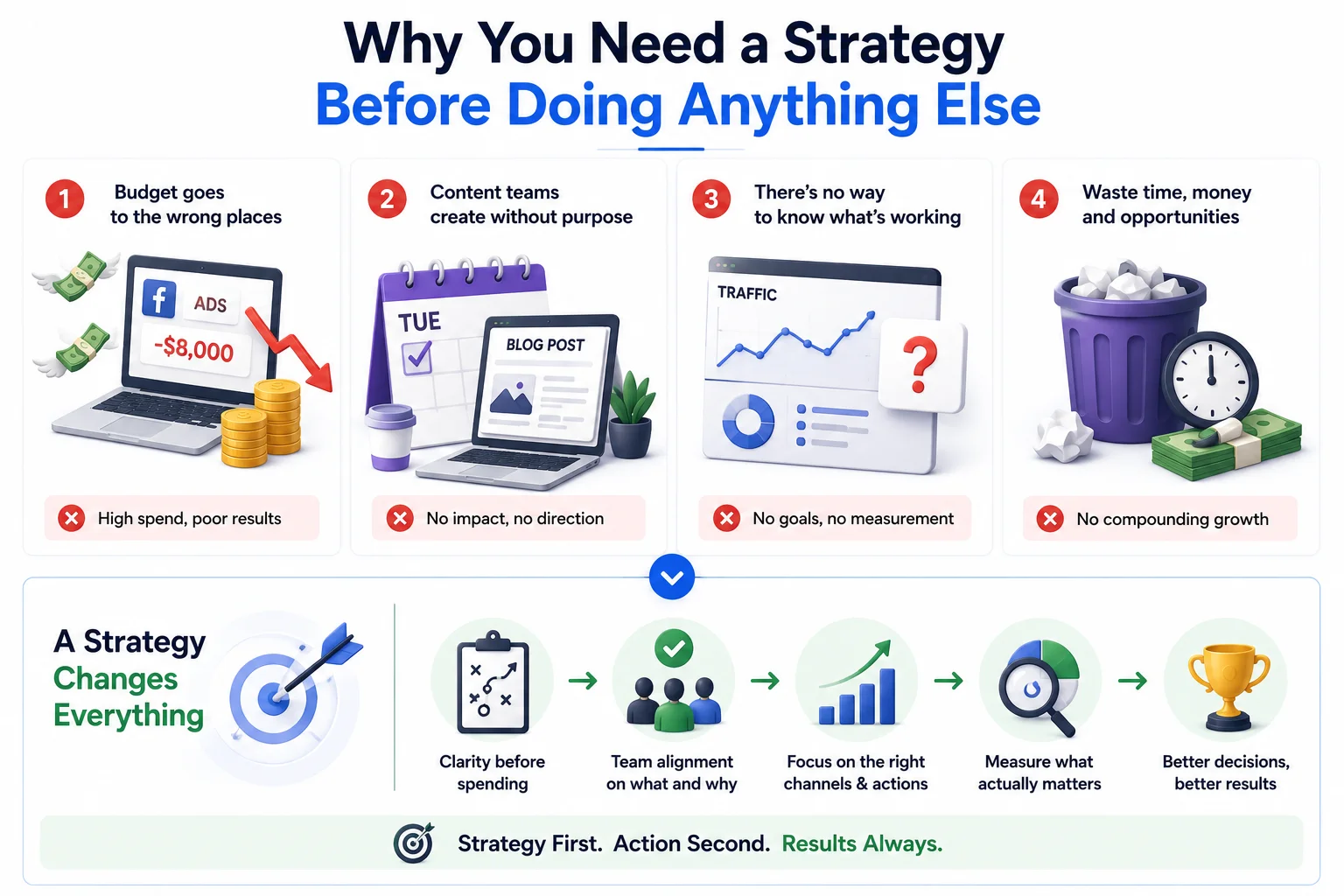
Look at what actually happens when businesses skip the strategy step.
Budget goes to the wrong places. A SaaS company spends $8,000 a month on Facebook ads because a competitor seems to be doing it, without checking whether their audience actually uses Facebook for professional research. Three months later the CPL is terrible and they blame the platform.
Content teams create without purpose. Blog posts go out every Tuesday because the calendar says so. None of them connect to a sales funnel. None of them target a keyword with real volume. Traffic stays flat. The team is exhausted and nobody can explain what any of it is for.
There’s no way to know what’s working. If you didn’t define success before you started, you can’t measure whether you got there. “More traffic” isn’t a goal. “2,000 organic visitors per month from SMB founders by Q3” is a goal.
Here’s the uncomfortable truth: most businesses that say they “tried digital marketing and it didn’t work” didn’t really try digital marketing. They tried a scattered collection of tactics, ran them for 60 days, got impatient, and stopped. That’s not a fair test of anything.
A documented strategy forces clarity before spending. It makes everyone on the team align on what they’re doing and why. And it creates a baseline you can actually measure against. That’s the whole point of having one.
Step-by-Step: How to Build Your Digital Marketing Strategy
This is the part where most people either get it right or waste the next six months. Not because the steps are hard, but because doing them in order, honestly, without skipping the uncomfortable ones, is harder than it sounds. Auditing a site that hasn’t moved in two years is uncomfortable. Admitting your target audience isn’t who you thought is uncomfortable. But that’s exactly where a real strategy starts.
Step 1: Audit Where You Currently Stand
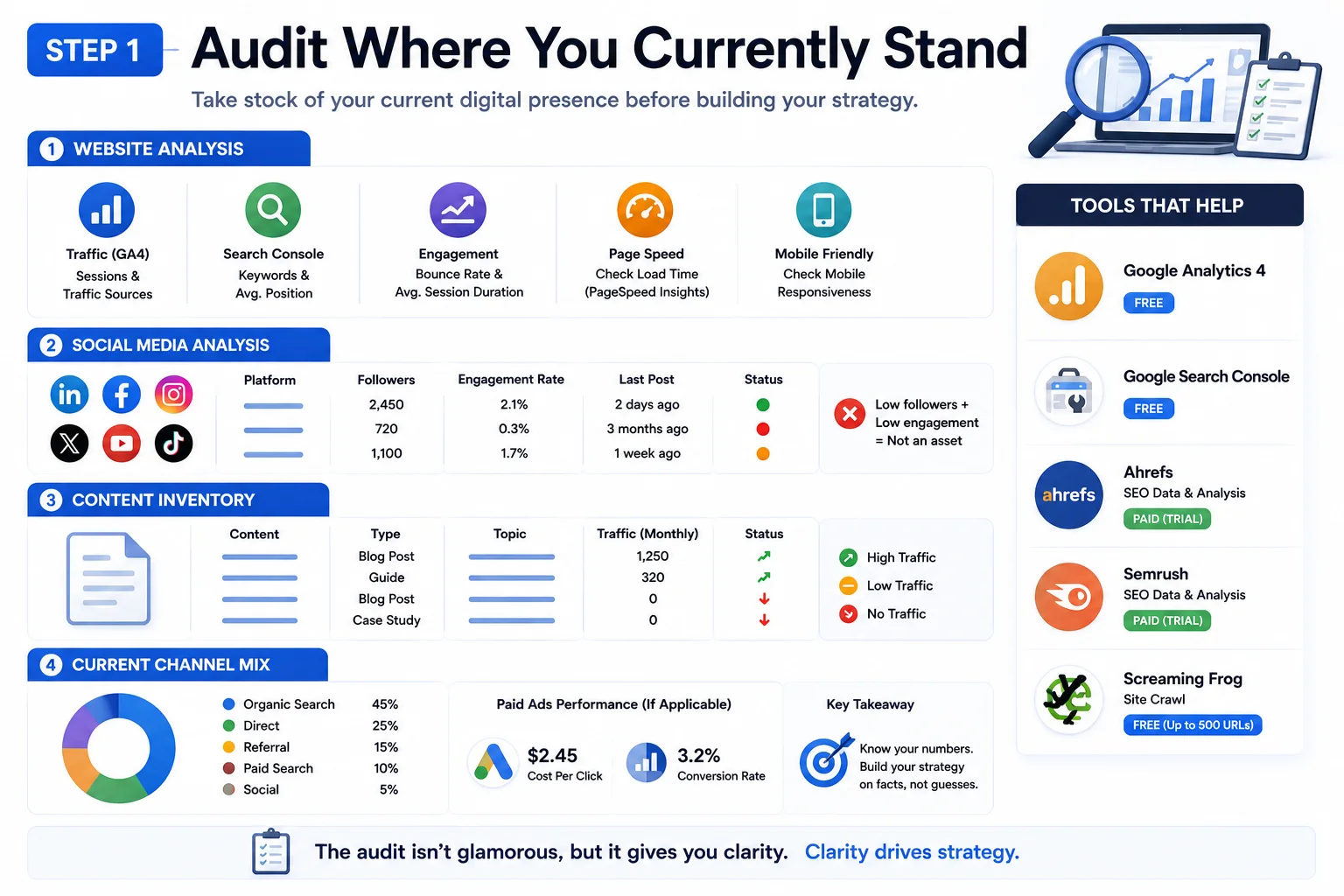
Before building anything, find out what you’re actually working with. Most businesses starting this process have some digital presence, even if it’s messy. Maybe there’s a website that hasn’t been touched since 2021. Maybe there’s a LinkedIn company page with 200 followers. Whatever’s there, take stock of it.
Website analysis:
- Pull your traffic data in Google Analytics 4. How many monthly visitors? Where are they coming from (organic, direct, paid, referral)?
- Check Google Search Console for which keywords you’re actually showing up for and what your average position is
- Look at your bounce rate and average session duration. Are people landing and immediately leaving?
- Run the site through Google PageSpeed Insights. A site that loads in 6 seconds is losing visitors regardless of how good the content is
- Check for mobile responsiveness. In most industries, over half of web traffic comes from mobile
Social media analysis:
- List every platform where you have a presence
- Note the follower count, average engagement rate, and when the last post went out
- Be ruthless here. A Facebook page with 300 followers and no engagement is not an asset, it’s just noise
Content inventory:
- List every blog post, guide, or piece of content you have
- Note which ones get traffic and which are sitting at zero visits
- Identify topics you’ve already covered vs. gaps
Current channel mix:
- What percentage of traffic is organic? Paid? Referral? Direct?
- Are you currently running any paid ads? If so, what’s the cost per click and conversion rate?
Tools that help with this: Google Analytics 4 (free), Google Search Console (free), Ahrefs or Semrush for SEO data (paid but both have free trials), Screaming Frog for a technical site crawl (free up to 500 URLs).
The audit isn’t glamorous. But it tells you exactly what you’re starting with, and that matters a lot more than guessing.
Step 2: Define Your Business Goals (And Tie Marketing Goals to Them)
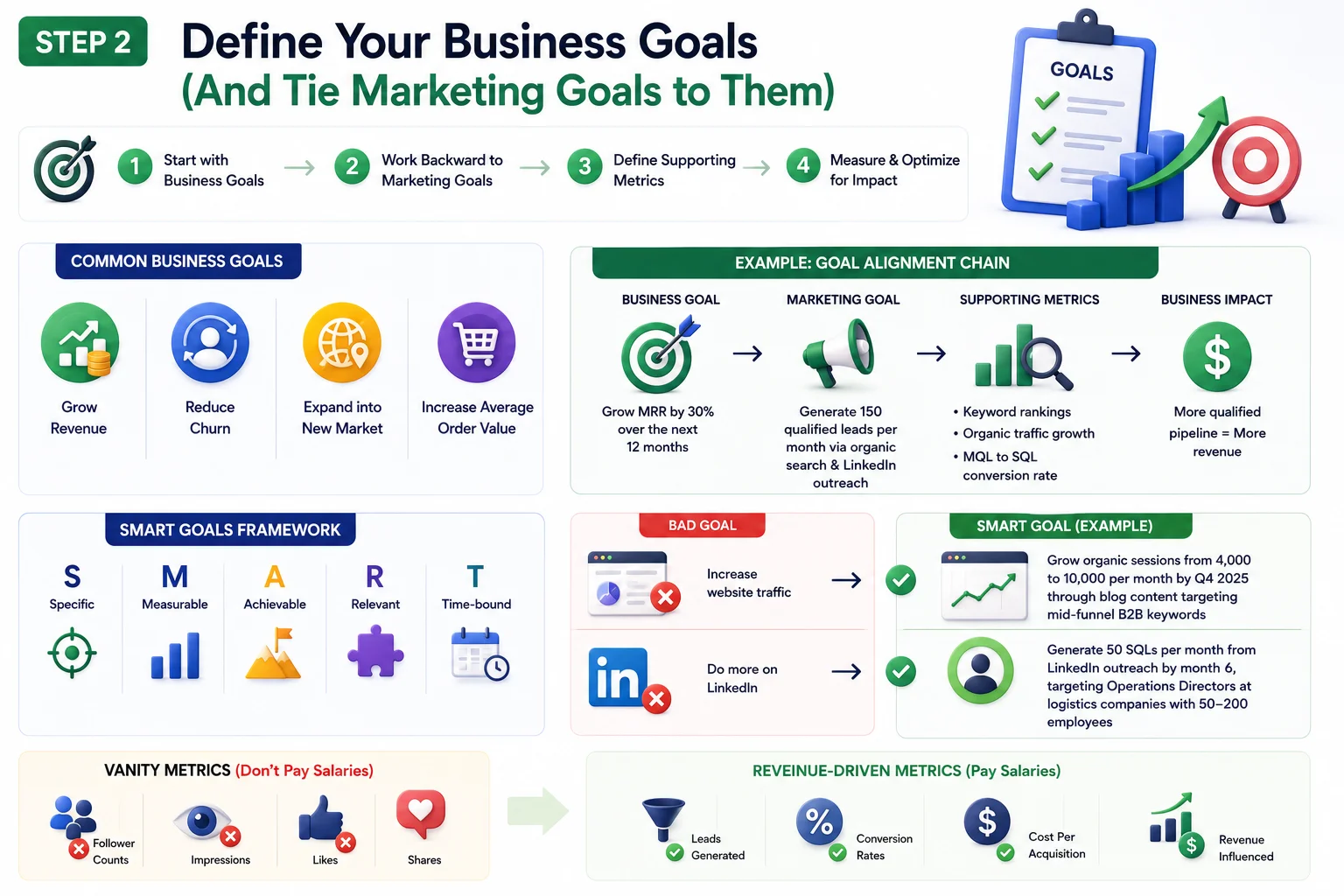
Start with business objectives, not marketing objectives. What does the business actually need?
Most business goals fall into one of these buckets: grow revenue, reduce churn, expand into a new market, or increase average order value. Pick the ones that matter this year and write them down. Then work backward to what marketing needs to do to support them.
For example:
- Business goal: Grow monthly recurring revenue by 30% over the next 12 months
- Marketing goal: Generate 150 qualified leads per month through organic search and LinkedIn outreach
- Supporting metrics: Keyword rankings, organic traffic growth, MQL-to-SQL conversion rate
That’s a chain from business to marketing to measurement. Most companies break this chain by jumping straight to “we need more social media followers” without connecting that to a revenue number.
SMART goals are the right framework here. The acronym has been run into the ground but it’s still correct. Specific, Measurable, Achievable, Relevant, Time-bound. Here’s what that looks like in practice:
- Bad goal: “Increase website traffic”
- SMART goal: “Grow organic sessions from 4,000 to 10,000 per month by Q4 2025 through blog content targeting mid-funnel B2B keywords”
- Bad goal: “Do more on LinkedIn”
- SMART goal: “Generate 50 SQLs per month from LinkedIn outreach by month 6, targeting Operations Directors at logistics companies with 50–200 employees”
One more thing: watch out for vanity metrics. Follower counts, impressions, and likes feel good. They do not pay salaries. Define success in terms of things that connect to revenue: leads generated, conversion rates, cost per acquisition, revenue influenced by a channel.
Step 3: Define Your Target Audience (Build Buyer Personas)
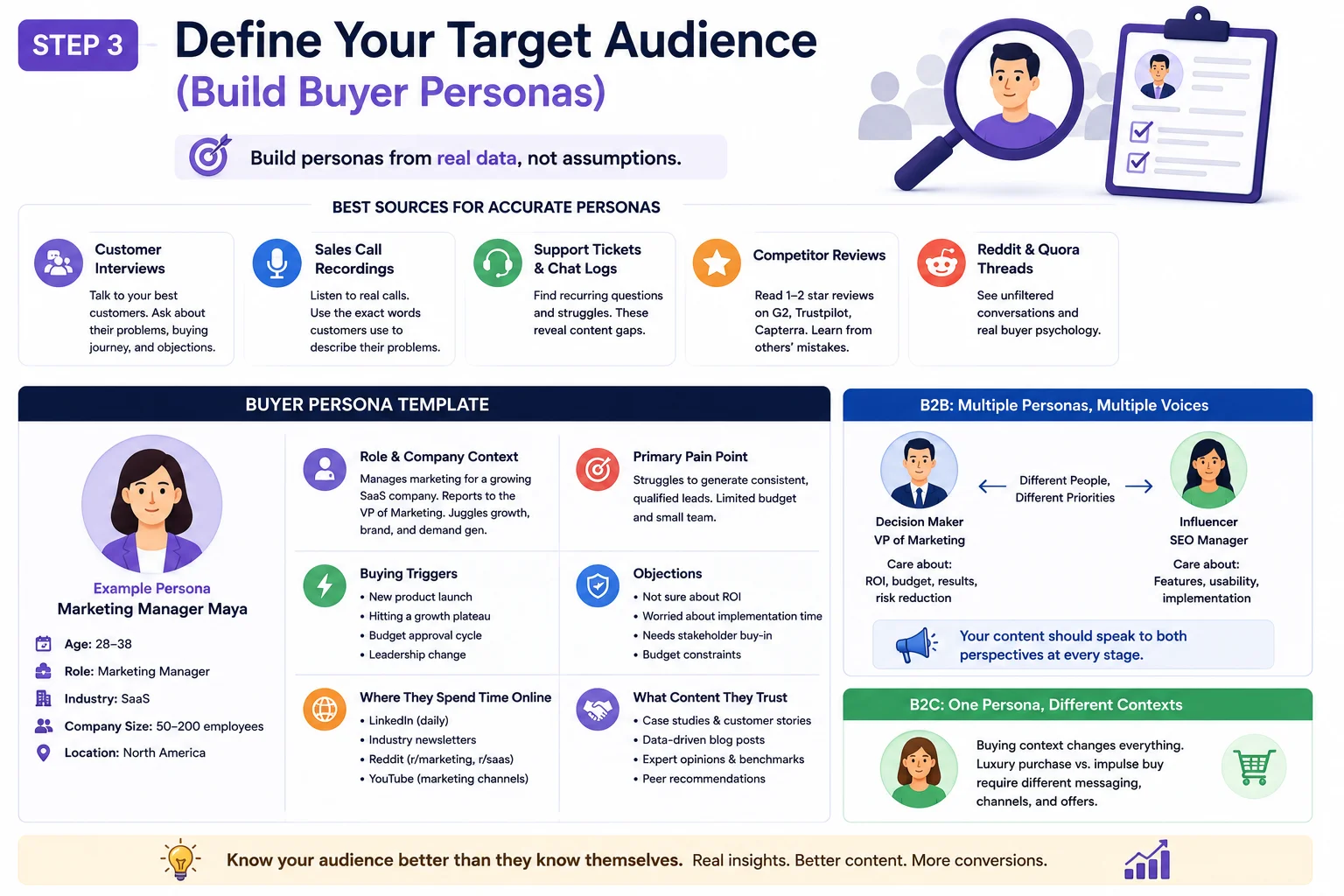
Here’s the problem with most buyer personas: they’re made up. Someone in a conference room decided the customer is “Marketing Manager Mike, 35–45, likes golf and LinkedIn, reads Harvard Business Review.” And then Mike just sits in a Google Doc and nobody uses him.
Useful personas come from real data. Not invented demographics.
The best sources for building an accurate buyer persona:
- Customer interviews: Talk to 5–10 of your best customers. Ask them what problem they were trying to solve when they found you, what they almost bought instead, and what almost stopped them from buying. Those answers are gold.
- Sales call recordings: If your team uses Gong, Chorus, or even just records Zoom calls, listen to 10–15 calls. Pay attention to the language customers use to describe their problems. That’s the language your content should use too.
- Support tickets and chat logs: What do customers struggle with after they buy? What do they ask repeatedly? Those are content gaps.
- Competitor reviews on G2, Trustpilot, and Capterra: Read the one and two-star reviews of your competitors. People are remarkably specific about what frustrated them. That’s your audience telling you exactly what they need.
- Reddit and Quora threads: Search your product category on Reddit. Read what people are complaining about and asking for. This is unfiltered buyer psychology.
A useful buyer persona template includes:
- Role and company context: Their job title, company size, industry, and what their day-to-day actually looks like
- Primary pain point: The one thing that keeps them up at night that your product or service addresses
- Buying triggers: What event or situation makes them start looking for a solution? (A new hire? A compliance deadline? A budget cycle?)
- Objections: What makes them hesitate to buy from you specifically?
- Where they spend time online: LinkedIn? Reddit? Specific newsletters? Industry publications?
- What content they trust: Do they read case studies? Watch YouTube? Trust peer recommendations more than ads?
For B2B, personas usually have a decision-maker and an influencer who are different people. A VP of Marketing makes the budget call. The SEO Manager does the research. Your content needs to speak to both.
For B2C, the persona is usually one person, but the buying context matters a lot. Someone buying a luxury item is in a completely different headspace than someone buying on impulse for under $20.
Step 4: Analyze Your Competitors’ Digital Presence
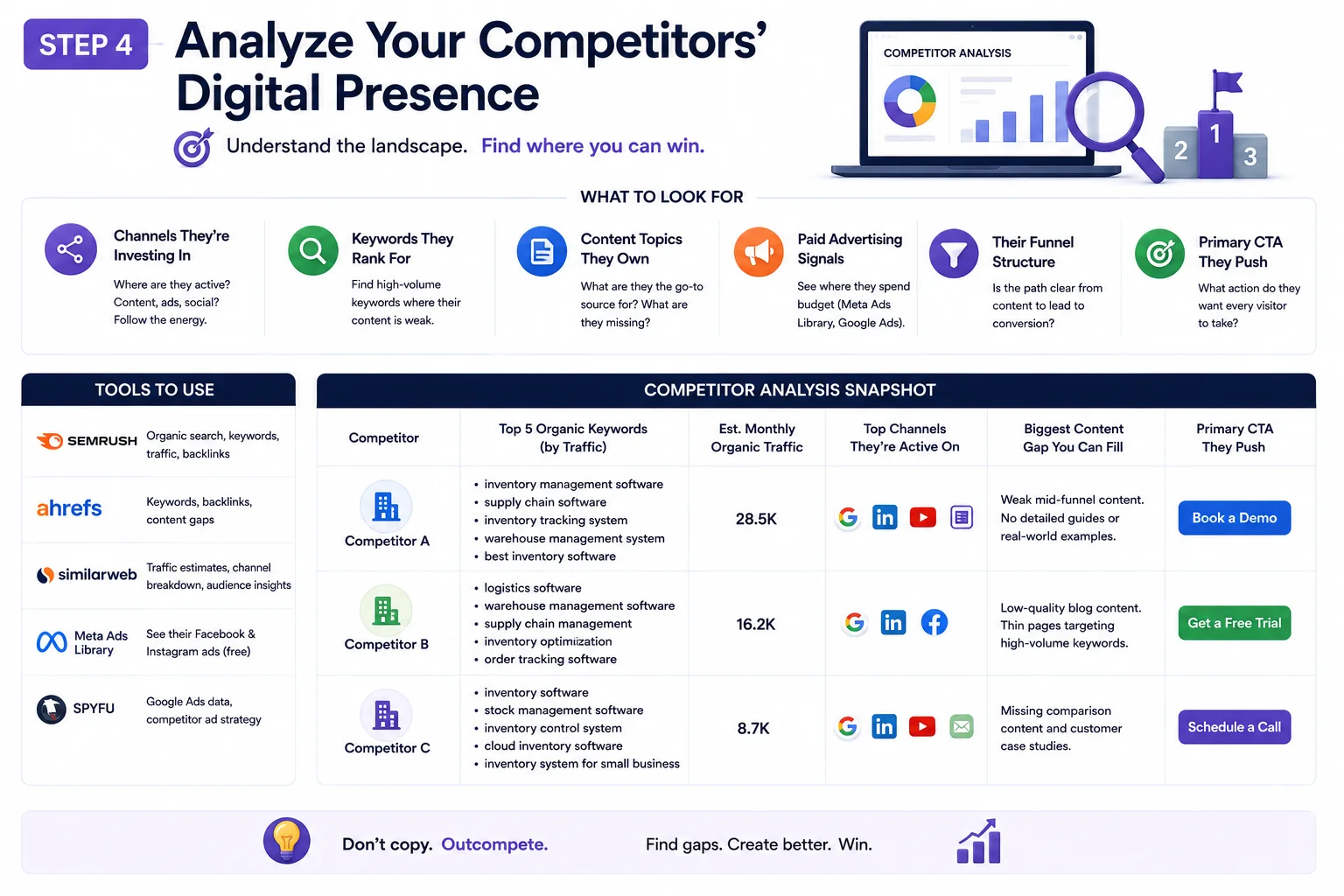
Competitor analysis isn’t about copying what they’re doing. It’s about understanding the landscape and finding where you can actually win.
What to look for:
- Channels they’re investing in: Are they publishing content weekly? Running YouTube ads? Active on LinkedIn? The pattern of where they’re spending energy tells you where they think their audience is
- Keywords they rank for: Use Semrush or Ahrefs to pull their top organic keywords. Look for high-volume keywords where their content is weak (low word count, thin coverage, no real examples) — those are your openings
- Content topics they own: What are they the go-to source for? What are they missing?
- Paid advertising signals: Meta Ads Library shows you what Facebook and Instagram ads they’re running, completely free. Google Ads transparency works similarly. This tells you where they’re allocating budget
- Their funnel structure: Go through their site like a new visitor. Can you tell what they want you to do? Is there a clear path from blog post to lead magnet to demo?
Tools: Semrush and Ahrefs for organic search and backlinks, SimilarWeb for traffic estimates and channel breakdown, Meta Ads Library (free) for social ads, SpyFu for Google Ads data.
A simple competitor analysis table helps keep this organized. For each main competitor, document:
- Their top 5 organic keywords by traffic
- Estimated monthly organic traffic
- Which channels they’re most active on
- The biggest content gap you spotted
- Their primary CTA (what do they push visitors toward?)
Don’t get obsessed with this. An hour of competitive research is useful. Three weeks of it is procrastination.
Step 5: Identify and Prioritize Your Marketing Channels
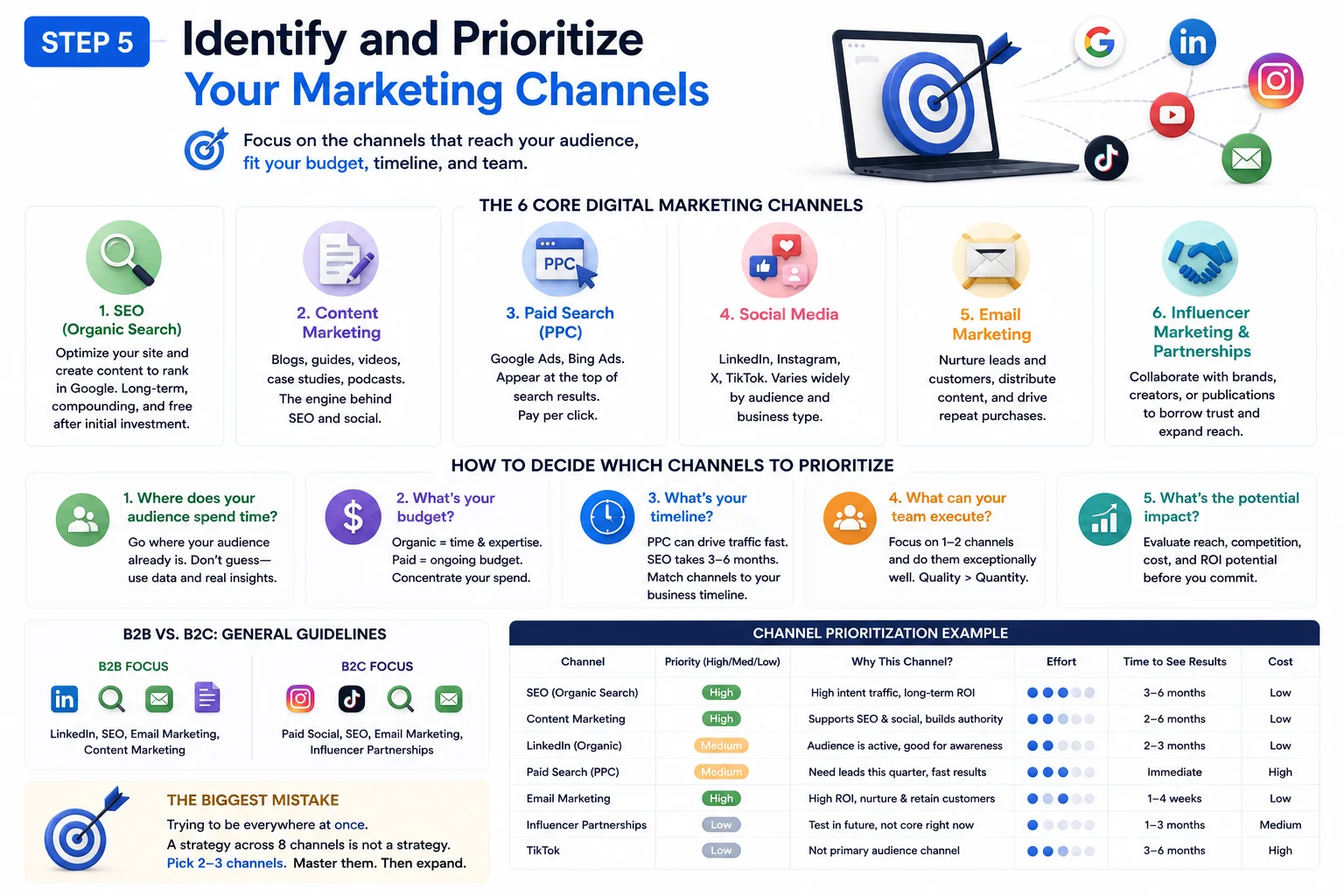
The six channels that make up most digital marketing strategies:
- SEO (organic search): Building content and optimizing your site to rank in Google. Long-term, compounding, and free after the initial investment in content creation
- Content marketing: Blogs, guides, videos, case studies, podcasts. Usually the engine behind SEO and social both
- Paid search (PPC): Google Ads, Bing Ads. Appear at the top of search results for specific keywords, pay per click
- Social media: LinkedIn, Instagram, X, TikTok. Varies wildly by audience and business type
- Email marketing: Nurturing existing leads and customers, distributing content, and driving repeat purchases
- Influencer marketing and partnerships: Collaborating with other brands, creators, or publications to borrow trust and reach
How to decide which ones to prioritize:
Where does your audience actually spend time? A B2B software company’s buyers are on LinkedIn and reading Google search results. A DTC skincare brand’s buyers are on Instagram and TikTok. This isn’t complicated, but it gets skipped more than it should.
What’s your budget? Organic channels (SEO, content, organic social) cost time and expertise, not media spend. Paid channels (PPC, paid social) require ongoing budget. If you have $2,000 a month, don’t spread it across six platforms. Concentrate it.
What’s your timeline? SEO takes 3–6 months to start showing real results. PPC can drive traffic on day one. If the business needs leads this quarter, paid channels have to be part of the mix. If you’re building for 18 months from now, invest in organic.
What can your team actually execute? A company with one part-time marketer should not have an active YouTube channel, a podcast, a newsletter, and a blog. Pick one or two channels and do them well.
On B2B vs. B2C: B2B companies generally get more value from LinkedIn, SEO, email marketing, and content. B2C companies tend to see stronger performance from paid social, SEO, email, and influencer partnerships. These aren’t absolute rules, but they’re a reasonable starting point.
The biggest mistake here is trying to be everywhere at once. A strategy spread across eight channels is not a strategy. It’s noise. Pick two or three channels, get good at them, and then expand.
Step 6: Build Your Content Strategy
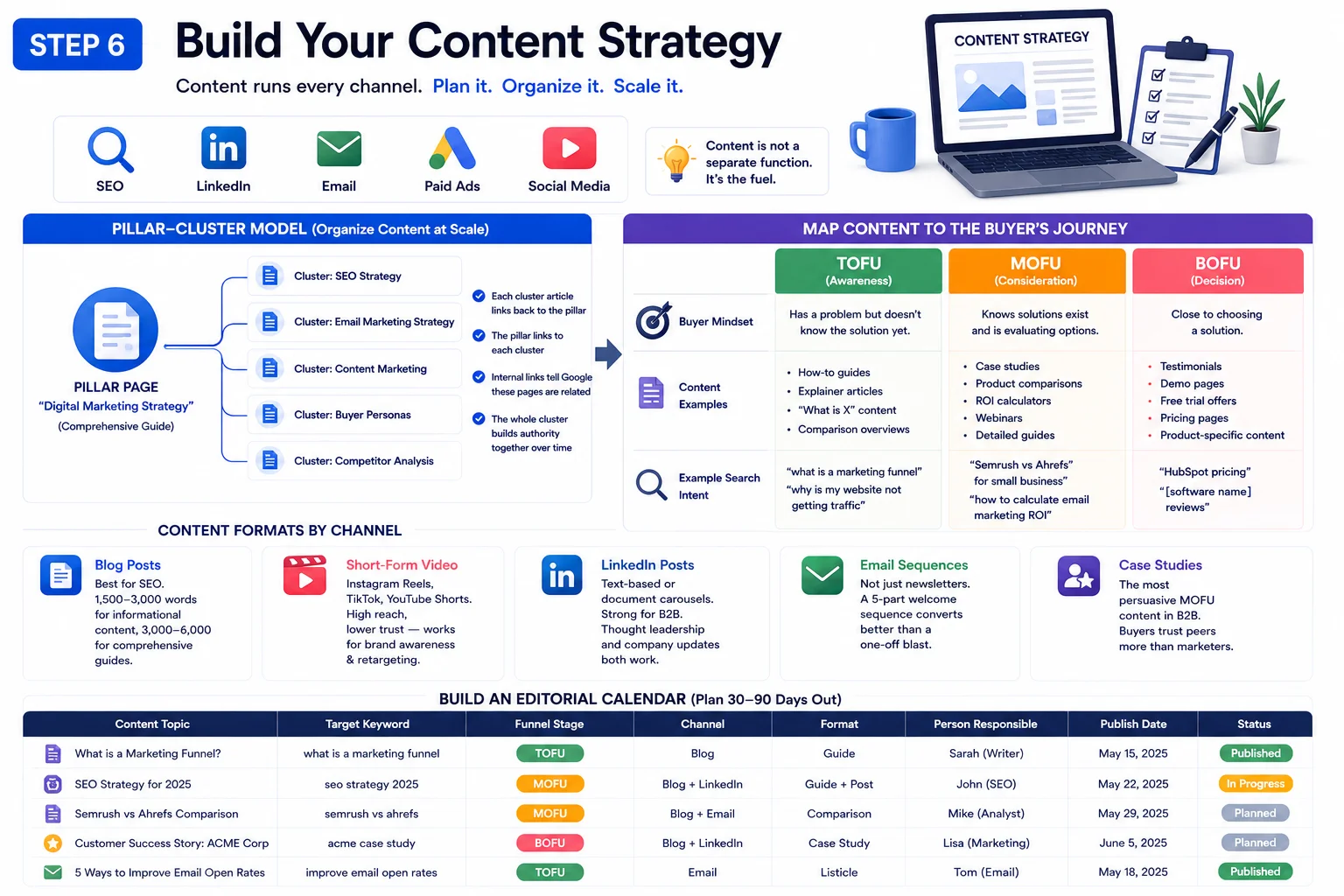
Content runs every digital marketing channel. SEO needs articles and landing pages. LinkedIn needs posts. Email needs something to say. Paid ads need copy and creative. Content is not a separate function. It’s the fuel.
The pillar-cluster model is the most practical framework for organizing content at scale. One large, comprehensive piece (the pillar page) covers a broad topic. A cluster of smaller, more specific articles link back to it and cover subtopics in depth. Internal links between them tell Google these pages are related, which helps the whole cluster rank better over time.
For example: a pillar on “digital marketing strategy” (like this one) gets supported by clusters on SEO strategy, email marketing strategy, content marketing, buyer personas, and competitor analysis. Each cluster article links back to the pillar. The pillar links to each cluster article. Over time, the whole thing builds authority together.
Map content to where buyers are in the funnel:
TOFU (top of funnel, awareness stage): Buyers have a problem but don’t know what the solution looks like yet. They’re searching for general information. Content here: how-to guides, explainer articles, “what is X” content, comparison overviews. Example search intent: “what is a marketing funnel” or “why is my website not getting traffic”
MOFU (middle of funnel, consideration stage): Buyers know solutions exist and are evaluating their options. Content here: case studies, product comparisons, ROI calculators, webinars, detailed guides. Example search intent: “Semrush vs Ahrefs for small business” or “how to calculate email marketing ROI”
BOFU (bottom of funnel, decision stage): Buyers are close to choosing. Content here: testimonials, demo pages, free trial offers, pricing pages, detailed product-specific content. Example search intent: “HubSpot pricing” or “[software name] reviews”
Content formats by channel:
- Blog posts: Best for SEO. 1,500–3,000 words for informational content, 3,000–6,000 for comprehensive guides
- Short-form video: Instagram Reels, TikTok, YouTube Shorts. High reach, lower trust — works for brand awareness and retargeting audiences
- LinkedIn posts: Text-based or document carousels. Strong for B2B. Thought leadership and company updates both work here
- Email sequences: Not just newsletters. A 5-part welcome sequence converts better than a one-off blast
- Case studies: The most persuasive MOFU content in B2B. Buyers trust peers more than marketers
Building an editorial calendar: plan content 30–90 days out. Include the target keyword, the funnel stage, the channel it’s written for, the person responsible, and the publication date. A simple Notion database or even a Google Sheet works fine for this.
Step 7: Set Your Budget and Resource Allocation
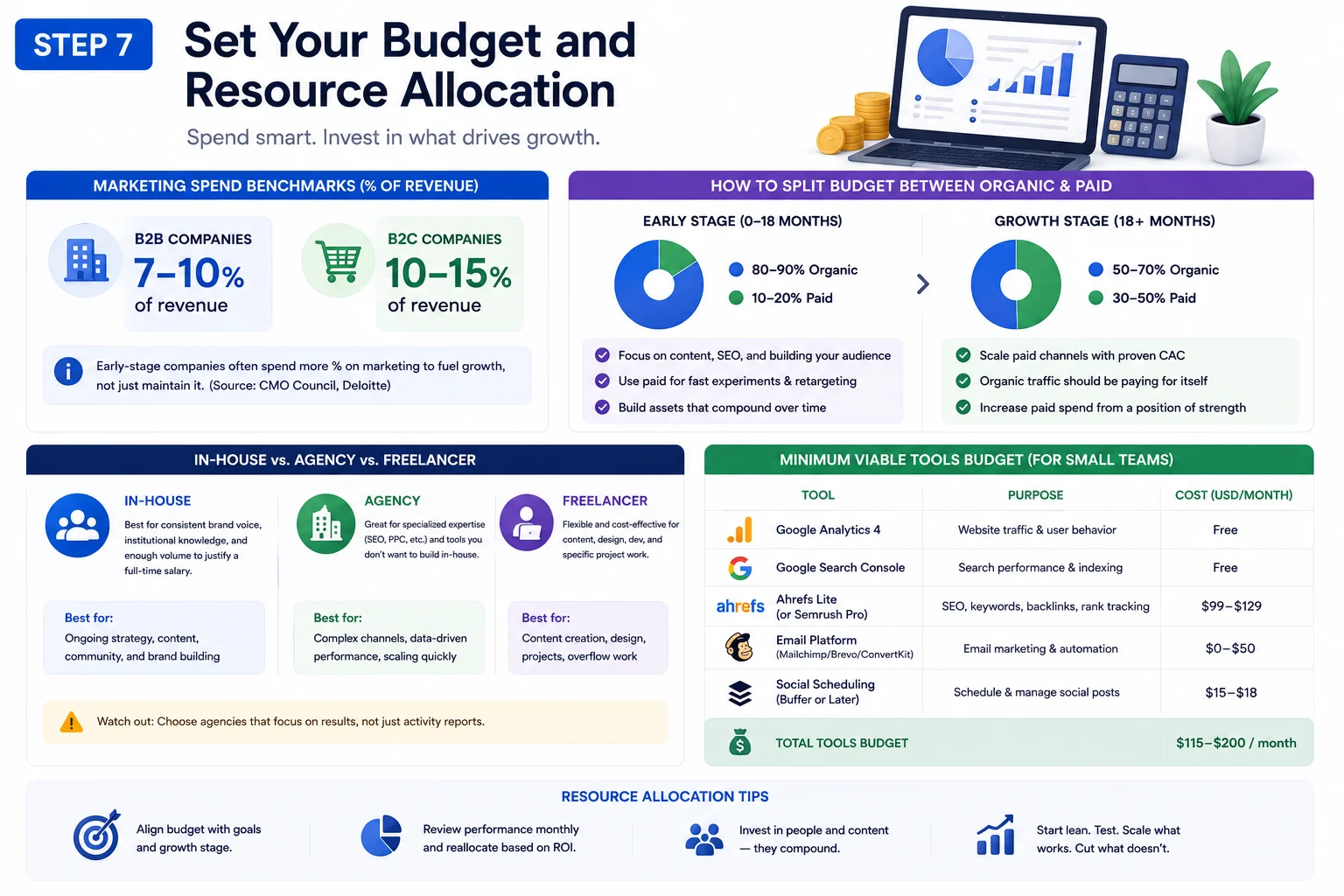
A rough benchmark for marketing spend as a percentage of revenue: B2B companies typically allocate 7–10% of revenue to marketing, B2C companies often allocate 10–15%. These are rough norms from CMO Council and Deloitte research. Early-stage companies frequently spend more as a percentage because they’re investing in growth, not just maintaining it.
How to split the budget between organic and paid:
Early stage (0–18 months): lean heavily into organic. Publish content consistently, build SEO, grow email list. Allocate maybe 10–20% of the marketing budget to paid channels for fast experiments and retargeting. The rest goes to content production and tools.
Growth stage (18+ months, some traction): start scaling paid channels where you have proof of a cost-per-acquisition that works. Organic should be paying for itself with consistent traffic. Now you can increase paid spend from a position of strength.
In-house vs. agency vs. freelancer:
- In-house: Best if you’re doing enough volume to justify a full salary and you want consistent brand voice and institutional knowledge
- Agency: Good for specific channels (PPC management, SEO) where they have specialized expertise and tools you can’t justify building in-house. Watch for agencies that report on activity rather than results.
- Freelancers: Flexible and often cost-effective for content production, design, and specific project work
Minimum viable tools budget for a small team:
- Google Analytics 4: free
- Google Search Console: free
- Ahrefs Lite or Semrush Pro: $99–$129/month for SEO
- Email platform (Mailchimp, Brevo, or ConvertKit): $0–$50/month depending on list size
- Social scheduling (Buffer or Later): $15–$18/month
That’s $115–$200/month for a functional marketing stack at the start. Don’t buy more tools than you’re using.
Step 8: Set Up Your Marketing Tech Stack
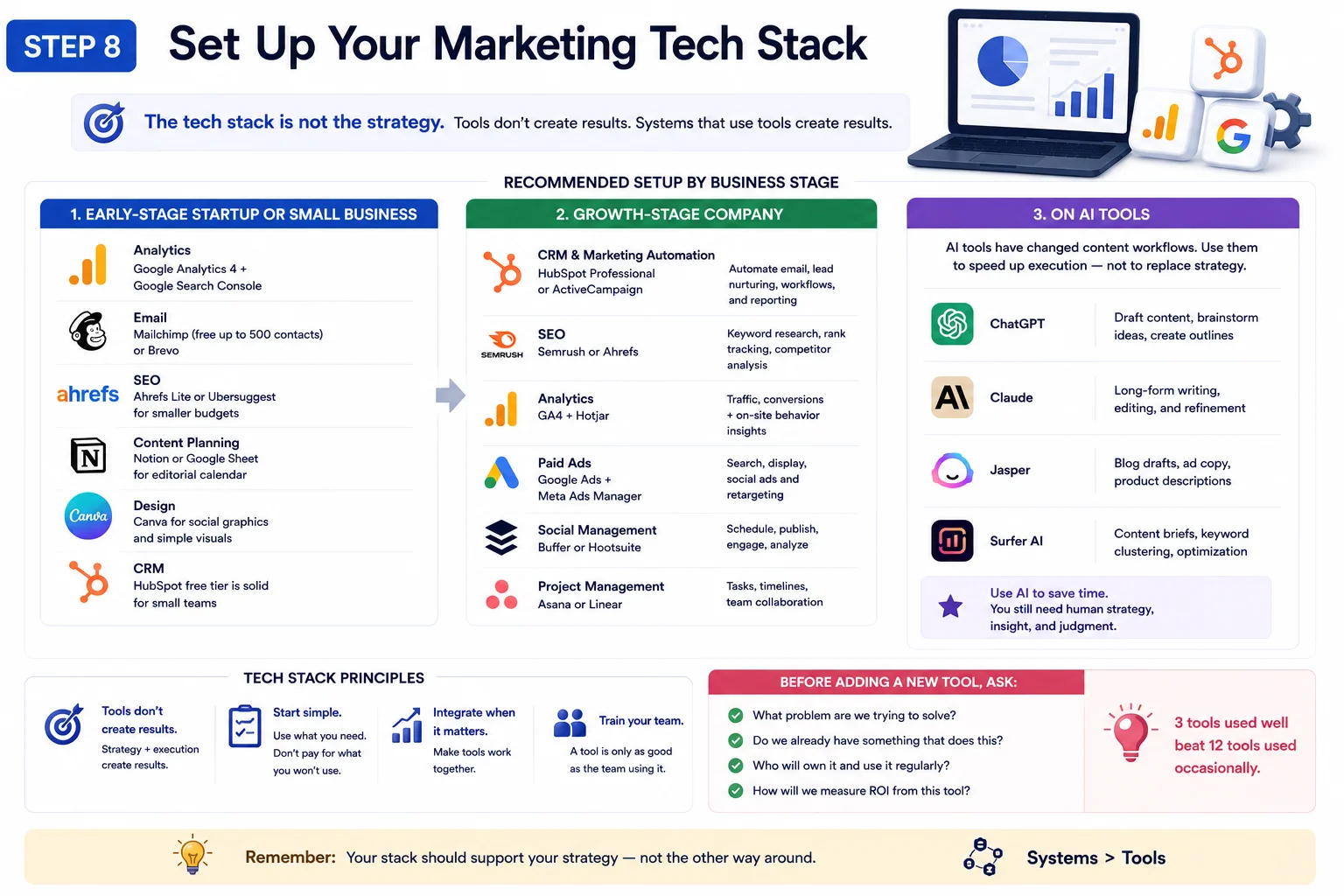
The tech stack is not the strategy. Say it again. The tech stack is not the strategy. There are companies spending $40,000 a year on HubSpot that don’t have a documented buyer persona. Tools don’t create results. Systems that use tools create results.
Recommended setup by business stage:
Early-stage startup or small business:
- Analytics: Google Analytics 4 + Google Search Console
- Email: Mailchimp (free up to 500 contacts) or Brevo
- SEO: Ahrefs Lite or Ubersuggest for smaller budgets
- Content planning: Notion or a Google Sheet for the editorial calendar
- Design: Canva for social graphics and simple visuals
- CRM: HubSpot free tier is solid for small teams
Growth-stage company:
- CRM and marketing automation: HubSpot Professional or ActiveCampaign
- SEO: Semrush or Ahrefs
- Analytics: GA4 + Hotjar for on-site behavior data
- Paid ads: Google Ads + Meta Ads Manager
- Social management: Buffer or Hootsuite
- Project management: Asana or Linear
On AI tools: they’ve genuinely changed content workflows. Tools like Claude, ChatGPT, Jasper, and Surfer AI are useful for drafts, content briefs, ad copy variations, and keyword clustering. They save hours of work. But they don’t replace knowing what to write about and why. Use them to speed up execution, not to replace strategy.
One thing worth checking: before adding a new tool, ask whether you’re actually going to use it. Most marketing teams are over-tooled and under-systematic. Three tools used well are more effective than twelve tools used occasionally.
Step 9: Launch, Measure, and Optimize
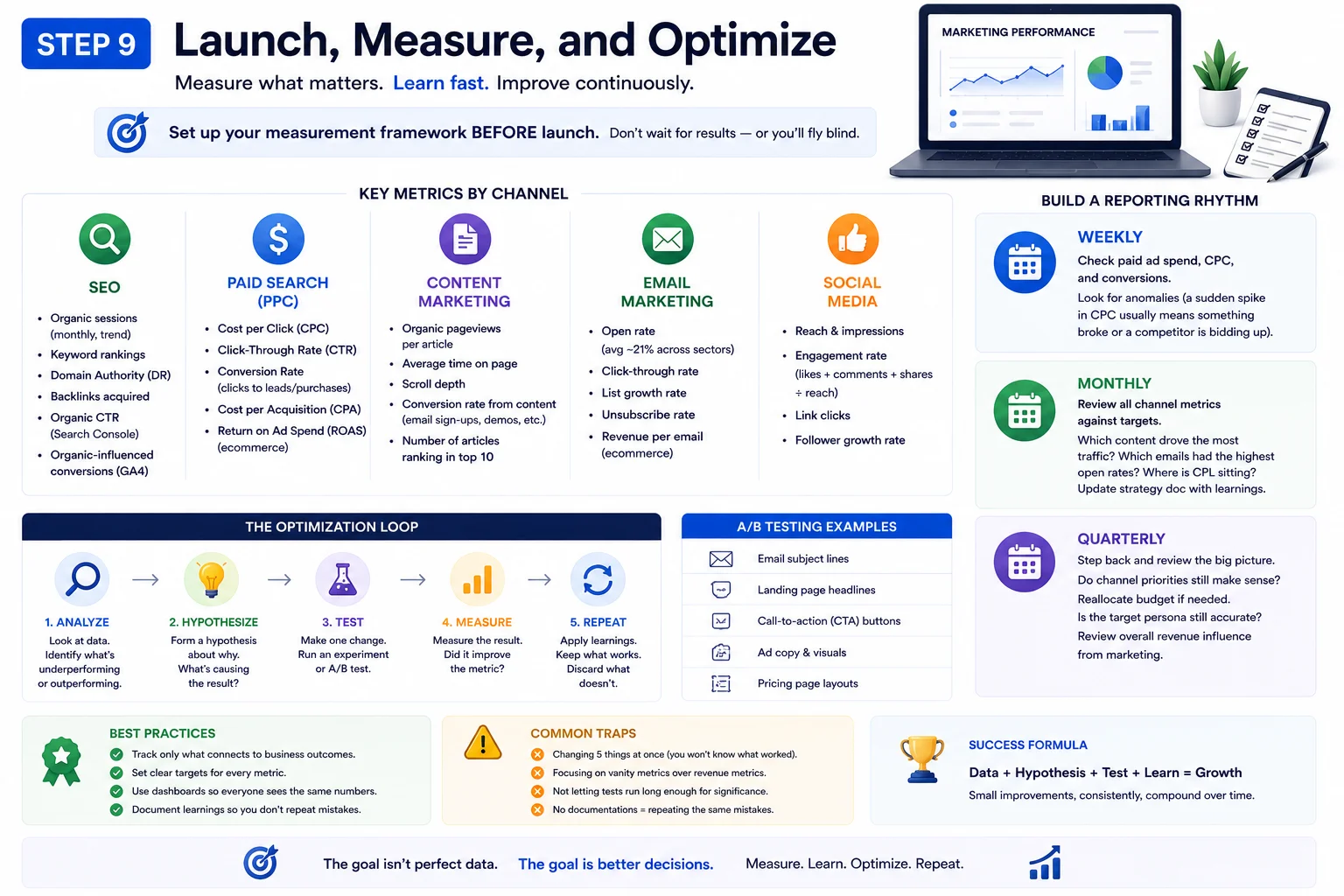
Set up your measurement framework before the first campaign launches. Not after. Not “we’ll figure out how to measure it once we see some results.” Before. Otherwise you’re flying blind and you’ll spend three months arguing over whether the numbers mean anything.
Key metrics by channel:
SEO:
- Organic sessions (monthly, trending over time)
- Keyword rankings for target keywords
- Domain authority / domain rating (Ahrefs/Semrush)
- Backlinks acquired
- Organic click-through rate from Search Console
- Organic-influenced conversions in GA4
Paid Search (PPC):
- Cost per click (CPC)
- Click-through rate (CTR)
- Conversion rate (clicks to leads or purchases)
- Cost per acquisition (CPA)
- Return on ad spend (ROAS) for ecommerce
Content Marketing:
- Organic pageviews per article
- Average time on page
- Scroll depth
- Conversion rate from content (email sign-ups, demo requests, etc.)
- Number of articles ranking in top 10
Email Marketing:
- Open rate (industry average across sectors is around 21%, per Mailchimp’s benchmark data)
- Click-through rate
- List growth rate
- Unsubscribe rate
- Revenue per email for ecommerce
Social Media:
- Reach and impressions
- Engagement rate (likes + comments + shares divided by reach)
- Link clicks
- Follower growth rate
Build a reporting rhythm:
Weekly: Check paid ad spend, CPC, and conversions. Look for anomalies (a sudden spike in CPC usually means something broke or a competitor is bidding up).
Monthly: Review all channel metrics against targets. Which content pieces drove the most organic traffic? Which email subject lines had the highest open rates? Where is the CPL sitting? Update the strategy doc with what you learned.
Quarterly: Step back and review whether the channel priorities still make sense. Are there opportunities to reallocate budget? Is the target persona still accurate? This is also when to look at overall revenue influence from marketing.
The optimization loop: analyze what’s underperforming, form a hypothesis about why, test a change, measure the result, repeat. That’s it. That’s all optimization is. The trap is changing five things at once and not knowing what moved the needle.
A/B testing is not an advanced tactic reserved for enterprise companies. It’s just running two versions of something (a subject line, a landing page headline, an ad visual) and seeing which performs better. Every email platform supports this natively. Every major ad platform does too. Run tests, document results, apply learnings.
Digital Marketing Strategy Templates and Frameworks
A one-page strategy canvas is more useful than a 50-slide deck. The goal is to have a document the team actually references, not one that lives in a Drive folder untouched.
Here’s the structure of a working one-page strategy canvas:
Business goal: What does the business need to achieve in the next 12 months? (One sentence, tied to revenue or growth.)
Target audience: Who are you trying to reach? (Primary persona, including their role, pain points, buying triggers, and where they spend time online.)
Primary channels (2–3 max): Which channels are you investing in? Why these specifically?
Content plan: What are the main content topics for this quarter? Which stage of the funnel do they address?
90-day marketing goals: Three specific, measurable goals for the next 90 days. (Not annual visions. 90-day targets you can actually hit or miss.)
Budget split: How much goes to content creation? Paid ads? Tools? Freelancers?
Key metrics: What are you measuring? What does success look like at 30, 60, and 90 days?
This document should fit on one page. If it doesn’t, it’s a plan, not a strategy. Plans are useful too, but they live underneath the strategy, not on top of it.
Free tools worth knowing about:
- Google’s Campaign URL Builder (ga-dev-tools.web.app): tag your campaign URLs so GA4 can track which campaigns drive traffic and conversions
- HubSpot’s Make My Persona tool (free): a decent guided questionnaire for building buyer personas
- Google Keyword Planner (free with a Google Ads account): keyword research and search volume data
- Answer The Public (free tier): shows you what questions people are searching around a topic, which is useful for content ideation
How Long Does It Take to See Results?
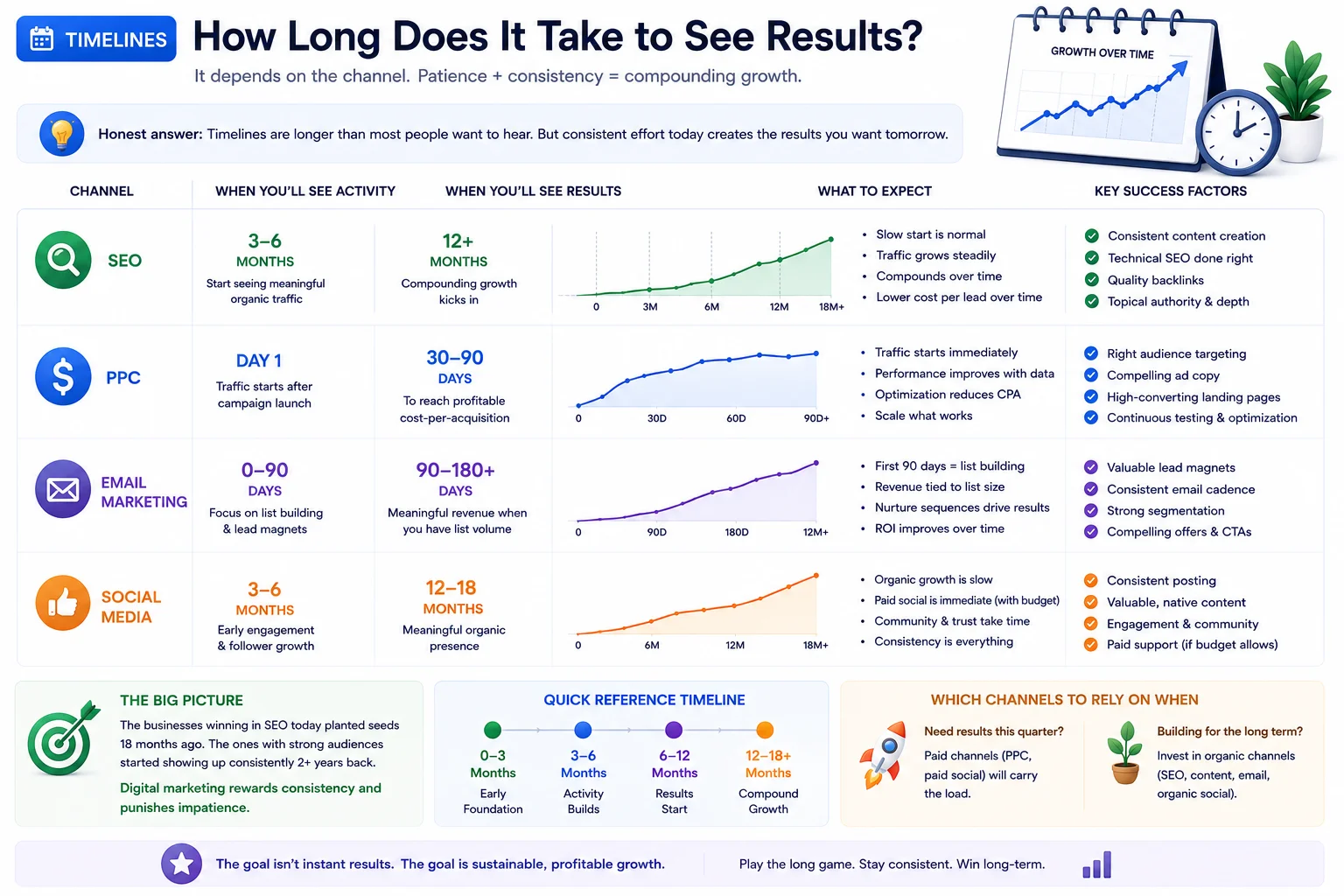
Honest answer: it depends on the channel, and the timelines are longer than most people want to hear.
SEO: 3–6 months to start seeing meaningful organic traffic from new content. 12+ months before you start seeing compounding effects from a consistent content strategy. This isn’t a prediction, it’s just how long it takes for Google to crawl, index, and develop trust in new content and domains. The businesses showing up at the top of search results for competitive keywords have usually been publishing and building links for 2–3 years.
PPC: Traffic starts on day one after campaign launch. But “traffic” and “results” aren’t the same thing. Getting PPC to a profitable cost-per-acquisition usually takes 30–90 days of testing, optimizing audiences, refining ad copy, and tightening landing page conversion rates.
Email marketing: Heavily dependent on list size. If you’re starting from zero, the first 90 days are mostly list-building (lead magnets, opt-ins, landing pages). You won’t see meaningful revenue from email until you have a list large enough to generate volume. A 500-person list is different from a 10,000-person list in terms of what it can produce.
Social media: Organic social growth is slow, especially on LinkedIn and Instagram where algorithm reach for business accounts has declined. Paid social is faster but tied to budget. Building a meaningful organic social presence from scratch is a 12–18 month project if you’re consistent.
The real point here: the businesses winning in SEO today planted seeds 18 months ago. The ones posting consistently on LinkedIn with 10,000+ followers started showing up daily two years back. Digital marketing rewards consistency and punishes impatience more than almost any other business activity.
If the business needs results this quarter, paid channels have to carry that load. If the goal is sustainable, lower-cost growth over the next year or two, organic channels are the investment worth making now.
Conclusion
Strategy sounds complicated because most people make it complicated. It’s not. It’s figuring out who you’re trying to reach, where they are, what you’re going to say to them, how you’re going to measure whether it worked, and then doing it consistently for long enough that it actually compounds.
The businesses that grow through digital marketing aren’t doing 15 clever things at once. They found one or two channels that work for their audience, got really good at executing on those, built systems to measure results, and kept going when the early numbers were underwhelming.
The steps in this guide are the same ones agencies charge $15,000 a month to help companies figure out. The audit. The personas. The channel selection. The content plan. The measurement framework. None of it is magic. It’s just a process, done in the right order, with enough honesty about what’s actually working to keep improving.
Start with the audit. Set real goals. Pick two channels. Build the content plan. Measure what matters. That’s the whole thing.
FAQs
What is the first step in building a digital marketing strategy?
Start with an audit. Before you build anything, understand what you’re working with: your current traffic, your existing content, your social presence, and your channel mix. Then define your business goals. Starting with channels or tactics before doing either of those things is why most strategies fail in the first 90 days.
How do I choose the right digital marketing channels for my business?
Answer three questions first. Where does your specific audience actually spend time online? What does your budget allow (organic takes time, paid takes money)? What can your team realistically execute at quality? The right channel is the one that reaches your audience at a cost you can sustain, not the one that seems trendy.
How much should I budget for digital marketing?
B2B companies generally allocate 7–10% of revenue to marketing. B2C companies often sit at 10–15%. Early-stage businesses typically spend a higher percentage because they’re investing in growth from a smaller base. If those numbers feel too abstract, start with what you can commit to consistently for 12 months. A smaller budget deployed consistently beats a larger budget spent inconsistently.
What’s the difference between a digital marketing strategy and a digital marketing plan?
The strategy is the “why” and the “where”: audience, goals, channel priorities, and how success is measured. The plan is the “what” and the “when”: the content calendar, campaign schedule, specific ad budgets, and production timelines. Strategy comes first. The plan operationalizes it.
Can a small business build a digital marketing strategy without an agency?
Yeah, absolutely. The frameworks in this guide don’t require an agency. What they require is clarity on your audience and goals, consistency in execution, and patience with channels that take time to compound. Agencies are useful for specific things (PPC management, technical SEO, high-volume content production), not for strategy that a business owner can’t articulate themselves.
What tools do I need to build a digital marketing strategy?
For the strategy itself: a document. Seriously. The strategy is a written plan, not a software subscription. For executing it: Google Analytics 4 and Search Console are free and cover your analytics needs. An email platform like Mailchimp or Brevo, one SEO tool (Ahrefs Lite at $29/month works for early-stage), and a scheduling tool for social posts. That’s a functional stack for under $150/month.
How do I measure if my digital marketing strategy is working?
Define your success criteria before you launch anything. What CPL is acceptable for your margin structure? What organic traffic growth are you targeting by month 6? What email conversion rate are you aiming for? Then measure against those targets monthly. If you didn’t define success before you started, any number can be made to look like progress.