
Most people search this exact phrase right after a sales call left them more confused than when it started. Someone on a Zoom call just used the words “omnichannel,” “full-funnel,” and “growth partner” four times in twenty minutes, and now there’s a proposal sitting in the inbox with a number on it and zero clarity about what that number actually buys. The deck had a lot of arrows pointing at a lot of boxes. None of it explained who was actually going to do the work.
So here’s the straight answer, no fluff first. A digital marketing agency is a team of specialists who run a business’s online marketing for it, things like SEO, paid ads, content, social, email, and website work, either as a full package or as individual pieces. That’s it. Everything else is detail.
But the detail matters, because “we handle your marketing” can mean five wildly different things depending on which agency is saying it. A three-person shop running Instagram reels for a local bakery and a ninety-person firm managing eight-figure ad budgets for a SaaS company both call themselves digital marketing agencies. Both are technically correct. Neither tells a business owner what they’re actually about to pay for, or what a normal week looks like once the contract is signed.
This gets asked constantly because marketing has quietly turned into one of the most confusing purchases a business owner makes. Nobody feels weird asking a plumber exactly what a pipe repair involves. Somehow marketing gets treated as this black box where questions feel dumb to ask, even though the person asking is about to hand over a chunk of their monthly budget for months, sometimes years.
This breaks down what these agencies actually do, day to day, who’s touching the account, what it realistically costs, how long results actually take, and how to tell a good one from a group of people reselling Canva templates at a markup. No vague promises, no “it depends” without an actual answer attached.
What a Digital Marketing Agency Actually Is
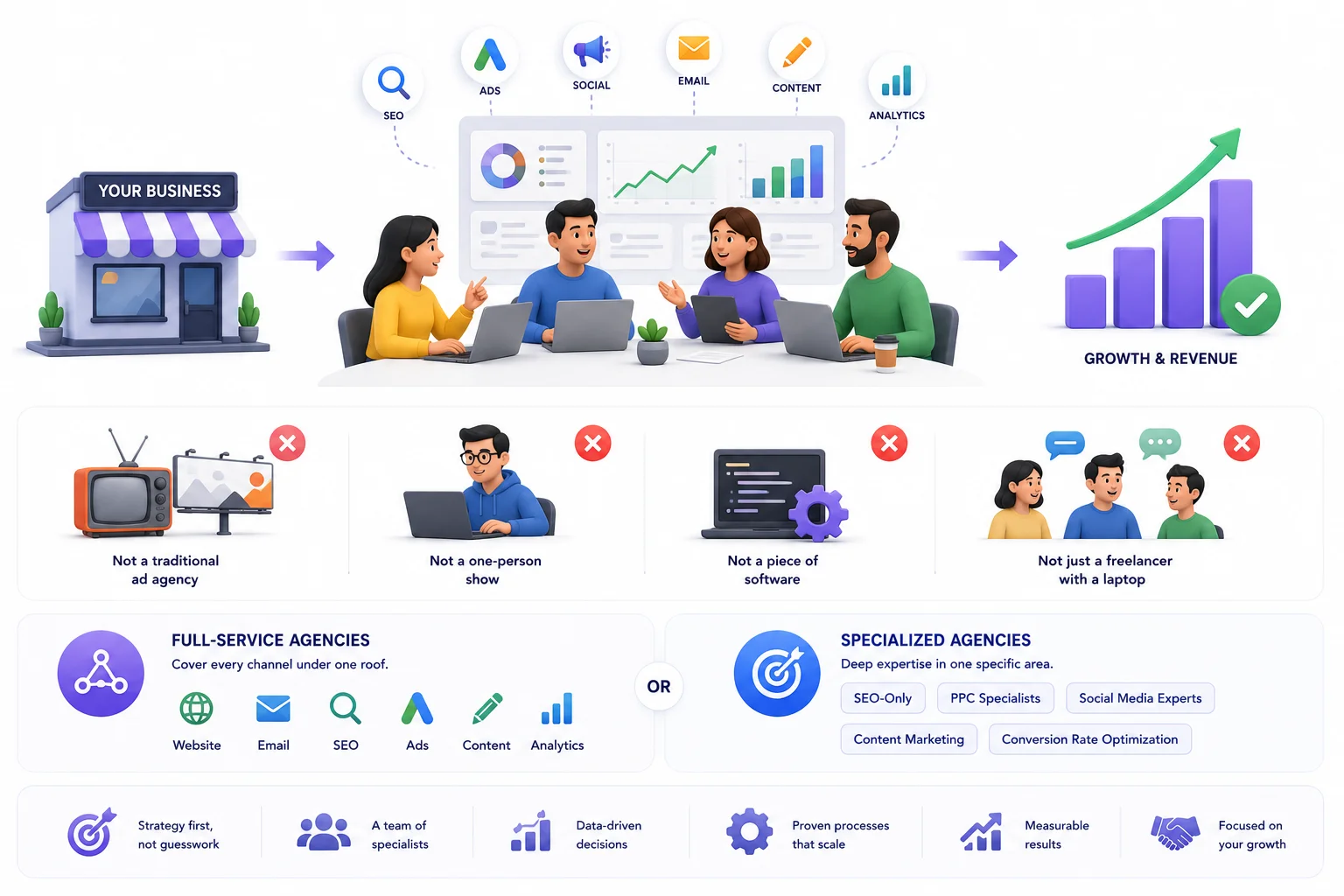
Strip away the jargon and a digital marketing agency is a service business. It gets hired to grow another business’s presence online and, ideally, turn that presence into revenue. Not likes. Not impressions. Revenue, or at minimum a real lead that a sales team can actually close into a paying customer.
That distinction matters more now than it did five years ago. Agencies used to get away with reporting follower counts and calling it a win. A screenshot of a growth chart, a happy client on a call, everyone moves on. Clients caught on to that eventually, mostly because CFOs started asking harder questions about where marketing spend was actually going and what it was returning. Now the better agencies talk about cost per lead, customer acquisition cost, and pipeline contribution, because that’s what actually gets a contract renewed at the end of a quarter.
A digital marketing agency is not the same thing as a traditional ad agency that makes billboards and TV spots and thirty-second commercials for the evening news. Traditional agencies still exist and still do good work, but their world is offline media, print placements, broadcast buys, out-of-home advertising. A digital marketing agency lives entirely online. Some traditional agencies have bolted on digital divisions over the years, which is where a lot of the confusion comes from, but the core skill sets are genuinely different.
It’s also not a single freelancer doing everything from a laptop, though the line blurs badly at the smallest end of the market. A freelancer who calls themselves an “agency” isn’t lying exactly, but the word implies a team, and a team means specialization. One person juggling SEO, copywriting, ad management, and design is spreading themselves across four disciplines that each take years to get genuinely good at.
And it’s not a piece of software either, no matter how many tools out there claim to run an entire marketing strategy on autopilot. Software helps execute campaigns, schedule posts, track analytics, automate email sequences. It doesn’t decide what the strategy should be, doesn’t read a market and figure out where the actual opportunity sits, and doesn’t make the judgment calls that separate a campaign that works from one that quietly burns budget for three months before anyone notices.
Some agencies work across every channel a business touches, website to email to ads to content, all under one contract. Others stick to one lane and go deep, an SEO-only shop that never touches paid ads, or a PPC specialist that only runs Google Ads and nothing else. Neither approach is automatically better. It depends entirely on what the business actually needs, which channels are underperforming, and how much internal capability already exists. That gets covered in more detail further down, but it’s worth planting early: there’s no single “right” agency structure, only the right fit for a specific situation.
Core Services Digital Marketing Agencies Provide
This is the part most people actually came for. What do these agencies do with their time, and what is a business really paying for when the invoice shows up every month.
SEO
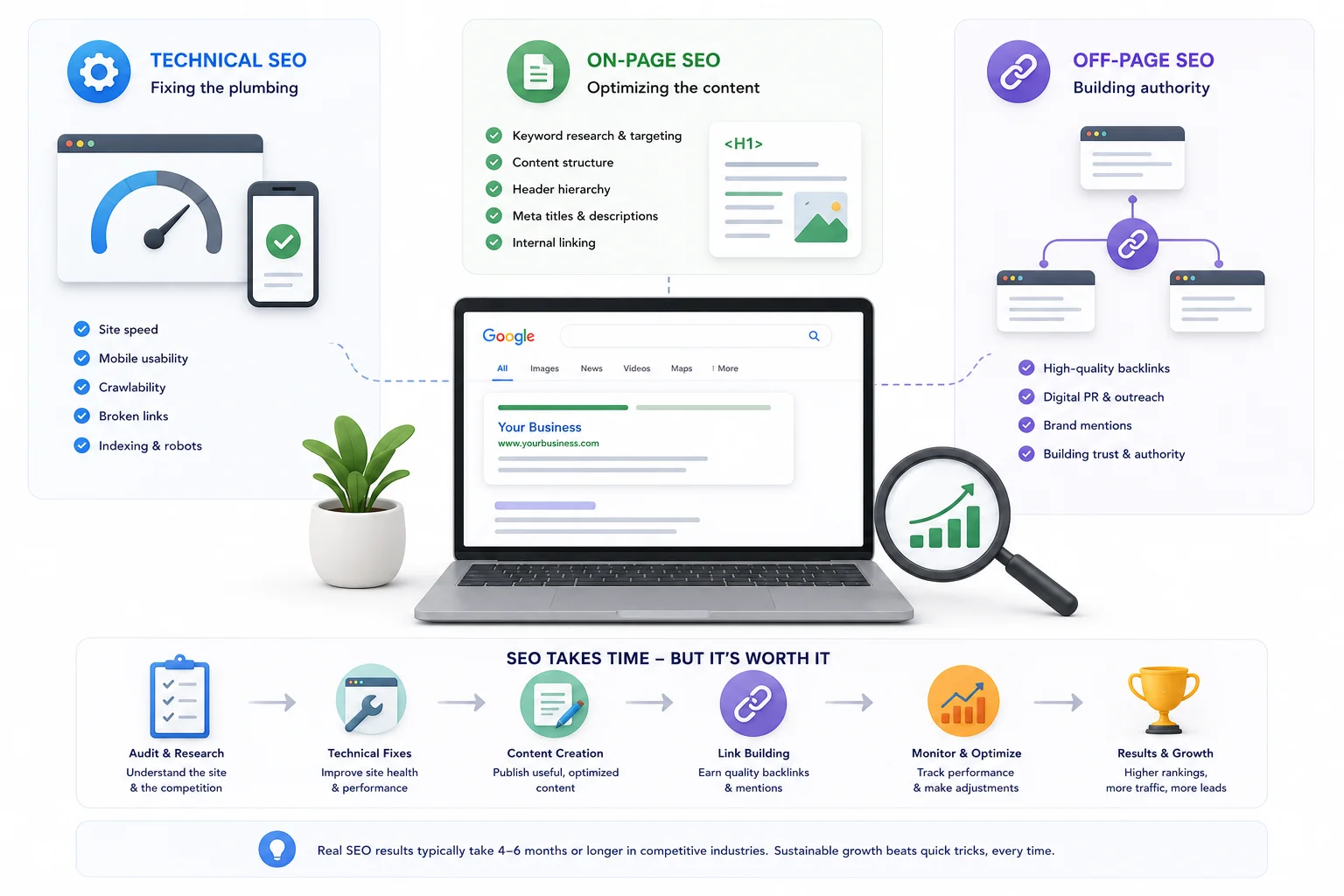
Search engine optimization is the slow, unglamorous work of getting a website to show up when someone searches for something the business sells. It’s not one task, it’s really three different disciplines stacked together, and agencies that only do one of them well tend to plateau fast.
Technical SEO fixes the plumbing. Site speed, mobile usability, broken links, crawlability, whether Google’s bots can even read the site properly in the first place. A beautifully written blog post sitting on a site that takes eight seconds to load on mobile is not going anywhere, no matter how good the writing is. This is the part of SEO that requires actual developer involvement, not just a marketer with opinions.
On-page SEO handles the content itself. Keyword targeting, page structure, header hierarchy, meta titles and descriptions, internal linking between related pages. This is where strategy meets writing, figuring out what someone is actually searching for and building content that answers that question better than what’s currently ranking.
Off-page SEO is mostly link building, getting other credible websites to point back to the client’s site. This still functions as one of the strongest trust signals search engines use to decide whether a site deserves to rank. It’s also the hardest piece to fake or rush. Buying cheap links from sketchy directories can actually hurt a site more than it helps, which is a mistake a lot of budget agencies still make because it’s the fastest thing to show a client on a report.
Here’s the part nobody likes hearing: SEO is slow. An agency can do everything right, technical fixes shipped, content published on schedule, links earned the honest way, and a client still won’t see meaningful movement for four to six months, sometimes longer for competitive industries like law, finance, or anything with a lot of well-funded competitors already sitting on page one. Anyone promising first-page rankings in thirty days is either lying or running something Google will eventually catch and penalize. Good agencies say this upfront instead of burying the timeline in the fine print of a contract nobody reads closely.
Content Marketing
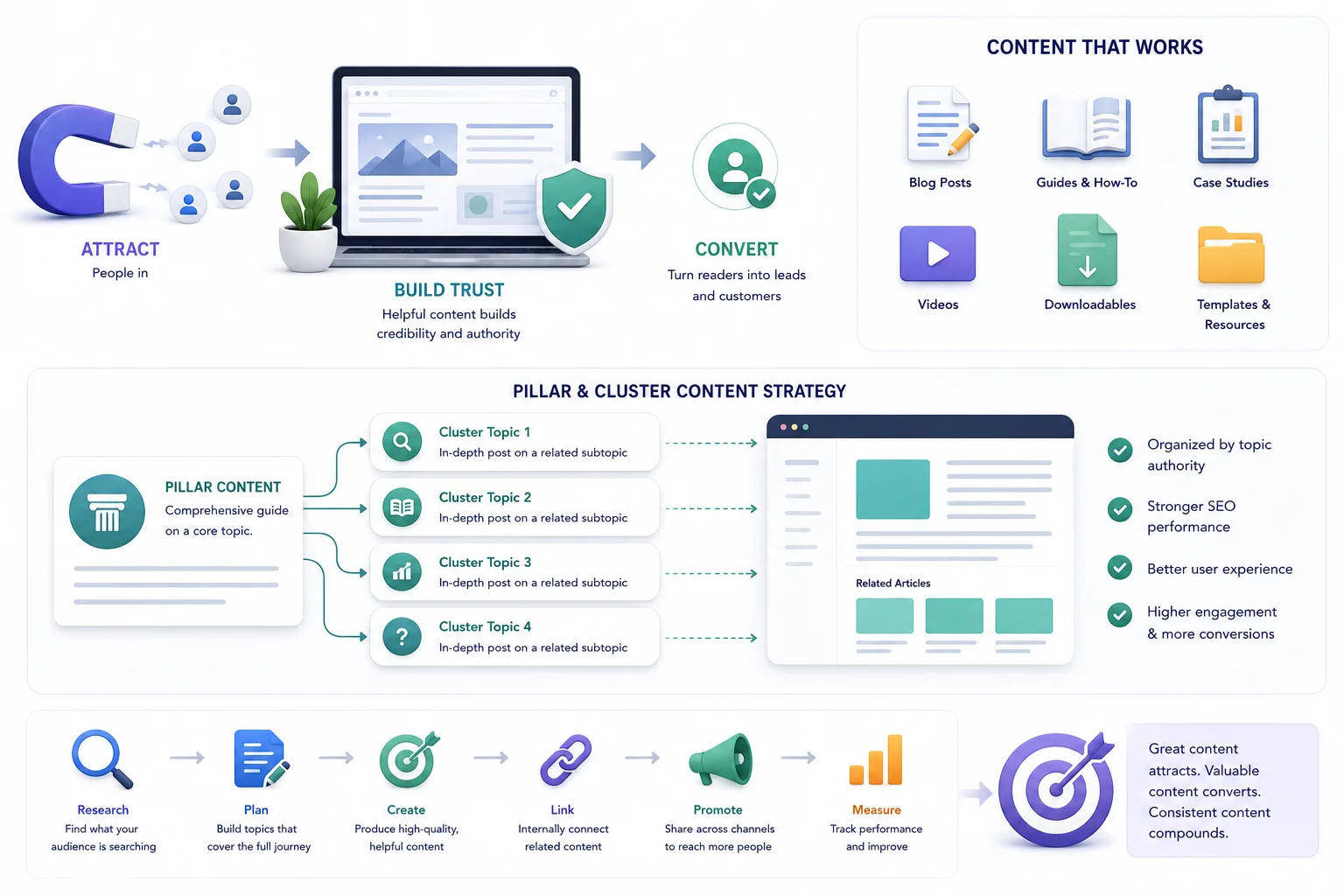
Content marketing is the blogs, guides, case studies, videos, and downloadable resources that pull people in before they’re ready to buy anything. It works hand in hand with SEO, since most content exists partly to rank in search and partly to build trust with someone still doing research before making a decision.
The better agencies don’t just churn out random blog posts hoping something sticks against the wall. That approach used to work when search engines rewarded volume over quality. It doesn’t anymore. Instead, the stronger operators build around pillar and cluster structures, one big comprehensive post on a core topic, like this one, surrounded by smaller, more specific posts that link back to it and cover the narrower questions someone might search after reading the main piece.
This keeps a website’s content organized the way search engines actually like to see it, grouped by topic authority instead of scattered across a hundred loosely related posts. It also keeps readers moving from one useful piece to the next instead of bouncing after a single article, which matters for both SEO and for actually building a relationship with someone before they ever talk to a sales team.
Content also isn’t just blog posts. Case studies show proof that the work actually delivers results, which matters enormously in B2B sales cycles where a buyer is comparing multiple vendors. Video content increasingly shows up in search results directly, especially for how-to and comparison queries. Downloadable guides and templates work as lead magnets, trading something useful for an email address that turns a random visitor into someone the sales team can actually follow up with.
PPC and Paid Advertising
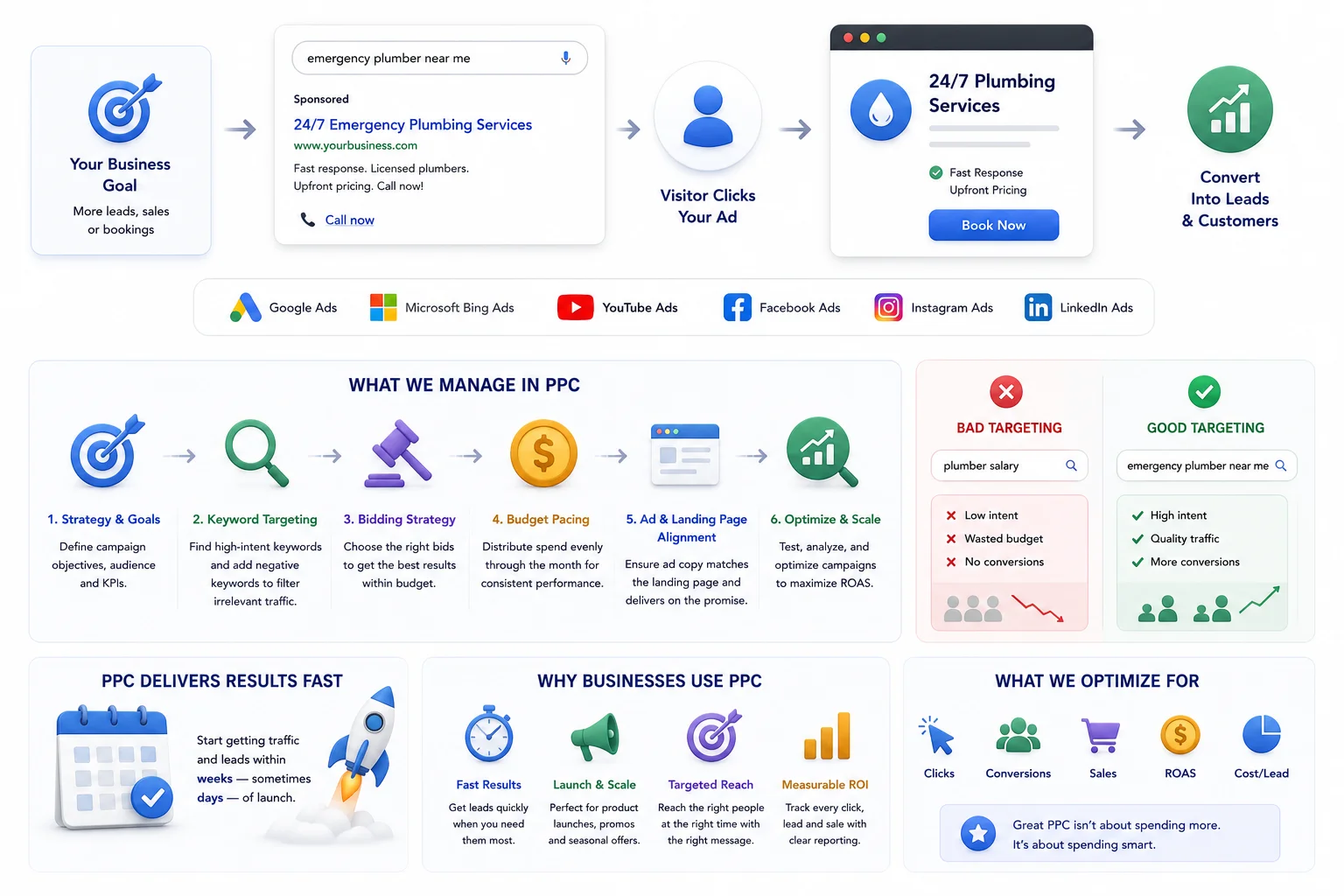
Pay-per-click covers Google Ads, Bing Ads, and the broader world of paid search. This is where an agency manages actual client money, not just creative work, which changes the stakes considerably. A bad blog post is a wasted afternoon. A poorly managed ad account can burn through a monthly budget in days with genuinely nothing to show for it.
Running PPC well involves bid strategy, deciding how aggressively to compete for specific keywords based on how valuable that traffic actually is. Budget pacing, making sure spend doesn’t front-load early in the month and leave nothing for the back half. Keyword targeting paired with negative keywords, filtering out searches that look relevant but actually bring in junk traffic that never converts, a plumbing company bidding on “plumber salary” instead of “emergency plumber near me,” for example. And landing page alignment, making sure the page someone lands on after clicking an ad actually matches what the ad promised, because a mismatch there kills conversion rates fast.
A well-managed PPC account can start producing leads within weeks of launch, sometimes days, because it’s paid placement rather than earned ranking. That speed is a big reason businesses lean on paid ads when they need results faster than SEO can realistically deliver, especially for a product launch or a seasonal push where waiting six months for organic traffic isn’t an option.
Social Media Marketing
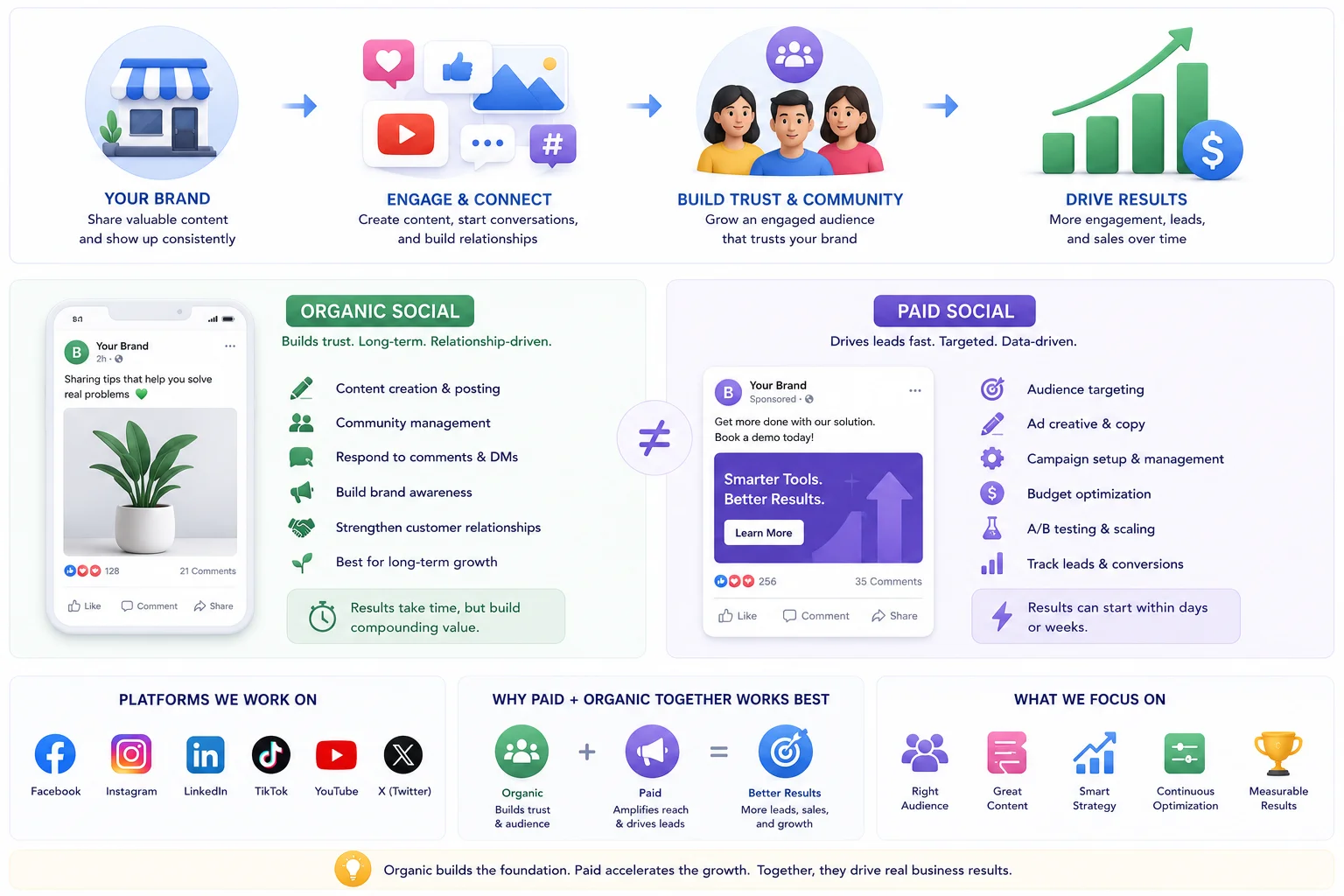
Social splits into two very different jobs that often get lumped together under one vague line item on a proposal. Organic social is the day-to-day posting, content creation, community management, and responding to comments and DMs. It’s slow, relationship-driven work. Paid social is running actual ad campaigns on platforms like Meta, LinkedIn, or TikTok, targeting specific audiences with real budget behind it, closer in spirit to PPC than to organic posting.
Organic builds trust over time and works best as a supporting channel rather than a primary lead source, though there are exceptions, some B2C brands genuinely do drive significant sales through organic content alone. Paid social can drive real leads fast, especially for businesses selling to a well-defined audience that platforms like Meta and LinkedIn can target precisely based on job title, interests, or behavior.
Treating organic and paid social as the same service, which a lot of smaller agencies do because it’s easier to sell as one bundle, usually means neither gets done particularly well. Organic needs someone thinking creatively and consistently. Paid needs someone thinking analytically about targeting and budget. Different skill sets, and cramming them into one junior social media coordinator’s job description is a common shortcut that shows up in underwhelming results.
Email Marketing and Marketing Automation
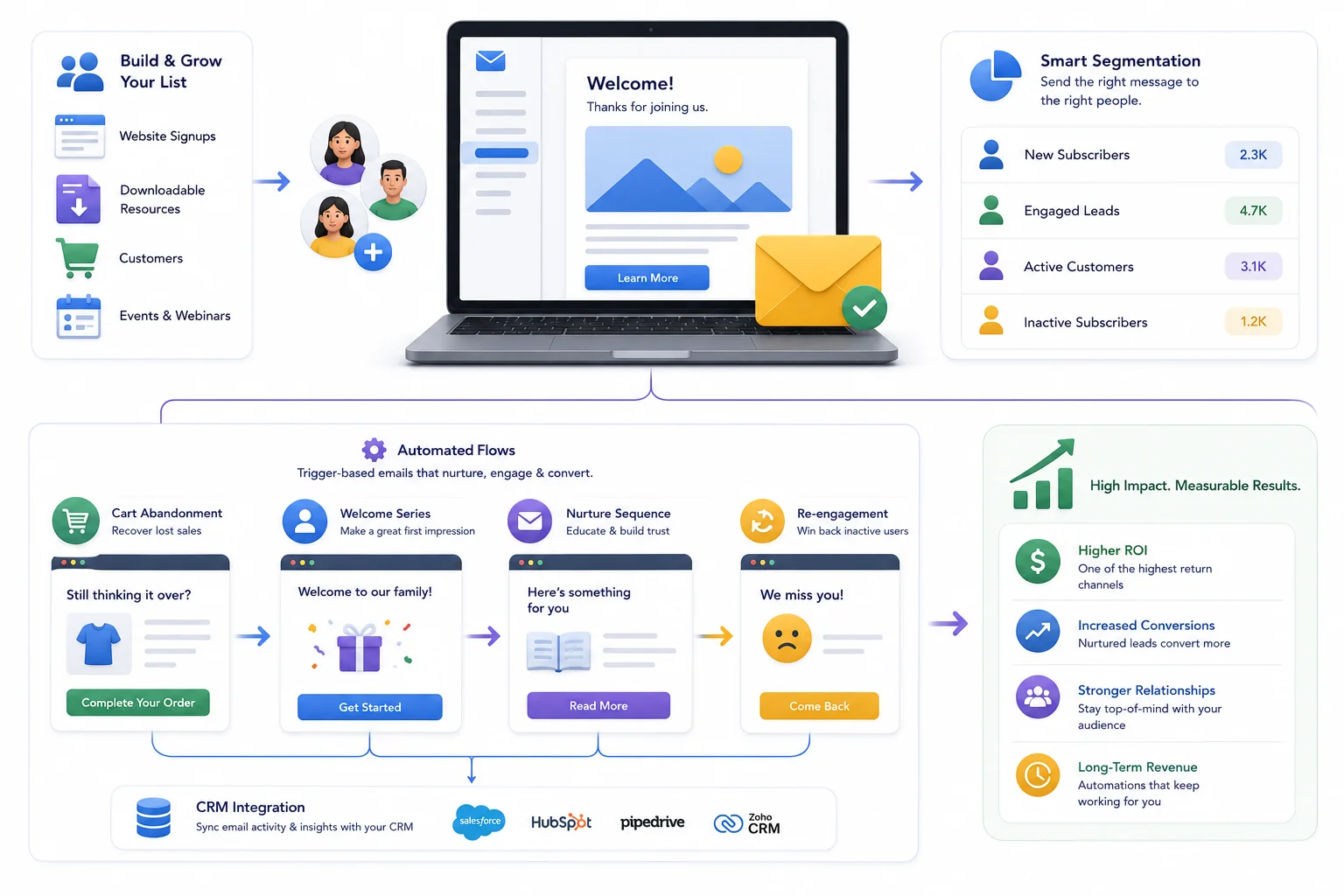
Email is still one of the highest return channels in digital marketing, mostly because it’s talking to people who already know the brand, already opted in, and already showed some level of interest. Nobody accidentally ends up on an email list the way they might stumble across a random social post.
Agencies handle list segmentation, splitting an audience by behavior or interest so messages actually feel relevant instead of generic. Nurture sequences for people who aren’t ready to buy yet, a slow drip of useful content that keeps a lead warm over weeks or months instead of losing them to inbox neglect. Automated flows tied to specific triggers, cart abandonment emails, welcome sequences for new subscribers, re-engagement campaigns for people who’ve gone quiet. And integration with whatever CRM the business is running, so email activity actually feeds back into the sales process instead of existing in its own disconnected silo.
This is less flashy than a viral ad campaign or a beautifully designed landing page, but it’s often where the actual revenue quietly comes from. A well-built email flow can keep producing sales for years with minimal ongoing maintenance, which makes it one of the better long-term investments in a marketing budget even though it rarely gets the attention paid ads or social does.
Web Design and Development
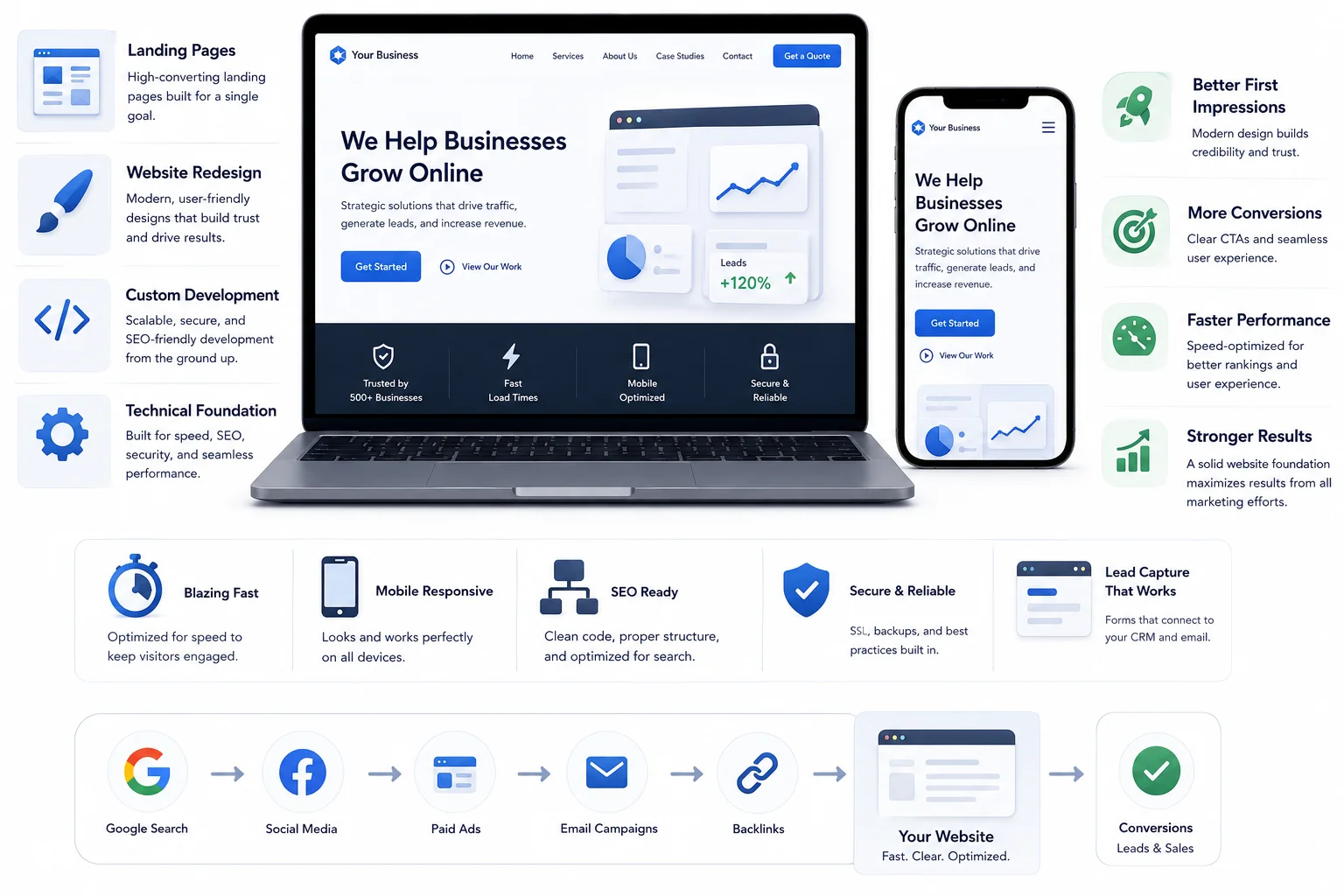
A lot of agency relationships start here, because the website is the thing every other channel eventually points back to. Every ad click, every organic search result, every social link, all of it lands on the website eventually. If that website is slow, confusing, or looks like it hasn’t been touched since the mid-2010s, none of the traffic an agency generates through SEO or ads is going to convert into anything.
Agencies handle landing page builds designed around a single conversion goal, full site redesigns when the existing structure has become a genuine liability, and the technical foundation that supports SEO from day one instead of fighting against a poorly built site later. This last part matters more than most business owners realize going in. A site built without SEO in mind often needs expensive rework six months into a marketing engagement just to make the rest of the strategy actually work.
Good web development in this context isn’t just about looking modern. It’s about page speed, mobile responsiveness, clear navigation that doesn’t confuse a first-time visitor, and forms that actually work and route leads to the right place instead of disappearing into an inbox nobody checks.
Conversion Rate Optimization
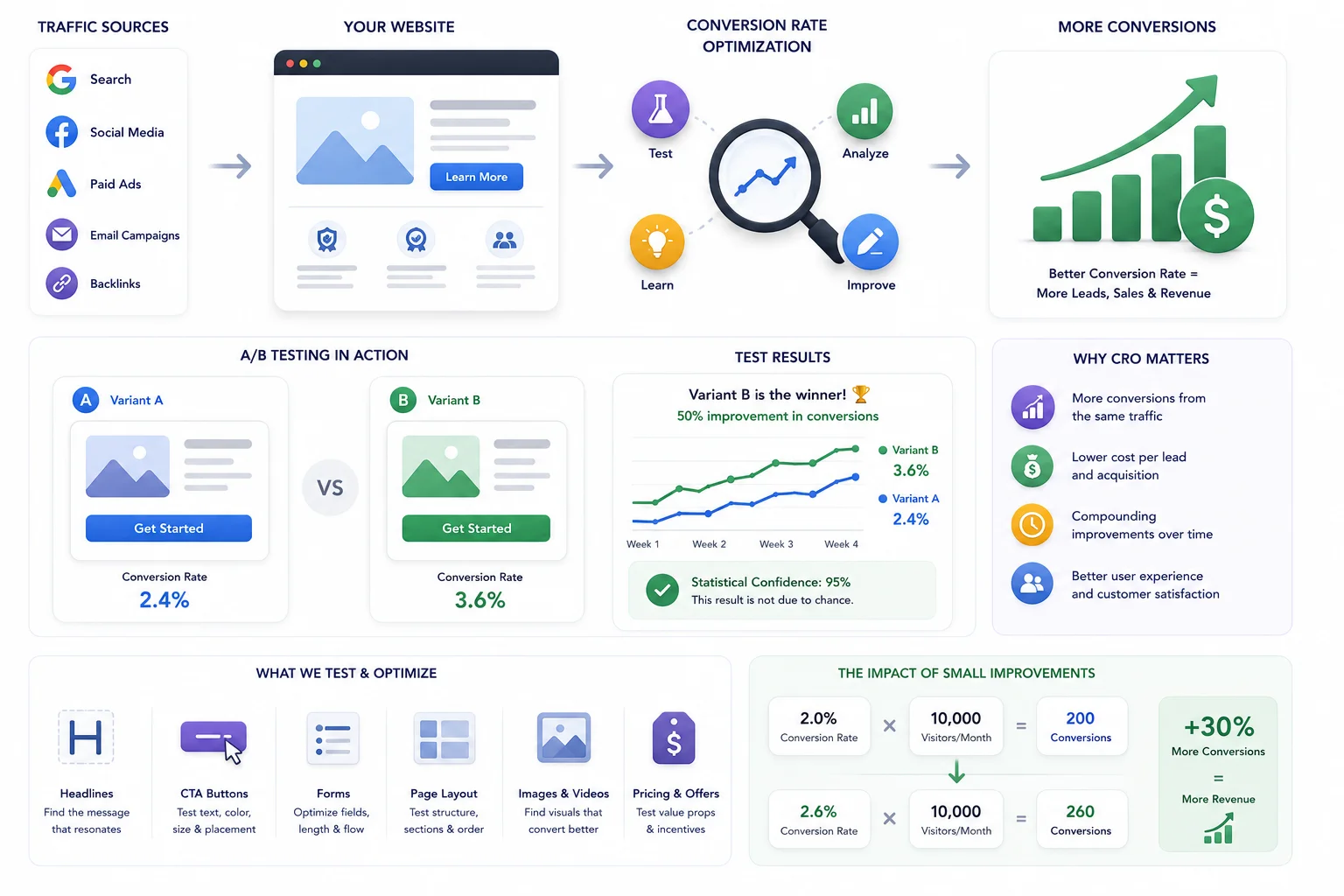
CRO is the service most agencies talk about the least and that honestly deserves more attention than it usually gets. It’s the practice of testing and improving what happens after someone lands on a page, headline variations, button placement and color, form length, page layout, all measured against actual conversion data instead of guesswork or personal opinion about what “looks better.”
A business can be paying for a ton of traffic through SEO and ads and still underperform badly if the site itself is leaking conversions somewhere in the process. A confusing checkout flow, a form asking for too much information upfront, a headline that doesn’t match what the visitor was actually looking for. All of that traffic, and all of that spend, goes to waste if the page itself doesn’t do its job.
Agencies that take CRO seriously run structured A/B tests, changing one variable at a time and measuring the impact with real statistical confidence rather than eyeballing a small sample and calling it a win. This tends to compound. Small improvements to conversion rate across every channel add up to meaningfully more revenue from the exact same traffic volume, which is often a cheaper win than trying to generate more traffic from scratch.
Analytics and Reporting
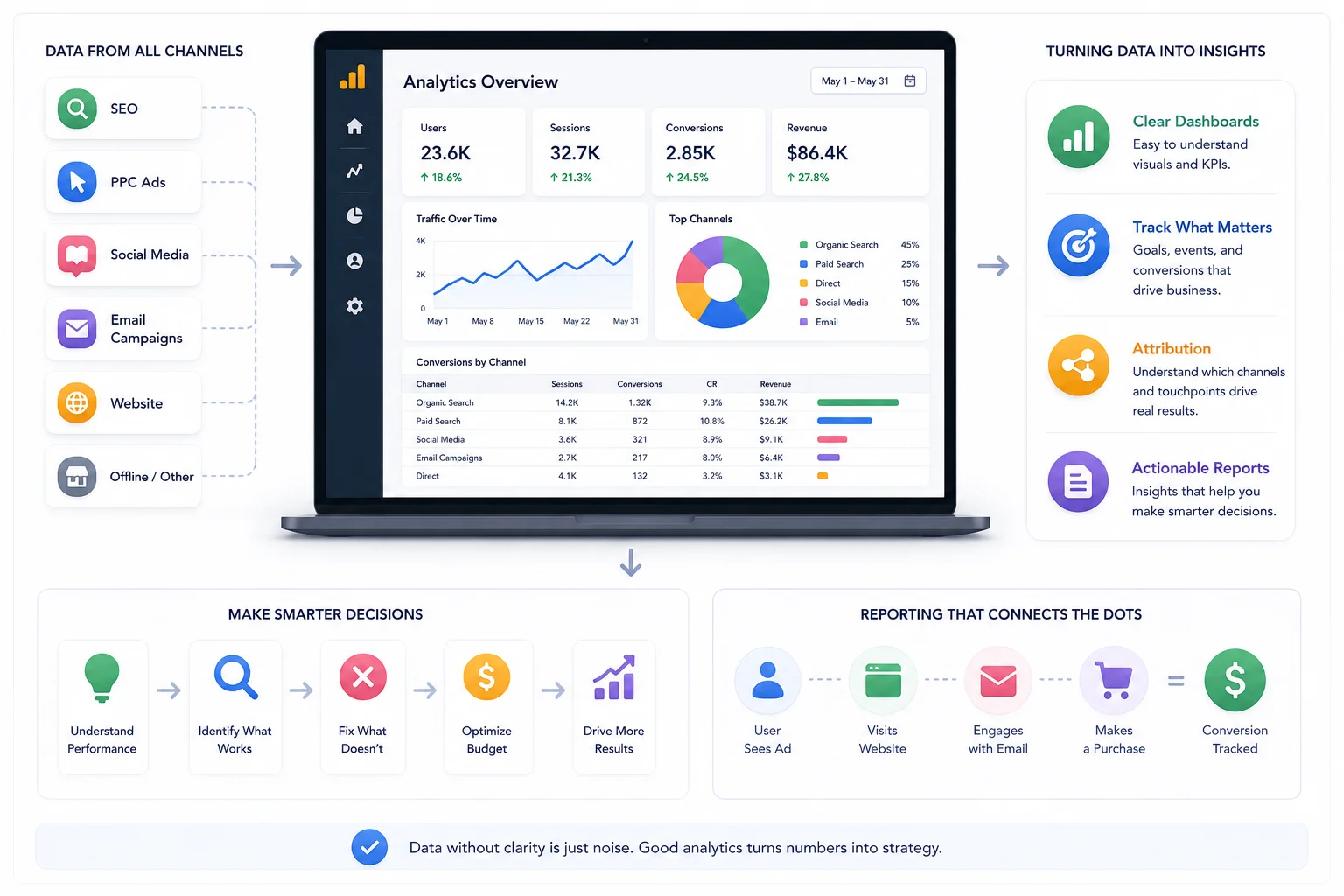
Every service above generates data, and someone has to make sense of it or the whole engagement runs on gut feeling instead of evidence. This means setting up and managing tools like Google Analytics 4, building dashboards that translate raw numbers into something a business owner can actually read without a marketing degree, and tracking attribution, figuring out which channel actually deserves credit when someone converts, since most customers touch multiple channels before they buy.
This sounds boring compared to the creative side of marketing, the ad campaigns and the content and the design work. But it’s the thing that tells a business whether any of the rest of this is actually working, or whether budget is quietly going toward channels that feel productive but aren’t moving the needle. A report that just shows traffic going up without connecting it to leads or revenue is telling half a story at best.
AI Search and GEO Optimization
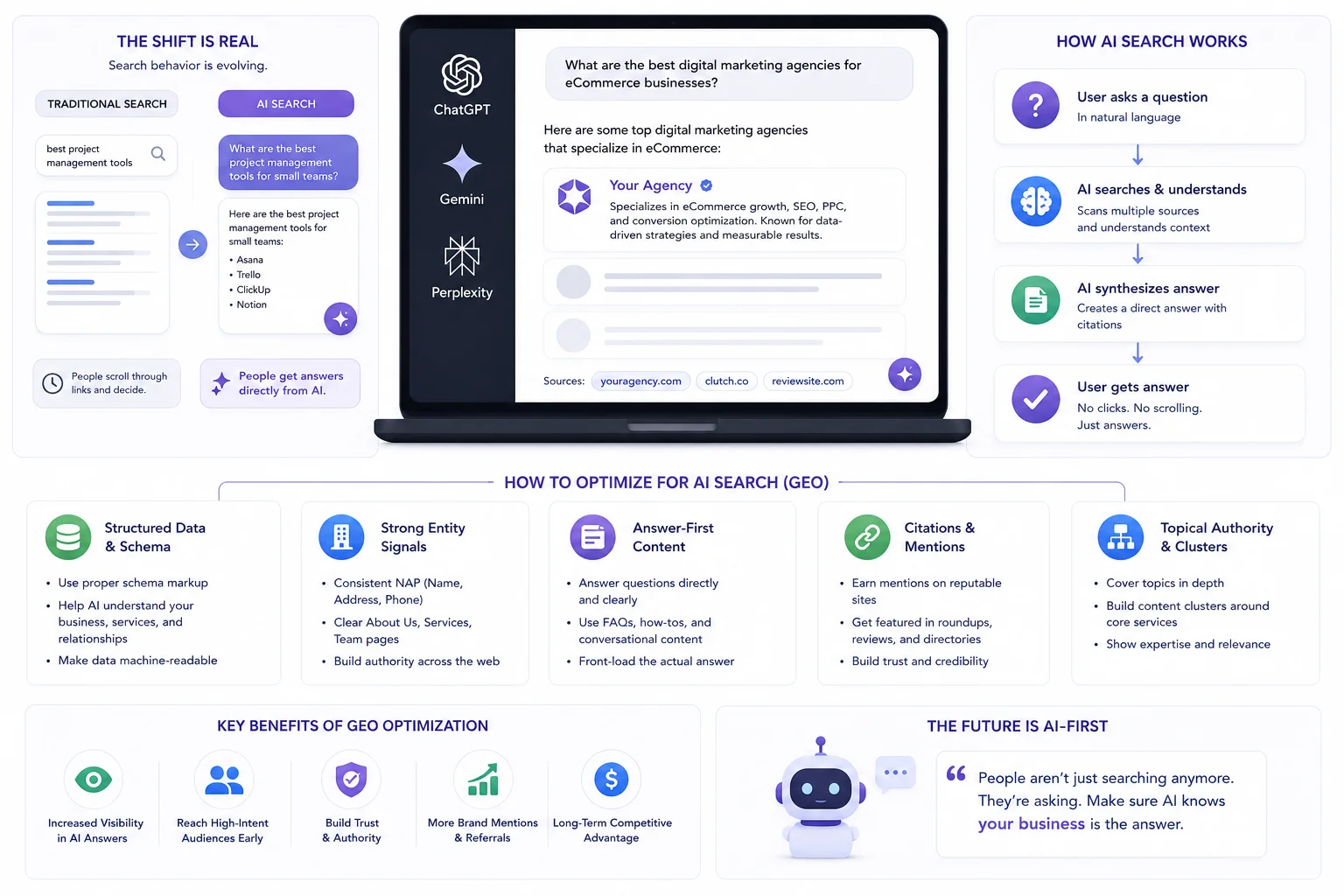
This one is newer, and most agencies, honestly, are still figuring it out in real time rather than offering it as a mature, proven service. Generative Engine Optimization is about getting a business mentioned or cited when someone asks an AI tool like ChatGPT, Gemini, or Perplexity a question, instead of typing that same question into a traditional Google search box and scrolling through blue links.
That means structured data that helps AI systems understand what a business actually does and who it serves. Clear entity signals, consistent information about the business across the web so AI tools can confidently cite it as a source. And content written to answer questions directly rather than burying the actual answer under three paragraphs of throat-clearing before getting to the point, which used to be a common SEO tactic and is now actively working against a business in an AI search context.
Search behavior is shifting in a way that’s genuinely different from previous algorithm updates. People are asking AI assistants questions that used to route straight to a Google search box, and getting a direct, synthesized answer with no click required at all. If a business isn’t showing up in those answers, it’s becoming invisible to a growing slice of people doing research before they buy, and that slice is only getting bigger. Agencies that ignore this entirely, treating it as a fad rather than a real shift in behavior, are going to look outdated fast, probably faster than most of them expect right now.
Types of Digital Marketing Agencies
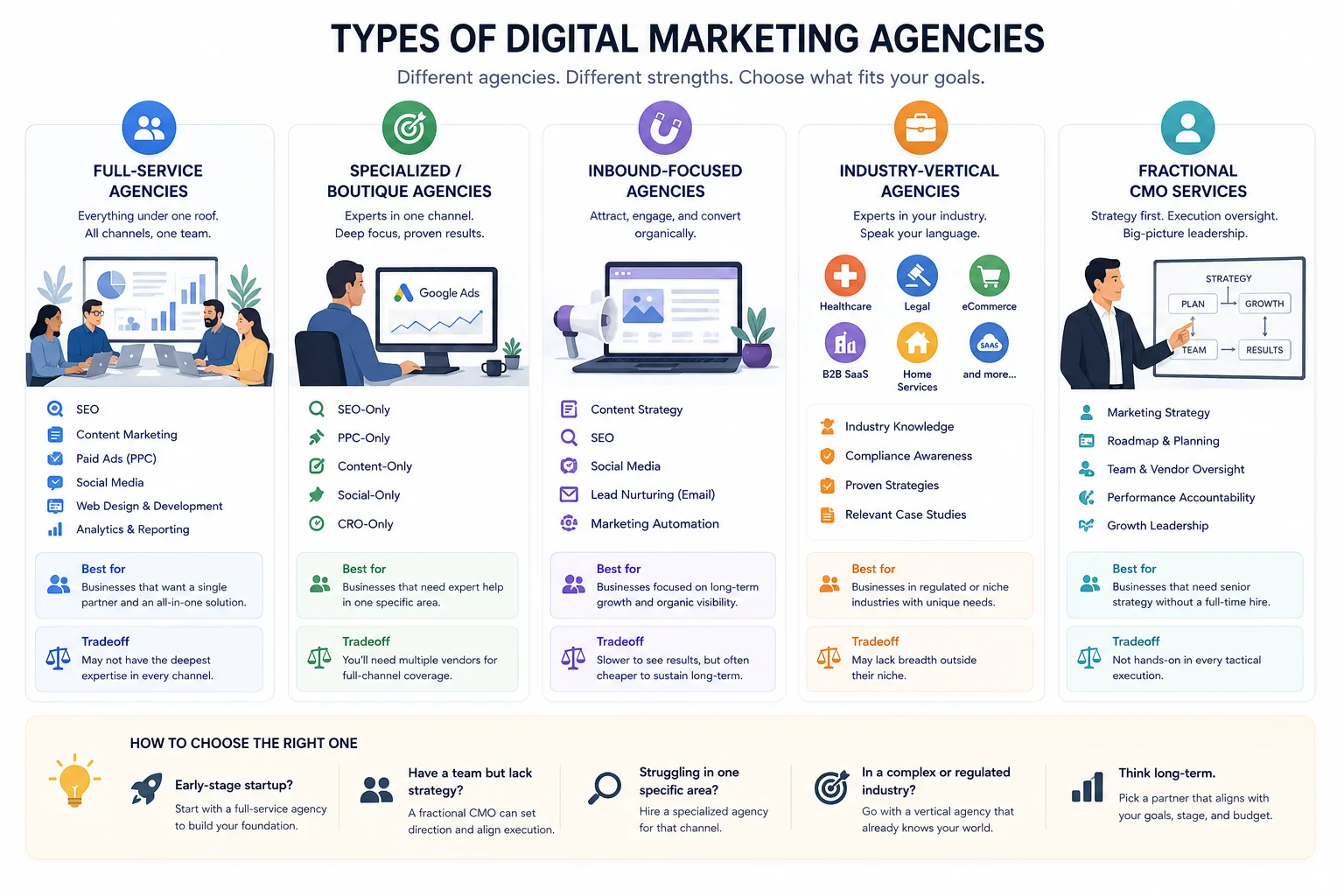
Not every agency does everything, and that’s not a weakness, it’s a business model choice, and understanding the types helps figure out which one actually fits a specific situation instead of picking based on who had the best sales pitch.
Full-service agencies handle everything under one roof. SEO, content, paid ads, social, design, the works, all coordinated by one team with one point of contact. Businesses that want a single relationship and don’t want to manage multiple vendors sending separate invoices and separate reports usually go this route. The tradeoff is that a full-service shop might not have the deepest possible expertise in every single channel, since resources get spread across a lot of disciplines.
Specialized or boutique agencies go deep on one channel. An SEO-only firm that lives and breathes technical audits and content strategy. A PPC-only shop that spends all day inside Google Ads and knows every bid strategy nuance. The tradeoff here runs the other direction, real depth in one lane, but a business needs to coordinate multiple vendors if it wants coverage across several channels, which adds management overhead.
Inbound-focused agencies build strategies around attracting customers organically. Content, SEO, and social, rather than pushing outbound ads that interrupt someone’s day. This tends to be slower to show results since it relies heavily on SEO’s natural timeline, but often cheaper to sustain long-term once the content library and rankings start compounding.
Industry-vertical agencies specialize in a specific sector, healthcare, legal, ecommerce, B2B SaaS, home services, and a handful of others. They come in already knowing the sales cycle for that industry, the compliance quirks that matter, whatever regulatory language has to be handled carefully, and the language that sector’s buyers actually respond to. A healthcare marketing agency understands HIPAA-adjacent concerns in a way a generalist shop might not. A B2B SaaS specialist understands long sales cycles and multiple decision makers in a way a local service business agency wouldn’t need to.
Fractional CMO models are a bit different from the rest of this list, worth separating out on its own. Instead of just executing campaigns, a fractional CMO plugs in at the strategic level, setting direction, owning the marketing roadmap, and often overseeing the execution team, whether that’s in-house staff, an outside agency, or some mix of both. This works well for businesses that have outgrown ad hoc marketing decisions made without a clear strategy behind them, but aren’t ready for the cost and commitment of hiring a full-time CMO onto the payroll.
Picking the right type usually comes down to stage. An early startup with no marketing function at all might just need a full-service agency to build everything from scratch, since there’s no internal structure to work around. A company that already has an internal team but lacks senior strategic direction is often better served by a fractional CMO, someone experienced enough to set the roadmap without needing to be hired full time. A business that only struggles with one specific channel, say their SEO has stalled while everything else works fine, doesn’t need to hire a full-service shop for that and would probably overpay for services it doesn’t actually need.
Who’s Actually Working on Your Account
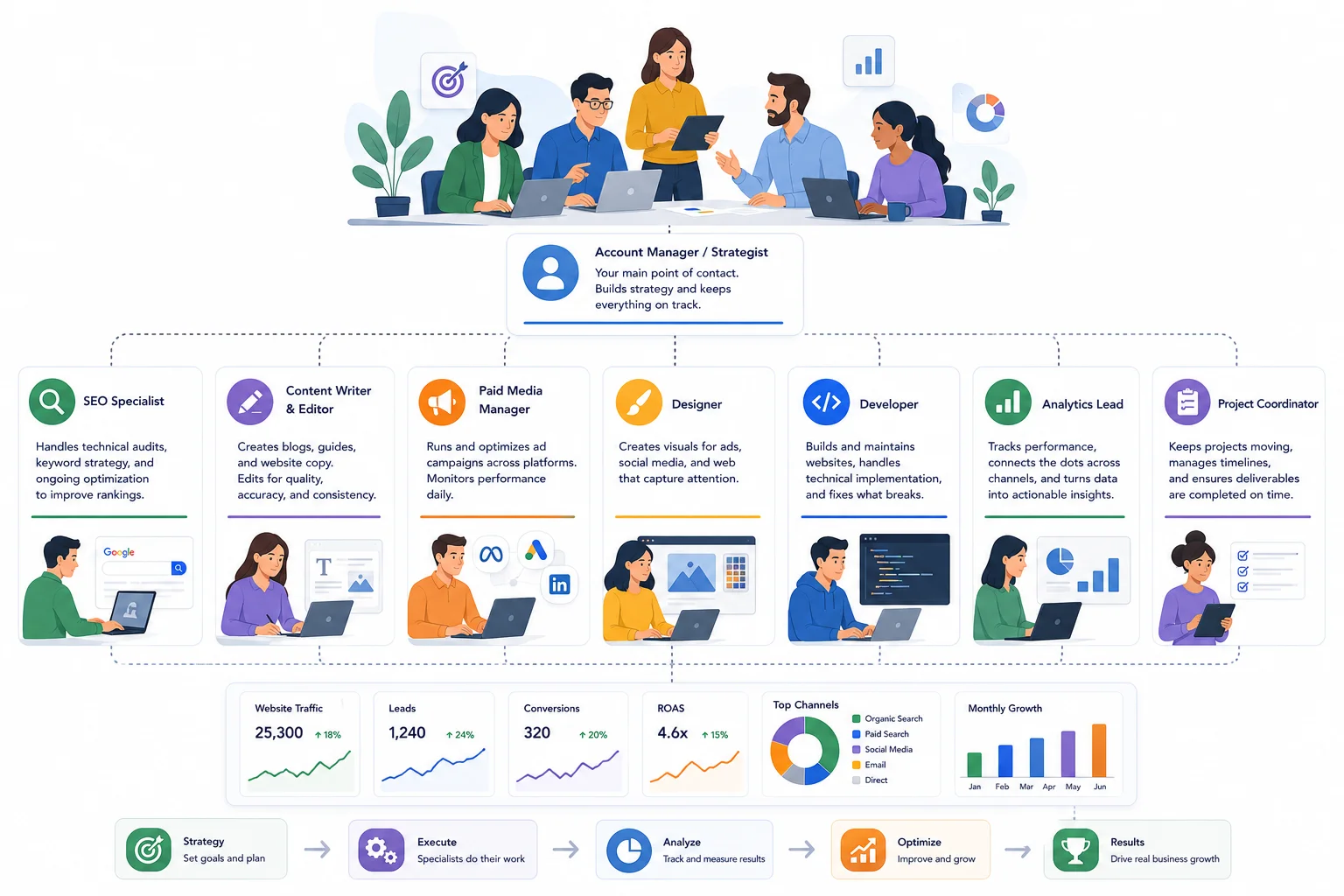
This is the part almost nobody explains clearly, and honestly, it’s usually the difference between a good agency experience and a genuinely frustrating one that ends in a canceled contract six months in.
A real agency engagement typically involves several different people, not one person doing everything under a job title that says “marketing manager” on a business card. The account manager or strategist acts as the main point of contact, translating business goals into an actual marketing plan and keeping the whole engagement on track week to week. The SEO specialist handles technical audits, keyword strategy, and the ongoing optimization work that never really finishes. A content writer and editor produces the blogs, guides, and website copy, usually with someone else reviewing for quality and consistency before anything goes live.
A paid media manager runs and optimizes ad campaigns across Google, Meta, or wherever the budget is actually going, watching performance daily or near-daily rather than checking in once a month. A designer handles visuals for ads, social, and web, since none of the other pieces land well without decent creative behind them. A developer builds or maintains the website itself, handling technical implementation that a marketer alone usually can’t do. And an analytics lead pulls all of this together into something usable, connecting the dots between channels instead of leaving each specialist reporting in isolation.
Here’s where it gets murky, and where a lot of businesses get surprised after signing. A freelancer marketing themselves as a one-person “agency” is doing all of this solo, which means something has to give somewhere. Usually it’s depth. Nobody is genuinely excellent at technical SEO, paid media strategy, copywriting, and web development at the same time, the disciplines are just too different, and each one takes years to actually master. That doesn’t mean a skilled freelancer can’t deliver real value, plenty do, but it does mean a business should go in with realistic expectations about how many balls one person can keep in the air at once.
A real agency has specialists for each piece, which is a meaningful part of what a business is actually paying for when the invoice looks bigger than a freelancer’s rate. Smaller boutique agencies sit somewhere in between the two extremes. Someone might handle both content and social because the volume doesn’t justify two separate hires, or the account manager might also run paid campaigns on smaller accounts where the budget doesn’t support a dedicated media buyer. That’s not necessarily a problem on its own, plenty of boutique shops do excellent work this way, but it’s worth asking about directly before signing anything.
Knowing who’s actually going to be doing the work, and how many other accounts that person is juggling at the same time, tells a business a lot more about what to expect than a slick case study or a well-produced sales deck ever will.
How a Digital Marketing Agency Actually Works: The Process
Most explanations of this get vague fast, “strategy, execution, optimization,” which sounds official and says almost nothing useful. Here’s what an engagement actually looks like on a real timeline, from the first call to ongoing monthly work.
Weeks one and two are discovery, and this stage gets rushed or skipped entirely by agencies trying to look fast and impressive out of the gate. This means audits, current SEO performance, competitor positioning, an honest look at what’s working and what isn’t in whatever existing campaigns are already running. It also means sitting down and actually defining goals and KPIs together with the client, not assuming what success looks like based on a generic template pulled from a previous, unrelated client. A business that skips this step and jumps straight into execution usually ends up with a strategy built on assumptions instead of real data, which tends to show up as wasted budget a few months down the line.
Weeks three and four are strategy building. This is where the audit turns into an actual plan, channel mix decided based on what the discovery phase actually revealed, budget allocation across those channels weighted toward whatever’s likely to move the needle fastest, and for content-heavy engagements, an editorial calendar with real topics and real publish dates instead of a vague promise to “post more content regularly.” This is also usually when the client sees the first real strategic deliverable, something concrete enough to push back on or adjust before execution actually begins.
Month two onward is execution. Content gets written and published on the schedule that was actually agreed on. Campaigns go live across whatever paid channels were chosen. Website changes get implemented, whether that’s a small landing page tweak or a larger technical fix flagged during the audit phase. This is usually the point where a client starts seeing actual output instead of decks and plans and strategy documents, which is often when the relationship starts to feel real for the first time.
From there it’s ongoing optimization, and this never really stops for as long as the engagement continues to run. Reporting usually happens weekly or monthly depending on the agency and the size of the account, with paid campaigns often getting checked far more frequently than that behind the scenes since ad performance can shift day to day. A real report shows what changed since the last one, what worked and why, what didn’t work and what’s being adjusted because of it, and what’s planned next based on the actual data rather than a generic template that could apply to any client.
A report that just lists impressions and follower growth without connecting any of it to business results is not a report worth paying attention to, no matter how polished it looks in a PDF.
Timelines matter enormously here, and agencies that are straight about them upfront earn a lot more trust than the ones who promise everything fast just to close the deal. SEO realistically takes four to six months before meaningful movement shows up in rankings or traffic, longer in competitive industries where a lot of well-funded competitors are already fighting for the same keywords. PPC can start generating leads within weeks of launch, sometimes days, because it’s paid placement rather than earned ranking that has to build up trust with a search engine over time. Content sits somewhere in between the two, individual posts can start ranking within a couple months of publishing, but the compounding effect of a full, interconnected content library takes closer to six months to a year to really show up meaningfully in the traffic and lead numbers.
What Digital Marketing Agencies Cost
Almost nobody talks about actual numbers, which is genuinely strange given that cost is usually the first question sitting on a business owner’s mind before they even pick up the phone.
Pricing generally comes in one of four models. Monthly retainer is a fixed fee for ongoing work, and it’s the most common structure for full-service engagements where a team is continuously running SEO, content, ads, and reporting month after month. Project-based pricing is a set fee for a defined deliverable, a website redesign, say, or a one-time SEO audit with a clear start and end date rather than an open-ended relationship. Hourly billing is less common for strategy work specifically, but shows up more often for specific technical tasks, a developer fixing a particular site issue, for example. Performance-based pricing ties fees to actual results, leads generated or ad spend managed, and shows up more commonly in PPC-heavy arrangements where performance is easier to measure directly and attribute cleanly.
For rough ranges, understanding these vary a lot by region, industry, and agency size, a small boutique agency working with a local or small business might run anywhere from a modest monthly retainer up to a few thousand dollars a month, depending on how many channels are actually involved and how much content volume is expected. Mid-size agencies handling multi-channel strategies for growing companies, businesses with real ad budgets and content demands, tend to land in a meaningfully higher monthly range, often a few thousand to somewhere in the low five figures depending on scope. Full-service enterprise agencies managing large ad budgets and complex campaigns across multiple markets can run well into five figures a month once management fees, creative production, and ad spend are all factored together.
Pricing in markets like India tends to run noticeably lower than US or UK pricing for comparable scope and quality of work, which matters a lot for agencies serving international clients from a lower cost base, and it’s part of why offshore and remote agency relationships have become so common over the past several years.
What actually drives price up or down comes down to a handful of factors. How many channels are in scope, since a single-channel engagement obviously costs less than a full multi-channel strategy. How competitive the industry is, since a local plumber and a fintech startup are not competing for the same keywords or facing anywhere near the same difficulty level in ranking or advertising. How much content volume is expected, since a business wanting four in-depth blog posts a month costs more to serve than one wanting one post a month. And whether ad spend is being actively managed on top of the service fee, since managing a hundred thousand dollars in monthly ad spend is a very different job than managing five thousand.
One honest thing worth saying plainly, even though it’s not always what a business wants to hear when comparing quotes: a suspiciously cheap agency almost always means one of two things. Either the work is being handed off to junior staff with minimal senior oversight, learning on a live client’s budget rather than bringing proven experience to the table. Or it’s being outsourced further downstream with no real quality control loop back to the client, essentially a middleman marking up work done somewhere else entirely. Neither is automatically a dealbreaker, plenty of junior teams do solid work under good management, but it’s worth knowing exactly what’s happening behind the scenes before signing a contract based on price alone.
In-House vs. Agency vs. Freelancer vs. Fractional CMO
This decision trips up a lot of businesses, mostly because the comparisons usually get presented as vague pros and cons lists instead of anything concrete enough to actually act on.
Cost structure looks meaningfully different across all four options. An in-house hire means salary, benefits, payroll taxes, and the overhead of actually managing that person day to day, a fixed cost regardless of how much output that person produces in any given month. A freelancer is usually the cheapest option upfront and offers real flexibility for a business just starting to invest in marketing, but scales badly once the workload grows past what one person can realistically handle without burning out or quality slipping. An agency retainer sits somewhere in the middle, higher than a single freelancer’s rate but covering an entire team’s worth of specialized skills instead of relying on one generalist. A fractional CMO usually costs meaningfully less than a full-time executive hire on payroll, while still providing the kind of senior strategic oversight a business would otherwise have to pay a much higher full-time salary to get.
Speed and flexibility matter just as much as raw cost. Agencies can typically ramp up or down faster than hiring or firing an in-house team, which matters enormously for businesses with seasonal demand or shifting priorities throughout the year. Firing and rehiring internal staff is slow, expensive, and disruptive in ways that adjusting an agency scope of work simply isn’t. Freelancers offer flexibility too but with limited bandwidth, since one person can only handle so much work in a given month before something starts slipping. In-house teams take the longest to actually build out, recruiting, onboarding, ramping up to full productivity, but offer the deepest institutional knowledge over time since that person lives inside the business every day rather than splitting attention across multiple clients.
Expertise breadth favors agencies and fractional CMOs by default, since both bring access to specialists across multiple disciplines rather than relying on one person’s individual skill set to cover everything. A freelancer might be genuinely excellent at one specific thing, SEO, say, but that leaves every other channel uncovered unless more freelancers get brought on, which starts looking a lot like an informal, harder-to-manage version of an agency anyway, just without the coordination.
So when does each option actually make sense in practice. An early-stage startup with no marketing function at all often benefits most from a full-service agency, since there’s no internal team to disrupt or coordinate around, and the agency can build everything from the ground up without stepping on anyone’s existing work. A company that’s scaled past the startup phase and has some internal marketing staff already in place but lacks senior direction is usually a strong fit for a fractional CMO, someone to set strategy and oversee the existing team without the cost of a full-time executive hire on the payroll. An enterprise with a large, capable internal team might only need an agency for specific specialized work that internal staff genuinely can’t cover, a technical SEO overhaul, say, or a paid media push into a brand new market the internal team has no experience in.
How to Measure If an Agency Is Actually Working
This is where a lot of client relationships quietly go wrong, because the wrong metrics get treated as proof of success month after month while the actual business outcomes stay flat.
Real signals worth tracking include revenue attribution, figuring out which channels are actually contributing to closed deals, not just generating traffic that never converts into anything. Customer acquisition cost, how much it actually costs to win a new customer through a given channel, and whether that number is trending in a healthy direction over time. Return on ad spend for paid campaigns specifically, a direct measure of whether the money going into ads is coming back with more attached to it. Organic traffic growth over time, tracked against actual conversions rather than raw visitor counts alone. And lead quality, not just volume, since a hundred leads a month sounds great in a report until half of them turn out to be people who were never realistically going to buy anything in the first place.
Vanity metrics deserve real skepticism in this context. Impressions, likes, follower counts, these numbers move around easily, can be influenced by all sorts of things that have nothing to do with revenue, and don’t reliably connect to anything a business actually cares about at the end of the day. An agency that leads every monthly report with follower growth and buries the actual conversion data somewhere near the bottom of the deck is either not tracking the right things internally, or hoping the client won’t ask the harder question about what any of it actually means for the bottom line.
A solid monthly report should show what actually happened across each channel in plain terms, tie it back directly to the KPIs agreed on during onboarding rather than introducing new metrics that weren’t part of the original conversation, flag what’s underperforming honestly instead of spinning bad numbers into something that sounds better than it is, and lay out what’s changing next month based specifically on that data. If a report consistently reads more like a highlight reel than an honest assessment of what’s working and what isn’t, that’s worth a direct, uncomfortable conversation sooner rather than later.
Red Flags and Questions to Ask Before Hiring
A few things tend to signal trouble early, well before a contract even gets signed, if a business knows what to look for during the sales process.
No clear reporting cadence, or vague, evasive answers when directly asked how often updates will happen and in what format. Case studies that are heavy on before-and-after screenshots but genuinely light on actual numbers or context about what the client’s situation actually was going in. Guaranteed rankings or a guaranteed number of leads, since no legitimate agency controls Google’s algorithm or a specific market’s buyer demand closely enough to promise a specific outcome with any honesty. No flexibility in contract terms, locking clients into long commitments with no real exit path if the relationship clearly isn’t working after a reasonable amount of time. And one person clearly handling everything under an “agency” label with no visible team behind them, which circles back to the team structure question raised earlier.
Worth asking directly before signing anything, even if it feels slightly awkward during a sales conversation. Who specifically will be managing the account day to day, by name, not just a vague reference to “our team.” How will success actually be measured and reported, and can that be seen in writing before the contract is signed. What’s the average client tenure, since a consistently high churn rate says a lot more than any case study will. And can the agency show real reporting samples from an actual client engagement, not just polished case study slides built specifically for the sales pitch.
None of this is about being difficult during a sales conversation, even though it might feel that way in the moment. It’s about knowing what’s actually being bought before money changes hands and a contract locks things in for months.
Signs You Actually Need a Digital Marketing Agency
Not every business needs one, and honestly, not every business is ready for one at a given point in its growth. A few situations where it usually makes genuine sense. Organic traffic has flatlined for months and nobody internally has the expertise to diagnose why. There’s no marketing capability in-house at all, and the business has been growing purely through word of mouth or referrals, which eventually runs out of runway on its own. Growth has outpaced what the current internal team can realistically handle without burning out or letting quality slip across the board. Or there’s a need for a very specific skill, technical SEO, paid media strategy, that genuinely nobody on staff currently has and that would take significant time to build internally from scratch. If none of these situations really apply right now, hiring an agency might just mean paying for work that isn’t actually solving a problem the business has yet, which rarely ends in a satisfying engagement for either side.
Conclusion
A digital marketing agency, at the end of the day, is a bet on expertise a business doesn’t have the time or the internal capability to build on its own. Some of that bet pays off fast, a paid campaign that starts producing real leads in the first month of running. Some of it takes patience, SEO and content that quietly compound over six months and then start pulling their weight for years afterward with very little additional spend. The businesses that get the most out of an agency relationship are usually the ones that go in understanding exactly what they’re buying, who’s actually doing the work behind the scenes, and what a reasonable timeline genuinely looks like, instead of expecting a miracle for the price of a mid-tier monthly retainer.
If any of this sounds like the gap a business is currently trying to close, whether that’s full execution across multiple channels, strategic direction through a fractional CMO, or something more specific and narrow, that’s exactly the kind of conversation worth having openly before signing anything with anyone.
Frequently Asked Questions
What’s the difference between a digital marketing agency and an ad agency?
A traditional ad agency usually focuses on offline channels, TV, print, billboards, and creative campaigns built primarily around brand awareness rather than direct response. A digital marketing agency operates entirely online and typically ties its work more directly to measurable outcomes like leads, traffic, and revenue, rather than broader brand metrics.
How long before results show up from a digital marketing agency?
It depends heavily on the channel involved. PPC can produce leads within weeks of launch. SEO usually takes four to six months for meaningful movement to show up in rankings and traffic. Content marketing sits in between, individual pieces can start ranking within a couple months, but the full compounding effect of a real content library takes longer to fully show up in the numbers.
Do agencies require long contracts, or is month-to-month an option?
Both exist in the market. Some agencies push for six or twelve month commitments, especially for SEO-heavy engagements given how long that timeline realistically takes to show results. Others offer month-to-month arrangements with more flexibility built in. This is worth clarifying directly before signing anything, rather than assuming either way.
Can an agency guarantee rankings or a specific number of leads?
No legitimate agency can guarantee this with real certainty. Rankings depend on factors outside any single agency’s full control, including competitor behavior and search engine algorithm changes. Lead volume depends heavily on market demand as much as it depends on campaign quality. Agencies promising firm guarantees here are usually overselling what they can actually deliver.
What’s the real difference between a full-service agency and a specialized one?
A full-service agency covers every channel under one contract and one point of contact. A specialized agency focuses deeply on a single channel, SEO or PPC, for example, and often brings more depth and experience in that one specific area than a generalist team would be able to offer across everything at once.
Is a fractional CMO a better fit than a full agency retainer?
It genuinely depends on what’s actually missing inside the business. If execution capacity is the gap, campaigns need to actually get built and run across multiple channels, an agency usually fits better. If the business already has execution capacity in-house but lacks senior strategic direction to point that capacity in the right direction, a fractional CMO tends to be the stronger fit.
How much should a small business realistically budget for digital marketing?
It varies quite a bit by industry and specific goals, but a small business running a focused strategy across one or two channels typically ends up in a modest monthly range, while a broader multi-channel push naturally costs more to run properly. The honest answer is that budget should scale with how competitive the industry actually is, not just with company size or revenue alone.