

Somewhere in your inbox right now there’s a business you forgot you signed up with. Maybe it was a discount code popup you clicked to escape, or a free PDF you wanted badly enough to hand over your email for. And then, nothing useful happened. Maybe one newsletter. Maybe silence for three months and then a random “we miss you” email that makes it obvious nobody was actually paying attention. That’s not an email funnel. That’s a business hoping your inbox does the selling for them while they focus on everything else.
An email funnel is the opposite of that. It’s a sequence of emails built with a specific job at each stage, moving someone from “who even are you” to “take my money” to “I’m telling my coworkers about this.” Most businesses have a list. Very few have a funnel. This guide is about the difference, and about actually building one instead of just sending emails and hoping something sticks.
What Is an Email Funnel?
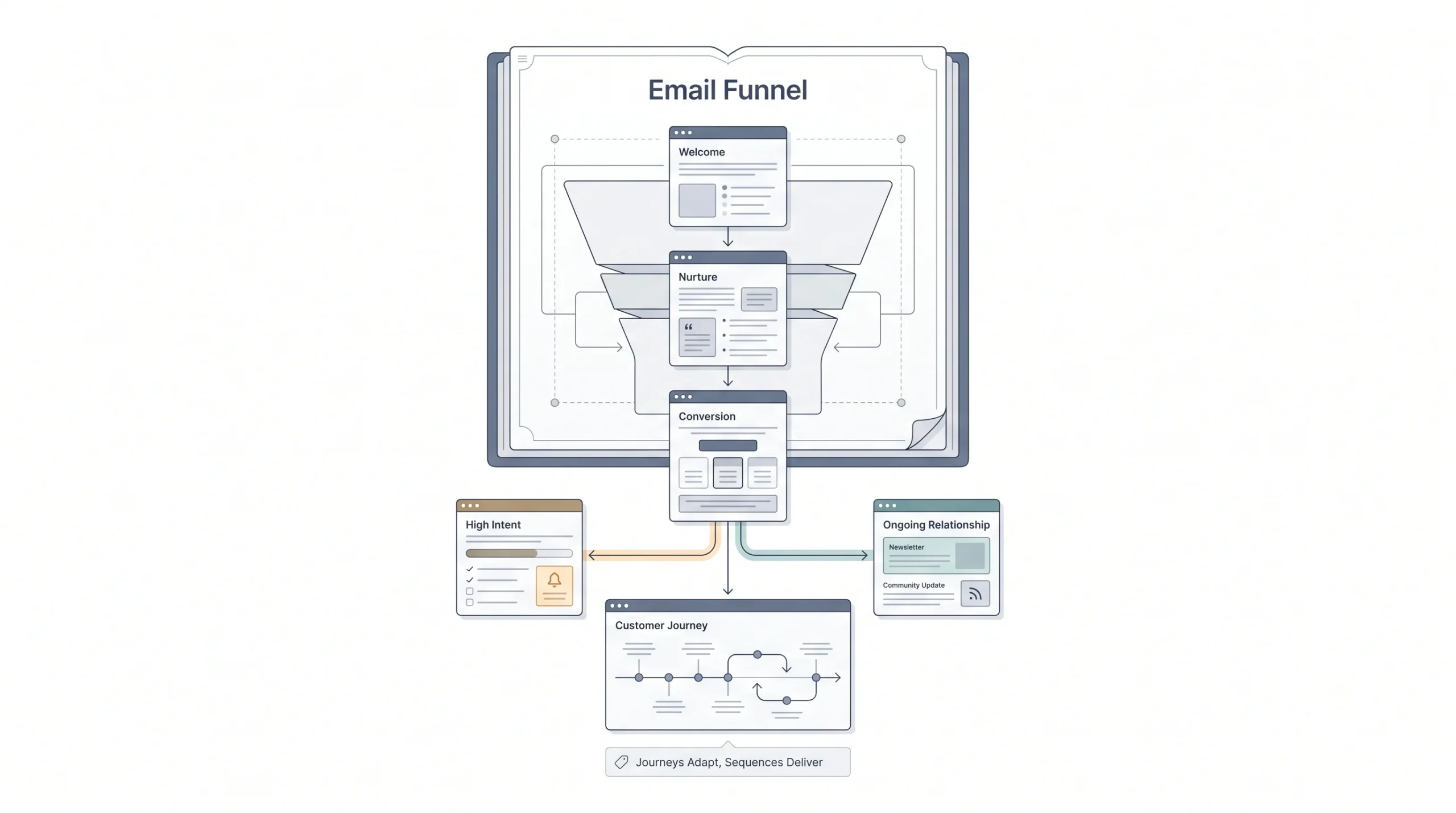
An email funnel is a structured sequence of emails, each with one job, designed to move a subscriber from first contact to purchase and then to loyalty. That’s it. Not a newsletter. Not a random batch of promotional blasts sent whenever someone on the team remembers to hit send. A funnel has a shape because it’s built around a decision someone is making, step by step, whether they realize it consciously or not.
Here’s where most beginners get tangled up. They hear “email funnel,” “email sequence,” “drip campaign,” and “autoresponder” used like they’re all the same thing. They’re not, and mixing them up is exactly why so many small businesses build something they call a “funnel” that’s really just three emails sitting in a folder with no strategy behind them.
| Term | What it actually means | Triggered by | Example |
|---|---|---|---|
| Email funnel | The whole journey, awareness to advocacy | Multiple triggers over time | A person’s full path from stranger to repeat customer |
| Email sequence | One ordered set of emails inside the funnel | A single event | A 5-email welcome sequence |
| Drip campaign | Time-based sends, not necessarily behavior-based | Calendar or schedule | Emails on Day 1, Day 3, Day 7 no matter what the person does |
| Autoresponder | The tech that sends the emails automatically | Any of the above | The tool itself, not a strategy |
So when someone says “I built an email funnel,” what they usually built is one sequence. Maybe a welcome sequence. That’s a room in the house, not the house. A real funnel has multiple sequences stitched together, each one waiting for a trigger, each one built for a different mindset the subscriber happens to be in at that moment.
Tip: If you’re calling your welcome sequence your “funnel,” you’re describing one room and calling it the whole building.
Also worth being blunt about: a drip campaign isn’t smart. It just fires on a timer. Day 1, email one. Day 3, email two. Doesn’t matter if the person already bought, already checked out emotionally, or opened every single email you’ve sent them so far. A funnel, done right, reacts. It watches behavior and adjusts course. That reaction is basically the entire value of building one instead of just scheduling a content calendar and calling it a strategy.
Take a simple example. Someone downloads a pricing comparison PDF from a SaaS company’s site. A drip campaign sends them the exact same three emails as everyone else on the list, regardless of what they do next. A funnel notices they clicked through to the pricing page twice in the same week, tags them as “high intent,” and pulls them into a shorter, more direct sequence instead of making them wait through five days of generic nurture content they don’t need anymore.
Why Email Funnels Matter (Beyond “It Makes Money”)
Everyone’s heard the line that keeping a customer costs less than getting a new one. True, but that’s not really the interesting part. The interesting part is what a funnel lets a business do that a person simply cannot do manually.
Think about what happens without one. A new lead signs up. Somebody on the team, or the founder themselves, has to remember to follow up. Remember what that person clicked on. Remember what stage they’re at. Remember to send the case study before the pricing page, not after. Now multiply that by 500 leads a month. It falls apart. Not because anyone’s lazy, just because people aren’t built to hold that much individual context in their head at scale, and nobody wants a job that’s basically being a human CRM.
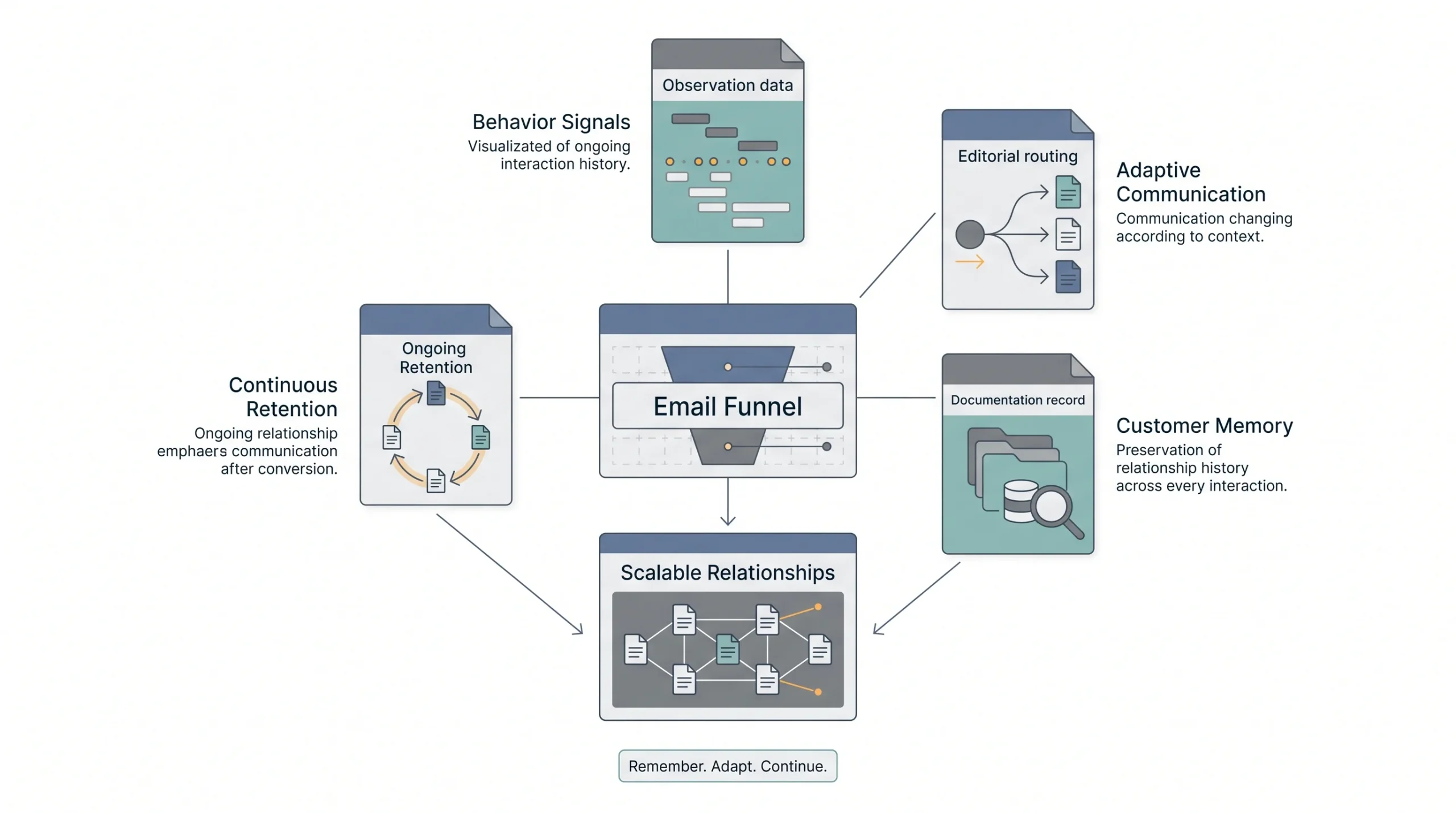
A funnel does that tracking automatically. It watches what a subscriber does, opens an email or doesn’t, clicks a link or ignores it, and responds without anyone touching a keyboard. That’s the real argument for building one. It’s not really about saving a few rupees on ad spend. It’s about being able to run a personal, sequenced conversation with ten thousand people at once, which is something no sales team on the planet can pull off by hand.
There’s also a data angle that gets underrated constantly. Every open, click, and non-response is information sitting there for free. A funnel turns an email list into a live map of who’s genuinely interested, who’s cooling off, and who’s ready to buy right now, today. Most businesses are sitting on this exact data and never using it, because they’re sending one generic newsletter to the entire list instead of routing people based on what they’ve already shown, through their own behavior, that they care about.
And retention gets treated as an afterthought by almost every guide on this topic. A funnel that stops the moment someone buys is only doing half its job. The people who already handed over money are the easiest next sale in the entire business. Ignoring them after checkout is leaving money sitting on a table that’s already yours.
Here’s a concrete way to think about the payoff. Say a business spends money to get 1,000 people onto a list. Without a funnel, maybe 2 percent buy something eventually, scattered and unpredictable. With a funnel actually built around the five stages below, that number climbs, not because the product changed, but because the right message showed up at the right moment instead of a random one showing up whenever someone remembered to hit send.
The Anatomy of an Email Funnel: The 5 Stages
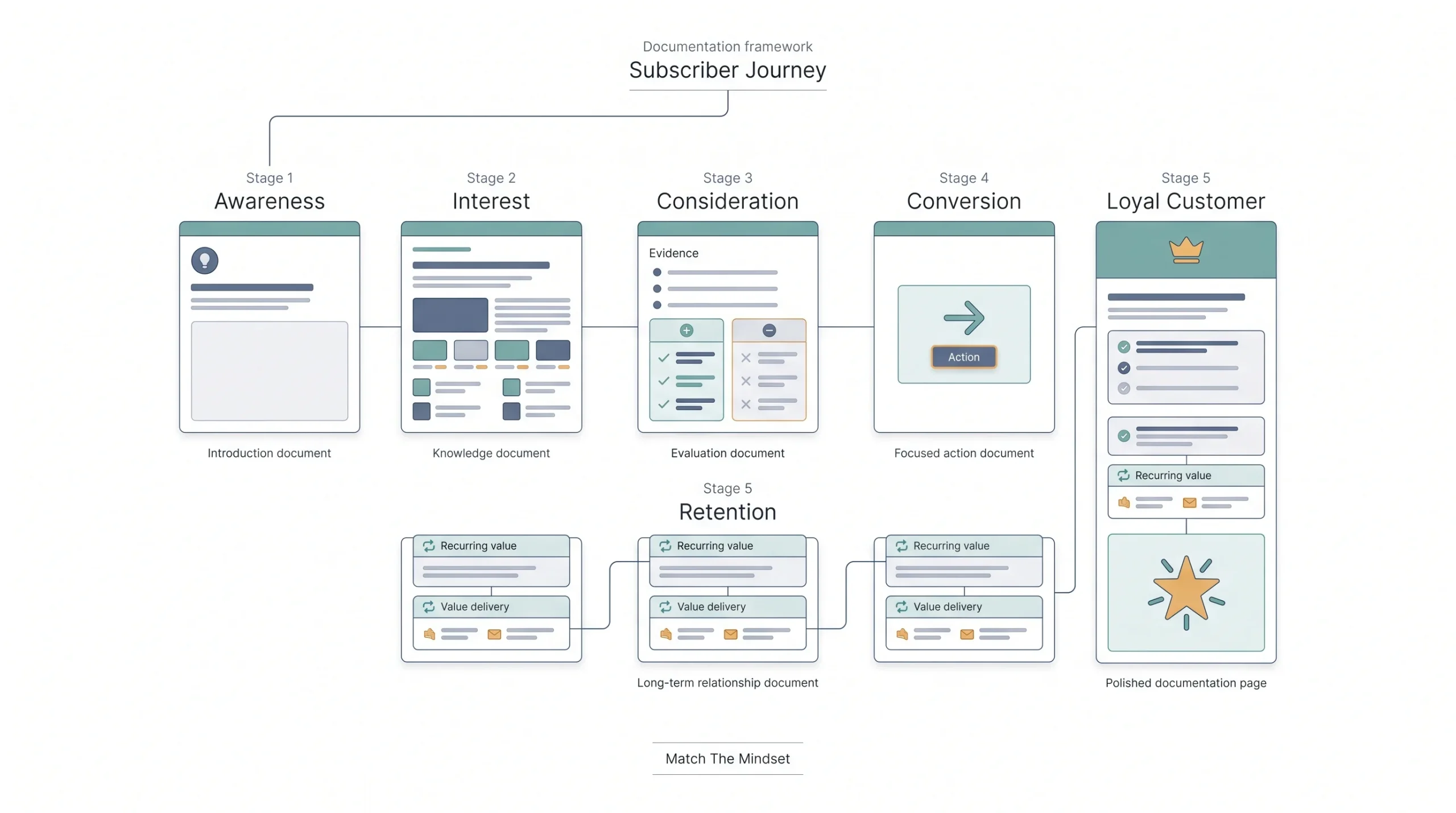
Every email funnel, no matter the business, moves through five stages. Someone starts as a stranger and, if things go well, ends up recommending the business to their coworkers or their group chat. Each stage carries a different mental state, and sending the wrong kind of email at the wrong stage is the single most common reason funnels underperform.
Awareness (Top of Funnel)
At this point the subscriber barely knows who’s emailing them. They handed over their email because something offered looked genuinely useful, a checklist, a discount, a free trial, whatever the entry point was. Their mental state is somewhere between curious and skeptical. They’re not thinking about buying anything. They’re thinking, “okay, who is this, and was signing up a mistake.”
The one job here is to earn permission to keep talking to them. Not to sell. Not yet. A welcome email that opens with a hard pitch at this stage is like walking up to a stranger at a party and immediately asking them to marry you. Too much, too soon, and it’s obvious you don’t actually see them as a person, just a transaction waiting to happen.
A subject line like “Here’s your guide (open this first)” does more work here than something clever ever would. Clarity beats cleverness in the first email, every single time, because the subscriber hasn’t earned enough trust yet to decode a joke or a riddle.
Interest / Nurture
Now the subscriber knows roughly who this is. The question in their head shifts to “is this actually useful to me, specifically.” This is where the business educates, not sells. Share something genuinely helpful. A short how-to, a common mistake people in their situation make, something that proves real knowledge without asking for anything back in return.
This stage is where most funnels either build trust or quietly lose it. If every email past the welcome message is a disguised sales pitch wearing a helpful subject line, subscribers figure that out fast, and they stop opening. Not dramatically, not with an unsubscribe click even, just a slow fade where the open rate drops and nobody notices until three months later when the whole sequence is basically talking to a wall.
Consideration
The subscriber is genuinely thinking about it now. Weighing whether this is worth their money or their time, even if they never type that hesitation into a reply. Is this too expensive. Does this actually work for someone in my exact situation. What if this turns into another thing I bought and never used.
Case studies live here. Comparisons live here. Testimonials that answer one specific doubt, not generic five-star praise with no context, live here. A software company’s email here might walk through how a customer in a similar industry, with a similar team size, actually used the product and what changed for them. A course creator’s email here might show one student’s before-and-after, with real specifics, not just “I loved this course.”
Conversion
The subscriber is ready, or close enough to it. The only job now is removing whatever’s still standing in the way. A deadline, a bonus, a clear and specific offer with one clean call to action. This is not the stage to introduce new information or a second competing offer. One CTA. One next step. Every extra option added here is friction dressed up as choice, and friction at this exact stage is what kills a sale that was one click away from closing.
Retention & Advocacy
This is the stage most competing guides barely mention, and it’s honestly the one with the best return for the least effort. The subscriber bought. Now what? If the answer is “nothing happens next,” the entire funnel budget just went toward one single transaction from someone who could’ve become a repeat customer, or better, someone who tells other people about the business for free.
Onboarding emails, usage tips so the purchase doesn’t sit unused and forgotten, a request for honest feedback, a well-timed upsell once there’s been a real win with what they bought already, this is where loyalty gets built or quietly, invisibly lost.
| Stage | Subscriber mindset | Your one job | Email type | Success metric |
|---|---|---|---|---|
| Awareness | “Who is this?” | Earn permission | Welcome email | Open rate |
| Interest | “Is this useful?” | Educate, not sell | Value or content email | Click rate |
| Consideration | “Is this worth it?” | Build trust, handle objections | Case study or comparison | Reply or engagement rate |
| Conversion | “Should I buy now?” | Remove friction | Offer or CTA email | Conversion rate |
| Retention | “Was this worth it?” | Deliver and delight | Onboarding or upsell | Repeat purchase rate |
Strategy: Most funnels die between Interest and Consideration, because businesses rush straight from “here’s something helpful” to “buy now” without ever addressing the doubt sitting quietly in the middle.
Types of Email Funnels
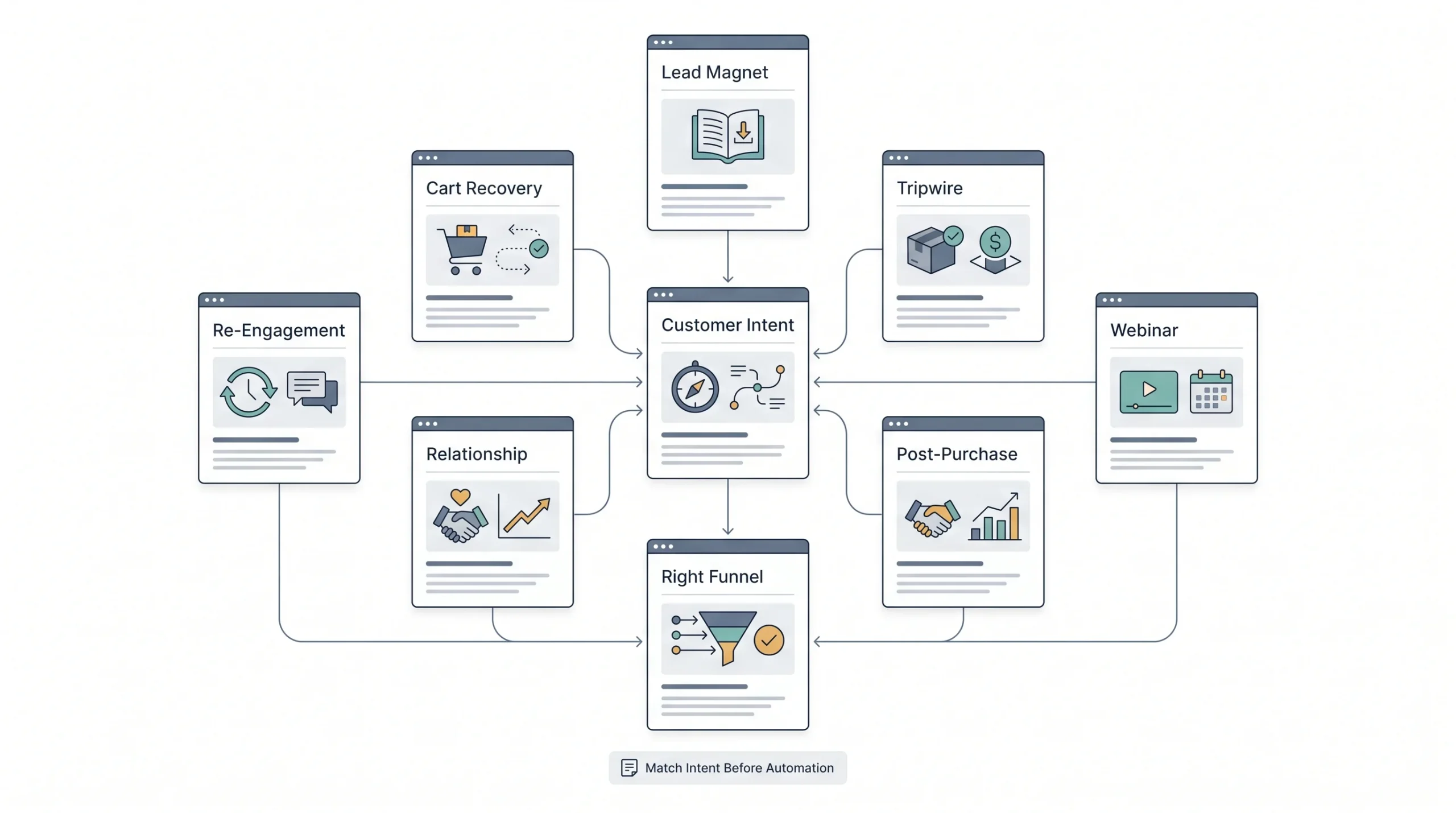
Here’s something most guides skip entirely. They talk about the five stages like every business runs the exact same funnel. They don’t. What’s being sold, and how much it costs, changes the whole shape of the thing, sometimes drastically.
Lead Magnet / Opt-In Funnel
The most common starting point for almost any business. Someone trades their email for something free, a checklist, a template, a guide, a discount code. The funnel that follows nurtures them toward the actual product. This works broadly because it’s low commitment on the subscriber’s side, they’re not risking money, just an inbox slot.
Tripwire Funnel
Built around a small, cheap offer before the real one shows up. Think a five dollar mini-course before the two hundred dollar full course sitting behind it. The tripwire isn’t really about the revenue from that first tiny sale, it’s about turning a subscriber into a buyer as fast as humanly possible. People who’ve already bought something small are far more likely to buy something bigger down the line. That first “yes,” even a tiny one, changes the entire relationship from “maybe someday” to “I’ve already trusted this business with my card.”
Webinar / Event Funnel
Common for higher-priced services, coaching programs, and courses. The funnel builds anticipation for a live event, reminder emails go out on a tight schedule, and the pitch happens during or right after the webinar while attention and trust are at their peak. This funnel lives and dies on show-up rate, so the reminder sequence matters just as much, sometimes more, than the actual content delivered during the webinar itself.
Cart Abandonment Funnel
Ecommerce-specific, and one of the highest-leverage funnels that exists because the intent is already there. Someone adds a product to their cart and leaves without finishing the purchase. This funnel is short, usually two or three emails, and it works because the person didn’t need convincing about the product itself, something else got in the way, a price surprise at checkout, a distraction, a “let me think about it” moment that turned into forgetting entirely. These emails just need to bring them back to finish what they already started.
Re-Engagement / Win-Back Funnel
For subscribers who’ve gone quiet without formally unsubscribing. This funnel exists to either wake them back up or clean them off the list entirely, and both outcomes are genuinely wins. A list full of people who never open anything hurts deliverability for everyone else on it and makes every performance number look worse than the actual engaged audience deserves.
Post-Purchase / Upsell Funnel
Runs after the sale closes. Onboarding, tips on getting real value from what was bought, and eventually a well-placed upsell or cross-sell once there’s been a genuine win. This is the funnel most businesses skip entirely, and it’s usually the cheapest revenue sitting untouched on the table, because there’s no new acquisition cost involved, these people are already customers.
| Funnel type | Best for | Typical length | Primary goal |
|---|---|---|---|
| Lead magnet | Any business building a list | 4 to 6 emails | List growth into a sale |
| Tripwire | Low-ticket digital products | 3 to 5 emails | Quick first purchase |
| Webinar | High-ticket services, courses | 5 to 7 emails | Live conversion event |
| Cart abandonment | Ecommerce | 3 emails | Recover a lost sale |
| Re-engagement | Any list with inactive subscribers | 3 to 4 emails | Reduce churn, clean the list |
| Post-purchase | Repeat-purchase businesses | Ongoing | Retention and lifetime value |
Most businesses don’t need all six running at once, and trying to launch all of them in the same month usually means none of them get built properly. Start with the one or two that match how people actually buy, and add the rest in as the list grows and the patterns become clearer.
How to Build an Email Funnel: Step-by-Step
This is the part that actually matters. Everything above is context. This is the build.
1. Define the One Action You Want
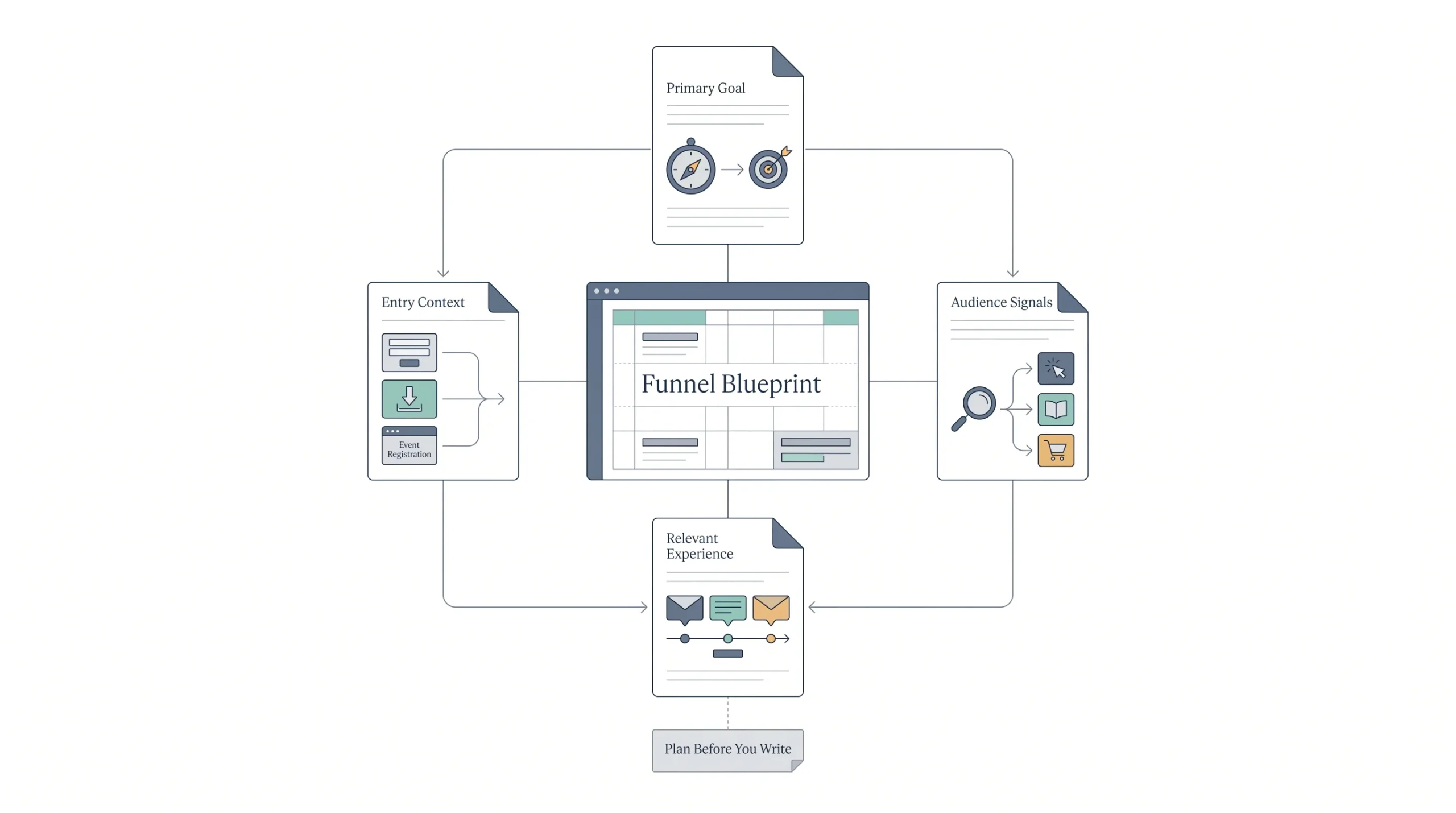
Before writing a single email, decide what success actually looks like. Not vaguely, specifically. Is it a purchase? A booked call? A demo signup? Pick one primary action per funnel. Trying to get someone to buy, book a call, and follow an Instagram account all in the same sequence usually means none of those things happen, because the subscriber genuinely doesn’t know what’s actually being asked of them.
2. Map the Customer Journey and Identify Entry Points
Where do people actually enter the world of this business? A blog post, an ad, a referral from a friend, a free tool someone used once. Each entry point might need its own funnel start, because someone arriving from a detailed 3,000-word blog post already knows more than someone who clicked a random Instagram ad on a whim. Sending both of them the exact same “here’s who we are” welcome email wastes context that’s already been handed over for free.
3. Segment the Audience
This is where most beginner funnels go completely flat. Sending the same five emails to every single subscriber, regardless of what they clicked, what they downloaded, or where they came from, ignores the one real advantage email has over almost every other channel: the ability to talk to people differently based on what they’ve already told you through their own behavior.
Segment by behavior first, demographics a distant second. Someone who’s clicked the pricing page three times this week is a fundamentally different subscriber than someone who’s only opened the welcome email once. Treating them the same is like giving a window shopper and someone standing at the checkout counter the exact same pitch.
4. Choose the Entry Offer
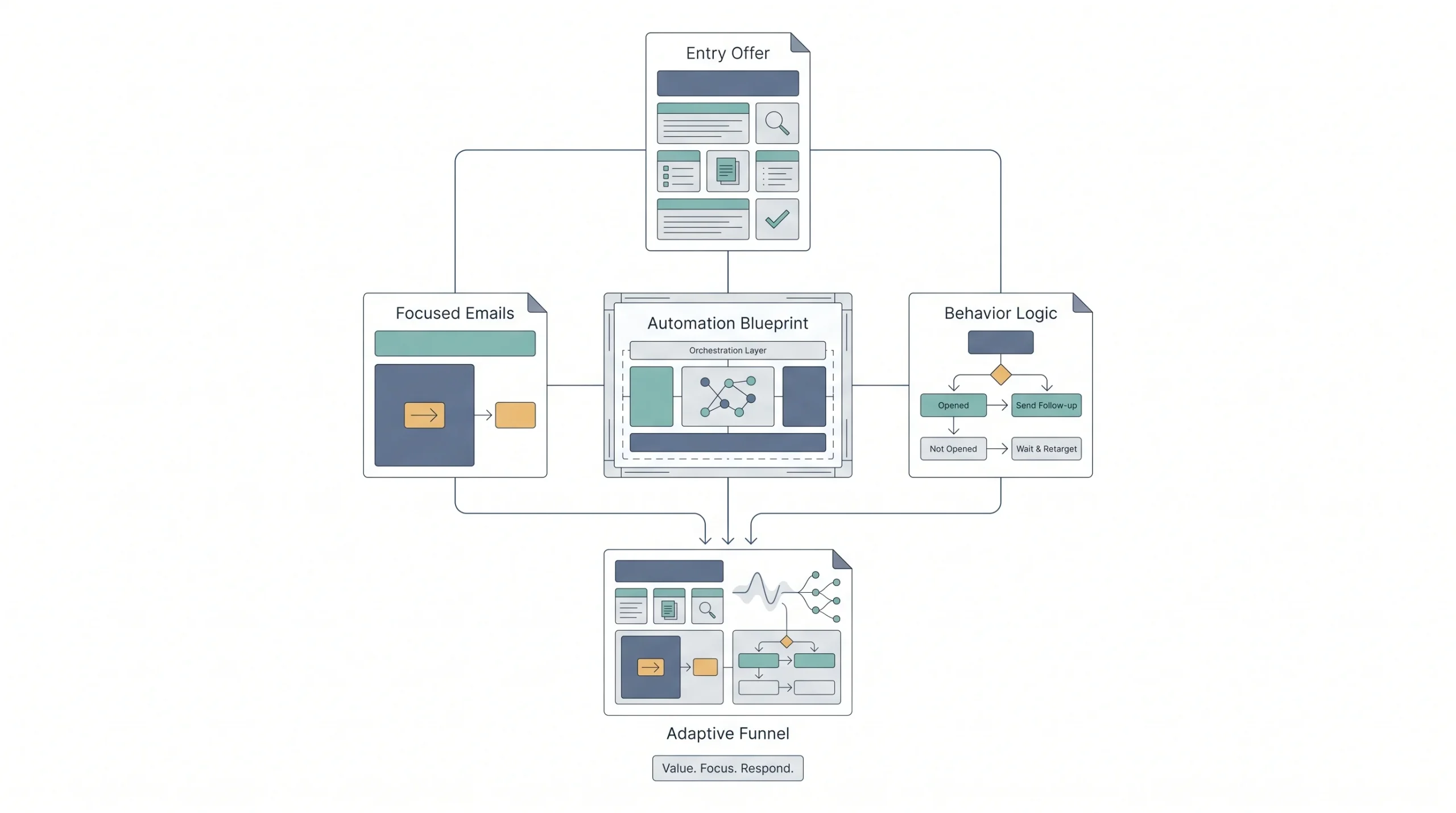
Whatever gets someone into the funnel needs to be specific and genuinely useful, not vague. “Free guide to marketing” gets scrolled past. “The exact posting schedule that took one account from 0 to 10,000 followers in four months” gets opened. Specificity is what actually makes someone hand over an email address in the first place, vagueness just blends into every other popup they’ve closed that week.
5. Write the Sequence, One Job Per Email
Every email in the sequence should do exactly one thing. Not three things wrapped into a single message with four links and two competing CTAs fighting for the same click. One idea, one action. Same principle from the five-stage breakdown above, just applied down at the level of a single email now.
6. Set the Automation Logic
This is the actual skill of building a funnel, and it’s the part almost nobody explains properly. It’s not the writing that separates a working funnel from a dead one. It’s the logic sitting behind when each email actually fires.
| Trigger | Condition | Action |
|---|---|---|
| Signs up via lead magnet | none | Send welcome email immediately |
| Opens welcome email | yes | Send value email 2 days later |
| Doesn’t open welcome email | after 3 days | Resend with a new subject line |
| Clicks pricing link | none | Move to consideration segment |
| No purchase after 7 days | none | Enter conversion nudge sequence |
| Makes a purchase | none | Exit sales sequence, enter onboarding sequence |
Tip: Trigger, condition, action. That’s the whole engine underneath every automated funnel that’s ever worked. Learn to think in this exact pattern and the rest starts making a lot more sense.
Worth noticing in that table: the moment someone makes a purchase, they need to be pulled out of the sales sequence immediately. Nothing kills trust faster than getting a “don’t miss this offer” email for something already sitting in a shopping bag at home. It happens constantly, and it’s almost always a logic gap, not a copywriting problem.
7. Choose Cadence and Timing
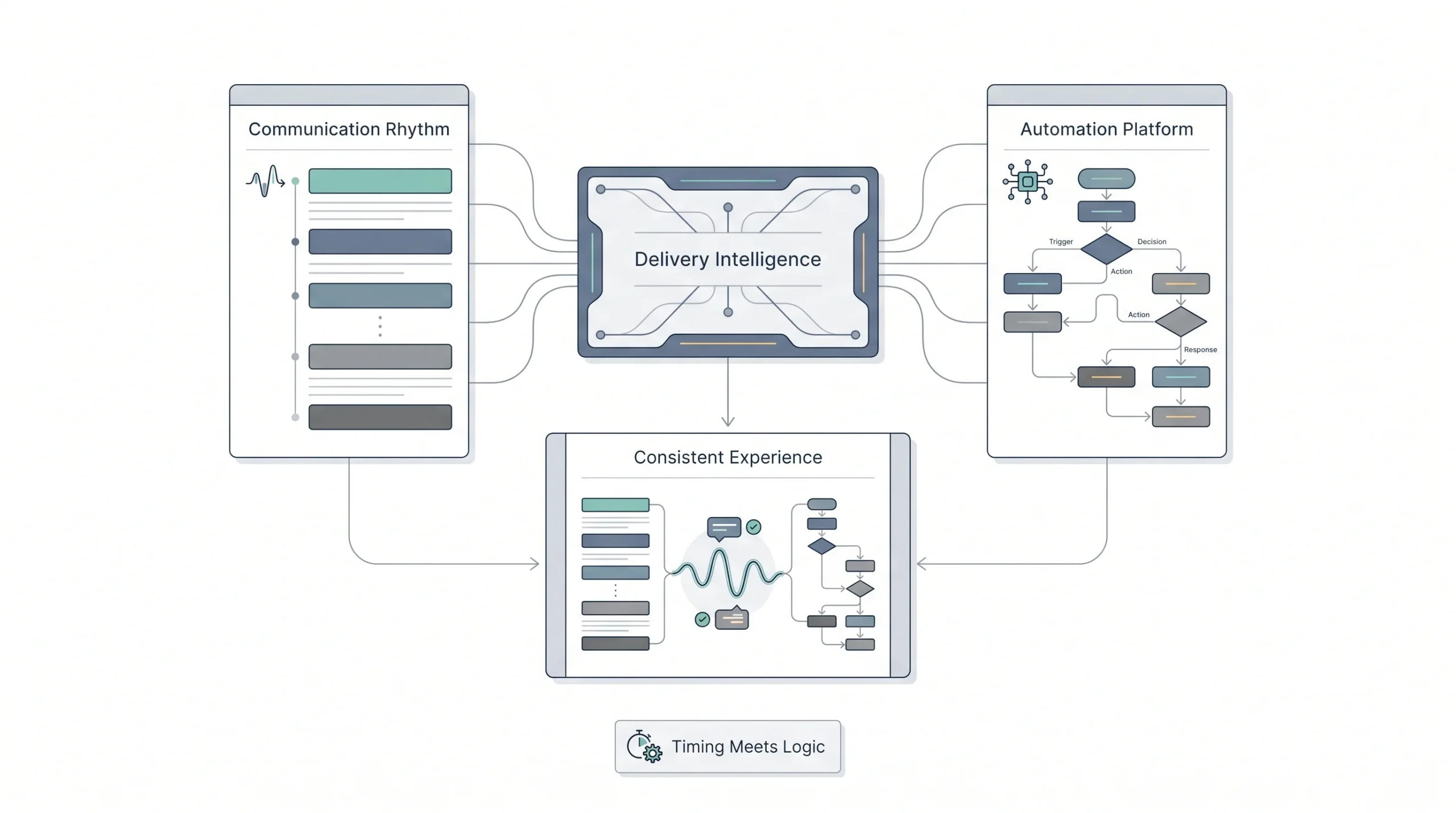
Too fast feels like spam. Too slow and the subscriber forgets who’s even emailing them. A common pattern is daily or every other day during the awareness and interest stages, when momentum matters most and the subscriber’s attention is freshest, then spacing out to a few days apart once someone reaches consideration and genuinely needs time to think things through. There’s no single perfect cadence. It depends heavily on how considered the purchase actually is. A ten dollar impulse product moves at a completely different speed than a five thousand dollar service that needs a manager’s sign-off.
8. Set Up the Tech Stack
An email service provider needs to handle conditional logic, not just scheduled sends on a calendar. Most modern platforms can do this now, but the setup still requires actually building the trigger and condition logic by hand, not just writing five emails, stacking them in a folder, and assuming the automation figures itself out.
9. Test Before Launch
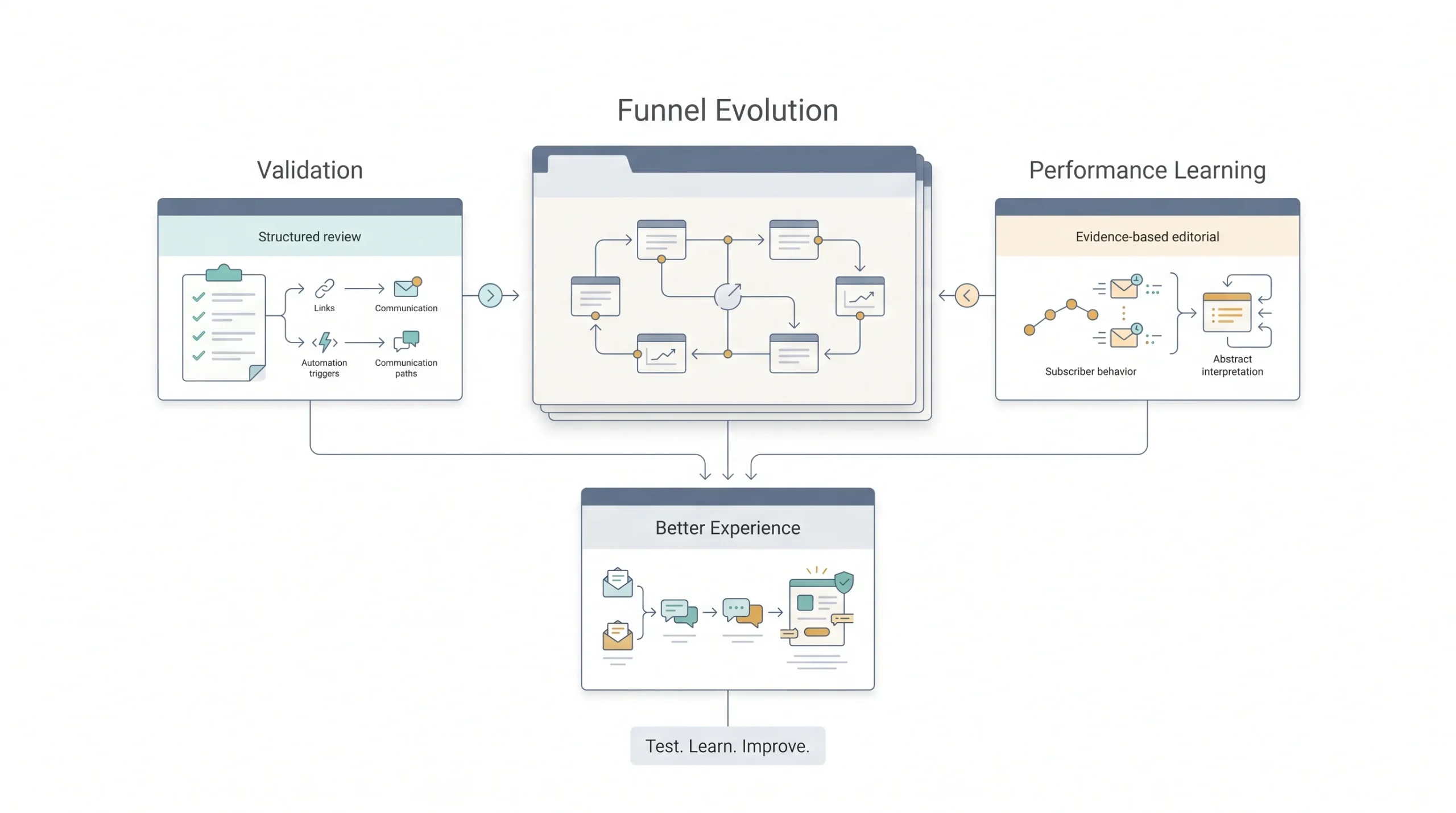
Send the entire sequence through as if walking in as a real stranger. Click through every link. Check that the conditional logic actually branches the way it was designed to on paper. Broken automation stays invisible until a real subscriber falls into the gap, and by the time anyone notices, that subscriber has usually already lost interest and moved on.
10. Track, Measure, Optimize
A funnel isn’t a one-time build that gets set up in January and left alone. Watch where people drop off. If everyone opens email one and almost nobody opens email two, the problem usually isn’t the subject line sitting on email two, it’s more likely that email one never gave anyone a reason to expect something worth opening next.
A Quick Worked Example
Picture a small business selling an online course on freelance writing. Someone downloads a free “10 cold pitch templates” PDF from a blog post. That’s the entry point. Email one goes out immediately: welcome, here’s your download link, here’s one quick tip on using it. Two days later, if they opened that first email, they get a short story about a freelancer who used one of those templates to land a client, pure interest-stage content, no pitch at all. A few days after that, an email addressing the most common doubt beginners have about freelance writing, “is there actually enough client demand for this right now,” backed with a specific example. Then, and only then, the course gets mentioned, with a clear deadline-based bonus and one single button. Anyone who clicks that pricing link but doesn’t buy within a week gets pulled into a shorter, three-email nudge sequence addressing price hesitation directly. Anyone who does buy gets pulled out of everything sales-related and dropped into a short onboarding sequence instead. That’s a full funnel, five stages, one entry point, real branching logic, nothing complicated about any single piece of it.
Email Funnel Copywriting: What Actually Goes in Each Email
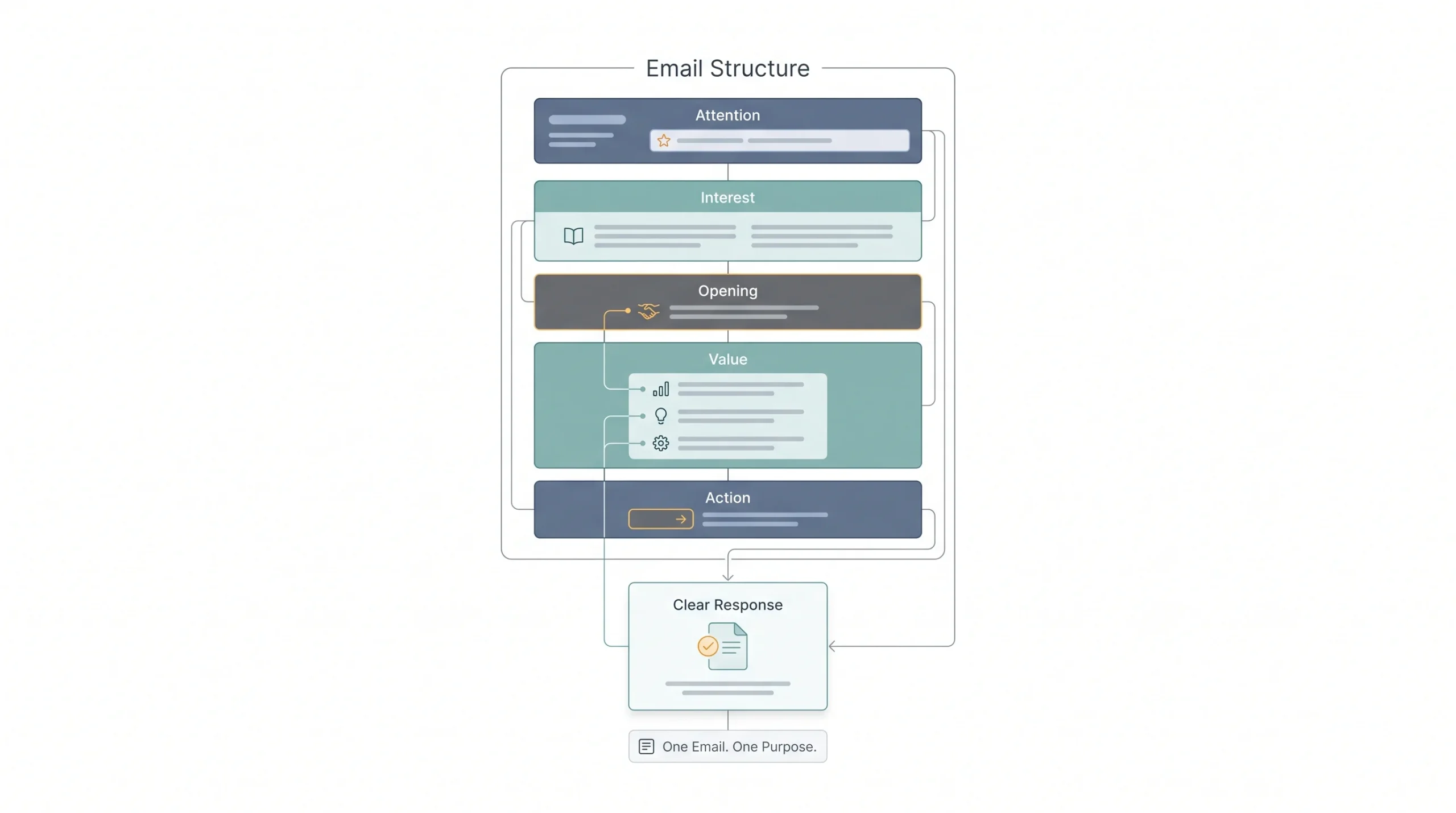
Every funnel email, no matter which stage it belongs to, shares the same basic skeleton underneath it.
| Element | Purpose | Common mistake |
|---|---|---|
| Subject line | Get the open | Too vague or too salesy |
| Preview text | Extend the subject’s hook | Left blank or auto-filled with garbage |
| Opening line | Earn the next sentence | Starts with “I hope this finds you well” |
| Body | Deliver one idea | Cramming three CTAs into one email |
| CTA | Drive one action | No clear CTA, or too many competing options |
The subject line has exactly one job, getting the email opened, nothing more. Don’t try to make it carry the entire message. “We need to talk about your cart” beats “Important update regarding your recent shopping session” every single time, because it sounds like an actual person wrote it instead of a legal department reviewing every word for risk.
Preview text is free real estate almost everyone leaves on the table. It’s the second line visible right next to the subject before anyone opens anything. Left blank, most inboxes just pull in the first line of the email body, which is often something completely useless like “having trouble viewing this in your browser.” Write it on purpose, every time.
The opening line has to earn the second sentence. Nobody owes an email their attention past line one. Skip the throat-clearing entirely. Get to the point, or get to something genuinely interesting, immediately.
Here’s a quick before and after, same underlying message, rewritten:
Before: “We hope this email finds you well. We wanted to reach out to inform you about an exciting opportunity that we believe would be of great value to you and your business goals.”
After: “Your trial ends Friday. Here’s what happens if you don’t do anything, and here’s what happens if you do.”
Same core message, buying more time or taking action, but one of these gets read in full and one gets deleted on sight without a second thought.
The body should deliver exactly one idea. One story, one piece of value, one argument, not a mini-newsletter crammed with five unrelated links competing for attention. And the CTA should point at one clear next step. Three buttons in a single email means three ways to build in indecision, because choosing between options is a heavier lift for most people than simply clicking the one obvious thing in front of them.
One more thing worth saying plainly: write funnel emails the way an actual person would write to another person, not the way a brand writes an announcement. “Hey, quick one” opens better than “Dear Valued Customer” almost every time, because it sounds like it came from someone, not from a department.
Metrics That Actually Tell You If Your Funnel Works
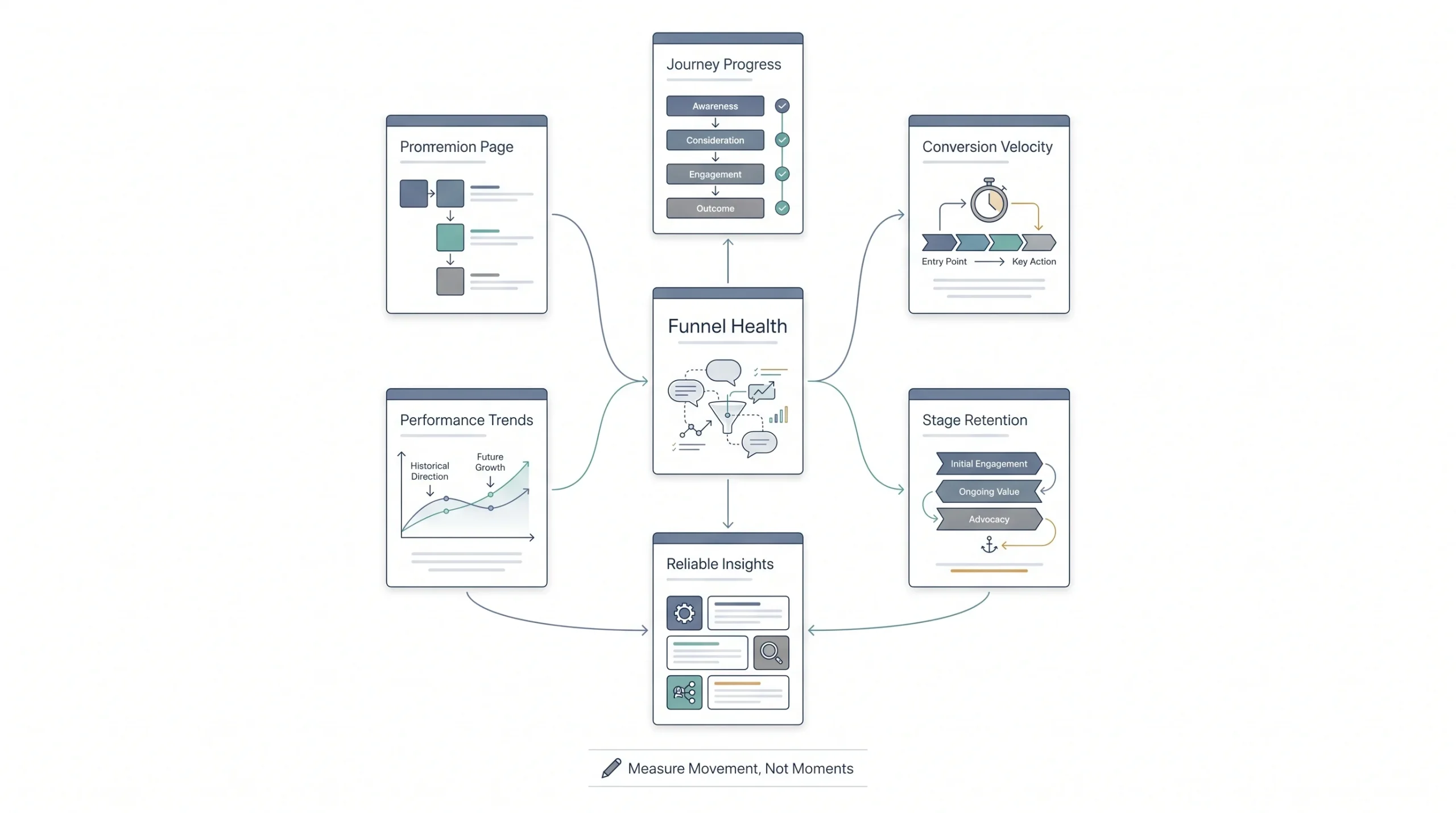
Open rate and click rate get talked about constantly, practically on repeat across every guide on this topic, but they’re surface-level metrics. They tell you if people are curious in the moment. They don’t tell you if the funnel is actually doing its job.
The metric that matters more is stage-to-stage drop-off. Out of everyone who entered the funnel at the awareness stage, how many actually made it to consideration? How many made it all the way to conversion? That drop-off curve tells you exactly where the funnel is leaking, which is a far more useful signal than knowing the average open rate across the entire sequence lumped together.
Time-to-conversion matters too, and it gets ignored constantly. If most buyers convert on day two but the sequence was built out for a ten-day journey, unnecessary emails are still going out to people who already made up their mind, and that’s a fast way to turn a happy new customer mildly annoyed.
| Stage | Metric to watch | Typical healthy range* |
|---|---|---|
| Awareness | Open rate | 30 to 50 percent |
| Interest | Click-through rate | 2 to 5 percent |
| Consideration | Reply or engagement rate | Depends heavily on list size and niche |
| Conversion | Conversion rate | 1 to 5 percent, industry-dependent |
| Retention | Repeat purchase rate | Track the trend over time, not one number |
*These ranges shift a lot by industry, list quality, and how the subscriber entered the funnel in the first place. Treat them as a general sense of direction, not a scoreboard to hit exactly every time.
Beyond the table, one habit worth building early is comparing this month’s drop-off curve to last month’s, not comparing against some outside benchmark pulled from a random blog post. The funnel’s own trend line, going up or down over time, tells a far more honest story than chasing a number that came from a completely different business, list size, and price point.
Tools You Can Use to Build an Email Funnel
The tool matters less than the strategy sitting behind it, but the right category of tool genuinely makes the build easier and less painful.
| Category | Good for | What to look for |
|---|---|---|
| Beginner ESPs | Simple sequences, smaller lists | Easy visual automation builder, solid deliverability |
| Advanced automation platforms | Complex trigger and condition logic | Behavior-based branching, tagging, CRM integration |
| Ecommerce-native tools | Cart recovery, purchase-based triggers | Native store integration, product-level behavior tracking |
If just starting out, don’t overbuy. A beginner-friendly ESP with basic conditional automation will handle a lead magnet funnel and a simple cart abandonment sequence just fine. Move to something more advanced only once the segmentation needs genuinely outgrow “opened or didn’t open,” not before.
Conclusion
None of this works as a one-time project. A funnel built in January and never touched again slowly turns into exactly the kind of ignored, generic email sequence this whole guide was trying to move you away from in the first place. The businesses that get real value out of email funnels are the ones treating it like a living system, watching where people drop off, adjusting the cadence, rewriting the one email that nobody’s opening anymore. The five stages, the funnel types, the automation logic, none of it is complicated sitting on its own. What’s actually hard is sitting down and building it properly instead of sending one newsletter a month and calling that a strategy. Start with one funnel. Get it working. Then build the next one.
FAQs
Is an email funnel the same as email marketing?
No. Email marketing is the broad category, newsletters, promotions, one-off sends whenever there’s news to share. A funnel is a specific structured sequence living inside that category, built around moving someone through defined stages toward one action.
How many emails should be in a funnel?
Depends entirely on the funnel type and how considered the purchase is. A cart abandonment funnel might be three emails. A webinar funnel might run seven. There’s no fixed magic number, the sequence should be exactly as long as it needs to be to do its job, not a single email longer.
Can a small business realistically run multiple funnels at once?
Yes, eventually, but start with one. A single lead magnet funnel that actually works beats five half-built funnels running at the same time with nobody watching any of them closely. Add funnel types in as the list and the business’s needs genuinely grow.
What’s the biggest sign a funnel isn’t working?
A high drop-off concentrated at one specific stage, not a generally low number spread evenly across the board. If almost everyone opens the first email but almost nobody makes it past email two, that’s a specific, fixable problem sitting in one spot, not a sign to scrap the whole thing and start over.
Do email funnels work for B2B, or just ecommerce?
Both, the stages and the underlying logic stay the same either way. What changes is the length of the consideration stage and the type of content used to build trust, case studies and demos tend to carry B2B, while reviews and side-by-side comparisons tend to carry ecommerce.
How long should someone stay in one stage before moving to the next?
There’s no fixed number of days, it depends on the trigger, not the calendar. Someone who clicks a pricing link twice in one day is showing consideration-stage behavior immediately, even if they only entered the funnel yesterday. Behavior should move people between stages, not a countdown timer sitting in the background.
Should every funnel end with a sale, or can the goal be something else?
The goal can absolutely be something else, a booked call, a demo request, a free trial activation. What matters is defining that one action clearly up front, not assuming “sale” is automatically the only valid endpoint for every business model.
What happens if someone doesn’t respond to any email in the sequence?
That’s exactly what the re-engagement funnel is for. After a set number of unopened emails, usually three to five depending on the business, a subscriber should get pulled out of the regular sequence and into a shorter win-back attempt, rather than just continuing to send the same emails into silence indefinitely.