

Here’s a scenario that plays out constantly. Two websites cover the exact same topic, say, “how to treat a sprained ankle.” One is written by a physical therapist with a name, a photo, and a license number listed. The other is an anonymous post on a content farm that clearly exists to run ads. Same basic information, roughly the same word count. Guess which one Google shows first, almost every single time. That gap is E-E-A-T doing its job.
A lot of site owners still treat E-E-A-T like some abstract concept from a Google whitepaper that doesn’t really apply to them. That’s a mistake, and an expensive one. If you’ve ever seen a page tank in rankings after a core update with no obvious technical cause, no broken links, no missing keywords, nothing flagged in Search Console, there’s a decent chance weak E-E-A-T signals were part of the problem. Google doesn’t send you a memo explaining why. It just quietly stops trusting your content as much as it used to.
Google EEAT stands for Experience, Expertise, Authoritativeness, and Trustworthiness. It’s not a single score sitting somewhere in Google’s database that you can check like a credit score. It’s a framework, originally built for the human quality raters who evaluate search results, that’s become deeply woven into how Google’s ranking systems judge whether content deserves to be trusted and shown to people. And here’s the part that trips people up: E-E-A-T itself isn’t technically a direct ranking factor you can optimize like a meta tag. It’s more like a lens. The actual ranking factors, content quality, backlinks, user engagement, all get filtered through whether the content demonstrates real experience and real trust.
So why does this matter more now than it did five years ago? Two reasons, honestly. First, AI-generated content flooded the internet starting around 2023, and a huge share of it is generic, unsourced, and written by nobody in particular. Google had to get better at telling the difference between content written by someone who’s actually done the thing and content assembled from other content. Second, Google’s Helpful Content updates and the string of core updates since have specifically gone after sites that look thin on real expertise, even if the writing itself reads fine on the surface.
This guide breaks down exactly what E-E-A-T means, why Google built it, how it actually influences your rankings, and what you can concretely do to strengthen each pillar on your own site. No vague “just write good content” advice. Real, specific moves you can make this month.
What You Will Learn in This Guide
You’ll walk away understanding what each letter in E-E-A-T actually means in practice, not just the dictionary definition. You’ll see how E-E-A-T connects to the Helpful Content system and why the two get confused so often. You’ll learn what YMYL means and why some industries face a much higher bar than others. And you’ll get a practical breakdown of how to strengthen experience, expertise, authority, and trust signals on your own site, along with a full checklist and real examples of what strong E-E-A-T actually looks like across different types of websites.
What Is Google’s E-E-A-T?
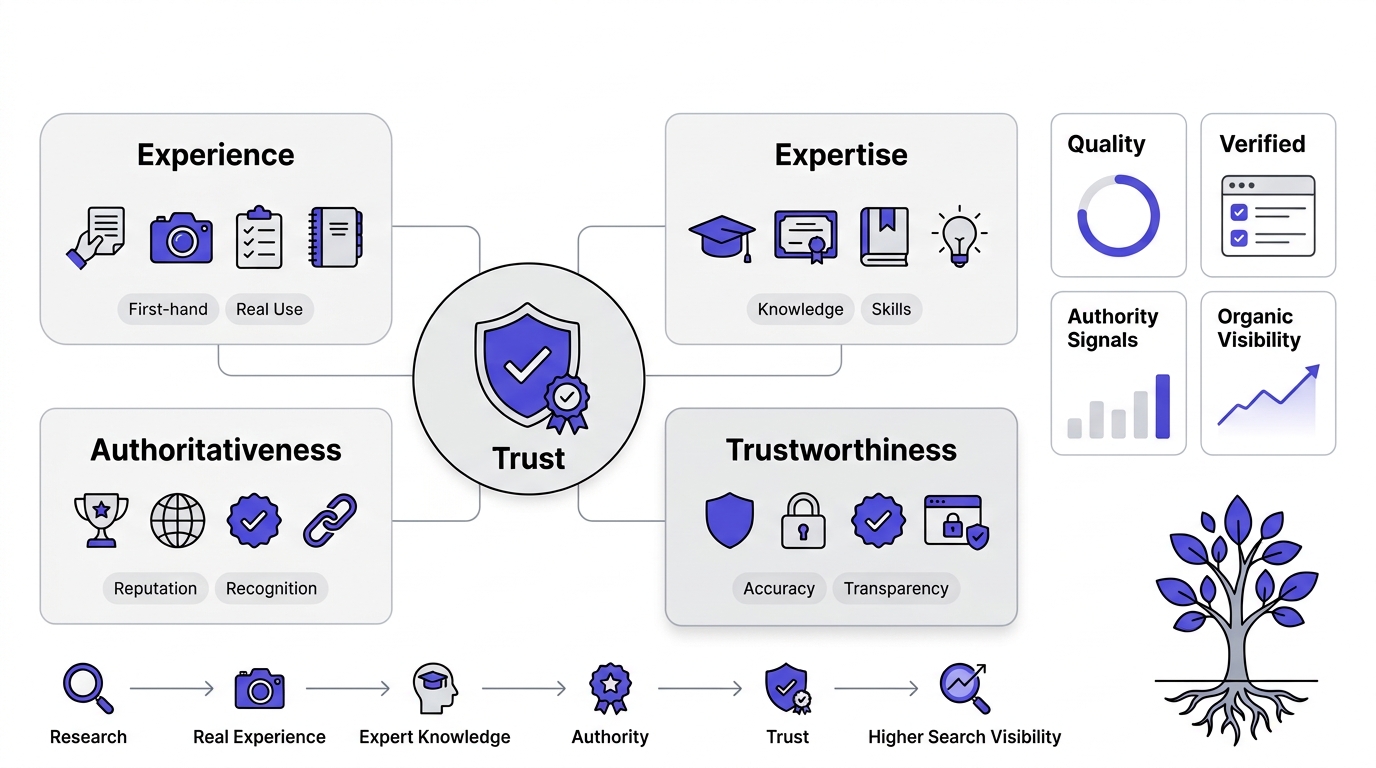
E-E-A-T is the framework Google’s Search Quality Rater Guidelines use to evaluate whether content and the website publishing it can be trusted. It stands for Experience, Expertise, Authoritativeness, and Trustworthiness, and it exists to help Google’s systems distinguish between content written by someone with real knowledge and content that just sounds confident.
What Does E-E-A-T Stand For?
Experience means the content creator has actual, first-hand experience with the topic, not just secondhand research. Someone who’s actually used a product, visited a place, or gone through a process themselves.
Expertise means the depth of knowledge and skill in the subject matter itself, whether that comes from formal credentials, years of hands-on work, or demonstrated mastery through the content.
Authoritativeness is about reputation. Is this site or author recognized as a go-to source on the topic by other credible sites, industry figures, and readers?
Trustworthiness is the accuracy, transparency, and safety of the content and the site publishing it. This one carries the most weight of all four, and Google says so directly in its own guidelines.
Why Google Introduced E-E-A-T
Google added the second “E” for Experience in December 2022, expanding the older E-A-T framework that had been part of the rater guidelines since 2014. The reasoning was pretty straightforward: expertise alone doesn’t guarantee good content. You could technically know a lot about hiking gear from research alone, but someone who’s actually spent 300 nights in a tent brings something research can’t replicate. Google wanted raters evaluating whether content shows that lived, first-hand quality, not just accurate facts assembled from other sources.
E-E-A-T vs E-A-T: What’s Changed?
The core difference is that single added “E.” Before 2022, the framework was E-A-T: Expertise, Authoritativeness, Trustworthiness. Adding Experience shifted the emphasis toward content created by people who’ve actually done the thing, not just researched it well. This mattered a lot for product reviews specifically. A reviewer who bought the blender, used it for two months, and photographed their own results demonstrates Experience in a way that a rewritten spec sheet never can, even if the spec sheet is technically accurate.
Is E-E-A-T a Direct Google Ranking Factor?
Nope, and Google has said this explicitly more than once. E-E-A-T is not a single measurable signal like page speed or mobile-friendliness that gets fed into an algorithm as one input. It’s a conceptual framework that shapes how raters judge quality, and those judgments inform how the actual ranking systems get built and tuned over time.
What Google Actually Says About E-E-A-T
Google’s own Search Quality Rater Guidelines describe E-E-A-T as a way to assess “page quality,” and the guidelines specifically call out Trustworthiness as the most important of the four, saying the other three factors exist mainly to contribute toward it. Google has also clarified that quality raters don’t directly set rankings. They evaluate search results and provide feedback that helps engineers understand whether the algorithm is working the way it’s supposed to.
How E-E-A-T Influences Search Rankings
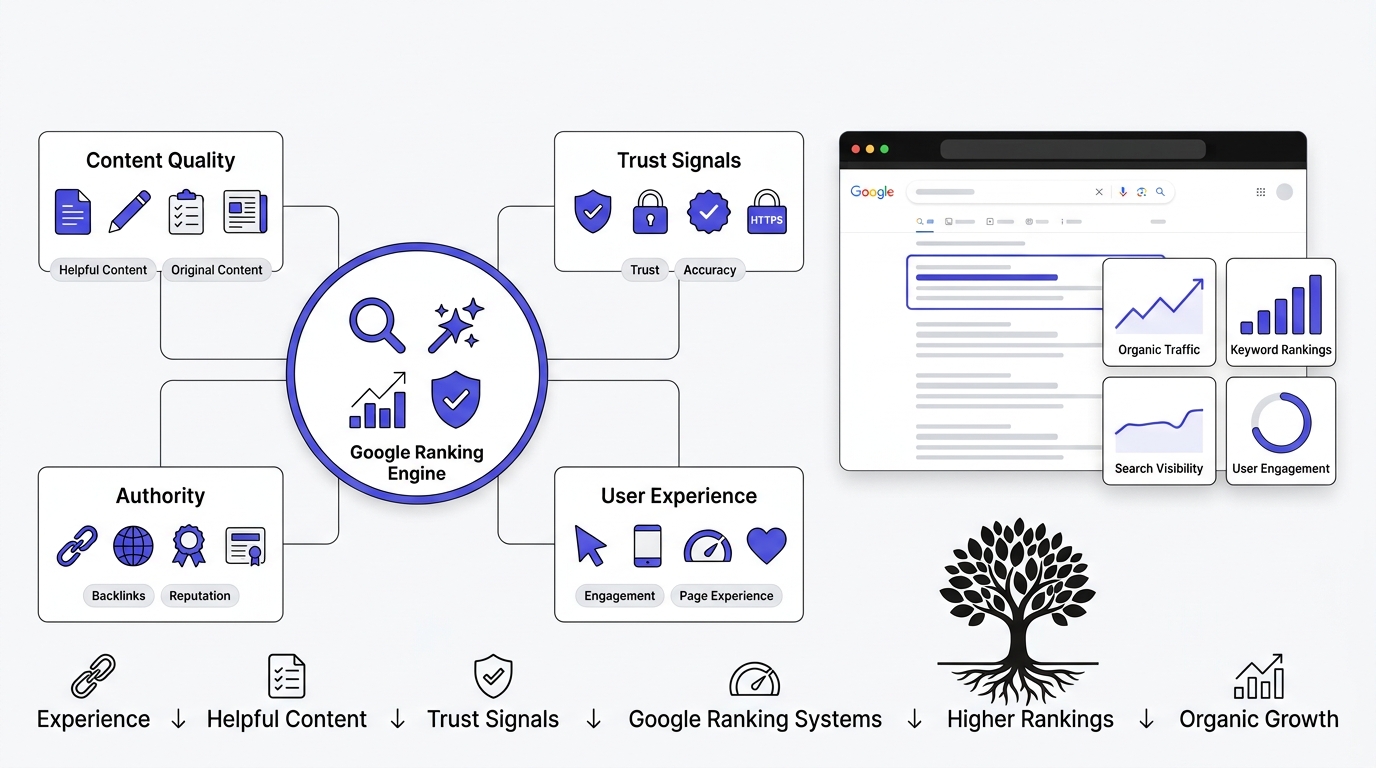
E-E-A-T doesn’t show up as a line item in a ranking report, but it influences rankings indirectly through the actual signals Google’s algorithms do measure: content quality, backlink profile, user engagement, and site reputation.
The Relationship Between Helpful Content and E-E-A-T
The Helpful Content system, now folded into Google’s core ranking systems, is essentially E-E-A-T’s practical enforcement mechanism. It’s built to identify content that seems written primarily to rank rather than to genuinely help a reader, and low E-E-A-T signals are one of the biggest tells of exactly that kind of content. If your site got hit by a Helpful Content-related drop, weak experience and trust signals are one of the first places to look.
Common Misconceptions About E-E-A-T
The biggest one: people think there’s a literal E-E-A-T score somewhere you can check or optimize toward, like a Domain Authority number. There isn’t. Another common one is assuming E-E-A-T only matters for YMYL sites like health and finance. It matters everywhere, just with a lower bar for topics where bad information can’t actually hurt anyone. And a third one: thinking a single author bio fixes everything. It helps, but E-E-A-T is a whole-site pattern, not a box you check once.
Why E-E-A-T Matters for SEO
Google’s primary goal is to provide users with the most helpful, accurate, and trustworthy information for every search. This is exactly why E-E-A-T (Experience, Expertise, Authoritativeness, and Trustworthiness) has become a crucial part of modern SEO. While E-E-A-T is not a direct ranking factor like page speed or backlinks, it strongly influences how Google evaluates the overall quality and credibility of your content.
Today, simply targeting keywords and building backlinks is no longer enough. If your website cannot demonstrate that its content is created by knowledgeable individuals with real-world experience and supported by trustworthy information, it becomes much harder to compete—especially in competitive industries.
How E-E-A-T Improves Organic Rankings
Strong E-E-A-T signals correlate with content that survives algorithm updates instead of getting wiped out by them. Sites with thin, anonymous, unsourced content are exactly the profile that keeps getting hit update after update, while sites with clear authorship, original data, and genuine depth tend to hold steady or even gain ground.
Building Long-Term Organic Visibility
Content built around real expertise doesn’t just rank once and fade. It tends to earn backlinks naturally because other sites cite it as a source, which reinforces authority over time. That’s a completely different growth pattern than content designed purely to match a keyword.
Improving User Trust and Engagement
Readers behave differently on trustworthy content, even if they can’t articulate why. They stay longer, click into more pages, and come back. Google reads that engagement pattern as a quality signal, which feeds back into rankings even without E-E-A-T being a direct factor.
Increasing Conversions Through Credibility
For commercial sites, trust signals directly affect whether people buy. A product page with a real return policy, clear contact info, and genuine reviews converts better than one that feels anonymous, regardless of what the SEO impact is. Good E-E-A-T and good conversion rate optimization end up pointing the same direction.
Protecting Your Website from Algorithm Updates
Every major core update since 2022 has disproportionately hit sites with weak experience and trust signals. Building these signals now isn’t just about ranking better today, it’s about not getting blindsided by the next update that specifically targets what you’re currently missing.
Understanding Each Pillar of E-E-A-T
Experience
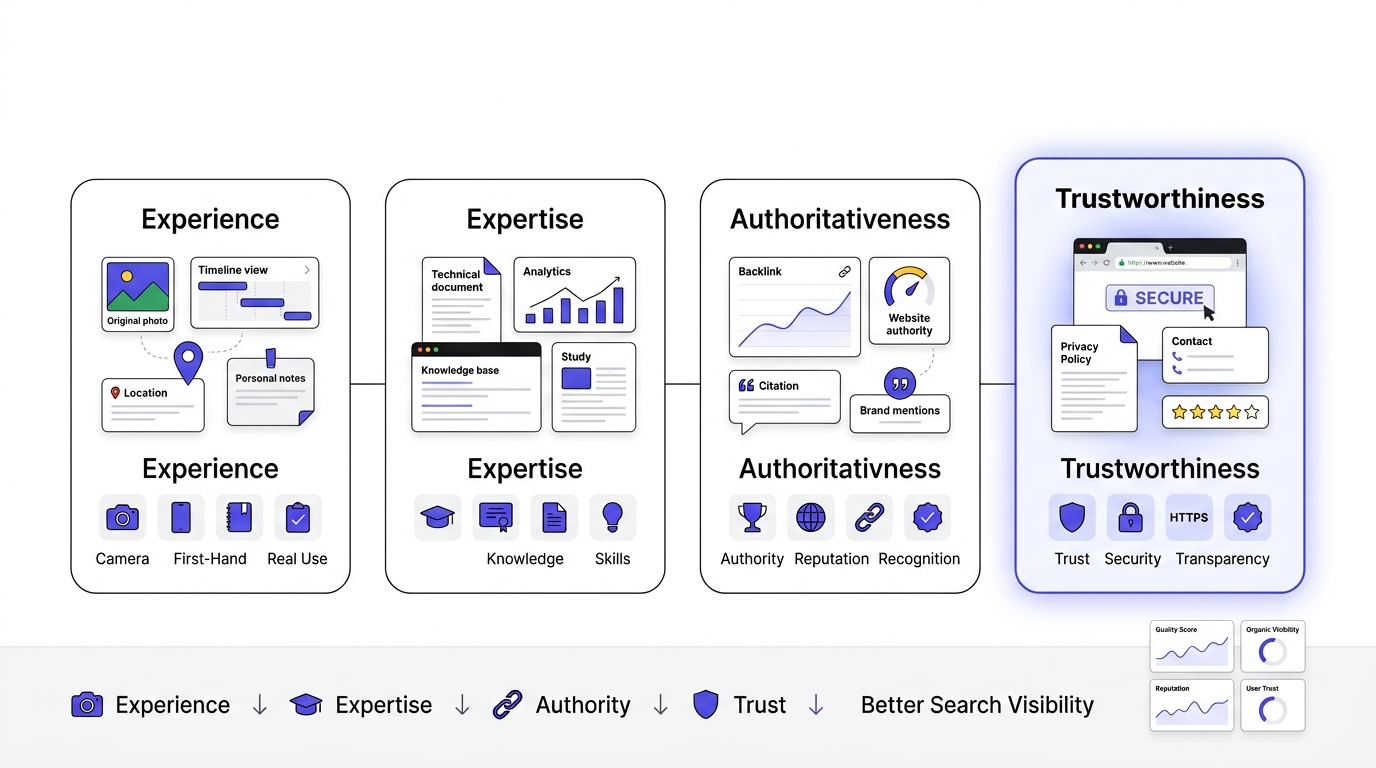
What Google Means by Experience: Direct, first-hand involvement with the subject matter. Not “I read five articles about this,” but “I actually did this.”
Examples of Experience-Based Content: A camera review written by someone who shot 500 photos with it over a month, including their own unedited samples. A recipe blog where the author photographed their own attempts, including the one that flopped. A software review showing actual screen recordings of the tool in use, not just marketing screenshots pulled from the vendor’s site.
How to Demonstrate First-Hand Experience: Use original photos and videos instead of stock images. Describe specific moments, “the battery died at hour six during a hike,” not vague generalities like “battery life could be better.” Include timestamps, locations, or version numbers that only someone who actually used the thing would know.
Mistakes That Reduce Experience Signals: Using only stock photos on a review site. Writing product comparisons without ever mentioning a detail that could only come from actual use. Publishing “best of” lists that read like they were assembled entirely from other best-of lists.
Expertise
What Counts as Expertise? Deep, accurate knowledge of a subject, demonstrated through the content itself, not just claimed in an author bio. Formal credentials help, especially in YMYL fields, but expertise can also come from years of hands-on work without a formal title.
Does Every Website Need Expert Authors? Not every single post needs a PhD behind it. A recipe blog doesn’t need a credentialed nutritionist writing every post. But a page giving medical dosage advice absolutely does need someone with real medical credentials, because the cost of being wrong is completely different.
Demonstrating Subject Matter Expertise: Go deeper than surface-level explanations. Explain the mechanism behind a recommendation, not just the recommendation itself. Reference specific tools, studies, or standards by name instead of vague generalities.
Industry-Specific Examples: A law blog citing actual statute numbers and case names instead of “the law generally says.” A finance site explaining the actual mechanics of compound interest with real numbers, not just “your money grows over time.”
Authoritativeness
What Is Website Authority? How recognized and respected your site is as a source on a specific topic, both by other sites and by readers directly.
What Builds Topical Authority? Consistently publishing deep, accurate content on a focused topic area over time, rather than scattering thin content across dozens of unrelated subjects. A site that’s published forty solid pieces on personal finance carries more topical weight than a general lifestyle blog that occasionally touches on money.
Brand Mentions and Recognition: Even unlinked mentions of your brand name across the web contribute to how Google’s systems perceive your site’s reputation, separate from direct backlinks.
Backlinks and Authority: Links from other credible, relevant sites remain one of the strongest authority signals there is, particularly when those links come from sites already established as trustworthy in the same niche.
Author Authority vs Website Authority: These are separate things that reinforce each other. A well-known expert author can lend credibility to a newer site, and a well-established site can help build recognition for a newer author. Neither fully substitutes for the other.
Trustworthiness
Why Trust Is the Most Important E-E-A-T Factor: Google’s own guidelines say this directly. Content can show tons of experience and expertise, but if it’s inaccurate, manipulative, or the site feels unsafe to use, none of that matters. Trust is the factor the other three ultimately serve.
Website Security (HTTPS): Basic table stakes at this point. A site without HTTPS signals a lack of attention to security that undermines trust before a reader even reads a word.
Accurate and Updated Information: Stale, outdated content, especially pricing, statistics, or medical and legal guidance, actively damages trust the moment a reader notices it’s wrong.
Transparent Business Information: Real company name, real address, real way to get in touch. Sites that hide who’s actually behind them read as evasive, and that’s exactly the read Google’s raters are trained to catch.
Privacy Policy, Terms, and Contact Information: Basic legal and contact pages aren’t just compliance boxes. They’re trust signals raters are specifically instructed to check for.
Editorial Standards: A visible process for how content gets fact-checked, reviewed, or updated tells readers and Google that accuracy isn’t accidental, it’s built into how the site operates.
Customer Reviews and Reputation: What people say about your business off-site, on Google Business Profile, Trustpilot, or industry-specific review sites, factors into how trustworthy your overall brand appears.
How Google Evaluates E-E-A-T
One of the biggest misconceptions in SEO is that Google assigns every website an “E-E-A-T score.” In reality, Google does not have a single E-E-A-T score or ranking metric. Instead, its ranking systems evaluate hundreds of signals that help determine whether your content demonstrates Experience, Expertise, Authoritativeness, and Trustworthiness.
Google uses a combination of algorithms, machine learning, quality signals, and guidance from its Search Quality Rater Guidelines to understand whether a page is likely to provide reliable, helpful information. Human quality raters don’t directly influence rankings, but their evaluations help Google improve the systems that identify high-quality content.
Search Quality Rater Guidelines Explained
Google employs thousands of human quality raters around the world who evaluate real search results against a lengthy internal document called the Search Quality Rater Guidelines. Raters don’t change individual rankings directly. Their evaluations get aggregated and used to assess whether algorithm changes are actually improving result quality before those changes roll out broadly.
Signals That May Indicate Strong E-E-A-T
Author Information: Named authors with real bios, credentials, and links to their other work or social presence. Content Accuracy: Claims that hold up against other credible sources, with nothing factually wrong or misleading. Original Research: Data, surveys, or studies the site itself conducted, not just aggregated from elsewhere. Citations and References: Clear sourcing for statistics and claims, linking to primary sources. Website Reputation: What independent, credible sites say about your site when they reference it. User Experience: A site that’s easy to navigate, fast, and not cluttered with intrusive ads. Content Freshness: Regularly reviewed and updated content, especially on time-sensitive topics. External Recognition: Being cited, quoted, or linked to by news outlets, industry publications, or other respected sites in your space.
E-E-A-T for Different Types of Websites
Blogs need consistent authorship and genuine depth, even without formal credentials, especially on lifestyle and hobby topics. Business Websites need transparent company information and clear service details. Local Business Websites benefit heavily from consistent NAP (name, address, phone) data and genuine local reviews. E-commerce Stores need clear return policies, real product photography, and authentic reviews, since purchase decisions ride directly on trust. SaaS Websites benefit from case studies, real customer results, and technical documentation written by people who actually built the product. Healthcare Websites face the highest bar of all, requiring credentialed medical review on nearly everything. Finance Websites need licensed professional input on anything touching investment or tax advice. Legal Websites need actual attorney review, with clear disclaimers about jurisdiction and general advice limits. Educational Websites benefit from citing primary academic sources and clear instructor credentials. News Websites need a demonstrated editorial process, corrections policy, and clear separation between reporting and opinion.
What is YMYL (Your Money or Your Life)
YMYL (Your Money or Your Life) is a term used by Google to describe topics that can significantly affect a person’s health, financial stability, safety, or overall well-being. Because inaccurate or misleading information in these areas can cause real-world harm, Google applies much stricter quality standards when evaluating YMYL content.
For websites that publish YMYL content, demonstrating Experience, Expertise, Authoritativeness, and Trustworthiness (E-E-A-T) is especially important. Google wants to ensure that users receive reliable, accurate, and well-supported information before making important life decisions.
What Is YMYL?
YMYL stands for “Your Money or Your Life,” Google’s classification for topics where inaccurate or misleading content could directly cause real harm, whether financial, physical, or otherwise significant to someone’s wellbeing.
Why Google Applies Higher Standards
Bad advice about the best hiking boots is annoying if it’s wrong. Bad advice about drug interactions can genuinely hurt someone. Google’s rater guidelines apply a noticeably higher quality bar to YMYL content because the real-world stakes of being wrong are completely different.
Examples of YMYL Topics
Health: Medical conditions, treatments, medications, mental health advice. Finance: Investment guidance, tax advice, loans, insurance. Legal: Legal rights, contracts, immigration guidance. Safety: Content related to physical safety, emergency procedures. Government: Voting information, benefits eligibility, civic processes.
E-E-A-T Requirements for YMYL Websites
YMYL content needs credentialed expert authorship wherever possible, clear sourcing to primary authorities like government health agencies or peer-reviewed research, visible review processes, and honestly, a much higher tolerance threshold for saying “consult a professional” rather than giving definitive advice on something genuinely risky.
How to Improve Experience Signals
Share Personal Insights: Add specific detail only someone who actually did the thing would know. Publish Original Case Studies: Document a real project from start to finish with actual results, even messy ones. Add Real Examples: Reference specific situations instead of generic hypotheticals. Use Original Photos and Videos: Skip stock imagery wherever the topic allows for real, original visuals. Showcase First-Hand Testing: For reviews, show the actual testing process, not just a summary of specs. Include Lessons Learned: Mention what didn’t work, not just what did. Nobody with real experience gets everything right the first time, and admitting that reads as more credible, not less.
How to Improve Expertise
Create High-Quality Content: Go deeper than what’s already ranking, don’t just match it. Demonstrate Subject Knowledge: Explain the “why” behind recommendations, not just the “what.” Use Expert Contributors: Bring in guest experts for topics outside your core team’s depth. Add Professional Credentials: List real qualifications where they genuinely apply, don’t invent them. Keep Content Updated: Revisit and correct content as facts, tools, or best practices change. Cover Topics Comprehensively: Answer the follow-up questions a knowledgeable reader would still have.
How to Build Website Authority
Develop Topical Authority: Focus content depth around a defined set of related topics rather than spreading thin across everything. Publish Content Clusters: Build pillar pages supported by detailed subtopic articles that interlink naturally. Earn High-Quality Backlinks: Prioritize a handful of links from genuinely relevant, respected sites over a pile of low-quality ones. Increase Brand Mentions: Get quoted, referenced, or featured in industry publications and roundups. Guest Posting: Contribute genuinely useful content to respected sites in your niche, not just link-farming submissions. Digital PR: Pitch original data or research to journalists covering your industry. Consistent Publishing: Sporadic bursts of content followed by long silence read worse than steady, less frequent output.
How to Improve Trustworthiness
Secure Your Website: HTTPS everywhere, no exceptions. Display Contact Information: Real address, real phone number or email, easy to find. Create Detailed About Us Pages: Explain who’s actually behind the site and why they’re qualified to publish on the topic. Add Author Bios: Every piece of meaningful content should have a named, credentialed author where the topic calls for it. Publish Editorial Policies: A visible page explaining how content gets researched, reviewed, and updated. Cite Reliable Sources: Link out to primary, authoritative sources for factual claims. Encourage Genuine Reviews: Never fake them. Fake reviews get discovered eventually and the damage outweighs any short-term benefit. Maintain Accurate Content: Fix errors fast once they’re spotted, and keep a visible “last updated” date on time-sensitive pages.
E-E-A-T and Content Writing
Creating high-quality content today is about much more than inserting keywords and following basic SEO practices. Google’s algorithms have become increasingly sophisticated, prioritizing content that demonstrates Experience, Expertise, Authoritativeness, and Trustworthiness (E-E-A-T). This means every piece of content should be written with the goal of genuinely helping users while proving that the information comes from a credible and knowledgeable source.
Whether you’re writing a blog post, product review, service page, or industry guide, incorporating E-E-A-T principles can improve both user trust and search visibility.
Write Helpful Content
Write for the person searching, not for the algorithm. Content built to genuinely help outperforms content built to match a keyword pattern, and Google’s systems have gotten noticeably better at telling the two apart.
Satisfy Search Intent
Match the format and depth people actually want for a given query. A quick factual question deserves a quick, direct answer, not 2,000 words of padding before you get to the point.
Avoid AI-Generated Low-Quality Content
Google doesn’t ban AI-assisted writing outright, but generic, unedited, unreviewed AI output tends to lack the specific detail and lived experience that strong E-E-A-T requires. If a piece could have been written about literally any brand in any industry without changing a word, that’s the tell.
Demonstrate Real Experience
Weave in specifics that couldn’t come from research alone: a real number, a real mistake, a real outcome. This is the single fastest way to separate genuinely useful content from a rewritten summary of what’s already out there.
Support Claims with Evidence
Every meaningful claim should have something backing it up, a study, a data point, a named source, right there in the same sentence or the one after it.
Use Clear and Accurate Language
Don’t oversell. Don’t hedge everything into meaninglessness either. Say what you actually mean, plainly.
E-E-A-T and On-Page SEO
Internal Linking connects related content and shows depth on a topic cluster. Structured Headings make content easy to scan and easy for Google to parse. Schema Markup, especially Article and Author schema, gives search engines explicit signals about who wrote what. Image Optimization with original, properly labeled images reinforces experience signals. Content Freshness, meaning visible update dates and genuinely revised information, signals ongoing editorial attention. External References to credible sources back up the trust side of the equation directly in the page itself.
E-E-A-T and Technical SEO
HTTPS Security is non-negotiable at this point. Mobile Friendliness matters because most search traffic is mobile, and a broken mobile experience undermines trust fast. Fast Loading Speed keeps readers from bouncing before they even see your content. Core Web Vitals are Google’s specific measurable metrics for load speed, interactivity, and visual stability. Website Accessibility for users with disabilities is both an ethical baseline and a quality signal. Crawlability and Indexability make sure Google can actually find and evaluate your content in the first place, none of the above matters if the page never gets crawled.
E-E-A-T for AI-Generated Content
Artificial intelligence has transformed content creation, making it possible to produce articles, product descriptions, and marketing copy much faster than ever before. However, Google does not rank content simply because it is written by a human or generated by AI. Instead, Google evaluates whether the content is helpful, accurate, original, trustworthy, and demonstrates strong E-E-A-T (Experience, Expertise, Authoritativeness, and Trustworthiness).
This means AI-generated content is not automatically penalized. What matters is the quality of the final content and whether it genuinely helps users solve their problems. If AI is used responsibly to assist the writing process while maintaining high editorial standards, the content can perform just as well as human-written content.
Does Google Penalize AI Content?
Not automatically. Google has said repeatedly that content quality matters more than how it was produced. What gets penalized is low-quality, unhelpful, or manipulative content, whether a human or an AI wrote it.
Human Review vs Fully Automated Content
Content published straight from an AI model with zero human review tends to lack the specific, verified detail that strong E-E-A-T requires. A human editor checking facts, adding real examples, and catching generic phrasing makes a measurable difference.
Adding Experience to AI-Assisted Content
If AI is part of your workflow, the human layer needs to add what AI can’t: actual first-hand detail, verified facts, and a real editorial pass that catches generic filler before it publishes.
Best Practices for AI Content
Always fact-check AI output against primary sources. Add original examples and data the AI couldn’t have generated on its own. Have a named human reviewer, even if AI drafted the first version. Don’t publish at a volume that outpaces your ability to actually review what’s going out.
How to Perform an E-E-A-T Audit
Evaluate Your Authors: Do they have real bios, credentials, and a visible track record? Review Existing Content: Flag anything thin, outdated, or unsourced. Check Website Trust Signals: Confirm HTTPS, contact info, and policy pages are all in place and easy to find. Analyze Competitor Websites: See what trust and authority signals your top-ranking competitors have that you don’t. Identify Weak Pages: Prioritize fixes on pages that once ranked well and have since dropped. Create an Improvement Plan: Sequence fixes starting with your highest-traffic, most YMYL-sensitive pages first.
Real Examples of Strong E-E-A-T
Example 1: Healthcare Website. A site where every article is reviewed by a licensed physician, with the reviewer’s name and credentials listed directly under the headline, plus a visible “medically reviewed on” date.
Example 2: SaaS Company Blog. A product blog that publishes real customer case studies with named companies and actual measured results, instead of vague claims like “customers see improved results.”
Example 3: E-commerce Store. A store with original product photography shot in-house, a clearly stated return policy, and reviews that include verified purchase badges.
Example 4: Personal Blog. A niche hobby blog where the author’s specific, ongoing history with the topic, years of doing the thing, not just writing about it, comes through in the level of detail in every post.
Key Lessons from Each Example
Across all four, the pattern repeats: specific, named, verifiable detail beats generic claims every time. None of these examples relied on tricks. They relied on actually having the substance and being willing to show it.
E-E-A-T Checklist
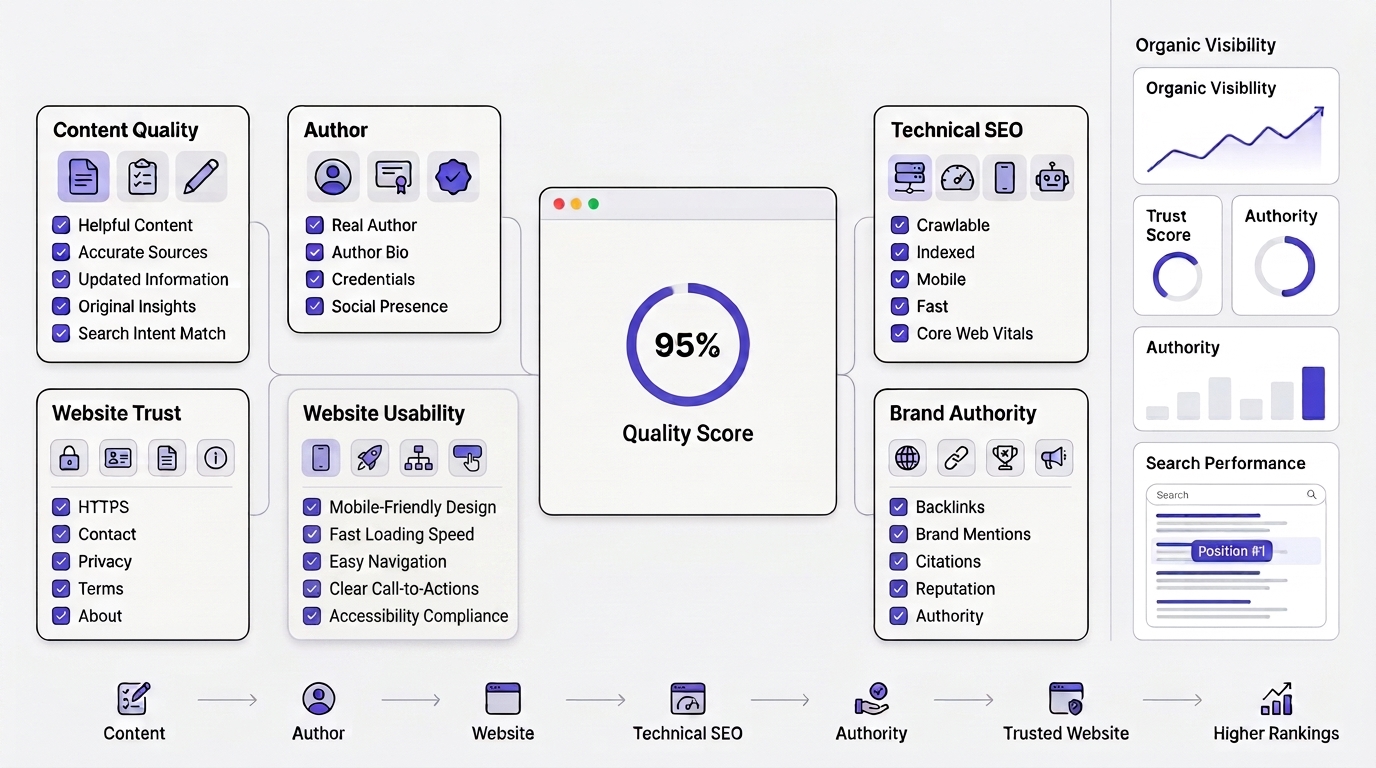
This checklist maps to Google’s E-E-A-T framework (Experience, Expertise, Authoritativeness, Trustworthiness), which Google’s Search Quality Raters use to judge whether content deserves to rank — especially for YMYL (Your Money Your Life) topics like health, finance, and legal content. Here’s what each section actually means in practice:
Content Checklist
This is about substance over padding.
Fully answers the question — no half-answers that force the reader to click away and search again. If someone asks “how to fix X,” the page should leave them able to actually fix X.
Claims backed by sources — statistics, medical claims, legal claims, etc. should link to or cite credible original sources (studies, official data, primary reporting) rather than just asserting things.
Information is current — outdated info (old prices, deprecated software steps, old regulations) actively hurts trust. Content needs a review/update cadence.
No generic filler — this targets the “AI slop” problem: paragraphs that sound fluent but say nothing new. Google’s raters are specifically trained to spot content that could’ve been written by anyone about anything.
Author Checklist
This establishes who is speaking, because Google can’t trust anonymous content on sensitive topics.
Real name + real bio — not “Admin” or “Staff Writer.”
Relevant credentials — a nutrition article written by a registered dietitian carries more weight than one with no attributed expertise. The credential should match the topic.
Links to other work/social presence — proves the author is a real, findable person with a track record, not a fabricated byline.
Website Trust Checklist
Baseline signals that the site itself is legitimate and safe.
HTTPS — non-negotiable at this point, both for security and as a minor ranking factor.
Visible contact info — phone, email, or address; sites that are impossible to contact read as untrustworthy.
Privacy policy & terms — legal transparency, also often required for AdSense/affiliate compliance.
About page that actually explains who runs the site — not vague marketing copy, but real info on the entity/company/person behind the content.
Technical SEO Checklist
This is less about trust and more about crawlability and experience — but Google increasingly folds UX into quality signals.
Fast load times, mobile-friendly, Core Web Vitals — page experience metrics (LCP, INP, CLS) that Google uses as ranking inputs.
Fully crawlable/indexable — no accidental noindex tags, broken robots.txt, or JS rendering issues that hide content from Googlebot.
Brand Authority Checklist
This is the “Authoritativeness” pillar of E-E-A-T, but it’s earned outside your own website.
Backlinks from relevant sites — other credible sites in your niche linking to you signals third-party trust, not self-declared trust.
Mentions in industry publications — even unlinked mentions (Google can associate a brand name with a topic even without a hyperlink).
Recognizable presence beyond the site — social proof, being a name people search for directly, being cited/discussed elsewhere. This is the hardest one to fake and the strongest long-term signal.
The overall logic: Google can’t directly measure “expertise” or “trust,” so it looks for proxies — bylines, citations, site transparency, external validation — that correlate with content actually being reliable. This checklist is essentially a punch list of those proxies.
Conclusion
E-E-A-T isn’t a checklist you complete once and forget. It’s a pattern that has to show up consistently across your authors, your content, and your site’s basic trust infrastructure. The sites that keep surviving core update after core update aren’t the ones that found some clever workaround. They’re the ones that actually have real people with real knowledge standing behind what they publish, and they make that visible instead of hiding behind anonymous bylines and thin content.
Start with an honest audit of where your weakest signals are, probably your author information or your site’s basic trust pages if you haven’t touched them in a while, and fix those first. Building genuine authority takes time, there’s no way around that, but every piece of real expertise and original experience you add compounds, the same way backlinks and traffic do. That’s the actual long game here, not chasing a score, but becoming a site actually worth trusting.
Frequently Asked Questions
What is Google’s E-E-A-T?
E-E-A-T is Google’s framework for evaluating content quality and trustworthiness, standing for Experience, Expertise, Authoritativeness, and Trustworthiness. It’s used by Google’s human quality raters to assess search results and, indirectly, shapes how the ranking algorithms get built and refined.
Is E-E-A-T a ranking factor?
Not directly. E-E-A-T is a conceptual framework, not a single measurable signal like page speed. It influences rankings indirectly through actual ranking inputs like content quality, backlinks, and user engagement, all of which are shaped by how well a page demonstrates real experience and trust.
What is the difference between E-A-T and E-E-A-T?
E-A-T (Expertise, Authoritativeness, Trustworthiness) was the original framework used since 2014. Google added the second “E” for Experience in December 2022 to specifically credit content created by people with first-hand, lived involvement in the topic, not just researched knowledge.
How can I improve my website’s E-E-A-T?
Add real, named author bios with genuine credentials, publish original examples and case studies instead of rehashed information, keep content updated and accurate, secure your site with HTTPS, and make contact and business information easy to find.
Does E-E-A-T apply to all websites?
Yes, though the bar varies significantly by topic. YMYL sites covering health, finance, legal, or safety topics face much stricter requirements than a hobby blog or a recipe site, where the real-world stakes of inaccurate information are lower.
Is E-E-A-T important for small businesses?
Very much so, especially for local businesses where trust signals like accurate contact information, genuine customer reviews, and a clear About page directly influence both rankings and whether visitors actually convert into customers.
Can AI-generated content meet E-E-A-T standards?
Yes, if it’s fact-checked, edited by a real human, and enhanced with original examples, data, or insight the AI couldn’t generate on its own. Fully automated content published without human review tends to lack the specific, verified detail strong E-E-A-T requires.
How long does it take to build E-E-A-T?
There’s no fixed timeline, but meaningful improvement usually takes several months to a year of consistent effort, since it depends on accumulating backlinks, reviews, brand mentions, and a track record of accurate, updated content over time.
What are the biggest E-E-A-T mistakes?
Publishing anonymous, uncredited content, leaving outdated information uncorrected, having no visible contact or business information, and relying on fully automated content with no human fact-checking or editorial review.
How do I know if my website has strong E-E-A-T?
Run an audit checking whether your authors have real bios and credentials, whether your content is current and well-sourced, whether basic trust signals like HTTPS and contact info are in place, and whether independent, credible sites reference or link to your content.