
Every business owner hits this wall eventually. You’ve got a marketing budget, maybe not a huge one, and two roads in front of you. One says put the money into content and technical fixes and wait. The other says put the money into ads and get traffic by tomorrow afternoon. Everyone around you has an opinion, and most of those opinions land on the same tired line: “it depends.” True, technically. Also useless if you’re the one who has to sign off on the spend this month.
Here’s the thing nobody tells you upfront. SEO and paid ads aren’t rivals fighting for the same job. They’re built differently, they behave differently, and they reward different kinds of patience. Someone running Google Ads for a client’s campaign and writing SEO content for another brand in the same week sees this constantly: the businesses that do well aren’t the ones that picked the “right” channel. They’re the ones that understood what each channel actually does before they spent a rupee on either.
This isn’t going to be another listicle that ends with “it depends, so do both.” By the end, you’ll have an actual way to work out where your money should go, based on your timeline, your budget, your industry, and where your business stands right now. That’s the real question anyway. Not “which is better,” but “which is better for you, this year, with the money you actually have.”
What Is SEO, Actually
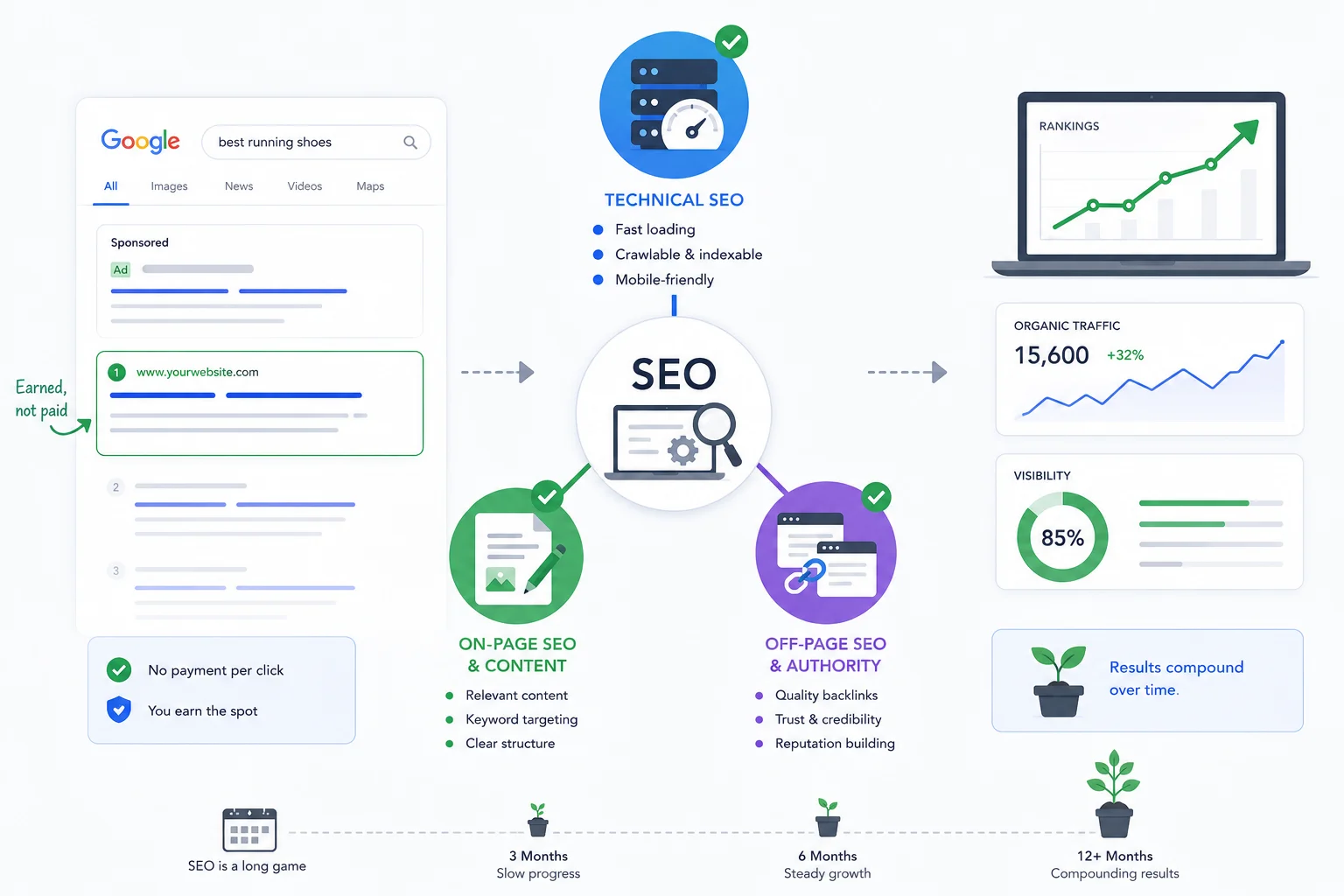
SEO stands for search engine optimization, and at its core, it’s the work of getting your website to show up in the free, non-paid results when someone searches on Google. No fee gets paid per click. No auction happens in real time. You earn the spot by being relevant, technically sound, and useful enough that Google’s algorithm decides you deserve to be there.
That work breaks down into three buckets, and skipping any one of them tanks the other two.
- Technical SEO covers the plumbing: how fast your site loads, whether Google can crawl and index your pages properly, whether your site works on mobile, whether your URL structure makes sense. None of this is glamorous. All of it matters. A beautifully written blog post sitting on a site that takes nine seconds to load isn’t going anywhere.
- On-page SEO and content is what most people picture when they hear “SEO.” Writing pages and posts that answer what people are actually searching for, structuring them so both readers and search engines can make sense of them, and targeting the keywords your customers are typing in.
- Off-page SEO and authority building is mostly about links. When other reputable sites link back to yours, it signals to Google that you’re a source worth trusting. This is the slowest piece to build and the hardest to fake convincingly.
So what does “results” actually look like here? It’s rankings moving up for terms that matter to your business, organic traffic climbing on your analytics dashboard, and visibility that keeps compounding as you add more content and earn more authority. Nobody can hand you an exact date when that starts happening. It depends on how competitive your keywords are, how old and trusted your domain already is, and how consistently you’re putting out quality content. What’s fair to say is that SEO rarely moves fast in the first few months. Most of the payoff shows up later, and then it tends to stick around.
What Is Paid Advertising (PPC/Paid Ads), Actually
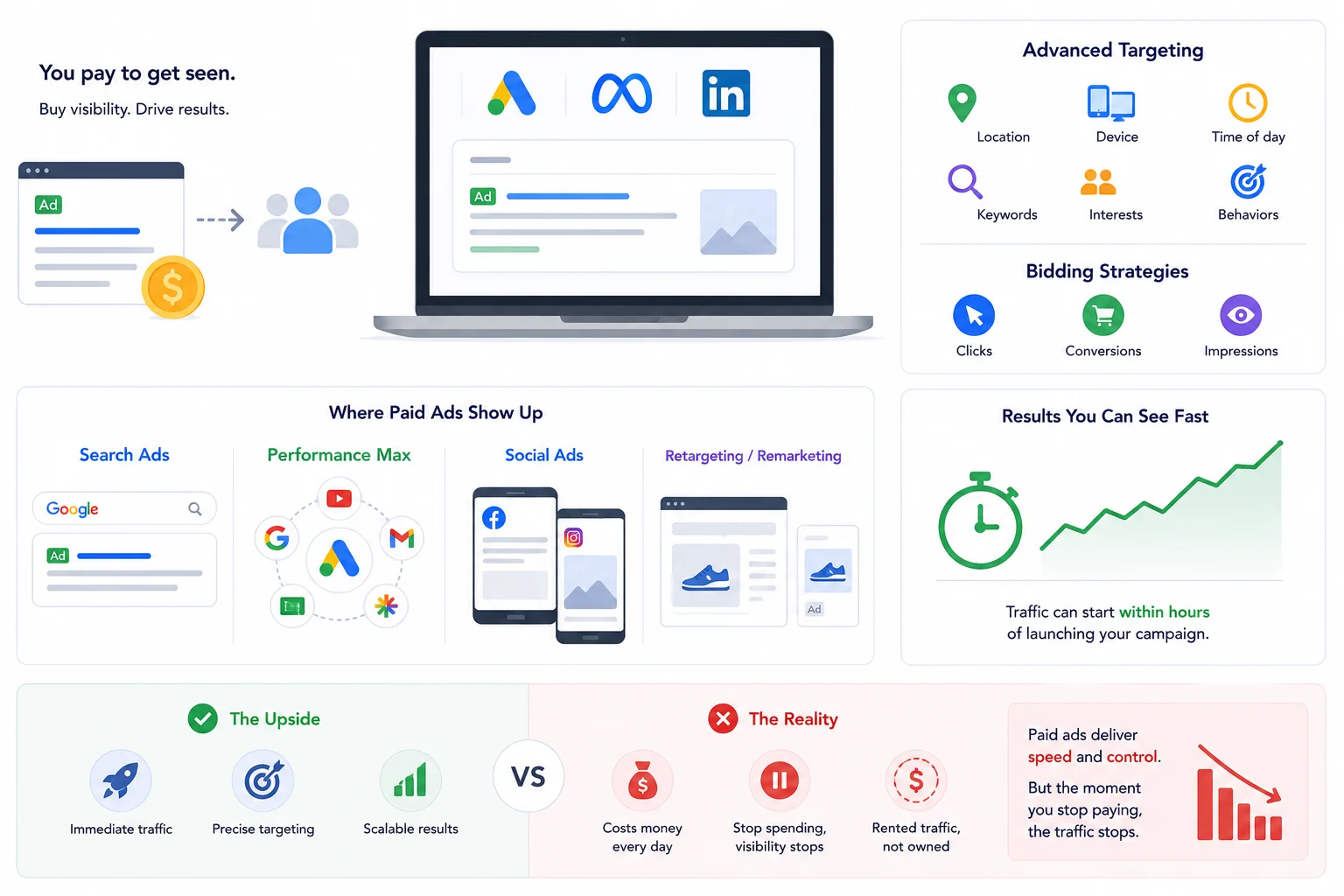
Paid ads flip the model entirely. Instead of earning your spot, you’re buying it. Platforms like Google Ads, Meta Ads, and LinkedIn Ads let you pay per click or per impression to put your business directly in front of people searching for or scrolling past content related to what you sell.
And paid ads today are a lot bigger than just the sponsored links at the top of a Google search. That’s Google Search Ads, sure, but there’s also Performance Max campaigns that automatically place your ads across Search, Display, YouTube, Gmail, and Discover from a single setup. There’s social advertising on Meta and LinkedIn, which lets you target based on interests, job titles, and behavior rather than just search intent. And there’s retargeting or remarketing, which shows ads specifically to people who already visited your site once and left without converting. Most articles comparing SEO and PPC stop at “Google Search Ads” and call it a day. That’s a narrow slice of what paid media can actually do for a business.
The targeting is where paid ads earn their keep. You can choose exactly who sees your ad based on location, device, time of day, specific keywords, or audience interests and behaviors. Bidding strategies let you tell the platform whether you care more about clicks, conversions, or impressions, and the system adjusts in real time.
Results here look completely different from SEO. Traffic shows up as soon as the campaign goes live, sometimes within the hour. But that traffic is directly tied to spend. The moment you pause the campaign or run out of budget, the visibility disappears. There’s no bank of earned trust sitting there waiting for you. It’s rented, not owned, and the rent is due every single day the campaign runs.
SEO vs Paid Ads: Side-by-Side Comparison
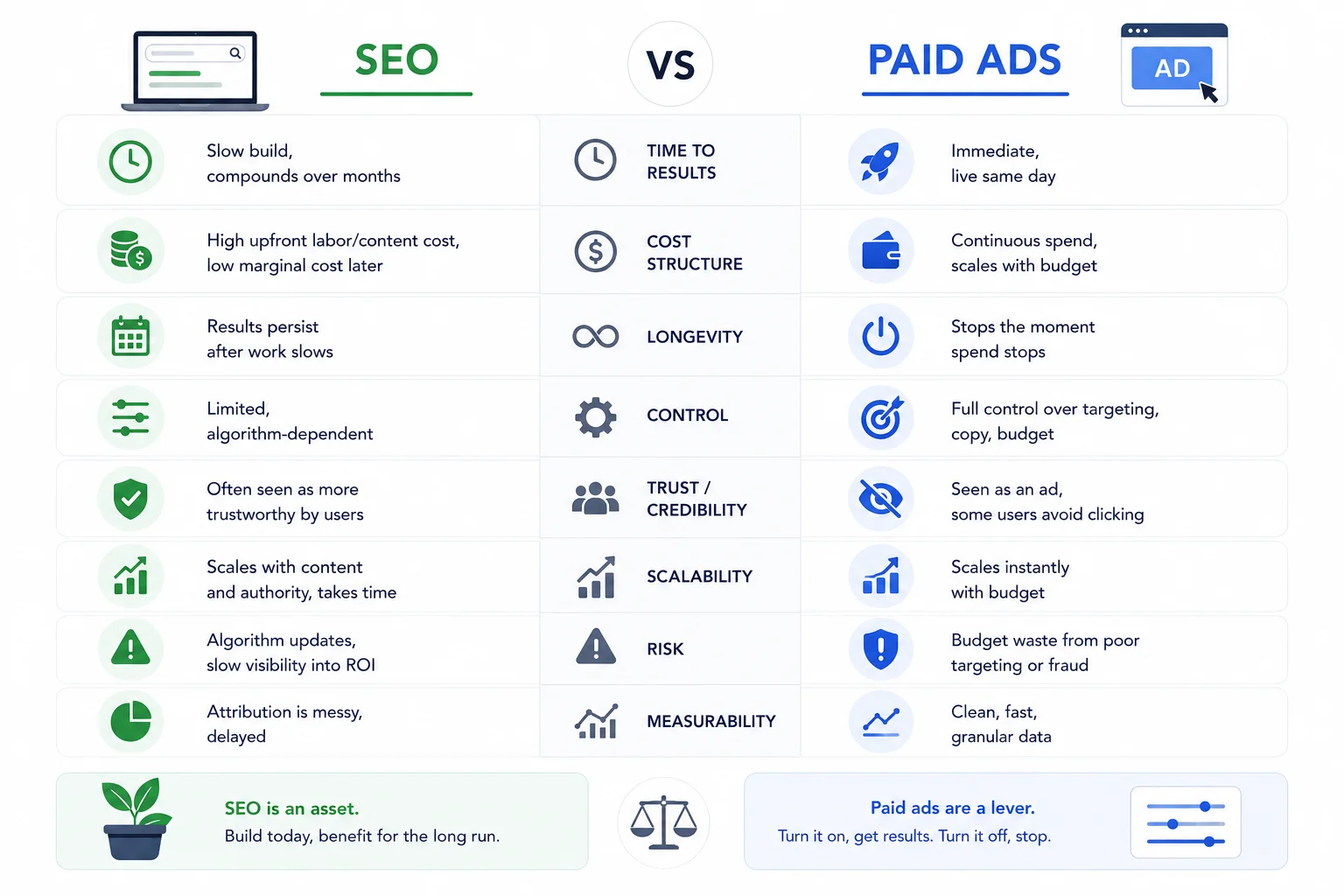
| Dimension | SEO | Paid Ads |
|---|---|---|
| Time to results | Slow build, compounds over months | Immediate, live same day |
| Cost structure | High upfront labor/content cost, low marginal cost later | Continuous spend, scales with budget |
| Longevity | Results persist after work slows | Stops the moment spend stops |
| Control | Limited, algorithm-dependent | Full control over targeting, copy, budget |
| Trust/credibility | Often seen as more trustworthy by users | Seen as an ad, some users actively avoid clicking |
| Scalability | Scales with content and authority, takes time | Scales instantly with budget |
| Risk | Algorithm updates, slow visibility into ROI | Budget waste from poor targeting or fraud |
| Measurability | Attribution is messy, delayed | Clean, fast, granular data |
Now let’s actually unpack these, because a table only tells you the shape of the difference, not why it matters.
Time to results is the one everyone already half-knows. SEO is a slow build. You publish, you optimize, you wait for Google to crawl, index, and eventually rank the page, and none of that happens on your schedule. Paid ads skip all of that. Set up a campaign in the morning, and by afternoon you can be getting clicks. If your business needs revenue this month, that gap alone might decide the whole question for you.
Cost structure works almost in reverse. SEO front-loads the pain. You’re paying for content creation, technical fixes, and possibly an agency retainer before you see a single extra visitor. Once that foundation is built, though, the marginal cost of keeping traffic flowing drops a lot. Paid ads are the opposite. There’s less upfront cost to get moving, but the spend never really stops. Every single lead is paying rent to the platform.
Longevity might be the sharpest contrast of the two channels. A blog post that ranks well can keep bringing in traffic for years with minimal upkeep. Turn off a PPC campaign and traffic drops to zero, often within hours. This is the point that gets glossed over the most in budget conversations. Paid ads are a tap you have to keep turning on. SEO is closer to something you build once and maintain.
Control and flexibility favor paid ads clearly. Want to test five different headlines this week? Change your targeting radius? Pause spend because a product just sold out? All of that happens in minutes with paid ads. SEO doesn’t work like that. You can optimize a page today, and Google might not even recrawl it for days, let alone re-rank it.
Trust and credibility tend to lean toward organic results. A lot of users have some instinct to skip past the ads at the top of a search page and go straight for the organic listings, treating them as more “earned.” That’s a commonly held perception rather than a hard rule, and it varies by industry and by how the person searching feels about ads in general. Still, it’s a real factor worth weighing, especially for businesses selling something that requires trust before purchase.
Scalability cuts both ways depending on what you mean by scale. Paid ads scale instantly. Double the budget, roughly double the traffic, assuming the market and your targeting can support it. SEO scales with content volume and authority, and that kind of scale takes real time to build. You can’t 10x your organic traffic by writing 10x more content this week. It doesn’t work that way.
Risk profile is different in kind, not just degree. With paid ads, the risk is wasted spend: click fraud, poor targeting, ad fatigue setting in as people see your ad too many times and start ignoring it. With SEO, the risk is an algorithm update wiping out rankings you spent months building, or simply not knowing whether your work is paying off until months after you started.
Data and measurability clearly favor paid ads. You get impressions, clicks, conversions, cost per click, cost per conversion, all in a dashboard you can check daily. SEO attribution is messier. Traffic moves for reasons that aren’t always obvious, and tying a specific ranking change to a specific business outcome takes longer and involves more guesswork.
The Real Cost Comparison
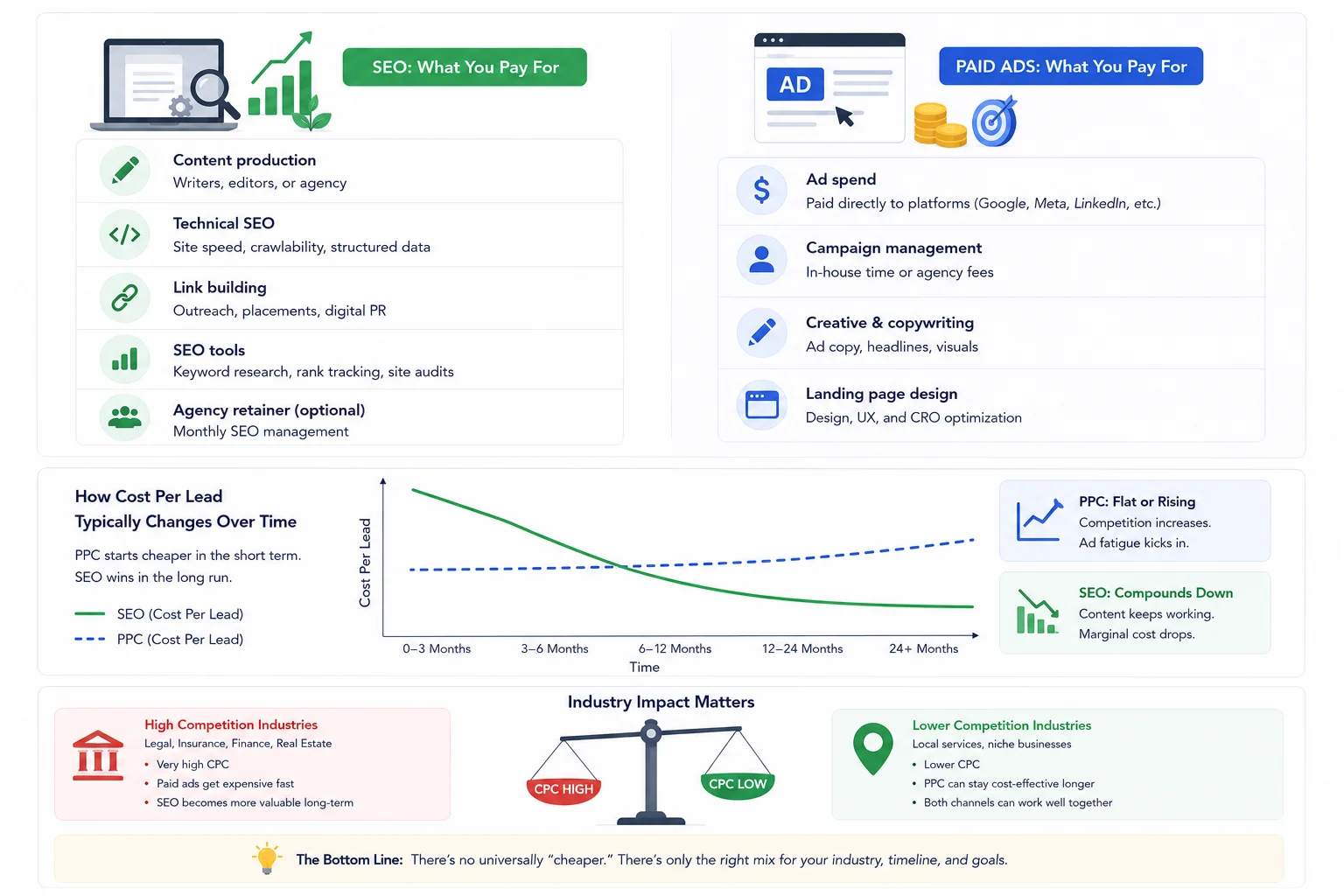
Cost is where most of these comparisons get sloppy, so let’s be precise about what you’re actually paying for in each channel instead of throwing around numbers that don’t hold up.
With SEO, the spend goes toward:
- Content production, whether that’s an in-house writer or an agency
- Technical SEO work, like site speed fixes, crawlability, and structured data
- Link building, which is often the most labor-intensive and slowest piece
- Tools for keyword research, tracking rankings, and auditing your site
- Possibly a monthly retainer if you’re working with an agency instead of doing it in-house
With paid ads, the spend goes toward:
- Ad spend itself, the money paid directly to the platform
- Campaign management, whether that’s your own time or an agency’s
- Creative and copywriting for the ads
- Landing page design and optimization, because a bad landing page tanks everything upstream of it
Here’s the honest pattern that tends to show up across most businesses running both channels. In the early going, PPC usually produces a lower cost per lead than SEO, simply because SEO hasn’t had time to build momentum yet. Give it a year or two of consistent work, though, and well-executed SEO tends to flip that around, often by a wide margin, because the content keeps working without needing proportionally more spend behind it.
That’s the compounding vs flat-line difference in a nutshell. PPC’s cost per lead tends to stay roughly flat or creep up as competition for your keywords increases and your ads start hitting fatigue. SEO’s cost per lead tends to fall over time, because the same piece of content keeps pulling in traffic long after you stopped actively working on it.
Industry matters here too, and it matters a lot. If you’re in legal services, insurance, finance, or real estate, cost per click on paid search can get brutal fast. Some of the most competitive legal and insurance keywords carry some of the highest costs per click in the entire ad ecosystem, and that changes the math significantly. In a market like that, SEO starts looking a lot more attractive simply because the alternative is so expensive. Compare that to a niche local service business with low search competition, where PPC might stay cheap and effective for a long time because nobody else is bidding aggressively on those terms.
None of this means one channel is objectively cheaper. It means the cost curve looks different depending on your industry, your timeline, and how long you’re willing to stay in the game.
When SEO Makes More Sense
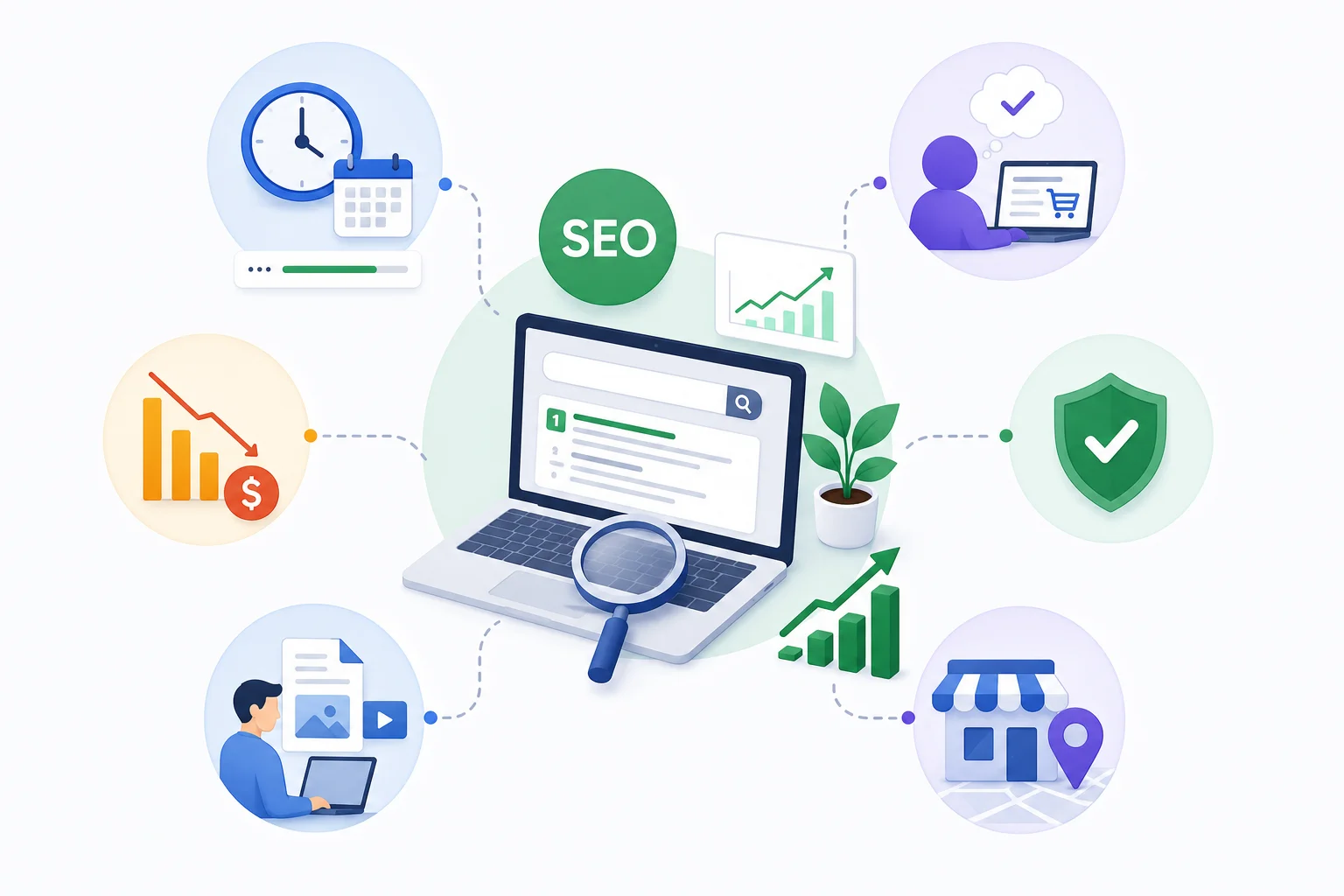
SEO tends to be the stronger bet in a specific set of situations, and it’s worth being honest about when those apply to you rather than assuming SEO is always the “smart long-term choice” by default.
- You’re playing the long game and can genuinely tolerate a slow ramp without panicking three months in
- Your industry involves high-intent, research-heavy buying cycles, like B2B software, professional services, or anything with a high price tag where buyers read multiple articles before deciding
- Your paid customer acquisition cost has already crept up to a point where it’s not sustainable, and you need an alternative that doesn’t scale in cost the same way
- You want a durable asset, something that keeps working for your business even if you have a slow month and can’t spend on ads
- You have the internal expertise or content resources to actually sustain the work, because half-committed SEO rarely goes anywhere
- You’re operating in a local or niche market with lower competition, where ranking is realistically achievable in a reasonable timeframe rather than a multi-year uphill fight
If most of these describe your situation, SEO is worth the patience it demands. If none of them do, it’s probably not the right starting point, at least not right now.
When Paid Ads Make More Sense
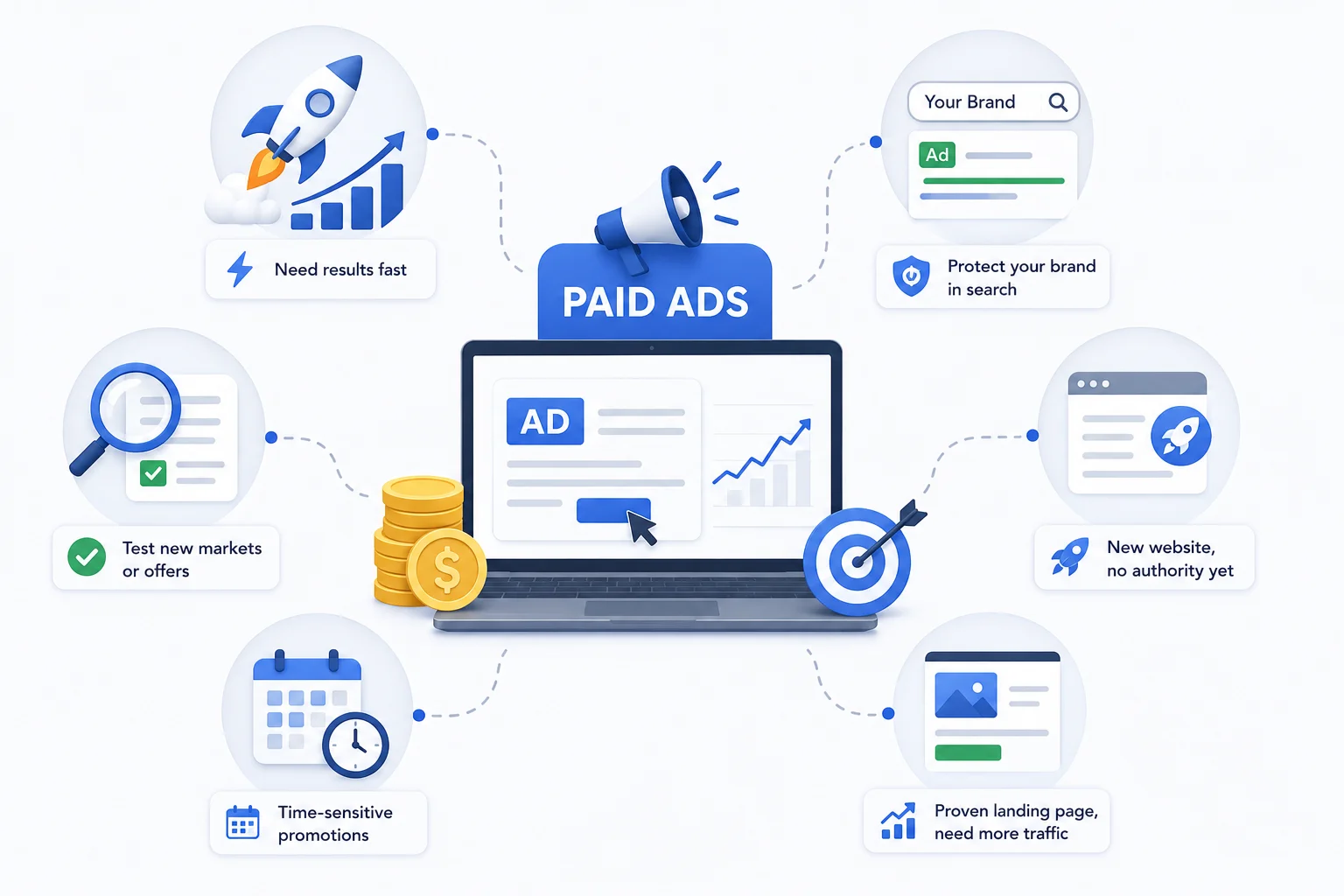
Paid ads earn their place just as clearly in a different set of circumstances.
- You need leads or revenue immediately, whether that’s a brand-new business, a cash flow gap, or launching a new product that needs customers now
- You’re testing a new market, a new offer, or new messaging and need fast validation before committing serious budget elsewhere
- You’ve got a time-boxed event or seasonal promotion, where SEO’s timeline simply doesn’t fit the window you’re working with
- You want to defend your own branded search terms so competitors don’t buy ads against your company name and siphon off your own customers
- Your website or domain is brand new with zero authority built up, and organic traction is realistically months away no matter how good your content is
- You already have a proven, high-converting landing page and just need more volume of qualified traffic hitting it
Notice the pattern here. Paid ads win when speed matters more than durability, or when SEO simply hasn’t had time to work yet. That’s not a weakness of paid ads. That’s exactly what they’re built for.
Why This Doesn’t Have to Be Either/Or
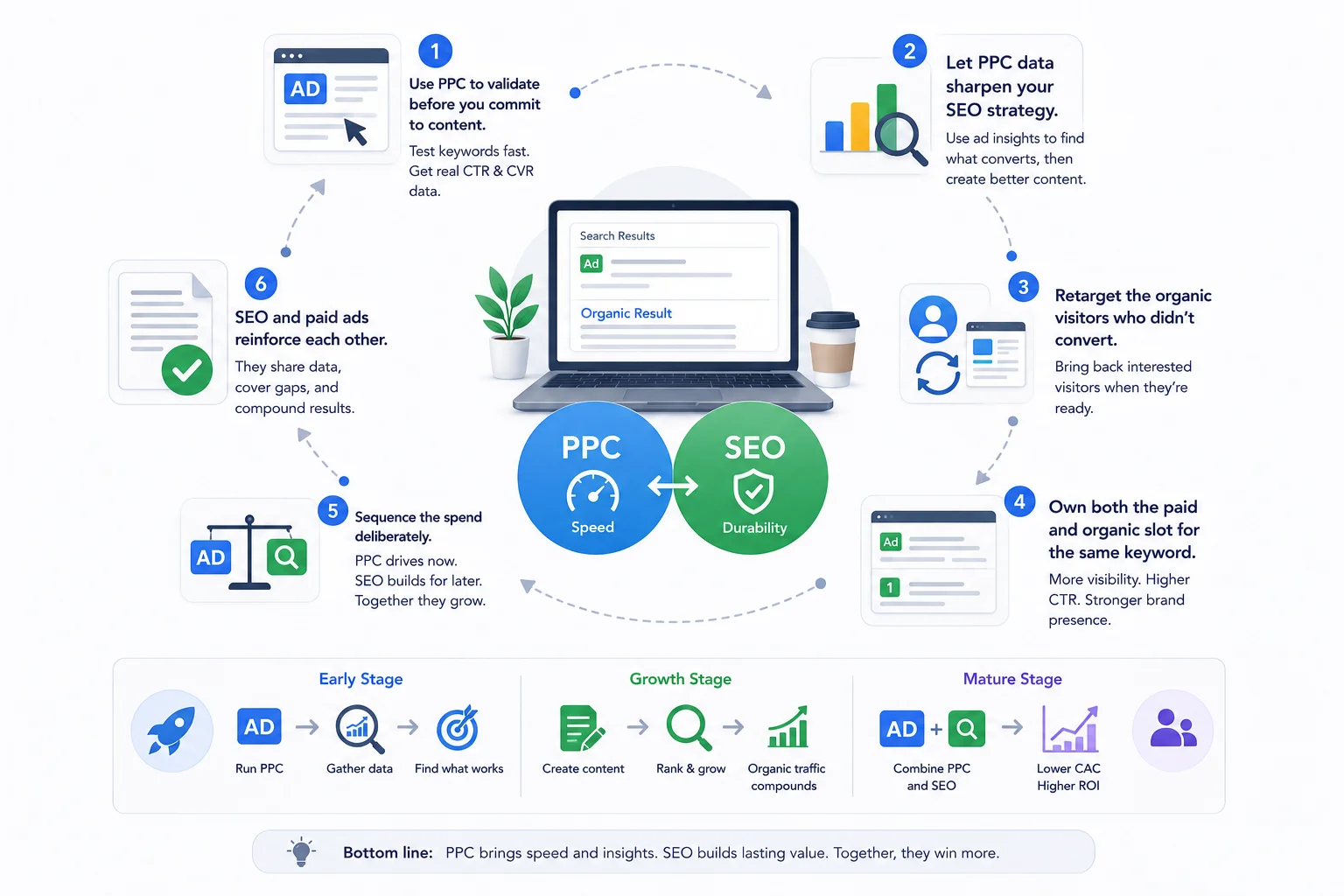
Here’s where most comparisons quietly give up and end with “well, use both.” Fair enough advice, but it’s worth actually explaining how these two channels reinforce each other instead of just existing side by side in the same budget.
- Use PPC to validate before you commit to content. Before spending weeks writing and optimizing a piece of content around a keyword, run a small PPC campaign targeting that same term. Within days you’ll have real data on click-through rate and conversion rate, which tells you whether that keyword is actually worth the SEO investment before you sink the time in.
- Let PPC data sharpen your SEO strategy. Your ad campaigns generate a goldmine of information: which search terms actually convert, which ad copy resonates, which landing pages leak leads. Feed that straight into your content calendar instead of guessing at topics.
- Retarget the organic visitors who didn’t convert. Someone finds your blog post through organic search, reads it, and leaves without buying anything. Retargeting ads let you follow up with that same person as they browse other sites, bringing them back when they’re closer to ready.
- Own both the paid and organic slot for the same keyword. When your business shows up as both the top ad and the top organic result for a valuable search term, you’re taking up a much bigger chunk of that results page. Competitors get pushed further down, and your overall click-through rate for that term tends to climb.
- Sequence the spend deliberately. Early on, lean on paid ads to generate cash flow and gather real data about what converts, while SEO investment quietly builds in the background. By the time PPC costs start climbing or budget gets tight, the organic side has had months to compound and can start carrying more of the weight.
Treated this way, SEO and paid ads aren’t two line items competing for the same dollar. They’re feeding each other information and covering each other’s weak spots. PPC gives you speed and data. SEO gives you durability and lower long-term cost. Running only one is like driving with one eye closed. Technically possible, just harder than it needs to be.
A Simple Framework to Decide Your Split
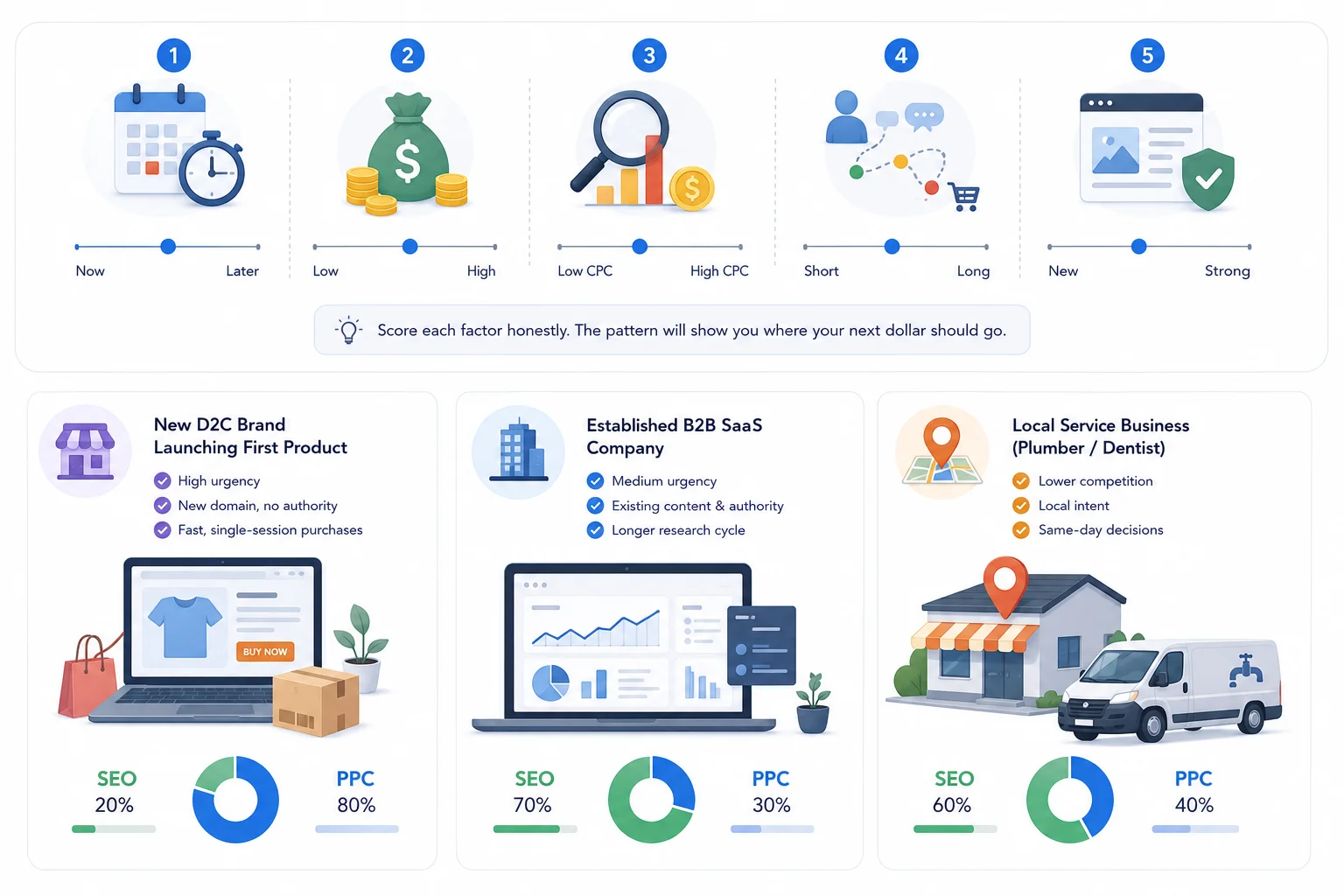
Enough theory. Here’s a practical way to actually work out where your next marketing dollar should go, based on five factors. Score your business honestly against each one, and the pattern that emerges will point you toward the right split.
1. Timeline urgency. If you need revenue this quarter, that pushes hard toward paid ads. If you can wait six to twelve months for compounding results, that opens the door to SEO.
2. Budget size. A small, irregular budget struggles to sustain PPC because you need consistent daily spend to generate meaningful data and results. That same small budget can go further with SEO if you have the time to invest instead of cash. Larger, steady budgets can support both channels running at once.
3. Industry competitiveness and CPC. High cost-per-click industries like legal, insurance, and finance make paid ads expensive fast, which tilts the scale toward SEO despite the slower timeline. Lower CPC, less competitive niches make paid ads a more efficient use of budget for longer.
4. Buyer research cycle length. If your customers research for weeks or months before buying, like enterprise software or major home renovations, SEO content matches that research behavior well because it can capture them at every stage of that journey. If purchases happen fast and impulsively, paid ads matching immediate intent tend to convert better.
5. Existing domain authority and content assets. A brand-new domain with nothing published yet is starting from zero on the SEO side, and that takes real time to change no matter how much money gets thrown at it. A domain with years of decent content and a few solid backlinks already has a head start that makes new SEO investment pay off faster.
Now play this out with a few real scenarios.
A new D2C brand launching its first product has urgency, a brand-new domain with zero authority, and a buyer whose purchase decision often happens in a single sitting. That combination points almost entirely toward paid ads for the first several months, with SEO content started quietly in the background for the terms that matter long-term.
An established B2B SaaS company with a few years of published content, a longer buyer research cycle, and less day-to-day urgency around any single quarter is sitting on a strong SEO foundation already. Doubling down there, while running a smaller, targeted PPC budget on high-intent bottom-of-funnel keywords, tends to make more sense than going all-in on either channel alone.
A local service business, say a plumber or a dentist, operating in a market with lower search competition and clients who tend to search and call within the same day, benefits from both channels working together at a smaller scale. Local SEO captures people searching for services in their area, while a modest, tightly geo-targeted PPC budget catches the ones who need something fixed right now and aren’t willing to scroll past the ads.
None of these scenarios is a universal template. They’re proof that the same five factors, scored differently, point to genuinely different budget splits. Run your own business through that same scoring exercise honestly, and the answer tends to become a lot less murky than “it depends.”
Conclusion
There isn’t a universal winner between SEO and paid ads, and honestly, chasing one is the wrong question to begin with. The right answer depends on where your business actually stands right now: how urgently you need results, how much budget you’ve got, how competitive your industry is, and how much groundwork you’ve already laid.
What’s true across almost every business, though, is this. Paid ads buy you time. SEO builds you an asset. Most businesses that grow well end up needing both at different points, sometimes at the same time, sometimes in sequence. The businesses that struggle are usually the ones that picked a side early and never revisited the decision as their situation changed.
Frequently Asked Questions
Is SEO better than PPC for small businesses?
Neither is universally better. Small businesses with limited cash but some time to invest often lean SEO for its lower long-term cost, while small businesses that need customers immediately, or that operate in a low-competition local market, often get more value out of a modest PPC budget first.
How long does SEO take to show results compared to PPC?
PPC can produce traffic the same day a campaign launches. SEO typically takes considerably longer to show meaningful movement, and how long depends heavily on keyword competition, domain age, and how consistently content gets published. There’s no fixed timeline that applies to every website.
Can I do SEO and PPC at the same time on a limited budget?
Yes, and for a lot of businesses this works better than going all-in on one channel. Even a modest, deliberately split budget between the two tends to outperform pouring everything into just one, because each channel covers a gap the other one has.
Which is more expensive long-term, SEO or PPC?
PPC cost per lead tends to stay flat or rise over time as competition and ad fatigue increase. SEO cost per lead tends to fall over time as content accumulates traffic without requiring proportionally more spend. Over a long enough horizon, that usually favors SEO on pure cost efficiency, though the upfront investment and patience required are real trade-offs.
Does running PPC ads help my SEO rankings?
PPC doesn’t directly boost organic rankings. Google has been clear that ad spend isn’t a ranking factor. What PPC does provide is fast data, like which keywords and messaging actually convert, and that data can meaningfully sharpen your SEO content strategy even though the ranking algorithm itself doesn’t care whether you’re running ads.
What industries benefit most from PPC over SEO?
Industries with short, low-consideration purchase cycles, time-sensitive promotions, or new product launches tend to see the fastest returns from PPC. Industries with very high CPC, like legal and insurance, still use PPC, but the economics push many of these same businesses to invest heavily in SEO as well, simply because paid clicks get expensive fast.