

Somebody starts a blog, opens Google Keyword Planner or Ubersuggest for the first time, types in their main topic, and gets hit with 4,000 rows of data. Volume, difficulty, CPC, a dozen columns that mean nothing yet. Most beginners pick the ones with the biggest volume number and call it a strategy. Six months later the traffic hasn’t moved, or worse, it moved and nobody bought anything. That’s not bad luck. That’s what happens when you treat every type of SEO keyword like it’s the same kind of thing.
It isn’t. A person typing “what is a mutual fund” and a person typing “best mutual fund app India 2026” are both technically searching for “mutual fund” content, but they’re standing in completely different places in their decision. One is curious. The other has a card in hand. Google knows the difference. Ranking content that ignores that difference is why so much SEO work goes nowhere, and it’s also why two websites can target roughly the same topic and get wildly different business results from it.
This post breaks down types of SEO keywords that actually matter, not just the four-intent framework everyone recycles, but the length-based types, the semantic stuff that gets misexplained constantly, branded versus non-branded, local, seasonal, ecommerce, even the paid search match types, because understanding those sharpens organic thinking too. Each section goes past the definition and into the mechanics, why the type exists, how Google actually treats it differently, and where beginners get it wrong in practice. By the end, keyword research stops being a spreadsheet exercise and starts being a way of reading what people actually want.
What Is an SEO Keyword, Really?
Ask ten people what a keyword is and most will say “a word you put in your content so Google finds it.” That definition was true around 2010. It’s mostly wrong now, and holding onto it is why so many beginners still write content that reads like it’s talking to a robot instead of a human.
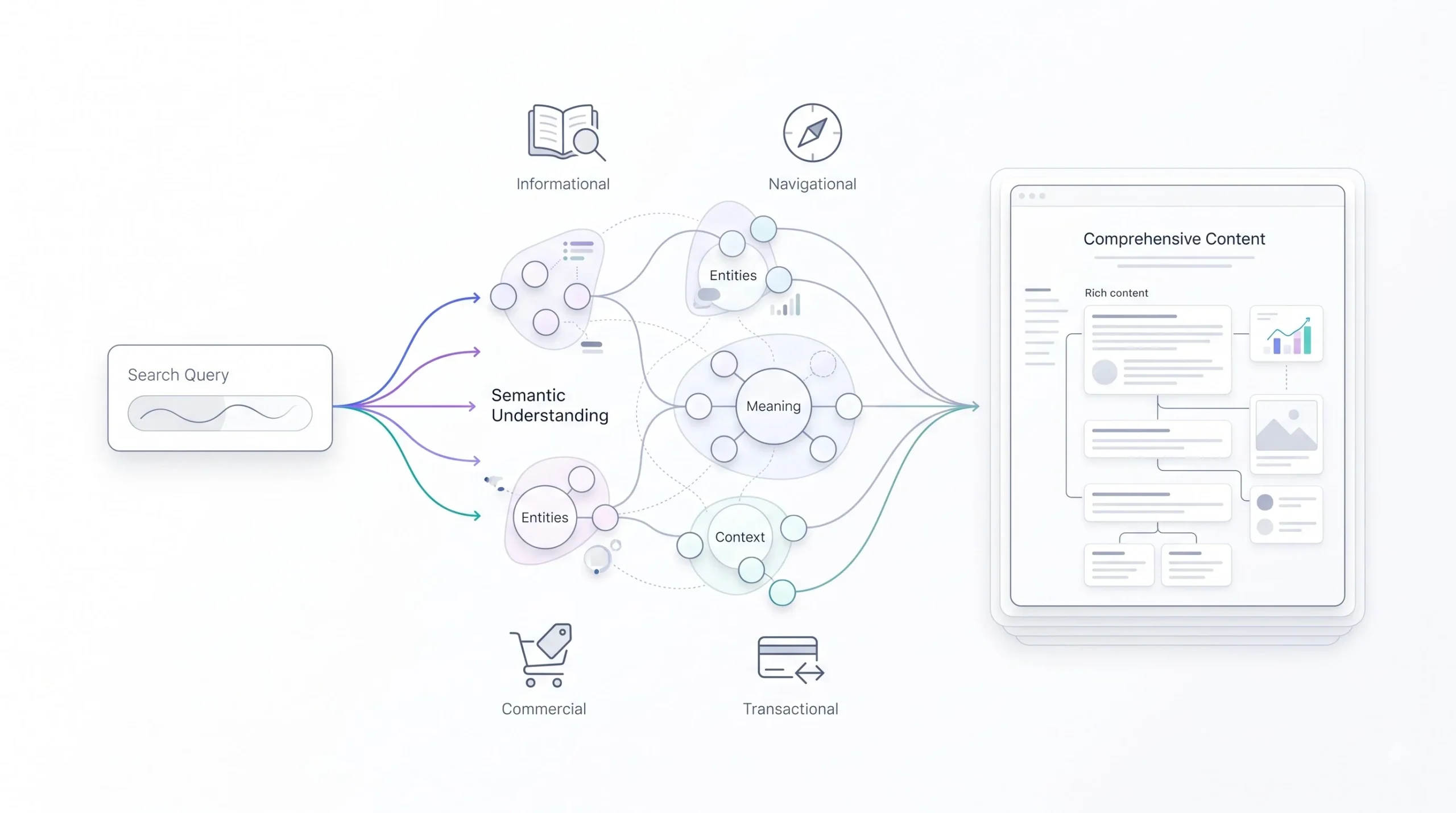
A keyword today is better thought of as a label for an intent, not a string of text to match exactly. Google stopped doing pure string matching years ago. Their systems, especially after updates like BERT and the broader move toward semantic search, read a query for meaning first, then look for content that satisfies that meaning, regardless of whether the exact words appear. Type “cheap flights to Paris” and Google doesn’t just look for pages with those four words in that order. It looks for pages about affordable airfare to Paris, budget carrier options, seasonal pricing, all of it, even if a page never uses the word “cheap” at all. This is why two pages targeting the exact same “keyword” as a text string can rank completely differently depending on how well they actually address the underlying need behind the search.
There’s a mechanical reason this shift happened, and it’s worth understanding instead of just accepting it. Language is genuinely messy. The same intent gets expressed a hundred different ways. “Cheap flights to Paris,” “budget airfare Paris,” “how to fly to Paris without spending a lot,” these are functionally the same request wearing different clothes. A search engine built purely on string matching would need separate content for every single phrasing, which is impossible and would have made the web unusable. So Google built systems that map queries into something closer to meaning space, essentially converting words into numerical representations where similar meanings sit close together, even when the actual words used are totally different. That’s the technical backbone behind why keyword stuffing died as a tactic and why writing for a real reader started working better than writing for a crawler.
So when someone says “target this keyword,” what they should really mean is “build content that fully satisfies what someone searching this phrase is trying to accomplish.” The phrase itself is just the entry point, a rough coordinate. This is exactly why keyword type matters more than keyword text. Once you know what type a search belongs to, you know what the person actually wants, and that tells you what to build, what format to build it in, and honestly, what not to bother building at all.
Why Keyword Types Matter More Than Keyword Volume
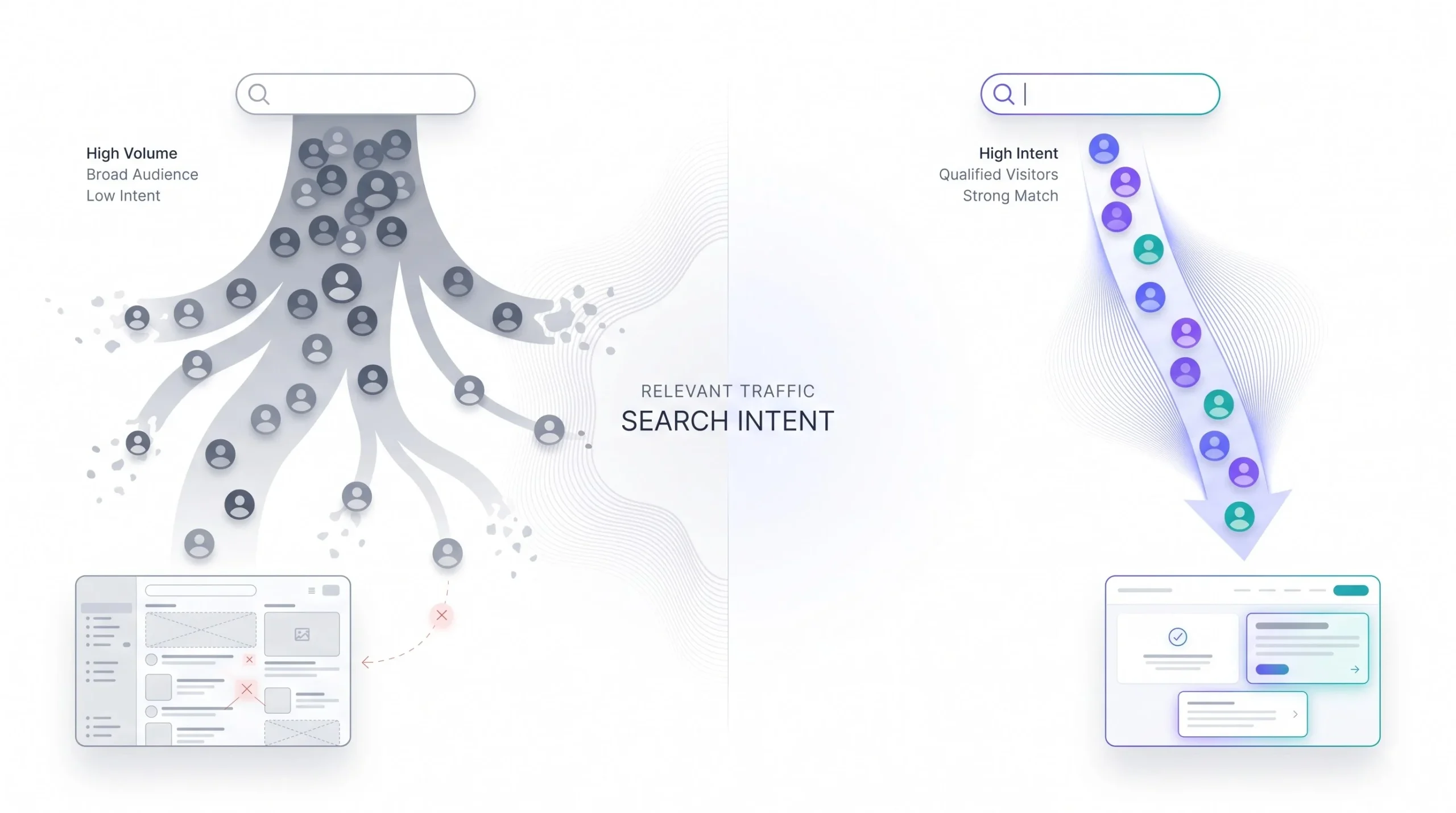
Volume gets all the attention because it’s the easiest number to stare at. Big number, feels exciting, must be worth chasing. Except volume tells you nothing about what happens after someone lands on the page. A keyword with 40,000 monthly searches and mostly informational intent will never convert like a keyword with 800 searches and clear transactional intent. Chasing the big number without knowing the type behind it is how so many beginners end up with traffic that never turns into anything, and then they blame the content, or the design, or the offer, when the actual problem was choosing the wrong kind of search to chase in the first place.
Volume tells you how many people are searching. Type tells you what they’re going to do next.
Here’s a real pattern that shows up constantly: someone builds a page around “digital marketing” because it gets tens of thousands of searches a month. The page ranks, sort of, buried on page 4 because the competition for that term is insane, and even if it did rank on page 1, most of that traffic is students, curious professionals, people doing research for an assignment. None of them are ready to hire an agency or buy a course. Compare that to “digital marketing course fees in Jaipur,” way lower volume, maybe 200 searches a month, but every single person typing that has already decided they want a course and is now comparing prices. That’s the kind of keyword that actually moves a business forward, and it only shows up once you start thinking in types instead of just numbers.
There’s also a compounding effect that beginners miss entirely. Ranking for high-competition, low-intent-match keywords wastes months of effort that could have gone toward twenty smaller, more targeted pages, each one capturing a slice of high-intent traffic. Twenty pages each getting 150 monthly visitors with strong conversion intent will outperform one page getting 3,000 low-intent visitors almost every time, because the total conversion count ends up higher and the cost per acquisition ends up lower. Volume-first thinking hides this math completely. Type-first thinking reveals it immediately.
The Search Intent Framework: The Foundation of Every Keyword Type
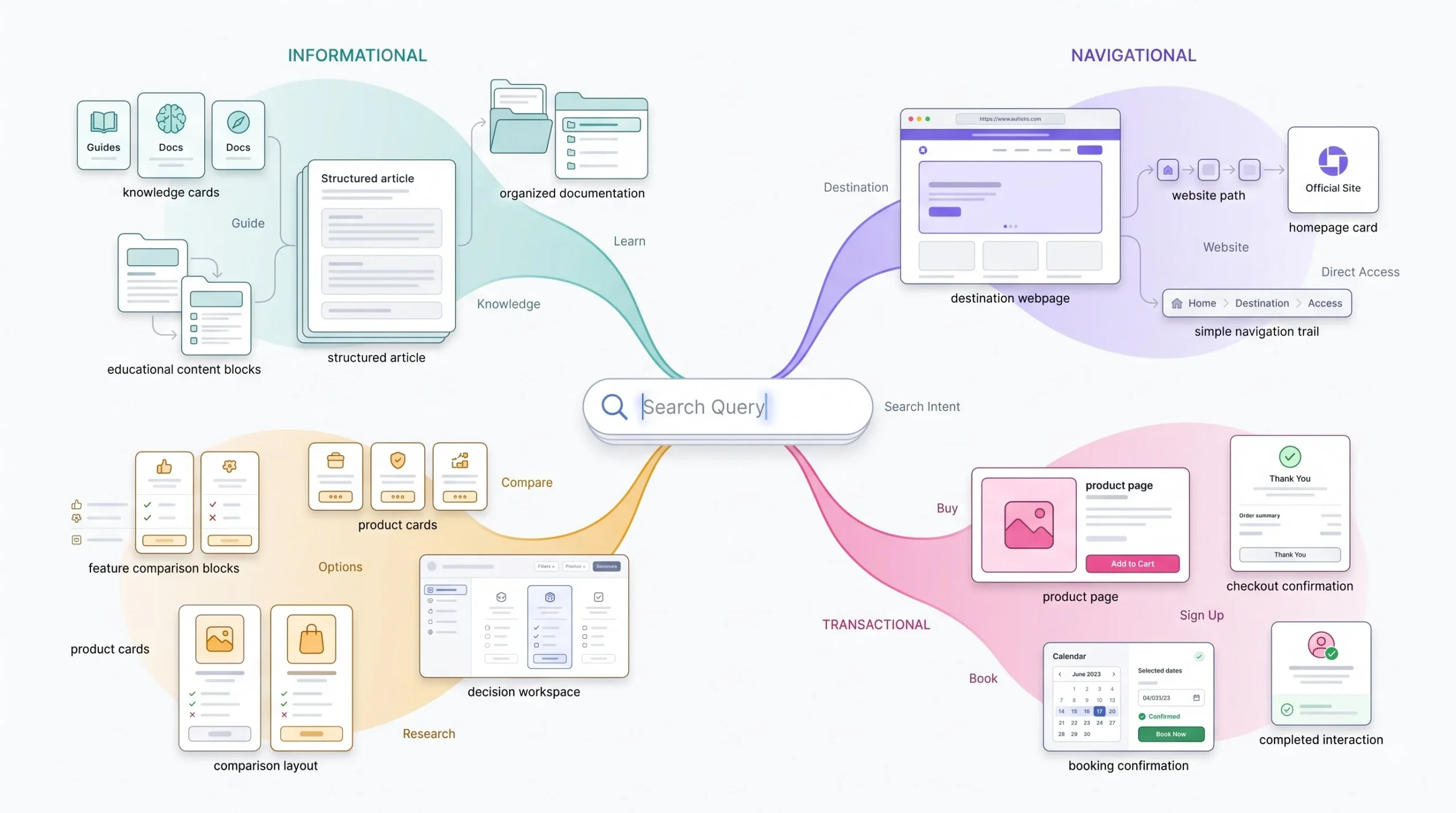
Every other keyword type in this post sits on top of this one framework, so it’s worth getting right before moving anywhere else. Search intent is basically the reason behind the search. Not the words someone typed, but what they were hoping to find when they typed them. Google groups intent into four broad categories, and this classification isn’t some marketing theory, it comes directly from how Google’s own quality rater guidelines describe evaluating search results, a document Google publishes and updates that trains the human raters who benchmark search quality.
Informational intent means the person wants to learn something. No purchase decision happening yet, sometimes no purchase decision ever. “How does compound interest work” is informational. So is “symptoms of dehydration.” The defining feature here isn’t the topic, it’s that the person’s next action after reading is almost never “buy something,” it’s “understand something.”
Navigational intent means the person already knows where they want to go and is using Google as a shortcut instead of typing a URL. “Facebook login,” “Zomato customer care number,” these aren’t really searches in the exploratory sense, they’re direct paths to a known destination. Ranking algorithms treat these queries almost like address lookups rather than open-ended research.
Commercial investigation intent sits in the middle, and it’s the most underrated category by beginners. This is comparison mode. “Best CRM for small teams,” “Zoho vs HubSpot,” the person knows they want to solve a problem, they’re just not sure which option yet. This is arguably the highest-leverage intent category for a business to own content around, because it’s the exact moment a brand can insert itself into someone’s decision before that decision gets made.
Transactional intent is the closest to a sale or a conversion. “Buy iPhone 15 online,” “book flight Delhi to Mumbai,” the decision is basically made, they’re executing it now. Content for this stage should get out of the way, not slow the person down with more education they don’t need anymore.
Why does Google organize things this way? Because ranking well isn’t really about matching keywords anymore, it’s about matching expectations. If someone searches with informational intent and lands on a hard sales page, they bounce immediately, and that bounce is a signal Google reads, through things like short dwell time and quick returns to the search results, as “this page didn’t answer the question.” Do that at scale and rankings drop even if the on-page SEO is technically perfect. Intent mismatch is one of the most common, least understood reasons content fails to rank, way more common than beginners assume when they blame keyword difficulty or backlinks. Fixing an intent mismatch, rewriting a hard sales page into an educational one, or vice versa, often produces ranking improvements faster than any backlink campaign would.
One more detail beginners skip: intent isn’t always a clean single category. Some queries carry mixed intent, and the safest way to check is to actually search the term and look at what’s ranking. If the top ten results are a mix of blog posts and product pages, that’s Google telling you the query itself has mixed intent, and content built for it might need to educate first, then guide toward a decision within the same page, rather than picking one lane and ignoring the other.
| Intent Type | Example Query | What the Searcher Wants | Funnel Stage | Best Content Format |
|---|---|---|---|---|
| Informational | “how does SEO work” | Understanding or education | Top of funnel | Blog post, guide, explainer |
| Navigational | “Ahrefs login” | A specific known destination | Not really funnel-relevant | N/A, usually a homepage or login page |
| Commercial Investigation | “best SEO tools 2026” | Comparison before deciding | Middle of funnel | Comparison post, review, roundup |
| Transactional | “buy Ahrefs subscription” | To complete an action now | Bottom of funnel | Product page, pricing page, landing page |
Keyword Types by Length and Structure
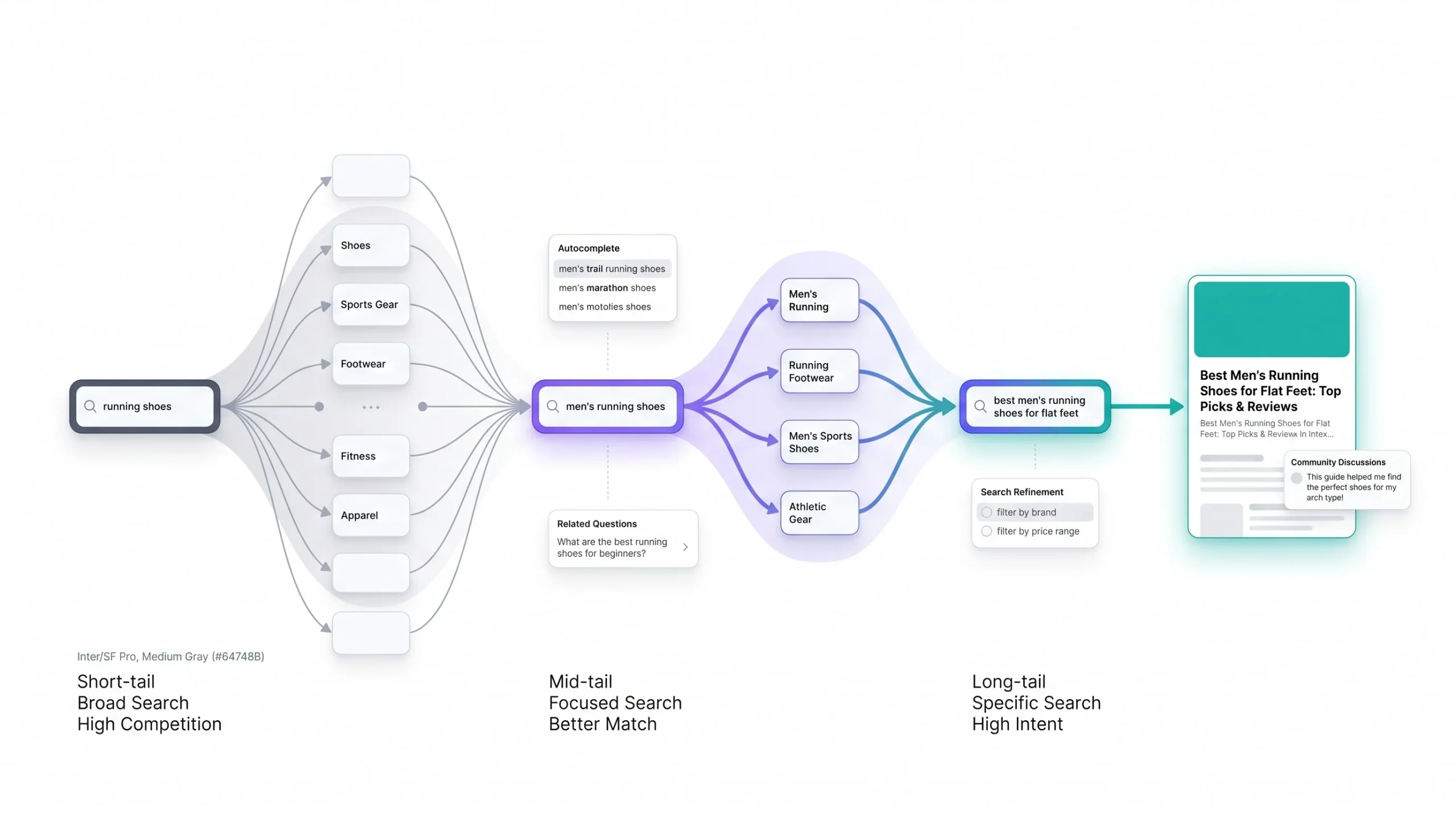
Intent tells you the “why” behind a search. Length tells you something different, how specific and how competitive that search is likely to be. This matters a lot for beginners because most people starting out either go too broad and get buried under massive competition, or go so narrow they’re writing content nobody searches for at all.
Short-tail keywords, sometimes called head terms, are usually one to two words. “Shoes.” “Insurance.” “Digital marketing.” These get enormous search volume, which is exactly why beginners gravitate toward them, but they’re also brutally ambiguous. Someone searching “insurance” could want health insurance, car insurance, insurance as a career, insurance stock prices, no way to know. Google has to guess, and because it has to guess, it tends to serve a mix of broad, high-authority domains for these queries, government sites, Wikipedia, massive publishers. Ranking for a term this vague usually means competing against domains with decades of authority behind them. For a new site, this is close to a waste of time, and it’s also strategically pointless even in the rare case it works, because the traffic that lands is so mixed in intent that most of it won’t be useful anyway.
Mid-tail keywords sit in the middle, usually two to four words, and this is honestly the zone most beginners skip past without realizing how valuable it is. “Term insurance for freelancers,” “running shoes for flat feet.” Still decent search volume, but specific enough that intent is much clearer, and competition drops noticeably compared to the head term version. Mid-tail is often where a growing site should focus first, because it builds topical relevance around a subject without demanding the domain authority a head term fight requires.
Long-tail keywords are the phrases everyone tells beginners to target, and for good reason, but the advice usually stops at “target long-tail keywords” without explaining why or how to actually find them. A long-tail keyword is typically four or more words, highly specific, lower individual search volume, but there are so many long-tail variations that collectively they make up the majority of all searches done on Google, a pattern that’s held steady for years even as search behavior has shifted toward voice and conversational queries. “Best term insurance plan for freelancers earning under 10 lakhs” is a long-tail keyword. Nobody’s fighting hard for that phrase specifically, and whoever ranks for it is talking to someone who is extremely close to making a decision.
The actual way to find these isn’t guessing, it’s watching patterns. Autocomplete suggestions in Google’s search bar are basically a live feed of what real people are typing, generated from actual query volume, not from what a marketer thinks people should be typing. The “People also ask” boxes on a results page are another goldmine, each question is a real, actual query with real volume behind it, and clicking on one usually expands into two or three more related ones, which is why that box keeps growing the longer someone scrolls through it. Reddit and Quora threads, especially the comment sections, often reveal exactly how people phrase problems in their own words, which almost never matches how a marketer would phrase it. A marketer writes “affordable term insurance options.” A real person on Reddit writes “is 500 rupees a month too much for term insurance at 25.” That gap between marketing language and real language is usually where the best long-tail opportunities are hiding.
| Type | Search Volume | Competition Level | Typical Conversion Rate | Example Query |
|---|---|---|---|---|
| Short-tail | Very high | Very high | Low | “insurance” |
| Mid-tail | Moderate | Moderate | Moderate | “term insurance for freelancers” |
| Long-tail | Low individually | Low | High | “best term insurance plan for freelancers earning under 10 lakhs” |
Keyword Types by Search Intent, In Depth
The four-category framework from earlier is the skeleton. This section puts muscle on it, because each intent type actually breaks into sub-patterns, and knowing those sub-patterns is what separates someone who understands SEO from someone who memorized a definition.
Informational Keywords
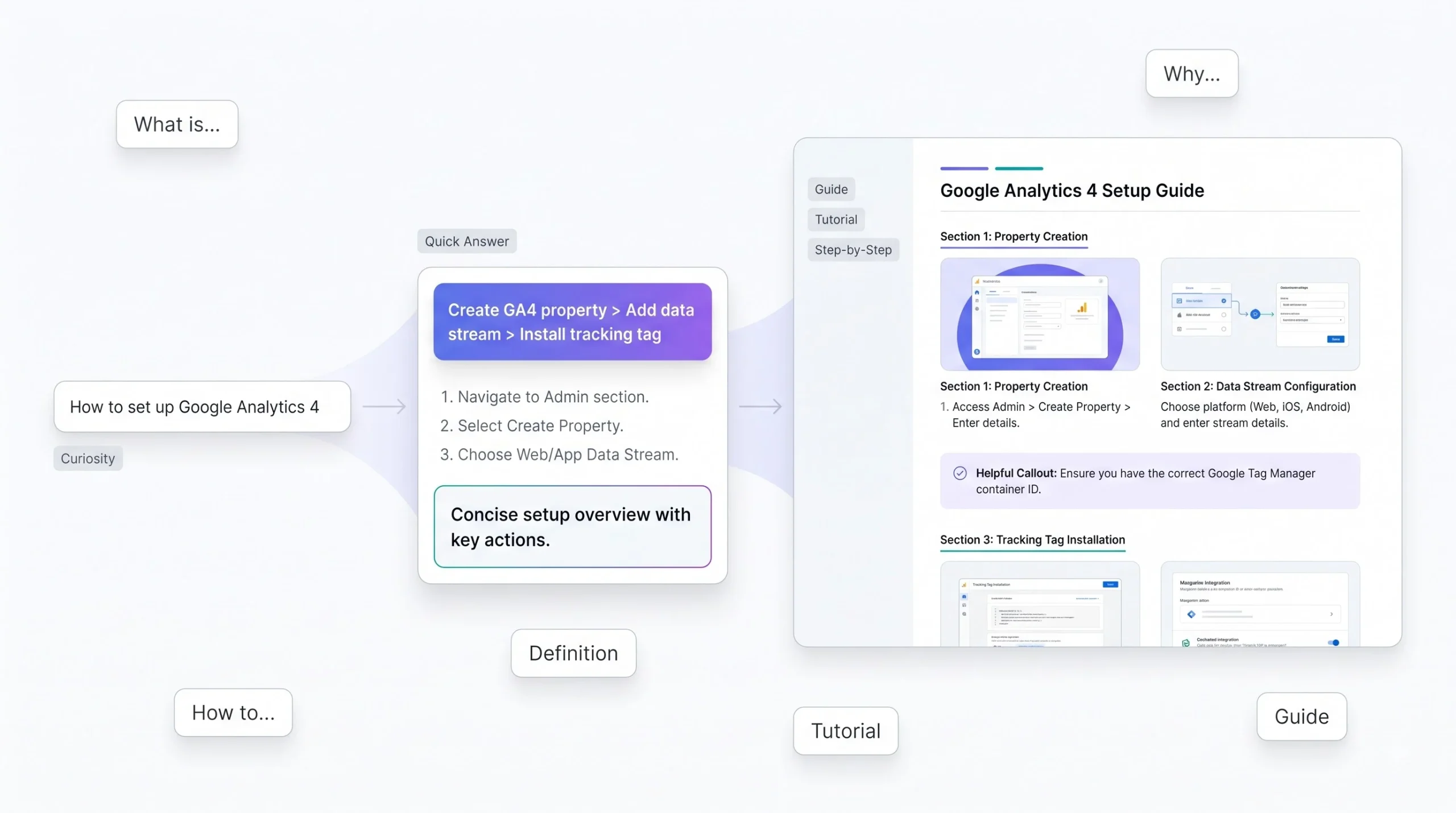
This is the biggest bucket by volume, and it splits into a few distinct flavors.
Question keywords start with what, why, how, when, who, “why does my WiFi keep disconnecting.” “How to” keywords are a subset worth calling out separately because they’re process-driven and usually want a step-by-step answer, not just an explanation, “how to set up Google Analytics 4.”
Definition keywords are short and blunt, “what is bounce rate,” someone wants a clear answer fast, not a 2,000-word essay wrapped around it.
Guide and tutorial keywords signal someone wants comprehensive, structured help, “complete guide to email marketing for beginners,” and these searchers are usually willing to spend real time on a page if the depth is genuinely there.
Featured snippets matter a lot in this category and beginners routinely ignore them. Google pulls a short answer, usually 40 to 60 words, directly into the search results above the normal listings, for a huge share of question-based queries. Structuring content with a clear, direct answer right after the heading, before diving into elaboration, dramatically increases the odds of winning that snippet spot, and that spot gets clicked even when a page isn’t the number one organic result, sometimes referred to as “position zero” because it sits above every other listing including paid ads in most cases. The pattern that tends to work is answer the question in one or two tight sentences immediately under the subheading, then use the rest of the section to go deeper for readers who want more than the quick answer.
Navigational Keywords
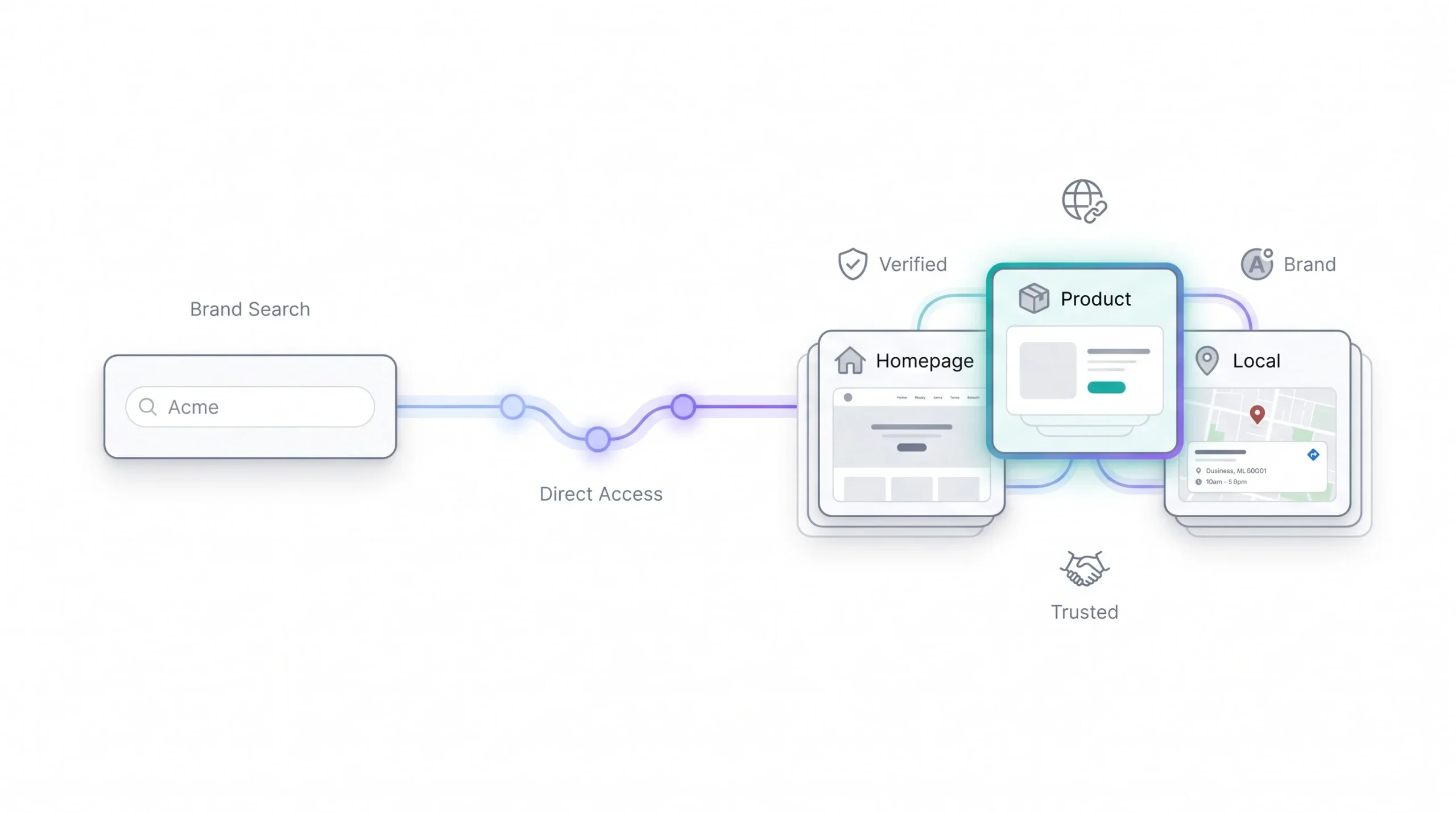
Beyond obvious brand searches like “Nike,” navigational intent includes product name searches, “iPhone 15 Pro Max specs” when someone already knows the exact product and just wants its page, and “near me” navigational queries, “Starbucks near me,” where the destination is known, just the location isn’t. Brand SERP protection matters here too. If a business doesn’t rank for searches on its own name, competitors sometimes buy ads on that exact query and intercept traffic that should have gone straight to the business, a tactic that’s technically allowed within most ad platform policies as long as trademark rules around ad copy are respected. Owning the first page results for a brand name search is one of the cheapest, most overlooked SEO wins available, and it usually just requires a well-optimized homepage, an active Google Business Profile where relevant, and consistent branded mentions across the web that Google can associate back to the business.
Commercial Investigation Keywords
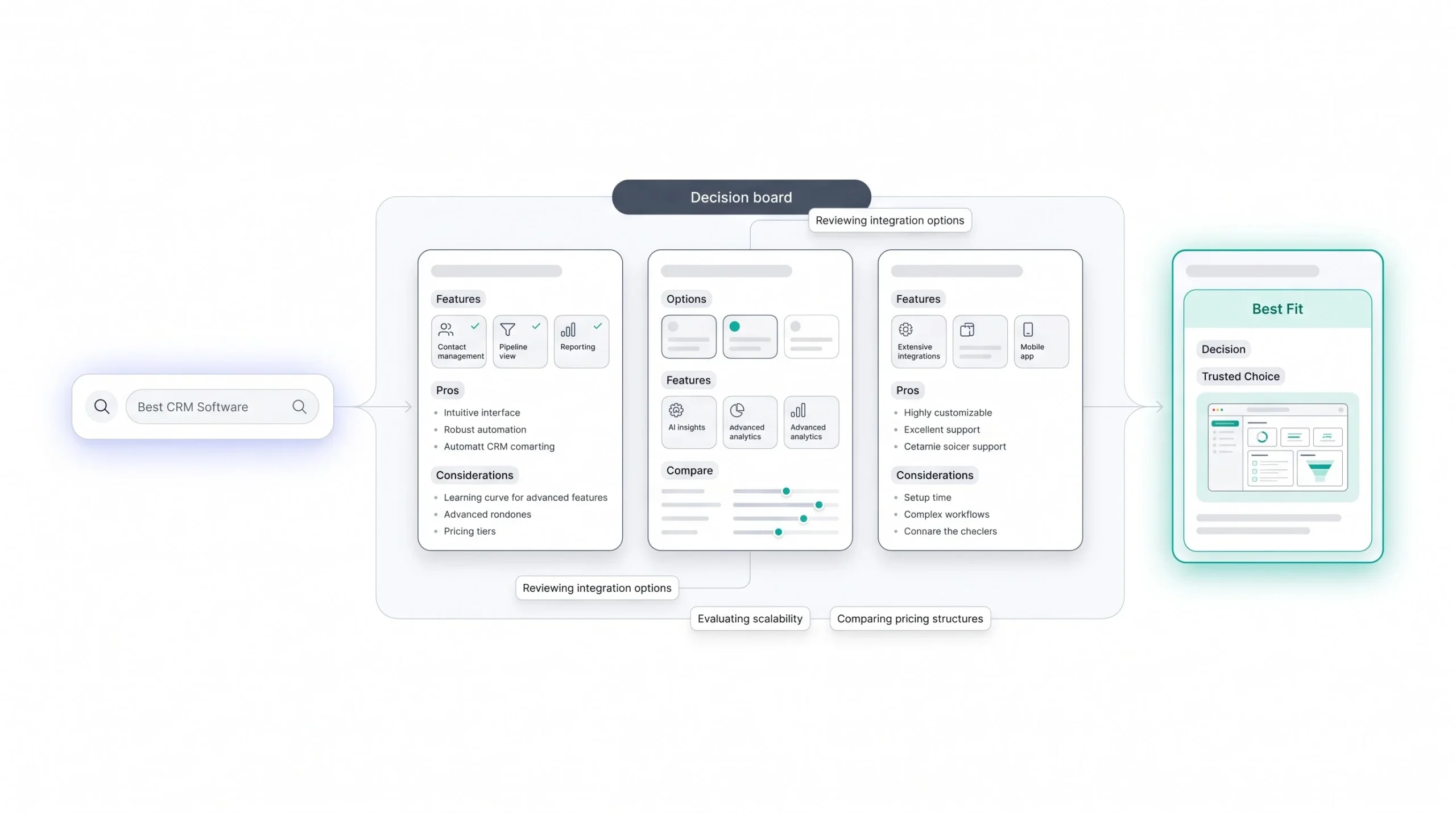
This is the comparison stage, and it’s consistently under-served with content because it takes more effort than a simple how-to post, real comparison content requires actually knowing the alternatives well enough to describe them fairly, not just praising your own option. “Best,” “top,” “vs,” and “review” queries live here. “Best project management software,” “Notion vs Asana,” “Grammarly review.” These searchers are past the informational stage and past the point of not caring, they’re actively deciding between real options, which makes this some of the highest-value organic traffic a business can capture, because the next logical step after reading a solid comparison is picking one and buying it. A comparison page that’s obviously biased toward one option loses credibility fast, readers can tell, and Google’s own quality signals increasingly reward content that shows genuine balance, listing real trade-offs instead of pretending one option has zero downsides.
Transactional Keywords
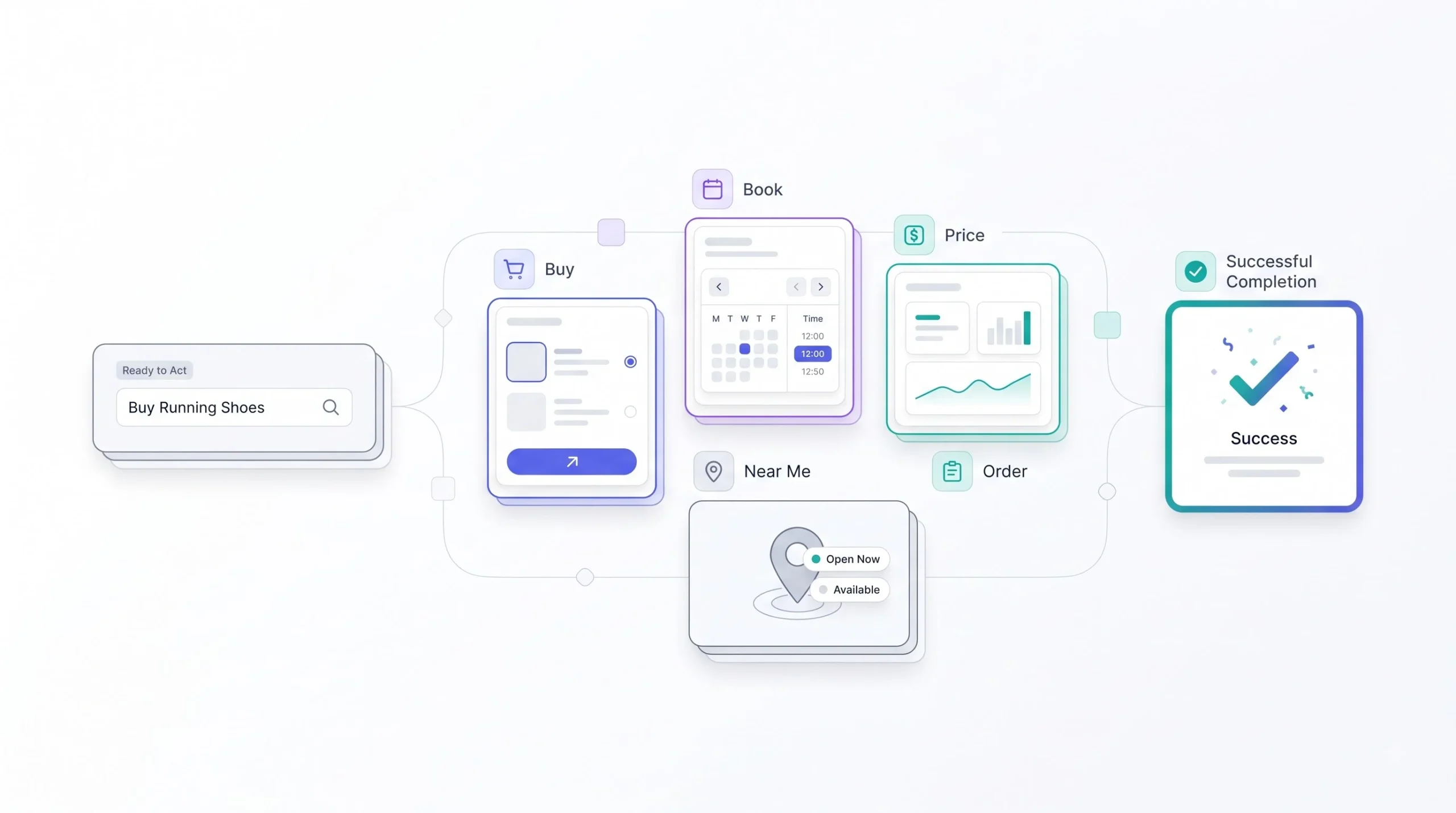
“Buy,” “price,” “discount,” “coupon,” and yes, “near me” again, but a different flavor of “near me” than the navigational one. This distinction trips up a lot of beginners. “Starbucks near me” is navigational, the person wants directions to a known place. “Coffee shop near me open now” is transactional, the person hasn’t picked a specific business yet, they want to make a decision right now based on proximity and availability. Same three words, “near me,” completely different intent underneath, and Google actually handles these differently in results, navigational near-me queries tend to surface the specific brand’s map listing directly, while transactional near-me queries surface a broader map pack of competing options. Treating both the same way in content strategy means missing half the opportunity, and it also means misreading Google’s own results as a signal for what content to build.
| Intent Subtype | Example Modifiers | Recommended Content Format |
|---|---|---|
| Question / How-to | how, why, what, steps, guide | Blog post with direct snippet-style answer |
| Definition | what is, meaning of | Short, focused explainer |
| Brand / Navigational | brand name, login, official site | Homepage, dedicated brand page |
| Commercial Investigation | best, top, vs, review, comparison | Comparison post, listicle, review article |
| Transactional | buy, price, discount, order, near me | Product page, landing page, pricing page |
Keyword Types by Funnel Stage
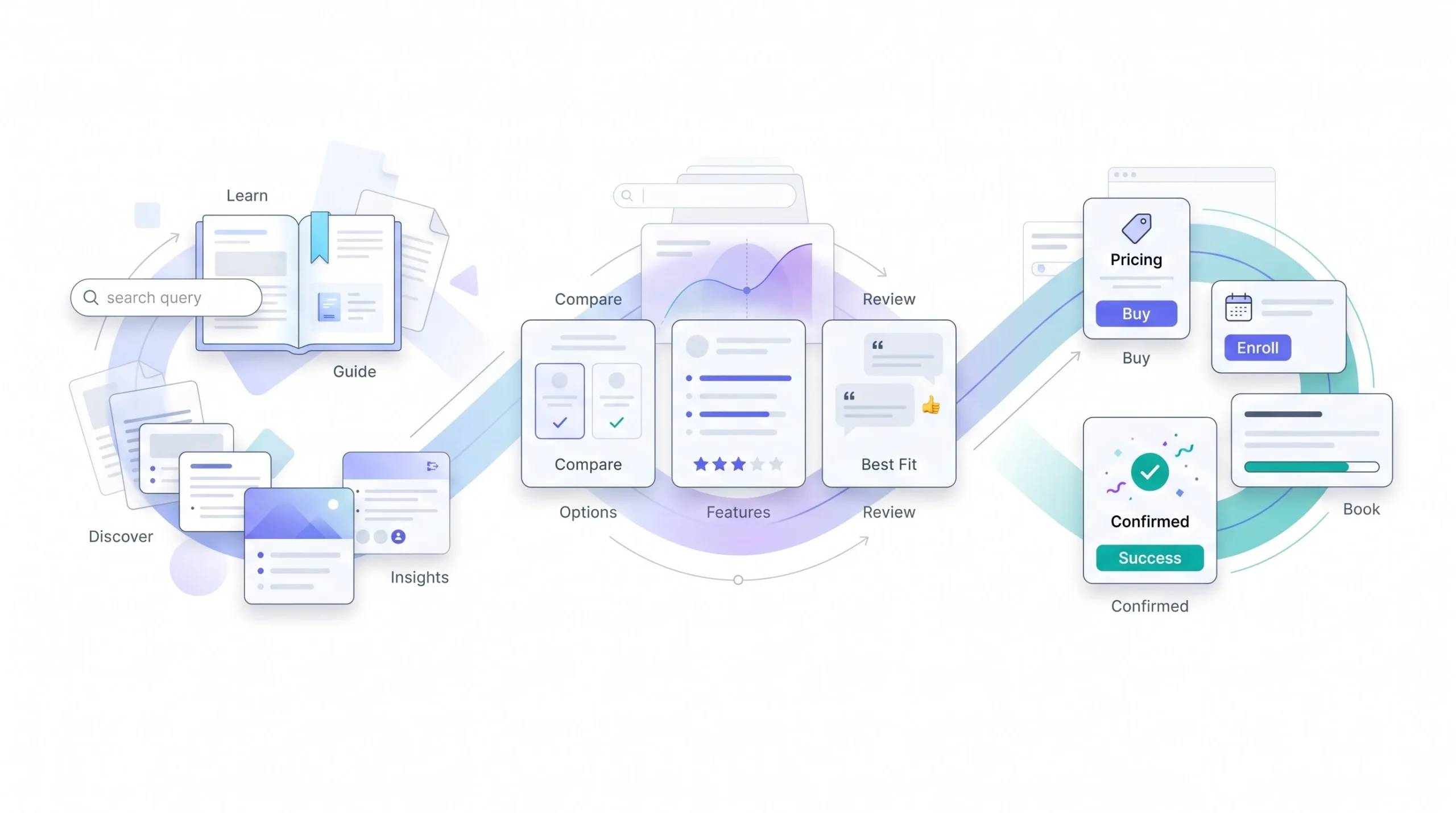
Line these intent types up against a sales funnel and the whole picture clicks into place. Informational keywords sit at the top, they’re for people who don’t know a business exists yet, they’re just trying to understand a problem. Commercial investigation sits in the middle, people who know they have a problem and are weighing solutions. Transactional sits at the bottom, people ready to act.
Take a digital marketing education business as an example. Someone searching “what is digital marketing” is top of funnel, they might not even know courses exist yet, the content here should be pure education, no pitch, because pitching too early actually damages trust with someone who’s still just trying to understand the basics. Someone searching “best digital marketing course with placement” is middle of funnel, they know courses exist, they’re comparing options, this is where a comparison post or a detailed program breakdown earns trust, and this is also the stage where testimonials, placement statistics, and faculty credentials start mattering because the reader is actively evaluating credibility. Someone searching “digital marketing course fees Jaipur” is bottom of funnel, they’ve basically decided to enroll somewhere, they just need the specifics to pull the trigger, and burying the price behind a “contact us for details” form at this stage usually costs more conversions than it protects.
Mapping keyword types onto funnel stages this way turns a random keyword list into an actual content calendar. Instead of publishing whatever keyword has the highest volume this week, content gets built to walk someone from curious to convinced to converted, which is a completely different strategy than just chasing traffic. The businesses that get this right usually have a visible content ratio too, more top of funnel pieces than bottom of funnel ones, because that mirrors how many people actually exist at each stage of the funnel in the real world. Nobody starts at “buy now,” most people start at “what even is this.”
Branded vs Non-Branded Keywords
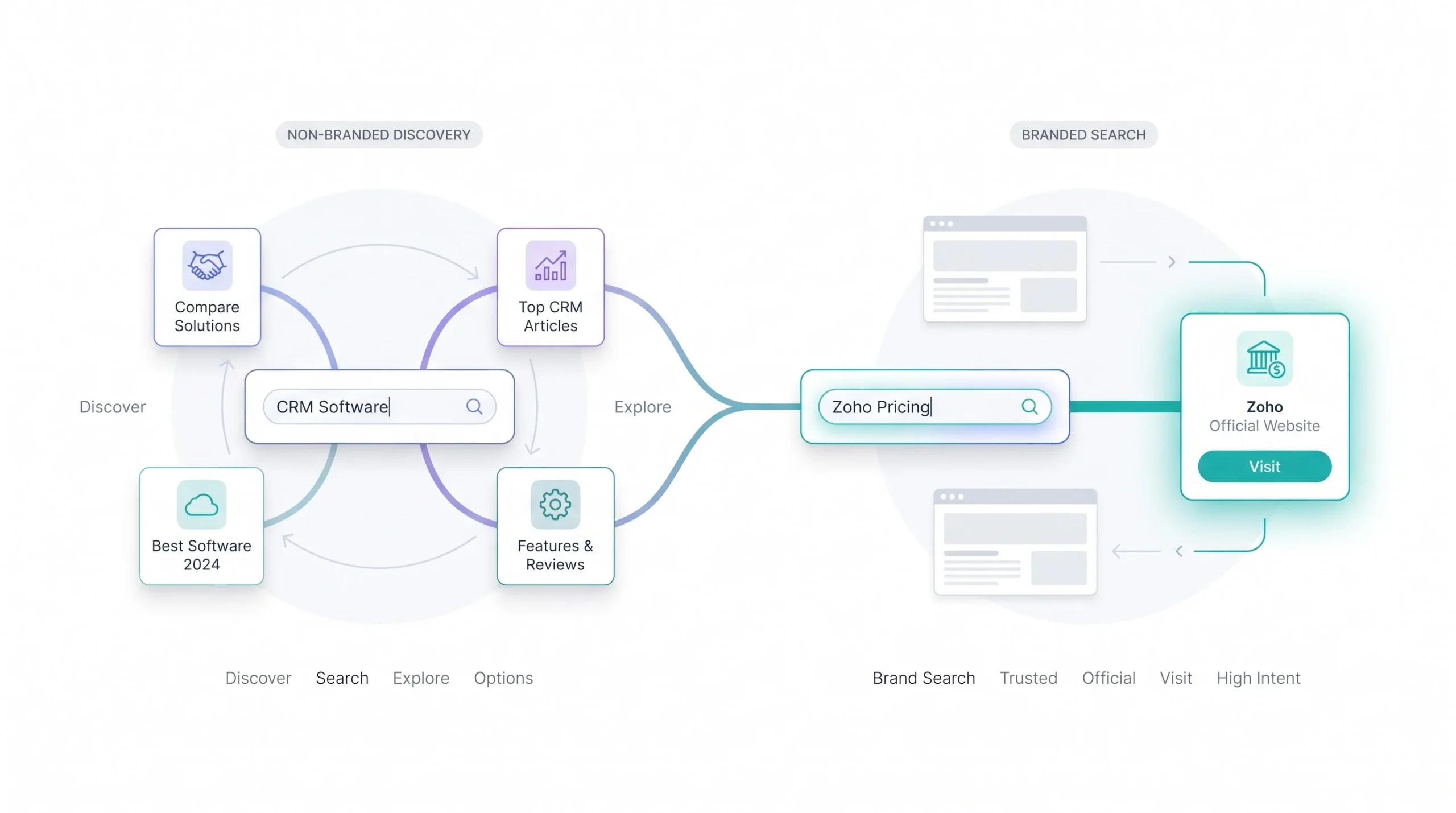
Branded keywords include the business’s name somewhere in the query, “Zoho pricing,” “Nike running shoes.” Non-branded keywords don’t, “CRM software pricing,” “running shoes for beginners.” Most SEO content focuses entirely on non-branded traffic because that’s where new customers are found, and that focus makes sense, but ignoring branded keyword tracking is a mistake beginners make constantly.
Branded search volume is one of the clearest signals of real brand demand that exists. If branded searches are climbing month over month, that’s people who heard about a business somewhere, maybe an ad, a referral, a social post, and are now actively looking it up. That’s a much stronger buying signal than someone stumbling onto a blog post from a generic search, because it means awareness already happened somewhere off Google and the search itself is just the follow-through. Branded keywords are also usually the easiest keywords to rank for, since nobody else has a legitimate reason to compete for a business’s own name, which makes losing that ranking to a competitor’s paid ad or an unrelated site especially frustrating and avoidable. It’s also worth tracking branded search volume alongside offline or off-platform marketing activity, a spike in branded searches right after a campaign, an event, or even a viral social post is a direct, measurable link between that activity and actual interest, something a lot of marketing efforts struggle to prove otherwise.
Semantic and Topical Keywords
Here’s where a lot of SEO content gets things wrong, and it’s worth clearing up properly. For years, SEO blogs have told people to sprinkle “LSI keywords” throughout their content, LSI standing for Latent Semantic Indexing. The problem is Google doesn’t actually use LSI. That’s a real technical concept from 1988, built for indexing documents based on statistical word relationships, and Google has never confirmed using it for search ranking, Google representatives have gone on record more than once specifically debunking the term as it’s used in SEO circles. The term got picked up by SEO tool marketers, repeated for over a decade, and now it’s treated as gospel even though it’s essentially a myth built on a misunderstanding of a completely different, much older technology.
Google isn’t matching a list of related synonyms. It’s building an understanding of what a page is actually about.
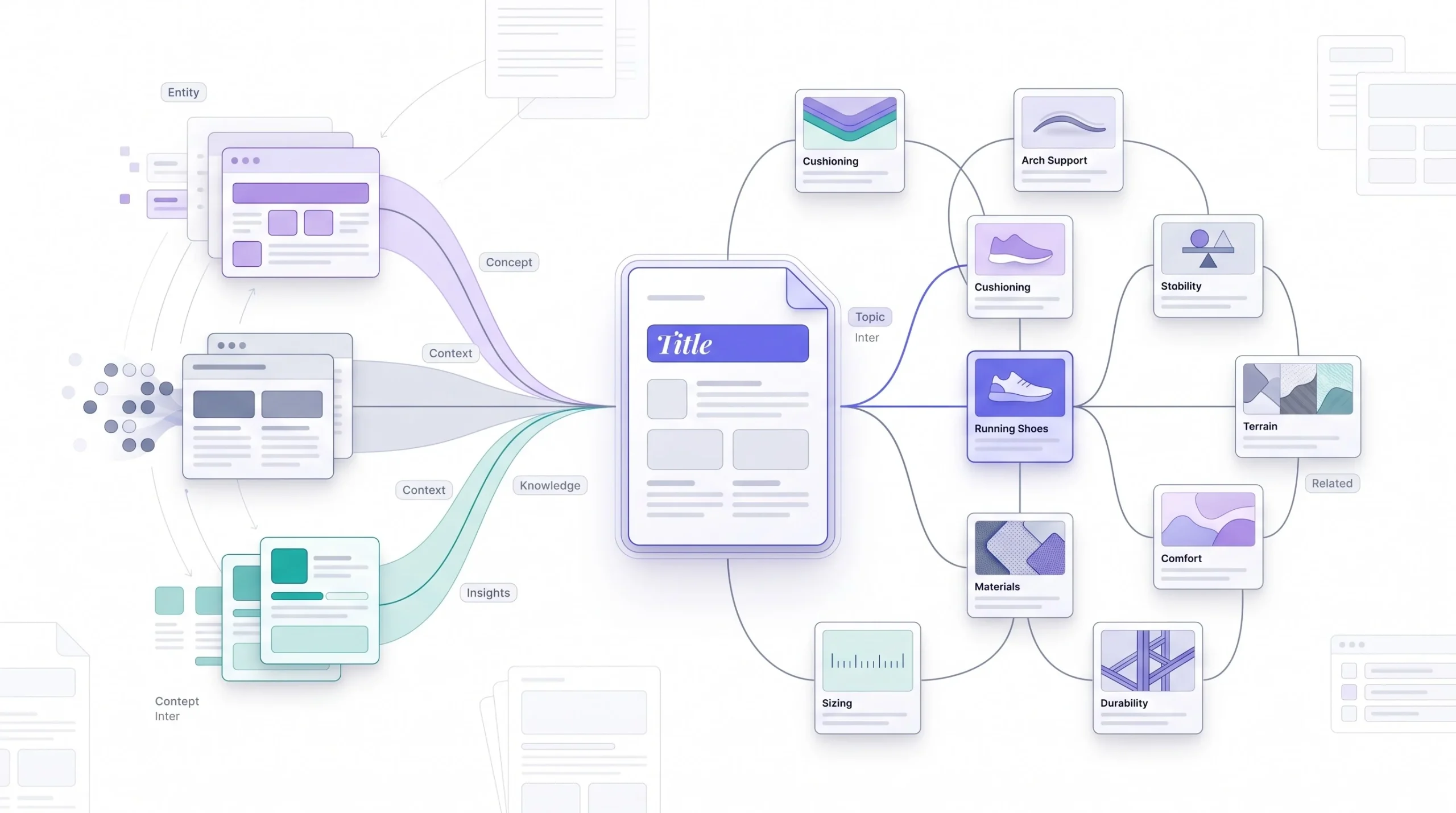
What Google actually does is closer to entity recognition and topic modeling. Their systems identify entities, real-world things, people, places, concepts, and understand how those entities relate to each other and to the query, this is part of what powers the Knowledge Graph, the system behind those info boxes that show up on the right side of search results for well-known topics. Topic modeling means the algorithm looks at the full range of subtopics a comprehensive piece on a subject would naturally cover, and checks whether a page demonstrates that breadth. A genuinely thorough article about running shoes would naturally mention cushioning, arch support, pronation, terrain type, breathability, without a writer consciously trying to hit a keyword list, because those are just the actual components of the topic. This is exactly why writing naturally about a topic, covering it the way someone who actually understands the subject would, tends to outperform keyword-stuffed content, even without deliberately trying to hit a checklist of related terms. Semantic depth isn’t about sprinkling synonyms. It’s about genuinely covering a topic the way an expert would explain it, which naturally pulls in the related terms, entities, and subtopics search engines are looking for anyway. The practical takeaway is almost the opposite of the old advice, stop trying to insert related keywords artificially, and instead just make sure the content actually is as complete and knowledgeable as it should be. Completeness produces semantic richness as a side effect, not the other way around.
Local SEO Keywords
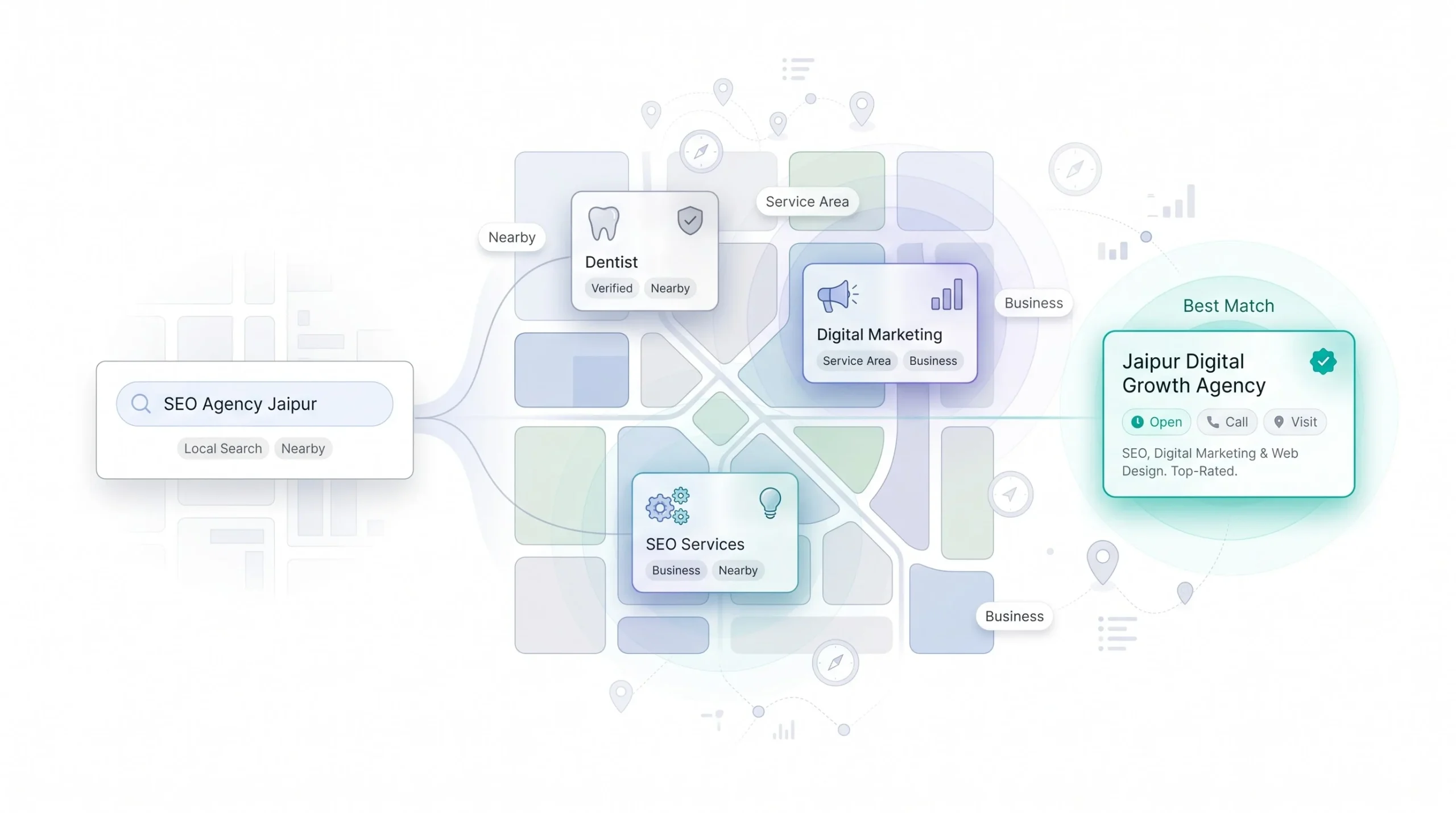
Local keywords combine a service or product with a geographic modifier, “plumber in Indore,” “digital marketing agency near Malviya Nagar,” “best dentist Pune.” These matter enormously for any business with a physical location or a defined service area, and they tie directly into Google Business Profile relevance, since Google leans heavily on matching local search queries against business profile categories, service areas, and even how often a profile posts fresh content, activity signals genuinely seem to influence how often a listing surfaces in the local map pack.
Beginners running local campaigns often stop at “city plus service” and miss the more specific patterns that actually convert better. “Digital marketing agency Jaipur” is broad. “Digital marketing agency for real estate in Jaipur” is narrower, lower volume, but targets exactly the kind of client that’s likely to convert, because it filters out everyone who isn’t in that niche before they even click. Local intent also interacts heavily with device type, a large share of “near me” and city-specific searches happen on mobile, often while someone is out and already close to making a decision, which is part of why local pages that load fast and show contact information prominently tend to outperform ones that bury it under a form.
| Local Keyword Pattern | Example | Best Use Case |
|---|---|---|
| Service + City | “SEO agency Jaipur” | Broad local visibility |
| Service + Neighborhood | “SEO agency Malviya Nagar” | Hyper-local targeting |
| Service + “near me” | “SEO agency near me” | Mobile, on-the-go searches |
| Niche Service + City | “SEO for real estate agents Jaipur” | High-intent, low-competition targeting |
Seasonal and Trending Keywords
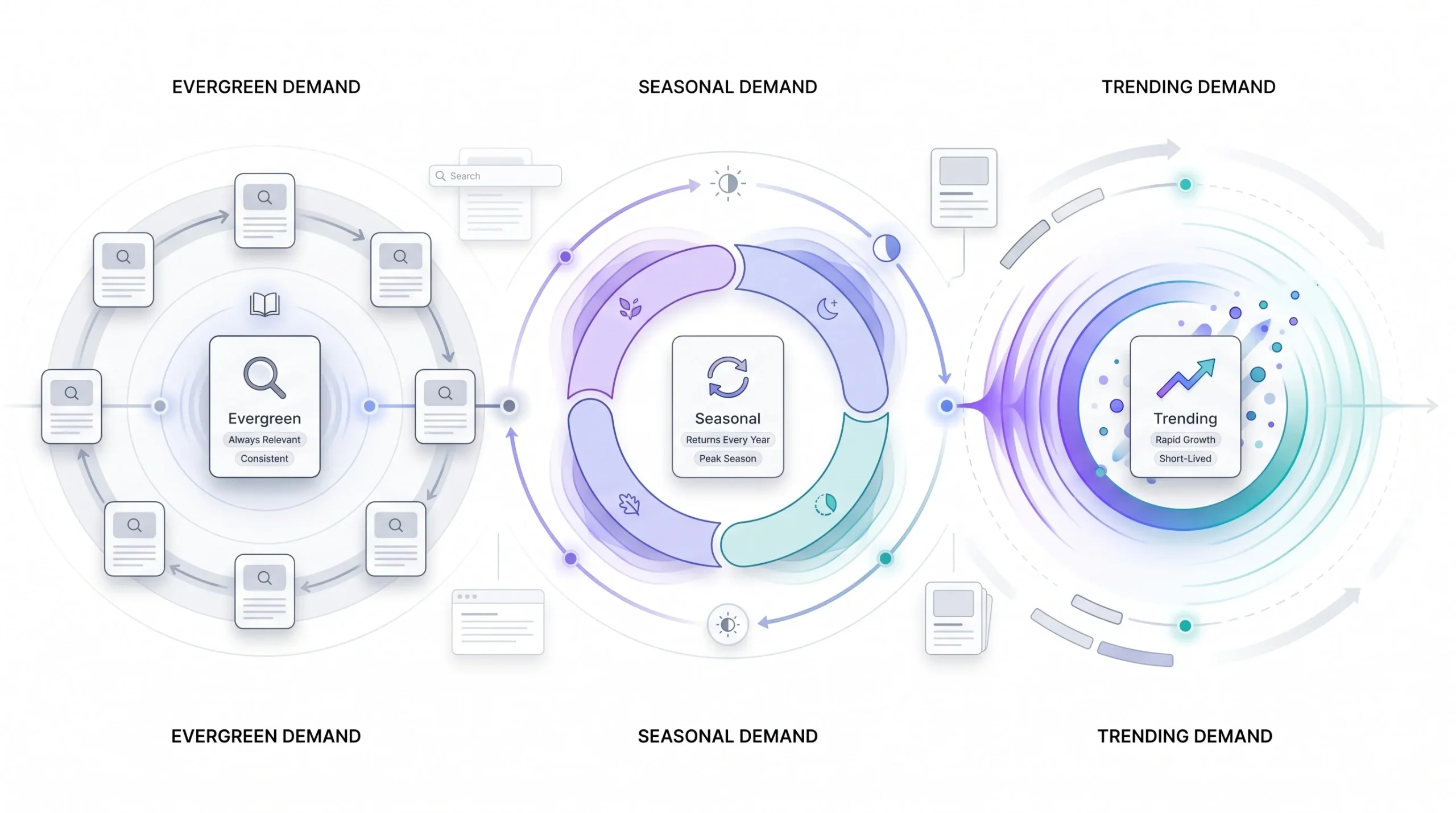
Not every keyword behaves the same way across the year. Evergreen keywords stay roughly consistent month to month, “how to write a resume.” Seasonal keywords spike predictably at certain times, “best Diwali gift ideas,” “tax saving investment options” right before the financial year ends in March. Trend-based keywords are less predictable, tied to a sudden event or cultural moment, and they can spike hard and fade fast, a new government policy announcement, a viral product, a sudden news story.
Tools like Google Trends make seasonality pretty easy to spot, the pattern usually repeats year after year in a clear wave, often visible going back five years or more on the same graph. The mistake beginners make isn’t failing to notice the seasonality, it’s underestimating the lead time content needs. Publishing a Diwali gifting post on the first of November does almost nothing, because Google needs time to crawl, index, and build enough trust signals around a page before it can rank competitively, and by the time that happens the season’s over. Seasonal content generally needs to go live six to eight weeks ahead of the actual spike to have a real shot at ranking when demand hits, and updating the same seasonal page year after year, rather than creating a fresh one annually, tends to work better because it lets the page accumulate authority over multiple seasonal cycles instead of starting from zero every year.
Product-Defining and Ecommerce Keywords
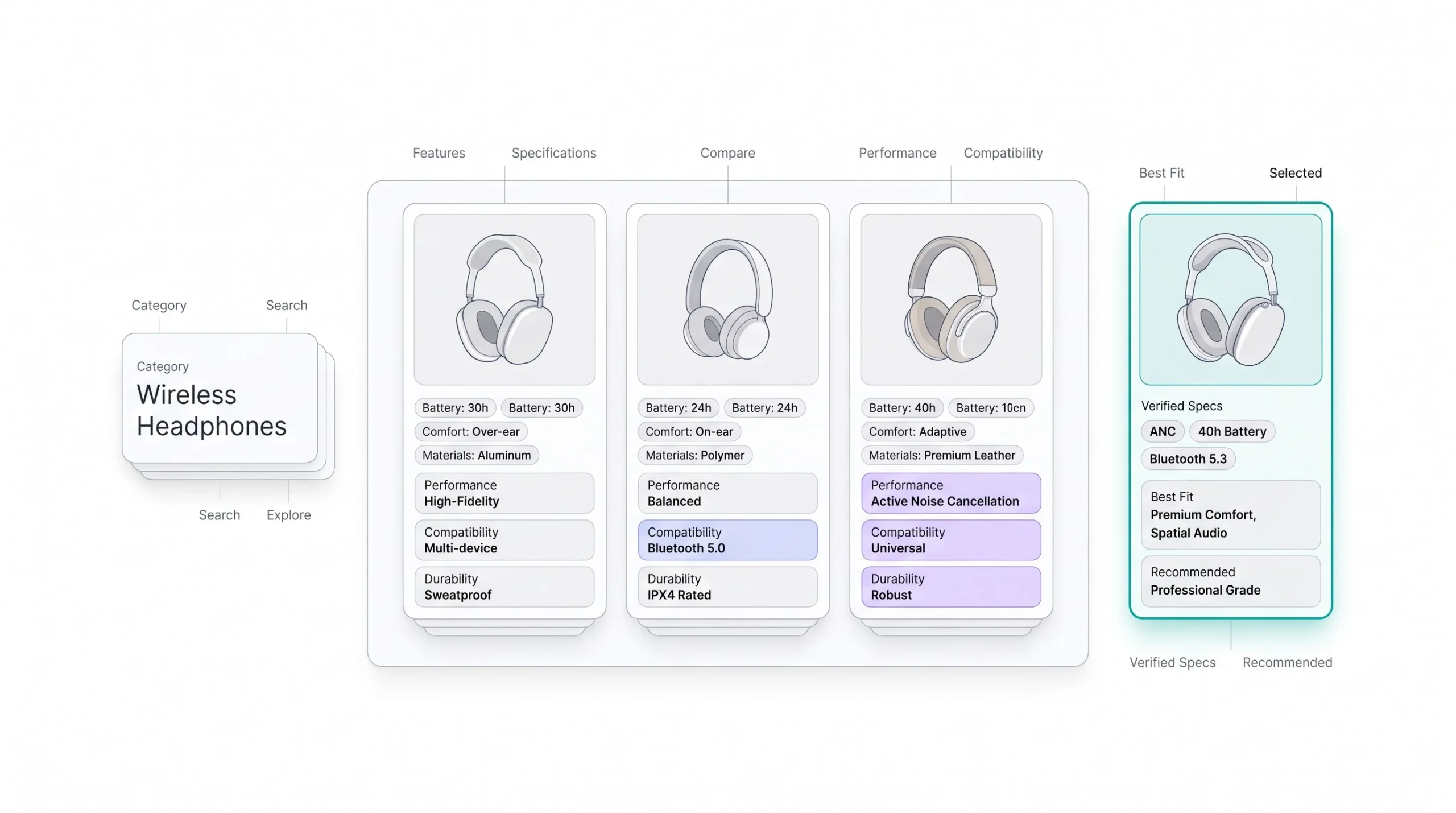
Ecommerce brings its own keyword patterns that general content strategy doesn’t cover well. Attribute keywords describe a specific feature or quality, “waterproof running shoes,” “wireless noise cancelling headphones.” Comparison keywords pit specific products against each other, “iPhone 15 vs Samsung S24.” Model or spec-based keywords are exact and technical, “Sony WH-1000XM5 review,” “RTX 4070 vs RTX 4060,” and these searchers usually already know quite a lot about the category, they’re deep in research mode and want precision, not a beginner-level overview.
These matter a lot for product page SEO specifically, because product pages that only target the generic product name, “wireless headphones,” compete against every major retailer on the internet, Amazon, Flipkart, and every brand’s own site all fighting for the same broad term. Product pages built around the attribute and comparison variations capture people who already know roughly what they want and are just deciding on the specific model or feature set, which is a much easier ranking fight and a much closer-to-purchase audience. This also plays into how product descriptions should actually be written, a description built around “wireless headphones with 30 hour battery life and active noise cancellation” naturally captures several attribute-based searches at once, without needing a separate page for each one.
Keyword Match Types in Paid Search
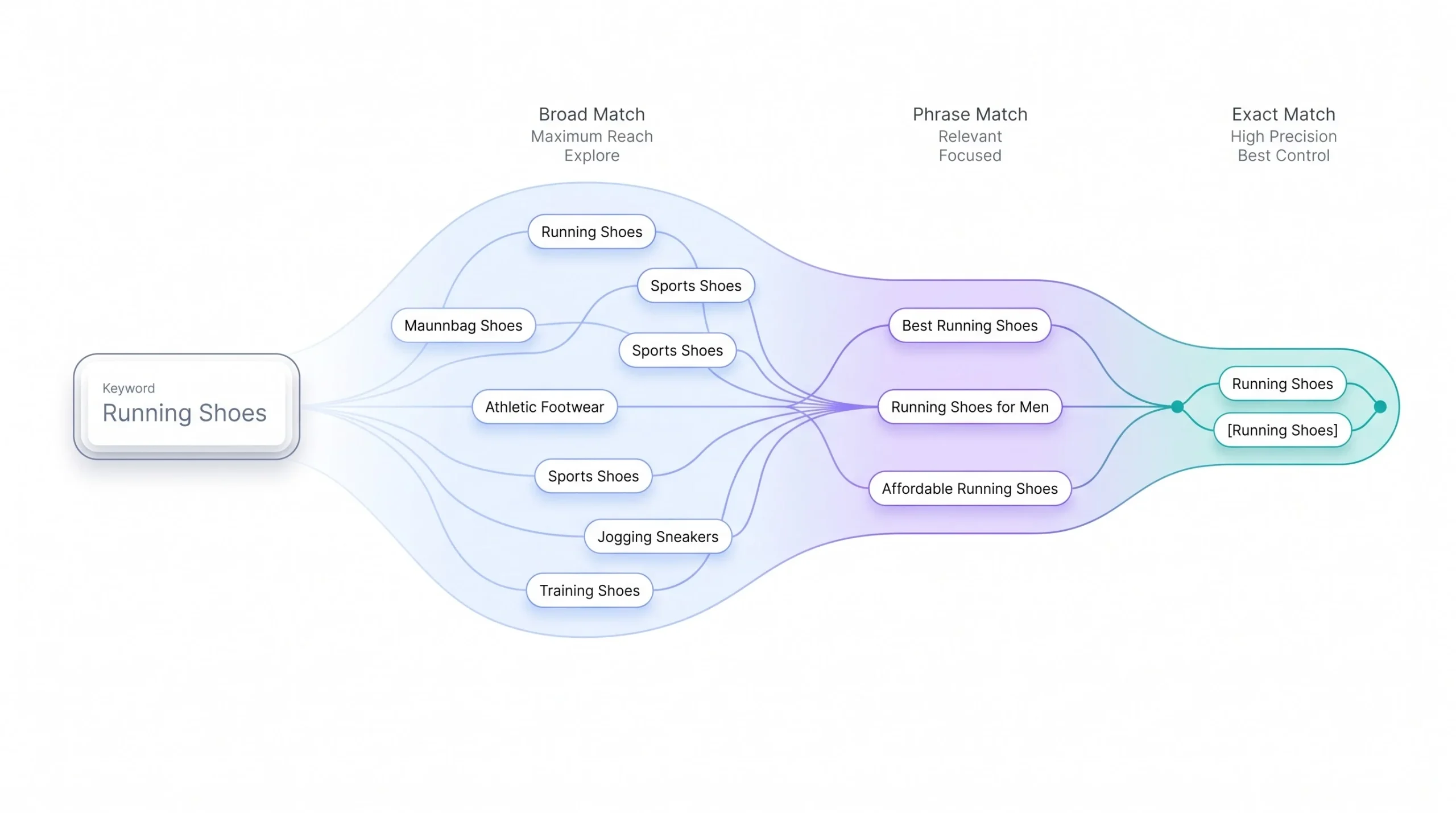
This one gets skipped in most organic-focused guides, but understanding paid match types actually sharpens keyword thinking across the board, and it matters directly for anyone running Google Ads alongside SEO work. Broad match targets a keyword and any search Google considers related, even loosely, which casts the widest net but often burns budget on irrelevant clicks, this is the default setting in most ad account interfaces, which is part of why it causes so much wasted spend among beginners who never change it. Phrase match requires the core meaning of the keyword to be present in the query, more control than broad, still some flexibility. Exact match targets only searches that closely match the specific keyword, the tightest control, the least reach, though even exact match has loosened over the years to include close variants like plurals and reordered words, not the rigid literal match it used to be.
Beginners running their first ad campaigns almost always default to broad match because it’s the default setting, and then wonder why the budget disappears fast with barely any conversions. Understanding match types isn’t just a paid search skill, it reinforces the whole point of this post: different keyword types serve different goals, and forcing every keyword into the same targeting approach wastes money in ads the same way it wastes content effort in SEO. A practical pattern that works well is starting new campaigns on phrase or exact match with a smaller, more predictable keyword list, then expanding into broad match later once negative keywords have been built up from actual search term data, rather than starting broad and hoping for the best.
| Match Type | How It Works | Example | Best Use Case |
|---|---|---|---|
| Broad Match | Matches related searches, even loosely connected ones | “shoes” may show for “footwear stores” | Maximum reach, needs tight budget monitoring |
| Phrase Match | Matches searches containing the core meaning | “running shoes” matches “best running shoes for men” | Balance of reach and relevance |
| Exact Match | Matches only close variants of the exact keyword | “running shoes” matches only that specific phrase | Maximum control, best for proven converters |
How to Actually Find and Categorize Keywords
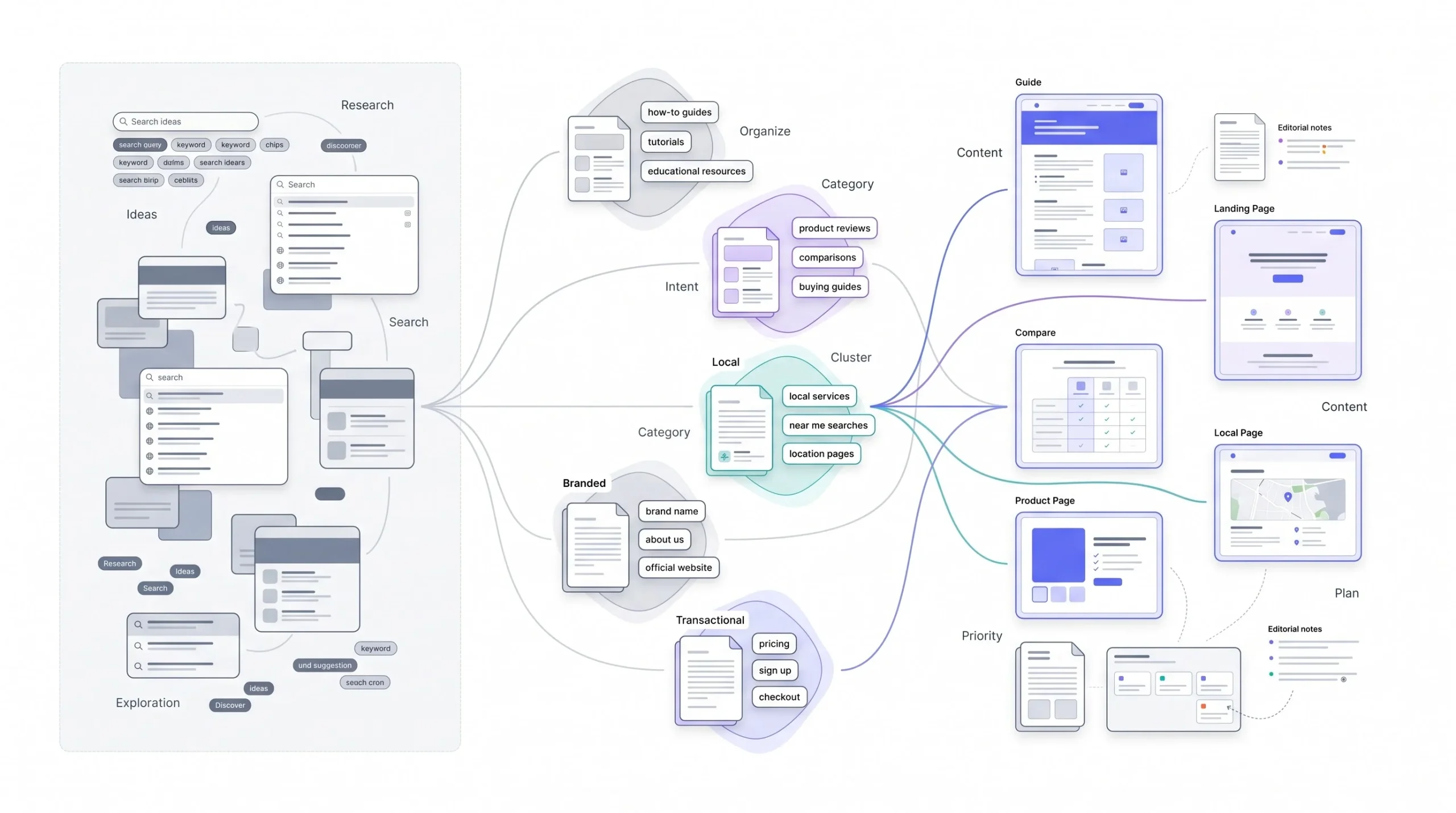
Finding keywords isn’t hard anymore, tools like Google Keyword Planner, Ubersuggest, Ahrefs, and even the free autocomplete and “People also ask” features on Google itself generate more raw keyword ideas than anyone could reasonably use. The actual skill is categorizing that raw list into something usable.
The process looks something like this. Start with a seed topic and pull every related keyword the tools return, don’t filter yet, just gather, the goal at this stage is volume of ideas, not precision. Then go through each keyword and tag it by type, length, intent, whether it’s branded or not, whether it’s got a local or seasonal angle, this step is tedious but it’s where the actual strategic thinking happens, not in the tool export. Once that’s done, map each keyword to a funnel stage based on its intent classification. The last step is assigning each keyword to a specific page, either an existing one that already targets that intent or a new piece that needs to be created, and if two keywords with the same intent are being split across two different pages unnecessarily, that’s usually a sign to consolidate rather than dilute authority across duplicate content.
This turns a messy keyword export into an actual content map, and it’s the difference between publishing content reactively, whatever keyword looked interesting that week, versus building a deliberate structure where every piece of content has a clear job to do.
| Keyword | Type | Intent | Funnel Stage | Target Page |
|---|---|---|---|---|
| what is digital marketing | Informational, short-tail | Informational | Top of funnel | Blog: Digital Marketing 101 |
| best digital marketing course with placement | Mid-tail, commercial | Commercial investigation | Middle of funnel | Comparison blog post |
| digital marketing course fees Jaipur | Long-tail, local, transactional | Transactional | Bottom of funnel | Course landing page |
| ADM Education reviews | Branded | Navigational / commercial | Middle to bottom | Testimonials or brand page |
Building a Content Strategy Around Keyword Types
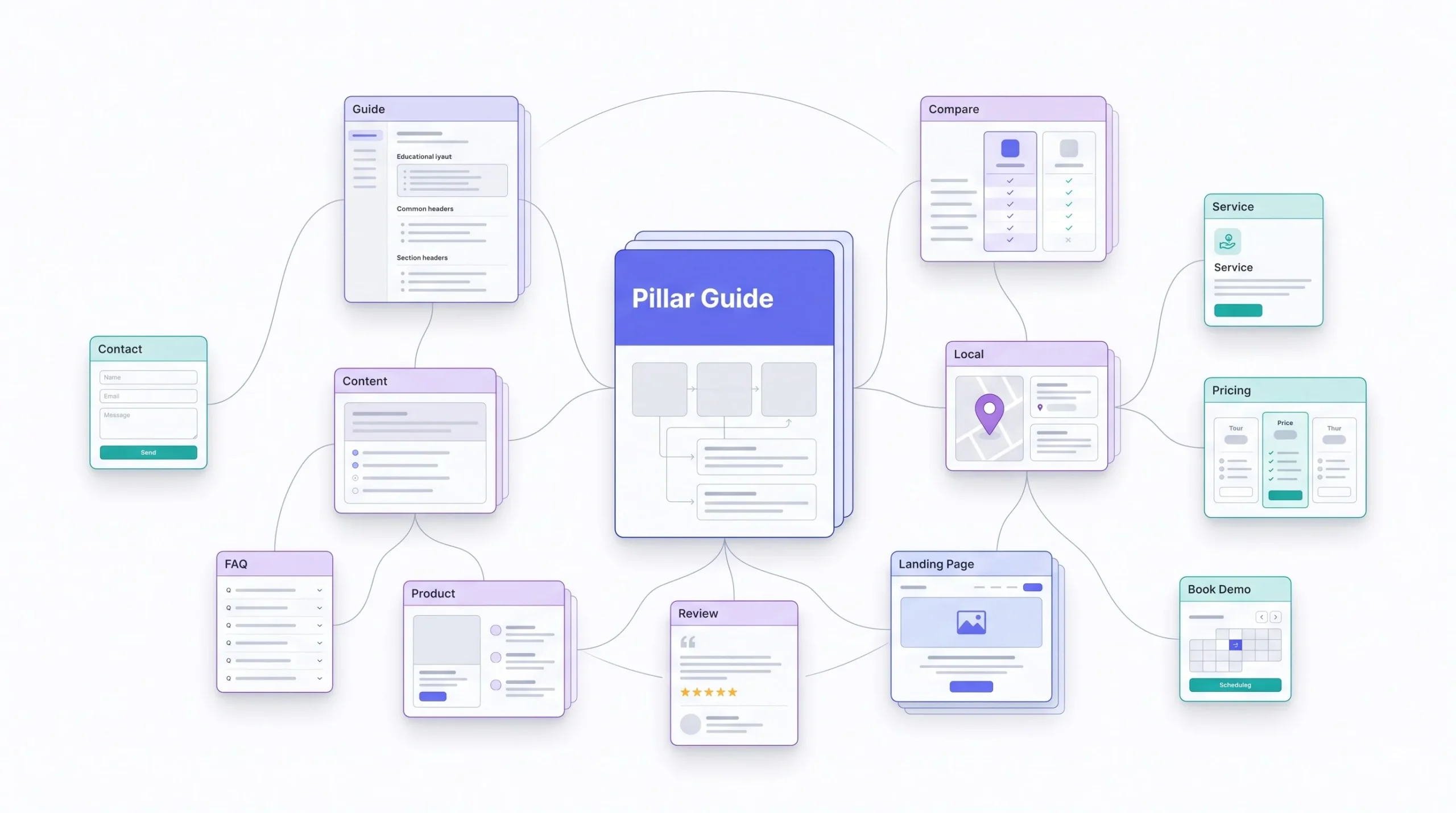
Everything in this post feeds into one model, the pillar-cluster approach. A pillar page covers a broad topic comprehensively, this post is one, and cluster content branches off it targeting more specific, usually longer-tail keywords, each linking back to the pillar. The keyword types covered here map naturally onto this structure. Informational, short and mid-tail keywords tend to become cluster posts that build topical authority. Commercial investigation keywords become comparison and review content that sits in the middle of the cluster. Transactional and local keywords become the landing pages the whole structure is ultimately built to support.
This is why understanding keyword types isn’t just a research exercise, it’s the actual blueprint for how a website’s content should be organized. Random blog posts targeting random keywords, even good keywords, don’t build the same kind of authority as a deliberately structured cluster where every piece knows its job and where it sits in someone’s decision process. Over time, this structure also compounds, internal links between cluster content and the pillar page pass relevance signals back and forth, and Google tends to reward sites that demonstrate depth across an entire topic rather than one isolated page that happens to rank well.
Conclusion
Keyword research stops being confusing the moment it stops being about volume and starts being about type. A search isn’t just a phrase, it’s a person standing somewhere specific in their own decision, and every type covered here, intent, length, semantic depth, branded status, local and seasonal patterns, is really just a different lens for understanding where that person is standing and what they need next. Chase the biggest number in a spreadsheet and traffic might grow while nothing else does. Understand the type behind every keyword and content starts doing actual work, moving people from curious to convinced to converted, one search at a time.
FAQs
1. What’s the difference between a keyword and search intent?
A keyword is the actual phrase someone types. Search intent is the reason behind that phrase, what the person actually wants to accomplish. Two completely different keywords can share the same intent, and the same keyword can sometimes carry mixed intent depending on context.
2. Which keyword type converts the best?
Transactional keywords generally convert the fastest since the person is ready to act. But commercial investigation keywords often convert best over time, because that’s the stage where a brand can actually influence which option someone picks, before the decision is already made.
3. How many keywords should a beginner target per blog post?
One primary keyword per page, ideally paired with several closely related long-tail variations that naturally fit the same intent. Targeting multiple unrelated keywords on one page usually dilutes relevance instead of expanding reach.
4. Are LSI keywords real?
Not in the way most SEO content describes them. Latent Semantic Indexing is a real, much older technology that Google has never confirmed using for ranking. What actually matters is genuine topical depth and entity coverage, not a checklist of synonyms.
5. Should beginners avoid short-tail keywords completely?
Not completely, but they shouldn’t be the first target for a new site. Short-tail terms usually require domain authority that takes time to build. Starting with mid-tail and long-tail keywords builds relevance and traffic faster in the early stages.
6. What’s the difference between branded and non-branded keywords?
Branded keywords include the business or product name directly. Non-branded keywords describe the need or category without naming a specific brand. Both matter, branded tracking shows real demand, non-branded targeting brings in new customers.
7. How is a “near me” transactional keyword different from a “near me” navigational one?
A navigational “near me” search already has a specific business in mind, like “Starbucks near me.” A transactional “near me” search is still comparing options, like “coffee shop near me open now.” Same phrase, different stage of decision.
8. Do seasonal keywords need special timing?
Yes. Content targeting seasonal keywords usually needs to go live six to eight weeks before the actual seasonal spike, since search engines need time to index and build trust around a page before it can rank competitively.
9. What’s the easiest keyword type for a new website to rank for?
Long-tail, informational keywords with local or niche specificity tend to be the easiest starting point. Lower competition, clearer intent, and they’re a natural entry into building topical authority around a broader subject.
10. How does understanding paid match types help with organic SEO?
It reinforces the core idea behind keyword types generally, that different searches need different levels of precision. Seeing how broad, phrase, and exact match behave in paid campaigns makes it easier to judge how tightly or loosely an organic keyword should be interpreted too.
11. Can one page target more than one keyword type?
It’s possible when intents overlap naturally, but usually not a good idea across very different intent categories. A page trying to be both a beginner’s guide and a hard sales page tends to satisfy neither audience well.
12. What’s the biggest mistake beginners make with keyword types?
Chasing volume without checking intent. A high-volume keyword with the wrong intent for a business’s goals will bring traffic that never converts, while a lower-volume keyword matched correctly to intent often performs far better in real business terms.