

It happens fast. One customer posts a screenshot at 11pm. By the time your social media manager wakes up and checks their phone over coffee, it’s got four thousand shares, four hundred comments, and a local news account has already picked it up. Nobody on your team said anything wrong on purpose. Nobody meant for this to happen. But now your brand name is trending for reasons that have nothing to do with the campaign you spent three months planning.
This is what a social media crisis looks like in 2026. It’s not slow anymore. It’s not something you catch on Monday morning and handle by Wednesday. Screenshots don’t disappear even if the original post gets deleted. Short-form video clips get remixed and reposted in formats you can’t control. And AI tools mean anyone can generate a fake quote, a fake screenshot, or a misleading clip that looks completely real within minutes. The old playbook where a brand had 48 hours to “craft the right response” is basically dead. You’ve got maybe an hour, sometimes less, before public opinion starts hardening into something that’s very hard to walk back.
Here’s the thing nobody tells small business owners and even a lot of marketing teams at bigger companies: it’s not really about avoiding a crisis. You can’t avoid every crisis. Employees make mistakes. Products fail. Customers get angry and post before they call your support line. Competitors dig up old tweets. Hackers try to get into your accounts. None of that is fully preventable. What actually separates brands that survive a bad social media moment from ones that don’t is whether they had a plan before it happened, and whether they know how to respond in the first sixty minutes without making things worse.
That’s what this guide is about. Not theory. Not vague “stay calm and be authentic” advice you’ve read a hundred times. Real, specific, step-by-step guidance on what social media crisis management actually looks like when you’re the one holding the phone at 11pm wondering if you should post something or wait.
What You Will Learn in This Guide
You’re going to learn what actually counts as a crisis versus what’s just an angry customer having a bad day. You’ll get a full breakdown of why these things happen in the first place, the different types of crises brands run into, and what the first 60 minutes of a response should actually look like. There’s a section on building an actual crisis plan with severity levels, a response team, and templates you can adapt. You’ll also get platform-specific advice, because what works on LinkedIn is a disaster on TikTok. There’s a big chunk on mistakes that make things worse, real case studies of brands that handled it well (and some that really didn’t), and a full FAQ section at the end answering the questions people search for most when they’re mid-crisis and panicking. This is long. It’s meant to be a resource you come back to, not something you skim once and forget.
What Is Social Media Crisis Management
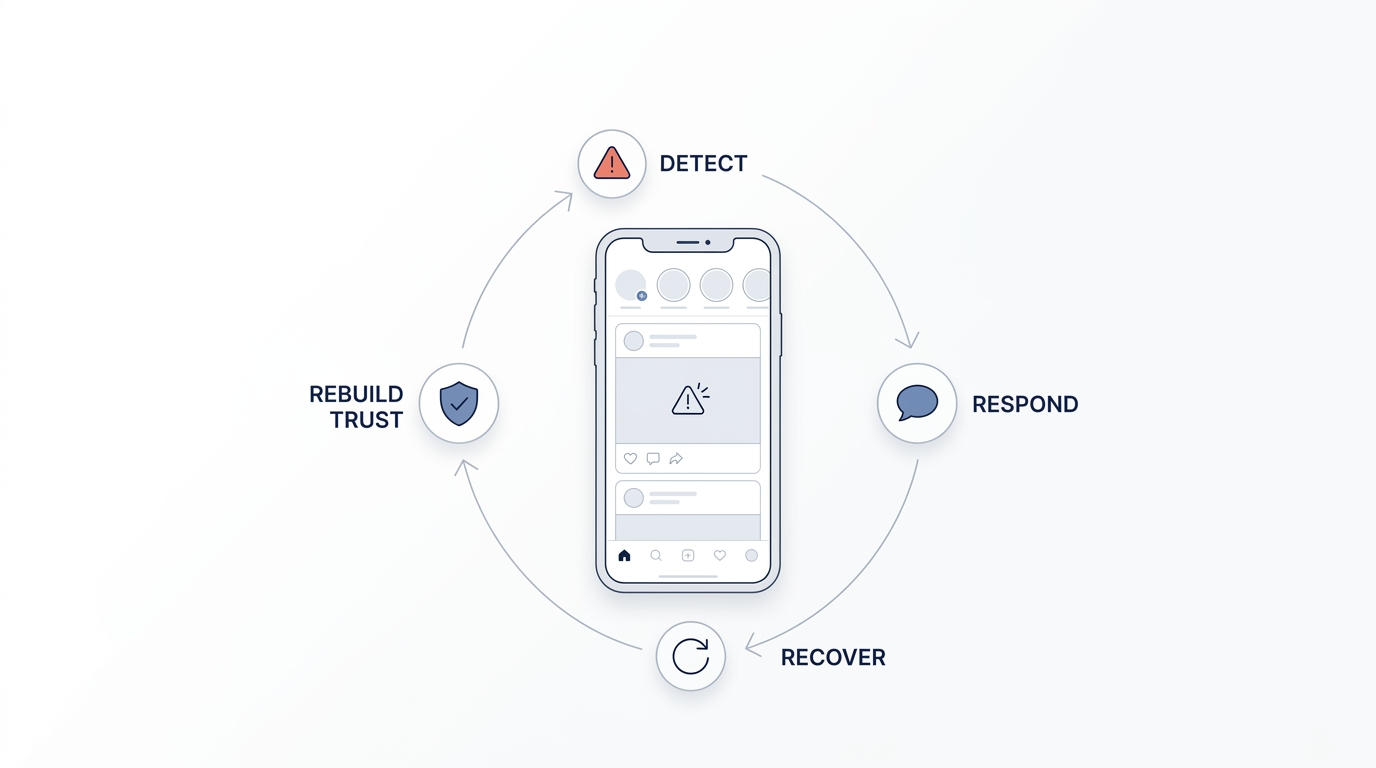
Social media crisis management is the process of detecting, responding to, and recovering from an event on social platforms that threatens a brand’s reputation, customer trust, or business operations. It covers everything from the moment something starts going wrong online to the weeks and months after, when a company is trying to rebuild whatever got damaged. It’s not just “writing a good apology tweet.” It’s a full discipline that touches PR, customer service, legal, leadership, and sometimes HR all at once.
What Qualifies as a Social Media Crisis
Not every angry comment is a crisis. A crisis is when a situation has the potential to spread beyond a single unhappy customer and start shaping how a wider audience feels about your brand. Usually that means it’s gaining traction fast, getting picked up by accounts with real reach, drawing media attention, or touching something sensitive like safety, discrimination, or money. If it’s contained to one thread with a handful of replies, it’s probably not there yet. If it’s showing up in your mentions from accounts you’ve never heard of, that’s a different story.
Difference Between a Complaint and a Crisis
A complaint is a customer telling you, publicly or privately, that something didn’t work the way they expected. It happens every day and it’s honestly a normal part of running a business with any kind of social presence. A crisis is when that complaint (or something else entirely, like a leaked internal email or an employee’s personal post) starts to represent a pattern in the public’s mind, something they generalize into “this company doesn’t care about X” or “this company is unsafe.” The line between the two isn’t always obvious in the moment, which is exactly why you need a framework to help you tell them apart quickly instead of guessing.
Why Every Brand Is Vulnerable
Doesn’t matter if you’re a two-person Etsy shop or a Fortune 500 company. If you have a social media presence, or even if you don’t, people can talk about you on platforms you don’t control. Reviews, forums, TikTok duets, screenshots forwarded in group chats. You don’t get to opt out of being talked about just because you’re small. Honestly, sometimes smaller brands get hit harder because they don’t have a team ready to respond, and silence in the first few hours reads as guilt even when it’s really just nobody being awake to answer.
Types of Businesses Most at Risk
Businesses that deal directly with the public every day carry more exposure than ones operating mostly B2B. Restaurants, airlines, healthcare providers, retail brands, and anything involving kids or safety tend to get hit hardest because the stakes feel personal to the audience. Financial services and anything touching data privacy are right up there too, since a breach or a bad policy decision affects people’s money or their sense of security. B2B companies aren’t immune either. Layoffs handled badly, executive scandals, or a bad product demo gone viral can absolutely blow up a company that thought it was too niche to ever trend.
The Cost of Ignoring a Crisis
Reputation damage. Once an audience decides a brand is careless or dishonest, that belief sticks around a lot longer than the news cycle that created it.
Customer loss. People don’t always complain before they leave. A lot of them just quietly stop buying and tell their friends why.
Revenue decline. Bad press plus lost customers plus paused ad campaigns adds up fast, and for smaller businesses it can hit within days, not quarters.
Legal consequences. If the crisis involves a product safety issue, discrimination, or a data breach, ignoring it publicly doesn’t make the legal exposure go away. It often makes it worse.
Employee morale. Staff see the same posts customers do. When leadership goes silent, employees start wondering if they should be updating their resumes.
Investor confidence. For public companies or startups raising money, a mishandled crisis raises questions about leadership judgment, not just the specific incident.
SEO and brand search impact. When people start Googling your brand name alongside words like “scandal” or “complaint,” those search results stick around and shape what new customers see before they ever visit your site.
Why Social Media Crises Happen
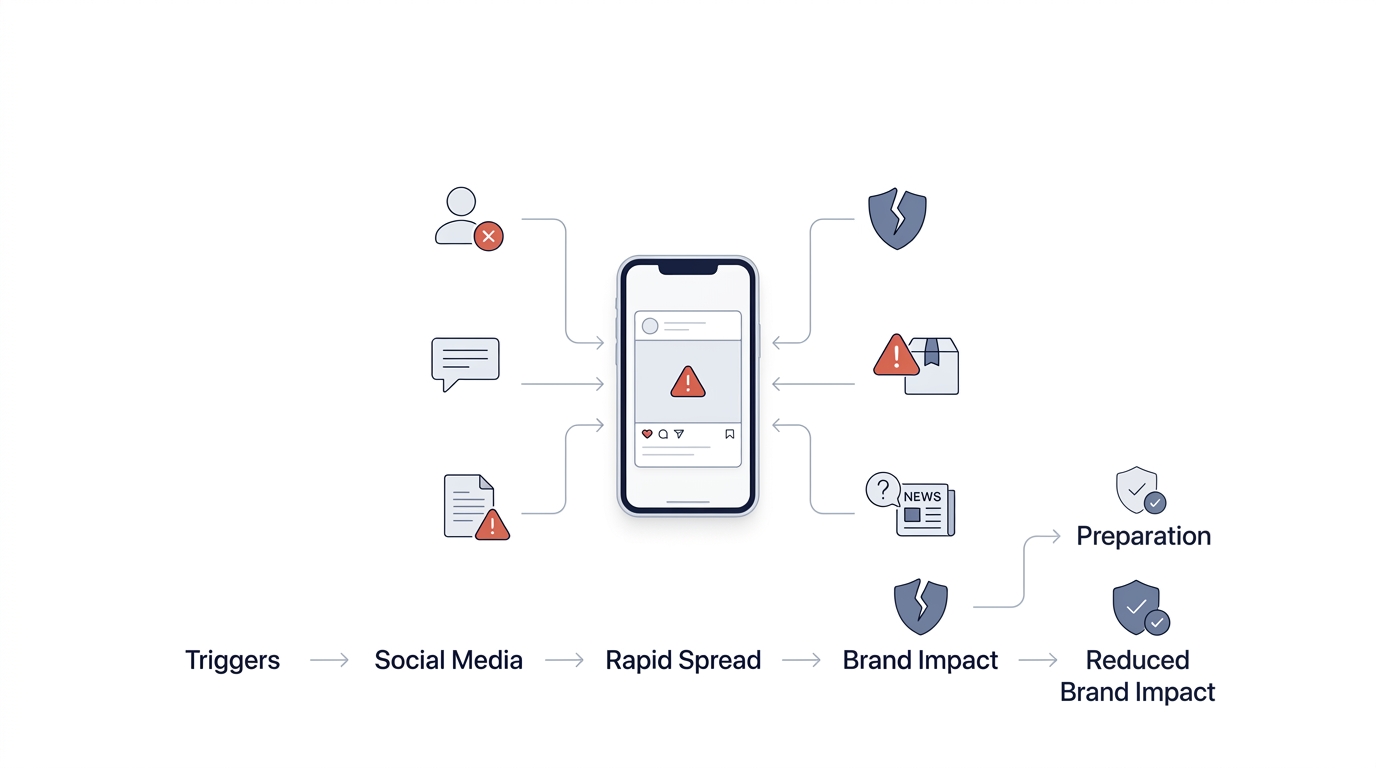
This section should explain that social media crises rarely happen without warning. Most crises result from a combination of poor communication, delayed responses, misunderstandings, operational failures, or rapidly spreading public sentiment. Explain how the speed and reach of social media allow small issues to escalate into major brand reputation problems within hours. Cover internal causes such as employee mistakes, publishing errors, customer service failures, inappropriate content, data breaches, misleading advertisements, and product issues, as well as external causes like misinformation, fake news, coordinated attacks, competitor actions, and unexpected global events. Help readers understand that while crises cannot always be prevented, strong preparation significantly reduces their impact.
Human Error
Most crises start with a mistake, not malice. Someone hits publish on the wrong account, a scheduled post goes out during an inappropriate moment, or a typo changes the meaning of an announcement entirely. Human error is honestly the most common cause and also the most forgivable one if handled with a quick, honest response instead of a defensive one.
Employee Mistakes
Beyond social media specifically, employees say things in customer service chats, in-store interactions, or even personal posts that get connected back to the brand. A single rude reply from a support account, screenshotted and shared, can spiral fast because it feels like proof of a bigger attitude problem, even if it’s one person having a bad shift.
Poor Customer Service
A lot of social crises are really customer service failures that escalated because nobody responded fast enough through the right channel. Someone tries calling, gets put on hold, tries the app, gets no response, then posts on Twitter and gets an answer in twenty minutes. That pattern teaches your entire customer base that yelling in public is the fastest way to get help, which is a terrible incentive loop to be stuck in.
Product or Service Failures
Defective products, service outages, shipping disasters during peak season. These generate crises because they affect a lot of people at once, and social media is where they all find each other and compare notes in real time.
Offensive or Insensitive Content
A tone-deaf joke, an ad that lands wrong, or content that ignores cultural or historical context can turn into a crisis within hours. This is one of the more preventable categories, usually solved by having more than one set of eyes review content before it goes out, especially eyes from different backgrounds than the team that made it.
Misleading Marketing Claims
When what’s advertised doesn’t match what’s delivered, customers notice, and they screenshot the ad next to their actual experience. This kind of crisis tends to have long legs because it involves receipts, literally.
Data Breaches and Security Incidents
These are some of the most serious crises a brand can face because they touch personal information and trust directly. Slow disclosure makes this category worse almost every single time; customers are more forgiving of the breach itself than they are of finding out about it from a journalist instead of the company.
Fake News and Misinformation
Sometimes the crisis isn’t your fault at all. A fabricated story or an AI-generated fake screenshot starts circulating and suddenly you’re fielding questions about something that never happened. These require a fast, clear correction because misinformation left unaddressed tends to calcify into “common knowledge.”
Influencer or Partner Controversies
You didn’t do anything wrong, but the influencer you paid to promote your product just got called out for something unrelated, and now your brand name is caught in the crossfire of their comment section.
Political or Social Issues
Brands get pulled into political and social conversations whether they want to be there or not, sometimes because of a decision they made, sometimes because customers project expectations onto them. Silence on a hot topic can be read as a statement just as much as speaking up can.
AI-Generated Content Mistakes
AI tools used for customer service, content generation, or chatbots have started causing their own category of crises: a chatbot promising something the company can’t deliver, an AI-generated image that looks careless or offensive, or an automated response that completely misreads the tone of an angry customer.
Hacked Social Media Accounts
Account takeovers are still happening constantly, and when they do, the hacked account often posts scams, offensive content, or spam to your entire follower base before anyone notices. Recovery involves both the platform’s security process and a public explanation once you’re back in control.
Platform Glitches
Sometimes it’s not even your fault at all: a platform bug shows old posts to new audiences, an algorithm change surfaces something out of context, or a feature malfunctions in a way that looks like brand behavior. These are rare but confusing, and they require quick communication so customers understand it’s not something you did.
Types of Social Media Crises
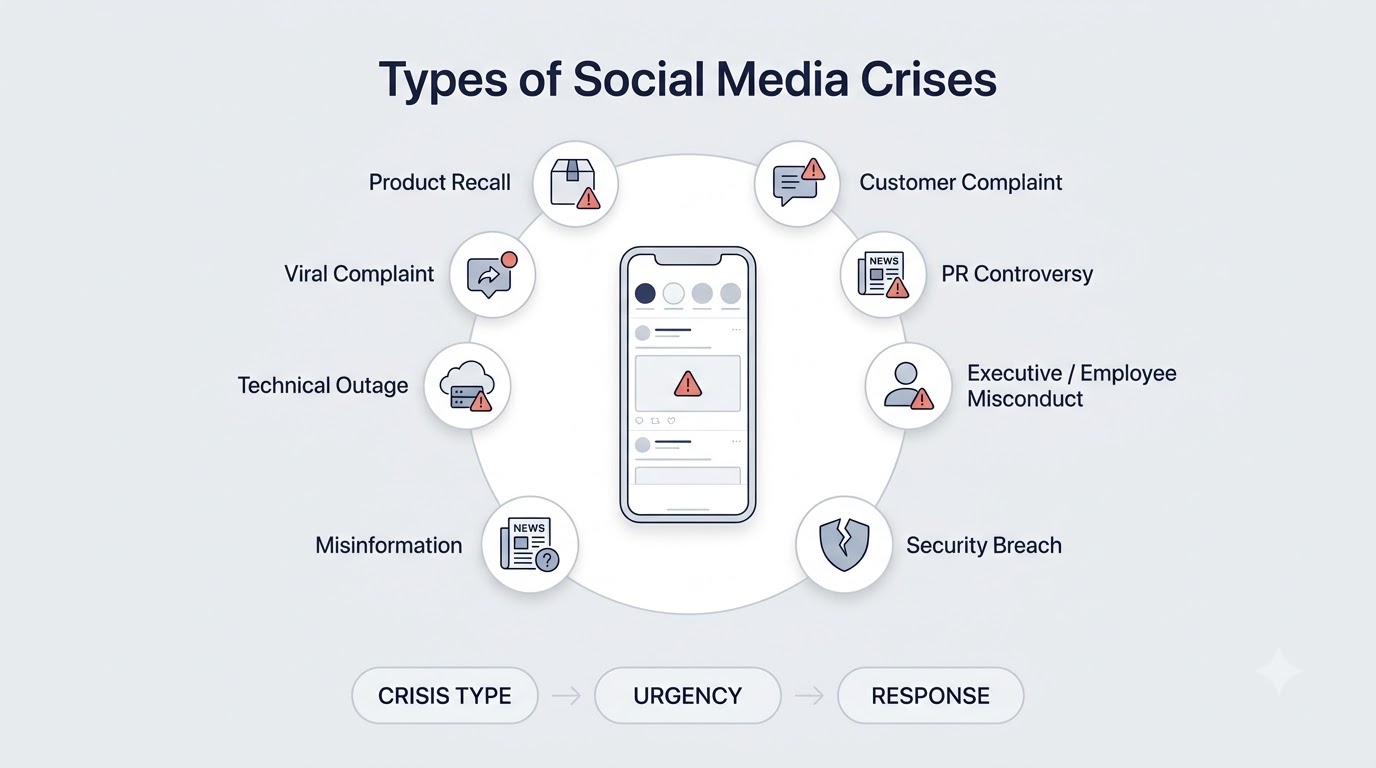
Introduce the major categories of social media crises that organizations commonly face. Explain product recalls, customer service failures, public relations controversies, executive misconduct, employee behavior, security breaches, misinformation campaigns, legal disputes, influencer controversies, social or political backlash, technical outages, and viral complaints. Describe how each crisis differs in severity, response urgency, stakeholder involvement, and communication strategy. Explain that identifying the crisis type quickly helps determine the most effective response and minimizes unnecessary damage.
Customer Complaint Going Viral
One person’s bad experience, amplified by shares, becomes a stand-in for how the whole brand supposedly treats customers, fair or not. It doesn’t matter that ninety-nine other customers had a completely normal experience that same week. The one loud screenshot becomes the story, and by the time it’s making rounds, nobody’s asking whether it’s representative. They’re just reacting to what’s in front of them.
PR Disaster
A statement, ad campaign, or executive comment that lands badly and gets picked up by press and influencers simultaneously, moving beyond just social media into full media coverage. These tend to snowball fast because once a journalist writes it up, the story gets a permanence that a tweet alone never had, and now you’re managing two audiences at once, not one.
Product Recall
When a product has to be pulled from shelves for safety reasons, the social media conversation moves fast and customers want clarity on refunds, replacements, and what actually went wrong. Vague safety language makes people more nervous, not less. They want specifics: what’s affected, what isn’t, and what they’re supposed to do with the thing sitting in their kitchen right now.
Employee Misconduct
Video or reports of an employee behaving badly toward a customer or coworker spread fast because footage feels undeniable in a way written complaints don’t. These crises hinge heavily on how quickly and seriously the company appears to take accountability. A slow or mealy-mouthed response makes it look like the company’s more worried about the employee’s job than the person who got treated badly.
Executive Controversies
Leadership comments, old social posts resurfacing, or personal scandals involving a CEO or founder can drag the entire brand into a crisis even when the company itself did nothing wrong. That’s the frustrating part. Customers don’t always separate the person from the brand, especially for founder-led companies, so the fallout lands on the business regardless of who actually caused it.
Data Privacy Incidents
Breaches, leaks, or discovering that user data was shared without proper consent hit differently than most other crisis types. Trust erodes fast here because it’s personal for every affected user, not just an abstract inconvenience. People start wondering what else the company hasn’t told them, and that suspicion tends to outlast the actual technical fix by a long shot.
Brand Boycotts
Organized campaigns asking customers to stop buying from a brand, usually tied to a specific decision or statement, can build slowly over weeks or explode overnight depending on who amplifies them. Sometimes a single creator with a big following turns a quiet grumbling into a full-blown movement within a single day, catching a brand completely off guard.
Fake Reviews
Coordinated fake positive or negative reviews distort a brand’s reputation, and once discovered, they raise questions about whether the company was involved in creating them. Even when a brand is the victim here, not the culprit, proving that gets complicated, and the accusation alone can do damage before anyone sorts out what actually happened.
Negative Media Coverage
An investigative piece or news segment that paints the brand unfavorably gets discussed and dissected across every social platform simultaneously, often faster than the brand can respond to any single one of them. What starts as one article turns into hundreds of separate conversations happening in parallel, each one needing its own kind of attention.
Social Activism Backlash
Brands that take a stance, or that customers feel should have taken a stance and didn’t, can face backlash from either direction depending on how the moment is read. There’s genuinely no safe middle ground sometimes. Staying quiet gets read as cowardice by one group and speaking up gets read as opportunism by another.
Legal Disputes
Lawsuits, especially ones involving customers or employees, often play out partly in public opinion on social media well before they’re resolved in court. Legal teams usually want silence, but total silence during an active public conversation lets other people control the narrative entirely while the company waits for a court date months away.
Account Suspension or Hacking
Losing access to your main account, whether through a hack or a platform error, creates a communication vacuum right when you need your channels the most. You can’t post the reassurance people are looking for because you literally don’t have access, which forces you to scramble for backup channels like email or a website banner instead.
Misinformation Campaigns
Deliberate or accidental spread of false claims about a brand’s products, safety, or practices can come from competitors, disgruntled ex-employees, or just confused customers repeating something they misread. Left unaddressed, false claims start feeling true simply through repetition, which is exactly why a fast, factual correction matters so much here.
Fake Accounts Impersonating Your Brand
Scammers create lookalike accounts to run phishing schemes or spread false information, and customers often can’t tell the difference between the fake and the real one. This isn’t just annoying, it’s genuinely dangerous when the fake account starts asking followers for money or personal information under your name.
The Social Media Crisis Lifecycle
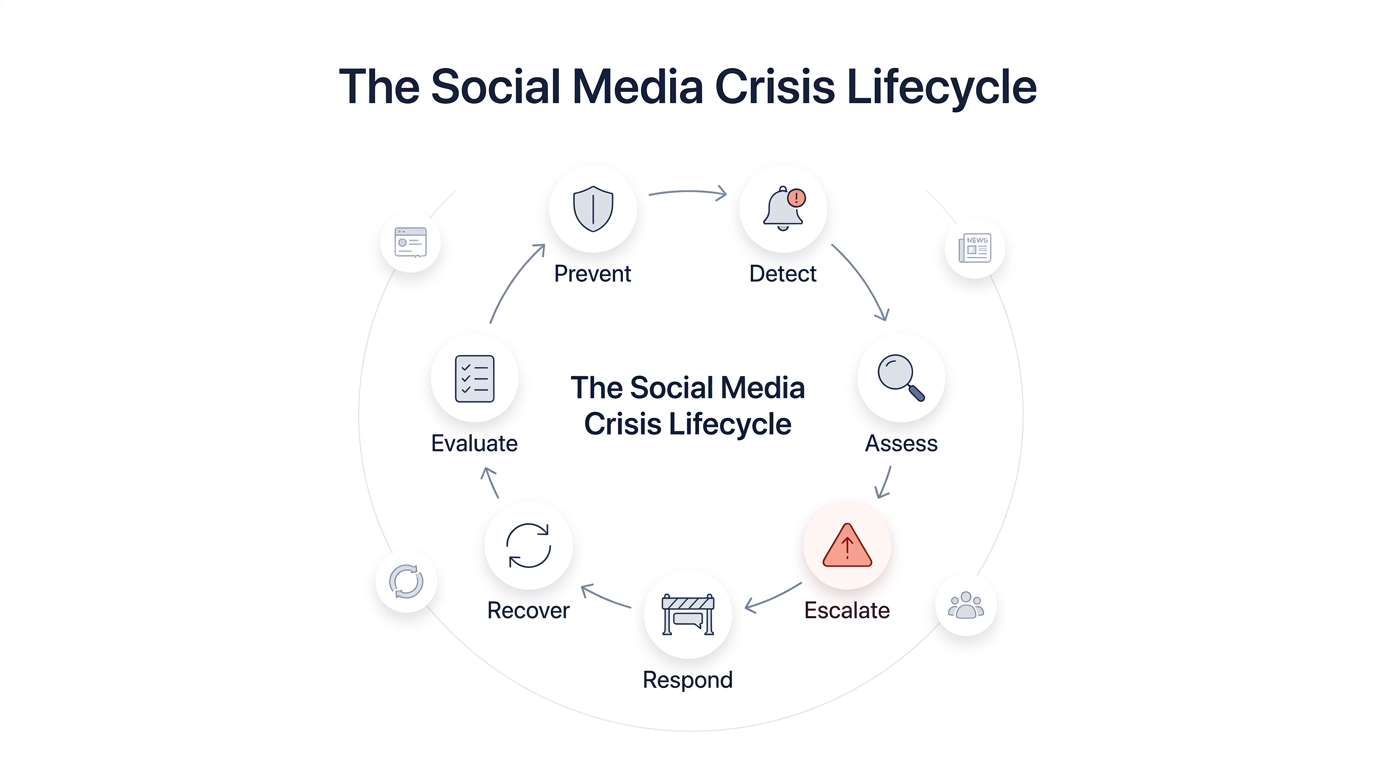
Explain the complete lifecycle of a social media crisis from the earliest warning signs to post-crisis recovery. Cover the stages of prevention, detection, assessment, escalation, response, containment, recovery, and long-term evaluation. Discuss how conversations evolve across different social platforms, news outlets, influencers, and online communities. Show how understanding each stage enables businesses to make better decisions, allocate resources effectively, and recover brand trust more quickly after the crisis ends.
Stage 1: Prevention
This is everything you do before anything goes wrong: training, approval processes, security setup, brand guidelines. Most of the work that actually prevents a crisis from becoming catastrophic happens here, long before anyone’s panicking. It’s unglamorous work, the kind nobody notices when it’s done right, which is exactly why it gets skipped so often.
Stage 2: Detection
The moment something starts happening, whether that’s a spike in mentions, a flood of comments, or an alert from a monitoring tool, is when the clock really starts ticking. Speed of detection often determines whether you’re dealing with a small fire or a full blaze by the time you actually notice it’s happening.
Stage 3: Assessment
Figuring out what’s actually going on, how serious it is, whether it’s accurate, and how fast it’s spreading takes a level head that’s hard to muster in the moment. This stage is where a lot of teams either move too slow, overthinking every angle, or too fast, reacting before they’ve confirmed a single fact.
Stage 4: Response
The actual public and private communication that addresses the situation is the part everyone thinks of as “crisis management.” But it only works well if the earlier stages, prevention, detection, and assessment, were handled properly first. A great response built on bad information still fails.
Stage 5: Recovery
The weeks after the initial response are focused on rebuilding trust, following through on any promises made, and returning to normal content without seeming tone-deaf about what just happened. This stage gets rushed constantly because everyone wants to move on, but customers usually need more time than the company does.
Stage 6: Learning and Improvement
Reviewing what happened, updating your plan, and fixing whatever gap allowed the crisis to happen or escalate in the first place is the stage most companies skip entirely. Without it, you’re basically guaranteeing the same mistake shows up again in six months wearing a slightly different costume.
How to Build a Social Media Crisis Management Plan
Explain the importance of creating a structured crisis management plan before problems occur. Cover defining crisis severity levels, assigning roles and responsibilities, building escalation procedures, creating approval workflows, preparing communication templates, identifying spokespersons, and documenting emergency contacts. Discuss cross-functional collaboration between marketing, customer support, legal, executive leadership, HR, and IT teams. Explain how regular crisis simulations and plan updates improve organizational readiness.
Why Preparation Matters More Than Reaction
Nobody thinks clearly at their best when they’re panicking and their phone won’t stop buzzing. That’s just how people work under pressure. A plan built in advance, when everyone’s calm and thinking straight, is always going to hold up better than decisions made in the middle of a storm. Brands that survive crises well almost always had something written down beforehand, even if it was just a simple one-pager taped inside a manager’s laptop.
Define Crisis Severity Levels
Level 1 (Routine Issues). A single unhappy customer, a minor complaint, something handled by frontline social or support staff without needing escalation. This is everyday noise, not a crisis, and treating it like one just wastes energy your team needs for the real thing.
Level 2 (Growing Concerns). Multiple complaints on a similar theme, a post gaining unusual traction, or a situation that could grow if not addressed within a day. This is your window to get ahead of something before it becomes unmanageable.
Level 3 (Major Brand Crisis). Widespread negative attention, media pickup, or a topic that’s clearly damaging trust across a large audience segment. At this point, silence is no longer an option and leadership needs to be involved directly.
Level 4 (Business-Critical Emergency). Safety issues, legal exposure, data breaches, or anything that threatens the core operation of the business, not just its image. This is the level where legal, leadership, and PR are all in the room together, immediately.
Create a Crisis Response Team
This should include someone from social media or marketing, someone from customer service, a legal contact, a PR or communications lead, and someone from leadership who can make fast calls without waiting on a committee. Small businesses might have one person wearing three of these hats at once, and that’s genuinely fine, but the roles still need to be clearly defined so nothing falls through the cracks.
Assign Roles and Responsibilities
Who drafts the statement. Who approves it. Who talks to press if it comes to that. Who monitors the ongoing conversation while everyone else is heads-down working the problem. Confusion about who’s supposed to do what wastes precious time during an actual crisis, time you genuinely don’t have to spare.
Build an Internal Escalation Process
A clear path for how something moves from “customer service noticed a spike in complaints” to “leadership is now aware and involved” needs to exist on paper, not just in someone’s head. Without this, information gets stuck at the bottom of the org chart and nobody senior finds out until it’s already a headline somewhere.
Define Approval Workflows
Decide in advance who needs to sign off on public statements, and how fast that approval can realistically happen. A workflow that takes six hours to get a single tweet approved is a workflow that guarantees you’ll look slow and out of touch by the time it finally goes out.
Create Crisis Communication Templates
Draft holding statements, apology frameworks, and FAQ responses ahead of time so your team isn’t starting from a completely blank page while also trying to manage a live, unfolding situation. Templates aren’t meant to be copy-pasted word for word, they’re meant to save you the mental load of figuring out structure while everything else is on fire.
Prepare Internal Communication Guidelines
Employees need to know what they can and can’t say publicly during a crisis, and where to direct questions from customers, press, or curious coworkers instead of guessing on the spot. An employee improvising an answer to a reporter’s question is how a contained situation turns into a much bigger one.
Build a Contact Directory
A list of legal counsel, PR agency contacts, platform support channels, and key leadership phone numbers, updated regularly, so it’s actually useful when you need it at 2am and not three job changes out of date. An outdated directory is almost worse than having none at all, because it wastes time you don’t have.
Create a Decision-Making Framework
Simple criteria for deciding whether to respond publicly, stay quiet, escalate to legal, or pause campaigns removes a lot of the guesswork when things are moving fast and everyone’s opinions start pulling in different directions. Having this decided ahead of time, while calm, keeps the team aligned instead of arguing mid-crisis.
How to Detect a Social Media Crisis Early
Focus on proactive monitoring rather than reactive responses. Explain how brands can identify unusual spikes in negative mentions, sentiment changes, customer complaints, media attention, influencer discussions, and viral posts before they become major crises. Discuss social listening, brand monitoring, keyword tracking, competitor monitoring, news alerts, and customer support trends. Explain why early detection provides more response options and often prevents widespread reputation damage.
Monitor Brand Mentions
Set up alerts for your brand name, product names, and common misspellings across platforms so you’re not relying on someone stumbling across a post by accident during their lunch break. A lot of early warning signs get missed simply because nobody was actively looking in the right place at the right time.
Track Hashtags
Branded hashtags and campaign tags can get hijacked fast during a crisis, turned against the very brand that created them. Keeping an eye on them tells you how the narrative is shifting in real time, often before it shows up anywhere else in your monitoring.
Watch Customer Reviews
Review platforms often show early warning signs before social media does, since customers sometimes vent there first before escalating to a public post aimed at a wider audience. If you’re only watching social channels, you’re missing a chunk of the conversation that’s already happening.
Monitor Competitor Conversations
Sometimes a crisis in your industry, even one involving a competitor, spills over into conversations about your brand too, especially if customers start comparing companies side by side. Watching competitor conversations isn’t just useful for marketing, it’s an early warning system for issues headed your way.
Use Social Listening Tools
Dedicated listening tools catch spikes in volume and sentiment shifts far faster than manually refreshing your notifications every ten minutes ever could. They’re built to catch patterns humans miss simply because a person can’t watch every channel at once, all day, every day.
Google Alerts
A free, simple way to catch news coverage and blog mentions that might not show up in your social monitoring but still shape public perception in a real way. It’s basic, it’s not flashy, but it fills a gap that dedicated social tools sometimes leave open.
Reddit Monitoring
Reddit threads about a brand can build for days before spilling onto more visible platforms, so it’s worth checking relevant subreddits regularly, not just after something’s already blown up elsewhere. Reddit users also tend to dig deeper and share more detail than a quick tweet ever would.
News Monitoring
Journalists sometimes catch onto a story before it fully trends on social media, working sources or tips the general public hasn’t seen yet. Tracking press mentions gives you a head start on preparing a response before the story becomes common knowledge everywhere else.
Community Forums
Niche forums and Discord servers related to your industry often have honest, detailed discussions that reveal problems before they hit mainstream platforms at all. These spaces move slower and get less attention from brands, which means issues can simmer there for a while unnoticed.
Employee Reporting Systems
Give employees an easy, low-friction way to flag things they’re seeing, whether that’s customer complaints in person or posts they’ve stumbled across online during their own scrolling. Frontline staff often hear about problems before corporate ever does, but only if there’s an actual system for them to say something.
AI-Based Monitoring
AI tools can flag unusual spikes in mention volume or shifts in sentiment faster than a human scanning manually across a dozen tabs. This kind of monitoring doesn’t replace judgment, but it buys your team lead time to prepare before a situation is fully public knowledge.
Early Warning Indicators
Sudden spikes in mentions, a shift from neutral to negative sentiment, comments repeating the same specific complaint, or unfamiliar accounts suddenly engaging with your content are all signs worth paying attention to before they grow into something bigger. Catching these patterns early is often the difference between a quiet fix and a public mess.
First 60 Minutes: What to Do Immediately
Describe the critical actions brands should take during the first hour after discovering a crisis. Cover verifying the facts, pausing scheduled content, assembling the crisis response team, assessing the severity, identifying affected audiences, documenting available information, assigning responsibilities, monitoring public reactions, and preparing an initial holding statement. Explain why responding too quickly without accurate information can worsen the situation, while excessive delays create speculation and reduce public trust.
Stay Calm and Verify the Facts
Reacting before you know what’s actually true is how brands end up apologizing for the wrong thing or confirming details that turn out to be false later on. Take a breath, get the actual facts nailed down, then act. Rushing this step almost always costs more time than it saves.
Pause Scheduled Posts and Ads
Nothing looks worse than a cheerful promotional post going out while your brand is trending for a completely different, unrelated reason. Pause everything scheduled, across every platform, until the situation is actually under control and you know what tone is appropriate again.
Assemble the Crisis Team
Get the right people looped in immediately, even if it’s just a quick message thread to start the conversation moving. Isolation during a crisis slows everything down, and decisions made by one person alone tend to miss angles a full team would catch.
Assess the Severity
Use your predefined severity levels to figure out how serious this actually is and how much response it genuinely warrants. Not every situation needs a full Level 4 response, and overreacting to a Level 1 issue can actually draw more attention to something that would’ve faded on its own.
Gather Evidence
Screenshot everything, including posts that might get deleted later by the original poster or by the platform itself, so you have a clear record of what actually happened and how it spread. This evidence matters for your response, and sometimes for legal purposes down the line too.
Prepare an Initial Holding Statement
Something short acknowledging you’re aware of the situation and looking into it buys time without overpromising details you don’t have confirmed yet. It doesn’t need to be perfect. It needs to exist, and it needs to go out fast.
Decide Whether to Respond Publicly
Not every crisis needs a public statement right away, and sometimes a direct, private response to the affected customer is actually the better first move. Jumping straight to a public statement can sometimes escalate a situation that would’ve resolved quietly with a direct conversation instead.
Notify Internal Stakeholders
Make sure leadership, customer service, and anyone else affected knows what’s going on before they hear about it from a customer or a journalist first. There’s nothing worse for internal trust than an executive finding out about a crisis from someone outside the company.
Monitor Public Reaction
Keep watching how the situation develops after your first move, because the response to your response often tells you exactly what to do next. Sometimes your first statement solves it. Sometimes it reveals you need to say a lot more.
How to Respond During a Social Media Crisis
Explain how brands should communicate throughout the active crisis period. Cover acknowledging the issue, demonstrating empathy, accepting responsibility when appropriate, providing factual updates, correcting misinformation, maintaining consistent messaging, answering questions transparently, and communicating across multiple platforms. Discuss balancing speed with accuracy and explain when to issue public statements, individual customer responses, press releases, or executive communications depending on the situation.
Respond Quickly Without Guessing
Speed matters, but speed with wrong information matters more in a bad way, since a wrong statement often creates a second crisis on top of the first one. Respond fast with what you actually know, and be upfront about what you’re still figuring out instead of pretending to have all the answers.
Acknowledge the Situation
Even a short “we’ve seen this and we’re looking into it” tells your audience you’re paying attention, which matters more than people expect in that first hour of confusion. Silence in that window reads as either ignorance or indifference, and neither one looks good.
Take Responsibility When Appropriate
If your brand made a mistake, say so clearly and without a dozen qualifying clauses attached to soften it. Vague, hedge-everything language reads as dodging blame, and audiences pick up on that immediately, often faster than companies expect them to.
Show Empathy
People want to feel heard before they want to hear your explanation, full stop. Lead with a genuine understanding of how the situation affected them, not with your side of the story or the technical reasons behind what happened.
Share Verified Information
Stick to facts you’ve actually confirmed, even if that means saying less than you’d like to in the moment. Speculating or sharing unverified details can force you into an embarrassing correction later, which damages credibility more than just waiting would have.
Avoid Defensive Language
Phrases that sound like you’re arguing with your own customers, even subtly, tend to escalate a crisis instead of calming it down. Nobody wins an argument with an upset customer in public, even when the company is technically in the right.
Keep Messaging Consistent Across Platforms
Say the same thing everywhere your brand shows up, without small variations that could be picked apart. Contradicting your own statement on a different platform gives critics something new to point at, and it makes the whole response look disorganized.
Correct Misinformation
If false claims are spreading, address them directly and clearly, without repeating the false claim more than necessary to correct it in the process. Over-repeating a false claim, even while denying it, can actually reinforce it in people’s minds.
Update Customers Regularly
Silence after your first statement feels like the situation was abandoned, even if work is actually happening behind the scenes. Regular updates, even short ones, keep trust intact while you work through the details of an actual resolution.
Move Sensitive Conversations to Private Channels
Public back-and-forth with an individual customer rarely goes well, no matter how reasonable the company’s side is. Invite them to DM or email so the details can be handled properly, without an audience turning it into a spectacle.
Know When to Stay Silent
Sometimes responding publicly gives a small issue more attention than it would’ve gotten otherwise, essentially handing it a bigger microphone. Part of the skill here is knowing when engagement makes things worse instead of better, and that judgment call gets easier with experience.
Crisis Communication Best Practices
Introduce the principles of effective crisis communication. Explain the importance of honesty, transparency, empathy, accountability, consistency, simplicity, and clarity in every public message. Cover tone of voice, message approval processes, communication timing, spokesperson selection, media coordination, stakeholder updates, and multilingual communication where necessary. Explain common communication mistakes such as defensiveness, silence, blame shifting, or deleting legitimate criticism without explanation.
Transparency Builds Trust
Audiences forgive mistakes more easily than they forgive being misled about mistakes, which is a distinction a lot of companies miss. Being upfront, even when it’s uncomfortable or exposes something unflattering, usually pays off faster than people expect it to.
Tone Matters More Than Perfection
A statement that’s a little rough around the edges but sounds genuinely human beats a polished, lawyer-approved statement that sounds like nobody actually wrote it, every single time. People can tell the difference between real language and corporate boilerplate almost instantly.
Avoid Copy-Paste Responses
Sending the exact same reply to dozens of different comments makes it obvious nobody’s actually reading what people are saying, which frustrates an already upset audience even further. Even small variations show that a human, not a script, is actually paying attention.
Use Human Language
Drop the corporate phrasing entirely. Nobody wants to hear “we take this matter seriously” for the hundredth time; they want to hear that an actual person understands what went wrong and genuinely cares about fixing it, not just managing the optics.
Keep Leadership Visible
When a CEO or founder shows up personally during a crisis, even briefly, it signals the company is taking it seriously at the highest level, not just delegating the problem to the social media team. That visibility carries weight that a branded account alone can’t replicate.
Communicate Across Multiple Channels
Don’t rely on just one platform to carry your entire message. Email, website banners, and press statements alongside social posts make sure the message reaches people wherever they’re actually paying attention, since not everyone follows the same accounts.
Balance Legal Advice with Public Expectations
Legal will often want you to say as little as possible, which is a reasonable instinct from a risk standpoint. That instinct, taken too far, makes a brand look evasive though. Find the version of the statement that’s both legally sound and genuinely responsive to what people actually want to know.
When to Issue a Public Apology
A public apology makes sense when the brand’s actions directly caused harm and a broad audience was affected or watching closely as it unfolded. Save it for situations that actually call for it, or it starts to feel hollow and diluted the next time you actually need one.
When Video Statements Work Better
Video adds a human face and tone that text can’t fully replicate, which is why leadership video statements often land better during serious crises than another written post buried in a thread. Seeing someone’s face and hearing their voice signals accountability in a way words on a screen sometimes can’t.
How to Manage Different Types of Social Media Crises
This section should provide tailored response strategies for different crisis scenarios. Explain how product recalls, customer complaints, misinformation, data breaches, employee misconduct, offensive campaigns, technical outages, influencer controversies, legal issues, and viral misinformation each require different communication priorities. Discuss appropriate escalation levels, legal considerations, customer communication, public messaging, and recovery strategies for each type of crisis while emphasizing flexibility based on the severity and business impact.
Viral Customer Complaints
Respond to the individual directly and quickly first, then address the broader pattern publicly if it’s clearly resonating with more than just one person’s isolated experience. Treating every viral complaint as a full-blown company-wide crisis wastes energy that should go toward the ones that actually are.
Product Defects
Be specific about what’s affected, what customers should do, and how they’ll be compensated or replaced, rather than offering vague reassurances that don’t actually answer anyone’s questions. Specificity calms people down. Vagueness makes them assume the worst.
Shipping Delays
Proactive updates before customers have to ask go a long way here, especially during peak seasons when delays are already expected industry-wide. Silence during known delay periods is what actually triggers most of the anger, not the delay itself.
Employee Misconduct
Address it seriously, outline what actions are being taken, and avoid language that sounds like you’re protecting the employee over the customer or coworker who was actually affected. Any hint of downplaying the incident reads as the company caring more about liability than people.
Executive Scandals
These are harder because leadership is often personally involved in deciding the response, which creates an obvious conflict of interest in how it gets handled. A clear separation between personal actions and company values needs to be communicated carefully and without sounding like an excuse.
Influencer Backlash
Assess quickly whether to distance the brand from the influencer or wait for more context, since premature statements can backfire badly if the situation changes or new details emerge. Acting too fast here has burned brands that later found out the full story was different.
Cybersecurity Incidents
Disclose promptly, be specific about what data was affected, and give clear steps for customers to protect themselves rather than vague reassurance that “security is a priority” without any real substance behind it. People want actionable steps, not corporate reassurance.
Brand Miscommunication
Correct the record quickly and clearly, without being defensive about the original mistake or acting like it wasn’t a big deal. A fast, clean correction closes the loop far quicker than a drawn-out explanation trying to justify the original error.
Fake News
Address it directly with facts, ideally supported by evidence, and avoid amplifying the false claim more than necessary to correct it clearly. The goal is to close the gap between what’s true and what’s spreading, not to keep repeating the false version.
Review Bombing
Report coordinated fake reviews to the platform through proper channels and respond calmly to the pattern without engaging in arguments with individual reviewers one by one. Fighting each fake review publicly just gives the campaign more visibility and drama to feed on.
Troll Attacks
Don’t feed it, plain and simple. Most troll campaigns lose steam faster when they’re not given an emotional reaction to work with, since the entire point is usually to provoke a response, not to communicate a real grievance.
Coordinated Online Harassment
Document everything, report to platforms, and involve legal or law enforcement if it crosses into threats or targeted abuse of employees specifically. This isn’t a normal comment-moderation situation, and it shouldn’t be treated like one once it crosses into genuine harassment.
Platform-Specific Crisis Management Strategies
Explain that every social media platform has different user behaviors, communication styles, and content formats that influence crisis response. Discuss how businesses should adapt their approach for Instagram, Facebook, LinkedIn, X (Twitter), TikTok, YouTube, Reddit, Threads, and emerging platforms. Cover response speed, comment moderation, live updates, video statements, pinned posts, Stories, Community Posts, and platform-specific engagement tactics to ensure messages reach audiences effectively.
Comments and shares spread fast here, and older demographics often see Facebook posts as more “official” than content on newer platforms. Responses here carry extra weight because of that perceived formality, so tone and accuracy matter even more than usual.
Crises often show up in comments and Stories replies first, before they migrate anywhere else. Turning off comments too fast can look like hiding from the problem, so use that option carefully and only when the comment section has genuinely turned unmanageable.
X (Twitter)
Still the fastest-moving platform for real-time crisis spread, where a single post can multiply reach within minutes. Quote tweets and screenshots multiply that reach even further, so speed of response matters most here compared to almost any other platform.
Crises here tend to involve leadership, layoffs, or workplace culture rather than typical consumer complaints. The audience skews toward professionals who expect a more formal, measured tone than what works on more casual platforms.
TikTok
Video-based crises spread through duets and stitches, meaning your response often needs to include video too, not just a text comment reply buried under the original clip. Text alone often doesn’t carry the same weight on a platform built entirely around video.
YouTube
Comment sections and community posts matter, but a lot of TikTok and YouTube crises actually originate from a specific video that needs direct addressing, sometimes requiring a full follow-up video rather than a written statement. The format of the response should usually match the format of the problem.
Redditors are skeptical of corporate accounts responding directly, often more so than users on other platforms. Transparency and specificity matter more here than polish, since a slick corporate response tends to get picked apart rather than trusted.
Google Business Profile
Reviews here affect both reputation and local SEO at the same time, so responding professionally and promptly matters for long-term visibility, not just how the immediate situation is perceived. A pattern of ignored reviews here can hurt search rankings for months.
WhatsApp Communities
Harder to monitor since conversations are private, but rumors spreading through WhatsApp groups can surface publicly later once someone screenshots and shares them elsewhere. It’s worth having customer-facing channels there too if your audience relies heavily on the platform.
Threads
Similar dynamics to X but with a newer audience still figuring out the platform’s culture and norms. Brand tone here should feel less corporate and more conversational to match what users actually expect from the space.
How to Handle Negative Comments and Reviews
Explain how brands should respond professionally to criticism without escalating conflict. Cover identifying legitimate complaints versus trolling, acknowledging customer concerns, responding publicly when appropriate, moving sensitive conversations to private channels, and following up with resolutions. Discuss moderation policies, deleting abusive content, managing fake reviews, handling coordinated attacks, and encouraging satisfied customers to share positive experiences. Explain why respectful engagement often strengthens trust more than ignoring criticism.
Which Comments Need a Response
Comments raising legitimate concerns, asking real questions, or representing a pattern deserve a genuine response from the brand. One-off insults without any real substance usually don’t need engagement, since responding to pure negativity rarely resolves anything and can invite more of the same.
When to Ignore Trolls
If a comment is clearly designed to provoke rather than communicate a real concern, responding often just gives it more visibility and energy than it would’ve had otherwise. Recognizing the difference between a troll and a genuinely upset customer takes practice but matters a lot.
When to Delete Comments
Comments containing hate speech, threats, or spam should be removed without hesitation. Deleting legitimate criticism, even harsh criticism, usually backfires when screenshotted and shared as proof of censorship, turning one problem into two.
When to Hide Comments
Hiding, rather than deleting, can be a middle ground for borderline content, keeping your feed cleaner without fully erasing the record of what was said. This option works well for content that’s not clearly against guidelines but still isn’t something you want front and center.
Responding to Angry Customers
Lead with acknowledgment of their frustration before explaining anything about policy or process. People need to feel heard before they’re actually ready to hear a resolution, and skipping straight to explanation often makes them feel dismissed.
Responding to Fake Reviews
Report them to the platform through proper channels and respond publicly with a calm, factual note rather than accusing the reviewer directly in the comments. Direct accusations can backfire if you’re wrong, and even when you’re right, it looks defensive.
Encouraging Positive Customer Advocacy
Happy customers rarely speak up on their own without being asked. Actively inviting reviews and testimonials during calm periods builds a reserve of goodwill that helps balance the conversation during rougher moments down the line.
Escalation Guidelines
Define clearly which comments get escalated to a manager, legal, or leadership versus which ones frontline staff can handle on their own without waiting for approval. Without this clarity, minor issues get needlessly escalated while serious ones sometimes slip through unnoticed.
How to Protect Your Brand Reputation During a Crisis
Focus on maintaining long-term credibility while managing immediate challenges. Explain strategies such as transparent communication, proactive updates, executive visibility, customer support improvements, media engagement, influencer collaboration, and community management. Discuss rebuilding trust through corrective actions rather than promises alone. Explain how consistent brand values, authentic leadership, and customer-focused decisions help organizations recover stronger after a crisis.
Reputation Management Principles
Consistency, honesty, and follow-through matter more than clever messaging, no matter how well-written a statement is. Reputation is really just the sum of what people believe about you based on repeated experience over time, not a single polished moment.
SEO During a Crisis
Search results tied to your brand name during a crisis can linger for months after the actual event has faded from everyone’s attention. Publishing clear, factual updates on your own site helps balance out what shows up when people search your name later on.
Media Relations
Having a single point of contact for press inquiries prevents mixed messages and keeps the company’s story consistent across every outlet covering it. Multiple people fielding press questions independently almost always leads to slightly different versions of the same story.
Influencer Support
Brand advocates who genuinely like your company can help balance the conversation during a crisis, offering a perspective that doesn’t sound like it’s coming from the company itself. This only works if the relationship was built before the crisis though, not scrambled together during it out of desperation.
Customer Trust Recovery
Following through on promises made during the crisis, whether refunds, fixes, or policy changes, matters more for long-term trust than the apology statement itself ever will. Words are cheap in a crisis. Actions are what people actually remember afterward.
Brand Sentiment Analysis
Tracking how sentiment shifts over the days and weeks following a crisis tells you whether your response actually worked or whether the damage is still quietly spreading underneath the surface. Sentiment doesn’t always bounce back the moment the noise dies down.
Community Management
Active, genuine engagement with your community during and after a crisis shows you’re not just managing optics but actually paying attention to real people and their real concerns. Community members notice the difference between performative engagement and the real thing.
Employee Advocacy
Employees who feel informed and supported during a crisis often become quiet advocates, correcting misinformation in their own circles without being asked to do so. An informed workforce is one of the most underrated defenses a company has during a rough public moment.
How to Use AI and Technology in Crisis Management
Explain how artificial intelligence supports faster and more informed crisis response. Cover AI-powered sentiment analysis, social listening, trend detection, anomaly monitoring, automated alerts, conversation clustering, misinformation detection, response drafting, multilingual translation, predictive analytics, and real-time dashboards. Discuss the benefits and limitations of AI, emphasizing that technology should assist human decision-making rather than replace strategic judgment during high-risk situations.
AI for Social Listening
AI tools can process massive volumes of mentions across platforms faster than any human team ever could manually, flagging spikes and unusual patterns early enough to actually act on them. This kind of scale simply isn’t achievable by a person scrolling through notifications all day.
AI for Sentiment Analysis
Understanding whether the tone around your brand is shifting negative, and how fast that shift is happening, helps prioritize where to focus response efforts first when multiple issues are unfolding at once. Sentiment tools give a rough read that’s still useful even if it’s not perfectly precise.
AI-Powered Crisis Detection
Some tools now flag potential crises before they fully trend, based on velocity of mentions and keyword patterns tied to past incidents the system has learned from. This early flagging buys teams precious extra minutes or hours to prepare a response.
AI Drafting Response Statements
AI can help draft a first version of a statement quickly, saving time when a team needs to move fast. It needs human review every time though, especially for tone and accuracy, since AI doesn’t know the full context of your specific situation or company history.
AI Risk Prediction
Some platforms use historical data to flag content or campaigns that carry higher risk of backlash before they even go live, catching potential issues during the planning stage rather than after the damage is already done.
Automation vs Human Judgment
Automated responses are fine for routine questions that come up constantly, but during an active crisis, automated replies can come across as tone-deaf or robotic exactly when people need to feel heard by an actual human being.
Ethical Considerations
Using AI to detect or respond to a crisis is fine and genuinely useful. Using AI to generate fake positive sentiment or fake apologies crosses a line that, if discovered, turns into its own separate crisis entirely, often a worse one than the original.
Social Media Crisis Management Tools
Introduce the software categories that help businesses monitor, respond to, and recover from crises. Cover social listening platforms, media monitoring tools, reputation management software, customer service platforms, collaboration tools, project management systems, analytics dashboards, AI monitoring solutions, alerting systems, and reporting software. Explain how integrating these tools into daily workflows improves response speed, team coordination, and post-crisis analysis.
Social Listening Platforms
Tools that track mentions, hashtags, and sentiment across multiple platforms in one dashboard save a huge amount of time compared to manually checking each network one by one throughout the day.
Reputation Monitoring Tools
Focused specifically on review sites and search results tied to your brand name, these tools are useful for catching issues that live outside social media itself but still shape public perception heavily.
Media Monitoring Software
Tracks press coverage and journalist activity related to your brand, useful for catching stories before they fully break and giving your team a head start on a coordinated response.
Team Collaboration Tools
Shared workspaces where the crisis team can coordinate responses, assign tasks, and keep a record of decisions made during a fast-moving situation prevent the confusion that comes from scattered emails and missed messages.
Analytics Platforms
Help measure the actual reach and impact of a crisis, which matters for deciding how big a response is genuinely warranted versus how big it feels in the moment.
Incident Management Systems
Structured systems for logging what happened, who was notified, and what actions were taken are useful for post-crisis review and legal documentation, especially when a situation escalates further down the line.
Customer Support Platforms
Centralized systems that let support and social teams see the same customer history avoid contradictory responses across channels, which is a common and avoidable mistake during a fast-moving crisis.
AI-Powered Monitoring Tools
Newer tools that combine listening, sentiment analysis, and early detection into one system reduce the number of separate tools a small team needs to juggle and monitor simultaneously.
How to Create a Long-Term Crisis Prevention Strategy
Explain that effective crisis management begins long before a crisis occurs. Cover employee social media policies, content approval processes, cybersecurity practices, influencer vetting, customer service improvements, regular risk assessments, brand guidelines, executive media training, ongoing monitoring, and crisis simulations. Discuss how continuous education, governance, and operational improvements reduce both the likelihood and severity of future social media crises.
Social Media Governance Policy
A clear written policy on who can post, what needs approval, and what topics require extra review reduces the chance of avoidable mistakes slipping through simply because nobody double-checked before hitting publish.
Employee Social Media Guidelines
Clear expectations for what employees can and can’t post, especially regarding company-related content on personal accounts, prevents a lot of accidental crises that start from good intentions but poor judgment.
Brand Voice Documentation
A documented tone and voice guide helps prevent tone-deaf posts by giving the team a clear reference for what fits the brand and what doesn’t, especially useful when new team members are onboarding.
Content Approval Workflow
A defined process for reviewing sensitive content before it goes live, especially anything touching current events or potentially controversial topics, catches problems before they become public rather than after.
Security Best Practices
Regular audits of who has access to social accounts and how that access is managed reduces the risk of account takeovers, which remain one of the more preventable crisis categories out there.
Password Management
Using dedicated password managers and rotating credentials regularly closes one of the most common entry points for hackers, an issue that’s entirely avoidable with a bit of basic discipline.
Two-Factor Authentication
A simple, often overlooked step that significantly reduces the risk of account hacking, which is one of the more preventable crisis types a brand can face if basic security hygiene is followed.
Crisis Simulation Exercises
Running a mock crisis scenario with your team once or twice a year reveals gaps in your plan before a real crisis exposes them in front of an actual audience.
Continuous Monitoring
Ongoing, regular monitoring rather than only checking in reactively keeps small issues from growing into full crises unnoticed, catching problems while they’re still small and manageable.
Social Media Crisis Management Checklist
Before a Crisis: Build your team, define severity levels, create templates, set up monitoring tools, and train employees on guidelines so everyone knows their role before anything actually happens.
During a Crisis: Verify facts, pause scheduled content, assemble the team, assess severity, and prepare an initial response before making any public statement.
First Hour Checklist: Confirm what happened, notify stakeholders, pause campaigns, draft a holding statement, and begin monitoring closely as the situation develops in real time.
First 24 Hours Checklist: Issue a full response if needed, respond to key comments, coordinate with press if applicable, and update internal teams regularly throughout the day.
First Week Checklist: Continue monitoring sentiment, follow through on any commitments made publicly, and begin evaluating what changes need to happen internally going forward.
Recovery Checklist: Track sentiment trends, rebuild engagement gradually, update policies based on lessons learned, and run a full post-crisis review with the entire team involved.
Industry-Specific Crisis Management Strategies
Show how crisis response differs across industries because of varying regulations, customer expectations, and operational risks. Cover healthcare, finance, eCommerce, SaaS, education, hospitality, travel, government, nonprofit organizations, manufacturing, retail, food and beverage, real estate, and B2B companies. Explain the most common crisis scenarios in each industry and discuss the communication priorities, compliance considerations, and recovery approaches that are most effective for maintaining stakeholder confidence.
E-commerce
Shipping delays, product defects, and payment issues drive most e-commerce crises, and fast, specific updates during peak shopping seasons matter more than usual given how many customers are affected at once.
SaaS
Outages and data security issues are the biggest risk here, and technical transparency, what broke, what’s being fixed, and when, matters more than emotional language when addressing a technically minded user base.
Healthcare
Trust and safety are everything in this industry, so crises here require extra care around accuracy and compliance, since misinformation can have real consequences for patients relying on that information.
Finance
Data breaches and service outages hit especially hard here because they touch people’s money directly, making fast, clear communication essential to prevent panic from spreading further.
Education
Crises often involve student safety, faculty conduct, or policy decisions, and parents and students expect a more formal, careful tone than typical consumer brands would use.
Hospitality
Guest experience issues spread fast through review platforms and social media simultaneously, so responses need to address both channels together rather than treating them as separate conversations.
Food and Beverage
Health and safety concerns, like contamination reports, require immediate, serious responses since public health perception can shift very quickly and has real consequences for public trust.
Real Estate
Crises here often involve pricing transparency or agent conduct, and personal, direct responses tend to work better than corporate statements given how personal real estate transactions already feel to customers.
Government and Public Sector
Public trust is already fragile in this space, so transparency and clear, jargon-free communication matter even more than in typical business crises, where audiences are already primed for skepticism.
Nonprofits
Donor trust is central here, so any crisis touching fund usage or leadership conduct needs an especially careful, transparent response to protect ongoing support from a donor base built on goodwill.
Key Metrics to Measure Crisis Response Success
Conclude by explaining how organizations should evaluate the effectiveness of their crisis management efforts. Cover metrics such as response time, issue resolution time, sentiment recovery, reach of official communications, engagement quality, customer satisfaction, media coverage, share of voice, brand mentions, website traffic, customer retention, support ticket volume, reputation scores, and post-crisis sales performance. Explain how post-crisis reporting, root cause analysis, and lessons learned help improve future crisis preparedness and strengthen overall brand resilience.
Response Time
How quickly the brand acknowledged the situation after it started gaining attention is a key factor in how the public perceives the company’s attentiveness and genuine care about the issue.
Resolution Time
How long it took from acknowledgment to actual resolution or meaningful update affects how patient the audience remains throughout the entire process, not just at the very start.
Engagement Rate
Tracking likes, shares, and comments on crisis-related posts helps gauge how much attention the situation is actually getting in real time, useful for calibrating how big a response is warranted.
Sentiment Score
Measuring the ratio of positive, negative, and neutral mentions over time shows whether the response is actually shifting public perception in the right direction or if the damage is continuing to spread.
Share of Voice
How much of the overall conversation around your brand or industry is being driven by the crisis versus other topics is useful for gauging the true scale of the situation.
Customer Retention
Tracking whether customers actually leave after a crisis, versus just complaining loudly but staying anyway, gives a clearer picture of the real business impact beyond just the noise online.
Brand Mention Trends
Watching whether mention volume returns to normal levels over time indicates whether the crisis has actually settled or is still simmering quietly under the surface.
Website Traffic Recovery
A dip in traffic during a crisis that doesn’t recover afterward can indicate lasting reputation damage worth addressing further with dedicated recovery efforts.
Media Coverage Quality
Tracking whether press coverage becomes more neutral or positive over time shows whether the recovery effort is working beyond just social media alone.
Revenue Recovery
Ultimately, tracking whether sales return to normal levels tells you the real business impact of both the crisis and the response, cutting past all the noise to what actually matters for the business.
Conclusion
Every brand is one unexpected event away from a bad day online. That’s just the reality of having any kind of public presence now. Nobody gets to plan the exact moment it happens, but everyone gets to decide how ready they are when it does. Preparation beats improvisation every time, not because improvisation never works, but because the odds are so much better when your team already knows the plan instead of figuring it out live in front of an audience.
Fast, honest, and genuinely empathetic communication protects trust in a way that clever wording never will. People forgive mistakes. What they don’t forgive as easily is feeling like they were lied to or ignored. Keep watching, keep learning from what goes wrong, and treat every incident, even a small one, as information for how to handle the next one better. A crisis management plan that’s actually been tested isn’t just a safety net sitting in a drawer somewhere. It’s genuinely a competitive advantage, because most brands still don’t have one, and the ones that do are the ones still standing after their worst day online.
Frequently Asked Questions
What is social media crisis management?
It’s the process of preparing for, responding to, and recovering from situations on social platforms that threaten a brand’s reputation or trust. It covers detection, response, and the recovery period afterward, not just the initial statement.
What causes a social media crisis?
Anything from employee mistakes and product failures to hacked accounts, misinformation, or a tone-deaf post can trigger one. Most start small and grow because of a slow or poorly handled response, not because the original issue was unmanageable.
How quickly should brands respond?
Ideally within the first hour with at least an acknowledgment, even if the full response takes longer to prepare. Speed matters, but not at the cost of confirming facts first.
Should you delete negative comments?
Only if they contain hate speech, threats, or spam. Deleting legitimate criticism almost always gets noticed and shared, making the situation worse.
How do you apologize on social media?
Be specific about what happened, take clear responsibility without hedging, show genuine empathy for those affected, and outline what you’re doing to fix it. Avoid vague corporate language that sounds like it was written by a lawyer instead of a person.
What is the first step during a crisis?
Verify the facts before doing anything else. Reacting to unconfirmed information often leads to a second, avoidable mistake on top of the original one.
Which tools help detect crises?
Social listening platforms, Google Alerts, and reputation monitoring tools all help catch early signs before a situation fully escalates.
How can small businesses prepare?
Even a simple one-page plan with severity levels, a contact list, and a few draft templates puts a small business ahead of most competitors who have nothing prepared at all.
How long does reputation recovery take?
It varies a lot depending on severity, but minor issues can settle within days while major crises can take months, especially if trust was broken around safety or honesty.
Can AI help manage social media crises?
Yes, for monitoring, sentiment analysis, and drafting first versions of responses. It shouldn’t replace human judgment for the final decision on tone and public statements though.
What should never be posted during a crisis?
Anything defensive, dismissive, or unverified. Also avoid resuming regular promotional content until the situation has genuinely settled down.
How do you rebuild trust after negative publicity?
Follow through consistently on any promises made, keep communicating even after the noise dies down, and let actions over the following months do more of the talking than statements did.
What is the difference between crisis communication and reputation management?
Crisis communication is the immediate response to a specific event. Reputation management is the ongoing, longer-term work of maintaining trust, which crisis communication feeds into during and after a specific incident.
Should businesses pause all social media content during a crisis?
Usually yes for scheduled promotional content, at least temporarily. Community management and direct crisis-related communication should continue, but lighthearted or sales-focused posts need to wait until the timing feels right.