

Picture a small kirana store owner in Indore who, instead of just selling groceries, starts a WhatsApp channel where he shares quick recipes using the vegetables he sells that week. He isn’t selling directly in every message. He’s teaching, entertaining, and quietly building trust. Six months later, when a customer needs groceries delivered fast, his shop is the first one that comes to mind. That, in essence, is content marketing, and it works the same way for a software company, a fashion brand, or a chartered accountant’s practice.
Content marketing is one of the most talked-about terms in digital marketing today, and yet it is one of the most misunderstood. Many beginners confuse it with simply ‘posting on social media’ or ‘writing blogs for SEO.’ In reality, content marketing is a complete, strategic discipline that sits at the heart of how modern brands earn attention, build trust, and eventually drive sales without shouting at people through traditional advertisements.
This matters more today than ever before. Indian consumers are bombarded with an estimated 4,000 to 10,000 promotional messages every single day, across TV, social media, search results, and even lift advertisements. Attention has become the scarcest resource in business. Brands that interrupt people with ads are increasingly ignored, while brands that genuinely help, educate, or entertain their audience earn permission to stay in their lives. Content marketing is the strategy built specifically for this new reality.
This guide is written for absolute beginners, students exploring a career in digital marketing, small business owners in India who want to grow without a massive ad budget, and working professionals who want to understand content marketing well enough to use it or manage a team that does. No prior marketing knowledge is assumed. Every concept is explained from the ground up, with real-world Indian examples, worked scenarios, and practical frameworks you can start using today.
By the end of this guide, you will not only understand what content marketing is in theory; you will know exactly how to plan, create, distribute, and measure a content marketing strategy of your own, and you will be able to avoid the mistakes that cause most beginner content efforts to fail.
| 📘 What You Will Learn In This Guide
What content marketing actually means, in plain language Why content marketing matters for businesses of every size in India How content marketing is different from advertising, SEO, and social media marketing The 8 major types of content marketing and when to use each one The content marketing funnel: Awareness, Consideration, and Decision stages A step-by-step process to build your own content marketing strategy The key metrics and KPIs used to measure content marketing success Essential tools used by content marketers, including free options Real examples of content marketing done well by Indian and global brands The most common mistakes beginners make and how to avoid them A complete FAQ answering the questions beginners ask most often A concrete action plan you can start executing today |
What Is Content Marketing? The Core Concept
At its simplest, content marketing is a marketing approach where a business creates and shares valuable, relevant, and consistent content such as articles, videos, podcasts, or social posts to attract and retain a clearly defined audience, with the ultimate goal of driving profitable customer action.
Notice what is missing from that definition: there is no mention of a sales pitch, a discount coupon, or a ‘Buy Now’ button in the first message. That absence is intentional and the single biggest thing separating content marketing from traditional advertising. Content marketing earns attention by being useful first and promotional second, or sometimes not promotional at all in a given piece.
A Simple Way to Understand It
Think of content marketing like a doctor who writes a free health column in a local newspaper. The doctor doesn’t mention their clinic in every paragraph. They simply share genuinely useful health advice, week after week. Readers begin to trust the doctor’s expertise. When they eventually need a doctor, guess who they call first? The one whose advice they have been reading and benefiting from for months, at no cost to them.
This is exactly how brands like Zomato, Zerodha, and CRED use content today. Zerodha, India’s largest stock brokerage, built an entire education platform called Varsity that teaches people how markets work, completely free, long before those readers ever open a trading account. That trust, built through content, is a major reason Zerodha became a market leader with almost no traditional advertising spend.
It helps to break the formal definition down into its parts because each word does real work. ‘Valuable’ means the content must genuinely help, entertain, or inform the reader, not simply exist to fill a content calendar. ‘Relevant’ means it must speak directly to the specific problems and interests of your defined audience, not a generic audience of everyone. ‘Consistent’ means it is published on a predictable, sustained schedule rather than in random bursts. And ‘clearly defined audience’ means you are not trying to speak to everyone at once, but to a specific group of people whose needs you understand deeply.
The final phrase in the definition, ‘profitable customer action,’ is often overlooked by beginners, but it is what separates content marketing from content for its own sake. Every serious content marketing effort is ultimately tied to a business outcome, whether that is a sale, a lead, a subscription, or a brand association that pays off later. Content marketing without a business goal attached to it is closer to a hobby blog than a marketing strategy, even if the content itself is excellent.
Common Misconceptions About Content Marketing
Many beginners assume content marketing simply means ‘writing blog posts’ or ‘being active on Instagram.’ Both can be part of content marketing, but neither is the whole picture. Content marketing is a strategic system with a defined audience, clear goals, and a distribution plan, not a random collection of posts published whenever someone finds the time.
Another common misconception is that content marketing produces instant results, similar to a paid advertisement. In reality, content marketing is a compounding strategy. A blog post published today might drive negligible traffic in its first month, then quietly become one of your top traffic sources 18 months later as it climbs search rankings and accumulates backlinks and shares. Businesses that expect overnight results from content marketing usually give up right before it starts working.
| ⚠️ Common Misconception
Content marketing is not the same as simply ‘creating content.’ A brand that posts promotional graphics daily is doing advertising through a content format, not content marketing. True content marketing prioritises audience value over brand promotion in the majority of what it publishes. |
Why Content Marketing Matters
Understanding why content marketing has become central to modern business strategy helps explain why so many companies, from one-person startups to giants like Tata and HDFC, now invest heavily in it. Here are the core reasons this discipline matters so much today.
1. It Builds Trust Before the Sale Happens
Traditional advertising asks for a purchase decision immediately. Content marketing instead builds a relationship over time, so that by the time a purchase decision is needed, trust already exists. Research consistently shows that buyers, especially in B2B and high-consideration purchases like insurance, education, or software, consume multiple pieces of content before ever speaking to a salesperson.
2. It Is More Cost-Effective Than Paid Advertising Over Time
A paid advertisement stops generating traffic the moment you stop paying for it. A well-optimised blog article, video, or guide can continue attracting visitors from search engines and social shares for years after it was published, with no ongoing spend. This is why content marketing is often described as an asset rather than an expense; it keeps working long after the initial investment.
3. It Supports Every Other Marketing Channel
Content is the fuel behind SEO, email marketing, social media, and even paid advertising. You cannot rank on Google without content for search engines to index. You cannot run an effective email newsletter without content to send. You cannot post on Instagram without content to post. Understanding content marketing therefore makes you better at almost every other area of digital marketing, which is why ADM treats it as a foundational, not optional, skill.
4. It Levels the Playing Field for Small Businesses
A large corporation can outspend a small business on advertising almost every time. But a small business with genuine expertise and a consistent content strategy can outrank and outperform much larger competitors in search results and social reach, because search engines and audiences reward usefulness and consistency more than budget size.
5. It Generates Compounding, Long-Term Returns
Unlike a single advertising campaign that has a clear start and end date, content marketing assets accumulate. Every well-made piece of content adds to a growing library that continues to attract, educate, and convert new visitors, month after month, long after it was published.
6. It Positions Your Brand as an Authority
When a brand consistently publishes accurate, well-researched content on a topic, it gradually becomes recognised as a go-to authority in that space. This authority has knock-on benefits well beyond direct sales: journalists cite authoritative sources, other websites link to them, and potential employees and business partners take the brand more seriously. This kind of reputational capital is very difficult to build through advertising alone, no matter how large the budget.
| 📊 Why This Matters The Numbers
Content marketing typically costs 62% less than traditional outbound marketing while generating roughly three times as many leads, according to widely cited industry benchmarks from the Content Marketing Institute. Companies that publish content consistently see significantly higher organic search traffic over 12 to 24 months compared to companies that publish sporadically or not at all. |
👉 Learn More: What Is SEO? The Complete Beginner’s Guide
Content Marketing for B2B vs B2C Businesses
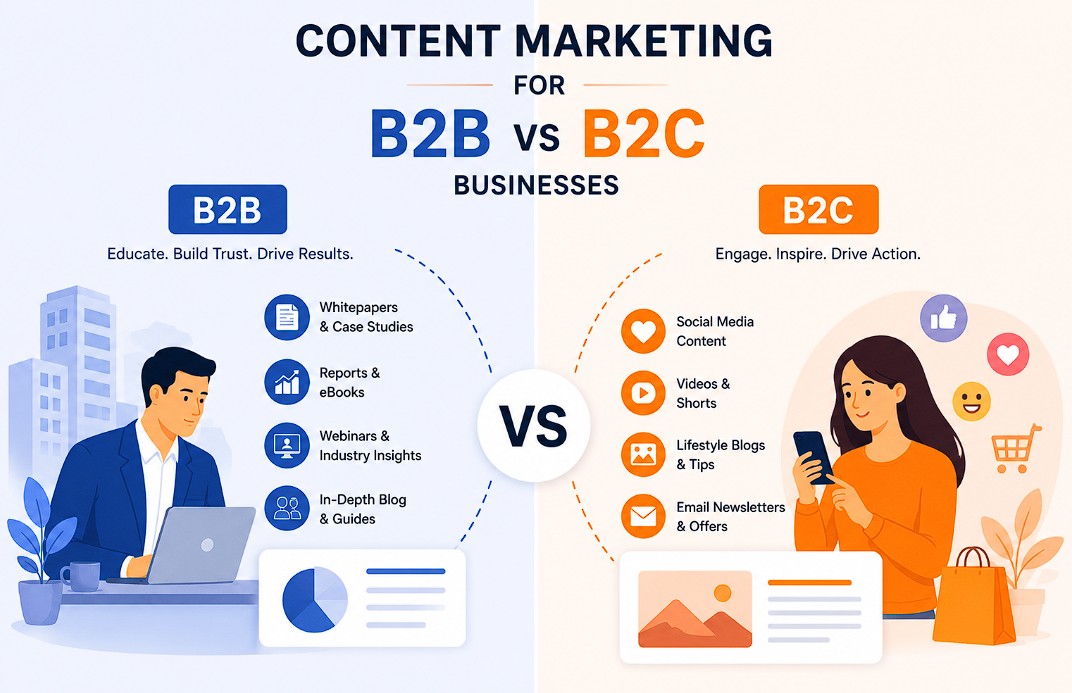
The core principles of content marketing apply universally, but the way those principles are executed differs meaningfully between B2B (business-to-business) and B2C (business-to-consumer) companies. Understanding this distinction helps beginners avoid copying a strategy that works well for one context but fails in another.
How B2B Content Marketing Works
B2B buying decisions are typically slower, more expensive, and made by multiple stakeholders rather than a single individual. A software company selling to enterprises, for example, might have a buying committee that includes a finance head, an IT head, and a department manager, each with different concerns. B2B content marketing therefore tends to be longer-form, more data-driven, and focused on building credibility over an extended consideration period. Whitepapers, detailed case studies, webinars, and LinkedIn thought-leadership content are especially common in B2B strategies, because they match how business buyers actually research major purchases.
How B2C Content Marketing Works
B2C buying decisions are usually faster and driven more by emotion, convenience, and social proof. A consumer deciding between two skincare brands is unlikely to read a 20-page whitepaper before purchasing. B2C content marketing therefore leans more heavily on short-form video, relatable storytelling, influencer collaborations, and visually engaging social content that fits into how consumers already scroll and browse. Brands like Mamaearth and Boat have built loyal followings largely through short, entertaining, high-frequency content on Instagram and YouTube rather than long-form written guides.
Where the Two Approaches Overlap
Despite these differences, both B2B and B2C content marketing rely on the same underlying funnel logic covered later in this guide, moving an audience from awareness to consideration to decision, and both ultimately succeed by being genuinely useful or genuinely engaging rather than purely promotional. Many growing companies, particularly in India’s fast-expanding D2C and SaaS sectors, blend elements of both approaches depending on the specific platform and audience segment they are targeting.
| Factor | B2B Content Marketing | B2C Content Marketing |
| Typical Buying Cycle | Weeks to months, multiple stakeholders | Minutes to days, often a single decision-maker |
| Content Depth | Long-form, data-heavy, detailed | Short-form, visual, emotionally engaging |
| Common Formats | Whitepapers, case studies, webinars, LinkedIn | Reels, Stories, influencer content, YouTube |
| Primary Driver | Logic, ROI, credibility, risk reduction | Emotion, trends, social proof, convenience |
Content Marketing vs Advertising vs SEO vs Social Media Marketing
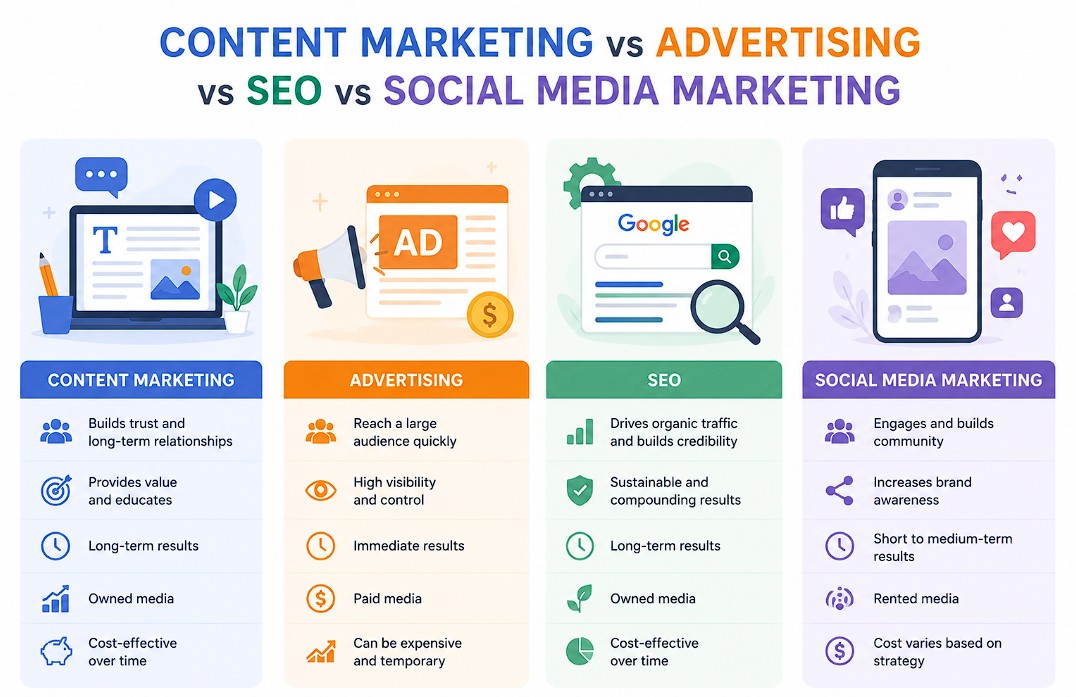
Beginners frequently mix up content marketing with related but distinct disciplines. Understanding the boundaries between these terms will help you use them correctly and understand how they work together as part of a complete digital marketing strategy.
The table below compares content marketing against the three concepts it is most often confused with: paid advertising, search engine optimisation (SEO), and social media marketing. Each has a different primary goal, a different relationship with the audience, and a different cost structure.
| Aspect | Content Marketing | Paid Advertising | SEO | Social Media Marketing |
| Primary Goal | Build trust and educate before selling | Drive immediate action or sale | Rank content in search engines | Build community and engagement |
| Cost Over Time | Front-loaded, then compounds for free | Ongoing stops when budget stops | Front-loaded, then largely free | Low cost, but time-intensive |
| Speed of Results | Slow weeks to months | Immediate | Slow months | Fast days to weeks |
| Relationship to Content | Content IS the strategy | Content is the ad creative | Content is what gets ranked | Content is the post itself |
| Best For | Trust, authority, long-term growth | Quick sales, launches, promotions | Long-term organic visibility | Community, brand voice, reach |
It is important to understand that these four disciplines are not competitors; they work best together. SEO determines whether your content gets found on Google. Social media marketing determines whether your content gets shared and discussed. Paid advertising can accelerate the reach of your best content. And content marketing is the substance running through all of them: without content, there is nothing for SEO to rank, nothing for social media to share, and nothing meaningful for an advertisement to promote.
| 💡 How These Fit Together
Think of content marketing as the engine, SEO as the road that leads people to it, social media as the word-of-mouth that spreads it, and paid advertising as the turbo boost you can switch on when you want faster results. |
👉 Learn More: SEO vs SEM: What Is the Difference?
The 8 Major Types of Content Marketing
Content marketing is not limited to blog posts. Modern content marketers work across many formats, choosing the type that best matches their audience’s preferences, the platform they are distributing on, and the stage of the buying journey they are targeting. Below are the eight major content types every beginner should understand.
1. Blog Articles and Written Guides
Blog content remains the backbone of most content marketing strategies because it is highly searchable, cost-effective to produce, and easy to update over time. A single comprehensive guide, like this one, can rank on Google for years and attract a steady stream of visitors without any ongoing ad spend. Indian businesses across industries, from real estate to personal finance to education, rely heavily on blog content to answer the exact questions their potential customers are typing into Google.
2. Video Content
Video has become the dominant content format on the internet, particularly in India where mobile data is cheap, and platforms like YouTube and Instagram Reels have massive reach. Video works especially well for tutorials, product demonstrations, and storytelling. Brands like boAt and Mamaearth built significant portions of their early audience through consistent, relatable video content rather than traditional television advertising.
3. Podcasts and Audio Content
Podcasts allow brands to build deep, ongoing relationships with an audience during commutes, workouts, or household chores moments when video and reading are impractical. While podcast adoption in India is still growing compared to the West, it is expanding rapidly, particularly in business, finance, and personal development niches.
4. Infographics and Visual Content
Infographics translate complex data or processes into a single, easily digestible visual. They are especially effective for statistics-heavy topics and are highly shareable on platforms like Pinterest and LinkedIn, often earning backlinks from other websites that reference the data.
5. E-books and Downloadable Guides
Longer-form, downloadable content such as e-books or whitepapers works well for capturing leads; a visitor exchanges their email address for a genuinely valuable, in-depth resource. This is especially common in B2B content marketing, where the buying decision is complex and requires more detailed education than a single blog post can provide.
6. Email Newsletters
Email remains one of the highest-return content channels because the audience has explicitly opted in to hear from you. A well-run newsletter keeps a brand top-of-mind between purchases and is not subject to the unpredictable algorithm changes that affect social media reach.
7. Social Media Content
Short-form content on Instagram, LinkedIn, and X (formerly Twitter) helps brands stay visible in daily conversation, build community, and drive traffic back to longer-form content like blog posts or videos. Social content typically works best as a distribution channel for other content types rather than as a standalone strategy.
8. Case Studies and Customer Stories
Case studies show real proof that a product or service works, using a specific customer’s results. They are particularly persuasive in the decision stage of the buyer’s journey, when a prospective customer is comparing options and looking for evidence rather than general education.
9. User-Generated Content (UGC)
User-generated content refers to reviews, photos, videos, and testimonials created by actual customers rather than the brand itself. UGC has become especially powerful in India’s D2C and fashion sectors, where potential buyers often trust the opinion of a fellow customer far more than polished brand messaging. Encouraging customers to share their experience, and then re-sharing that content, is one of the most cost-effective content strategies available, since the content is created for free by an already-satisfied customer.
| 📝 Real Example: Zomato’s Content Playbook
Zomato blends witty social media captions (short-form content) with data-driven blog reports on Indian food trends (long-form content) and behind-the-scenes videos. Each format serves a different purpose: social posts build daily brand affinity, while data reports earn media coverage and backlinks that improve SEO. |
👉 Learn More: Types of SEO Every Marketer Should Know
The Content Marketing Funnel: Matching Content to the Buyer’s Journey
Not all content should try to sell. Effective content marketing maps different types of content to different stages of a buyer’s journey, commonly described using the funnel model: Top of Funnel (TOFU), Middle of Funnel (MOFU), and Bottom of Funnel (BOFU). Understanding this model is one of the most important skills a content marketer can develop, because it prevents the common beginner mistake of trying to sell to someone who isn’t ready to buy yet.
Top of Funnel (TOFU): Awareness Stage
At this stage, the audience may not even know your brand exists, and often doesn’t fully realise they have a problem your product solves. TOFU content is broad, educational, and entertaining. Its goal is simply to attract attention and introduce the brand as a helpful, credible source. Examples include beginner guides, listicles, and entertaining social videos.
Middle of Funnel (MOFU): Consideration Stage
Here, the audience has identified their problem and is actively researching possible solutions, including yours and your competitors’. MOFU content goes deeper, comparing options, explaining frameworks, and building credibility. Examples include comparison articles, detailed how-to guides, webinars, and email nurture sequences.
Bottom of Funnel (BOFU): Decision Stage
At this final stage, the audience is close to making a purchase decision and needs reassurance that your specific product or service is the right choice. BOFU content is more direct and often includes some promotional element. Examples include case studies, product comparison pages, testimonials, free trials, and demo videos.
| Funnel Stage | Audience Mindset | Best Content Types | Example Topic |
| TOFU Awareness | ‘I have a problem, not sure what to do’ | Blog guides, social videos, infographics | ‘What Is Content Marketing?’ |
| MOFU Consideration | ‘I know my options, comparing solutions’ | Comparison posts, webinars, email series | ‘Content Marketing vs Paid Ads’ |
| BOFU Decision | ‘I’m ready to choose, need reassurance’ | Case studies, demos, testimonials | ‘How Brand X Grew Traffic 300%’ |
| ⭐ The 80/20 Rule of Funnel Content
Most beginner content strategies fail because they focus almost entirely on BOFU, sales-heavy content while ignoring TOFU. A healthy content mix typically allocates roughly 60-70% of content to TOFU and MOFU stages, and only 20-30% to direct BOFU content. Build the audience first; the sales content only works once there is an audience to see it. |
How to Build a Content Marketing Strategy: A Step-by-Step Process
Understanding the theory of content marketing is only half the job. This section walks through the practical, repeatable process used by professional content marketers to build a strategy from scratch, whether for a personal brand, a small business, or a large organisation.
- Define clear, measurable goals. Before creating a single piece of content, decide what success looks like: more website traffic, more email subscribers, more qualified leads, or stronger brand awareness. Vague goals like ‘go viral’ lead to vague, unfocused content.
- Research and define your target audience. Build a simple audience profile: their demographics, the problems they face, the questions they search for, and the platforms they already spend time on. Without this step, content ends up speaking to nobody in particular.
- Conduct keyword and topic research. Use tools to find out what your audience is actually searching for online, and prioritise topics with real search demand over topics you simply assume are interesting.
- Audit your existing content. If you already publish content, review what is currently working and what isn’t, so new efforts build on real data rather than guesswork.
- Choose your content formats and channels. Based on your audience research, decide which formats (blog, video, social, email) and which platforms deserve the bulk of your effort. Trying to be everywhere at once is a common early mistake.
- Build a content calendar. Plan topics, formats, and publishing dates in advance, mapped to the TOFU/MOFU/BOFU funnel stages, so your content mix stays balanced rather than accidentally becoming all sales-focused.
- Create the content with genuine quality. Prioritise depth, accuracy, and usefulness over volume. One outstanding, thorough guide will typically outperform ten shallow, rushed posts.
- Distribute and promote every piece. Publishing is not the finish line; actively share content through email, social media, relevant communities, and, where appropriate, small paid promotion budgets to give it an initial push.
- Measure performance against your original goals. Track the specific metrics that map to your Step 1 goals, not vanity metrics that look impressive but don’t reflect real business impact.
- Refine and repeat. Use performance data to double down on what is working, update or retire what isn’t, and continuously improve the strategy over time. Content marketing is never truly ‘finished.’
Content Marketing Metrics and KPIs
One of the most important shifts a beginner content marketer must make is moving from vanity metrics, which look impressive but don’t necessarily reflect business impact, to metrics that connect content performance to actual business goals. This section breaks down the metrics that matter most and when to use them.
Awareness Metrics
These metrics tell you whether people are discovering your content in the first place. They include organic website traffic, impressions in search results, and reach on social media platforms. Awareness metrics are important early indicators but should never be the only numbers a content marketer tracks.
Engagement Metrics
Engagement metrics reveal whether the people who find your content actually find it valuable enough to interact with. Time on page, scroll depth, comments, shares, and average watch time on video content all fall into this category. High traffic paired with low engagement usually signals a mismatch between what people expected from a headline and what the content actually delivered.
Conversion Metrics
Conversion metrics connect content directly to business outcomes: email sign-ups, free trial starts, demo requests, downloads, or direct sales attributed to a specific piece of content. These are the metrics that ultimately justify continued investment in content marketing to business stakeholders.
Retention and Loyalty Metrics
These measure whether content keeps existing customers engaged and coming back: email open rates over time, returning visitor percentage, and newsletter subscriber churn. Retention is often overlooked by beginners focused entirely on acquiring new audiences, but retaining an existing audience is typically far cheaper than acquiring a new one.
| Metric Category | Example Metrics | What It Tells You |
| Awareness | Organic traffic, impressions, reach | Are people discovering the content? |
| Engagement | Time on page, shares, comments | Is the content genuinely valuable? |
| Conversion | Sign-ups, leads, sales | Is content driving business results? |
| Retention | Returning visitors, open rates | Is content keeping the audience engaged over time? |
Essential Tools for Content Marketing
You do not need an expensive tool stack to get started with content marketing, but certain categories of tools make the process significantly more efficient as your content operation grows. This section covers the main tool categories a beginner should be aware of, including free options suitable for Indian small businesses and students.
Research and Planning Tools
Keyword research tools such as Google Keyword Planner (free) and Ubersuggest help identify what topics your audience is actually searching for. Google Trends is another free tool that reveals how interest in a topic changes over time, which is particularly useful for planning seasonal content around Indian festivals and shopping seasons.
Content Creation Tools
For writing, tools like Grammarly help with clarity and correctness, while Canva has become the go-to free design tool for creating social graphics and infographics without needing a professional designer. For video, even a smartphone paired with free editing apps like CapCut is sufficient for most beginner content marketing needs.
Distribution and Scheduling Tools
Social media scheduling tools such as Buffer or Later allow content to be planned and published in advance across multiple platforms, saving significant time compared to manual daily posting. Email marketing platforms like Mailchimp offer free tiers suitable for small businesses just starting a newsletter.
Analytics and Measurement Tools
Google Analytics (free) and Google Search Console (free) together form the essential measurement foundation for any content strategy, revealing which content drives traffic, how visitors behave once they arrive, and which search queries bring people to your site.
| 💡 Start Free, Upgrade Later
Beginners often over-invest in paid tools before they have a proven content process. Start with the free tiers of Google Analytics, Google Search Console, Canva, and Google Keyword Planner. Upgrade to paid tools only once you can clearly identify where the free tools are limiting your growth. |
Building a Content Marketing Team: Key Roles Explained
As a content marketing effort grows beyond a single founder or marketer handling everything, businesses typically bring in specialists for different parts of the process. Understanding these roles is useful even for solo content marketers, because it clarifies which skills you may need to develop or outsource as you scale.
Content Strategist
The content strategist sets the overall direction: defining the target audience, the content pillars, the funnel mapping, and the goals against which success will be measured. In smaller teams, this role is often held by the founder or head of marketing rather than a dedicated specialist.
Writers and Content Creators
Writers, video creators, and designers are responsible for actually producing the content, whether that means drafting blog articles, scripting and filming videos, or designing infographics and social graphics. Many small businesses in India start by outsourcing this work to freelance writers and designers before hiring in-house talent.
SEO Specialist
The SEO specialist ensures that content is optimised to be found by search engines, conducting keyword research, reviewing on-page SEO elements, and analysing organic performance. In smaller teams, the content strategist or writer often absorbs basic SEO responsibilities directly.
Distribution and Community Manager
This role focuses on getting finished content in front of the right audience: scheduling social posts, engaging with comments, building relationships with other creators or publications, and managing paid promotion of top-performing content.
Analytics and Data Owner
Someone needs to own the measurement side of content marketing: tracking the metrics covered earlier in this guide, reporting on performance, and translating data into recommendations for what to create next. Without this role, even a well-produced content library risks drifting without clear direction.
| 💡 A Realistic Starting Point for Small Teams
You do not need five separate people to start. A single founder or marketer can reasonably cover the strategist, writer, and analytics roles simultaneously in the early stages, and bring in freelance design or video support only for specific pieces that need it. |
Common Mistakes Beginners Make in Content Marketing
Most content marketing efforts fail not because the strategy is fundamentally wrong, but because of a handful of avoidable execution mistakes. Understanding these pitfalls in advance will save you significant time and wasted effort.
1. Publishing Inconsistently
Content marketing depends on compounding momentum. A burst of five articles followed by three months of silence performs far worse than one consistent article every two weeks over the same period, because search engines and audiences both reward consistency and predictability.
2. Creating Content Without Audience Research
Many beginners create content based on what they personally find interesting rather than what their target audience is actually searching for or struggling with. This mismatch is one of the single biggest reasons content fails to attract meaningful traffic.
3. Focusing Only on Selling
Content that promotes a product in every paragraph reads as an advertisement, not genuine content, and audiences quickly learn to ignore it. As covered in the funnel section above, the majority of content should educate or entertain, not sell.
4. Ignoring SEO Fundamentals
Beautifully written content that no one can find is a wasted effort. Beginners frequently skip basic on-page SEO practices like using target keywords naturally in headings, writing clear meta descriptions, and structuring content with proper headings, which severely limits organic discoverability.
5. Neglecting Distribution
Publishing content and hoping it will be found is not a strategy. Many beginners spend 90% of their effort on creation and almost none on promotion, when a healthier split gives meaningful, ongoing effort to sharing and distributing each piece across relevant channels.
6. Chasing Vanity Metrics
Celebrating high view counts or likes while ignoring whether that traffic converts into subscribers, leads, or customers leads to a content strategy that feels successful but doesn’t actually grow the business.
7. Copying Competitors Without a Unique Angle
Simply rewriting what competitors have already published rarely outperforms the original, because search engines and audiences already have that information covered. The content that wins usually adds a genuinely new angle, deeper detail, more current data, or a more relatable example.
8. Giving Up Too Early
As mentioned earlier, content marketing is a compounding strategy that often takes several months to show meaningful results. Many businesses abandon content marketing at exactly the point where consistent, patient effort would have started to pay off.
| ⚠️ The Number One Beginner Mistake
Treating content marketing like a paid advertising campaign, expecting immediate, direct sales from every single piece of content published. Content marketing builds an asset and an audience over time; judging it by day-one sales numbers is the fastest way to abandon a strategy right before it starts working. |
Real-World Content Marketing Examples
Seeing content marketing principles applied by real brands makes the concepts far more concrete. This section walks through a few well-known examples, including Indian brands, and highlights exactly what made each approach effective.
Zerodha Varsity
Zerodha, India’s largest stockbroker, built Varsity, a completely free, in-depth educational platform teaching stock market concepts from absolute basics to advanced trading strategies. Varsity doesn’t push Zerodha’s product in every chapter. It simply teaches, thoroughly and honestly. The trust this built became a foundation of Zerodha’s rapid growth, almost entirely without traditional advertising.
CRED’s Content and Brand Storytelling
CRED, the credit card bill payment app, invested heavily in high-production video content and quirky, memorable social campaigns during India’s biggest cricket tournament. While CRED’s content leans more toward brand awareness than direct education, it demonstrates how content marketing techniques storytelling, entertainment, consistency extend beyond just ‘how-to’ articles.
HubSpot’s Blog (Global Example)
HubSpot, a global marketing software company, built one of the internet’s largest marketing education blogs, answering nearly every question a marketer might search for. This content strategy is widely credited as a major driver of HubSpot’s growth from a startup to a publicly listed company, illustrating how content marketing can become a company’s primary growth engine rather than a supporting activity.
| 📝 What These Examples Have in Common
Every example above prioritises genuine usefulness or genuine entertainment value over direct selling in the majority of its content. Each built consistency over years, not weeks. And each matched its content format to where its specific audience already spends time. |
Conclusion
Content marketing is not a trend or a buzzword; it is a fundamental shift in how businesses earn attention and trust in a world where consumers actively avoid traditional advertising. From the kirana store owner sharing recipes on WhatsApp to Zerodha’s Varsity teaching millions of Indians how markets work, the underlying principle remains the same: provide genuine value first, consistently, and business results follow naturally over time.
You now understand what content marketing is, why it matters, how it differs from advertising, SEO, and social media marketing, the major content formats available to you, how to map content to the buyer’s journey, and the step-by-step process for building a real strategy. You also know the metrics that matter, the tools that can help, and the mistakes that derail most beginner efforts.
The gap between knowing content marketing theory and actually building an audience is simply consistent action. Businesses and individuals who start today, even with imperfect first attempts, will be far ahead of those who wait for the ‘perfect’ strategy before beginning. Use the action plan below to take your very first concrete steps.
Whether you are a student building a portfolio, a small business owner in India looking to grow without a large advertising budget, or a professional aiming to move into a content marketing career, the fundamentals covered in this guide remain the same: know your audience deeply, prioritise genuine value over self-promotion, stay consistent even when results feel slow, and let data guide your next move rather than guesswork. Content marketing rewards patience and craftsmanship more than any other channel in digital marketing and that is precisely why it remains one of the most durable, defensible growth strategies available to any business today.
Frequently Asked Questions
Is content marketing the same as digital marketing?
No. Digital marketing is the broader umbrella term that includes content marketing along with paid advertising, SEO, email marketing, social media marketing, and more. Content marketing is one important discipline within digital marketing, focused specifically on creating and distributing valuable content rather than paying for placements or interruptive advertisements.
How long does content marketing take to show results?
Most businesses begin seeing measurable results, such as growing organic traffic or email subscriber counts, somewhere between three and six months of consistent publishing. Significant, compounding results, particularly from SEO-driven blog content, often take six to twelve months or longer, which is why patience and consistency are essential rather than optional.
How much does content marketing cost for a small business in India?
Costs vary enormously depending on whether content is created in-house or outsourced. A small business handling content in-house might spend primarily time rather than money, while outsourcing to freelance writers or agencies in India can range from roughly ₹3,000 to ₹15,000 per blog article, and considerably more for professionally produced video content. The key is starting with a realistic, sustainable budget rather than a large one-time burst of spending.
Do I need to be a good writer to do content marketing?
Strong writing skills help, but they are not a strict requirement. Many successful content marketers rely on clear thinking, genuine subject-matter expertise, and audience empathy more than polished prose, then use editing, tools like Grammarly, or professional editors to refine the final output. Video and audio content also don’t require traditional writing skills at all.
What is the difference between content marketing and copywriting?
Copywriting is focused specifically on persuading someone to take an immediate action, such as clicking ‘Buy Now’ on an advertisement. Content marketing is broader and often has an educational or entertainment goal first, with persuasion happening gradually over multiple interactions rather than within a single piece.
Which platform is best for content marketing in India?
There is no single best platform the right choice depends entirely on where your specific target audience spends time and what type of content best explains your product. B2B companies often find LinkedIn and blog content most effective, while consumer brands targeting younger audiences frequently see stronger results on Instagram and YouTube.
Can a small business really compete with big brands using content marketing?
Yes, and this is one of content marketing’s greatest strengths. Search engines and social platforms generally reward genuinely useful, well-targeted content over sheer advertising budget. A small business with deep expertise in a specific niche can often outrank and outperform much larger competitors that haven’t invested seriously in content.
How often should I publish content?
Consistency matters more than frequency. Publishing one high-quality, thorough article every two weeks, sustained for a year, will typically outperform publishing daily for one month and then stopping. Choose a realistic publishing frequency you can sustain long-term, and only increase it once that rhythm feels comfortable.
What is the role of SEO in content marketing?
SEO ensures that the valuable content you create can actually be discovered by the people searching for it on Google and other search engines. Without basic SEO practices, even excellent content can remain invisible, buried far below competitors on search results pages.
Do I need a large team to do content marketing well?
No. Many successful content marketing efforts, particularly for small businesses and individual creators, are run by a single person handling research, writing, design, and distribution. As the content program grows, roles are often split among specialists, but starting small and lean is both common and effective.
How do I know if my content marketing strategy is working?
Track the specific metrics tied to the goals you set at the very beginning of your strategy, as outlined in the metrics section of this guide. If your goal was lead generation, measure leads generated by content, not just traffic or likes. Reviewing performance every one to three months allows you to refine your approach based on real data rather than guesswork.
Should I outsource content marketing or handle it in-house?
This depends on your budget, timeline, and the level of subject-matter expertise required. Many small businesses start by handling content in-house because it is more affordable and the founder often has the deepest product and customer knowledge. As the business grows, outsourcing specific tasks, such as design, video editing, or SEO auditing, to freelancers or agencies often becomes more efficient than hiring full-time specialists for every function.
Can content marketing work for very small or local businesses?
Yes, and it often works particularly well for local businesses because there is less competition for hyper-local search terms compared to national or global keywords. A local business that consistently publishes content addressing its specific city, neighbourhood, or community can often rank strongly in local search results with a relatively modest, consistent effort.