

Somebody sets up their first Google Ads account, splits their budget between a search campaign and a display campaign, and two weeks later they’re staring at the numbers completely confused. The search campaign is converting fine. The display campaign has a click-through rate that looks broken, like something is wrong with the setup. Nothing is wrong. They’re just comparing two things that were never supposed to behave the same way.
That mix-up happens constantly, and honestly, it’s not the advertiser’s fault. Google bundles both under one dashboard, one login, one “Ads” brand name, so it’s easy to assume they’re variations of the same tool. They’re not. Search ads and display ads run on different logic, show up in different places, and get judged by different scorecards. Mixing them up wastes budget fast, especially for anyone working with a small monthly spend where every dollar has to earn its place.
This post breaks down what each one actually is, where they show up, how the costs and conversion behavior differ, and when to use one, the other, or both together. No fluff, no theory for theory’s sake. Just what you need to know before you open the campaign creation screen again.
What Are Search Ads?
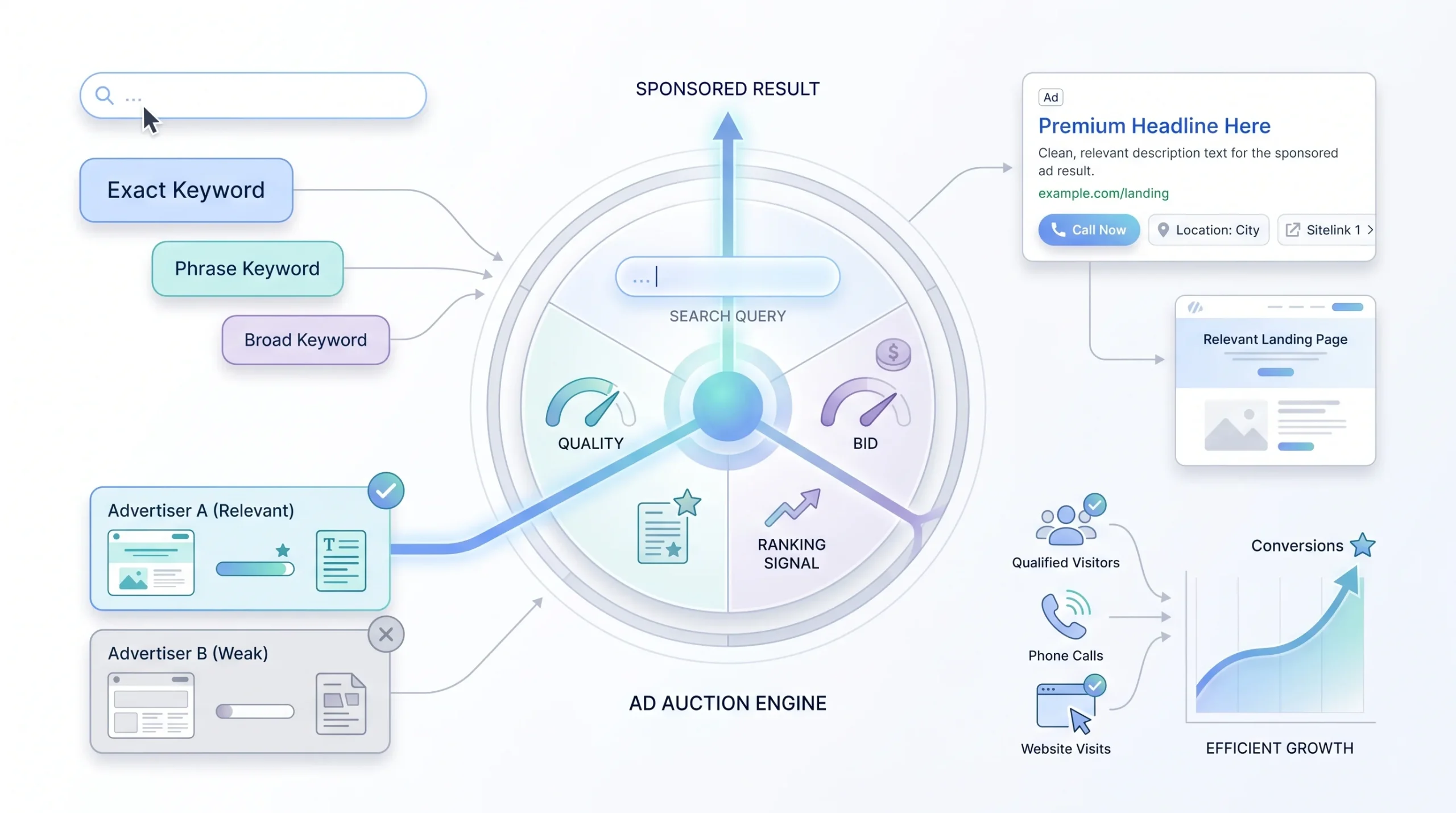
Search ads are the text ads that show up on a search engine results page when someone types in a query. Search for “emergency plumber Jaipur” and the top couple of results, usually marked “Sponsored,” are search ads. They’re bought through an auction, but it’s not just about who pays the most. Google weighs your bid against something called Quality Score, which factors in how relevant your ad and landing page are to the keyword, and how well your ads have historically performed for similar searches. A well-optimized ad with a lower bid can beat a lazy ad with a bigger budget. That surprises a lot of beginners.
The format is simple, almost boringly so. A headline, a couple of description lines, a display URL. No images, no video, nothing flashy. What you can add are extensions: a call button, links to specific pages on your site, your business address, maybe a price list. These extensions matter more than people give them credit for. A plumber running search ads without a call extension is leaving conversions on the table, because someone in a plumbing emergency wants to tap and call, not fill out a contact form and wait.
Keyword match types are worth understanding here too, since they control how loosely or tightly your ad matches a search. Broad match casts a wide net and can pull in searches only loosely related to what you bid on. Phrase match tightens that up. Exact match is the most restrictive, showing your ad only for searches that closely mirror your target keyword. Get this wrong and you’ll either burn budget on irrelevant clicks or miss searches you should be catching.
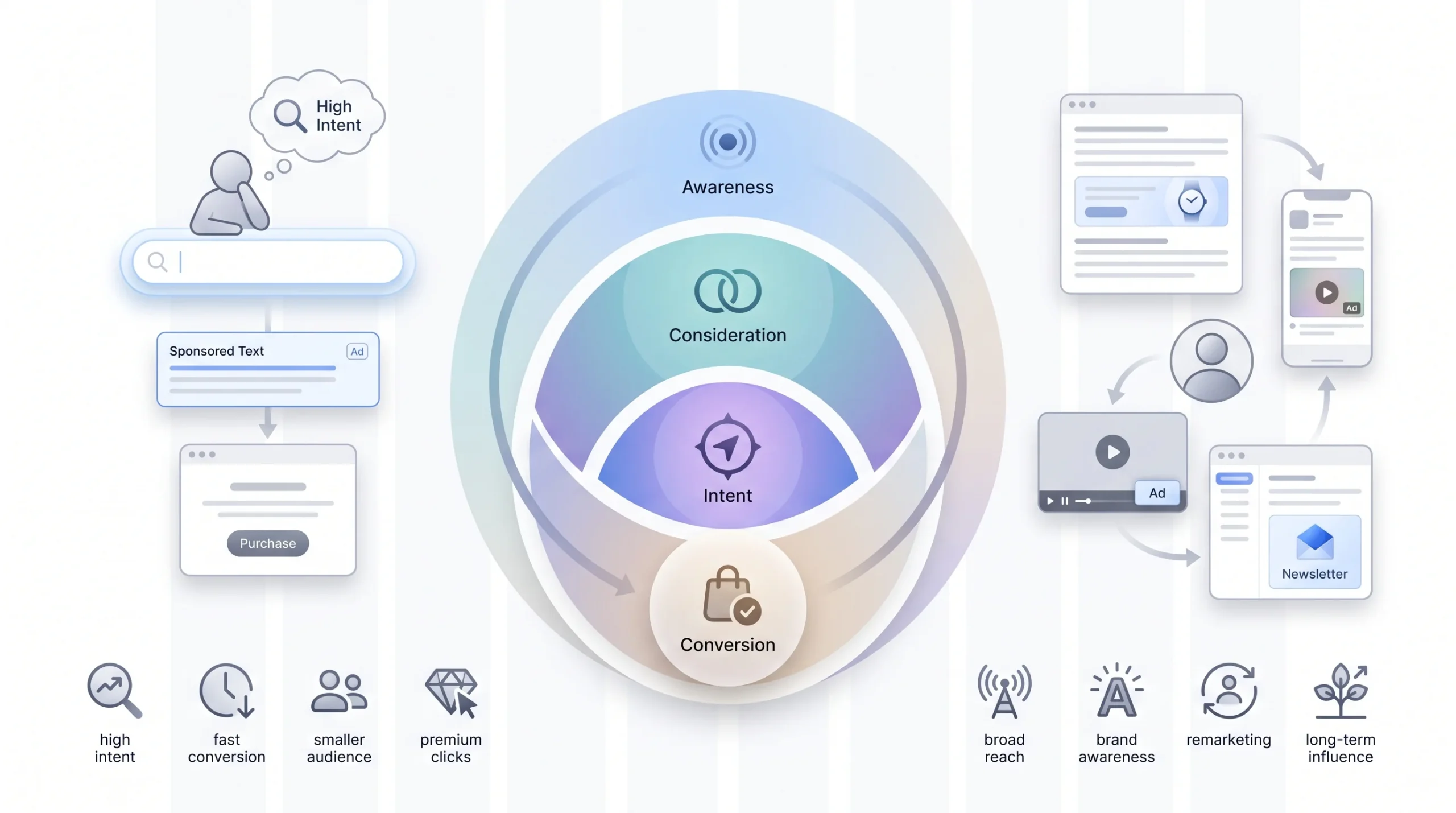
Search ads are “pull” advertising. The person already wants something. Your job isn’t to convince them they need it, your job is to be the clearest, most relevant answer the moment they go looking.
What Are Display Ads?
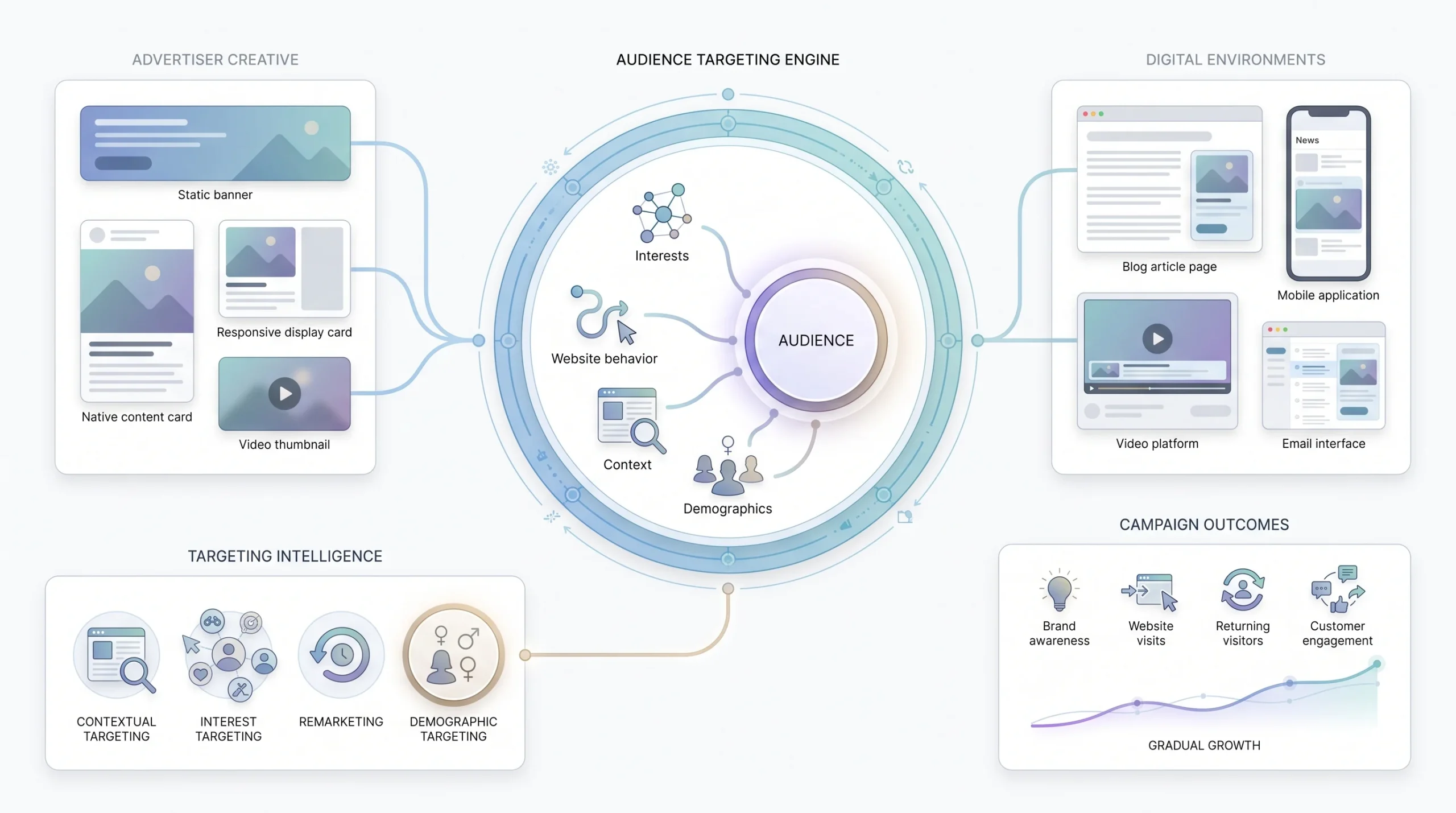
Display ads are the visual ads you see while reading a blog, checking Gmail, or scrolling through an app. They’re image or video based, and instead of appearing because someone searched for something, they appear based on targeting parameters set by the advertiser. Google runs these across the Google Display Network, which covers millions of websites, YouTube, Gmail, and various apps. Reach here isn’t the issue. Getting someone to actually notice the ad among everything else on the page, that’s the real challenge.
Formats vary a lot more than search. Static banners, native ads that blend into the site’s content, responsive ads that adjust size and shape depending on where they land, video ads, and rich media ads with interactive elements like a swipeable carousel or a mini quiz. That flexibility is both the appeal and the trap. More creative options means more ways to get the creative wrong.
Targeting is where display gets interesting. Contextual targeting places your ad next to content related to your product, so a hiking boot ad shows up on a trail review site. Audience targeting uses interest and behavior data to find people likely to care about what you’re selling, regardless of what page they’re on. Remarketing, probably the most useful of the bunch, shows ads specifically to people who already visited your site. And demographic targeting narrows things by age, location, income bracket, whatever’s relevant.
Pricing usually runs on a cost-per-thousand-impressions basis, though cost-per-click options exist too. That’s a different mental model than search. You’re not paying purely for intent, you’re often paying for exposure, and exposure at scale is cheap compared to a search click.
Display ads are “push” advertising. Nobody asked for it. The ad has to earn attention in about three seconds, or it’s just wallpaper.
Search Ads vs Display Ads: Side-by-Side Comparison
Here’s the comparison laid out plainly, because honestly this is the table people bookmark and come back to.
| Factor | Search Ads | Display Ads |
|---|---|---|
| Ad format | Text only | Image, video, rich media, native |
| Placement | Search engine results page | Websites, apps, YouTube, Gmail |
| Targeting basis | Keywords and search intent | Interests, demographics, context, remarketing |
| User intent | High, active, already looking | Low to passive, not actively searching |
| Common pricing model | Mostly cost-per-click | Mostly cost-per-thousand-impressions, some CPC |
| Cost per click | Generally higher | Generally much lower |
| Conversion rate | Generally higher | Generally lower on last-click, better on assisted |
| Funnel stage it suits | Middle to bottom | Top to middle, plus retargeting near bottom |
| Best for | Capturing existing demand fast | Building awareness and staying visible over time |
None of these rows exist in isolation. They all trace back to one underlying difference, which brings us to the actual concept worth sitting with.
Push vs Pull: The Core Conceptual Difference
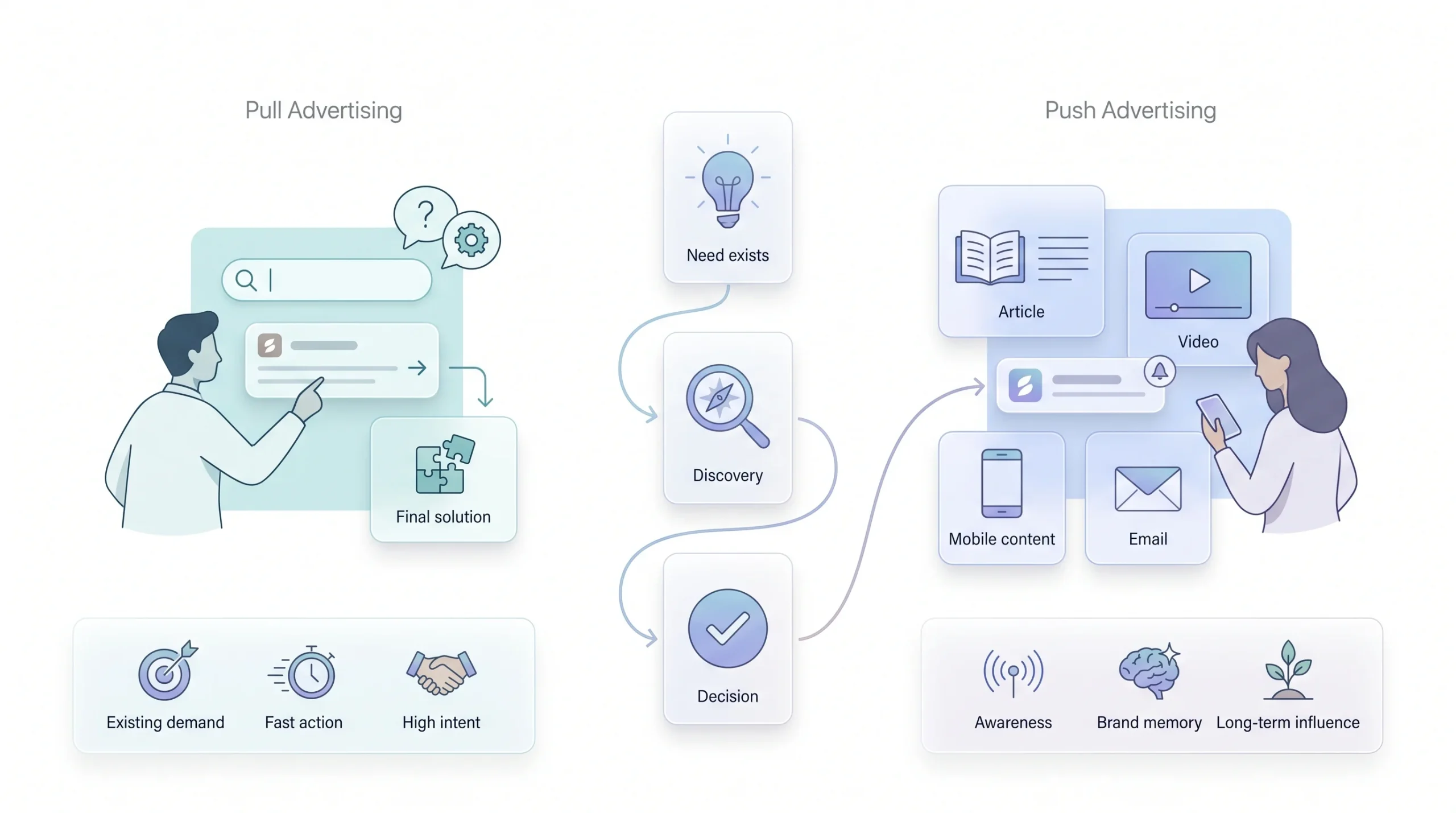
Everyone throws around “push and pull” advertising like it’s obvious, but it’s worth actually slowing down on because it explains basically every number in that table above.
Search is pull advertising. The demand already exists before your ad ever shows up. Someone has a leaking pipe, they search “plumber near me,” and your ad answers a question they already asked. You’re not creating the need. You’re just trying to be the answer that gets picked.
Display is push advertising. Nobody searched for anything. Your ad interrupts whatever someone was doing, reading an article, checking email, scrolling a feed, and tries to plant an idea or a reminder. Think of it like the difference between a shop sign that someone walks past looking for exactly your kind of shop, versus a billboard someone sees while thinking about something else entirely. The sign works because the person was already looking. The billboard works, if it works, because it’s memorable enough to change what someone thinks about later.
That’s why display’s click-through rate looks so low compared to search. It’s not underperforming, it’s answering a completely different question. Search is asking “did we capture the person who wanted this.” Display is asking “did we get in front of the right person and leave an impression.” Judging one by the other’s scorecard is where most of the confusion in this whole topic comes from.
Where Each Ad Type Fits in the Marketing Funnel
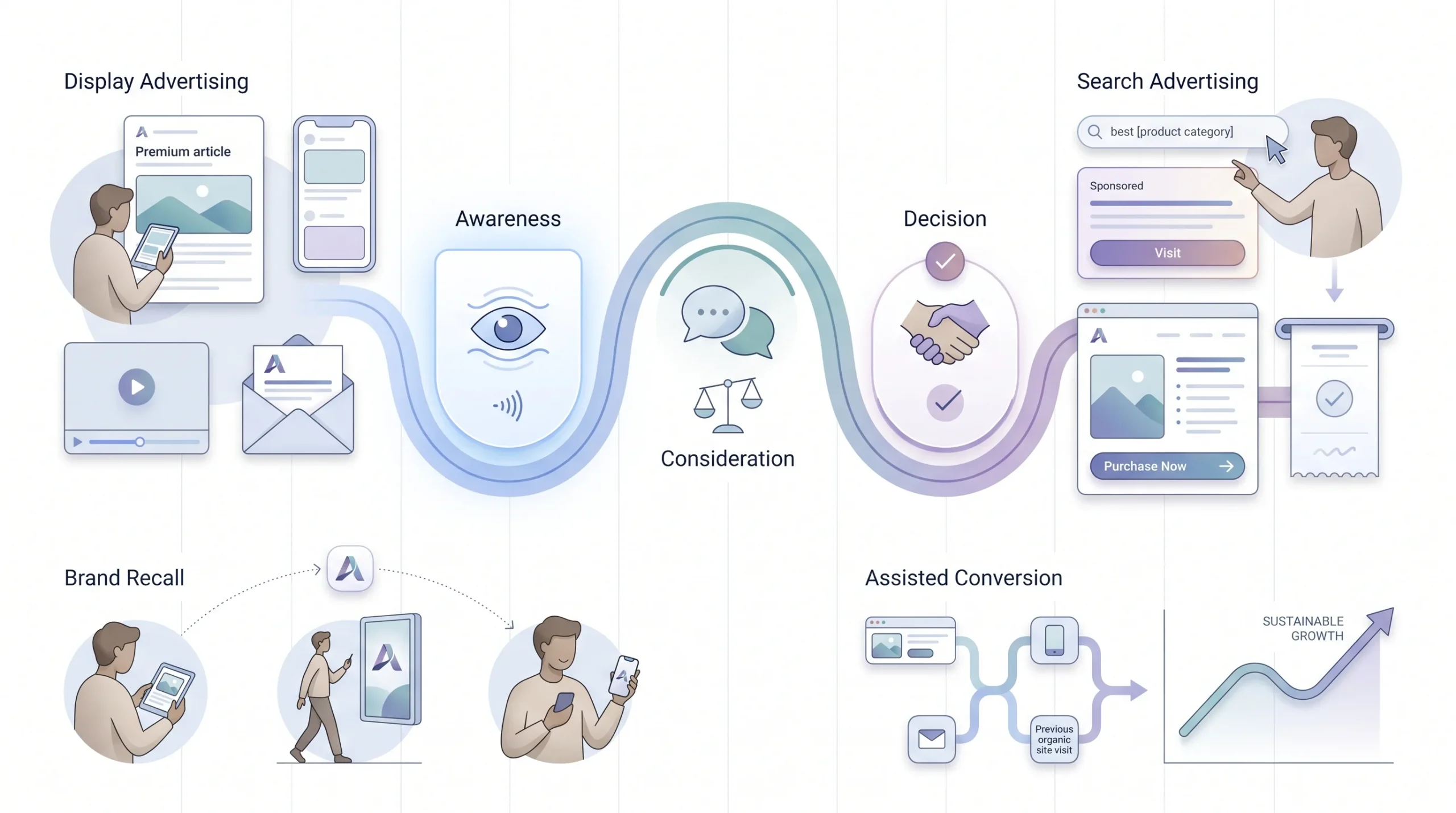
If you’ve read through the TOFU, MOFU, BOFU breakdown on this site already, this section will click fast. If not, the short version: TOFU is awareness, MOFU is consideration, BOFU is decision. Search and display don’t carry equal weight at every stage.
| Funnel Stage | Search Ads Role | Display Ads Role |
|---|---|---|
| TOFU (Awareness) | Weak fit, there’s little to no search volume from people who don’t know they have a problem yet | Strong fit, this is where display earns its keep, building visibility before demand exists |
| MOFU (Consideration) | Strong, this is where comparison searches happen, “best X for Y” type queries | Supportive, keeps your brand visible while someone’s still weighing options |
| BOFU (Decision) | Very strong, branded searches and high-intent product queries convert well here | Retargeting cart abandoners and past visitors, closing people who almost converted |
Here’s the part that trips people up constantly. Display’s real job isn’t winning the last click, it’s showing up in the assisted conversion path. Someone sees a display ad, doesn’t click, browses later, sees a retargeting ad, then finally searches your brand name and converts through search. If you only look at display’s last-click numbers, you’ll conclude it’s failing. But it likely nudged that person along earlier in the journey, and that value doesn’t show up unless you’re actually looking at assisted conversion data, not just the final touchpoint.
Cost Comparison: What You’ll Actually Pay
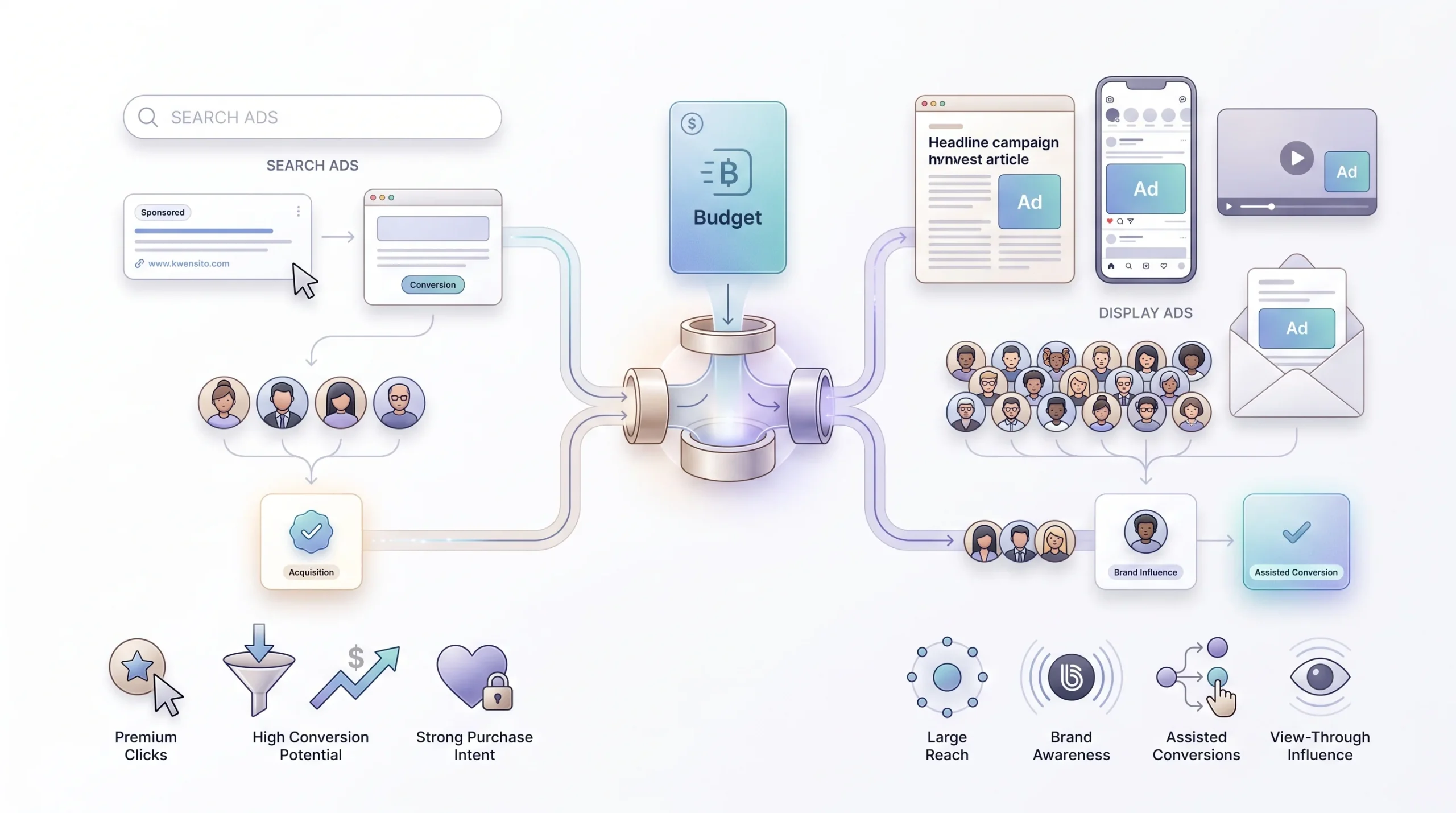
Numbers matter here, but worth being upfront: exact costs shift by industry, location, competition, and time of year, so treat any figure as a rough planning number, not a guarantee.
Broadly speaking, search ads cost more per click than display ads, sometimes several times more. That gap makes sense once you think about it. Search clicks come from people already in buying mode, so advertisers are willing to pay a premium to capture that intent. Display impressions are cheaper because most people seeing the ad weren’t looking for anything, so advertisers are paying for reach and visibility rather than a guaranteed conversion-ready visitor.
Say someone has a thousand dollars to spend. Put it entirely into search, and depending on the industry and competition for those keywords, that budget might buy a few hundred clicks from people actively searching for the product. Put that same thousand into display, and because CPMs run so much lower than search CPCs, it can buy exposure to tens of thousands of impressions, sometimes more. Neither is “better” here. It depends entirely on whether the goal is a handful of high-intent clicks or broad visibility across a much bigger audience.
Here’s what to actually track for each, since the KPIs that matter shift depending on which format is running.
| KPI | Search Ads | Display Ads |
|---|---|---|
| Click-through rate | Primary quality signal, watch this closely | Secondary metric, expect it to run much lower than search |
| Conversion rate | Primary success metric | Secondary, pair it with assisted conversion data instead of judging alone |
| Cost per acquisition | Direct efficiency number | Blend this with the awareness value, don’t judge it in isolation |
| Impression share | Shows competitive visibility for your keywords | Shows reach and frequency across the network |
| View-through conversions | Not really applicable | Key metric, and one a lot of advertisers forget to check |
Don’t split a tiny budget evenly between search and display just to “cover both.” A small search budget concentrated on a handful of high-intent keywords usually beats the same money spread thin across both formats.
Pros and Cons of Each
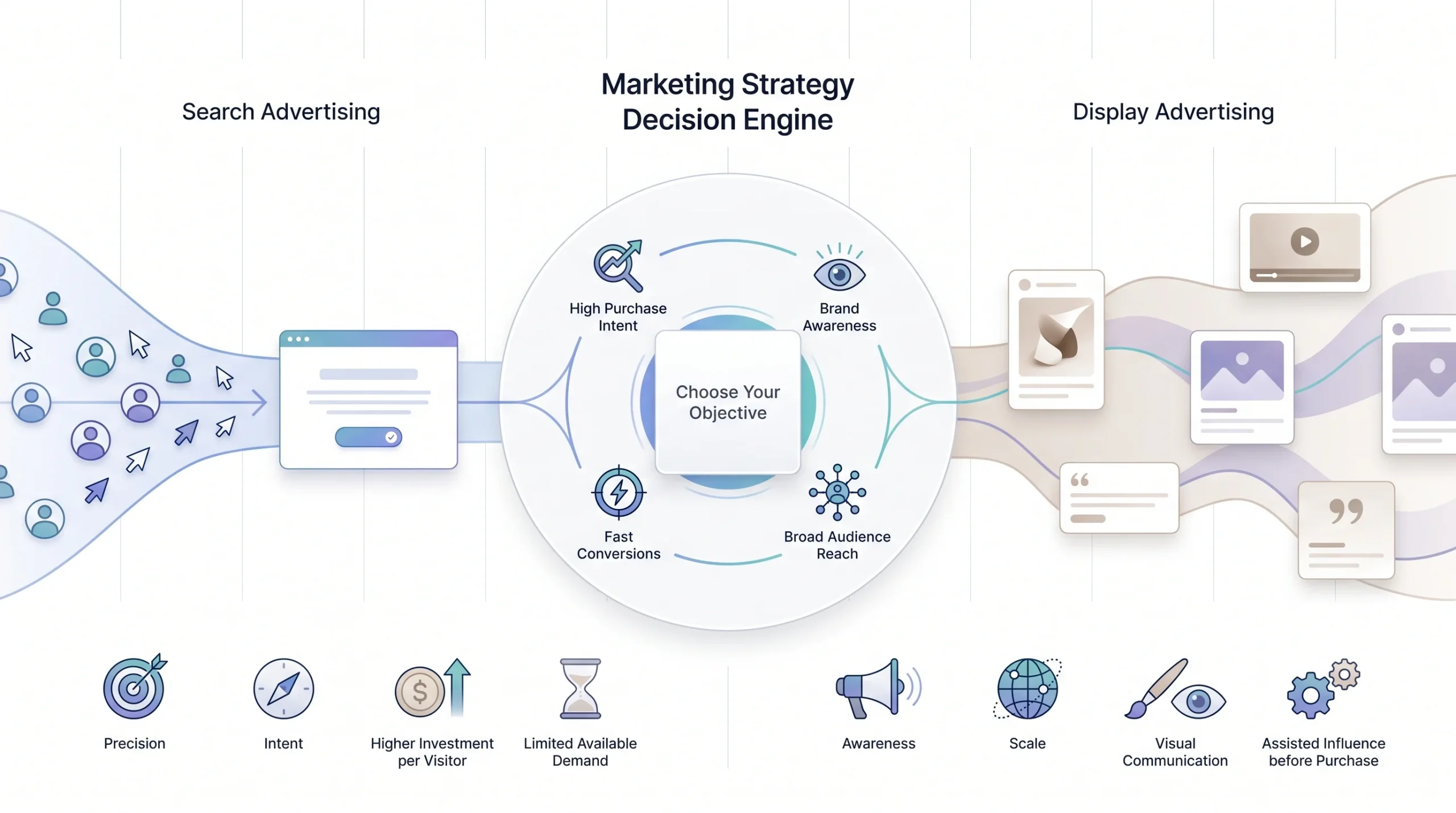
Every format has a trade-off. Pretending otherwise is how budgets get wasted.
Search ads bring high intent straight to the door. Someone typing a specific query is close to a decision already, which usually means faster return on ad spend and cleaner attribution, since you can see exactly which keyword drove which conversion. The catch is cost. Competitive keywords, especially in industries like insurance or legal services, can get expensive fast, and search volume caps out at however many people are actually searching that term. You can’t manufacture more demand than exists.
- High intent means faster, more measurable conversions
- Strong attribution, you know which keyword drove the click
- Limited by existing search volume, no demand means no traffic
- Cost per click can climb quickly in competitive industries
Display ads bring scale and visual storytelling that search simply can’t touch. A product that benefits from being seen, home decor, fashion, travel, gets a real lift from an image or video that a text ad can’t deliver. Cost per impression is low, so reach comes cheap. But intent is low too. Banner blindness is real, most people scroll past display ads without registering them, and attribution gets murkier because the path from seeing an ad to eventually converting somewhere else is harder to trace cleanly.
- Visual formats work for products that need to be seen
- Very cost-efficient for reach and impressions
- Lower intent, most viewers aren’t in buying mode
- Attribution is harder to pin down, especially for assisted conversions
When to Use Search Ads
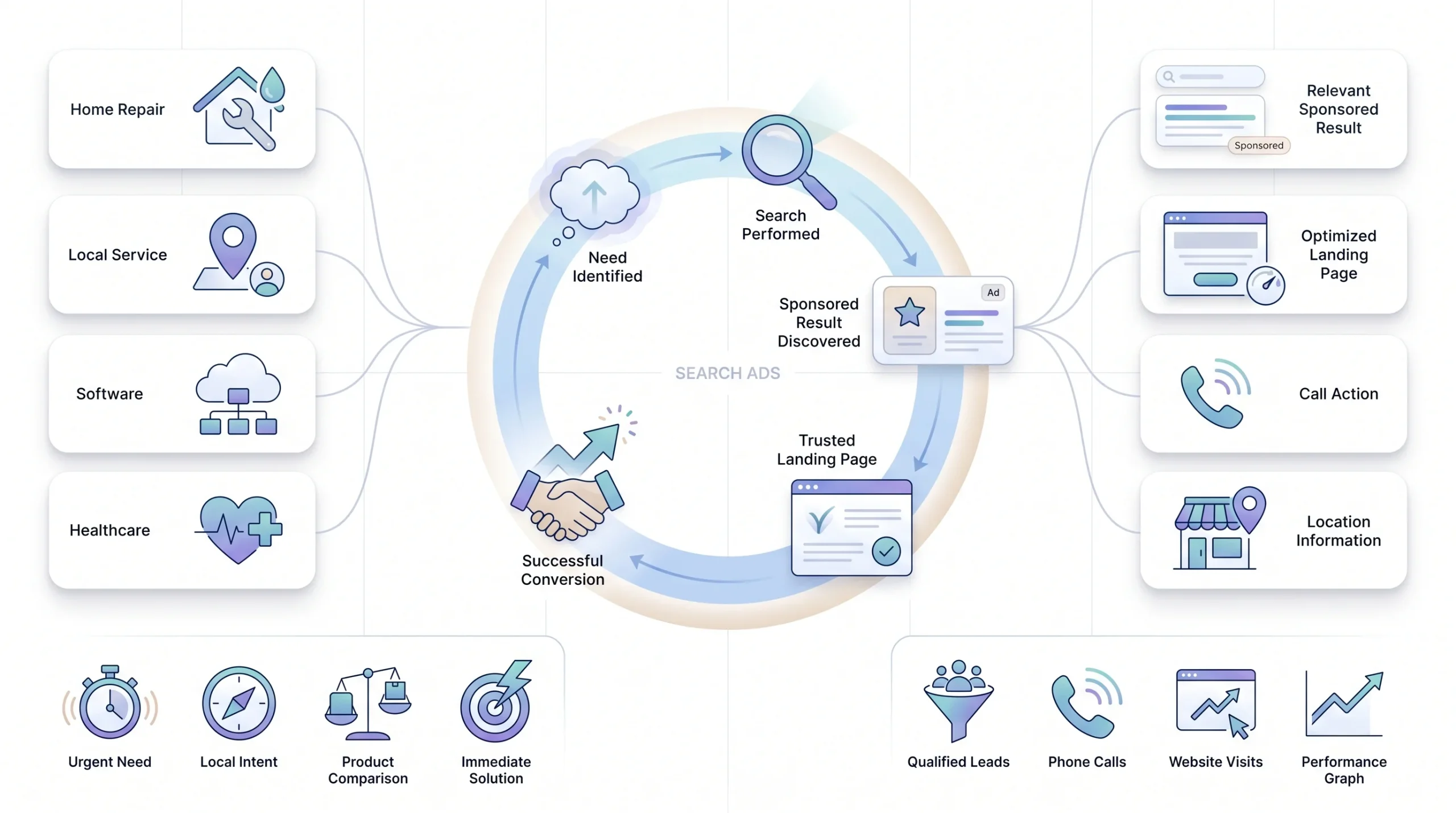
Urgency is the clearest signal. Emergency plumbers, locksmiths, towing services, urgent medical care, these are things nobody browses for casually. When the need hits, people search immediately and pick from what’s in front of them. A locksmith running only display ads is missing the exact moment someone’s locked out of their car and searching frantically on their phone.
Local businesses tend to do well here too. Someone searching “HVAC repair Jaipur” has both intent and geography working in their favor, and adding location extensions or call buttons makes the path to conversion nearly frictionless.
Search also earns its place when organic SEO isn’t there yet. A newer site that hasn’t built up rankings for its target keywords can use search ads to occupy that visibility gap while the SEO work catches up in the background. And for a SaaS company running a free trial signup, high-intent keywords like “[competitor] alternative” or “[category] software” pull in people actively comparing options, which tends to convert far better than a cold display impression ever would.
If a call extension isn’t switched on for a service business, that’s the first thing to fix before touching anything else in the campaign. It’s a two-minute change that often moves the needle more than a bid adjustment.
When to Use Display Ads
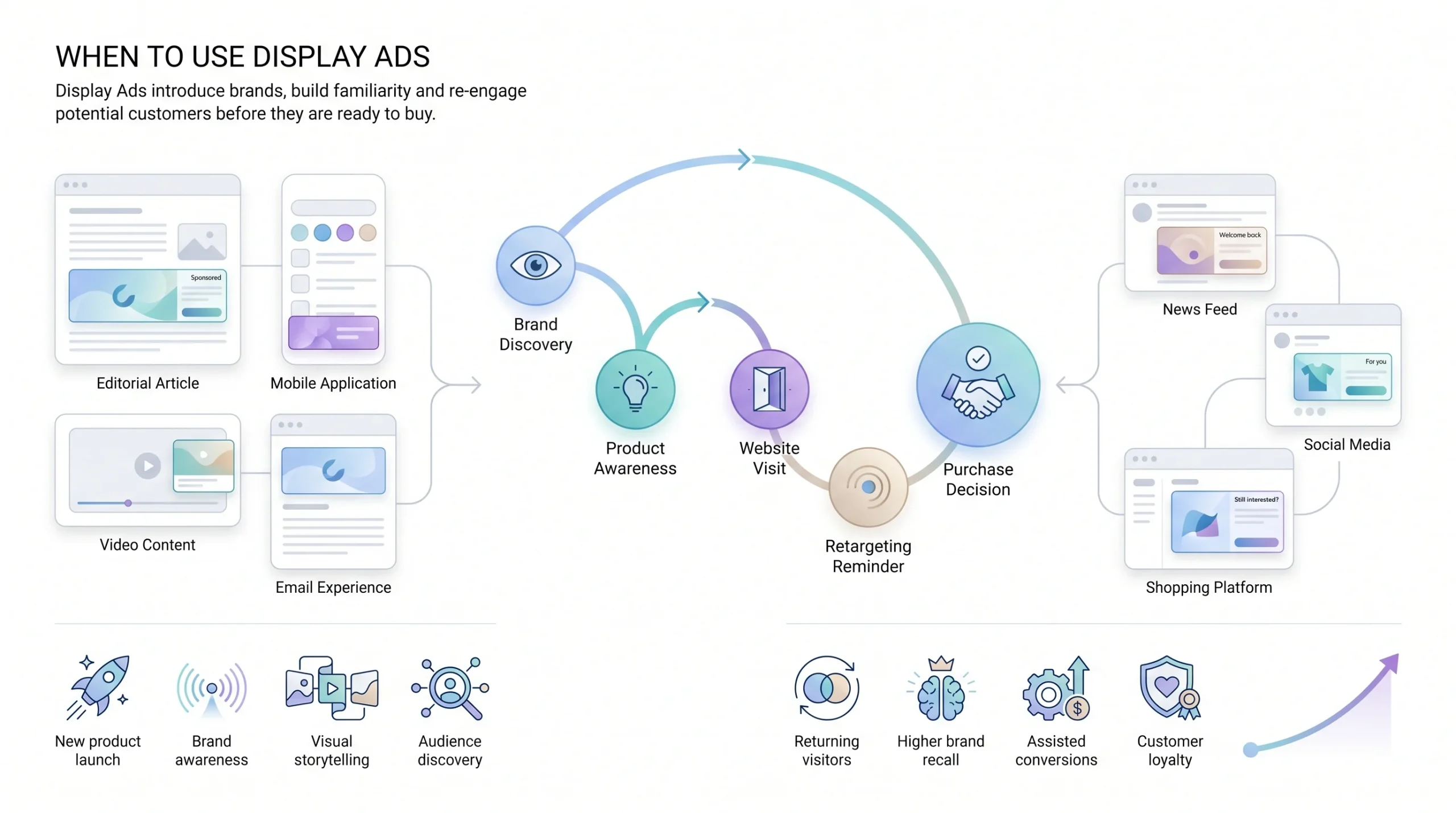
New product launches are a natural fit, since search volume for something nobody’s heard of yet is basically zero. Nobody’s searching for a product name that doesn’t exist in their vocabulary. Display gets the idea in front of people before they even know to look for it.
Visually driven industries benefit heavily too. Fashion, home decor, travel, anything where seeing the product does more convincing than reading about it. A well-shot image of a living room makeover is going to move someone further than three lines of text ever could.
Retargeting is arguably display’s strongest use case across the board. Someone visits a product page, doesn’t buy, and a well-placed display ad reminds them a few days later, sometimes with the exact product they were looking at. That’s not creating new demand, it’s recovering demand that already existed and almost converted.
There’s also a real case for using display before search has anything to work with, building general awareness in a category so that later, when the person does start searching, your brand name feels familiar rather than unknown.
One rule worth keeping in mind for display creative specifically: if the call-to-action and core message aren’t clear within about three seconds of looking at the ad, it’s not going to work. Nobody studies a banner ad. They glance, they decide, they move on.
Using Search and Display Together
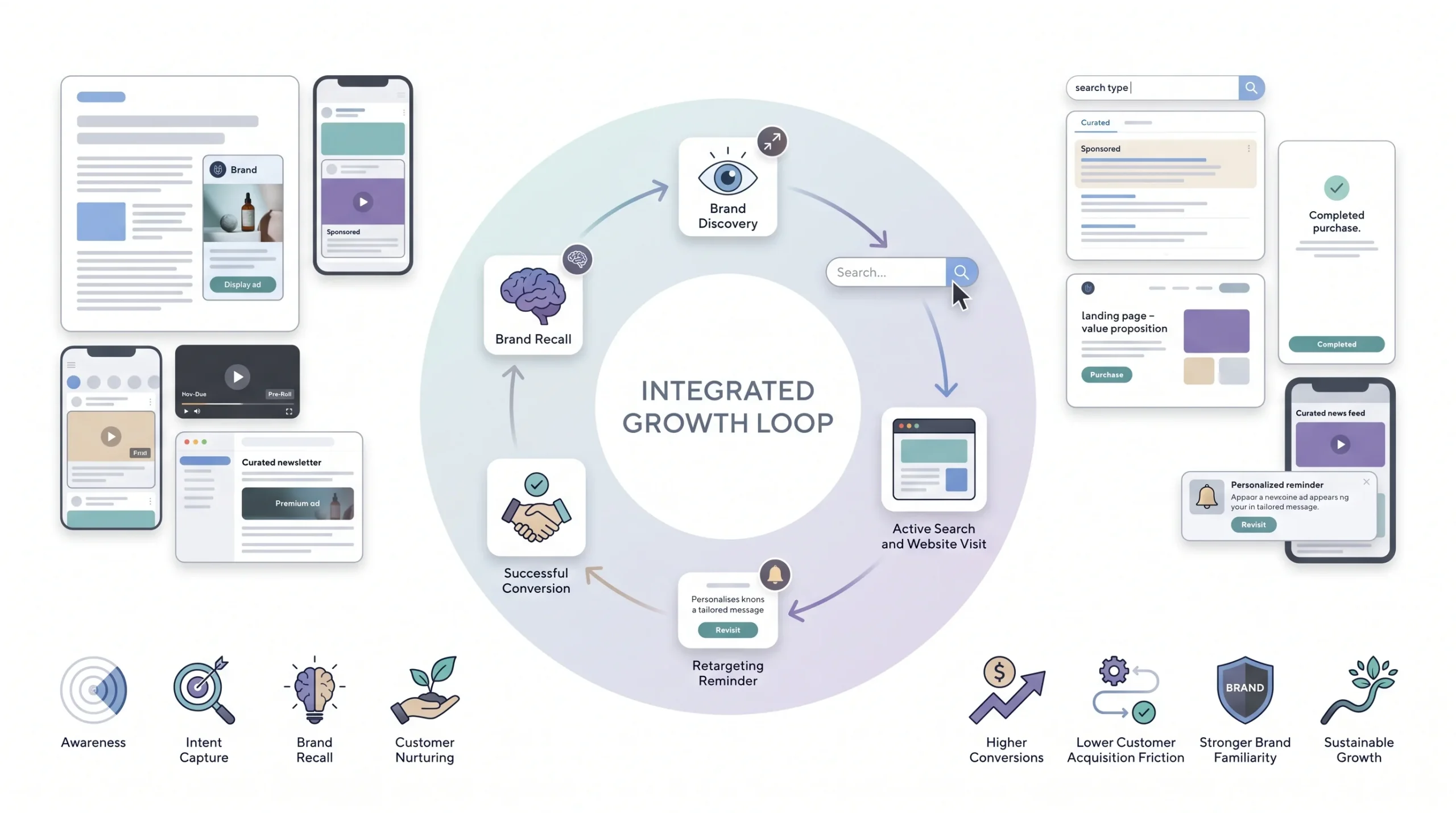
This is the part most beginner guides skip, and it’s honestly the most useful section for anyone trying to actually run a real strategy instead of picking one format and hoping.
The sequence usually looks something like this. Display runs first, building awareness across a broad but relevant audience, people who fit the target profile but haven’t shown any active interest yet. Some portion of that audience, having seen the brand once or twice, eventually turns that passive awareness into an active search. That’s where search ads step in, catching the query once it exists. And for everyone who clicked that search ad but didn’t convert, display comes back around with a retargeting ad, closing the loop on people who got close but needed one more nudge.
Picture a company selling reusable water bottles. They run display ads on outdoor and sustainability-focused websites, putting the product in front of people who care about that lifestyle even if they weren’t shopping that day. A chunk of that audience later searches “eco-friendly water bottle” or “sustainable drinkware,” and the search ad is right there waiting. Some of those searchers click through and buy immediately. Others browse the site, leave without purchasing, and get served a retargeting display ad a day or two later showing the exact bottle they looked at. That’s the full loop, awareness, capture, recovery, and it’s a lot more effective than any single format run alone.
Keep search and display in separate campaigns, not blended into one. They’re reading completely different intent signals, and mixing them muddies your performance data enough that you won’t be able to tell what’s actually working.
Quick Decision Framework
When the choice still feels murky, this usually clears it up fast.
| If your priority is… | Lean toward… |
|---|---|
| Fast, measurable leads right now | Search Ads |
| Building brand awareness at scale | Display Ads |
| Re-engaging people who already visited | Display Ads, specifically retargeting |
| Limited budget where every dollar needs to work hard | Search Ads |
| Launching something new with no existing search demand | Display Ads first, then Search once demand builds |
Conclusion
None of this is really a competition, even though the “vs” in the title makes it look like one. Search and display solve different problems at different points in someone’s decision to buy something. Search shows up when the demand already exists and somebody’s actively looking. Display shows up before that, trying to plant the idea or bring someone back who almost converted and didn’t. Most businesses that get real results aren’t choosing one over the other, they’re sequencing both based on where their budget is tightest and where their audience actually is in the buying process. Start with whichever format matches the demand that already exists today, and layer in the other once there’s a clear reason to.
FAQs
Which is cheaper, search ads or display ads?
Display is almost always cheaper per impression and typically per click too, since it’s built on a lower-intent, higher-volume model. Search costs more because you’re paying for people who are already close to converting.
Can you run search and display ads in the same Google Ads campaign?
Google Ads technically allows a “Search Network with Display select” option, but it’s generally not a good idea. The intent signals are too different, and blending them makes your performance data harder to read and optimize.
Do display ads work for B2B?
Yes, though usually more for awareness and retargeting than direct lead generation. B2B buying cycles tend to be long, so display’s strength in staying visible over time and retargeting site visitors fits naturally into that longer decision process.
What’s a good click-through rate for display ads compared to search ads?
Display click-through rates run far lower than search, often by a wide margin, and that’s expected, not a red flag. Comparing the two on the same scale is one of the most common misreads in paid advertising.
Should a beginner start with search or display?
If the budget is tight and there’s already existing search demand for the product, search usually delivers faster, more measurable results. Display makes more sense as a second step, or as a first step specifically when there’s no search demand yet to tap into.
Does Quality Score affect display ads the way it affects search ads?
Not in the same way. Search Quality Score is tied to keyword relevance, expected click-through rate, and landing page experience. Display doesn’t use that exact scoring system, but it does have its own version through Ad Rank and relevance signals tied to the audience and placement you’re targeting. Weak creative or a mismatched audience will still hurt performance and drive up cost, just through a different mechanism.
What’s the difference in creative control between the two formats?
Search gives almost no creative room, just headlines and description lines within strict character limits. Display gives a lot more room to work with: image sizing, video length, animation, interactive elements. That flexibility is an advantage for brand storytelling, but it also means more can go wrong if the design isn’t strong.
Can a small business with a limited budget still run display ads effectively?
Yes, mainly because CPMs are low enough that even a modest budget can buy real reach. The mistake small businesses make is spreading that budget across too broad an audience. Narrowing display targeting to a specific remarketing list, like past site visitors, tends to get far better results than trying to reach a huge cold audience with a small budget.
How is ROI measured differently for search versus display?
Search ROI is usually straightforward: cost per click, conversion rate, cost per acquisition, all tracked cleanly back to a specific keyword. Display ROI needs a wider lens, since a chunk of its value shows up in assisted conversions and view-through conversions rather than direct last-click sales. Judging display purely on last-click ROI almost always undersells what it’s actually doing.
Do search ads and display ads use the same keywords?
Not really. Search ads target keywords directly, matching a live user query. Display ads can use keyword-based contextual targeting to place ads on relevant pages, but that’s placement targeting, not query matching. The keyword strategy for each format needs to be built separately, not copy-pasted from one to the other.
How long does it take to see results from each format?
Search tends to show usable signal faster, often within a couple of weeks, since conversions tie directly back to a click. Display usually needs more time and more impressions before patterns become reliable, partly because a chunk of its impact shows up later through assisted conversions rather than immediate clicks.
Is remarketing the same thing as a display ad?
Remarketing is a targeting method, not a separate ad format. It usually runs through display (and sometimes video), showing ads specifically to people who already visited a site or app. So every remarketing ad is technically a display ad, but not every display ad is remarketing.