

So you’ve been staring at a number in some SEO tool for the past twenty minutes, wondering why your Domain Authority score is stuck at 18 while your competitor’s is sitting pretty at 45. Maybe you just installed the Moz toolbar for the first time and got a little obsessed. Maybe someone told you “you need higher DA to rank” and you took that at face value. Honestly? Most people who start caring about Domain Authority do so for the wrong reasons at first and figure out the right ones later.
Here’s the thing nobody tells beginners up front: Domain Authority isn’t something Google invented, uses, or even acknowledges as existing. It’s a third-party metric built by Moz, a software company, to help SEOs estimate how well a website might perform in search results. That’s it. Google doesn’t have a “DA field” somewhere in its ranking algorithm. And yet, the number still matters not because Google cares about it, but because it’s a decent shorthand for “how strong is this website’s backlink profile compared to others.”
That contradiction confuses a lot of people. You’ll see forum threads where someone insists DA is meaningless, and right below it, someone else insists it’s the most important number in SEO. Both of them are half right. This guide exists to sort through that mess and give you something you can actually use not just a definition, but a real understanding of where the number comes from, what moves it, and what to do if you want yours to go up.
Whether you’re running a blog that gets 200 visitors a month, managing an ecommerce store trying to compete with Amazon listings, or you’re an agency explaining metrics to a client who read one article about “Domain Authority 50+ or bust,” this guide is for you. We’re going to walk through what DA actually is, how it’s calculated, why it still matters even though Google ignores it, and what specific things you can do starting today to move that number in the right direction.
What You Will Learn in This Guide
- What Domain Authority actually is and where it came from
- Why Google doesn’t use DA as a ranking factor, and why the metric still matters anyway
- How the DA score gets calculated behind the scenes
- What factors move the needle, and what doesn’t matter as much as people think
- How to read the DA scale and figure out what’s “good” for your situation
- The difference between DA, DR, Authority Score, and other competing metrics
- Seven practical strategies to increase your Domain Authority over time
- Common mistakes that quietly kill DA growth
- A realistic timeline for seeing results
- Industry benchmarks so you know what you’re actually up against
- Whether you can rank well with low DA (spoiler: yes, and it happens constantly)
- A 90-day action plan you can actually follow
This isn’t going to be another surface-level explainer that tells you “backlinks are important” and calls it a day. We’re getting into the mechanics.
What Is Domain Authority?
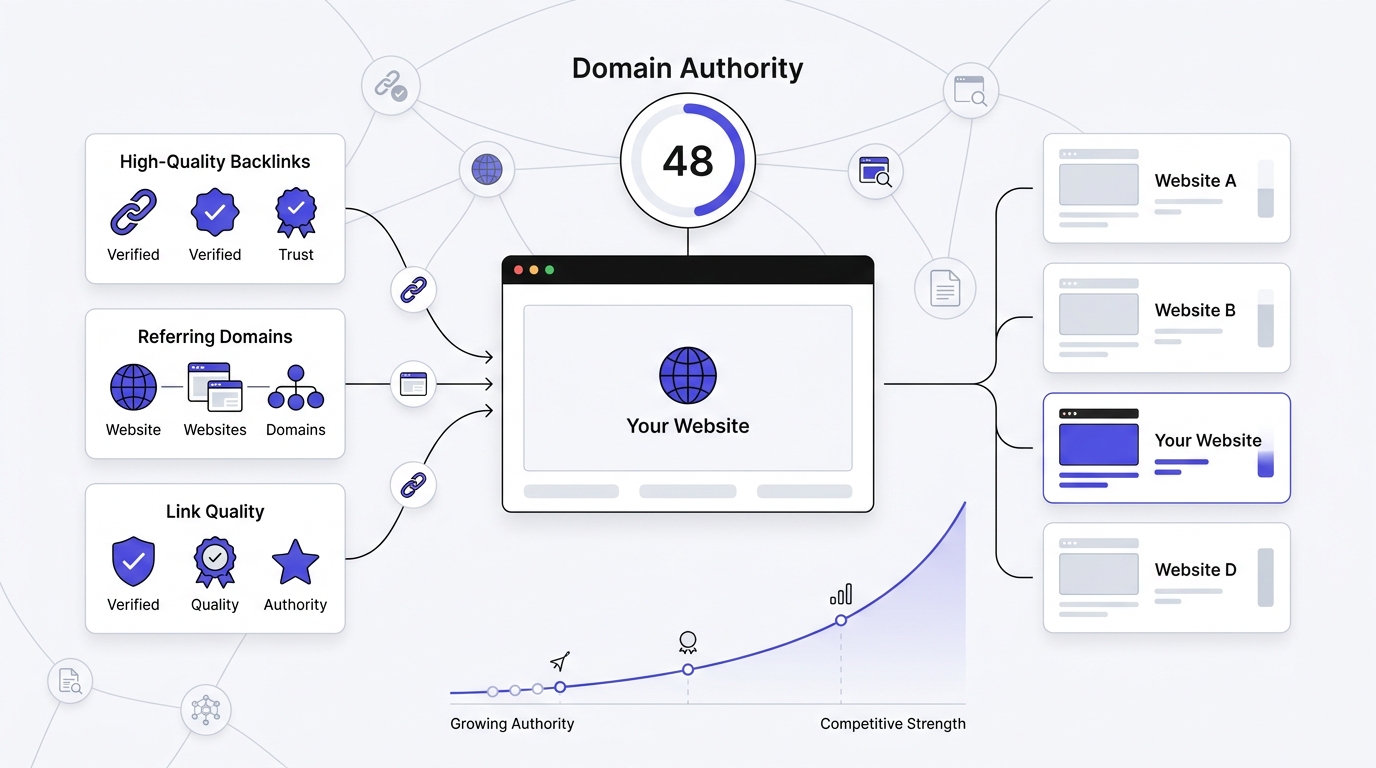
Domain Authority (DA) is a search engine optimization (SEO) metric that predicts how likely a website is to rank in search engine results compared to other websites. It is measured on a scale from 1 to 100, with higher scores indicating a stronger ability to compete for organic rankings. While Domain Authority does not guarantee top positions on Google, it serves as a useful benchmark for evaluating the overall strength of a domain.
Domain Authority considers multiple SEO factors rather than relying on a single element. These include the quality and quantity of backlinks, the diversity of referring domains, the overall trustworthiness of linking websites, and the authority of the site’s pages. Websites with a strong backlink profile and consistent SEO practices generally have higher Domain Authority scores.
Simple Explanation
Domain Authority is a score from 1 to 100 that predicts how likely a website is to rank in search engine results. Higher score, stronger prediction. It was built by Moz, and it’s calculated using machine learning that looks at a huge range of factors — mostly related to backlinks — and spits out a number.
Think of it like a credit score, but for your website’s link profile instead of your finances. A credit score doesn’t guarantee you’ll get approved for a loan, but lenders use it as a quick signal. DA works the same way for SEOs trying to gauge competitive strength.
Technical Definition
More precisely, Domain Authority is a logarithmic score based on data from Moz’s Link Explorer index. It factors in the number of linking root domains and the total number of inbound links, then runs that data through a machine-learned algorithm trained to correlate with actual Google search results. The score isn’t linear — going from DA 20 to DA 30 is a lot easier than going from DA 70 to DA 80. That’s the logarithmic part, and it trips people up constantly because they expect steady, even progress.
Who Created Domain Authority?
Domain Authority was developed by Moz, one of the leading companies in the SEO industry. Moz introduced the metric to help marketers estimate the ranking potential of websites without relying on Google’s internal algorithms, which are not publicly available.
The score is generated using machine learning models that analyze numerous ranking signals, primarily focusing on backlinks and domain strength. Moz continuously updates its Domain Authority algorithm to better reflect changes in Google’s search ecosystem and improve the accuracy of its predictions.
History of Moz Domain Authority
Moz introduced Domain Authority back in 2004 under a different name — it went through several iterations before becoming what SEOs recognize today. The tool grew out of Moz’s broader mission to make SEO data accessible to people who weren’t Google engineers. Before metrics like DA existed, SEOs were basically guessing at competitive strength based on gut feel and whatever backlink data they could scrape together manually.
Why Moz Introduced the Metric
Moz built DA because there was a real gap in the market. SEOs needed a fast way to compare websites without diving into raw backlink spreadsheets every single time. So Moz took its own crawl data, ran it through a predictive model, and gave the industry a single number to argue about for the next two decades. Funny enough, that’s basically all it ever was — a comparison tool, not a ranking factor. But the industry ran with it, and now it’s baked into nearly every SEO conversation.
Is Domain Authority a Google Ranking Factor?
One of the biggest misconceptions in SEO is that Google uses Domain Authority as a ranking factor. The answer is no.
Google has repeatedly stated that it does not use Moz’s Domain Authority or any third-party authority metric when determining search rankings. Google’s algorithm evaluates hundreds of ranking signals, including content quality, relevance, page experience, backlinks, user intent, and many other factors.
However, Domain Authority often correlates with better rankings because the factors that increase DA—such as earning high-quality backlinks and building website credibility—are also important for Google’s ranking algorithm.
Rather than treating Domain Authority as a direct ranking signal, consider it a benchmarking tool that helps measure your website’s competitive strength relative to other domains in your industry.
Google’s Official Position
Nope. Google has said this directly, multiple times, through people like John Mueller. Domain Authority is not part of Google’s algorithm. Google doesn’t use it, doesn’t reference it internally, and doesn’t factor it into rankings in any way. If you’ve been told your site “needs a DA 40 to rank on page one,” that’s not how it works, and whoever told you that either misunderstood the metric or was trying to sell you a link package.
Why the Confusion Exists
So why does everyone act like it matters? Because DA correlates with ranking ability, even though it doesn’t cause it. Websites with strong backlink profiles tend to rank well. DA measures backlink strength. So high-DA sites often rank well too — but that’s correlation, not causation. It’s the same logic error as saying umbrellas cause rain because people carry them when it’s raining.
Domain Authority vs Google’s Ranking Algorithms
Google’s actual ranking system looks at hundreds of factors: content relevance, page experience, backlinks (yes, but evaluated very differently than Moz does it), site structure, user intent matching, freshness, and a pile of stuff nobody outside Google fully understands. DA is Moz’s attempt to model a small slice of that — mostly the backlink piece — using publicly available crawl data. It’s an approximation, built by a third party, based on incomplete information compared to what Google actually sees.
Why Domain Authority Still Matters
Even though Domain Authority is not used by Google, it remains valuable for SEO planning and performance analysis.
A higher Domain Authority often indicates that a website has earned quality backlinks, established trust, and built a strong online presence. These characteristics generally contribute to better search performance over time.
Competitive Benchmarking
Even though Google ignores it, DA is genuinely useful for sizing up competitors. If you’re entering a niche where every top-ranking site has a DA above 50, that tells you something real about the difficulty level. You’re not going to outrank an established authority site with a brand-new blog and twelve backlinks, and DA gives you a fast way to see that before you waste six months finding out the hard way.
Link Building Evaluation
When you’re doing outreach for backlinks, DA is a quick filter. A link from a DA 60 site is generally going to carry more weight than a link from a DA 8 site with three pages indexed. It’s not perfect, but it beats guessing, and it’s become a standard shorthand that most link builders and site owners already understand.
Website Trust Indicator
DA also acts as a rough trust signal. Sites that have earned links over years, built real audiences, and avoided spammy backlink schemes tend to have healthier DA scores. It’s not a perfect trust meter, but a site that jumped from DA 5 to DA 40 in two months probably did something sketchy to get there.
SEO Progress Tracking
For your own site, tracking DA over months gives you a general sense of whether your SEO efforts are working. It shouldn’t be your only KPI — organic traffic and rankings matter more — but watching DA creep upward alongside those other metrics is a decent confirmation that you’re building something real.
How Domain Authority Is Calculated
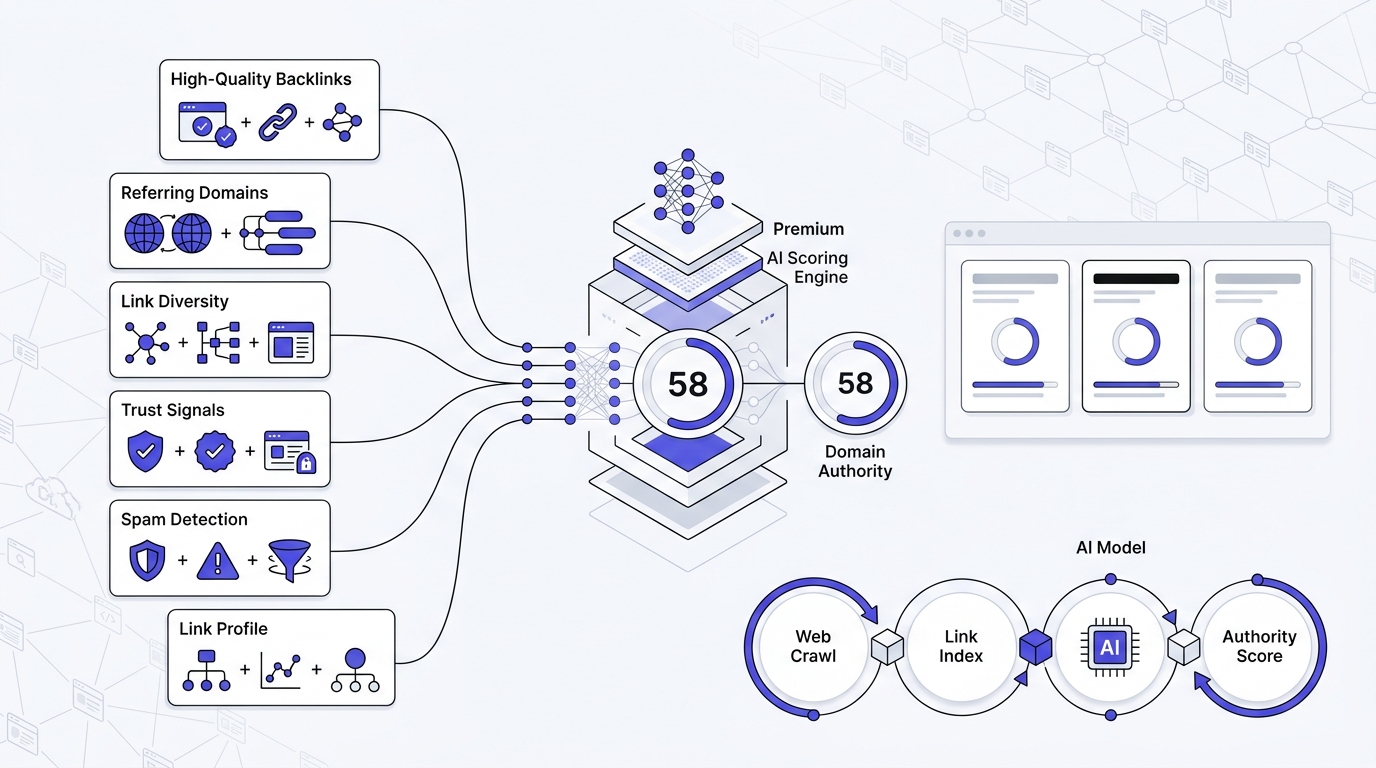
Domain Authority is calculated using a complex machine learning model that evaluates multiple signals related to a website’s backlink profile and overall authority.
The Machine Learning Model Behind DA
Moz doesn’t manually assign these scores. They run a machine learning model trained on their Link Explorer index, which crawls a huge chunk of the web looking for links. The model was trained to predict how well a site would rank based on patterns found in actual search results. Every time Moz updates its index or refines the model, DA scores shift slightly across the board — which is why your score can fluctuate even if you haven’t changed anything on your site.
Factors That Influence Domain Authority
Quality of Backlinks — Not all links are equal. A link from a respected publication carries more weight than a link buried in a low-quality directory nobody visits.
Number of Referring Domains — This matters more than raw link count. Ten links from ten different websites beats a hundred links from the same website, every time.
Link Diversity — A natural link profile includes links from different types of sites: news outlets, blogs, forums, .edu sites, industry publications. A profile that’s 90% from one source type looks manufactured.
Website Trust Signals — Age, consistency, and the overall trustworthiness of the domains linking to you all factor in.
Spam Score — Moz calculates a separate Spam Score that feeds into how DA gets weighted. Sites linking to you from spammy neighborhoods can actually drag your score down.
Link Profile Strength — The overall combination of everything above, run through the model.
Overall Website Authority — A composite of all these signals that Moz translates into that single 1–100 number.
Factors That Do NOT Directly Affect Domain Authority
This is where a lot of beginners get tripped up, so let’s be blunt about it.
Social Media Followers don’t move DA. You can have 500,000 Instagram followers and a DA of 12. Social signals aren’t part of the backlink-based model.
Paid Ads don’t move DA either. Running Google Ads or Facebook campaigns has zero direct impact on your link profile, so it has zero direct impact on DA.
Website Age Alone isn’t a factor. An old, neglected domain with no backlinks won’t outscore a newer site with a strong link profile. Age helps indirectly — older sites have had more time to accumulate links — but age by itself does nothing.
Number of Blog Posts Alone doesn’t matter either. You can publish 500 posts and still sit at DA 15 if nobody’s linking to any of them.
Traffic Alone isn’t a factor. Traffic and DA often move together because good content attracts both visitors and links, but traffic itself isn’t part of the calculation.
Understanding the Domain Authority Scale
Domain Authority uses a logarithmic scale ranging from 1 to 100. This means increasing your score becomes progressively more difficult as you move higher.
DA Score Ranges Explained
Here’s where the logarithmic thing really matters. Moving from 1–10 is genuinely easy — almost any live website with a handful of links can get there. Moving from 90–100 is nearly impossible; that top tier is reserved for sites like Wikipedia, Google itself, and major government or educational domains.
1–10: Brand-new websites, personal blogs with almost no backlinks, freshly launched businesses.
11–20: Sites starting to accumulate a small handful of legitimate backlinks. Still early stage.
21–30: A reasonable foothold. Small businesses and niche blogs commonly sit here after a year or two of consistent effort.
31–40: Solid mid-tier authority. You’re starting to compete seriously in less crowded niches.
41–50: Respectable authority. This range is where a lot of established small-to-medium business sites land after years of work.
51–60: Strong authority. Sites here typically have consistent link building history and solid content libraries.
61–70: This is where you start seeing well-known regional or industry publications, larger ecommerce brands, and established SaaS companies.
71–80: Major brands, large media outlets, well-funded companies with years of digital PR behind them.
81–90: National news sites, huge platforms, category-leading brands.
91–100: The very top — Wikipedia, Google, Facebook, major government domains. Almost nobody outside that tier gets here, and honestly, you don’t need to.
What Is a Good Domain Authority?
This depends entirely on context, and anyone who gives you a flat “you need DA 30” answer without asking about your niche is guessing.
Small Business Websites — DA 15–25 is completely normal and often sufficient for local competition.
Blogs — Anywhere from 20–40 depending on niche competitiveness and how long the blog has been actively building links.
Ecommerce Stores — Often lower than people expect, DA 20–35, because product pages don’t naturally attract editorial links the way content does.
SaaS Websites — Typically higher, DA 40–60, because SaaS companies tend to invest heavily in content marketing and digital PR.
Enterprise Websites — DA 60+ is common, backed by years of brand recognition, press coverage, and massive content libraries.
Domain Authority vs Other SEO Metrics
Domain Authority is just one of many metrics used to evaluate a website’s SEO performance. It should never be viewed in isolation.
Domain Authority (DA): Moz’s proprietary metric. 1–100 scale, logarithmic, based on their own crawl index.
Domain Rating (DR): Ahrefs’ equivalent metric. Also 1–100, but calculated differently using Ahrefs’ own massive backlink index, which many SEOs consider larger and more frequently updated than Moz’s. DR tends to run higher than DA for the same website, which confuses people who compare the two side by side and assume something’s broken.
Authority Score (Semrush): Semrush’s version of the same idea, combining backlink data with organic traffic estimates and spam signals into one composite score.
Trust Flow (Majestic): Majestic takes a different angle — measuring the quality of sites linking to you based on how “trustworthy” those linking sites are, rather than just raw quantity.
Citation Flow: Also from Majestic, this measures link quantity and influence without factoring in quality the way Trust Flow does. The gap between Citation Flow and Trust Flow tells you a lot — a huge gap usually signals spammy link building.
Page Authority (PA): Moz’s page-level equivalent of DA, predicting how well a specific page (not the whole domain) will rank.
URL Rating (UR): Ahrefs’ page-level equivalent of DR.
Which Metric Should You Trust?
Honestly, none of them in isolation. Each tool crawls a different slice of the web, so scores will never match perfectly across platforms. The smart move is picking one or two tools and tracking relative change over time, rather than obsessing over the exact number from any single source.
Domain Authority vs Page Authority
Although Domain Authority and Page Authority are related, they measure different aspects of a website.
Domain Authority (DA) predicts the ranking strength of an entire domain or subdomain.
Page Authority (PA) predicts the ranking potential of an individual webpage.
For example, a website may have a Domain Authority of 50, while one of its blog posts has a Page Authority of 28 and another has a Page Authority of 45.
Key Differences
DA measures the strength of the entire domain. PA measures the strength of one specific page. A site can have a strong overall DA while individual pages have weak PA if those pages haven’t earned their own backlinks.
When to Focus on DA
Use DA when you’re evaluating a website as a whole — deciding whether to guest post there, comparing your site to a competitor’s overall strength, or tracking long-term SEO progress.
When to Focus on PA
Use PA when you care about a specific page ranking — say, a product page or a cornerstone blog post you’re trying to push up the rankings. A page can outrank competitors even on a lower-DA site if that specific page has earned strong, relevant backlinks.
Real-Life Examples
You’ll see this constantly with news sites. A major newspaper’s homepage might sit at DA 90, but a random article buried three years deep might have a PA of 20 because nobody’s ever linked to it directly. Meanwhile, a small niche blog at DA 25 might have one specific guide with a PA of 45 because it became the go-to resource everyone links to.
What Influences Domain Authority?
High-Quality Backlinks
Editorial Links — Links earned naturally because someone found your content valuable enough to reference it. These carry the most weight.
Guest Posts — Contributing content to other sites in exchange for a byline link. Still effective when done on relevant, quality sites — not so much when it’s spammy mass guest posting.
Resource Pages — Getting listed on curated “best resources” pages within your niche.
Digital PR — Getting coverage from journalists and publications through newsworthy stories, data, or expert commentary.
Referring Domains
Why Unique Domains Matter More Than Multiple Links — Ten links from ten different domains will move DA more than fifty links from a single domain. Google (and Moz’s model) treats diversity as a stronger trust signal than volume from one source.
Link Relevance
Links from sites in your industry or closely related niches carry more weight than random, unrelated links. A cooking blog getting a link from a food publication matters more than the same blog getting a link from a car insurance site.
Website Trustworthiness
Sites with a clean, consistent history — no spammy redirects, no shady link schemes — build trust over time, which the model picks up on.
Technical SEO Health
A site riddled with broken links, slow load times, or crawl errors makes it harder for Moz’s bots (and Google’s) to properly index and evaluate your content, which indirectly affects authority accumulation.
Internal Linking
How you link between your own pages affects how link equity flows through your site, which influences page-level authority and, cumulatively, domain-level authority.
Content Quality
Nobody links to thin, recycled content. Original, useful, well-researched content is what earns backlinks in the first place — it’s the fuel behind everything else on this list.
Brand Mentions
Even unlinked brand mentions can contribute to broader trust and authority signals over time, especially as search engines get better at recognizing entity-based signals beyond just hyperlinks.
User Experience Signals
While not a direct DA factor, sites with strong UX tend to retain visitors longer and earn more natural shares and links, which snowballs into authority growth indirectly.
How to Check Your Domain Authority
Checking your Domain Authority is straightforward using several SEO tools.
Moz Link Explorer: The original source. Free with a Moz account, gives you your DA score straight from the people who built the metric.
Ahrefs: Won’t show DA directly since it’s a competing tool, but gives you Domain Rating, which most SEOs treat as a close equivalent for comparison purposes.
Semrush: Shows Authority Score, their own composite metric.
Ubersuggest: Offers a free-tier version of domain authority checking, useful for quick spot checks without a subscription.
Small SEO Tools: Free, fast, but often less accurate since the data isn’t as frequently refreshed as the paid platforms.
SEO Review Tools: Another free option, decent for casual checking but not something to rely on for serious competitive analysis.
Which Tool Is Most Accurate?
None of them are “accurate” in an absolute sense because none of them see what Google sees. Moz Link Explorer is the authoritative source for DA specifically, since it’s their metric. If you want the broadest, most frequently updated backlink index in general, most SEOs lean toward Ahrefs. Pick one primary tool and stick with it for consistent tracking.
Step-by-Step Guide to Improve Domain Authority
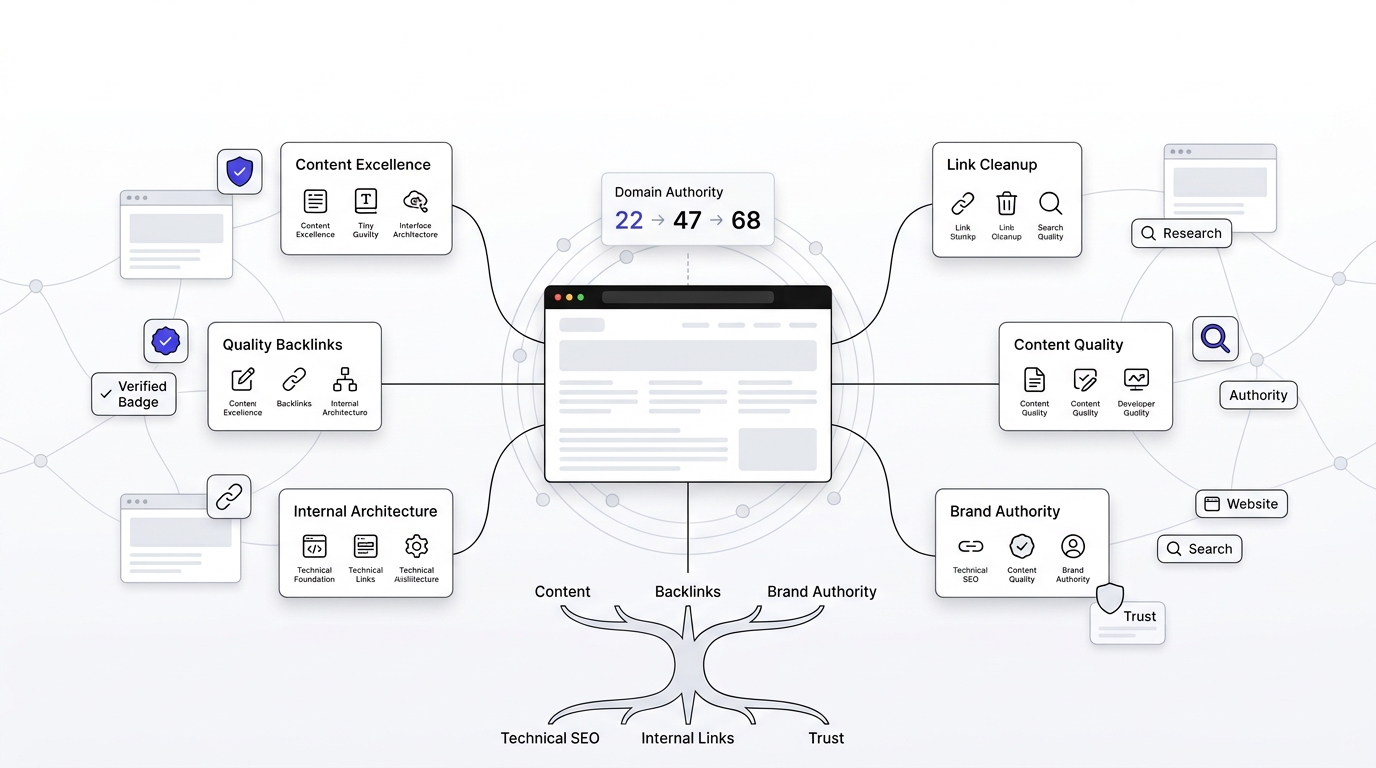
Improving Domain Authority requires a consistent, long-term SEO strategy focused on increasing your website’s trust and authority.
Strategy 1: Create High-Quality Content
Why Content Drives Authority — Every single backlink strategy starts here. Nobody links to boring, shallow content. Content is the reason people have something worth linking to in the first place.
Pillar Pages — Long, comprehensive resources that cover a topic thoroughly enough to become the default reference point in your niche.
Topic Clusters — Groups of related supporting content that link back to a central pillar page, signaling depth and topical relevance.
Evergreen Content — Content that stays relevant for years, continuing to earn links long after publication instead of going stale in a month.
Original Research — Surveys, studies, and proprietary data are link magnets. Journalists and bloggers love citing original numbers instead of recycling the same stats everyone else uses.
Case Studies — Real results, real numbers, real names when possible. These earn trust and links because they’re specific instead of generic.
Industry Statistics — Compiling and updating stat roundups for your niche is a reliable, repeatable way to earn ongoing citations.
Strategy 2: Build High-Quality Backlinks
White-Hat Link Building — Earning links through legitimate outreach, relationship building, and genuinely valuable content. Slower, but it’s the only approach that holds up long term.
Guest Posting — Still works when you’re contributing real value to relevant, reputable sites — not blasting the same generic article to fifty low-quality blogs.
HARO Alternatives — Platforms like Connectively (the rebrand of HARO), Qwoted, and Featured let you respond to journalist queries and earn press mentions with links.
Broken Link Building — Finding dead links on relevant sites and suggesting your content as a replacement. Old-school, but it still works because it genuinely helps the site owner fix something broken.
Link Reclamation — Finding unlinked brand mentions and reaching out to ask for a link to be added. Low-hanging fruit that a lot of sites never bother collecting.
Resource Pages — Reaching out to sites with curated resource lists and asking to be included, assuming your content genuinely fits.
Skyscraper Technique — Finding content that already earned a lot of links, creating something noticeably better, then reaching out to the sites linking to the original.
Digital PR — Building newsworthy campaigns, data stories, or expert commentary that journalists want to cover and cite.
Expert Roundups — Either contributing to other people’s roundups (earning a link) or hosting your own (earning links from every contributor who shares it).
Podcast Appearances — Guest appearances usually come with a link back to your site in the show notes, plus exposure to a new audience.
Link Building Mistakes to Avoid
Buying Links — Google can detect unnatural patterns, and paid link schemes risk manual penalties that tank your rankings entirely, DA number or not.
Private Blog Networks (PBNs) — Networks of fake or low-quality sites built purely to funnel links. Extremely risky, and Google actively hunts for these.
Spam Directories — Mass-submitting to low-quality directories does nothing for authority and can actually hurt your spam score.
Automated Link Building — Software that auto-generates hundreds of backlinks overnight is a red flag both to Google and to Moz’s spam detection model.
Strategy 3: Improve Internal Linking
Why Internal Links Matter — They distribute authority from your strongest pages to weaker ones, helping your whole site rise together instead of just isolated pages.
Topic Clusters — Structuring content around clusters helps search engines understand depth and relevance, which supports topical authority alongside link authority.
Anchor Text Best Practices — Use descriptive, natural anchor text instead of “click here” repeated a hundred times. It helps both users and search engines understand what the linked page is about.
Link Equity Distribution — Make sure your most authoritative pages link out to newer or weaker pages, so authority flows through your site instead of pooling in one spot.
Strategy 4: Improve Technical SEO
Website Speed — Slow sites frustrate users and crawlers alike. Faster load times support better indexing, which supports authority growth over time.
Mobile Friendliness — With mobile-first indexing, a site that doesn’t work well on phones is fighting an uphill battle before content even enters the equation.
HTTPS — Basic trust signal at this point. Not having it in 2026 is a red flag.
Crawlability — If bots can’t crawl your site properly, they can’t index your content, and unindexed content can’t earn links or authority.
XML Sitemap — Helps search engines find and understand your site structure efficiently.
Robots.txt — Make sure you’re not accidentally blocking important pages from being crawled.
Structured Data — Helps search engines understand context, which can improve visibility in ways that indirectly support link earning.
Core Web Vitals — Google’s page experience metrics. Poor scores here won’t tank DA directly, but they hurt overall SEO performance, which affects everything downstream.
Strategy 5: Remove Toxic Backlinks
What Are Toxic Links? — Links from spammy, irrelevant, or penalized sites that can drag down trust signals and, in extreme cases, trigger manual actions from Google.
How to Find Them — Use tools like Moz, Ahrefs, or Semrush to audit your backlink profile and flag suspicious links based on spam score, relevance, and site quality.
Disavow Tool Basics — Google’s Disavow Tool lets you tell Google to ignore specific backlinks when evaluating your site. Use it carefully.
When You Should NOT Disavow Links — Most links, even mediocre ones, don’t need disavowing. Google is generally good at ignoring low-quality links on its own. Disavowing too aggressively can actually do more harm than the links themselves. Reserve it for clear, sustained spam attacks or paid link schemes tied directly to your site.
Strategy 6: Improve Content Quality
E-E-A-T — Experience, Expertise, Authoritativeness, Trustworthiness. Google’s framework for evaluating content quality, especially for topics that affect health, finances, or safety.
Experience — Showing you’ve actually done the thing you’re writing about, not just researched it secondhand.
Expertise — Demonstrating genuine knowledge depth, not surface-level summaries.
Authoritativeness — Being recognized by others in your field as a credible source.
Trustworthiness — Accuracy, transparency, and a track record that holds up under scrutiny.
Content Freshness — Updating old content with current information instead of letting it rot, especially for topics that change over time.
Search Intent — Matching what people actually want when they type a query, instead of writing what you assume they want.
Comprehensive Coverage — Covering a topic thoroughly enough that readers don’t need to bounce to five other sites to get their answer.
Strategy 7: Build Brand Authority
Become a Recognized Expert — Speaking at events, contributing to publications, building a presence beyond just your own website.
Earn Mentions from Trusted Websites — Even without a direct link, being talked about by credible sources builds broader authority signals.
Publish Original Research — Worth repeating here because it’s one of the single most effective ways to earn both links and brand recognition simultaneously.
Build Community Trust — Engaging genuinely with your audience, industry peers, and niche communities builds the kind of organic reputation that eventually turns into backlinks nobody had to ask for.
How Long Does It Take to Improve Domain Authority?
There is no fixed timeline for increasing Domain Authority because progress depends on factors such as your website’s current authority, competition, backlink acquisition, and content quality.
For newer websites, noticeable improvements may take several months. More established websites may require sustained effort over a longer period to achieve meaningful gains, especially because the Domain Authority scale becomes more challenging at higher levels.
Consistent publication of valuable content, ethical link-building, and technical optimization are essential. Rather than expecting rapid increases, focus on steady growth and overall improvements in your website’s SEO performance.
New Websites: Brand-new sites often see DA jump from 1 to somewhere around 10-15 within the first few months just from basic indexing and a handful of natural early links. That early jump feels fast, but it’s the easy part of the curve.
Growing Websites: Sites actively building content and earning links typically see steady, gradual growth — a few points every few months — assuming consistent effort.
Established Websites: Once you’re past DA 40 or so, growth slows considerably. Getting from 40 to 50 might take a year or more of sustained, high-quality link building and content work.
Factors That Affect Growth Speed: Niche competitiveness, content publishing frequency, backlink quality, technical health, and how aggressive your outreach efforts are — all of these speed up or slow down the timeline. There’s no universal number of months that applies to every website.
What Is a Good Domain Authority by Industry?
A “good” Domain Authority varies significantly across industries because different niches have different levels of competition.
For example, local businesses may compete effectively with relatively modest authority scores, while industries such as finance, insurance, or technology often require much stronger domain authority due to intense competition.
Instead of comparing your score with large global brands, benchmark your Domain Authority against businesses targeting the same audience and keywords. If your score is similar to or higher than your direct competitors, you are generally in a strong position to compete.
Remember that Domain Authority is relative, not absolute. Context matters far more than the number itself.
Local Businesses: DA 10–25 is typical and often sufficient for ranking well in local search results, since local SEO leans heavily on Google Business Profile signals and local citations rather than pure domain authority.
E-commerce: DA 20–40 is common, though top-tier ecommerce brands with strong content marketing can push well beyond that.
SaaS: DA 40–65 tends to be the competitive range, since SaaS companies typically invest heavily in blogs, comparison content, and digital PR.
Affiliate Marketing: Wildly variable, but competitive niches often require DA 30+ just to have a shot at ranking for anything commercially valuable.
News Websites: Often DA 70+ due to constant natural link earning from being cited as a primary source.
Education: Educational institutions frequently sit in the DA 60-90 range thanks to .edu domain trust and decades of accumulated academic linking.
Healthcare: DA 30-60, typically, with major hospital systems and government health sites pushing higher.
Finance: Highly competitive, often requiring DA 40+ to compete for valuable commercial keywords.
Domain Authority Benchmarks
DA 10–20
Goals — Get indexed properly, start earning your first handful of legitimate backlinks, establish basic technical SEO health.
Priorities — Content foundation and technical cleanup before aggressive link building.
DA 20–40
Growth Strategies — Consistent content publishing, targeted outreach, guest posting on relevant sites, fixing any lingering technical issues.
DA 40–60
Competitive SEO — Digital PR campaigns, original research, deeper content clusters, more selective and strategic link building.
DA 60+
Maintaining Authority — At this level, it’s less about aggressive growth and more about protecting what you’ve built — monitoring for toxic links, maintaining content freshness, and continuing brand-building efforts.
Can You Rank Without High Domain Authority?
Yes. A high Domain Authority is not a requirement for achieving strong search rankings.
Many websites with relatively low authority rank well because they target less competitive keywords, create highly relevant content, satisfy user intent, and maintain strong technical SEO.
Google ranks individual pages based on their relevance and usefulness, not simply on the authority of the entire domain. A well-optimized page that addresses a specific search query effectively can outperform pages from more authoritative websites.
For newer websites, focusing on niche topics, long-tail keywords, and high-quality content often produces better results than chasing Domain Authority alone.
Examples of Low-DA Websites Ranking Well
Yeah, absolutely, and it happens all the time. Niche blogs with DA 20 regularly outrank corporate sites with DA 50 for specific long-tail queries because the smaller site nailed search intent and covered the topic better. DA gives you a general strength indicator, not a hard ceiling.
Importance of Search Intent
If your content answers exactly what someone’s searching for, better than anyone else has, you have a real shot regardless of your domain’s overall authority level.
Importance of Topical Authority
Being the go-to resource on a narrow topic often beats being a generalist site with higher overall DA but shallow coverage of that specific subject.
Long-Tail Keywords
Less competitive, more specific search terms are where low-DA sites have the best shot at ranking, since fewer high-authority competitors are targeting them directly.
Content Quality Over Metrics
At the end of the day, Google is trying to serve the best answer, not the highest DA site. Quality content that genuinely satisfies the query wins more often than beginners expect.
Domain Authority Myths
DA Is a Google Ranking Factor — Nope, covered this already, but it bears repeating because this myth refuses to die.
Higher DA Guarantees Rankings — It doesn’t. Plenty of high-DA pages sit on page three because the content itself is weak or irrelevant to the query.
More Backlinks Always Increase DA — Only if those backlinks are from quality, diverse, relevant domains. Spammy links can actually hurt more than help.
DA Improves Overnight — It doesn’t, and anyone selling you a service that promises overnight DA gains is probably using tactics that will hurt you later.
Website Age Automatically Increases DA — Age alone means nothing without accumulated links and trust signals.
Paid Ads Improve DA — They don’t touch the metric at all, directly.
Social Signals Directly Increase DA — They don’t factor into the calculation, though social visibility can indirectly lead to more natural backlinks over time.
Monthly Domain Authority Improvement Checklist
Content — Publish at least a few pieces of genuinely useful, well-researched content. Update older posts that have gone stale.
Technical SEO — Run a crawl audit, fix broken links, check page speed, confirm mobile usability.
Internal Linking — Add links from strong pages to newer or underperforming ones. Review anchor text for natural variety.
Backlink Acquisition — Set a realistic monthly outreach target. Even five quality links a month adds up significantly over a year.
Competitor Analysis — Check what your competitors are earning links from that you’re not, and figure out why.
Performance Monitoring — Track DA, organic traffic, and keyword rankings together, not DA in isolation.
Free Tools to Improve Domain Authority
Google Search Console — Essential for understanding how Google actually sees your site, including indexing issues and search performance.
Google Analytics 4 — Tracks traffic patterns that help you understand which content is working.
Moz Link Explorer — Free tier available for checking DA and basic backlink data.
Ahrefs Webmaster Tools — Free version offering backlink and site audit data for verified site owners.
Google PageSpeed Insights — Free speed and Core Web Vitals testing.
Screaming Frog SEO Spider (Free) — Crawls up to 500 URLs free, useful for smaller sites doing technical audits.
Bing Webmaster Tools — Often overlooked, but gives additional backlink and indexing data beyond just Google’s ecosystem.
Google Trends — Helps identify content opportunities based on rising search interest.
SEO Minion — Browser extension for quick on-page SEO checks, broken link detection, and SERP analysis.
Case Study: Improving Domain Authority from 10 to 30
Initial Website Condition
Picture a small niche blog, about eighteen months old, DA sitting at 10, maybe 40 backlinks total from a handful of low-effort directory submissions and a couple of guest posts nobody really planned strategically.
SEO Strategy Implemented
The owner shifted focus toward publishing fewer, more comprehensive pieces instead of churning out short posts weekly. Alongside that, they started a consistent outreach cadence — five to ten personalized pitches per week to relevant blogs and resource pages in their niche.
Content Plan
Two comprehensive pillar guides per month, supported by three to four shorter cluster posts linking back to those pillars, all built around actual search intent research instead of guesswork.
Link Building Campaign
Focused almost entirely on relevant, niche-specific sites rather than chasing high-DA sites outside the industry. Turns out a DA 25 site directly in your niche often does more for you than a DA 60 site with zero topical relevance.
Technical Improvements
Fixed a pile of broken internal links, compressed images that were tanking load speed, and cleaned up a messy URL structure that had accumulated over a year of inconsistent publishing.
Timeline and Results
Over about ten months, DA climbed from 10 to 30. Organic traffic tripled in that same window, which honestly mattered more than the DA number itself, but the two clearly moved together.
Lessons Learned
Consistency beat intensity. A steady, months-long cadence of quality content and relevant outreach outperformed short bursts of aggressive link building followed by long stretches of nothing.
Domain Authority vs Topical Authority
Here’s something a lot of guides skip entirely, and it’s honestly more important than DA in a lot of cases. Topical authority is about how deeply and comprehensively your site covers a specific subject area, regardless of your overall domain-wide backlink strength. A site with moderate DA that has published fifty genuinely thorough articles on, say, home espresso brewing, can outrank a much higher-DA general lifestyle site that covered the topic once in a 600-word post.
Google’s systems increasingly reward sites that demonstrate depth and consistency within a niche. That’s part of why niche-focused blogs sometimes punch way above their DA weight class. If you’re choosing where to spend your limited time — building broad domain authority or building deep topical authority in your specific niche — the topical route often pays off faster, especially for smaller sites that can’t compete on raw link volume against bigger players.
How AI Search Is Changing Website Authority
Search doesn’t look the way it did even two years ago. AI Overviews and other generative search features are pulling information directly into the results page, sometimes without a click ever happening. That’s changed the conversation around authority quite a bit.
Getting cited within an AI-generated answer seems to lean on similar signals to traditional ranking — content clarity, structured information, credible sourcing — but citation patterns in these AI summaries don’t map perfectly onto classic backlink-based authority metrics like DA. A site can have moderate DA and still get pulled into an AI answer because its content answered a specific question clearly and was structured in a way the model could easily extract and cite.
What this means practically: don’t treat DA as the whole authority picture anymore. Structuring content clearly, answering questions directly near the top of a page, and building genuine topical depth all seem to matter for AI citation likelihood in ways that go beyond pure backlink counting. Nobody has this fully mapped out yet — it’s still shifting — but ignoring it and only optimizing for DA would be a mistake at this point.
How to Analyze Competitors’ Domain Authority
Start by pulling up three to five direct competitors in your space and checking their DA alongside their referring domain count. A big gap between DA and referring domains can reveal something interesting — a site with surprisingly few referring domains but high DA probably has a handful of extremely powerful links, while a site with tons of referring domains but modest DA might have a lot of low-quality links diluting its overall strength.
Next, dig into where their backlinks are actually coming from. Most SEO tools let you export a competitor’s backlink list. Look for patterns — are they getting links from industry publications, from guest posts, from digital PR campaigns, from resource pages? That pattern tells you what’s actually working in your niche instead of guessing.
Finally, look for gaps. Find sites linking to multiple competitors but not to you. Those are often your best outreach targets since they’ve already shown interest in linking to sites like yours. This “link gap” analysis is one of the most efficient ways to build a targeted outreach list instead of cold-pitching randomly.
90-Day Domain Authority Growth Plan
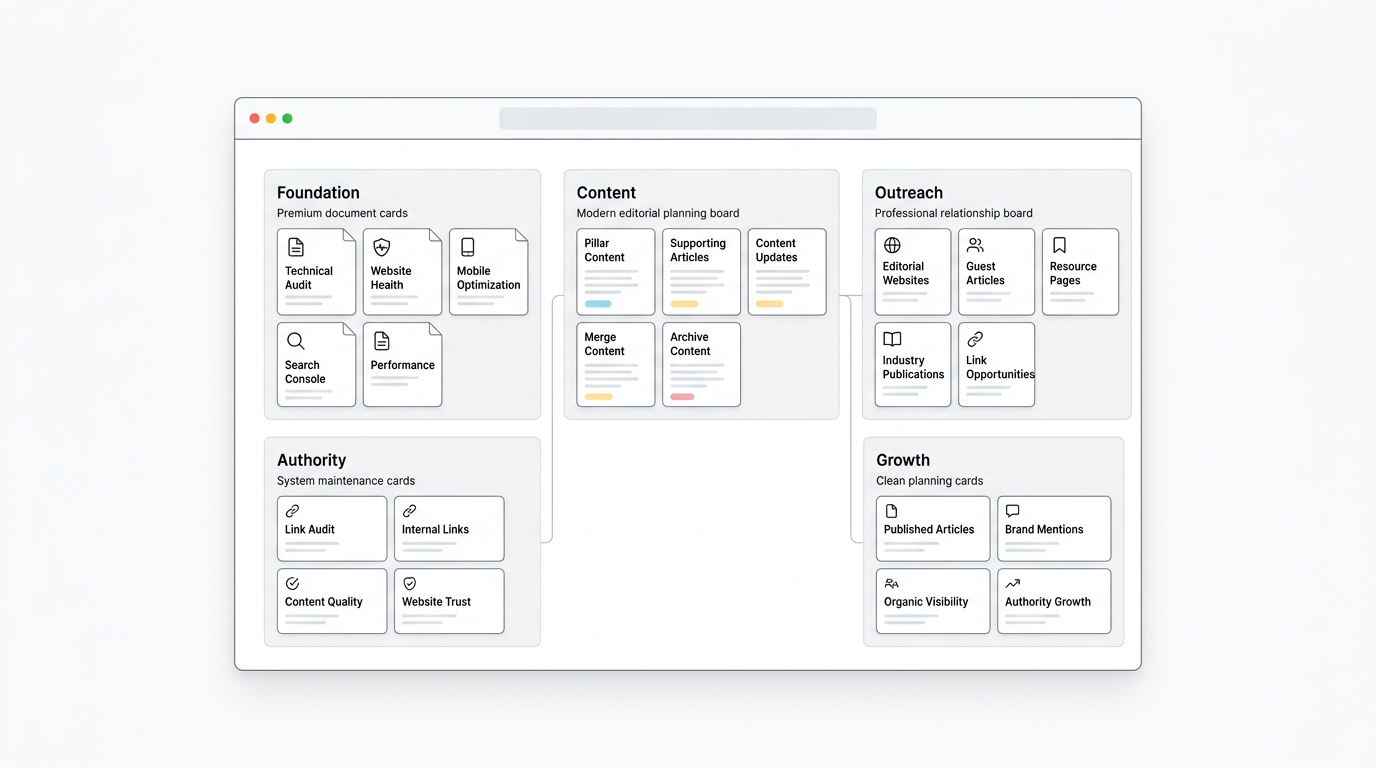
Building Domain Authority isn’t something that happens by accident, and it definitely doesn’t happen overnight. Anyone who’s tried to grow a website’s authority knows the frustration of publishing content into the void, sending a handful of outreach emails that go unanswered, and checking their DA score every few days, hoping to see it tick upward. The truth is that sustainable authority growth follows a sequence you can’t skip steps without undermining the ones that come after. This 90-day plan is built around that principle: fix what’s broken, understand what you already have, create something worth linking to, and only then go out and ask people to link to it.
Weeks 1-2: Foundation
This phase exists because a technical SEO audit at the very start prevents you from wasting effort in every phase that follows. If your site has broken links, slow load times, or crawl errors, then any content you publish or any backlinks you earn afterward are working against a leaky foundation — Google may not even index new pages properly, and users may bounce before reading anything, no matter how good the content is.
- Fixing broken links matters because they waste crawl budget and create dead ends for both users and search bots, signaling a poorly maintained site.
- Improving page speed matters because it directly feeds into Core Web Vitals, a confirmed ranking factor, and slow pages increase bounce rate regardless of content quality.
- Confirming mobile usability matters because Google indexes primarily based on the mobile version of your site (mobile-first indexing), so problems here affect your entire site’s standing, not just mobile visitors.
- Cleaning up crawl issues (broken robots.txt rules, accidental noindex tags, orphaned pages) ensures Google can actually discover and read everything you want ranked.
- Setting up Google Search Console and a DA tracking tool (Moz, Ahrefs, Semrush) gives you a measurable baseline. Without a “before” snapshot, you have no way to prove what worked when you review results in Week 13+.
Weeks 3-4: Content Audit
This phase comes before any new content production because most sites — especially ones that have been live for a while — accumulate pages that are thin, outdated, or simply underperforming. Auditing first prevents you from repeating old mistakes or creating topic overlap with material you already have.
Every existing page gets sorted into one of three buckets:
- Update — the topic is still relevant, but the information is stale (old stats, outdated screenshots, changed processes).
- Merge — you have multiple mediocre, overlapping pages that would be stronger combined into one authoritative resource.
- Cut entirely — the page serves no real search intent and is only diluting your site’s overall quality signal.
This matters specifically for Domain Authority because a site cluttered with weak pages can drag down how Google perceives your overall content quality, even when a handful of your pages are genuinely excellent. Quality density matters, not just quality peaks.
Weeks 5-8: Content Production
The plan deliberately caps this at two to four pieces rather than pushing volume, because the goal is comprehensive, well-researched content that fully satisfies real search intent — not a high quantity of average posts. This connects directly back to E-E-A-T principles: each piece needs to be the kind of resource that could realistically earn citations and backlinks later, because in the outreach phase (Weeks 9-12) you need something genuinely worth pitching.
Internal linking during this phase is just as important as the content itself. Linking these new pieces to existing relevant pages distributes authority across the site and helps Google understand how your content connects topically — reinforcing that your site has depth and expertise in that subject area, not just isolated articles.
Weeks 9-10: Outreach Prep
This is separated from actual outreach execution on purpose. Rushing into pitching without a well-researched target list leads to low response rates, wasted time, and can even damage your site’s reputation if pitches feel spammy or irrelevant.
Building the target list involves:
- Competitor backlink analysis — seeing who links to your competitors and identifying realistic, similar opportunities for your own site.
- Guest posting targets — sites in your niche that accept outside contributors.
- Resource page opportunities — pages that curate links to helpful content in your topic area where your new content could fit.
- Broken link building targets — pages with dead links pointing to content similar to what you now have, where you can offer your page as the replacement.
Weeks 11-12: Outreach Execution
The instruction to send personalized pitches on a consistent weekly cadence, rather than one large batch, matters for two reasons. First, generic mass-outreach emails have very low success rates and can hurt your credibility with site owners if they feel templated. Second, spreading outreach out weekly is more sustainable and lets you learn from early responses — refining your pitch, subject lines, and targeting based on what’s actually getting replies rather than guessing upfront.
Weeks 13+ (Ongoing into Month 4)
This final phase shifts from a discrete task list into a continuous cycle, because SEO growth doesn’t have a finish line — it has to be maintained to keep compounding.
- Continuing to publish and continuing outreach keeps the whole engine running instead of treating link building as a one-off project that stops once the “plan” ends.
- Revisiting your backlink profile for toxic links means checking whether you’ve picked up spammy or low-quality links — sometimes from bad directories, sometimes from competitors trying to hurt you through negative SEO — and disavowing them if they’re actively harming your authority.
- Reassessing DA alongside organic traffic and rankings is the most important habit here. Domain Authority is a third-party metric from Moz, not an actual Google ranking factor, so the plan deliberately tells you not to look at DA in isolation. If DA rises but traffic and rankings don’t move, that’s a signal to dig into what’s actually happening rather than celebrating a vanity number.
Domain Authority Improvement Checklist
- Run a full technical SEO audit and fix crawl issues
- Improve site speed and Core Web Vitals
- Confirm mobile-friendliness across key pages
- Audit existing content and update or remove thin pages
- Publish comprehensive, intent-matched content consistently
- Build internal links connecting new and existing content
- Identify relevant sites for guest posting and outreach
- Pursue broken link building opportunities
- Reclaim unlinked brand mentions
- Monitor backlink profile for toxic or spammy links
- Track DA, referring domains, organic traffic, and rankings together monthly
- Avoid buying links or using automated link schemes
- Build genuine topical depth in your core niche, not just broad content volume
Conclusion
Domain Authority isn’t a Google ranking factor, and it never has been. But that doesn’t make it useless — it’s a genuinely helpful shorthand for comparing your site’s link-based strength against competitors, tracking progress over time, and making smarter decisions about where to focus your outreach energy. The mistake most beginners make is treating the number itself as the goal instead of what it actually represents: a snapshot of accumulated backlink quality and trust.
Real DA growth comes from doing the unglamorous work consistently — publishing content that’s genuinely worth linking to, earning backlinks the honest way, keeping your technical SEO clean, and building depth in your specific niche instead of chasing generic authority. None of that happens overnight, and anyone promising otherwise is probably setting you up for a penalty down the road instead of sustainable growth.
So don’t obsess over watching that number tick upward every week. Focus on creating something genuinely useful, building real relationships in your industry, and fixing the technical stuff that quietly holds sites back. Do that consistently, and Domain Authority takes care of itself.
If you haven’t already, go run a backlink audit on your own site today. Check your current DA, note where you’re starting from, and pick two or three strategies from this guide to actually implement this month. Progress tracking only works if you know your starting point — so go check it now.
Frequently Asked Questions
What is Domain Authority?
Domain Authority is a score from 1 to 100, created by Moz, that predicts how well a website is likely to rank in search results based mainly on its backlink profile.
Is Domain Authority important for SEO?
It’s useful as a benchmarking and competitive analysis tool, but it’s not something you should chase directly. It matters more as a reflection of good SEO work than as a goal in itself.
Is Domain Authority a Google ranking factor?
No. Google has confirmed this repeatedly. DA is a third-party metric built by Moz and has no direct influence on Google’s actual ranking algorithm.
What is a good Domain Authority score?
It depends heavily on your industry and competition level. A small local business might be totally fine at DA 15-20, while a competitive SaaS niche might require DA 40+ to compete seriously.
How can I improve my Domain Authority quickly?
Honestly, there’s no legitimate “quick” way. Consistent content creation, quality backlink outreach, and solid technical SEO over months is the real answer. Anything promising fast results usually involves risky tactics.
How long does it take to increase Domain Authority?
New sites can see fast early jumps within a few months. After DA 30-40, growth slows significantly and often requires sustained effort over a year or longer for meaningful increases.
How often does Domain Authority update?
Moz updates its index and recalculates DA scores periodically, historically every few weeks to a couple of months depending on their crawl schedule. It’s worth checking Moz’s current documentation since update frequency has changed over the years.
Which is better: Domain Authority or Domain Rating?
Neither is objectively “better” — they’re built by different companies using different crawl data. Pick one, track it consistently over time, and don’t stress too much about comparing the raw numbers across tools.
Does blogging improve Domain Authority?
Only indirectly. Blogging itself doesn’t move DA, but if your blog content earns backlinks because it’s genuinely useful, that link growth is what raises your score.
Can a new website have high Domain Authority?
Extremely unlikely. DA is built on accumulated backlink data, and new sites simply haven’t had time to earn a meaningful link profile yet, regardless of how good the content is.
How many backlinks do I need to increase DA?
There’s no fixed number. Quality and relevance matter far more than raw count. A handful of strong, relevant links can move DA more than dozens of weak, unrelated ones.
Should I focus on DA or organic traffic?
Organic traffic, every time. DA is a helpful supporting metric, but traffic and rankings are the actual business outcomes that matter. Build for traffic, and DA tends to follow as a byproduct.