


Look, if you’ve been doing SEO for more than a year, you already know the first page of Google isn’t what it used to be. Five years ago, you could stuff a few keywords, build some backlinks from directories nobody visits, and watch your rankings creep up. That game is dead. Not “dying” — dead. Google’s algorithm now runs on a stack of AI systems that read content almost the way a person does, and it’s gotten scary good at telling the difference between something written to rank and something written to actually help someone. Every update since 2023 has pushed harder in the same direction: reward the site that actually knows what it’s talking about, punish the one that’s just recycling what’s already ranking.
So why is this harder than ever? Because everyone and their cousin now has access to AI writing tools. The barrier to publishing “content” dropped to basically zero. Which means the internet is flooded with mediocre articles that all say the same six things in a different order. Google noticed. It responded with helpful content systems, spam updates, and an AI Overview feature that answers a huge chunk of queries before anyone even clicks a link. If your strategy is still “write 1500 words, add some keywords, hope for the best” — you’re going to watch your traffic flatline while competitors who understand the new rules eat your lunch. And honestly, most sites that lost traffic in the last two years lost it because they never adjusted from that old playbook.
This guide isn’t a theory piece. It’s a full breakdown of what actually moves the needle in 2026: how Google’s systems work now, how to research and structure content that earns trust, the technical stuff most people skip, and how to make sure you’re not invisible to the AI-powered search experiences that are quietly replacing a chunk of traditional search traffic. Every section below is written the way an actual practitioner would explain it to a friend over coffee, not the way a corporate deck would present it.
Who this is for: bloggers trying to build an audience from scratch, small business owners who can’t afford a $10k/month agency, in-house marketers who need results their boss can actually see, and agencies who want a framework that doesn’t fall apart the next time Google pushes an update.
What You Will Learn in This Guide
- How Google actually crawls, indexes, and ranks pages in 2026, including the AI systems sitting on top of the classic algorithm
- Why search intent decides almost everything, and how to stop guessing what people actually want
- A real approach to keyword research that goes beyond typing a word into a tool and copying whatever comes out
- How topical authority works and why chasing single keywords is a losing long-term strategy
- The on-page and technical SEO fundamentals that still matter, and the ones that stopped mattering
- How to actually improve Core Web Vitals instead of just staring at a red score in PageSpeed Insights
- A realistic view of link building in 2026 — what still works, what’s a waste of money
- E-E-A-T, explained without the fluff, and what it means for a normal website owner
- Generative Engine Optimization (GEO) — how to show up in AI Overviews and chatbot answers, not just blue links
- A full roadmap, a case study, common failure points, and a tool list that isn’t just an ad for one company’s software
Grab a coffee. This one’s long, on purpose, because ranking well in 2026 isn’t a five-minute trick anymore.
How Google Search Works in 2026
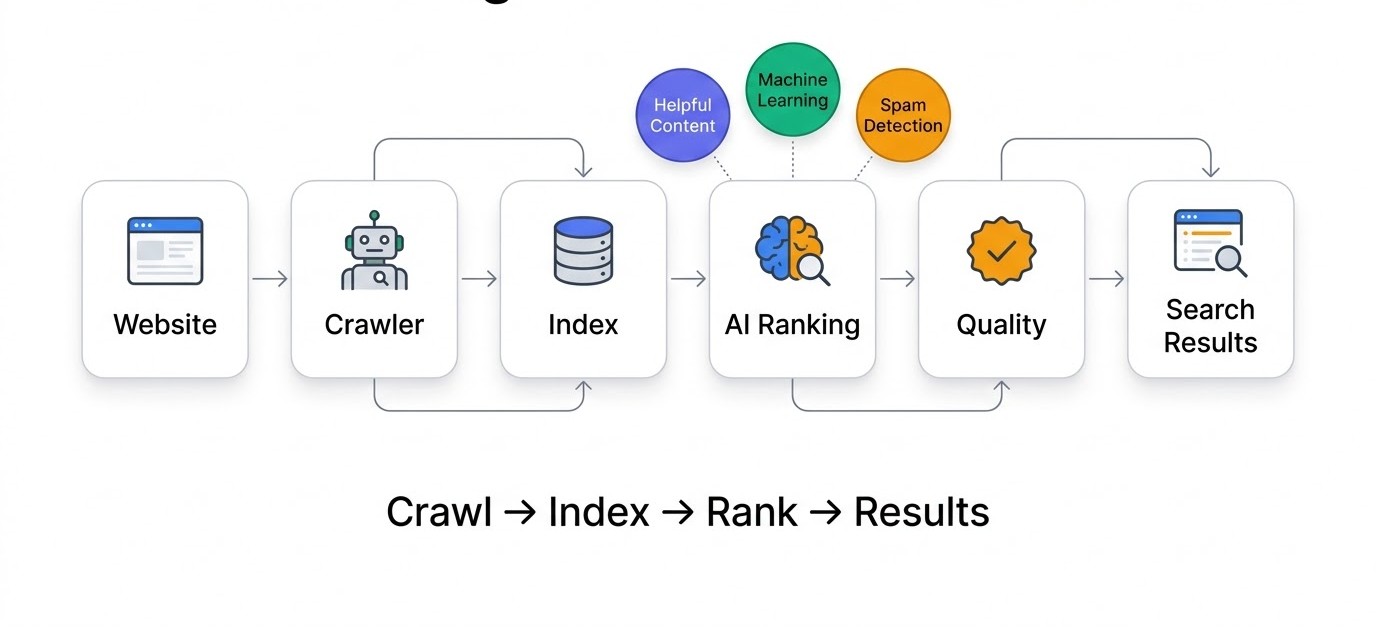
Before you touch a single keyword, you need to understand what’s actually happening behind the scenes when Google decides who gets page one and who gets buried on page four with the abandoned MySpace profiles. A lot of people skip this part because it feels theoretical, but skipping it is exactly why so many SEO efforts fail quietly — you end up optimizing for a version of Google that doesn’t exist anymore. The system today isn’t one algorithm, it’s a layered stack of smaller systems, each doing a specific job, all feeding into the final result you see on the search page. Understanding those layers changes how you approach literally everything else in this guide, from keyword research to link building. So don’t rush past this section just because it feels like background reading. It’s the foundation everything else sits on.
Crawling
Crawling is just Google’s bots (Googlebot, mainly) visiting pages and following links to find new ones. Sounds simple, but here’s the thing people miss: Google doesn’t have infinite time to crawl your site. It allocates something called “crawl budget” based on how important and how fast your site is. If your site is slow, has a messy structure, or is full of low-value pages, Googlebot spends its budget on garbage instead of your good content. That’s why a bloated site with thousands of thin tag pages or duplicate category pages often ranks worse than a smaller, cleaner one. You can actually watch this happen in Search Console’s Crawl Stats report — if your crawl requests are spiking on junk URLs, that’s budget your good pages aren’t getting.
Indexing
Once a page is crawled, Google decides whether to index it at all. Not every crawled page makes it into the index. If your content looks thin, duplicated, or auto-generated, Google might crawl it and just… not bother indexing it. You can check this in Search Console under Page Indexing, and honestly, most sites have way more “Crawled – currently not indexed” pages than they realize. That’s usually a content quality problem, not a technical one. People panic and start fiddling with sitemaps when the real fix is rewriting the page so it actually says something worth indexing. I’ve seen sites fix this issue just by merging five thin pages into one solid one.
Ranking
This is the part everyone obsesses over, but ranking is really just Google scoring indexed pages against a query using hundreds of signals — relevance, quality, freshness, user experience, authority, and increasingly, whether the content demonstrates real experience with the topic. There’s no single “ranking algorithm” anymore. It’s a layered system where classic signals (backlinks, on-page relevance) work alongside newer AI-driven quality models. What makes this tricky is that these signals interact — a page with great content but terrible speed can still lose out to a page that’s slightly weaker on content but loads instantly and feels trustworthy. That’s why isolated tweaks rarely move the needle much on their own.
Understanding Search Intent
Ranking is meaningless without matching intent. Google can tell — pretty accurately now — whether someone searching “best running shoes” wants a buying guide or a philosophical essay on the history of jogging. If your content doesn’t match what people actually want when they type that phrase, none of the other work matters. We’ll dig deeper into this later, but keep it in your head as you read everything else. Honestly, half the “my content isn’t ranking” complaints I’ve seen over the years trace back to this one issue — great writing, completely wrong format for what the searcher actually wanted.
Google’s AI-Powered Ranking Systems
Google’s search stack today includes systems specifically built to evaluate helpfulness and detect manipulation. These aren’t bolt-ons anymore — they’re baked into core ranking. That means the old trick of “write content for Google, not for humans” backfires harder than it ever has. These systems learn from patterns across billions of pages, which means they’re not looking at your site in isolation — they’re comparing your content’s structure and depth against everything else Google has ever seen on that topic. That’s a much harder bar to fake than an old-school keyword density check.
Helpful Content System
This system rewards content built for people first. It looks at whether a site seems to exist primarily to rank in search rather than to serve an actual audience. Sites that pump out low-effort articles on every trending topic under the sun, without any real depth or point of view, tend to get flattened site-wide — not just on individual pages. That site-wide part is what scares people, and it should. I’ve seen entire domains lose 70-80% of their traffic overnight because a handful of weak sections dragged the whole site’s reputation down with them.
Spam Detection Systems
Google’s spam systems now catch things like scaled content abuse (mass-producing AI content with no human oversight), site reputation abuse (parasite hosting on trusted domains), and expired domain abuse. If you’re thinking about any shortcut that sounds even slightly sketchy, assume there’s already a system built to catch it. The people who got away with these tactics in 2019 are, in most cases, the same people who quietly deindexed in 2024 and 2025 and are still confused about why. Don’t be that person three years from now.
The Role of Machine Learning in Search
Machine learning models help Google understand language more like a person does — synonyms, context, intent, even sarcasm and nuance. This is why keyword-matching tricks matter less than they used to. Google understands that “cheap flights to Tokyo” and “affordable Tokyo airfare” are basically the same question. What this means practically is that writing naturally, the way you’d actually explain something to a friend, tends to outperform writing that’s been mechanically optimized around exact-match phrases. The model rewards clarity over cleverness.
How Google Evaluates Content Quality
Quality isn’t a vibe — Google evaluates it through signals like depth of coverage, originality, accuracy, and whether the content shows genuine understanding versus surface-level summarizing. Honestly, this is where a lot of AI-generated content falls apart. It sounds fine on the surface but says nothing new. The fix isn’t avoiding AI tools entirely — it’s making sure a real person with real knowledge is shaping the final piece, adding the specific details, corrections, and opinions that a purely generated draft never would.
What Does It Take to Rank on Google’s First Page?
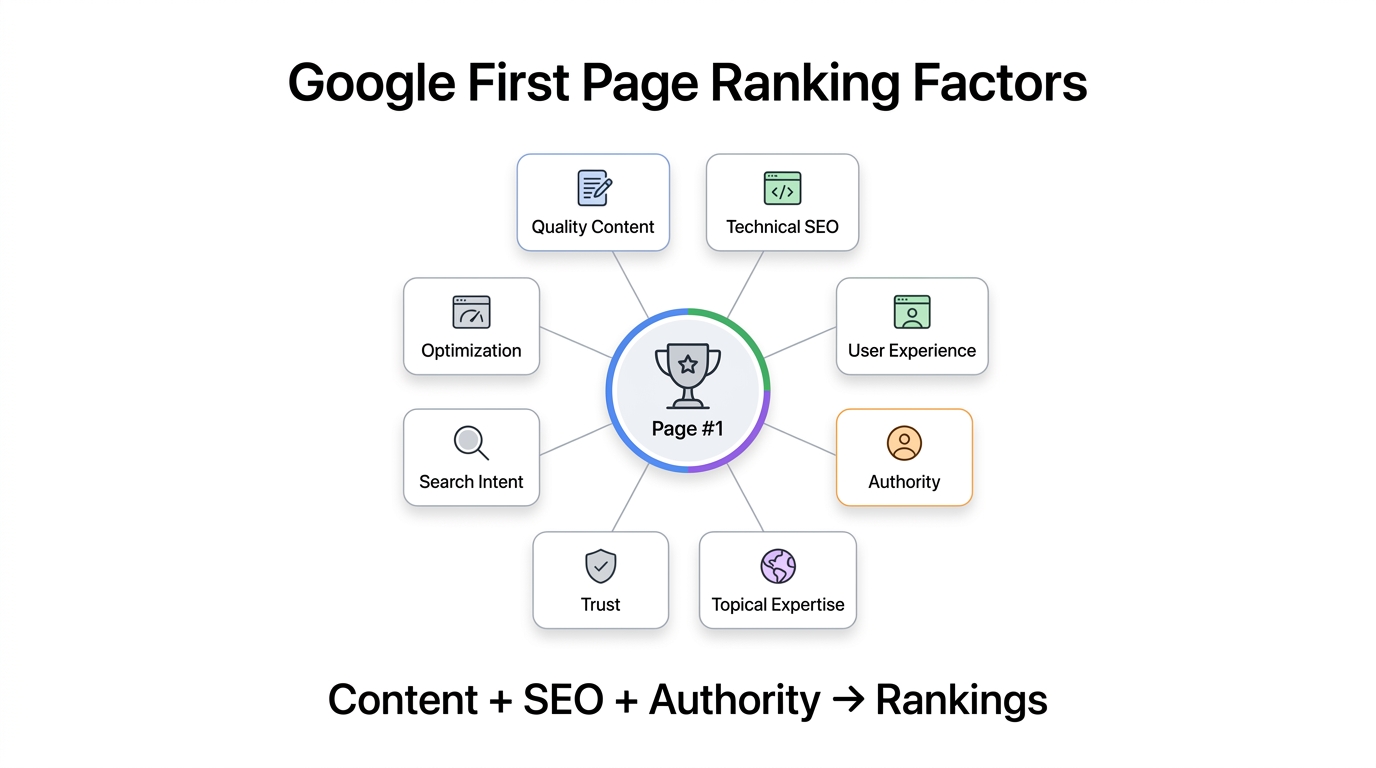
People want a checklist, and fine, here’s the honest one. But don’t treat these as boxes to tick — they interact with each other constantly. A site can nail six of these eight things and still stall out because the seventh one is quietly sabotaging everything else. I’ve watched businesses spend six figures on content while ignoring page speed, and wonder why nothing moved. So read this list as a system, not a to-do list you check off once and forget about.
Quality Content
Content that actually answers the question, in enough depth that the reader doesn’t need to click back and search again. That’s it. That’s the bar. It sounds obvious written out like that, but go check your own site’s top ten pages honestly — how many of them would actually satisfy you if you were the one searching? Most site owners are too close to their own content to see the gaps a stranger would spot immediately.
Strong Technical SEO
If Google can’t crawl and understand your site properly, none of your content work matters. Technical SEO is the plumbing. Nobody notices it when it works, everyone notices when it doesn’t. It’s the unglamorous part of this whole field, which is exactly why so many people skip it — until a broken redirect chain quietly tanks half their indexed pages and nobody catches it for months.
Excellent User Experience
Slow load times, intrusive pop-ups, and confusing navigation push people back to the search results within seconds. Google notices that pattern. Think about your own behavior — how long do you actually wait for a page to load before hitting back? Two seconds, maybe three if you’re being generous. Your visitors are exactly as impatient, and Google’s systems are built to notice when people bounce right back to the results.
Website Authority
Sites that have built trust over time — through backlinks, brand mentions, and consistent quality — get more benefit of the doubt on new content than a brand-new domain does. This is frustrating for newer sites, no doubt about it, but it’s also not a permanent wall. Authority compounds. Every good piece of content and every genuine link you earn today makes the next piece slightly easier to rank.
Topical Expertise
Covering a subject broadly and deeply, not just publishing one article and hoping it carries the whole topic. Google increasingly rewards sites that read like they actually live in a niche rather than sites that dip in for one post and move on to the next trending subject. Depth in one lane beats being scattered across ten.
Trust Signals
Author bios, transparent business information, accurate claims, and a track record of not misleading people. These feel like small details until you realize how much they add up. A page with a named, credentialed author and clear sourcing simply reads as more trustworthy than an anonymous post with vague claims — to readers and to Google’s evaluation systems alike.
Search Intent Alignment
Matching the format and depth of your content to what searchers actually want, not what you feel like writing. This is one of those things that costs nothing to fix and yet gets ignored constantly. Before writing anything, spend five minutes actually looking at what’s ranking for your target term — Google already told you the intent, you just have to look.
Continuous Optimization
Rankings aren’t permanent. Content that ranked great in 2023 can quietly slide if nobody touches it again. SEO isn’t a project with an end date, it’s closer to maintaining a garden — stop watering it and things that used to thrive start dying off, slowly enough that you might not notice until the traffic’s already gone.
Understand Search Intent Before Creating Content
Here’s a mistake I see constantly: someone finds a keyword with decent volume, writes a blog post about it, and wonders why it never ranks — meanwhile a completely different content format is sitting in position one. The keyword was never the problem. The intent mismatch was. This single misunderstanding probably wastes more content budget across the industry than any other mistake on this list, because people assume good writing alone should be enough to win, when the format itself is often the disqualifying factor before a single sentence gets read.
What Is Search Intent?
Search intent is the actual reason behind a query. “Best laptop for video editing” isn’t really about laptops in general — it’s someone close to making a purchase who wants a shortlist and reasoning, not a history of laptop computing. Every query carries an implied job the searcher wants done, and your content’s entire job is to do that thing as directly and completely as possible, without making them dig for it.
Types of Search Intent
Informational — someone wants to learn something. “How does Core Web Vitals affect SEO.”
Navigational — someone wants a specific site or page. “Ahrefs login.”
Commercial Investigation — someone’s comparing options before buying. “Semrush vs Ahrefs.”
Transactional — someone’s ready to act. “Buy Semrush subscription.”
Each of these four categories needs a genuinely different content shape. Treat an informational query like a sales page and you’ll feel pushy and get ignored. Treat a transactional query like an essay and you’ll lose the person who just wanted to check out already. Recognizing which bucket a keyword falls into, before you write a single word, saves you from building the wrong thing entirely.
How to Identify Intent
The fastest way? Just Google the term and look at what’s already ranking. If the top 10 results are all list-style buying guides, Google has already told you what intent it thinks that query has. Don’t fight it with a personal essay. This takes maybe five minutes and it’s one of the highest-leverage habits you can build into your content process — most people skip it because it feels too simple to matter, but it consistently prevents wasted writing time.
Matching Content Format to Intent
Informational queries usually want guides or explainers. Commercial queries want comparisons and pros/cons. Transactional queries want product pages, not 3,000-word blog posts. Get the format wrong and you’re fighting the algorithm for no reason. It’s a bit like showing up to a job interview in workout clothes — the content of what you say barely matters if the format itself signals you’re not reading the room.
Search Intent Mistakes to Avoid
Writing a sales pitch for an informational query. Writing an academic essay for a transactional one. Assuming every keyword needs the same content type. These mistakes are everywhere, and they’re avoidable in about five minutes of research. The most common version of this I still see, even from experienced marketers, is treating every keyword as an excuse to promote a product, when half the searchers just want a straight answer with no pitch attached.
Perform Keyword Research Like a Pro
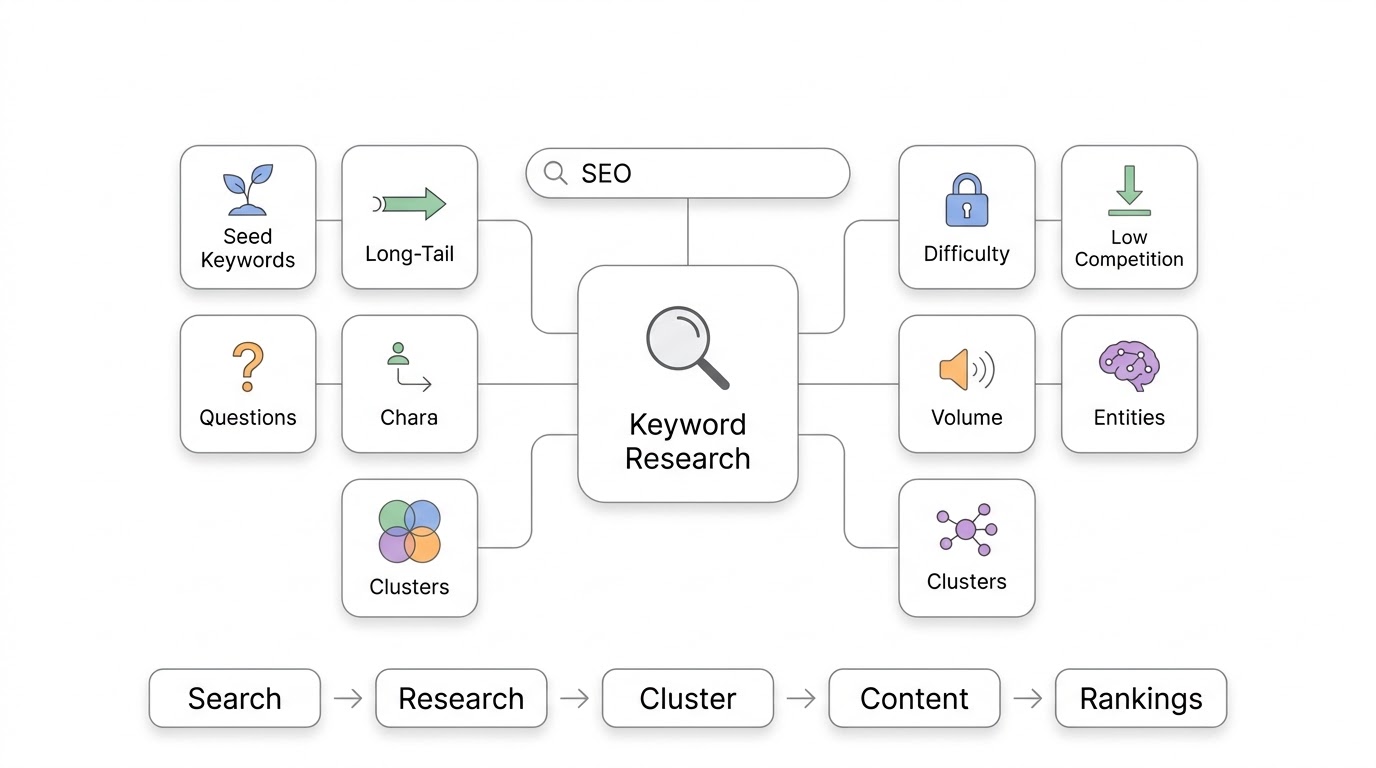
Keyword research tells you what people actually type, in their own words, not the words you assume they’d use. Skip this step and you’re writing for yourself, not your audience. It’s genuinely surprising how often the phrase a business uses internally (“enterprise resource planning solutions”) is completely different from what a real person types into Google (“best software to manage inventory and orders”). Without research, you’re guessing at a language gap you might not even know exists.
Seed Keywords
Broad terms that start the process — “SEO,” “content marketing,” “email tools.” Not something you’d target directly, but the starting point for expansion. Think of seed keywords as the trunk of a tree — you’re not going to build a page around the trunk itself, but every branch and leaf you eventually target grows out from it.
Long-Tail Keywords
Longer, more specific phrases like “how to improve Core Web Vitals for WordPress sites.” Lower volume individually, but they add up, and they convert better because the searcher knows exactly what they want. A site chasing only high-volume head terms is often outperformed, in total traffic and revenue, by one methodically covering dozens of specific long-tail variations nobody else bothered writing about.
Question-Based Keywords
Phrases starting with how, what, why, can, does. These map directly to FAQ sections and voice search queries, and they’re a goldmine for featured snippets. They’re also usually easier to rank for than their broader parent keyword, because fewer competitors bother answering the specific version of the question directly and completely.
Low-Competition Keywords
Terms with decent search interest but weak competing content. New sites should hunt these first instead of trying to outrank a decade-old domain authority on day one. It’s not glamorous work, sifting through dozens of lower-volume terms, but it’s exactly how new sites build early traction and start earning the trust that lets them compete for bigger terms later.
Keyword Difficulty
A rough score estimating how hard a term is to rank for, based mostly on the backlink profiles of current top results. Useful as a filter, not gospel. I’ve seen plenty of “high difficulty” terms get outranked by genuinely better content, and plenty of “easy” terms stay stubborn because the tool’s estimate didn’t account for something else Google was weighing.
Search Volume
How many people search a term monthly. Don’t obsess over huge numbers — a keyword with 200 searches a month that converts is worth more than one with 10,000 searches and zero buying intent. Chasing volume alone is one of the fastest ways to burn content budget on traffic that never turns into anything for the business.
Keyword Clustering
Grouping keywords that share the same intent so you can target them with one comprehensive page instead of five thin ones competing with each other. This single habit alone fixes a huge chunk of the “why do my own pages rank worse than each other” confusion that a lot of site owners run into without realizing what’s happening.
Semantic Keywords
Related terms and concepts that naturally belong in comprehensive content on a topic. Google expects to see them — their absence is a signal your content might be shallow. You don’t need to force these in awkwardly; if you genuinely understand a topic and write about it in depth, they tend to show up naturally in your language anyway.
Entity-Based SEO
Google increasingly understands topics as entities — people, places, concepts — connected in a knowledge graph, rather than just strings of text. Writing with clear entities (naming specific tools, people, places) helps Google place your content correctly. Vague writing that avoids naming anything specific is actually harder for these systems to categorize confidently than writing that’s concrete and named.
Building a Keyword Map
Assign every target keyword cluster to a specific page on your site. This avoids the common trap of five different blog posts quietly competing against each other for the same query. Before you write anything new, check the map first — there’s a decent chance the topic already has a home on your site, and what it actually needs is expansion, not a brand-new competing page.
Build Topical Authority Instead of Chasing Individual Keywords
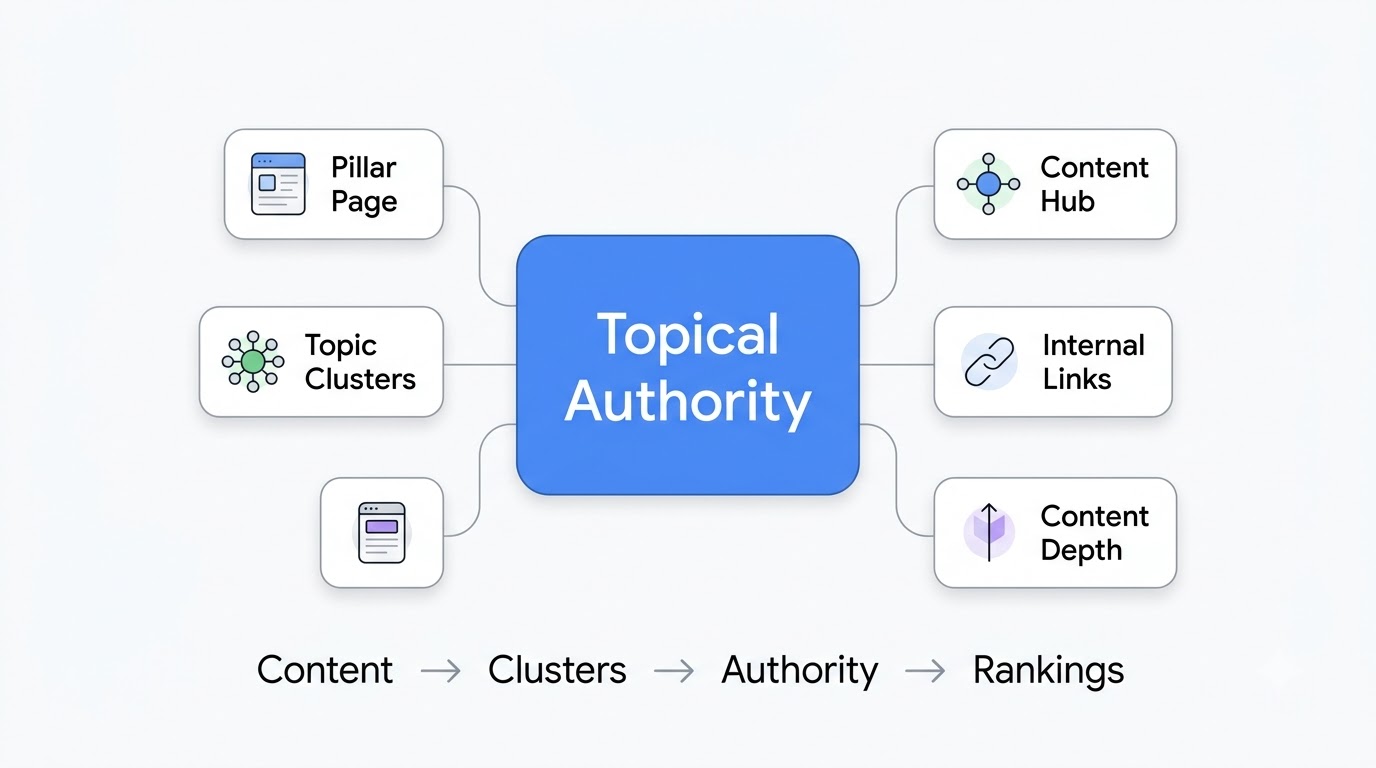
It’s the reputation your site builds around a subject when you cover it thoroughly and consistently, rather than writing one article and moving to a completely different topic next week. Google can’t literally “know” you’re an expert, but it can infer it from patterns — how many related pages you have, how they link together, and how completely they cover the surrounding subtopics a real expert would naturally address.
Why Google Rewards Topic Expertise
A site with 40 well-connected articles on running gear reads as more trustworthy on that subject than a general lifestyle blog that happens to have one running post. Google’s systems pick up on that pattern. It mirrors how trust works between people too — you’d trust a running coach’s shoe recommendation over a random blogger who mentioned running once in passing.
Pillar Pages
Broad, comprehensive pages covering a topic at a high level, linking out to more specific supporting content underneath. A good pillar page acts like a table of contents for an entire subject — someone should be able to land there, get the big picture, and then dive into whichever specific supporting article actually answers their narrower question.
Topic Clusters
Groups of related articles that all link back to a pillar page and to each other, forming a web of related content Google can crawl easily and understand as a coherent subject. This structure does double duty — it helps search engines map your site’s expertise, and it keeps readers moving through your site instead of bouncing back to Google after one article.
Content Hubs
A structured section of the site organized entirely around one theme — think of it as your site’s dedicated “department” for that topic. Building an actual hub, with clear navigation and a logical hierarchy, signals a level of intentional investment in a subject that a handful of scattered posts never quite communicates.
Internal Linking Strategy
Deliberately linking related content together, using descriptive anchor text, so both users and Google can navigate the topic naturally. This is one of the cheapest, most underused levers in SEO — it costs nothing but a few minutes of editing, and it can meaningfully boost how older content performs just by connecting it properly to newer, related pieces.
Content Depth vs Content Quantity
Ten deep, useful articles beat fifty shallow ones every time. Depth signals expertise. Quantity without depth just signals a content farm. If you’re choosing between publishing twice as often at half the depth, or half as often with real substance, take the substance every time — it compounds better and it protects you better against future algorithm updates.
Create Helpful, Comprehensive Content
Content that answers the actual question completely, without forcing the reader to open five other tabs to fill in the gaps. Helpfulness isn’t a fuzzy, subjective idea either — you can test it directly. Read your own piece as if you knew nothing about the topic, and ask honestly whether you’d still have unanswered questions by the end.
Cover Topics Completely
Anticipate the follow-up questions a reader would have and answer them in the same piece, instead of making them search again. Every time someone has to leave your page to go find the answer to something you should have covered, that’s a small trust loss, and enough of those add up to a page that never quite earns its ranking.
Demonstrate Experience
Show you’ve actually done the thing. Specific numbers, real screenshots, actual results — not vague generalities that could’ve been written by someone who’s never touched the topic. This is the single easiest way to separate genuinely useful content from the sea of generic AI-flavored writing that says technically correct things without ever really showing anything.
Use Original Examples
Made-up hypotheticals read as filler. Real examples, even small ones, build trust fast. A specific story — “I tried this on a client site last year and it took four months to show up in rankings” — does more convincing than ten sentences of confident-sounding generalities ever will.
Include Statistics and Research
Improve Readability
Short paragraphs, clear language, logical flow. Nobody wants to wade through a wall of text to find one useful sentence. Break things up, use headers generously, and write the way you’d actually talk if you were explaining the topic out loud to someone standing in front of you.
Optimize for Featured Snippets
Answer common questions directly and concisely near the top of a section — this is exactly the format Google pulls into snippets and AI Overviews. A short, direct answer followed by supporting detail performs far better here than burying the answer three paragraphs deep after a long windup.
Write for Humans First
If it wouldn’t help an actual person reading it, cut it. Google’s systems are increasingly good at telling when content exists only to satisfy an algorithm. The simplest test that’s never failed me: would you actually send this article to a friend who asked you this exact question? If not, it needs more work.
Optimize On-Page SEO
SEO-Friendly Titles
Clear, specific, includes the main keyword naturally, and honestly describes what’s in the content. Clickbait titles hurt more than they help now — bounce rate is a signal. A title that overpromises gets the click and then loses the trust the moment the content doesn’t deliver, and that mismatch shows up in your engagement data whether you notice it or not.
Meta Descriptions
Not a direct ranking factor, but a strong influence on click-through rate. Write it like an actual pitch for why someone should click your result over the nine others. Think of it as your one shot at a elevator pitch, competing against nine other elevator pitches on the same page.
URL Structure
Short, descriptive, readable. /seo-guide-2026 beats /post?id=48291 every single time. A clean URL isn’t just prettier — it’s easier to share, easier to remember, and gives both users and search engines an instant clue about what the page is actually about before they even click.
Header Tags
Use H1 for the title, H2 for main sections, H3 for subsections. This isn’t just for looks — it helps both readers and Google’s parsing systems understand your content’s structure. A well-organized heading hierarchy is also exactly what lets AI systems pull clean, accurate summaries out of your page for their own generated answers.
Image SEO
Descriptive file names, proper alt text, compressed file sizes. Ignored constantly, and it costs sites both accessibility points and image search traffic. It takes two extra minutes per image and most people still skip it, which is honestly a small, easy win sitting right there for anyone willing to bother.
Internal Links
Connect related pages with descriptive anchor text. This spreads authority around your site and helps Google understand relationships between pages. Every time you publish something new, go back and find three or four older pages where it genuinely fits, and link it in — it’s one of the fastest ways to help new content get discovered and indexed.
External References
Linking out to credible sources when you cite data isn’t a leak of “link juice” — it’s a trust signal. Stop being afraid of it. Sites that never link outward, ever, actually read as slightly suspicious to both readers and to quality evaluation systems, like they’re trying too hard to keep visitors trapped rather than genuinely help them.
Schema Markup
Structured data that tells Google exactly what type of content a page contains — article, FAQ, product, recipe, whatever. More on this later. It’s essentially a translation layer that removes ambiguity for search engines, and it often unlocks visual enhancements in the results page that plain text alone never gets.
Anchor Text Optimization
Use descriptive, natural anchor text instead of “click here” everywhere. It helps both users and search engines understand what they’re clicking into. “Read our Core Web Vitals guide” tells someone exactly what’s waiting on the other side; “click here” tells them nothing at all.
Content Freshness
Regularly updating dates, statistics, and examples signals the content is actively maintained, not abandoned. A page that still references numbers from three years ago, sitting untouched, quietly tells both readers and Google that nobody’s been paying attention to it in a while.
Build a Strong Website Architecture
Flat Site Structure
Keep important pages within a few clicks of the homepage. Deep, buried pages get crawled less and rank worse. If a genuinely important page sits six clicks deep in your navigation, you’re basically asking both users and Googlebot to work harder than they’re willing to just to find it.
Logical Navigation
Menus and categories that make sense to an actual visitor, not just an internal team structure nobody outside the company understands. Internal jargon and department names rarely mean anything to a visitor — navigation should be organized around how people actually think about the topic, not how your company happens to be organized.
Category Pages
Well-organized hub pages that group related content logically, helping both users and search engines navigate your site. A strong category page does more than list links — it gives context, a short overview, and a clear path into the subtopics beneath it.
Breadcrumbs
Small navigational trails showing where a page sits in your site’s hierarchy. Helps users, and Google often displays them right in search results. They’re small, cheap to implement, and they quietly improve both usability and how your listings look in search.
Topic Silos
Organizing content into clearly separated topical sections so Google understands what your site’s core subjects actually are. A site that mixes unrelated topics without any clear separation sends a confusing signal about what it’s actually an authority on.
Crawl Depth
How many clicks it takes to reach a page from the homepage. Deep pages get crawled less frequently — keep your important content shallow. If you’re publishing something you genuinely want to rank well, make sure it’s linked from somewhere prominent, not buried at the bottom of an old archive.
XML Sitemap
A file listing your important pages so Google can find them more efficiently. Simple, often neglected, still matters. It won’t force Google to index everything, but it removes any excuse for your important pages to go unnoticed.
Robots.txt Optimization
Controls which parts of your site Googlebot can access. Getting this wrong can accidentally block your whole site from being crawled — it happens more than you’d think. I’ve personally seen a site relaunch with a single misplaced “disallow: /” left over from staging, and lose weeks of visibility before anyone caught it.
Master Technical SEO
Crawlability
Making sure nothing — broken links, bad redirects, blocked resources — stops Googlebot from reaching your important pages. This is the most basic requirement in all of SEO, and yet technical audits routinely turn up pages that have been silently unreachable for months without anyone noticing.
Indexability
Ensuring pages you want ranked aren’t accidentally set to noindex, and that duplicate or low-value pages aren’t competing for index space. A stray noindex tag left over from a redesign is one of the most common, and most embarrassing, technical mistakes I’ve seen take down an otherwise solid page.
Canonical Tags
Tell Google which version of a page is the “main” one when duplicates or near-duplicates exist, avoiding internal competition. Without clear canonicals, you can end up with your own pages quietly splitting ranking signals between near-identical URLs.
HTTPS
Basic table stakes now. A non-secure site looks untrustworthy to users and search engines alike. If you’re still running any part of your site on plain HTTP in 2026, that’s not a minor detail — it’s an immediate red flag to anyone paying attention.
Mobile Friendliness
Google indexes mobile-first. If your mobile experience is broken, your rankings are broken, full stop. Test your own site on an actual phone regularly — desktop testing alone hides a surprising number of mobile-specific problems.
Structured Data
The technical backbone of schema markup — helping search engines parse exactly what your content represents. Getting this implemented correctly, and validated, closes the gap between what your page says and what a machine can confidently confirm it says.
Pagination
Properly handling multi-page content (like paginated blog archives) so Google doesn’t treat each page as duplicate or disconnected content. Poorly handled pagination can quietly fragment your authority across dozens of near-identical archive pages.
Duplicate Content
Multiple pages saying nearly the same thing confuses ranking systems and dilutes authority. Consolidate where you can. If you’ve got three blog posts all circling the same topic from slightly different angles, merging them into one strong piece usually outperforms all three separately.
Broken Links
Dead links waste crawl budget and frustrate users. Regular audits catch these before they pile up. A quarterly link check takes an afternoon and saves you from the slow accumulation of dead ends that eventually make a site feel neglected.
Redirect Management
Clean, direct redirects (not chains of five redirects in a row) preserve authority and load faster. Every extra hop in a redirect chain adds load time and a small amount of signal loss — clean them up whenever you spot them.
Improve Core Web Vitals
Largest Contentful Paint (LCP)
Measures how fast the main content loads. Slow LCP usually means unoptimized images or bloated server response times. The fix is almost always some combination of compressing your largest images and getting your server to respond faster — rarely anything more exotic than that.
Interaction to Next Paint (INP)
Measures how responsive a page feels when someone actually interacts with it — clicks, taps, scrolls. Heavy JavaScript is the usual culprit here. Pages loaded with tracking scripts and heavy interactive widgets often feel sluggish exactly because of this metric, even when they load visually fast.
Cumulative Layout Shift (CLS)
Measures visual stability — that annoying thing where a page jumps around as it loads and you click the wrong button. Reserve space for images and ads to fix this. It’s a small technical fix with an outsized effect on how trustworthy and polished a page feels to a visitor.
PageSpeed Optimization
A mix of compressing files, enabling caching, and reducing unnecessary scripts. Small changes compound fast here. You rarely need one dramatic fix — usually it’s five or six small improvements stacked together that finally push a slow page into “fast enough” territory.
Image Optimization
Compress, use modern formats like WebP, and lazy-load images below the fold. Images are consistently one of the biggest, easiest wins on a slow page, and yet they’re often the last thing anyone bothers to fix.
JavaScript Optimization
Defer non-critical scripts, remove what you don’t need, and avoid render-blocking code. Most sites are carrying scripts nobody’s used or needed in years — an audit here usually finds easy weight to cut.
CSS Optimization
Minify stylesheets and eliminate unused CSS — bloated stylesheets slow down rendering more than people realize. A site redesign three years ago often leaves behind CSS nobody ever cleaned up, quietly weighing every page down.
Hosting Performance
Cheap, overloaded shared hosting caps everything else you do. Sometimes the fastest win is just upgrading your host. No amount of code optimization fixes a server that’s fundamentally too slow or too overloaded to respond quickly.
Build High-Quality Backlinks
Why Backlinks Still Matter
Despite what some people claim, links remain one of the strongest trust signals Google has. They’re just harder to earn cheaply now, which is honestly a good thing. The links that survive today’s spam systems are the ones that were earned because the content actually deserved them, which is a healthier incentive for the whole ecosystem.
Characteristics of High-Quality Links
Relevant, from real sites with real traffic, editorially given rather than paid or traded in bulk. A single link from a genuinely respected, relevant site in your niche is worth more than fifty links from random unrelated blogs nobody reads.
Digital PR
Creating newsworthy content or data that journalists and publications want to reference naturally. This is one of the more scalable approaches left — one good original data story can earn dozens of links at once from publications that would never respond to a cold outreach email.
Guest Posting
Still works, when done on relevant, genuinely read publications instead of spam networks built purely for link exchanges. The test is simple: would you be proud to have written this piece even if it had zero SEO benefit at all?
Linkable Assets
Original research, tools, templates, or data visualizations that people want to reference and link to on their own. These assets tend to keep earning links passively for years after you publish them, long after any active promotion has stopped.
Resource Pages
Pages that curate helpful links on a topic. Getting listed on relevant ones is a solid, often overlooked link source. A quick search for “[your topic] + resources” turns up more of these opportunities than most people expect.
Broken Link Building
Finding dead links on other sites and suggesting your content as a replacement. Old tactic, still works when done with genuine relevance. It’s a rare win-win — you help the site owner fix something broken, and you earn a natural, relevant link in return.
HARO-Style Opportunities
Responding to journalist requests for expert quotes in exchange for a citation and link. These take a bit of consistent effort, but a handful of well-placed expert quotes over a year can meaningfully boost both authority and referral traffic.
Competitor Backlink Analysis
Studying where competitors get their links from often reveals opportunities you hadn’t considered. If three competitors are all mentioned on the same resource page and you’re not, that’s a very specific, actionable gap to go chase.
Toxic Link Management
Occasionally disavowing spammy or manipulative links pointing at your site, especially if you suspect negative SEO attacks. Most sites don’t need to touch this often, but it’s worth a periodic check if you notice a sudden spike in odd, unrelated backlinks.
Strengthen Google’s E-E-A-T Signals
Experience
Firsthand, hands-on experience with the topic — actually having done the thing you’re writing about. This is the newest addition to Google’s framework, and it exists specifically because so much generic, secondhand content had flooded search results without anyone behind it having actually done the thing described.
Expertise
Demonstrated knowledge and skill in the subject, ideally backed by credentials or a track record. Expertise doesn’t always mean a formal degree — years of hands-on, demonstrated work in a field counts just as much in most contexts.
Authoritativeness
Recognition from others in the field — mentions, citations, and reputation built outside your own site. This is essentially your reputation as others see it, which is why it can’t be faked purely through what you say about yourself.
Trustworthiness
Accuracy, transparency, and a track record of not misleading readers. This one underpins everything else. Without trust, expertise and experience don’t count for much — readers and search engines alike need to believe what you’re telling them is accurate.
Author Bios
Clear information about who wrote the content and why they’re qualified to. A real name, a real background, and a real reason to be writing about this specific topic go a long way toward establishing credibility instantly.
About Page
A real, detailed page explaining who runs the site and what it’s about — not a placeholder paragraph nobody bothered writing. This is often one of the most neglected pages on a site, despite being one of the first places a skeptical visitor (or evaluator) checks.
Contact Information
Visible, real contact details. Sites that hide who’s behind them read as less trustworthy, to both users and Google. A missing or vague contact page is a small thing that quietly undermines everything else you’ve built.
Editorial Policies
Clear standards for how content gets researched, fact-checked, and updated. Publishing an editorial policy, even a short one, signals a level of accountability that a lot of competing sites simply never bother to establish.
Content Updates
Regularly revisiting and correcting older content shows ongoing care rather than a “publish and abandon” approach. A visible “last updated” date, paired with genuine changes, tells both readers and search engines that someone’s actually still watching this page.
Optimize for AI-Powered Search and GEO
What Is Generative Engine Optimization (GEO)?
GEO is about optimizing content so it gets pulled into AI-generated answers — Google’s AI Overviews, chatbot responses, and similar surfaces — not just traditional blue links. It’s SEO’s newest cousin, and ignoring it in 2026 means missing a growing chunk of visibility. It borrows a lot from traditional SEO fundamentals, but it adds a new layer of thinking about how machines summarize and cite your content, not just how they rank it.
AI Overviews and Their Impact
AI Overviews now answer a huge share of informational queries directly on the results page. That’s fewer clicks for some content, sure, but it also means being the source an AI Overview cites can drive real brand visibility even without a click. Some businesses are seeing brand awareness gains purely from repeated citation, even as raw click-through numbers on certain query types decline.
Structuring Content for AI Retrieval
Clear headings, direct answers near the top of sections, and well-organized information make it easier for AI systems to extract and cite your content accurately. Content that buries its actual answer under three paragraphs of preamble is much harder for these systems to pull cleanly, which lowers your odds of getting cited at all.
Using Entities and Semantic SEO
Writing clearly about specific people, tools, places, and concepts (not vague generalities) helps AI systems place your content correctly within a knowledge graph. Specificity isn’t just good writing practice anymore — it’s practically a technical requirement for being understood correctly by these systems.
FAQ Optimization
Directly answering common questions in a dedicated FAQ format — like the one at the end of this guide — makes content far easier for AI systems and snippet features to pull from. A well-built FAQ section is basically a set of pre-packaged, citation-ready answers sitting right there for these systems to grab.
Clear Answer Blocks
A short, direct answer right after a heading, followed by supporting detail. This structure gets pulled into snippets and AI summaries constantly. Lead with the answer, then explain — not the other way around.
Citation-Worthy Content
Original data, unique perspectives, and genuinely useful frameworks get cited more than generic rehashes of what’s already out there. If your content says nothing that dozens of other pages haven’t already said, there’s simply no reason for an AI system (or a human) to cite you specifically over anyone else.
Building Brand Mentions Across the Web
Being talked about across forums, review sites, and other publications — even without a direct link — feeds into how AI systems and Google both assess your credibility. Unlinked mentions used to be considered nearly worthless in old-school SEO thinking; that’s changed as these systems get better at reading brand reputation broadly across the web.
Improve User Experience (UX)
Navigation Simplicity
Visitors should find what they need in a couple of clicks, not a maze of dropdown menus. Every extra click between a visitor and what they came for is a small chance for them to give up and leave instead.
Readability
Clear fonts, sufficient contrast, short paragraphs. If it’s a strain to read, people leave. Test your own site’s readability on a phone in bright sunlight sometime — you’ll notice problems you’d never catch staring at a desktop monitor in a dim office.
Mobile Experience
Buttons that are actually tappable, text that doesn’t require zooming, layouts that don’t break on a phone screen. Most traffic today is mobile-first, so a broken mobile experience isn’t a minor inconvenience for a few users — it’s a broken experience for the majority.
Accessibility
Alt text, proper contrast ratios, keyboard navigation. It’s the right thing to do, and it happens to help rankings too. Building accessibly from the start is far easier than retrofitting it later, and it genuinely opens your content to a wider audience.
Calls-to-Action
Clear, well-placed prompts guiding visitors toward the next step, without being obnoxious about it. A confused visitor who doesn’t know what to do next is a visitor who leaves without converting, no matter how good the content above was.
Content Layout
Logical flow, good use of whitespace, visual hierarchy that guides the eye through the page. A page that’s visually exhausting to scan loses readers before they even engage with the actual words.
Interactive Elements
Calculators, quizzes, and tools that engage visitors longer and give them a reason to stay and explore further. These also tend to earn natural backlinks and shares in a way plain text articles rarely do on their own.
Reducing Bounce Rate
Match content to intent, load fast, and make the page easy to navigate — bounce rate mostly fixes itself once those three things are handled. Chasing bounce rate directly rarely works; fixing the underlying causes almost always does.
Use Structured Data to Enhance Search Visibility
Code added to your pages that explicitly tells search engines what type of content they’re looking at — a recipe, a review, an FAQ, a product listing. It removes guesswork from the equation, translating your content into a format machines can parse with total confidence.
Article Schema
Marks up blog posts and articles, helping search engines understand publish dates, authors, and headlines. This is one of the simplest schema types to implement and one of the most broadly useful across an entire content site.
FAQ Schema
Marks up question-and-answer content so it can appear directly in search results as an expandable FAQ block. This can noticeably increase how much space your listing takes up on the results page, without paying a cent for it.
Breadcrumb Schema
Shows the page’s position in your site hierarchy directly within search results. It’s a small visual addition that makes your listing look more organized and trustworthy compared to a plain single-line result.
Organization Schema
Provides details about your business — name, logo, social profiles — helping build a recognizable brand presence in search. It’s especially useful for newer brands trying to establish a consistent identity across search results.
Author Schema
Connects content to a specific author’s credentials and other published work, reinforcing E-E-A-T signals. This ties directly back into the trust and expertise signals discussed earlier — it’s the technical way of proving those claims.
Product Schema
Displays pricing, availability, and reviews directly in search results for e-commerce pages. Rich product listings with visible star ratings and prices routinely outperform plain listings on click-through rate.
Local Business Schema
Helps local businesses show up with accurate address, hours, and contact details in local search results. For any business relying on foot traffic or local service calls, this is one of the highest-value technical additions available.
Validation Tools
Use Google’s Rich Results Test or Schema Markup Validator to confirm your structured data is actually implemented correctly before assuming it’s working. It’s easy to write schema that looks fine but has a small syntax error quietly making it invalid — always validate before moving on.
Create a Content Publishing Strategy
Publish Consistently
Regular publishing signals an active, maintained site. Doesn’t need to be daily — it needs to be sustainable and consistent. A predictable, honest schedule you can actually maintain beats an ambitious one you abandon after six weeks.
Build Topic Clusters
Plan new content around existing clusters instead of publishing random, disconnected topics. Before writing something new, check whether it strengthens an existing cluster or starts a scattered new direction that dilutes your overall focus.
Update Existing Content
Revisiting old articles to fix outdated information often produces faster ranking gains than publishing something brand new. Older pages already have some trust and history built up — refreshing them is often the highest-leverage move available.
Refresh Statistics
Old data quietly kills credibility. Update numbers and examples regularly. A page citing 2021 statistics in 2026 reads as neglected, even if everything else about it is still solid.
Repurpose Content
Turn a strong blog post into a video, an infographic, or a social thread — getting more mileage out of research you’ve already done. This multiplies the return on the original research and writing effort without starting from scratch each time.
Content Calendar
A planned schedule keeps publishing consistent instead of sporadic bursts followed by long silences. Even a simple spreadsheet planning out the next quarter’s topics beats reactive, last-minute content decisions.
Seasonal Content Planning
Preparing timely content ahead of predictable seasonal search spikes instead of scrambling last minute. If a topic spikes every November, that content needs to be published and indexed well before November arrives, not during it.
Promote Your Content Effectively
Email Marketing
Send new content directly to an audience that already trusts you — still one of the highest-converting promotion channels available. Unlike social platforms, you own this list, and it’s not subject to a sudden algorithm change deciding who sees your update.
LinkedIn Promotion
Effective for B2B content, especially when shared with genuine commentary rather than just a dropped link. Adding your own perspective or a specific takeaway performs noticeably better than a bare link with no context.
X (Twitter)
Good for real-time visibility and reaching niche communities quickly, though the shelf life of a post there is short. It works best for timely content that benefits from immediate reactions and discussion.
Still valuable for community-driven niches and local businesses, particularly through relevant groups. Genuine participation in a niche group tends to outperform posting on a general business page with a small, disengaged following.
Communities and Forums
Genuinely participating in relevant communities (Reddit, niche forums) and sharing content where it’s actually relevant builds real traffic and trust. Dropping links without context in these spaces backfires fast — genuine participation has to come first.
Content Syndication
Republishing content on other platforms with proper canonical tags to extend reach without duplicate content penalties. This lets you reach an entirely different audience on another platform without hurting your own site’s SEO.
Influencer Outreach
Getting relevant voices in your niche to share or reference your content, extending reach into audiences you don’t already have. A single share from the right person in a tight-knit niche can outperform weeks of your own promotion efforts.
Digital PR Campaigns
Pitching unique data or stories to journalists and publications for coverage and backlinks at scale. This works best when you actually have something genuinely newsworthy to offer, not just a generic pitch about your business.
Measure SEO Performance
Organic Traffic
The core metric — how many visitors are actually landing on your site through search. Track this over months, not days — SEO is inherently noisy week to week, and short-term fluctuations rarely mean much on their own.
Keyword Rankings
Tracking position changes over time for your target terms, ideally by cluster rather than obsessing over one keyword at a time. Watching a whole cluster trend upward together tells you more about real progress than fixating on one term’s daily position.
Click-Through Rate (CTR)
How often people click your result when it appears. Low CTR with high impressions usually means your title or description needs work. This is one of the fastest things to test and improve — a title rewrite can shift CTR within days.
Impressions
How often your pages show up in search results, even without a click — useful for spotting visibility trends early. Rising impressions often show up before rising clicks, making this a useful early warning signal.
Index Coverage
Tracking how many of your pages are actually indexed versus excluded, which can reveal hidden technical problems. A sudden drop in indexed pages is usually the first visible sign that something’s gone technically wrong.
Core Web Vitals
Ongoing monitoring of LCP, INP, and CLS scores across your site, not just a one-time check. Sites naturally add weight over time — new scripts, new images, new plugins — so what passed six months ago might not pass today.
Conversion Rate
Traffic means nothing if it doesn’t convert. Track what percentage of organic visitors take the action you actually want. A smaller volume of highly relevant traffic converting well often beats a much larger volume that never does anything.
Engagement Metrics
Time on page, scroll depth, and pages per session — signals of whether content is genuinely holding attention. These metrics tell you honestly whether people are actually reading, or just landing and immediately leaving.
Revenue from Organic Search
The metric that actually matters to a business. Everything else is a proxy for this one. Rankings and traffic are only useful insofar as they eventually connect back to something the business actually cares about.
Step-by-Step SEO Roadmap to Rank on Google’s First Page
| Phase | Focus | Key Actions |
|---|---|---|
| Phase 1: Build a Strong Foundation | Technical readiness | Technical SEO audit, website architecture cleanup, analytics setup |
| Phase 2: Keyword & Competitor Research | Strategic direction | Keyword mapping, competitor gap analysis, topic clustering |
| Phase 3: Content Creation | Execution | Pillar pages, supporting articles, on-page optimization |
| Phase 4: Authority Building | Trust and links | Internal linking, link building, brand mentions |
| Phase 5: Optimization & Growth | Long-term gains | Content updates, performance monitoring, conversion optimization |
Phase 1: Build a Strong Foundation starts with a proper technical SEO audit — find what’s broken before building on top of it. Fix your site architecture so it’s flat, logical, and crawlable. Set up analytics and Search Console properly so you’re not flying blind later. Skipping this phase and jumping straight to content is one of the most common mistakes newer teams make, because it means building good work on top of a broken foundation.
Phase 2: Keyword & Competitor Research means mapping keywords to specific pages, studying what’s already ranking (and why), and identifying gaps competitors haven’t covered yet. This phase is where strategy actually gets set — everything downstream depends on getting this research right.
Phase 3: Content Creation is where pillar pages and supporting articles get built, each optimized on-page and matched carefully to search intent. This is the most visible, time-consuming phase, and it’s where all the earlier research finally gets put to use.
Phase 4: Authority Building involves connecting your content internally, earning genuine backlinks, and building brand mentions across the web. This phase is slower and less controllable than the others, since it depends partly on other people’s willingness to link and mention you.
Phase 5: Optimization & Growth is ongoing — updating content, monitoring performance, and refining based on what the data actually shows, not what you assumed would happen. This phase never really ends; it’s the maintenance loop that keeps everything built in the earlier phases from decaying.
Case Study: Ranking a New Website on Google’s First Page
Website Overview: A brand-new niche site in the home fitness equipment space, launched with zero existing authority and a handful of pages. The founders had no prior SEO experience and started the project as a side hustle alongside full-time jobs.
Initial Challenges: No backlinks, no brand recognition, and a market already dominated by a few established review sites. Competing directly on the biggest terms in the niche was never realistically going to happen in year one.
SEO Strategy Used: Instead of competing directly on high-volume terms like “best home gym equipment,” the site targeted specific, lower-competition long-tail queries first — things like comparisons between two specific pieces of equipment — while building topical depth around the niche. This patient, focused approach is what eventually made the bigger terms reachable.
Content Plan: A pillar page covering home gym setup broadly, supported by a dozen specific comparison and buying-guide articles, all internally linked into a clear cluster. Every piece was written by someone who’d actually set up and used the equipment discussed, not researched secondhand.
Technical Improvements: Fast hosting from day one, clean URL structure, and proper schema markup on every article and product mention. These foundational choices meant technical debt never had a chance to build up the way it does on older, neglected sites.
Internal Linking Framework: Every supporting article linked back to the pillar and to at least two related articles, keeping the whole cluster tightly connected. This structure alone helped newer pages get discovered and indexed noticeably faster than isolated posts would have.
Link Building Campaign: A mix of genuine outreach to fitness bloggers, a few resource page mentions, and one piece of original research (a survey on home workout habits) that got picked up by a couple of niche publications. The original survey data ended up being the single highest-leverage piece of the entire campaign.
Performance Timeline (30, 90, and 180 Days): At 30 days, mostly just indexing and a handful of long-tail rankings in positions 40-plus. By 90 days, several long-tail terms had climbed into the top 20, with early featured snippet wins on a couple of FAQ-style pages. By 180 days, the pillar page itself was ranking on page one for its target term, and organic traffic had grown roughly 6x from the starting point.
Results and Key Takeaways: Starting with lower-competition terms, building genuine topical depth, and being patient with authority-building paid off more than trying to rank for the biggest keyword on day one ever would have. The site didn’t win by outspending competitors — it won by being more focused and more patient than they were.
Essential SEO Tools for First-Page Rankings
Google Search Console
Free, essential, and honestly underused. Shows exactly how Google sees your site — indexing issues, search performance, and manual actions if you’ve got them. If you only ever check one tool regularly, make it this one — it’s a direct line into how Google itself is treating your site.
Google Analytics 4
Tracks user behavior once they land on your site — where they go, how long they stay, what converts. Rankings and traffic mean little without understanding what visitors actually do once they arrive, and this is where that story gets told.
Google Keyword Planner
A solid starting point for keyword volume data, especially useful alongside paid tools for cross-checking. It’s free, tied directly to Google’s own advertising data, and a reasonable sanity check against other tools’ estimates.
Google Trends
Good for spotting rising topics and seasonal patterns before they peak. It’s especially useful for planning content ahead of predictable seasonal spikes rather than reacting once they’ve already started.
Ahrefs
Strong for backlink analysis, keyword research, and competitor gap analysis at a deeper level. It’s one of the more comprehensive paid tools available, particularly for understanding a competitor’s link profile in detail.
Semrush
Similar strengths to Ahrefs, with solid site audit and content optimization features built in. Many teams end up choosing between these two based on interface preference and specific feature needs rather than any dramatic difference in core data quality.
Screaming Frog SEO Spider
A crawler that surfaces technical issues — broken links, missing tags, duplicate content — across an entire site. Running a full crawl periodically surfaces the kind of quiet technical decay that builds up on any actively maintained site.
PageSpeed Insights
Google’s own tool for checking Core Web Vitals and speed issues, with specific recommendations. It’s directly tied to the metrics Google itself uses, making it one of the more reliable free diagnostics available.
Surfer SEO
Content optimization based on comparing your draft against top-ranking competitors for a target keyword. It’s useful as a sanity check on depth and coverage, though it should guide your writing, not dictate it word for word.
Frase
Helps with content briefs and research, speeding up the planning stage before writing. It’s most useful in the early research phase, helping map out what a comprehensive piece on a topic should actually cover.
ChatGPT for SEO Workflows
Useful for brainstorming, outlining, and speeding up research — but it should support your process, not replace the actual expertise and fact-checking that goes into good content. Treat it as a fast first draft partner, never as the final authority on accuracy.
Conclusion
So here’s the honest recap: ranking on Google’s first page in 2026 isn’t about tricking an algorithm anymore. It’s about building something genuinely useful, structured well, technically sound, and trusted over time. Quality content, real search intent matching, solid topical authority, honest E-E-A-T signals, backlinks earned rather than bought, and consistent optimization — that’s the whole game now. There’s no shortcut hiding somewhere that skips all this.
Take the roadmap in this guide and work through it step by step. Don’t try to do everything at once — fix your foundation first, then build content, then build authority, then keep refining based on what your actual data tells you. SEO in 2026 rewards patience and genuine expertise more than it ever has. Sites that treat it like a long game, not a quick trick, are the ones still standing on page one a year from now.
Frequently Asked Questions
How long does it take to rank on Google’s first page?
Realistically, anywhere from three to twelve months depending on competition, domain authority, and content quality. Low-competition long-tail terms can rank in weeks; competitive head terms often take much longer. Patience genuinely matters more here than most people want to hear.
Can a new website rank in 2026?
Yes, but not by targeting the biggest keywords first. New sites do better starting with long-tail, lower-competition terms and building topical authority before going after bigger targets. It’s a slower path, but it’s a real one.
What is the most important Google ranking factor?
There isn’t one single factor — it’s a combination of content quality, search intent alignment, technical health, and trust signals working together. Anyone selling a single silver-bullet ranking factor is oversimplifying how this actually works.
How many backlinks do I need?
There’s no fixed number. Quality and relevance matter far more than raw count. A handful of strong, relevant links often outperforms hundreds of weak ones, sometimes dramatically so.
Does AI-generated content rank on Google?
It can, but content that’s generic, unedited, or lacks real expertise tends to struggle. Content that demonstrates genuine experience and gets properly reviewed does better, regardless of how it was drafted. The real deciding factor is human oversight and genuine expertise, not the tool itself.
How important are Core Web Vitals?
They’re a real ranking factor, though not the strongest one on their own. A slow, unstable site still hurts user experience and conversions even where it doesn’t tank rankings directly. Fixing them helps regardless of the exact ranking weight involved.
What is topical authority?
It’s the trust and relevance a site builds by covering a subject thoroughly and consistently over time, rather than publishing one isolated article on the topic. It’s earned gradually, not achieved with a single great post.
How often should I update my content?
Depends on the topic. Fast-moving subjects (tech, finance, current events) need updates every few months. More evergreen topics can go a year or more between refreshes. The key is checking regularly, even if the update itself isn’t always needed.
How can I improve my rankings without building backlinks?
Focus on comprehensive content, strong internal linking, better search intent matching, and technical health. These alone can move rankings meaningfully, especially for less competitive terms where link profiles matter less.
Is SEO still worth investing in during 2026?
Yes. Search behavior has shifted with AI Overviews and chatbots, but organic search remains a major, cost-effective traffic source for most businesses that do it properly. The channel changed shape, it didn’t disappear.
Do meta keywords still matter?
No, that tag has been ignored by Google for years now. Focus energy on titles, headers, and actual content quality instead — that’s where the real returns are.
Is it better to update old content or write new content?
Often updating old content that already has some authority produces faster gains than starting from zero with something new, especially for competitive topics. New content is still worth pursuing, but don’t neglect what’s already sitting there with untapped potential.