
Every few months, someone posts a hot take saying Facebook is dead. Gen Z isn’t on it. It’s just for boomers sharing recipes and conspiracy theories now. Ad costs are too high. Organic reach is a joke. And every few months, businesses that actually run their marketing on Facebook quietly keep printing money while everyone else argues about it on Twitter.
Here’s the thing nobody wants to admit: Facebook still has more than 3 billion people using it every month. That’s not a typo. That’s more humans than live in India and China combined, checking their feed. You can’t call a platform “dead” when it’s still the biggest room on the internet. What’s actually happened is different — Facebook changed, and a lot of businesses didn’t change with it. They’re still doing what worked in 2016. Post a photo, slap on some hashtags, wait for likes. That doesn’t work anymore, and hasn’t for years. So when people say Facebook is dead, what they usually mean is “the lazy way I was using Facebook stopped working.” Fair enough. But that’s not the platform’s fault.
What’s actually different in 2026 is that Facebook rewards real engagement over passive scrolling. It’s leaned hard into video, it’s using AI to figure out what people actually want to see instead of just what their friends posted, and it’s become a genuine sales channel with Shops, Messenger commerce, and click-to-message ads doing heavy lifting for small businesses that never touched a website. Organic reach by itself, just posting and hoping? That alone isn’t enough anymore, and honestly it probably shouldn’t be. But organic reach combined with a real strategy, paired with even a modest ad budget, still moves the needle for businesses in almost every industry you can think of.
The smart businesses aren’t treating Facebook as its own island either. They’re running it as one piece of a bigger picture — Instagram, email, SMS, Messenger, maybe TikTok — all feeding into each other. Someone sees a Reel on Facebook, checks the comments, clicks through to a landing page, gets retargeted a week later, and finally buys after seeing a testimonial video. That’s not one channel working. That’s Facebook doing its job inside a system.
What You Will Learn in This Guide
This is a long one, so here’s what you’re getting. You’ll learn how the Facebook algorithm actually decides what to show people in 2026, not the outdated version everyone still repeats. You’ll get a real framework for setting up a business page that doesn’t look like it was abandoned in 2019. You’ll walk through building an actual marketing strategy instead of just “posting content.” We’ll cover which content formats are actually performing right now, how to run Reels that don’t die at 40 views, how Facebook Groups can outperform your page entirely, how paid advertising works today including Advantage+ campaigns, lead generation tactics that don’t feel spammy, and how to track results without drowning in numbers that don’t matter. There’s also a full breakdown of tools, mistakes to avoid, trends worth watching, and a checklist at the end you can actually use. Grab a coffee. Let’s get into it.
What Is Facebook Marketing?
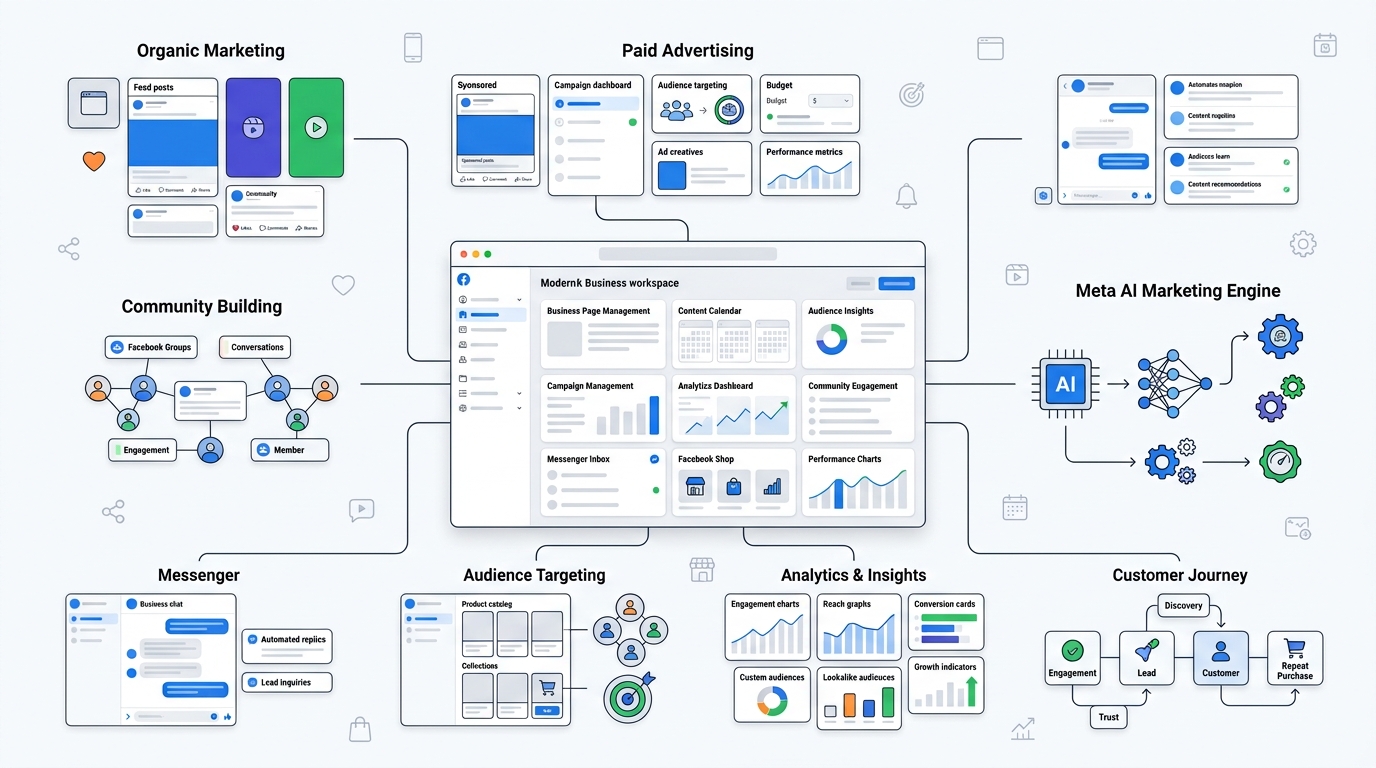
Facebook marketing is the practice of using Facebook’s tools — pages, groups, ads, Messenger, Shops, Reels — to build awareness, connect with an audience, and eventually turn that attention into leads or sales. That’s the simple definition. The messier, more honest definition is that Facebook marketing in 2026 is really relationship marketing wearing a tech disguise. People don’t follow brands anymore because a brand is “cool.” They follow because the brand gives them something — entertainment, information, a sense of belonging, a good deal. Miss that, and no amount of tactics will save you.
Organic vs Paid Facebook Marketing
Organic is everything you do without paying — posts, Reels, group activity, replying to comments. Paid is everything you boost with money — ads targeting cold audiences, retargeting people who visited your site, lead gen campaigns. For years, marketers acted like these were separate worlds. They’re not, not really. Your best organic content becomes your best ad creative. Your ad data tells you what to post more of organically. Businesses that treat them as one connected system outperform the ones running two separate strategies that don’t talk to each other.
How Facebook Marketing Fits Into the Modern Customer Journey
Nobody buys anything the first time they see it anymore, not on Facebook, not anywhere. Someone might scroll past your Reel today, see a carousel post from you next week, get retargeted with an ad ten days later, and finally message your page when they’re actually ready. Facebook marketing today isn’t about one perfect post that converts. It’s about showing up consistently enough, in enough formats, that when someone’s ready to buy, you’re the name they already trust.
Why Facebook Still Matters in 2026
Look at what actually happens when small businesses drop Facebook entirely to chase whatever’s trendy. Most of them come back within a year. Why? Because Facebook still has the widest age range of any major platform, still has the most powerful ad targeting infrastructure on the planet, and still has Groups — a feature no other platform has replicated well. Instagram is great for younger, visual-first audiences. TikTok is great for reach and virality. But Facebook is still where people 30 and older actually make buying decisions, join communities, and trust recommendations.
Businesses That Benefit Most from Facebook Marketing
Local businesses. Service providers. E-commerce brands selling to anyone over 25. B2B companies doing lead gen. Coaches and consultants. Real estate agents. Restaurants. Healthcare clinics. Basically, if your customer is a real person with real money and real problems, Facebook can reach them. The businesses that struggle most are the ones chasing an audience that’s genuinely under 20 and nowhere else — and even then, Instagram (owned by Meta anyway) usually picks up that slack.
Is Facebook Marketing Still Effective in 2026?
Short answer: yes, but only if you’re doing it right. Long answer, keep reading.
Latest Facebook User Statistics
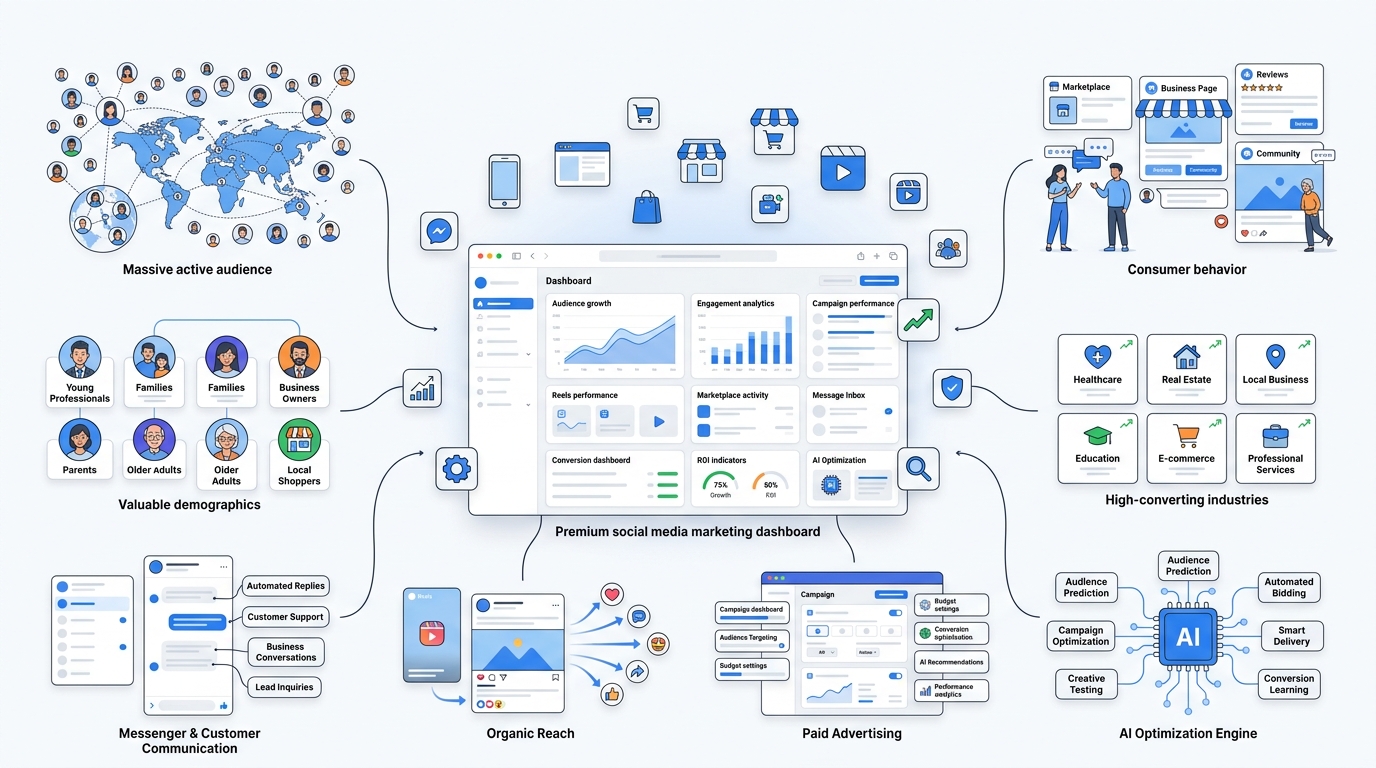
Facebook remains the largest social platform in the world by monthly active users, sitting well above 3 billion. The average time spent per session has actually held steady rather than collapsing the way some predicted, largely because of how much time people now spend on Reels and Marketplace. Facebook Marketplace alone has become a massive discovery engine for local and secondhand commerce, something a lot of marketers still sleep on.
Demographics That Businesses Should Know
The 25–44 age bracket is still Facebook’s biggest and most commercially valuable group. That’s people with jobs, mortgages, kids, and disposable income — exactly who most businesses want to reach. Younger users haven’t abandoned Facebook completely either; they use it differently, mostly for Marketplace, Groups, and Messenger rather than posting personal updates. Older users, 45+, remain heavily active and tend to trust content on Facebook more than on newer platforms, which matters a lot for industries like healthcare, finance, and home services.
Consumer Behavior on Facebook
People on Facebook aren’t just scrolling mindlessly anymore, even though it might look that way. They’re researching purchases, reading reviews in comment sections, joining niche Groups for hobbies or local recommendations, and messaging businesses directly instead of calling. Click-to-message has quietly become one of the biggest behavior shifts on the platform. People would rather type “is this still available” than pick up a phone, and businesses that respond fast are winning customers that used to go to whoever answered the phone first.
Industries Seeing the Highest ROI
Home services, healthcare and wellness, local retail, real estate, education, and e-commerce are consistently seeing strong returns on Facebook. These are industries where trust matters and where a video testimonial or a before-and-after photo does more convincing than a polished ad ever could. B2B is trickier, but it’s not dead there either — lead gen campaigns targeting decision-makers by job title and company size still perform, especially when paired with LinkedIn.
Common Myths About Facebook Marketing
“Organic reach is zero” — nope, it’s lower than it used to be, but posts that spark real conversation still reach thousands without a dollar spent. “Only old people use Facebook” — the platform’s user base skews a bit older than Instagram, sure, but 3 billion people is not a niche audience by any definition. “You need a huge budget to see results” — plenty of local businesses run $10–20 a day and get consistent leads. “Facebook ads don’t work anymore because of privacy changes” — they got harder to target as precisely, yes, but Meta’s AI-driven Advantage+ system has actually closed a lot of that gap by optimizing delivery automatically.
How the Facebook Algorithm Works in 2026
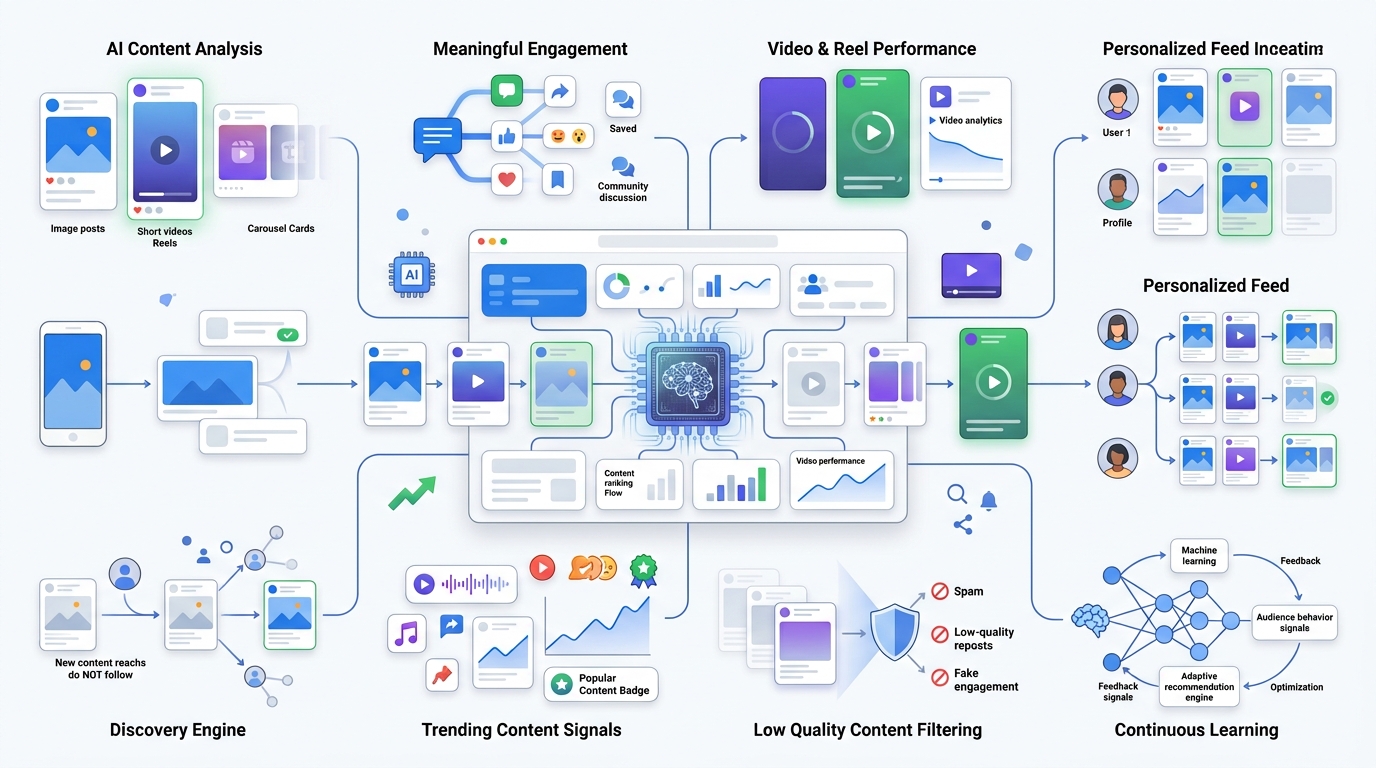
This section should explain how Facebook determines which content appears in a user’s feed. Start by describing the purpose of the algorithm showing people content they are most likely to engage with instead of displaying posts chronologically.
What the Algorithm Prioritizes
Facebook’s algorithm in 2026 is built around one core idea: keep people on the app longer by showing them what they’re actually going to engage with, not just what their friends posted. That means the algorithm now leans heavily on machine learning to predict, before a post even gets many views, whether you’re likely to watch it, comment on it, or share it. It’s less about who posted something and more about whether the content itself is good.
Meaningful Engagement Signals
Not all engagement counts equally. A comment is worth more than a like. A share is worth more than a comment, because sharing means someone found it valuable enough to put their own name next to it. Replies within comment threads actual back-and-forth conversation signal to the algorithm that a post is genuinely sparking discussion, and that gets rewarded with more reach.
Watch Time and Video Performance
Video, especially Reels, gets judged on watch time and completion rate more than raw views. A 15-second video that people watch all the way through beats a 60-second video where everyone drops off at second 8. This is why hook quality in the first two seconds matters so much more than production value. Nobody cares if your video is shot on a $3,000 camera if it doesn’t grab attention immediately.
Shares vs Likes vs Comments
Honestly, if you’re only optimizing for likes, you’re optimizing for the wrong thing. Likes are the laziest form of engagement and Facebook knows it. Shares tell the algorithm “this is worth showing to someone else’s friends,” which is the whole game. Comments tell it “this made someone stop and think.” Build content designed to get people talking or tagging a friend, not just tapping a thumbs up.
AI-Powered Content Recommendations
Facebook’s feed increasingly shows content from accounts you don’t follow, based purely on what its AI thinks you’ll like — the same model that made TikTok’s For You page so addictive. This is actually good news for small businesses. You no longer need thousands of followers to get discovered. A single strong Reel can reach people who’ve never heard of your business, purely because the content itself performs.
How Facebook Ranks Reels
Reels get ranked on a combination of watch time, replays, shares, and audio usage. Using trending audio genuinely helps discoverability because Facebook groups Reels by audio trends the same way TikTok does. Original audio can still work, especially for voiceovers or educational content, but if you want an extra push, trending sounds matter more than people think.
Feed Ranking Explained
The main feed ranks content based on relevance to the individual user — their past behavior, the accounts they engage with most, and content type preferences. This is why two people can follow the same page and see completely different amounts of its content. If your top fans aren’t engaging, even they might stop seeing your posts.
Content That Gets Suppressed
Facebook actively suppresses engagement bait (“comment YES if you agree,” “tag someone who needs this”), clickbait links, low-quality reposted content, and anything that looks spammy or misleading. It also quietly limits reach on posts that send people off-platform too aggressively, since Facebook wants to keep people scrolling, not clicking away.
Common Algorithm Mistakes
The biggest one? Posting inconsistently and then blaming the algorithm when reach drops. The second biggest? Chasing vanity likes instead of building content that gets shared. Third? Ignoring video completely because “our audience prefers photos” — that’s rarely true anymore, it’s usually just that nobody’s tried making a decent video yet.
How to Set Up a Facebook Business Presence the Right Way
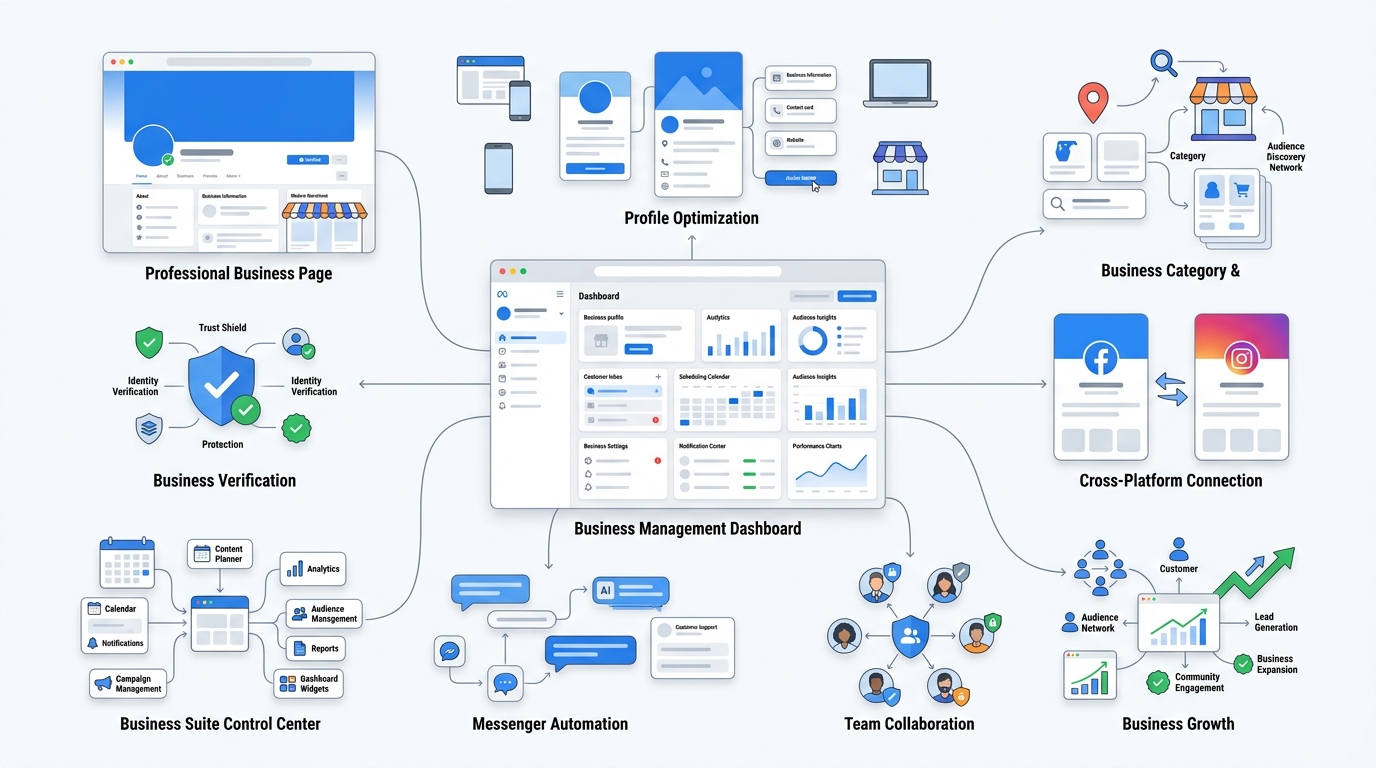
Instead of simply explaining how to create a Facebook Page, make this section a complete business setup guide. Walk readers through building a professional Facebook ecosystem that is optimized for credibility, discoverability, customer communication, and advertising.
Creating a Professional Facebook Business Page
This sounds basic, but so many pages still look half-finished. A proper business page isn’t a personal profile with a logo slapped on — it needs a clear purpose, consistent branding, and information a stranger could use to trust you within ten seconds of landing there.
Optimizing Your Profile
Cover Image — Use this space to show what you actually do, not just a logo on a plain background. A photo of your storefront, your team, or your product in action tells a story faster than any text.
Profile Photo — Your logo, cropped tightly since the circle cuts off edges. Keep it simple enough to recognize at thumbnail size.
CTA Button — Pick the one that matches your actual goal. “Send Message,” “Book Now,” “Shop Now,” whatever fits. So many pages default to a generic button that doesn’t match how customers actually want to reach them.
Business Information — Fill out everything. Hours, description, website, category. Half-empty profiles look abandoned, and people notice.
Contact Details — Phone number and email that are actually monitored. Nothing kills trust faster than messaging a business and getting silence for three days.
Choosing the Right Category
This affects what features show up on your page and how Facebook categorizes you for search and Marketplace visibility. A restaurant page needs to be tagged as a restaurant, not “local business,” or you’ll miss out on menu features and review prompts that matter.
Verifying Your Business
A blue or gray verification badge does more for trust than most businesses realize. It’s not just vanity — it tells customers this isn’t a scam page, which matters a lot given how much impersonation happens on the platform now.
Connecting Instagram
Linking your Instagram account lets you cross-post content and run ads across both platforms from one place. If you’re already making Reels for one platform, there’s no reason not to distribute to both with a couple of tweaks.
Setting Up Meta Business Suite
This is your control center — scheduling, inbox management, insights, ad creation, all in one place. Businesses still running everything manually through the app are wasting hours a week they don’t need to waste.
Configuring Messenger
Set up automated greetings, quick replies for common questions, and away messages for after hours. People expect a response within minutes now, and a well-set-up Messenger flow can hold that expectation even when nobody’s actively watching the inbox.
Page Roles and Permissions
If you’ve got a team, assign roles properly — admin, editor, moderator — rather than sharing one login. It’s cleaner, safer, and lets you see who actually posted what when something goes wrong.
How to Build a Facebook Marketing Strategy That Works
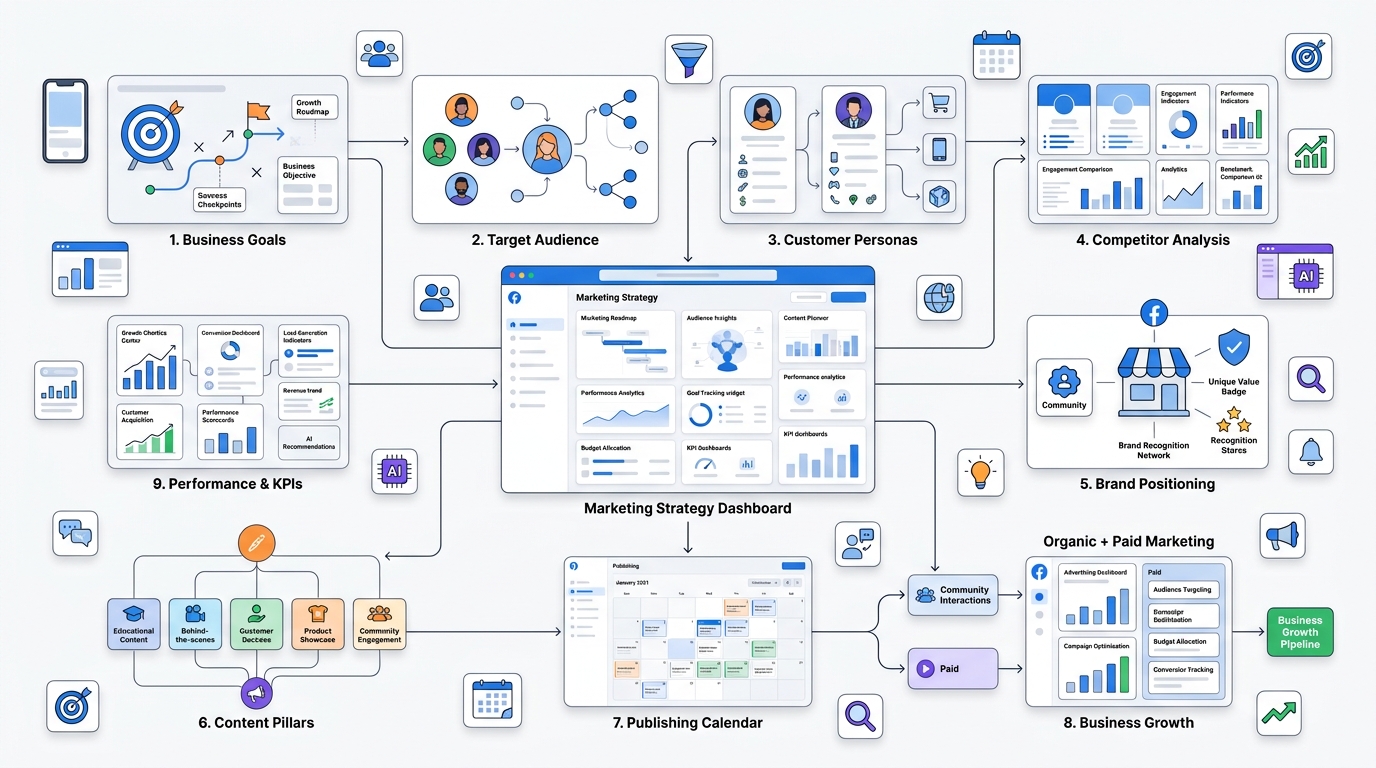
Before anything else, decide what you actually want. More leads? More sales? Brand awareness for a new product? Community building for retention? Vague goals produce vague strategies. “Get more engagement” isn’t a goal, it’s a feeling.
Identify Your Target Audience
Who’s actually buying from you right now? Not who you wish was buying — who actually is. Pull that from your existing customer data before guessing at demographics.
Create Customer Personas
Build two or three specific personas with real details — age range, pain points, what they’re scrolling past, what stops their thumb. “Busy moms” is not a persona. “34-year-old working mom, tired at 9 PM, scrolling for quick dinner ideas she can make in under 20 minutes” is a persona you can actually write content for.
Competitor Analysis
Look at what your direct competitors are posting and, more importantly, what’s actually getting engagement in their comments. You don’t need fancy tools for this — just scroll their page for twenty minutes and take notes.
Brand Positioning
What makes you different, in a sentence someone could repeat to a friend? If you can’t answer that clearly, your content will feel generic no matter how often you post.
Content Pillars
Pick three to five recurring themes — education, behind-the-scenes, testimonials, product features, community — so you’re never staring at a blank page wondering what to post.
Posting Frequency
Quality over sheer volume, but consistency matters more than either. Three solid posts a week beats one great post a month and it beats seven mediocre posts a week too.
Budget Planning
Decide upfront how much you’re spending, split between content creation and paid promotion. Even a modest $300–500 monthly ad budget, spent well, outperforms a $0 budget spent on hope.
Organic vs Paid Balance
Organic builds trust and community. Paid builds reach and speed. You need both — organic alone is too slow for most business timelines, and paid alone without organic trust-building often feels cold and salesy.
KPIs to Measure Success
Pick metrics tied to your actual goal, not vanity numbers. If your goal is leads, track cost per lead, not likes.
Types of Facebook Content That Still Perform
Let’s talk about what actually gets posted versus what actually works, because there’s a real gap there. Most business pages post the same five things on rotation and wonder why nothing lands. So let’s go through each format properly, not just the one-liner version.
Short Videos
Under 60 seconds. That’s the sweet spot, and there’s a reason for it. People aren’t sitting down to “watch content” on Facebook, they’re killing 90 seconds between tasks, waiting for coffee, half-listening to something else. A short video that solves one problem or tells one story fits into that gap perfectly. The mistake most businesses make is trying to cram three ideas into one video. Don’t. Pick one thing — “here’s how to fix a squeaky door hinge” — show it, done. These consistently beat static images in reach right now because Facebook’s algorithm is actively pushing video harder than photos, full stop. If you’re still mostly posting images because “that’s what we’ve always done,” you’re leaving reach on the table for no real reason.
Facebook Reels
Reels are the golden child right now. Meta is fighting TikTok for attention, and Reels are the weapon they’ve chosen, which means the algorithm is quietly boosting them over almost every other format. If you’re a small business owner with fifteen minutes a day to spend on content and you can only commit to one format, make it Reels. Not because everything else is useless, but because this is where Facebook is actively sending extra reach right now, sometimes to accounts with barely any followers. That’s rare. Most platforms make you earn an audience first. Reels can put you in front of strangers on day one if the content’s good.
Image Posts
People keep saying images are dead. They’re not, they’re just held to a higher bar now. A blurry product shot with Comic Sans text over it isn’t going to cut it in 2026. But a genuinely well-shot photo — good lighting, clean composition, maybe a bit of personality in the styling — still performs, especially for product announcements, quotes, or simple statements you want people to screenshot. The difference between “image posts don’t work” and “image posts work great” usually comes down to whether someone actually put thought into the shot or just grabbed whatever was on their phone.
Carousel Posts
Carousels are underrated, honestly. Every swipe counts as a form of engagement, so a five-slide carousel that keeps someone swiping is quietly telling the algorithm “this person is really into this post.” Step-by-step tutorials work great here — slide one is the problem, slides two through four are the process, slide five is the result. Before-and-afters work even better as carousels because people love the reveal, the anticipation of swiping to see the “after.” Product catalogs are the other big use case — showing five products in one post instead of five separate posts that’ll compete with each other for reach.
Stories
Stories are the low-pressure cousin of your main feed. They disappear in 24 hours, which sounds like a downside but is actually the whole point — nobody expects Stories to be polished. You can post a blurry photo of your team eating lunch, a quick poll, a screenshot of a good review, whatever. It keeps you visible between your “real” posts without the pressure of it needing to be your best work. A lot of businesses skip Stories entirely because they feel like “extra work,” but honestly they’re the easiest content you’ll ever make because nobody’s judging them the way they judge a feed post.
Facebook Live
Live video still gets a genuine reach boost, plus Facebook pushes a notification out to your followers when you go live, which no other format does automatically. That alone is worth something. Q&As work well because people can ask questions in real time and you can respond right there, which builds trust fast. Product launches feel like an event instead of just another post. Behind-the-scenes tours — walking through your kitchen, your studio, your warehouse — give people a reason to stick around even if they weren’t planning to watch a livestream that day.
Polls
Polls are almost too easy to skip, but don’t. They ask basically nothing of the viewer — one tap — and that low barrier is exactly why they get so much engagement. “Which one should we launch first, the blue or the green?” gets people emotionally invested in an outcome before they’ve spent a dollar. Then when you actually launch the winning option, the people who voted feel some ownership over that decision. That’s not a small thing. It turns passive scrollers into people who feel like they’re part of your process.
Educational Posts
“How to” content, myth-busting, quick tips — this is the stuff that actually builds authority over time. Nobody shares a promotional post with their friends, but people absolutely share a genuinely useful tip because sharing it makes them look helpful too. Educational content also gets saved way more than any other format, and saves are a strong engagement signal Facebook pays attention to. If you’re in a field where people have real questions — skincare, home repair, finance, fitness — answering those questions publicly does more for your reputation than any sales pitch ever will.
User-Generated Content
This one’s basically free marketing. When a customer posts a photo with your product or tags you in a review, reposting that does two things at once: you get content without lifting a camera, and anyone who sees it gets social proof from a real person instead of your brand talking about itself. People trust other customers more than they trust you, that’s just how it works. Always ask permission before reposting, but most customers are flattered to be featured, not annoyed.
Customer Testimonials
Text reviews are fine, but video testimonials hit different. There’s something about watching a real person’s face, hearing their actual voice, seeing them hesitate a little before saying something genuine, that a five-star text review just can’t replicate. If you can get even three or four customers on camera talking about a real result they got, that footage will outperform almost anything you could write yourself. It doesn’t need to be professionally shot either — a slightly shaky phone video of someone being genuinely enthusiastic beats a scripted, over-produced testimonial every time.
Before-and-After Posts
If your business has any kind of visual transformation involved — fitness progress, a home renovation, a deep clean, a skincare result — before-and-afters basically sell themselves. You don’t need clever copy or a strong hook, the image does all the convincing. The trick is making sure the before and after are shot in similar lighting and angles so the comparison feels honest, not staged. People are pretty good at spotting a before-and-after that’s been set up to exaggerate the difference, and that kills trust fast.
Behind-the-Scenes Content
This is the stuff that makes a business feel like real people instead of a logo. Show the mess. Show the team arguing over which font to use. Show the fifth attempt at a recipe that didn’t work before the sixth one did. People are honestly a little tired of perfectly polished brand content — it feels distant. Behind-the-scenes closes that distance. It reminds people there are actual humans behind the page, and that matters more for loyalty than almost anything else on this list.
Community Discussions
Asking a genuine question and then actually showing up in your own comments to reply is one of the cheapest reach hacks that still works. Every comment, every reply, every back-and-forth keeps that post alive in the algorithm longer, which means more people see it organically. The catch is it has to be a real question people actually want to answer, not “comment below!!” engagement bait, because Facebook’s gotten good at spotting and suppressing that kind of lazy tactic.
Product Demonstrations
Nobody wants to read three paragraphs explaining what your product does when a 20-second video could just show it happening. Watch someone open the packaging, use the product, see the result — that’s it, that’s the whole pitch. Demos work because they remove the guesswork. People don’t have to imagine how something works, they just watched it work, and that’s a much shorter path to “I want that.”
Memes (When Appropriate)
Memes can be a genuine engagement machine if they actually fit your brand’s personality. Relatable humor gets shared constantly because sharing a meme with a friend is basically a form of communication now — it says “this is us” without anyone having to type anything. But this only works if it’s natural. A stiff, corporate brand trying to force a meme usually just looks like it’s trying too hard, and people can smell that from a mile away. If humor isn’t part of your brand voice already, don’t force it in here.
Seasonal Content
Tying posts to holidays, seasons, or industry-specific moments gives you a built-in, timely reason to post that doesn’t feel like you’re just selling for the sake of selling. A gym posting about New Year’s resolutions in January feels natural. A tax firm posting reminders in March feels helpful, not pushy. The key is picking moments that are actually relevant to your audience’s life, not just slapping a pumpkin emoji on every October post because it’s autumn.
Organic Facebook Marketing Strategies That Still Work
Begin by explaining why organic reach has changed over the years and why quality engagement now matters much more than posting frequency.
Introduce the concept of relationship-based marketing and explain that Facebook rewards businesses that consistently create conversations rather than simply broadcasting promotional content.
Publish Consistently
This one sounds obvious until you actually watch how most business pages behave. They post like crazy for two weeks after a New Year’s resolution to “be better at marketing,” then go quiet for a month, then panic-post five times in one day to make up for it. That inconsistency is the actual reach killer, not the algorithm. Followers build an unconscious expectation without even realizing it — they get used to seeing you show up a certain number of times a week, and when you vanish, the algorithm notices that engagement on your page has dropped and starts showing your content to fewer people by default. You don’t need to post daily. Three times a week done reliably beats seven times a week done for one sprint and then abandoned. Predictability is the actual currency here, not volume.
Focus on Conversations Instead of Broadcasting
Most pages are still stuck in old-school advertising mode — post, announce, promote, repeat. That’s a megaphone, and megaphones get tuned out fast. What actually works now is treating your page like you’d treat a conversation at a dinner table. Ask something people actually want to answer. Reply to comments like a human, not a brand account copy-pasting “Thanks for reaching out!” fifty times a day. The businesses seeing real growth right now are the ones who’ve figured out that people don’t want to be sold to constantly, they want to feel like someone’s actually listening. That shift, from broadcasting to conversing, changes everything about how your content performs, because the algorithm rewards back-and-forth engagement way more than it rewards passive viewing.
Use Storytelling
Here’s a simple test. “New product launched” — do you feel anything reading that? Probably not, and neither does anyone scrolling past it. Now compare that to a post that starts with “We tried four different suppliers before finding one that didn’t cut corners, and it took us eight months longer than we wanted.” Suddenly there’s a reason to keep reading. Storytelling works because it creates a small gap — a question in the reader’s mind — that they want closed. Why did it take so long? What went wrong with the other suppliers? People will read three extra paragraphs to satisfy that curiosity, but they won’t read three extra paragraphs of straight product features. If you’re announcing something, don’t just announce it — explain why it exists, what problem it’s solving, what happened behind the scenes to get there.
Encourage Shares
Shares are the hardest engagement to earn and the most valuable to get, because when someone shares your post, they’re putting their own reputation behind it. Nobody shares something boring, because it makes them look boring by association. So the content that actually gets shared tends to fall into a few buckets: something genuinely useful enough that people want to save it for later or pass it to a friend who needs it, something relatable enough that tagging a friend feels like an inside joke, or something that makes the sharer look smart, funny, or thoughtful for having shared it. If you’re creating a post and asking yourself “would someone actually want their friends to see they shared this,” that’s the filter worth using before you hit publish.
Build a Community
This is the slow, unglamorous strategy that nobody wants to hear about because it doesn’t produce a spike in a week. But it’s also the one thing your competitors can’t copy overnight and the one thing an algorithm change can’t take away from you. A follower who just happened to see one ad once is replaceable. A follower who’s part of an actual community around your brand — who comments regularly, who feels some ownership, who’d notice and care if you disappeared — that’s not replaceable. Every algorithm update in the last several years has hurt brands relying purely on reach and helped brands that had already built real community, because community-driven engagement doesn’t depend on the algorithm being generous that particular week.
Optimize Posting Times
Every “best time to post on Facebook” chart you find online is based on aggregate data across millions of accounts in different industries, different time zones, different audiences. It’s a starting point, not a rule. A B2B company’s audience is scrolling during lunch breaks and evenings after work. A local bakery’s audience might be checking Facebook first thing in the morning deciding where to grab breakfast. Your actual audience has actual patterns, and Meta Business Suite will show you exactly when your specific followers are online if you bother to check. Test a few different times over a few weeks, watch what actually happens to your reach and engagement, and let that data — not a generic blog post chart — tell you when to post.
Repurpose Existing Content
So many businesses treat every single post like it needs to be created from scratch, and that’s exhausting and unnecessary. That blog post you spent hours writing? Pull five separate ideas out of it and turn each into its own post. Turn the core message into a Reel script. Break the steps into a carousel. Quote a strong line from it as a standalone image post. You already did the hard thinking when you wrote the original piece — repurposing is just packaging that same value in different formats for people who consume content differently. Some people read blogs, some only watch video, some only skim carousels. Repurposing gets your message in front of all of them without multiplying your workload.
Cross-Promote Across Channels
Your channels shouldn’t be operating like strangers who’ve never met. If you’ve got an email list, mention your Facebook Group in it — “here’s where the community actually hangs out.” If you’re active on Instagram, put your Facebook link in your bio and vice versa. This feels almost too simple to mention, but so many businesses build audiences on three or four different platforms that never send traffic to each other. Every channel you own should be quietly pointing people toward your other channels, so the audience you build in one place compounds into growth everywhere else instead of staying siloed.
Employee Advocacy
Here’s something a lot of businesses miss entirely: personal Facebook profiles often get significantly better organic reach than business pages do, simply because the algorithm still favors content from actual people over branded pages. So when you encourage your team to share company posts, or better yet, to talk about their work in their own words on their own profiles, you’re tapping into reach your business page alone could never get. It also just reads as more authentic — a customer trusts “my coworker Sarah is excited about this” a lot more than “Company XYZ is excited to announce.”
Collaborations
Partnering with another local business or a micro-influencer in your niche is one of the most underused organic strategies out there, mostly because businesses assume “collaboration” means some big formal influencer contract with a huge budget attached. It doesn’t have to. A local coffee shop and a local bakery cross-promoting each other costs nothing but benefits both, because their audiences overlap but aren’t identical. A micro-influencer with 8,000 genuinely engaged local followers can send you more real customers than a celebrity with a million followers who’s never heard of your town. Shared audiences mean shared growth, and it’s often just a conversation and a handshake away.
Local Community Engagement
If you’re a local business and you’re not active in local Facebook Groups, you’re skipping one of the highest-trust marketing channels available to you. Join the Groups your actual customers are already in — neighborhood pages, local recommendation Groups, niche interest Groups relevant to your industry. Show up as a genuinely helpful person first. Answer a question about plumbing because you actually know plumbing, not because you’re trying to sell a service in that exact comment. Mention your business only when it’s actually relevant to the conversation. This builds a level of local trust that no amount of paid advertising can replicate, because it comes from a real person being genuinely useful in a space the community already trusts.
Facebook Reels Strategy for Maximum Reach
Explain why Meta continues prioritizing short-form vertical video and how Facebook Reels differ from Instagram Reels despite sharing many features.
Why Reels Continue Growing
Meta isn’t being subtle about this one. They’re locked in a real fight for attention with TikTok, and Reels are the format they’ve decided to bet the platform’s future on. That means the algorithm is actively, deliberately pushing Reels into more feeds than any other content type right now. Businesses that lean into this early are catching a wave that other formats simply can’t access — you can post a Reel from a page with almost no followers and still land in front of thousands of strangers if the content performs. That kind of reach gift doesn’t last forever with any format historically, so the businesses moving on this now are the ones benefiting most.
Ideal Reel Length
Fifteen to thirty seconds isn’t an arbitrary number, it comes from how attention and completion rate actually behave. Go shorter than that and you often don’t have enough time to build a real hook and payoff. Go much longer and you start losing people halfway through, and a video where half your viewers drop off before the end tells the algorithm this content isn’t holding attention, which tanks your reach on the next one too. It’s not really about length for its own sake — it’s about matching your content to a length where people are likely to watch the whole thing, because completion rate matters more to the algorithm than almost anything else.
Best Hook Techniques
You’ve got about two seconds before someone’s thumb decides whether to keep scrolling. Two seconds. That’s not a lot of room for a slow intro or a logo animation. The Reels that actually stop the scroll tend to do one of three things immediately: start in the middle of the action instead of setting it up first, open with a question that the viewer genuinely wants answered, or show the finished result upfront and make people curious how you got there. “Wait, I fixed this in ten seconds” is a stronger opener than “Hi guys, today I’m going to show you how to fix a leaky faucet.” Cut straight to the interesting part.
Editing Tips
Fast cuts keep momentum, and momentum keeps people watching. If there’s a pause, a stumble, an “um,” or a slow transition that doesn’t add anything, cut it out. Every second where nothing interesting is happening is a second where someone might scroll away. Burned-in captions matter here too, and not just for accessibility — the vast majority of people scrolling Facebook have their sound off, whether they’re at work, in bed next to someone sleeping, or just in the habit of scrolling silently. If your message only exists in the audio, you’re losing most of your potential audience before they ever hear a word.
Trending Audio
Using trending audio genuinely helps Reels get discovered because Facebook groups content by the audio being used, similar to how TikTok’s audio trends work. But the mistake a lot of businesses make is grabbing whatever’s trending overall without checking if it fits their niche at all. A trending sound that’s popular with teenagers doing dance trends isn’t going to help a plumbing company’s Reel land in front of homeowners who need a pipe fixed. Check what’s trending specifically within your niche or industry, because relevance to your actual audience matters more than raw popularity of the sound itself.
Captions
This isn’t optional anymore, it’s baseline. A huge portion of people watching Reels have the sound off by default, and if your video relies entirely on spoken audio to make sense, you’re losing a massive chunk of potential viewers before your message even lands. Burn captions directly into the video rather than relying on Facebook’s auto-captions alone — sometimes those are inaccurate, and having your own styled captions also gives you a chance to emphasize key words visually, which helps retention too.
CTA Placement
The call-to-action needs to feel like a natural next step, not a jarring sales pitch bolted onto the end of otherwise genuine content. “Drop a comment if you want the recipe” invites participation and feels low-pressure. “Buy now” at the end of a casual behind-the-scenes Reel feels like a tone whiplash that can undo the trust you just built over the previous twenty seconds. Save the harder sell for content that’s actually meant to sell, and keep your value-driven Reels focused on softer, more natural CTAs that match the vibe of what came before them.
Common Reel Mistakes
The biggest one is giving up after one or two attempts. Reels genuinely take volume and testing before patterns emerge — you might post five that flop before one takes off, and that one gives you information about what actually resonates that the previous five didn’t. Weak hooks kill videos before they have a chance. Skipping captions loses silent viewers. Grabbing irrelevant trending audio just because it’s popular wastes the discoverability boost audio can actually give you. And treating Reels as a one-and-done experiment rather than an ongoing practice means you never actually learn what works for your specific audience.
How to Use Facebook Groups for Community Marketing
Introduce Facebook Groups as one of the strongest tools for building loyal communities rather than simply increasing follower counts.
Why Groups Often Outperform Pages
Here’s something a lot of marketers still haven’t caught onto: Groups get algorithm treatment that pages simply don’t get anymore. When someone posts in a Group you’re a member of, there’s a much higher chance you’ll actually see a notification and that post will land in your feed, compared to a page you follow where posts routinely get buried under everything else. That difference in visibility is why a lot of savvy businesses have shifted energy toward building or participating in Groups rather than pouring everything into their page alone.
Starting Your Own Group
The instinct is to name it after your brand — “XYZ Company Community” — but that’s usually a mistake. Nobody joins a Group because they want more branded content in their life. They join Groups built around something they actually care about. “Home Renovation Tips & Ideas” pulls in people interested in the topic, some of whom will become customers naturally over time. “XYZ Company Fan Club” pulls in almost nobody except existing customers who are already loyal, which limits your growth ceiling from day one.
Participating in Existing Groups
Before you ever try to build your own audience, spend time in Groups where your potential customers already hang out. Answer questions. Be genuinely helpful without an agenda. Don’t mention your business in every single comment — that gets you flagged as spam fast, and moderators in well-run Groups will remove you. The trust you build by being useful without an obvious sales motive converts far better down the line than any cold pitch ever could, because by the time you do mention what you do, people already respect your input.
Group Engagement Strategy
A Group that just sits there with occasional promotional posts dies fast. The ones that grow are actively driving conversation — posting questions, running polls, personally welcoming new members by name when they join. That personal touch matters more than people expect. A new member who gets a genuine “hey, glad you’re here, what brings you to the Group” comment is far more likely to stick around and participate than one who joins and hears nothing.
Lead Generation Without Spamming
The line between “helpful community member” and “spammer” is thinner than people think, and crossing it kills your credibility fast. Answer questions thoroughly, with real detail, not just enough to bait someone into DMing you. Only mention your product or service when it’s genuinely the most relevant answer to what’s being asked. The moment a Group starts feeling like an ad feed disguised as a community, people mute it or leave, and that reputation follows you.
Group Rules
Set clear rules from day one — no spam, no self-promotion without genuine context, whatever fits your specific Group’s purpose — and actually enforce them consistently. A Group with no rules or inconsistent enforcement slowly fills with noise, and once that happens, real members stop engaging because it doesn’t feel worth their time anymore. A well-moderated Group feels safe and valuable, and that reputation is what makes it grow through word of mouth.
Community Moderation
This isn’t a set-it-and-forget-it task. Stay active, remove spam quickly before it accumulates, and keep the tone consistent with your brand’s values. An unmoderated Group can turn toxic surprisingly fast — one unaddressed argument or one ignored spam wave, and suddenly the vibe shifts and people who made the Group valuable in the first place start quietly leaving.
Facebook Advertising in 2026
This should become one of the most comprehensive sections of the blog.
Begin by explaining how Meta Ads Manager works and how campaigns are structured into Campaigns, Ad Sets, and Ads.
Why Paid Ads Still Matter
Organic growth is real and valuable, but it’s slow, and most businesses don’t have the luxury of waiting six months for community trust to compound into sales. Paid ads let you skip the waiting line and put your message directly in front of the exact people most likely to actually buy from you, right now, rather than hoping the algorithm decides to be generous with your organic reach that particular week.
Campaign Objectives
Facebook builds its entire ad system around what action you actually want someone to take — awareness, traffic, engagement, leads, sales, or app installs — and it optimizes delivery specifically toward that goal. Picking the wrong objective is genuinely one of the most common reasons ad campaigns underperform. If your goal is sales but you set up an engagement campaign, you’ll get plenty of likes and comments and very few actual purchases, because that’s literally what you told the system to prioritize.
Awareness Campaigns
These work best when you’re brand new or launching something nobody’s heard of yet. They’re cheap on a per-impression basis because Meta isn’t optimizing for a harder action like a purchase, just visibility. Don’t expect this alone to drive direct sales — think of it as planting the seed that other campaigns and organic content will later water.
Traffic Campaigns
These send people to your website or landing page, which is useful, but on its own it’s just visits, not necessarily results. The real value comes when you pair this with a pixel installed on your site, so everyone who clicks but doesn’t convert gets added to a retargeting audience you can follow up with later, rather than that traffic simply disappearing.
Engagement Campaigns
These push a specific post to get more likes, comments, and shares, which builds social proof. A product page or ad with hundreds of genuine comments underneath it converts better than one with none, because people trust what other people are already engaging with. Use this before a bigger sales push to warm up the social proof first.
Leads Campaigns
This is where Instant Forms come in — people fill out their information without ever leaving Facebook, pre-filled with their existing profile data, which removes almost all the friction of a normal form. Conversion rates here are consistently higher than sending someone off to an external landing page, simply because every extra step and every extra page load loses people along the way.
Sales Campaigns
These are optimized directly for purchases and work best paired with a pixel or Conversions API so you’re tracking actual revenue generated, not just surface-level clicks. This is usually the objective businesses care about most, but it also requires the most data to optimize well, so it performs best once you’ve got some purchase history for the algorithm to learn from.
App Promotion
If your business has a mobile app, this objective specifically optimizes for installs and meaningful in-app actions, rather than generic website clicks that don’t actually matter for an app-based business model.
Audience Targeting
Privacy changes over the last several years have limited some of the precision advertisers used to have, that’s true. But you can still target based on interests, behaviors, location, and lookalike audiences built from your existing customer list, which remains a genuinely powerful way to find new people who resemble the customers already buying from you.
Advantage+ Campaigns
This is Meta’s AI-driven campaign type, and it’s earned its reputation faster than most advertisers expected. It automates targeting and placement decisions based on real performance data rather than manual guesswork. A lot of experienced advertisers who were skeptical at first, assuming manual targeting would always beat an algorithm, have quietly switched over because Advantage+ is now consistently outperforming hand-built audiences once it has enough data to learn from.
AI Optimization
Meta’s systems now handle a huge chunk of the guesswork that used to require someone manually checking and adjusting campaigns every day. Feed it strong creative and a clear goal, and the algorithm does a lot of the heavy lifting around delivery, bidding, and placement that used to eat hours of a marketer’s time.
Budgeting Strategies
Don’t dump your entire budget into one untested ad hoping it works. Start small, run a few different creatives against each other, see what actually performs with real data, then scale the budget behind whatever’s winning. This protects you from wasting money on an approach that never had a chance to begin with.
Creative Best Practices
Ads that look native to the feed — like a real person made them, not a polished studio production — consistently outperform overly slick, corporate-looking ads. Show real people, real results, and make sure the first three seconds are strong enough to stop someone mid-scroll, because if you lose them there, nothing else in the ad matters.
Facebook Lead Generation Strategies
Explain that successful Facebook lead generation requires much more than simply running Lead Ads.
Instant Forms
These come pre-filled with the user’s existing Facebook information, which removes almost all the friction of a typical form. Great for webinar sign-ups, quote requests, or consultation bookings, since the person barely has to do anything except confirm and submit.
Messenger Leads
Instead of sending someone to a form, these ads open directly into a chat conversation. This feels more personal and often gets stronger response rates for service-based businesses, because a conversation feels less transactional than filling out a static form.
WhatsApp Integration
In regions where WhatsApp is the dominant way people communicate, Click-to-WhatsApp ads can outperform every other lead format by a wide margin, simply because you’re meeting people exactly where they already prefer to talk.
Landing Pages
Still essential when your offer needs more explanation than an Instant Form allows for. Just make sure it’s genuinely built for mobile, since the overwhelming majority of your traffic will be arriving on a phone screen, not a desktop.
Webinar Registration
A proven format for coaches and service businesses to generate warm leads who’ve already raised their hand and shown real interest before a sales conversation ever happens, which makes the eventual sales call far easier than cold outreach.
Ebook Offers
Lower commitment than a webinar, which makes it useful earlier in the funnel when someone’s curious but not ready for a bigger ask. It’s a lightweight way to start capturing contact information from people still in the research phase.
Free Consultation Funnel
Works especially well for coaches, agencies, and local service providers, where trust genuinely needs to be built before someone’s willing to hand over money for advice or a service they haven’t experienced yet.
Lead Magnets
Checklists, templates, discount codes — anything that gives someone immediate, tangible value in exchange for their contact information. The stronger and more specific the value, the higher your opt-in rate tends to be.
CRM Integration
Connecting your lead forms directly to your CRM means new leads get followed up within minutes instead of sitting untouched for days. Speed to follow-up is one of the single biggest predictors of whether a lead actually converts into a paying customer, so this isn’t a minor technical detail, it’s genuinely one of the highest-leverage things you can set up.
Facebook Content Calendar Planning
Explain why random posting leads to inconsistent results and how a structured content calendar improves consistency, quality, and campaign planning.
Weekly Posting Framework
Having a repeatable structure — say Monday’s educational, Wednesday’s behind-the-scenes, Friday’s a testimonial or promo — removes the daily panic of staring at a blank screen wondering what to post. It also naturally forces variety into your content mix instead of accidentally posting the same type of thing five times in a row.
Monthly Campaign Planning
Zoom out beyond the week and plan around bigger initiatives — a product launch, a seasonal sale, a themed content series — so your weekly posts are actually supporting something larger instead of existing as disconnected, isolated pieces of content with no bigger direction behind them.
Seasonal Campaigns
Plan around holidays and seasonal moments weeks ahead of time rather than scrambling the day before. Content made in a rush rarely represents your best work, and seasonal moments are often high-traffic opportunities you don’t want to waste on something thrown together last minute.
Promotional Content Balance
A common rule of thumb floating around is roughly 80% value-driven content to 20% direct promotion. Too much selling and people tune out fast, unfollow, or just scroll past everything you post. Too little promotion and you never actually give people the chance to buy, which defeats the point of marketing in the first place. Finding that balance for your specific audience takes some testing, but 80/20 is a reasonable starting point.
Evergreen Content
Keep a running bank of timeless posts — tips, FAQs, testimonials — that don’t depend on a specific date or trend. When you’re short on fresh material or things get busy, you’ve always got something solid to fall back on instead of skipping a post entirely.
AI-Assisted Content Planning
AI tools can now help draft captions, suggest posting times based on your data, and even generate content ideas based on what’s already performing well in your niche. This genuinely speeds things up, but it still needs a real human pass before publishing, because AI-generated content without editing tends to sound generic and can miss your specific brand voice entirely.
Facebook Marketing Funnel
Explain that Facebook supports the entire customer journey—from discovery to repeat purchases.
Break the section into funnel stages:
Awareness Stage
This is the very first touchpoint — someone discovers you through a Reel, an ad, or a friend sharing something you posted. The goal here isn’t to sell anything. It’s purely to get noticed and register in someone’s memory as something worth paying attention to later.
Interest Stage
People start following your page, engaging with a post or two, maybe clicking through to check out your website out of curiosity. They’re interested but not remotely ready to buy yet — this is where nurturing through consistent, valuable content matters most.
Consideration Stage
This is where people are actively comparing you against competitors, reading reviews, watching testimonials, weighing whether you’re actually worth their money. Social proof does the heaviest lifting here — reviews, testimonials, before-and-afters, real customer stories.
Conversion Stage
The actual moment of purchase or lead submission. Retargeting ads aimed at people who’ve already shown interest, paired with a clear, direct call-to-action, matter most at this exact stage, since these are people already close to the decision, not cold strangers.
Retention Stage
The sale isn’t the finish line. Post-purchase content, exclusive offers for existing customers, and Group membership all keep people engaged so they don’t forget about you the moment the transaction’s done, which matters a lot since repeat customers are almost always cheaper to keep than new customers are to acquire.
Advocacy Stage
This is the payoff stage that happens naturally if everything before it was done right. Happy customers start sharing your content and tagging friends without being asked to. It’s the cheapest, most trusted form of marketing that exists, because it comes from a real person vouching for you, not from your brand talking about itself.
Facebook Analytics and Performance Tracking
Reach tells you how many unique individual people actually saw your content, while impressions count every single time it was shown, including repeat views from the same person — two very different numbers that tell different stories. Engagement wraps together likes, comments, and shares into one figure showing overall interaction. Clicks show how many people actually took action and clicked through, and CTR takes that a step further by dividing clicks by impressions to show how compelling your content actually was relative to how often it was seen. CPC and CPM tell you what you’re paying per click and per thousand impressions respectively, which matters a lot for budgeting. ROAS, return on ad spend, is arguably the number that matters most if you’re running paid campaigns, because it directly ties spending to actual revenue generated. Video views and watch time show how well your video content is actually holding attention. Followers matter less than most businesses think — it’s a vanity number that doesn’t necessarily reflect real engagement. Leads and sales, at the end of the day, are the numbers that actually pay the bills.
Meta Business Suite Insights
This is your first, easiest stop for a quick health check — page performance, your top-performing posts, and audience demographics, all without needing to install or pay for any extra tools. Most businesses should be checking this weekly at minimum.
Events Manager
This tracks specific actions people take after interacting with your ads — purchases, sign-ups, add-to-carts — giving you the fuller picture beyond just clicks, which on their own don’t tell you whether someone actually did anything meaningful afterward.
Meta Pixel
Installed directly on your website, the Pixel tracks visitor behavior after they leave Facebook and feeds that data back into the platform, which improves your ad targeting and lets you build retargeting audiences of people who’ve already shown interest.
Conversion API
A more reliable, privacy-resilient way to send conversion data straight from your server rather than relying purely on browser-based tracking, which has become noticeably less dependable as browsers and privacy settings have tightened over the past few years.
UTM Tracking
Tagging your links lets you see, inside Google Analytics, exactly which specific post or campaign actually drove real traffic, rather than relying solely on Facebook’s own self-reported numbers, which can sometimes paint a rosier picture than what’s actually happening.
GA4 Integration
Pairing your Facebook data with GA4 gives you visibility into what actually happens after someone clicks through — whether they browsed, left immediately, or converted days later after multiple visits — filling in gaps that Facebook’s own numbers alone can’t show you.
Monthly Reporting Dashboard
Pull your key numbers together somewhere simple, even a basic spreadsheet works fine, so you can actually spot trends over time instead of reacting emotionally to daily fluctuations that don’t mean much on their own.
AI and Automation in Facebook Marketing
Introduce how artificial intelligence is reshaping both organic and paid Facebook marketing by reducing manual work and improving campaign performance.
AI Content Creation
AI tools can now draft captions, generate image variations, and even help storyboard entire Reels, which speeds up production dramatically. But the best-performing content still gets a real human pass before going live, because AI on its own tends to produce something that reads a little generic if left unedited.
AI Ad Creative Optimization
Meta’s systems can automatically test multiple versions of your ad creative simultaneously and shift budget toward whichever version is actually performing best, often faster and more precisely than a human manually running A/B tests ever could.
AI Audience Targeting
Advantage+ audiences use machine learning to find people statistically likely to convert, and once a campaign has enough data feeding into it, this often outperforms manually built audiences that a human spent hours carefully constructing based on assumptions rather than real behavioral data.
AI Chatbots
These handle the repetitive, common Messenger questions instantly — hours, pricing, availability — which frees up actual humans to focus on more complex conversations that genuinely need a person’s judgment.
Automated Responses
Quick replies and saved responses keep your response times low even outside business hours, which matters a lot given how quickly people now expect an answer. A slow response can lose a customer who simply messages your competitor next.
Scheduling Tools
Batching your content creation and scheduling weeks ahead removes the daily scramble of posting in the moment, and it also lets you plan your content mix more intentionally instead of just posting whatever’s easiest that particular day.
Predictive Analytics
Some tools now forecast which content types are statistically likely to perform well based on your historical data, which helps you prioritize what to create next rather than guessing blindly.
AI Limitations
AI is genuinely useful for speed, but it still doesn’t understand your specific brand voice the way you do, and left unchecked it can produce content that feels generic or slightly off-tone. Lean on it to move faster, not to make the final creative call without a human reviewing it first.
Best Facebook Marketing Tools
Organize this section by function rather than listing tools randomly.
Meta Business Suite
This is the one tool nobody should be paying for alternatives to before they’ve actually used what’s already sitting there for free. It’s built directly into Facebook and handles scheduling across both Facebook and Instagram, gives you one unified inbox for messages and comments so you’re not jumping between apps, and pulls basic performance insights without needing to connect anything external. So many businesses go straight to paid third-party tools because they sound more “professional,” but honestly Meta Business Suite covers 80% of what a small or medium business actually needs. Start here, figure out what’s actually missing for your specific workflow, and only then look at paid options to fill that gap.
Canva
Canva took graphic design and made it accessible to literally anyone with a laptop, and that’s not an exaggeration. You don’t need to know what a kerning setting is or own Photoshop to put together a genuinely on-brand graphic. Templates, brand kits where you save your fonts and colors once and reuse them everywhere, drag-and-drop simplicity — it’s the reason so many small businesses stopped looking amateurish overnight. The trap to avoid is using an obviously generic template that a thousand other pages are also using. Spend the extra ten minutes customizing it so it actually looks like yours, not like a stock template with your logo pasted on top.
ChatGPT
This is a brainstorming partner, not a ghostwriter you publish word-for-word. Where it actually earns its place is helping you get past a blank page — throw it a rough idea and get back five caption variations, or ten content ideas for the week when you’re staring at your calendar with nothing. Ad copy drafts work the same way — get a starting point, then rewrite it in your actual voice, because raw AI output tends to sound a little generic and a little too polished in a way that reads as inauthentic. Treat it as the first draft machine, not the final voice of your brand.
CapCut
If Reels are your priority format, and they should be right now, CapCut is basically the industry-standard editing app for it. Built-in trending effects, ready-made templates, easy caption tools — all the stuff that used to require real editing software and real editing skill now takes a few taps. It’s genuinely closed the gap between “big brand with a video team” and “small business owner editing on their phone during lunch,” which is a real advantage for anyone without a dedicated content team.
Buffer
Once you’re managing more than one platform — Facebook, Instagram, maybe LinkedIn too — jumping between each app to post manually gets old fast and eats real time. Buffer lets you plan and schedule everything from one dashboard, so you can batch a week or two of content in one sitting instead of logging in daily to post something in the moment. It’s straightforward, not overloaded with features you’ll never use, which makes it a solid fit for solo operators or small teams who just want scheduling to work without a learning curve.
Hootsuite
Hootsuite sits in similar territory to Buffer but leans more into deeper analytics and team collaboration features, which makes it a better fit once you’ve got an actual team managing multiple accounts rather than one person handling everything solo. If you need approval workflows, more granular reporting, or you’re managing content across several brands or clients at once, Hootsuite’s extra complexity starts paying for itself. For a solo business owner, it might honestly be more tool than you need.
Metricool
This one sits nicely in the middle — combining scheduling and genuinely useful analytics without the enterprise price tag that comes with some of the bigger platform names. If Buffer feels a little too basic for your reporting needs but Hootsuite feels like overkill and overspend, Metricool tends to be the sweet spot a lot of growing businesses land on.
Later
Later built its reputation around visual planning, letting you see how your grid or feed will actually look before you publish, which matters a lot if aesthetic consistency is part of your brand identity. It’s particularly useful if you’re cross-posting between Facebook and Instagram, since it was originally built with Instagram’s visual-first nature in mind and that strength carries over well when you’re managing both platforms together.
Zapier
This is less exciting than a design or scheduling tool but arguably more important behind the scenes. Zapier connects your lead forms directly to your CRM or email marketing tool automatically, which means a lead who fills out an Instant Form doesn’t just sit there until someone manually exports and uploads it later. It removes the delay and the human error that comes with manual data entry, and remember, speed to follow-up is one of the biggest factors in whether a lead actually converts. This tool quietly protects that speed without anyone having to think about it.
Google Analytics 4
Facebook’s own numbers will tell you a lot, but they stop telling the story the moment someone leaves Facebook and lands on your website. GA4 picks up from there — what they browsed, how long they stayed, whether they converted immediately or came back three days later after seeing a retargeting ad. If you’re only looking at Facebook’s native metrics, you’re missing the second half of the customer’s actual journey.
Looker Studio
Once you’re pulling data from multiple sources — Facebook, GA4, maybe your CRM too — Looker Studio takes all of that scattered information and turns it into one clean, visual dashboard. This matters especially if you’re reporting to a boss, a client, or a team that doesn’t want to dig through raw spreadsheets themselves. A well-built dashboard turns “here’s a pile of numbers” into “here’s what’s actually happening and why it matters,” which makes reporting conversations far more productive.
Facebook Marketing for Different Business Types
Explain that there is no universal Facebook strategy because every industry has different audiences, buying cycles, and marketing goals.
Local Businesses
For a local business, your Facebook page basically functions as a second storefront, one people check before ever physically walking through your door. Location tags help you show up in local searches and Marketplace-adjacent discovery. Active participation in local community Groups puts you directly in front of neighbors who are actively asking for recommendations. And genuine reviews on your page carry serious weight, because most people trust what other real customers in their own area are saying far more than anything you could say about yourself. If your local page looks abandoned or has zero reviews, that’s a red flag to anyone doing a quick check before deciding whether to visit.
E-commerce Stores
E-commerce on Facebook really runs on three pillars working together. Facebook Shops lets people browse and sometimes even buy without ever leaving the app, cutting out steps that used to lose customers along the way. Product tags embedded directly in regular posts turn everyday content into shoppable moments instead of requiring a separate catalog browse. And retargeting ads aimed specifically at people who added something to cart but didn’t finish checking out recover sales that would otherwise just vanish. On the content side, video product demos consistently beat static photos because people actually want to see something working, moving, being used in real life, before they commit their money to it.
SaaS Companies
B2B software sales don’t happen on impulse the way a t-shirt purchase might. Lead gen campaigns that specifically target decision-makers by job title — not just broad interest categories — tend to perform far better here because you’re reaching the actual person with buying authority. But that alone isn’t enough. Pairing those campaigns with genuinely educational content that demonstrates expertise builds the credibility needed before someone’s willing to commit budget to a new tool, especially since B2B buyers usually have to justify the purchase to someone else too.
Coaches & Consultants
This is a trust-first business model if there ever was one. Nobody hands over money for advice or coaching from someone they don’t believe can actually help them. Testimonials from real past clients carry enormous weight here. Free consultation funnels let potential clients test the waters with low commitment before a bigger financial ask. Live Q&A sessions let people see how you actually think and communicate in real time, which does more to build trust in fifteen minutes than any polished sales page could do on its own.
Healthcare Clinics
Trust matters in every industry on this list, but it matters at a different level entirely in healthcare, because people are making decisions that affect their actual health and wellbeing, not just their wallet. Educational content that genuinely helps people understand a condition or treatment option builds credibility. Patient testimonials add a human layer of proof, but this absolutely has to be handled carefully and fully within relevant privacy regulations — this isn’t an area where you can afford to cut corners or assume something’s fine without checking.
Educational Institutions
Prospective students and their families are doing serious research before committing to an institution, often one of the biggest financial and life decisions they’ll make in that stage of life. Groups built specifically for prospective students let genuine questions get asked and answered. Live campus tours give people a real, unfiltered sense of the place without needing to travel there first. And testimonial videos from actual current students or alumni carry a kind of authenticity that official marketing materials from the institution itself simply can’t replicate.
Restaurants
Food is one of the most naturally visual, naturally shareable categories that exists on social media, and restaurants that lean into that tend to do very well. Behind-the-scenes kitchen content shows the craft and care going into what’s being made. Appetizing, well-lit menu photos do more selling than any written description could. And genuine engagement in local Groups — actually responding when someone asks for restaurant recommendations in your area — consistently drives real foot traffic in a way that feels earned rather than forced.
Real Estate
Real estate is interesting because the agent’s personal brand often matters just as much as, sometimes even more than, any individual property they’re listing. Property tour Reels let potential buyers walk through a space before ever scheduling an in-person viewing, saving everyone time. Regular market update posts position the agent as someone genuinely knowledgeable about local trends, not just someone posting listings. And active local community engagement builds the kind of name recognition that makes someone think of that specific agent first when they’re finally ready to buy or sell.
B2B Companies
B2B buyers are rarely making impulse decisions, and generic awareness content tends to fall flat with them because it doesn’t speak to their specific situation. Lead gen forms that target specific industries and job titles reach people with actual relevance and authority to act. Pairing that with genuine case study content — real numbers, real results, real client situations — significantly outperforms vague brand-awareness posts, because B2B buyers are looking for proof that a solution actually works in a context similar to their own before they’ll take a meeting.
Personal Brands
For personal brands, the entire game shifts. It’s not about production value or a perfectly color-coordinated content calendar. People follow individuals because they genuinely connect with who that person is — their opinions, their personality, their way of showing up consistently over time. A slightly rough, authentic video from a personal brand often outperforms something overly polished, because polish can actually work against you here by feeling distant or manufactured. Consistency in showing up as yourself matters more than consistency in aesthetic.
Facebook Marketing Case Studies
Use this section to demonstrate how the principles discussed throughout the guide work in real-world scenarios.
Local Business Growth Example
A neighborhood bakery started posting daily behind-the-scenes Reels — dough being shaped by hand, ovens opening to reveal fresh loaves, customers genuinely reacting to the smell and taste in real time. Within a few months, foot traffic noticeably increased, and most of that growth was driven by shares happening inside local Facebook Groups they’d never spent a single dollar advertising in.
E-commerce Revenue Growth
A small skincare brand shifted away from broad awareness campaigns toward Advantage+ sales campaigns, using real customer testimonial videos as the core creative. Once the AI had gathered enough performance data to optimize delivery properly, cost per purchase dropped meaningfully compared to their earlier approach.
Service-Based Business Lead Generation
A local home renovation company moved away from a traditional landing page funnel toward Instant Form lead ads paired with before-and-after carousel content showing real project transformations. Lead volume increased while cost per lead actually dropped, largely because removing the friction of leaving Facebook entirely made it easier for interested people to follow through.
Community Building Success
A fitness coach built a private Facebook Group centered around accountability rather than directly promoting her paid programs inside it. Members who joined that free Group ended up converting into paying clients at a noticeably higher rate than cold ad traffic ever did, because the trust and relationship had already been established before any sales conversation happened.
Lessons Learned
Across every one of these examples, the same underlying pattern shows up. Trust gets built before the sale ever gets asked for. Video and genuine community consistently outperform static, one-directional promotional posts. And critically, none of these results came from a single viral moment — they came from consistent effort sustained over months, which is honestly the least exciting but most reliable truth in all of Facebook marketing.
Facebook Marketing Trends Shaping 2026
Conclude the educational portion of the guide by exploring the major trends expected to influence Facebook marketing throughout 2026 and beyond.
AI-Driven Content Discovery
The feed increasingly surfaces content based on predicted individual interest rather than strictly who someone already follows, which means genuinely strong content can now reach far beyond your existing audience, sometimes dramatically so.
Short-Form Video Dominance
Reels keep eating up more feed real estate every single year, and businesses still ignoring video are increasingly ignoring exactly where the attention actually is right now.
Creator Collaborations
Partnering with smaller, niche creators for authentic promotion is increasingly outperforming traditional influencer deals built around huge but less-engaged followings, since audience trust matters more than raw follower count.
Social Commerce Expansion
Shops, in-post product tags, and native in-app checkout continue shrinking the gap between someone discovering a product and actually buying it, cutting out steps that used to lose potential customers along the way.
Click-to-Message Campaigns
More businesses are building entire funnels around Messenger and WhatsApp conversations instead of traditional landing pages, especially in service-based industries where a conversation converts better than a static form ever could.
Personalized Advertising
Even with real privacy limitations in place, AI-driven personalization within ad delivery keeps improving relevance without needing the kind of invasive tracking that used to be standard practice.
Privacy-First Measurement
Tools like Conversion API are quickly becoming standard practice as traditional browser-based tracking grows less reliable, pushing more businesses toward server-side data solutions that hold up better against privacy restrictions.
Automation and Conversational Commerce
Chatbots and automated Messenger flows are increasingly handling entire sales conversations from the very first question all the way to purchase confirmation, requiring minimal human involvement for straightforward, repetitive inquiries.
Facebook Marketing Checklist
This section should serve as the ultimate action plan that readers can use after finishing the entire guide. Instead of introducing new concepts, it should summarize every important aspect of Facebook marketing into a practical checklist that businesses can follow before launching campaigns or conducting monthly performance reviews.
Business Page Optimization Checklist
Complete profile information filled out fully, high-quality cover and profile images uploaded, the correct business category selected, a verified badge applied for, a CTA button that actually matches your real goal, Instagram connected, and Messenger set up with functional quick replies ready to go.
Content Creation Checklist
Clear content pillars defined ahead of time, a genuine mix of video, image, and carousel formats planned into your calendar, captions written for accessibility on every video, consistent branding maintained across all visuals, and a strong hook built into the first two seconds of every single video you post.
Organic Growth Checklist
A consistent posting schedule you can actually sustain, active replies happening in your comments, either genuine Group participation or your own Group started and maintained, cross-promotion happening across your other channels, and employee advocacy actively encouraged among your team.
Facebook Ads Checklist
A clear campaign objective selected before launch, both Pixel and Conversion API properly installed, multiple creatives actively being tested against each other, audience targeting reviewed on a monthly basis, and budget genuinely aligned with your actual business goals rather than an arbitrary number.
Analytics Checklist
Key metrics tracked monthly without fail, UTM parameters used consistently on all outbound links, GA4 connected to capture post-click behavior, ROAS calculated for every paid campaign you run, and top-performing content regularly reviewed to spot patterns worth repeating.
Monthly Optimization Checklist
A genuine review of what worked and what flopped that month, content pillars adjusted based on actual performance data, ad creatives refreshed once they show signs of fatigue, competitor activity checked periodically, and goals updated whenever business priorities genuinely shift.
Conclusion
Facebook isn’t dead. It never was. What’s dead is the lazy version of Facebook marketing that worked back when the algorithm rewarded almost anything you posted. In 2026, the platform rewards businesses that actually show up — with real video, real conversations, real community, and yeah, a real ad budget when it makes sense.
The shift that matters most here isn’t a new feature or a new format. It’s a mindset shift, from chasing reach for its own sake to building actual relationships that turn into customers over time. Organic content builds the trust. Paid ads speed up the discovery. Groups build the loyalty. AI tools speed up the production. None of these pieces work as well alone as they do together.
So here’s the honest move: go audit your Facebook page right now. Look at your last ten posts. Are they actually starting conversations, or just broadcasting into the void? Pull up your last ad campaign, if you’ve run one — was it optimized the right way, or set-and-forget? Use the frameworks in this guide, test things, track what actually happens, and adjust based on real numbers instead of gut feeling alone.
If you want a head start, grab the Facebook marketing checklist from this guide and run through it this week. And if you’d rather have someone build and run this strategy for you instead of doing it all yourself, that’s exactly the kind of thing worth reaching out to a marketing team about — because doing this well takes consistent time, and most business owners don’t have hours a day to spare on it.
Frequently Asked Questions
Is Facebook marketing still worth it in 2026?
Yes. With over 3 billion monthly users and a growing focus on video and AI-driven discovery, Facebook remains one of the most effective platforms for reaching a broad, commercially valuable audience — as long as you’re using it the way it actually works now, not the way it worked five years ago.
How much should I spend on Facebook marketing?
There’s no universal number. Local businesses often see solid results starting around $10–20 a day. E-commerce and lead gen businesses may need more depending on competition in their niche. Start small, watch your cost per result, and scale what’s actually working.
Is organic Facebook marketing enough?
For some very local, community-driven businesses, it can be. But for most businesses wanting predictable, scalable growth, organic alone is too slow. Pairing organic trust-building with even a modest ad budget almost always outperforms either one alone.
How often should I post on Facebook?
Three to five times a week is a solid baseline for most businesses. Consistency matters more than raw frequency — a predictable rhythm beats sporadic bursts of activity.
What type of content gets the most engagement?
Right now, short-form video, especially Reels, tends to outperform static posts. But testimonials, behind-the-scenes content, and posts that genuinely spark conversation also perform strongly across almost every industry.
Are Facebook Reels better than regular posts?
Not universally “better,” but they currently get more algorithmic priority and reach, especially to people who don’t already follow you. A mix of Reels alongside other formats tends to work best.
How long does Facebook marketing take to show results?
Paid campaigns can show initial results within days. Organic growth and community building usually take three to six months of consistent effort before you see real momentum.
How can small businesses compete on Facebook?
By being more authentic and responsive than bigger competitors can afford to be. Small businesses can reply personally, show real behind-the-scenes moments, and build genuine local community in ways larger brands often can’t.
Which industries perform best on Facebook?
Home services, healthcare, local retail, real estate, education, and e-commerce consistently see strong engagement and ROI, largely because trust plays such a big role in these purchase decisions.
What is the difference between Facebook Marketing and Facebook Ads?
Facebook marketing is the broader strategy — organic content, community building, branding, and paid promotion together. Facebook Ads is specifically the paid piece of that puzzle.
How does the Facebook algorithm work?
It ranks content based on predicted relevance to each individual user, weighing signals like watch time, shares, comments, and past behavior far more heavily than simple likes.
Can I generate leads without running ads?
Yes, through active Group participation, valuable organic content, and a well-optimized page with a clear CTA. It’ll be slower than paid lead gen, but it’s absolutely possible.
Which tools are best for Facebook marketing?
Meta Business Suite for the basics, Canva for design, CapCut for Reels editing, and a scheduling tool like Buffer or Metricool once you’re managing enough content to need one.
What metrics should I track?
Focus on metrics tied to your actual goal — leads, sales, or ROAS if you’re running ads; engagement rate and reach if you’re focused on organic growth. Don’t get distracted chasing follower counts alone.
How do I increase engagement on my Facebook page?
Ask genuine questions, reply to every comment you can, post video consistently, and give people a reason to share your content rather than just scroll past it.