

Two ads for the same running shoe. One says: lightweight mesh upper, 8mm heel drop, responsive foam cushioning, available in six colors. The other opens with a guy who hasn’t run in four years, laces up because his doctor told him his blood pressure is a problem, and three months later finishes his first 5K crying at the finish line. Same shoe. Same price. Nobody’s going to remember the mesh upper by next week. Everybody remembers the guy crying at the finish line.
That’s the whole argument for storytelling in marketing, really. Not the neuroscience, not the case studies, just that one comparison. People don’t buy specs, they buy the version of themselves they get to become. Marketers know this on some level, everyone nods along when you say “people connect with stories,” but knowing it and actually building a piece of content around it are two very different skills, and most marketing content still defaults to the spec sheet because a spec sheet is easier to write under a deadline. This post is going to walk through why that’s true, what kinds of stories actually exist in marketing (there’s more than one, and mixing them up is where most people go wrong), a structure you can steal for your very next piece of content, how that structure bends depending on where you’re publishing, and what it looks like when it’s done badly versus well. By the end you’ll have an actual template, not just a reason to feel inspired.
What Storytelling In Marketing Actually Means
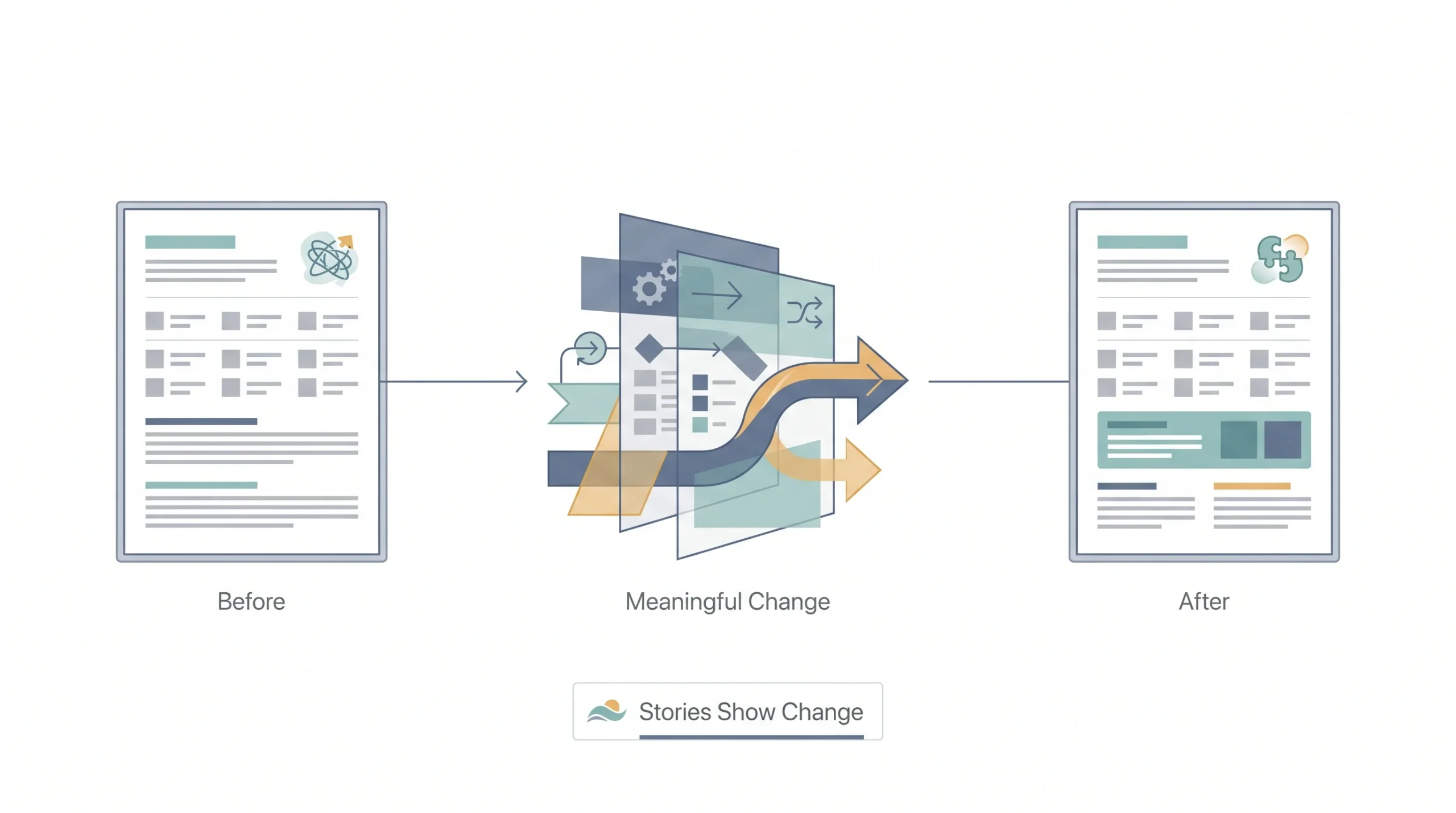
Storytelling in marketing gets thrown around like it means “add some personality to your copy.” It doesn’t. It means structuring your message so the customer goes through a change, not just receives information. A feature list tells someone what a product does. A story shows them what happens to a person because of it. That’s the entire difference, and it’s a bigger difference than it sounds.
Here’s the thing people get wrong constantly: storytelling isn’t about being more creative or more dramatic. Plenty of boring-sounding products have great stories. A SaaS tool for invoice tracking doesn’t need fireworks, it needs one small business owner who used to lose three hours a week chasing late payments and now doesn’t. That’s a story. It’s not exciting, it’s just true and specific, and specific beats exciting almost every time.
The confusion usually comes from thinking storytelling means adding a narrator’s voice to an ad, or opening a blog post with “picture this.” Nope. Tone is not structure. You can write in a completely flat, unemotional voice and still tell a real story if you show a before, a change, and an after. You can also write in a wildly dramatic voice and still just be listing features with exclamation points. The test isn’t how it sounds, it’s whether something actually moves.
Think about the difference between “our platform reduces churn” and “a subscription box company was losing one in five customers every quarter, mostly for reasons nobody on the team could explain, until they started sending a single follow-up email after every cancellation.” The first sentence is a claim. The second is a scene, even though it’s one sentence long and nobody cried. That’s the bar. Not drama, just enough specificity that a reader can picture the situation instead of just processing a category of benefit.
There’s also a difference between storytelling and anecdote-dropping, which a lot of marketing content confuses. Slapping “meet Sarah, a busy mom of two” in front of a paragraph of product features isn’t a story, it’s a label pasted onto a list. A real story needs the shift, the actual change in circumstance, or it’s just a name attached to the same spec sheet from before. If Sarah shows up in paragraph one and never changes by paragraph four, nothing happened, and the reader can feel that even if they can’t articulate why the piece fell flat.
| Feature-First Marketing | Story-First Marketing | |
|---|---|---|
| What’s emphasized | Specs, capabilities, comparisons | A person’s situation before and after |
| What the customer remembers | Almost nothing, a week later | The moment things changed |
| Emotional response | Interest, maybe | Recognition (“that’s me”) or relief |
| Typical CTA framing | “Buy now, 20% off” | “Start your own version of this” |
| Example line of copy | “Now with 40% faster load times” | “She stopped losing customers to a slow checkout page” |
Storytelling in marketing isn’t decoration on top of your message. It’s a different way of organizing the message itself, one built around change instead of around a list.
Why Storytelling Actually Works
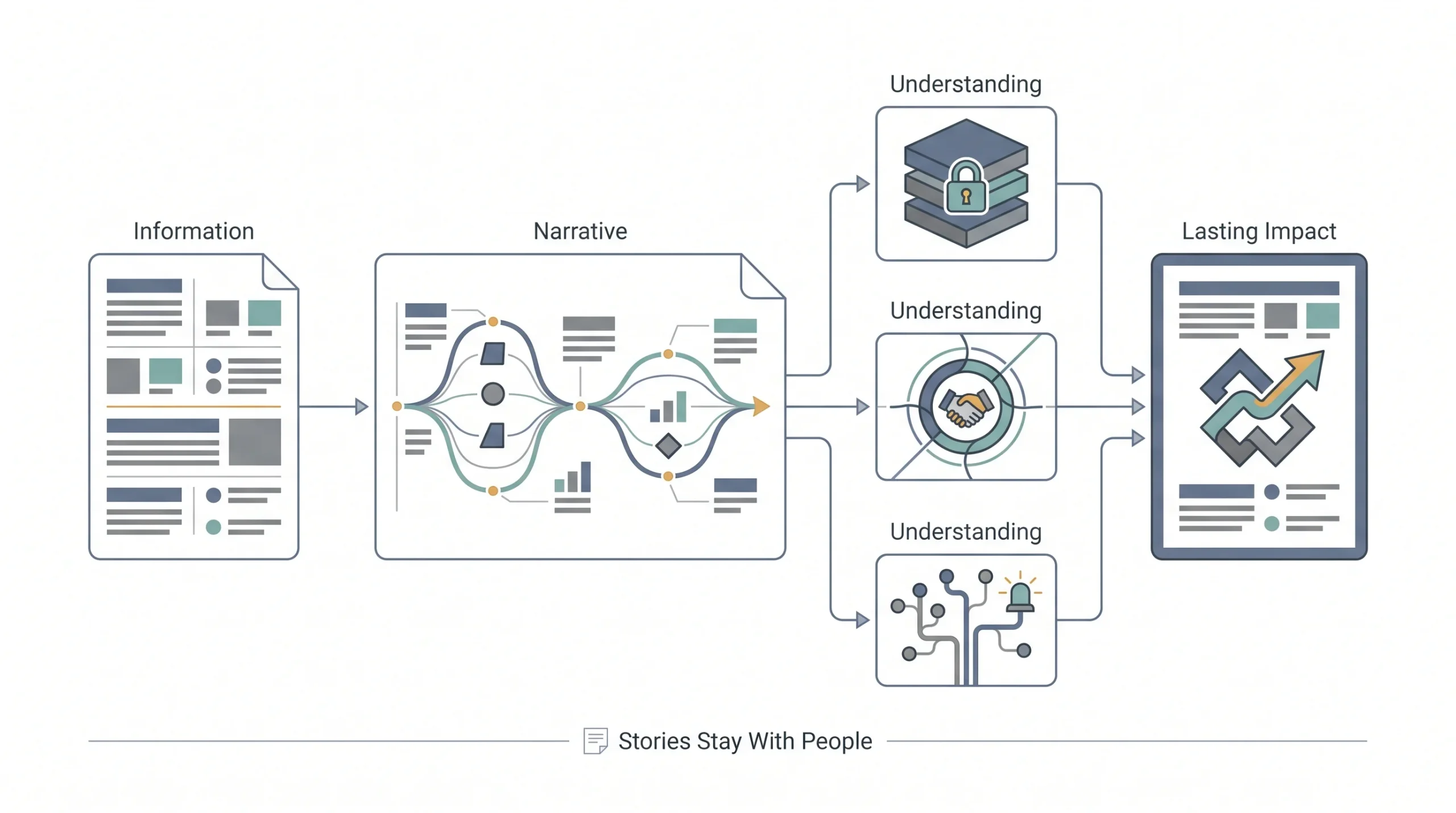
Ok, the brain science part. Every article on this topic mentions it, and there’s a reason: it’s real. When someone reads a spec sheet, a small part of their brain lights up, the part that processes language. When someone reads a story, way more of the brain gets involved, the parts tied to sensation, movement, emotion. Basically, a good story doesn’t get processed like information. It gets processed more like something that’s actually happening to the reader. That’s not a marketing trick, that’s just how narrative works on people, and it’s been true since long before marketing existed as a job.
But here’s where most explanations stop short. They tell you the brain science and then just move on to examples, like knowing the “why” is the same as knowing what to do with it. It isn’t. So let’s break down what this actually means for the way you write.
Retention. People forget facts fast. A stat you read in a blog post is gone in a day unless it’s attached to something. But people remember stories for years, sometimes decades, especially if the story made them feel something specific. If you want your brand’s message to survive past the moment someone scrolls past your ad, it has to be wrapped in something narrative, not just stated.
Trust. A straight pitch puts the customer on guard immediately, because they know they’re being sold to. A story lowers that guard, not because it’s manipulative, but because stories put the listener in the position of witness instead of target. When you show someone a transformation instead of telling them to trust you, you’re giving them room to decide for themselves. That reads as more honest, even when the underlying message is identical.
Identification. This is the big one and it’s the one people underuse. A good marketing story isn’t really about your brand. It’s a mirror. The reader sees a version of their own problem in someone else’s story, and that recognition does more work than any argument you could make about why your product is good. You’re not convincing them, you’re letting them convince themselves by watching someone like them go through it.
There’s a fourth thing worth naming too, even though it doesn’t get the same airtime as the big three: momentum. A story pulls a reader forward the way a list never does. A bullet list of five benefits can be read in any order, or half-read, or skimmed and abandoned, because nothing in it demands the next line. A story creates a small unresolved question right at the disruption stage, what happens next, and that question is what keeps someone reading past the point where a spec sheet would’ve lost them. It’s the same reason a bad TV show can still keep you watching for one more episode. Open loops pull harder than closed information ever will.
None of this means facts and numbers don’t matter, to be clear. A story with zero specifics is just as weak as a spec sheet with zero narrative. The strongest marketing usually blends both, a real arc carrying real numbers, rather than picking one lane and staying there the whole way through.
| Psychological Trigger | What It Does | How To Use It In Copy |
|---|---|---|
| Retention | Locks the message into long-term memory instead of short-term attention | Anchor your core message to one specific scene or moment, not a list of benefits |
| Trust | Lowers the reader’s defensiveness because they’re witnessing, not being pitched | Show the transformation happening to someone else before you ever mention your product |
| Identification | Reader sees their own situation reflected, does the persuading themselves | Describe the “before” state in painfully specific detail so the right reader goes “that’s literally me” |
Facts tell. Stories sell. It’s a cliché at this point, but it’s a cliché because it holds up every single time someone actually tests it against a plain feature list.
The Three Types of Marketing Stories
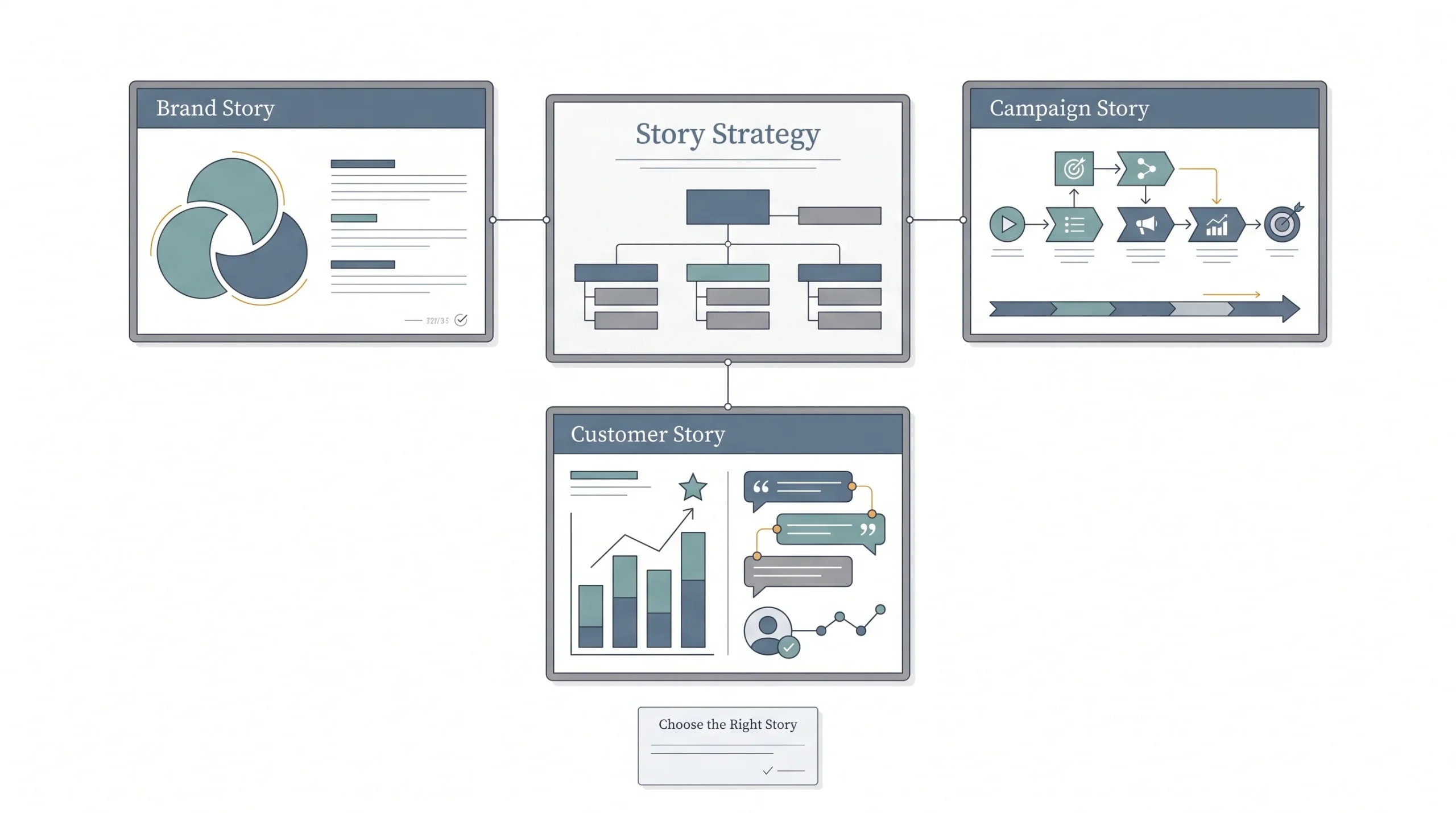
Here’s a mistake that happens constantly, and almost nobody talks about it directly: people treat “storytelling” like it’s one thing. It’s not. There are at least three different kinds of stories a brand tells, they serve completely different purposes, and using the wrong one in the wrong place is a big reason storytelling attempts flop.
Brand story. This is the big one, the origin story. Why you exist, what problem made you start this thing, what you believe. It doesn’t change often. It lives on your About page, your founder’s LinkedIn, maybe an anniversary campaign once a year. It’s not meant to sell a specific product, it’s meant to build the reason someone chooses you over a competitor with a similar product at a similar price.
Campaign story. This is the story for one specific push. A product launch, a seasonal promotion, a rebrand. It borrows some DNA from the brand story but it’s built around a specific moment and a specific ask. This is the story that lives in your ad script, your launch email, your landing page for three weeks and then gets retired.
Customer story. Case studies, testimonials, before-and-afters, user-generated content. This is proof dressed up as narrative. It’s the least “creative” of the three and often the most persuasive, because it’s not your brand talking about itself, it’s a real person talking about what actually happened to them.
| Story Type | When To Use It | Where It Lives | Example Format |
|---|---|---|---|
| Brand story | Building long-term trust and differentiation | About page, founder content, brand anniversary pieces | A 3-4 minute video or a long-form About page |
| Campaign story | Driving action around one specific launch or offer | Ad scripts, launch emails, landing pages | A 30-second video ad or a single-page email sequence |
| Customer story | Proving the product actually works, reducing risk in the buyer’s mind | Case study pages, testimonials, sales decks | A written case study or a short customer video |
Mixing these up is why a lot of storytelling attempts feel off. If your campaign story tries to also carry the full weight of your brand’s origin, it gets bloated and loses the urgency a launch needs. If your brand story tries to hard-sell a specific product, it stops feeling like a story and starts feeling like an ad wearing a story costume. Know which one you’re writing before you write a single line.
Here’s a small test that helps sort out which type you’re actually dealing with. Ask what happens if you swap out the product name and put a competitor’s name in instead. A brand story usually breaks completely, because it’s tied to a specific founding moment that belongs to nobody else. A customer story mostly survives the swap, because the customer’s problem and outcome were real regardless of which tool eventually solved it, which is exactly why customer stories carry so much weight, they don’t depend on brand loyalty to be believable. A campaign story sits somewhere in the middle, it can survive a swap in theory but usually loses the specific hook that made it feel timely.
Worth saying too, most brands only ever need one solid brand story, refreshed occasionally, but they need a steady supply of campaign stories and customer stories, new ones regularly, because those are the ones doing the actual selling week to week. If you’ve only ever written the big brand story and nothing else, that’s usually the gap.
The Story Structure Every Beginner Can Actually Use
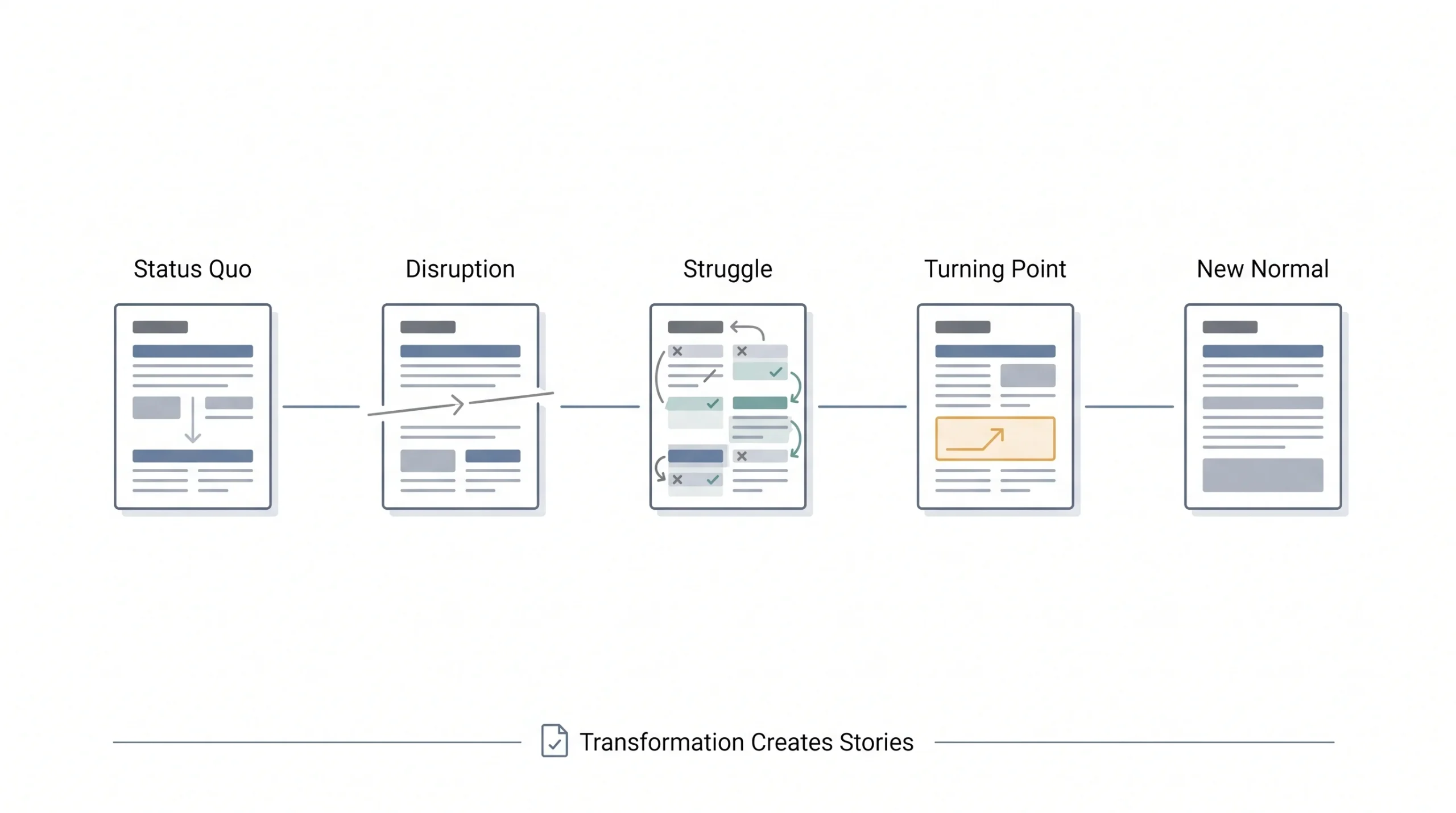
Most articles on this topic mention the hero’s journey, throw out the word “Campbell,” and move on like that’s useful. It’s not, not for marketing. The hero’s journey has like twelve stages and it was built for analyzing myths, not writing a landing page. Here’s a version that actually works for marketing, stripped down to five stages.
Status quo. Where the customer is before anything happens. This has to be specific and ordinary, not dramatic. Don’t open with a crisis, open with normal life that has a crack in it.
Problem or disruption. Something breaks the normal. A cost goes up, a competitor shows up, a deadline gets moved, a habit stops working. This is the moment the customer notices something’s wrong.
Struggle. They try to fix it themselves, or with the wrong tool, or they just live with it for longer than they should. This part matters more than people think, because it’s where the reader recognizes their own effort and their own frustration.
Turning point. Your product or service enters here. Not as a magic fix, as the thing that changes how the struggle plays out. This is the only place your brand should show up in the story, right at the hinge.
New normal. Life after. Specific, measurable if possible, and quieter than the disruption was. The best endings aren’t triumphant, they’re just calm. That calm is the actual sell.
Take a small business owner, we’ll call her running a boutique clothing store. Status quo: she’s been doing her own bookkeeping in a spreadsheet for six years, it works, mostly. Problem: her accountant flags three missed invoices right before tax season, and she realizes she’s been undercharging two clients for months without noticing. Struggle: she tries color-coding the spreadsheet, sets reminders on her phone, still misses one more invoice the next month. Turning point: she starts using an invoicing tool that flags overdue payments automatically. New normal: six months later she’s not thinking about invoices at all, because she doesn’t have to.
Notice the product shows up exactly once, right at the turning point. Not in the status quo, not in the struggle, not three separate times for emphasis. Once. That restraint is what makes it read like a story instead of an ad interrupting itself to remind you it exists.
Run the same structure against something completely different, a skincare product this time, and it holds up the same way. Status quo: someone’s had mild breakouts on and off for years, nothing severe, just annoying enough to notice in photos. Problem: a big event is coming up, a wedding, a work trip, whatever, and the breakouts flare up worse than usual right before it. Struggle: they try three products off the shelf, none of them make a real difference, one actually makes it worse. Turning point: a dermatologist-recommended routine, or a specific product with an ingredient that finally addresses the actual cause instead of just covering symptoms. New normal: clear skin isn’t a big event anymore, it’s just Tuesday.
That last line matters more than it looks like it does. The strongest version of “new normal” usually isn’t a celebration, it’s the absence of the problem being a big deal anymore. Boring is the goal. If the ending still feels like a triumph, it can come across staged. If it feels like the problem just quietly stopped being a problem, it reads as true.
One more thing worth flagging here, because it trips people up constantly: the struggle stage is not optional, even when there’s pressure to cut it for length. Marketers under a word count or a 15-second ad slot often skip straight from problem to turning point, and the story goes flat immediately. The struggle is where the reader’s own frustration gets reflected back at them, it’s the identification moment from the psychology section earlier. Cut it and the whole thing turns into an infomercial, no matter how good the other four stages are.
| Stage | Prompt Question | Your Answer |
|---|---|---|
| Status quo | What did this person’s normal day look like before the problem showed up? | |
| Problem/Disruption | What specific event or moment made the problem impossible to ignore? | |
| Struggle | What did they try before finding your product, and why didn’t it fully work? | |
| Turning point | How exactly does your product enter the picture, and what does it change? | |
| New normal | What does life look like now, in specific and preferably measurable terms? |
The customer is the hero. Your brand is the guide. If your product shows up in every single stage of the story, you’ve written an ad wearing a costume, not a story. Say less about the product and more about the person, and the product will actually land harder.
Storytelling By Channel
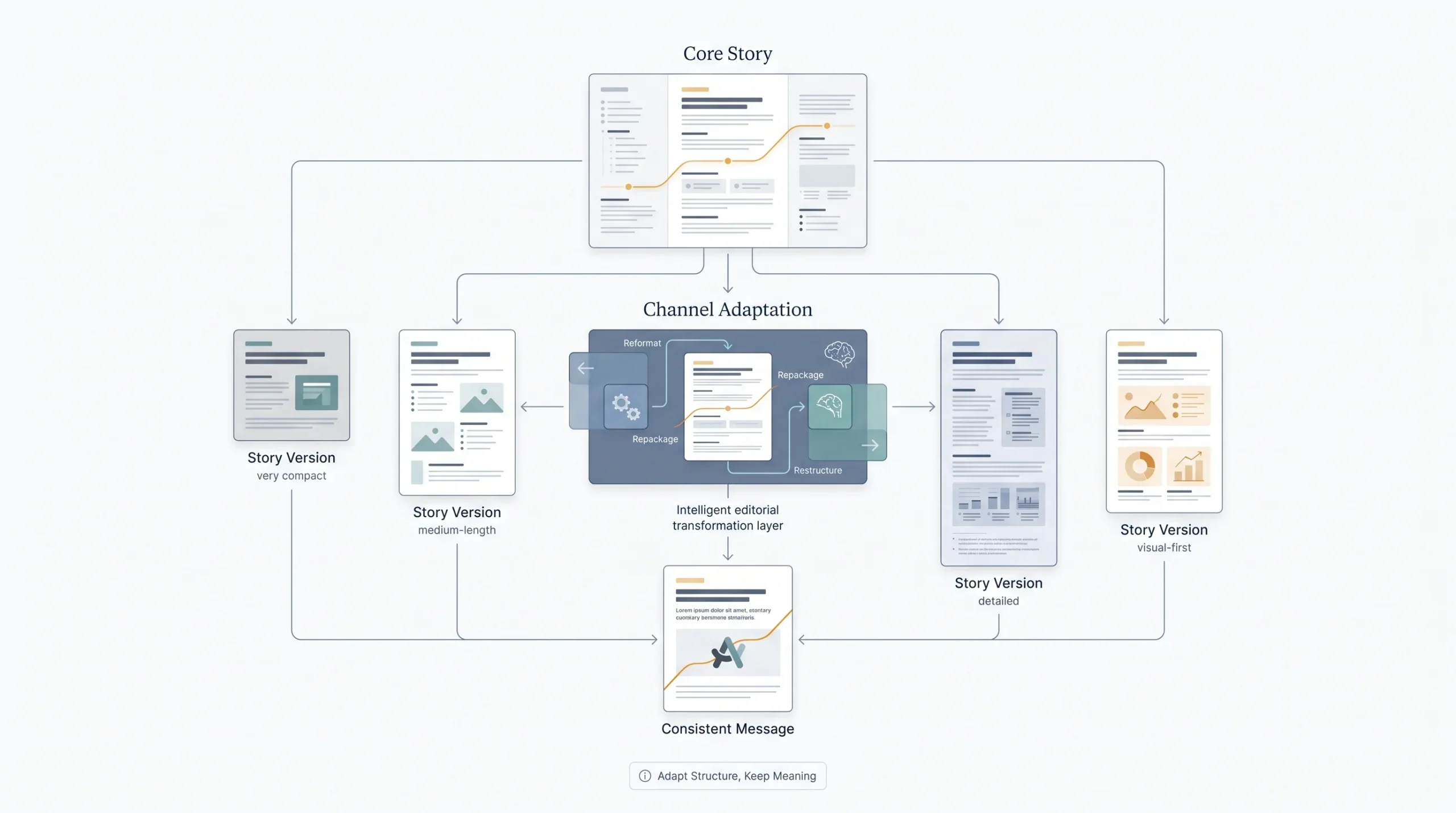
Here’s something almost nobody covers properly. A story doesn’t stay the same shape when you move it from one channel to another. It’s not “write the story once and paste it everywhere.” A 15-second Reel and a 2,000-word case study aren’t the same story stretched or squeezed, they’re built differently from the ground up, because the reader’s patience and intent are different in each place.
Instagram and Reels. You get maybe two seconds before someone scrolls. There’s no room for status quo and struggle as separate beats, they have to be compressed into a single visual or line of text. The turning point usually has to happen almost immediately, and the new normal gets shown, not explained, through a visual before-and-after rather than a sentence.
Email. More room to breathe than social, but people are still skimming. The subject line often has to carry the “problem” beat on its own, and the body copy can walk through struggle and turning point at a normal pace, but the new normal needs to land in the first two lines of the closing paragraph, not buried at the very bottom after three more paragraphs of detail.
Landing page. This is where you can build out the full five-stage arc properly, especially if it’s a page for a considered purchase. Headline usually captures the disruption, the hero section shows the new normal as a payoff, and the middle of the page is where struggle and turning point get proven out with specifics, testimonials, screenshots, whatever backs the claim.
Long-form blog content. The most room of any channel, which is both an advantage and a trap. You can develop status quo and struggle in real detail here, multiple paragraphs even, but the trap is dragging it out past the point where the reader still cares. Long-form doesn’t mean slower, it means more scenes, not more words per scene.
Sales decks and B2B pitches. The story here is usually a customer story, not a campaign story, and it needs to move fast through status quo (a sentence, maybe two) into a problem that’s framed in business terms, cost, time, risk, not emotional terms. The struggle and turning point sections often get backed by numbers because the audience in the room is evaluating risk, not feeling.
Video ads. Similar constraints to Reels but with slightly more room, usually 15 to 60 seconds. The visual has to carry status quo and problem simultaneously in the opening few seconds, because there’s no separate scene budget for each beat the way there is in a blog post.
Push notifications and SMS. Barely gets talked about as a storytelling channel at all, but it counts. There’s no room for structure here, one line, maybe two. What actually happens is you borrow a single beat from a bigger story that’s already been told elsewhere, usually the turning point or the new normal, and use it as a callback. “Your order’s finally arriving” lands differently to someone who read the full disruption story in an earlier email than it does cold, out of context.
Podcasts and long-form audio. Slower pacing than almost any other channel, and the audience is more patient because they chose to be there for 20 to 60 minutes. Struggle can get more room here than anywhere else, sometimes several minutes of it, because audio listeners tolerate a slow build in a way scroll-based readers don’t. The trap is the opposite of social media’s trap, dragging the struggle stage out so long that the turning point feels like an afterthought tacked on at the end.
A useful way to think about all of this together: the five stages don’t shrink or grow evenly across channels. Some channels compress every stage equally, like a 15-second ad. Others compress only certain stages and leave others full-length, like an email that rushes through status quo in the subject line but takes its time on struggle and turning point in the body. Knowing which stages your channel actually gives you room for is more useful than trying to force the full arc everywhere.
| Channel | Story Length | What Changes | Example |
|---|---|---|---|
| Instagram/Reels | 2-3 beats max, compressed | Status quo and problem merge into one visual moment | A 7-second before/after clip with minimal text overlay |
| Short but sequential | Subject line often carries the problem, body carries struggle to resolution | A launch email with a one-line hook and a short customer story in the body | |
| Landing page | Full 5-stage arc | Headline usually opens at disruption, hero section shows new normal upfront | A SaaS landing page with a headline, a proof section, and a case study block |
| Long-form blog | Full arc, multiple scenes | More scenes allowed, but pacing still has to move | A pillar post using one running example across several sections |
| Sales deck/B2B pitch | Compressed, numbers-heavy | Struggle and turning point framed around cost, time, or risk instead of emotion | A case study slide with a before/after metric comparison |
| Video ad | 2 beats compressed into visuals | Status quo and problem often shown simultaneously in the opening seconds | A 30-second ad opening mid-frustration, no separate setup scene |
B2B Storytelling: Different Rules
There’s a weird assumption floating around that B2B marketing is inherently boring and storytelling is a B2C thing, something for perfume ads and sneaker brands. That’s backwards, honestly. B2B storytelling isn’t boring by nature, it’s just under-attempted. Most B2B marketing skips story entirely and goes straight to a spec sheet or a case study full of jargon, which is exactly the mistake this whole post has been arguing against.
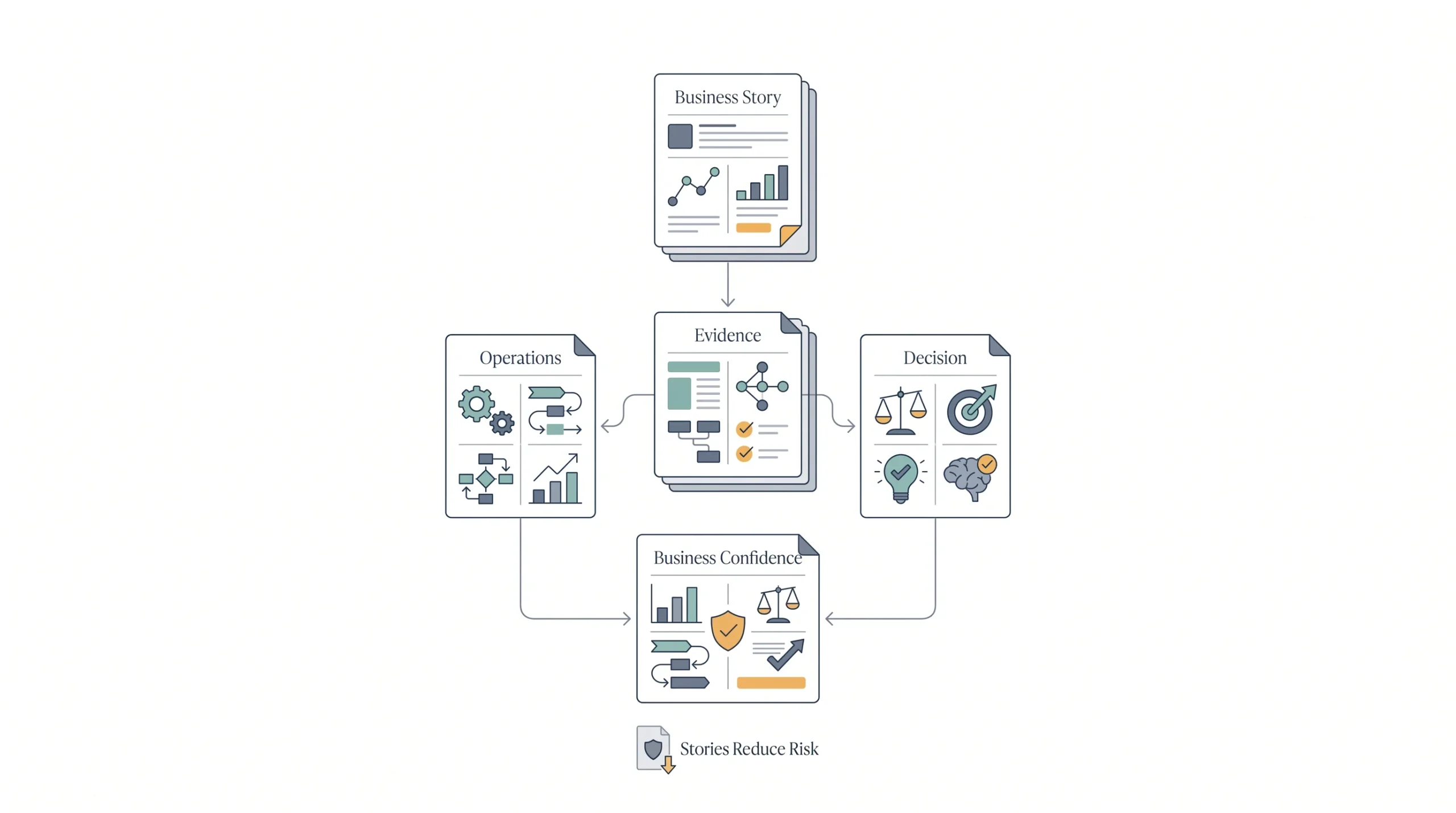
The rules do shift, though. In B2C, the emotional payoff can be personal, pride, relief, belonging, whatever. In B2B, the “emotional” payoff is almost always tied to risk reduction and confidence in front of other people. The buyer isn’t just asking “will this make my life better,” they’re asking “will this make me look competent to my boss, or will I get blamed if it doesn’t work.” That changes what the story needs to prove.
A decent B2B story pattern looks like this: a company had a specific, quantifiable problem (missed deadlines, dropped leads, a process that took too many people too many hours). They tried something that didn’t fully solve it. They adopted the product or service. The outcome gets stated in numbers wherever possible, because the decision-maker reading it is going to have to justify the purchase to someone else, and a number is easier to repeat in a meeting than a feeling is.
| B2C Story Focus | B2B Story Focus | |
|---|---|---|
| Emotional payoff | Personal, individual, felt directly | Confidence and reduced risk in front of others |
| Decision-maker | Usually the person in the story themselves | Often someone different from the end user, has to justify the choice upward |
| Proof needed | Can lean on feeling and identification alone | Needs specifics, ideally numbers, alongside the narrative |
| Typical length | Short to medium, tuned for quick emotional read | Often longer, since trust has to be built with detail, not just feeling |
The mistake B2B marketers make most is thinking a case study full of quotes about “seamless integration” and “robust functionality” counts as storytelling. It doesn’t, that’s corporate testimonial copy with no actual arc. A real B2B story still needs the same five stages as anything else, it’s just that the new normal gets described in a metric instead of a feeling, and the struggle gets described in operational terms instead of emotional ones.
There’s also a group dynamic in B2B storytelling that doesn’t exist in most B2C buying. The person reading your case study often isn’t the same person who’ll actually use the product day to day, and the story has to work for both of them at once. The operations manager cares about the struggle stage, the actual daily friction. The person signing the invoice cares more about the new normal stage, expressed as cost saved or risk avoided. A B2B story that only speaks to one of those readers is going to stall somewhere in the approval chain, even if the person who found the product loved it.
Sales enablement is a piece of this too, and it’s worth naming separately from marketing content, even though the two overlap heavily. A story built for a landing page doesn’t automatically work in a sales deck, because a deck gets presented live, often by someone other than the marketer who wrote it. The story needs to be simple enough that a salesperson who didn’t write it can retell it accurately in a live meeting without notes. If the story only works when read exactly as written, it won’t survive contact with an actual sales call.
Real Brand Examples, But Broken Down
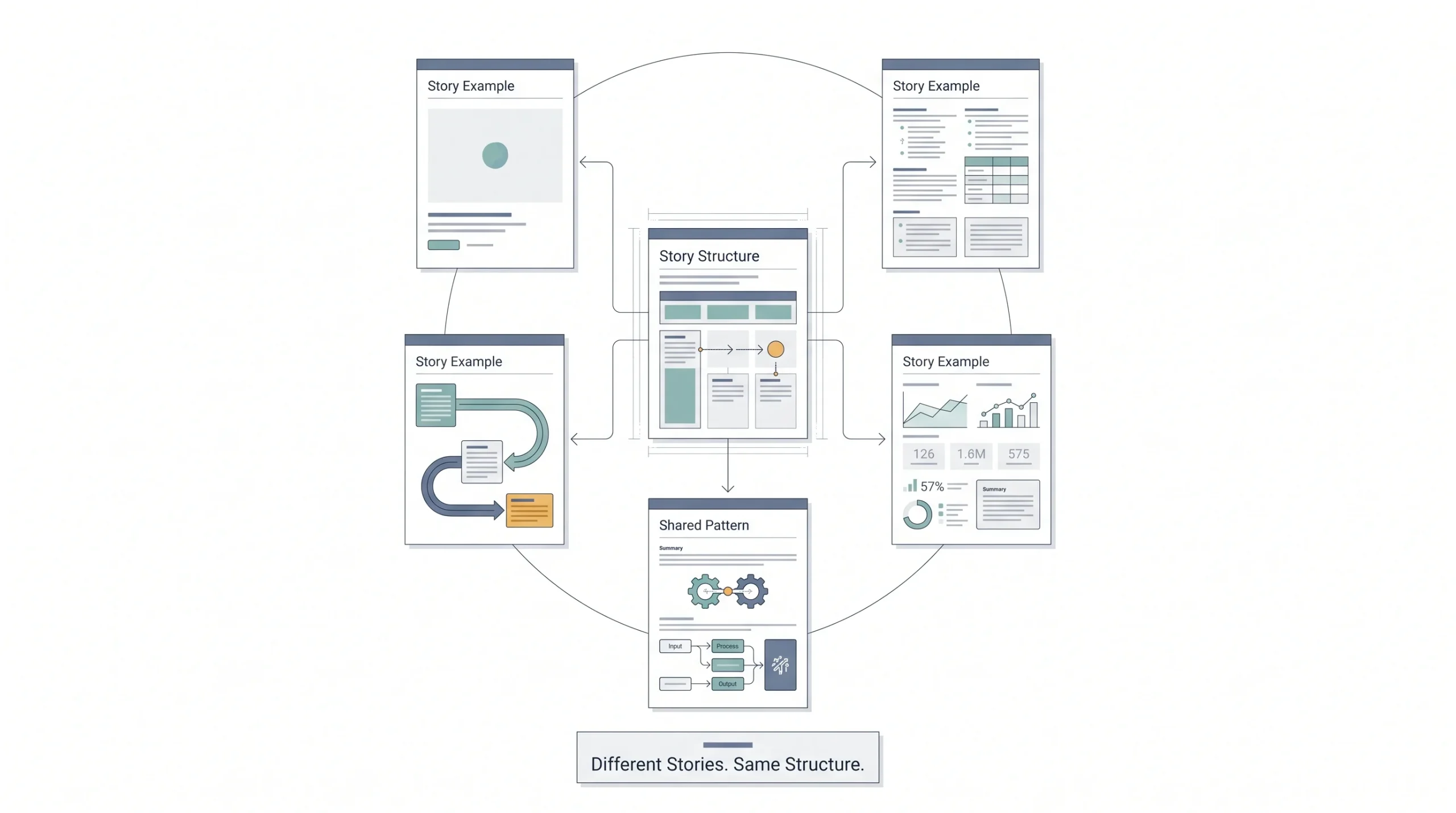
Examples are only useful if you can see the mechanics, not just the name of the brand. So here’s a handful, broken down against the five-stage structure instead of just listed.
A running shoe brand’s comeback ad. These typically open on an athlete after an injury, not during a win. Status quo before the injury is barely shown, maybe a flashback shot. The disruption is the injury itself, shown quickly and without dwelling. The struggle stretches across most of the ad, physical therapy, doubt, slow progress. The turning point isn’t the shoe showing up dramatically, it’s more like the shoe appearing quietly during the training montage, worn rather than announced. New normal is the athlete back on the track or the court, and the ad ends there, not on a trophy. That restraint, ending on “back to normal” instead of “triumphant victory,” is what keeps it from feeling like a highlight reel and keeps it feeling like a story.
A credit card brand’s long-running emotional campaign. Built almost entirely around the idea that some experiences matter more than the money spent to get there. The disruption in each individual ad is small and ordinary, a dad taking his kid to a game, a couple on a trip. The struggle beat barely exists, which is intentional, because the campaign isn’t about overcoming hardship, it’s about noticing value in ordinary moments. The turning point is the purchase itself, framed as enabling the moment rather than causing it. It’s a lighter version of the five-stage arc, but the stages are still there in miniature.
A workplace collaboration tool built by a small team, growing mostly through word of mouth and product-led content. Their case studies tend to follow the arc tightly and without much polish, which actually works in their favor. Status quo: a team communicating through scattered channels. Disruption: something falls through the cracks publicly enough that it becomes a problem leadership notices. Struggle: they try tightening processes manually. Turning point: adopting the tool. New normal: stated in a specific number, hours saved per week, or a reduction in missed handoffs. No dramatic music, no cinematic framing, just the arc, done plainly and repeated across dozens of customer stories. It works because the specificity does the emotional work that flashier brands get from cinematography.
A payments company that grew heavily on developer trust rather than consumer emotion. Their storytelling shows up less in ads and more in their documentation and blog, oddly enough. The “story” here is usually about a developer’s frustrating experience integrating payments elsewhere (the struggle beat, essentially) before landing on a cleaner implementation. It’s a quiet, almost invisible use of the five-stage structure, but it’s there, and it’s a good example that storytelling doesn’t require an ad budget or a camera crew. Sometimes it’s just well-structured writing about a real frustration.
An outdoor gear brand known for prioritizing environmental causes over pure sales messaging. Their campaigns often skip the product almost entirely in the opening, choosing instead to tell a story about a place, a river, a mountain range, something under threat. The disruption isn’t a personal problem at all, it’s environmental. The struggle stage becomes collective, framed around a community or a cause rather than one individual. The turning point is subtle, the brand’s actions or the customer’s choice to buy from them becomes part of the fight rather than the hero of it. It’s a version of the five-stage structure where the brand deliberately underplays its own role, which sounds risky, but it’s exactly what built the loyalty that brand is known for. It proves the structure holds even when a brand chooses to make itself a supporting character on purpose.
The common thread across every one of these, regardless of industry or budget, is restraint. None of them cram the product into every beat. None of them explain the moral at the end. They trust the structure to do the work, and get out of the way once it’s set up properly.
How To Write Your Brand Story: Step-By-Step Process
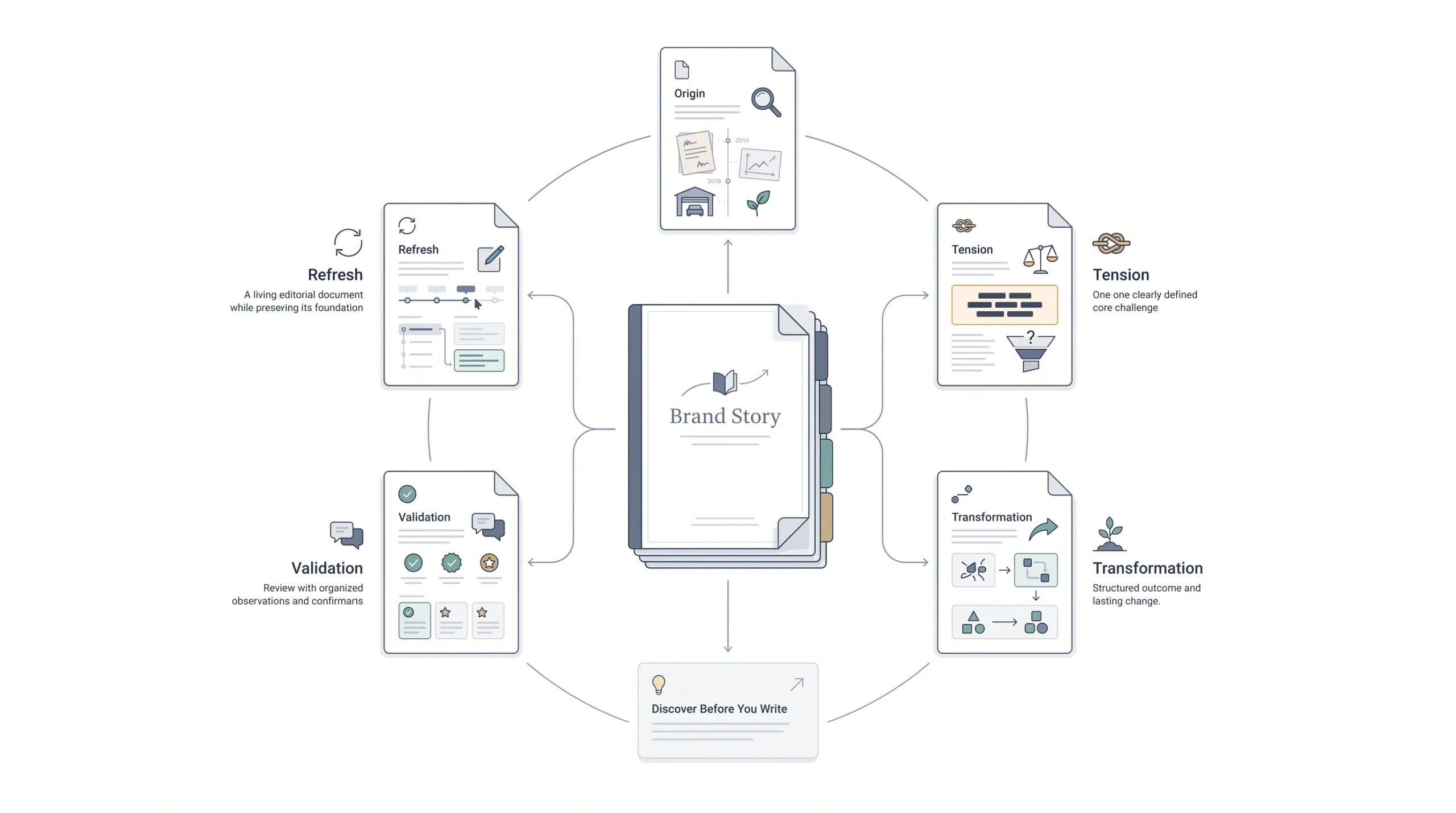
Writing a single campaign story is one thing. Defining your brand’s core story, the one that sits underneath everything else you publish, is a bigger and slower job, and it’s worth doing properly once instead of reinventing it every quarter.
Start by digging into the actual reason the thing was started. Not the polished version for investors, the real one. What was broken, annoying, missing, or unfair that made someone decide to build this instead of just living with the problem. If there’s genuinely no tension in the origin, that’s worth being honest about too, some brands are built on craft or curiosity rather than a fight against a problem, and forcing a struggle narrative onto that just reads as fake.
From there, identify the founding tension clearly, in one or two sentences, no fluff. This is usually harder than it sounds, because founders often describe their company in terms of what it does rather than what it’s against. “We built X because Y was broken” is a much stronger sentence than “We built X to help businesses grow.”
Next, define the transformation the brand actually offers, at the level of the customer’s life or work, not at the level of the product’s features. This should read almost like the “new normal” stage from the five-part structure, but applied to your brand as a whole rather than one customer.
Then work on voice. Not tone guidelines in a brand deck, actual voice, the way the brand would talk if it were a person in the room. Read the story out loud. If it sounds like something a real person would say to a friend over coffee, it’s probably right. If it sounds like a mission statement, go back and cut the corporate language out.
Finally, and this step gets skipped constantly, test the story against real customers. Not internally, not with the team who already believes it. Show it to a handful of actual customers or prospects and watch their reaction. If they nod politely, the story isn’t landing. If they say “wait, that’s exactly what happened to me,” it’s working.
Worth adding a note on who should actually write this. It’s tempting to hand the brand story to whoever’s the best writer on the team and let them run with it, but the founding tension usually needs to come straight from whoever lived through it, a founder, an early employee, someone who was actually there. A skilled writer can shape the language, but they can’t invent the specific detail that makes an origin story feel real, the exact moment, the exact frustration, the small decision that could’ve gone differently. Interview the person who lived it before writing a single line, even if that person insists their story isn’t interesting. It almost never is to them. It usually is to everyone else.
It’s also worth revisiting this brand story every year or two, not to rewrite it from scratch, but to check whether it still holds. Companies change, the market changes, and a founding story that made total sense five years ago can start to feel disconnected from what the brand actually does today. That doesn’t mean throwing it out, most of the time the core tension is still true, it just means the language and the framing might need a small refresh to keep it honest.
Before publishing your brand story, ask one blunt question: would a stranger care about this, or only you? If the honest answer is only you, it’s not ready yet.
How To Measure If Your Storytelling Is Working
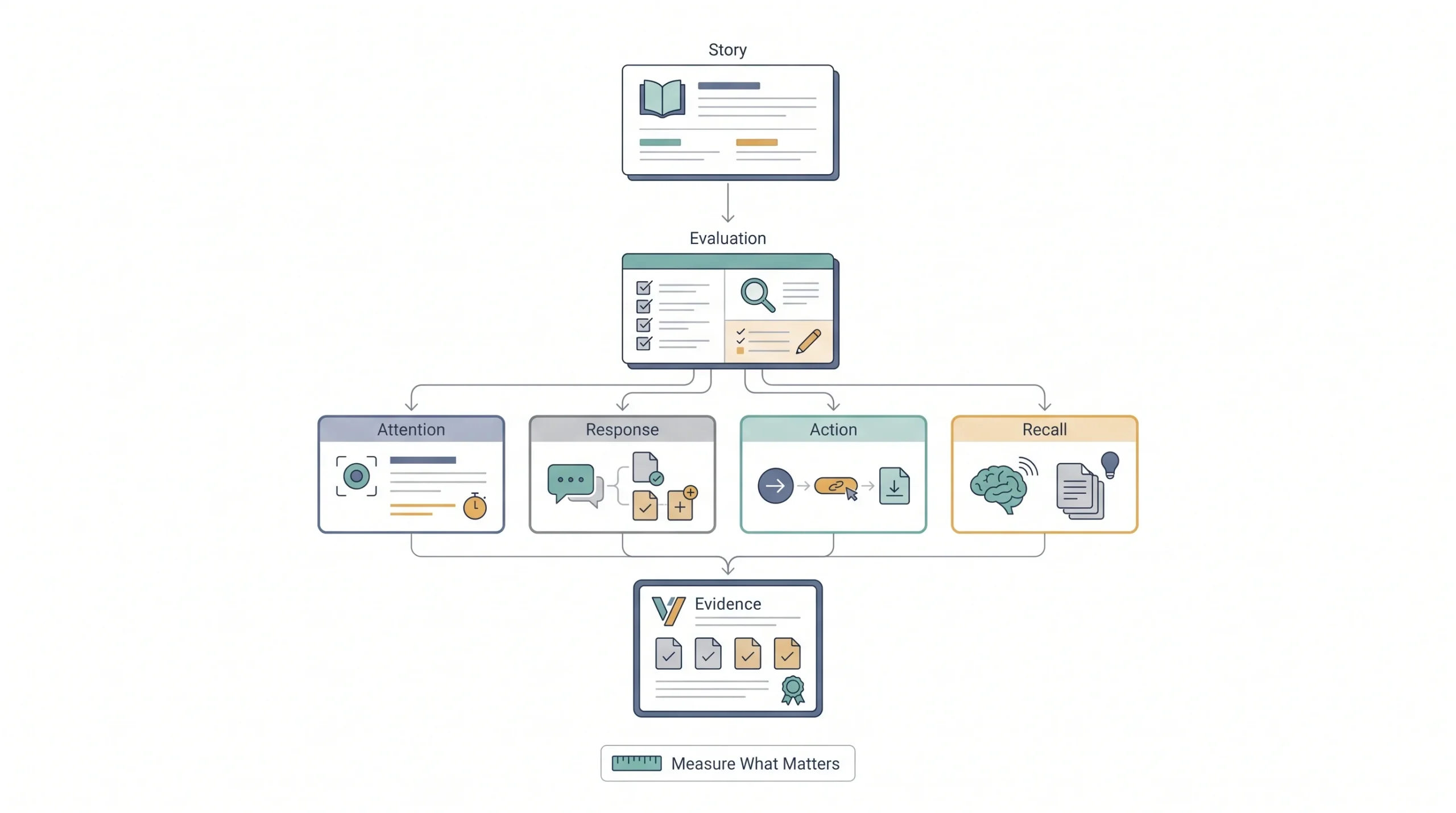
This part gets skipped almost everywhere, which is strange, because “does it work” should be the whole point.
Scroll depth and time on page are decent early signals for written content. If a story-led piece keeps people reading significantly longer than a feature-led piece on the same topic, that’s a real signal the structure is doing something.
Engagement rate comparisons matter more than raw numbers. Post a story-led piece of content next to a feature-led one, same product, same audience, and compare likes, comments, shares. Story-led content tends to pull higher engagement because people react to people, not to spec lists.
Conversion rate comparison is the one that actually justifies the effort to a skeptical boss. Run a landing page with a story-led hero section against a feature-led version and watch what happens to signups or purchases. This is the cleanest test because it removes guesswork, the number either moves or it doesn’t.
Brand recall is the hardest to measure without a formal survey, but it’s worth knowing it exists as a metric. If it’s feasible, even an informal poll asking people to describe the brand in their own words a few weeks after a campaign can reveal whether the story actually stuck, versus whether people just remember “that ad with the guy running.”
| Metric | What It Tells You | Where To Track It |
|---|---|---|
| Scroll depth / time on page | Whether the story is holding attention longer than a plain feature-led version | Site analytics tools, heatmap software |
| Engagement rate (story-led vs feature-led) | Whether people are actually reacting to the narrative, not just scrolling past | Social platform native analytics |
| Conversion rate comparison | Whether the story is actually moving people to act, not just to feel something | A/B testing tools on landing pages |
| Brand recall | Whether the story is sticking in memory past the moment of exposure | Informal surveys, post-campaign polling |
A simple A/B test is usually the fastest way to get a real answer here. Same offer, same audience, one version leads with a story, one leads with a feature list. Run it for a couple of weeks and look at the numbers instead of arguing about it in a meeting.
One thing worth being honest about here, storytelling doesn’t always win. Sometimes a plain, direct feature list converts better, especially for purchases where the buyer already knows exactly what they want and just needs the specs confirmed fast, someone buying a specific size of packaging material for a warehouse isn’t looking for a narrative. Storytelling tends to earn its keep most where the buying decision involves some uncertainty or emotional weight, a considered purchase, a new category, something the buyer isn’t 100% sure they need yet. Testing both versions honestly, rather than assuming story always wins because this article said so, is the only way to know which one actually applies to a specific product and audience.
It’s also worth tracking these metrics over a longer window than a single campaign, if possible. A story-led piece might not outperform a feature-led one in the first 48 hours, especially on paid channels where algorithms take time to optimize delivery, but pull ahead over two or three weeks as word of mouth and shares kick in. Judging a story-led campaign purely on day-one numbers can lead to killing something that just needed more runway.
Tools That Help
Nothing here replaces actually sitting down and writing the story yourself, but a few things make the process smoother. Story mapping tools or even a plain whiteboard app work well for laying out the five-stage structure before writing full copy, especially with a team, since it’s much easier to spot a missing struggle stage on a whiteboard than three drafts into a Google Doc. AI writing assistants can help draft a first pass of a customer story once you’ve given them the raw facts, though the specific details, the actual numbers and quotes, still have to come from a real conversation with the customer, not from a generic prompt, because that’s exactly the kind of specificity that separates a real story from a template with names swapped in.
A shared documents folder where every customer-facing team logs small stories as they happen, a support ticket that turned into a great outcome, an offhand comment from a client call, ends up being one of the most underrated tools of all, because most good stories get lost simply because nobody wrote them down when they happened. Sales and support teams hear these moments constantly and rarely think to pass them along to whoever’s writing content, which means marketing ends up manufacturing generic examples instead of pulling from a stockpile of real ones that were sitting there the whole time. A simple recurring reminder for those teams to flag anything interesting, even a single line in a shared doc, tends to produce better raw material than any tool built specifically for storytelling.
Conclusion
Go back to the running shoe example from the start. Nobody remembers the mesh upper, everybody remembers the guy at the finish line. That’s not a coincidence and it’s not magic, it’s just how people are built to process information, and once you see it, it’s hard to unsee it in every ad, every landing page, every case study that crosses your feed. The brands doing this well aren’t smarter or more creative than everyone else, they’re just more disciplined about putting the customer in the hero seat and keeping the product where it belongs, at the turning point, not narrating every scene. Pull out the fill-in-the-blank template from earlier in this post, plug in one real customer, and write the five stages honestly. That’s the whole exercise. Do it once properly and it gets a lot easier to spot the difference between a story and a pitch wearing a story’s clothes.
Frequently Asked Questions
What actually makes a brand story good, versus just okay?
Specificity, mostly. A good brand story names the exact problem, the exact moment things changed, and doesn’t hide behind vague words like “innovative” or “passionate.” The okay ones are the ones that could belong to almost any company in the category if you swapped the logo. If a competitor’s name would fit just as well in your brand story, it’s not specific enough yet.
Is storytelling only for big brands with ad budgets?
Nope, and this is one of the more persistent myths on the topic. Some of the strongest storytelling shows up in places that cost nothing, a founder’s LinkedIn post, a well-written case study, a support team logging a good customer moment. Budget affects production value, not whether the five-stage structure holds up. A small business with one real customer story, told well, usually beats a big brand’s generic campaign that skipped the struggle stage entirely.
How long should a brand story actually be?
Depends entirely on where it’s living, which is basically the whole point of the channel section above. An About page brand story might run 300 to 600 words comfortably. A campaign story in an ad might be a single sentence carried mostly by a visual. There’s no fixed ideal length, the length should match how much patience the reader has in that specific format, not some universal rule about attention spans.
What’s the actual difference between storytelling and content marketing?
Content marketing is the broader category, basically any content published to attract and keep an audience, how-to guides, checklists, comparison posts, all of it. Storytelling is one method within that category, a way of structuring a specific piece of content around change instead of around information. Plenty of content marketing has zero storytelling in it, a straightforward listicle doesn’t need a narrative arc to be useful. Storytelling is a tool inside the content marketing toolbox, not a synonym for it.
Can a B2B brand really use storytelling, or is that mostly a B2C thing?
It works in B2B too, arguably it’s underused there more than anywhere else. The shift is what the story proves. In B2B, the story usually needs to land on a number or a reduced risk by the end, not just a feeling, because the reader has to justify the decision to someone else. Skip the story entirely in B2B and you’re left with a spec sheet competing against every other vendor’s spec sheet.
How often should a brand refresh its core brand story?
There’s no fixed calendar for it, but checking in every year or two is reasonable. The founding tension usually stays true for much longer than that, most companies don’t need to reinvent their origin story often. What tends to need a refresh is the language and framing around it, since markets shift and a story that felt sharp a few years back can start to feel a little disconnected from what the brand actually does today.
Does storytelling always outperform a plain feature list?
Not always, and it’s worth being honest about that instead of treating storytelling as a guaranteed win. For purchases where the buyer already knows exactly what they need, replacing a part, buying a known quantity of something, a direct feature list can convert just as well or better. Storytelling tends to earn the most ground on considered purchases, new categories, or anything where the buyer’s still deciding whether they even have the problem. Testing both against each other for a specific product beats assuming one always wins.
What’s the fastest way to find a good customer story if none exist yet?
Ask the support and sales teams first, before writing anything from scratch. They hear the real moments constantly, a customer mentioning something worked out well, a support ticket that ended with genuine relief, and most of that never makes it to whoever’s writing content. A quick recurring check-in with those teams usually surfaces better raw material in a week than trying to manufacture a generic example from nothing.