

Here’s something that happens on basically every e-commerce store out there. A customer lands on a product page, scrolls for maybe six seconds, and leaves. No purchase, no add to cart, nothing. The product itself might be great. The photos might be sharp. But the words sitting under that price tag did nothing to close the deal, and honestly, in most cases, that’s exactly why the sale never happened.
Most product descriptions fail for one simple reason. They read like a spec sheet instead of a conversation. “100% cotton. Machine washable. Available in four colors.” Okay, cool, but so what? Nobody buys a t-shirt because it’s machine washable. They buy it because it makes them feel a certain way when they put it on, or because it solves a problem they’ve been dealing with, like every other shirt they own shrinking after one wash. The biggest mistake online stores make is listing features and assuming the customer will do the emotional math themselves. Most won’t. They’ll just click away and buy from whoever spelled it out for them.
Features alone don’t sell because features are facts, and facts don’t move people the way stories and outcomes do. Think about how you actually make buying decisions yourself. You don’t sit there rationally comparing thread counts. You imagine yourself using the thing, feeling good in it, solving whatever annoyed you about the last version you owned. That’s the psychology behind persuasive product pages, and it’s the same psychology behind literally every ad you’ve ever responded to. People buy on emotion and justify with logic afterward. A product description that only speaks to logic is only doing half the job, and honestly, it’s the less important half.
This guide walks through everything you need to actually write product descriptions that convert, not just describe. We’re covering the full framework, real writing formulas brands use every day, SEO techniques so your pages actually get found, AI prompts you can steal and use immediately, ready to use templates, real before and after examples, the mistakes that quietly kill conversions, and specific tips for optimizing pages once they’re live. This isn’t theory. It’s the stuff that actually moves the needle on a product page.
What You Will Learn in This Guide
- A proven framework for writing product descriptions that actually convert
- Writing formulas like AIDA, PAS, and FAB that professional copywriters use daily
- SEO optimization techniques to help product pages rank in search
- Ready to use AI prompts for generating first drafts fast
- Copy-paste templates for different platforms and product types
- Real before and after examples across multiple industries
- The most common mistakes that quietly tank conversion rates
- A full optimization checklist you can run every product page through
What Is a Product Description?
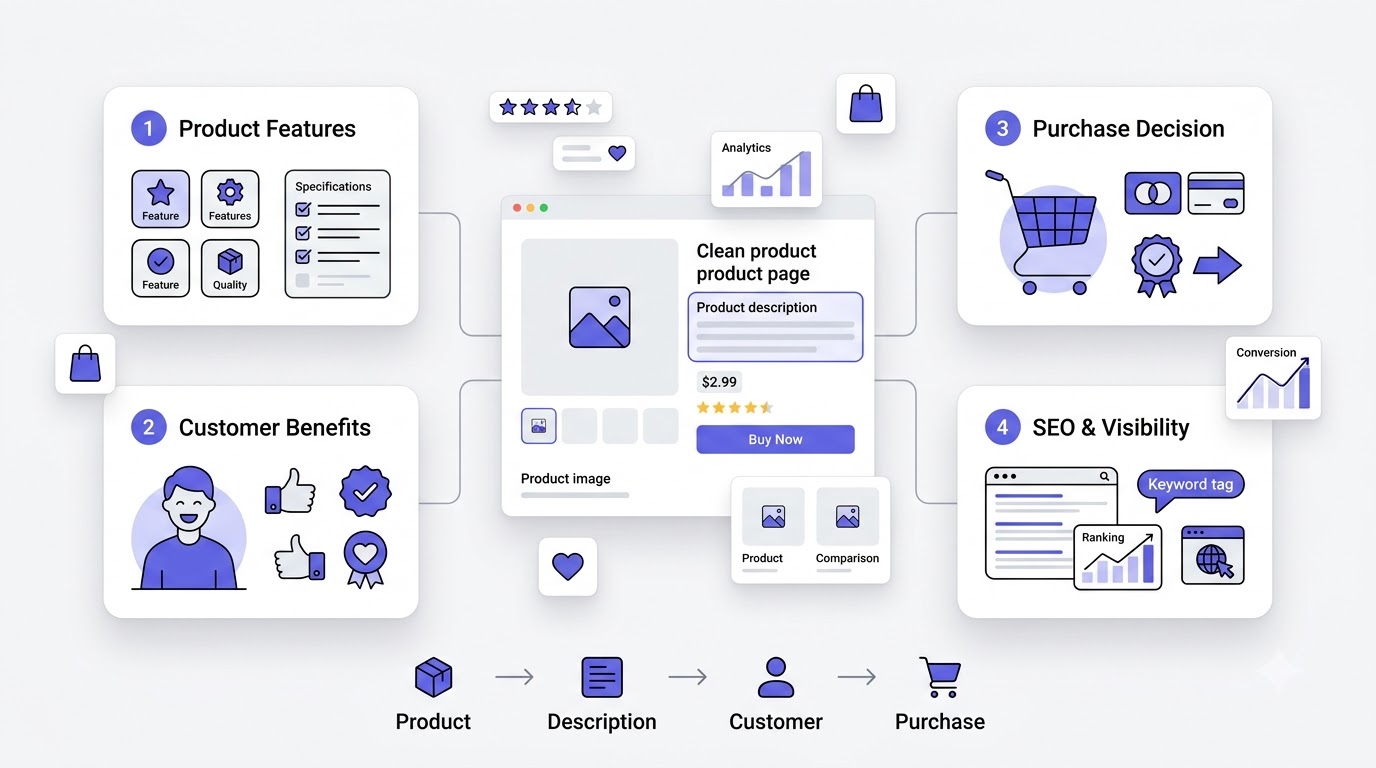
A product description is the block of copy on a product page that explains what the item is, what it does, and why someone should buy it. It sits somewhere between marketing and information, part sales pitch, part user manual, and the best ones manage to be both without feeling like either.
Difference Between Product Information and Product Copy
Product information is the raw stuff, dimensions, materials, weight, compatibility. It’s factual and necessary, but it doesn’t persuade anyone on its own. Product copy is what happens when you take that raw information and frame it around a real person’s problem, turning “stainless steel” into “won’t rust on you after a few months like the cheap ones do.” Good product pages need both, but copy is what actually closes the sale while information just supports the decision once someone’s already leaning toward buying.
Purpose of a Product Description
A product description has to do more than just describe. It needs to Educate the customer on what exactly they’re getting and how it works. It needs to Build Trust so the customer feels confident buying from a page instead of touching the product in person. It has to Remove Objections before they even form in the customer’s head, answering the “but what if” questions before they become a reason to leave. It should Improve SEO so the page actually shows up when someone searches for what you’re selling. Ultimately it needs to Increase Conversions, because that’s the whole point of the page existing. And a description that sets accurate expectations also helps Reduce Returns, since customers who know exactly what they’re getting are less likely to send it back disappointed.
Most store owners only think about one or two of these purposes at a time, usually conversions and maybe SEO if they’re paying attention. But a description doing its full job hits all six at once, which is exactly why the best ones take real effort to write instead of getting copy pasted from a supplier’s spec sheet and called done.
Why Product Descriptions Matter in E-commerce
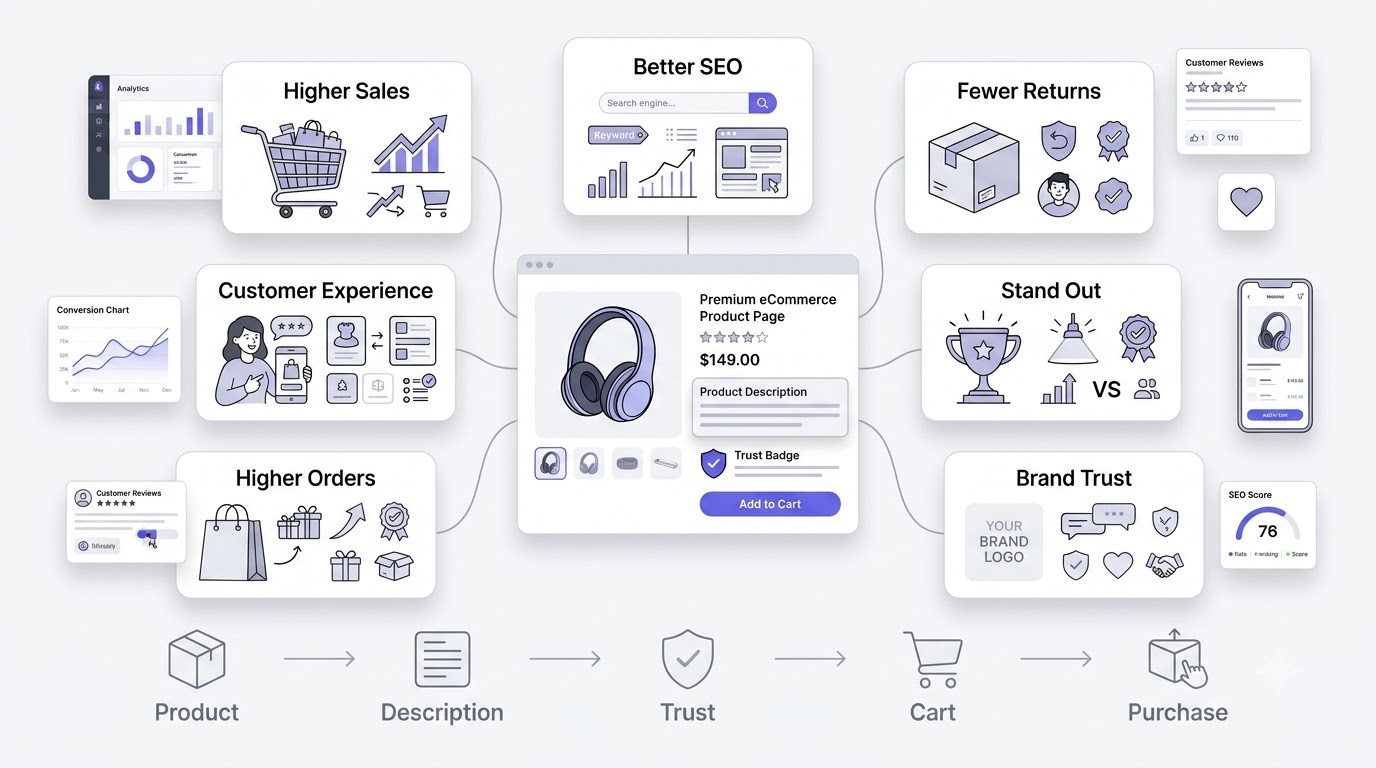
Look, a lot of store owners treat product descriptions as an afterthought. Photos get all the attention, the description gets whatever’s left over, usually copied straight from the manufacturer’s spec sheet. That’s a mistake, and here’s the actual impact good copy has on a store’s bottom line.
Increase Conversion Rate
A well written description directly moves people from browsing to buying. It answers the questions they’d otherwise need to message customer support for, and it builds enough confidence that clicking “add to cart” feels like an easy decision instead of a risky one. Stores that rewrite weak descriptions often see conversion lifts without changing anything else on the page.
Improve SEO Rankings
Search engines need text to understand what a page is about. A thin, generic description gives Google almost nothing to work with, while a detailed, keyword aware description gives your product page a real shot at ranking for the terms people are actually searching. This matters even more for stores relying on organic traffic instead of paid ads to drive sales.
Reduce Product Returns
When a description sets clear, honest expectations, size, material, what it does and doesn’t do, customers know what they’re getting before it arrives. Vague or exaggerated copy leads to disappointment, and disappointment leads straight to a return request, which costs money on both ends of the transaction.
Improve Customer Experience
A page that answers questions clearly feels easier to shop from. Customers aren’t digging through reviews trying to figure out basic details, they’re getting what they need right there on the page, which makes the whole shopping experience smoother and faster.
Differentiate From Competitors
On Amazon especially, dozens of sellers can list nearly identical products. The description is often the only real point of differentiation left, since photos and prices can look nearly the same across listings. Good copy is genuinely a competitive advantage here, not just a nice touch.
Increase Average Order Value
Descriptions that highlight complementary use cases or premium versions can nudge customers toward higher value purchases. Mentioning “pairs well with our matching case” or “also available in the pro version” plants an idea that pure product specs never would.
Build Brand Voice
Every product description is a chance to reinforce how your brand sounds and feels. A playful, casual brand and a luxury, minimal brand should read completely differently on their product pages, and consistency across every listing builds recognition over time.
Include Statistics: E-commerce conversion data consistently shows that detailed, benefit focused product pages outperform generic ones by a wide margin. Customer behavior studies show most shoppers read the description before checking reviews, not after, which means it’s doing more heavy lifting than most stores assume. And mobile shopping insights show an increasing majority of purchases now happen on phones, meaning descriptions need to be scannable and punchy, not long paragraphs nobody’s going to read on a five inch screen.
Put all three of these together and the picture is pretty clear. Descriptions get read early in the buying process, they get read mostly on small screens, and they directly influence whether someone trusts a store enough to pull out their card. Treating that page as an afterthought means leaving money sitting on the table for reasons that are honestly pretty easy to fix once you know where to look.
None of this is theoretical either. Walk into any successful e-commerce store’s product pages and you’ll notice the same pattern repeating, benefit driven headlines, specific numbers instead of vague claims, and a description that reads like someone who actually understands the customer wrote it, not someone filling in a template. That pattern isn’t an accident. It’s the direct result of treating the description as a sales tool instead of a formality tucked below the “add to cart” button.
How Customers Actually Buy Products (Psychology of Buying)
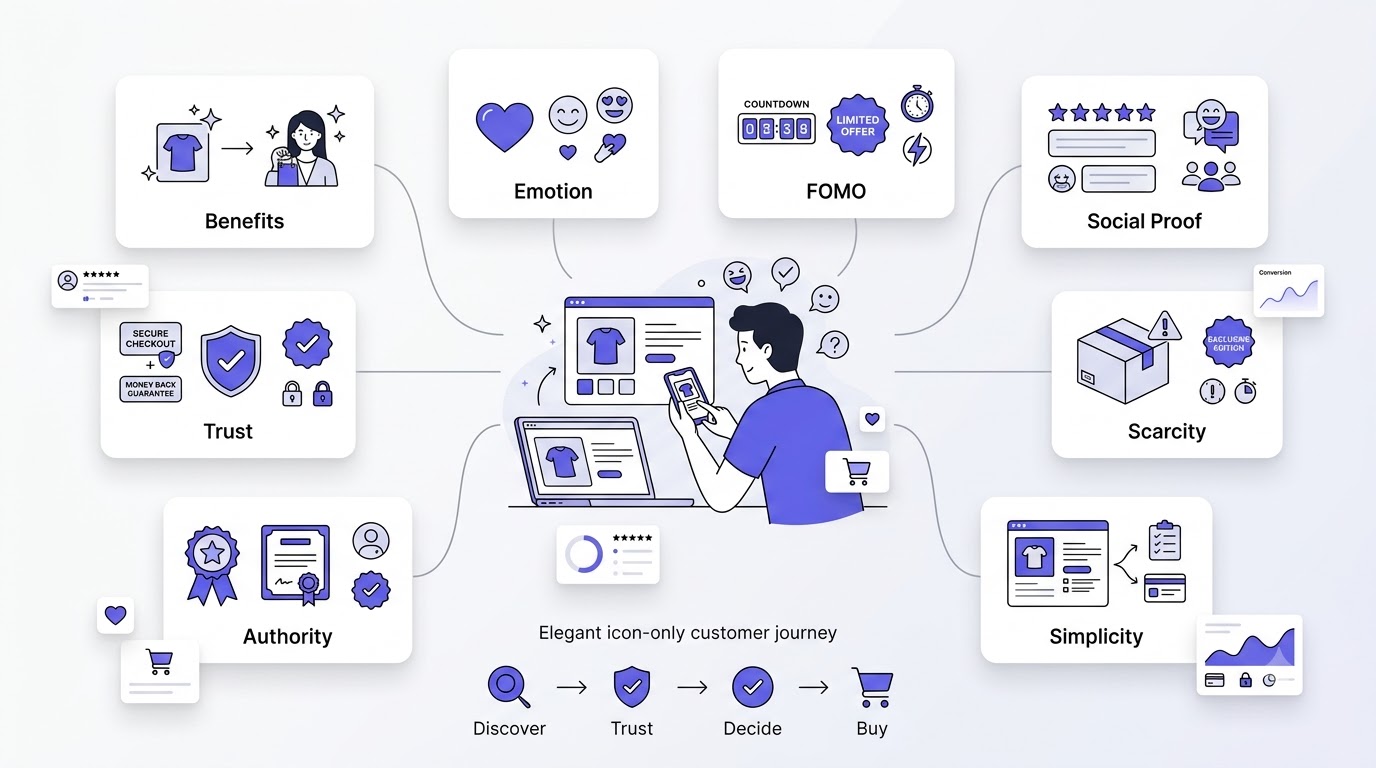
Customers Buy Benefits, Not Features
Nobody wakes up wanting a “2200mAh battery.” They want a phone that survives a full day without dying on them at 6pm. That’s the whole game right there. Every feature needs translating into what it actually means for the person using it, or it’s just noise sitting on the page doing nothing.
Emotion Comes Before Logic
People decide emotionally first, then use logic to justify that decision to themselves. A description that hits an emotional note, relief, confidence, excitement, gets someone leaning toward buying. The specs then just confirm they made a smart choice, which is why both matter but in that specific order.
Fear of Missing Out (FOMO)
“Only 3 left in stock” or “Sale ends tonight” taps into a very real psychological trigger. People hate the idea of missing a good deal or losing access to something they wanted, and that discomfort often pushes hesitant browsers into finally clicking buy.
Social Proof
Reviews, ratings, and mentions of how many people already bought something reduce the risk a customer feels. If 4,000 other people bought this and left good reviews, that’s reassuring in a way that no amount of your own marketing copy can replicate on its own.
Trust Signals
Money back guarantees, secure checkout badges, and clear return policies quietly remove hesitation. Customers aren’t consciously reading every trust signal on a page, but they notice when those signals are missing, and that absence creates doubt even if they can’t articulate why.
Scarcity
Limited editions, limited stock, or limited time offers create urgency that a permanently available product just doesn’t have. People move faster when they think an opportunity might disappear, which is exactly why scarcity shows up so often in high converting copy.
Authority
Mentions of awards, certifications, or endorsements from credible sources borrow trust from somewhere else and lend it to your product. “Recommended by dermatologists” does more persuasive work than “we think this is great,” because it’s not just your own brand talking anymore.
Simplicity Wins
A cluttered, overly complicated description loses people fast. Clear, simple language that gets to the point beats clever wordplay almost every time, especially on mobile where attention spans are shorter and patience for dense paragraphs is basically zero.
Anatomy of a High-Converting Product Description
If you want to know how to write product descriptions that actually pull their weight, it helps to break one down piece by piece. Every high converting description, no matter the industry, tends to hit these same eight components in roughly this order.
This isn’t a rigid formula you need to follow word for word every single time. Some short, cheap products can skip a step or two and still convert fine. But when you’re staring at a page that isn’t performing and trying to figure out why, running through these eight components usually reveals exactly what’s missing. Nine times out of ten it’s either a weak opening hook or benefits that never actually showed up, hidden somewhere behind a wall of specs nobody wanted to read.
1. Product Title
The title needs the right Keyword Placement so search engines and shoppers both understand what the product is immediately. It needs Clarity, no clever wordplay that obscures what’s actually being sold. Include the Brand name where relevant for recognition and trust, and clearly note Variations, size, color, model, so customers land on the exact version they’re looking for without confusion.
2. Opening Hook
You’ve got maybe one line to Grab Attention Instantly before someone’s eyes glaze over and they scroll past. This isn’t the place for a feature dump. It’s the place for a punchy statement that speaks directly to the outcome or feeling the product delivers.
Example: “Finally, a water bottle that keeps ice frozen for 24 hours, even left in a hot car.” That’s a hook. It’s specific, it’s a real problem solved, and it makes someone want to read the next line.
3. Customer Problem
Before pitching the solution, name the problem. Talk about the Pain Points they’re dealing with, the Frustrations that led them to search for this product in the first place, and the Emotional Triggers underneath it, like feeling embarrassed, stressed, or inconvenienced by whatever the old solution failed to fix.
4. Product Solution
Once the problem’s on the table, show exactly how the product solves it. This is the bridge between the pain you just named and the relief the customer is about to get, written plainly enough that the connection is obvious without needing to be spelled out further.
5. Benefits
This is where the real conversion work happens. Explain the transformation the product delivers, not the spec behind it. Instead of writing “Waterproof,” Write “Stay dry during unexpected rain.” One’s a fact. The other’s a feeling, and feelings sell.
6. Features
Once benefits have done their job, back them up with the actual details. Size, Material, Technology, Compatibility, and Specifications all belong here, giving the more analytical shoppers the hard facts they need to finalize their decision.
7. Social Proof
Weave in Reviews, Ratings, Awards, and Certifications wherever they exist. Even a short line like “Rated 4.8 stars by over 2,000 customers” does real persuasive work, borrowing confidence from people who’ve already made the purchase and were happy with it.
8. Call to Action
End with a clear, direct push toward action. Simple works best here, things like Buy Now, Order Today, or Limited Stock create urgency and clarity about what to do next, instead of leaving the customer to figure it out themselves.
Step-by-Step Process to Write Product Descriptions That Sell
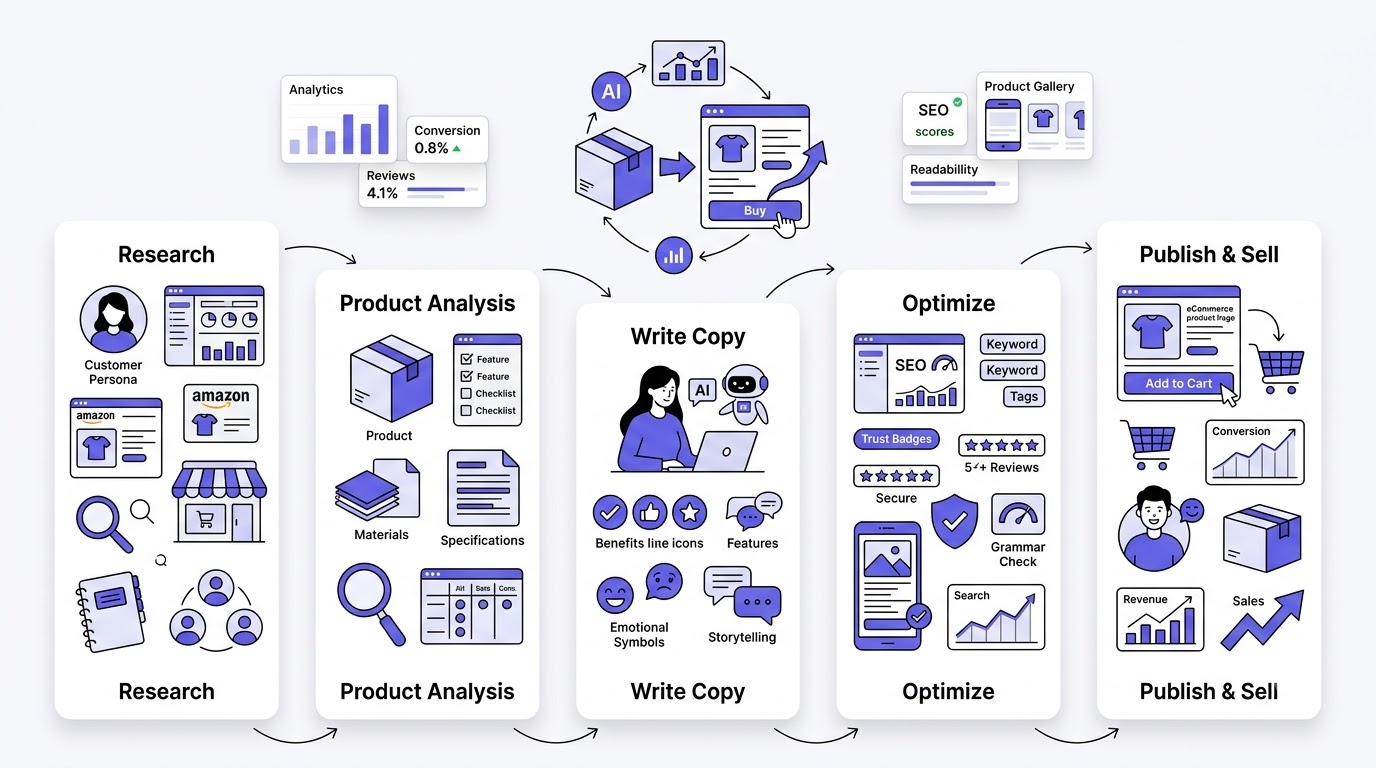
Knowing the anatomy of a good description is one thing. Actually sitting down and writing one is another. Here’s the process, broken into ten steps, that takes you from a blank page to a description that actually converts.
This process feels slower the first few times you run through it, especially step four where you’re forced to sit and think through what each feature actually means for a real person. Stick with it anyway. Once you’ve done it a handful of times, translating features into benefits starts happening almost automatically, and you’ll notice yourself doing it instinctively even when you’re just skimming a competitor’s listing or reading your own product spec sheet.
Step 1: Know Your Target Customer
Before writing a single word, get specific about who you’re writing for. Answer real questions about their Age, Gender, Budget, Lifestyle, Goals, and Pain Points. A description written for a budget conscious college student sounds completely different from one written for a luxury shopper, and trying to write for everyone usually means connecting with nobody.
Step 2: Research Competitors
Look at how similar products are being sold elsewhere. Analyze Amazon Listings, Shopify Stores, and Brand Websites in your space. Specifically look for Common Benefits everyone’s already highlighting, Missing Information that customers might be searching for but nobody’s providing, and genuine Opportunities to say something better or clearer than what’s already out there.
Step 3: List Product Features
Before you can write persuasive copy, get every actual feature down on paper. Build a full feature inventory, materials, dimensions, technology, included accessories, everything. You can’t translate features into benefits if you haven’t actually listed them all out first.
Step 4: Convert Features Into Benefits
This is the core skill of product copywriting. Take every feature from your list and ask “so what does that actually mean for the customer.” A simple table makes this easy to work through systematically.
| Feature | Benefit |
|---|---|
| Stainless Steel | Won’t rust for years |
| Fast Charging | Saves time every day |
| Waterproof | Use in any weather |
Step 5: Create Emotional Appeal
Once benefits are mapped out, layer in emotional language that connects to deeper motivations. Think about Comfort, Confidence, Convenience, Luxury, Safety, or Status, whichever fits your product and audience, and weave that into how the benefits are framed.
Step 6: Remove Buying Objections
Think through what’s actually stopping someone from clicking buy right now. Questions like Is it durable?, Is it worth the money?, or What if it doesn’t fit? are usually sitting unanswered in a hesitant customer’s head. Address them directly in the copy instead of hoping the customer just doesn’t think about it.
Step 7: Add Trust Elements
Reinforce the decision with concrete trust builders. Warranty information, Returns policy, Shipping details, Reviews, and any relevant Certifications all reduce the perceived risk of buying from a page instead of a physical store.
Step 8: Write Naturally
Avoid robotic writing that sounds like it was generated by a template with the blanks filled in. Read what you wrote out loud. If it sounds like something a real person would actually say to a friend, you’re on the right track. If it sounds stiff and corporate, rewrite it.
Step 9: Optimize for SEO
Once the copy reads well, layer in SEO without breaking the natural flow. Work in the Primary Keyword, Related Keywords, Product Category terms, Brand name, and relevant Variations so the page has a real shot at ranking in search results.
Step 10: Edit Ruthlessly
Run through a final checklist before publishing. Check Grammar, overall Readability, clean Formatting, a strong CTA, and confirm the page reads well on Mobile Optimization, since that’s where most shoppers will actually encounter it.
Product Description Formula That Always Works
Copywriters didn’t invent these formulas for fun, they exist because they work consistently across industries and products. Here are five you can lean on whenever you’re stuck staring at a blank page.
Honestly, you don’t need to memorize all five and agonize over which one fits best before you start typing. Pick whichever one matches how you naturally think about your product, write a draft, and see if it flows. Most experienced copywriters end up blending pieces of two or three formulas without even thinking about it consciously once they’ve internalized the underlying logic, problem first, emotion next, proof after that, action last.
Formula 1: Problem → Solution → Benefits → Features → Trust → CTA
This is basically the full anatomy laid out earlier, condensed into a repeatable sequence. Start with the problem, present the solution, sell the benefits, back it up with features, reinforce with trust signals, and close with a clear call to action. It’s the safest, most reliable structure for most product types.
Formula 2: AIDA
Attention grabs the reader immediately with a hook. Interest builds by connecting to their situation or problem. Desire creates an emotional pull toward owning the product. Action closes it out with a direct CTA. AIDA works especially well for products with a strong emotional angle, fashion, beauty, lifestyle goods.
Formula 3: PAS
Problem names what’s frustrating the customer. Agitate pushes a little deeper into why that problem actually matters and what it’s costing them. Solution then arrives as the relief, positioned as exactly what they need. PAS tends to work great for problem solving products, things that fix a specific annoyance or pain point.
Formula 4: FAB
Features are listed first, the raw facts. Advantages explain what that feature does functionally. Benefits connect it to what the customer actually gains. This formula suits more technical or B2B products where the audience genuinely wants the functional logic spelled out before the emotional payoff.
Formula 5: Before–After–Bridge
Paint the Before picture, life with the problem still unsolved. Then the After picture, life once the product’s in play. The Bridge is simply the product itself, positioned as the thing connecting those two states. This formula is especially persuasive because it makes the transformation feel vivid and real instead of abstract.
SEO Best Practices for Product Descriptions
Writing persuasive copy means nothing if nobody finds the page in the first place. SEO isn’t separate from good copywriting, it’s part of it, and here’s how to build it into your product pages properly.
Keyword Research is step one, figuring out exactly what terms customers type in when they’re searching for a product like yours. Search Intent matters just as much as the keyword itself, since someone searching “best running shoes for flat feet” wants different content than someone searching “buy Nike Pegasus 40.” Semantic Keywords, related terms and phrases, help search engines understand the full context of the page instead of relying on one exact match term.
Product Schema markup helps your listing show up with rich results, star ratings, price, and availability directly in search results, which tends to boost click through rates noticeably. The Meta Title and Meta Description are what actually show up in search results, so they need to be compelling enough to earn the click, not just accurate. Image Alt Text helps with both accessibility and image search visibility, and it’s an easy win most stores skip entirely.
Internal Linking to related products or category pages strengthens your site’s overall structure and keeps shoppers browsing longer instead of bouncing after one page. A clean URL Structure, short and keyword relevant, helps both search engines and customers understand what the page is about at a glance. Proper Heading Structure, using H1 and H2 tags correctly, helps search engines parse the page’s hierarchy and importance.
Adding Product FAQs directly on the page answers common questions and can also earn Rich Snippets in search results, giving your listing extra visual real estate. And don’t ignore E-E-A-T Considerations, experience, expertise, authoritativeness, and trustworthiness, especially for higher stakes purchases where customers want to feel confident in who’s selling to them.
None of this SEO work matters if it comes at the cost of readability, though. A page stuffed with keywords but stripped of any real persuasion might technically rank, but ranking without converting just means more people seeing a page that fails to sell them anything. Treat SEO as the thing that gets someone to the page, and persuasive copy as the thing that gets them to actually buy once they’re there. Both jobs matter, and neither one should get sacrificed for the other.
Product Description Writing Tips by Industry
Different categories need different voices, different levels of detail, and different emotional triggers. Here’s how the approach shifts across ten common industries.
What works for a $15 candle absolutely will not work for a $2,000 sofa, and that’s not just about length. It’s about pacing, how much proof a customer needs before they trust you enough to pull out their card, and what emotional lever actually applies to that specific purchase. A grocery item needs almost no persuasion, people already know they need milk. A piece of jewelry meant as an anniversary gift needs an entirely different kind of emotional weight behind every sentence.
Fashion
Writing style should be sensory and visual, describing how fabric feels and how a piece fits into someone’s life. The CTA often leans playful, “add to bag” or “shop the look.” Benefits center on confidence and style expression. Keywords should include fabric type, fit, occasion, and season. Example: “This linen shirt breathes easy through summer heat, and the relaxed fit means you’re comfortable from brunch straight through to dinner.”
Electronics
Writing style here is more precise and spec driven, though it still needs a benefits layer on top. The CTA usually pushes toward comparison or upgrade, “see why it’s faster.” Benefits focus on time saved, performance gains, and reliability. Keywords include specs, compatibility, and model numbers. Example: “Charges to 50% in just 20 minutes, so you’re never stuck waiting around when you’re running late.”
Beauty
Writing style blends emotional and ingredient focused language. The CTA often invites trial, “see the difference in two weeks.” Benefits center on confidence, self care, and visible results. Keywords include skin type, ingredients, and concerns addressed. Example: “Formulated with hyaluronic acid to keep skin hydrated through the day, without that heavy, greasy feeling.”
Furniture
Writing style is warm and lifestyle oriented, helping customers picture the piece in their own home. The CTA often nudges toward room visualization, “see it in your space.” Benefits focus on comfort, durability, and how a room feels. Keywords include material, dimensions, and style category. Example: “Solid oak construction that’s built to handle Sunday family dinners for decades, not just a couple years.”
Grocery
Writing style stays simple and factual, with a focus on freshness and origin. The CTA is usually straightforward, “add to cart.” Benefits highlight taste, nutrition, and convenience. Keywords include ingredients, dietary tags, and sourcing. Example: “Locally sourced, picked fresh within 48 hours of delivery to your door.”
SaaS
Writing style is benefit heavy and outcome focused, since the product itself is intangible. The CTA typically pushes a free trial or demo. Benefits center on time saved, efficiency, and problem solving. Keywords include use cases, integrations, and pain points solved. Example: “Cuts your reporting time from three hours to fifteen minutes, every single week.”
Jewelry
Writing style leans emotional and aspirational, often tied to meaning and occasion. The CTA often nudges toward gifting, “make it a gift.” Benefits focus on sentiment, status, and craftsmanship. Keywords include material, occasion, and style. Example: “Handcrafted in sterling silver, made to become the piece she reaches for every single day.”
Sports Equipment
Writing style is energetic and performance focused. The CTA often pushes toward action, “gear up.” Benefits center on performance improvement and durability under real use. Keywords include sport type, performance specs, and material. Example: “Grip technology that holds even when your hands are sweating through the fourth quarter.”
Home Decor
Writing style is atmospheric, helping customers imagine the mood a piece creates. The CTA often invites styling inspiration, “shop the room.” Benefits focus on ambiance and personal expression. Keywords include style, room type, and material. Example: “Soft, warm light that turns any corner into the spot you actually want to sit in.”
Digital Products
Writing style is clear and outcome driven, since there’s no physical object to describe. The CTA usually pushes instant access, “download now.” Benefits focus on convenience, speed, and immediate value. Keywords include format, use case, and compatibility. Example: “Instant download, no waiting around, start using the templates within minutes of purchase.”
Product Description Examples (Before vs After)
Seeing real transformations makes all of this click faster than theory ever will. Here are eight examples showing weak, feature only copy next to a rewritten version that actually sells.
Notice what’s actually changing in each of these rewrites. It’s not that the “after” version adds more information, most of the time it’s actually shorter. What changes is the angle, shifting from what the product is made of to what the product does for the person using it. That shift alone is responsible for most of the conversion lift good copywriting produces, and it’s worth reading through these examples twice to really let the pattern sink in.
Example 1: Running Shoes
Before: “Lightweight mesh upper. Rubber sole. Available in six colors.” After: “Feels like running on clouds, mile after mile, with breathable mesh that keeps your feet cool even on your longest runs.”
Example 2: Coffee Maker
Before: “12-cup capacity. Programmable timer. Stainless steel.” After: “Wake up to fresh coffee already brewed and waiting, thanks to a timer that does the early morning work so you don’t have to.”
Example 3: Skincare Product
Before: “Contains vitamin C and niacinamide.” After: “Brighter, more even skin in just two weeks, without the irritation you’d expect from a strong active ingredient.”
Example 4: Smartphone
Before: “6.5 inch display. 128GB storage. Dual camera.” After: “Never run out of space for photos again, and capture every moment in detail sharp enough to print and frame.”
Example 5: Office Chair
Before: “Adjustable height. Mesh back. 300lb weight capacity.” After: “Sit through an 8 hour workday without the back pain that used to hit by 3pm, thanks to support that actually moves with you.”
Example 6: Wireless Earbuds
Before: “Bluetooth 5.0. 6-hour battery life. Noise cancellation.” After: “Block out the office chatter and actually focus, with sound quality good enough to make you forget you’re wearing earbuds at all.”
Example 7: Water Bottle
Before: “Insulated stainless steel. 32oz capacity.” After: “Ice still rattling around 24 hours later, even after a full day left in a hot car.”
Example 8: Handmade Product
Before: “Hand-poured soy candle. 8oz. Lavender scent.” After: “Hand-poured in small batches, this lavender candle turns a stressful evening into the calm wind-down you’ve been needing all week.”
AI Tools for Writing Product Descriptions
AI has made drafting product descriptions dramatically faster, especially when you’re staring down a catalog of two hundred SKUs and no time to write each one by hand. Here’s a rundown of the tools worth knowing.
ChatGPT is flexible and works well for generating first draft copy across almost any product category. Best use cases include brainstorming multiple angles for the same product fast. Claude tends to produce more natural, less robotic sounding copy out of the box, which makes editing faster afterward. Gemini integrates well if you’re already inside Google’s ecosystem for other marketing work.
Jasper AI is built specifically for marketing copy and includes brand voice training, useful for larger teams needing consistency across many writers. Copy.ai offers templated workflows specifically for e-commerce copy, which speeds up bulk description writing. Writesonic leans toward SEO integration, helping keyword placement happen automatically as you draft. Grammarly isn’t a generator but catches tone, clarity, and grammar issues after you’ve written or generated a draft. Surfer SEO helps you benchmark your description’s keyword density and structure against top ranking competitor pages.
Pros across these tools generally include speed, reduced writer’s block, and the ability to generate variations quickly for A/B testing. Cons include a tendency toward generic, overly enthusiastic language if you don’t edit carefully, and none of them truly understand your specific brand voice without heavy prompting and editing. Pricing ranges from free tiers on tools like ChatGPT and Claude to monthly subscriptions on the higher end for Jasper and Surfer SEO. Best for teams managing large catalogs where writing every description by hand isn’t realistic, provided a human still edits the final output.
A word of caution here, since it comes up constantly. AI generated descriptions have a tell. They tend to overuse certain phrases, lean on the same sentence structures, and sound weirdly enthusiastic about everything regardless of the actual product. A $9 phone case does not need to be described as “revolutionary.” Read every AI draft out loud before publishing it, and if it sounds like it’s trying too hard, trim it back until it sounds like an actual person talking about a product they understand.
AI Prompt to Generate High-Converting Product Descriptions
Here are eight reusable prompts you can copy, adjust, and use immediately.
Basic Prompt: “Write a product description for [product name], highlighting its main benefit of [benefit], in a friendly, conversational tone under 150 words.”
Advanced SEO Prompt: “Write an SEO optimized product description for [product name], naturally including the keywords [primary keyword] and [secondary keyword], while keeping the tone persuasive and benefit focused.”
Amazon Prompt: “Write an Amazon style product description with bullet points for [product name], focusing on the top five benefits and including relevant search keywords for [product category].”
Shopify Prompt: “Write a Shopify product description for [product name] with a strong opening hook, three key benefits, and a clear call to action, written for [target audience].”
Luxury Product Prompt: “Write a premium, understated product description for [product name] that conveys quality and exclusivity without sounding overly salesy.”
Technical Product Prompt: “Write a product description for [product name] that leads with the key technical specification of [spec], then explains what that means practically for the user.”
Emotional Copywriting Prompt: “Write a product description for [product name] using the PAS formula, focusing on the emotional pain point of [problem] and how this product resolves it.”
B2B Product Prompt: “Write a product description for [product name] aimed at business buyers, focusing on ROI, efficiency gains, and how it solves [specific business problem].”
Product Description Optimization Checklist
Run every product page through this before hitting publish.
Make sure the copy stays genuinely Customer-Focused, speaking to their needs rather than just listing what the product is. Confirm Benefits Before Features appear early in the copy, not buried after three paragraphs of specs. Check that relevant SEO Keywords are worked in naturally, not stuffed awkwardly. Read for Readability, short paragraphs, simple language, no jargon unless your audience expects it.
Confirm there’s a clear, direct CTA that tells the customer exactly what to do next. Test the page for Mobile Optimization, since that’s likely where most traffic is landing. Verify Trust Signals like guarantees, shipping info, and return policy are visible somewhere on the page. Include relevant FAQs addressing common pre-purchase questions. Double check Images are high quality and support the copy rather than needing to compensate for weak descriptions. Make sure Reviews are visible and easy to find. And confirm Schema Markup is implemented correctly so search engines can pull rich results for the listing.
Print this list out, or better yet, turn it into an actual checklist inside whatever tool your team uses to manage product uploads. Running new listings through it before they go live catches problems early, before a weak description has a chance to sit there quietly costing you sales for weeks or months without anyone noticing why conversions on that particular page seem lower than everything else in the catalog.
Product Description Templates
Sometimes the fastest way to write a good description is starting from a proven structure instead of a blank page. Here are ten templates you can adapt to your own products right now.
None of these are meant to be filled in mechanically like a mad-libs worksheet. Use them as a starting skeleton, then let your actual knowledge of the product and the customer shape what goes into each section. The structure does the heavy lifting of making sure you don’t forget an important element, but the specific words still need to come from understanding what you’re actually selling and who’s buying it.
Simple Template
“[Hook sentence about the main benefit]. [One sentence naming the problem it solves]. [Two to three key benefits]. [Core features]. [Trust element like reviews or guarantee]. [CTA].” This bare bones structure works for almost any product when you’re short on time and just need something solid published quickly.
Shopify Template
Start with a short, punchy headline under the product title, then a two sentence hook, followed by three bullet pointed benefits, a short paragraph on materials or specs, a mention of shipping or returns policy, and end with a CTA that matches your brand’s tone. Shopify pages tend to convert better with a mix of scannable bullets and a little narrative copy woven in between.
Amazon Template
Lead with a keyword rich title, then five bullet points covering the top benefits in order of importance, followed by a short paragraph description below the fold for shoppers who scroll further. Amazon shoppers scan bullets first, so front load the strongest benefit in the very first bullet point.
WooCommerce Template
Similar to Shopify but with more room for detailed specifications since WooCommerce stores often serve more research heavy buyers. Open with a benefit driven paragraph, follow with a features table, include a short FAQ block, and close with a CTA button copy that matches the checkout flow.
Luxury Brand Template
Keep it short and understated. One elegant paragraph focusing on craftsmanship and exclusivity, minimal bullet points if any, and a subtle CTA like “Discover More” rather than an aggressive “Buy Now.” Luxury buyers respond to restraint, not hype.
Technical Product Template
Lead with the core technical benefit, follow with a specifications table, include a compatibility section, and add a short FAQ addressing common technical questions before closing with a CTA. Technical buyers want the facts accessible, not buried under flowery language.
Fashion Product Template
Open with a sensory hook describing how it looks or feels, follow with sizing and fit details, mention styling suggestions or occasions it works for, and close with a playful CTA. Fashion shoppers respond well to visual, lifestyle oriented language throughout.
Digital Product Template
Lead with the immediate outcome or transformation, list what’s included clearly, mention format and compatibility, include a short FAQ about access and usage, and close with an instant access CTA. Digital buyers want to know exactly what they’re getting and how fast they can start using it.
Subscription Product Template
Open with the ongoing value proposition, explain what each shipment or cycle includes, mention flexibility around pausing or canceling, include social proof from existing subscribers, and close with a low commitment CTA like “Try your first box.” Reducing perceived commitment matters a lot for subscription conversions.
Handmade Product Template
Lead with the story behind the piece, mention materials and the crafting process, note that each piece may have slight variations since it’s handmade, include a personal touch about the maker or small batch production, and close with a warm, personal CTA. Handmade buyers value authenticity over polish, so let that show in the copy.
Conclusion
Getting product descriptions right isn’t complicated once you’ve got the framework down, but it does take actual effort most stores skip because it feels less exciting than photography or ads. Know your audience before writing a single word, since copy written for everyone convinces nobody. Focus on benefits over features, translating every spec into what it actually means for the person reading it. Use persuasive copywriting formulas like AIDA or PAS instead of guessing at structure from scratch every time.
Optimize for SEO so the work you put into writing actually gets found by the people searching for it. Include trust-building elements, reviews, guarantees, clear policies, since risk reduction is half the battle on any product page. Write for humans first, search engines second, because copy that reads robotic won’t convert no matter how well it’s optimized. And test and refine descriptions regularly, since what works for one product or audience won’t always work for another, and the only way to know for sure is watching what actually happens once real customers start reading it.
Take the formulas, the templates, and the checklist from this guide and actually run your product pages through them this week. Small changes to how a description is framed, benefits first, objections handled, a clear CTA at the end, can shift conversion rates more than most stores expect from something that costs nothing but a little time to fix.
Frequently Asked Questions
What makes a good product description?
A good product description leads with benefits, not just features, speaks directly to a real customer problem, and includes enough trust signals and detail to remove hesitation. It should read naturally, like a person explaining why this product is worth buying, not like a spec sheet copied from the manufacturer.
How long should a product description be?
There’s no fixed number, it depends on the product and platform. Simple, low consideration items might only need 100 to 150 words, while higher priced or more complex products often benefit from 300 words or more, especially when there are objections that need addressing before someone feels confident buying.
Should product descriptions be SEO optimized?
Yes, absolutely. A description that ignores SEO might read beautifully but never actually gets found by anyone searching for that product. The trick is weaving keywords in naturally so the copy still reads like it was written for a person, not stuffed for a search algorithm.
Can AI write product descriptions?
AI can generate a solid first draft fast, especially useful for large catalogs where writing every single description manually isn’t realistic. That said, AI output usually needs editing to sound like your actual brand voice and to avoid the generic, overly enthusiastic tone AI tends to default to.
How do I write descriptions that increase conversions?
Focus on benefits before features, address real objections directly, include trust signals like reviews and guarantees, and end with a clear call to action. Testing different versions against each other over time also helps you figure out what specifically resonates with your audience.
What is the difference between features and benefits?
A feature is a fact about the product, like “stainless steel construction.” A benefit is what that fact actually means for the customer, like “won’t rust or corrode for years.” Good copy always translates the feature into the benefit instead of leaving that work for the customer to figure out.
Should every product have a unique description?
Yes, duplicate descriptions across similar products hurt SEO since search engines can penalize duplicate content, and they also miss the chance to highlight what makes each specific variation worth choosing over another.
How do I write product descriptions for Amazon?
Lead with a keyword rich title, use five bullet points highlighting the strongest benefits first, and include a short paragraph description below for shoppers who scroll further. Amazon shoppers scan fast, so the most persuasive point needs to come first, not buried at the bottom.
How do I write Shopify product descriptions?
Shopify gives more creative freedom than Amazon, so lean into a mix of a strong hook, bulleted benefits, and a short narrative paragraph that reflects your brand voice. Since you’re not competing directly against other sellers on the same page, tone and personality matter more here.
What keywords should I include?
Include your primary product keyword, a few closely related secondary keywords, the product category, brand name, and relevant variations like color or size. Keyword research tools can help confirm which specific phrases people are actually searching for around your product.
How often should I update product descriptions?
Review them every few months, especially for products that aren’t converting well. Seasonal products need updates tied to relevant timing, and any description referencing outdated features, pricing, or availability should get fixed as soon as you notice it.
Do product descriptions affect Google rankings?
Yes, product pages with thin or duplicate descriptions tend to rank poorly since there’s not enough unique content for search engines to understand and rank the page. Detailed, well optimized descriptions give your product pages a real shot at organic visibility.
How do I write descriptions for mobile shoppers?
Keep paragraphs short, use bullet points where possible, and put the most persuasive information first since mobile shoppers scroll fast and rarely read every word. Long, dense paragraphs that look fine on desktop often get skipped entirely on a phone screen.
What tone of voice works best?
It depends entirely on your brand and audience. A skincare brand targeting younger shoppers might use a casual, friendly tone, while a luxury furniture brand might lean formal and restrained. The key is consistency, whatever tone you pick should show up the same way across every product page.
Can storytelling improve product sales?
Yes, especially for handmade, artisanal, or brand driven products where the story behind the product is part of what customers are actually paying for. A little narrative context can make a product feel more meaningful than a plain functional description ever could.
Should I include technical specifications?
Yes, but after the benefits, not instead of them. Technical buyers do want the hard data, size, material, compatibility, but leading with specs alone loses the emotional hook that gets less technical shoppers interested in the first place.
How do I reduce product returns through better descriptions?
Set accurate, honest expectations about sizing, materials, and what the product actually does. Vague or exaggerated descriptions lead directly to disappointed customers sending items back, so clarity upfront protects both the customer experience and your bottom line.
What are the best AI tools for product description writing?
ChatGPT, Claude, and Jasper AI are strong options depending on your needs, speed and flexibility, natural sounding output, or brand voice consistency respectively. Whichever tool you use, plan on editing the output rather than publishing it directly, since AI drafts almost always need a human pass for tone and accuracy.
How can I make product descriptions more persuasive?
Lean on proven formulas like AIDA or PAS, translate every feature into a benefit, and address objections directly instead of hoping customers won’t think of them. Persuasion comes from understanding what’s actually stopping someone from buying and speaking to that directly in the copy.
What should I avoid when writing product descriptions?
Avoid generic language that could describe any competing product, keyword stuffing that reads unnaturally, overhyped claims that damage trust, and dense unformatted paragraphs that mobile shoppers will skip entirely without reading.