

Most marketers are still using ChatGPT like a fancy autocomplete. They type “write me a blog post about email marketing” and get back something so generic it could belong to any brand on earth. Then they copy, paste, publish, and wonder why it doesn’t rank or convert. That’s not a ChatGPT problem. That’s a “nobody showed you how this actually works” problem.
Here’s the thing nobody tells you when you start out: learning how to use ChatGPT for marketing isn’t about finding one magic prompt. It’s about understanding where AI genuinely saves you hours, where it needs heavy editing, and where you should honestly just do the work yourself. A one-person shop running Facebook ads for a local plumber needs something completely different from a SaaS company building a 40-article content calendar. Both can use ChatGPT well. Both will get burned if they treat it like a vending machine.
This guide walks through the real, practical stuff: content, SEO, social media, email, ads, video, e-commerce, local business marketing, lead gen, customer support, and market research. You’ll get workflows you can actually run this week, prompts worth saving, industry examples, comparisons with other tools, and the mistakes that quietly wreck people’s results. No fluff about “the future of AI.” Just what works right now, in 2026, when you sit down and open a chat window.
What You Will Learn in This Guide
By the end of this article, you’ll know exactly where ChatGPT fits in your marketing stack and where it doesn’t. You’ll walk away with over 50 practical use cases across every major marketing channel, five step-by-step workflows you can copy today, a stack of ready-to-use prompts, and a clear-eyed view of what ChatGPT gets wrong so you stop trusting it blindly. You’ll also see how it stacks up against Gemini, Claude, Jasper, and a handful of other tools people keep asking about, plus how to actually measure whether any of this is moving the needle for your business.
What is ChatGPT, Really?
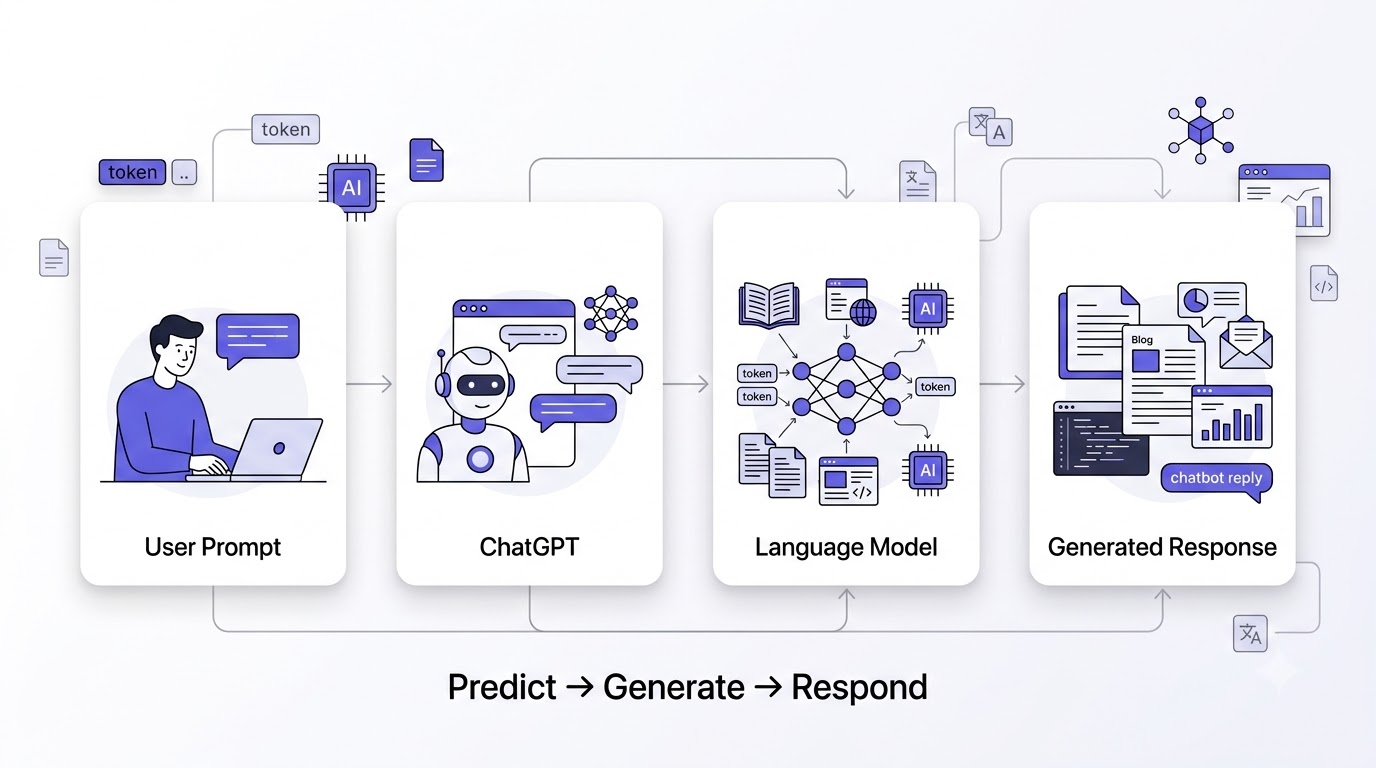
ChatGPT is a chatbot built on top of a large language model, trained on massive amounts of text so it can predict, sentence by sentence, what a helpful response looks like. It doesn’t “know” things the way a person does. It’s pattern-matching at an enormous scale, which is exactly why it’s so good at writing and so shaky when it comes to facts, dates, or anything that changed after its training data was locked in.
Understanding Generative AI and Large Language Models
A large language model, or LLM, is trained on billions of sentences pulled from books, websites, and articles. It learns the statistical relationships between words: which ones tend to follow which, in what order, in what tone. When you ask it a question, it’s not looking anything up in a database. It’s generating a response one token at a time based on probability. That’s why it can write a blog post that sounds confident and polished while getting a fact completely wrong in the same paragraph. Marketers who understand this stop treating ChatGPT’s output as gospel and start treating it as a very fast first draft.
ChatGPT Free vs Paid: What Marketers Actually Need
The free version runs on a lighter model and hits usage caps fast, which is fine if you’re testing one or two prompts a week. But if you’re running actual marketing operations, the paid tier is worth it almost immediately. You get access to stronger models, higher usage limits, faster response times, and features like custom GPTs and file uploads that matter once you’re doing real campaign work instead of occasional experimenting. Most agencies and in-house teams that use this seriously are on a paid plan within their first month, because the free tier’s rate limits start hurting productivity fast.
Why How to Use ChatGPT for Marketing Matters Right Now
Marketing teams are getting squeezed from both sides. Budgets aren’t growing the way headcount would need them to, and content demands keep climbing across more channels than ever, blogs, LinkedIn, Instagram, email, YouTube, paid ads, all running at once. Figuring out how to use ChatGPT for marketing isn’t optional anymore if you want to keep pace without burning out your team or your budget. The businesses pulling ahead right now aren’t the ones with the biggest teams. They’re the ones who figured out which parts of the marketing process AI can carry and which parts still need a human making the calls.
The Real Benefits of Using ChatGPT in Marketing
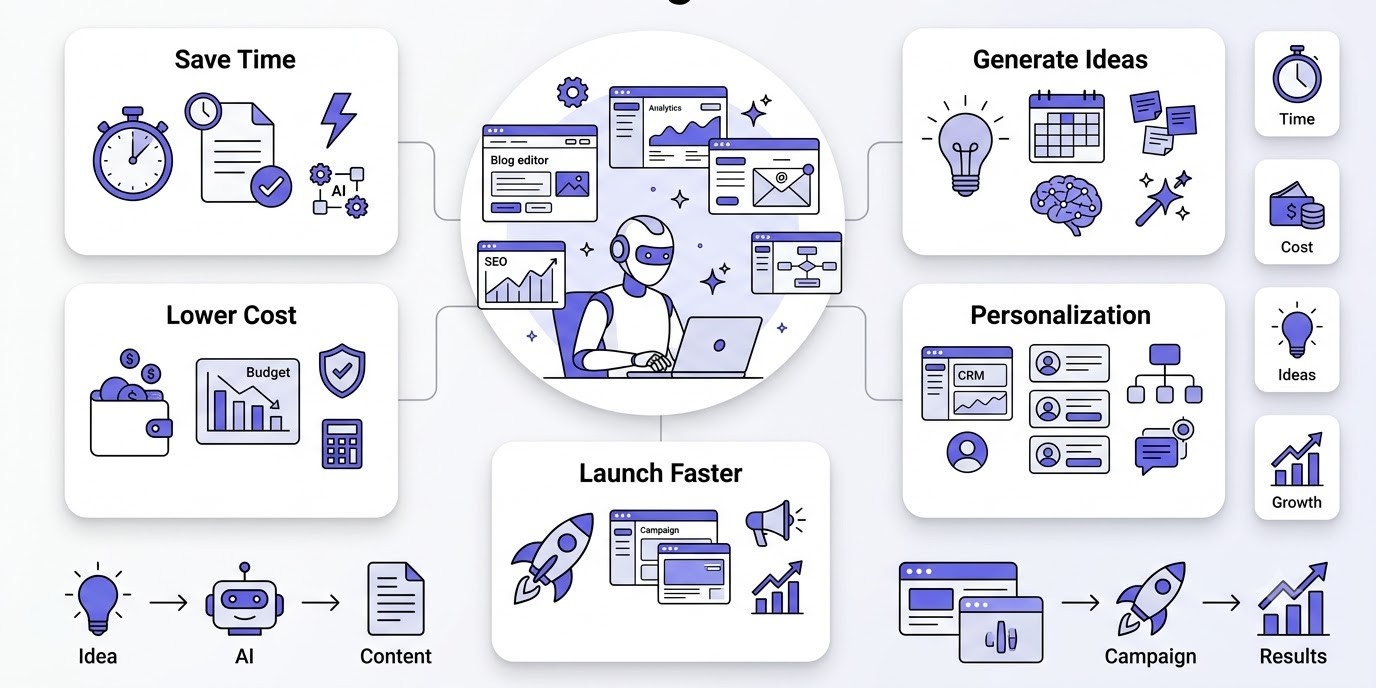
Let’s skip the vague “it boosts productivity” talk and get specific about what actually changes when a marketing team adopts ChatGPT properly.
It Saves Real Time, Not Just “Some” Time
Writing a first draft of a 1,500-word blog post from scratch takes most marketers two to three hours once you count research, outlining, and drafting. ChatGPT can get you a usable first draft in under 15 minutes, leaving your time for the part that actually matters: editing for accuracy, adding your own examples, and making sure it sounds like your brand instead of a robot. That’s not a small win. Over a month of consistent content production, that’s dozens of hours back.
It Reduces Marketing Costs Without Gutting Quality
Freelance copywriters charge anywhere from $50 to $300 per blog post depending on length and expertise. Social media captions, ad variations, email sequences, all of that adds up fast when you’re outsourcing every piece. ChatGPT doesn’t replace a skilled writer, but it cuts down how much outsourced volume you need for lower-stakes content like social captions or first-pass product descriptions, freeing budget for the work that genuinely needs a specialist.
It Multiplies How Many Ideas You Generate
Staring at a blank content calendar is one of the most common bottlenecks in marketing. Ask ChatGPT for 30 blog topic ideas around a niche keyword and you’ll have more raw material in two minutes than most brainstorming sessions produce in an hour. Not every idea will be good. Some will be repetitive or off-target. But sorting through 30 ideas to find 10 worth pursuing beats staring at an empty doc.
It Helps You Personalize Marketing at Scale
Writing five different versions of an email for five different customer segments used to mean five separate drafting sessions. Now you can hand ChatGPT your base message plus a description of each segment and get tailored variations back in minutes. That’s the kind of personalization that used to be reserved for enterprise teams with dedicated CRM specialists, now available to a two-person marketing team running out of a spreadsheet.
It Speeds Up Campaign Execution From Idea to Launch
Campaigns die in the gap between “we should do this” and “it’s actually live.” ChatGPT compresses that gap. Landing page copy, ad variations, email sequences, and social posts for a single campaign can go from concept to draft in an afternoon instead of a week, which matters a lot when you’re trying to catch a trend or respond to a competitor’s move before the window closes.
Where ChatGPT Fits Into the Marketing Funnel
Different stages of the buyer journey need different content, and ChatGPT can support all of them if you know what to ask for at each stage.
Awareness Stage: Getting Found
At the top of the funnel, people don’t know your brand yet. They’re searching for answers to problems, not for you by name. ChatGPT is strong here for blog topic generation, SEO-focused outlines, and social hooks that grab attention in the first line. The goal is volume and relevance, not conversion, so this is where AI-assisted drafting genuinely earns its keep.
Consideration Stage: Building Trust
Once someone knows you exist, they’re comparing options. This is where comparison content, case study frameworks, FAQ pages, and detailed how-to guides matter. ChatGPT can draft the skeleton fast, but this stage needs your real product knowledge and honest positioning layered in, because generic comparison content is easy for readers to spot and dismiss.
Decision Stage: Closing the Gap
Product pages, pricing page copy, testimonial framing, and objection-handling FAQs live here. ChatGPT is useful for drafting multiple angles on the same value proposition so you can test which one resonates, but the final copy needs someone who actually understands the buyer’s hesitation to sharpen it.
Retention and Advocacy: Keeping and Growing Customers
Onboarding emails, re-engagement sequences, loyalty program messaging, and review request copy all fall here. ChatGPT handles the repetitive structure of these well, letting your team focus energy on the parts that build real relationships, like personal check-ins or handling escalations.
How to Use ChatGPT for Marketing Across Every Channel
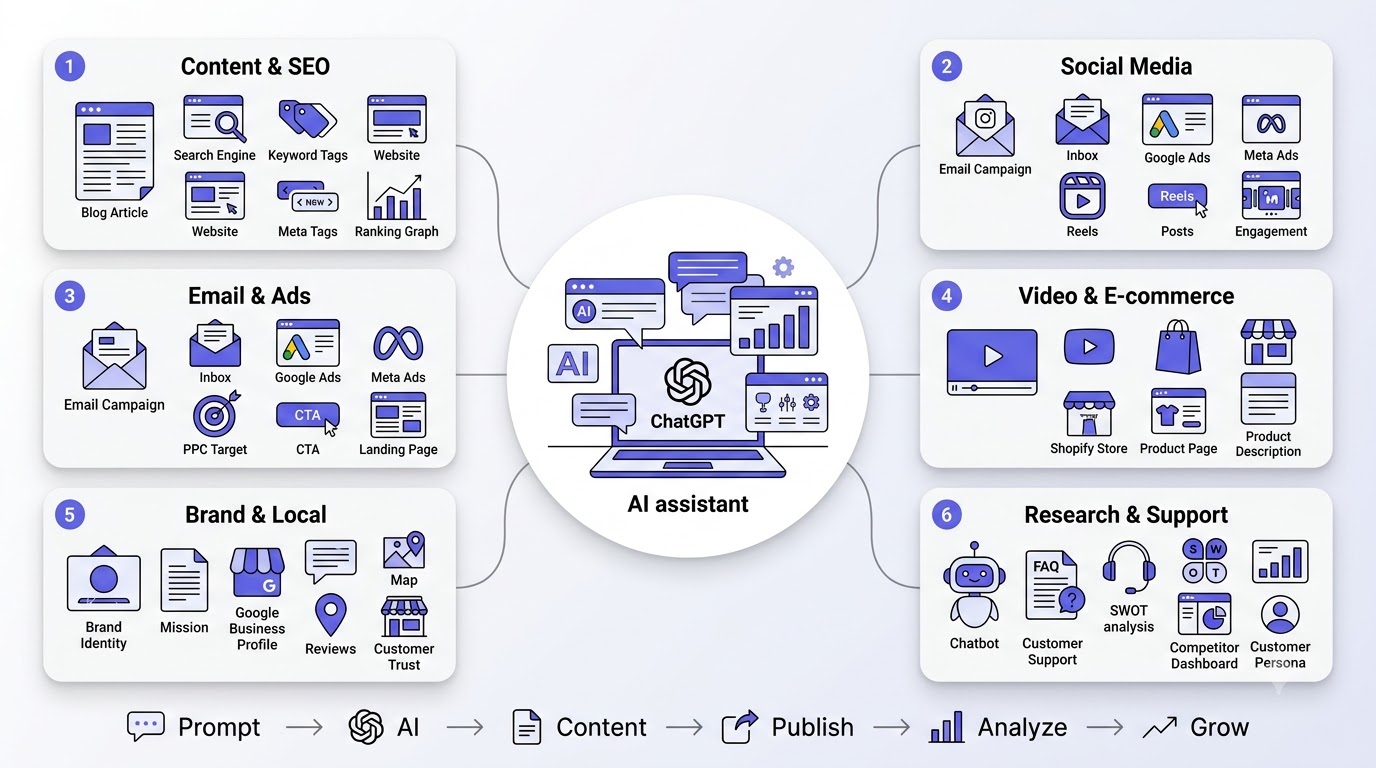
This is the part most people are here for. Below are practical, channel-specific ways teams are actually using ChatGPT right now, not theoretical use cases.
Content Marketing
ChatGPT handles blog topic ideas, outlines, FAQs, and full drafts well, especially when you feed it a clear keyword and audience. It’s also genuinely good at repurposing, turning one long article into a LinkedIn post, a Twitter thread, and an email newsletter blurb without you starting from zero each time. Content calendars, intro paragraphs, conclusions, and CTAs are all quick wins. Where it struggles is deep expertise: if the topic requires firsthand experience or niche technical accuracy, treat the draft as a scaffold, not a final product.
SEO Marketing
For keyword research assistance, ChatGPT can cluster related terms and suggest search intent angles, though you still need a real keyword tool like Ahrefs or Semrush for actual search volume data. It’s strong at drafting meta titles, meta descriptions, schema markup, and image alt text fast, and decent at suggesting internal linking opportunities once you paste in your site structure. Featured snippet optimization works well too: ask it to write a 40 to 50 word direct answer for a specific question, and you’ll often get something close to what Google rewards.
Social Media Marketing
Instagram captions, LinkedIn posts, Twitter threads, and carousel copy are some of the fastest wins in this entire guide. Give ChatGPT your topic, platform, and tone, and you’ll get three or four usable variations in under a minute. Reel scripts and YouTube Shorts scripts benefit from the same speed. Hashtag suggestions and posting calendars are useful starting points, though always sanity-check hashtags against what’s currently working in your niche since trends shift fast. Community replies are a gray area: fine for drafting a response template, risky if you’re auto-posting AI replies without a human glance first.
Email Marketing
Welcome sequences, newsletters, promotional emails, and abandoned cart flows are where ChatGPT shines because email structure is predictable and repetitive. Subject line testing is especially strong: ask for 15 variations with different angles (curiosity, urgency, benefit-driven) and you’ll have solid A/B test material fast. Product launch emails and re-engagement sequences follow similar patterns. Personalization tokens and merge fields need to be added manually since ChatGPT doesn’t know your ESP’s syntax by default, so tell it explicitly what placeholder format to use.
PPC and Advertising
Google Ads headlines and descriptions have strict character limits, and ChatGPT is good at hitting them precisely if you specify the limit up front (30 characters for headlines, 90 for descriptions). Facebook, Instagram, and LinkedIn ad copy variations come fast too, useful for testing multiple hooks against the same audience. Landing page copy drafts save real time, but always verify the CTAs match your actual conversion goal instead of a generic “learn more.”
Video Marketing
YouTube scripts, hook writing, and video descriptions are strong use cases, particularly hooks since ChatGPT understands pattern interrupts and curiosity gaps well when you ask for them explicitly. Podcast scripts and episode outlines work the same way. Thumbnail text ideas are hit or miss since visual impact matters more than the words themselves, so treat those suggestions as a starting brainstorm, not a final answer.
E-commerce Marketing
Product descriptions are probably the single most time-saving use case in this whole list if you’re running a catalog with hundreds of SKUs. Feed ChatGPT the product specs and target customer, and you’ll get consistent, benefit-focused descriptions fast. Product FAQs, category page intros, and Amazon or Shopify listing copy follow the same pattern. The catch: descriptions can start sounding samey across a large catalog, so vary your prompts and inject real product details to keep each one distinct.
Local Business Marketing
Google Business Profile posts, local landing pages, and review reply templates are quick, repeatable wins for local businesses without a dedicated marketing team. A dentist, a plumber, a local gym, all can use ChatGPT to draft responses to Google reviews (both good and bad) in a tone that sounds human and specific rather than corporate and canned, as long as you edit in real details from the actual review.
Brand Marketing
Brand story drafts, mission and vision statement options, and tone-of-voice guidelines are useful starting points when you’re too close to your own brand to articulate it clearly. Taglines and slogans work best when you generate 20 options and pick the one that actually sounds like you, rather than accepting the first output. This is one area where heavy human judgment matters most, since brand voice is something ChatGPT can approximate but never fully own.
Lead Generation
Lead magnets, checklist templates, and webinar scripts are strong use cases because they follow predictable structures. Landing page and form copy for lead capture also draft quickly. eBooks need more careful handling since longer-form gated content tends to read as generic if you don’t inject specific data, examples, or a distinct point of view throughout.
Customer Support
FAQ generation and knowledge base article drafts save real hours, especially when you feed ChatGPT actual support tickets and ask it to identify the most common questions. Chatbot response scripts benefit the same way, though live customer replies should always have a human review step before going out, since a wrong or tone-deaf AI response can do real damage to trust.
Market Research
Competitor analysis frameworks, SWOT draft structures, and customer persona templates are genuinely useful for organizing your thinking, even though ChatGPT can’t pull live competitor data on its own unless you paste it in or use a connected browsing tool. Survey question drafts and industry trend summaries work the same way: good for structure, but always verify any specific claim before publishing it.
ChatGPT Marketing Workflows (Step-by-Step)
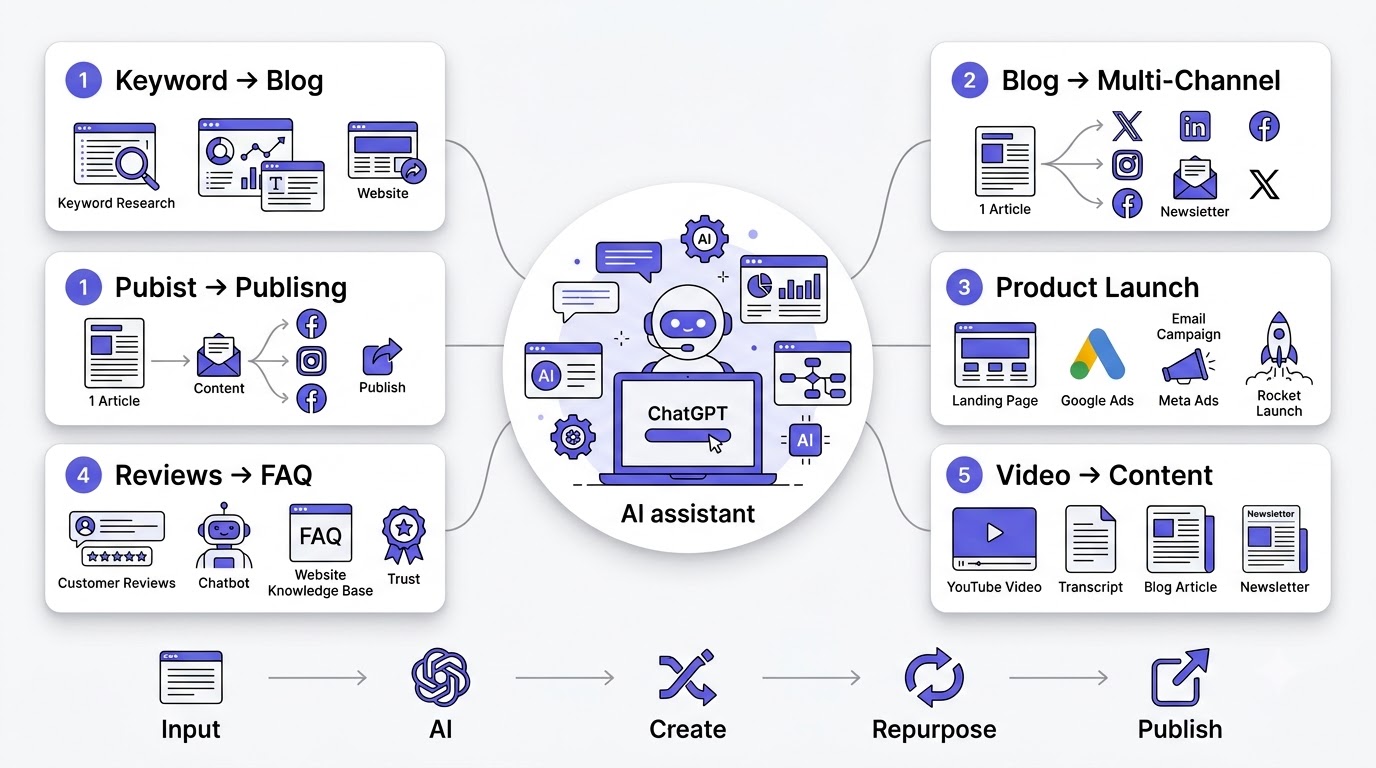
Individual use cases are useful, but the real leverage comes from chaining them into a workflow. Here are five that teams are actually running.
Workflow 1: Keyword to Published Blog
Start with a target keyword, then ask ChatGPT to draft a content outline built around search intent. From there, generate the full draft section by section rather than all at once, since longer generations tend to lose specificity halfway through. Once the draft is done, run it through your own edit pass for facts and voice, then ask for meta title, meta description, and internal linking suggestions before you publish.
Workflow 2: One Blog, Five Channels
Take your finished blog post and repurpose it across LinkedIn, Instagram, Facebook, and email in a single afternoon. Paste the article in and ask for a LinkedIn post that pulls out the single most useful insight, an Instagram carousel outline breaking the article into five slides, a Facebook post with a conversational hook, and an email blurb that teases the piece without giving everything away.
Workflow 3: Product Launch Sprint
For a new product, start with the landing page copy, then branch into ad variations for whichever platforms you’re running, followed by a launch email sequence and social posts announcing the release. Doing this in one session, referencing the same core positioning throughout, keeps your messaging consistent across every touchpoint instead of drifting channel by channel.
Workflow 4: Turning Customer Reviews Into Website Content
Paste in a batch of real customer reviews and ask ChatGPT to extract the most common praise points, objections, and use cases mentioned. That becomes raw material for a genuinely useful FAQ page, since it’s built on what real customers actually say instead of what you assume they’re wondering about.
Workflow 5: One Video, Four Formats
Take a YouTube video transcript and turn it into a blog post, a newsletter section, and three or four social posts pulling out standalone quotes or insights. This is one of the highest-leverage workflows in this whole guide, since video content already contains the raw material, real language, real examples, that AI needs to produce something that doesn’t sound generic.
ChatGPT Prompts Every Marketer Should Save
A good prompt does three things: gives context, states the format you want, and specifies the constraints (length, tone, audience). Here’s a working set across the categories that matter most.
SEO and Content Prompts
“Write a 150-word meta description for a blog post about [topic], including the keyword [keyword], staying under 160 characters.” “Create 15 blog topic ideas around [keyword] for an audience of [audience], mixing beginner and advanced angles.” “Write a direct 45-word answer to the question ‘[question]’ formatted to win a featured snippet.”
Social Media and Email Prompts
“Write 4 LinkedIn post variations about [topic] for a [industry] audience, each under 200 words, with a hook in the first line.” “Write 10 subject lines for an email about [offer], mixing curiosity, urgency, and direct benefit angles, each under 50 characters.” “Draft a 3-email welcome sequence for new subscribers to [brand], introducing the brand, sharing one useful tip, and inviting a first purchase.”
Ad Copy and Persona Prompts
“Write 5 Google Ads headline variations under 30 characters for [product], each testing a different angle: price, speed, quality, ease, trust.” “Build a customer persona for [product] targeting [audience], including their main pain point, what they’ve already tried, and what would make them trust a new solution.” “Write a SWOT analysis outline for [company] competing against [competitor], based on the following facts: [paste facts].”
Industry-Specific ChatGPT Marketing Examples
The general use cases matter, but how you apply them shifts a lot depending on the industry you’re in.
SaaS and B2B
SaaS marketing lives on educational content, comparison pages, and demand gen assets. ChatGPT is strong here for drafting feature comparison tables, “alternative to [competitor]” landing pages, and case study outlines once you feed it the customer’s actual results. The challenge is technical accuracy, so any claim about product functionality needs a product team review before it goes live.
E-commerce and D2C
Product descriptions, category pages, and abandoned cart emails are the highest-leverage use cases here, given how much repetitive copy an online store needs. Seasonal campaign copy also drafts fast, letting small e-commerce teams run more promotions without a full-time copywriter on staff.
Real Estate and Local Services
Property listing descriptions, neighborhood guides, and local landing pages benefit from ChatGPT’s ability to draft consistent, benefit-driven copy fast across dozens of listings or service areas. Local SEO content, like “best [service] in [city]” pages, follows the same pattern, though real local details (landmarks, specific streets, actual customer stories) need to be added manually to avoid sounding templated.
Healthcare, Education, and Finance
These industries carry higher stakes around accuracy, since bad medical, financial, or educational advice has real consequences. ChatGPT is still useful for drafting FAQ structures, patient or student communication templates, and general educational content, but every factual claim in these industries needs verification against a credible source before publishing, no exceptions.
Real Scenarios: What This Looks Like in Practice
Writing a Complete SEO Blog From Scratch
Start with your target keyword and a quick competitor scan of what’s already ranking. Ask ChatGPT to build an outline that goes deeper than the top three results, then draft section by section, checking facts and adding your own examples as you go. Finish with meta title, meta description, and a featured snippet-formatted answer near the top of the article.
Generating a Month of Social Media Content
Give ChatGPT your content pillars (say, three to five recurring themes) and ask for 20 post ideas spread across them, formatted for your primary platform. From there, draft five or six in full to establish a consistent voice, then use those as reference examples when drafting the rest, which keeps quality consistent across the whole batch instead of drifting.
Running a Complete Email Campaign
Map out the sequence first: awareness email, value email, offer email, urgency email, last-chance email. Draft each one with a consistent CTA and subject line variations for A/B testing. This structure, built out in a single sitting, usually takes under two hours compared to a full day drafting each email separately.
Best Practices for How to Use ChatGPT for Marketing the Right Way
Getting good results out of ChatGPT comes down to how specific you are. Vague prompts get vague, forgettable output. So give it real context: your audience, your brand voice, examples of past content that worked, and the exact format you need. Ask for multiple versions instead of accepting the first draft, since variation 3 is often better than variation 1. And always, always edit before publishing. Add your own facts, your own examples, your own voice. Combine whatever ChatGPT gives you with real performance data from your analytics, because AI can draft content but it can’t tell you what’s actually converting for your specific audience.
Common Mistakes to Avoid
The single biggest mistake is publishing AI output without editing it, and it’s an easy trap because the drafts read smoothly even when they’re wrong or generic. Right behind that is ignoring SEO fundamentals, assuming a well-written post will rank on writing quality alone when keyword research and structure still matter just as much as they always did. Using generic prompts without context produces generic content every time. So does forgetting to specify your brand voice, which is why AI-generated copy across a company often sounds like it came from ten different writers. Not fact-checking is a serious one too, especially for stats, dates, or claims about competitors. And overusing AI across every single piece of content, without any human judgment in the mix, tends to produce a body of work that reads flat and forgettable even when each individual piece is technically fine.
ChatGPT Limitations Marketers Should Know
ChatGPT can produce information that sounds confident and turns out to be wrong, a known issue called hallucination, and it happens more often with specific stats, dates, or niche facts than with general concepts. Its real-time knowledge depends on which model and tools you’re using; the base model has a training cutoff and won’t know about things that happened after that unless it has browsing enabled. It doesn’t replace human creativity, especially the kind that comes from genuinely understanding your specific customers and market. It also can’t understand your business automatically. You have to teach it your context every single time unless you’re using a custom GPT with saved instructions. Good prompts matter enormously, a weak prompt gets a weak answer nearly every time. And there are real privacy and ethical considerations: never paste sensitive customer data or proprietary business information into a prompt without checking your company’s data policy first.
ChatGPT vs Traditional Marketing Methods
| Feature | Traditional | ChatGPT |
|---|---|---|
| Speed | Days to weeks for drafts | Minutes for first drafts |
| Cost | Higher, especially for freelance or agency work | Lower per piece of content |
| Content Creation | Fully human, slower but deeply specific | Fast draft, needs human refinement |
| Personalization | Manual, time-intensive at scale | Fast to generate multiple variants |
| Research | Deep but time-consuming | Fast for structure, weak for live facts |
| Brainstorming | Limited by team size and time | Near-instant, high volume |
| Scalability | Hard to scale without more headcount | Scales content volume easily |
The honest read here: traditional methods still win on depth, accuracy, and genuine originality. ChatGPT wins on speed and volume. The best marketing teams aren’t choosing one over the other, they’re using ChatGPT for the first 60% of the work and human expertise for the last 40% that actually separates good content from forgettable content.
ChatGPT vs Other AI Marketing Tools
Google Gemini is tightly integrated with Google’s ecosystem (Docs, Ads, Search), which makes it convenient if your team already lives in Google Workspace, though many marketers find its long-form writing less polished than ChatGPT’s. Claude, from Anthropic, tends to produce more natural, less “AI-sounding” prose out of the box and handles long documents well, making it a strong pick for teams doing heavy editing and long-form content. Microsoft Copilot is the natural choice if your team runs on Microsoft 365, since it’s embedded directly into Word, Outlook, and Excel. Jasper AI is purpose-built for marketing teams with brand voice training and built-in workflow templates, but it costs significantly more than ChatGPT and mostly wraps similar underlying models. Copy.ai and Writesonic both lean toward short-form ad and social copy with templated workflows, useful for teams that want guardrails rather than a blank chat window. Perplexity AI is genuinely strong for research because it cites sources and pulls live web data, making it a better fit for competitor research than for drafting. Grammarly AI is less a content generator and more a polish layer, catching tone and clarity issues after you’ve already written something.
For most marketing teams starting out, ChatGPT remains the most versatile single tool because of its balance of writing quality, flexibility, and price. Specialized tools earn their place once you know exactly which gap you need filled.
Essential AI Tools That Work Well with ChatGPT
Canva pairs well with ChatGPT for turning drafted copy into actual visual assets fast, since you can paste generated captions or headlines straight into a template. Notion AI works well for organizing everything ChatGPT produces into a searchable content database your whole team can access. Grammarly catches the tone and grammar issues that slip through even a careful ChatGPT edit. Surfer SEO and Semrush fill the gap ChatGPT can’t: real keyword volume data and on-page optimization scoring based on what’s actually ranking. Ahrefs does the same for backlink and competitor research. Zapier and n8n let you automate the handoff between ChatGPT and your other tools, like auto-populating a content calendar from generated topic ideas. Google Analytics and Search Console tell you what’s actually working, which you then feed back into your next round of ChatGPT prompts to sharpen future output. Buffer and Hootsuite handle the scheduling and publishing once your ChatGPT-drafted social content is ready to go live.
Measuring Success When Using ChatGPT for Marketing
None of this matters if you’re not tracking whether it’s actually working. Organic traffic and conversion rate tell you if ChatGPT-assisted content is genuinely ranking and converting, not just getting published. Click-through rate matters for headlines and meta descriptions specifically, since that’s where AI-generated variations get tested most directly. Email open rate and engagement rate show you whether AI-drafted subject lines and copy are landing with your list or falling flat. Leads generated and return on investment are the numbers that ultimately justify the time saved against the editing time spent, since AI content that needs heavy rewriting isn’t actually saving you anything. Time saved is worth tracking on its own too, even informally, because it’s often the clearest signal of whether your ChatGPT workflow is genuinely working or just adding an extra step to your process.
Conclusion
Learning how to use ChatGPT for marketing isn’t about replacing your team or your judgment. It’s about handing off the repetitive first-draft work so your actual time goes toward strategy, editing, and the kind of specific, human insight that AI still can’t fake. The teams getting real value out of this aren’t the ones using it for everything. They’re the ones who picked two or three workflows from this guide, ran them consistently, and got sharper with their prompts over time. Start with one channel, one workflow, and build from there. Everything else in this guide is here when you’re ready to expand.
Frequently Asked Questions
Is ChatGPT good for marketing?
Yes, for drafting speed, idea generation, and repurposing content across channels. It’s not a replacement for strategy, brand judgment, or fact-checking, so the best results come from pairing it with human editing rather than publishing raw output.
Can ChatGPT replace digital marketers?
No. It can handle drafting and repetitive tasks fast, but it can’t set strategy, understand your specific market the way a human researcher can, or make judgment calls about brand voice and positioning. It’s a tool that makes marketers faster, not a replacement for the role itself.
How can small businesses use ChatGPT for marketing?
Small businesses get the most value from ChatGPT drafting Google Business Profile posts, review replies, local landing pages, and social captions, since these are high-volume, repetitive tasks that would otherwise eat hours a small team doesn’t have.
Is ChatGPT useful for SEO?
Yes, for meta titles, meta descriptions, content outlines, and featured snippet-formatted answers. It’s not a substitute for actual keyword research tools like Ahrefs or Semrush, which pull real search volume and ranking data that ChatGPT doesn’t have access to on its own.
Can ChatGPT write ad copy?
Yes, ChatGPT drafts Google Ads headlines, Facebook ad copy, and landing page variations quickly, especially when you specify exact character limits. Always test multiple versions against each other rather than trusting the first output to perform well.
Is ChatGPT free for marketing use?
The free version works for light, occasional use but hits usage caps quickly. Teams running consistent marketing operations typically move to a paid plan within their first month for higher limits and stronger models.
Can ChatGPT create marketing strategies?
It can help structure a strategy framework, like a SWOT analysis or a persona outline, based on facts you provide. It can’t independently research your market or competitors with full accuracy, so any strategic recommendation needs to be verified against real data before you act on it.
How accurate is ChatGPT?
It’s accurate for general knowledge and structure but prone to factual errors, especially with specific stats, dates, or niche claims. Always fact-check anything specific before publishing, particularly numbers, names, or claims about competitors.
Does Google penalize AI content?
Google has stated it doesn’t penalize content simply for being AI-assisted; it evaluates content quality regardless of how it was produced. Thin, generic, unedited AI content still tends to underperform because it lacks the depth and specificity that ranks well, not because of the AI label itself.
What are the best ChatGPT prompts for marketing?
The best prompts include specific context: your audience, your brand voice, the exact format and length you need, and examples of what’s worked before. Vague prompts like “write a blog post about marketing” produce vague, forgettable output every time.
Can ChatGPT manage social media?
It can draft captions, threads, and posting calendars, but it can’t manage actual scheduling, community engagement, or real-time trend response on its own. Pair it with a scheduling tool like Buffer or Hootsuite and a human reviewing what goes out.
Is ChatGPT suitable for e-commerce marketing?
Yes, especially for product descriptions across large catalogs, category page copy, and abandoned cart emails. The main risk is descriptions starting to sound repetitive across hundreds of SKUs, so vary your prompts and include real product specifics each time.
Can ChatGPT help generate leads?
It helps draft the assets that support lead generation: landing pages, lead magnets, checklists, and webinar scripts. It can’t run your ad campaigns or manage your funnel on its own, so it’s one piece of a larger lead gen system, not the whole thing.
What are the risks of using AI in marketing?
The main risks are publishing factual errors, losing brand voice consistency across a team, over-relying on AI for content that needs real expertise (like healthcare or finance), and privacy issues if sensitive customer data gets pasted into prompts without checking your company’s data policy first.