

Type a question into Google right now and there’s a decent chance you never click a single link to get your answer. Sixty-eight percent of US Google searches in 2026 end without a click, up from roughly 45% a decade ago, and inside Google’s AI Mode that number jumps to 93%. Read that again. Almost every search inside AI Mode ends with the person getting an answer and closing the tab, never landing on a website at all. That’s not a small algorithm tweak marketers can wait out. That’s the entire economics of organic search getting rewritten in real time, and a huge chunk of the SEO playbook built over the last two decades simply doesn’t work the same way anymore.
Here’s the thing that makes this moment genuinely different from every previous Google update panic, Panda, Penguin, the mobile-first shift, all of it. Those updates changed how Google ranked pages. This shift changes whether Google shows pages at all. AI Overviews now appear on more than 20% of all searches and keep climbing, AI Mode surpassed one billion monthly users within months of its March 2026 US rollout, and the overlap between ranking in Google’s top ten and actually getting cited inside an AI Overview collapsed from around 75% in mid-2025 down to somewhere between 17% and 38% by early 2026. That means a business can hold its rankings steady, keep the same impressions it’s always had, and still watch leads quietly disappear, because the AI answer engine is citing someone else entirely, someone who might not even show up on page one of traditional results.
So this guide walks through exactly what’s changed, why it changed, and what marketers, business owners, and SEO professionals actually need to do about it heading into the rest of 2026. Not vague hand-waving about “adapting to AI,” but the specific mechanics: how AI Overviews and AI Mode actually pull citations, how keyword research has shifted toward intent and entities, how content creation workflows now blend AI drafting with human editing, and what technical SEO fundamentals still matter even when half your traffic used to come from queries that no longer send a single click. This isn’t a eulogy for SEO. It’s a genuinely practical breakdown of how the discipline has changed shape, and what still works underneath all the noise.
What This Guide Covers
- How AI Overviews, AI Mode, and generative search actually work, and why being cited matters more than ranking now
- The full evolution of Google’s AI systems from RankBrain through BERT, MUM, and the Helpful Content System
- How keyword research, content creation, on-page optimization, and technical SEO have all shifted under AI
- Specific AI tools worth using across research, content, and link building, and where they actually help versus where they don’t
- A step-by-step AI SEO workflow you can actually follow, from market research through content refresh
- Real benefits and real risks of using AI in SEO, without the hype or the doom
- Trends shaping where AI search is heading next, and a concrete 90-day action plan to get ready
- Over ten frequently asked questions covering what people are actually searching for on this exact topic
What Is AI SEO?
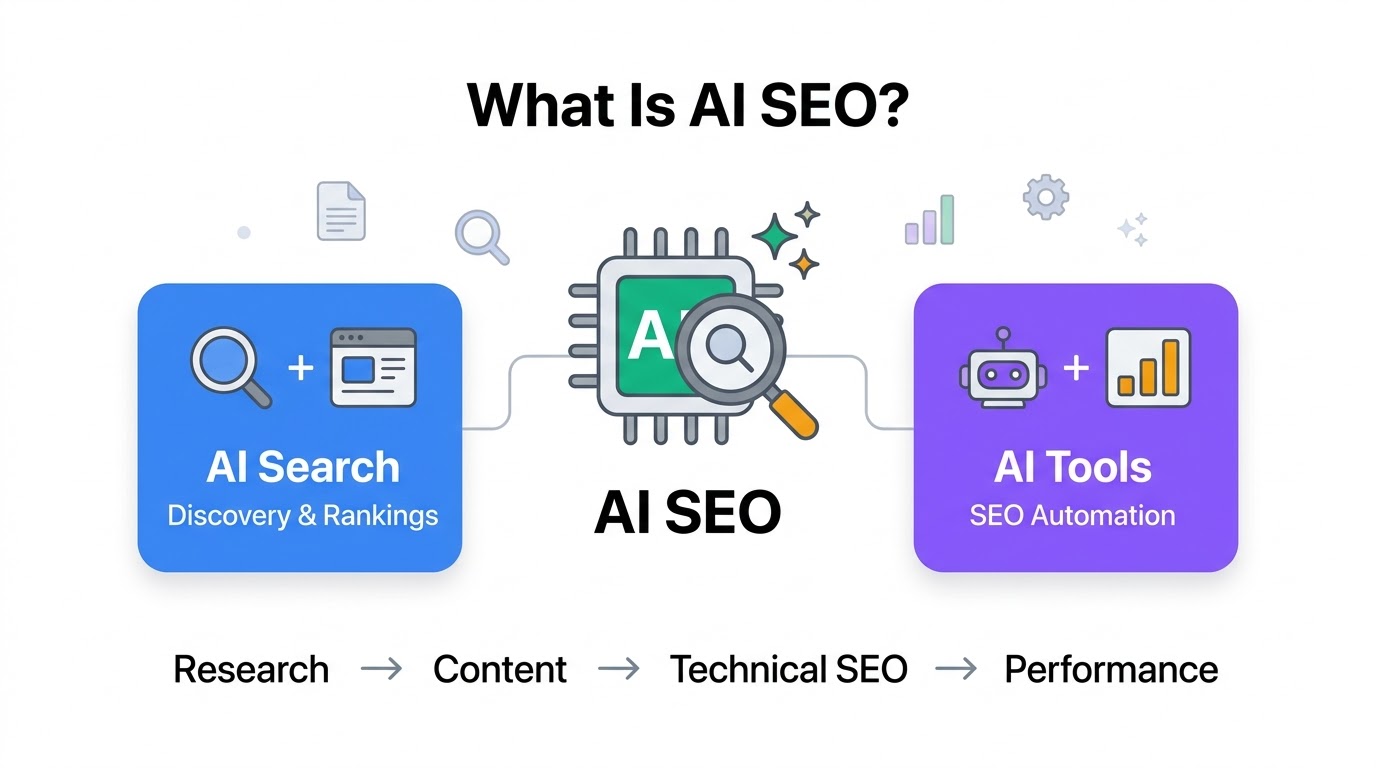
AI SEO refers to using artificial intelligence, both to optimize for how AI-powered search engines discover and cite content, and to use AI tools throughout the SEO process itself, research, content creation, technical audits, and performance tracking. It’s a two-way relationship: AI shapes how search results get generated, and AI tools now shape how SEO professionals actually do their jobs day to day, which makes the term genuinely broader than it sounds at first glance.
How AI Differs from Traditional SEO
Traditional SEO optimized for ranking algorithms that matched keywords, counted backlinks, and evaluated on-page signals to decide which ten blue links to show. AI SEO optimizes for systems that read, synthesize, and summarize content across multiple sources before generating a single answer. That’s a fundamentally different target. Nope, keywords and backlinks haven’t become irrelevant, but they’re no longer the whole game, because now you’re optimizing to get quoted inside an answer, not just to rank above a competitor.
Why AI Has Become Essential for Modern SEO
AI Overviews already touch more than 20% of Google searches, and AI Mode queries are reportedly doubling every quarter since its March 2026 rollout. Ignoring that shift isn’t a neutral choice anymore, it’s a decision to let competitors capture the citations and brand mentions inside AI answers while you keep optimizing purely for a shrinking pool of traditional clicks. That’s why AI has stopped being an optional add-on to SEO strategy and started being the thing SEO strategy has to be built around.
AI SEO vs Automated SEO
These terms get used interchangeably, and honestly, that’s a mistake worth correcting. Automated SEO usually means using software to handle repetitive tasks, bulk meta tag updates, automated reporting, scheduled crawls, work that’s mechanical and rules-based. AI SEO goes further, using machine learning and language models to actually understand intent, generate genuinely useful content drafts, and predict what will perform well. Automation speeds up the old playbook. AI SEO changes what the playbook actually needs to look like.
Common Misconceptions About AI in SEO
The biggest misconception floating around is that AI-generated content automatically ranks worse, or that Google can reliably detect and penalize it outright. That’s not quite true, Google has said repeatedly it evaluates content quality regardless of how it was produced, not whether AI touched it. The bigger misconception on the other side is that AI tools alone can replace strategic thinking entirely. Neither extreme holds up, and most of the real risk sits in the messy middle where people use AI carelessly rather than skillfully.
The Evolution of SEO Before and After AI
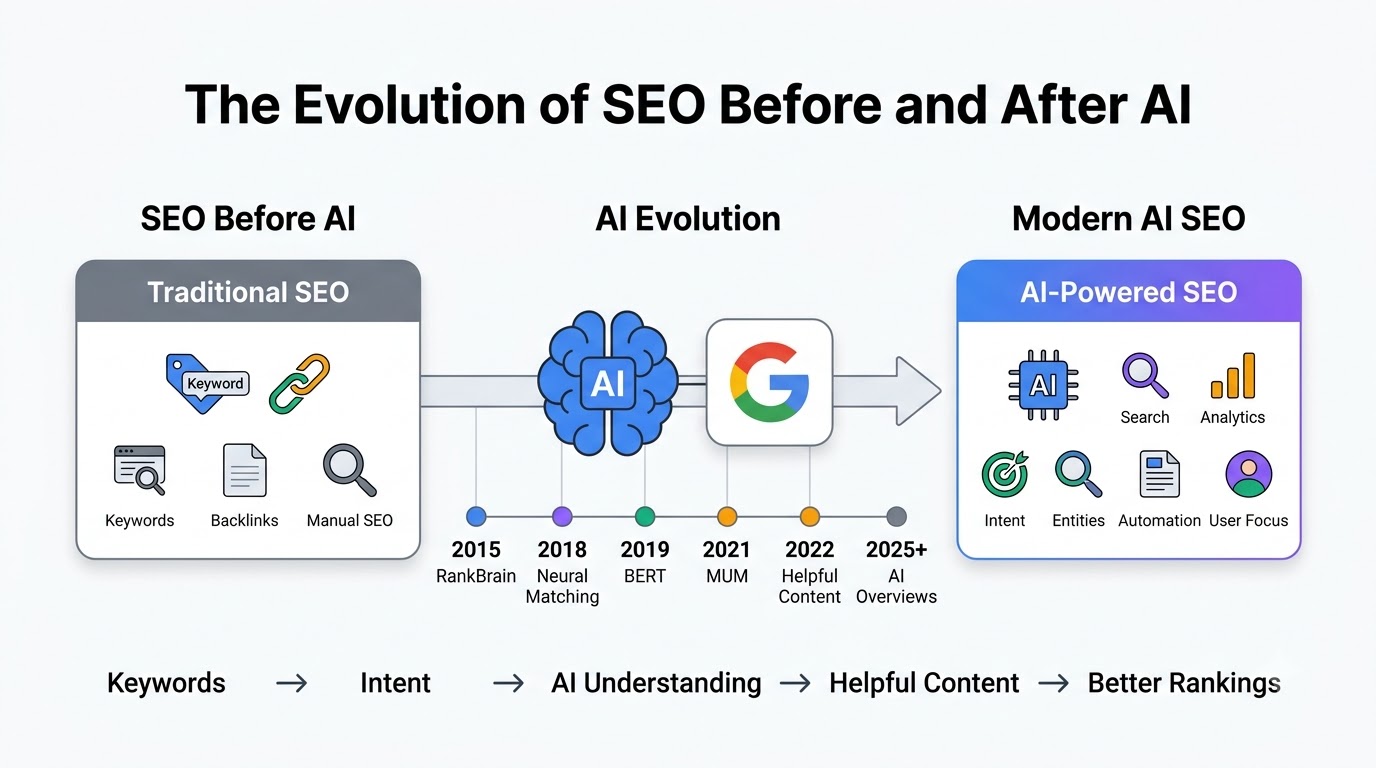
SEO has evolved from simple keyword optimization and manual backlink building to intelligent, data-driven strategies powered by AI. Earlier, marketers relied heavily on experience and trial-and-error. Today, AI analyzes search behavior, predicts trends, automates repetitive tasks, and helps create more relevant, user-focused content at scale.
SEO Before Machine Learning
Early SEO, the late 1990s through roughly 2013, was mostly a keyword-matching game. Stuff the target phrase into the title, headers, and body enough times, build as many backlinks as possible, and rankings would climb almost mechanically. That system got heavily gamed, keyword stuffing, link farms, doorway pages, and Google spent years patching it with algorithm updates that punished manipulation without actually understanding content quality the way a human reader would.
Google’s AI Journey
Google’s shift toward genuine machine learning in search didn’t happen overnight, it built up gradually over more than a decade through a series of specific systems, each one making search results smarter and less dependent on exact keyword matching. Understanding this progression matters because every AI SEO tactic that works today builds directly on top of these earlier shifts rather than replacing them entirely.
RankBrain, introduced in 2015, was Google’s first major machine learning system built directly into the core ranking algorithm, helping interpret ambiguous or never-before-seen search queries by relating them to concepts Google already understood. Neural Matching, rolled out around 2018, went further, connecting queries to pages even when the exact words didn’t match, essentially understanding synonyms and related concepts at a much deeper level than keyword matching ever could. BERT, launched in 2019, brought genuine natural language understanding to search, letting Google grasp the context of prepositions and phrasing that used to trip up keyword-based matching entirely. MUM, announced in 2021, pushed further still, capable of understanding information across text, images, and even multiple languages simultaneously, laying groundwork for the multimodal search experiences showing up now. The Helpful Content System, first introduced in 2022 and folded into core ranking by 2023, specifically targeted content written primarily to rank rather than to genuinely help readers, rewarding original, experience-driven writing over generic filler. And most recently, AI Overviews and AI Mode represent the culmination of all that groundwork, generative systems that don’t just rank pages anymore, they read them, synthesize them, and answer questions directly on the results page.
How User Behavior Has Changed
People search differently now than they did five years ago, and it’s not subtle. Queries inside AI Mode run noticeably longer and more conversational than traditional search terms, often reading like a full sentence or a follow-up question rather than a clipped keyword phrase. Follow-up queries inside AI Mode have risen more than 40% month over month in the US, which tells you people are treating search less like a lookup tool and more like an ongoing conversation with something that remembers context.
From Keyword Matching to Intent Understanding
The whole industry has had to relearn what “ranking for a keyword” even means. It’s not really about matching a phrase anymore, it’s about satisfying the actual reason someone typed that query in the first place. That’s why intent-based content, content that answers the real underlying question rather than just repeating a target phrase, now outperforms keyword-stuffed pages consistently, both in traditional rankings and in whether AI systems choose to cite that page at all.
How AI Is Changing SEO & Search Engines
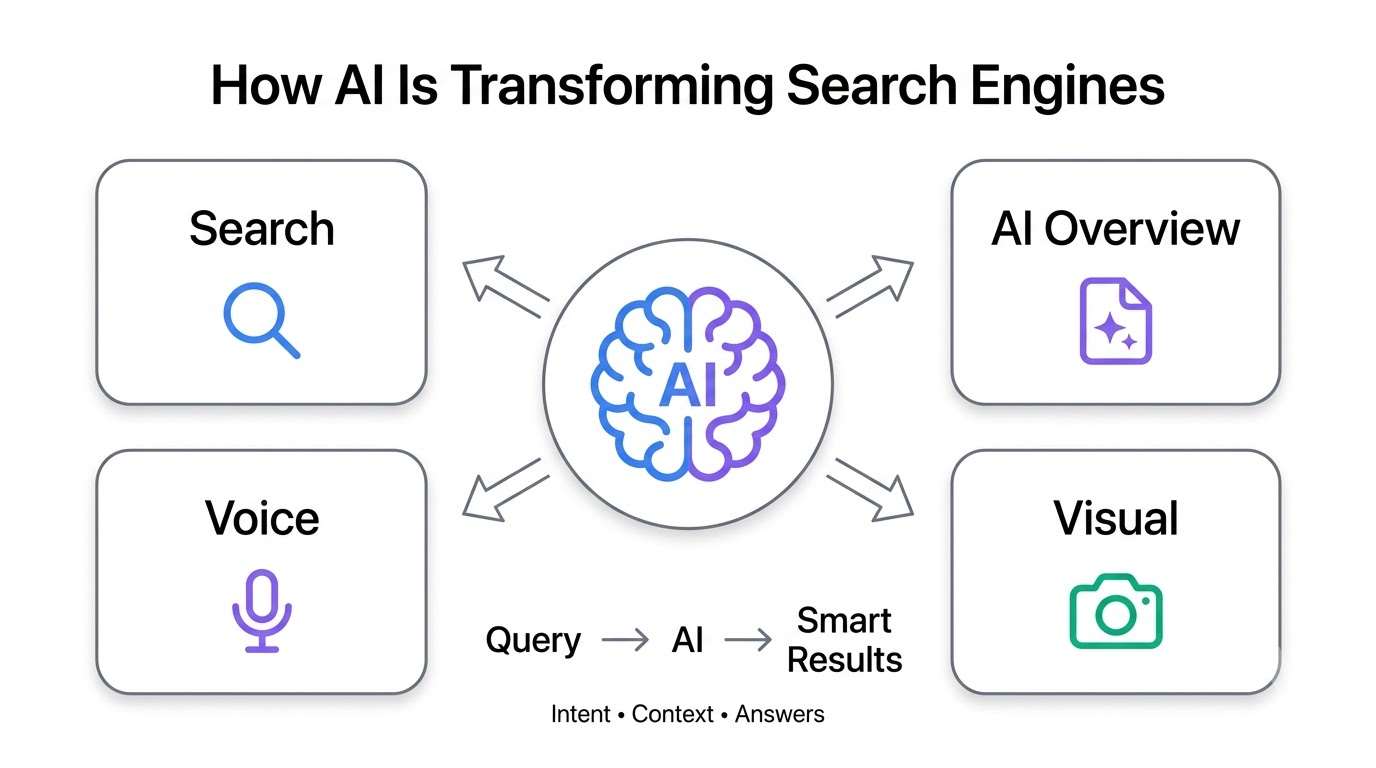
AI has fundamentally changed how search engines understand and rank content. Instead of matching exact keywords, modern algorithms interpret user intent, context, and semantic meaning. Google’s AI systems deliver personalized, conversational, and highly relevant search results, making quality, expertise, and user satisfaction more important than ever.
AI-Powered Search Results
Search results today blend traditional links, AI-generated summaries, knowledge panels, and increasingly conversational answer boxes all on the same page. That blending means a page can technically still rank well while capturing far less actual traffic than it used to, because a growing share of searchers get their answer from the summary sitting above the results and never scroll down to click anything at all.
Search Generative Experience (SGE) and AI Overviews
AI Overviews, the evolution of what Google originally tested as Search Generative Experience, now appear on more than 20% of all Google searches and keep expanding into new query categories. When an AI Overview shows up, organic click-through rates drop by nearly 60%, from roughly 1.76% down to around 0.61% according to Seer Interactive’s tracking, which is why getting cited inside that summary box has become genuinely more valuable than a plain top-three ranking underneath it.
Personalized Search Results
Search results increasingly reflect an individual user’s history, location, device, and even prior conversation context rather than showing every searcher the exact same page. That personalization makes SEO harder to measure cleanly, because two people searching the identical phrase can see meaningfully different results, and it means broad-strokes ranking reports don’t capture the full picture of how visible a brand actually is across different user segments.
Conversational Search
AI Mode turned search into something closer to a conversation than a lookup, letting people ask follow-up questions, refine their original query, and get responses that build on what was already discussed. That conversational format rewards content written in a natural, question-and-answer style, because the AI system needs to pull clear, well-structured answers to slot into an ongoing back-and-forth rather than a single static response.
Voice Search and AI
Voice search, powered by the same underlying language models driving AI Overviews and AI Mode, keeps pushing content toward natural, spoken-language phrasing rather than clipped keyword strings. Someone typing “best pizza NYC” phrases a voice query completely differently, more like “what’s the best pizza place near me right now,” which means content optimized purely around short-tail keyword matching increasingly misses how people are actually asking questions out loud.
Visual Search
Tools like Google Lens let people search using a photo instead of typed words, and AI has made that experience dramatically more accurate at identifying products, plants, landmarks, and text within images. For ecommerce and local businesses specifically, this means image quality, alt text, and structured product data have become genuine ranking factors in a search modality that barely existed as a serious channel a few years ago.
Multimodal Search
Multimodal search means a single query can combine text, images, and even video or audio input, and AI systems process all of it together to generate one coherent response. Someone might snap a photo of a broken appliance part and type “how do I fix this,” and a properly optimized multimodal search experience needs to understand both inputs simultaneously, which is a genuinely different technical challenge than pure text-based search ever was.
Predictive Search
Predictive search uses AI to anticipate what someone is likely to search next based on patterns, seasonality, and individual behavior, surfacing suggestions before a full query even gets typed. This shapes SEO strategy in a quieter way, businesses now need content ready and indexed before demand spikes rather than reacting after a trend has already peaked, because predictive systems increasingly surface content proactively rather than waiting for an exact match query.
The Biggest Ways AI Is Changing SEO
AI influences nearly every aspect of SEO, including keyword research, content creation, technical optimization, link analysis, and performance tracking. It enables marketers to automate repetitive tasks, uncover deeper insights from data, improve decision-making, and develop SEO strategies that adapt quickly to changing search behaviors.
Search Intent Analysis
AI has made intent analysis dramatically more precise, distinguishing between someone who wants to buy right now, someone doing early research, and someone just looking for a quick fact, all from subtle phrasing differences in a query. That’s why content strategy increasingly starts with intent mapping rather than keyword lists, because ranking for the right keyword with the wrong intent match still fails to convert or get cited.
Semantic Search
Semantic search means Google, and the AI models sitting on top of it, understand the meaning and relationships between words rather than just matching exact strings. A page about “affordable running shoes for beginners” can now rank for searches that never use those exact words, because the underlying concept gets recognized and matched contextually, which rewards genuinely comprehensive content over pages built around a narrow list of exact-match phrases.
Entity-Based SEO
Entities, people, places, brands, concepts, that Google recognizes and connects through its Knowledge Graph have become a core part of how AI systems decide what a page is actually about and how trustworthy it is. Building clear entity associations, consistent naming, structured data, and Wikipedia or Wikidata presence where relevant, helps AI systems confidently identify what a business does and cite it correctly rather than guessing based on ambiguous text alone.
Contextual Understanding
AI models read content in context now, understanding how one sentence relates to the next and how a page fits into a broader topic rather than scanning for isolated keyword matches. That’s why disjointed content, sections that don’t logically build on each other, tends to underperform even when every individual paragraph is technically well written, because the whole page needs to read as one coherent, connected explanation.
Natural Language Processing (NLP)
NLP is the underlying technology letting AI systems parse grammar, sentiment, and meaning from human language, and it’s the backbone of nearly every AI SEO advancement covered in this guide. Content written in clear, natural sentences, rather than awkward keyword-stuffed phrasing designed for older algorithms, now performs better precisely because NLP models process natural language far more effectively than mechanically optimized text.
User Experience Signals
Google has leaned increasingly on real user experience data, time on page, bounce behavior, Core Web Vitals, mobile usability, as ranking inputs, and AI systems make it possible to process these signals at a scale and precision that wasn’t feasible before. A technically fast, easy-to-use page increasingly outperforms a slower page with marginally better keyword optimization, because user experience has become a genuine trust signal rather than a secondary consideration.
Content Quality Evaluation
AI-powered quality evaluation looks well past surface-level keyword density now, assessing depth, originality, accuracy, and whether content actually demonstrates real expertise on the topic. That’s why thin, templated content that used to slip through on decent keyword optimization alone increasingly gets filtered out or ignored, both by traditional ranking systems and by the citation models deciding what to quote inside an AI answer.
EEAT in the AI Era
Experience, Expertise, Authoritativeness, and Trust, Google’s EEAT framework, has become genuinely more important in the AI era, not less. Because AI can generate plausible-sounding content instantly, the systems evaluating that content lean harder on signals that are harder to fake: real author credentials, first-hand experience, citations from authoritative sources, and a demonstrable track record, all of which separate genuinely trustworthy content from content that just sounds confident.
Zero-Click Searches
Zero-click searches, queries that get answered directly on the results page without a single click to any website, now account for 68% of all US Google searches, and that number climbs to 93% inside AI Mode specifically. That’s forced marketers to rethink what success even means, because ranking without traffic doesn’t pay the bills, and brand visibility inside an AI answer now matters even when it doesn’t generate an immediate click.
AI Citation-Based Visibility
Because AI Overviews and AI Mode pull from multiple sources to construct a single answer, getting cited inside that answer has become its own distinct visibility goal, separate from traditional ranking. BrightEdge found a 400% increase in citations pulled from pages ranked between positions 21 and 30, meaning a page doesn’t need to be first to get quoted, it needs to be genuinely clear, well-structured, and directly answer the exact question being asked.
AI and Keyword Research
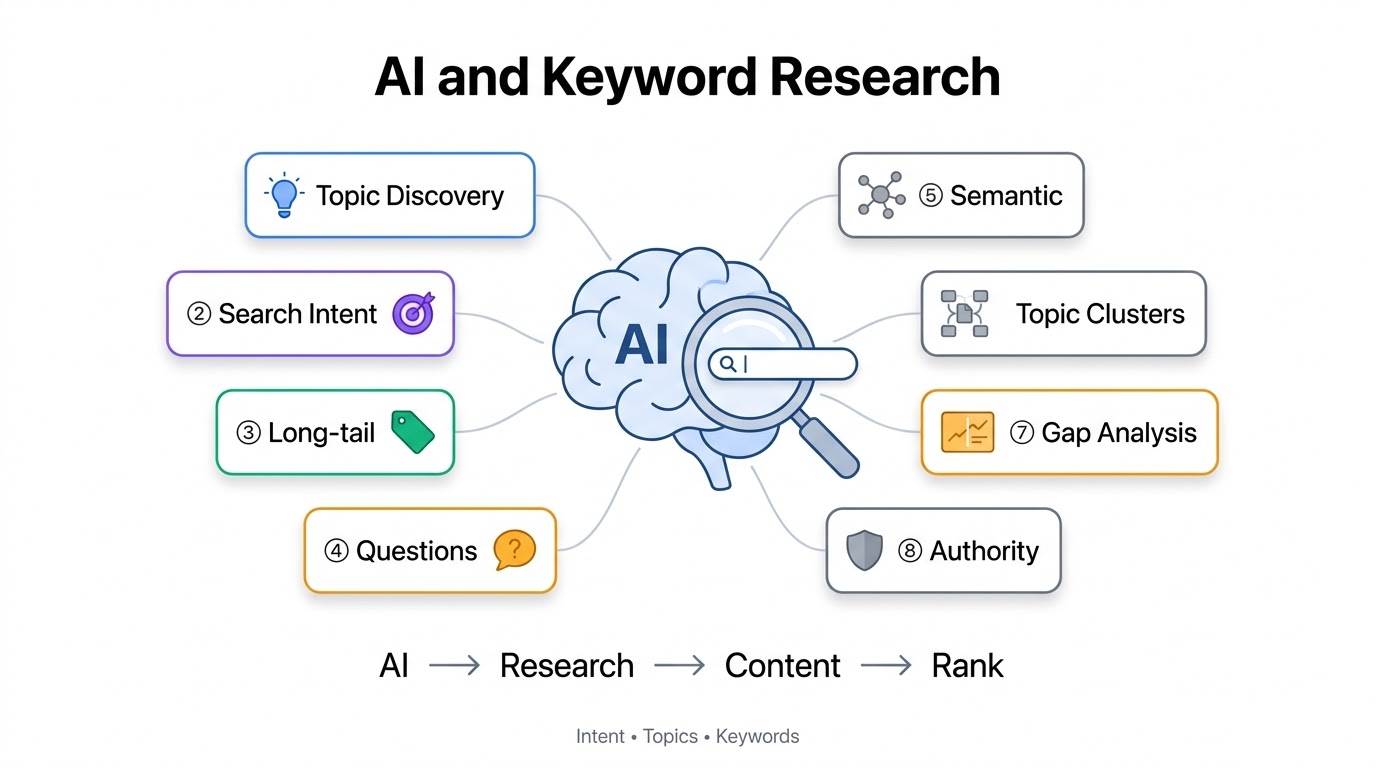
AI-powered keyword research goes beyond search volume by identifying user intent, semantic relationships, trending topics, and long-tail opportunities. Modern AI tools help marketers discover content gaps, cluster related keywords, predict future demand, and build comprehensive topical authority rather than targeting isolated search terms.
Why Traditional Keyword Research Is Changing
Keyword research used to mean finding a list of high-volume, low-competition phrases and building pages around each one individually. That approach is losing ground fast, because AI systems now understand topics holistically rather than matching isolated phrases, which means comprehensive topic coverage tends to outperform a scattered collection of narrowly optimized single-keyword pages built the old way.
AI for Topic Discovery
AI tools can now analyze massive datasets of search queries, forum discussions, and social conversations to surface topics a business hasn’t even considered yet, patterns a human researcher would take weeks to spot manually. That speed matters, because it lets content teams identify emerging demand early, before competitors catch on and before a topic becomes so saturated that ranking for it gets genuinely difficult.
Finding Search Intent
Modern keyword tools increasingly classify search intent automatically, informational, navigational, commercial, or transactional, using AI models trained on how people actually behave after searching a given phrase. That classification helps content teams avoid the classic mistake of building a sales-focused landing page for a keyword where searchers are actually still in the early research phase, which almost always tanks both conversion rates and dwell time.
Long-Tail Keyword Generation
AI dramatically speeds up long-tail keyword discovery, generating hundreds of natural-language variations and question-based phrasings that a human researcher would take hours to brainstorm manually. Because AI Mode queries run longer and more conversational than traditional search terms, having genuine long-tail coverage matters more now than it did when most searches were two or three words long.
Question-Based Keywords
Since so much of AI-driven search now happens through direct questions, identifying and targeting question-based keywords specifically, “how does,” “why is,” “what’s the difference between,” has become a core research task. Structuring content to directly answer these questions in clear, quotable sentences increases the odds of getting pulled into an AI Overview or AI Mode response verbatim.
Semantic Keyword Clustering
Rather than treating every keyword as a separate target, AI tools now group semantically related terms into clusters representing a single underlying topic, letting content teams build one comprehensive page instead of several thin, competing ones. This clustering approach aligns directly with how semantic search actually evaluates content, rewarding depth and topical completeness over a scattered collection of narrowly focused pages.
Topical Authority Mapping
Topical authority mapping uses AI to identify every subtopic and related question a genuinely authoritative resource on a subject would need to cover, then compares that map against what a website currently has published. Gaps identified this way become a prioritized content roadmap, and closing those gaps systematically is one of the clearest ways to build the kind of comprehensive coverage AI citation systems increasingly favor.
Keyword Gap Analysis Using AI
AI-powered gap analysis compares a website’s existing content against competitors and against what’s actually ranking or getting cited for a given topic, surfacing exactly what’s missing far faster than manual competitive research ever could. This kind of analysis has become genuinely essential for competitive industries, where the difference between getting cited in an AI answer and getting ignored often comes down to covering one specific angle a competitor already addressed.
Building Topic Clusters
Topic clusters, a central pillar page supported by multiple interlinked subtopic pages, have become one of the most effective content structures for both traditional SEO and AI citation visibility. AI tools help identify the right cluster structure automatically, and internal linking between cluster pages reinforces topical relevance signals that both traditional algorithms and generative AI systems use to judge overall subject authority.
AI Content Creation for SEO
AI assists marketers in generating outlines, drafting articles, optimizing headings, improving readability, and creating metadata. While AI accelerates content production, successful SEO still requires human expertise, original insights, fact-checking, and brand-specific perspectives to produce trustworthy, high-quality content that ranks consistently.
How AI Generates Content
AI content tools work by predicting the most statistically likely next word or phrase based on massive training datasets, essentially pattern-matching language at a scale no human writer could replicate manually. That’s genuinely useful for speed and first drafts, but it also means AI-generated content can sound confidently correct while actually being subtly wrong, which is exactly why human review remains non-negotiable in any serious content workflow.
Best AI Writing Tools
ChatGPT, Claude, and Gemini have become the most widely used general-purpose AI writing tools for SEO content, each with slightly different strengths, Claude tends to produce more natural, less robotic prose, while tools like Surfer SEO and Frase combine AI generation directly with SEO scoring and competitor analysis built into the same workflow. Choosing the right tool usually comes down to whether a team needs raw drafting speed or integrated optimization guidance alongside the writing itself.
AI Content vs Human Content
AI content tends to excel at structure, comprehensiveness, and speed, pulling together a well-organized draft covering the obvious angles on a topic almost instantly. Human content still wins decisively on genuine first-hand experience, opinion, nuance, and the kind of specific, verifiable detail that signals real expertise rather than pattern-matched generalization, which is exactly why the strongest content workflows blend both rather than picking one exclusively.
Where AI Performs Well
AI genuinely excels at first drafts, outlining, summarizing research, generating variations of headlines or meta descriptions, and handling repetitive structural tasks like formatting or basic fact compilation. These are places where speed matters more than deep originality, and AI can cut hours of work down to minutes without meaningfully sacrificing quality, freeing up human time for the parts of content creation that actually require judgment.
Where Human Expertise Is Essential
Human expertise remains essential anywhere genuine experience, professional judgment, or original research drives the value of the content, product reviews based on actually using something, expert commentary grounded in real credentials, or reporting based on primary sources AI simply doesn’t have access to. Skipping human involvement in these areas tends to produce exactly the generic, unverifiable content that both readers and AI citation systems increasingly distrust.
Google’s View on AI-Generated Content
Google has stated repeatedly that it doesn’t penalize content simply because AI was involved in producing it, its systems evaluate quality, helpfulness, and originality regardless of the tool used to write it. That said, Google has been explicit that content created primarily to manipulate rankings, regardless of whether a human or an AI wrote it, still violates its spam policies and remains subject to the same enforcement either way.
Avoiding Low-Quality AI Content
Low-quality AI content usually shows up in specific, recognizable patterns, generic phrasing that could apply to any topic, repetitive sentence structures, claims without specific supporting detail, and a total absence of genuine opinion or experience. Avoiding these pitfalls means actively editing AI drafts to add specifics, real examples, and a clear point of view rather than publishing the first output an AI tool produces without meaningful revision.
Building Original, Helpful Content
Original, helpful content answers the actual question someone has, backed by specific detail, real examples, and where relevant, genuine first-hand experience that couldn’t have been generated by simply summarizing existing search results. That originality is exactly what separates content that earns trust and citations from content that just occupies space, and it’s become the clearest differentiator between websites that thrive under AI search and ones that quietly lose visibility.
AI Content Editing Workflow
A solid AI content editing workflow treats the AI draft as a starting point, not a finished product: fact-check every claim, add specific examples and data the AI couldn’t have known, adjust tone to match genuine brand voice, and cut generic filler phrases that add length without adding value. Teams that skip this editing step consistently produce content that reads as hollow, and both readers and AI citation systems have gotten noticeably better at spotting that hollowness.
AI for On-Page SEO
AI improves on-page optimization by analyzing content quality, keyword placement, heading structure, internal linking, image optimization, schema opportunities, and readability. It provides actionable recommendations that enhance relevance, user experience, and search engine understanding while ensuring pages align with modern ranking expectations.
Optimizing Titles
AI tools can now generate and test dozens of title variations almost instantly, predicting which phrasing is most likely to earn clicks based on patterns across millions of existing search results. That speed matters for scale, but the strongest titles still combine AI-generated options with human judgment about actual brand voice and genuine relevance, since AI-optimized titles can drift toward generic clickbait phrasing if left completely unchecked.
Writing Better Meta Descriptions
AI-generated meta descriptions can pull directly from page content to summarize it accurately within character limits, saving real time across large websites with thousands of pages needing unique descriptions. The catch is that AI-written descriptions sometimes miss the specific selling point that would actually earn a click, which is why reviewing and adjusting AI output for genuine persuasiveness still matters more than accepting the first generated version.
Header Structure Optimization
AI tools can analyze how well a page’s header structure, H1 through H4, matches the logical flow a reader or an AI summarization system needs to follow content easily. Clear, descriptive headers that genuinely reflect the content underneath them, rather than vague or overly clever phrasing, help AI systems parse and cite specific sections accurately, which matters more now that AI Overviews often pull from a single specific section rather than an entire page.
Internal Linking Suggestions
AI-powered internal linking tools scan a website’s entire content library and suggest contextually relevant links a human editor might easily miss, especially across large sites with thousands of pages. Smart internal linking reinforces topical authority signals and helps both search crawlers and AI citation systems understand how pages relate to each other, which strengthens the case for a whole topic cluster rather than just individual isolated pages.
Image SEO
AI has made image optimization significantly more automated, compressing file sizes without visible quality loss, suggesting descriptive filenames, and identifying which images are actually contributing to page load speed problems. As visual search grows through tools like Google Lens, properly optimized images have become a genuine traffic source in their own right rather than just a supporting element for text content.
Alt Text Generation
AI can generate accurate, descriptive alt text automatically by analyzing image content directly, which helps both accessibility and image search visibility at a scale manual writing simply can’t match across large catalogs. The best practice still involves reviewing AI-generated alt text for accuracy and specificity, since generic descriptions like “product photo” provide little value even when they’re technically present on every image.
Schema Markup Assistance
AI tools can now generate structured data markup automatically based on page content, correctly identifying whether a page needs Product, FAQ, Article, or Review schema without requiring a developer to hand-code each implementation. This matters more under AI search specifically, because structured data helps generative systems understand exactly what a page contains and increases the odds of accurate, specific citation rather than a vague summary.
Content Freshness Recommendations
AI monitoring tools can flag which pages are losing rankings or traffic due to outdated information, comparing content against newer competing pages and current search trends automatically. Since AI citation systems tend to favor recently updated, accurate information, especially for fast-moving topics, having a systematic freshness review process has become a genuine ranking factor rather than just good housekeeping.
Readability Improvements
AI readability tools analyze sentence length, structure, and clarity, flagging sections that are needlessly complex or hard to follow for the average reader. Since both user experience signals and AI summarization systems favor clear, well-structured writing, improving readability isn’t just about accessibility anymore, it’s directly tied to whether content gets accurately understood and cited by the systems generating AI-powered search answers.
AI for Technical SEO
Technical SEO has become more efficient with AI-driven site audits, automated crawl analysis, log file evaluation, structured data recommendations, and issue detection. AI identifies indexing problems, broken links, duplicate content, Core Web Vitals issues, and website performance bottlenecks much faster than manual analysis.
Crawl Analysis
AI-enhanced crawl analysis tools process crawl data at a scale and speed manual review simply can’t match, flagging patterns across thousands or millions of pages, orphaned content, crawl budget waste, unexpected redirect chains, that would take a human analyst days to spot manually. This matters more on large sites, where technical issues can quietly suppress visibility across entire sections without anyone noticing until traffic has already dropped.
Indexability Audits
AI tools can automatically flag pages that should be indexed but aren’t, or pages that are indexed but shouldn’t be, cross-referencing sitemap data, robots directives, and canonical tags to catch conflicts a manual audit might miss. Getting indexability right remains foundational, because none of the AI citation or ranking improvements covered elsewhere in this guide matter at all if a page isn’t even indexed in the first place.
Site Architecture Optimization
AI can model how a site’s internal structure affects crawl efficiency and topical clustering, suggesting reorganization that groups related content more logically and reduces the number of clicks needed to reach important pages. Clean, logical site architecture helps both traditional crawlers and AI systems understand how content relates to each other, which directly supports the kind of topical authority signals that improve citation likelihood.
Core Web Vitals Monitoring
AI-powered monitoring tools track Core Web Vitals, loading speed, interactivity, and visual stability, continuously and flag performance regressions automatically rather than waiting for a scheduled manual audit. Since page experience remains a confirmed ranking factor and slow pages tend to get filtered out of both traditional results and AI citation consideration, continuous monitoring has become far more valuable than periodic manual checks.
Log File Analysis
AI tools can parse raw server log files to reveal exactly how search engine bots, including newer AI crawlers, actually behave on a website, which pages get crawled frequently, which get ignored, and where crawl budget is being wasted on low-value pages. This level of analysis used to require serious technical expertise, and AI has made it accessible to marketing teams without a dedicated technical SEO specialist on staff.
Duplicate Content Detection
AI-powered duplicate content detection can identify near-duplicate pages, not just exact copies, comparing semantic similarity across a website’s entire content library to catch cannibalization issues that keyword-based duplicate checkers used to miss entirely. Resolving these issues matters because duplicate or overlapping content confuses both traditional ranking algorithms and AI citation systems about which page should actually be considered authoritative.
Redirect Analysis
AI tools can map entire redirect chains automatically, flagging redirect loops, unnecessary multi-hop chains, and broken redirects that quietly waste crawl budget and slow down page load times. Cleaning up redirect chains has become an easy, high-value technical fix that AI tools now surface proactively instead of requiring a manual site-wide crawl every time an audit gets scheduled.
Broken Link Detection
AI-enhanced broken link tools scan both internal and external links continuously, flagging dead links immediately rather than waiting for a scheduled crawl to catch them weeks later. Broken links hurt user experience and waste crawl budget, and fixing them quickly has become simpler now that AI tools can prioritize which broken links actually matter most based on traffic and authority rather than flagging everything with equal urgency.
XML Sitemap Optimization
AI tools can automatically generate and maintain XML sitemaps that update in real time as content changes, ensuring search engines always have an accurate map of a site’s most important pages without manual intervention. This matters especially for large or frequently updated sites, where a stale sitemap can genuinely slow down how quickly new or updated content gets discovered and considered for indexing.
Robots.txt Recommendations
AI tools can analyze a robots.txt file against actual site structure and traffic patterns to flag misconfigurations, like accidentally blocking important pages or leaving low-value pages open to unlimited crawling that wastes budget. Getting robots.txt right has taken on new relevance too, since some AI crawlers respect these directives differently than traditional search bots, making careful configuration more important than it used to be.
AI in Link Building
AI streamlines link building by identifying authoritative websites, analyzing backlink profiles, finding outreach opportunities, and evaluating link quality. It helps prioritize high-value prospects, detect toxic backlinks, personalize outreach campaigns, and build stronger, more relevant link acquisition strategies with greater efficiency.
Prospect Identification
AI tools can scan massive datasets of websites to identify genuinely relevant link prospects based on topical overlap, domain authority, and existing linking patterns, far faster than manual prospecting through search operators ever could. That speed matters because link building has always been the most time-intensive part of SEO, and AI-assisted prospecting frees up time for the actual relationship-building work that determines whether outreach succeeds.
Competitor Backlink Analysis
AI-powered backlink analysis tools can identify not just where competitors are getting links from, but patterns in the types of content, angles, or data that earned those links in the first place. That deeper pattern recognition helps teams replicate the underlying strategy behind a competitor’s successful link acquisition rather than just chasing the same individual sites one by one without understanding why those links worked.
Personalized Outreach
AI can help draft genuinely personalized outreach emails at scale, referencing specific details about a prospect’s recent content or audience rather than sending an obviously templated pitch. That said, outreach that reads as too polished or too obviously AI-generated tends to get ignored just as fast as generic spam, so the strongest teams use AI to speed up research and drafting while keeping the final message genuinely human in tone.
Digital PR Opportunities
AI tools can monitor journalist requests, trending topics, and news cycles in real time, flagging digital PR opportunities where a business could contribute expert commentary or original data before a story goes fully mainstream. Speed matters enormously in digital PR, and AI’s ability to surface relevant opportunities faster than manual monitoring has become a genuine competitive advantage for teams building authority through earned media coverage.
Link Relevance Analysis
AI can assess how topically relevant a potential link source actually is, going beyond simple domain authority scores to evaluate whether the linking page’s actual content genuinely relates to the target page’s subject matter. This matters because search engines have gotten better at discounting links from irrelevant sources, so prioritizing genuinely relevant prospects over simply high-authority ones tends to produce more durable ranking benefit.
Toxic Link Detection
AI-powered toxic link detection can identify spammy or manipulative backlinks pointing at a website far more accurately than older rule-based tools, reducing false positives that used to flag perfectly legitimate links as risky. Catching genuinely harmful links early, before they trigger a manual action or algorithmic penalty, has become significantly easier with AI models trained on patterns across millions of known spam link networks.
Link Monitoring
AI tools can track backlink profiles continuously, alerting teams immediately when a valuable link gets removed, when a new toxic link appears, or when a competitor suddenly earns a significant new placement worth investigating. That continuous monitoring replaces what used to be periodic manual backlink audits, catching problems and opportunities in near real time rather than discovering them weeks or months after the fact.
AI and Local SEO
AI enhances local SEO by optimizing Google Business Profiles, analyzing customer reviews, improving local keyword targeting, and identifying location-based search trends. Businesses can automate reputation management, maintain consistent business information, and create localized content that attracts nearby customers more effectively.
Google Business Profile Optimization
AI tools can now analyze a Google Business Profile against top-performing local competitors, flagging missing categories, incomplete attributes, or underused features like posts and Q&A sections that could be improved. Since local search results increasingly pull from these profiles directly into AI-generated local answers, keeping this information complete and accurate has become more consequential than it used to be.
Review Analysis
AI-powered sentiment analysis can process hundreds or thousands of customer reviews to identify recurring themes, common complaints, and genuine strengths a business might not have noticed from reading reviews individually. This analysis helps businesses respond strategically to patterns rather than reacting to individual reviews in isolation, and it also surfaces language customers actually use, which is genuinely useful for aligning website content with real customer vocabulary.
Local Keyword Discovery
AI tools can identify hyper-local search patterns, neighborhood names, nearby landmarks, and local slang terms, that generic keyword research tools often miss entirely. Since local intent queries increasingly get answered through AI-generated local packs and map results, capturing this genuinely local language in content and business listings has become a meaningful differentiator between businesses that show up and ones that don’t.
AI for Local Content
AI can help generate location-specific content at scale for businesses operating across multiple cities or regions, while still requiring human review to ensure each location page reflects genuinely local, accurate detail rather than a thinly reskinned template. Google has gotten noticeably better at detecting and discounting these templated multi-location pages, which makes genuine local specificity a real ranking differentiator rather than a nice-to-have.
Local Competitor Analysis
AI tools can benchmark a local business against nearby competitors across review volume, response rate, posting frequency, and profile completeness, surfacing exactly where the competitive gaps sit. This kind of analysis used to require manually checking each competitor’s profile one at a time, and AI has made it possible to monitor an entire local competitive set continuously instead of through occasional manual spot checks.
Location-Based Search Trends
AI-powered trend analysis can flag seasonal or emerging search patterns specific to a geographic area, letting local businesses prepare content and promotions ahead of demand spikes rather than reacting after the fact. This matters more now that predictive search increasingly surfaces content proactively, meaning businesses that anticipate local trends early tend to capture visibility before competitors even notice the pattern forming.
AI for Ecommerce SEO
Ecommerce businesses use AI to optimize product descriptions, category pages, internal linking, product recommendations, structured data, and search intent targeting. AI also identifies seasonal demand, improves product discoverability, and helps large online stores scale SEO efforts across thousands of product pages.
Product Description Generation
AI can generate product descriptions at genuine scale for catalogs containing thousands of SKUs, which used to be a massive manual bottleneck for ecommerce teams. The real skill here lies in prompting AI with genuinely specific product attributes and use cases rather than accepting generic output, because templated, interchangeable descriptions across similar products tend to get filtered out by both search algorithms and increasingly skeptical shoppers.
Category Page Optimization
AI tools can analyze how category pages perform against search intent, suggesting improvements to filtering options, descriptive copy, and internal linking between related categories and products. Since retail keywords triggering AI Overviews surged significantly in recent years, well-optimized category pages that clearly explain what’s available and why have become genuinely more important for capturing both traditional traffic and AI citation visibility.
Product Schema
AI-assisted structured data implementation ensures product pages carry accurate schema markup, price, availability, ratings, that both traditional search results and AI shopping experiences can pull directly into rich results or generated answers. Given that purely transactional searches remain relatively protected from the zero-click trend compared to informational queries, getting product schema right directly supports one of the few search categories still reliably sending qualified traffic.
AI-Powered Product Recommendations
AI recommendation engines analyze browsing and purchase behavior to surface genuinely relevant related products, which keeps users engaged longer and increases average order value, both of which indirectly support SEO through improved engagement signals. These recommendations also help search engines understand product relationships and categorization more clearly, reinforcing the kind of structured, logical site architecture that benefits crawlability and topical authority overall.
Image Optimization
For ecommerce specifically, AI-powered image optimization handles compression, alt text, and even automated background removal or resizing across massive product catalogs, work that would take a human team weeks to complete manually. As visual search keeps growing, particularly for products people want to identify from a photo, having properly optimized product images has become a genuine acquisition channel rather than just a supporting visual element on the page.
Faceted Navigation Improvements
AI tools can analyze how faceted navigation, filters for size, color, price range, and so on, affects crawl efficiency and duplicate content risk, since poorly configured filters can generate thousands of near-identical indexable URLs. Fixing these configurations with AI-assisted analysis prevents crawl budget waste and duplicate content penalties that have historically plagued large ecommerce sites relying heavily on filterable product listings.
AI for Enterprise SEO
Enterprise SEO teams leverage AI to manage massive websites with thousands of pages. AI automates technical audits, content optimization, reporting, keyword clustering, and workflow management, enabling organizations to maintain consistency, improve efficiency, and execute complex SEO strategies across multiple business units.
Managing Large Websites
Enterprise sites with tens of thousands or millions of pages simply can’t be managed through manual review alone, and AI tools have become essential for processing that scale, flagging issues, prioritizing fixes, and tracking performance across a website far too large for any single team to review page by page. That scale problem is exactly where AI delivers the clearest, most measurable value in the entire SEO toolkit.
Automated Content Audits
AI-powered content audits can evaluate thousands of pages simultaneously against quality, freshness, and performance criteria, flagging which pages need updates, consolidation, or removal entirely. This kind of audit used to take enterprise teams months to complete manually, and AI has compressed that timeline down to days while surfacing patterns a manual review would likely miss across such a large content library.
Scalable Internal Linking
AI tools can suggest and even implement internal linking improvements across massive websites automatically, identifying contextually relevant connections between pages that would take a human editor impossibly long to map manually at enterprise scale. This scalability matters because internal linking remains one of the strongest signals for both topical authority and crawl efficiency, and doing it well manually simply isn’t feasible past a certain site size.
Predictive SEO Analytics
AI-powered predictive analytics can forecast how specific content or technical changes are likely to affect traffic and rankings before they’re even implemented, based on patterns across historical data and current search trends. This predictive capability lets enterprise teams prioritize resources toward changes most likely to move the needle rather than spreading effort thin across every possible optimization simultaneously.
SEO Workflow Automation
AI has made it possible to automate large chunks of the SEO workflow end to end, research, drafting, optimization checks, and reporting, connected through workflow automation tools that trigger each step based on the previous one’s output. This automation frees enterprise teams from repetitive manual work and lets human strategists focus on the judgment calls AI genuinely can’t make reliably on its own.
AI Dashboards
AI-powered dashboards now pull data from multiple sources, rankings, traffic, AI citation tracking, technical health, into a single view that highlights what actually needs attention rather than just displaying raw numbers. For enterprise teams managing dozens of stakeholders and business units, having one AI-curated view of priorities has become genuinely more useful than the sprawling multi-tab reports SEO teams used to rely on.
How AI Changes Google’s Ranking Signals
Google increasingly uses AI to evaluate content based on relevance, helpfulness, expertise, authority, trustworthiness, and user satisfaction. Instead of rewarding keyword density alone, AI-powered algorithms analyze context, topical depth, engagement signals, and content quality to determine which pages deserve higher rankings.
Content Quality
AI has made content quality evaluation genuinely more sophisticated, assessing depth, accuracy, and originality rather than relying on surface signals like word count or keyword density alone. That shift rewards content that demonstrates real understanding of a topic and punishes content that just sounds plausible without actually saying anything substantive, which has raised the practical bar for what counts as genuinely competitive content.
Search Intent Satisfaction
Ranking signals increasingly weigh whether a page actually satisfies the intent behind a search, not just whether it contains the right words. AI systems can now measure this more directly through behavioral signals, whether users immediately bounce back to search after clicking, whether they engage deeply, which makes genuinely helpful, intent-matched content more valuable than technically optimized but shallow pages.
User Experience
Page experience factors, loading speed, mobile usability, intrusive interstitials, have become more heavily weighted as AI makes it possible to measure and compare these signals at scale across the entire web. A technically excellent page that loads instantly and works flawlessly on mobile increasingly outperforms a slower page with marginally stronger keyword optimization, because experience has become a genuine trust and quality signal in its own right.
Topical Authority
Google increasingly evaluates whether a website demonstrates comprehensive, consistent expertise across an entire subject area rather than just ranking individual pages in isolation. AI makes it possible to assess this kind of site-wide topical depth at scale, which is why building out comprehensive topic clusters has become more valuable than publishing isolated pages targeting individual keywords without any surrounding context.
Brand Authority
Brand signals, mentions across the web, consistent entity recognition, and genuine reputation, have become a stronger ranking factor as AI systems get better at recognizing and cross-referencing brand mentions even when they don’t include a direct link. This matters because it means digital PR and brand-building work now directly supports SEO performance in ways that used to be considered separate, disconnected marketing functions.
Expertise Signals
AI evaluation systems increasingly look for concrete expertise markers, author bios with real credentials, citations from recognized authorities, and evidence of genuine first-hand experience with a topic. These signals matter more now precisely because AI can generate plausible-sounding content instantly, so search systems lean harder on markers that are genuinely difficult to fake convincingly at scale.
Freshness
Content freshness has become a more nuanced signal under AI evaluation, distinguishing between topics that genuinely require frequent updates, breaking news, pricing, fast-moving industries, and evergreen topics where age matters far less than accuracy. This nuance means blanket “update everything constantly” advice misses the point, freshness only matters as a ranking signal where the underlying topic actually changes meaningfully over time.
Engagement Metrics
AI makes it possible to analyze engagement metrics, time on page, scroll depth, return visits, with far more precision than before, feeding these signals back into ranking decisions more directly. Content that genuinely holds attention and brings people back tends to outperform content that earns a click but immediately loses the reader, which reinforces the broader shift toward rewarding substance over surface-level optimization tricks.
AI SEO Tools Every Marketer Should Know
Modern marketers use AI-powered tools for keyword research, content optimization, technical audits, competitor analysis, rank tracking, and workflow automation. These platforms reduce manual effort, provide predictive insights, and help teams make faster, data-driven SEO decisions while improving overall campaign performance.
ChatGPT
ChatGPT remains one of the most widely used general-purpose AI tools for SEO work, handling everything from content drafting and brainstorming to competitor research summaries and quick technical explanations. Its strength lies in flexibility and speed, though output still needs human review for accuracy and genuine originality before publishing anything drafted through it directly.
Gemini
Google’s Gemini model powers AI Overviews and AI Mode directly, which makes understanding how it interprets and summarizes content genuinely useful for SEO professionals trying to predict what gets cited. Gemini’s growing referral share in AI search traffic, expanding from roughly 5.7% to 21.5% within a year, also makes it worth monitoring as a distinct traffic source in its own right, not just a background technology.
Claude
Claude has become a favorite among content teams specifically for its more natural, less formulaic writing style compared to some competing models, producing drafts that require less heavy editing to sound genuinely human. It’s particularly useful for longer-form content and nuanced explanations where tone and flow matter as much as raw information accuracy.
Perplexity
Perplexity operates as an AI-powered answer engine in its own right, citing sources directly within its responses, which makes it a genuinely useful tool both for research and for understanding how a separate AI search platform selects and displays citations. Tracking visibility inside Perplexity specifically has become its own emerging discipline as AI search fragments across multiple platforms beyond just Google.
Semrush AI Toolkit
Semrush’s AI-powered features combine keyword research, content optimization scoring, and competitive analysis into one integrated toolkit, cutting down the time needed to move from research to a genuinely optimized draft. Its AI-driven content templates specifically help teams align new content against what’s already performing well for a given topic before writing even begins.
Ahrefs AI Features
Ahrefs has layered AI-powered insights on top of its backlink and keyword database, surfacing content gaps, ranking opportunities, and competitor patterns that would take significantly longer to identify through manual analysis of the raw data alone. Its AI content grading features also help teams benchmark new drafts against what’s currently ranking well for a target topic.
Surfer SEO
Surfer SEO combines AI content generation directly with real-time SEO scoring, analyzing top-ranking pages for a target keyword and suggesting specific structural and content improvements as a draft gets written. This tight integration between writing and optimization has made it a genuinely popular choice for content teams trying to hit strong on-page optimization without needing separate audit tools afterward.
Clearscope
Clearscope focuses specifically on content optimization, analyzing top-performing pages for a target term and generating a report of related terms, questions, and topics a genuinely comprehensive piece should cover. It’s less about generating content directly and more about ensuring whatever gets written, whether by a human or an AI tool, actually covers a topic thoroughly enough to compete.
Frase
Frase combines AI-assisted content briefs, drafting, and optimization scoring in one workflow, specifically built to help content teams move from a target keyword to a genuinely competitive draft quickly. Its content brief generation feature has become particularly popular for teams managing outsourced or freelance writers who need clear, AI-generated guidelines before starting a piece.
MarketMuse
MarketMuse leans heavily into topical authority analysis, using AI to map out an entire content strategy based on where a site has genuine authority gaps compared to competitors across a whole subject area. It’s particularly useful for larger content operations planning months of content in advance rather than optimizing individual pieces one at a time.
Screaming Frog AI Integrations
Screaming Frog, long a staple technical SEO crawling tool, has added AI-powered features that help interpret crawl data more intelligently, flagging patterns and prioritizing issues rather than just dumping raw technical data for a human to sort through manually. This shift reflects a broader trend across the whole toolset landscape, technical tools getting smarter about surfacing what actually matters instead of just collecting more data.
AI SEO Workflow: Step-by-Step Process
An effective AI SEO workflow begins with keyword research, followed by search intent analysis, content planning, AI-assisted drafting, human editing, on-page optimization, technical auditing, publishing, performance monitoring, and continuous optimization. Combining AI efficiency with human expertise delivers the strongest long-term SEO results.
Market Research
Every genuinely effective AI SEO workflow starts with market research, using AI tools to analyze the broader competitive landscape, industry trends, and audience behavior before committing to any specific content direction. Skipping this step and jumping straight into keyword lists tends to produce content that’s technically optimized but strategically misaligned with what the market actually needs right now.
Competitor Research
AI-assisted competitor research goes beyond simply checking who ranks first, analyzing content depth, structure, and citation patterns across the entire competitive set to identify genuine gaps worth pursuing. This research directly feeds into prioritization, helping teams avoid competing head-on for topics already thoroughly covered while identifying angles competitors have genuinely missed.
Topic Selection
Topic selection should combine AI-surfaced opportunity data with genuine business judgment about what a company can credibly speak to with real expertise or experience. AI can identify what’s trending or underserved, but human strategists still need to filter that data against what actually aligns with a brand’s genuine authority, since chasing every AI-flagged opportunity without that filter produces scattered, unfocused content.
Keyword Research
With topic direction set, AI-powered keyword research fills in the specific terms, questions, and semantic variations a genuinely comprehensive piece needs to cover, organized into clusters rather than a flat, disconnected list. This research becomes the actual content brief, guiding structure and coverage rather than existing purely as a reference document nobody actually consults while writing.
Content Brief Creation
AI tools can compile all of this research, competitor analysis, keyword clusters, and topic gaps, into a structured content brief automatically, saving hours of manual brief-writing for content teams working with in-house or freelance writers. A genuinely good AI-generated brief still benefits from human review to ensure it reflects the specific angle and expertise the final piece needs to actually deliver.
Draft Generation
Draft generation is where AI writing tools do the heaviest lifting, producing a structured first draft based on the brief that would otherwise take a human writer significantly longer to research and outline from scratch. This draft should always be treated as a genuine starting point, not a finished product, since AI-generated first drafts consistently need real editing before they’re ready to represent a brand’s actual voice and expertise.
Human Editing
Human editing is the single most important step in the entire workflow, adding specific examples, correcting inaccuracies, injecting genuine opinion and experience, and cutting the generic filler phrasing AI models tend to default toward. Skipping or rushing this step is exactly where most AI content workflows fail, producing published pieces that read as hollow even when the underlying research was genuinely solid.
SEO Optimization
Once editing is complete, AI-powered optimization tools check the final draft against on-page best practices, header structure, internal linking opportunities, meta descriptions, schema requirements, flagging anything missing before publication. This step catches technical gaps a writer focused purely on content quality might easily overlook, ensuring the piece is genuinely ready to compete once it goes live.
Publishing
Publishing itself has become increasingly automated too, with AI-assisted content management tools handling formatting, image insertion, and even scheduling based on predicted optimal timing for a given topic or audience. This automation reduces the manual overhead of getting content live, letting teams focus their remaining time on strategy and quality rather than repetitive publishing mechanics.
Performance Monitoring
After publication, AI-powered monitoring tools track rankings, traffic, engagement, and increasingly AI citation visibility continuously, flagging performance shifts far faster than a manual monthly check ever could. This continuous monitoring means teams can catch and address underperformance within days rather than discovering a problem months later during a scheduled quarterly review.
Content Refresh
The workflow doesn’t end at publication, AI tools can flag when a piece needs refreshing based on declining performance, outdated information, or emerging competitor content that’s pulled ahead on the same topic. Building content refresh into the standard workflow, rather than treating it as a separate occasional project, keeps a site’s existing content library genuinely competitive instead of slowly decaying in relevance over time.
How AI Helps Measure SEO Performance
AI analyzes rankings, traffic, user behavior, conversions, engagement metrics, and competitor performance in real time. It identifies patterns, predicts future trends, detects anomalies, and generates actionable recommendations, allowing marketers to optimize campaigns faster and maximize return on SEO investments.
Ranking Analysis
AI-powered rank tracking now goes beyond simple position numbers, analyzing ranking volatility patterns, identifying which algorithm updates likely caused specific movements, and distinguishing between temporary fluctuation and genuine, lasting decline. This deeper analysis helps teams respond appropriately, not panicking over normal daily volatility while still catching genuine problems that need real attention quickly.
Traffic Prediction
AI models can forecast expected traffic based on ranking position, search volume trends, and seasonality, giving teams a genuine baseline to measure actual performance against rather than just watching raw numbers without context. This predictive baseline makes it much easier to spot when a page is genuinely underperforming its potential versus simply following an expected seasonal pattern everyone should have anticipated anyway.
Content Decay Detection
AI tools can automatically flag content that’s losing rankings or traffic gradually over time, a pattern often called content decay, well before the decline becomes severe enough to notice through casual manual review. Catching decay early makes refreshing that content dramatically more effective than waiting until traffic has already dropped to near zero before taking any action.
CTR Optimization
AI-powered CTR analysis can identify which pages are ranking well but earning surprisingly low click-through rates, flagging a mismatch between position and actual clicks that usually points to a weak title or meta description needing improvement. This kind of granular analysis used to require manually cross-referencing rankings against click data, and AI has made it something teams can monitor continuously without dedicated manual effort.
Conversion Insights
AI tools increasingly connect SEO performance data directly to actual conversion outcomes, revealing which keywords and content pieces genuinely drive revenue versus which ones generate traffic without meaningfully contributing to business goals. This connection matters because pure traffic metrics can be genuinely misleading, and tying SEO performance back to real business outcomes keeps strategy focused on what actually matters.
User Behavior Analysis
AI-powered behavior analysis tools can process heatmaps, scroll depth, and session recordings at scale, surfacing patterns across thousands of sessions that would be impossible to review manually one recording at a time. These insights help teams understand not just whether a page performs well in rankings, but whether it actually delivers a genuinely good experience once someone actually lands on it.
Forecasting SEO Growth
AI-powered forecasting models can project future traffic and ranking growth based on planned content initiatives, technical improvements, and historical performance patterns, giving teams a genuine basis for setting realistic goals and communicating expected timelines to stakeholders. This forecasting capability has made SEO planning considerably more data-driven than the rough estimates teams used to rely on.
Benefits of Using AI for SEO
AI increases productivity, improves accuracy, saves time, uncovers hidden opportunities, enhances decision-making, and automates repetitive SEO tasks. It enables marketers to scale content production, optimize websites more efficiently, and respond quickly to changing search engine algorithms and user behavior.
Increased Productivity
AI tools genuinely compress the time needed for research, drafting, and optimization work that used to take days into tasks completable in hours, freeing SEO professionals to focus more time on strategy and judgment calls AI genuinely can’t replicate. That productivity gain compounds across a team, letting smaller teams accomplish work that used to require significantly more headcount.
Faster Research
Research that used to require manually reviewing dozens of competitor pages, forums, and search results now happens in minutes through AI-powered analysis tools that process massive amounts of data simultaneously. This speed advantage matters most in competitive, fast-moving industries where being first to identify and act on an emerging opportunity genuinely determines who captures the visibility.
Better Content Planning
AI-assisted content planning produces genuinely more comprehensive, strategically aligned content calendars by analyzing search trends, competitor gaps, and business priorities together rather than planning content reactively one piece at a time. This upfront planning reduces the wasted effort of publishing content that technically ranks but doesn’t actually support meaningful business goals.
Smarter Optimization
AI-powered optimization suggestions are genuinely more precise than older rule-based checklists, because they’re based on analyzing what’s actually performing well for a specific topic right now rather than generic best practices applied uniformly across every piece of content. That specificity produces measurably better results than following a one-size-fits-all optimization checklist.
Data-Driven Decisions
AI makes it possible to base SEO decisions on genuine data patterns across massive datasets rather than intuition or outdated best practices, reducing the guesswork that used to drive a lot of SEO strategy. This shift toward genuinely data-driven decision-making has made SEO results considerably more predictable and easier to justify to stakeholders who need clear reasoning behind resource allocation.
Cost Efficiency
AI tools reduce the cost of producing and optimizing content at scale, letting smaller teams and budgets accomplish work that used to require significantly larger headcount or agency spend. This cost efficiency has genuinely leveled the playing field somewhat, letting smaller businesses compete for visibility against larger competitors with much bigger traditional marketing budgets.
Better Personalization
AI enables genuinely personalized content and search experiences at scale, tailoring recommendations and even page variations based on individual user behavior and context in ways that would be impossible to manage manually. This personalization improves engagement metrics that increasingly feed back into ranking signals, creating a genuine feedback loop between personalization quality and search visibility.
Challenges and Risks of AI in SEO
Despite its advantages, AI presents challenges including factual inaccuracies, generic content, over-automation, ethical concerns, and potential search engine penalties for low-quality material. Marketers must combine AI with human expertise, editorial oversight, and strategic thinking to maintain content quality and credibility.
AI Hallucinations
AI models can confidently generate factually incorrect information, a problem commonly called hallucination, which becomes genuinely dangerous when published without careful fact-checking. This risk is exactly why human review remains non-negotiable in any serious AI content workflow, because a single confidently wrong statistic or claim can seriously damage a brand’s credibility once it’s published and discovered by a reader or competitor.
Generic Content
AI models trained on massive, similar datasets tend to produce genuinely generic output when prompted without specific direction, resulting in content that sounds plausible but says nothing particularly unique or valuable. This genericness is exactly what both readers and increasingly sophisticated quality evaluation systems have gotten better at recognizing and filtering out, making it a genuine competitive risk rather than a minor stylistic concern.
Lack of Original Experience
AI simply cannot replicate genuine first-hand experience, actually using a product, visiting a place, living through a situation, which remains one of the strongest trust and quality signals search systems reward. Content that leans entirely on AI without any genuine human experience woven in tends to feel hollow, and increasingly, both readers and evaluation algorithms notice that hollowness pretty quickly.
Over-Reliance on Automation
Teams that lean too heavily on AI automation without maintaining genuine human oversight risk publishing content or making technical changes that look correct on the surface but miss important nuance or context an experienced human would have caught immediately. That over-reliance has become one of the most common and avoidable mistakes teams make as AI tools get faster and more convincing.
Duplicate Content Risks
Because many teams and competitors now use similar AI tools with similar training data, there’s a genuine risk of independently generated content converging on nearly identical phrasing and structure, even without any actual copying involved. This convergence risk makes deliberate differentiation, adding unique data, opinion, and experience, more important than ever to avoid blending into an increasingly homogenous sea of AI-assisted content.
Ethical Concerns
Using AI in SEO raises genuine ethical questions around transparency, whether readers deserve to know content was AI-assisted, and around the environmental cost of running massive AI models at scale. These aren’t purely theoretical concerns either, some publications have faced real backlash for undisclosed AI content, which suggests transparency is becoming a genuine trust factor rather than just an internal policy decision.
Data Privacy Issues
AI tools that process user behavior data for personalization or analysis raise real data privacy questions, particularly as regulations around AI and personal data usage continue evolving across different regions. Teams using AI tools that touch customer data need to stay genuinely current on compliance requirements, since privacy violations carry real legal and reputational risk beyond just an SEO performance concern.
Constant Algorithm Changes
AI-powered search systems change and improve at a genuinely faster pace than traditional ranking algorithms ever did, which means SEO strategies built around today’s AI Overview or AI Mode behavior might need real adjustment within months rather than years. That pace of change requires teams to stay genuinely current rather than treating any single AI SEO tactic as a permanent, set-it-and-forget-it solution.
Best Practices for AI-Powered SEO
Successful AI-powered SEO combines automation with human expertise. Marketers should prioritize search intent, produce original content, verify AI-generated information, optimize for user experience, follow E-E-A-T principles, monitor performance regularly, and continuously refine strategies based on search data and audience feedback.
Keep Humans in the Loop
Every genuinely effective AI SEO workflow keeps a human reviewing, editing, and approving output at every meaningful stage rather than letting AI tools run entirely unsupervised. That human checkpoint catches hallucinations, generic phrasing, and strategic misalignment before publication, and it remains the single most reliable safeguard against the most common AI content risks covered throughout this guide.
Focus on Experience and Expertise
Prioritizing content that demonstrates genuine first-hand experience and real expertise, rather than purely AI-synthesized information, remains the clearest way to stand out as AI-generated content becomes increasingly common across the entire web. This focus aligns directly with what Google’s EEAT framework rewards and with what actually earns genuine trust from readers navigating an increasingly AI-saturated content landscape.
Build Topical Authority
Building comprehensive topical authority, covering a subject thoroughly across interconnected pages rather than publishing isolated, disconnected content, has become one of the clearest ways to earn both traditional rankings and AI citation visibility simultaneously. This requires genuine strategic planning rather than opportunistic, one-off content creation based purely on individual keyword opportunities.
Optimize for Search Intent
Every piece of content should be built around genuinely satisfying the specific intent behind the queries it’s targeting, rather than optimizing purely for keyword presence or technical scoring metrics. This intent-first approach consistently outperforms purely technical optimization, because AI evaluation systems increasingly measure whether content actually answers the question a person asked, not just whether it contains the right words.
Create Original Research
Original research, surveys, proprietary data, genuine case studies, has become genuinely more valuable under AI search specifically, because it’s the kind of content AI models literally cannot generate on their own without an original source to pull from. Businesses that invest in producing this kind of original data create content that’s inherently more citable and harder for competitors to simply replicate.
Use AI as an Assistant, Not a Replacement
The most successful AI SEO strategies treat these tools as genuinely powerful assistants that speed up research, drafting, and analysis, rather than as full replacements for human strategic thinking and editorial judgment. That framing keeps teams from falling into the over-reliance trap covered earlier while still capturing the genuine productivity benefits AI tools offer when used thoughtfully.
Update Content Regularly
Regularly updating existing content, correcting outdated information, adding new data, expanding thin sections, keeps a site’s content library genuinely competitive rather than slowly losing relevance as competitors publish fresher material. This ongoing maintenance matters more under AI search specifically, since generative systems tend to favor accurate, current information over outdated content even when that older content still technically ranks.
Measure Real Business Outcomes
Ultimately, SEO success should be measured against genuine business outcomes, leads, sales, revenue, rather than purely vanity metrics like raw traffic or keyword rankings that don’t necessarily translate into actual business value. This focus matters more than ever given the zero-click trend, since ranking well without generating meaningful business impact isn’t actually a win anymore, even if the numbers on a rank tracker look impressive.
AI SEO Trends That Will Shape the Future
Future SEO will focus on generative search experiences, conversational AI, multimodal search, predictive analytics, personalized results, agentic AI, and real-time optimization. Businesses that embrace AI responsibly while maintaining high-quality, user-focused content will gain a significant competitive advantage.
Agentic AI
Agentic AI, systems capable of autonomously completing multi-step tasks rather than just answering a single question, is starting to reshape how people interact with search entirely, potentially booking, comparing, or purchasing on a user’s behalf without ever visiting a traditional website. This trend suggests SEO may eventually need to optimize not just for human readers or citation engines, but for autonomous AI agents making decisions on a person’s behalf.
AI Search Assistants
Standalone AI search assistants like ChatGPT, Perplexity, and Gemini are increasingly becoming genuine alternatives to traditional Google search for a meaningful share of queries, fragmenting search visibility across multiple platforms rather than concentrating it entirely within one search engine. This fragmentation means SEO strategy increasingly needs to account for visibility across several distinct AI platforms rather than optimizing purely for Google.
Multimodal Search
Multimodal search, combining text, image, voice, and video input into a single query, will keep expanding as AI models get better at processing multiple input types simultaneously and coherently. Businesses that invest early in genuinely well-optimized visual and structured content will likely capture disproportionate visibility as this modality grows beyond its current relatively early adoption stage.
AI Shopping Experiences
AI-powered shopping experiences, where an assistant compares products, checks reviews, and even completes a purchase based on a simple conversational request, are becoming a genuine emerging channel for ecommerce specifically. This trend raises the stakes for accurate, well-structured product data, since an AI shopping assistant needs clean, trustworthy information to confidently recommend and complete a purchase on a shopper’s behalf.
Hyper-Personalized Search
Search results will likely keep becoming more individually tailored, reflecting a person’s specific history, preferences, and context rather than showing identical results to everyone searching the same phrase. This trend makes broad, one-size-fits-all content strategies less effective over time, pushing businesses toward creating content flexible enough to genuinely serve different audience segments and contexts.
AI-Powered Browsers
AI-integrated browsers, capable of summarizing pages, answering questions about content without requiring a separate search, and even completing tasks directly within the browsing session, represent another emerging layer where traditional website visits might get bypassed entirely. This trend reinforces the broader shift toward optimizing for citation and accurate AI summarization rather than purely for click-through traffic.
Autonomous SEO Tools
SEO tools are increasingly moving toward genuine autonomy, not just suggesting changes but implementing them directly, adjusting meta tags, fixing technical issues, and even publishing content updates with minimal human intervention required. While this autonomy offers real efficiency gains, it also raises the stakes on maintaining genuine human oversight, since autonomous tools operating without proper guardrails can make changes at a scale that amplifies mistakes just as quickly as improvements.
Predictive Search Optimization
Predictive search optimization, preparing content proactively based on anticipated demand rather than reacting to existing search volume data, will likely become a more standard part of SEO strategy as AI forecasting tools get more accurate. Businesses that can reliably anticipate what their audience will search for next, before competitors catch on, stand to capture meaningfully more visibility during that early window.
Action Plan for Marketers
Marketers should begin by integrating AI into keyword research, content creation, technical SEO, and performance analysis while maintaining strong human oversight. Invest in AI tools, develop topical authority, optimize for search intent, measure results continuously, and adapt strategies as AI-driven search continues to evolve.
Skills Every SEO Professional Should Learn
Modern SEO professionals genuinely need to build comfort with AI tools for research, drafting, and technical analysis, while simultaneously strengthening the human skills AI can’t replicate, strategic judgment, genuine subject matter expertise, and editorial discernment about what actually deserves to get published. That combination, technical AI fluency paired with genuine human judgment, has become the actual competitive skillset in this field rather than either extreme alone.
How Businesses Should Adapt
Businesses need to shift measurement away from pure ranking and traffic metrics toward genuine visibility and citation tracking across both traditional search and AI-generated answers, while investing in the kind of original, experience-driven content that AI systems genuinely can’t replicate on their own. This adaptation isn’t optional anymore given how much of search behavior has already shifted toward zero-click and AI-mediated answers.
Building an AI-Ready SEO Strategy
An AI-ready SEO strategy combines strong technical fundamentals, clean site architecture, fast performance, proper structured data, with genuinely comprehensive, expertise-driven content built around real topical authority rather than isolated keyword targeting. This combination positions a site to perform well across both traditional rankings and AI citation systems simultaneously, rather than optimizing for one at the expense of the other.
Common Mistakes to Avoid
The most common mistakes teams make right now include publishing unedited AI content without genuine human review, ignoring AI citation visibility entirely while focusing purely on traditional rank tracking, and assuming that because AI Overviews reduce clicks, SEO investment no longer matters. Each of these mistakes stems from treating this shift as either a total crisis or a complete non-event, when the reality sits somewhere genuinely in between.
90-Day AI SEO Implementation Roadmap
A realistic 90-day roadmap starts with auditing current technical health and content quality in the first month, then spends the second month rebuilding priority content around genuine topical authority and intent satisfaction while implementing AI-assisted workflows for research and drafting. The final month should focus on measuring both traditional performance and AI citation visibility, adjusting strategy based on what the data actually shows rather than assumptions made before implementation began.
Frequently Asked Questions
How is AI changing SEO?
AI is changing SEO by shifting the goal from purely ranking in traditional search results to also getting cited inside AI-generated answers like AI Overviews and AI Mode. This means content now needs to satisfy both traditional ranking signals and generative citation criteria simultaneously, which requires deeper topical authority, clearer structure, and genuinely demonstrated expertise rather than just keyword optimization alone.
Will AI replace SEO professionals?
No, but it’s genuinely changing what the job looks like day to day. AI handles a lot of the repetitive research and drafting work that used to consume most of an SEO professional’s time, which frees up more time for strategic thinking, genuine editorial judgment, and the kind of nuanced decision-making AI still can’t reliably replicate on its own.
Does Google penalize AI-generated content?
Google has stated it doesn’t penalize content simply because AI was involved in creating it, evaluating quality and helpfulness regardless of the tool used. That said, content created primarily to manipulate rankings, regardless of whether AI or a human wrote it, still violates Google’s spam policies and remains subject to the same enforcement either way.
What are the best AI tools for SEO?
The best AI tools for SEO depend on the specific task, ChatGPT, Claude, and Gemini for general content and research work, Semrush and Ahrefs for AI-powered keyword and competitive analysis, and Surfer SEO, Frase, or Clearscope for integrated content optimization scoring. Most genuinely effective workflows combine several of these tools rather than relying on just one for everything.
How can beginners use AI for SEO?
Beginners should start by using AI tools for research and first drafts, keyword clustering, competitor analysis, and content outlines, while learning the fundamentals of search intent, on-page optimization, and technical SEO alongside that AI usage rather than skipping straight to AI without understanding the underlying principles. That foundation matters because AI output still needs genuinely informed human review to be effective.
Is keyword research still important with AI?
Yes, genuinely more important in some ways, though the approach has shifted from targeting isolated exact-match phrases toward building comprehensive topic clusters around semantically related terms and questions. AI tools have made this research faster and more thorough, but the underlying need to understand what an audience is actually searching for hasn’t gone away at all.
How does AI affect Google’s ranking algorithms?
AI has been embedded into Google’s ranking algorithms since RankBrain in 2015, progressively adding deeper language understanding through Neural Matching, BERT, and MUM, and now generating direct AI answers through AI Overviews and AI Mode. This means AI doesn’t just influence rankings anymore, it’s directly involved in generating a growing share of what search results actually look like.
Can AI improve technical SEO?
Yes, AI genuinely speeds up crawl analysis, indexability audits, Core Web Vitals monitoring, and duplicate content detection, processing data at a scale manual review simply can’t match, especially on large websites. These improvements catch technical issues faster and more accurately than manual audits alone, though genuinely fixing complex technical problems still often requires human developer expertise.
What is AI-powered content optimization?
AI-powered content optimization means using AI tools to analyze top-performing content for a given topic and suggest specific improvements, related terms to include, structural changes, readability adjustments, that make a piece more competitive both for traditional rankings and for AI citation consideration. It’s become a standard part of most modern content workflows rather than an optional add-on.
What is the future of SEO with AI?
The future of SEO with AI likely involves continued fragmentation across multiple AI search platforms beyond just Google, growing importance of citation visibility alongside traditional rankings, and increasingly autonomous AI agents making decisions on behalf of users. Businesses that build genuine topical authority and original, experience-driven content now will be best positioned as this landscape keeps evolving over the next several years.
Conclusion
So where does all this actually leave marketers heading into the rest of 2026? The honest answer is that SEO hasn’t died, despite what plenty of alarmist headlines keep suggesting, but it has genuinely changed shape in ways that require real adjustment rather than just waiting for things to settle back to normal. Sixty-eight percent of searches ending without a click isn’t a temporary blip, it’s the new baseline, and the businesses that adapt fastest to measuring citation visibility alongside traditional rankings are the ones that will keep capturing attention even as the mechanics of search keep shifting underneath everyone’s feet.
The core lesson running through this entire guide is that AI hasn’t replaced the fundamentals of good SEO, it’s raised the bar on them. Genuine expertise, original research, and content that actually demonstrates real experience have become more valuable, not less, precisely because AI can generate plausible-sounding generic content instantly. That’s why the strongest strategy going forward isn’t choosing between AI tools and human judgment, it’s combining both deliberately: using AI to move faster on research, drafting, and technical analysis, while keeping genuine human expertise, editorial judgment, and original thinking at the center of everything that actually gets published. Marketers who build that combination now, rather than picking one extreme or the other, are the ones who’ll still be genuinely visible, whether that’s a traditional ranking, a citation inside an AI Overview, or a mention inside a completely different AI platform three years from now.