
I’ve watched two pages target the exact same keyword, same volume, same difficulty score, and land in completely different places. One sits on page one for eighteen months straight. The other bounces around position 40, gets a spike from an update, then quietly disappears. Same keyword. Same word count, even. The difference almost every time comes down to one thing: search intent. One page understood what the person typing that phrase actually wanted. The other page just stuffed the keyword in and hoped Google would reward the effort.
That’s the mistake I see constantly, even from people who’ve been doing SEO for years. They pull a keyword from Ahrefs or Semrush, see decent volume, write 1,500 words around it, and wonder why it never moves. Nobody asked the obvious question first: why is someone actually typing this into Google? What do they want to happen next? A blog post answering “buy running shoes online” isn’t going to outrank a store’s product page, no matter how well it’s written, because Google already knows that searcher wants to check out, not read a listicle.
This guide is my attempt to lay out search intent properly, not as a checkbox in an SEO audit but as the thing that should shape every decision you make about a page: format, depth, structure, even the call to action at the bottom. I’ll walk through what search intent actually means, the four core types, how to spot intent by reading a SERP instead of guessing, and how to build an intent map for your whole site so you stop competing with yourself for the same rankings.
What You Will Learn in This Guide
- What search intent means and why it matters more than the keyword itself
- The four major types of search intent, plus the categories that don’t fit neatly into four boxes
- How the search funnel connects intent to where someone sits in their buying journey
- How Google actually reads and interprets intent from a query
- A repeatable, step-by-step process for identifying intent for any keyword
- How to match content format, depth, and CTA to what the searcher actually wants
- Real examples across digital marketing, SaaS, ecommerce, local business, and B2B
- How to build a search intent map so your content stops cannibalizing itself
- The most common intent mistakes, and how to fix content that’s already live
- How intent optimization connects to AI search, AEO, and Google’s AI Overviews
- How to measure whether your content is actually matching intent
- A full audit checklist and FAQ section you can use on your next content review
What Is Search Intent?
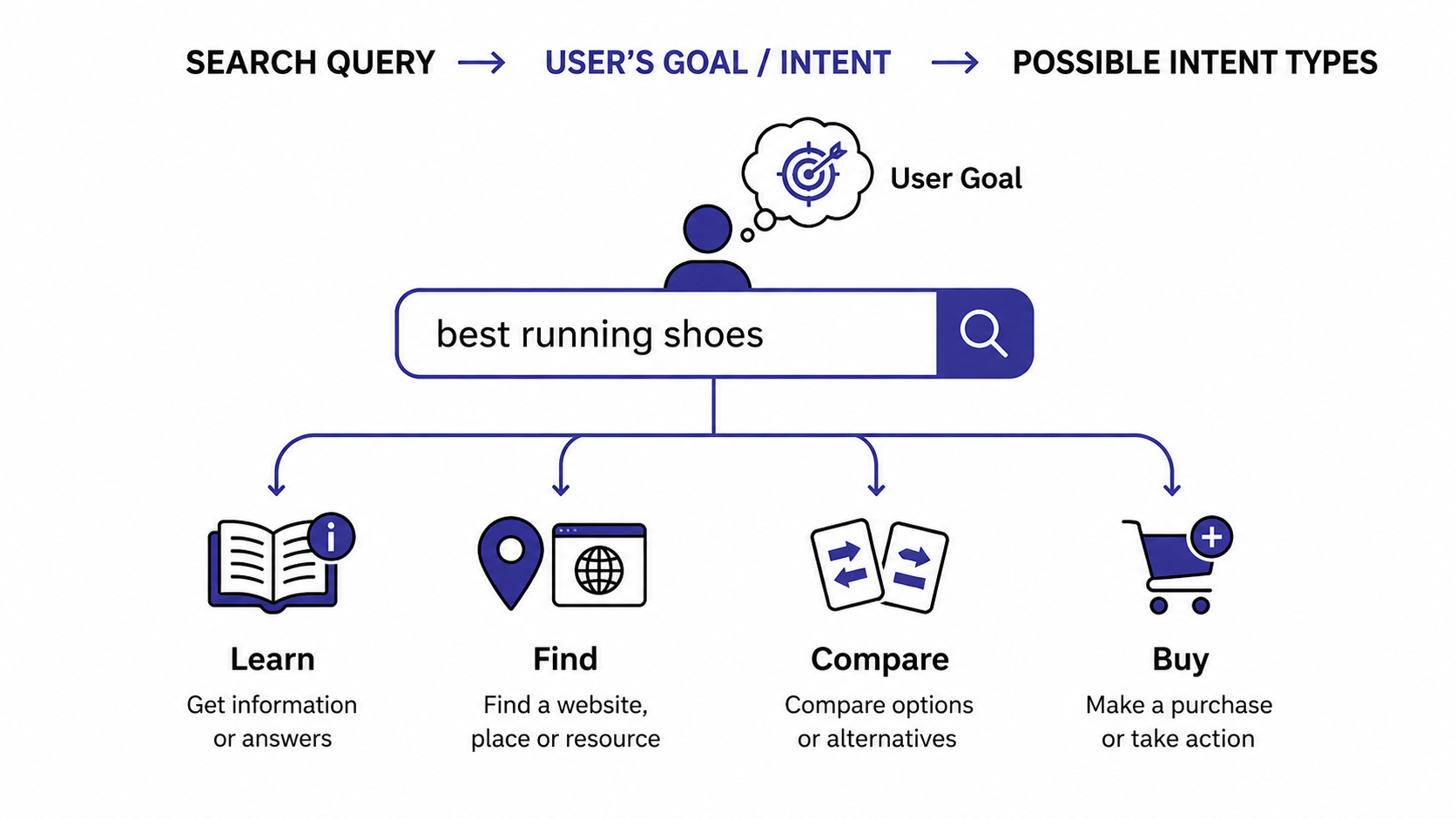
Search intent is the reason someone typed a query into a search engine in the first place. It’s the goal behind the words, not the words themselves. Two people can type completely different phrases and want the exact same outcome, and one person can type a three-word query that could mean five different things depending on what’s actually going on in their head that day.
Search Intent Definition in Plain Language
Think of the query as the surface and the intent as what’s underneath it. When someone searches “what is SEO,” they want to learn, plain and simple. When someone searches “Semrush,” they’re probably just trying to get to Semrush’s homepage without typing the URL. “Semrush alternatives” means they’re already using something else, or thinking about switching, and want a comparison. “Buy SEO software” means the wallet’s out. Same broad topic, four completely different jobs for a page to do.
I’ve run into clients who get this backwards constantly. They’ll ask me to rank for “email marketing” because the volume number looks juicy, without asking what someone searching that broad, vague phrase actually wants. Usually it’s a mixed bag: some want a definition, some want tool comparisons, some are already shopping. Google splits the difference by ranking a mix of guides and best-of lists. If your page doesn’t match what’s already winning, it won’t win either.
Search Intent vs Search Query: They’re Not the Same Thing
The query is the literal string of words typed into the search box. The intent is the goal sitting behind those words. Confusing the two is where most keyword targeting goes wrong.
| Search Query | Search Intent |
|---|---|
| What is SEO? | Learn what SEO means and how it works |
| Ahrefs login | Reach the Ahrefs login page directly |
| Best SEO tools | Compare and shortlist SEO tools before choosing |
| Buy SEO software | Complete a purchase |
Notice how the query for “Ahrefs login” is only two words, but the intent is razor sharp. There’s zero ambiguity. Compare that to “best SEO tools,” which sounds specific but actually hides a lot of variation: some searchers want a ranked list, some want pricing, some just want to know what options even exist. That’s why a page targeting a broad commercial query has to work harder to cover the ground the query itself doesn’t spell out.
Why Search Intent Is Important for SEO
Getting intent right changes almost every metric that matters. Better keyword targeting comes first, because you stop chasing volume for its own sake and start choosing keywords your business can actually serve with the right page type. More relevant content follows naturally, since you’re building the page around what the reader needs rather than around what you assume they need.
Higher rankings show up because Google’s whole ranking system is built to reward pages that satisfy the query completely, and intent match is a huge part of that signal. Better engagement follows too. People stick around when the page gives them what they came for instead of forcing them to scroll past irrelevant sections. Conversion rates climb when the CTA matches where someone actually is in their decision, instead of pushing a “buy now” button on someone who’s still trying to understand what the product even does.
There’s also a structural benefit that gets ignored way too often: better content architecture. When you map intent properly across your site, you build a clearer hierarchy of pages instead of a pile of blog posts competing with each other. That reduces keyword cannibalisation, which I’ll get into later, and it builds stronger topical relevance because each page has a clear, distinct job. All of that adds up to a better user experience, and Google has spent the last several years getting noticeably better at rewarding exactly that.
Search Intent and the Modern Search Experience
Search has moved a long way from simple keyword matching. Ten years ago, ranking often meant matching the exact phrase on the page enough times. Now Google runs on query understanding, and increasingly, on intent satisfaction. It’s trying to figure out what you actually want, not just what words you used to ask for it.
Semantic search is a big part of that shift. Google interprets meaning and relationships between words instead of just matching strings. Natural language queries have exploded too, especially with voice search and now AI-assisted search, where people type or speak full questions instead of fragments. “Best CRM for a five-person sales team on a tight budget” is a real query now, not a hypothetical.
Conversational search builds on that. People ask follow-up questions in the same session, sometimes in the same search box thread when using AI-powered search experiences. Entity understanding lets Google connect a query to a specific thing, brand, person, or concept, and then pull related information even if the page never used the exact phrase. And search journeys matter more than single queries now. Someone researching a CRM might search five or six different phrases across a week before ever converting, and Google is increasingly good at recognizing that whole arc rather than treating each query as an isolated event.
The 4 Main Types of Search Intent
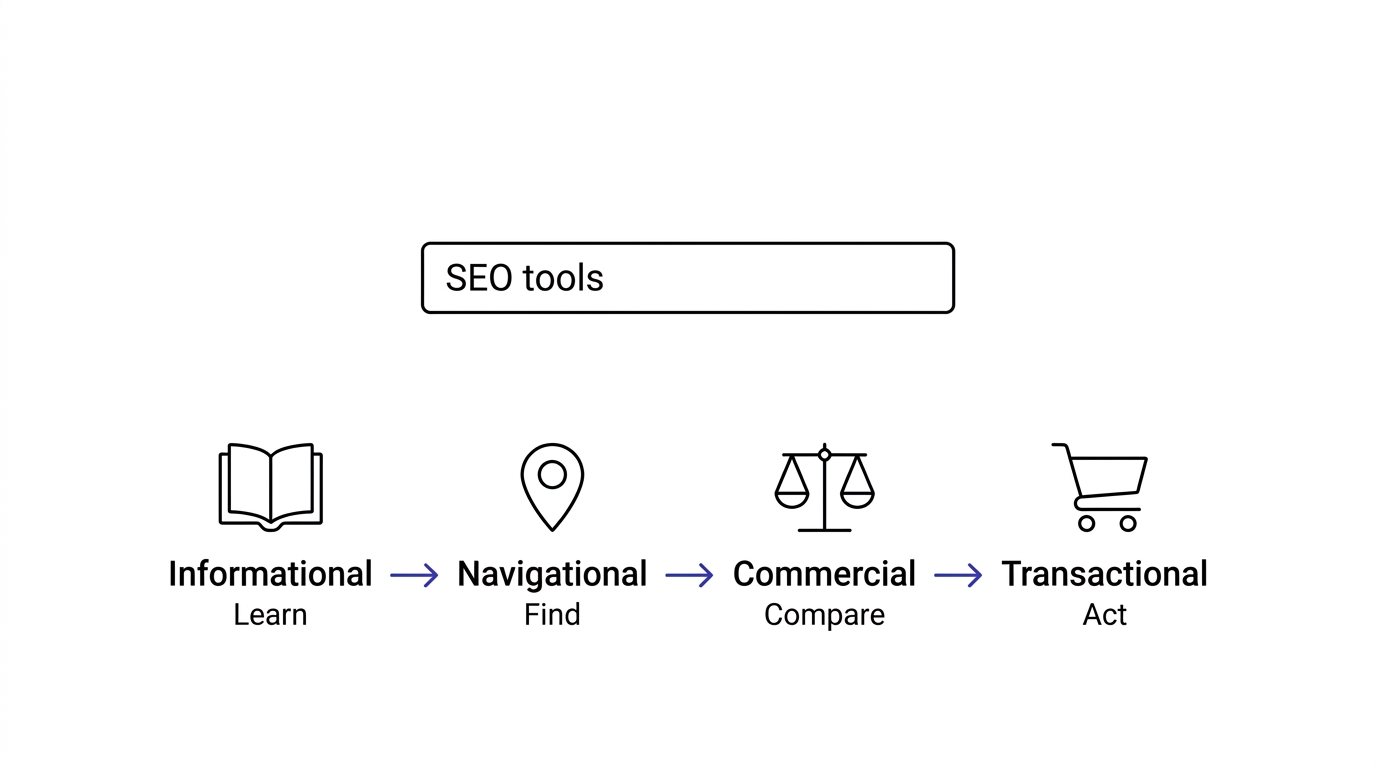
Every intent classification system eventually comes back to four buckets: informational, navigational, commercial investigation, and transactional. These aren’t arbitrary categories somebody invented for a blog post. They map to real, distinct stages of what a person is trying to accomplish, and each one calls for a different kind of page.
1. Informational Search Intent
Informational intent means the searcher wants to learn something. They’re not ready to buy, they’re not trying to reach a specific site, they just want an answer. This sits at the top of the funnel most of the time, though not always, since plenty of bottom-funnel buyers still ask informational questions right before they convert.
Examples of Informational Queries
“What is digital marketing?” “How does SEO work?” “Search intent explained.” “How to create a content strategy.” “Benefits of email marketing.” Every one of these is a question or a topic someone wants explained, not a product they’re ready to hand over a credit card for.
Common Content Formats for Informational Intent
Blog posts do the heaviest lifting here, followed by comprehensive guides, tutorials, how-to articles, educational videos, glossaries, checklists, and infographics. The format depends on how complex the topic is. A simple definitional query might only need a strong paragraph and a featured-snippet-friendly answer. A process-heavy topic like “how to build a content calendar” needs a full walkthrough.
SEO Strategy for Informational Queries
Answer the query fast, ideally in the first sentence or two after the relevant heading. Don’t make someone scroll through three paragraphs of throat-clearing to get the definition they searched for. From there, provide comprehensive context: the why behind the what, not just the surface answer. Use clear headings so both readers and Google can scan the structure. Address related questions the reader will naturally have next, because informational searchers rarely stop at one query, they chain several together. Include real examples wherever possible, and build topical depth by covering the subtopics a genuinely thorough answer would need to touch.
2. Navigational Search Intent
Navigational intent means the searcher already knows where they want to go. They’re using the search bar as a shortcut to a specific website, page, brand, or destination rather than as a research tool.
Examples of Navigational Queries
“Google Analytics login.” “HubSpot.” “Ahrefs pricing.” “LinkedIn.” “Canva login.” Notice how short and direct these are. There’s no ambiguity in what the person wants: get to that exact page, fast.
Common SERP Features for Navigational Queries
Google usually responds with the official website front and center, often accompanied by sitelinks that jump straight to subpages like login, pricing, or support. Knowledge panels show up for well-known brands, pulling in logos, social links, and quick facts. Brand results dominate the page because there’s really only one correct answer to satisfy.
Content Strategy for Navigational Intent
Make your own branded pages easy to find and easy to load. Optimize title tags so your brand name appears clearly, since that’s exactly what people are typing. Maintain consistent branding across every page Google might surface, because inconsistency confuses both users and search engines. Create dedicated pages for important branded searches, like a clean pricing page if “yourbrand pricing” gets meaningful search volume. And don’t waste time trying to rank generic content for clearly navigational searches you don’t own. You’re not going to outrank HubSpot’s homepage for “HubSpot” with a comparison article, so don’t try.
3. Commercial Investigation Intent
This is the research phase. The searcher is seriously considering a purchase but hasn’t locked in a decision yet. They’re comparing, weighing, reading reviews, trying to figure out which option actually fits their situation.
Examples of Commercial Investigation Queries
“Best SEO tools.” “Semrush vs Ahrefs.” “Best email marketing software.” “Canva alternatives.” “Best CRM for small businesses.” Every one of these signals someone who’s past the “what is this category” stage and into the “which specific option should I pick” stage.
Common Content Formats for Commercial Investigation
Comparison pages perform strongly here, along with product reviews, alternatives pages, “best X” listicles, buying guides, and case studies. These formats give the searcher the side-by-side view they’re actively looking for.
What the Searcher Actually Wants
Options laid out clearly. Honest pros and cons, not just marketing copy dressed up as objectivity. Real pricing, not “contact us for a quote” hidden behind three clicks. Feature breakdowns. Direct comparisons between the named tools they’re already considering. Genuine reviews, and recommendations that account for different use cases instead of one blanket “best overall” pick.
SEO Strategy for Commercial Investigation
Be transparent, because readers can smell a fake comparison from a mile away, especially when every “winner” happens to be the article’s own affiliate product. Compare features that actually matter to the decision, not filler specs nobody cares about. Include real decision-making information: pricing tiers, who each tool is built for, what the deal-breakers tend to be. Explain who each option is genuinely best for instead of pretending one tool wins for everyone. Use tables where it makes the comparison easier to scan, because commercial investigation searchers are usually comparing three or four things at once and want that laid out visually.
4. Transactional Search Intent
Transactional intent means the person is ready to act. That action might be a purchase, a signup, a download, a booking, or a subscription, but the common thread is: they’re done researching and they want to do the thing now.
Examples of Transactional Queries
“Buy SEO software.” “Semrush free trial.” “Hire SEO agency.” “Download keyword research template.” “Book digital marketing consultation.” These queries have verbs baked right into them: buy, hire, download, book. That’s usually your clearest signal.
Common Content Formats for Transactional Intent
Product pages, service pages, landing pages, pricing pages, signup pages, and checkout pages all belong here. Notice none of these are blog posts. A 2,000-word article explaining the benefits of SEO software is not what someone wants when they type “buy SEO software.” They want a page where they can actually buy it.
Optimization Strategy for Transactional Pages
Focus on a clear CTA that’s impossible to miss, front-loaded pricing so people don’t have to hunt for it, a tight summary of benefits and features, trust signals like testimonials or client logos, real reviews, an FAQ section that knocks out last-minute objections, full product or service details, and a conversion path with as little friction as possible. Every extra click or unclear step at this stage costs you a percentage of your traffic.
Are There More Than 4 Types of Search Intent?
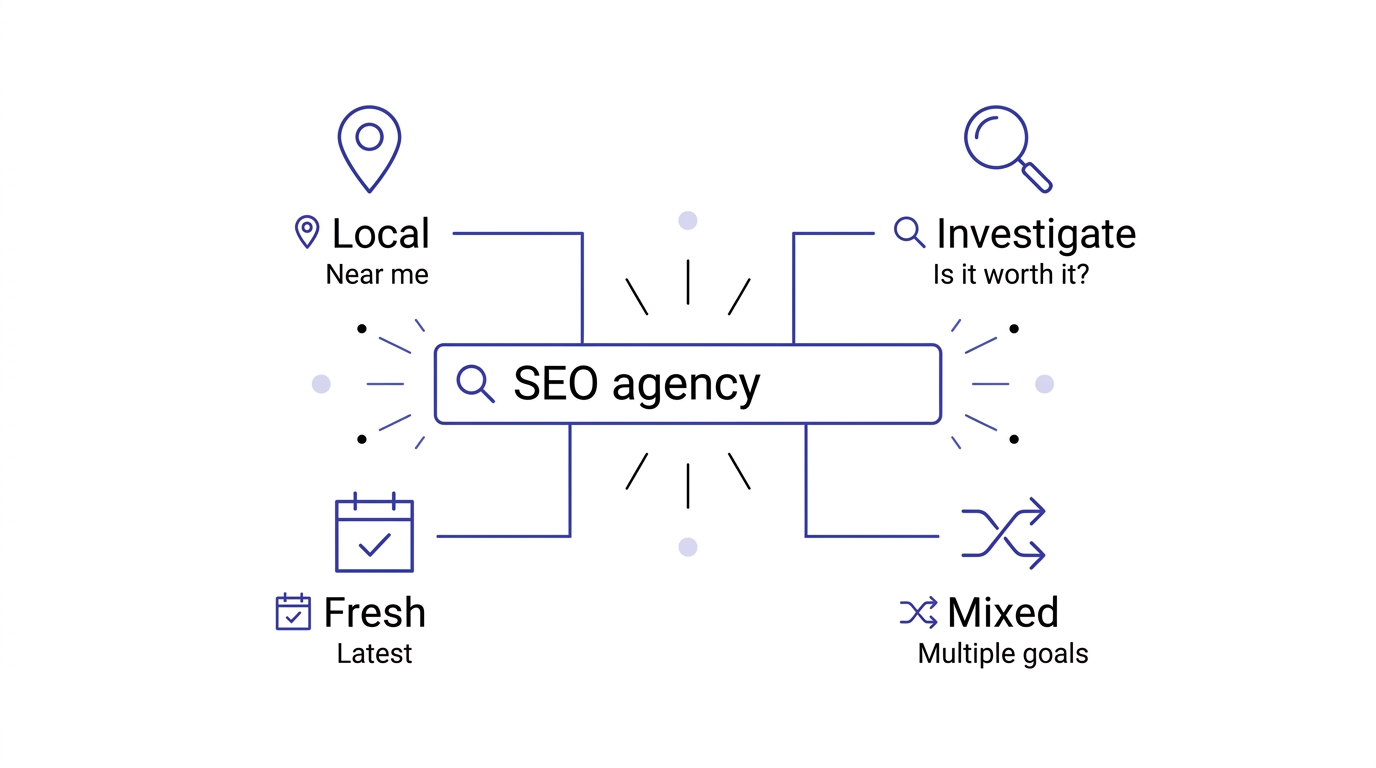
The four-category model is genuinely useful and I use it constantly, but it’s a simplification. Real search behavior is messier than four clean boxes, and a few other patterns show up often enough that they deserve their own explanation.
Local Search Intent
Local intent shows up when someone wants something nearby, whether that’s a business, a service, or a physical location. “SEO agency near me,” “best restaurant in Bhubaneswar,” and “digital marketing agency in Pune” all fall into this bucket. The searcher cares about proximity as much as, or more than, anything else in the query.
Ranking for local intent depends heavily on your Google Business Profile being fully filled out and actively maintained, along with dedicated local landing pages for each city or region you serve. Maps visibility matters a lot here, since the local pack often sits above organic results entirely. Reviews carry real weight too, both in volume and in how recently they were posted. Local schema markup helps search engines understand your address, hours, and service area cleanly, and location-specific content, meaning pages that actually mention the neighborhood, landmarks, or regional details, tends to outperform generic pages with a city name swapped in.
Investigational Intent
Some searches sit in the gap between pure informational curiosity and full commercial investigation. I call these investigational, and they’re worth handling carefully because they often carry more buying signal than they first appear to.
“Is Ahrefs worth it?” “How much does SEO cost?” “Which SEO tool is best for agencies?” These read like questions, but the person asking them is usually closer to a decision than a plain “what is SEO” searcher. Treat them with the depth of an informational piece but the persuasive structure of a commercial page, because that’s genuinely what the searcher needs at that moment.
Freshness-Based Intent
Some queries need current information above everything else, and Google treats them differently because of it. “Google algorithm update,” “SEO trends 2026,” and “latest AI marketing tools” are all queries where a five-year-old article, no matter how well written, just won’t cut it.
Freshness matters here because the underlying facts change fast enough that outdated content actively misleads the reader. Google tends to favor recently published or recently updated pages for these queries specifically, which means a solid content refresh strategy matters more for this intent type than almost any other.
Mixed Search Intent
A single keyword can carry more than one intent at the same time, and pretending otherwise leads to content that satisfies half the searchers and loses the other half. “Best AI SEO tools” is a good example. Some people typing that are still learning what these tools even do. Some are actively comparing three specific options. Some are one click away from starting a free trial.
The smart move is building a page that handles all three layers: enough context for the learner, a clear comparison for the evaluator, and a strong CTA for the person ready to commit. You don’t need three separate pages for one mixed-intent keyword. You need one page that respects all three angles.
Search Intent Funnel: From Learning to Buying
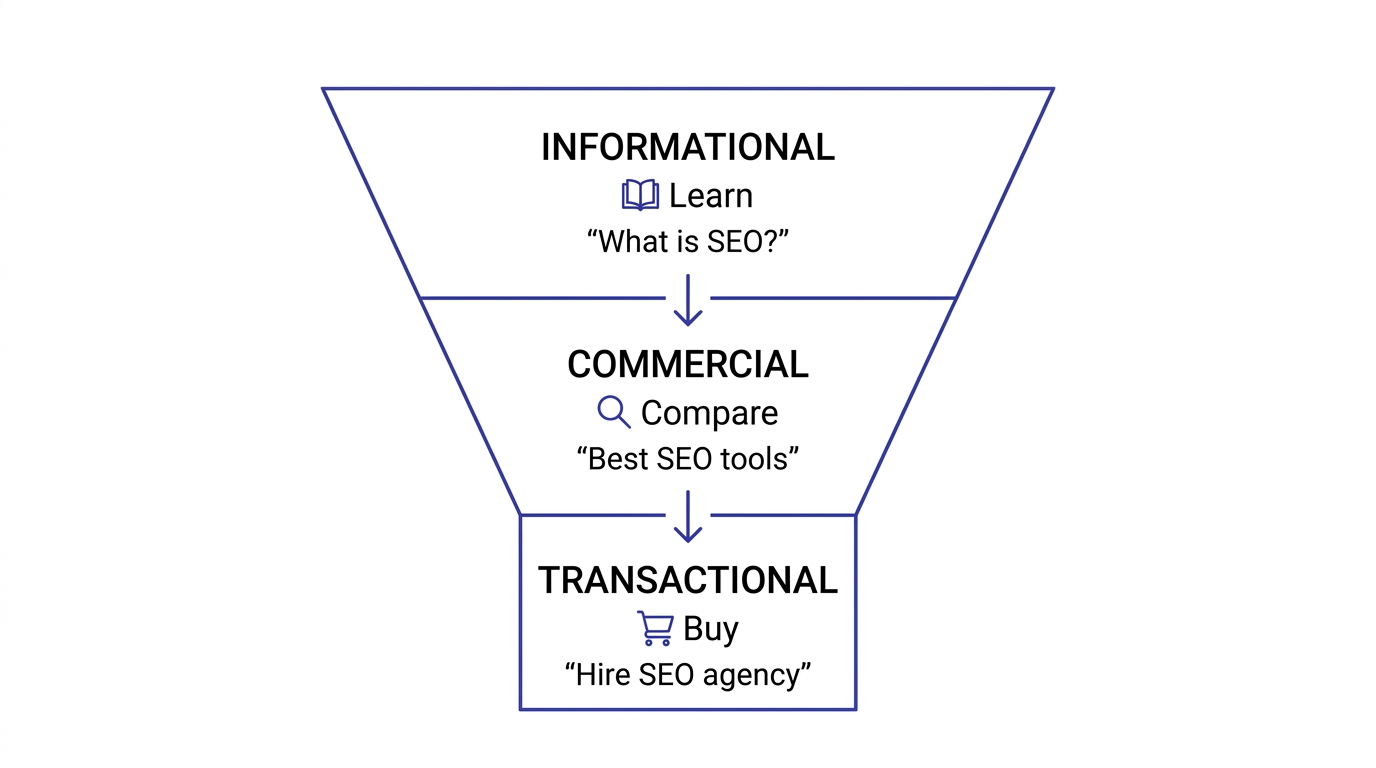
Search intent connects directly to where someone sits in the buying journey, and understanding that connection helps you plan content that actually moves people forward instead of leaving them stranded at one stage.
Top of Funnel: Informational Queries
Queries like “what is SEO,” “how does SEO work,” and “SEO benefits” sit at the very top. These people might not even know your brand exists yet. Your job here is to be genuinely useful and build trust, not to sell anything. Sell too hard this early and you lose the reader’s confidence before you’ve earned it.
Middle of Funnel: Commercial Investigation
Once someone’s decided they need a solution, they move into comparison mode. “Best SEO tools,” “SEO agency vs freelancer,” and “Ahrefs vs Semrush” all live here. This is where trust starts converting into consideration, and it’s where a lot of businesses lose people by being too pushy or, on the flip side, too vague to actually help someone decide.
Bottom of Funnel: Transactional Queries
“SEO agency pricing,” “hire SEO agency,” and “SEO consultation” show up when someone’s ready to move. These searchers have usually already done their homework elsewhere, so your page needs to close the loop fast: clear pricing, clear next step, minimal friction.
Why the Funnel Isn’t Always Linear
Real buying journeys don’t move in a straight line from informational to transactional. They loop. A typical path looks more like problem, research, comparison, validation, purchase, then support, and a single person might run all of those searches within days of each other, sometimes even within the same session using different tabs. Someone might read a beginner guide, jump straight to a pricing page, bounce back to a comparison article to double check, then finally convert two days later after reading a case study. Building content only for a straight-line funnel misses all of that back-and-forth behavior that real buyers actually go through.
How Google Determines Search Intent
Google doesn’t have a single dial it turns to label a query “informational” or “transactional.” It’s inferring intent from a mix of signals, and understanding roughly how that works helps you predict what kind of content stands a chance of ranking.
Google Looks Beyond Exact-Match Keywords
Modern Google understands meaning, not just word matching. It can connect “cheap flights to Tokyo” with “affordable Tokyo airfare” as functionally the same query, even without shared words. That semantic layer means keyword stuffing does almost nothing for you anymore, while genuinely covering the topic thoroughly does a lot.
Search Results Reveal What Google Thinks the Intent Is
This is the part most people skip, and it’s the single most useful trick in this entire guide: search the keyword yourself and look at what’s already ranking. Google has effectively already run the intent analysis for you and published the results on page one. If nine of the top ten results are blog posts, don’t build a product page. If eight are ecommerce category pages, a guide isn’t going to break through no matter how good it is.
Search Intent Signals Google May Interpret
Google draws on query wording and phrasing, the surrounding context of a search session, a user’s search history where available, location, language, device type, whether the query implies a need for fresh information, entity relationships between the query and known topics, how relevant the actual page content is, and how people interact with results once they click through. It’s worth being honest here: nobody outside Google knows the exact weighting of these signals, and Google’s systems evolve constantly. Treat this as directional understanding, not a fixed formula you can reverse-engineer with certainty.
Why the SERP Is Your Best Intent Research Tool
I’ll keep coming back to this because it’s genuinely the most practical advice in the whole guide. Google’s current results for a query are live evidence of what it believes the dominant intent to be. Skip the guesswork. Run the search, look at the page types, look at the SERP features, and build accordingly.
How to Identify Search Intent for a Keyword
Here’s the actual process I run through every time I’m scoping a new page. It’s not complicated, but skipping steps is exactly how people end up building the wrong content for a keyword.
Step 1: Look at the Keyword Itself
Certain words act as flags for intent before you even open Google. Informational modifiers include what, why, how, guide, tutorial, meaning, definition, and examples. Commercial modifiers include best, top, vs, comparison, alternatives, review, and pricing. Transactional modifiers include buy, hire, order, subscribe, book, download, and sometimes pricing again, depending on context. Navigational modifiers include login, website, official, contact, and support. This first pass gets you most of the way there for a lot of keywords, though not all of them, since plenty of queries carry no obvious modifier at all.
Step 2: Search the Keyword on Google
Type it in and actually look. What page types dominate page one? Blog posts signal informational intent. Product pages signal transactional intent. Category pages often signal a mix of commercial and transactional. Service pages usually mean local or transactional. Videos ranking prominently suggest people want a visual walkthrough. Forums showing up often means the query is more nuanced or opinion-based than a straightforward answer can cover, and local business listings obviously point to local intent.
Step 3: Analyze the SERP Features
Featured snippets showing up almost always means informational intent, since Google is trying to answer the query directly on the results page. People Also Ask boxes confirm there’s a cluster of related questions worth covering. Video results suggest a visual or process-based need. Image packs suggest a visual query. Shopping results are about as clear a transactional signal as you’ll ever get. A local pack confirms local intent immediately. Reviews appearing prominently point to commercial investigation, and knowledge panels usually mean navigational or entity-based intent.
Step 4: Analyze the Top-Ranking Pages
Once you know the page types, dig into what those pages actually contain. Look at content length, since informational pages tend to run long while transactional pages stay tight and focused. Look at the page type itself, the headings used, the content format, which topics get covered, what CTAs appear, whether pricing shows up, whether comparisons are included, and how much visual content, like screenshots or diagrams, gets used. Patterns across the top five or six results tell you almost everything about what Google expects a winning page to include.
Step 5: Identify the Dominant Intent
Classify the keyword based on the strongest, most consistent pattern you found across steps two through four, not based on your first guess from the keyword phrase alone. This matters: don’t classify intent purely from the words in the query. Validate it against what’s actually ranking, because sometimes a keyword that looks informational on paper turns out to have a heavily commercial SERP, and vice versa.
Step 6: Identify Secondary Intent
Most keywords carry a primary intent plus a handful of supporting sub-intents that a genuinely thorough page still needs to address. Take “best CRM for small business” as an example. The primary intent is clearly commercial investigation. But the secondary layers underneath include questions about features, pricing, ease of use, integrations, and setup. A page that nails the primary intent but ignores those secondary questions will lose readers to a competitor that covers all of it.
How to Match Content With Search Intent
This is where everything comes together. Once you know the intent, the job is matching content type, depth, format, and CTA to exactly what that intent calls for.
Match Informational Intent With Educational Content
The right formats here are guides, tutorials, explainers, how-to content, and clear definitions. The approach: answer first, explain deeply right after, provide real examples that make the concept concrete, cover the related questions the reader will naturally have next, and don’t rush past the depth just to hit a word count. Informational content earns trust by being genuinely thorough, not by being padded.
Match Navigational Intent With Destination Pages
The right pages here are your homepage, dedicated brand pages, login pages, contact pages, support pages, and relevant product pages. The goal is simple: help people reach exactly where they’re trying to go, as fast as possible, with zero friction and zero unnecessary detours through marketing copy they didn’t ask to read.
Match Commercial Intent With Comparison Content
The right formats are best-of lists, honest reviews, direct comparisons, alternatives pages, and buying guides. Make sure to include real pricing, genuine feature breakdowns, honest advantages and limitations for each option, and clear guidance on which option fits which kind of buyer. Commercial investigation content lives or dies on how trustworthy it feels, so resist the urge to make every comparison suspiciously one-sided.
Match Transactional Intent With Conversion Pages
The right formats are product pages, service pages, landing pages, and pricing pages. Include a strong headline that states the value immediately, a clear value proposition, a tight list of benefits and features, social proof that’s specific rather than vague, an FAQ section that handles objections before they become reasons to leave, and a CTA that’s obvious and repeated at the natural points where someone might be ready to act.
Search Intent Explained Through Content Format: What Should You Create?
Mapping intent to format makes the whole system practical instead of theoretical. Here’s the breakdown I use as a quick reference.
| Search Intent | Searcher Goal | Best Content Type |
|---|---|---|
| Informational | Learn | Guide or blog post |
| Navigational | Find | Brand or destination page |
| Commercial | Compare | Comparison or review page |
| Transactional | Act or buy | Product or service page |
| Local | Visit or contact | Local landing page |
| Investigational | Evaluate | Case study or deep comparison |
Informational intent needs a guide or blog post because the goal is learning, and that format gives you room to explain, define, and build context without pushing a sale. Navigational intent needs a brand or destination page because the goal is arrival, not persuasion, so the content should be findable and fast, not elaborate. Commercial intent needs a comparison or review page because the goal is evaluation, and that requires laying options side by side with honest detail. Transactional intent needs a product or service page because the goal is action, so everything on the page should reduce friction toward completing that action. Local intent needs a local landing page because the goal involves physical proximity, which means location details, maps, and contact information matter more than general content depth. Investigational intent needs a case study or deep comparison because the goal is evaluation with more skepticism baked in, so real proof points carry more weight than surface-level claims.
Search Intent Examples Across Different Industries
Seeing intent mapped across real industries makes the whole framework click faster than any abstract explanation. Here’s how it plays out in a handful of common niches.
Search Intent Examples for Digital Marketing
| Keyword | Intent | Recommended Content |
|---|---|---|
| What is SEO? | Informational | Guide |
| Best SEO tools | Commercial | Listicle |
| Semrush vs Ahrefs | Commercial | Comparison |
| Hire SEO agency | Transactional | Service page |
Digital marketing keywords tend to split cleanly across all four intent types, which makes the niche a good training ground for practicing intent classification before applying it somewhere messier.
Search Intent Examples for SaaS
SaaS keywords like “best CRM software,” “CRM pricing,” “CRM alternatives,” and “how CRM works” cover the full range from informational curiosity through to transactional readiness. SaaS buyers tend to move through a longer research cycle than other industries, often bouncing between pricing pages and comparison articles multiple times before converting, which makes intent-matched content especially valuable for reducing drop-off at each stage.
Search Intent Examples for Ecommerce
Ecommerce keywords like “best running shoes,” “Nike running shoes,” “buy running shoes online,” and “running shoes for flat feet” show how tightly intent and product catalog structure need to connect. A category page, a brand page, a checkout-ready product listing, and a use-case-specific filter or guide all serve different searches that look superficially similar but need completely different page types underneath them.
Search Intent Examples for Local Businesses
Local business keywords like “dentist near me,” “best dentist in Bhubaneswar,” “dental implant cost,” and “book dentist appointment” move fast from awareness to action, often within a single search session. Local intent tends to compress the funnel: someone searching “dentist near me” is frequently much closer to booking than an equivalent informational query in a non-local niche.
Search Intent Examples for B2B
B2B keywords like “what is lead generation,” “best lead generation software,” “HubSpot vs Salesforce,” and “lead generation agency” reflect longer, more considered buying cycles involving multiple stakeholders. Content here often needs to serve both the researcher gathering information and the decision-maker who eventually signs off, which is why B2B commercial content tends to run deeper than equivalent B2C comparison pages.
How to Create a Search Intent Map for Your Website
A search intent map turns everything above into a repeatable system instead of a one-off exercise you do for a single article. Here’s how I build one for a site.
Step 1: Build Your Keyword List
Pull keywords from every source available: Google Search Console for what you’re already getting impressions on, Google Keyword Planner for volume and ideas, Semrush or Ahrefs for competitive gaps, general keyword research tools for long-tail variants, and direct competitor research to see what’s driving traffic to sites you’re up against.
Step 2: Assign Intent to Each Keyword
Build out a spreadsheet with columns for the keyword itself, search volume, keyword difficulty, primary intent, secondary intent, the SERP type you observed, the recommended content type, the funnel stage it represents, any existing URL already targeting it, the target URL you’re planning to build or update, and go through every keyword using the six-step identification process covered earlier.
Step 3: Group Keywords by Intent
Once every keyword has an intent label, cluster them into groups: informational, commercial, transactional, navigational, and local. This clustering is what reveals your content gaps and your overlaps at a glance, since you’ll often find you have five blog posts covering informational intent for a topic and zero pages built for the commercial or transactional version of the same topic.
Step 4: Assign Keywords to Existing or New Pages
For each cluster, decide whether an existing page already covers that intent well enough to just get updated, whether you need a brand new page entirely, whether two overlapping pages should get merged into one stronger page, whether an old page should get redirected because it no longer serves a purpose, or whether the content format itself needs to change because the current page type doesn’t match what the intent actually calls for.
Step 5: Build an Intent-Based Content Calendar
Use the intent map to prioritize what gets published next. Commercial and transactional gaps usually deserve priority since they tend to sit closer to revenue, but don’t neglect the informational layer that builds the topical authority those bottom-funnel pages depend on to rank in the first place.
Search Intent and Keyword Mapping
Intent mapping and keyword mapping sound similar but they’re solving different problems, and understanding the difference prevents a lot of wasted content.
Traditional Keyword Mapping
Traditional keyword mapping is a simple one-to-one relationship: keyword points to URL. It answers “which page targets which keyword” but says nothing about why that keyword matters or what the page needs to actually accomplish once someone lands on it.
Intent-Based Keyword Mapping
Intent-based mapping extends that relationship into a full chain: keyword connects to intent, intent connects to funnel stage, funnel stage connects to content type, content type connects to the actual URL, and the URL connects to the right CTA for that stage. This fuller chain is what actually prevents wasted content, because it forces you to justify every page by what job it’s doing, not just which keyword it happens to target.
Why This Prevents Keyword Cannibalization
Cannibalization usually isn’t a technical accident. It’s an intent accident. Take “best SEO tools,” “top SEO tools,” and “SEO tools for agencies.” Treated as three separate keywords without intent context, you might build three separate articles, all competing against each other in search results and splitting your own ranking signals. Treated through an intent lens, you’ll likely realize all three map to the same commercial investigation intent and should live on one strong, comprehensive comparison page instead of three thinner competing ones.
How to Optimize Existing Content for Search Intent
Most sites don’t need a pile of brand new content nearly as much as they need an honest audit of what’s already live. Here’s the process I run for that.
Identify the Page’s Target Keyword
Start by confirming exactly which keyword or keyword cluster the page is meant to serve, since older content sometimes drifts from its original target after several rounds of edits.
Check the Current SERP
Search that keyword today and see what’s ranking now, not what was ranking when the page was first written. Intent shifts over time, and last year’s winning format might not be this year’s.
Compare Your Page With Ranking Pages
Line your page up against the current top results. Look for gaps in format, depth, structure, and the specific subtopics they cover that yours doesn’t.
Identify Intent Mismatch
Be honest about whether your page is even the right type of content for what’s currently ranking. This is often the actual root problem, more than thin content or weak backlinks.
Change the Content Format if Necessary
Sometimes the fix is structural: turning a blog post into a comparison page, turning a blog post into a service page, or expanding a thin product page into a full buying guide with the product embedded inside it.
Improve Content Depth
Once the format is right, look for missing subtopics, missing examples, and missing specificity that the top-ranking pages include and yours doesn’t.
Update Titles and Headings
Make sure your title and headings reflect the actual intent match, since a mismatched title can suppress click-through even when the content underneath is solid.
Improve Internal Links
Connect the page to related content across the funnel, so readers who aren’t ready to convert on this page have a clear next step instead of a dead end.
Align CTAs With Intent
Revisit the CTA with the same intent lens from the mistakes section above, and adjust it to match where the reader actually is.
Measure Performance After the Update
Track rankings, click-through rate, and engagement for at least a few weeks after the change before drawing conclusions, since search engines take time to fully re-evaluate an updated page.
Search Intent Optimization for AI Search and AEO
Search intent explained through a 2026 lens has to account for how people are searching now, which increasingly includes AI-powered assistants sitting between the searcher and the traditional results page.
Search Intent in AI-Powered Search
People ask AI search tools longer, more conversational questions than they ever typed into a traditional search box. Multi-part questions and natural follow-ups are the norm now, not the exception, which changes what “answering the query” actually requires.
Create Content That Answers the Full User Need
Instead of only answering “what is search intent,” strong content also answers why it matters, what the types are, how you identify it, how you optimize for it, and what mistakes to avoid, all within reach of the same piece. AI systems tend to pull from content that already anticipates the follow-up questions instead of forcing a second query.
Optimize for Follow-Up Questions
Clear sections, tight definitions, concrete examples, honest comparisons, and a dedicated FAQ block all make it easier for both human readers and AI systems to extract a complete, standalone answer without needing extra context from elsewhere on the page.
Search Intent and Entity-Based Content
There’s a clear chain running from entity to topic to question to intent to content. A page that’s explicit about the entities it covers, meaning it names real tools, real platforms, and real concepts instead of staying vague, gives search systems a much easier time connecting it to the right queries.
The AEO and GEO Opportunity
Intent-focused content genuinely improves your odds of being useful across traditional search, AI search, dedicated answer engines, and conversational interfaces, since all of them are ultimately trying to satisfy the same underlying need behind a query. That said, intent optimization alone doesn’t guarantee a citation in an AI Overview or an AI assistant’s answer. It improves your odds. It doesn’t lock in the outcome.
How to Measure Whether Your Content Matches Search Intent
You can’t just publish and assume the intent match landed. Here’s what to actually track.
Organic Rankings
Watch your target keyword position over time, along with visibility for related keywords the page should also be picking up if the intent match is genuinely solid, and overall SERP presence across the cluster.
Organic Click-Through Rate
A gap between what your title promises and what your content or page type actually delivers shows up fast in CTR. If people are clicking through and bouncing immediately, that’s often an intent signal, not just a content quality issue.
Engagement Metrics
Depending on the page type, watch scroll depth, time-related engagement signals, and pages per session, since these tell you whether people are actually using the page the way its intent match should predict.
Conversions
Track leads, signups, downloads, purchases, calls, and demo requests against the specific intent the page was built for. A commercial investigation page that generates zero downstream conversions over time might be missing the trust signals that intent actually requires.
Search Console Query Data
Dig into which exact queries are bringing impressions and clicks to a page. Sometimes you’ll discover a page is ranking for an intent you never intended to target, which is useful information either way.
Content Decay
Intent shifts over time as markets mature, as new competitors enter, and as user behavior changes. A page that matched intent perfectly two years ago can decay simply because the dominant intent for that keyword has moved on without the page moving with it.
Search Intent Audit Checklist
Keyword
- Primary keyword identified
- Related keywords identified
- Search intent identified
SERP
- Top-ranking pages reviewed
- Dominant content format identified
- SERP features analyzed
Content
- Content matches the searcher’s goal
- The main question is answered early
- Secondary questions are addressed
- Content depth matches what the intent actually requires
Conversion
- CTA matches intent
- Internal links support the next logical step
- Commercial elements appear only where appropriate
Optimization
- Title matches intent
- Headings match the questions users actually have
- Content is easy to scan
- The page satisfies the SERP’s dominant intent
Conclusion
Search intent comes down to one habit: build for the reason behind the search, not just the words used to search it. Keywords tell you what people are typing. Intent tells you what they actually need from you once they land on the page, and that gap is exactly where most content either wins or quietly fails.
The SERP will keep telling you the truth if you’re willing to look at it before you write. Different intents call for genuinely different pages, secondary needs deserve just as much attention as the primary one, and intent isn’t static, so revisit your pages as the market around them shifts. Next time you’re about to build a page for a keyword, run the process from this guide first: query, intent, SERP, content type, content, CTA, measurement, optimization. Skip the guessing and let the evidence decide the format.
Frequently Asked Questions
What is search intent in SEO?
Search intent is the underlying goal behind a search query, meaning what the person is actually trying to accomplish rather than the literal words they typed. It’s the single biggest factor in whether a page can realistically rank and convert for a given keyword.
What are the four types of search intent?
The four core types are informational, navigational, commercial investigation, and transactional. Informational searchers want to learn something, navigational searchers want to reach a specific destination, commercial investigation searchers are comparing options before deciding, and transactional searchers are ready to take action like buying or signing up.
How do I identify search intent for a keyword?
Look at the keyword’s modifiers first, like “best,” “buy,” or “how to,” then search the term on Google and study what page types and SERP features dominate the results. The current top-ranking pages are the clearest evidence of what Google believes the dominant intent to be.
Why is search intent important for SEO?
Matching intent leads to better rankings, higher engagement, and stronger conversion rates because the content actually gives searchers what they came for. Ignoring intent means you can write technically solid content that still fails to rank or convert simply because it’s the wrong format for what the query demands.
What is informational search intent?
Informational intent means the searcher wants to learn something rather than buy anything or reach a specific site. Queries like “how does SEO work” or “what is digital marketing” fall into this category, and the right response is usually a guide, tutorial, or in-depth explainer.
What is commercial search intent?
Commercial investigation intent means the searcher is actively comparing options before making a purchase decision. Queries like “best CRM software” or “Ahrefs vs Semrush” fall here, and the strongest content types are comparisons, reviews, and buying guides that lay out honest pros and cons.
What is transactional search intent?
Transactional intent means the searcher is ready to take an action right now, whether that’s buying, signing up, booking, or downloading something. Product pages, service pages, and pricing pages match this intent far better than blog content ever will.
What is navigational search intent?
Navigational intent means the searcher already knows exactly which website or page they want to reach and is using search as a shortcut to get there. Queries like “Gmail login” or a specific brand name are classic examples, and the right response is simply making that destination easy to find.
Can a keyword have multiple search intents?
Yes, and it happens more often than most people assume. A keyword like “best AI SEO tools” can simultaneously attract people who are still learning about the category, people actively comparing specific tools, and people who are one click away from starting a free trial, all searching the same phrase.
How does search intent affect content strategy?
Search intent should shape which pages you build, what format each page takes, how deep the content needs to go, and what call to action belongs on it. A content strategy that ignores intent ends up producing pages that technically cover a topic but fail to match what searchers actually came looking for.
How do I optimize content for search intent?
Start by confirming the dominant intent through the current SERP, then match your content’s format, depth, and structure to that intent, answer the core question early, cover the secondary questions a thorough searcher would still have, and align your CTA with how ready that searcher actually is to convert.
Can search intent change over time?
Yes. Intent shifts as markets mature, as new competitors and product categories emerge, and as user behavior evolves, especially around AI-powered search. A keyword that was purely informational two years ago can develop a much stronger commercial or transactional layer as the underlying market changes, which is why periodic content audits matter.