

A few years back, writing the first draft of an ad meant staring at a blank doc for twenty minutes, typing three lines, deleting them, and starting over. Now that first draft exists in about nine seconds. Not always a good draft, not always the right draft, but a draft. And that one shift, going from a blank page to something you can react to, has quietly rewired how marketing teams spend their day.
This is what generative AI actually is. Not some far-off sci-fi concept, not a replacement for your strategist, and definitely not magic. It’s software that creates new content, text, images, video, code, by predicting patterns it learned from an almost unimaginable pile of examples. And by 2026, marketers aren’t debating whether to use it anymore. Ninety-three percent of CMOs say they’re seeing real, measurable ROI from it. So the conversation has moved. Nobody’s asking “should we try this” anymore. The real question is how to use it well, without it wrecking the brand voice or embarrassing someone in front of a client.
That’s what this guide covers, properly. Not a surface-level explainer, not a tool listicle dressed up as a strategy piece. This goes into the actual mechanics of how these systems produce content, where exactly they fit into a marketer’s real workflow, and where they quietly fall apart if nobody’s watching. By the end, the goal isn’t to sound smart at a dinner party. It’s to actually understand this well enough to use it without getting burned by it.
What Is Generative AI, Really?
Let’s kill the confusion right away, because most explanations either dumb this down into nothing or bury it in jargon nobody asked for.
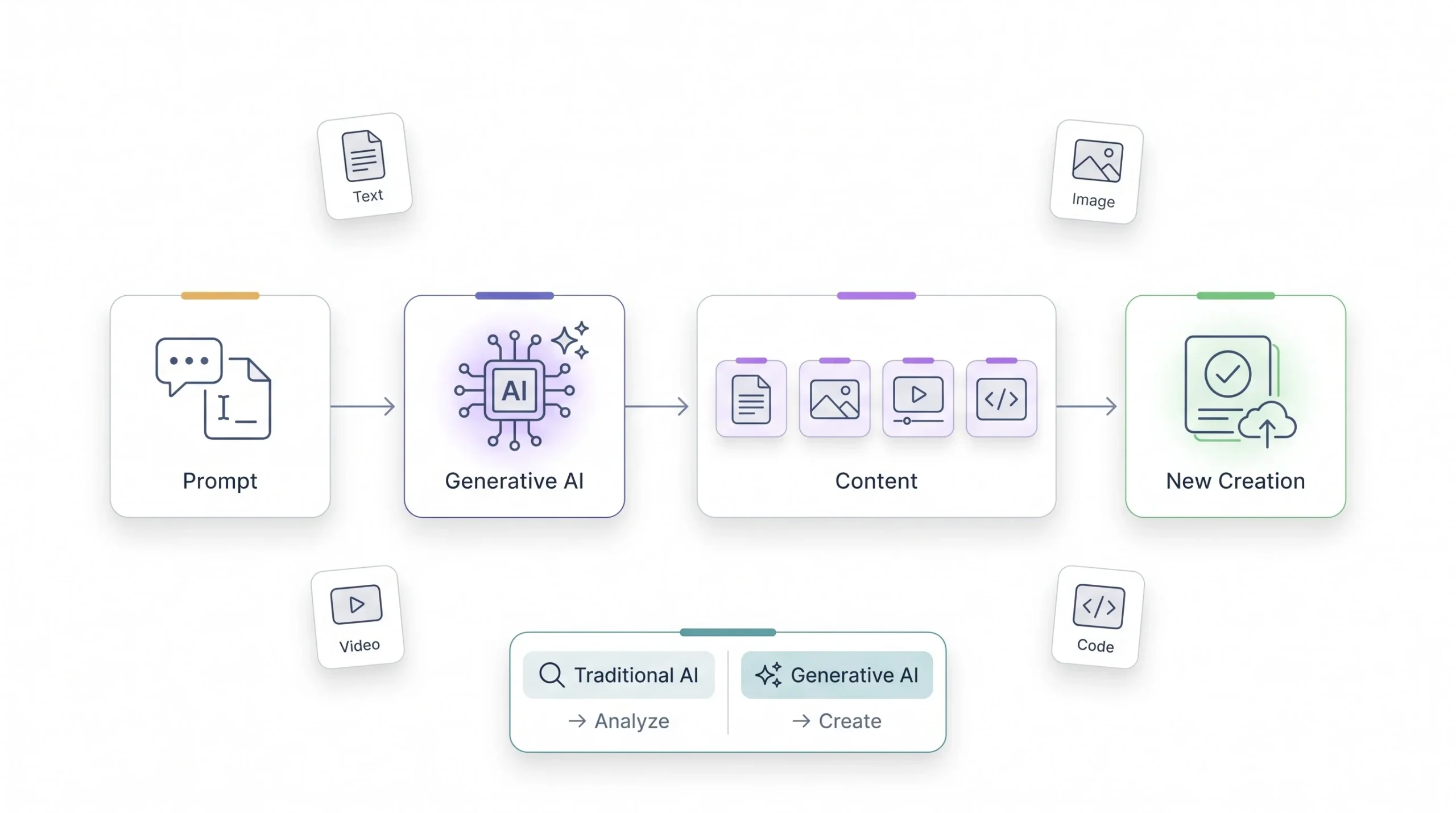
Generative AI is a category of artificial intelligence built to create new content instead of just analyzing content that already exists. Text, images, video, audio, code, all of it. Compare that to something like a spam filter. A spam filter looks at an email and decides “junk” or “not junk.” It classifies. It doesn’t write you a new email. Generative AI does the opposite job. Feed it a prompt and it builds something that didn’t exist thirty seconds earlier.
That part’s easy. The part that actually matters, and the part almost every beginner guide skips, is understanding what’s happening under the hood well enough to predict when this thing will do something genuinely useful and when it’ll quietly hand you nonsense dressed up in confident language.
How it actually works, at the level that matters
Start with tokens, because this is the single concept that unlocks everything else about how these tools behave. A language model doesn’t read words the way a person does. It breaks text down into chunks called tokens, sometimes whole words, sometimes just fragments of words. “Marketing” might be one token. “Unbelievably” might get split into two or three. Every single thing the model reads and writes happens at this token level.
During training, the model gets fed an enormous volume of text, think a meaningful chunk of the public internet, books, articles, code repositories, and it plays one simple game over and over across trillions of examples: given the tokens so far, predict the next one. Get it right, adjust the internal math slightly to reinforce that pattern. Get it wrong, adjust it the other way. Do that across a mind-bending number of repetitions and the model ends up with a statistical map of how language actually works. Not facts stored like a database. Patterns.
The architecture that made this actually work well is called a transformer, and the piece inside it that matters most is called attention. Attention lets the model weigh which earlier words in a sentence matter most when predicting the next one. In the sentence “the ad campaign for the sneaker brand launched, and it performed well,” the model needs attention to figure out that “it” refers back to “the ad campaign,” not “the sneaker brand,” not “well.” Earlier AI architectures struggled badly with exactly this kind of long-range connection. Transformers solved it, and that solve is a big part of why AI-generated text suddenly went from stiff and robotic to genuinely fluent starting around 2022.
Once training is done, generating text is just repeated prediction. The model looks at everything so far, including the prompt, calculates a probability for every possible next token, and picks one. Then it does that again for the next token. And again. One token at a time, hundreds of times per response, each one influenced by everything that came before it. There’s also a setting called temperature that controls how predictable or how creative those choices are. Low temperature, the model almost always picks the single most likely next word, which produces safe, sometimes repetitive output. Higher temperature, it takes more risks, which produces more varied, more surprising output, and also more mistakes.
Image generation runs on a completely different mechanism, worth understanding separately because it explains a lot of the weird visual glitches people run into. Most modern image models use something called diffusion. Training starts with real images, then the system deliberately adds random noise to them, step by step, until the image is pure static. Then it trains a model to reverse that process, predicting how to remove noise one step at a time to recover something image-like. Once trained, generation works backward from that same process. Start with random noise, and step by step, the model removes noise in a way that’s guided by the text prompt, until an actual image emerges out of what started as static. That’s also exactly why hands and text inside images have historically been rough. Faces and simple objects show up constantly in training data with consistent structure. Hands, with their weird overlapping fingers and endless possible positions, and readable text, with its need for pixel-perfect precision, show up in far more variable and inconsistent ways, so the noise-removal process has a much harder time converging on something coherent.
Generative AI vs. traditional or predictive AI
This is the single biggest point of confusion for anyone new to this space, so it’s worth being precise about it. Marketing teams have been using “AI” for years before ChatGPT ever showed up. Lead scoring models, churn prediction, recommendation engines. All of that is AI. None of it is generative.
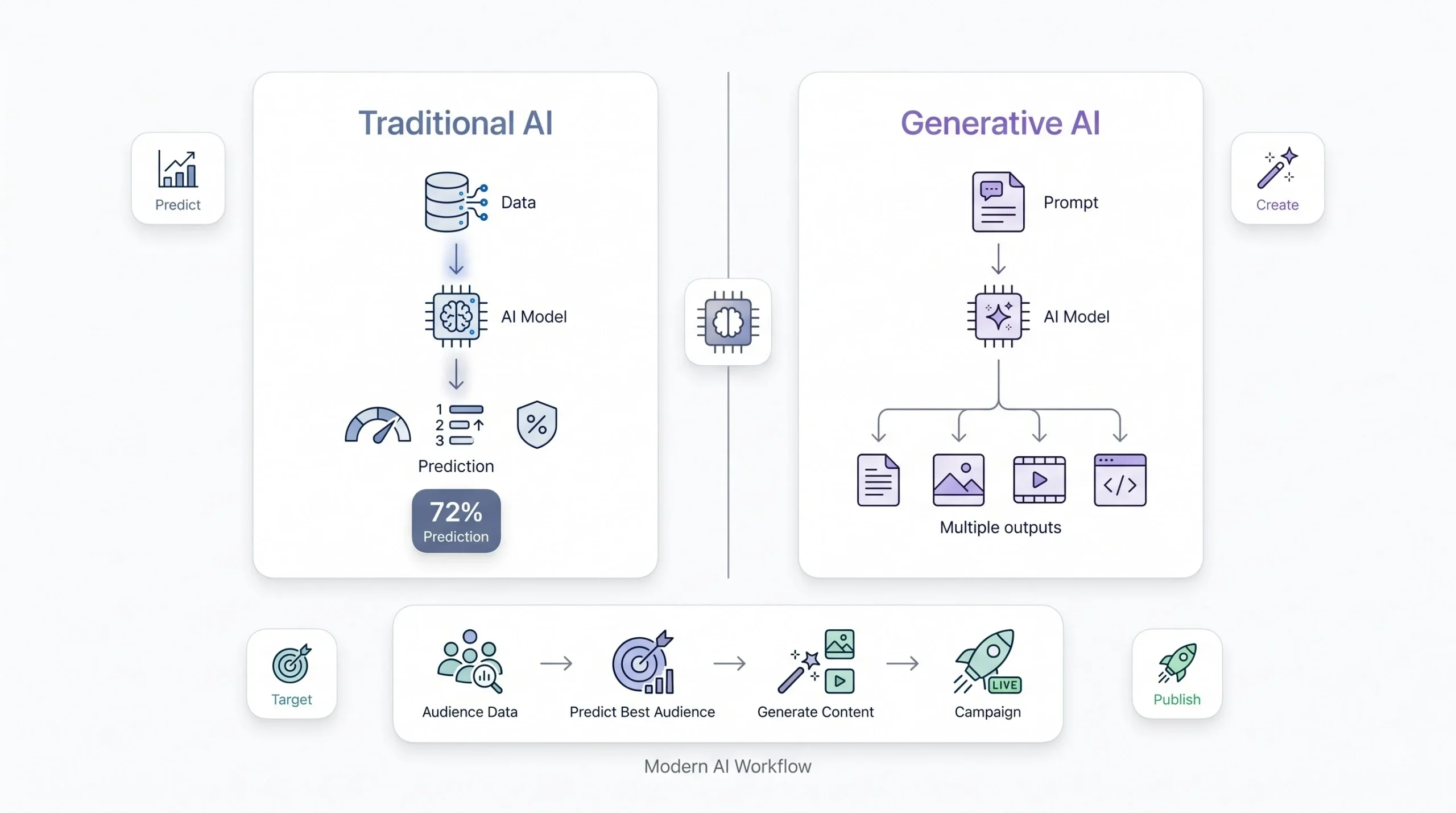
The difference comes down to output type and the underlying task the model was trained to do. Traditional predictive AI is trained to map inputs to a specific, bounded output, usually a number, a category, or a ranked list. A churn model gets fed a customer’s behavior data and outputs a probability, something like 0.72, meaning a 72% chance that customer leaves in the next quarter. That’s the entire job. It’s not generating anything, it’s classifying a pattern against patterns it saw in training data labeled with outcomes.
Generative AI is trained on an open-ended task: predict the next token, or reverse the noise. There’s no fixed, bounded output. The same prompt can produce genuinely different responses depending on randomness settings, because the model isn’t retrieving one correct answer, it’s constructing one plausible answer out of a near-infinite space of possible ones.
| Traditional / Predictive AI | Generative AI | |
|---|---|---|
| Core task during training | Learn to map inputs to a fixed output (label, score, ranking) | Learn to predict the next token or reverse image noise |
| What it does | Analyzes, classifies, predicts | Creates new content |
| Example in marketing | Lead scoring, churn prediction, recommendation ranking | Writing ad copy, generating images, drafting emails |
| Output | A number, label, or recommendation | Text, image, video, audio, code |
| Same input twice | Same output every time | Output can vary run to run |
| Marketer’s role | Interpret the output | Direct, edit, and approve the output |
Both matter, and plenty of modern marketing stacks run both types side by side, a predictive model deciding who to target and a generative model writing what to say to them. But when people say “generative AI,” they specifically mean the creation side. Keep that distinction straight and half the confusion in this space disappears.
The models behind the tools
Text generation runs on large language models, or LLMs, the ChatGPT, Claude, Gemini family. These get trained primarily on text and built to hold conversations, write copy, summarize documents, reason through problems, whatever gets asked of them within a chat interface.
Image and video generation runs on diffusion-based models, trained on visual data instead of text, though most modern ones also understand text prompts because they’re trained jointly on image-caption pairs, learning to associate the word “sunset” with the visual patterns that actually look like one. Midjourney is the best known name on the image side, and video-focused tools have been closing the gap fast, though video adds a whole extra layer of difficulty, because the model has to keep objects, lighting, and characters consistent across dozens of frames instead of getting away with getting one single frame right.
This isn’t the place to rank tools or recommend a subscription. That’s a separate piece entirely. What matters here is understanding the categories well enough that when a client or a teammate name-drops a tool, the mental model of what it’s actually doing under the hood is already in place.
A Short, Honest History (Why This Matters Now)
Nobody needs the full history of artificial intelligence going back to the 1950s. But understanding the last decade properly, not just as a list of product launches but as a sequence of actual technical unlocks, explains why this topic suddenly took over every marketing conversation instead of staying a research curiosity.
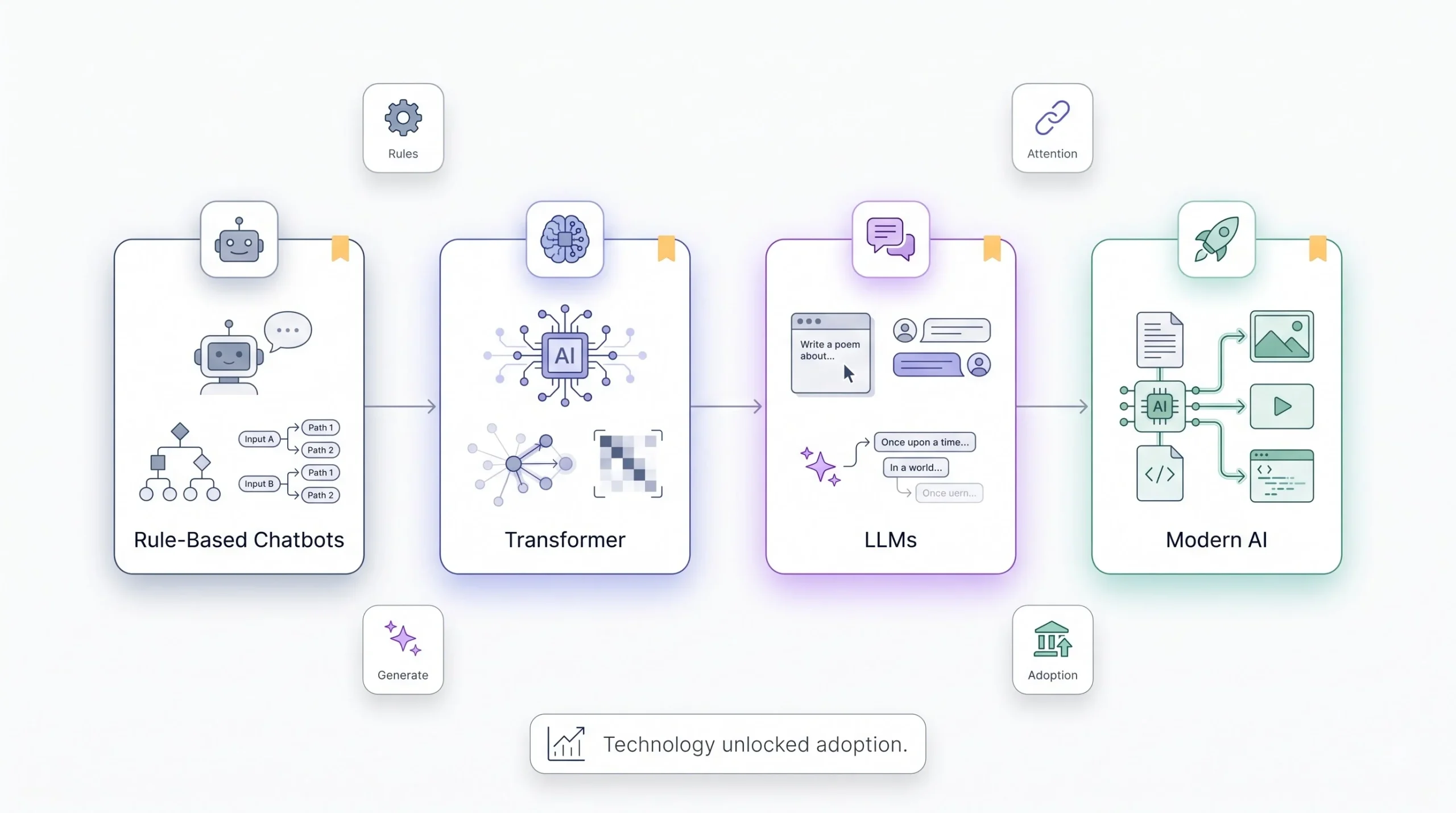
Chatbots existed long before ChatGPT, and they were rough. Rules-based systems, built on decision trees. Type the expected phrase and the bot responded correctly. Type anything slightly off-script and it looped back to some version of “I’m sorry, I didn’t understand that.” There was no actual language understanding happening, just pattern matching against a fixed list of expected inputs. Nothing generative about it at all.
The real technical unlock came from a research paper in 2017 that introduced the transformer architecture, the attention mechanism described earlier. Before transformers, language models processed text sequentially, one word at a time, in order, which made it genuinely hard for them to connect ideas that were far apart in a sentence or a paragraph. Transformers let a model look at an entire chunk of text at once and weigh every word against every other word simultaneously. That single architectural shift is the foundation almost every major language model since has been built on.
From there, progress was mostly about scale. Bigger models, trained on more data, with more computing power thrown at training, kept getting noticeably better at holding coherent conversations and following instructions. Early versions were genuinely limited, prone to losing the thread after a few sentences, obviously robotic in tone. By the time ChatGPT launched publicly at the end of 2022, the underlying technology wasn’t actually brand new, researchers had been building toward this for years. What changed overnight was accessibility. Suddenly anyone with a browser could type a question and get something genuinely useful back, with zero technical setup required. That’s the moment public perception flipped from “AI is a lab experiment” to “AI is something I use before lunch.”
From 2023 onward, adoption inside marketing departments moved fast, but enterprise integration lagged behind consumer hype for a specific reason worth understanding: legal and data governance teams needed time to catch up. A marketer testing ChatGPT for fun on a personal account is a very different risk profile than a company plugging a generative model into a system that touches real customer data. That gap between “individuals are already using this daily” and “the company has approved and governed how it gets used” is exactly the tension still playing out inside a lot of marketing organizations right now. By 2026, the conversation has shifted from “should we try this” to integration depth, meaning how deeply this is woven into the actual workflow and tech stack, versus sitting on the side as something one person runs manually when they remember to.
How Generative AI Applies to Marketing: The Big Picture
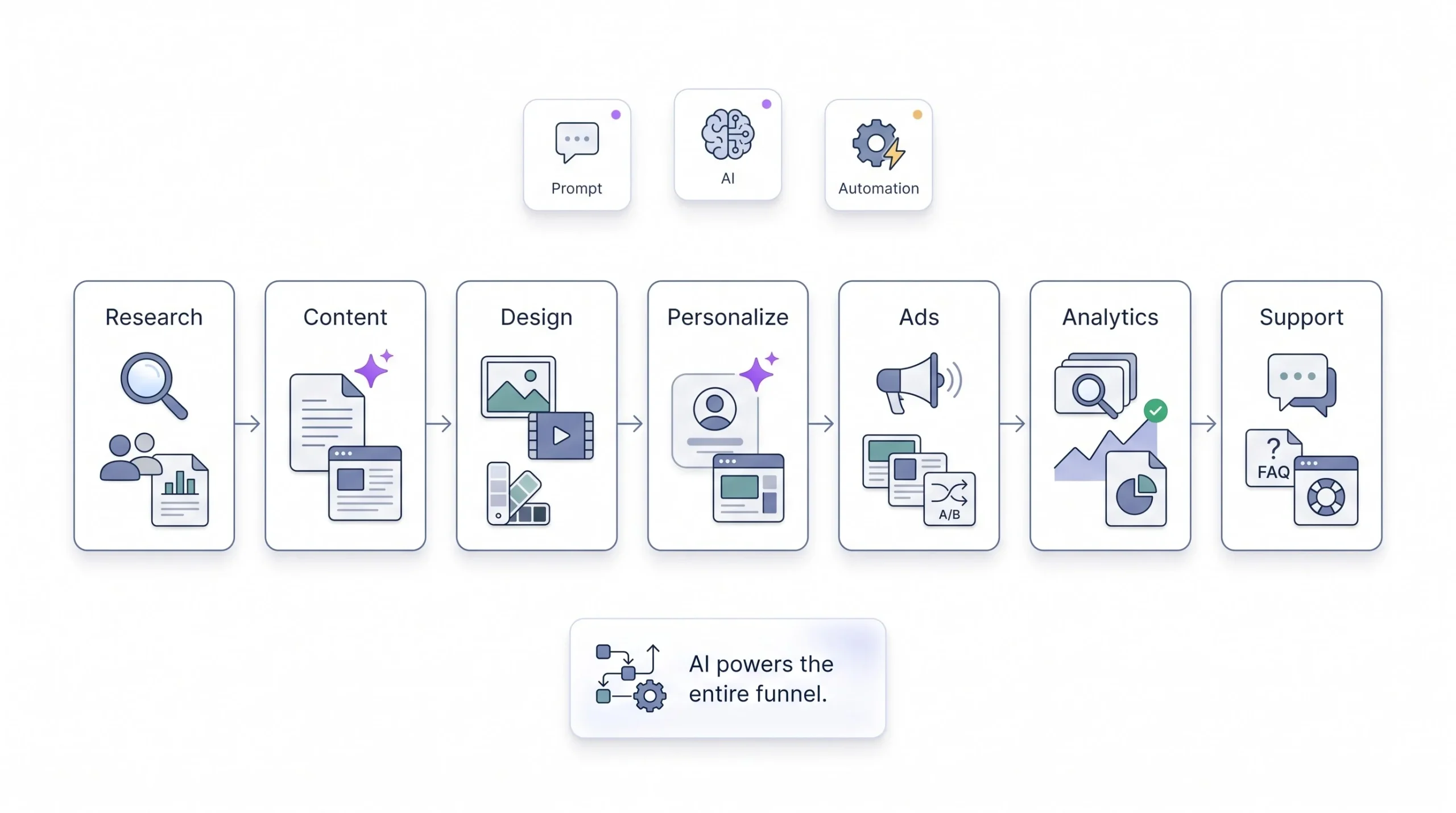
Here’s where most explanations go wrong. They treat generative AI in marketing as being about writing blog posts and social captions faster. That’s part of it, and it’s the most visible part, but it’s nowhere close to the whole picture.
Generative AI now touches nearly every stage of the marketing funnel, not just the content creation stage, and it does so through a few distinct technical patterns worth understanding before diving into each use case. The simplest pattern is direct prompting, where someone types a request and gets a response back, which is how most people first encounter these tools. A more advanced pattern, increasingly common inside real marketing stacks, is retrieval-augmented generation, often shortened to RAG, where the model gets fed relevant company-specific data, past campaign performance, brand guidelines, product catalogs, right alongside the prompt, so the output is grounded in actual business context instead of just general internet knowledge. And the most advanced pattern is full workflow integration, where generative models sit inside automated pipelines, triggered by real-time customer behavior with no human typing a prompt at all, which is exactly what powers the dynamic personalization use cases covered later in this guide.
| Funnel Stage | What Generative AI Does | Typical Integration Pattern |
|---|---|---|
| Research & strategy | Audience insights, competitor summaries, campaign briefs | Direct prompting |
| Content creation | Blog posts, ad copy, product descriptions, scripts | Direct prompting, sometimes RAG for brand voice |
| Design & visuals | Images, social graphics, video, product mockups | Direct prompting |
| Personalization | Dynamic emails, tailored landing pages, product recs | RAG, workflow integration |
| Paid advertising | Ad variant generation, A/B testing at scale | Direct prompting, workflow integration |
| Analytics & reporting | Summarizing performance data, generating insights | RAG |
| Customer service | Chatbots, support responses, FAQ generation | RAG, workflow integration |
Every one of those rows gets its own deep section below. This table is the skeleton of the rest of this guide, and the integration pattern column matters more than it looks, because it’s the difference between a marketer casually pasting a prompt into a chat window and a system that’s actually wired into the business.
Content Creation & Copywriting
This is the use case everyone thinks of first, and it deserves the deepest dive, because it’s also where the gap between “looks fine” and “actually good” is easiest to miss if nobody’s paying attention.
Blog and long-form content
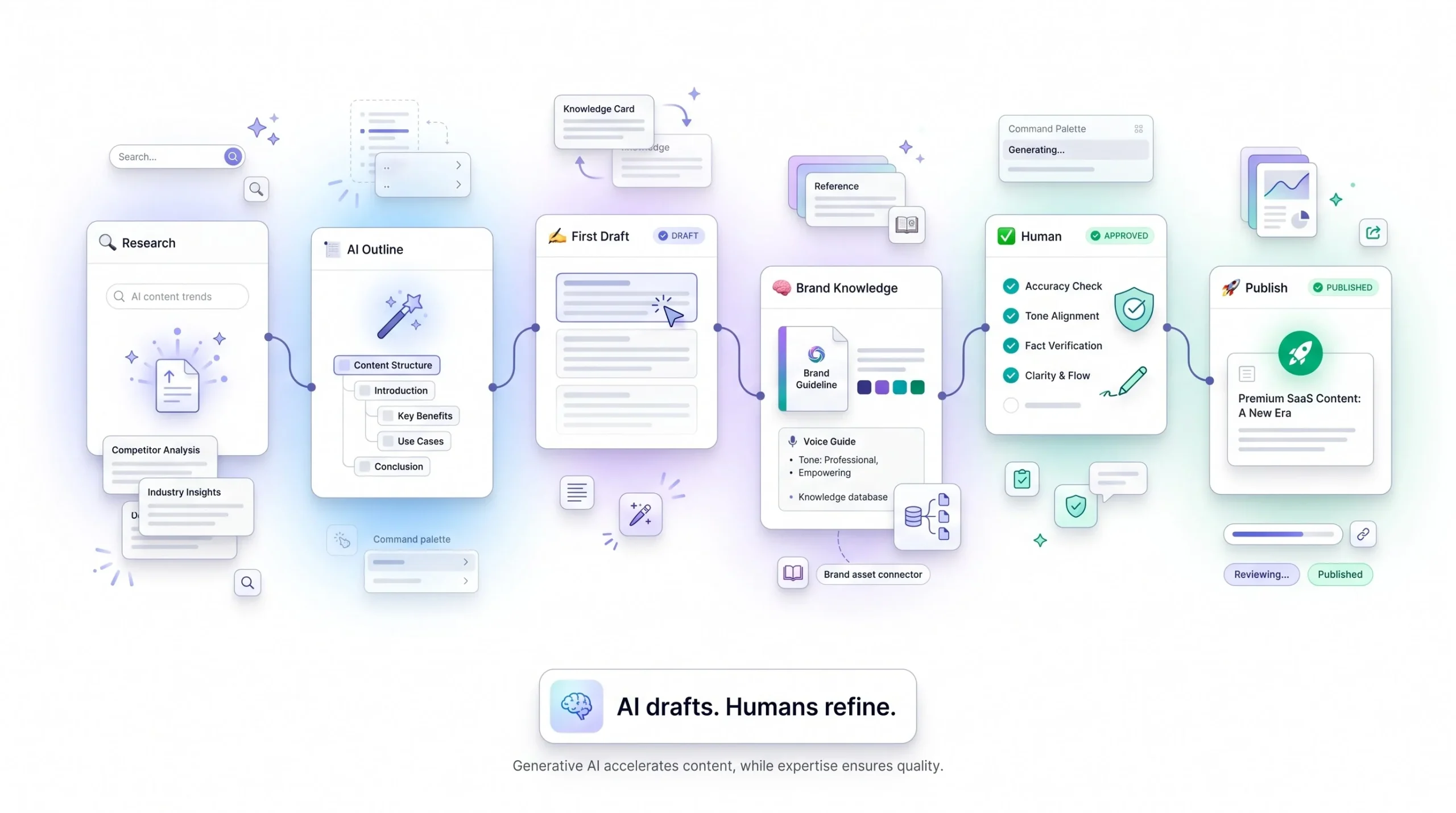
Generative AI is genuinely strong at building the skeleton of a piece before a human ever touches it, competitive outlines, research summaries, first drafts of individual sections. But there’s a technical limitation baked into this that’s worth understanding, called the context window. Every model has a maximum amount of text it can “see” at once, its own prompt plus everything it generates in response, measured in tokens. Older models had context windows small enough that they’d genuinely forget instructions given earlier in a long conversation. Modern models have windows large enough to hold entire documents, but the practical issue hasn’t fully disappeared, models still tend to pay closer attention to information near the beginning and end of a long prompt than information buried in the middle, a pattern researchers sometimes call “lost in the middle.” That’s a real, practical reason why feeding a model a massive style guide and expecting perfect adherence across a ten-section article doesn’t always work the way people expect.
The bigger issue is brand voice, and this is where RAG earns its keep. A base model with no additional context has no idea what a specific brand’s voice actually sounds like beyond generic patterns it absorbed during training. Feeding it a handful of past pieces, along with explicit voice rules, dramatically narrows that gap, but it still doesn’t know that a specific campaign flopped six months ago because of a tone-deaf joke, or that legal quietly rejected a specific claim last quarter. That kind of institutional memory doesn’t live in any document most teams have ever written down, and no amount of prompting recovers information that was never captured anywhere in the first place.
Ad copy and social captions
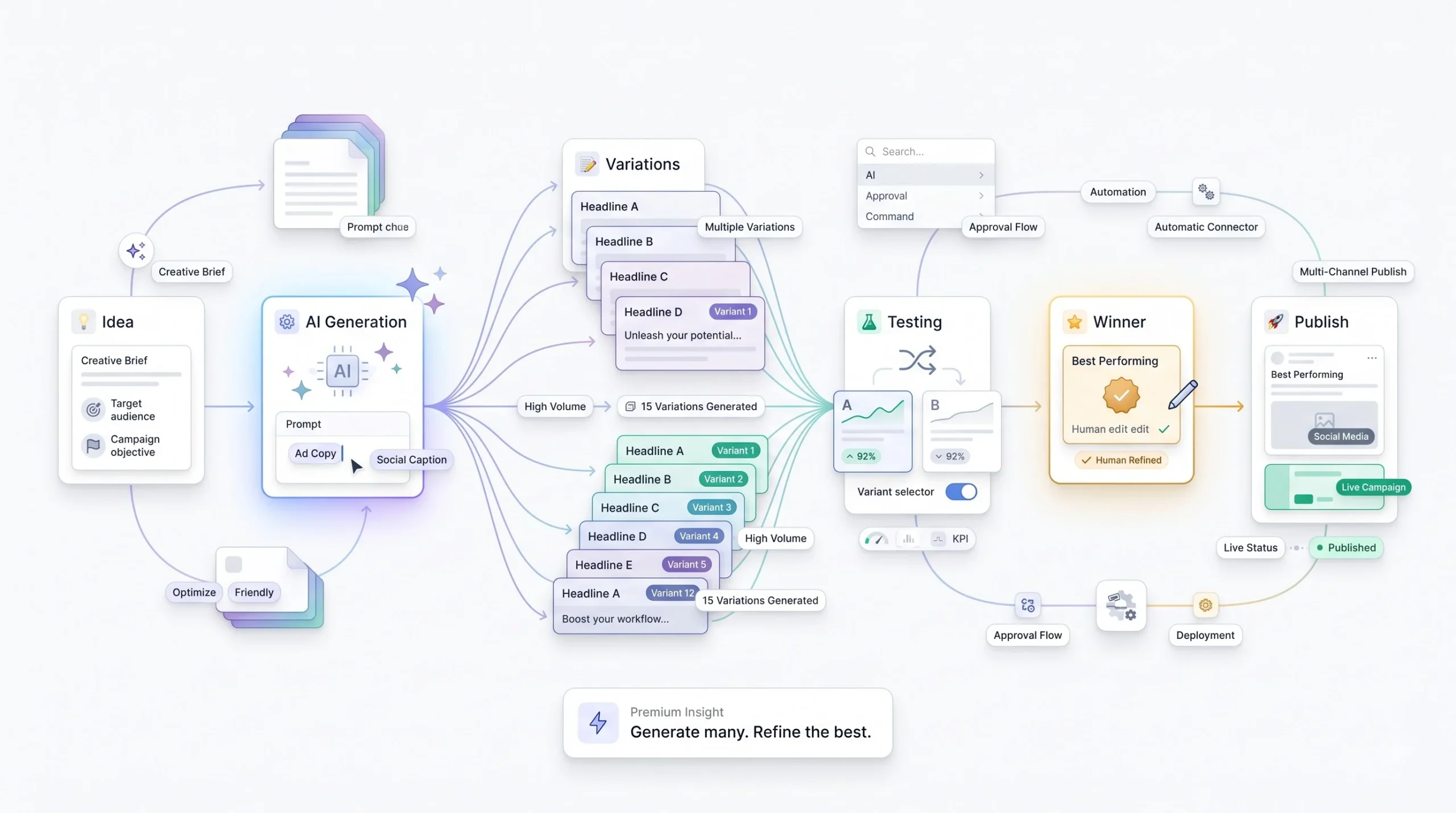
This is where the speed advantage is genuinely dramatic, and it’s worth understanding why. Generating fifteen headline variants isn’t fifteen separate creative efforts for a language model the way it is for a human copywriter. It’s the same underlying prediction process, run with slightly different random sampling each time, which is exactly why setting the temperature parameter mentioned earlier matters for this specific use case. Higher temperature produces more varied, more creative-feeling variants, useful for genuine A/B testing. Lower temperature produces safer, more predictable output, more useful when brand safety matters more than creative range. A copywriter used to burn a full day producing fifteen genuinely different headline angles by hand. Now that same volume takes minutes, freeing up the actual creative time for picking winners and refining the best two or three instead of grinding out the first draft of all fifteen.
Email marketing
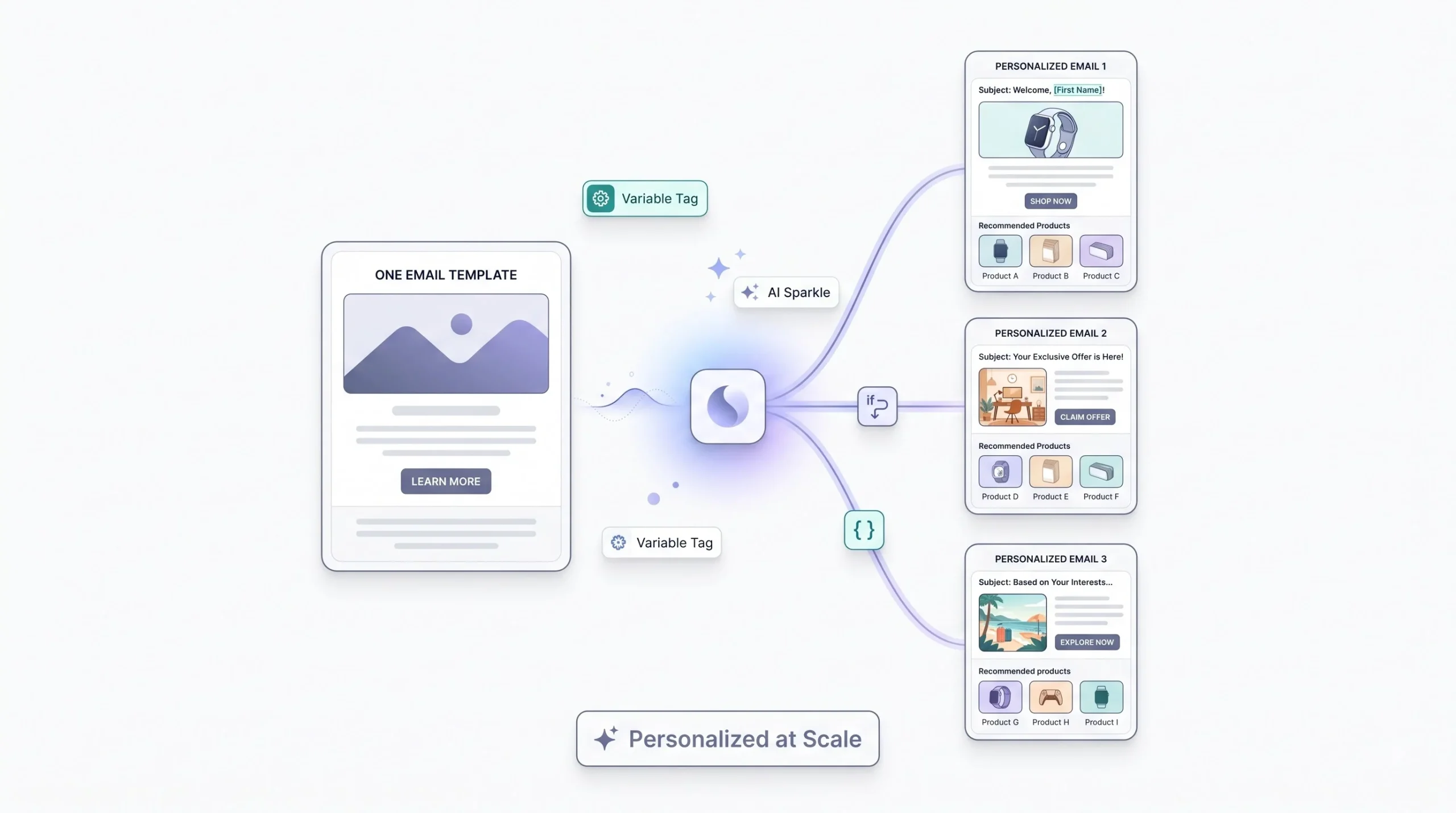
Subject lines and body copy are the obvious entry point, but the more advanced application is dynamic, real-time personalization, and this is worth explaining mechanically because it’s more sophisticated than most people assume. It’s not one email getting written and then blasted to everyone. It’s a template with variable slots, fed by a customer data platform in real time, where the generative model fills those slots based on live signals like browsing behavior, purchase history, even something as specific as local weather at the moment the email gets triggered. One documented example involved a model dynamically generating subject lines, body copy, and product image selection based on exactly this kind of real-time behavioral and contextual data, and it reportedly drove a 22% increase in click-through rate. That’s not a trivial bump. That’s the kind of number that gets an entire email team rethinking whether static, one-size-fits-all campaigns still make sense at all.
Product descriptions and SEO content at scale
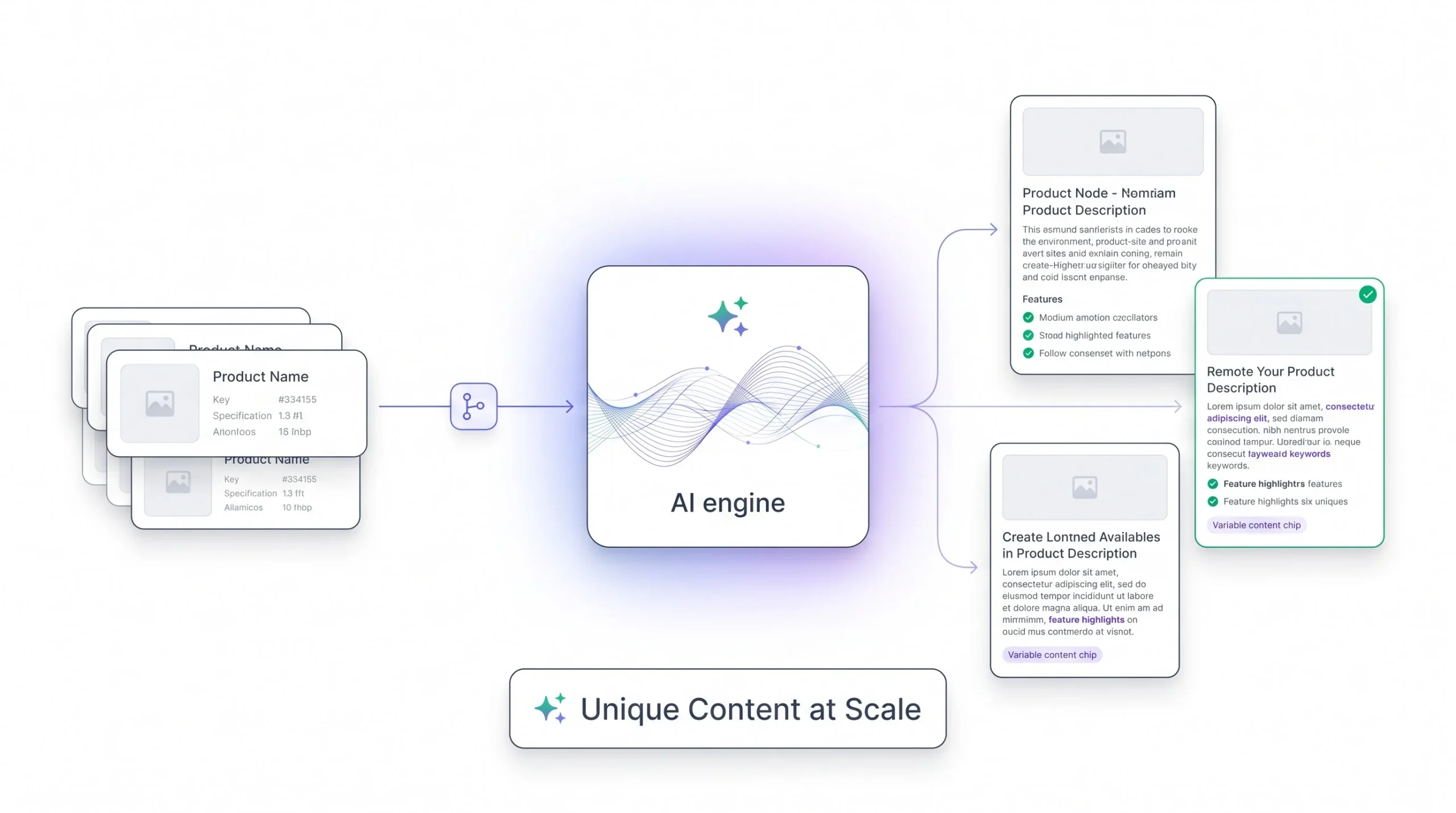
For anyone managing an e-commerce catalogue running into the thousands of SKUs, this is a genuine unlock, but it comes with a real risk worth naming directly. Search engines have gotten noticeably better at identifying thin, templated, mass-generated content, meaning the same basic structure copy-pasted across thousands of product pages with only the noun swapped out. That kind of output can actively hurt SEO instead of helping it. The fix isn’t avoiding generative AI for this task, it’s feeding the model enough distinct, specific input per product, actual specifications, actual use cases, actual differentiators, so the output varies meaningfully instead of reading like the same five sentences wearing a thousand different outfits.
Tip: Generative AI writes the first draft. It doesn’t know your brand’s actual voice, your last campaign’s flop, or what your legal team will reject, and it doesn’t have that context unless someone deliberately feeds it in. Treat every output as a draft built from patterns, not a deliverable built from judgment.
Visual and Video Content
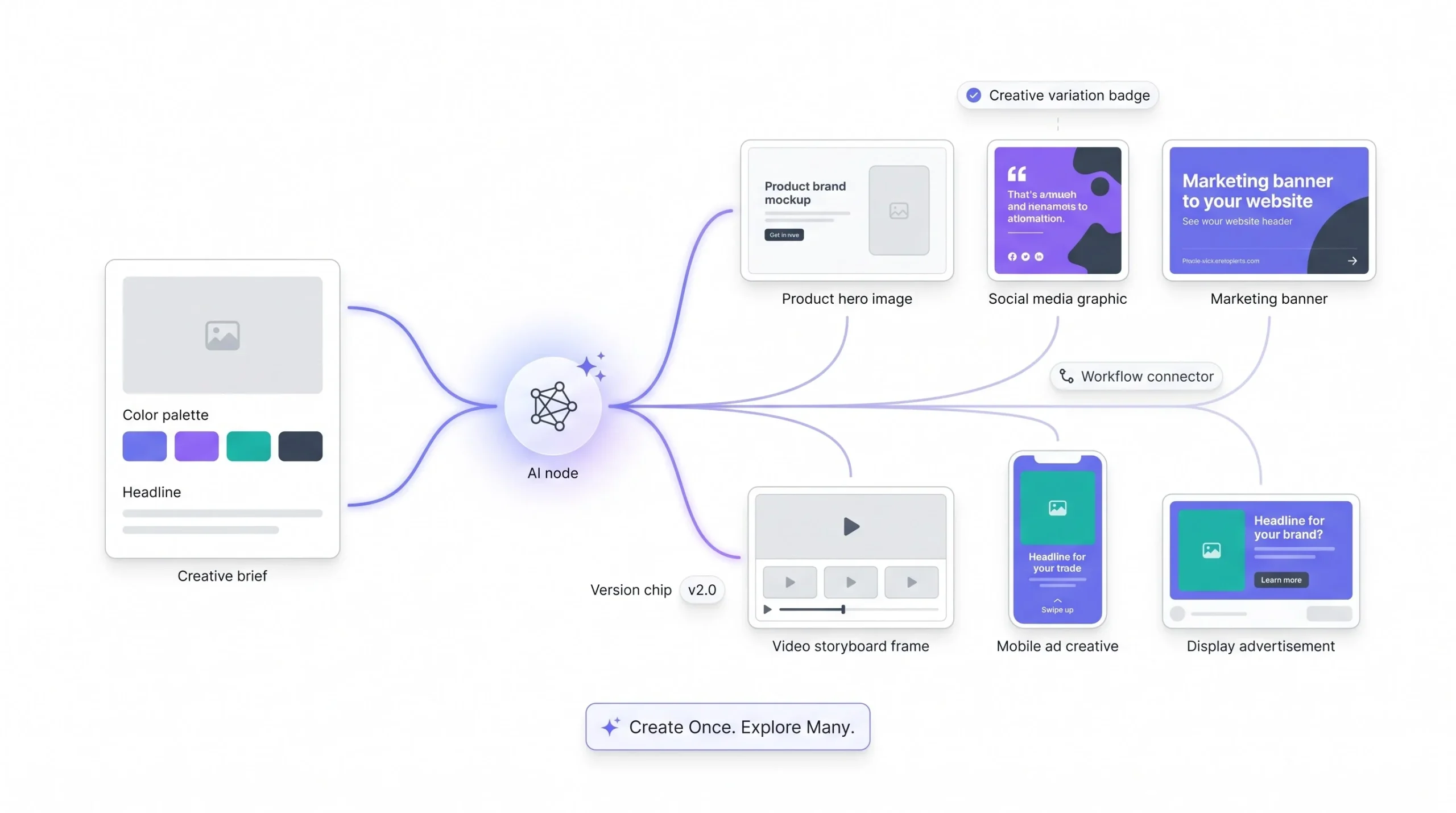
Text gets most of the attention in these conversations, but the visual side has moved just as fast, and for a lot of small teams without a dedicated design department, it’s arguably the bigger unlock.
Image generation
The diffusion process explained earlier, noise getting progressively removed and guided by a text prompt, is why image generation behaves the way it does in practice. Broad, common visual concepts, a person standing in an office, a product on a clean background, render reliably because the training data contained enormous numbers of similar examples for the model to learn consistent patterns from. Highly specific or unusual requests, an exact proprietary product design, a very particular brand color used in a very particular way, render far less reliably, because the model is essentially interpolating between patterns it’s seen before rather than truly understanding a specific, novel object it’s never encountered.
Video generation
Video generation takes the same diffusion logic and adds a dimension that makes it dramatically harder, temporal consistency. A static image only needs to be internally coherent once. A video needs every single frame to stay consistent with the frames before and after it, meaning a character’s face, an object’s shape, the lighting in a scene, all need to hold steady across potentially hundreds of frames. This is the core reason video generation has trailed image generation technically, and why generated video sometimes shows objects subtly warping or shifting between frames in a way a generated still image never would.
Design iteration speed
Here’s the actual strategic shift, and it’s bigger than the tools themselves. Creative testing used to be gated by production cost, producing even one new visual variant meant real time, sometimes a real photoshoot. That gate meant only a handful of creative options ever got tested, and the choice usually came down to a creative director’s opinion carrying the whole campaign. Now, producing five, ten, twenty visual variants costs almost nothing in comparison, which means the decision can shift from opinion to actual performance data. That’s a genuinely different way of making creative decisions, not just a faster version of the old way.
Worth being blunt here. This stuff still isn’t flawless. Hands still render wrong sometimes, for the exact reason explained in the mechanics section above. Text inside generated images is frequently garbled, same underlying reason, pixel-level precision doesn’t diffuse cleanly the way broad shapes do. And keeping a visually consistent brand look across dozens of separately generated assets takes real, deliberate effort, usually through carefully engineered prompts and reference images, not a single button press that magically respects a brand guideline the model was never actually trained on.
Personalization at Scale
This is the part most beginner guides skip entirely, or mention in a single throwaway line, and that’s a real mistake, because the mechanics behind this are genuinely one of the more interesting shifts happening in marketing right now.
Personalization used to be gated by human labor cost. Writing a genuinely unique message for every customer segment meant paying a person to sit down and write each version, which meant only the biggest, highest-value segments ever got that treatment. Everyone else got the generic version, maybe with a first name token slotted in and nothing else meaningfully different.
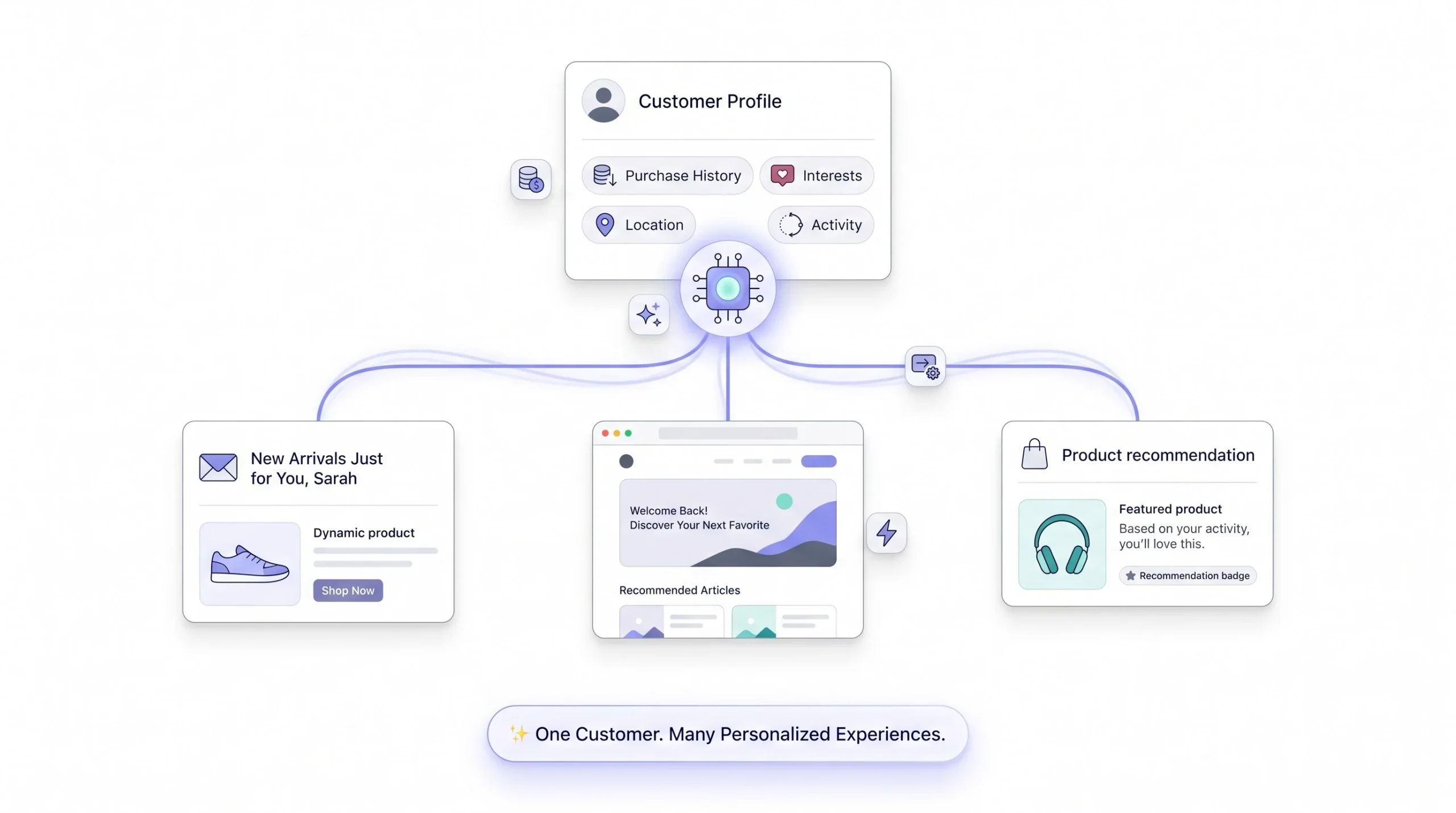
Generative AI breaks that constraint by turning personalization into a templating and inference problem instead of a writing-labor problem. A customer data platform holds structured data on each customer, behavior, purchase history, location, engagement level. At the moment a message needs to go out, that data gets fed into a prompt template alongside instructions, and the model generates the actual copy in real time, per recipient, instead of a human writing one version for an entire segment ahead of time. This is what makes near one-to-one personalization technically and economically feasible even for small segments that used to be considered too costly to bother targeting individually.
Dynamic email content
Covered in detail above in the email section, but worth restating in this context: the technical pattern is real-time inference at send time, not a pre-written template with a mail-merge field.
Personalized landing pages
Same underlying pattern, applied to a webpage instead of an email. The headline and body copy shift depending on who’s actually loading the page, a first-time visitor coming from a paid search ad sees different framing than a returning visitor who abandoned a cart last week, because the generative layer has access to that visitor’s session data and adjusts the copy accordingly.
Product recommendations that read like a person wrote them
“Customers also bought” is a recommendation engine’s output, a ranked list, which is traditional predictive AI, not generative. Generative AI’s role here is turning that ranked list into an actual sentence explaining why a specific product fits a specific customer’s situation, which reads as genuinely helpful instead of a robotic list of related SKUs. The two systems, predictive and generative, are working together here, one deciding what to recommend, the other explaining why.
Personalization used to mean picking a name field. Now it means the entire message gets constructed, in real time, around who’s actually reading it.
Paid Advertising & Campaign Management
Paid media runs on volume and speed, which makes it one of the strongest structural fits for generative AI in the entire marketing stack, and it’s worth understanding why the fit is this good instead of just accepting it as a given.
Ad variant generation
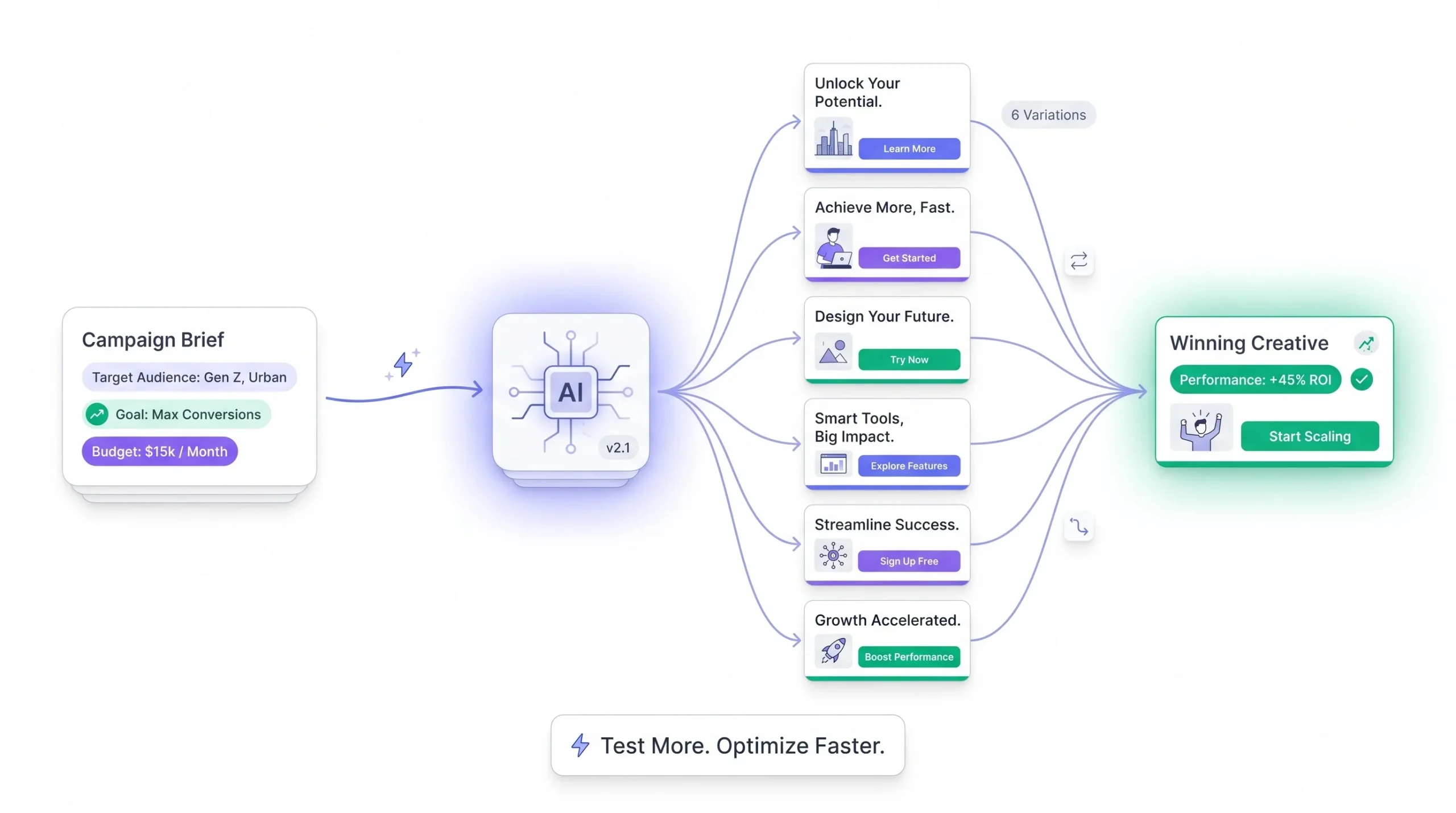
Ad platforms reward advertisers who test more variants, more often, because more data points let the platform’s own optimization algorithms find winning combinations faster. That used to mean a human hand-writing every single headline and description combination, which put a hard ceiling on how much testing volume was realistically possible. Generative AI removes that ceiling. A marketer can produce ten genuinely distinct ad copy angles for one campaign in the time it takes to grab a coffee, then let the platform’s own testing and delivery algorithms figure out which one actually converts with real audience data, instead of relying on a creative team’s best guess about which angle will land.
Worth knowing here that platforms themselves have leaned into this. Google’s and Meta’s automated campaign tools increasingly generate and test creative variations as part of their own optimization loop, meaning generative AI isn’t just something a marketer manually invokes anymore, it’s increasingly baked directly into the ad platforms themselves, running in the background of campaigns that look, on the surface, like standard automated bidding setups.
Audience and targeting insights
Instead of manually reading through a performance dashboard trying to piece together what happened, generative AI can turn raw numbers into an actual plain-English explanation. “CTR dropped because the top-performing audience segment fatigued after the third week of the same creative running” is genuinely more useful than a spreadsheet showing a percentage decline with no explanation attached. This only works well, though, when the model has access to the underlying campaign data through a RAG setup, a general-purpose chat model with no access to actual account data will produce a plausible-sounding explanation that may have nothing to do with what actually happened, which circles back to the accuracy risk covered later in this guide.
Campaign briefs and creative strategy documents
Even the strategic side benefits from this. First-pass plan-of-action decks, messaging frameworks, campaign briefs, all of these can get a working first draft in minutes instead of half a day of blank-page staring. None of these come out genuinely finished on the first pass, strategic framing still requires someone who understands where the brand is actually trying to go, but a working starting point changes how a team spends its time, shifting effort from generation to refinement.
Customer Experience: Chatbots, Support & Beyond
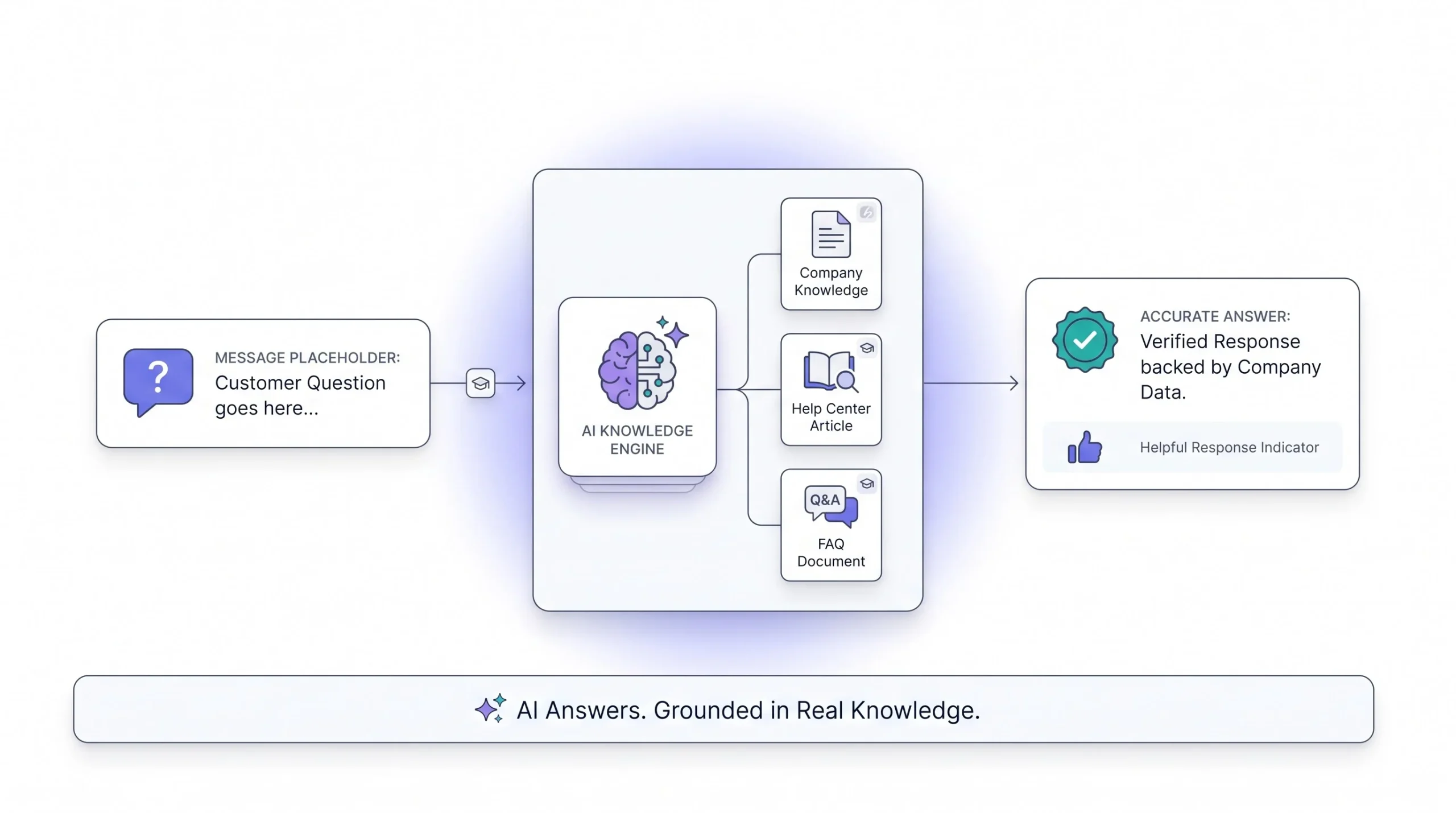
This use case sits right on the edge of marketing and customer service, but the overlap is bigger than most people give it credit for, and the technical distinction between chatbot types matters here.
Early chatbots, the rules-based kind covered in the history section, worked off fixed decision trees. Modern generative chatbots work differently, and the better ones use RAG specifically to avoid a serious problem: a general-purpose language model with no access to a company’s actual policies, pricing, or product catalogue will confidently answer customer questions with information that sounds right and is completely wrong. RAG fixes this by retrieving the actual relevant company documents at the moment a question comes in, feeding them to the model alongside the customer’s question, so the response is grounded in real, current company information instead of general patterns absorbed during training.
FAQ pages and help-center articles benefit from generative drafting too, and this matters more than it sounds like on paper, because a badly written help article is often the exact reason a customer gives up and leaves a bad review instead of finding the answer they needed.
The marketing overlap shows up specifically in chat-based lead capture and product discovery. A visitor asking a chatbot “what’s the difference between your two pricing plans” is, functionally, a marketing touchpoint, even though it looks like a pure support interaction on the surface, and increasingly these chat interactions get treated as qualified leads worth handing off to a sales team, not just closed support tickets.
Analytics, Reporting & Strategic Insight
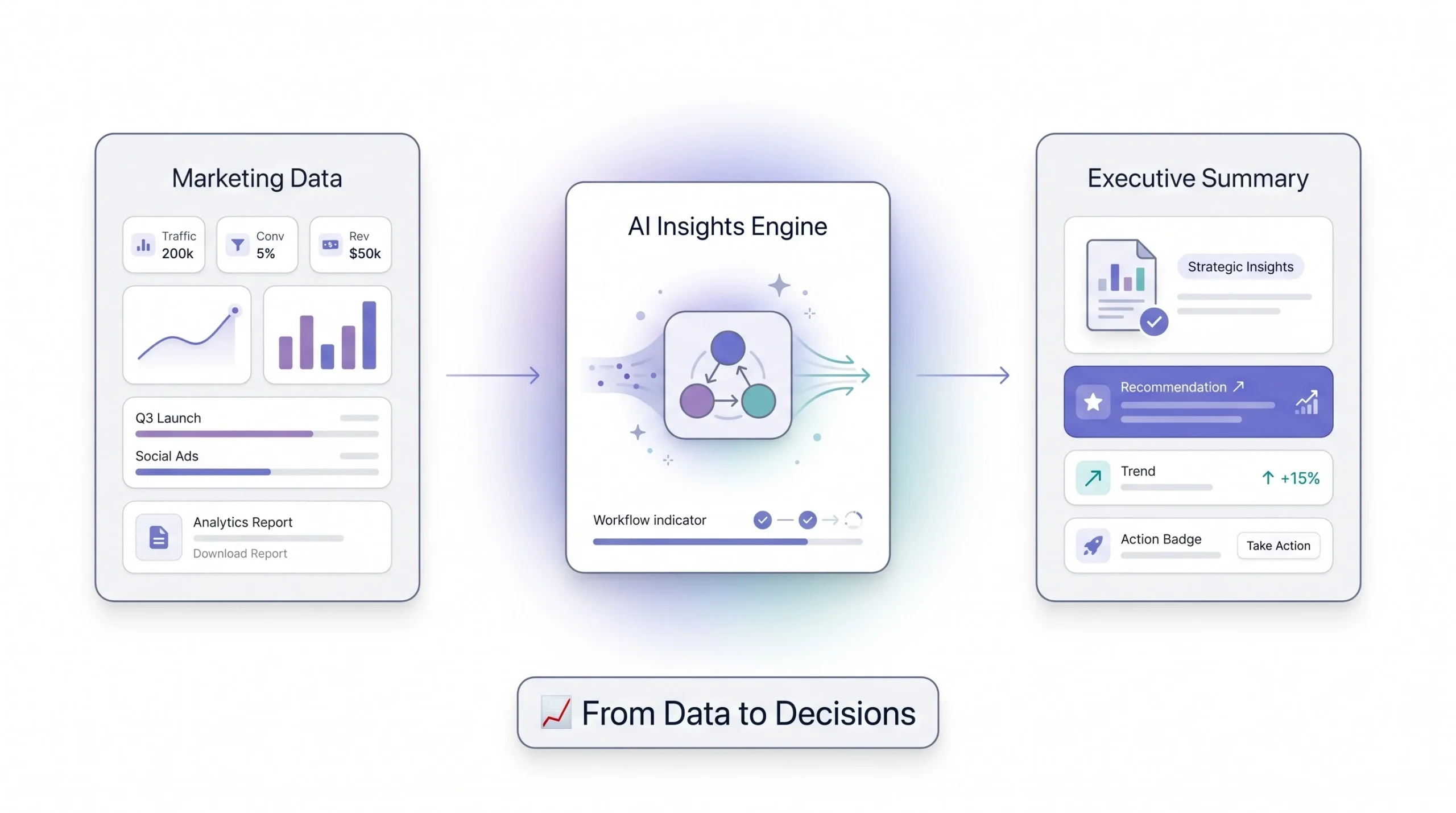
Most guides on this topic treat generative AI purely as a creative tool. That’s underselling it badly. The reporting and analysis side is just as valuable, and it’s the part that quietly saves the most hours every single week without anyone talking about it much.
Summarizing campaign performance into an actual readable narrative instead of a raw dashboard full of numbers changes how fast a team can act. This works through the same RAG pattern covered above, campaign data gets retrieved and fed into the model alongside a request to explain what happened, and the model constructs a plain-English narrative grounded in that specific data rather than generic knowledge about what usually causes CTR to drop.
There’s a real limitation worth flagging here directly, because it’s the kind of thing that causes real mistakes if ignored. A generative model summarizing performance data can describe correlation convincingly and make it sound like causation, because fluent, confident language is exactly what these models are built to produce regardless of whether the underlying claim is actually proven. “CTR dropped because of creative fatigue” might be the correct explanation, or it might just be the most statistically plausible-sounding explanation given the data it was shown, with the real cause being something else entirely, a tracking pixel issue, a seasonal dip, a competitor’s promotion. Treat these summaries as a strong starting hypothesis worth investigating, not a verified conclusion.
The same underlying skill applies to competitor and market research. Instead of manually reading through ten competitor landing pages and taking notes by hand, a marketer can get a summarized comparison in minutes, though the same accuracy caveat applies here too, worth spot-checking specific claims against the actual source pages before repeating them in a strategy document a client will read.
What Generative AI Can’t Do (Yet), Setting Realistic Expectations
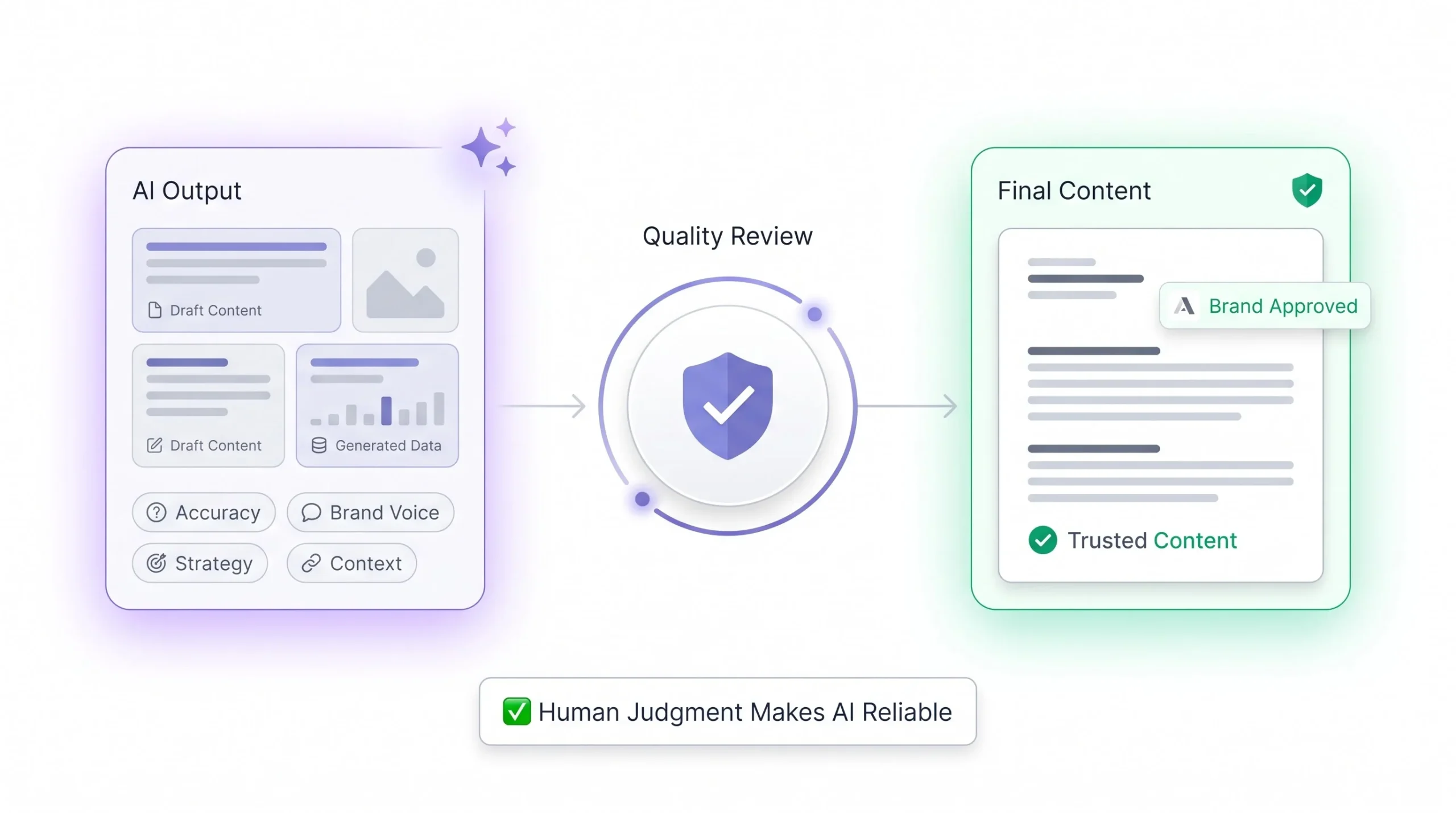
Every guide on this topic that skips this section is either selling something or hasn’t used these tools enough to know better. This is the honest part, and it deserves real depth, because most of the expensive mistakes teams make with generative AI trace back to not understanding exactly why these limitations exist.
It hallucinates, and understanding why matters more than just knowing that it happens. A language model doesn’t have a database of verified facts it looks things up in. It predicts the next most statistically plausible token based on patterns learned during training. Most of the time, that produces accurate output, because accurate information dominates the patterns in the training data. But when a model doesn’t actually “know” something, it doesn’t have a built-in mechanism to say “I don’t know.” It keeps predicting plausible-sounding tokens anyway, which is exactly why a fabricated statistic or an invented source reads with the exact same fluent, confident tone as something completely true. This isn’t a bug that gets patched out eventually, it’s a direct consequence of how the underlying prediction mechanism works, which means it needs a permanent human fact-checking layer, not a wait-for-the-next-update mindset. Roughly 44% of organizations using generative AI have already run into real negative consequences from exactly this, and inaccuracy is the single most cited reason.
It doesn’t know your brand unless someone explicitly teaches it, and most of what makes a brand voice work never gets written down anywhere. This is a knowledge-capture problem, not a technology problem. Why a specific message landed well in one segment but flopped in another, which claims legal quietly rejected last quarter, which tone reads as confident in one market and pushy in another, none of that typically exists in any document a model could be fed even through RAG. Recent research on exactly this gap found that 75% of leaders consider preserving that kind of institutional knowledge critical as teams change, but only 9% feel like they actually have a system for capturing it. Skip that step and the output comes back fluent, grammatically flawless, and completely off-brand, and fixing that after the fact eats up more time than writing it correctly from scratch would have.
It has a knowledge cutoff, and that matters more in marketing than most people assume. Every model gets trained on data up to a certain point in time, and anything after that point simply isn’t in its learned patterns unless it’s specifically given that information in the prompt or through a connected tool. A model asked about current campaign trends, this quarter’s platform algorithm changes, or a competitor’s product launched last month may confidently answer based on outdated patterns from its training data, with zero built-in signal that the information might be stale.
It can’t replace strategic judgment. It can generate ten ad variants in minutes. It can’t independently know which one actually fits where the brand is trying to position itself next quarter, or whether a specific campaign angle quietly contradicts something the sales team promised a client last month. That kind of judgment requires understanding the whole business context, not just the text of a single prompt.
Cultural nuance still needs a human eye, and this gets ignored constantly. In Japan, for example, awareness of AI-generated content has already reached 77.5%, and audiences that detect impersonal, obviously AI-only content tend to respond to it badly. Generic global messaging that ignores this kind of cultural context isn’t just a missed opportunity, it actively damages trust with the exact audience it’s supposed to be reaching, and no amount of prompt engineering fixes a cultural blind spot the model was never trained to recognize as a blind spot in the first place.
Fluent isn’t the same as accurate, and grammatically correct isn’t the same as on-brand. The gap between the two exists because of exactly how these models generate output, and it’s exactly where human review still earns its place.
Risks, Governance & Using It Responsibly
This isn’t a legal deep dive, and it doesn’t need to be one for a marketer to grasp the real stakes here. But skipping this section entirely would be genuinely irresponsible, so here’s the version that actually matters in practice.
Data privacy, and specifically what happens to what gets pasted into these tools. Client data, unpublished campaign briefs, anything confidential, none of that belongs in a public AI tool without first checking whether that specific tool’s terms keep inputs private or use them for future model training. Under frameworks like the EU AI Act, tracking exactly where data travels from an internal system out to an external model, sometimes called data lineage, is becoming a genuine compliance requirement for companies operating in or serving those markets, not just a nice-to-have internal policy.
Shadow AI is a real, seriously underrated problem. Around 80% of employees are already using AI tools their company never formally approved, while only about 12% of companies actually have a formal AI governance policy in place. That gap is enormous, and it tends to spread through channels that traditional IT security doesn’t monitor well, personal browser extensions, free tool sign-ups using a work email, features quietly bundled into everyday productivity software nobody flagged as “an AI tool” in the first place. Marketing teams sit right in the middle of this exposure, because the pressure to ship fast is constant and the approval process for officially sanctioned tools usually moves far slower than the actual work does.
Intellectual property and ownership questions are still genuinely unsettled. Who owns AI-generated content, and whether that content can even be copyrighted in the first place, varies by jurisdiction and is still actively being tested in courts in multiple countries. For a marketing team, the practical takeaway isn’t to avoid generative tools over this uncertainty, it’s to treat heavily AI-assisted creative as something worth a quick legal sanity check before it becomes the centerpiece of a major paid campaign or a trademarked brand asset, rather than assuming ownership works exactly the way it did with fully human-made work.
Disclosure and authenticity. There’s no single universal rule here yet, but the honest approach tends to age better than getting caught hiding it later. When AI involvement in content genuinely matters to an audience’s trust, being upfront about it tends to cost far less credibility than a customer discovering it after the fact and wondering what else wasn’t disclosed.
| Do | Don’t |
|---|---|
| Fact-check every AI-generated claim, especially statistics | Publish stats without verifying the original source |
| Edit for brand voice before publishing, every time | Ship the first draft as final |
| Keep sensitive client data out of public tools | Paste unpublished briefs into consumer AI apps |
| Check ownership on heavily AI-assisted creative before major campaigns | Assume AI output is automatically ownable exactly like human-made work |
| Disclose AI use where it matters to audience trust | Pass off fully AI-written work as entirely human when it matters |
How to Actually Get Started (A Practical First Step)
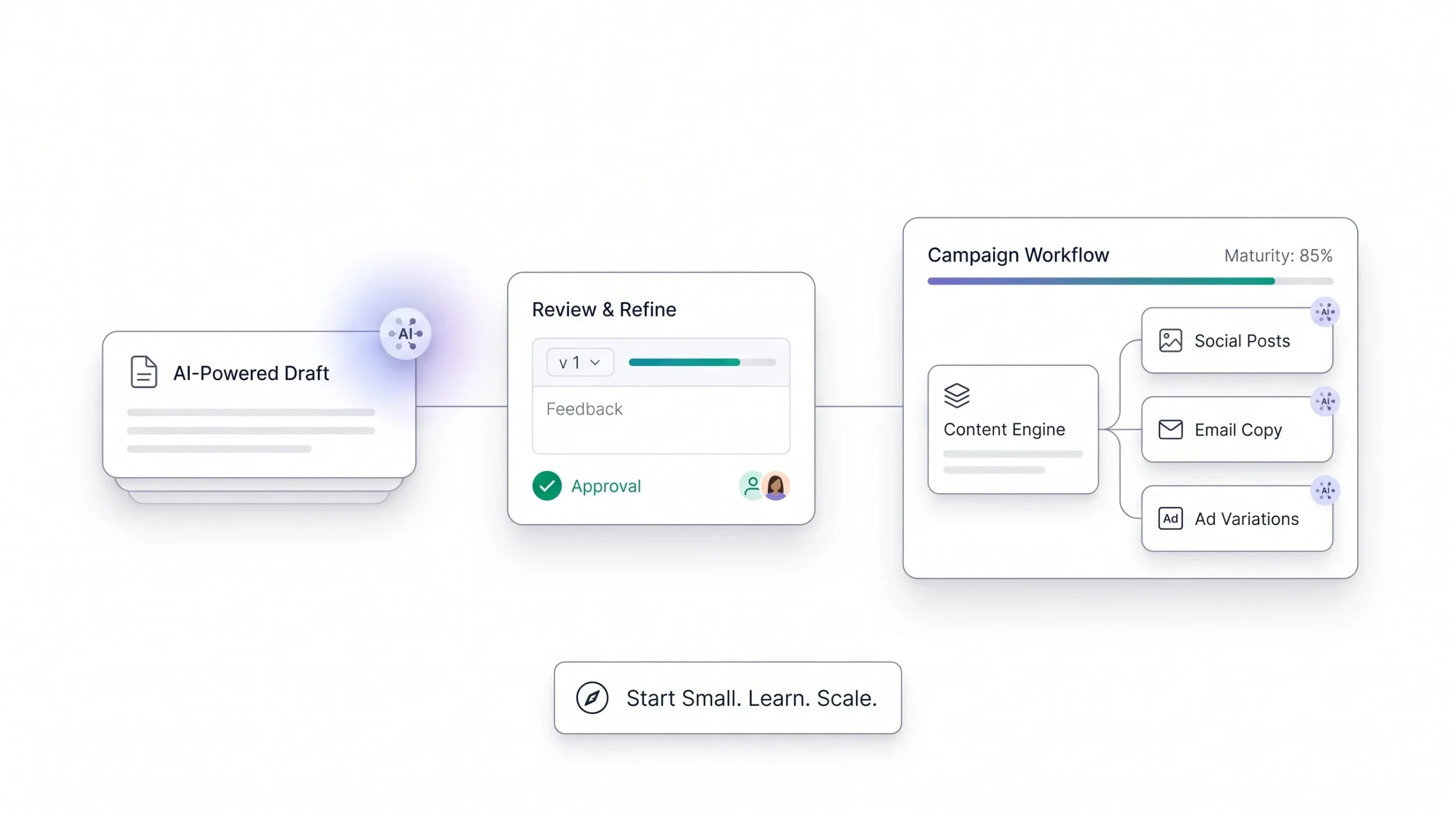
Every guide like this needs to end with something a person can actually act on Monday morning, not just a stack of concepts to nod along with.
Pick one narrow use case first, not “AI everything” across the whole stack at once. Spreading thin across ten use cases simultaneously is exactly how budgets get burned and internal trust gets lost before the tooling ever proves its actual value. Start specific. Email subject line testing. Ad copy variants for one live campaign. One thing, executed well, with clear before-and-after numbers to point to, beats five things done sloppily with nothing measurable to show for it.
Start with tasks that already have a human review checkpoint built in. Ad copy that gets approved before it ships. Blog drafts that pass through an editor. Anything with an existing checkpoint is a far safer starting point than something that goes live untouched, because the review step catches the hallucination and off-brand-voice problems covered earlier before they ever reach a customer.
Build a real internal brand-voice reference, not just a vague mental sense of “how we sound.” It doesn’t need to be a fifty-page document. A short reference covering tone, banned phrases, a handful of concrete good-versus-bad output examples, and a couple of past mistakes worth avoiding, gives a RAG setup or even just a well-crafted prompt something concrete to work from instead of guessing based on generic training patterns.
Treat the first month as calibration, not full automation. Nobody gets this dialed in on day one. The first few weeks are genuinely about figuring out where the tool saves real time and where it quietly creates more editing work than it saves. That’s normal, and it’s the actual process of learning the tool’s real strengths and blind spots inside a specific brand’s context, not a sign that something’s being done wrong.
Conclusion
None of this is really about replacing marketers. That framing gets thrown around constantly, and it misses what’s actually happening underneath the hype. It’s about where time goes. Less of it spent staring at a blank page or manually reading through a dashboard line by line, more of it spent deciding which draft is genuinely good enough to ship, which explanation actually holds up under scrutiny, and which creative angle is worth betting a real budget on. Generative AI is a co-pilot with real production capability, built on prediction and pattern-matching, not a replacement for the judgment that decides what’s actually worth making in the first place.
Where this heads next is fairly visible already: campaigns that plan, write, design, and launch with barely any human input at each individual step. That’s coming, probably faster than most teams currently expect. But the brands that actually win with this won’t be the ones that hand over the keys entirely and hope for the best. They’ll be the ones that understand exactly how these systems work well enough to know precisely where to let the machine run free and precisely where to keep a trained human hand firmly on the wheel.
Frequently Asked Questions
Is generative AI the same thing as ChatGPT?
No, and this mix-up happens constantly. ChatGPT is one specific product built on top of a large language model. Generative AI is the broader category that ChatGPT belongs to, along with Claude, Gemini, Midjourney, and every video and audio generation tool out there. Calling all of generative AI “ChatGPT” is a bit like calling every search engine “Google,” it’s the most famous name in the category, not the category itself. The distinction matters in marketing conversations because different tools inside that category are built for different jobs, text versus image versus video, and picking the wrong one for the task is a common early mistake.
Is generative AI free to use for marketing?
Most tools offer some kind of free tier, but the free version usually comes with real limits, slower response times, fewer generations per day, older or weaker underlying models, and sometimes your inputs get used to train future versions of the model, which is a genuine concern if you’re pasting anything client-related. For any serious, ongoing marketing use, a paid plan is basically the standard, and the cost usually pays for itself fast once you count the hours it replaces on repetitive drafting work.
Will generative AI replace marketers?
Not in the way that question usually gets framed. It’s already replacing specific tasks, first drafts, variant generation, basic reporting summaries, the stuff that used to eat hours without requiring much judgment. What it isn’t replacing is the strategic thinking underneath those tasks, knowing which draft is actually good, which angle fits the brand, which claim will get legal in trouble. The marketers who struggle aren’t losing to the technology directly, they’re losing to other marketers who learned to use it well and now move faster on the parts that don’t need a human.
How accurate is AI-generated marketing content?
Fluent, but not automatically accurate, and the gap between those two things is the whole point of the accuracy section earlier in this guide. These models predict plausible-sounding text, they don’t look facts up in a verified database. Statistics, sources, and specific claims need a human fact-check every single time, no exceptions. Around 44% of organizations using generative AI have already run into real problems from exactly this, with inaccuracy topping the list of causes.
Can generative AI write my whole content calendar?
It can draft one fast, topics, angles, even rough outlines for a month or two at a time. What it can’t do well on its own is know which topics actually matter for your specific audience right now, what a competitor just launched, or what your sales team is hearing on calls this week. Treat an AI-generated calendar as a strong starting skeleton that a human still needs to sanity-check against what’s actually happening in the business.
Is AI-generated content bad for SEO?
Not inherently, but thin, templated, mass-generated content is, and that’s true whether a human or a machine wrote it. Search engines have gotten noticeably better at spotting the same generic structure copy-pasted across hundreds of pages with only a few words swapped out. The fix is feeding the model genuinely specific input per piece and editing hard before publishing, not avoiding the tool altogether.
Do I need to disclose that content was made with AI?
There’s no single universal rule covering every platform and region right now. But as a general practice, being upfront when AI involvement genuinely matters to your audience’s trust tends to hold up a lot better over time than getting caught hiding it. Worth checking specific platform policies too, since some ad platforms and publishers have started asking for disclosure directly.
What’s the difference between generative AI and marketing automation?
Marketing automation moves things through a workflow, sends the email at the right time, triggers the follow-up, updates the CRM. It doesn’t create anything new, it executes rules someone already set up. Generative AI creates the actual content, the email copy, the ad variant, the image. A lot of modern marketing stacks combine both, automation handling the “when” and “who,” generative AI handling the “what gets said.”
How does a small team start using generative AI without a big budget?
Pick one narrow task first instead of trying to overhaul the whole workflow at once, something like ad copy variants or email subject lines, since both have a fast, measurable before-and-after. Most tools have a usable paid tier well under what a single freelance copywriter costs per month. Start there, get comfortable with what it actually saves versus what still needs heavy editing, then expand from that one proven use case instead of buying five tools at once and using none of them properly.
Is it safe to use generative AI with customer data?
Only with tools that explicitly guarantee your data stays private and isn’t used for training, and even then, sensitive or personally identifiable customer data shouldn’t get pasted into a general-purpose public chat tool as a habit. Enterprise-grade setups with proper data handling agreements exist for a reason, and if a marketing team is working with real customer data regularly, that’s the setup worth pushing for internally instead of relying on whatever free tool is fastest to open in a browser tab.
Does generative AI automatically understand my brand voice?
No, and this is one of the most common expectations that trips people up early on. A base model with no extra context only knows generic patterns from its training data, not your brand’s specific tone, past mistakes, or the claims your legal team already rejected. It needs to be explicitly taught, through a real style guide, example pieces, and clear do’s and don’ts, before the output stops sounding like everyone else’s AI-generated content.
What’s the real difference between generative AI and the predictive AI marketers already use?
Predictive AI analyzes existing data and outputs a number, score, or ranking, think lead scoring or churn prediction. It doesn’t create anything, it classifies patterns. Generative AI creates new content from scratch, text, images, video. Plenty of marketing stacks now run both side by side, predictive AI deciding who to target, generative AI writing what to actually say to them.