

So you’ve probably noticed this already: some blog posts sit around getting three visitors a month while others just… take off. Same website. Same writer sometimes. Same effort, maybe even less effort on the one that blew up. That’s not luck, and it’s not magic. It’s the type of content, how it matches what people are actually searching for, and whether Google (and now AI search engines) trust it enough to show it to people.
Here’s the thing nobody tells you when you start writing online: publishing more content does not automatically mean more traffic. I’ve seen sites push out three posts a week for a year and barely move the needle, while a competitor drops one genuinely useful comparison page and it pulls in 40,000 visits a month for three years straight. Volume isn’t the game anymore. It never really was, but now it’s obvious.
Google changed how it evaluates pages. AI search engines like ChatGPT, Perplexity, and Gemini changed where people even go to ask questions in the first place. And users themselves got pickier — they can smell thin, recycled content from a mile away, even if they can’t articulate why a page feels “off.”
This guide breaks down exactly which types of content get the most traffic, why they work, and how you can build them for your own site. We’re not doing vague theory here. We’re going through 25 actual content types, real traffic sources, and the mechanics behind why some pages rank and convert while others just sit there collecting dust.
What You Will Learn in This Guide
- The different types of traffic and which content wins on each one
- How Google actually decides what gets ranked and shown
- Why matching search intent beats keyword stuffing every single time
- 25 content formats that consistently pull in traffic, with real examples
- Which content types generate backlinks versus which ones convert visitors into customers
- How AI search is reshaping what “getting traffic” even means
- A step-by-step framework you can actually use, not just admire
Let’s get into it.
What Does “High-Traffic Content” Actually Mean?
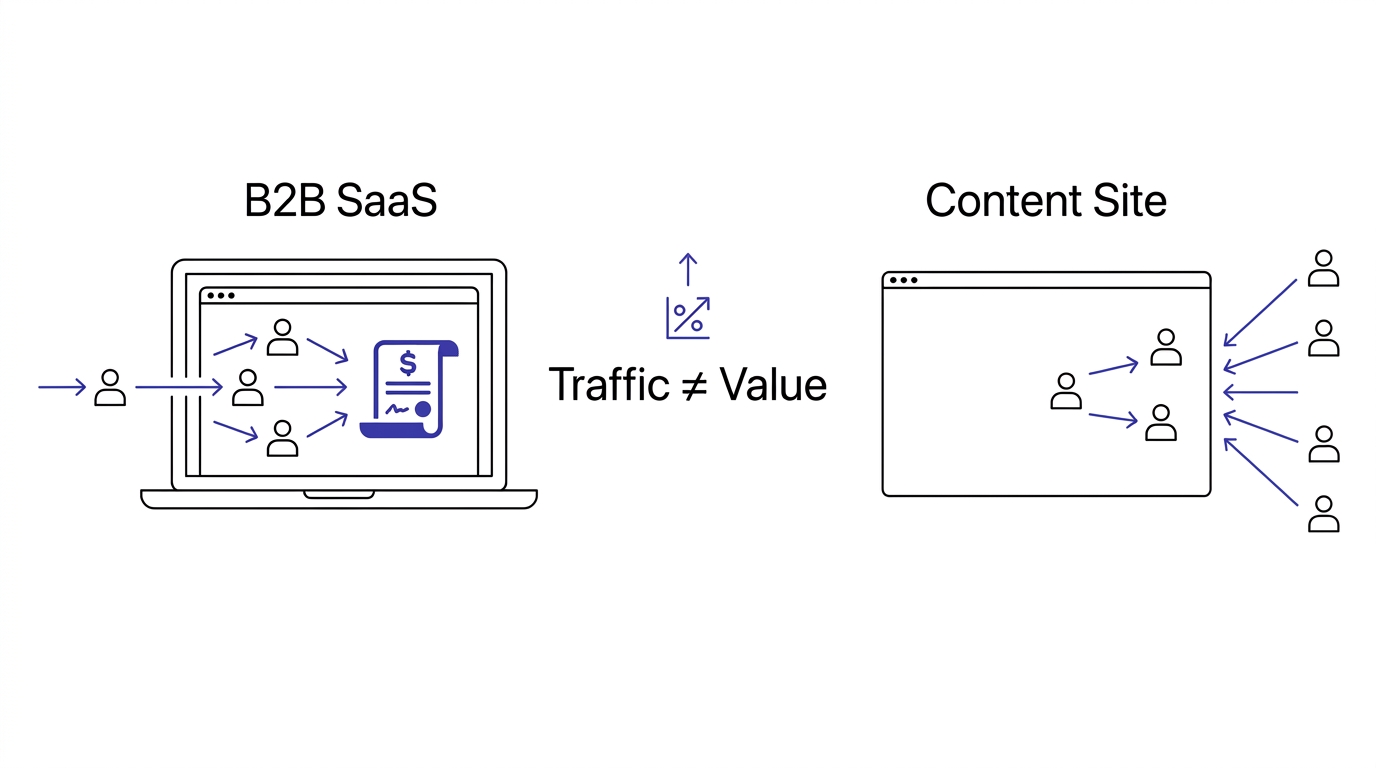
Before we go further, let’s get one thing straight. “High traffic” doesn’t mean the same thing for every business. A B2B SaaS company might consider 2,000 visits a month to a comparison page a massive win because those visitors convert into $10,000 contracts. A recipe blog might need 200,000 visits a month just to make decent ad revenue. So when we talk about traffic, we need to talk about where it’s coming from too.
Organic Traffic
This is traffic from unpaid search results — someone types a question into Google, your page shows up, they click. It’s the most valuable traffic long term because you’re not paying per click and it keeps coming in months or years after you hit publish. A guide you wrote in 2023 can still be pulling in visitors today if you keep it updated and it still matches what people search for.
Social Traffic
This comes from platforms like LinkedIn, X, Instagram, or Facebook. It spikes fast and dies fast. Post something good on LinkedIn and you might get 5,000 visits in two days, then almost nothing after that. It’s great for awareness, not so great as a long-term traffic engine unless you’re posting constantly.
Referral Traffic
This is when other websites link to your page and people click through. It’s a strong trust signal for Google too, since backlinks are still one of the heaviest ranking factors. A single mention from a big publication can send thousands of visitors and also boost your rankings for months afterward.
Direct Traffic
People typing your URL straight into the browser or using a bookmark. This usually means brand recognition. New sites basically get zero direct traffic. Established brands live off it.
AI Search Traffic
This is the newer one. People are asking ChatGPT, Perplexity, or Google’s AI Overviews questions instead of typing them into a search bar and scrolling through ten blue links. If your content gets cited or referenced in those answers, you get a different kind of visibility — sometimes a click, sometimes just brand exposure without a click at all.
Video Traffic
YouTube is technically the second-largest search engine on earth, and traffic from video content behaves differently than text. People watch, then click through to your site for more detail, a template, or a purchase link.
Email Traffic
Traffic from your own list. It’s often the highest converting traffic you’ll ever get because these people already chose to hear from you. It won’t scale your total numbers the way organic search does, but it’s incredibly reliable.
Organic search wins long term because it compounds. You write something once, it ranks, and it keeps working while you sleep. That’s why most of this guide focuses on what makes content rank organically — because that’s where the real leverage is.
How Google Determines Which Content Gets Traffic
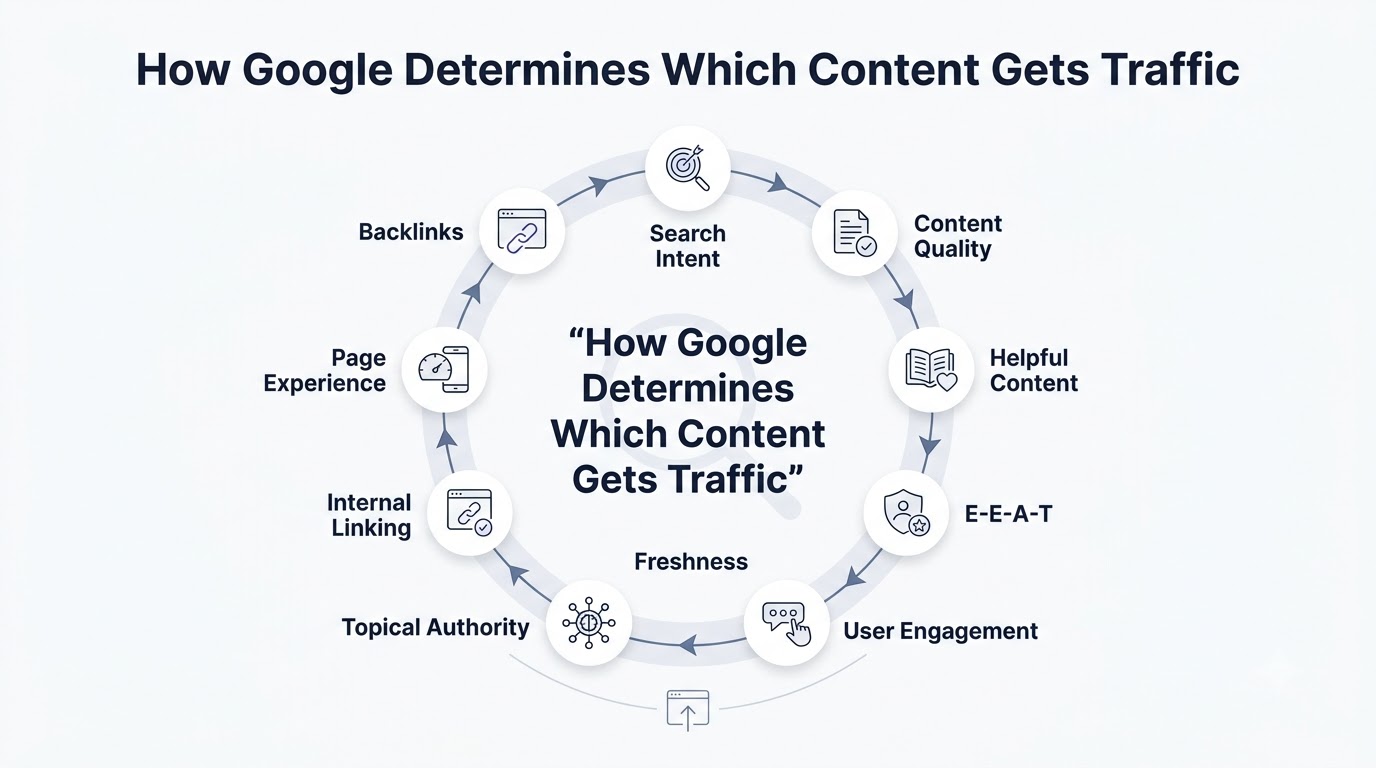
Google isn’t just scanning your page for keywords anymore. Honestly, that stopped mattering the way people think it does years ago. What Google actually cares about is whether your content solves the problem the searcher had in their head when they typed that query.
Search Intent Matching
If someone searches “best running shoes for flat feet,” they don’t want your brand story. They want a list, comparisons, maybe prices. Google reads the intent behind a query and matches content format to it. Miss the format and you won’t rank, no matter how well-written your page is.
Content Quality Signals
Depth, originality, and structure all factor in. Thin pages with 300 words and no real answer get buried. Pages that actually cover the topic — with examples, data, and clear explanations — rise.
Helpful Content System
Google’s system specifically targets content made primarily to rank rather than to help people. If your page reads like it was written for a search engine instead of a human, it gets suppressed, even if the SEO boxes are technically checked.
EEAT (Experience, Expertise, Authoritativeness, Trustworthiness)
EEAT matters more every year. Google wants to know: did the person writing this actually do the thing they’re describing? A review of a hiking backpack written by someone who’s clearly never hiked reads differently than one written by someone showing actual wear-and-tear photos from a real trip.
User Engagement Signals
How long people stay, whether they bounce right back to Google, whether they scroll — these all feed into how Google evaluates a page over time, even if Google is careful not to say exactly how much weight each carries.
Freshness
Some queries need up-to-date info (like “best laptops 2026”) and Google favors recently updated pages for those. Other evergreen topics don’t need constant updates, but stale statistics or dead links still hurt you.
Topical Authority
Sites that cover a topic deeply, with many interlinked pages, tend to outrank sites with just one article on the subject. If you’ve written 40 articles about email marketing, your 41st article about email marketing has an easier time ranking than a random site’s first attempt.
Internal Linking
Pages that are well-connected to other relevant pages on your site rank better. It helps Google understand your site structure and passes authority between pages.
Page Experience
Site speed, mobile usability, and how intrusive your ads or pop-ups are all factor in. A page that takes eight seconds to load loses people before they even read a word.
Backlinks
Still one of the strongest ranking signals that exists. Other sites linking to you tells Google that real people found your content valuable enough to reference.
The short version: intent beats keyword stuffing every time. You can cram “best CRM software” into your page fifty times and it won’t matter if the content doesn’t actually help someone compare CRM software.
What is Search Intent Before Choosing Content Type
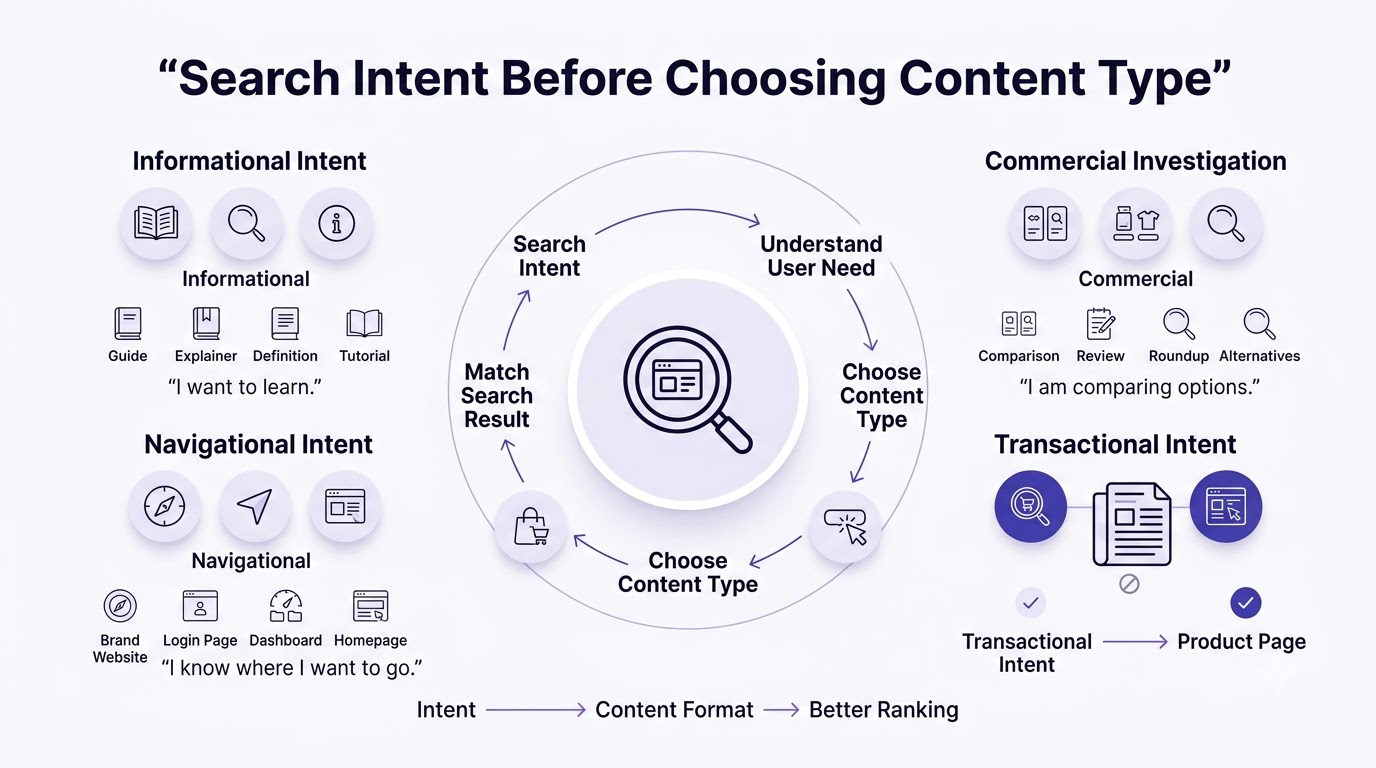
Picking a content format before understanding intent is like building a house before checking what kind of land you’ve got. It just doesn’t work.
Informational Intent
The person wants to learn something. “How does compound interest work” or “what is a content calendar.” These searches want guides, explainers, definitions. Traffic potential here is often huge because informational queries get searched a lot, but conversion potential is lower since people aren’t ready to buy yet.
Commercial Investigation
The person is comparing options before deciding. “Best email marketing tools for small business” or “Mailchimp vs ConvertKit.” These searches want comparisons, reviews, and roundups. Traffic is solid, and conversion potential is much higher because these searchers are close to making a decision.
Transactional Intent
The person wants to do something right now — buy, sign up, download. “Buy running shoes online” or “Notion pricing.” These want product pages, pricing pages, landing pages. Traffic volume is usually lower than informational searches, but conversion rates are the highest of any intent type.
Navigational Intent
The person already knows where they want to go. “Facebook login” or “HubSpot dashboard.” There’s basically nothing to rank for here unless you are the brand being searched.
Look at what actually happens when people mismatch content to intent: someone writes a 3,000-word educational guide targeting a transactional keyword like “buy noise cancelling headphones,” and it just won’t rank, because Google knows that searcher wants a product page, not an essay.
25 Types of Content That Get the Most Traffic
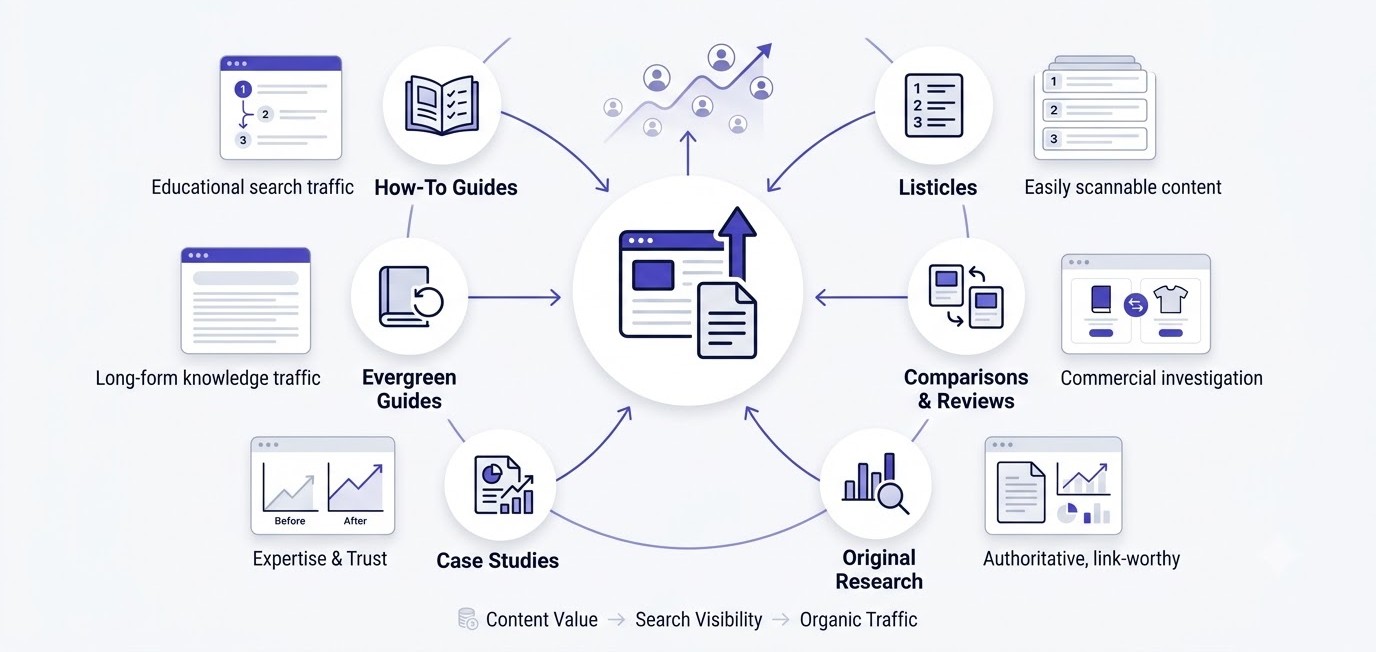
This is the meat of it. Let’s go through each one.
1. Ultimate Guides (Pillar Content)
Google genuinely loves comprehensive content because it satisfies more of a searcher’s follow-up questions in one place, which reduces the chance they bounce back to search again. Ideal word count usually lands between 3,000 and 6,000 words, though that’s not a rule carved in stone — it depends on the topic. Structure matters more than length: clear headers, a table of contents, and logical flow from basic to advanced. Think of Backlinko’s guide to link building or Ahrefs’ guide to keyword research — both are massive, both still rank years after publishing, because they cover the topic from every angle a beginner or expert might need.
2. How-To Guides
Step-by-step tutorials are some of the most reliably searched content on the internet because people constantly need to do specific tasks — “how to set up email forwarding,” “how to remove background noise from a video.” These have strong evergreen potential since the steps rarely change dramatically, and search demand for “how to” queries never really dries up. The trick is being genuinely specific. Vague steps kill trust fast.
3. Beginner Guides
Every industry has a wave of people just starting out, and they all search the same basic questions. “What is SEO,” “how does affiliate marketing work,” “what is a sales funnel.” These target high-volume keywords because beginners massively outnumber experts in any niche. Educational searches like this convert well into email subscribers even if they don’t convert into immediate sales, because beginners want to keep learning from a source they trust.
4. List Posts
“Top 20 Productivity Apps,” “Best 50 Marketing Tools,” “101 Blog Post Ideas.” Listicles get dismissed as lazy content sometimes, but honestly, they still work because they’re scannable and match how people actually browse rather than read online. People decide within seconds whether a list post is worth their time, and the format makes that decision easy.
5. Statistics & Data Roundups
Journalists and bloggers need numbers to back up their claims, and they constantly search for stat pages to cite. A well-maintained “Email Marketing Statistics 2026” page can attract backlinks for years because every writer covering that topic needs a source. This is one of the most underrated backlink magnets in content marketing.
6. Original Research
Surveys, polls, industry reports, and original case studies produce data nobody else has. That uniqueness is exactly why they attract links and traffic that competitors literally cannot replicate by copying your article. If you run a survey of 500 marketers and publish the results, you own that data point on the internet.
7. Case Studies
People trust results more than promises. A good case study walks through the actual problem someone faced, the process they used to solve it, and the measurable results that came out of it. This format converts extremely well because it shows proof instead of claims.
8. Comparison Articles
“Ahrefs vs Semrush,” “WordPress vs Wix” — these searches come from people who are actively deciding between two options, which means they’re close to buying. Buyers search comparison keywords specifically because they want someone to lay out the tradeoffs instead of marketing copy from either brand.
9. Product Reviews
Review content earns traffic because people don’t trust brand claims anymore — they want an outside opinion. Trust signals matter a lot here: real photos, specific pros and cons, actual usage details instead of just repeating the spec sheet.
10. Best Tools Articles
“Best SEO Tools,” “Best CRM,” “Best AI Writers” — these roundup pages rank extremely well because they combine informational and commercial intent in one page. Someone researching options gets a curated shortlist instead of having to compare fifteen products themselves.
11. Templates
Email templates, proposal templates, resume templates — people search for these constantly because they want to skip the blank-page problem. These often have surprisingly high search volume and low competition compared to more “content-heavy” formats, making them a sneaky good traffic opportunity.
12. Checklists
Printable resources generate backlinks because other content creators like linking out to genuinely useful tools rather than recreating them. A solid “Website Launch Checklist” can become the go-to reference other bloggers point their readers toward.
13. Industry Glossaries
A glossary page covering fifty or a hundred terms in your industry captures thousands of long-tail keyword searches — people searching “what does CTR mean” or “what is a bounce rate” — each individually small in volume, but massive combined.
14. FAQs
FAQ content is built for voice search and featured snippets. When someone asks Alexa or Google Assistant a direct question, the answer often comes straight from an FAQ-formatted page because it’s structured exactly the way spoken queries are phrased.
15. Problem-Solving Articles
“How to fix a slow WordPress site,” “why is my Instagram engagement dropping” — these searches come from people in an active moment of frustration. They want direct answers immediately, so clarity beats cleverness every time in this format.
16. Trend Reports
Annual content like market reports and industry predictions gets a traffic spike each year around the same time, and it positions you as someone tracking the pulse of your industry rather than just reacting to it.
17. Evergreen Content
This is content that stays relevant regardless of when someone reads it — “how compound interest works” doesn’t change year to year. The characteristic that makes it valuable is durability, but that doesn’t mean zero maintenance. Even evergreen pages need occasional updates for broken links or outdated screenshots.
18. Seasonal Content
Holiday campaigns, event coverage, festival guides. This content spikes hard around a specific date and then goes quiet for eleven months, which means annual planning matters — you want to publish and update these pages well before the seasonal search spike actually hits.
19. Beginner Mistakes Articles
“10 SEO Mistakes Beginners Make” style content gets a high click-through rate because people are almost more afraid of doing something wrong than they are curious about doing something right. That fear-driven curiosity translates into strong engagement once they land on the page.
20. Expert Roundups
Interviewing multiple experts on one topic and compiling their answers builds authority fast, partly because each expert you feature is likely to share the article themselves, multiplying your reach beyond your own audience.
21. Infographic-Based Content
Visual content built around data gets shared and linked to differently than plain text. An infographic summarizing a complex process attracts links from people who want to embed the visual on their own site, crediting you as the source.
22. Video Companion Articles
Pairing a YouTube video with a written article creates synergy — the video ranks on YouTube, the article ranks on Google, and each one drives traffic back to the other. People also just prefer different formats depending on context, so covering both widens your reach.
23. AI Search Optimized Content
Formatting content so ChatGPT, Gemini, and Perplexity can pull clean, structured answers out of it is becoming its own skill. That means clear headers, direct answers near the top of sections, and content that reads well even when extracted out of context by an AI Overview.
24. Local SEO Content
City pages, location guides, and service pages targeting “[service] in [city]” queries pull in highly targeted local traffic. These pages don’t need massive search volume individually because the intent behind them is so strong.
25. Industry Resource Pages
Curated resource pages listing useful tools, directories, and links become reference points other people bookmark and share. They’re less flashy than a viral listicle, but they build steady, compounding traffic over time.
Which Content Types Generate the Most Backlinks?
If you’re chasing backlinks specifically, not all content pulls equal weight. Statistics pages and original research sit at the top because they give other writers something concrete to cite — nobody links to your opinion, but they’ll link to your data. Ultimate guides come next since they’re comprehensive enough that other bloggers reference them instead of rewriting the whole topic themselves. Infographics attract links from people who want the visual without wanting to build it from scratch. Free tools are arguably the strongest of all — a genuinely useful calculator or generator gets linked from hundreds of “best tools” roundups without you doing any outreach. Industry reports round out the list, especially annual ones that become a recurring citation source.
People link to content that saves them work — either by giving them data they’d otherwise have to gather themselves, or a resource they’d otherwise have to build. Your link acquisition strategy should follow that logic: build the thing people would rather link to than recreate.
Which Content Types Have the Highest Conversion Rate?
Traffic without conversions is just a vanity metric, honestly. Buying guides convert well because they walk someone through a decision they’re already trying to make. Comparison articles convert even better since the reader has narrowed things down to two or three options and just needs the final push. Case studies build the trust that gets hesitant buyers over the line by showing proof instead of promises. Product pages and landing pages are built specifically for conversion, so naturally they perform best when the traffic hitting them already has strong intent. Product reviews sit somewhere in the middle — they convert well but usually require an affiliate link or clear next step to actually capture that intent.
Traffic alone isn’t enough because a million visitors who never buy anything or subscribe to anything doesn’t grow a business. That’s why smart content strategies mix high-traffic informational content (to build the audience) with high-converting commercial content (to turn that audience into revenue).
Evergreen vs Trending Content: Which Should You Create?
This question comes up in basically every content strategy meeting, and honestly, it’s kind of a trap. People treat it like you have to pick a side, evergreen or trending, and build your whole calendar around that one choice. That’s not really how it works in practice. The smarter question isn’t “which one should I create,” it’s “what mix actually serves my traffic goals over the next twelve months.” Let’s break both down properly first.
Evergreen Content
The benefit here is compounding value — you write it once and it keeps working for years with minor updates. Examples include “how to write a resume” or “what is inflation.” These topics don’t expire, so the traffic they generate keeps accumulating instead of resetting every few months.
Trending Content
The pros are speed and volume — trending content can spike massive traffic in a short window if you catch a topic early. The cons are obvious too: it decays fast, and once the trend passes, that page becomes basically dead weight unless you can repurpose it for the next cycle.
Best Publishing Mix
A reasonable split looks something like 60% evergreen content for long-term compounding traffic, 25% trending content to capture short-term spikes and stay relevant, and 15% seasonal content tied to specific annual moments. That mix keeps your traffic base stable while still giving you shots at bigger short-term wins.
Which Content Performs Best on Different Platforms?
Every platform trains its audience to expect a certain kind of content, and fighting that expectation just wastes your time. What crushes it on LinkedIn will flop on Pinterest. So before you repurpose one article into ten formats, it helps to actually understand why each platform rewards what it rewards.
Google Search
Google’s algorithm is built to reward pages that actually satisfy a searcher’s intent from start to finish, not pages that just touch on a topic. That’s why long-form, structured content with clear headers tends to win — it lets Google (and the reader) find the specific answer fast, while also proving the page covers the topic deeply enough to be trusted. Flashy design or clever writing doesn’t move the needle here nearly as much as depth and clarity do.
AI Search Engines
Tools like ChatGPT and Perplexity aren’t scanning for keyword density, they’re extracting the clearest, most trustworthy answer they can find and summarizing it for the user. That means your content needs to state things directly, back claims up with credible sourcing, and avoid burying the actual answer under fluff. If an AI tool can’t easily pull a clean answer from your page, it’ll just grab one from a competitor instead.
YouTube
People go to YouTube because they want to watch something happen, not read about it happening. Tutorial and demonstration content dominates because it shows the process in real time — someone setting up software, fixing a device, cooking a recipe. Text can describe a process, but video removes all the guesswork, which is exactly why it converts so well for anything hands-on or visual.
LinkedIn users scroll expecting to hear from actual humans, not brands reciting talking points. Personal insights, career lessons, and behind-the-scenes business commentary consistently outperform generic, polished blog-style posts because they feel like something a real person would say out loud, not something copywritten for engagement. The platform rewards vulnerability and specificity over corporate polish.
Instagram is a visual-first platform, so anything that requires reading a wall of text before getting to the point loses people almost instantly. Short, punchy carousels that deliver value in bite-sized visual chunks perform far better than long captions, mainly because the format matches how people actually scroll — fast, thumb-driven, and impatient.
Facebook’s algorithm still favors content that sparks conversation and sharing, especially inside niche groups where people already share a common interest. Community-driven posts that feel relatable or emotionally resonant get more traction than promotional content, because Facebook’s whole design is built around social interaction, not passive browsing.
Pinterest behaves less like a social feed and more like a visual search engine, which is a huge distinction most people miss. That’s why highly visual, evergreen content — recipes, DIY projects, design inspiration — performs so well long after posting. Pins can keep driving traffic for years, the same way an evergreen blog post keeps ranking on Google.
Reddit users can spot a marketing pitch from a mile away, and they’ll bury it fast if it smells promotional. What actually works here is genuine, non-promotional discussion — answering questions honestly, sharing real experience, participating like an actual community member instead of someone trying to funnel traffic somewhere else.
Quora
Quora rewards detailed, specific answers that genuinely solve the asker’s problem, not vague summaries that could apply to any question. Content that reads like real expertise — with examples, nuance, and personal experience — consistently outperforms generic answers that feel copy-pasted from a blog post.
Content Types by Marketing Funnel
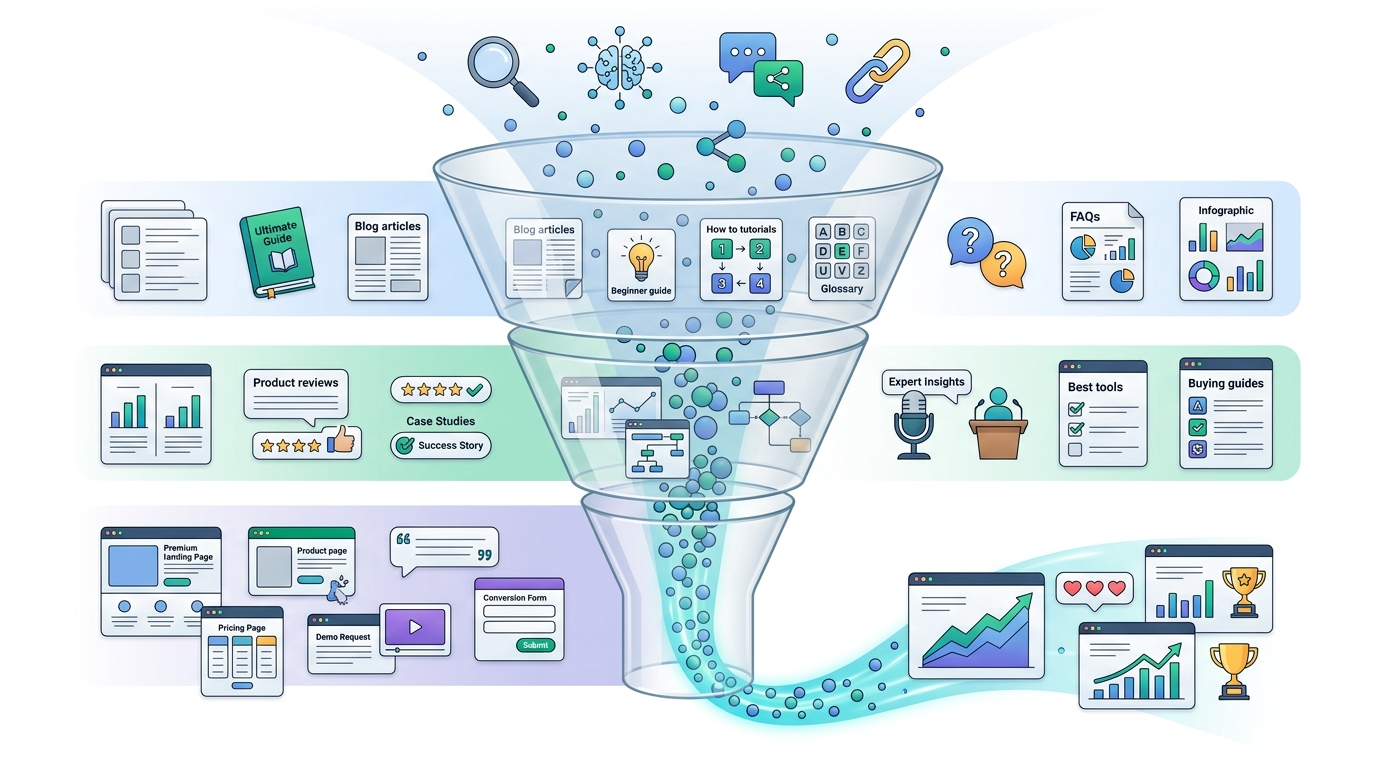
Not every piece of content is meant to do the same job, and treating them like they are is one of the most common content mistakes out there.
TOFU (Top of Funnel)
This is the awareness stage, where someone just realized they have a problem but hasn’t started evaluating solutions yet. Guides, educational blogs, and definitions live here because the goal isn’t to sell anything at all — it’s purely to be useful, answer the basic question, and build enough trust that the reader remembers you later when they’re ready to go deeper.
MOFU (Middle of Funnel)
At this stage, people already know their problem and are actively comparing ways to solve it. Comparisons, reviews, and case studies work best here because the reader wants proof and tradeoffs, not another basic explainer. They’re trying to narrow down options, so content that helps them decide earns far more trust than content that just repeats what they already know.
BOFU (Bottom of Funnel)
This is decision time — the reader has already chosen their direction and just needs the final push to act. Landing pages, product pages, and testimonials belong here because they’re built specifically to remove last-minute doubt and make taking action as frictionless as possible. Anything too educational at this stage actually slows the reader down instead of helping.
Picture the whole thing narrowing like a funnel — broad, helpful content at the top, gradually sharpening into specific, action-driven pages at the bottom. Most sites pour resources into TOFU content because it’s easier to write and ranks for higher search volume, but they underinvest in MOFU and BOFU. That’s exactly why so many sites pull in decent traffic numbers but struggle to turn any of it into real revenue.
How to Find High-Traffic Content Ideas
Coming up with content ideas shouldn’t feel like guesswork. There are specific places people leave digital breadcrumbs of exactly what they’re searching for.
Google Autocomplete
When you start typing a query into Google, the suggestions that pop up aren’t random — they’re based on real searches millions of people have already made. That makes autocomplete one of the fastest, laziest-but-effective ways to spot exactly how people phrase their questions, which often differs from how you’d phrase it yourself.
People Also Ask
This expandable box sitting in the middle of search results is basically Google handing you a content outline for free. It shows the exact follow-up questions real searchers had about your topic, which means you can build an FAQ section or even entire subsections around these without ever guessing what readers actually want to know.
Related Searches
Scroll all the way to the bottom of any Google results page and you’ll find a cluster of related queries tied to your original search. These often reveal adjacent topics or angles you hadn’t considered, which is useful both for new content ideas and for expanding an existing article’s coverage.
Google Trends
This tool is less about finding evergreen ideas and more about spotting momentum — topics that are rising in interest before they peak, or seasonal patterns that repeat every year. It’s especially useful for timing when to publish or update seasonal content so it’s live before the demand spike hits.
Keyword Research Tools
Paid tools like Ahrefs and Semrush, or free options like Google Keyword Planner, give you the hard numbers behind a topic — search volume, competition level, and related keyword variations. These numbers help you prioritize which ideas are actually worth the hours it takes to write them properly.
Competitor Gap Analysis
This means literally looking at what your competitors already rank for that you don’t have any content on yet. These gaps tend to be some of your fastest wins because the demand is already proven — someone else is already capturing traffic you could be capturing too.
Searching your topic on Reddit exposes you to raw, unfiltered conversations — actual complaints, actual confusion, actual questions people are asking in their own words. This kind of demand rarely shows up cleanly in keyword tools, which makes Reddit one of the best places to find content angles competitors haven’t thought to cover.
Quora
Quora works similarly to Reddit but leans more heavily question-focused, which makes it especially useful for spotting exactly how people phrase their problems. Reading through multiple answers on the same question can also reveal what existing content is missing or getting wrong.
YouTube Suggestions
Typing a topic into YouTube’s search bar surfaces autocomplete suggestions that often differ from what you’d see on Google, because video search behavior tends to skew more toward tutorials and demonstrations. This makes it a solid source for content angles specifically suited to visual or process-driven topics.
Search Console
If your site already gets some traffic, Search Console shows you queries you’re already ranking for on page two or three of Google. These are often the easiest wins available — a few tweaks to an existing page can push it onto page one faster than starting something from scratch.
A repeatable workflow ties all of this together: start broad with keyword tools to gauge actual volume, narrow things down using People Also Ask and Reddit to understand real intent behind the numbers, then check Search Console to prioritize quick wins before ever writing something brand new.
How to Validate Whether a Content Idea Can Generate Traffic
Not every idea deserves the hours it takes to write it properly, so running a quick validation check before committing saves you from wasted effort.
Search volume tells you whether enough people are actually asking this question in the first place — no point writing brilliantly for a query nobody searches. Keyword difficulty tells you how realistic it is to actually rank given your site’s current authority level, since chasing a keyword way above your site’s weight class rarely pays off quickly. CPC (cost per click) often hints at commercial value, because higher CPC usually means advertisers are paying real money for that traffic, which is a decent signal the topic converts into something valuable.
Search intent needs to genuinely match the format you’re planning to build — writing a blog post for a keyword that wants a product page is a guaranteed miss. SERP quality means actually looking at what’s currently ranking for that keyword; if the top ten results are outdated, thin, or poorly written, that’s a real opening for you to do better. Backlink competition tells you roughly how many links you’d realistically need to compete with what’s already ranking.
Content freshness matters most for time-sensitive topics where outdated info gets penalized fast. AI Overview presence is a newer consideration — if Google’s AI Overview already fully answers a query at the top of the results page, organic click-through rates for that keyword might end up lower than the raw search volume suggests, even if the topic still ranks well. And finally, user demand — sometimes a keyword tool shows decent volume, but the actual conversations happening in forums and comment sections tell a completely different story about how badly people want this answered.
Running through this decision framework before writing, not after, is what separates people who consistently produce content that performs from people who are just guessing and hoping.
How to Structure High-Traffic Content
Even great research and a smart topic choice can fail if the content itself is structured poorly, because readers (and Google) both reward pages that are easy to navigate and easy to trust.
Headline Optimization
Your headline is doing one job only — getting the click. It needs to promise a clear, specific outcome or answer rather than vaguely describing the topic in general terms. A weak headline can bury genuinely great content before anyone even gets the chance to read it.
Introduction
The first hundred words of your page need to immediately confirm the reader landed in the right place and hint at the value coming up. Too many articles waste this space on throat-clearing and backstory instead of getting straight to what the reader actually came for.
Clear Heading Hierarchy
H2s and H3s aren’t just decoration or an SEO checkbox — they function as a map for the reader, letting them scan the page and jump straight to the section they need instead of reading everything top to bottom. A messy or inconsistent heading structure makes even good content feel harder to trust.
Visuals
Screenshots, charts, and images do work that words alone genuinely struggle to do, especially for anything process-based or data-heavy. They also break up long stretches of text visually, which keeps readers from bouncing out of sheer fatigue partway through a longer piece.
Tables
Comparison data belongs in a table, not spread across three paragraphs of prose. Tables let readers scan and compare specs, prices, or features almost instantly, which matches exactly how people evaluate options when they’re in a commercial-intent mindset.
Bullet Lists
Bullet points break down steps, features, or options without forcing readers through dense, run-on sentences. They’re especially useful for how-to content or feature comparisons where the reader just wants the key points fast, not a narrative explanation.
Internal Links
Linking to related content on your own site keeps readers exploring longer instead of bouncing back to Google after one page. It also helps search engines understand how your site is structured and which pages relate to each other, which supports your overall topical authority.
External Sources
Linking out to credible outside sources signals you’ve actually done research instead of just repeating assumptions. It builds trust with readers and, done right, doesn’t hurt your own rankings — it actually reinforces that your content is well-grounded.
CTAs
Every piece of content should point the reader toward some kind of next step, even something as simple as subscribing or reading a related article. Without a CTA, even a page that performs well traffic-wise ends up being a dead end for your business goals.
FAQs
Answering the common follow-up questions readers have at the bottom of your page captures additional long-tail search queries you might otherwise miss entirely. It also significantly improves your odds of showing up in featured snippets or voice search results.
Schema Markup
Structured data behind the scenes helps search engines understand exactly what your content is about, which can unlock rich results like star ratings, FAQ dropdowns, or how-to steps directly inside the search results. These rich results tend to boost click-through rates even without a ranking change.
A well-structured piece isn’t really about rigidly following a template — it’s about respecting how people genuinely read online, which is scanning first and reading second, only slowing down once they’ve confirmed the page is worth their time.
How AI Search Is Changing High-Traffic Content
The way people find information is shifting, and content that ignores this shift is going to feel increasingly invisible even if it still technically ranks somewhere.
Google AI Overviews
These now sit at the very top of a lot of search results, answering queries directly without the searcher ever needing to click through to a website. That means some traffic that used to flow to individual sites now just stays inside Google itself. Still, getting cited inside an AI Overview matters for visibility and brand exposure, even when it doesn’t guarantee a click.
ChatGPT Search
More people are asking ChatGPT the kinds of research-heavy or comparison-based questions they used to type into Google. Content that’s clearly structured, well-sourced, and specific has a noticeably better shot at being pulled into these AI-generated answers than vague or promotional writing does.
Perplexity
Perplexity leans especially hard on citing its sources directly inside the answers it gives, which means sites that are already well-established and credible tend to get referenced again and again across different related queries. Building that credibility over time pays off here more than chasing any single keyword.
Gemini
Built into Google’s broader ecosystem, Gemini pulls from indexed content in a way that’s similar to traditional search, but it synthesizes that content into more conversational, digestible answers instead of just listing links. Content that’s clearly written and well-organized has an easier time getting pulled into those synthesized answers.
Answer Engines
Across the board, these AI tools favor structured answers over fluff, entity optimization (clearly signaling what your content is actually about), topical authority built over multiple related pieces rather than one isolated post, semantic SEO that covers a topic’s full context instead of just isolated keywords, strong source credibility, and content specific enough to actually be worth quoting directly.
This shift is real, and it’s genuinely uncomfortable for a lot of publishers who built their traffic entirely around clicks. But the core principle underneath all of it hasn’t really changed — be the clearest, most credible source on a topic, and you’ll get referenced one way or another, whether that reference comes as a blue link in Google or a quoted line inside an AI-generated summary.
High-Traffic Content Creation Framework (Step-by-Step)
Here’s a workflow you can actually reuse instead of reinventing your process every time:
- Audience Research — know who you’re actually writing for and what they struggle with.
- Keyword Research — find topics with real search demand and a realistic shot at ranking.
- Intent Mapping — confirm what format Google is currently rewarding for that keyword.
- Competitor Analysis — see what’s already ranking and figure out how to genuinely do it better.
- Content Brief Creation — outline structure, headings, and key points before writing.
- Writing — draft with the reader’s actual problem in mind, not just the keyword.
- On-Page SEO — optimize titles, meta descriptions, headers, and image alt text.
- Internal Linking — connect the new piece to relevant existing content on your site.
- Visual Optimization — add images, charts, or screenshots that actually add clarity.
- Publishing — get it live, properly formatted, and indexed.
- Promotion — share it where your audience actually spends time, not everywhere at once.
- Updating and Refreshing — revisit it every few months to keep it accurate and competitive.
This isn’t a one-time checklist. Consistent traffic growth comes from repeating this loop, learning what worked, and doing it again.
Real Examples of Content That Generated Massive Traffic
HubSpot’s marketing guides built years of consistent organic traffic by covering foundational marketing topics in genuine depth, then interlinking hundreds of related articles to build topical authority most competitors simply can’t match.
Ahrefs’ SEO tutorials work because they’re written by people who actually use their own tool daily, meaning the screenshots and examples come from real usage instead of hypothetical scenarios.
Backlinko’s long-form content leans heavily on original data and case studies, which is exactly why other SEO writers cite it constantly, feeding a steady stream of backlinks and referral traffic.
NerdWallet’s comparison pages convert extremely well because they’re built specifically around commercial investigation intent, giving readers exactly the side-by-side breakdown they came looking for.
Zapier’s software roundups rank for hundreds of “best tools for X” queries because Zapier genuinely understands the software ecosystem it integrates with, and that authenticity comes through in the depth of the comparisons.
The takeaway across all five: depth, real experience, and consistent topical coverage beat one-off viral attempts every time. None of these built their traffic overnight. It’s compounding, built article by article, over years.
Conclusion
There’s no single “best” content type that works for every business, and anyone telling you otherwise is oversimplifying. What actually works is aligning your content with what your specific audience is searching for, building real topical authority instead of scattered one-off posts, and keeping your business goals in the loop instead of chasing traffic for its own sake.
Build a balanced portfolio. Pillar pages that establish your authority on core topics. Supporting cluster content that fills in the details and captures long-tail searches. Evergreen assets that keep compounding traffic for years. Comparison and review content that captures people close to a decision. Original research that earns backlinks nobody else can replicate. And conversion-focused pages that actually turn your traffic into something meaningful for the business.
None of this works as a one-time project. Measure what’s actually performing, refresh what’s slipping, and stay adaptable as search behavior keeps shifting — especially with AI search reshaping how people find answers. The sites winning right now aren’t the ones that found some secret trick. They’re the ones that kept showing up, kept improving what they already published, and never stopped paying attention to what their audience actually needed.
Frequently Asked Questions
What type of content gets the most organic traffic?
Ultimate guides, how-to articles, and list posts typically pull the most organic traffic because they target high-volume informational searches. But “most traffic” doesn’t always mean “most valuable” — comparison and review content often brings in less volume but far more qualified visitors.
Do long-form articles rank better?
Generally yes, but not because length itself is a ranking factor. Longer articles tend to cover a topic more thoroughly, which naturally satisfies more search intent and keeps readers engaged longer. A padded 3,000-word article with no real substance won’t outrank a focused 800-word piece that actually answers the question.
Is evergreen content better than trending content?
Neither is strictly better — they serve different goals. Evergreen content builds a stable, compounding traffic base over years. Trending content captures quick spikes tied to current events or seasonal demand. A healthy content strategy uses both.
How often should I publish new content?
Consistency matters more than frequency. Publishing one genuinely useful, well-researched piece a week beats five thin posts a week. Quality and depth outperform sheer volume almost every time now.
Which content attracts the most backlinks?
Original research, statistics pages, and free tools consistently attract the most backlinks because they give other writers something concrete and unique to reference or cite.
What content performs best in AI search?
Clearly structured content with direct answers, strong sourcing, and genuine expertise tends to get pulled into AI-generated answers more often than vague or promotional content.
How do I find topics with high traffic potential?
Use a mix of keyword research tools, Google’s autocomplete and People Also Ask sections, Reddit and Quora discussions, and your own Search Console data to spot real demand instead of guessing.
How long does it take for content to rank?
It varies a lot depending on your site’s authority and competition, but most content takes somewhere between three and six months to reach its ranking potential, and sometimes longer in competitive niches.
Which content type has the highest conversion rate?
Comparison articles, buying guides, and case studies tend to convert best because they target readers who are already close to making a decision.
Should I focus on blogs, videos, or social media content?
It depends on where your audience actually spends time and what kind of information they’re looking for. Ideally, you’re not choosing one — you’re repurposing core ideas across formats, since blog content, video, and social all reinforce each other rather than compete.
Can old content be updated instead of writing something new?
Yes, and honestly this often gets overlooked. Refreshing an existing page that’s already ranking on page two with updated data, better structure, and fresh examples can be faster and more effective than starting from scratch.
Do I need backlinks if my content is really good?
In low-competition niches, sometimes great content ranks with minimal backlinks. In competitive niches, backlinks are almost always necessary because Google uses them as a trust signal that other sites don’t have an easy way to fake.