
Somewhere right now, a college student is scrolling through job listings and noticing something weird. Half the openings say “digital marketer,” “growth marketer,” “performance marketer,” or “SEO specialist,” and none of them ask for a marketing degree. A lot of them don’t even ask for any degree at all. They ask for a portfolio, a Google Analytics certificate, and proof you’ve actually run a campaign before. That’s the moment most people start wondering how to become a digital marketer, and honestly, it’s a fair question, because the path doesn’t look like anything a career counselor would have described ten years ago.
Digital marketing has quietly become one of the few fields where a fresher with six months of self-taught skill can out-earn someone with a four-year degree and zero hands-on work. Startups need people who can run a Meta ad campaign without burning the budget. Local restaurants need someone who understands Google Business Profile. Enterprise brands need analysts who can read GA4 data and tell a story out of it. That demand isn’t slowing down, it’s spreading into every industry that touches a screen, which by 2026 is basically every industry.
This guide walks through the entire path: what digital marketing actually involves day to day, the skills worth learning first, the courses and certifications that carry real weight, the career paths you can specialize in, what the salary numbers actually look like at each stage, and the mistakes that trip up almost every beginner. Whether reading this as a student figuring out what to study, a graduate tired of sending resumes into the void, a career switcher coming from an unrelated field, a business owner who wants to stop paying agencies, or a freelancer trying to build a client base, there’s a section here built for that exact situation.
What You Will Learn in This Guide
- What digital marketing actually is and why the demand for it keeps climbing every year
- The real day-to-day work of a digital marketer, not the polished version from job ads
- The technical and soft skills that actually get people hired, ranked by priority
- A step-by-step roadmap from zero experience to a first paying job or client
- Which courses and certifications are worth the time and which ones are resume filler
- Career paths inside digital marketing, along with realistic salary ranges by role and country
- The tools professionals use daily, broken down by category
- How to build a portfolio that gets interviews instead of getting ignored
- Common beginner mistakes and how to skip past them entirely
- Where digital marketing is heading with AI, AEO, and GEO reshaping the field
What Is Digital Marketing?
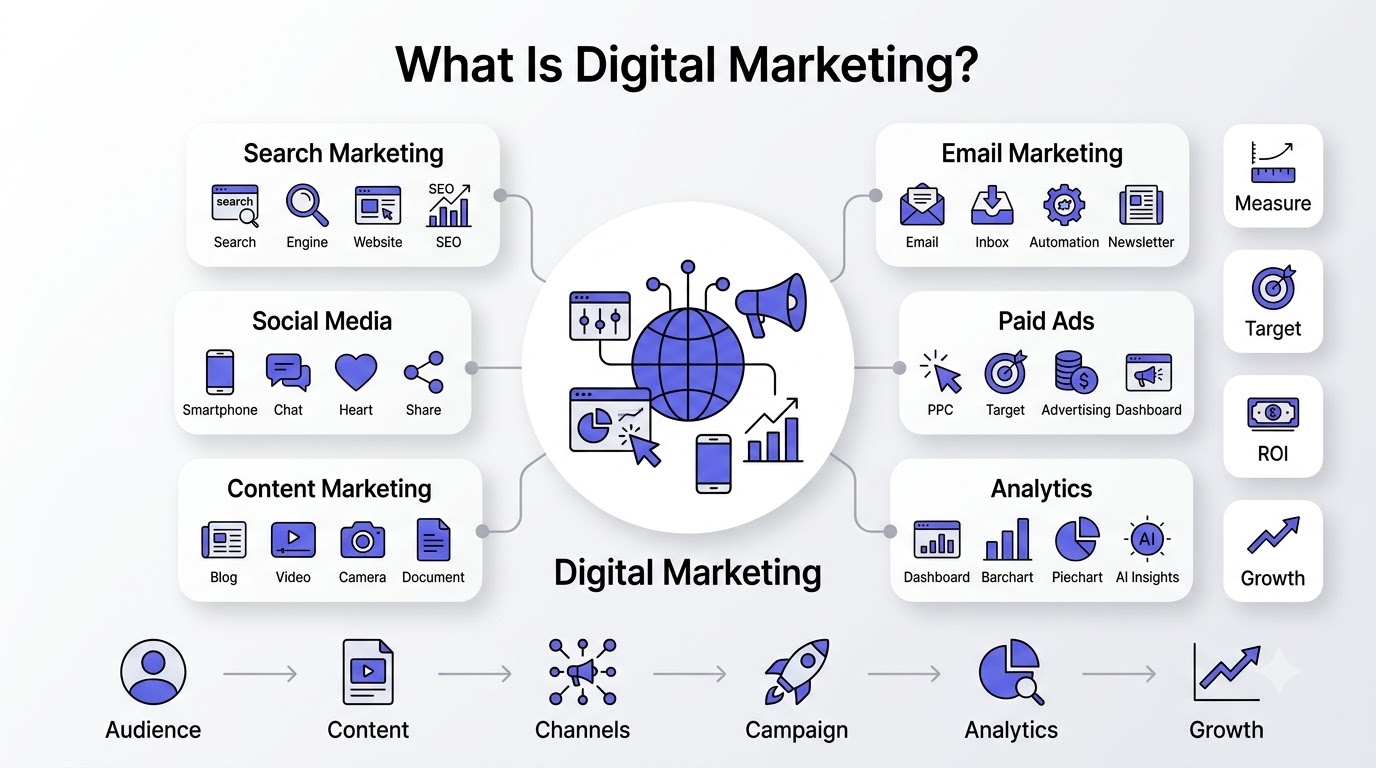
Digital marketing is the practice of promoting products, services, or brands through internet-based channels like search engines, social media, email, and paid ads, instead of relying only on TV, print, or billboards. It’s not one skill. It’s a cluster of specializations that all point toward the same goal: getting the right message in front of the right person at the right time, and then proving it worked with data.
That last part is what actually separates digital marketing from traditional marketing. A billboard company can’t tell you how many people looked at their ad and then bought the product three days later. A Google Ads dashboard can. That level of measurability is why marketing budgets have shifted so hard toward digital channels, and it’s why companies keep hiring people who can read that data and act on it.
Traditional Marketing vs Digital Marketing
Traditional marketing pushes a message out to a broad audience and hopes it lands, think newspaper ads, radio spots, and cold calling. Digital marketing works the other way around. It targets specific people based on their behavior, interests, location, and search history, then tracks exactly how they respond. A traditional TV ad campaign might cost six figures with no way to measure direct impact. A Google Ads campaign with a fraction of that budget can show you the exact cost per click, cost per conversion, and return on ad spend within 24 hours.
The other big difference is speed of iteration. If a print ad underperforms, the campaign is stuck until the print run ends. If a Facebook ad underperforms, a marketer can pause it, tweak the creative, and relaunch it within the hour. That feedback loop is why digital marketing skills compound so fast for people who practice regularly. Every campaign teaches something the next one can use.
Why Digital Marketing Matters Right Now
Over 5.5 billion people use the internet globally, and more than 60% of the world’s population is active on social media in some form. Mobile devices account for the majority of web traffic in most countries, and online shopping has become the default for anything from groceries to enterprise software. None of that is slowing down, and every business trying to reach those people needs someone who understands the channels they’re spending time on.
AI has added another layer to this. Search behavior is shifting toward AI assistants and generative search results, which means brands now need visibility not just in Google’s blue links but inside AI-generated answers too. Customer behavior has also changed permanently, people research products for days on their phones before ever talking to a salesperson, and that entire research journey happens across digital touchpoints a marketer has to understand and influence.
Real-World Examples of Digital Marketing in Action
Amazon runs one of the most aggressive personalization engines in retail, showing different product recommendations to every single visitor based on browsing and purchase history. Nike leans hard into social and influencer content, building brand loyalty through storytelling rather than direct product pitches. Zomato uses hyper-local SEO and push notifications to stay relevant to hungry users at the exact moment they’re deciding where to order from. Netflix runs constant A/B tests on thumbnail images and descriptions to figure out what actually gets someone to click play. Even a small local bakery running a Google Business Profile with updated photos and customer reviews is doing digital marketing, just at a scale that matches its budget.
What Does a Digital Marketer Do?
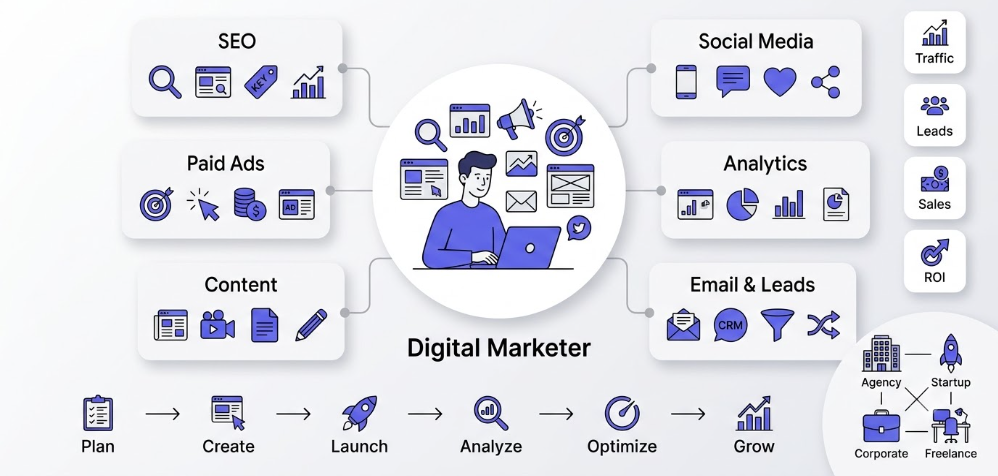
A digital marketer plans, executes, and analyzes campaigns across online channels to grow traffic, leads, and revenue for a business. That’s the short version. The longer, more honest version is that the job changes shape depending on the company size, the industry, and whether someone works as a generalist or a specialist.
Daily Responsibilities of a Digital Marketer
On any given day, a digital marketer might be optimizing a website’s meta descriptions for better click-through rates, checking keyword rankings, adjusting bids on a paid ad campaign, scheduling social posts, writing a blog outline, pulling a GA4 report for a client call, testing subject lines for an email campaign, or fixing a landing page that’s leaking conversions. Some days lean heavily into one of these, other days it’s a mix of five different tasks before lunch.
Website optimization covers page speed, mobile responsiveness, and structure, all things that affect both user experience and search rankings. SEO work involves researching keywords, writing content around them, fixing technical issues like broken links or slow load times, and building backlinks from other sites. Paid advertising means managing budgets on platforms like Google Ads and Meta Ads, watching cost per click, and adjusting targeting when performance dips. Content creation spans blog posts, video scripts, social captions, and ad copy. Analytics work means pulling data from GA4 or Search Console and turning raw numbers into decisions. Lead generation and conversion optimization tie everything together, since none of the traffic matters if it doesn’t turn into signups, sales, or inquiries.
A Typical Daily Workflow
Morning usually starts with checking overnight campaign performance, reviewing analytics dashboards, and responding to any urgent client or team messages. This is when most marketers catch problems early, a paused ad, a sudden traffic drop, a broken form on a landing page.
Afternoon tends to be the deep work block: writing content, building campaigns, doing keyword research, or setting up automation sequences. This is where the actual output for the week gets created, and it’s usually blocked off with fewer meetings.
Evening, especially for freelancers or agency workers juggling multiple clients, often involves reporting, client calls across time zones, and planning the next day’s priorities. It’s less glamorous than it sounds on LinkedIn, but it’s where a lot of the strategic thinking actually happens.
Different Work Environments for Digital Marketers
Working at an agency means juggling multiple clients across different industries, which builds range fast but can also mean tight deadlines and constant context switching. Working at a startup usually means wearing several hats at once, one week it’s SEO, the next it’s paid ads, because startups rarely have the headcount for narrow specialists. Corporate roles tend to be more structured, with clearer ownership over one channel and more approval layers before anything goes live. Freelancing offers the most flexibility but also the most responsibility, since there’s no team to catch mistakes and no fixed paycheck if a client churns. Remote jobs have become the norm across all of these, digital marketing was already remote-friendly before remote work became mainstream everywhere else.
Why Choose Digital Marketing as a Career?
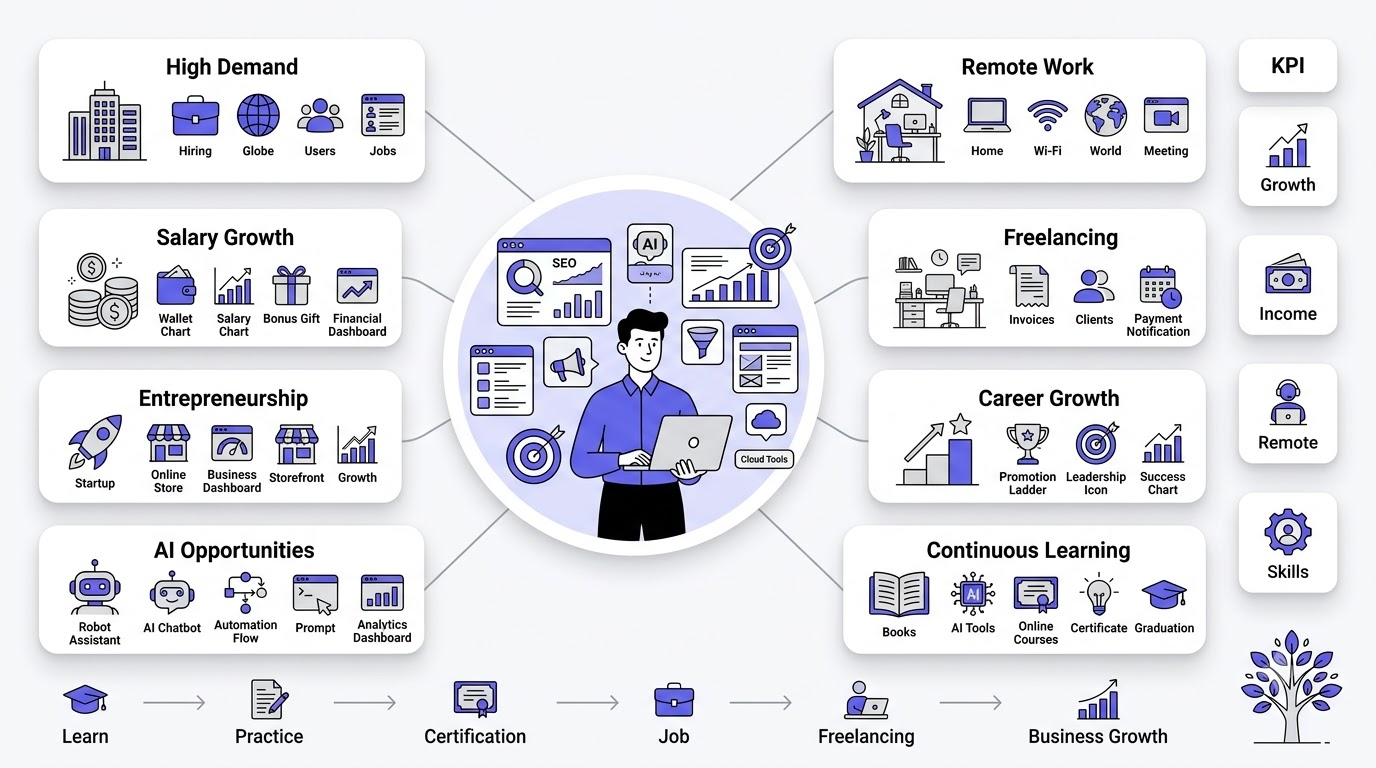
Digital marketing is worth choosing as a career because it combines high demand, flexible entry points, and strong earning potential without requiring a specific degree, unlike most professional fields. That combination is rare, and it’s why so many people are switching into it from completely unrelated backgrounds.
High Demand Across Every Industry
Every business with a website needs someone managing its digital presence, whether that’s an in-house hire, an agency, or a freelancer. This isn’t limited to tech companies either. Hospitals, law firms, real estate agencies, and manufacturing companies are all hiring digital marketers now, because the customer journey for almost everything starts with a search or a scroll.
Salary Growth That Rewards Skill, Not Just Tenure
Unlike a lot of traditional roles where salary bumps come mostly from years of service, digital marketing salaries jump when someone proves they can drive measurable results. A PPC specialist who can show a client’s return on ad spend doubled in six months has a much stronger case for a raise than someone who’s just been in the seat longer. Skills translate directly into leverage.
Remote Opportunities Are the Default, Not the Exception
Most digital marketing work happens on a laptop with internet access, which makes it one of the most naturally remote-compatible careers out there. Companies hiring for SEO, content, or paid ads roles routinely hire across countries and time zones, because the work product, rankings, campaigns, reports, doesn’t depend on physical location at all.
Freelancing Income Can Outpace a Full-Time Salary
A freelance digital marketer juggling three or four retainer clients can often out-earn a junior in-house hire, especially once they specialize in a high-demand skill like paid ads or SEO. The tradeoff is inconsistent income early on, but once a client base is stable, freelancing offers a level of income ceiling that most entry-level jobs don’t.
Low Entry Barrier Compared to Other Careers
Nobody asks a digital marketer for a licensing exam. There’s no bar exam equivalent, no medical residency, no engineering degree requirement. The barrier to entry is a laptop, internet access, and the willingness to actually practice the skills instead of just reading about them. That’s a massive advantage for people without the resources to pursue longer, more expensive career paths.
Continuous Learning Keeps the Work Interesting
Platforms change constantly. Google updates its algorithm several times a year. Meta changes its ad auction logic. New AI tools show up every few months. This can feel exhausting to someone who wants a static skillset, but for people who like learning, it keeps the job from ever getting boring.
AI Is Creating New Opportunities, Not Replacing the Role
AI tools have taken over a lot of repetitive tasks, drafting ad copy, generating first-pass content, summarizing analytics. But someone still has to prompt these tools correctly, verify the output, and connect it to actual strategy. Marketers who learn to use AI as a force multiplier are becoming more valuable, not less, and a new specialization, AI marketing, is opening up entirely because of this shift.
Entrepreneurship Becomes a Realistic Option
Learning digital marketing gives someone the exact skillset needed to launch and grow their own business, run their own ads, build their own audience, and market their own products without depending on an agency. A lot of digital marketers eventually use these skills to start something of their own, whether that’s an agency, an e-commerce store, or a content brand.
Skills Required to Become a Digital Marketer
Becoming a digital marketer requires a mix of technical skills, like SEO, paid ads, and analytics, and soft skills, like communication and problem-solving, since campaigns need both the technical execution and the human judgment to interpret results and adjust strategy.
Technical Skills Every Digital Marketer Needs
SEO (Search Engine Optimization) is often the first skill people learn because it touches almost every other channel. On-page SEO covers things like title tags, header structure, and content optimization on a specific page. Off-page SEO is about building authority through backlinks and mentions from other websites. Technical SEO deals with site speed, crawlability, structured data, and making sure search engines can actually index a site properly. Local SEO focuses on ranking for location-based searches, which matters enormously for any business with a physical location or service area.
Content Marketing is the skill of creating material, blog posts, videos, guides, that attracts and retains an audience without directly selling to them. It works hand in hand with SEO, since most content is built around specific keywords, but it also stands on its own as a way to build trust and authority over time.
Keyword Research is the process of finding out exactly what words and phrases people type into search engines when looking for something, and it underlies almost every SEO and content decision. Tools like Semrush and Ahrefs show search volume, competition level, and related terms, which shapes what content gets created and how it’s optimized.
Google Ads is the platform for running paid search campaigns, showing ads at the top of search results for specific keywords. It’s one of the highest-paying skills in digital marketing because it directly and immediately affects a company’s revenue, and mistakes are expensive, which makes skilled practitioners valuable.
Meta Ads covers advertising across Facebook and Instagram, targeting users based on interests, behavior, and demographics rather than search intent. It’s a different discipline from Google Ads because it interrupts people scrolling rather than catching them actively searching, which requires a different approach to creative and targeting.
Social Media Marketing goes beyond just posting content, it includes community management, platform-specific strategy, and increasingly, short-form video, since platforms like Instagram and YouTube now prioritize Reels and Shorts in their algorithms.
Email Marketing remains one of the highest return-on-investment channels in digital marketing, largely because it reaches people who already opted in and are genuinely interested. Learning how to segment lists, write subject lines that get opened, and build automated sequences is a specific skill that pays off across almost every other channel.
Marketing Automation is the practice of setting up workflows that trigger automatically based on user behavior, like sending a follow-up email three days after someone abandons a cart. Tools like Zapier and Make have made this accessible even to marketers without a coding background.
Analytics (GA4 and Search Console) is the skill of reading data and turning it into decisions. GA4 shows how users behave on a website, where they come from, what they click, where they drop off. Search Console shows how a site performs in Google’s search results specifically, which queries bring traffic and which pages have indexing issues.
Conversion Rate Optimization (CRO) is about improving the percentage of visitors who take a desired action, whether that’s a purchase, signup, or form fill. This usually involves A/B testing different headlines, button colors, or page layouts and measuring which version performs better.
Landing Pages are standalone pages built for a single campaign goal, and knowing how to structure one, headline, benefit, social proof, call to action, is a specific skill that directly affects conversion rates.
Basic HTML and CSS aren’t required to be a full developer, but understanding enough to make small edits to a webpage or troubleshoot a tracking pixel issue saves enormous time and makes a marketer far more self-sufficient.
WordPress remains the most widely used content management system, and knowing how to publish content, install plugins, and manage basic site settings is practical knowledge most digital marketing jobs assume someone already has.
AI Tools like ChatGPT, Gemini, Claude, Perplexity, Midjourney, and Canva AI have become part of the daily toolkit, used for drafting content, generating research summaries, creating quick visuals, and speeding up repetitive tasks that used to eat hours of a marketer’s day.
Soft Skills That Separate Good Marketers From Great Ones
Communication matters because marketers constantly have to explain campaign results to clients or stakeholders who don’t speak the technical language of CTR or CPA. Being able to translate a spreadsheet into a clear story is often what determines whether a client renews a contract.
Creativity shows up in ad copy, campaign concepts, and content ideas that actually stop someone mid-scroll. It’s not about being artistic in the traditional sense, it’s about generating angles that feel fresh instead of generic.
Problem-solving is what happens when a campaign underperforms and someone has to figure out why, was it the targeting, the creative, the landing page, the offer itself, without a manual telling them the answer.
Data analysis ties directly into problem-solving, since almost every marketing decision should be backed by a number, not a gut feeling. Marketers who can spot a trend in a spreadsheet before it becomes an obvious pattern have a real edge.
Research skills matter for understanding competitors, audiences, and market trends before launching anything. Skipping this step is one of the most common reasons campaigns fail right out of the gate.
Critical thinking helps marketers question assumptions, like whether a metric that looks good is actually meaningful, or whether it’s a vanity number that doesn’t connect to revenue.
Adaptability is non-negotiable in a field where platform algorithms and best practices shift every few months. Someone who gets attached to one specific tactic will burn out fast when that tactic stops working.
Time management matters because most digital marketing roles involve juggling multiple campaigns, clients, or channels at once, and missed deadlines directly cost money in a way that’s easy to measure.
Project management becomes essential once someone is coordinating a content calendar, a launch campaign, or a team of freelancers, and knowing how to keep everything on track without dropping a task is a genuinely valuable skill.
Client handling is its own discipline, managing expectations, delivering bad news when a campaign underperforms, and keeping a relationship healthy even during a rough month.
Step-by-Step Roadmap to Become a Digital Marketer
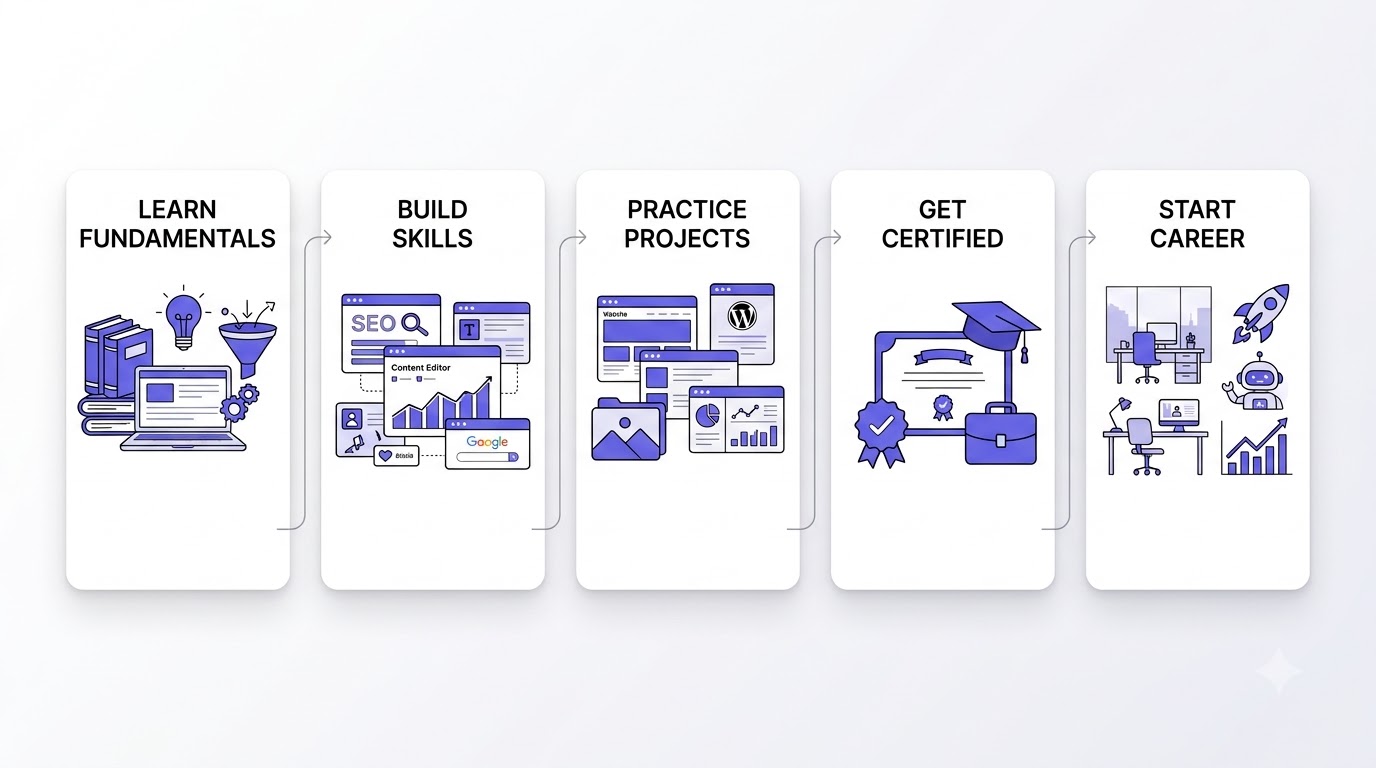
Becoming a digital marketer follows a repeatable roadmap: learn the fundamentals, pick one skill to specialize in first, practice on real projects, build a portfolio, earn a few targeted certifications, and then apply for internships or entry-level roles while continuing to learn.
Step 1: Understand Marketing Fundamentals
Before touching any tool, it helps to understand basic marketing concepts, the marketing funnel, customer personas, and how brand positioning works. This isn’t about memorizing theory, it’s about having a mental framework so that later tactical skills, like running a Facebook ad, actually make sense in context instead of feeling like button-pushing.
Step 2: Choose Learning Resources
Free resources include Google’s Skillshop, HubSpot Academy, Meta Blueprint, and YouTube channels run by working marketers who show real campaign breakdowns. Paid resources include structured bootcamps, agency training programs, and university certificate courses, which trade money for a more guided, faster path. Neither route is inherently better, the free path takes more self-discipline, the paid path front-loads structure.
Step 3: Learn One Skill at a Time
Trying to learn SEO, paid ads, social media, and email marketing all in the same month is a fast way to learn none of them well. A practical order that works for most beginners: start with SEO because it teaches how search and content work, move to content marketing since it builds on SEO directly, then social media, then paid ads once there’s a budget mindset in place, then analytics to measure everything, then email marketing, then automation to tie it all together.
Step 4: Practice on a Personal Website
Reading about SEO and actually doing SEO are completely different experiences. Setting up a simple WordPress or Wix site, even a personal blog, gives a real environment to practice keyword research, on-page optimization, and basic analytics setup without the pressure of a client watching.
Step 5: Build Real Projects
A personal blog proves someone can write and optimize content. An affiliate website shows they understand monetization and traffic generation together. A portfolio site demonstrates design and messaging sense. Helping a local business improve its Google Business Profile or run a small ad campaign, even for free or cheap, produces real case study material that a resume alone never can.
Step 6: Earn Certifications
Certifications from Google, Meta, and HubSpot won’t get someone hired on their own, but they signal baseline competency and fill a resume gap for people without a marketing degree. They matter most when paired with actual project work, not as a replacement for it.
Step 7: Create a Portfolio
A portfolio should include real case studies with specific numbers, keyword rankings achieved, traffic growth percentages, ad campaign screenshots with actual metrics, and analytics reports that show before-and-after comparisons. Vague claims like “improved SEO” mean nothing to a hiring manager, specific numbers do.
Step 8: Apply for Internships
Internships, even unpaid or low-paid ones early on, provide something a portfolio built solo can’t: exposure to real client accounts, real budgets, and real team workflows. Three months in an agency internship often teaches more than six months of solo learning.
Step 9: Get the First Job
The first job rarely comes from the perfect application, it comes from a mix of a solid portfolio, a LinkedIn profile that actually shows activity in the space, and direct outreach to companies instead of only applying through job boards where hundreds of others are competing for the same listing.
Step 10: Keep Learning
The learning never actually stops in this field. Algorithms change, new ad formats launch, AI tools reshape entire workflows. The marketers who stay relevant five years in are the ones who treat learning as a permanent part of the job, not a phase that ends once they land a role.
Best Digital Marketing Courses
The best digital marketing courses combine free foundational training from platforms like Google, HubSpot, and Meta with paid, project-based programs that offer mentorship and portfolio-building support, since certifications alone rarely teach the practical execution employers actually test for.
Free Digital Marketing Courses Worth Taking
Google’s Skillshop offers free courses on Google Ads, Analytics, and general digital marketing fundamentals, and its certifications are among the most recognized in the industry. HubSpot Academy covers inbound marketing, content strategy, email marketing, and CRM basics, all free and reasonably in-depth. Meta Blueprint teaches Facebook and Instagram advertising directly from the platform that runs the auction, which makes the training highly practical. Semrush and Ahrefs both run academies focused on SEO, covering everything from keyword research to technical audits, often free or at low cost. LinkedIn Learning offers free trial access to marketing courses taught by working professionals, and Coursera allows auditing many university-level marketing courses without paying for the certificate.
Paid Digital Marketing Courses and Programs
Agency training programs, often run by established digital marketing agencies, tend to be practical and built around real client scenarios rather than theoretical case studies. University programs offer more structured, credential-heavy learning, useful for people who want a formal certificate tied to an institution’s name. Online bootcamps compress a lot of learning into a short, intense timeframe and usually include mentorship and portfolio review, which speeds up the path to job-readiness. Industry certification programs from platforms like Semrush or specific SEO training academies focus narrowly on one skill area but go deeper than free introductory courses.
How to Choose the Right Course
Checklist for evaluating any course: an updated syllabus that reflects current platform features (not screenshots from three years ago), live or hands-on projects instead of only video lectures, some form of placement support or job assistance, a heavy weighting toward practical training over theory, recognized certifications, access to mentorship for questions, and a community of other learners for accountability and networking. A course missing most of these is likely to leave a gap between finishing it and actually being job-ready.
Best Certifications for Digital Marketers
The best certifications for digital marketers come from Google, Meta, HubSpot, Semrush, and Ahrefs, since these are the platforms employers actually use and recognize, and certifications from unrelated or unknown providers rarely carry the same weight in hiring decisions.
Google Certifications
Google’s certifications cover Google Ads (Search, Display, Video, Shopping), Google Analytics (GA4), and the broader Google Digital Marketing & E-commerce Certificate. These are widely recognized because Google Ads and Analytics are the actual tools most companies use, so the certification proves familiarity with the real interface, not just theory.
Meta Certifications
Meta’s certifications focus on Facebook and Instagram advertising, covering campaign structure, the ad auction system, and creative best practices specific to Meta’s platforms. Given how much ad spend still flows through Meta despite rising competition from TikTok and other platforms, this certification remains genuinely relevant.
HubSpot Certifications
HubSpot offers certifications in inbound marketing, content marketing, email marketing, and CRM usage. These matter especially for anyone targeting roles at companies using HubSpot as their marketing platform, which is a large chunk of small and mid-sized businesses globally.
Semrush Academy and Ahrefs Academy
Both platforms run SEO-focused certification courses that go deep into keyword research, technical SEO, and competitive analysis using their respective tools. Since Semrush and Ahrefs are the two most widely used SEO platforms in the industry, familiarity certified through these academies translates directly into job-ready skill.
Microsoft Advertising and LinkedIn Certifications
Microsoft Advertising certification covers running ads on Bing, which has a smaller but often less competitive and cheaper audience than Google Ads. LinkedIn’s certifications focus on B2B advertising and organic content strategy on the platform, which matters heavily for anyone targeting careers in B2B or enterprise marketing.
Which Certifications Actually Matter?
Certifications matter most when they’re paired with proof of actual application, a case study, a real campaign screenshot, a portfolio piece. A stack of ten certifications with zero practical projects behind them signals someone who studies but hasn’t executed, and hiring managers notice that gap fast. Two or three relevant, well-chosen certifications backed by real project work will outperform a resume cluttered with certificates that have no supporting evidence.
Digital Marketing Career Paths
Digital marketing offers dozens of specialized career paths, from SEO Specialist and PPC Specialist to Growth Marketer and AI Marketing Specialist, each with its own skill focus, salary range, and long-term growth trajectory inside the field.
SEO Specialist
An SEO Specialist focuses on improving a website’s organic search rankings through keyword research, content optimization, technical fixes, and link building. Required skills include keyword research tools like Ahrefs or Semrush, understanding of technical SEO factors like site speed and crawlability, and content strategy. Entry-level SEO salaries typically start modest but grow quickly with proven ranking results, and the growth path often leads toward SEO Manager or Head of SEO roles within a few years.
PPC Specialist
A PPC (pay-per-click) Specialist manages paid search and display campaigns, primarily on Google Ads and Microsoft Advertising, optimizing for cost per click and return on ad spend. This role demands comfort with budgets and numbers, since mistakes directly cost client money. PPC skills translate well into performance marketing roles, and experienced PPC specialists often move into managing six or seven-figure ad budgets.
Social Media Manager
A Social Media Manager plans content calendars, manages community engagement, and runs organic and sometimes paid campaigns across platforms like Instagram, TikTok, and LinkedIn. The role has shifted heavily toward short-form video strategy in recent years, and managers who understand platform-specific algorithm behavior tend to see faster career growth.
Content Marketer
A Content Marketer creates blog posts, guides, videos, and other material designed to attract and educate an audience, usually working closely with SEO to ensure content actually ranks and drives traffic. This role rewards strong writing skills combined with research ability, and often grows into Content Strategist or Head of Content positions.
Email Marketing Specialist
An Email Marketing Specialist builds segmented lists, writes campaigns, and sets up automated sequences that nurture leads toward a purchase. Because email consistently delivers strong return on investment, this specialization is in steady demand, particularly in e-commerce, where abandoned cart sequences alone can recover significant revenue.
Marketing Automation Expert
A Marketing Automation Expert builds workflows using tools like Zapier, Make, or HubSpot’s automation features, connecting different marketing channels so actions trigger automatically based on user behavior. This role blends marketing knowledge with a bit of technical logic, and it’s increasingly valuable as companies try to scale personalized marketing without scaling headcount.
Performance Marketer
A Performance Marketer focuses purely on measurable outcomes, leads, sales, signups, often running paid campaigns across multiple platforms simultaneously and optimizing based on cost per acquisition. This role sits close to the revenue line, which tends to make it one of the higher-paying specializations.
Analytics Specialist
An Analytics Specialist lives inside GA4, Looker Studio, and other data tools, building dashboards and reports that inform every other marketing decision. This role suits people who enjoy numbers more than creative work, and it often becomes a bridge into broader data analyst or marketing operations roles.
Affiliate Marketer
An Affiliate Marketer promotes other companies’ products in exchange for a commission on sales, often through a blog, YouTube channel, or social media presence. This path can be built independently without an employer at all, which makes it appealing to people who want full control over their income.
E-commerce Marketing Specialist
An E-commerce Marketing Specialist manages the full digital funnel for online stores, product page SEO, paid ads, email flows, and conversion optimization, all aimed at driving direct sales rather than general brand awareness. Given how much retail has shifted online, this specialization has some of the most consistent demand in the field.
Growth Marketer
A Growth Marketer runs rapid experiments across multiple channels to find the fastest, cheapest ways to acquire and retain users, often in startup environments where speed matters more than polish. This role blends marketing with a bit of product thinking, and it’s one of the more intellectually demanding paths inside digital marketing.
AI Marketing Specialist
An AI Marketing Specialist focuses on integrating AI tools into marketing workflows, from content generation to predictive analytics to chatbot-driven customer engagement, and increasingly, optimizing brand visibility inside AI-generated search results. This is one of the newest and fastest-growing specializations as AI reshapes how people discover information.
Marketing Consultant
A Marketing Consultant advises businesses on overall digital strategy without necessarily executing every campaign personally, which requires broad expertise across multiple channels plus strong communication skills to translate strategy into action for a client’s internal team.
Digital Marketing Manager
A Digital Marketing Manager oversees an entire marketing team or function, setting strategy, managing budgets, and coordinating specialists across SEO, paid ads, content, and social. This is typically a senior role reached after several years of hands-on specialist experience, and it comes with both higher pay and higher accountability for overall results.
Digital Marketing Salary Guide
Digital marketing salaries vary heavily by experience level, specific role, and country, but the field consistently rewards demonstrated skill and results over years of tenure alone, which is why salary growth in the first few years can move faster than in many traditional careers.
Salary by Experience Level
Interns typically earn a small stipend or nothing at all, but the experience gained often outweighs the short-term pay gap. Freshers entering their first digital marketing job usually land in the lower salary bands, but with a strong portfolio, freshers who can show real project results often negotiate above the typical starting range. Marketers with one to three years of experience see meaningful jumps once they’ve proven they can independently run campaigns without heavy supervision. The three-to-five-year range is where specialization really starts paying off, someone who’s built a reputation in PPC or SEO specifically tends to out-earn generalists at the same experience level. Five-to-ten-year professionals often move into management or highly specialized consulting roles, where pay reflects both expertise and responsibility. Beyond ten years, many digital marketers have moved into director-level roles, started their own agencies, or become independent consultants commanding premium rates.
Salary by Role
SEO roles tend to start lower than paid ads roles but grow substantially once someone can point to real ranking and traffic results. PPC and performance marketing roles often command higher starting salaries because they directly manage budgets tied to revenue. Content roles vary widely depending on whether the work is purely writing-focused or strategy-focused, with strategy roles paying more. Social media roles have historically paid less than technical specializations, though this is shifting as short-form video expertise becomes harder to find. Email marketing specialists often earn steady, reliable pay given the consistent ROI they deliver. Analytics specialists, especially those comfortable with tools like Looker Studio and advanced GA4 configurations, tend to command strong salaries due to the technical skill involved. Growth marketing roles, particularly at funded startups, often pay at the higher end of the spectrum given the direct link to company growth metrics.
Salary by Country
India offers a wide salary range depending on city and company size, with metro areas like Bangalore, Mumbai, and Delhi paying noticeably more than smaller cities. The USA generally has the highest absolute salary numbers in the field, particularly in tech hubs, though cost of living eats into that advantage significantly. The UK sits somewhere between US and European averages, with London commanding a premium over other cities. Canada’s digital marketing salaries trail the US somewhat but remain competitive, especially in Toronto and Vancouver. Australia offers strong salaries relative to cost of living outside major cities, and the Middle East, particularly UAE and Saudi Arabia, has seen rising demand and competitive pay as businesses there invest heavily in digital transformation.
Freelancing Income Potential
Freelance digital marketers can charge hourly, monthly retainer, project-based, or through longer-term agency-style contracts. Hourly rates vary enormously based on specialization and track record, with experienced PPC or SEO freelancers commanding significantly more than generalists. Monthly retainers offer more predictable income and are common for ongoing SEO or social media management work. Project-based pricing suits one-off work like a website audit or a single campaign launch. Freelancers who eventually build out a small team and operate more like a boutique agency can scale income well beyond what a single freelancer managing everything alone could achieve.
Best Tools Every Digital Marketer Should Learn
The best tools for digital marketers span SEO platforms like Semrush and Ahrefs, ad managers like Google Ads and Meta Ads Manager, analytics platforms like GA4, and increasingly, AI tools like ChatGPT and Claude that speed up research and content creation across every channel.
SEO Tools
Google Search Console shows exactly how a website performs in Google’s organic search results, including which queries bring traffic and which pages have crawling or indexing issues. Google Keyword Planner, originally built for ad campaigns, remains a solid free option for basic keyword volume data. Semrush and Ahrefs are the two dominant paid SEO platforms, offering deep keyword research, backlink analysis, and competitor tracking. Screaming Frog is a technical SEO crawler that scans an entire website to find broken links, missing meta tags, and other structural issues that hurt rankings.
PPC Tools
Google Ads is the primary platform for search, display, video, and shopping ad campaigns, and mastering its interface is close to mandatory for anyone pursuing paid media work. Meta Ads Manager handles campaign creation, targeting, and budget management across Facebook and Instagram, with its own distinct auction logic and creative requirements.
Social Media Tools
Buffer and Hootsuite both allow scheduling posts across multiple social platforms from a single dashboard, along with basic analytics to track engagement over time. These tools save enormous time for anyone managing more than one or two social accounts simultaneously.
Content Tools
Grammarly catches grammar and clarity issues in written content, which matters for anyone producing blog posts or email copy at volume. Canva has become the default design tool for marketers without a dedicated designer, offering templates for social graphics, ads, and presentations that would otherwise require a professional designer’s time.
AI Tools
ChatGPT, Claude, Gemini, and Perplexity are used across content drafting, research summarization, and even campaign brainstorming, dramatically speeding up tasks that used to take hours. The skill isn’t just using these tools, it’s knowing how to prompt them effectively and how to verify their output before publishing it.
Analytics Tools
GA4 (Google Analytics 4) tracks user behavior across a website or app, showing traffic sources, conversion paths, and engagement patterns. Looker Studio turns raw data from GA4 and other sources into visual, shareable dashboards that make reporting to clients or stakeholders far easier. Google Tag Manager handles the tracking code setup behind the scenes, letting marketers add or adjust tracking without needing a developer for every small change.
Email Marketing Tools
Mailchimp remains one of the most widely used email platforms for small to mid-sized businesses, offering templates and automation without a steep learning curve. Brevo (formerly Sendinblue) combines email with SMS marketing in one platform, and ConvertKit is popular specifically among creators and bloggers for its simpler, audience-focused approach.
Automation Tools
Zapier connects different apps and tools together so actions in one trigger actions in another, like automatically adding a new lead from a form into a CRM. Make (formerly Integromat) offers similar functionality with more advanced, visual workflow building for complex automation needs. n8n is an open-source alternative that appeals to marketers comfortable with a bit more technical setup in exchange for more control and no subscription cost.
How to Build a Strong Digital Marketing Portfolio
A strong digital marketing portfolio includes real case studies with specific results, a resume that highlights measurable outcomes, an active LinkedIn presence, relevant certifications, and client testimonials, since hiring managers care far more about proven results than a list of skills without evidence.
What to Include in a Digital Marketing Portfolio
A personal website acts as the home base for everything else, showing basic web presence skills while housing case studies and contact information. A resume should focus on outcomes, not just responsibilities, “grew organic traffic 140% in four months” says far more than “responsible for SEO tasks.” A LinkedIn profile with regular activity, posts about campaigns, insights, or industry trends, signals genuine engagement with the field rather than a dormant profile that only shows up when job hunting. Certifications fill credibility gaps, especially for people without a marketing degree. Live projects, even small ones done for free for a local business, prove someone can execute, not just study. Case studies should walk through the problem, the approach taken, and the measurable result, ideally with screenshots of actual data. Analytics dashboards shared as portfolio pieces show comfort with tools like GA4 and Looker Studio in a way that’s hard to fake. Client testimonials, even short ones, add third-party credibility that self-reported results can’t match alone.
Common Portfolio Mistakes to Avoid
The biggest mistake is listing skills without any proof of application, claiming “SEO expert” with zero case studies attached. Another common one is using vague, unquantified results like “improved website performance” instead of specific numbers. Some beginners also pad their portfolio with too many small, low-effort projects instead of two or three deep, well-documented case studies that actually demonstrate skill. Outdated portfolios that haven’t been touched in over a year also raise a red flag, since the field moves fast enough that stale work signals disengagement.
How to Get Your First Digital Marketing Job
Getting a first digital marketing job usually comes down to a combination of a results-focused resume, an active LinkedIn presence, targeted internship applications, direct outreach to companies, and interview preparation that goes beyond memorized definitions into actual problem-solving ability.
Resume Tips for Digital Marketing Roles
Lead with outcomes, not tasks. Instead of “managed social media accounts,” write “grew Instagram engagement rate from 2% to 5.8% over three months through content testing.” Keep the resume to one page for entry-level applications, and tailor the listed skills to match the specific job description rather than sending the same generic resume to every posting.
LinkedIn Optimization for Job Seekers
A strong headline goes beyond “Digital Marketing Enthusiast” and instead states a specific focus, like “SEO Specialist | Helped 3 local businesses rank on Google’s first page.” Posting regularly, even short breakdowns of a campaign or a tool tip, builds visibility with recruiters who search LinkedIn actively for candidates showing genuine engagement in the field.
Internship Strategy
Internships, even short or unpaid ones, remain one of the fastest ways to gain real agency or in-house experience. Applying directly to smaller agencies or local businesses, rather than only large companies with hundreds of internship applicants, often produces faster results and more hands-on responsibility early.
Networking That Actually Works
Joining digital marketing communities on LinkedIn, Reddit, or Discord and genuinely participating, answering questions, sharing small wins, asking thoughtful ones, builds relationships that often lead to job referrals long before a formal application ever gets submitted.
Freelancing as an Entry Point
Taking on a few small freelance projects, even at low rates initially, builds both portfolio material and real client-handling experience that translates directly into full-time job readiness. Platforms aside, direct outreach to small local businesses often works just as well, since most of them have no digital marketing help at all.
Cold Outreach to Companies
Reaching out directly to a company’s marketing manager with a specific, relevant idea, “I noticed your blog hasn’t been updated in six months, here’s a quick audit of what’s missing”, often gets more traction than applying to a generic job posting competing against hundreds of other applicants.
Interview Preparation for Digital Marketing Roles
Beyond knowing definitions, interviewers increasingly ask candidates to walk through a real or hypothetical campaign scenario, how would they approach a client whose website traffic dropped 30% overnight, for example. Practicing this kind of structured problem-solving out loud, not just memorizing terminology, makes a much stronger impression than reciting textbook answers.
Future of Digital Marketing
The future of digital marketing is being shaped by AI-driven search, voice search, first-party data collection, and the rise of Answer Engine Optimization and Generative Engine Optimization, as brands adapt to being discovered inside AI-generated answers instead of only traditional search results.
AI is reshaping nearly every workflow in the field, from content drafting to predictive analytics to automated customer segmentation, and marketers who learn to work alongside AI tools rather than resist them are pulling ahead noticeably faster.
Voice search continues growing as smart speakers and voice assistants become more common, which shifts keyword strategy toward more natural, conversational phrases rather than short, choppy search terms.
Answer Engine Optimization (AEO) is the practice of structuring content so AI assistants and chatbots can extract clear, direct answers from it, a shift away from optimizing purely for traditional blue-link search rankings.
Generative Engine Optimization (GEO) focuses specifically on getting content cited and referenced inside AI-generated search summaries, which requires factually dense, well-structured content that AI systems can confidently pull from and attribute.
First-party data has become critical as third-party cookies phase out across browsers, pushing marketers toward building owned audiences through email lists, loyalty programs, and direct customer relationships instead of relying on ad platform targeting alone.
Automation keeps expanding beyond simple email sequences into full customer journey orchestration, where a user’s behavior across multiple channels triggers coordinated, personalized responses automatically.
Personalization is moving from broad segmentation, like age or location, toward individual-level customization based on real-time behavior, something AI has made far more feasible at scale than it was even a few years ago.
Video-first marketing continues to dominate attention, with short-form video now the primary discovery mechanism on platforms like Instagram, TikTok, and YouTube, pushing marketers to build video literacy even if their background is in text-based content.
Privacy changes across regulations and browser policies keep tightening what data marketers can legally collect and use, which is forcing a shift toward more transparent, consent-based data practices industry-wide.
Cookieless marketing is the practical result of all these privacy shifts, requiring marketers to lean more heavily on contextual targeting, first-party data, and platform-native audience tools instead of the third-party tracking that dominated the previous decade.
Conclusion
Nobody becomes a digital marketer overnight, and honestly, anyone promising a thirty-day transformation into a fully skilled professional is selling something. What actually works is picking one skill, SEO, content, paid ads, whatever fits best, going deep on it through free or paid courses, and then proving that knowledge through real projects instead of letting it sit as theory. That combination, one skill mastered plus real proof of results, beats a scattered resume full of certifications every single time.
The roadmap in this guide isn’t complicated: understand the fundamentals, specialize, build a portfolio with actual numbers attached, get certified where it adds credibility, and start applying or pitching clients well before feeling “fully ready,” because nobody ever feels fully ready in a field that keeps shifting under everyone’s feet. Success here comes from consistency and measurable results, not from collecting badges.
Start with one specialization this week. Pick SEO, content, or paid ads, commit to it for the next thirty days, and build something real out of it, a small site, a mock campaign, an audit for a local business. From there, keep expanding into the other guides on SEO fundamentals, Google Ads strategy, content marketing, social media marketing, email marketing, and how AI is reshaping digital marketing, since every one of those connects back to the same core goal: getting genuinely good at reaching people online and proving it with results.
Frequently Asked Questions
Can I become a digital marketer without a degree?
Yes. Most digital marketing employers care more about a demonstrated portfolio and relevant certifications than a specific degree. Many successful digital marketers are self-taught or came through short courses and bootcamps rather than a four-year marketing degree.
Is digital marketing difficult to learn?
Digital marketing isn’t inherently difficult, but it does require consistent practice rather than just reading or watching tutorials. The concepts themselves are learnable within weeks, but real competence comes from actually running campaigns, analyzing results, and adjusting strategy over time.
How long does it take to become a digital marketer?
Someone studying consistently and practicing hands-on can reach a job-ready beginner level in about three to six months, though true proficiency in a specialization like SEO or paid ads typically develops over one to two years of active work.
Which digital marketing skill pays the most?
Paid advertising (PPC) and performance marketing roles tend to pay the most early in a career because they directly manage budgets tied to measurable revenue. SEO and analytics specialists often catch up or surpass this once they’ve built a strong track record over a few years.
Can I learn digital marketing for free?
Yes. Google Skillshop, HubSpot Academy, Meta Blueprint, Semrush Academy, and Ahrefs Academy all offer free, high-quality courses that cover most core digital marketing skills without any cost.
Which certification is best for beginners?
Google’s Digital Marketing & E-commerce Certificate and Google Analytics certification are widely recognized starting points, since they cover tools that almost every digital marketing job actually uses day to day.
Can I work remotely as a digital marketer?
Yes, digital marketing is one of the most remote-friendly careers available, since the core work, campaign management, content creation, analytics, doesn’t require physical presence in an office at all.
Do I need coding knowledge to become a digital marketer?
No, coding isn’t required, though basic HTML and CSS knowledge helps with tasks like editing landing pages or troubleshooting tracking pixels. Most digital marketing tools are built for non-developers to use directly.
Can I become a freelance digital marketer with no experience?
Starting freelancing with zero experience is possible but harder, since clients want proof of results. A more realistic path is building two or three small portfolio projects first, even unpaid ones for a friend’s business, before pitching paid freelance work.
What are the best AI tools for digital marketers?
ChatGPT, Claude, Gemini, and Perplexity are widely used for content drafting and research, while Canva AI and Midjourney help with visual content creation. These tools speed up work significantly but still require human review and strategic input to be effective.
Is SEO still a good career in the AI era?
Yes, though the skill set is evolving to include Answer Engine Optimization and Generative Engine Optimization alongside traditional SEO, since AI-generated search summaries now sit alongside classic search results and require their own optimization approach.
Can I start a digital marketing agency without prior agency experience?
It’s possible but riskier, since agency work involves managing multiple clients, budgets, and expectations simultaneously. Most successful agency founders spend a few years working in-house or at another agency first to understand how client relationships and campaign delivery actually work at scale.
How do I get clients as a beginner digital marketer?
Start with direct outreach to small local businesses that likely have no digital marketing support at all, offer a free basic audit as a foot in the door, and ask satisfied early clients for referrals and testimonials to build momentum for paid work.
Is digital marketing a stable career long term?
Digital marketing has grown consistently for over a decade and shows no signs of slowing, since almost every business now depends on online visibility. Stability comes from continuously updating skills rather than assuming any single tactic will stay relevant indefinitely.
What should I learn first, SEO or Google Ads?
SEO is generally a better starting point because it teaches foundational concepts, keyword research, content structure, user intent, that apply across almost every other digital marketing skill, including paid ads later on.