

Walk into most small business owners’ offices and ask them what their digital marketing plan is, and you’ll usually get some version of “well, we post on Instagram a few times a week, we run some Google Ads when we have budget, and we send out an email newsletter sometimes.” That’s not a plan. That’s a collection of activities happening in isolation, with nobody entirely sure whether any of it is actually moving the business forward.
This is more common than you’d think, even among businesses spending real money every month. They’re posting on social media, running paid ads, publishing blog content, and sending emails, but none of it is connected to a specific goal, and nobody’s checking whether the whole thing is working together or just quietly wasting budget. “Doing digital marketing” and “having a digital marketing plan” are two completely different things, and the gap between them is usually where money disappears without a trace.
An unstructured approach doesn’t just waste budget, it wastes time too. Teams end up chasing whatever trend or platform feels urgent that week instead of building something that compounds. A proper digital marketing plan fixes this. It forces you to define what you’re actually trying to achieve, who you’re trying to reach, which channels deserve your attention, what you’ll create, how much you’ll spend, and how you’ll know if it’s working. And no, this isn’t just for big companies with dedicated marketing departments. A solo business owner running a bakery needs a plan just as much as a 200-person SaaS company does, maybe even more, because they can’t afford to waste a single rupee guessing.
This guide walks you through the entire process of building a digital marketing plan from scratch, and it includes a free template at the end you can actually fill in and use. The whole framework boils down to a simple sequence: Goals → Audience → Positioning → Channels → Content/Campaigns → Budget → KPIs → Optimization. Keep that sequence in your head as you read, because everything below builds on it.
What You Will Learn in This Guide
- What a digital marketing plan actually is, and how it’s different from a marketing strategy
- Everything a complete digital marketing plan should include
- A full step-by-step process for building your own plan from the ground up
- How to choose the right marketing channels for your specific business instead of chasing every platform
- How to build out your content, SEO, social media, and paid advertising strategies
- How to set a realistic budget and define KPIs that actually mean something
- A practical 90-day action plan you can start executing immediately
- A free digital marketing plan template you can copy and fill in today
- A real example showing the entire framework applied to an actual business
- The most common planning mistakes that quietly sink marketing efforts
- How often you should revisit and update your plan
- Answers to the questions people ask most often about digital marketing plans
What Is a Digital Marketing Plan?
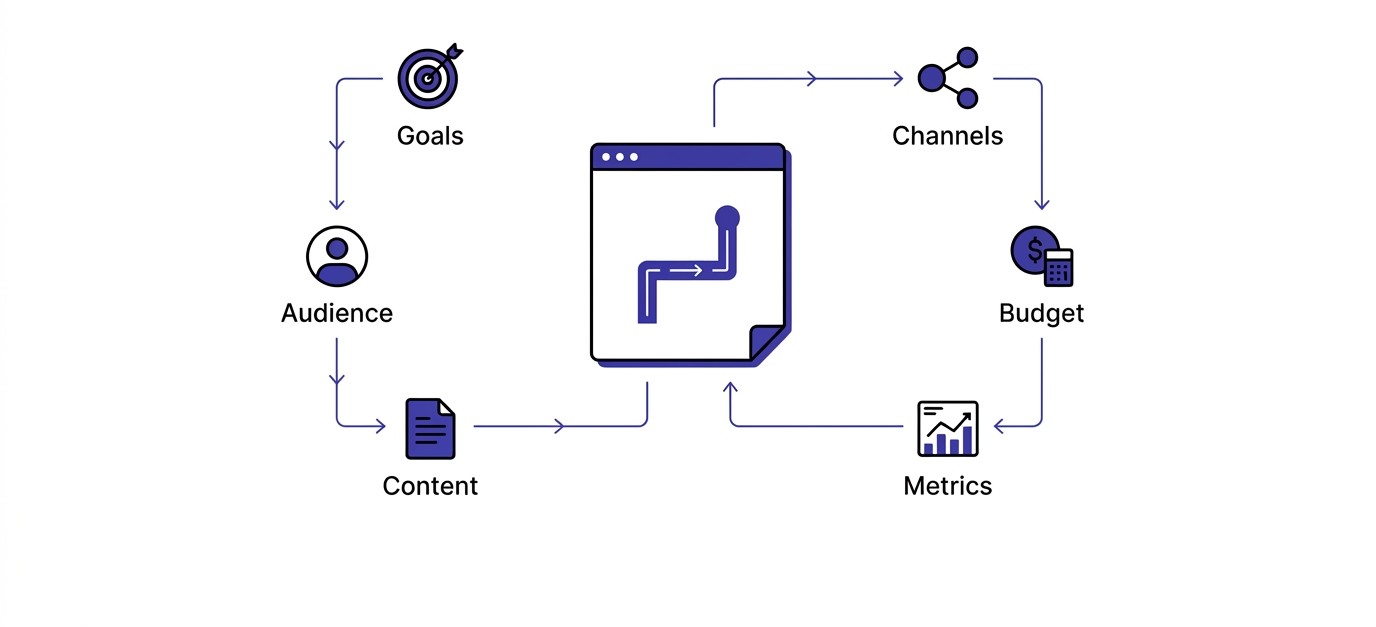
A digital marketing plan is a structured roadmap that lays out exactly what your business wants to achieve, who you’re trying to reach, which digital channels you’ll actually use, what campaigns and content you’ll create to support all of that, how much money you’re putting behind it, which metrics you’ll track to know if it’s working, and how you’ll adjust things when they’re not. Think of it as the document that turns “we should probably do more marketing” into something you can actually execute, delegate, and measure.
Digital Marketing Plan vs. Digital Marketing Strategy
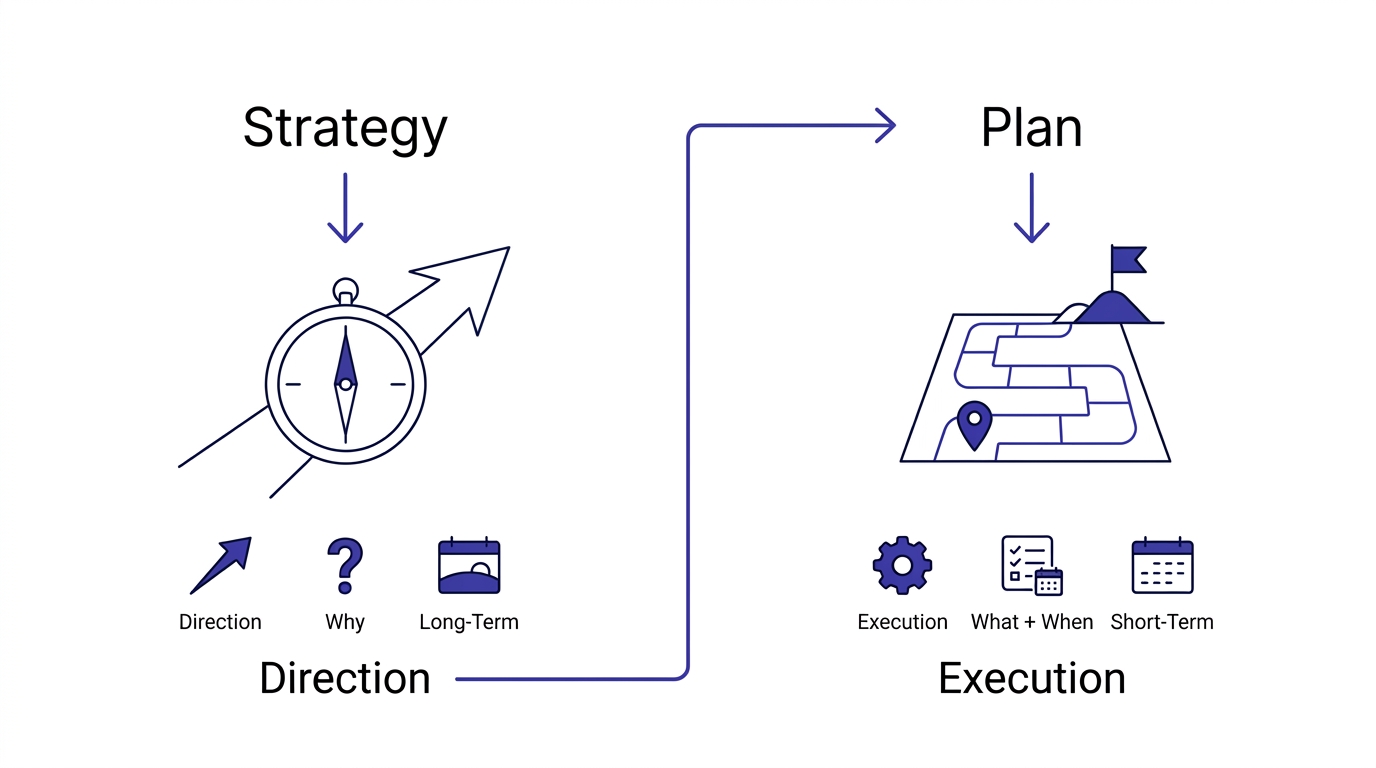
People use these two terms interchangeably all the time, and honestly, it causes a lot of confusion. A strategy and a plan are related but they’re not the same thing.
| Digital Marketing Strategy | Digital Marketing Plan |
|---|---|
| Overall direction | Specific execution roadmap |
| Defines the “why” | Defines the “what, when, and how” |
| Longer-term | Often organized monthly/quarterly |
| Positioning and approach | Campaigns, channels, budgets, timelines |
Your strategy is the big-picture thinking: who you are in the market, why customers should choose you, and the general direction you’re heading in over the next year or two. Your plan is what you actually do about it this month and next month. You need both. A strategy without a plan is just an idea nobody executes. A plan without a strategy is just busywork without direction.
Why a Digital Marketing Plan Matters
A real plan gives your marketing direction instead of letting it drift week to week based on whatever feels urgent. It aligns your marketing activity with actual business objectives, so you’re not just generating traffic for the sake of traffic, you’re generating traffic that’s supposed to turn into revenue. It improves how you allocate budget, because you’re spending based on a defined priority order instead of splitting money evenly across everything out of indecision. It creates accountability, since everyone involved knows what they’re responsible for and what success looks like. It makes performance measurable instead of a matter of gut feeling. It prevents random, disconnected marketing activities that don’t build on each other. And it helps teams prioritize which channels actually deserve attention instead of trying to be everywhere at once, which is usually a recipe for doing everything badly.
What Should a Digital Marketing Plan Include?
Before we walk through the step-by-step process, here’s the full checklist of what a complete digital marketing plan should cover. Think of this as your reference list, something to come back to and check off as you build your own plan out.
A solid plan includes a business overview, a current digital marketing audit, clearly defined marketing goals, a description of your target audience, detailed buyer personas, a competitor analysis, your unique value proposition, a mapped-out marketing funnel, the digital marketing channels you’ll actually use, a content strategy, an SEO strategy, a social media strategy, a paid advertising strategy, an email marketing plan, a conversion strategy for turning traffic into customers, a defined budget, the KPIs you’ll track, a realistic timeline, the tools and resources you’ll need, and a plan for how you’ll measure and optimize things going forward.
That’s a long list, and yeah, it can feel overwhelming staring at it all at once. But you don’t need to build every piece perfectly on day one. What matters is that each piece exists in some form and connects logically to the others. A goal without a channel to achieve it is wishful thinking. A channel without a budget behind it is a hobby. A budget without a KPI to measure it against is just money leaving your account with no accountability attached.
How to Create a Digital Marketing Plan Step by Step
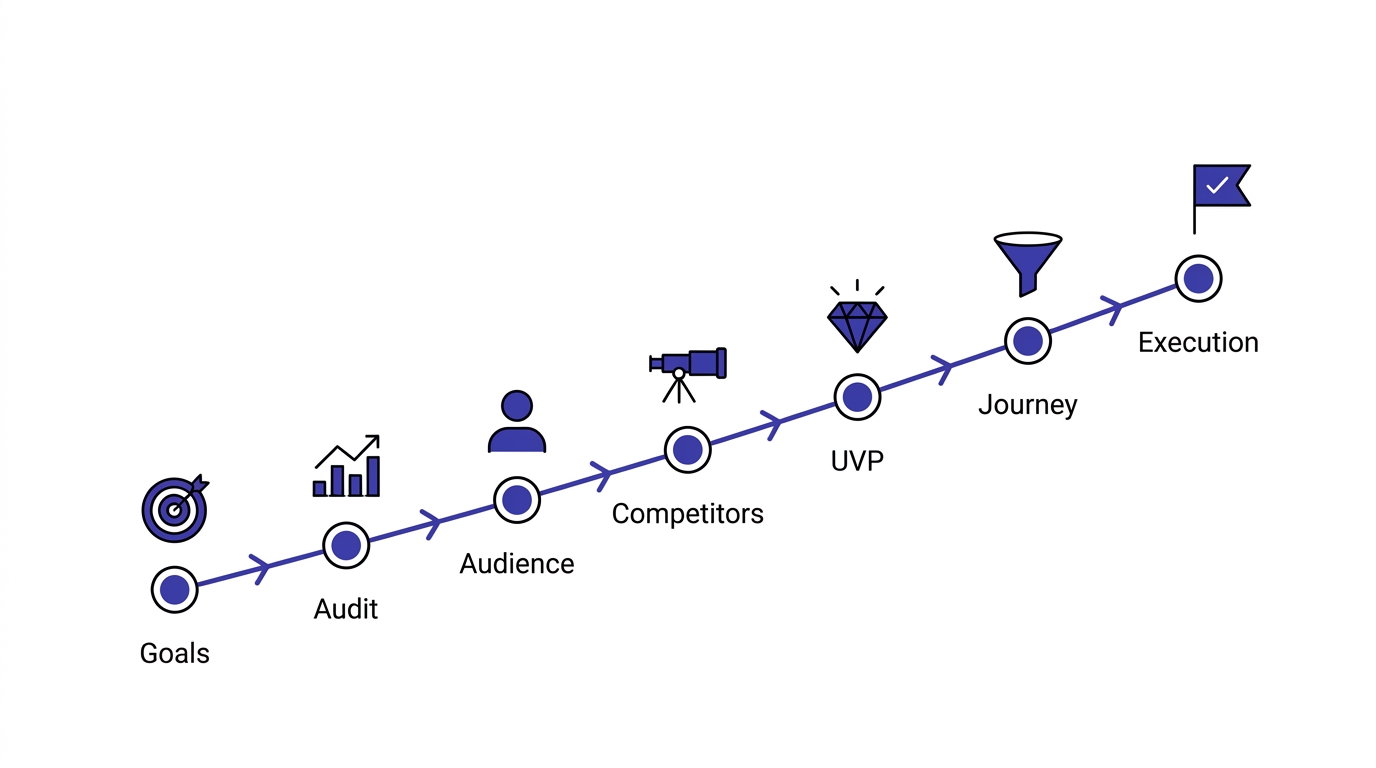
This is the core of the whole guide, so let’s actually get into it.
Step 1: Define Your Business and Marketing Objectives
Marketing objectives shouldn’t exist in a vacuum. They need to trace directly back to actual business objectives, otherwise you’re just generating activity that looks busy but doesn’t move anything that matters. Start by asking what the business actually needs right now. Is it revenue growth? More qualified leads? A higher customer acquisition rate? Better brand awareness in a specific market? More website traffic? A successful product launch? Better customer retention so fewer people churn out? Or expansion into a new market or region?
Whatever the business objective is, your marketing objective needs to be a direct extension of it, not a separate wish list.
Use SMART Marketing Goals
You’ve probably heard of SMART goals before, but it’s worth actually applying the framework instead of just nodding along. Your goals should be Specific, Measurable, Achievable, Relevant, and Time-bound. This isn’t just a nice acronym, it’s the difference between a goal you can actually plan around and a vague hope.
Here’s the difference in practice. Instead of saying “we want more leads,” which tells you absolutely nothing about how to plan a campaign, say something like “generate 500 qualified website leads within the next six months through SEO, Google Ads, and content marketing.” Now you know the number, the timeframe, and the channels responsible for hitting it.
This looks different depending on your business type. An e-commerce brand might set a goal like “increase online revenue by 25% over the next quarter through paid social and email retargeting.” A SaaS company might aim for “generate 150 free trial signups per month through content marketing and LinkedIn ads.” A local business might target “get 80 new customer calls per month through Google Business Profile optimization and local SEO.” A B2B service company might set a goal like “book 40 qualified sales calls per quarter through LinkedIn outreach and gated content.” Notice how each one is specific enough that you could actually build a campaign around it.
Step 2: Audit Your Current Digital Marketing Performance
Before you decide where to go next, you need an honest look at where you already stand. A lot of businesses skip this step because it feels like extra work before the “real” planning starts, but honestly, this is where you find out what’s already working and what’s just quietly draining budget.
Website Audit
Look at your traffic numbers, your conversion rate, which landing pages are actually performing well, your bounce and engagement metrics, how the site performs on mobile, your page speed, whether your CTAs are clear and visible, whether your forms are actually easy to fill out, and whether there are any glaring technical SEO issues holding things back. A website that looks fine to you might be quietly losing half its visitors because of a slow mobile load time nobody bothered to check.
SEO Audit
Check your organic traffic trends, where your keywords currently rank, how many of your pages are actually indexed by Google, the state of your backlink profile, any technical issues flagged in Search Console, how your existing content is performing, and your overall search visibility compared to where you’d like to be.
Social Media Audit
Review your follower counts (though don’t obsess over these), your reach, your engagement levels, which specific pieces of content have performed best, how consistently you’ve been posting, how much traffic your social channels are actually sending to your website, and how many leads, if any, have come directly from social activity.
Paid Advertising Audit
Look at how much you’ve been spending, your cost per click, your click-through rate, your conversion rate, your cost per acquisition or cost per lead, and your return on ad spend. If you’ve been running ads for a while without checking these numbers regularly, this audit alone can be a wake-up call.
Email Marketing Audit
Check your list size, your open rates, your click-through rates, your conversion rate from email specifically, and your unsubscribe rate. A shrinking list or a rising unsubscribe rate usually means something in your email strategy needs attention, whether that’s frequency, relevance, or just plain quality.
Pull all of this together into a simple digital marketing audit checklist you can revisit every quarter. It doesn’t need to be fancy, a spreadsheet works fine. What matters is that you’re actually looking at these numbers regularly instead of assuming things are fine because nobody’s complained.
Step 3: Identify Your Target Audience
“Everyone” is not a target audience. If your answer to “who are your customers?” is genuinely everyone, you don’t have a marketing plan problem, you have a positioning problem, and it needs fixing before anything else in this guide will work properly.
A real audience definition covers demographics like age and gender if relevant, location, industry if you’re B2B, job role or title, income level or business size, interests, specific pain points they’re dealing with, what actually motivates them to buy, the objections that hold them back from buying, how they behave online, and which platforms they actually spend time on. The more specific you get here, the easier every other decision in this plan becomes, because you’ll know exactly where to find these people and what to say to them once you do.
Create Buyer Personas
Turning your audience research into an actual persona makes it a lot easier to make decisions later, because you can ask “would this resonate with [persona name]?” instead of guessing in the abstract. Here’s a practical template you can use:
Persona Name: Job/Role: Business Type: Main Problem: Goals: Challenges: Buying Motivation: Objections: Preferred Channels: Search Behavior:
Here’s an example filled in for a B2B digital marketing agency targeting small business owners: Persona Name is “Growth-Stage Rohan.” Job/Role is Founder/CEO. Business Type is a small B2B service company with 10-30 employees. Main Problem is inconsistent lead flow and no clear marketing system in place. Goals include predictable monthly leads and better brand visibility in his niche. Challenges include limited time to manage marketing personally and skepticism from past bad agency experiences. Buying Motivation is wanting measurable ROI, not vague promises. Objections include worrying about contract lock-in and unclear reporting. Preferred Channels are LinkedIn and Google search. Search Behavior involves searching things like “best digital marketing agency for B2B” and reading case studies before ever booking a call.
Step 4: Analyze Your Competitors
Skipping competitor research is one of the fastest ways to waste marketing budget doing exactly what everyone else in your space is already doing, just slightly worse or slightly later. Understanding your competitive landscape tells you what’s already been done well, what’s been done poorly, and where the actual openings are.
Look at competitors across their website quality, their SEO performance, the keywords they’re ranking for, their content output and quality, their social media presence, whether they’re running paid advertising and what that looks like, their backlink profile, their offers and pricing, their customer reviews, and how they’re positioning themselves in the market.
Identify Competitor Gaps
This is where competitor research actually becomes useful instead of just being interesting trivia. Look for keywords your competitors aren’t targeting that your audience is still searching for. Look for content gaps, topics nobody in your space has covered well yet. Look for poor user experience on their websites that you could genuinely do better. Look for weak calls-to-action that aren’t converting visitors effectively. Look for customer questions that keep coming up in reviews or comments that nobody’s actually answering properly. Look for weak local SEO if you’re in a local market. And look for poor social engagement, which often means an opening for a brand that actually shows up and interacts with people.
Competitor Analysis Table
| Factor | Your Business | Competitor A | Competitor B |
|---|---|---|---|
| Organic traffic | |||
| Content | |||
| Social presence | |||
| Paid ads | |||
| Reviews | |||
| Key strengths | |||
| Gaps |
For actually gathering this data, tools like Semrush and Ahrefs are useful for SEO and keyword research, Google Search Console gives you your own site’s real search performance, and Meta Ad Library lets you see what ads your competitors are currently running on Facebook and Instagram. You don’t need every tool on the market, just enough to fill in the picture honestly.
Step 5: Define Your Unique Value Proposition
Once you know your audience and your competitive landscape, you need a clear answer to the question every customer is silently asking: why should I choose you instead of the other options? If you can’t answer that clearly, your marketing is going to struggle no matter how much budget you throw at it.
A strong UVP covers your core differentiator, meaning what genuinely sets you apart, the specific customer benefit that differentiator delivers, proof that backs up your claim, how you’re positioned relative to competitors, and the actual messaging you’ll use to communicate all of this.
Simple UVP Formula:
We help [target audience] achieve [desired outcome] through [unique solution/difference].
A few examples to show how this plays out: “We help small e-commerce brands increase repeat purchases through personalized email automation that actually feels human.” Or “We help busy founders get consistent leads through a done-for-you content and SEO system, without needing an in-house marketing team.” Or “We help local restaurants fill more tables through hyper-targeted local ads and a Google Business Profile strategy most agencies ignore.” Notice each one names a specific audience, a specific outcome, and a specific mechanism, not just vague promises about being “the best.”
Step 6: Map Your Customer Journey and Marketing Funnel
Not everyone who encounters your brand is ready to buy immediately, and treating every piece of marketing as a hard sell is a good way to scare off people who just haven’t gotten there yet. Understanding the funnel helps you match the right content and channel to where someone actually is in their decision process.
Awareness
This is where people first discover you exist. The channels that work best here are SEO, social media, YouTube, paid ads, influencer marketing, and general content marketing. The goal isn’t to sell at this stage, it’s to get noticed and start building some familiarity.
Consideration
Once someone knows you exist, they start comparing options and researching more seriously. This is where blog posts, case studies, comparison pages, webinars, email nurture sequences, and retargeting ads do the heavy lifting. This is the stage where trust actually starts getting built.
Conversion
Now they’re ready to act. This is where landing pages, product pages, demo request forms, consultation forms, clear offers, and testimonials matter most. If any of these are weak or confusing, you lose people right at the finish line after all the work it took to get them here.
Retention
Getting the sale isn’t the end of the journey, even though a lot of marketing plans treat it that way. Email, remarketing, loyalty programs, ongoing customer education, and community building are what keep customers coming back instead of buying once and disappearing.
| Funnel Stage | Primary Channels |
|---|---|
| Awareness | SEO, social media, YouTube, paid ads, influencers |
| Consideration | Blog content, case studies, webinars, email, retargeting |
| Conversion | Landing pages, demo forms, offers, testimonials |
| Retention | Email, remarketing, loyalty programs, community |
Choose the Right Digital Marketing Channels for How to Create a Digital Marketing Plan
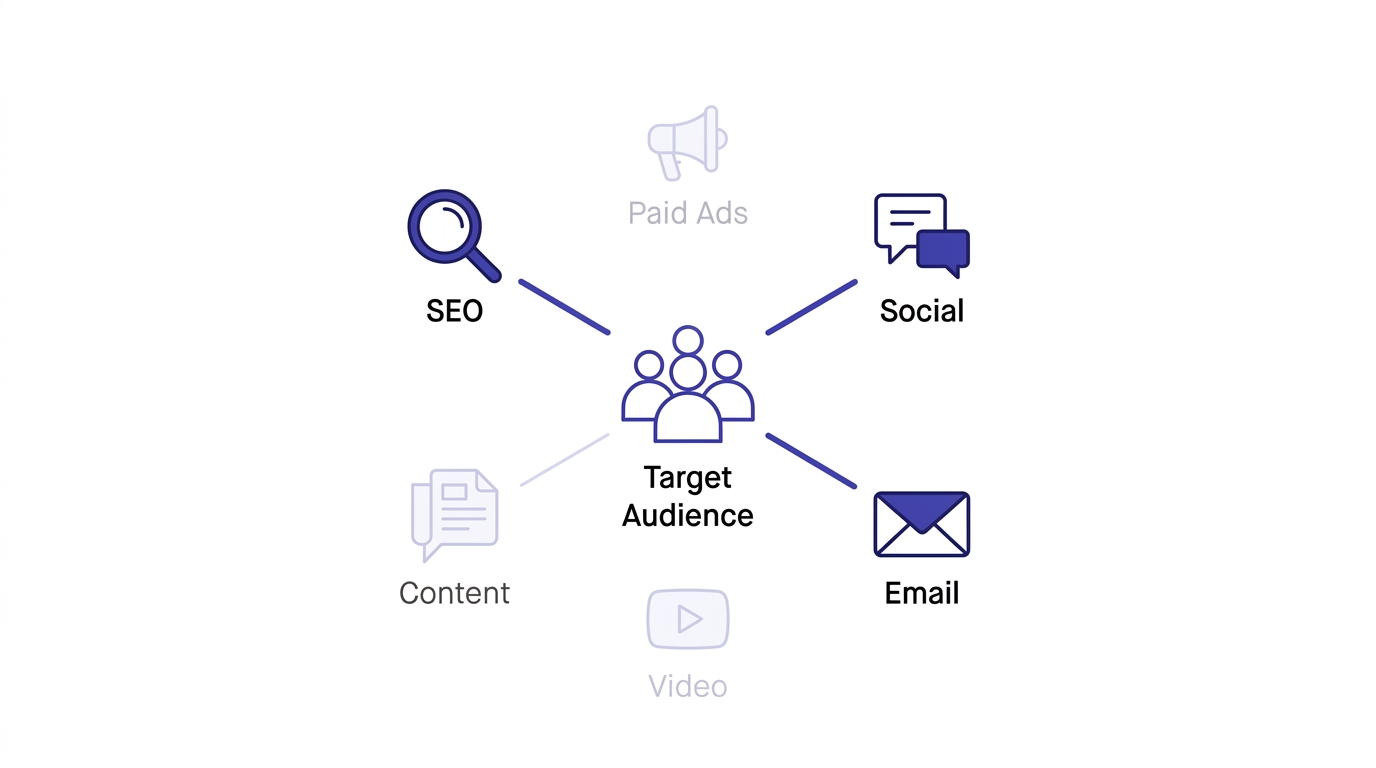
Here’s a principle worth repeating because so many businesses get this wrong: you don’t need to be everywhere. You need to be where your target customers actually are. Trying to run a strong presence on six platforms at once with a small team usually means doing all six badly instead of doing two or three genuinely well.
SEO
SEO makes sense when your audience is actively searching for solutions like yours, and when you’re playing a long game rather than needing instant results. It covers keyword research to find out what people are actually typing into Google, on-page SEO to structure your content properly, technical SEO to make sure your site can actually be crawled and indexed well, content creation built around what people are searching for, link building to establish authority, and local SEO if you serve a specific geographic area. Expect this to take a few months before you see real traction, longer in competitive industries.
SEO is best for businesses wanting long-term, compounding traffic, B2B companies with longer sales cycles, local businesses competing for nearby searches, e-commerce brands with lots of product and category pages, and any content-driven business that has genuine expertise to share.
Content Marketing
Content marketing includes blog posts, in-depth guides, case studies, whitepapers, videos, infographics, and lead magnets you can trade for someone’s email address. The trick here is matching content to both search intent and the funnel stage it’s meant to serve. A blog post targeting someone just starting their research looks completely different from a case study meant to close a deal with someone who’s already comparing vendors.
Social Media Marketing
Instagram, Facebook, LinkedIn, YouTube, X, and TikTok all serve different audiences and different content formats. The mistake most businesses make is choosing platforms based on popularity instead of where their actual customers spend time. A B2B software company probably doesn’t need to be pouring effort into TikTok, while a D2C fashion brand almost certainly should be. Choose based on your business model and your audience’s actual behavior, not what feels trendy.
Pay-Per-Click Advertising
PPC covers Google Ads, Meta Ads, LinkedIn Ads, and YouTube Ads. Understanding the terminology here matters: CPC is cost per click, CPM is cost per thousand impressions, CTR is click-through rate, CPL is cost per lead, CPA is cost per acquisition, and ROAS is return on ad spend. Paid advertising makes the most sense when you need results faster than organic channels can deliver, when you have a clear enough offer and landing page to convert paid traffic well, and when your margins can actually absorb the cost of acquiring customers this way.
Email Marketing
Email covers lead capture forms, welcome sequences for new subscribers, promotional campaigns, educational newsletters, product update emails, abandoned cart recovery emails for e-commerce, and re-engagement campaigns for subscribers who’ve gone quiet. Email tends to get underused by businesses chasing flashier channels, which is honestly a mistake, because it’s often the highest-return channel once your list is built properly.
Influencer and Creator Marketing
This includes working with micro-influencers who have smaller but highly engaged audiences, industry experts whose endorsement carries real credibility, UGC creators who produce authentic-feeling content, and affiliate partnerships where people earn a commission for driving sales. This channel works especially well for consumer brands where trust and social proof drive purchase decisions.
Local Digital Marketing
If you serve a specific geographic area, local marketing deserves serious focus. This covers optimizing your Google Business Profile properly, local SEO targeting “near me” and city-specific searches, actively managing your reviews, building local landing pages for each area you serve, getting listed consistently across local citation directories, and creating location-based content that speaks directly to your service area.
Build Your Content Marketing Strategy
Once you know your channels, you need to actually decide what you’re creating and why.
Define Your Content Pillars
Content pillars are the core themes everything you create falls under. A typical mix includes educational content that teaches your audience something useful, product or service content that explains what you offer, industry insight content that shows you understand the bigger picture, case studies that prove you deliver results, and customer-focused content that puts your audience’s stories and questions at the center.
Match Content to Search Intent
Understanding search intent keeps your content from missing the mark. Informational intent means someone’s looking to learn something, so your content should educate, not sell. Navigational intent means someone’s looking for a specific brand or page. Commercial intent means someone’s comparing options before buying, so comparison content and reviews work well here. Transactional intent means someone’s ready to buy right now, so this is where your product pages and clear CTAs need to shine.
Build a Content Calendar
A content calendar keeps everything organized and prevents that last-minute scramble to figure out what to publish this week. A simple structure works fine:
| Date | Topic | Format | Keyword | Funnel Stage | Channel | CTA |
|---|
Fill this in a month or two ahead, and you’ll never find yourself staring at a blank page wondering what to write about next.
Repurpose Content
One solid piece of content can stretch a lot further than most businesses realize. Take one pillar blog post and you can turn it into a LinkedIn post highlighting the key insight, an Instagram carousel breaking down the main points visually, a short reel covering the core idea, an email newsletter feature, a longer YouTube video going deeper into the topic, additional short-form video clips, and an infographic summarizing the data. This is honestly one of the most underrated ways to get more value out of the content work you’re already doing without doubling your workload.
Create Your SEO Strategy for How to Create a Digital Marketing Plan
Since SEO shows up as a channel in so many marketing plans, it deserves its own dedicated section here.
Keyword Research
This starts with identifying your primary keywords, the core terms most tied to what you offer, secondary keywords that support those primary terms, long-tail keywords that are more specific and often easier to rank for, commercial keywords that signal buying intent, and local keywords if geography matters to your business.
On-Page SEO
On-page work covers writing clear, keyword-relevant title tags, meta descriptions that actually encourage clicks, proper heading structure using H1s, H2s, and H3s logically, smart internal linking between related pages on your site, optimizing images with proper alt text and file sizes, and making sure your content actually matches the search intent behind the keyword you’re targeting.
Technical SEO
Technical SEO covers site speed, since a slow site loses visitors and search rankings both, mobile usability given how much search traffic is mobile now, making sure your pages are properly indexed by search engines, your Core Web Vitals scores, structured data markup that helps search engines understand your content, and general crawlability so search engines can actually find and read your pages properly.
Off-Page SEO
This covers building backlinks from other credible websites, digital PR efforts to earn media coverage and mentions, guest posting on relevant sites in your industry, tracking and encouraging brand mentions, and general authority building over time. Off-page SEO is slower and harder to control than on-page work, but it’s a major factor in how much search engines trust your site.
Modern SEO Considerations
A few things worth keeping on your radar without turning this into a whole separate guide: helpful content that genuinely serves the reader rather than just targeting a keyword, building topical authority by covering a subject area thoroughly rather than randomly, E-E-A-T (experience, expertise, authoritativeness, trustworthiness) which search engines increasingly weigh, the rise of AI-generated search experiences changing how results get displayed, and the emerging practices around Answer Engine Optimization and Generative Engine Optimization as AI tools become bigger sources of discovery. These are shifting fast, so treat this as something to keep an eye on rather than a fixed rulebook.
Create Your Social Media Marketing Strategy
| Platform | Best For |
|---|---|
| B2B, professional services | |
| Visual brands, lifestyle, D2C | |
| Local businesses, communities | |
| YouTube | Education, reviews, long-form video |
| TikTok | Short-form, younger audiences |
Match this table against your actual audience research from earlier. If your buyer personas are mostly on LinkedIn searching for B2B solutions, pouring effort into TikTok content probably isn’t the best use of your time, no matter how tempting the platform’s growth potential looks.
Define Your Content Mix
A commonly used starting framework looks something like 40% educational content, 20% engagement-focused content, 20% promotional content, and 20% authority or social proof content like testimonials and case studies. This isn’t a universal rule carved in stone, it’s a reasonable starting point you can adjust once you see what your specific audience actually responds to.
Establish Posting Frequency
Consistency matters more than raw volume. Posting three times a week reliably beats posting daily for two weeks and then going quiet for a month. Quality should generally win over quantity, especially on platforms where the algorithm rewards engagement over sheer output. Different formats work differently on each platform, so don’t just copy-paste the same content everywhere. And don’t treat social media as a broadcast channel only, actually engaging with comments and messages builds the kind of community that makes people stick around.
Plan Your Paid Advertising Strategy
Building a real paid media plan means working through a few key pieces: your campaign objective (awareness, leads, sales, whatever it is), your target audience, which platform makes sense for that audience, your budget, the actual ad creative, the landing page people land on after clicking, conversion tracking so you know what’s working, and retargeting to bring back people who didn’t convert the first time.
Budget Allocation Example
Here’s an example allocation for a ₹1,00,000 monthly paid media budget:
| Channel | Budget |
|---|---|
| Google Ads | ₹40,000 |
| Meta Ads | ₹25,000 |
| SEO/Content | ₹20,000 |
| Retargeting | ₹10,000 |
| Testing | ₹5,000 |
This is just an example, not a formula to copy blindly. Your actual allocation should depend on your specific business goals, your profit margins, what you can afford to spend acquiring a customer, and which channels have already shown they perform for your particular business.
Set Your Digital Marketing Budget
A realistic marketing budget needs to account for advertising spend, SEO work, content production, design work, software and tool subscriptions, email marketing platforms, freelancers or agency fees, video production if you’re using it, website costs, and analytics tools. Miss any of these and you’ll end up underestimating what your marketing actually costs to run properly.
Percentage-Based Budgeting
There are a few common ways businesses approach setting a budget. A fixed monthly budget just sets a flat number regardless of revenue. A percentage of revenue approach ties spend to how the business is performing. A percentage of an overall marketing budget divides an already-set marketing figure across specific channels. And goal-based budgeting works backward from what you’re trying to achieve to figure out what it’ll actually cost to get there, which tends to be the most grounded approach of the bunch.
Example Budgets
A startup might work with somewhere around ₹30,000 to ₹1,00,000 a month, often weighted toward paid acquisition for fast learning. A small business might land around ₹15,000 to ₹50,000, focused more on local visibility and SEO. A growing business might sit around ₹75,000 to ₹2,00,000, running a genuine multi-channel mix. A mid-sized business might range from ₹1,50,000 to ₹3,00,000 or more, supporting a fuller team and broader campaigns. These are illustrative examples only, not universal benchmarks you should feel locked into. Your actual number depends entirely on your specific goals, margins, and market.
Define Your Digital Marketing KPIs
It helps to be clear on the difference between metrics, KPIs, vanity metrics, and business outcomes, because mixing these up is how a lot of reporting ends up misleading everyone involved. Metrics are just numbers you can measure. KPIs are the specific metrics tied directly to your goals. Vanity metrics look impressive but don’t actually connect to revenue, things like raw follower counts or impressions with no context. Business outcomes are the actual results that matter to the bottom line, like revenue, customers, and profit.
Important Digital Marketing KPIs
For your website, track users, sessions, engagement, conversion rate, and leads generated. For SEO, track organic traffic, keyword rankings, impressions, click-through rate, and conversions coming from organic search. For paid ads, track CPC, CTR, CPL, CPA, and ROAS. For social media, track reach, engagement rate, saves, shares, follower growth, and clicks back to your website. For email, track open rate, click-through rate, conversion rate, and unsubscribe rate.
Build a Marketing KPI Dashboard
A simple dashboard structure just needs a few columns: the KPI itself, the channel it belongs to, the current value, the target value, and the status showing whether you’re on track, behind, or ahead. This doesn’t need to be complicated software. A well-organized spreadsheet updated weekly or monthly does the job just fine for most businesses starting out.
Create a 90-Day Digital Marketing Action Plan
Having a plan on paper means nothing if it doesn’t turn into actual execution. Here’s how to structure the first 90 days.
Days 1–30: Foundation
The first month should be spent on your audit, defining clear goals, doing your audience research, running your competitor research, setting up proper tracking so you can actually measure things from day one, fixing any glaring website issues, doing your keyword research, and putting together the overall strategy that everything else will follow.
Days 31–60: Execution
The second month is where you actually start doing the work: publishing content consistently, implementing your SEO fixes and improvements, launching your social media campaigns, getting paid advertising live, building out lead magnets to capture interest, sending your first email campaigns, and building or improving the landing pages your traffic will land on.
Days 61–90: Optimization
The third month is about looking at what’s actually happening and adjusting accordingly: analyzing performance data honestly, improving campaigns that are underperforming instead of abandoning them too early, scaling the channels that are clearly working, running conversion rate optimization on your key pages, setting up retargeting for people who’ve shown interest but haven’t converted, refreshing older content that needs updating, and reallocating budget based on what the first two months actually taught you.
| Phase | Days | Focus |
|---|---|---|
| Foundation | 1–30 | Audit, goals, research, tracking setup |
| Execution | 31–60 | Content, SEO, campaigns, landing pages |
| Optimization | 61–90 | Analysis, scaling, CRO, budget reallocation |
Free Digital Marketing Plan Template
This is where all of the thinking above turns into something you can actually use. Copy this structure into a doc or spreadsheet and start filling it in with your own business details.
Template Section 1: Business Overview
Business name, industry, products or services offered, target market, and main competitors.
Template Section 2: Goals
| Goal | KPI | Target | Deadline |
|---|
Template Section 3: Audience
Persona, pain points, needs, preferred channels, and buying behavior.
Template Section 4: Channel Strategy
| Channel | Objective | Strategy | KPI |
|---|
Template Section 5: Content Plan
| Topic | Format | Keyword | Funnel Stage | Channel |
|---|
Template Section 6: Budget
| Activity | Monthly Budget | Expected Result |
|---|
Template Section 7: KPI Tracking
| KPI | Current | Target | Actual | Status |
|---|
Go ahead and download this framework, plug in your own business goals, audience details, channels, budget numbers, and KPIs, and you’ll have a working digital marketing plan instead of just a bunch of ideas floating around in your head or scattered across old notes.
Digital Marketing Plan Example
Let’s make this real with a full example, start to finish.
Example Business: A local home renovation company.
Business Goal: Generate 100 qualified leads within six months.
Target Audience: Homeowners aged 30-55 within the company’s service area, likely dealing with an outdated kitchen or bathroom and researching costs before committing to a project.
Selected Channels: Local SEO, Google Business Profile optimization, Google Ads, Facebook and Instagram, content marketing, and email follow-up sequences for leads who aren’t ready to book yet.
Example Content Topics: Home renovation cost guides that answer the “how much will this cost me” question everyone’s Googling, kitchen renovation ideas for inspiration-stage browsers, bathroom remodeling guides, before-and-after project showcases that build trust visually, and customer case studies that prove the work gets done well and on budget.
Example Budget: Say the monthly budget is ₹80,000. That might break down as ₹30,000 for Google Ads targeting high-intent local searches, ₹15,000 for Meta Ads running awareness and retargeting, ₹20,000 for content and SEO work, ₹10,000 for email and lead nurturing, and ₹5,000 for tools and tracking.
Example KPIs: Organic leads generated, paid leads generated, cost per lead, conversion rate from lead to booked consultation, phone calls received, and quote requests submitted through the website.
Here’s how the whole thing connects: the business goal of 100 leads in six months becomes a marketing goal of roughly 17 leads a month. That marketing goal gets split across channels, local SEO and Google Business Profile handling organic discovery, Google Ads and Meta handling paid acquisition. Each channel runs specific campaigns, like a “Kitchen Renovation Cost Calculator” lead magnet promoted through both organic content and paid ads. And each campaign gets measured against KPIs like cost per lead and conversion rate, so the business knows within a few weeks whether this is working or needs adjusting.
How Often Should You Update Your Digital Marketing Plan?
Different parts of your plan need attention on different timelines. Weekly, you should be monitoring your active campaigns to catch problems early. Monthly, do a proper KPI review to see how things are trending. Quarterly, step back and review your overall strategy, not just individual campaigns. Annually, do major strategic planning that resets your direction for the year ahead.
Beyond that regular rhythm, a few specific triggers should prompt an off-schedule review: a major search engine algorithm update that shifts your rankings, new competitors entering your market, broader market or economic changes, changes to your available budget, launching new products or services, a channel that’s clearly underperforming despite reasonable time invested, or noticeable shifts in how your customers are behaving online. When any of these happen, don’t wait for your next scheduled review, go back and adjust the plan.
How to Measure Whether Your Digital Marketing Plan Is Working
Beyond individual KPIs, it helps to zoom out periodically and ask a set of bigger-picture questions. Are you actually reaching the right audience, or just generating traffic from people who were never going to buy? Is that traffic genuinely qualified, or just high in volume but low in relevance? Are visitors converting once they land on your site? Are the leads you’re generating actually turning into paying customers? Is your customer acquisition cost sustainable given your margins? Which channels are generating the best return relative to what you’re spending on them? Which campaigns deserve more budget because they’re clearly working? And which activities should be paused or reworked because they’re not pulling their weight?
The underlying process here is simple even if the execution takes discipline: track what’s happening, analyze what the data is actually telling you, learn from it honestly even when it’s not what you hoped to see, optimize based on what you’ve learned, and then scale whatever’s proven to work. Track → Analyze → Learn → Optimize → Scale. Skip any one of these steps and the whole cycle breaks down.
Conclusion
Here’s the whole framework laid out one more time, start to finish: define your goals, audit your current performance, understand your audience, analyze your competitors, select your channels, create your content and campaigns, set your budget, define your KPIs, execute the plan, and then measure and optimize based on what actually happens.
A plan sitting in a document does nothing on its own. The businesses that actually see results are the ones that take this framework, fill in their own specifics, and then genuinely act on it week after week, adjusting as real data comes in instead of guessing forever. So go ahead, download the free digital marketing plan template from this guide, fill in your business goals, your audience, your channels, your budget, and your KPIs, and turn what’s been a scattered set of marketing activities into a plan you can actually measure and grow from.
Frequently Asked Questions
What is a digital marketing plan?
A digital marketing plan is a structured document that outlines your marketing goals, target audience, chosen channels, campaigns and content, budget, and the KPIs you’ll use to measure success. It turns vague marketing intentions into something specific and executable.
How do I create a digital marketing plan?
Start by defining your business and marketing objectives, then audit your current performance, identify your target audience, analyze your competitors, define your unique value proposition, map your customer journey, choose your channels, build out your content and campaign strategy, set a budget, define your KPIs, and put together an action plan to execute against.
What are the 7 steps of a digital marketing plan?
While the exact number of steps varies depending on how you break it down, the core sequence generally covers setting goals, researching your audience, analyzing competitors, choosing your channels, creating your content and campaign strategy, setting your budget, and defining the KPIs you’ll track to measure success.
What should a digital marketing plan include?
A complete plan includes a business overview, a current marketing audit, clear goals, audience research and buyer personas, competitor analysis, your unique value proposition, a mapped funnel, chosen channels, a content and SEO strategy, a social media and paid advertising plan, an email strategy, a budget, defined KPIs, a timeline, and a plan for ongoing measurement and optimization.
What is the difference between a digital marketing plan and strategy?
Your strategy is the overall direction and positioning, the “why” behind your marketing. Your plan is the specific execution roadmap, the “what, when, and how” that puts that strategy into action through actual campaigns, channels, and timelines.
How much does it cost to create a digital marketing plan?
If you build it yourself using a template like the one in this guide, it costs nothing but your time. If you hire a consultant or agency to build it for you, costs vary widely based on the depth of research and strategy work involved, but it’s typically a smaller, one-time cost compared to your ongoing monthly marketing execution budget.
How long should a digital marketing plan be?
There’s no fixed length. What matters is that it’s complete and actionable, not padded out with filler. A small business plan might fit on a few pages, while an enterprise plan covering multiple product lines and markets could run much longer. Length should follow necessity, not the other way around.
How often should a digital marketing plan be updated?
Review campaigns weekly, KPIs monthly, overall strategy quarterly, and do major strategic planning annually. Beyond that regular rhythm, update your plan whenever something significant changes, like a new competitor, a budget shift, or a major algorithm update affecting your results.
What are the most important digital marketing KPIs?
This depends on your specific goals, but commonly tracked KPIs include website conversion rate, cost per lead, cost per acquisition, organic traffic growth, ROAS for paid campaigns, and email conversion rate. Focus on the KPIs tied directly to your stated business goals rather than tracking everything just because you can.
Which digital marketing channels should a small business use?
Most small businesses get the best early results from local SEO, Google Business Profile optimization, social media on one or two platforms where their audience actually spends time, and a modest, well-targeted Google Ads budget. Start narrow, prove what works, then expand.
Can I create a digital marketing plan myself?
Yes, absolutely. The framework in this guide is designed so any business owner can walk through it themselves without needing an agency. It takes real time and honest thinking, but there’s nothing in the process that requires specialized expertise you can’t learn or figure out as you go.
What is the best digital marketing plan template?
The best template is one that’s actually simple enough that you’ll use it consistently, covering your business overview, goals, audience, channel strategy, content plan, budget, and KPI tracking in one place. The free template included in this guide covers exactly that.