

Most people who want to start an email list get stuck on the same excuse. “I’ll build my list once I have an audience.” That sounds reasonable until you actually sit with it for a minute, because it’s backwards. Audience and email list are not the same thing, and treating them as one problem is exactly why so many beginners never send their first campaign.
Here’s the thing nobody tells you when you’re starting from zero: you don’t need followers to get subscribers. You need a reason. One good reason, aimed at the right person, at the right moment. That’s it. Somebody with 40 Instagram followers and a genuinely useful checklist can out-collect someone with 40,000 followers and no plan. It happens more than you’d think.
This post is not a list of “10 tips to grow your email list.” It’s the whole system, start to finish. Setting up the boring technical stuff nobody wants to touch, picking a lead magnet that actually works when you have no trust built up yet, choosing channels that make sense at zero, and then handling the list once people are actually on it, because getting the subscriber is only half the job. By the end you should have enough to go build this yourself, not just enough to feel inspired for a day and forget about it by Thursday.
Your Instagram followers belong to Instagram. Your email list belongs to you. Keep that in your head as you read the rest of this, because it explains almost every decision below.
Why an Email List Still Matters in 2026
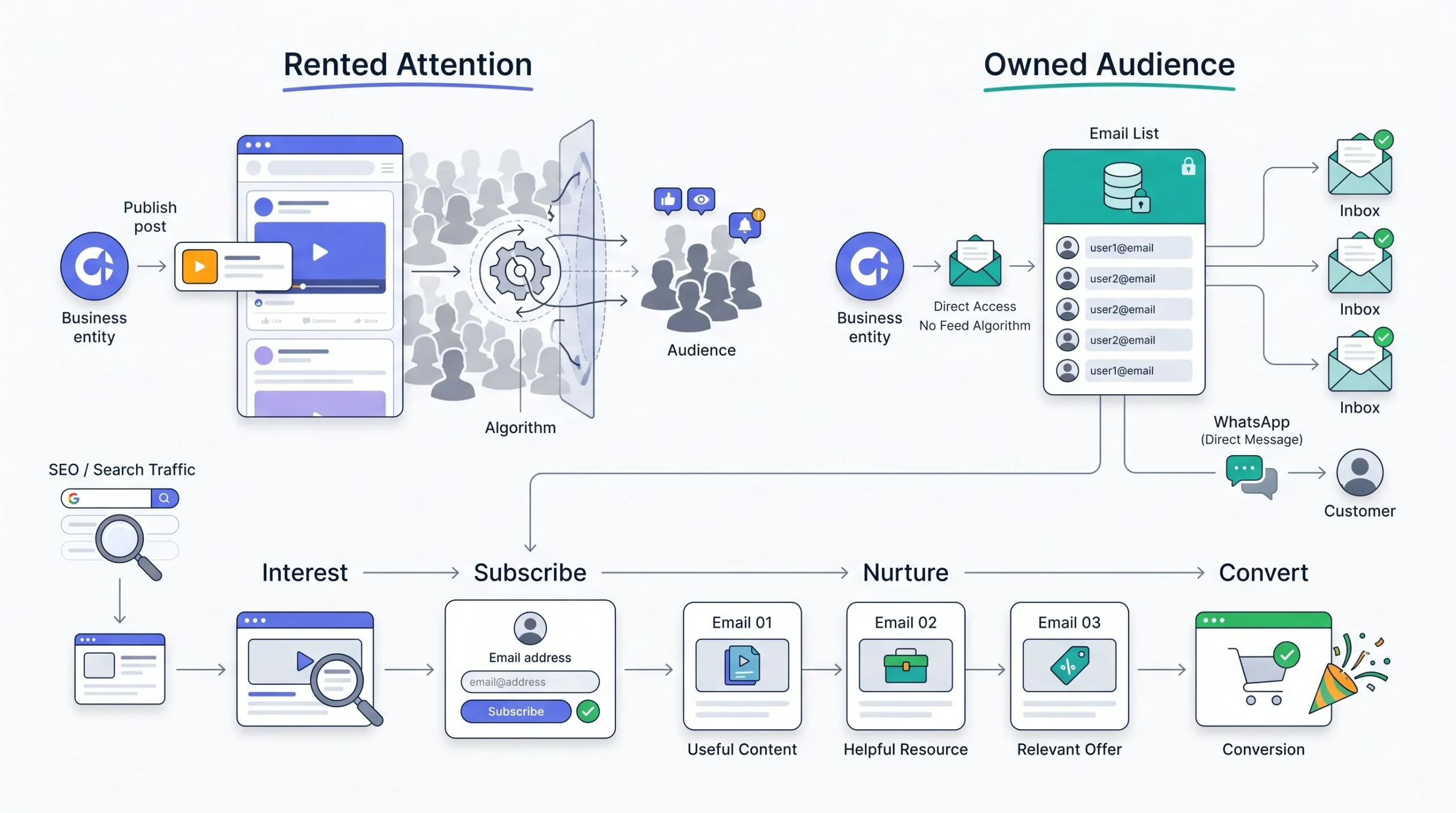
Look, everyone loves to declare email dead every couple of years. Then they check their open rates against their Instagram reach and go quiet. Reach on social platforms isn’t something you control. One algorithm tweak and a post that used to hit 20% of your followers now hits 3%. That’s not a hypothetical, that’s just how the last several years have gone for anyone posting on Meta or LinkedIn regularly. Your list doesn’t work like that. If you have 500 emails and you hit send, your message lands in 500 inboxes. Nobody’s algorithm gets a vote.
That’s the whole argument, honestly, but let’s break it into pieces because each one matters for different reasons.
Ownership. You’re renting attention on every social platform. The day Instagram decides your niche isn’t worth pushing, or your account gets flagged for something dumb, that audience is gone. An email list is the closest thing to owning a channel that exists in marketing right now.
Direct access. No feed, no “for you” page deciding whether your message is worth showing. It goes to the inbox. Even a mediocre email gets seen by more of your list than a great post gets seen by your followers.
Conversion reliability. This is the part people undersell. Email consistently converts better than social traffic for actual purchases, sign-ups, bookings, whatever your goal is. Not because email is magic, but because someone who gave you their email already crossed a bigger trust threshold than someone who tapped follow.
Where does this fit in your funnel? Early on, your list is mostly a top-of-funnel and middle-of-funnel tool, you’re capturing interest before someone’s ready to buy. But the same list becomes your bottom-of-funnel weapon later, when you’re launching something and need direct access to people who already said yes to you once.
| Channel | You Own the Audience? | Algorithm Risk | Direct Access | Typical Conversion Reliability |
|---|---|---|---|---|
| Email List | Yes | None | Inbox, direct | High |
| Instagram Followers | No | High | Feed-dependent | Medium-Low |
| WhatsApp Broadcast | Partial | Low | Direct | High (India-specific) |
| Google/SEO Traffic | No | Medium | Search-dependent | Medium |
Worth noticing that WhatsApp shows up here too, and if you’re building an audience in India specifically, that’s not a coincidence. We’ll come back to WhatsApp later as something that actually pairs with email rather than competes with it.
Myth-Busting: What “Zero Followers” Actually Means
Before going any further, a few things need clearing up, because most of the fear around list-building at zero comes from believing things that just aren’t true.
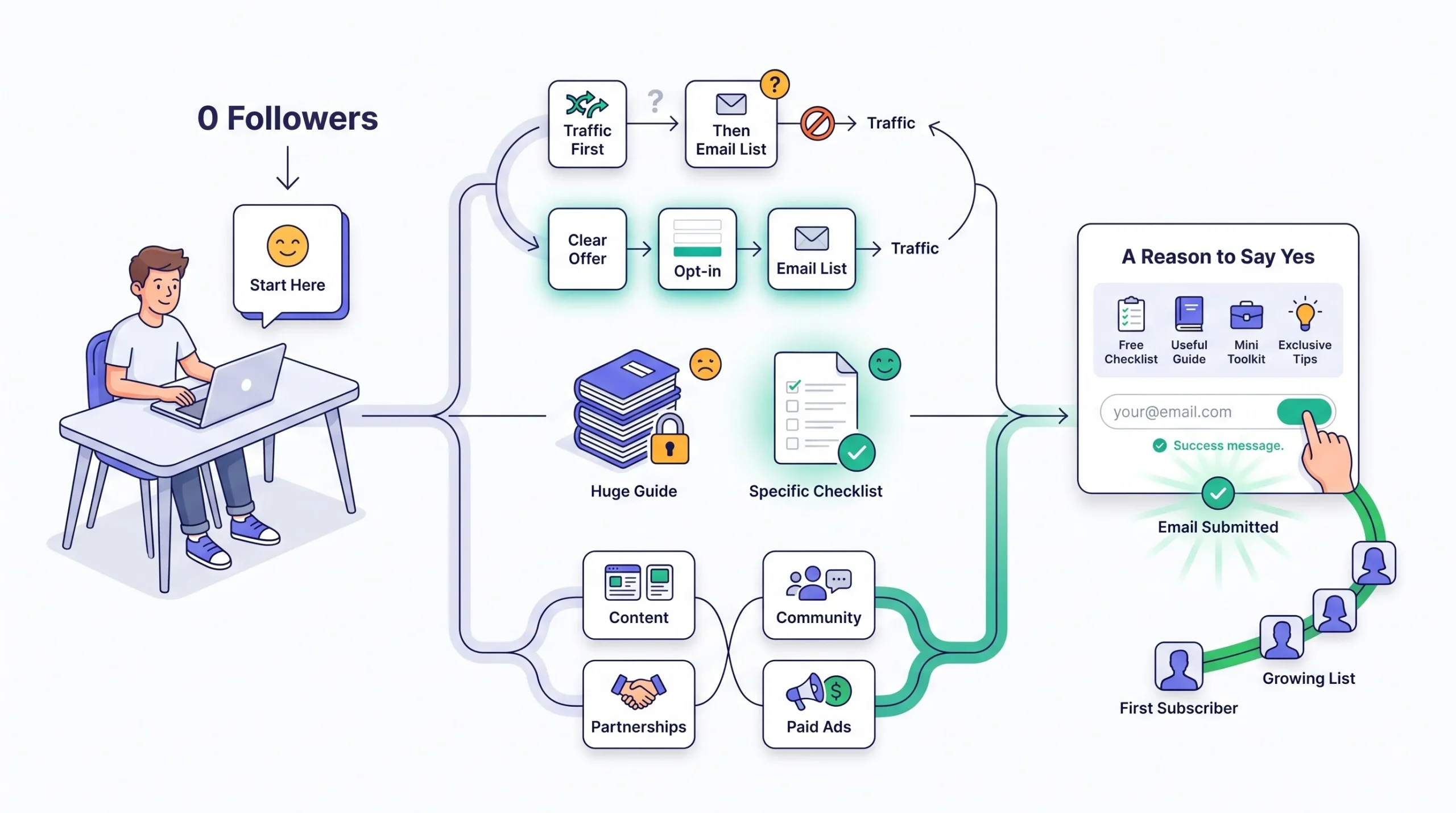
Myth 1: You need traffic before you need a list. Nope, it’s the opposite. Building your opt-in system first is what forces you to think clearly about who you’re for and what you’re offering. People who wait for traffic to “figure out” their list strategy usually end up with a generic newsletter signup box that converts at basically nothing, because they never had to get specific.
Myth 2: You need a big lead magnet to start. Honestly this one wastes more time than any other myth on this list. A beginner spends three weekends building a 40-page PDF guide, publishes it, and gets 4 downloads. Meanwhile a one-page checklist solving one specific annoying problem gets downloaded 40 times in a week. Smaller, sharper wins. Every time.
Myth 3: Paid ads are the only fast way to build a list at zero. Paid works, sure, and we’ll talk about it. But plenty of lists get built to their first thousand subscribers with zero ad spend, through communities, content, and partnerships. Money speeds things up. It’s not the only door in.
So if not an audience, what do you actually need before you can start? A reason for someone to say yes. That’s the real prerequisite, and it’s smaller than people think.
Pre-Launch Foundations: What to Set Up Before You Ask for a Single Email
This is the part everyone skips because it’s boring, and it’s exactly why so many beginner lists end up in spam folders or die from bad deliverability before they even get going. Get this right first.
Here’s the thing about foundations, though. They don’t feel productive. Setting up SPF records doesn’t give you a subscriber count going up. Choosing an ESP doesn’t feel like “growth.” So people skip straight to the fun part, writing the lead magnet, designing the landing page, and treat this section as optional homework they’ll circle back to later. Later usually means never, or means circling back after three months of poor open rates with no idea why. Do it now, once, properly, and stop thinking about it.
Choosing an Email Service Provider (ESP)
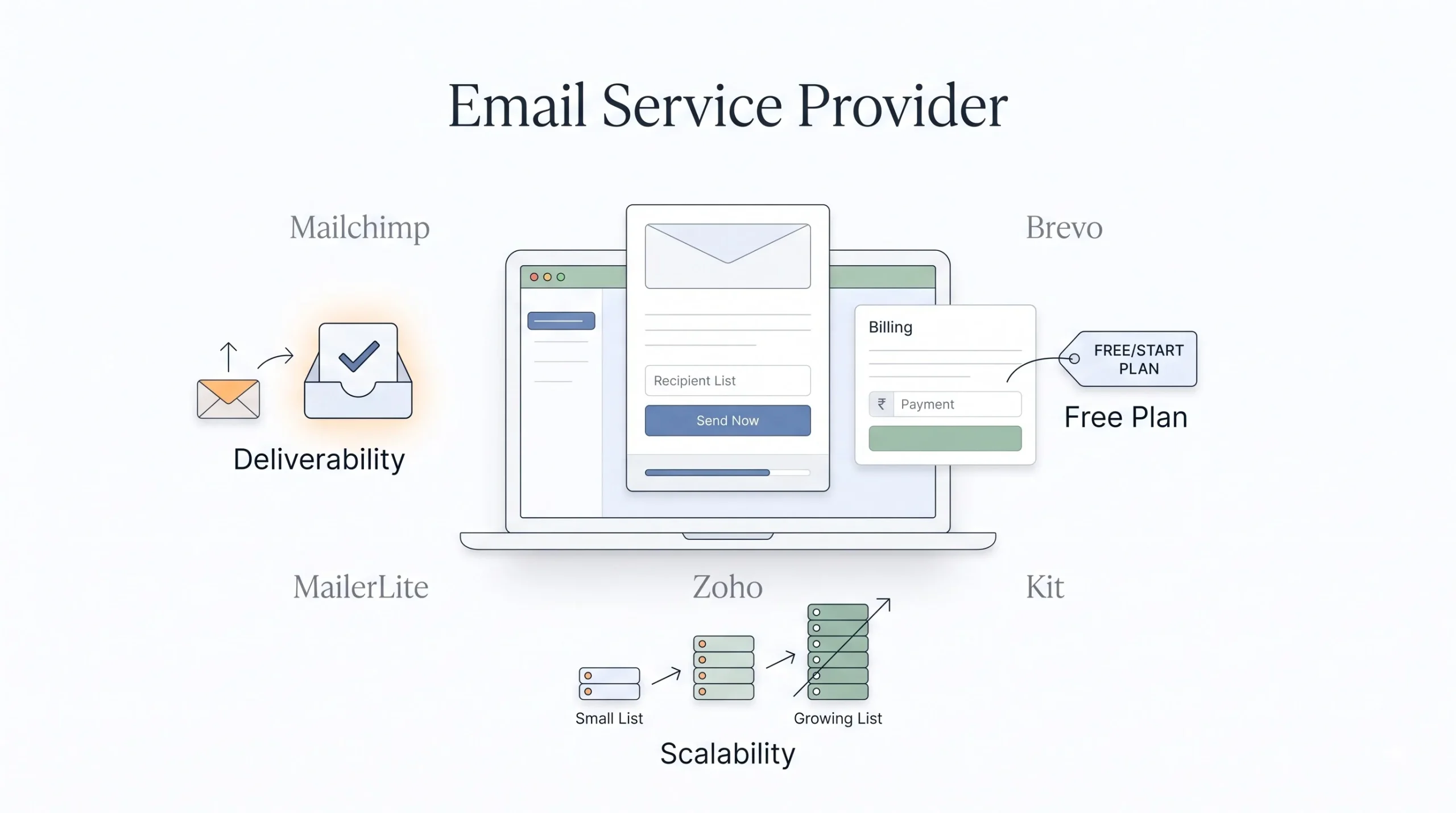
At zero subscribers, what matters isn’t which ESP has the fanciest automation builder. It’s deliverability reputation, whether the free tier is actually usable, and whether it plays nice with Indian payment methods when you eventually upgrade.
| ESP | Free Tier Limit | Starting Paid Price (₹/mo approx) | Best For | Notable Limitation |
|---|---|---|---|---|
| Mailchimp | ~500 contacts | ~₹1,500+ | Beginners, templates | Restrictive free automation |
| MailerLite | ~1,000 subscribers | ~₹800+ | Landing pages + email combo | Fewer integrations |
| Brevo (Sendinblue) | ~300 emails/day | ~₹1,900+ | Transactional + marketing combo | Learning curve |
| ConvertKit (Kit) | ~10,000 subs (limited) | ~₹2,300+ | Creators, tagging/segmentation | Pricier at scale |
| Zoho Campaigns | ~2,000 contacts | ~₹700+ | Existing Zoho/India business users | Smaller template library |
None of these is objectively “the best.” MailerLite is a solid starting point if you want landing pages bundled in without extra tools. Zoho makes sense if you’re already running your business email through Zoho anyway, no point adding another login. ConvertKit (now branded Kit) leans heavily toward creators who want tagging and subscriber-level segmentation from day one, that’s more power than most beginners actually need at zero subscribers, but if you already know you’ll want detailed behavior tracking later, starting there saves a migration. Mailchimp is the name everyone’s heard of, which is exactly why its free tier automation is so limited, they’re monetizing recognition, not generosity. Brevo throws in transactional email alongside marketing email, useful if you’re also sending order confirmations or account emails from the same domain, but the interface takes longer to feel natural than MailerLite’s does.
Pick one, get moving, switching ESPs later is annoying but not the end of the world. What actually matters more than the brand name is whether you’ll consistently use it. A slightly clunkier tool you open every week beats a beautifully designed one you forget about after month one.
Domain authentication basics (SPF, DKIM, DMARC)
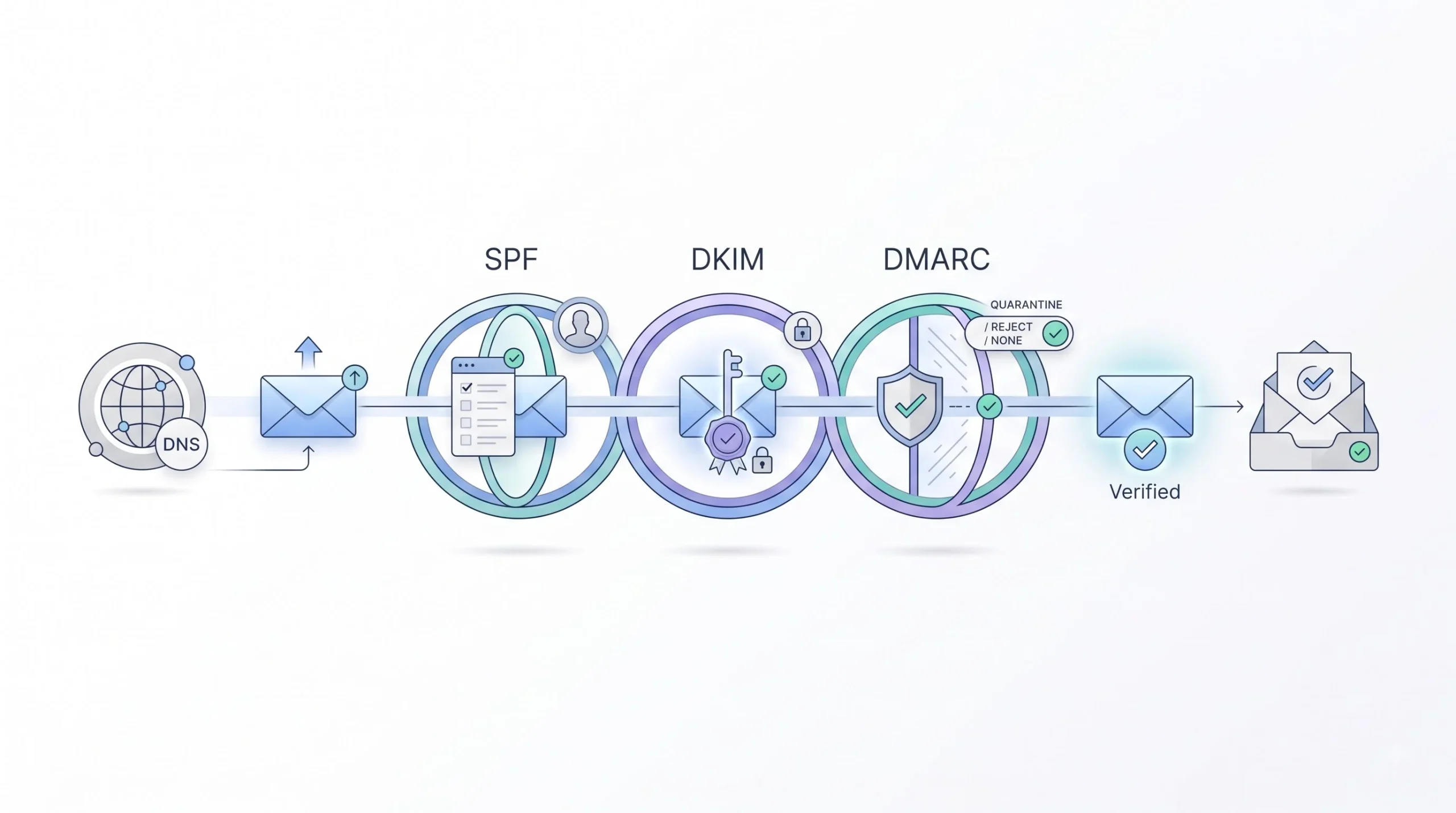
This is the part people find genuinely boring and then regret ignoring about six weeks in. Here’s why it matters before you send email number one, not after your open rates mysteriously crater.
SPF, DKIM, and DMARC are records you add to your domain that tell inbox providers “yes, this ESP is actually authorized to send email on my behalf.” Without them, Gmail and Outlook have zero reason to trust that your MailerLite or Brevo account sending on your behalf isn’t a spoofed sender. New senders without authentication routinely get dumped straight into spam, no matter how good the email itself is.
Setting this up is usually a copy-paste job, your ESP gives you the DNS records, you paste them into your domain registrar (GoDaddy, Hostinger, whoever you bought the domain through), and wait for propagation. Takes maybe twenty minutes total. Skip it and you’re fighting deliverability problems you don’t even know you have.
Quick breakdown of what each one actually does, because “just add these three records” means nothing if you don’t know why. SPF tells receiving mail servers which servers are allowed to send email claiming to be from your domain, think of it as a guest list at the door. DKIM adds a digital signature to your outgoing emails so the receiving server can verify the message wasn’t tampered with in transit, basically a tamper-proof seal. DMARC sits on top of both and tells inbox providers what to do if an email fails either check, reject it, quarantine it, or let it through anyway. Without DMARC, even having SPF and DKIM set up doesn’t fully protect you, because there’s no instruction for what happens on a failure.
The mistake beginners make here is assuming this is a one-time task and then never checking back. If you ever switch ESPs, or add a new sending tool, those records need updating too, otherwise your new tool is sending unauthenticated and you’re back to square one on deliverability without realizing it.
Skipping domain authentication is the number one reason beginner senders end up in spam folders before they even get their first 100 subscribers.
Legal compliance for Indian creators and businesses
Most list-building content out there talks about GDPR and CAN-SPAM and stops there, which is fine if you’re targeting a US or EU audience but leaves a gap if you’re building a list of Indian subscribers. The Digital Personal Data Protection Act (DPDP Act, 2023) sets rules around consent and how you use personal data you collect, including email addresses. The short version that actually matters for list building: get clear, informed consent before adding someone to your list, and don’t use their data for purposes beyond what you told them.
Double opt-in helps here in two ways at once. It’s a stronger consent trail (someone actively confirmed they want in, not just typed an email and moved on), and it protects your deliverability, because it filters out fake or mistyped addresses before they ever hit your list.
There’s also a practical side that has nothing to do with law and everything to do with trust. Being upfront about what someone’s signing up for, and how often you’ll email them, isn’t just a compliance checkbox, it reduces spam complaints down the line. Someone who expected a weekly checklist email and instead gets daily promotional blasts is going to hit the spam button, and spam complaints hurt your sender reputation with every single inbox provider watching, not just that one subscriber’s inbox. Set the expectation clearly on the opt-in page itself, “one email a week, practical stuff only,” and you’ll get fewer angry unsubscribes down the road.
Setting a single, specific list-building goal
“Grow my list” isn’t a goal, it’s a wish. Put a number and a date on it. “200 subscribers in 60 days from my checklist landing page” is something you can actually plan backward from. Vague goals produce vague effort, every time.
Once you’ve got the number and the date, work backward into weekly targets. Two hundred in sixty days is roughly 23-24 a week, which suddenly makes it obvious whether one blog post a week with a content upgrade is going to get you there or whether you need a second channel running alongside it. This backward math is what turns a wish into an actual plan, and it’s the difference between checking your subscriber count anxiously every few days versus knowing exactly whether you’re on pace.
The Lead Magnet System: What to Offer When You Have Nothing Yet
This is where most beginner attempts fall apart, so slow down here.
What makes a lead magnet convert
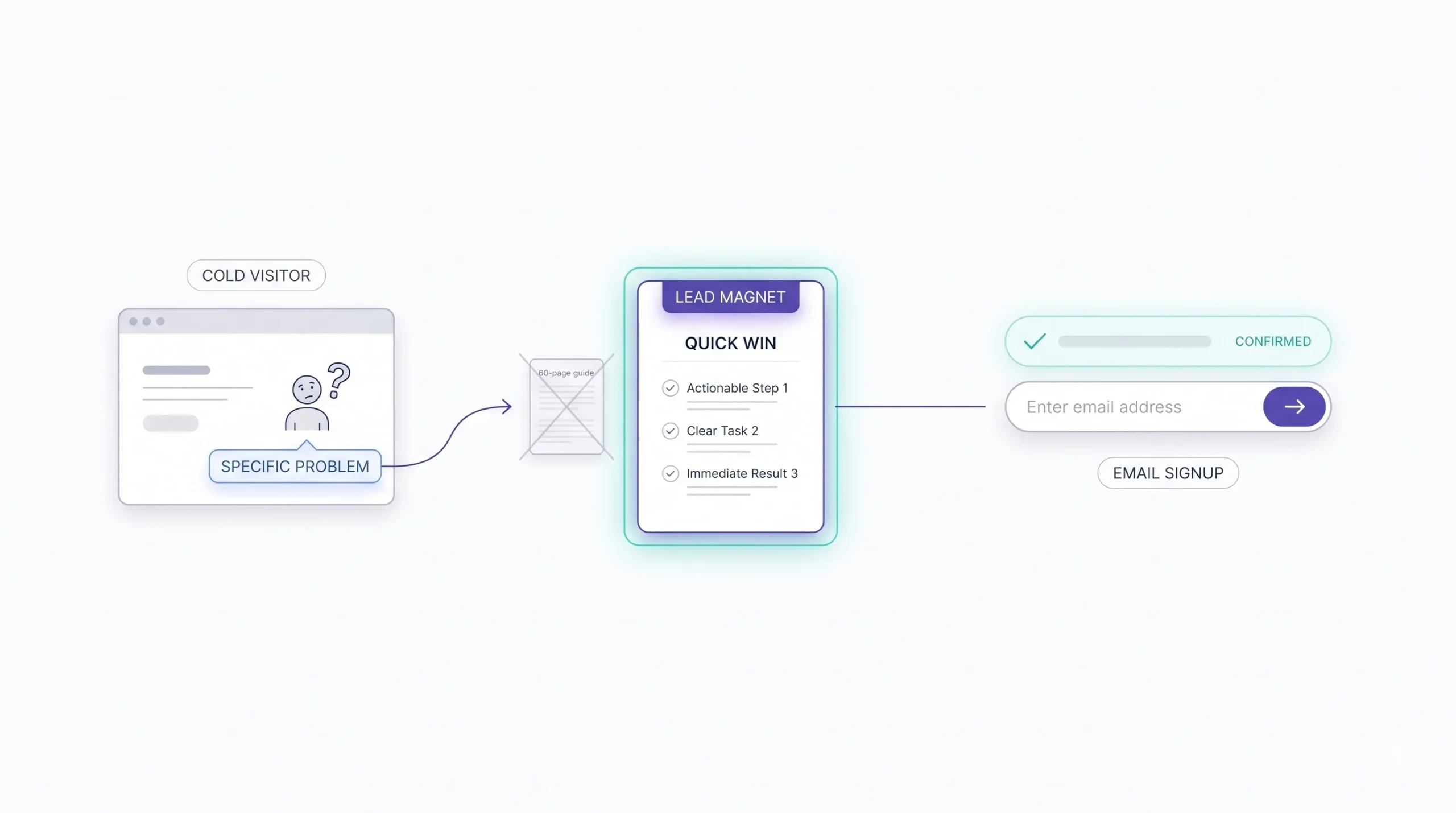
A lead magnet converts when it solves one narrow, specific, annoying problem, instantly. Not “everything you need to know about X.” Nobody trusts a stranger to deliver “everything.” They’ll trust a stranger to hand them a five-step checklist that fixes the one thing bugging them right now. Specificity beats comprehensiveness at the opt-in stage, every single time. You can go deep later, once they trust you.
Think about the last time you opted into something yourself. Was it a 60-page ebook titled “The Complete Guide to Marketing”? Probably not. It was more likely something like “5 subject lines that got me a 40% open rate” or “the exact email template I used to land my first client.” Narrow, specific, and it promises something you can use in the next ten minutes, not something you’ll “get around to reading eventually.” That eventually pile is where most 40-page PDFs go to die, unread, forgotten, and honestly a little bit of a broken promise that quietly damages trust in whoever sent it.
There’s also a speed-to-value question worth asking about every lead magnet idea before building it. How fast can someone go from opening this to actually using it. A checklist, thirty seconds. A template, a couple minutes to adapt it. A 10-day email course, ten days, obviously, and that’s fine for a different purpose, building a relationship over time rather than delivering an instant win. Match the magnet type to how fast you actually need someone to feel the value.
Lead magnet types mapped to funnel stage
| Type | Funnel Stage | Build Effort | Best Use Case |
|---|---|---|---|
| Checklist/Cheat sheet | TOFU | Low | Quick-win, low commitment |
| Template/Swipe file | MOFU | Low-Medium | Practical tool users reuse |
| Mini-course (email-based) | MOFU | Medium | Builds authority over days |
| Free tool/calculator | TOFU-MOFU | Medium-High | High perceived value, shareable |
| Webinar/live session | BOFU | High | Best for warm/existing traffic |
| Discount/first-order offer | BOFU | Low | E-commerce/service businesses |
Notice the pattern. Low effort, low commitment items sit at the top of the funnel where you’re catching cold strangers. Higher effort stuff like webinars only really works once someone already knows who you are, otherwise you’re asking a total stranger to block out an hour of their evening for you. That’s a big ask at zero trust.
The “zero audience” lead magnet strategy
When you’ve got no warm audience, your magnet needs to work on cold, one-time discovery. Someone finds your blog post through Google, reads for ninety seconds, and either opts in or leaves forever. That means your magnet has to sell itself in the moment, no relationship required. Checklists, templates, and swipe files do this well because the value is obvious at a glance. A mini-course or webinar needs someone to already half-trust you, which cold traffic doesn’t have yet.
How to validate a lead magnet idea before building it
Don’t build first and hope. Check search volume for the problem your magnet solves, that tells you people are actually looking. Go into communities where your audience hangs out (Reddit threads, Facebook groups, WhatsApp communities) and see what questions get asked over and over. Look at what competitors are offering as their lead magnet and figure out what’s missing or half-done. If three different sources point at the same pain point, you’ve got your magnet topic.
One more validation trick that gets skipped constantly, just ask. Post a quick poll in a community you’re already active in, or ask a handful of people in your network directly, “would a checklist for X be useful to you, or does something like that already exist that you use?” You’ll get a mix of confirmation and, sometimes more valuable, someone pointing out that a similar resource already exists and isn’t very good. That gap is your opening.
And resist the urge to build the “perfect” version before testing it. A rough first draft of the magnet that goes live and gets forty downloads teaches you more than three more weeks spent polishing something nobody’s seen yet. You can always improve version two once you know people actually want version one.
Building Your First Opt-In System
You’ve got a magnet. Now you need somewhere for people to actually give you their email.
Landing pages vs embedded forms vs pop-ups
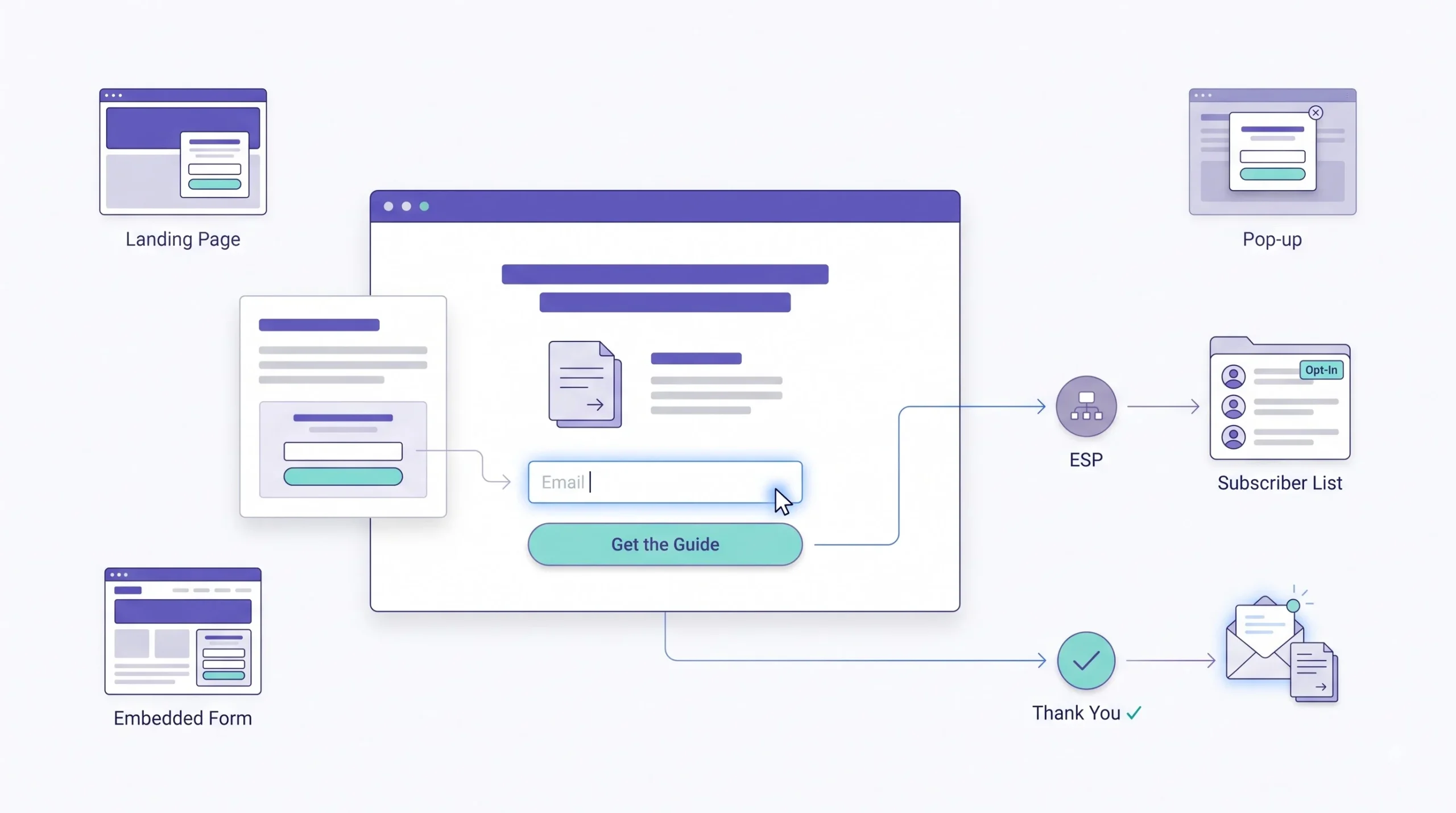
A dedicated landing page, one page, one goal, no navigation menu pulling people away, converts better than almost anything else because there’s nowhere else to go. Embedded forms inside blog posts or sidebars convert lower but catch people already reading your content, which is warmer traffic than someone landing cold. Pop-ups (especially exit-intent ones) are annoying to build a brand around but they work, the data on this is consistent even if nobody enjoys admitting it.
Anatomy of a high-converting opt-in page
Keep it stupidly simple. One clear headline that states the outcome, not the feature (“Get 10 more email subscribers this month” beats “Download my email guide”). One call to action, repeated maybe twice on the page, not five competing buttons. A line of social proof once you have any, even “used by 40 small business owners” beats nothing. Minimal form fields, honestly just ask for the email, every extra field you add drops your conversion rate a little more.
Where to place opt-ins with zero traffic
With no traffic yet, prioritize placement by where your actual visitors are going to land. If your traffic is coming from a blog post, the opt-in belongs inside that post as a content upgrade, not buried in a footer nobody scrolls to. If you’re sending people from a bio link or ad, send them straight to the dedicated landing page. Footer and header opt-ins matter eventually, once you’ve got consistent traffic across the whole site, but they’re not where you start.
Technical setup basics
Connect your form directly to your ESP so subscribers land in your list automatically, don’t do this manually, you’ll forget or fall behind. Set up a proper thank-you page or redirect after signup, this is also a good spot to deliver instant gratification (a “check your inbox” message, maybe even a bonus tip) while they wait for the actual magnet to arrive.
List-Building Channels: The Full Playbook for Zero Followers
This is the part everyone’s actually here for. Here’s every channel that realistically works at zero, and how to use each one without wasting months on the wrong one.
SEO/content-based list building
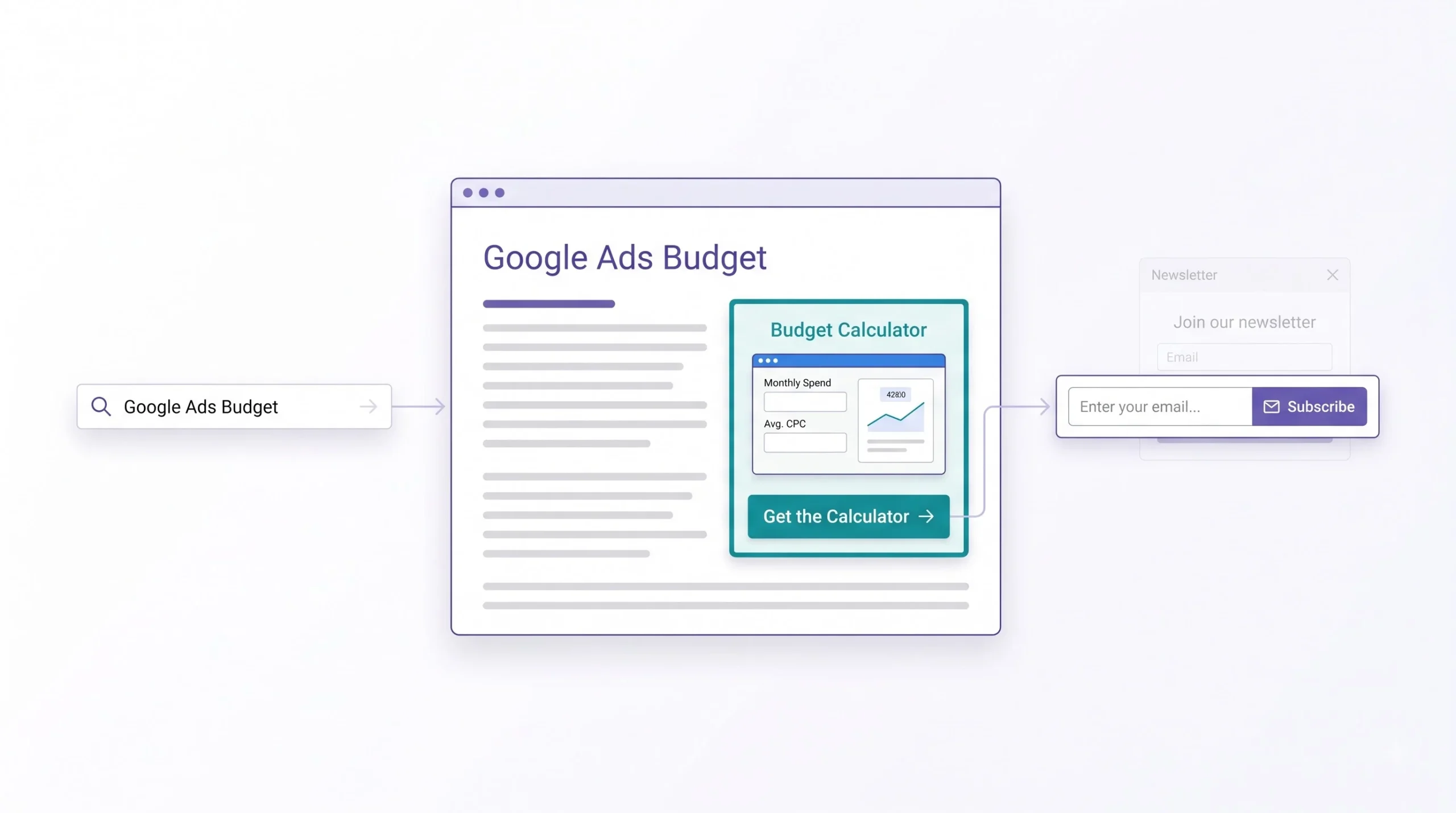
If you’re already writing blog content (and if you’re reading this, you probably are), this is one of the highest quality channels available, because someone finding your post through search already has the exact problem your content solves. Add a content upgrade, a more specific, deeper resource related to the exact post they’re reading, right inside the article. Someone reading a post about Google Ads budgets is a much better candidate for a “Google Ads Budget Calculator” opt-in than a generic “join my newsletter” box ever will be.
The reason this outperforms a generic sitewide opt-in box comes down to relevance at the exact moment of intent. Someone landing on your Quality Score post from a Google search is thinking about Quality Score right then, not “email newsletters in general.” A content upgrade that says “get the Quality Score checklist I use with clients” matches that exact headspace. A generic “subscribe to our newsletter” box, sitting in the same spot, has to first convince them a newsletter is even something they want, before it can convince them yours is worth it. That’s two convincing jobs stacked instead of one.
Practically, this means every well-performing blog post you’ve already published is a candidate for its own content upgrade, not just new posts going forward. Go back through your existing traffic data, whichever posts already pull decent organic visits are the ones worth prioritizing first, since the upgrade rides on traffic you already have instead of traffic you’re still trying to earn.
Community-based list building
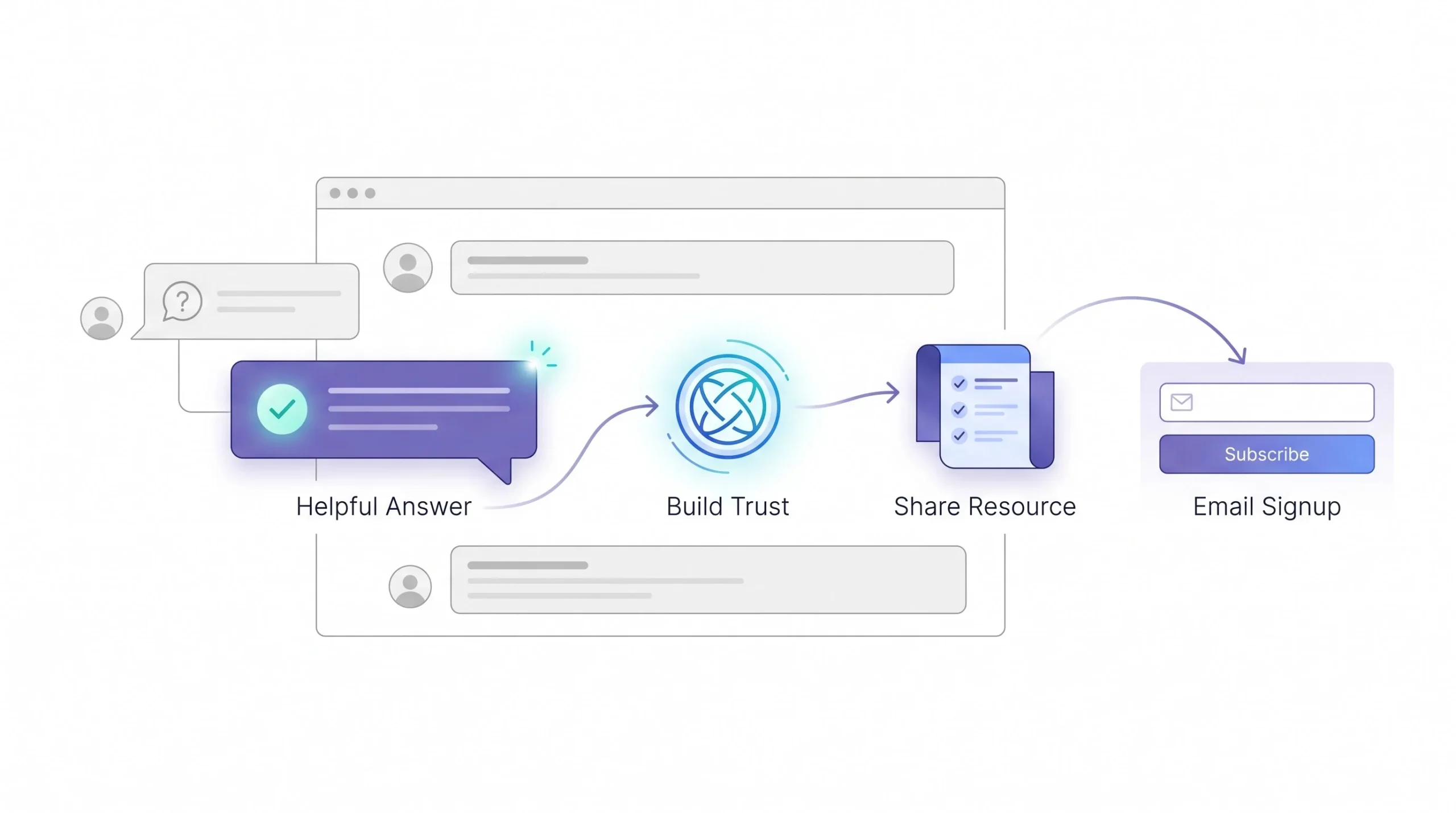
Reddit threads, niche Facebook groups, WhatsApp communities, Discord servers, wherever your specific audience actually spends time (not wherever’s easiest to post in). The rule here is simple and gets broken constantly: show up with value first, answer questions properly, be useful without a pitch attached, for a while, before you ever mention your lead magnet. Communities smell self-promotion instantly and it kills your credibility fast. Do this right and people start asking you for the resource before you’ve even offered it.
“For a while” is doing a lot of work in that sentence, so let’s be concrete about it. It’s not one helpful comment and then a pitch on comment two. Think weeks, not days, of genuinely answering questions with no ask attached at all. Somewhere along the way, someone’s going to ask a question your lead magnet directly answers, and that’s when you mention it, “actually made a checklist for exactly this, happy to share it if useful.” That lands completely differently than dropping a link unprompted in a thread where nobody asked.
Most communities also have explicit rules about self-promotion, some ban it outright, others allow it in specific threads or on specific days. Read the rules before posting anything with a link in it, getting banned from a relevant community over an impatient post is a bigger loss than the subscriber you were chasing.
Guest content and partnerships
Guest posting on a blog that already has your target audience, or guesting on a podcast, or co-hosting a lead magnet with a business that serves the same audience but isn’t a competitor, all of these borrow trust that took someone else years to build. A joint checklist with a business adjacent to yours (say, a digital marketing agency and a web design freelancer sharing a “launch-ready website checklist”) doubles your reach without doubling your work.
The part people get wrong here is picking the wrong partner. A partnership only works when the audiences overlap but the offers don’t compete. A web design freelancer and a copywriter both serve small businesses launching a site, neither one steals the other’s customer by teaming up, they actually make each other’s offer stronger. Pick a competitor by mistake and you’re literally handing your list to someone chasing the exact same client.
Reaching out cold for a guest post or partnership works better when you lead with what you’re bringing to the table, not what you’re asking for. “I noticed your audience asks a lot about X, I’ve written about it in depth and think your readers would find it useful, happy to write something original for your blog” gets a very different response than “can I guest post on your site.” One’s an offer, the other’s a favor request.
Paid acquisition at small budgets
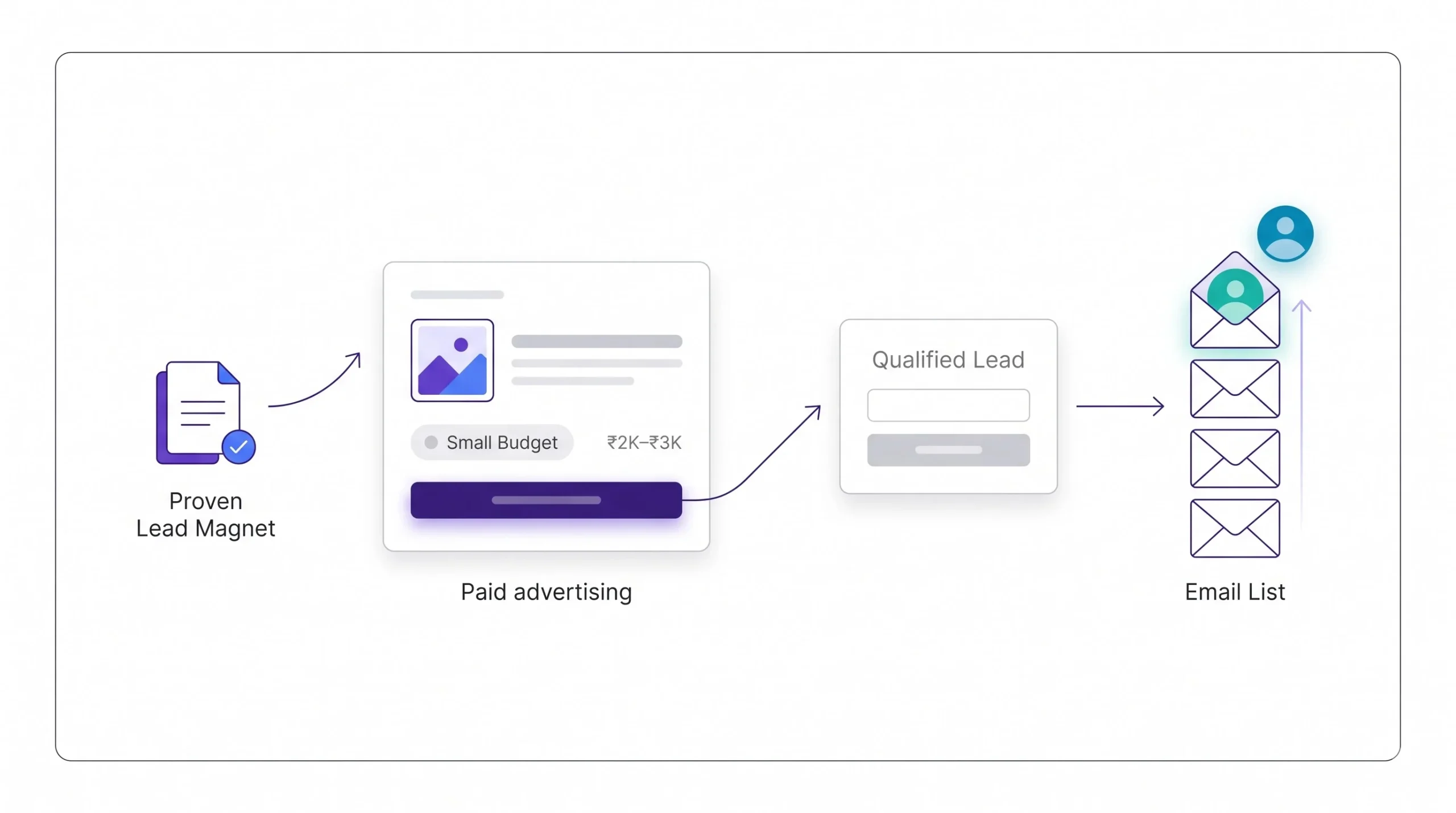
Meta lead ads let you collect an email without the person even leaving the platform, which raises conversion but can lower quality, since the friction that normally filters out uninterested people isn’t there. Realistic cost-per-lead in India varies a lot by niche, but treat any early paid test as a learning exercise, not a scaling decision, until you know your numbers. Paid makes the most sense once your organic magnet is already proven to convert, use ads to speed up something that’s already working, not to test a completely unproven idea.
Here’s the sequencing mistake that trips up a lot of beginners with a small budget. They run paid ads on an unproven lead magnet, spend the whole budget in a week, and can’t tell if the poor results are because the ad targeting was off, the creative didn’t land, or the magnet itself just wasn’t compelling enough. Too many variables changing at once. Prove the magnet converts organically first, even at a small scale through a blog post or a community share, then bring paid traffic to something you already know works. That isolates the one thing you’re actually testing with the ad spend, which platform, audience, and creative gets you the cheapest qualified lead.
A small starting budget, even something like ₹2,000-3,000 spread over a week, is enough to get directional signal on whether a lead ad campaign is worth scaling. Don’t expect statistically bulletproof data at that spend level, but you’ll get a rough sense of cost-per-lead and whether the audience targeting is even in the right zone.
Offline/in-person list building
Don’t sleep on this one, especially if you’re running a business in a Tier-2 or Tier-3 city where in-person trust still carries a lot of weight. Events, local meetups, even a QR code on a receipt or a shop counter pointing to your opt-in page, these work particularly well for local service businesses and education institutes where the customer relationship already has some in-person trust built into it.
A QR code sitting quietly on a counter converts differently than one someone’s actively pointed out and explained. If a staff member or the business owner personally says “hey, we’ve got a free roadmap for anyone thinking about this course, scan here,” conversion jumps compared to a code that’s just sitting there hoping to get noticed. The human handoff still matters even when the actual signup happens on a phone screen.
Local workshops or free info sessions work the same way but at a bigger scale, someone’s already shown up in person, which is a much bigger commitment than a passive social scroll, so asking for an email at that point has very little friction left in it. Bring a simple signup sheet or a QR code linked to your landing page to any offline touchpoint you already have, a class, a stall at a local event, even a WhatsApp group meetup, and you’re capturing subscribers you’d otherwise lose entirely.
Referral and viral loop mechanics
Even a tiny list can grow through referrals if you make it easy. “Forward this to a friend who’d find it useful” works better than people expect, because someone who already opted in and found value has a natural reason to share, they don’t need convincing, just a nudge.
The nudge matters more than people assume. Most subscribers genuinely would share something useful, they just don’t think of it on their own in the moment. A simple line at the bottom of a genuinely useful email, “know someone who’d find this useful? forward it their way,” costs you nothing and occasionally brings in a subscriber who trusts you more than a cold visitor would, because they arrived through a friend’s recommendation instead of an ad or a random search result. That trust transfer is worth more than the raw number suggests.
WhatsApp-to-email bridge strategy
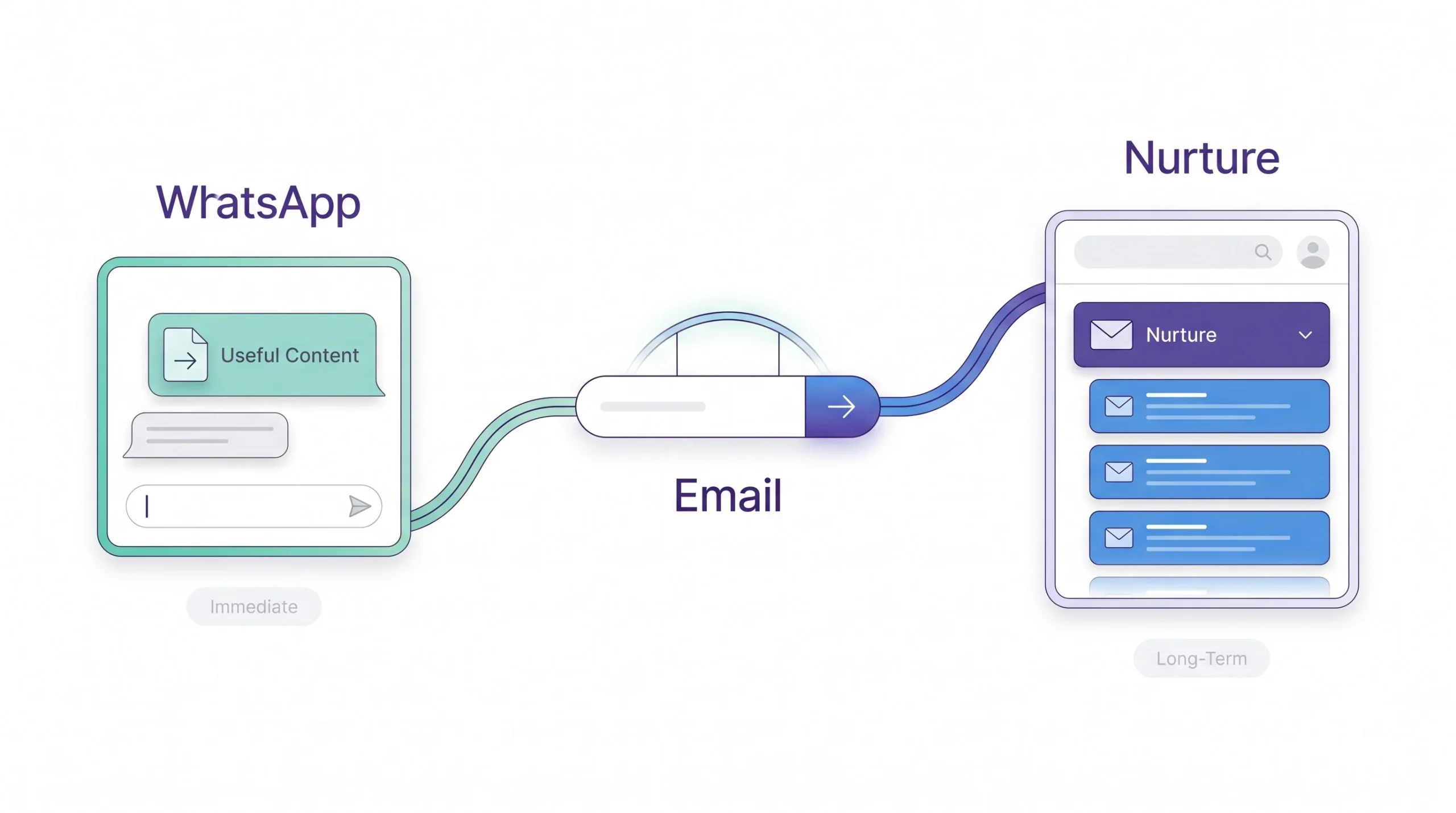
This one’s specific to how people actually communicate in India, and most list-building guides written for a US audience miss it completely. WhatsApp Business broadcast lists have insanely high open rates compared to email, people check WhatsApp constantly. Use WhatsApp as the first touchpoint, share something useful there, then bridge people into your email list for the deeper, more structured content. It’s not either-or, it’s sequencing, WhatsApp for immediate attention, email for depth and long-term nurture.
| Channel | Speed to First 100 | Cost | Effort | Subscriber Quality |
|---|---|---|---|---|
| SEO content upgrades | Slow | Free | Medium | High |
| Community participation | Medium | Free | Medium-High | High |
| Guest posts/partnerships | Medium | Free | High | High |
| Paid lead ads | Fast | ₹ (variable) | Low-Medium | Medium |
| Offline/events | Medium | Low-₹ | Medium | Very High |
| Referral loops | Slow initially | Free | Low | High |
Pick 2 channels max in month one. Beginners who try 6 channels simultaneously build 6 half-systems instead of 1 that actually works.
Cold vs Warm Traffic: Why Your First 100 Subscribers Are the Hardest
Nobody talks about this enough. When you’re starting from zero, almost all your early traffic is cold, meaning these are strangers who’ve never heard of you before landing on your page. That changes what you can ask for. A cold visitor isn’t ready for “book a call with me” or “join my exclusive webinar.” They need a small, low-risk yes first.
That’s the whole idea behind a “trust bridge”, a small sequence of tiny yeses that gets someone from total stranger to subscriber to eventually customer. Your lead magnet is usually the first plank in that bridge. Ask for too much too early and cold traffic just bounces. This is also why the first hundred subscribers take longer than the next four hundred, once you’ve got some subscribers and social proof and content out there, warm traffic starts showing up too, and warm traffic converts a lot easier.
The Welcome Sequence: What Happens After Someone Subscribes
Getting the subscriber is only step one. What happens right after matters more than most beginners realize, and it’s the part that gets skipped constantly because people are so focused on the opt-in itself.
Your welcome email gets opened more than almost any other email you’ll ever send to that person. Ever. That’s not an exaggeration, it’s just how attention works, someone just gave you their email, they’re paying attention right now, in a way they won’t be three weeks from now when you’re just another sender in a crowded inbox.
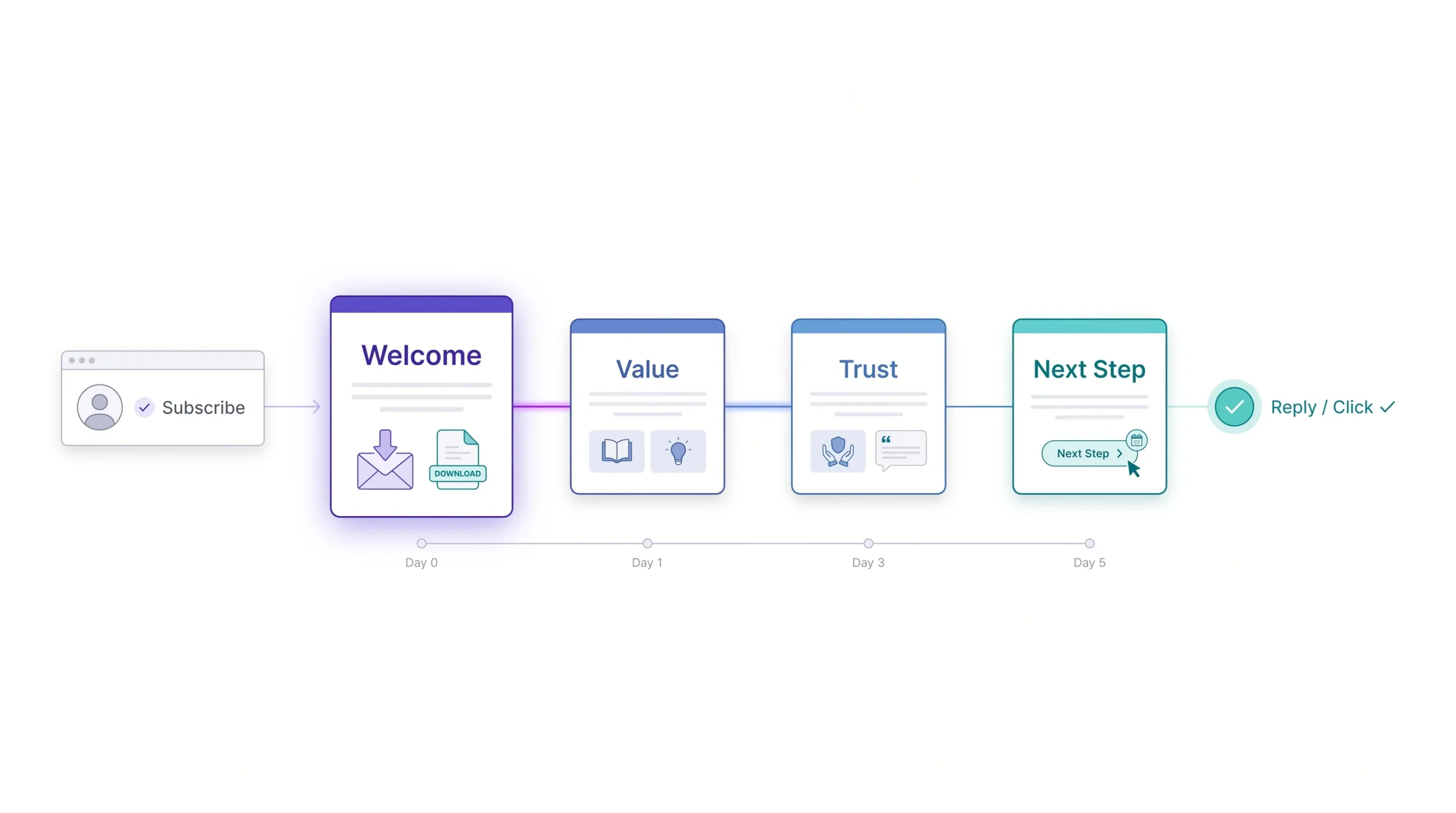
A solid welcome sequence runs three to five emails. First one delivers exactly what you promised, immediately, no delay, no “click here in three days.” Then a couple of emails that build trust, share something genuinely useful, maybe a quick story about why you do what you do. Then you introduce a bit more value and work in a soft call to action, nothing aggressive, just a natural next step for someone who’s now warmed up.
There’s a deliverability angle here too that’s easy to miss. A new sending domain has no reputation yet with inbox providers. A welcome sequence with decent open rates in the first days of sending actually helps build that reputation, think of it as a warm-up lap before you’re sending regular campaigns to a bigger list.
Timing between welcome emails matters more than people think too. Sending all five emails on day one buries someone in your content before they’ve even processed the first one, and it looks desperate besides. Sending them too far apart, say once a week, loses the momentum of that initial high-attention window entirely, by email three they’ve half-forgotten why they signed up. Somewhere in between works best for most beginners, first email immediately on signup, then roughly a day or two apart for the rest of the sequence, close enough to keep the thread alive, spaced enough to not feel like a flood.
And don’t skip asking for a small action inside the sequence itself, replying to one email, clicking through to a specific piece of content, something. Subscribers who take even one small action in that first week tend to stay more engaged long term than ones who just silently receive and never interact. It’s a tiny thing but it starts building an actual two-way relationship instead of a one-way broadcast.
List Hygiene and Deliverability Fundamentals
This is the unglamorous stuff that decides whether your emails land in the inbox or the spam folder six months from now, and almost nobody writes about it in beginner content.
Double opt-in versus single opt-in is a real trade-off, not just a legal checkbox. Double opt-in means someone confirms their email before they’re fully added, which shrinks your list size on paper but massively improves quality, you’re not carrying fake addresses or typos. Single opt-in grows your number faster but drags along dead weight that eventually hurts your sender reputation.
Speaking of reputation, a brand-new sending domain needs a warm-up period. Don’t blast 2,000 emails on day one even if you somehow had that many subscribers. Inbox providers watch new senders closely, sending a small volume consistently and building up gradually signals you’re a legitimate sender, not someone who bought a list.
Spam traps are another thing worth knowing about early, these are email addresses planted specifically to catch senders using old, purchased, or scraped lists. Regular list cleaning (removing addresses that haven’t opened anything in months) keeps you away from these traps and keeps your open rates honest. And segment by engagement early, don’t blast your entire list with every single campaign from day one. People who never open anything from you are dragging your overall stats down, which then makes inbox providers trust you less for everyone else on the list too.
Set a rough rule for yourself here, something like, anyone who hasn’t opened a single email in the last 90 to 120 days gets moved into a separate re-engagement track, or eventually removed if they still don’t respond. That feels counterintuitive at first, deliberately shrinking your own list, but a smaller list of people who actually open and click will outperform a bigger, mostly-dead one on every metric that matters, and it protects the sending reputation for the subscribers who do care.
A quick re-engagement email before removing anyone is worth the effort too, something simple like “still want to hear from us? click here to stay subscribed” filters people who genuinely forgot they signed up from people who’ve just gone permanently quiet. The ones who click, keep. The ones who don’t, let go. It’s a small step but it keeps your list honest instead of just growing a number that doesn’t mean much.
The Content Flywheel: Making List Growth Compound Over Time
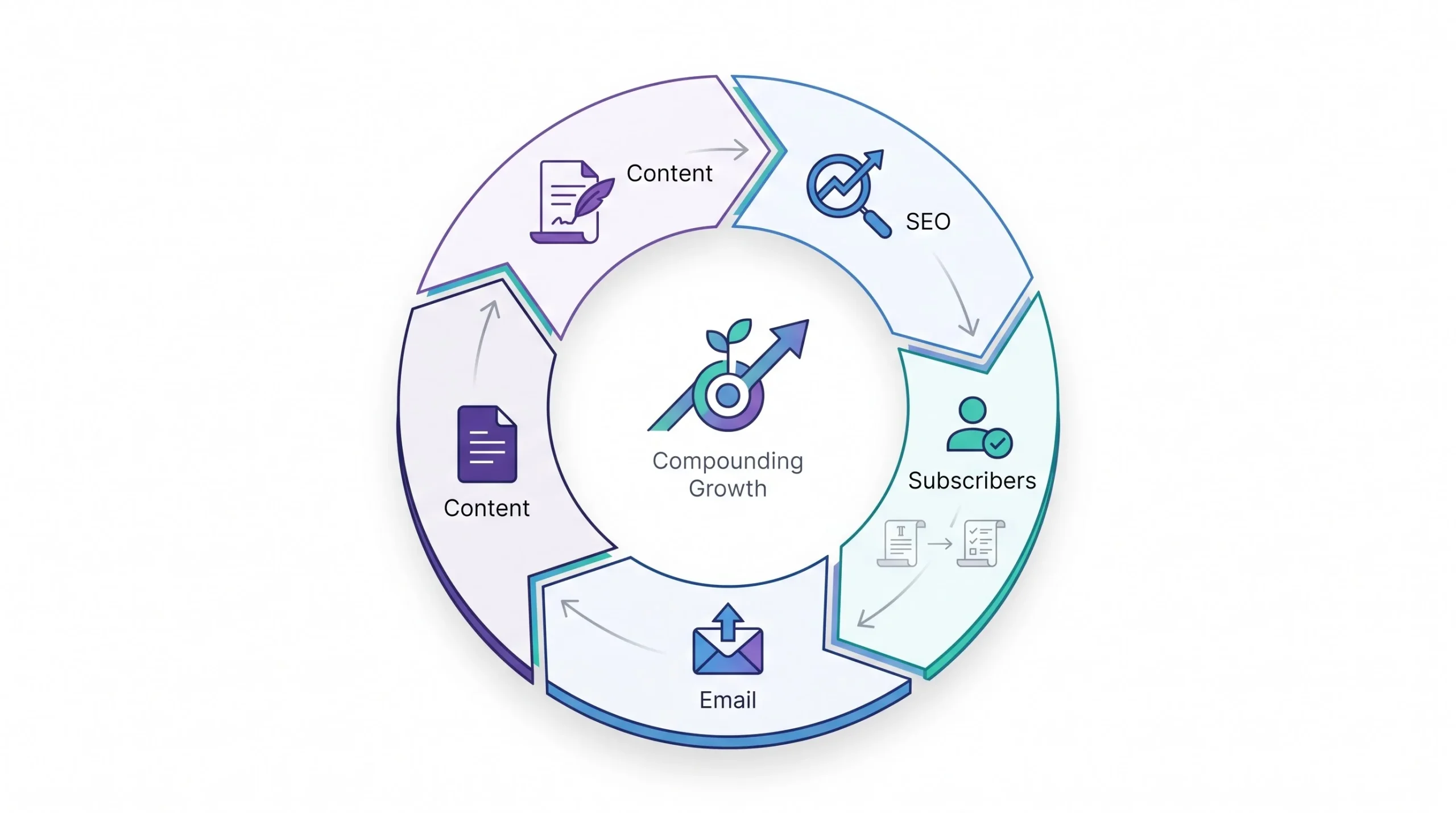
Here’s the part that makes all the earlier setup worth it. Blog content, SEO, and your email list aren’t three separate projects, they feed each other. A blog post ranks, brings in traffic, the content upgrade on that post converts a slice of that traffic into subscribers, and your welcome sequence and ongoing emails send some of those subscribers back to more of your content, which builds topical authority, which helps more posts rank. Round and round.
Repurposing content into lead magnets is one of the most underused moves here. That pillar post you already wrote can become the source material for a checklist, a swipe file, or a short mini-course delivered over email, without starting from scratch each time.
Most beginners expect linear growth and get discouraged when month one feels slow. Reality tends to look different, growth often stays flat-ish for the first couple months while search rankings and community trust build up, then starts compounding once there’s enough content and social proof in place. Don’t judge the system by week three.
Think about it from the content side specifically. A new blog post can take weeks or months to climb Google’s rankings, that’s just how search works, it’s not instant. Every post you publish today is essentially a subscriber source that hasn’t fully activated yet, it’s still ranking, still building the authority that eventually pushes it up the results page. So the flywheel effect isn’t really visible in month one, it’s happening quietly underneath, and it shows up later as multiple older posts all contributing subscribers simultaneously instead of one post carrying the whole load. That’s the compounding part, and it’s also why consistency in publishing matters more than any single “viral” piece of content.
Benchmarks: What “Good” Actually Looks Like
Numbers help set expectations so you’re not comparing yourself to some inflated case study that doesn’t reflect your actual starting point.
| Source | Typical Opt-In Rate Range |
|---|---|
| Dedicated landing page (cold traffic) | 2–5% |
| Blog content upgrade (relevant traffic) | 3–8% |
| Exit-intent pop-up | 2–4% |
| Paid lead ad form | 15–30% (but lower quality) |
| Referral/word-of-mouth | Highly variable, high quality |
Notice paid lead ads have the highest number and the biggest asterisk next to it. High conversion doesn’t automatically mean high quality subscribers, someone who tapped through a low-friction ad form isn’t always as invested as someone who found your blog post and actively chose to hand over their email. Both have their place, just don’t judge success by opt-in rate alone.
For the first 30 days, expect setup and maybe your first trickle of subscribers, this is foundation-building, not growth-measuring time. By day 60, if you’ve picked your channels and stayed consistent, a first hundred subscribers is a realistic target for most beginners. By day 90, the compounding starts kicking in a bit, especially if SEO content was part of your channel mix.
Common Mistakes Beginners Make
A few patterns show up again and again with people just starting this.
- Building the list before deciding what they’ll actually send it. Subscribers pile up with no plan behind them, then six weeks later there’s a scramble to figure out what to email, and by then engagement has already started decaying from silence.
- Over-gating content, putting an opt-in wall in front of every single thing. This kills the reading experience and honestly makes people trust you less, not more. Give away plenty for free, gate the genuinely high-value stuff.
- Ignoring deliverability until it’s already a problem. By the time open rates crash, the damage to sender reputation takes real effort to undo. Handle this at setup, not after the fact.
- Treating list size as the whole goal. A thousand disengaged subscribers who never open anything is worse than three hundred who actually read and click. Vanity metrics feel good, engaged subscribers pay the bills.
- Writing the lead magnet for what feels impressive to build instead of what the audience actually asked for. A beautifully designed 20-page guide that answers a question nobody’s actually googling won’t convert, no matter how good it looks.
- Forgetting to test the opt-in flow themselves before launching. Sounds obvious, but plenty of beginners never actually go through their own signup process end to end, and only find out the confirmation email is landing in spam, or the download link is broken, once real people start complaining.
30-60-90 Day Action Roadmap
| Phase | Focus | Key Actions |
|---|---|---|
| Days 1–30 | Foundation | ESP setup, domain auth, 1 lead magnet, 1 landing page |
| Days 31–60 | Distribution | 2 channels activated, welcome sequence live, first 100 subs |
| Days 61–90 | Optimization | A/B test opt-in placement, segment engaged subs, add 2nd lead magnet |
Nothing here is complicated on its own. The reason most people don’t finish is sequencing, trying to do distribution before the foundation is solid, or trying to optimize before there’s even enough data to optimize against. Follow the order.
Case Example: A Tier-2 City Business Starting from Zero
Picture a small digital marketing education institute in a Tier-2 city, maybe similar in size and setup to plenty of local coaching centers or training institutes around the country. No email list. A modest Instagram page nobody’s actively growing. Website gets a trickle of traffic from a few blog posts targeting local search terms.
Month one, they’d set up an ESP (something like MailerLite, since it bundles landing pages and keeps cost low at that stage), get domain authentication sorted, and build one lead magnet, say a simple “Digital Marketing Career Roadmap” checklist aimed at students and job-seekers in the area, since that’s exactly who searches for the institute’s blog content already. One dedicated landing page, one content upgrade inside their top-performing blog post.
Month two, they’d lean on two channels. SEO content upgrades, since they’ve already got blog traffic coming in from local search, and community participation in local student and career-focused Facebook or WhatsApp groups, answering genuine questions without pitching, occasionally mentioning the free roadmap when it’s actually relevant to the conversation. Welcome sequence goes live, three emails delivering the roadmap, sharing a quick success story from a past student, and a soft nudge toward a course info session.
By month three, with content upgrades compounding on existing blog traffic and a bit of word of mouth from the community participation, a first hundred to two hundred subscribers is a realistic outcome, built without spending a rupee on ads and without any pre-existing follower base. That’s the whole point of this system, it doesn’t need an audience to start, it needs a plan.
Conclusion
Zero followers was never actually the blocker. The blocker is not having a system, and now you’ve got one. Foundation first, get the boring technical stuff sorted so your emails actually land where they’re supposed to. Then a lead magnet sharp enough to convert a total stranger in ninety seconds. An opt-in system that doesn’t get in its own way. Channels picked deliberately instead of scattered across everything at once. A welcome sequence that treats those first few days of attention like the gift they are. And hygiene practices that protect the whole thing long term, because a big list that can’t reach the inbox isn’t worth much.
None of this is a one-time campaign you run and forget. Build it once, properly, and it keeps compounding, blog content feeding subscribers, subscribers feeding back into content performance, trust building on trust. That’s the actual advantage an email list gives you over chasing algorithm reach forever. Start with the foundation this week. Everything after that gets easier.
Frequently Asked Questions
How many subscribers do I need before email marketing becomes worthwhile?
Honestly, even a hundred is worth working with, if they’re engaged. A small list that opens and clicks beats a huge one that ignores you. The value shows up the moment you send something useful and someone actually acts on it, that can happen at 50 subscribers just as easily as 5,000.
Can I build an email list without a website?
Yes. A landing page from your ESP works fine without a full website behind it, and plenty of people run their entire opt-in system off one standalone page for months before ever building a proper site. A website helps long term, mainly through SEO-driven content upgrades, but it’s not a hard requirement to start.
What’s the best free ESP for absolute beginners in India?
Depends what you need most. MailerLite’s free tier is generous and bundles landing pages, so if you don’t want to juggle separate tools, start there. Zoho Campaigns makes sense if you’re already inside the Zoho ecosystem for business email. Neither is “wrong,” pick based on what else you’re already using.
How long does it take to get the first 100 subscribers from zero?
Varies a lot by how consistent you are, but 45 to 60 days is a realistic window for most beginners running one or two channels properly, not scattered across five half-efforts. Some get there faster with a strong community push or a decent lead ad budget, some take longer if they’re relying purely on SEO content that’s still climbing the rankings.
Do I need a lead magnet, or can I just ask people to subscribe?
Just asking works occasionally, mostly for people who already know and trust you. At zero followers, with cold traffic, a plain “subscribe to my newsletter” box converts at a fraction of what a specific lead magnet does. Skip it only if you’ve already got real trust built somewhere else.
Is buying an email list ever a good idea?
No. Not “usually no,” just no. Purchased lists tank deliverability fast, since none of those addresses actually opted in, and inbox providers treat that as spam behavior. You’ll damage your sender reputation for every future email, including the ones going to people who genuinely did sign up. It’s not a shortcut, it’s a setback.
How often should I email a brand-new list?
Once a week is a safe, sustainable starting cadence for most beginners. It’s frequent enough to stay top of mind, not so frequent that you run out of things worth saying. Ramp up only once you know you can consistently produce something worth opening, sending more often just to hit a schedule usually hurts engagement rather than helping it.
What’s the difference between single and double opt-in?
Single opt-in adds someone to your list the moment they submit the form. Double opt-in sends a confirmation email first, and they’re only added once they click to confirm. Double opt-in shrinks your list size on paper but keeps quality higher, fewer fake addresses, fewer typos, stronger consent trail. Worth the small drop in numbers.
Can WhatsApp replace email for an Indian audience?
Not really replace, more like complement. WhatsApp gets read fast and often, which makes it great for immediate, short-form touchpoints. Email still wins for longer-form content, structured nurture sequences, and anything you want archived and searchable later. Using WhatsApp to bridge people into email tends to work better than picking one over the other.
How do I know if my lead magnet isn’t converting?
Check the opt-in rate on whatever page or content upgrade is delivering it. If it’s sitting well under 2% on a dedicated landing page, something’s off, usually either the offer isn’t specific enough, the headline doesn’t clearly state the outcome, or it’s not reaching the right traffic in the first place. Test one variable at a time rather than rebuilding the whole thing at once.
What’s a realistic subscriber growth rate for month 1 vs month 6?
Month one is mostly foundation and a trickle of early subscribers, don’t expect much here. By month six, with consistent content and a couple of working channels, growth is usually noticeably faster than month one, since SEO content has had time to rank and referral/community trust has had time to build. It’s rarely a straight line, expect it to feel slow early and pick up pace later.
Is it legal to email people who downloaded a free resource?
Yes, as long as they gave clear consent to be added to your list when they downloaded it, not just consent to receive the one resource. Under the DPDP Act, that consent needs to be informed and specific. Make sure your opt-in form clearly states they’re joining an email list, not just grabbing a one-time download, and you’re on solid ground.