

Somebody asks this question every single day in some marketing Slack channel, and honestly, most of the answers are garbage. “It depends” is technically true and completely useless. You’re not asking because you want a philosophy lesson. You’re asking because you spent money, or you’re about to spend money, and you want to know when you’ll see something for it.
So here’s the deal. SEO takes somewhere between 4 and 12 months to show real results for most businesses, and competitive niches push that further out. That’s not a dodge, that’s the actual range backed by how search engines work and what tends to happen on real sites month after month. But that number alone doesn’t help you much, because “results” means different things at month 2 versus month 8, and the businesses that get frustrated and quit usually do it right before things start moving.
This post walks through the whole timeline, what’s actually happening behind the scenes at each stage, what speeds things up, what kills momentum, and how to tell the difference between “SEO is slow” and “SEO isn’t working.” No fluff, no vague reassurances, just the actual mechanics of why this takes as long as it does and what to watch for while you wait.
The Short Answer (For People Who Just Want a Number)
Fine, here’s the number first, then the reasoning.
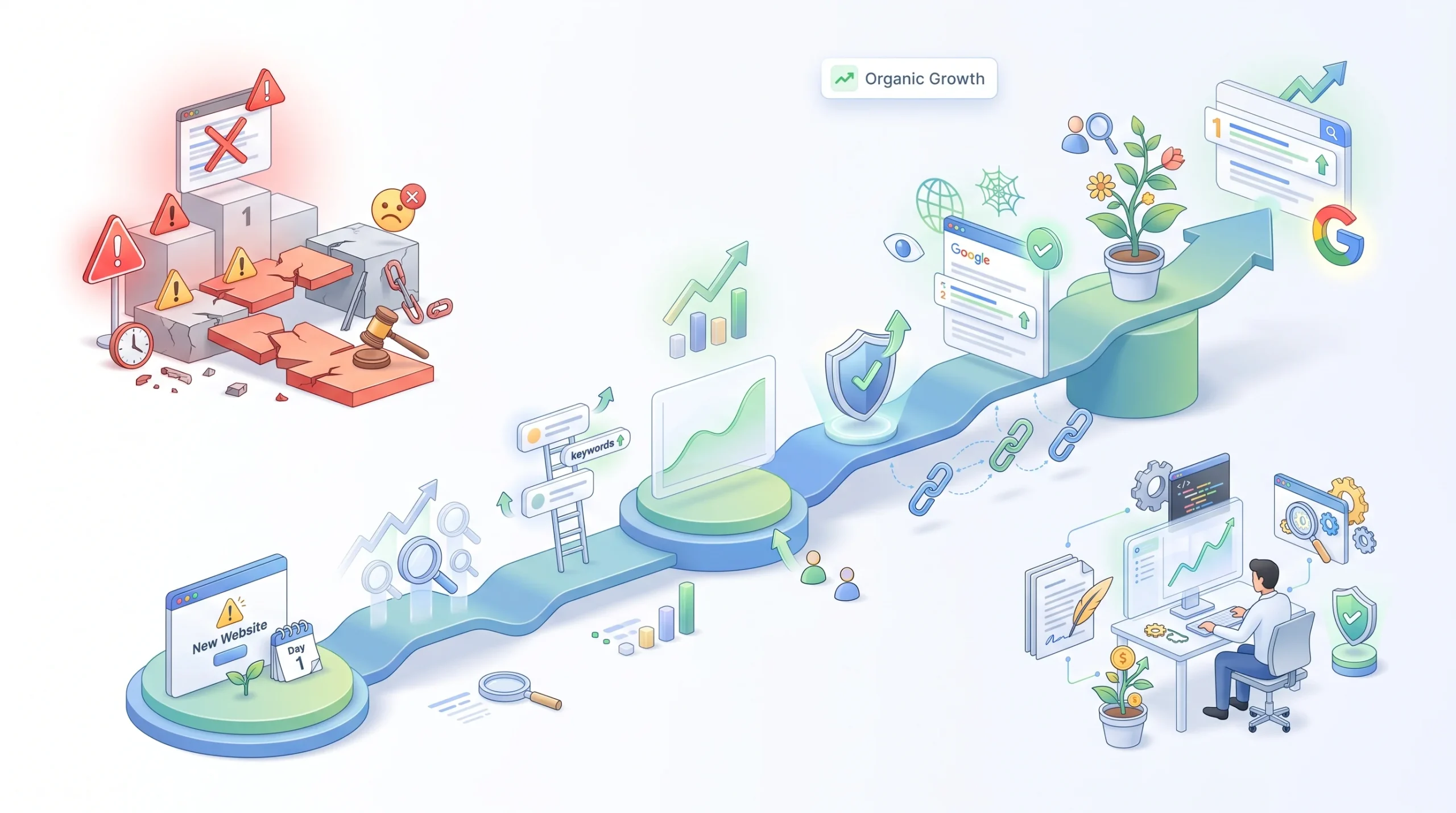
Most sites see early movement, more impressions, a few keywords creeping up, somewhere around month 3 to 4. Real traffic growth that you’d actually notice on a graph shows up around month 6 to 8. Competitive keywords, the ones with real search volume and a hundred sites fighting for them, usually take 10 to 12 months minimum, sometimes longer if the niche is brutal (think law firms, SaaS, insurance).
This is a framework, not a promise. A brand new domain with zero authority and a legal services site with 8 years of backlinks are not playing the same game, even if they publish identical content on the same day.
And look, if anyone tells you they’ll get you ranking in 30 days, walk away. Either they’re talking about a hyper-specific long-tail keyword nobody searches for, or they’re doing something Google’s going to penalize you for later. There’s no legitimate shortcut that skips the trust-building part of this. None.
Why SEO Doesn’t Work Like Paid Ads
This is the part people struggle with the most, especially if they’ve run Google Ads or Meta campaigns before. You launch a paid campaign on Monday, you’ve got clicks by Monday afternoon. SEO doesn’t work that way, and it’s not because SEO is broken or slower for no reason. It’s structural.
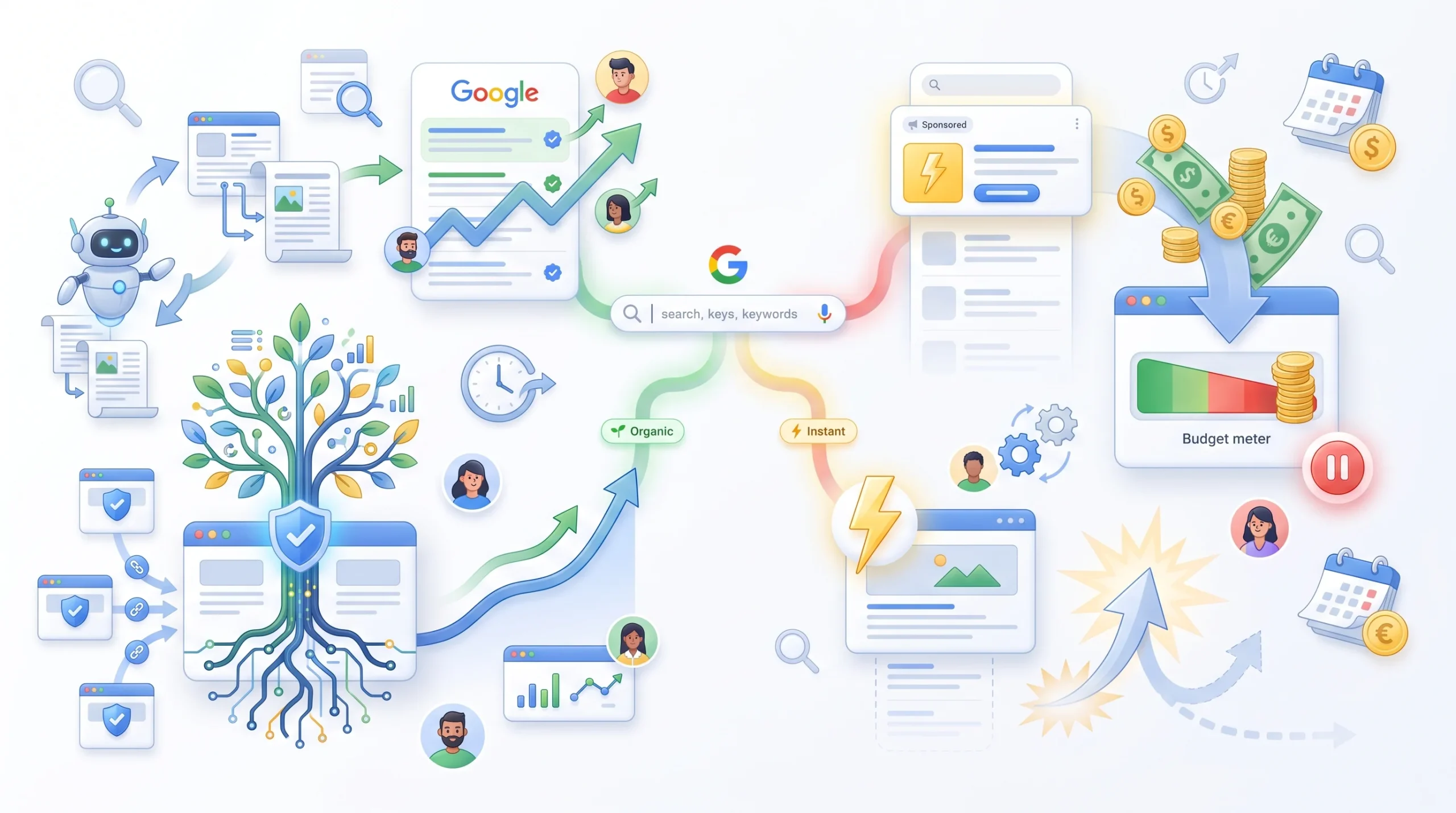
With paid ads, you’re renting visibility. You pay, you show up, you stop paying, you disappear. Google doesn’t need to trust you for this. It just needs your payment to clear.
Organic search is different because Google is trying to figure out if your page deserves to be shown to people for free, ahead of everyone else trying to rank for the same thing. That takes evaluation. Google has to crawl your pages, which isn’t instant, especially on smaller or newer sites that don’t get crawled as often. Then it has to index those pages, which is a separate step from crawling and can lag behind by days or weeks. Then it has to actually evaluate the content against everything else already ranking, and decide where you fit.
Google’s own Search Central documentation has said flat out that SEO can take 4 months to a year to show effects, even when everything is done right. That’s not a marketing team hedging their bets. That’s the platform itself telling you the ramp-up is real.
There’s also a trust layer that doesn’t exist with paid. A domain that’s been publishing consistent, useful content for two years and has other reputable sites linking to it has built up what a lot of people casually call “authority.” A brand new domain hasn’t earned any of that yet, no matter how good the content is on day one. Google isn’t being unfair here, it’s just being cautious, because anyone can throw up a website and claim to be an expert. The trust has to be demonstrated over time, through consistency, through other sites vouching for you via links, through users actually engaging with your content instead of bouncing back to the search results.
Think about it from Google’s side for a second. Every day, millions of new pages get published on the internet. Some are genuinely useful. A lot are thin, recycled, or straight up spam trying to game the system. Google can’t just take a page’s word for it that it’s the best answer to a query. It has to watch how that page performs over time, whether people click it and stay, whether other credible sites reference it, whether the domain behind it keeps producing similar quality work or just fired off one good article and went quiet. That observation period is where the “it takes months” part comes from. It’s not a switch that flips, it’s a pattern that has to establish itself.
And here’s the thing people miss. Paid and organic aren’t actually competing with each other, they’re solving different problems on different timelines. Paid buys speed. Organic buys a channel that doesn’t disappear the second the budget runs out. A lot of smart marketing setups run both at once, paid ads cover the gap while organic ramps up in the background, and once organic hits its stride, the paid budget can shift toward testing new markets or offers instead of just holding the fort.
So yeah, SEO is slower. But it’s slower because it’s actually evaluating something real, not because the process is inefficient. Anyone frustrated by the timeline is usually frustrated because they’re comparing it to a channel that was never built to work the same way in the first place.
The SEO Timeline, Month by Month
Okay, this is the part everyone actually wants. Let’s go month by month and talk about what’s really happening, not the sanitized version.
Months 1-2: Foundation and Technical Cleanup
Nobody wants to hear this, but the first two months are mostly invisible work, and if you skip it, everything after it is built on sand.
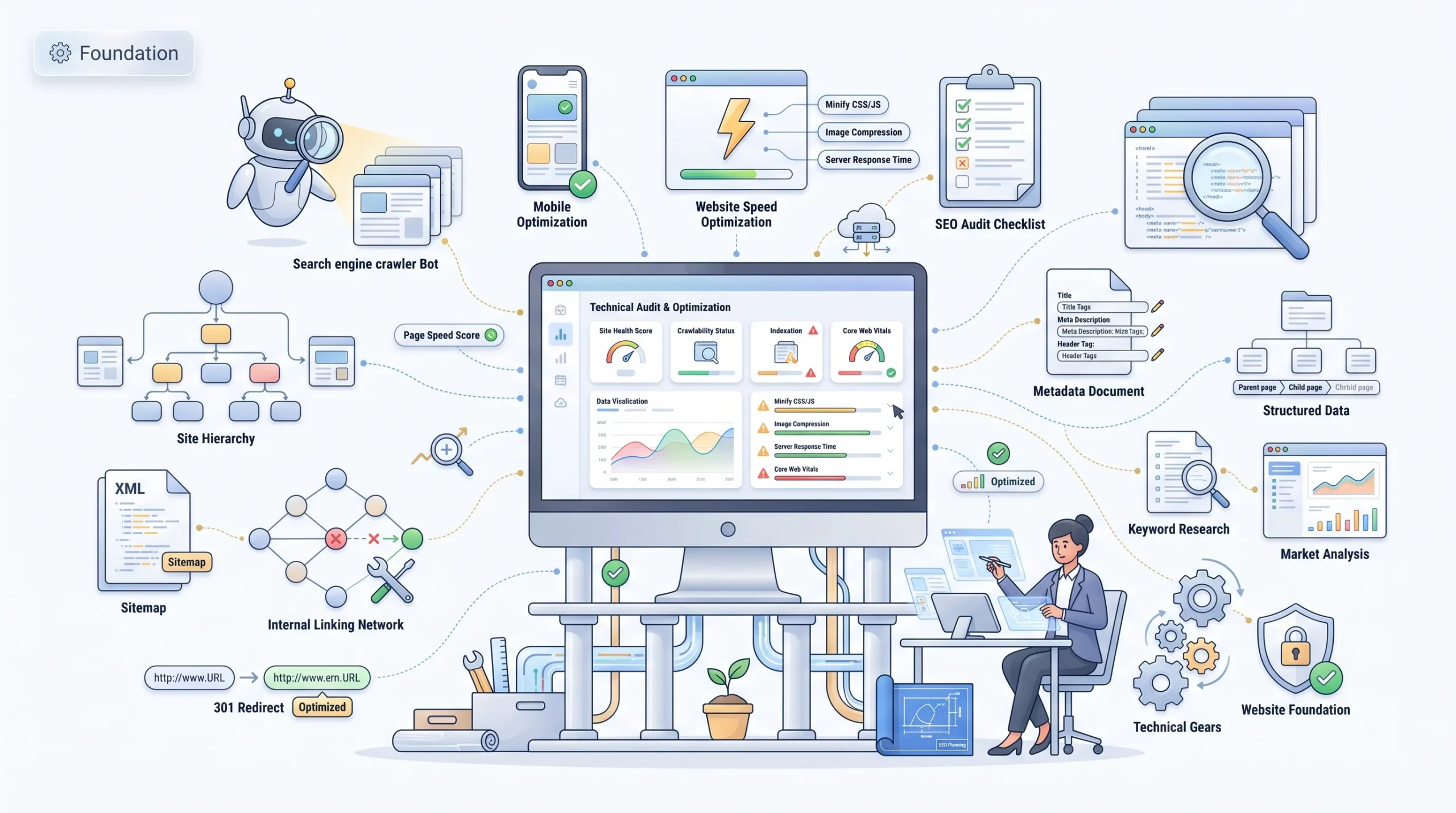
This is when the technical audit happens. Is the site crawlable? Are there broken pages, redirect chains, duplicate content issues, slow load times, missing meta tags, orphaned pages with no internal links pointing to them? A lot of sites, especially ones that have been around a while and gone through a redesign or two, have technical debt nobody noticed. Fixing this doesn’t create rankings on its own, but not fixing it caps how high anything else can go, no matter how good the content is.
This is also when keyword research gets finalized, content gaps get mapped out against competitors, and on-page optimization starts on existing pages, title tags, header structure, internal linking between pages that should be talking to each other but aren’t.
A lot of this stage is genuinely unglamorous. Somebody’s going through server response codes, checking whether old pages redirect properly instead of throwing 404s, making sure the site’s XML sitemap actually reflects what’s live instead of pointing at pages that were deleted two years ago. Somebody’s checking whether the site is mobile-friendly in a way that actually holds up, not just technically responsive but usable. None of this makes for an exciting client update. “We fixed 40 broken internal links this week” doesn’t sound like progress, but it’s the difference between Google being able to fully crawl the site or getting stuck halfway through and giving up.
Competitor research also happens here, and it’s worth being honest about what that actually involves. It’s not just glancing at who ranks #1 for a keyword. It means pulling apart what those top-ranking pages actually cover, how long they are, what subtopics they hit that your content doesn’t yet, what kind of pages are winning, is it blog content, product pages, tool pages. Skipping this step means writing content in a vacuum and hoping it’s good enough, which is a bad bet against sites that did their homework.
What to expect in terms of results here: basically nothing visible. Traffic charts look flat. Rankings haven’t moved. This is the part where impatient clients start emailing, and it’s also exactly the wrong time to panic. You cannot build a house by starting with paint. Skip the foundation and every ranking gain later gets capped by whatever technical ceiling was never addressed. Sites that try to shortcut this stage usually end up circling back to it around month 5 or 6 anyway, except now they’ve also burned months publishing content on top of a broken foundation.
Months 3-4: Early Signals
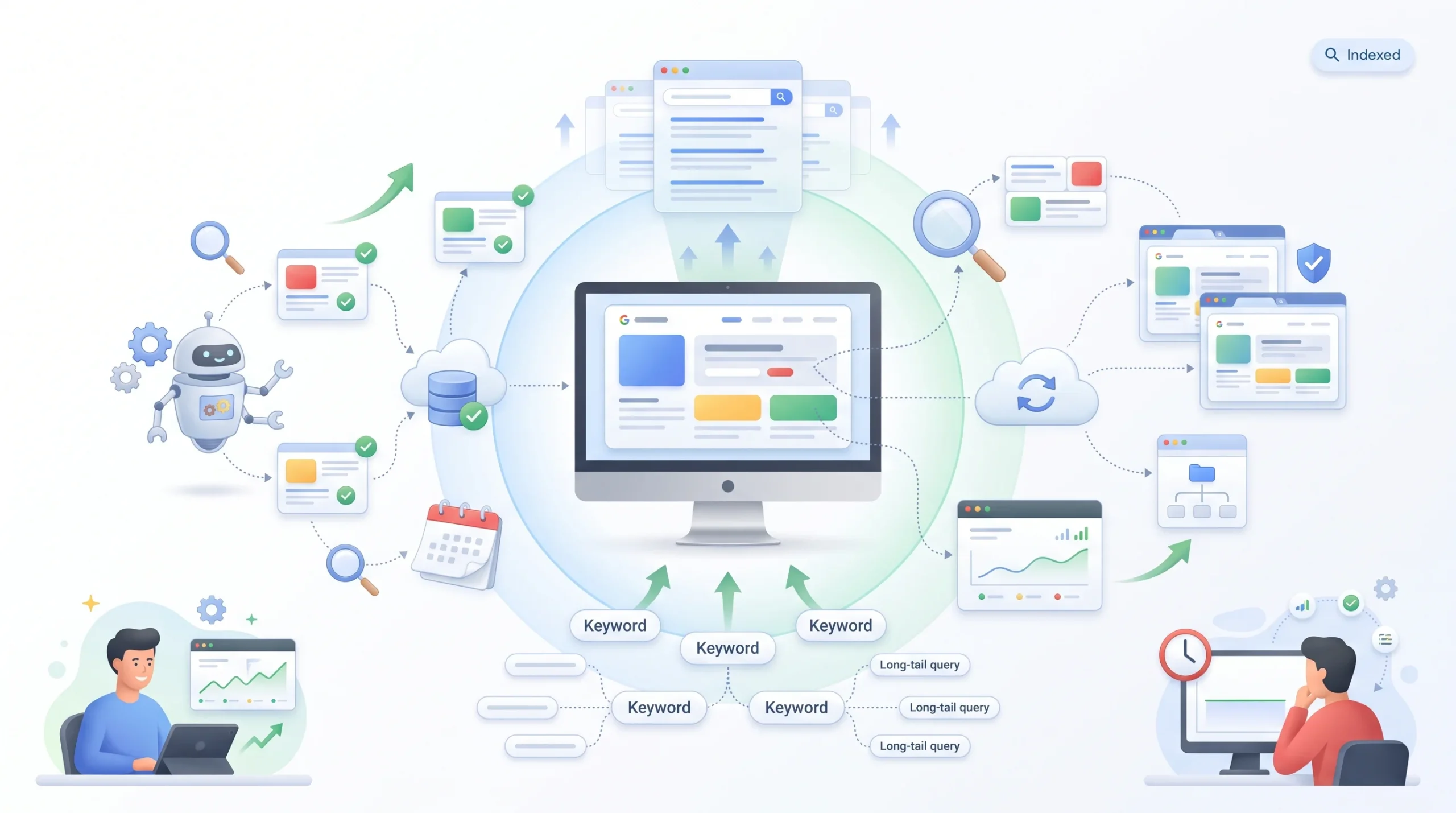
This is where things get interesting, but only if you know where to look. Most people are staring at Google Analytics waiting for a traffic spike. Wrong place to look this early. The real signal is in Google Search Console, specifically impressions.
Impressions climb before clicks do. That’s just how it works. Your pages start showing up in search results, even if they’re sitting at position 40 or 60 where nobody scrolls that far. But it means Google is indexing the content and starting to figure out where it belongs. A page that shows zero impressions for a target keyword isn’t even in the running yet. A page showing impressions at position 45 is in the running, just not winning yet.
Long-tail keywords, the specific, lower-competition phrases, start showing movement here too. Something like “how long does local SEO take for a dentist office” might crack page 2 or 3 while the broader “how long does SEO take” is still nowhere close. That’s normal. Long-tail terms have less competition, so they move faster, and honestly, they often convert better anyway because the searcher knows exactly what they want.
Something else starts happening around here too, and it’s easy to miss if you’re not looking. Google starts crawling the site more frequently. Check the crawl stats in Search Console and you’ll usually see the crawl rate climbing compared to month 1, which is basically Google saying “okay, this site is active, worth checking on more often.” That’s a quiet vote of confidence, and it means new content published from here on tends to get picked up faster than it did in month 1.
This is the stage where most people get impatient and start questioning the whole strategy. Understandable, but also usually a mistake. Two to four months in, you should be seeing directional signals, not victory laps. If someone’s expecting a doubled traffic number by month 4, they set the wrong expectation from the start, not the strategy that’s failing them.
Months 5-6: First Real Movement
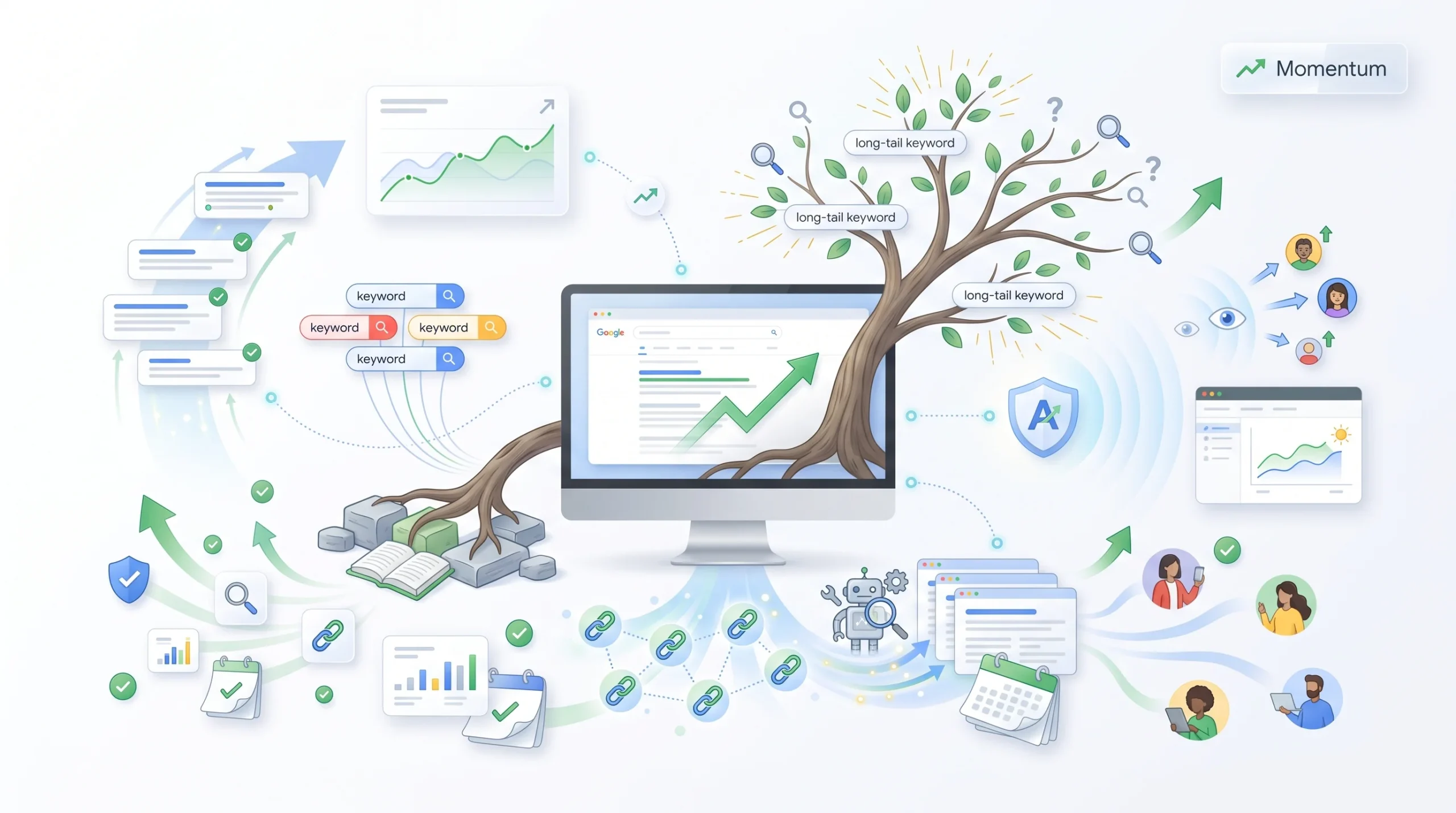
Now things start actually happening. Target keywords that were sitting on page 3 or 4 start creeping into page 1 or 2. It’s not dramatic yet, nobody’s throwing a party over jumping from position 14 to position 9, but it’s real, sustained movement instead of random noise.
Organic traffic starts trending upward on the graph, not in a hockey stick way, but a visible slope you can point to and say “yeah, that’s working.” Content published back in month 1 or 2 has had time to get crawled, indexed, linked internally, and picked up some authority. It’s not a coincidence that stuff from the earliest weeks tends to perform best around now, it had the longest runway.
If link building is part of the strategy, this is also when backlinks start compounding a bit. Not every link acquired shows up in rankings the next day. It takes time for Google to discover and factor in new links, so links earned in month 2 or 3 are just starting to show their effect around month 5 or 6.
This is also usually the point where the site starts pulling in what’s called “long-tail traffic diversity,” meaning instead of ranking for the 10 keywords originally targeted, Search Console starts showing dozens, sometimes hundreds, of variations and related queries the content is picking up traffic for without anyone specifically optimizing for them. That’s a genuinely good sign. It means Google understands the topical range of the content well enough to match it against searches that weren’t explicitly planned for. Sites that only ever rank for their exact target list and nothing else tend to have a narrower, more fragile footprint.
Months 7-9: Compounding Results
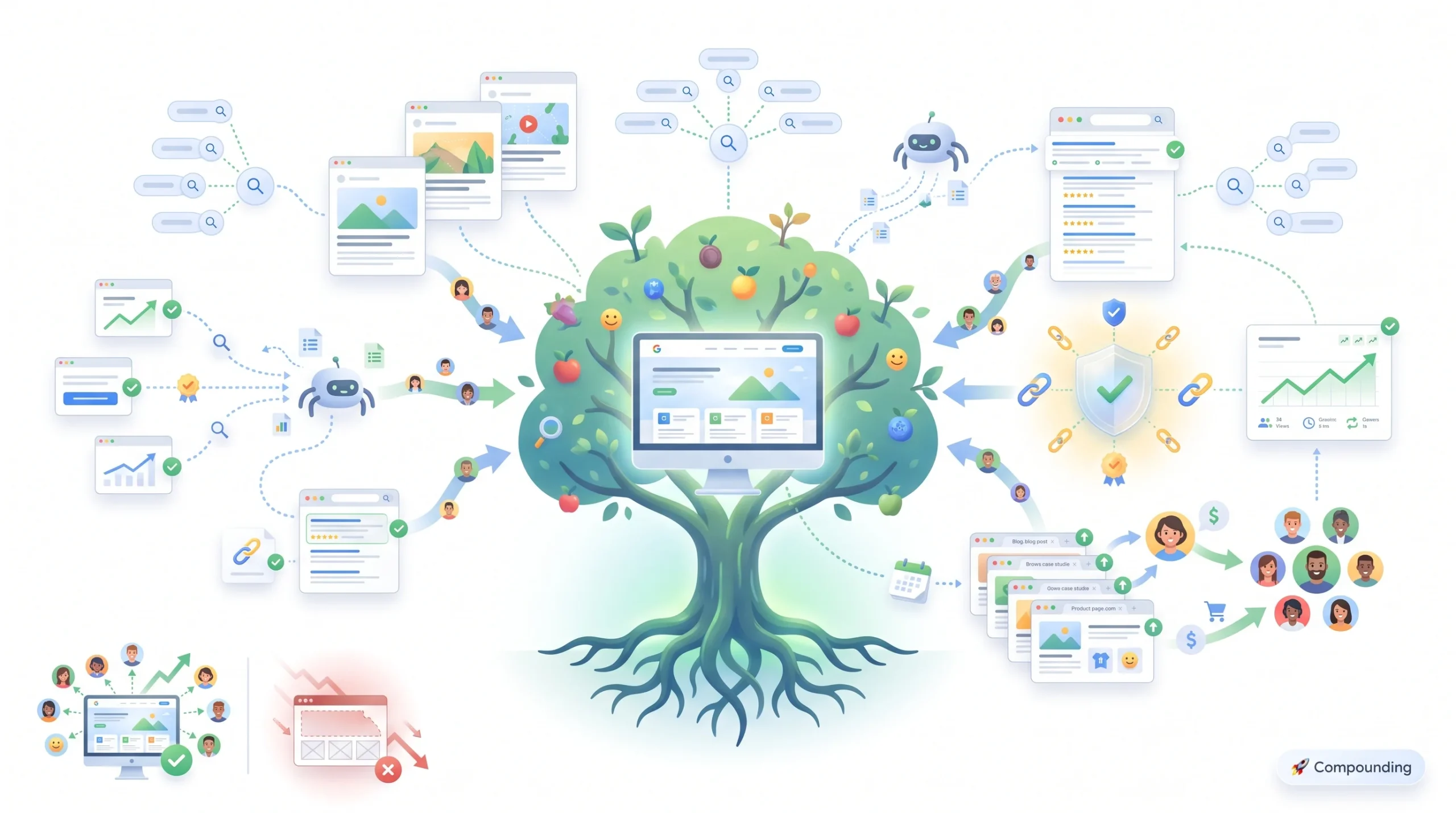
This is where the graph starts looking like something worth screenshotting. Traffic growth becomes more consistent, less like isolated spikes and more like a real upward trend across multiple weeks. And it’s not just one hero page carrying the whole site anymore. Multiple pages are ranking, multiple keywords are pulling in traffic, which matters because relying on a single page for all your organic traffic is fragile. One algorithm update and you’re back to zero.
This is also usually when conversions from organic search start showing up in a way that’s noticeable in analytics, not just traffic for traffic’s sake but actual leads, signups, or sales tied back to organic channels. That’s the number that actually matters to whoever’s paying for this.
Domain authority metrics, however you’re measuring them, tend to show visible improvement here too, which is really just a lagging indicator of everything that’s happened in the months before.
This is also the stretch where the gap between the sites that stuck with it and the sites that bailed early becomes obvious. A business that pulled the plug at month 4 because “nothing was happening” never gets to see this part. It’s frustrating, honestly, because the work that built this traffic was done back in months 1 through 4, it just took this long to fully pay off. There’s a real lag between effort and outcome in SEO that doesn’t exist in most other channels, and months 7 through 9 are usually where that lag finally closes.
Months 10-12+: Maturity and Scaling
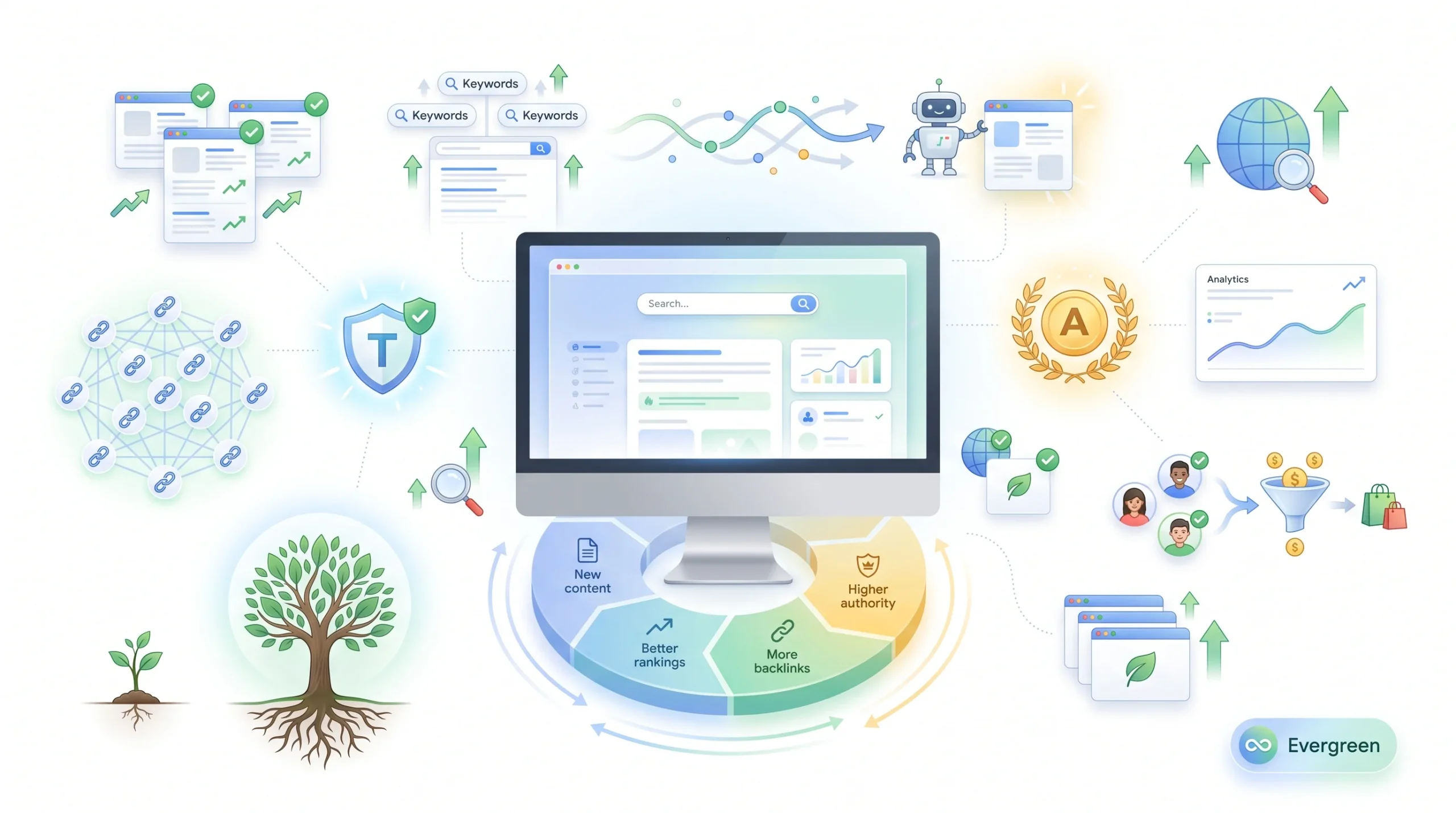
By now, if things have gone reasonably well, competitive keywords, the ones with real search volume that actually move the needle for the business, start moving too. These are the terms that took the longest because they had the most competition, and they’re finally responding to a year’s worth of consistent work.
This is also when SEO starts to feel less like a slog and more like a flywheel. Existing content keeps ranking and pulling traffic without new work being poured into it constantly. New content published now benefits from the domain authority already built up, so it can rank faster than content published in month 1 ever could. That’s the compounding effect people talk about, and it’s real, it’s just slow to arrive.
It’s worth being specific about what “faster” means here, because it’s not magic. A piece of content published in month 1 might have taken 5 or 6 months to reach page 1 for its target keyword. A similar piece published in month 11, on a domain that’s now got a year of consistent output and some earned links behind it, might hit page 1 in half that time. The content itself isn’t necessarily better. The domain carrying it has more credibility, so Google trusts it faster. That’s the actual mechanism behind “SEO gets easier over time,” and it’s why businesses that give up in year one and restart somewhere else are essentially resetting a clock they’d already made a year of progress on.
Here’s the whole timeline laid out at a glance, since it’s easy to lose track of what’s happening when across nine months of explanation:
| Timeframe | What’s Actually Happening | What Results to Expect |
|---|---|---|
| Months 1-2 | Technical audit, crawlability fixes, keyword research, on-page setup | Basically nothing visible, traffic flat |
| Months 3-4 | Indexing improves, crawl rate increases | Impressions climbing, long-tail keywords on page 2-3 |
| Months 5-6 | Content and links start gaining traction | Target keywords entering page 1-2, traffic trend starts |
| Months 7-9 | Multiple pages ranking, authority building | Consistent traffic growth, organic conversions appear |
| Months 10-12 | Competitive keywords respond, flywheel kicks in | Competitive terms move, new content ranks faster |
| Beyond Year 1 | Maintenance and expansion, less new effort needed | Compounding traffic, older content still converting |
Worth repeating, this is a general framework, not a guarantee for every site. A highly competitive niche might push every one of these stages out by a few months, while a low-competition local business might compress the whole thing into half the time.
Beyond Year 1
Past the 12 month mark, the game changes from “building” to “maintaining and expanding.” A lot of the heavy lifting, technical fixes, foundational content, initial link building, is done. What’s left is ongoing publishing, updating older content that’s started to slip, and going after new keyword opportunities.
Here’s the underrated part. Content built in year one keeps working in year three, often with very little additional effort. A blog post published in month 2 that ranks well by month 8 can still be pulling in traffic two years later with just occasional refreshes. That’s the return on the early, boring, invisible work. It doesn’t expire the way a paid ad does the second the budget runs out.
Factors That Speed Up SEO Results
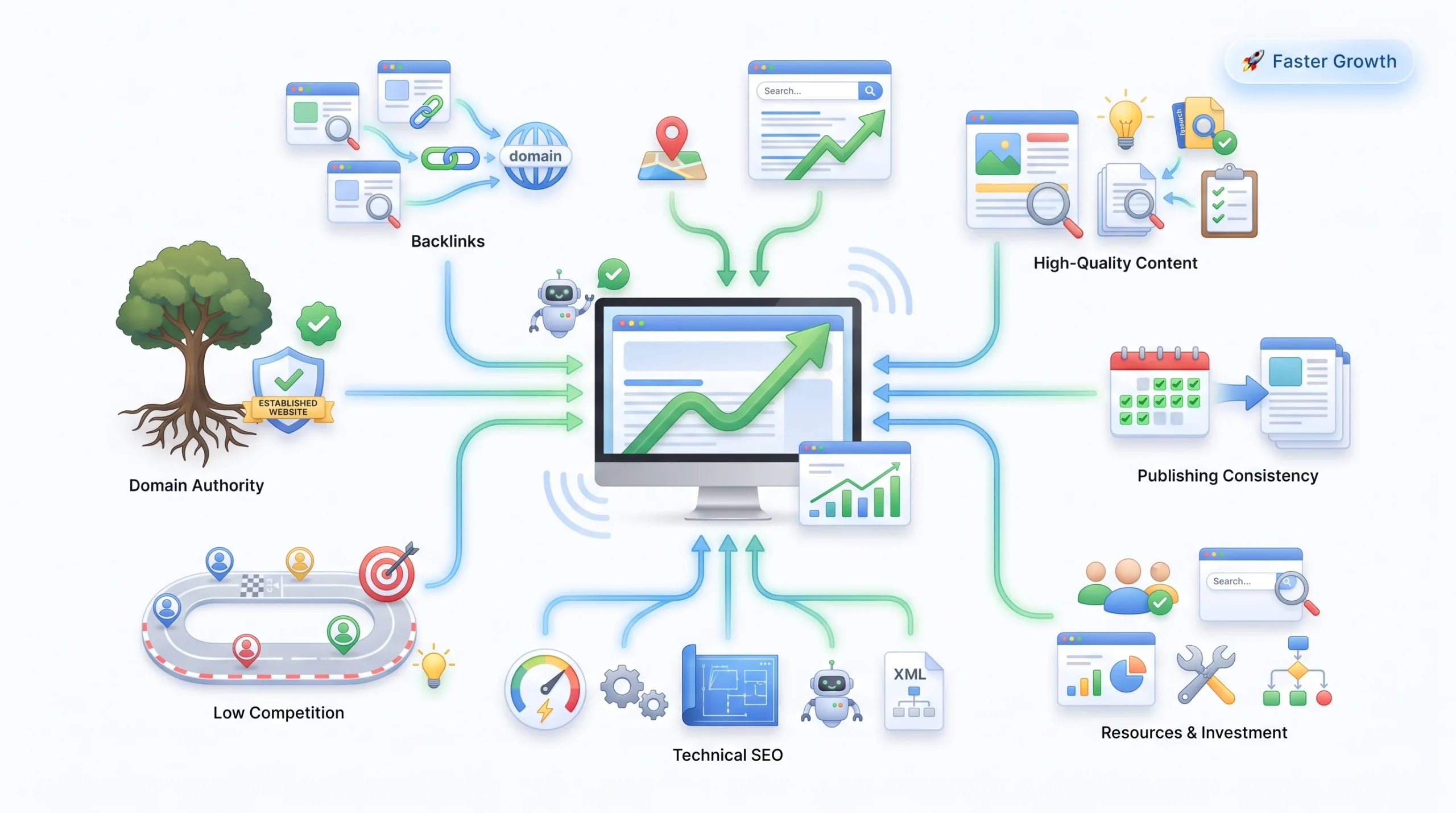
Not every site takes the same amount of time, and it’s worth being honest about why some businesses see faster movement than others. Two businesses can hire the exact same agency, follow the exact same process, and still land on wildly different timelines because of factors that have nothing to do with the quality of the work being done.
- Domain age and existing authority. A site that’s been live for 6 years with decent content and some earned backlinks already has trust built up. New content on that domain rides on existing credibility and can rank faster than the exact same content on a domain registered last month.
- Competition level in the niche. Ranking for “best hiking boots for wide feet” is a very different fight than ranking for “personal injury lawyer Chicago.” Less competition means less time waiting in line.
- Content quality and publishing consistency. Sites that publish genuinely useful, well-researched content on a steady schedule tend to build momentum faster than sites that post sporadically or churn out thin content.
- Technical health going in. A site with clean architecture, fast load times, and no crawl errors gives Google nothing to trip over. Less friction, faster evaluation.
- Budget and resource allocation. More content, more consistent link building, more technical resources thrown at the problem generally compresses the timeline, though it doesn’t eliminate it entirely.
- Scope of the SEO effort. Local SEO for a single location moves faster than national SEO across dozens of markets, simply because the competitive field is smaller.
- Existing backlink profile. A site with a handful of legitimate, relevant backlinks already has a head start that a brand new site doesn’t.
Factors That Slow SEO Results Down
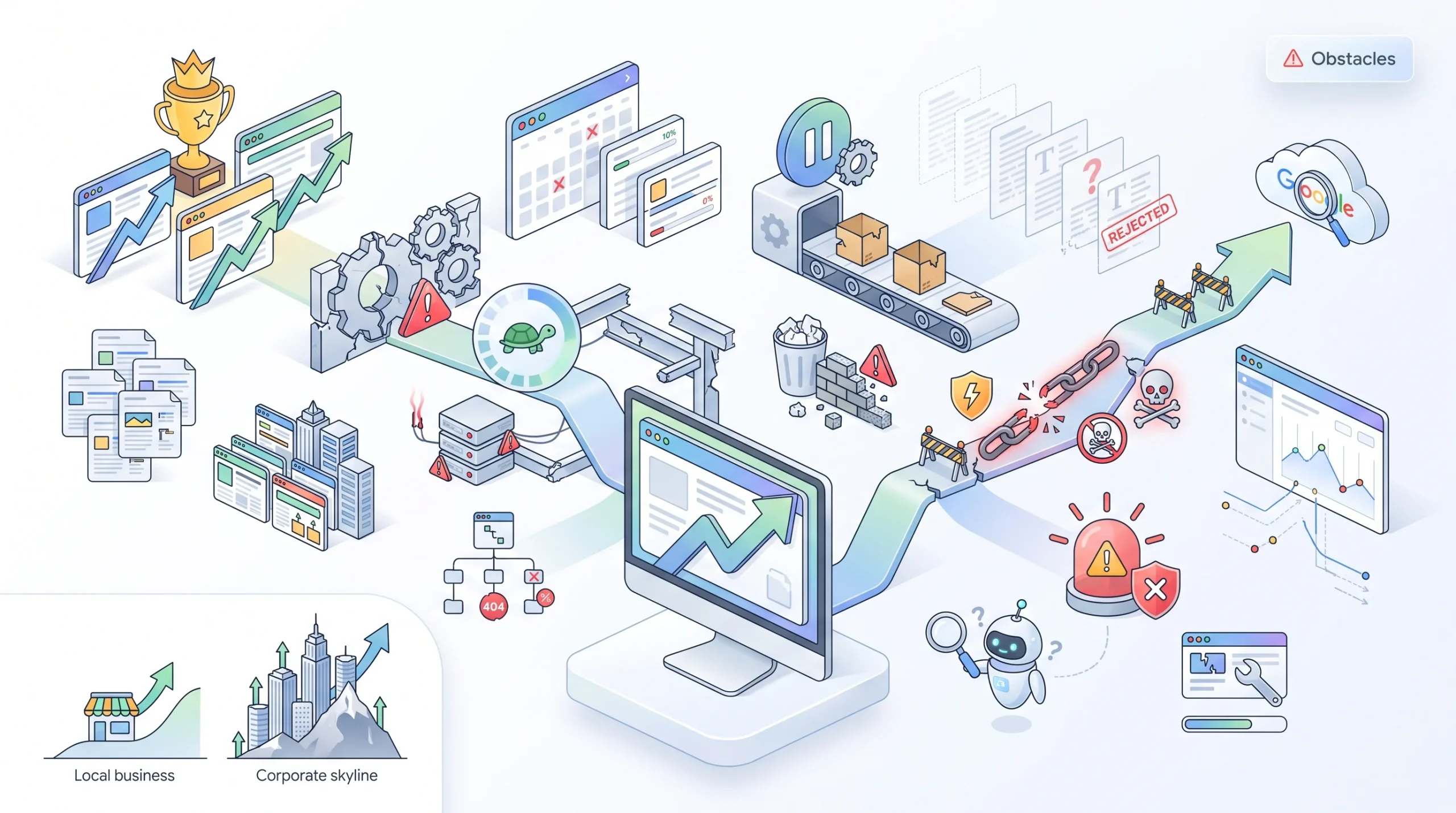
On the flip side, some situations are just going to take longer no matter how good the strategy is. Nobody likes hearing this, especially after paying for a few months of work, but pretending these variables don’t exist just sets everyone up for a bad conversation later.
- Highly competitive industries. Legal, finance, insurance, SaaS, anything where the keywords have serious commercial value, has more competitors fighting for the same real estate, which stretches the timeline out.
- Technical debt. Poor site architecture, unresolved Core Web Vitals issues, duplicate content across product pages, these create friction that slows everything down, sometimes capping progress entirely until fixed.
- Inconsistent strategy or publishing. Starting and stopping, changing direction every few months, or pausing content production kills the momentum that took months to build.
- Thin or low-quality content. Content that doesn’t actually answer the question better than what’s already ranking isn’t going to outrank it, no matter how optimized the title tag is.
- Previous penalties or spammy backlink history. Sites that inherited a shady link profile or got hit with a manual action in the past are starting from a deficit, not zero.
- No clear conversion tracking. This one’s sneaky. If you can’t measure what’s actually happening, it’s easy to misjudge whether something is working, which leads to premature strategy changes that reset the clock.
None of these factors mean SEO won’t work, they just mean the timeline needs adjusting before the campaign even starts. A legal firm in a major city competing against 40 other firms for the same three keywords needs a different set of expectations than a local bakery competing against two other bakeries in town. Pretending both situations run on the same clock is how good strategies get labeled “failures” way too early.
What “Results” Actually Means (Because It’s Not Just Rankings)

Here’s where a lot of people trip themselves up. They define “results” as one thing, usually rankings, usually for one specific keyword, and then get discouraged when that one number doesn’t move fast enough. But there’s a whole sequence of metrics that show progress before rankings for competitive terms ever budge.
- Impressions. The earliest signal available. Shows Google is indexing and considering your content for search queries, even before you’re ranking well.
- Average position movement. Going from position 55 to position 30 doesn’t feel like a win because you’re still not on page 1, but it’s real progress and usually happens before the jump to page 1 does.
- Organic clicks and traffic. The metric everyone actually cares about, but one of the later ones to show meaningful movement.
- Keyword rankings, specifically page 1 versus top 3. There’s a massive difference between ranking position 8 and position 2, since most clicks go to the first few results. Cracking page 1 at all is a milestone, cracking the top 3 is a different milestone entirely.
- Conversions and leads from organic. The metric that actually justifies the investment. This lags behind traffic growth because it depends on traffic existing first.
- Domain authority or trust signals. A slower-moving, more abstract metric, but one that reflects the accumulated effect of everything else.
The mistake is watching only the last two or three of these and ignoring the earlier signals. If impressions are climbing and average position is improving, that’s the machine working, even if clicks haven’t caught up yet.
Here’s a way to think about it that actually holds up. Rankings are a lagging indicator. Impressions and crawl activity are leading indicators. If someone’s only checking rankings, they’re checking the metric that moves last, and by the time it moves, months of invisible progress already happened. Checking Search Console regularly for the earlier signals gives a much more honest read on whether the strategy is working than staring at a rank tracker waiting for a keyword to jump to page 1.
How to Track SEO Progress Without Losing Your Mind
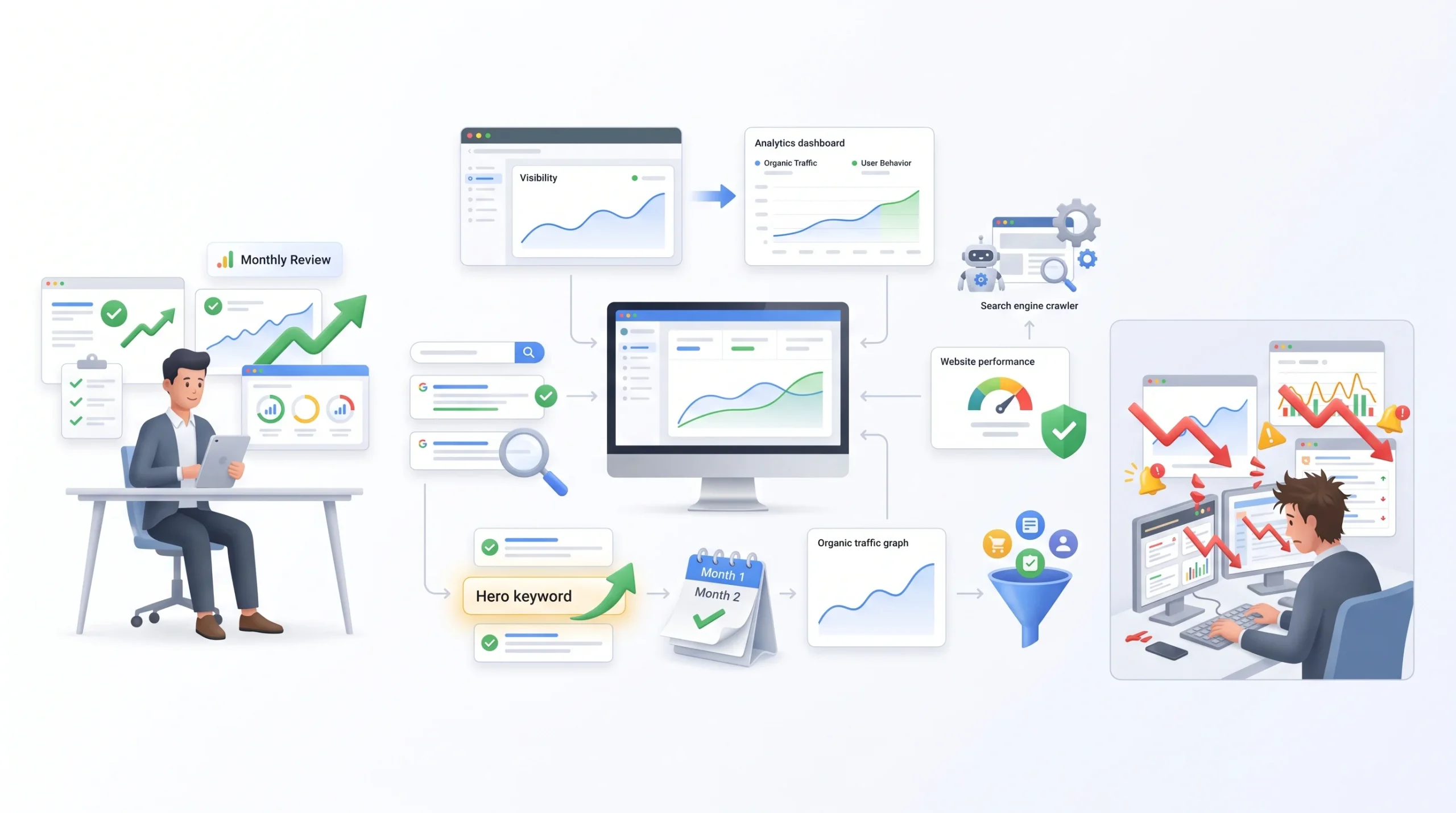
Checking rankings every single day is a fast way to make yourself miserable, because day to day fluctuation is normal and mostly meaningless. Google’s results shift constantly for reasons that have nothing to do with your strategy.
Google Search Console and GA4 are the two tools that actually matter here, alongside whatever rank tracking software fits the budget. Search Console shows impressions, clicks, and average position by query, which is the earliest and most honest signal of what’s happening. GA4 shows what people actually do once they land, time on page, conversions, which pages they bounce from.
Monthly check-ins are the right cadence for most businesses. Weekly if there’s a specific campaign or launch being watched closely, but daily rank checking is a recipe for chasing noise. A realistic monthly report should include impressions trend, click trend, movement on target keywords (not just whether they hit page 1, but whether they moved at all), and conversions tied to organic traffic where trackable.
If this is agency-facing content, or if there’s a client or stakeholder involved, setting the expectation upfront that month 1 and 2 will look flat saves a lot of awkward conversations later. Nobody likes surprises, especially the kind that make it look like nothing’s happening.
Something that helps a lot in practice: pick a small set of “hero” keywords, maybe 5 to 10, that actually matter to the business, and track those specifically instead of trying to watch every keyword the site touches. Trying to monitor 200 keywords every week is a fast way to drown in noise, since plenty of them will bounce around for reasons that have nothing to do with the site’s own performance, algorithm updates, seasonal search behavior, a competitor publishing something new. Focusing on a smaller, meaningful set makes the monthly check-in actually useful instead of overwhelming.
Signs Your SEO Is Working (Even If Traffic Hasn’t Exploded Yet)
Some quiet signals that things are moving in the right direction, even before the big traffic jump shows up:
- Impressions climbing steadily in Search Console, even if clicks haven’t caught up yet.
- Rankings shifting from page 5 to page 2, not yet page 1, but clear directional movement.
- Indexing rate improving, meaning new content gets picked up by Google faster than it used to.
- Engagement metrics improving on optimized pages, longer time on page, lower bounce rate.
- More keywords appearing in Search Console than showed up a few months ago, meaning the site is being considered for a wider range of search queries.
Signs Your SEO Strategy Needs a Rethink
On the other hand, some patterns are genuine red flags, not just “SEO takes time” excuses:
- Zero movement after 6 or more months of consistent execution. Slow is normal. Frozen is not.
- Rankings stuck below page 5 across the board with no upward trend at all.
- Technical issues identified early on that never actually got resolved.
- Content published but never indexed, which usually points to a deeper crawlability problem.
- No clear target keyword strategy from the start, which means effort’s been scattered instead of focused.
The distinction matters. “SEO is slow” means the trend line is pointing up even if it’s gradual. “SEO isn’t working” means there’s no trend line at all, just flat or declining numbers month after month with no explanation. Confusing the two leads people to either quit too early on something that was actually working, or keep funding something that genuinely isn’t.
Does the Type of SEO Change the Timeline?
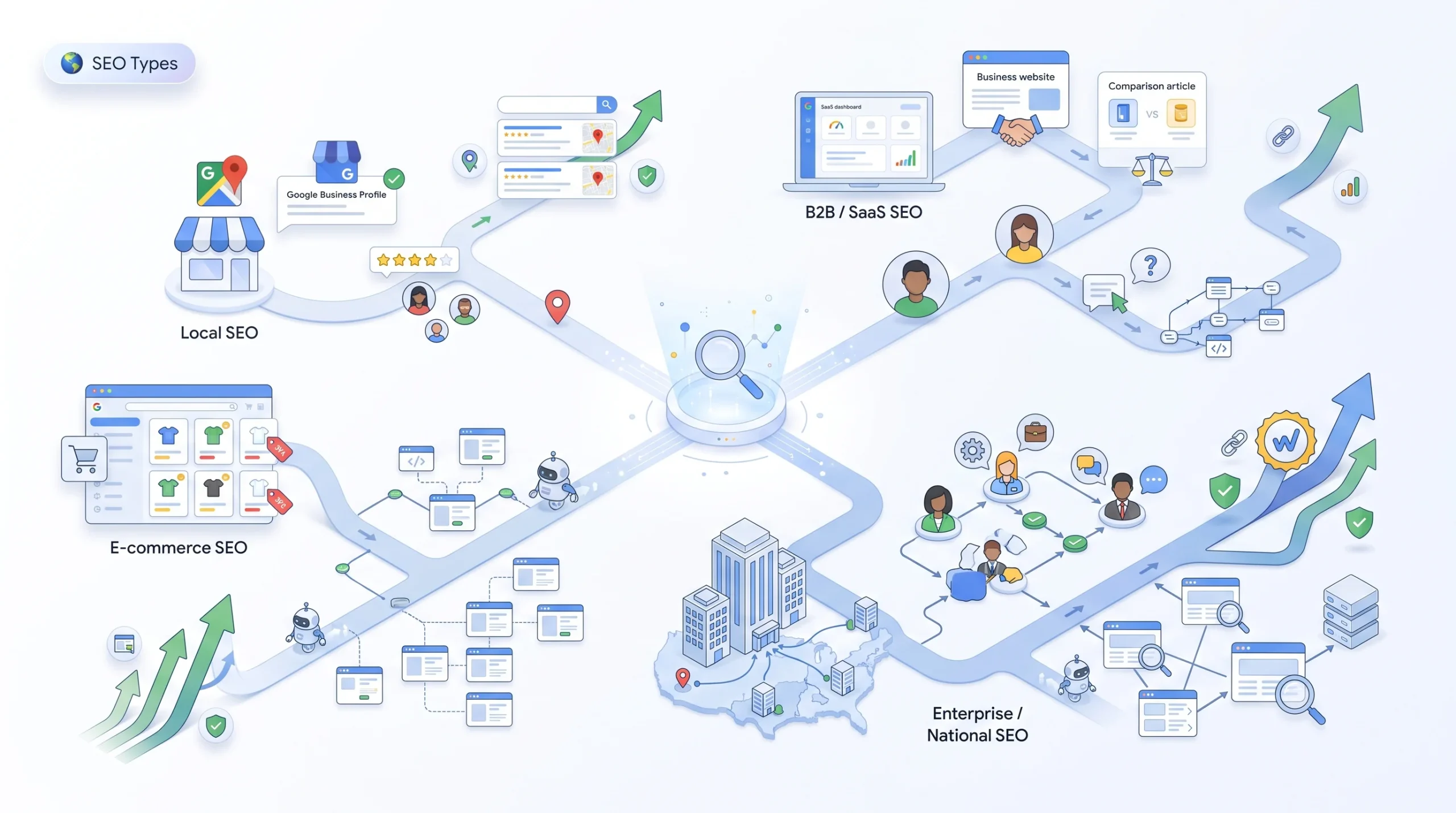
Yeah, quite a bit actually. Not all SEO is playing on the same field.
Local SEO
Usually the fastest category, often showing meaningful results in 3 to 6 months. Google Business Profile signals, local reviews, and location-specific competition being smaller than national competition all work in favor of a faster timeline. A dentist office competing for local visibility isn’t fighting the entire internet, just the other dentist offices in the same metro area.
Reviews play a bigger role here than in most other SEO categories. A steady flow of genuine reviews, and a business actually responding to them, feeds into local ranking signals in a way that doesn’t really have an equivalent in national or e-commerce SEO. Consistency in business name, address, and phone number across directories also matters more than people expect, since mismatched info across the web can quietly undermine an otherwise solid local strategy.
E-commerce SEO
Tends to run slower, mainly because of scale and structural issues. Product pages often duplicate content across variants (same product, different color or size), category pages compete against each other, and large sites just take longer to fully crawl and index. More pages, more technical complexity, more time.
There’s also a specific problem e-commerce sites run into that other categories mostly avoid: crawl budget. Google allocates a certain amount of attention to crawling any given site, and if a store has 50,000 product pages, a big chunk of them might rarely get crawled at all, especially the ones buried deep in the category structure. That means new products or updated pages can sit unindexed far longer than a blog post would on a smaller site. Fixing this usually means cleaning up thin or near-duplicate product pages, tightening internal linking so important pages aren’t buried five clicks deep, and being deliberate about which pages actually deserve to be indexed versus which ones should be no-indexed or consolidated.
B2B and SaaS SEO
The ranking timeline might actually move at a normal pace, but the business result lags further behind because of longer sales cycles. Someone reading a comparison blog post today might not become a customer for another 3 to 6 months, even after the content is ranking well and driving traffic. So the SEO timeline and the revenue timeline aren’t the same clock here.
This trips up a lot of SaaS marketing teams specifically, because they’ll see traffic climbing nicely by month 6 and then get pressure from leadership asking why revenue hasn’t followed the same curve. The honest answer is that it’s not supposed to yet. A demo request that comes in during month 7 might close as a paying customer in month 10, and attributing that revenue back to the blog post that started the journey requires decent tracking, which a lot of companies still don’t have set up properly.
Enterprise or National SEO
Generally the longest timeline of all, for two reasons. First, the competition at a national or enterprise scale is fierce, everyone with resources is fighting for the same visibility. Second, larger organizations tend to move slower internally, approvals, legal reviews, multiple stakeholders signing off on content, which adds friction that smaller, more nimble sites don’t deal with.
Can You Speed Up SEO Results? (Realistic Expectations)
Some things legitimately compress the timeline. Fixing technical issues early removes friction that would otherwise slow everything down for months. Increasing content velocity, publishing more high quality content more consistently, gives Google more surface area to index and rank. Digital PR and legitimate link building accelerate the trust-building process, since earned links from reputable sites are one of the strongest signals Google uses. Solid internal linking helps distribute authority across the site instead of concentrating it on one or two pages.
What doesn’t work, and often actively backfires: keyword stuffing, which reads as manipulative and can hurt rankings instead of helping. Buying spammy backlinks from low-quality sites, which risks a penalty that sets the whole site back further than doing nothing at all would have. Publishing thin, AI-generated content at scale without real editorial oversight, since Google has gotten noticeably better at identifying content that doesn’t actually add value, and ranking it accordingly.
A hybrid approach, running paid ads alongside organic SEO, is a legitimate way to get visibility and traffic while the SEO ramps up in the background. It’s not cheating, it’s just being smart about the fact that organic takes time and the business still needs traffic in the meantime.
There’s a version of “speeding things up” that’s really just about sequencing well instead of doing anything dramatically different. Publishing the easiest, lowest-competition content first, while working on the harder, more competitive pieces in parallel, gets some early wins on the board that build momentum and buy patience from whoever’s funding the effort. It’s not a trick, it’s just being strategic about which fights to pick first instead of throwing everything at the hardest keyword on day one and waiting a year to see any movement at all.
Conclusion
Look, SEO takes time because it’s actually earning something, not because the process is slow for no reason. The businesses that get frustrated and pull the plug at month 3 are usually doing it right before the early signals start turning into real movement. The ones that stick with it through the boring, invisible foundation work are the ones still pulling in organic traffic two years later without paying for every single click.
None of this means patience alone guarantees results. A strategy with no clear keyword targets, unresolved technical issues, or inconsistent content still won’t work no matter how long you wait. But if the fundamentals are solid, impressions are climbing, rankings are moving even slowly, content is going out consistently, then the timeline described here is what’s realistic, not what someone’s telling you to make a sale sound good. Give it the months it actually needs, and check the right metrics along the way instead of just staring at a traffic graph waiting for a miracle.
FAQs
How long does it take to rank #1 on Google?
Depends entirely on competition. For low-competition, long-tail keywords, it can happen in a few months. For competitive commercial terms, ranking #1 can take a year or more, and for some of the most contested industries, it might never happen without significant, sustained investment.
Why is my SEO not showing results after 3 months?
Honestly, 3 months is still early for most sites, especially if the first month or two went into technical fixes and foundational work. Check Search Console for impressions and average position movement before assuming nothing’s happening. If those are flat too, something’s likely wrong with either the technical setup or the content strategy.
Does SEO ever stop taking time, or does it always take months?
New initiatives, new keyword targets, new content categories, will always have a ramp-up period, even on an established site. But an established domain with existing authority ranks new content faster than a brand new domain would for the same content. So it gets faster over time, it never becomes instant.
Can new websites rank quickly with SEO?
For low-competition, specific long-tail terms, yes, sometimes within a few months. For anything with real competition, a new site is starting from zero trust and will generally take longer than an established competitor, all else being equal.
How long does local SEO take compared to national SEO?
Local SEO usually moves faster, often 3 to 6 months for meaningful results, because the competitive pool is smaller and location-specific signals (Google Business Profile, local reviews) carry real weight. National SEO involves competing against every relevant site in the entire country, which naturally takes longer.
Is it normal to see no traffic increase in the first 60 days?
Yes, completely normal. The first two months are typically foundation work, technical fixes, content planning, initial optimization. Visible traffic movement usually starts showing up around month 3 or 4, and even then it’s early signals like impressions, not big traffic jumps.
How do I know if my SEO agency is actually making progress?
Ask for impressions and average position data from Search Console, not just ranking screenshots for a handful of cherry-picked keywords. Real progress shows up as a broader trend across many keywords and pages, not just movement on one or two terms picked to look good in a report. If a report only ever shows the same 3 keywords every single month with no mention of what’s happening across the rest of the site, that’s worth asking about directly.
Does site age matter more than content quality?
Not exactly, but they interact. An old domain with weak content won’t outrank a newer domain with genuinely better content forever, Google does eventually reward the better answer. But in the early months, age and existing trust give a real head start, so a newer site publishing equally good content should expect a longer runway before it catches up, not because the content is worse but because the trust hasn’t been established yet.
Should I pause SEO if I don’t see results in 4 months?
Generally no, not if the fundamentals are sound and impressions or average position are trending upward even slightly. Pausing at month 4 usually means restarting the clock later, losing whatever crawl momentum and trust had already started building. If there’s genuinely zero movement across every metric, including impressions, that’s a different conversation, and worth investigating rather than just pausing blindly.