

A student in one of our cohorts once asked me why her local bakery’s website ranked for “best sourdough bread” in her city but couldn’t crack page one for “sourdough bread recipe” no matter how much content she published. The answer was that she was running local SEO tactics, Google Business Profile optimization, local citations, review generation, and expecting them to move rankings for a completely different type of query that required content-driven on-page and off-page SEO instead. She wasn’t doing anything wrong. She just didn’t know these were different disciplines with different playbooks.
That mix-up is incredibly common, and it’s the reason I wanted to write this guide. “SEO” gets talked about like it’s one skill, but it’s actually a collection of related disciplines, some defined by where the work physically happens (on your site, off your site, in your site’s code) and some defined by what kind of business or search behavior you’re optimizing for (local searches, product searches, voice queries, non-English markets). Beginners often learn one type first, usually on-page SEO because it’s the most visible, and assume that’s the whole picture. It isn’t.
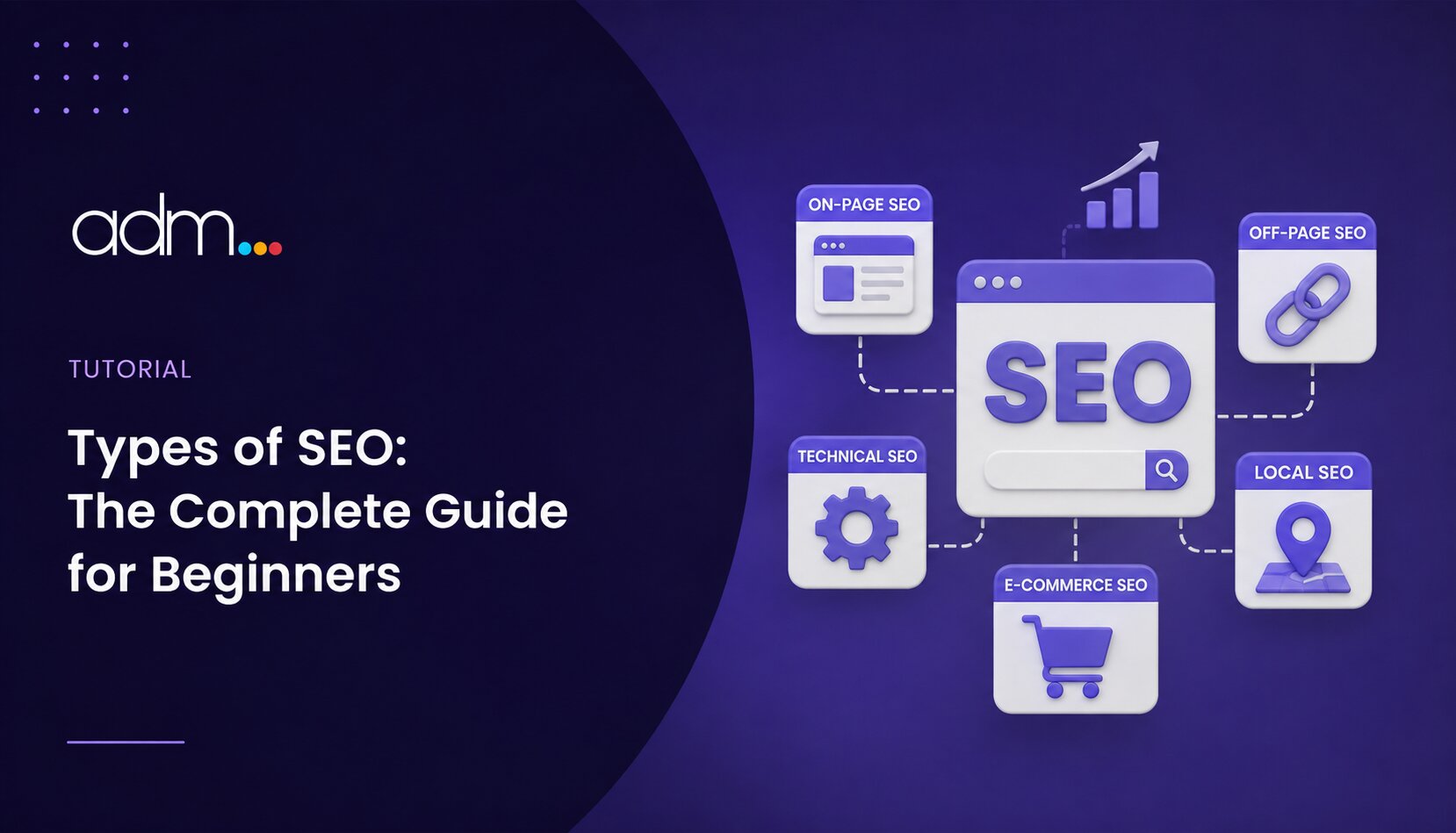
In this guide, I’m going to map out every major types of SEO you’re likely to encounter, organized in a way that actually makes sense rather than just listing terms alphabetically. You’ll learn the two different frameworks people use to categorize SEO, the three core pillars that everything else builds on, the specialized types tied to specific business models, how all of these work together on a single real site, and where the line sits between legitimate SEO and the black hat tactics that get sites penalized. This is a long guide, because the topic genuinely has a lot of surface area, and I’d rather give you the complete map than a shortened version that leaves you making the same mistake my student made.
- SEO splits into two overlapping frameworks: by where the work happens (on-page, off-page, technical) and by what you’re optimizing for (local, ecommerce, mobile, voice, international).
- On-page, off-page, and technical SEO are the three foundational pillars that every other specialized type of SEO builds on top of.
- Local SEO revolves around Google Business Profile and citation consistency, and it’s a fundamentally different playbook from content-driven organic SEO.
- Ecommerce SEO has unique challenges around faceted navigation and duplicate product content that don’t exist on a typical content site.
- Voice search SEO and featured snippet optimization overlap heavily, since most voice assistants pull answers from the same content that wins snippets.
- International SEO requires hreflang tags to avoid Google showing the wrong country or language version of your site to searchers.
- Black hat tactics like keyword stuffing and link buying can produce short-term gains but risk manual penalties that can wipe out years of organic visibility.
What “Types of SEO” Actually Means (Two Ways to Categorize It)
Most confusion about “types of SEO” comes from mixing up two different classification systems that answer two different questions. The first system classifies SEO by where the optimization work physically happens: on your own page’s content, off your site through external signals, or within your site’s technical infrastructure. The second system classifies SEO by what kind of search behavior or business model you’re optimizing for: local searches, product searches, mobile users, voice queries, or international audiences.
Here’s why that distinction matters practically. On-page, off-page, and technical SEO aren’t alternatives to local or ecommerce SEO, they’re the underlying toolkit that local and ecommerce SEO both draw from. A local SEO strategy still involves on-page work (optimizing your homepage for “plumber in Austin”), technical work (making sure your site loads fast on mobile since most local searches happen on phones), and off-page work (getting mentioned in local business directories). Local SEO isn’t a fourth pillar sitting next to the first three. It’s a specialized application of all three pillars aimed at a specific kind of search intent.
I’ve seen beginners waste months because they treated these as competing categories instead of layered ones. Someone running an online store would ask “should I focus on on-page SEO or ecommerce SEO?” as if they were mutually exclusive, when ecommerce SEO is really on-page, off-page, and technical SEO applied specifically to product and category page challenges. Once that clicks, the rest of this guide will make a lot more sense, because I’m going to walk through the three foundational pillars first, then show you how the specialized types are really just those pillars reapplied to different contexts.
Why This Two-Framework Confusion Trips Up Beginners Specifically
New SEOs typically learn from scattered blog posts and YouTube videos that each cover one type in isolation, without ever showing how the types relate to each other. You’ll read an article about technical SEO, then a separate article about local SEO, and nothing connects them, so it feels like you’re learning ten unrelated skills instead of one skill (SEO fundamentals) applied to ten different contexts. That’s part of why I wrote this as a single connected guide rather than assuming you’d piece it together from ten different sources. If you want the deep technical mechanics specifically, we’ve already covered that in our dedicated technical SEO guide, and this article will reference it rather than repeat it.
SEO by Where the Work Happens: The Three Core Pillars
Every type of SEO you’ll ever practice, no matter how specialized, is built from some combination of these three pillars. Understanding each one deeply is what lets you correctly diagnose which pillar is weak when a specialized strategy (local, ecommerce, whatever) isn’t working.
On-Page SEO: Optimizing What’s Actually on the Page
On-page SEO is the practice of optimizing individual page elements, content quality, title tags, header structure, keyword usage, and internal linking, so that a specific page is both relevant to a target query and genuinely useful to the person reading it. This is usually where beginners start because it’s the most directly controllable and doesn’t require any coding or outreach.
The core components are: title tags and meta descriptions (the clickable text in search results), header tags (H1 through H6, structuring content for both readers and search engines), keyword placement (using your target phrase and its natural variations without forcing it awkwardly), content depth and quality (does the page actually answer the query completely), and internal linking (connecting related pages on your own site so both users and crawlers can navigate between them).
A mistake I see constantly: writers optimize a title tag for a keyword but never check whether the page’s actual content matches the search intent behind that keyword. If someone searches “best running shoes for flat feet,” they want a comparison or recommendation, not a history of running shoe technology. Matching search intent, not just keyword matching, is the real skill inside on-page SEO. A perfectly keyword-optimized page that answers the wrong question still won’t rank, because Google’s ranking systems are built to reward relevance to intent above surface-level keyword presence.
Off-Page SEO: Building Authority Beyond Your Own Site
Off-page SEO covers everything that happens outside your own domain that influences how search engines perceive your site’s authority and trustworthiness, most importantly backlinks, but also brand mentions, social signals, and digital PR. The underlying logic is that Google treats other websites linking to you as a vote of confidence, and the more relevant, authoritative sites that vouch for you, the more Google trusts your content in return.
Backlinks aren’t all equal. A link from a well-established industry publication carries far more weight than a link from a low-quality directory nobody visits. Beginners often chase link quantity, submitting to dozens of directories or buying cheap link packages, when link quality and relevance matter dramatically more. One genuine link from a site in your exact niche, earned because you published something worth referencing, outweighs fifty low-quality directory links.
Digital PR has become one of the more effective modern off-page tactics: creating genuinely newsworthy content (original research, data studies, unique surveys) and pitching it to journalists and industry publications who then link back to you as the source. This works because it produces links that would be extremely hard to fake or buy, which is exactly what makes them valuable in Google’s eyes. Brand mentions without a link (someone mentioning your company name in an article without hyperlinking it) also carry some weight, since Google’s systems have gotten better at recognizing unlinked brand references as a trust signal, even if their impact is smaller than an actual backlink.
Technical SEO: Making Sure Search Engines Can Actually Access Your Site
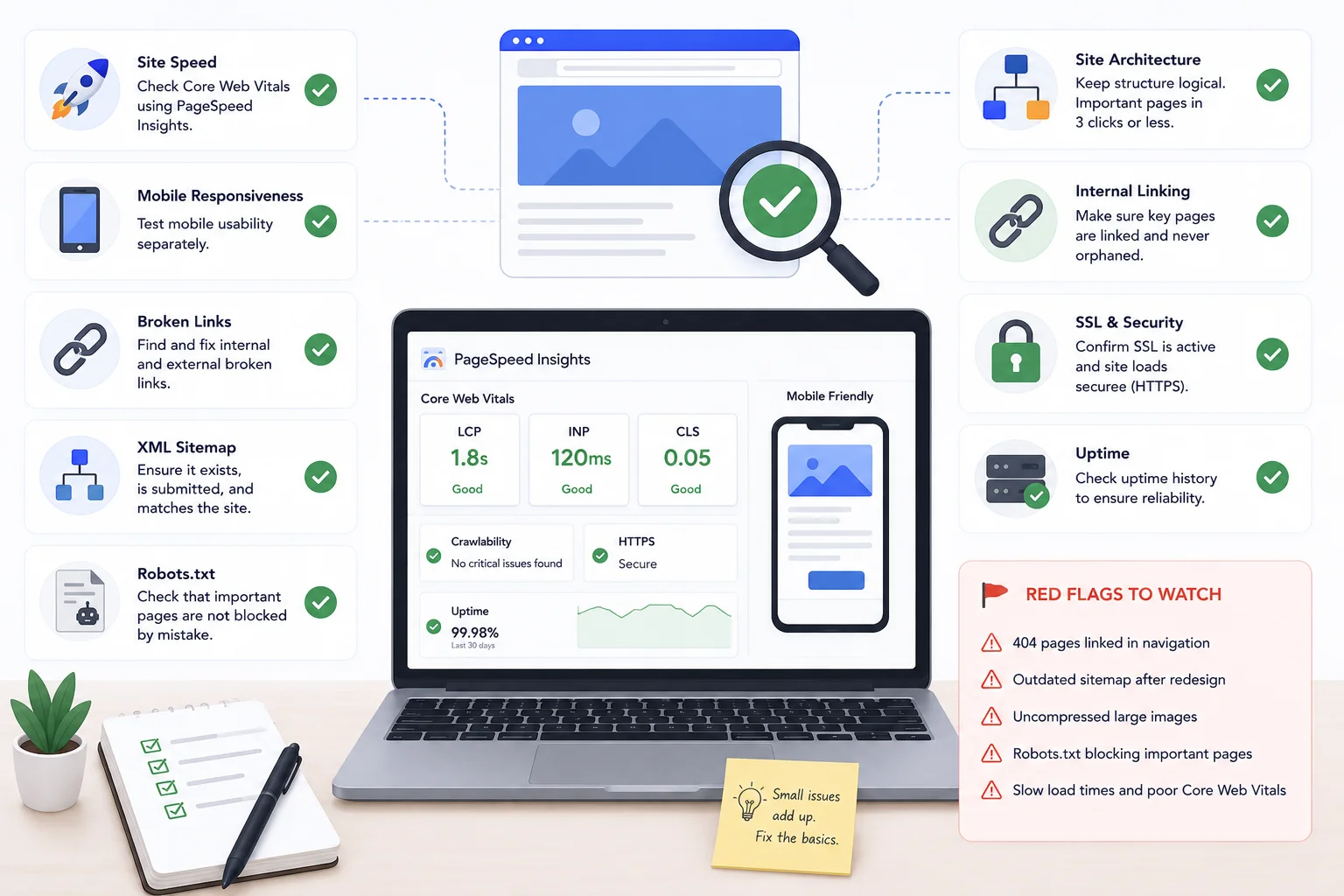
Technical SEO is the practice of optimizing your site’s infrastructure, crawlability, indexability, page speed, mobile usability, and structured data, so search engines can properly access, understand, and evaluate your pages in the first place. This is the pillar that determines whether your on-page and off-page work even has a chance to matter, because a page that can’t be crawled or indexed can’t rank no matter how well-written it is or how many backlinks point to it.
Rather than repeat the full breakdown here, we’ve already covered technical SEO in depth, including the exact checklist I run on every audit, in our dedicated guide: Technical SEO: A Beginner’s Guide to Website Optimization. The short version for this article: crawling and indexing come first (can Google even find and store your pages), then performance and usability (Core Web Vitals, mobile-first indexing), then structured data (schema markup for rich results). If you haven’t audited your site’s technical foundation yet, that guide is the place to start before layering any specialized SEO type on top.
SEO by Business Context: Specialized Types You’ll Encounter
Once you understand the three pillars, the specialized types of SEO below will make a lot more sense, because each one is really just those three pillars applied to a specific kind of search behavior or business model.
Local SEO: Winning Searches Tied to a Physical Location
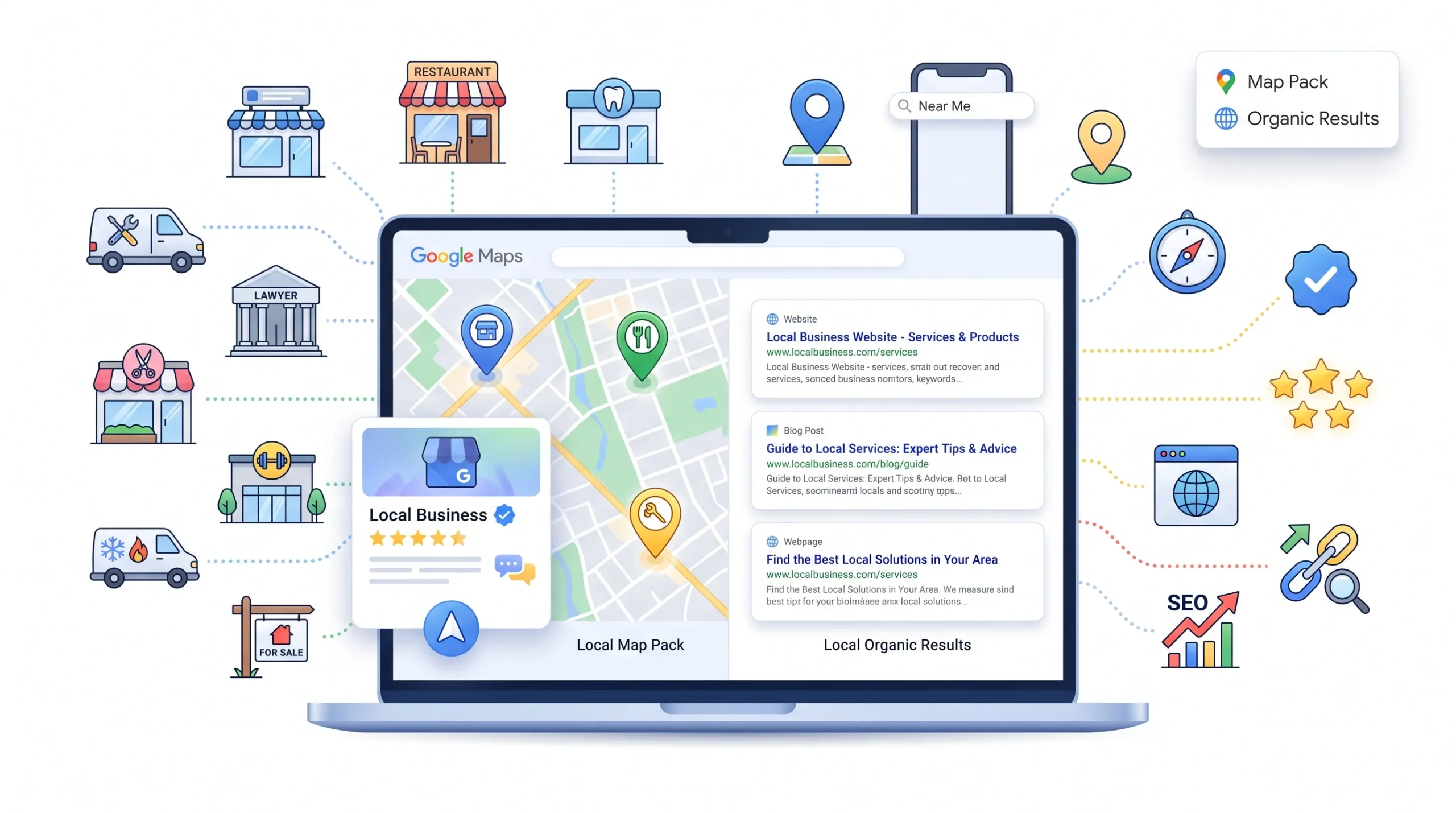
Local SEO is the practice of optimizing a business’s online presence to rank in geographically relevant searches, like “coffee shop near me” or “dentist in Denver,” and it revolves around a completely different set of ranking signals than standard organic SEO. The centerpiece is your Google Business Profile (formerly Google My Business), a free listing that controls how your business appears in Google Maps and the local three-pack that shows above standard organic results for location-based queries.
NAP consistency, meaning your business Name, Address, and Phone number match exactly across every platform (your website, Google Business Profile, Yelp, Facebook, industry directories), is one of the most overlooked local ranking factors. Even small inconsistencies, like “St.” on one platform and “Street” on another, can weaken Google’s confidence in your business’s legitimacy and hurt local pack rankings.
Review quantity, recency, and your response rate to reviews also factor heavily into local rankings. A business with 150 reviews and consistent recent activity generally outperforms a competitor with 20 reviews from two years ago, even if both have similar star ratings. Local citations, meaning your business listed accurately on directories like Yelp, Yellow Pages, and industry-specific directories, function similarly to backlinks but for local trust signals specifically.
Ecommerce SEO: Optimizing Product and Category Pages at Scale
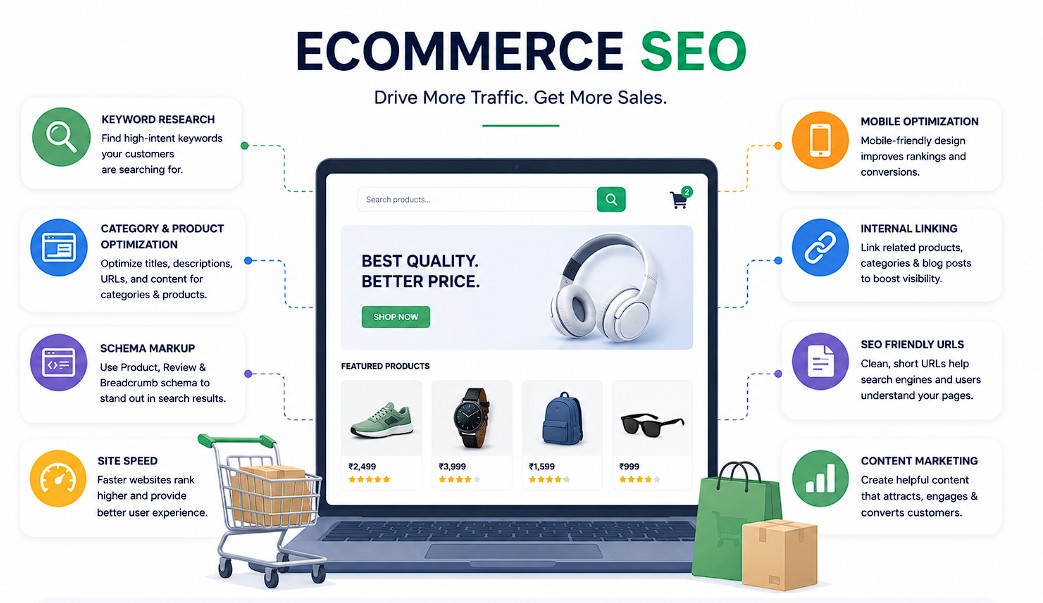
Ecommerce SEO applies on-page, off-page, and technical SEO specifically to the unique structural challenges of online stores, primarily managing product and category pages at scale without creating duplicate content or wasting crawl budget. This is genuinely one of the harder specializations because ecommerce platforms auto-generate URLs (filtered views, size and color variants, sort orders) far faster than a typical content site does.
Faceted navigation, the filter system that lets shoppers narrow results by size, color, price, and brand, is the single biggest technical challenge in ecommerce SEO. Each filter combination can generate a unique URL, and without proper canonical tags or parameter handling, a store can accidentally create tens of thousands of near-duplicate pages competing against each other for the same keywords, exactly the crawl budget problem we covered in our technical SEO guide.
Product schema markup (structured data specifying price, availability, and review ratings) is close to mandatory for ecommerce, since it’s what makes products eligible for rich results showing star ratings and pricing directly in search results, which measurably improves click-through rates. Category page content also matters more than beginners expect. A category page with zero unique text, just a wall of product grid, gives Google very little to understand what the page is about beyond the product titles themselves, which weakens its ability to rank for broader category-level searches like “women’s running shoes” rather than just specific product names.
Mobile SEO: Optimizing for the Majority of Search Traffic
Mobile SEO is the practice of ensuring your site performs well specifically on mobile devices, and it’s become less of a separate discipline and more of a baseline requirement since Google shifted to mobile-first indexing for all sites in 2023, meaning Googlebot evaluates your mobile version as the primary version of your site regardless of desktop performance.
The core mobile SEO checks: responsive design that adapts cleanly to different screen sizes rather than a separate stripped-down mobile site, tap targets (buttons and links) spaced far enough apart to avoid mis-taps, text that’s readable without pinch-zooming, and page speed specifically on mobile networks, which are typically slower and less consistent than desktop broadband connections. We covered the technical mechanics of testing this, including Search Console’s Mobile Usability report, in the technical SEO guide, but the strategic point worth adding here is that mobile SEO isn’t optional or supplementary anymore. For most industries, mobile traffic now exceeds desktop traffic, so a site that’s technically fine on desktop but broken on mobile is effectively broken for the majority of its potential audience.
Voice Search SEO: Optimizing for Conversational Queries
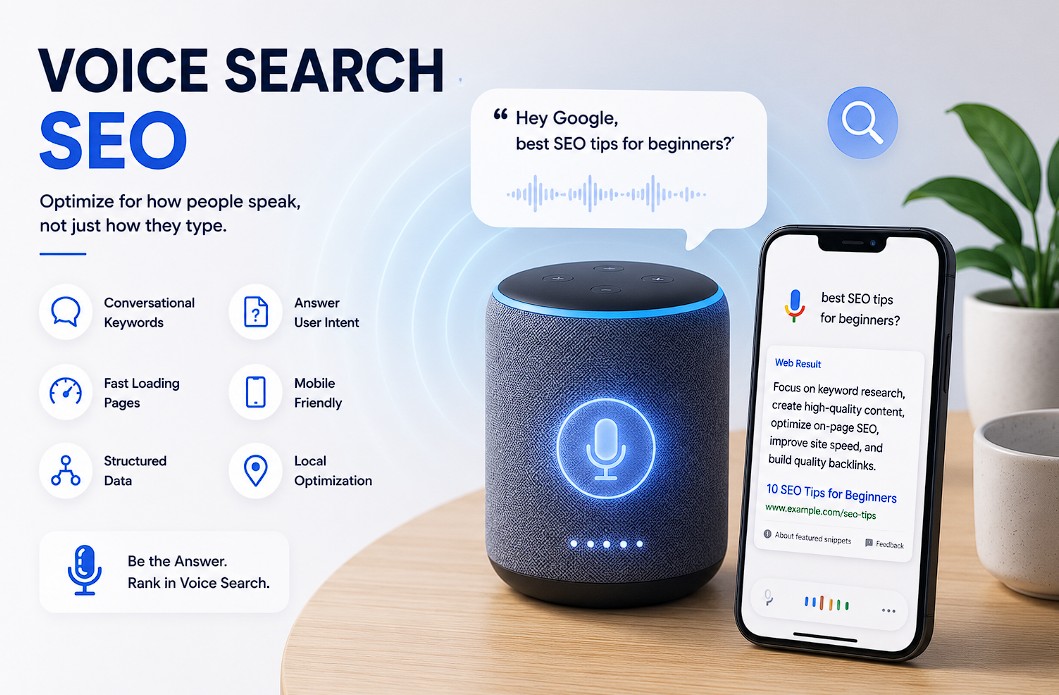
Voice search SEO is the practice of optimizing content to appear in results returned by voice assistants like Google Assistant, Siri, and Alexa, and it overlaps heavily with featured snippet optimization, since most voice assistants read the answer directly from the same content winning the featured snippet position on a standard search results page.
Voice queries tend to be longer and more conversational than typed searches. Someone typing might search “weather Chicago,” while the same person speaking to a voice assistant is more likely to ask “what’s the weather like in Chicago today.” Optimizing for voice search means writing content that directly and concisely answers full-sentence questions, often in a dedicated FAQ format, since FAQ-style content structured with a clear question as a header followed by a direct answer in the first sentence or two is what tends to get pulled into both featured snippets and voice responses.
Local voice queries are especially common (“find a pizza place near me”), which means voice search SEO and local SEO overlap significantly in practice. If you’re already doing solid local SEO with an optimized Google Business Profile and consistent local citations, you’re already covering much of what voice search optimization for local queries requires.
International and Multilingual SEO: Ranking Across Different Countries and Languages
International SEO is the practice of optimizing a site to rank appropriately across multiple countries or languages, and it introduces a technical challenge that doesn’t exist for single-market sites: telling Google which version of your content to show to which audience. The primary tool for this is the hreflang tag, an HTML attribute that specifies the language and, optionally, the country a particular page is intended for, so Google can serve French searchers your French page and Canadian French searchers a Canada-specific variant if you have one.
A major early decision in international SEO is site structure: country-code top-level domains like yoursite.fr and yoursite.de (strongest signal of local relevance but requires managing multiple domains), subdirectories like yoursite.com/fr/ and yoursite.com/de/ (easiest to manage and consolidates domain authority under one root domain), or subdomains like fr.yoursite.com (a middle-ground approach). Most beginners and small businesses expanding internationally are better served by subdirectories, since they keep all authority-building efforts consolidated under a single domain rather than splitting it across multiple properties that each have to build authority independently.
A mistake I see often: sites translate their content but forget to translate the keyword research behind it. A phrase that’s the natural, high-volume way to search for something in English often isn’t a direct translation of the highest-volume equivalent phrase in another language. Real international SEO requires running keyword research separately in each target market’s language, not just translating your existing English keyword list.
App Store Optimization (ASO): The Adjacent Discipline Worth Knowing
App Store Optimization isn’t technically SEO since it doesn’t involve Google or Bing, but it’s worth knowing about because it applies nearly identical logic to a different search engine: the App Store or Google Play Store’s internal search algorithm. ASO involves optimizing your app’s title, description, keywords, screenshots, and review ratings to rank higher within app store search results and category rankings. If your business has both a website and a mobile app, understanding that ASO exists as a parallel discipline, using similar principles of relevance and authority signals but applied to a completely separate search ecosystem, helps you avoid the mistake of assuming strong web SEO automatically translates into app store visibility. It doesn’t; they’re evaluated by entirely separate systems.
A Real Example: How These Types Work Together on One Site
Let me walk through how this actually plays out on a single business, because seeing the types layered together matters more than reading about them separately.
A regional furniture retailer I worked with sold both in physical showrooms and through an online store, which meant their SEO strategy genuinely needed almost every type covered in this guide simultaneously, not as separate projects but as one coordinated strategy. Their showroom locations needed local SEO: optimized Google Business Profiles for each of their four physical locations, consistent NAP data across furniture-specific directories, and a review generation process built into their in-store checkout flow. Their online catalog needed ecommerce SEO: canonical tags across hundreds of product variants (different fabric colors and sizes of the same couch model), product schema markup showing pricing and availability, and category pages with enough unique descriptive content to rank for broader searches like “mid-century modern sofas” rather than only exact product names.
Underneath both of those specialized layers, they needed the three foundational pillars solid: on-page SEO on their blog content targeting informational searches like “how to choose a couch size for a small living room,” off-page SEO through partnerships with interior design bloggers who linked back to specific product pages, and technical SEO to handle the crawl budget problem their faceted navigation was creating, the exact pattern from the ecommerce variant case we walked through in our technical SEO guide.
Because most of their showroom traffic came from people searching on their phones while physically nearby, mobile SEO wasn’t a separate initiative either, it was baked into every other layer, since a slow-loading, poorly-formatted mobile experience would have undermined the local SEO work, the ecommerce work, and the content work all at once. This is the real lesson: for most businesses beyond the simplest single-purpose blog, you’re not choosing one type of SEO. You’re running several types simultaneously, and the foundational pillars are what make all the specialized layers actually function.
White Hat SEO vs Black Hat SEO vs Gray Hat SEO vs Negative SEO
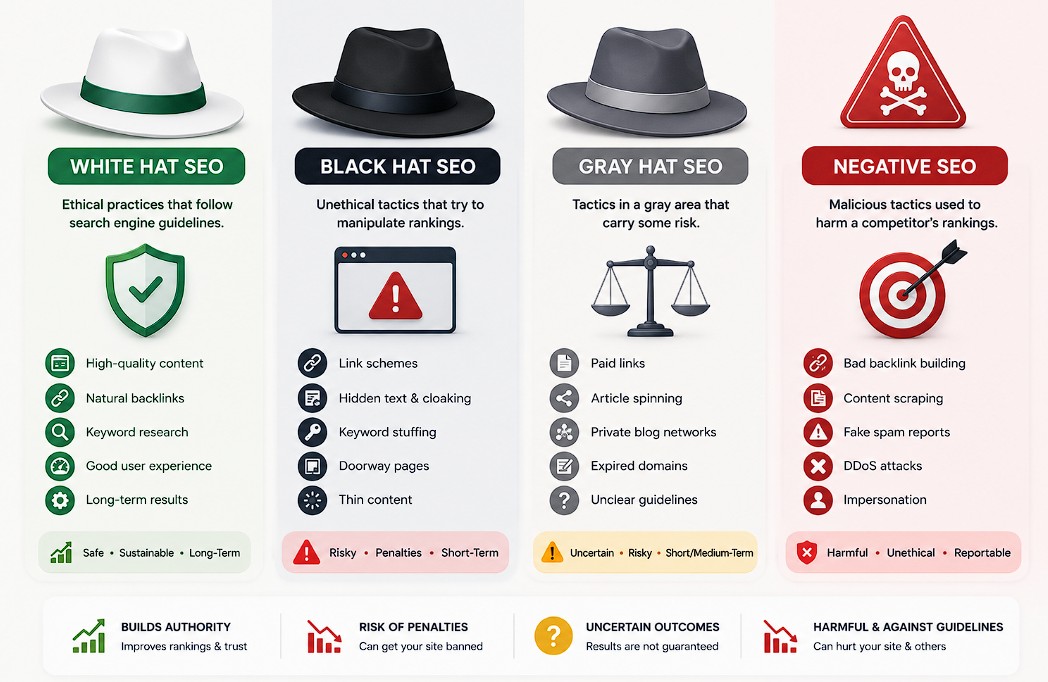
No guide to types of SEO is complete without covering the ethical and risk-based classification, because beginners genuinely do stumble into black hat territory without realizing it, usually because a tactic sounded reasonable in isolation without understanding why Google penalizes it.
White hat SEO refers to tactics that align with search engine guidelines and focus on genuinely improving the user’s experience: quality content, legitimate link earning, clean technical implementation. This is everything covered earlier in this guide. It’s slower than black hat tactics in some cases, but the results are durable and don’t carry penalty risk.
Black hat SEO refers to tactics that violate search engine guidelines specifically to manipulate rankings, often producing short-term gains but carrying real risk of manual penalties or algorithmic devaluation. Common black hat tactics include keyword stuffing (unnaturally repeating a keyword far beyond what natural language would produce), cloaking (showing search engines different content than what users see), buying links in bulk from link farms, and hidden text (stuffing keywords in text colored to match the background so it’s invisible to users but readable by crawlers). Google has gotten considerably better at detecting all of these algorithmically, and a manual penalty from black hat tactics can tank a site’s visibility for months or longer, well past the point where whatever short-term gain the tactic produced is long forgotten.
Gray hat SEO sits in the ambiguous middle: tactics that aren’t explicitly banned but push against the spirit of search engine guidelines, like aggressive guest posting purely for links rather than genuine audience value, or private blog networks (PBNs) built specifically to manipulate link signals. Gray hat tactics carry real risk because Google’s guidelines and enforcement evolve, and a tactic considered borderline-acceptable today can become actively penalized after a future algorithm update, sometimes retroactively affecting sites that used it years earlier.
Negative SEO is a different category entirely: it’s when someone else tries to sabotage your rankings, typically by building a large volume of spammy, low-quality backlinks pointing at your site to trigger a spam penalty, or by scraping and republishing your content elsewhere to create duplicate content confusion. If you suspect negative SEO, Search Console’s disavow tool lets you tell Google to ignore specific toxic backlinks pointing at your site, though this should be used carefully and only after confirming the links are genuinely harmful rather than assuming every low-quality link is an attack.
The practical takeaway for beginners: if a tactic is being marketed as a shortcut, guaranteed rankings, thousands of backlinks for a flat fee, automated content at scale with no editorial oversight, it’s very likely black or gray hat, and the downside risk (a manual penalty that can take months to recover from) usually far outweighs whatever time it might save compared to doing the work properly.
Conclusion
SEO isn’t one skill, it’s a layered set of disciplines, and most of the confusion beginners run into comes from not knowing which layer they’re actually working in. The three core pillars, on-page, off-page, and technical, are the foundation everything else is built on. The specialized types, local, ecommerce, mobile, voice, and international, are those same pillars reapplied to specific business contexts and search behaviors. And the white hat versus black hat distinction determines whether the gains you build are durable or one algorithm update away from disappearing.
If you’re just starting out, don’t try to master every type at once. Get the three foundational pillars solid first, since every specialized type depends on them, then layer in whichever specialized type matches your actual business: local SEO if you have a physical location, ecommerce SEO if you sell products online, international SEO if you’re expanding beyond one market. That’s the order that actually works in practice, and it’s the same order I use with every new client regardless of their industry.
Frequently Asked Q
What are the main types of SEO?
The main types of SEO split into two categories: the three core pillars (on-page, off-page, and technical SEO) that apply to every website, and specialized types (local, ecommerce, mobile, voice, and international SEO) that apply the core pillars to specific business contexts. Most real-world SEO strategies combine several types simultaneously rather than relying on just one.
What is the difference between on-page and off-page SEO?
On-page SEO covers elements you control directly on your own pages, like content, title tags, and internal linking, while off-page SEO covers external signals like backlinks, brand mentions, and digital PR that happen outside your own site. Both influence rankings, but on-page SEO determines relevance to a query while off-page SEO primarily builds authority and trust.
Is technical SEO more important than on-page SEO?
Technical SEO functions as a prerequisite rather than a competitor to on-page SEO, since a page that search engines can’t crawl or index won’t rank regardless of how well-optimized its content is. In practice, technical SEO should be audited and fixed first, with on-page optimization built on top of a technically sound foundation.
What is local SEO and who needs it?
Local SEO is the practice of optimizing a business’s online presence, primarily its Google Business Profile and local citations, to rank in geographically relevant searches like “near me” queries. Any business with a physical location or a defined service area, from restaurants to home service contractors, needs local SEO as a core part of their strategy.
How is ecommerce SEO different from regular SEO?
Ecommerce SEO applies standard SEO principles to the unique structural challenges of online stores, particularly managing faceted navigation and product variants that can generate thousands of duplicate URLs if not handled with canonical tags and careful sitemap management. Regular content-focused SEO doesn’t typically face this scale of duplicate content risk.
Do I need to optimize for voice search separately from regular SEO?
Voice search SEO overlaps heavily with featured snippet optimization, since most voice assistants pull their answers from the same content winning snippet positions in standard search results. Rather than treating it as a fully separate discipline, structuring content to directly and concisely answer common questions serves both goals simultaneously.
What is hreflang and why does international SEO need it?
Hreflang is an HTML attribute that tells search engines which language and country a specific page is intended for, allowing Google to serve the correct regional or language version of a site to the appropriate searchers. Without it, Google may show searchers the wrong language version of your content or fail to differentiate between similar pages targeting different markets.
What’s the difference between white hat and black hat SEO?
White hat SEO follows search engine guidelines and focuses on genuinely improving user experience through quality content and legitimately earned links, while black hat SEO uses tactics like keyword stuffing or bought links that violate guidelines to manipulate rankings artificially. Black hat tactics carry real risk of manual penalties that can severely and durably damage a site’s visibility.
Is gray hat SEO safe to use?
Gray hat SEO tactics aren’t explicitly banned but push against search engine guidelines, and their safety is genuinely inconsistent since enforcement and algorithm updates evolve over time, sometimes penalizing tactics retroactively. Because of that unpredictability, most established SEO practitioners treat gray hat tactics as a risk rather than a reliable long-term strategy.
What is negative SEO and can I protect my site from it?
Negative SEO is when a third party deliberately tries to damage your rankings, most commonly by building spammy backlinks pointing at your site to trigger a spam-related penalty. Google Search Console’s disavow tool lets you tell Google to ignore specific toxic links, though it should be used carefully and only after confirming the links are genuinely harmful.
Which type of SEO should a complete beginner learn first?
A complete beginner should start with the three core pillars, on-page, off-page, and technical SEO, since every specialized type of SEO builds on top of these foundations. Once those fundamentals are solid, layering in a specialized type like local or ecommerce SEO becomes far easier because the underlying mechanics are already familiar.