

Here’s a stat that trips people up every time: two websites can publish almost identical content, same keyword, same length, same formatting, and one shows up on page one while the other sits buried on page four. Nine times out of ten, the difference isn’t the writing. It’s the links pointing back to that page from other sites.
That’s a backlink. One website vouching for another by linking to it. Sounds simple, and honestly it is simple at the surface level. But backlinks are also the single most misunderstood part of SEO. People buy them in bulk from shady marketplaces, panic when a competitor “has more,” or ignore them completely because someone told them “content is king” and left it at that.
Neither extreme works. Google has said for years that links remain one of the strongest signals it uses to rank pages, right alongside content quality. Not the only signal. Not something you can fake your way through anymore. But still something that, done right, moves the needle more than almost anything else you can do to a website.
This guide covers what a backlink actually is, why Google cares about them, which types matter and which ones are basically decoration, how to tell a good link from a worthless one, how to audit what you already have, and how to actually go out and earn more of them without getting your site penalized. No fluff. No vague “experts say” nonsense. Just what’s actually true and what actually works.
What Is a Backlink?
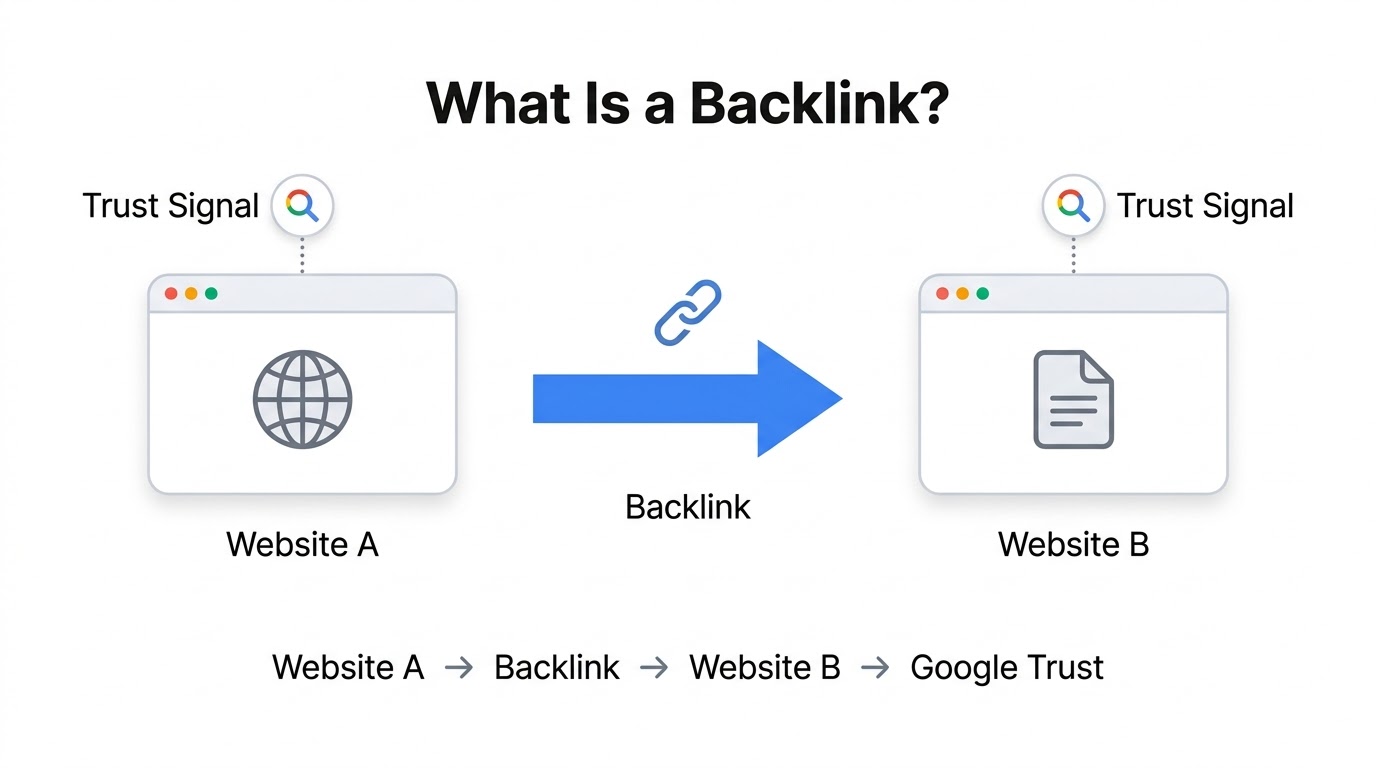
A backlink is a hyperlink on one website that points to a page on a different website. If Site A links to Site B, Site B just picked up a backlink. That’s it. That’s the whole definition.
Think of it like a reference letter. If one person recommends you for a job, that carries some weight. If ten different, credible people recommend you independently, that carries a lot more weight, especially if those ten people don’t know each other and have nothing to gain from vouching for you. Google treats backlinks the same way. A link from an unrelated site with nothing to gain, pointing to your page because it genuinely helped them, tells Google something a paid ad or a self-written bio never can.
Backlink vs. Outbound Link vs. Internal Link
People mix these up constantly, so let’s clear it up:
- Backlink (also called an inbound link): a link coming INTO your site from another website. This is what SEO people obsess over.
- Outbound link: a link FROM your site pointing OUT to another website. If your blog post links to a Wikipedia page, that’s an outbound link for you and a backlink for Wikipedia.
- Internal link: a link between two pages on the SAME website. Your homepage linking to your services page is internal linking. Useful for SEO too, but a completely different mechanism than backlinks.
The Anatomy of a Backlink
Every backlink has a few working parts, and each one matters:
- Anchor text: the clickable, visible text of the link. If a site writes “check out this backlink guide” and links “backlink guide” to your page, that phrase is the anchor text. Google reads anchor text as a clue about what your page is about.
- Source URL: the page the link is sitting on.
- Destination URL: your page, the one receiving the link.
- Rel attributes: hidden HTML tags like
rel="nofollow",rel="sponsored", orrel="ugc"that tell Google how much trust to place in that particular link. More on that in a minute.
So when someone says “get more backlinks,” what they really mean is: get more other websites to naturally decide your page is worth sending their readers to.
Why Do Backlinks Matter for SEO?
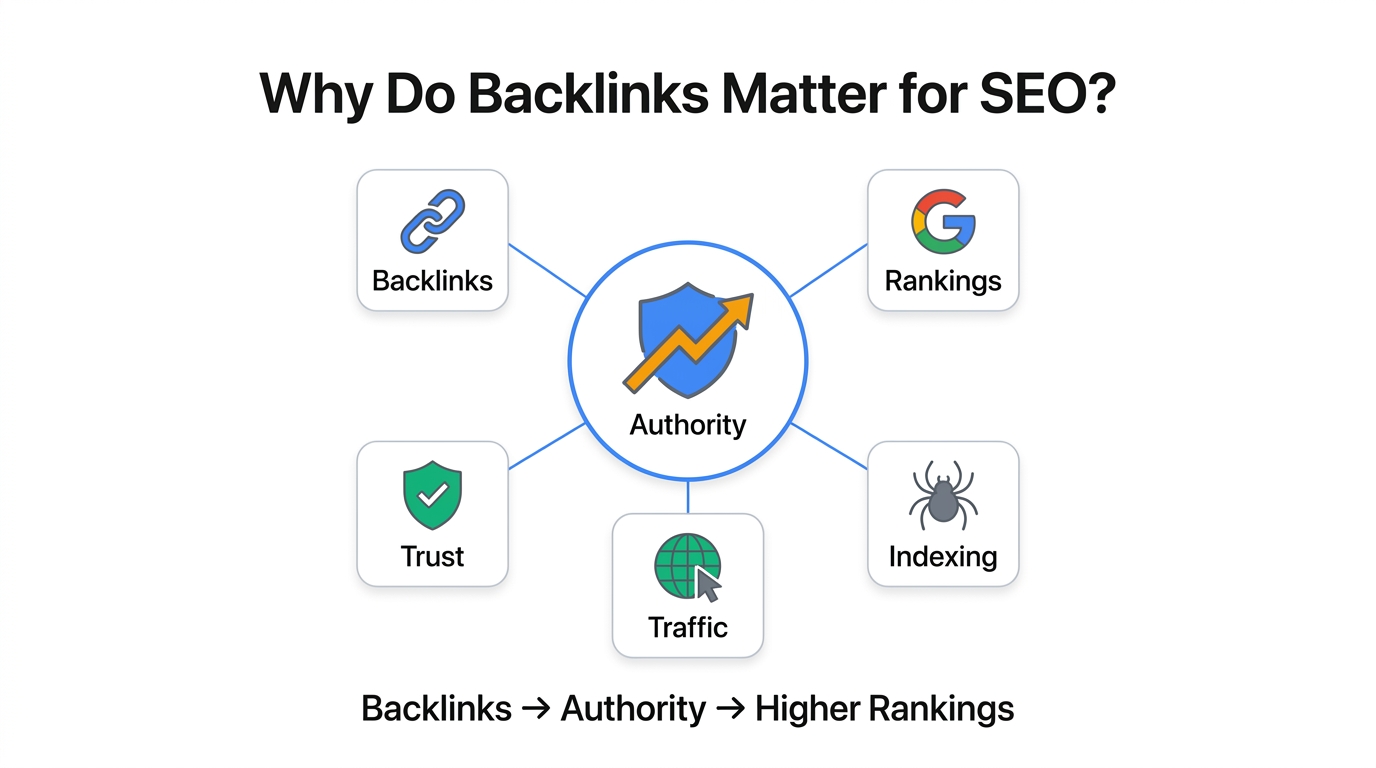
Backlinks matter because Google’s entire ranking system was originally built around the idea that links equal votes. That’s not an exaggeration, it’s literally where the algorithm came from.
Backlinks as a Ranking Signal (a Bit of History)
Back in the late 90s, Larry Page and Sergey Brin at Stanford built something called PageRank. The idea was blunt: a page is important if important pages link to it. That one concept is the reason Google beat every search engine that came before it, because earlier engines just counted keywords on a page, which was incredibly easy to spam.
PageRank changed the game because it’s hard to fake. You can stuff a page with keywords in an afternoon. You can’t fake ten unrelated, credible websites deciding your page deserves a link, not without real work or real manipulation, and Google has spent two decades getting better at spotting the manipulation.
How Google Uses Backlinks Today
The algorithm has changed a ton since 1998, but the underlying logic hasn’t gone anywhere. Google still uses backlinks as a core trust and authority signal. A page with links from well-established, relevant sites is treated as more credible than a page with no links at all, even if the content on both pages reads the same.
Google has confirmed publicly, through its own Search Central documentation and statements from people like Gary Illyes and John Mueller, that links remain one of the top ranking factors it uses. Not THE only one. Content quality, user experience, page speed, and E-E-A-T all matter too. But strip backlinks out of the equation entirely and rankings would look completely different overnight.
Backlinks and Organic Traffic
Here’s something people miss: backlinks don’t just help you rank higher, they also send direct traffic. If a popular blog in your niche links to your guide and their readers click through, that’s real visitors landing on your site, no ranking required at all. So a good backlink pays twice: once through referral traffic, once through the ranking boost that traffic and authority create over time.
Backlinks and Crawling and Indexing
Google finds new pages by crawling links. If your brand new page has zero backlinks and isn’t submitted through Search Console, Google might take weeks to stumble onto it organically. A backlink from an already-indexed, frequently-crawled site can get your new page discovered and indexed much faster, because Googlebot is already visiting that source page regularly and follows the link straight to yours.
Backlinks and Brand Authority (E-E-A-T Connection)
Google’s Search Quality Rater Guidelines lean heavily on E-E-A-T: Experience, Expertise, Authoritativeness, and Trust. Backlinks are one of the clearest external signals of authoritativeness that exists. If the Mayo Clinic links to a health article, that’s a much stronger authority signal than the same article getting linked from a random personal blog with ten visitors a month. Google can’t read minds, so it looks at who’s vouching for you as one proxy for whether you actually know what you’re talking about.
Types of Backlinks
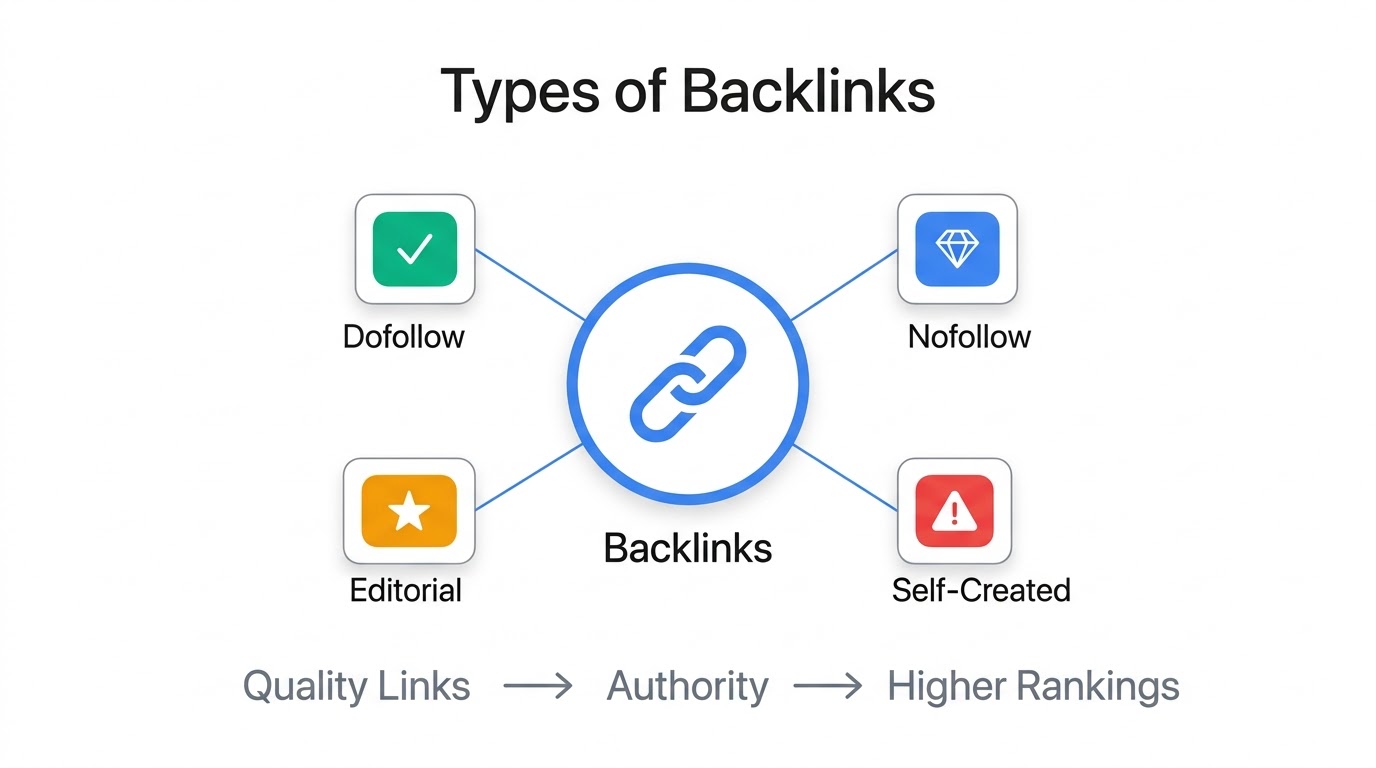
Not all backlinks are created equal, and honestly, that’s the part most beginners get wrong. They see a number go up in a backlink checker and assume more is always better. Nope. The type of link matters as much as the count.
Dofollow vs. Nofollow Backlinks
By default, every link is “dofollow” unless told otherwise. A dofollow link passes what’s often called “link equity” or “link juice,” basically a vote of confidence that can help the destination page rank.
A nofollow link has rel="nofollow" in its HTML code, which originally told Google “don’t count this as an endorsement.” Sites use nofollow on things like blog comments, forum signatures, and paid content, places where anyone can drop a link and the site owner doesn’t want to be seen as vouching for it.
Here’s the twist though: Google has said nofollow links aren’t completely ignored anymore. Since 2019, Google treats nofollow as a “hint” rather than a strict directive, meaning in some cases it might still use the link as a signal, especially for discovery and traffic patterns. So nofollow links aren’t worthless. They’re just weaker, and they shouldn’t be the main strategy.
Sponsored and UGC Tags
Google introduced two more attributes back in 2019 to clean things up:
- rel=”sponsored”: used for paid links, affiliate links, or anything exchanged for money or product.
- rel=”ugc”: stands for user-generated content, used for links in blog comments, forum posts, or reviews that regular users add themselves.
These exist so Google can tell the difference between “this site paid for placement” versus “this site earned it through genuine content.” If you’re doing any kind of paid partnership or sponsored post, tagging it correctly with rel=”sponsored” actually protects you. Skipping it and pretending it’s a natural dofollow link is exactly the kind of thing that gets flagged in a manual review.
Natural (Editorial) Backlinks
This is the gold standard. A natural backlink happens when someone finds your content on their own and decides to link to it because it genuinely helped them, with zero outreach, payment, or request from you. If a journalist cites your original research in a news article because they found it through a Google search, that’s about as natural and valuable as a backlink gets.
Manual Outreach Backlinks
These are links you earn through actual effort: guest posting on relevant sites, building a relationship with a site owner, pitching a resource to be added to their page. It’s still a “real” link, and Google has no problem with it, as long as the content genuinely adds value and isn’t just a thin excuse to drop a link.
Self-Created Backlinks
This is where people get themselves in trouble. Self-created backlinks are ones you place yourself: blog comment spam, forum signature links, low-quality directory submissions, links dropped in random Q&A sites. Technically you “got a backlink.” Practically, it does close to nothing for rankings, and if done at scale, it can look manipulative and drag your site into risky territory.
Internal Links vs. External Backlinks (Quick Reminder)
Just to reinforce it again since it trips people up: internal links connect pages within your own site. They help with site structure and passing authority around your own domain. But they are not backlinks. Don’t confuse the two when someone’s talking about “link building.”
Comparison at a Glance
| Type | How It’s Earned | SEO Value | Risk Level |
|---|---|---|---|
| Natural/Editorial | Found organically | Highest | None |
| Manual Outreach | Guest posts, pitches | High, if relevant | Low |
| Dofollow | Default, no rel tag | High | Depends on source |
| Nofollow | Tagged rel=”nofollow” | Moderate (hint signal) | Low |
| Sponsored | Paid placement | Low direct SEO value, but drives traffic | Low if tagged correctly |
| Self-created | Comments, directories, forums | Very low | Moderate to high if done at scale |
What Makes a “High-Quality” Backlink?
Okay, so if not all backlinks are equal, what actually separates a good one from a waste of time? A few concrete things.
Domain Authority / Domain Rating of the Linking Site
Tools like Moz (Domain Authority) and Ahrefs (Domain Rating) give a rough score, on a 0 to 100 scale, estimating how strong a site’s overall link profile is. A backlink from a site scoring 70+ carries a lot more weight than one from a brand new domain with a score of 5. These metrics aren’t Google’s own numbers, they’re third-party estimates, but they’re a decent proxy for judging link quality at a glance.
Relevance (Topical Alignment)
A link from a site in your actual niche matters more than a link from something totally unrelated. If you run a personal finance blog, a link from a banking or investing site is worth far more than a link from a random pet grooming blog, even if that pet site technically has a higher domain score. Google looks at context, not just raw authority.
Placement on the Page
Where the link sits matters too. A link embedded naturally inside the main body content of an article is treated as more valuable than a link buried in a footer, sidebar widget, or author bio box. In-content links look editorial. Footer links look like boilerplate.
Anchor Text Relevance and Diversity
The words used as anchor text give Google clues about your page’s topic. But here’s the catch: if every single backlink uses the exact same keyword-stuffed anchor text, like “best backlink checker tool 2026” repeated across fifty links, that pattern looks unnatural and manipulative. Real, organic link profiles have a messy mix: branded anchors, naked URLs, generic phrases like “click here,” and only occasionally exact-match keywords.
Traffic of the Referring Page
A link sitting on a page that actually gets visitors is worth more than a link sitting on a page nobody ever sees. Some sites have decent domain scores but almost zero real traffic, meaning the link exists on paper but does nothing in practice. Real referral traffic is a sign the page and the link are actually being seen by people, not just crawled by bots.
Editorial vs. Paid or Manipulative Links
A link that was earned because your content genuinely deserved it is fundamentally different from a link that was bought, swapped, or manipulated into existence. Google’s guidelines are explicit about this: buying links specifically to manipulate rankings violates its spam policies, and getting caught can tank a site’s visibility entirely.
Quick Checklist: Signs of a High-Quality Backlink
- Comes from a site relevant to your niche or industry
- Sits within the actual content, not the footer or sidebar
- Comes from a domain with a real, established history and decent authority score
- Uses natural, varied anchor text
- Sits on a page that gets genuine visitor traffic
- Was earned, not paid for or manipulated into existence
Low-Quality and Toxic Backlinks (What to Avoid)
Just as important as knowing what’s good is knowing what’s actively bad. Toxic backlinks won’t just fail to help you, they can actively hurt your rankings.
Link Farms and PBNs (Private Blog Networks)
A link farm is a network of low-quality sites created purely to link to each other or to a client site, with basically no real content or real audience. A PBN, private blog network, is a more organized version of the same trick: someone buys a bunch of expired domains that already have some authority and builds a hidden network of sites just to pump links to a “money site.” Google has gotten very good at detecting these patterns, and when it does, it doesn’t just ignore the links, it can penalize every site involved.
Irrelevant or Spammy Directories
Submitting your site to hundreds of generic, low-quality directories that have nothing to do with your industry used to be a common tactic. It doesn’t work anymore, and it hasn’t for years. These links look exactly like what they are: mass-produced, non-editorial noise.
Paid Links That Violate Guidelines
There’s a difference between running a legitimate sponsored post (properly tagged) and secretly buying dofollow links specifically to manipulate rankings. Google’s spam policies explicitly call out “buying or selling links that pass ranking credit” as a violation. Get caught, and it’s not a slap on the wrist, it can mean a manual action against your entire site.
Excessive Exact-Match Anchor Text
If 80% of your backlinks all use the exact same commercial keyword as anchor text, that’s a huge red flag to Google’s spam systems. Natural link profiles just don’t look like that. Real people linking to you use your brand name, the article title, or generic phrases far more often than a perfectly optimized keyword phrase.
The Penguin Update, Briefly
Google rolled out the Penguin algorithm update back in 2012 specifically to target sites using manipulative link schemes: keyword stuffing in anchor text, link farms, low-quality guest post networks built purely for links. Penguin has since been folded into Google’s core, real-time algorithm rather than running as a separate periodic update, but the underlying enforcement never went away. If your link profile looks manipulative, it can still hurt you today.
A Quick Word on the Disavow Tool
If your site has picked up a pile of spammy backlinks, maybe from negative SEO attacks by a competitor, or from an old, sketchy campaign someone ran years ago, Google offers a Disavow Tool through Search Console. It lets you tell Google “please ignore these specific links when evaluating my site.” It’s a narrow, careful tool though, not something to reach for casually, and it deserves its own deep dive rather than a quick mention here.
How Google Evaluates Backlinks (E-E-A-T and Algorithms)
E-E-A-T in the Context of Links
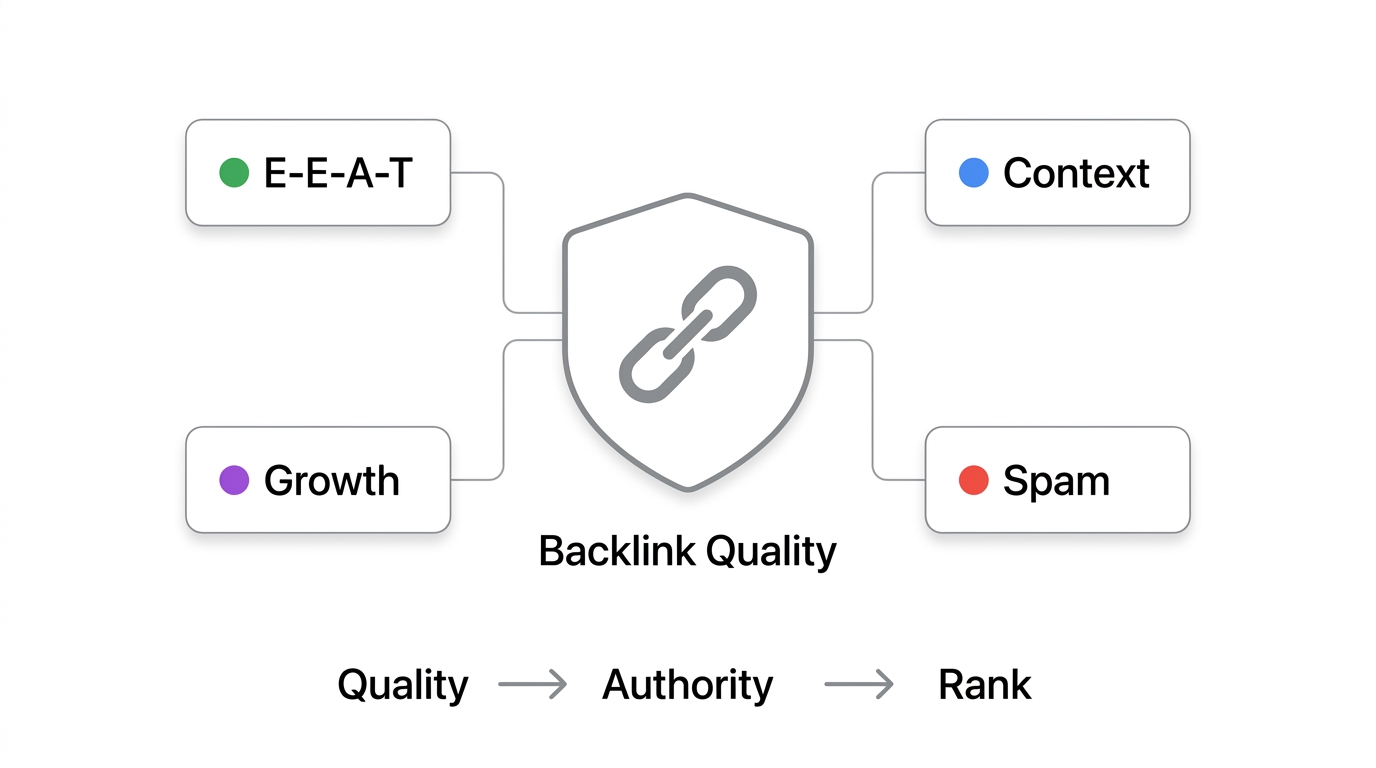
E-E-A-T stands for Experience, Expertise, Authoritativeness, and Trust, and it comes straight from Google’s own Search Quality Rater Guidelines. Backlinks feed directly into the “Authoritativeness” and “Trust” parts of that equation. If credible, relevant sites in your field consistently link to you, that builds a pattern Google can read as “other people in this space consider this source reliable.”
Link Neighborhoods and Context
Google doesn’t just look at individual links in isolation, it looks at the “neighborhood” a link exists in. If your site is surrounded by links from spammy, unrelated, low-quality domains, that context can drag your own site’s perceived trust down, even if you didn’t create those links yourself. This is part of why negative SEO attacks, competitors intentionally pointing spammy links at your site, are a real concern, though usually Google is decent at recognizing and discounting obvious attacks on its own.
Natural Link Velocity
“Link velocity” refers to the speed and pattern at which a site gains backlinks over time. A brand new site that suddenly gains ten thousand backlinks in a week looks deeply unnatural, because that’s not how real popularity or authority builds. Organic link growth tends to be gradual and uneven, some weeks nothing happens, some weeks a piece goes semi-viral and picks up a dozen links at once. Sudden, suspiciously consistent spikes are one of the patterns Google’s spam detection systems are built to catch.
Google’s Official Stance on Link Spam
Google publishes its Spam Policies for Google Search publicly through Search Central, and link spam gets its own dedicated section. It explicitly lists things like buying/selling links, excessive link exchanges, and large-scale automated link creation as violations. Anyone doing serious link building work should actually read that documentation directly rather than relying on secondhand summaries, because Google updates it periodically.
How to Check Your Backlinks (Backlink Audit)
You can’t fix or grow what you haven’t looked at. A backlink audit just means pulling a report of every link pointing at your site and reviewing it for quality and risk.
Free and Paid Tools
- Google Search Console: free, and it’s the tool Google itself uses to show you links it’s aware of, under the “Links” report. Not the most detailed dataset out there, but it’s straight from the source and it’s the one place that reflects what Google itself sees.
- Ahrefs: one of the most detailed backlink databases available, paid, widely used by SEO professionals for competitor and audit work.
- Semrush: similar depth to Ahrefs, with its own backlink audit tool built specifically to flag toxic links.
- Moz Link Explorer: solid free-tier option with Domain Authority scoring built in.
- Ubersuggest: a budget-friendly option, less comprehensive but useful for smaller sites just getting started.
Step-by-Step: Pulling a Backlink Report
- Log into Google Search Console, go to the “Links” section, and export the list of top linking sites.
- Cross-reference with a third-party tool like Ahrefs or Semrush for a more complete dataset, since no single tool captures every link on the web.
- Sort by Domain Rating or Domain Authority to spot your strongest and weakest links quickly.
- Check the anchor text report for any suspicious over-optimization patterns.
- Flag anything from clearly spammy, irrelevant, or foreign-language domains that have nothing to do with your niche.
Metrics Worth Actually Tracking
- Referring domains: unique websites linking to you, more meaningful than raw link count, since one site can link to you fifty times and that’s still just one vote of confidence, not fifty.
- Domain Rating/Authority distribution: are your links coming from strong sites or weak, thin ones?
- Anchor text distribution: is it natural and varied, or suspiciously repetitive?
- Dofollow to nofollow ratio: a healthy mix is normal; all-dofollow can look manufactured.
Identifying and Handling Toxic Links
If the audit turns up links from obvious link farms, PBNs, or spammy foreign directories with zero relevance to your niche, those are candidates for the disavow process mentioned earlier. Again, that’s a narrower, more careful topic, worth its own dedicated guide rather than a rushed explanation here.
How to Build Backlinks: Proven Strategies
This is the part everyone actually cares about. Here’s what genuinely works, based on how link building has actually played out across the industry for years, not shortcuts that used to work and quietly stopped.
Create Linkable Assets
The single most reliable long-term strategy is simply making something worth linking to. Original research, in-depth guides, free tools, calculators, templates, or well-designed infographics all tend to attract links naturally because they solve a specific problem better than what already exists. Original data especially tends to get cited by journalists and bloggers looking for a statistic to back up their own articles.
Guest Posting
Writing an article for another site in your niche, in exchange for a byline and usually a link back to your own site, still works, but the bar has gone up. Google has specifically called out low-quality, mass-produced guest posting done purely for links as a spam tactic. The difference between effective guest posting and spam guest posting comes down to genuine relevance and quality: writing something the host site’s actual audience benefits from, not a thin 400-word filler article stuffed with a link.
Digital PR and Journalist Outreach
Services like HARO (Help a Reporter Out) and similar platforms connect journalists looking for expert quotes with people willing to provide them. Getting quoted in a legitimate news article, with a link back to your site, is one of the strongest kinds of backlinks available, because news and media sites tend to carry serious authority.
Broken Link Building
This one’s a bit tedious but genuinely effective: find broken (dead) links on relevant resource pages in your niche, then reach out to the site owner suggesting your own content as a replacement. It works because you’re solving an actual problem for them (a dead link hurts their own user experience too), not just asking for a favor.
The Skyscraper Technique
Find an existing piece of content that already has a decent number of backlinks, then create something noticeably better, more current, more thorough, better designed, and reach out to the sites linking to the original asking if they’d consider linking to the improved version instead. It only works if your version is genuinely better, not just longer for the sake of it.
Resource Page Link Building
Many niches have “resource pages,” curated lists of helpful links compiled by educators, bloggers, or organizations. Finding these pages and pitching your content as a worthy addition is a straightforward, low-friction way to pick up relevant, high-quality links.
Competitor Backlink Analysis (Gap Analysis)
Running a competitor’s domain through a tool like Ahrefs or Semrush shows exactly which sites link to them and not to you. That gap is basically a prospect list, sites already proven to link to content in your space, making them warmer outreach targets than cold, random pitches.
Unlinked Brand Mention Reclamation
Sometimes a site mentions your brand or product by name without actually linking to you. Setting up a Google Alert or using a mention-tracking tool to catch these, then reaching out and politely asking them to turn the mention into a link, is a quick win that a lot of sites overlook entirely.
Building Real Relationships
A chunk of the best backlinks in the world come from actual relationships, not cold outreach templates. Being active in your niche’s community, showing up on relevant podcasts, contributing to expert roundup posts, engaging genuinely in industry forums, all of that builds the kind of trust that eventually turns into people linking to your work without being asked.
Internal Linking as a Supporting Strategy
Internal links aren’t backlinks, but they matter alongside a link building strategy. When a new page earns an external backlink, strong internal linking helps spread that authority to other relevant pages across your own site, rather than it staying trapped on a single page.
Do’s and Don’ts Quick Reference
Do:
- Focus on relevance over raw domain score
- Diversify anchor text naturally
- Build genuine relationships in your niche
- Create content actually worth linking to
Don’t:
- Buy links in bulk from marketplaces
- Use the exact same anchor text repeatedly
- Chase volume over quality
- Ignore relevance just because a site has a high authority score
Backlinks vs. Other SEO Ranking Factors
Backlinks matter a lot, but they’re not the whole game, and treating them like the only thing that matters is a mistake plenty of sites have made and paid for.
Content quality still has to hold up. A backlink can get Google’s attention, but if the page it points to doesn’t actually answer the search intent well, rankings won’t hold, especially with how much Google has leaned into helpful content signals in recent years. Technical SEO, things like site speed, mobile usability, and crawlability, determines whether Google can even properly access and understand a page in the first place. And Core Web Vitals, Google’s page experience metrics, factor into how a page performs once someone actually lands on it.
| Ranking Factor | Importance | Backlink’s Role |
|---|---|---|
| Content Quality | Very High | Backlinks amplify good content, they don’t fix bad content |
| Backlinks | Very High | Core authority and trust signal |
| Technical SEO | High | Determines if Google can crawl/index at all |
| User Experience/Core Web Vitals | Moderate to High | Affects rankings and retention once ranked |
The honest takeaway: backlinks are one leg of a table with several legs. Kick out any one of them and the whole thing gets wobbly.
Conclusion
So where does all this leave things. Backlinks are still one of the strongest signals search engines use to decide who deserves to rank, and that’s not changing anytime soon, no matter how many “content is all that matters now” takes float around. But the game has shifted from raw quantity to genuine relevance and quality. A handful of the right links from the right sites will always beat a pile of the wrong ones.
The sites that win at this long term aren’t the ones gaming the system with PBNs or bulk-bought links from some marketplace. They’re the ones creating something genuinely worth linking to, showing up consistently in their industry, and building real relationships that turn into real links over time. That’s slower. It’s also the only version of this that actually lasts, because Google’s spam detection has only gotten sharper with every passing year, not weaker.
Start with an honest audit of what you already have. Figure out what’s actually helping versus what’s dead weight. Then build forward from there, one genuinely earned link at a time.
Frequently Asked Questions
Do I need thousands of backlinks to rank?
No, and this is one of the more damaging myths out there. Plenty of pages rank well with a modest number of highly relevant, high-quality backlinks, sometimes just a handful from genuinely authoritative sites in the right niche. Quality consistently beats raw quantity. A page with fifteen relevant, editorial backlinks will often outrank a page with three hundred spammy ones.
Are nofollow links worthless?
Not entirely. Since 2019, Google treats nofollow as a hint rather than a strict rule, meaning it can still factor them in, particularly for discovery purposes. On top of that, nofollow links can still drive real referral traffic and build brand visibility, which has its own indirect SEO value even setting aside direct link equity.
How many backlinks do I need to rank for a keyword?
There’s no fixed number, and anyone giving you an exact figure is guessing. It depends heavily on competition level for that specific keyword. A low-competition, long-tail keyword might need very few quality links. A highly competitive commercial keyword might require a much stronger link profile just to be in the conversation. Looking at what currently ranks on page one for your target keyword, using a tool like Ahrefs, gives a far more realistic benchmark than any generic number.
Can too many backlinks hurt my site?
Too many backlinks by themselves, no. Too many low-quality, spammy, or unnaturally acquired backlinks, yes, that can absolutely hurt. It’s not really about volume, it’s about pattern and quality. A sudden unnatural spike in low-quality links is a much bigger risk than steadily growing a link profile over time.
How long does it take for backlinks to impact rankings?
There’s no universal timeline. Google needs to crawl and process the linking page first, which can take anywhere from days to weeks depending on how frequently that source site gets crawled. Beyond that, ranking impact tends to build gradually rather than happening overnight, especially for competitive keywords where authority needs to accumulate over time.
Is buying backlinks ever safe?
Buying links specifically to manipulate rankings directly violates Google’s published spam policies, and getting caught can result in a manual action that tanks a site’s visibility. There’s a difference between running a properly disclosed, rel=”sponsored” tagged sponsorship (which is fine) and secretly paying for dofollow links purely to pass ranking credit (which isn’t). If in doubt, tag it and disclose it.