

Most people learn SEO backwards. They start with keywords, then headings, then meta tags, and somewhere around month three they hit a wall. The page is optimized. The content is good. Nothing moves. That’s usually the moment someone finally asks the question they should’ve asked on day one: what’s actually happening outside my website that affects my ranking?
That’s off-page SEO. And honestly, it’s the part most beginners skip because it feels less controllable. You can rewrite a title tag in thirty seconds. You can’t force another website to link to you in thirty seconds. So people avoid it, focus on what feels safe, and wonder why their “perfectly optimized” blog sits on page four.
And here’s what makes it worse. Off-page SEO doesn’t get explained well most places you look. You’ll find a hundred listicles titled “15 off-page SEO tactics” that jump straight into broken link building and guest posting without ever slowing down to explain why any of it works in the first place. So people copy the tactics without the reasoning behind them, and copying tactics without understanding the logic is exactly how you end up doing the wrong version of the right idea.
This post walks through what off-page SEO actually is, why it matters more than most beginners think, how it’s different from on-page and technical SEO, and what to actually do about it. Not a checklist you skim once. An actual explanation, the kind you’d want if someone sat you down and explained this properly the first time.
What Is Off-Page SEO?
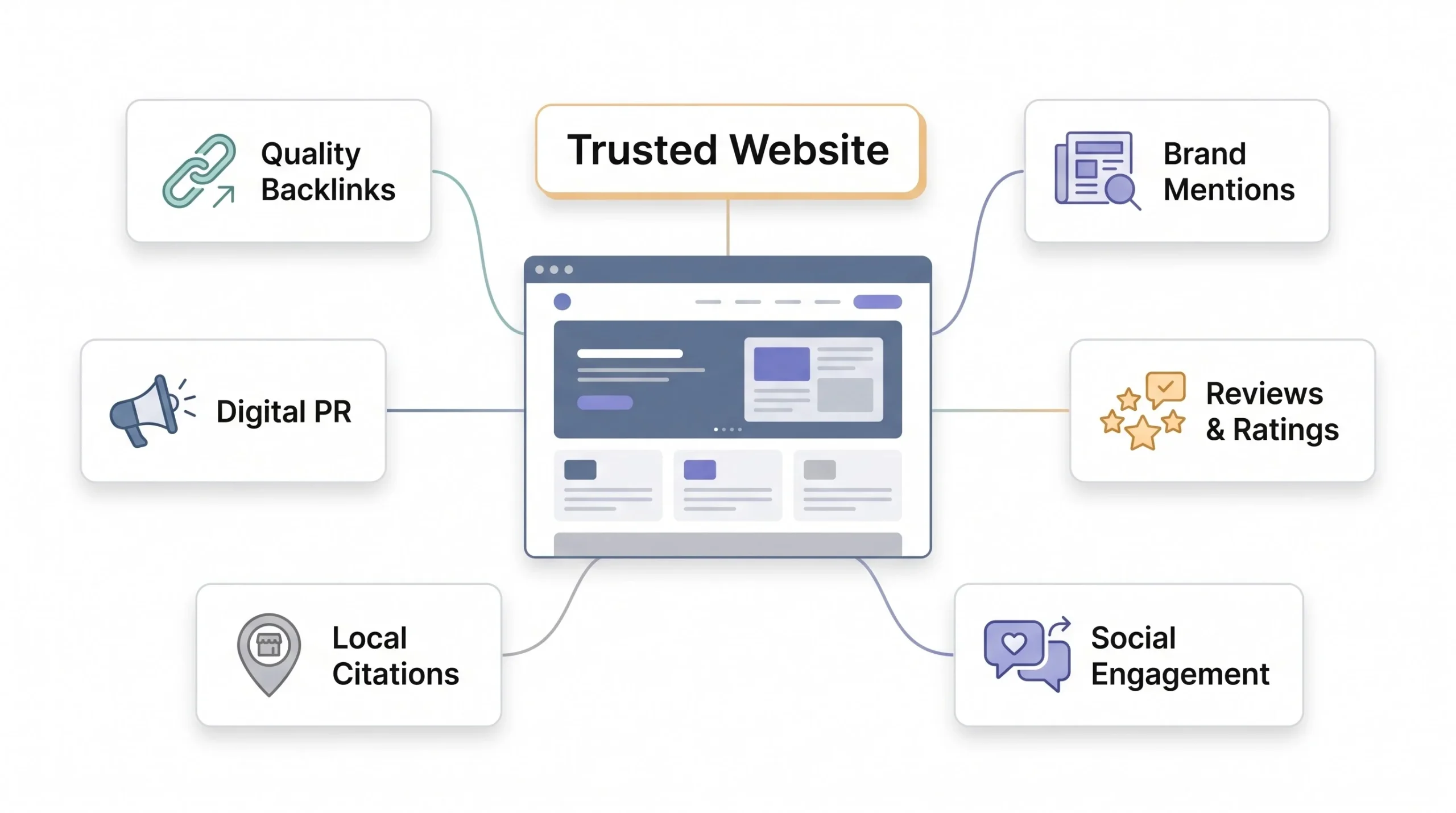
Off-page SEO is everything you do outside your own website to convince search engines, and real people, that your site is worth trusting. Backlinks. Mentions. Reviews. Social buzz. None of it lives on your domain, and that’s the whole point.
Here’s the thing people miss: Google can’t just take your word for it. You can write “we’re the best SEO agency in Jaipur” on your homepage all day long. Google doesn’t care. Anyone can say that about themselves. What Google actually pays attention to is whether other people, other sites, other sources, are saying it about you without being asked.
Think about how you actually decide where to eat when you’re in a new city. You don’t just walk into the restaurant with the nicest menu design. You check reviews. You see if a friend mentioned it. You notice if it’s the place three different food bloggers wrote about. The food itself (on-page, basically) matters, sure. But you’re relying on outside signals to decide if it’s actually good before you ever taste it. That’s off-page SEO in a sentence. Google’s doing the same thing you do before picking a restaurant, just at scale, across the entire internet.
| Off-page element | What it signals to Google | Example |
|---|---|---|
| Backlinks | Other sites vouch for your content | A niche blog links to your guide |
| Brand mentions (linked or unlinked) | You’re recognized as an entity | A news site mentions your brand name |
| Social signals | Content is engaging real audiences | Shares, comments, saves |
| Reviews & ratings | Trustworthiness, real-world reputation | Google Business Profile reviews |
| Local citations | Legitimacy and consistency | NAP listed correctly on directories |
| Digital PR | Authority and reach at scale | Coverage in industry publications |
Quick way to remember it: on-page SEO answers “is this page relevant to what someone searched?” Off-page SEO answers a completely different question: “should this page be trusted?” Google asks both. A lot of people only answer one.
Something worth sitting with here. Off-page doesn’t mean “stuff that happens randomly and you have no say in.” It means stuff that happens outside your domain, but a lot of it you can still influence, even engineer, through deliberate effort. Nobody’s backlink profile builds itself by accident. Someone earned every single one of those links through outreach, through creating something worth linking to, through a relationship, through PR work, through years of just being consistently useful in a space. The “off” in off-page doesn’t mean “out of your hands.” It means “not on your own property.”
Off-Page vs. On-Page vs. Technical SEO
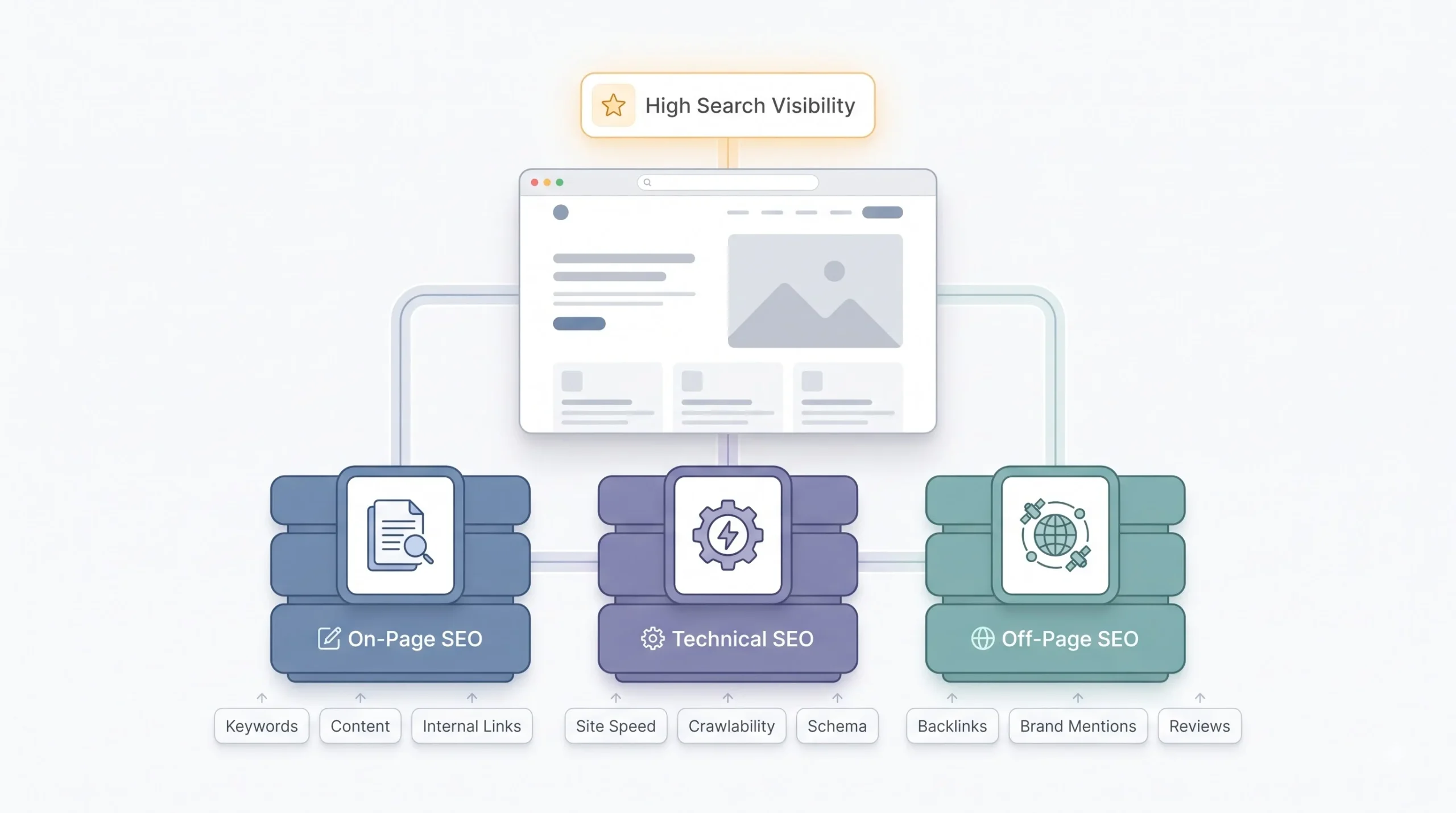
These three aren’t three separate battles you fight. They’re three levers on the same machine, and Google pulls all of them at once when it decides where to rank you.
On-page SEO is what lives on your actual pages. Your keywords, your headers, your content structure, your internal links. Technical SEO is the backend stuff. Can Google crawl your site properly? Does it load fast? Is your schema markup set up right? Off-page is the only one of the three that happens somewhere else entirely, on other people’s sites, in other people’s mentions, in the way real users talk about you when you’re not in the room.
| On-Page SEO | Technical SEO | Off-Page SEO | |
|---|---|---|---|
| Where it happens | On your pages | In your site’s backend | Outside your website |
| Controls | Fully in your control | Fully in your control | Partly out of your control |
| Core question answered | Is this relevant? | Can Google access and read this? | Can this be trusted? |
| Examples | Keywords, headers, meta tags | Site speed, crawl budget, schema | Backlinks, PR, reviews, mentions |
| Timeframe to see results | Weeks | Weeks | Months, and it compounds |
That last row matters more than people give it credit for. On-page changes can move the needle in weeks. Off-page takes longer because you’re not just publishing something and hitting save. You’re earning trust from other people, and trust doesn’t move on your schedule.
Here’s the mistake almost every beginner makes. They pour everything into on-page because it’s the part they control. Perfect keyword density, flawless headers, meta descriptions written and rewritten five times. Meanwhile their off-page profile is basically empty. Zero backlinks worth mentioning, no reviews, nobody talking about the brand anywhere. And then they’re confused why a competitor with a messier-looking page outranks them. The competitor didn’t write better content. They just have people vouching for them, and Google noticed.
Technical SEO gets treated the same way, honestly, just less often talked about. People obsess over content quality and completely forget their site takes six seconds to load or that half their pages aren’t even indexed. All three of these need to work together. A technically broken site with amazing content and a hundred backlinks still won’t rank if Google can’t crawl it properly. A perfectly fast, perfectly structured site with zero off-page authority won’t rank either, because nobody outside your own team thinks it’s worth trusting yet. You need all three moving at the same time, not one maxed out while the other two get ignored.
Why Off-Page SEO Matters
Look, backlinks have been one of Google’s core ranking signals for a long time, and that hasn’t really changed even as everything else about search evolves. That alone should tell you something. Algorithms get rewritten constantly. This particular signal keeps sticking around.
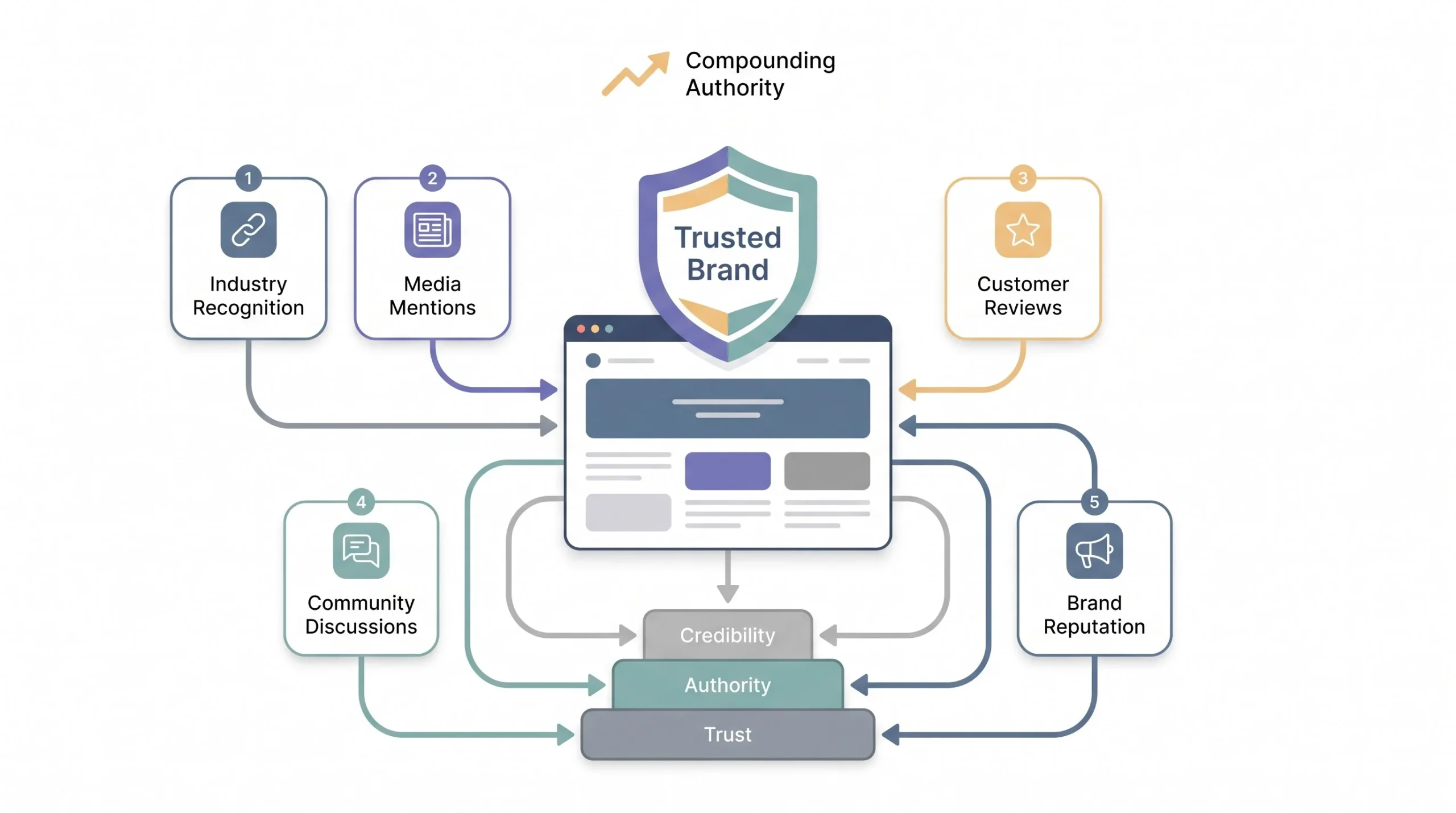
Part of the reason is E-E-A-T. Experience, Expertise, Authoritativeness, Trustworthiness. You’ll hear these four letters constantly in SEO circles, and off-page SEO is where most of that gets built. On-page content can demonstrate expertise inside your own four walls. But authoritativeness and trustworthiness? Those get built when other sources, ones that aren’t you, back up what you’re saying.
There’s also a compounding effect nobody talks about enough. A blog post you write today gets read today and maybe next week, then it fades unless you keep pushing traffic to it. A backlink you earn today is different. It sits there. It keeps sending a trust signal to Google for as long as that page exists, which could be years. You’re not chasing a spike, you’re stacking bricks.
And there’s a cost angle worth being honest about. Paid ads work while you’re paying for them. The second the budget stops, so does the traffic. Off-page authority doesn’t behave that way. It’s slower to build, sure, but once it’s there, it keeps working without you writing a check every month. For anyone running lean, that difference matters.
There’s a psychological piece too, not just an algorithmic one. When someone searches for your brand name and sees you showing up in a few other places, a mention on a niche blog, a review on Google, a thread on Reddit where someone recommended you, that builds trust before they even land on your website. By the time they hit your homepage, they’ve already half decided you’re legit. That’s not something a perfectly written About page can replicate on its own. It has to come from outside.
One more thing worth planting here, because it’s going to come back later in more detail: this isn’t just about ranking in classic Google search anymore. AI tools that summarize and answer questions directly are leaning on the same kind of outside validation, who’s citing you, who’s mentioning you, how consistently your name shows up across independent sources. Off-page authority is quietly becoming just as relevant there. More on that later.
The Core Off-Page SEO Ranking Factors
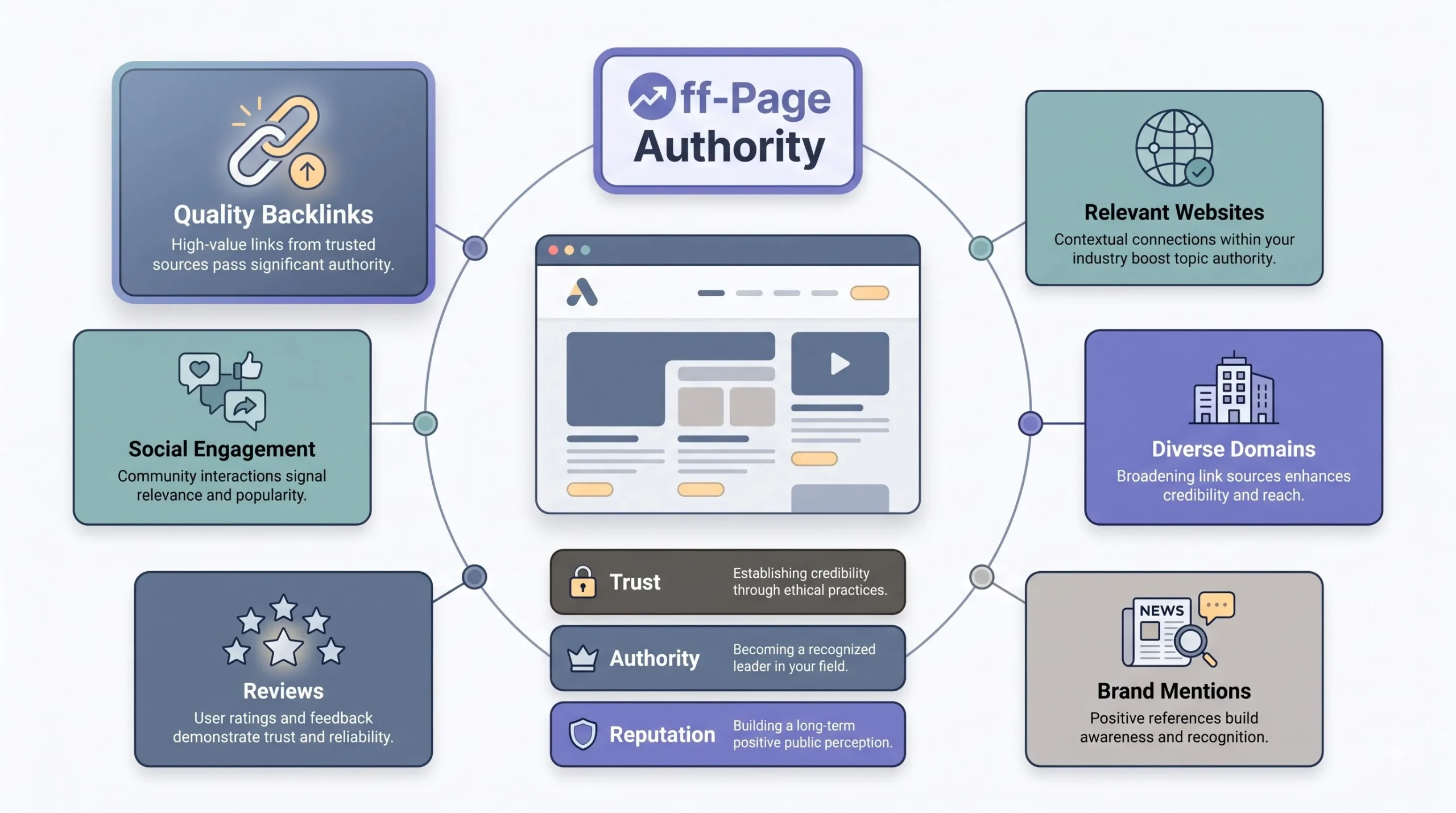
Not all off-page signals carry equal weight. Some genuinely move rankings. Some are more about reputation than rankings directly. Knowing the difference saves you from wasting effort on the wrong things. This part trips people up constantly, because a lot of off-page advice online treats every single tactic as equally important, when in reality some of these factors do the heavy lifting and others are more of a supporting cast. Here’s a breakdown of what actually carries weight, and what beginners tend to get wrong about each one.
Backlink quality over quantity. One link from a site that actually matters in your space beats ten links from random low-effort domains. This is the single most repeated piece of advice in SEO and people still get it backwards, chasing numbers instead of relevance.
Anchor text distribution. Anchor text is just the clickable words in a link. If every single backlink to your site uses the exact phrase “best digital marketing course,” that’s not a good sign to Google, that’s a red flag. It looks manufactured because, honestly, it usually is. Natural link profiles have a mix. Branded anchors, generic ones like “click here” or “this guide,” and only a small share of exact-match keyword anchors.
Link relevance. A backlink from a site that actually covers your topic area is worth more than an unrelated one, even if the unrelated site technically has more traffic. A marketing blog linking to your marketing guide makes sense to Google. A random recipe site linking to it doesn’t, and too many of those can actually hurt more than help.
Referring domain diversity. Fifty backlinks sound impressive until you realize they all came from three domains. Google cares less about total link count and more about how many different, independent sources are vouching for you.
Brand mentions, linked and unlinked. This one’s growing in importance. Google’s gotten better at recognizing when your brand name shows up somewhere even without a hyperlink attached, and it’s starting to treat that as a trust signal on its own.
Social proof and engagement. Social shares aren’t a direct ranking factor the way backlinks are. But they drive discovery, and discovery leads to more people finding your content, and some of those people run websites and might link to you. It’s indirect, but it’s real.
Reviews and reputation. Especially for local and service-based businesses, this one’s huge. A page full of five-star Google reviews is doing off-page work whether you think of it that way or not.
| Factor | Weight in practice | Beginner mistake to avoid |
|---|---|---|
| Backlink quality | High | Chasing volume over relevance |
| Anchor text | Medium | Over-using exact-match anchors |
| Link relevance | High | Buying links from unrelated niches |
| Referring domain diversity | High | Getting 50 links from 3 domains |
| Brand mentions | Growing | Ignoring unlinked mentions entirely |
| Reviews and reputation | High for local | Letting negative reviews go unanswered |
Link Building: The Foundation of Off-Page SEO
If off-page SEO has a center of gravity, it’s link building. Everything else orbits around it. So it’s worth slowing down here.
What Makes a Backlink Actually Good
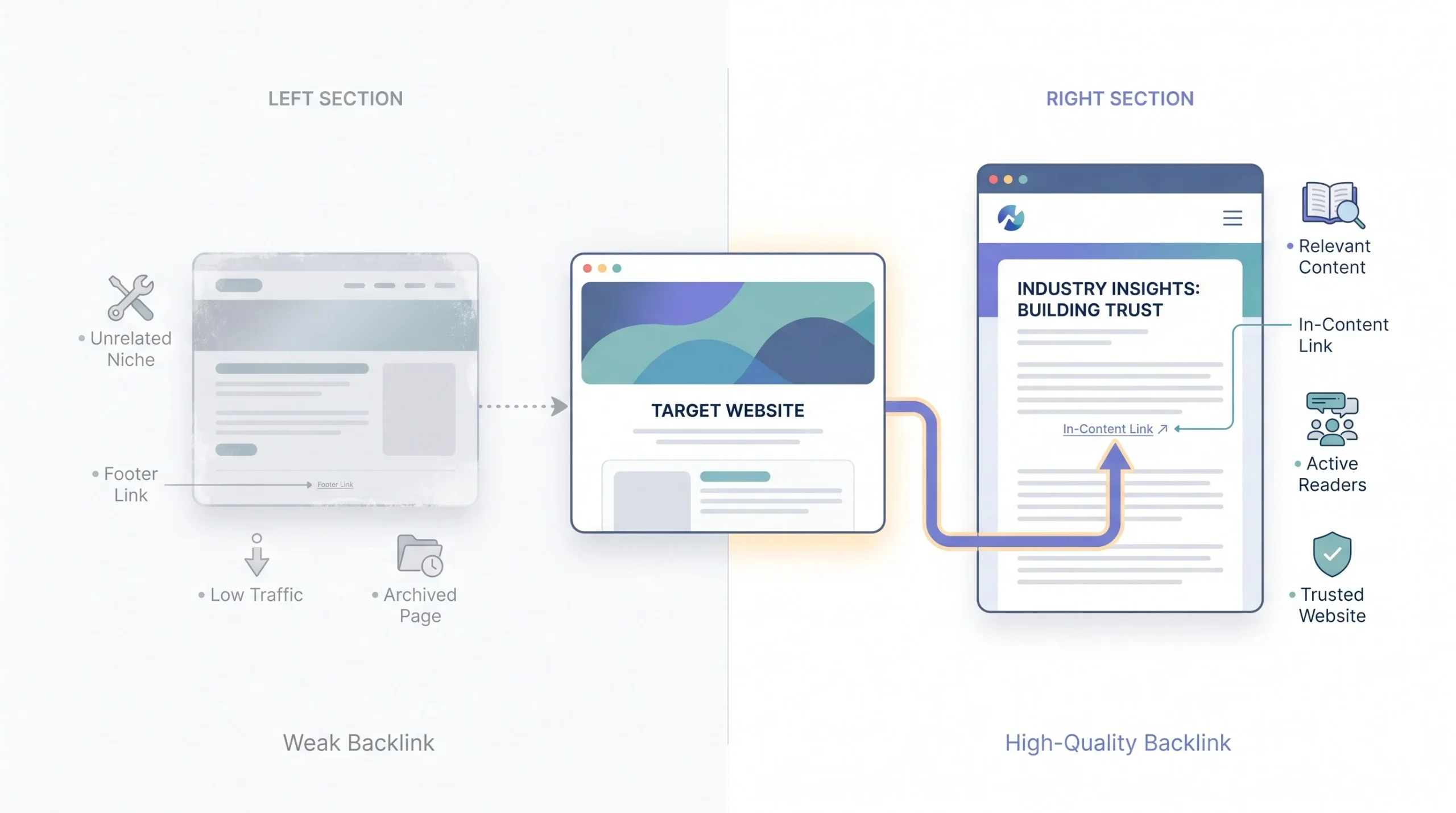
Not every backlink is created equal, and treating them like they are is how people waste months on the wrong strategy. A good backlink comes from a domain that has real authority in its space. It’s relevant to your topic, not just some random tangential connection. It’s placed inside actual content, in the body of an article where readers see it, not buried in a footer or sidebar nobody scrolls to. It’s a followed link, not a nofollow one, though nofollow links still have some value for exposure and traffic even if they don’t pass the same ranking weight. And here’s the part people forget to check: does the linking page actually get traffic? A link from a page nobody visits is close to worthless, DA score be damned.
Beginners fixate on domain authority scores like they’re the whole story. They’re not. A domain can have a decent score and still be sitting on a page that hasn’t been visited in two years, buried ten pages deep in some archive nobody clicks into. Meanwhile a smaller site with a slightly lower score but an actively read, actively shared article can send real referral traffic and real trust signal, both. Check the page the link sits on, not just the domain it lives under. That one habit alone separates people who build real authority from people who just collect numbers that look nice in a spreadsheet.
White-Hat vs. Grey-Hat vs. Black-Hat
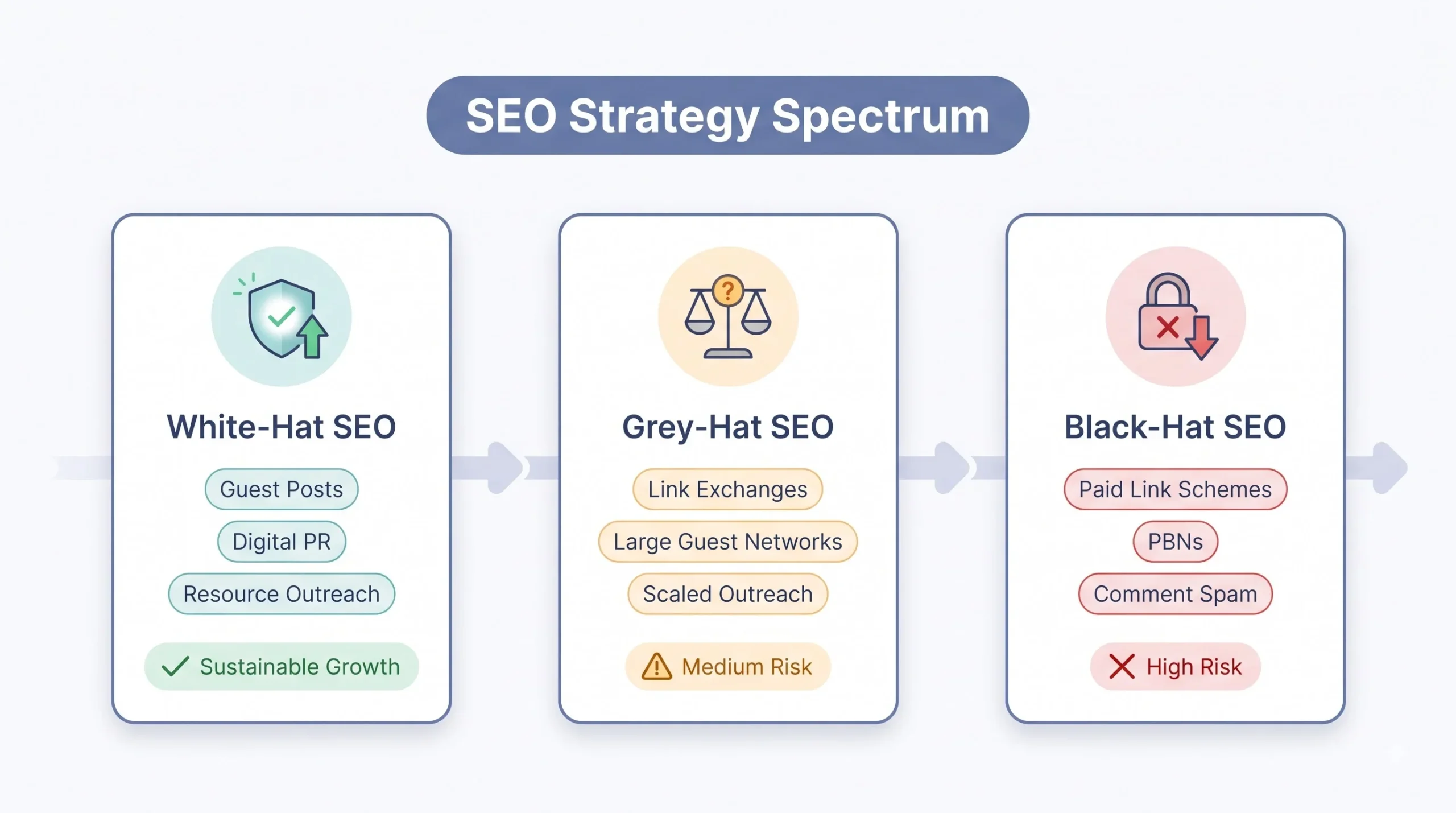
| Approach | Examples | Risk level | Recommended? |
|---|---|---|---|
| White-hat | Guest posts, digital PR, resource link outreach, journalist requests | Low | Yes |
| Grey-hat | Aggressive guest post networks, large-scale reciprocal link exchanges | Medium | Use with caution |
| Black-hat | Paid link schemes, private blog networks, comment spam | High | No |
Grey-hat tactics aren’t automatically disasters, but they’re the kind of thing where the risk creeps up on you slowly. Black-hat tactics are a different story. They might work for a while. Then Google catches up, and it’s not a slap on the wrist, it’s a manual penalty that can take months to recover from. Not worth it.
Proven Link Building Tactics
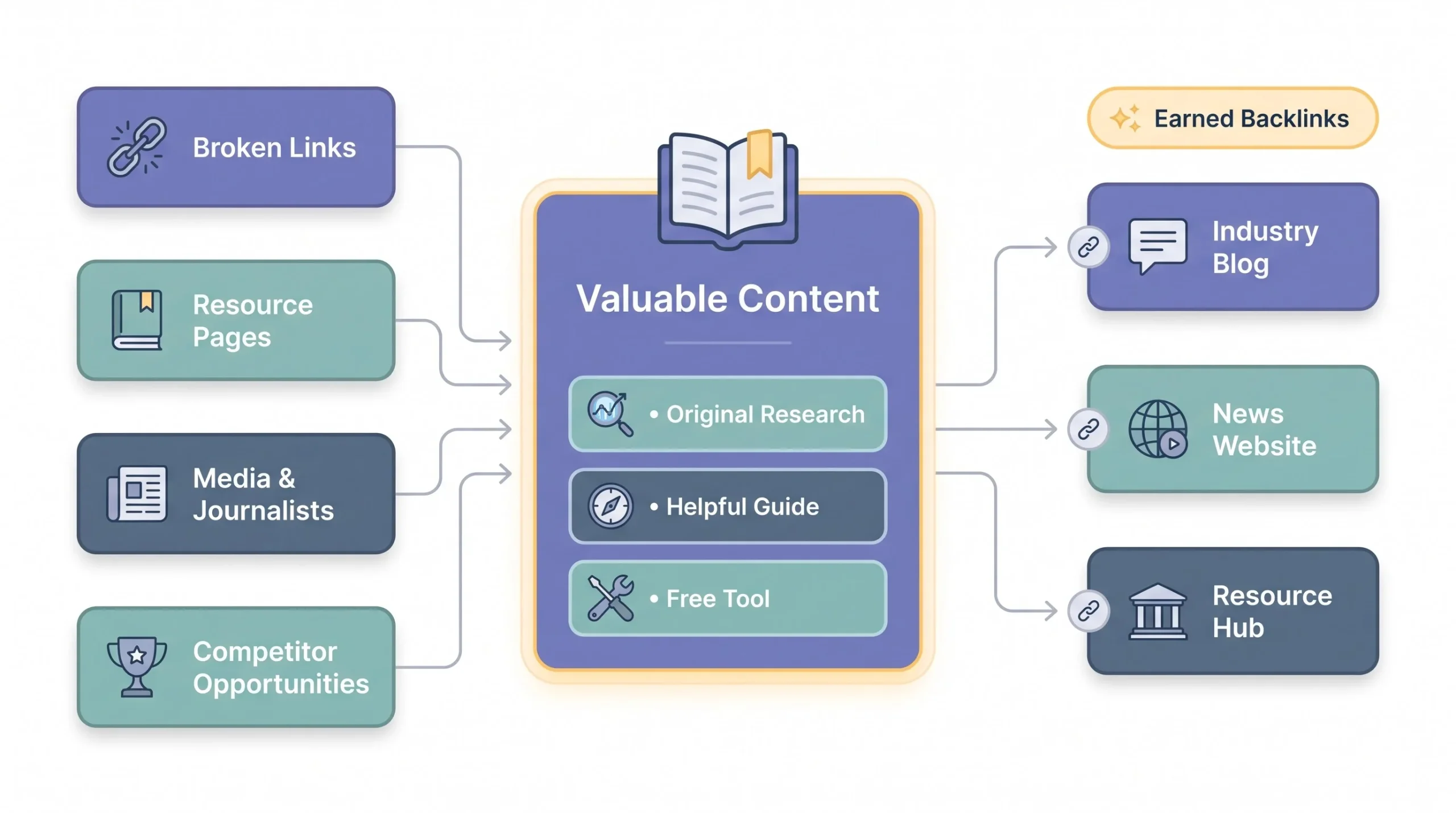
Broken link building. Every niche has resource pages with links that have gone dead over time. Old articles get taken down, sites shut down, URLs change. Find those broken links, and pitch your own content as the replacement. Site owners generally want their pages to work properly, so this pitch tends to land better than cold outreach usually does.
Resource page outreach. Search for pages that exist specifically to link out to useful stuff in a given niche, the kind of page titled “resources” with a long list of links. These pages were built for exactly this purpose. A well-targeted pitch with something genuinely useful has a real shot here.
Competitor backlink gap analysis. Look at who’s linking to your competitors but not to you. These are pre-qualified opportunities. They already link to businesses in your category, which means they’ve already shown they’re open to it.
Guest blogging. Done right, this means writing something genuinely valuable for a site your audience actually reads, not stuffing a low-effort article with anchor text and calling it a day. Done wrong, it’s spun, generic content dumped on low-quality sites just to get a link in. Google’s gotten a lot better at telling the difference, and so have readers.
Unlinked brand mention reclamation. Sometimes people already mention your brand without linking to you. Maybe they wrote about your product, quoted your founder, referenced your data. Find those mentions and simply ask for a link. It’s one of the easiest wins in link building because the relationship and context already exist.
Digital PR and newsjacking. Original data, a genuinely useful study, sharp commentary on something happening in your industry right now. This is what earns real coverage from real publications, not a generic press release nobody reads. The key word here is original. Summarizing someone else’s research doesn’t earn coverage. Running your own small survey, pulling insight from your own client data with permission, or being one of the first to react intelligently to a shift in your industry, that’s what journalists and bloggers actually want to cite, because it gives their own piece something nobody else has.
Journalist request platforms. Reporters are constantly looking for expert sources to quote. Responding to these requests, when you actually have something useful to say, can land you links from publications you’d never get through cold outreach alone.
Skyscraper technique. Find content that’s already ranking well and already earning links, then build something genuinely better, more current, more thorough, more useful. Then reach out to the people already linking to the older version.
Linkable asset creation. Original research, free tools, calculators, templates. Stuff people actually want to reference and link to because it solves a real problem, not because you asked nicely.
The tactics that are working best right now share a pattern worth noticing. They target pages and people who are already linking out to your category. You’re not trying to convince someone to do something new. You’re catching demand that already exists and pointing it at you instead of someone else.
What to Avoid
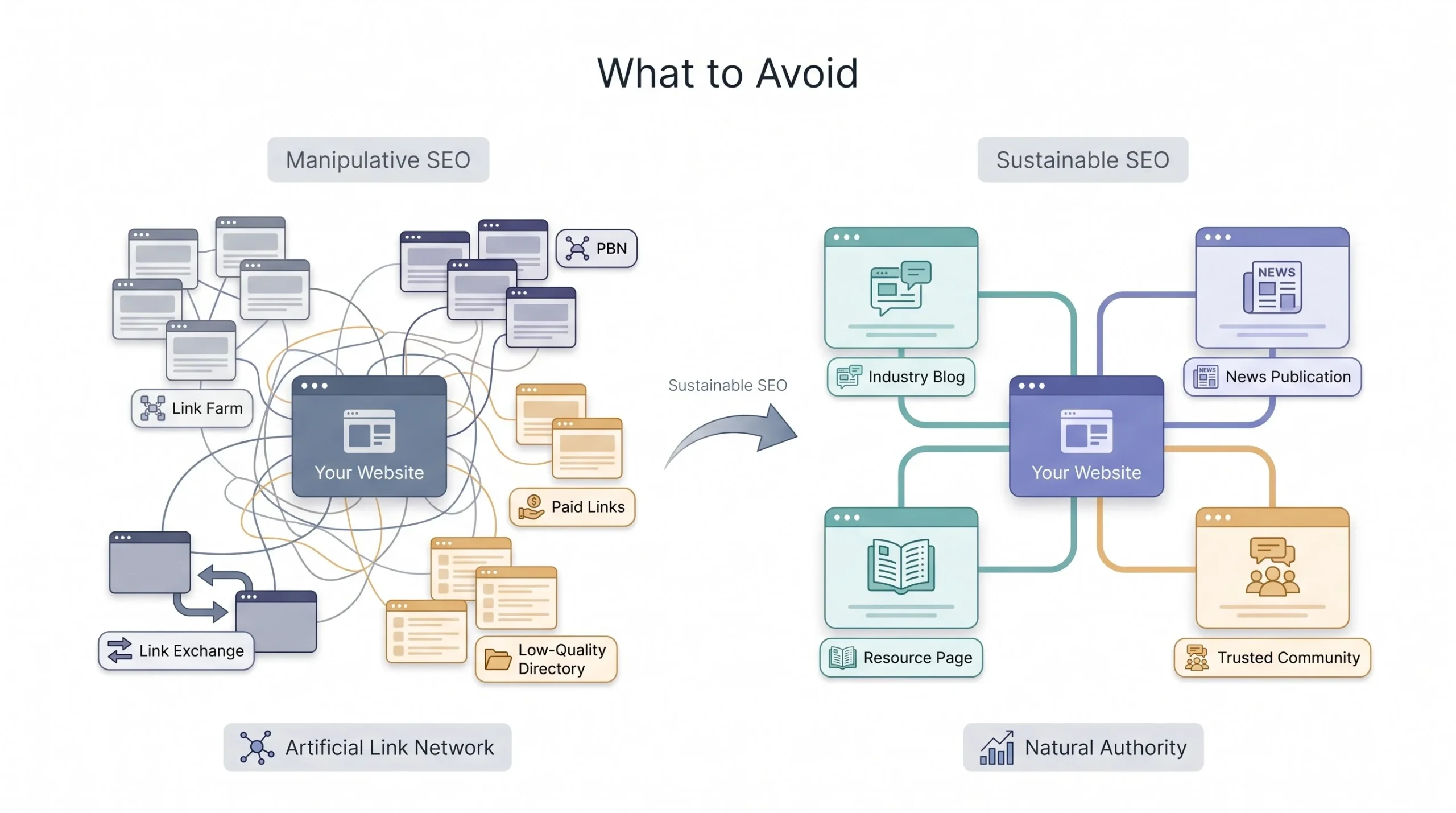
Link farms, private blog networks, excessive reciprocal linking schemes, buying links outright, and dumping your URL into low-quality directories that exist purely for SEO manipulation. These aren’t gray areas. They’re the fastest way to build a backlink profile that looks manufactured, because it is, and Google’s gotten very good at spotting the pattern.
The tempting part is these tactics used to work, and some people still swear by them because they remember a version of SEO from years ago that rewarded volume over everything else. That version of SEO is mostly gone. What’s left is a much higher bar for what counts as a legitimate link, and chasing shortcuts now just delays the eventual cleanup, or worse, invites a manual action that can undo months of otherwise solid work. Slower and real beats fast and fake, every single time, in this specific game.
Beyond Backlinks: Other Off-Page Signals
Backlinks get most of the attention, but they’re not the whole picture. There’s a whole layer of off-page work that doesn’t involve link building at all, and skipping it means leaving trust signals on the table.
Social Media Signals
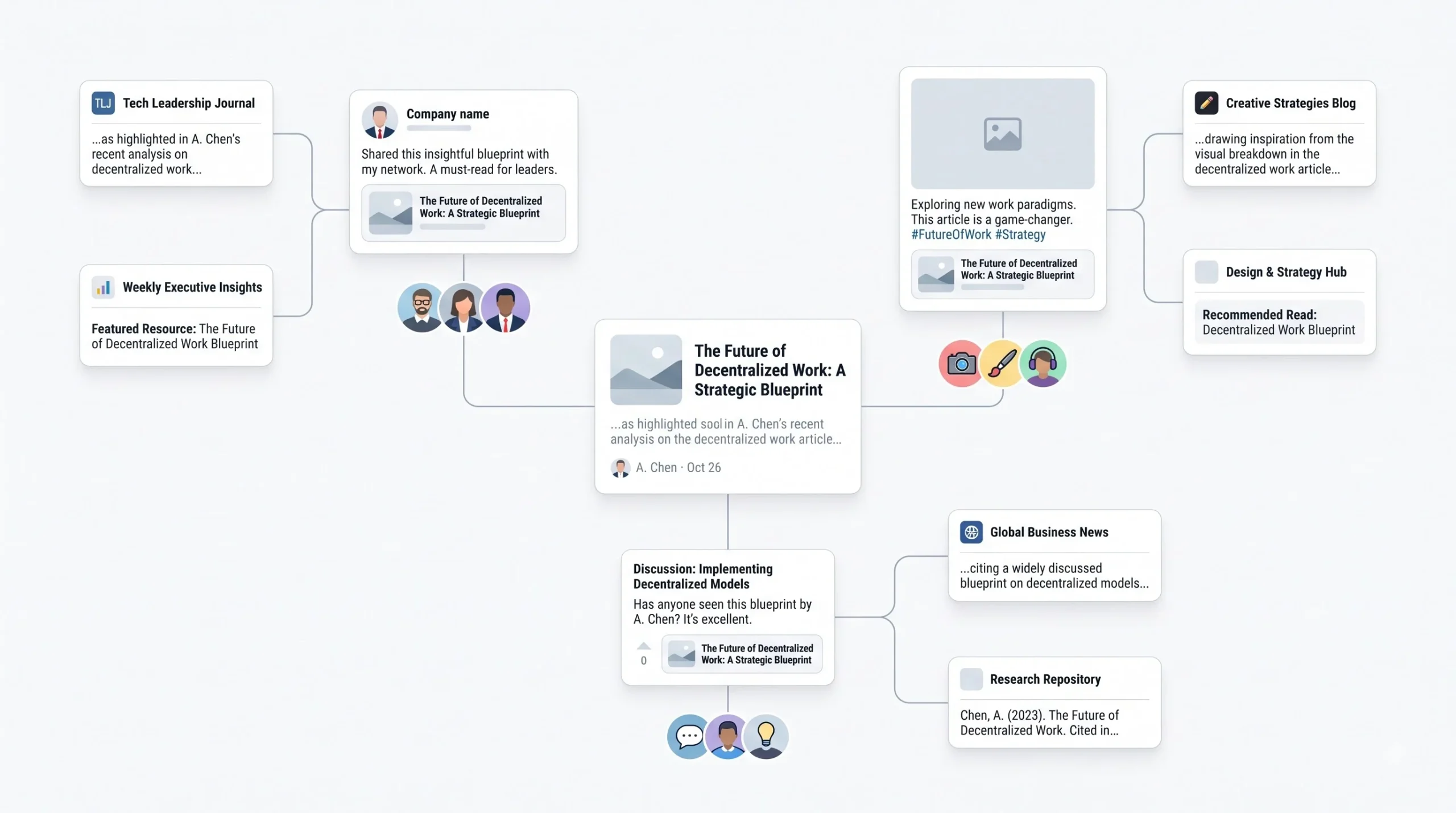
Social shares aren’t a direct ranking factor. Nobody’s claiming otherwise here. But social media does something backlinks alone can’t: it puts your content in front of people who might link to it, quote it, or mention your brand somewhere else entirely. It’s a discovery engine sitting upstream of everything else.
Different platforms carry different weight depending on what you’re doing. LinkedIn tends to matter more for B2B authority, the kind of space where being seen as a credible voice actually influences buying decisions. Instagram and short-form video are better for brand reach and staying visible with a broader audience. And places like Reddit have become genuinely important for topical trust, since Google’s been surfacing Reddit threads in search results far more often than it used to.
None of this means posting for the sake of posting. A LinkedIn post that gets ignored by everyone except your own team doesn’t do anything for off-page authority. What actually moves things is when the right people, people who run blogs, who write newsletters, who have an audience of their own, see your content and decide it’s worth sharing or referencing. That’s the actual mechanism. Volume of posts means nothing if nobody with any reach engages with them.
Online Reviews and Reputation Management
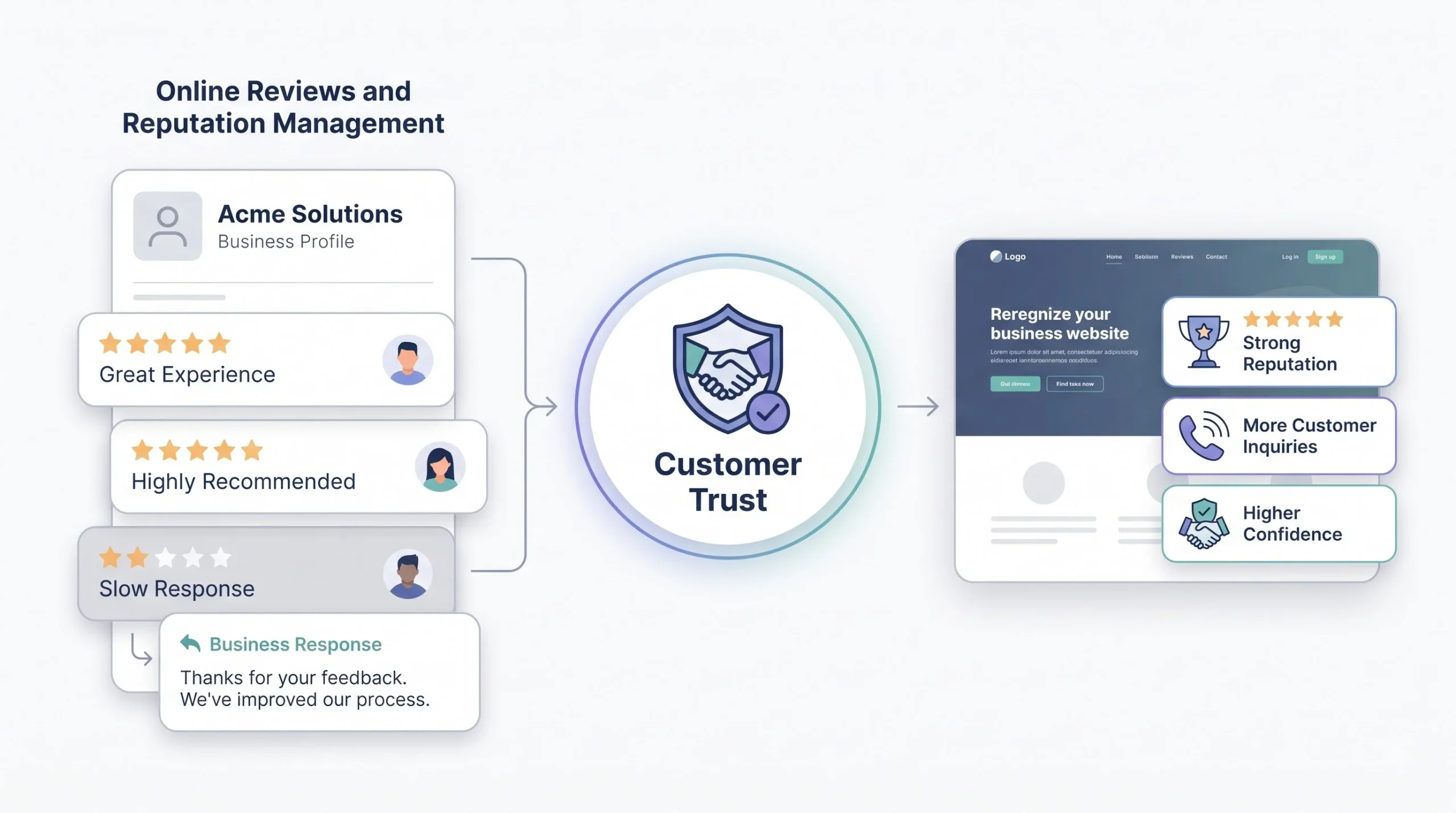
For local and service businesses especially, this is not optional. Reviews on your Google Business Profile, and on third-party sites relevant to your industry, function as a trust signal both to Google and to the actual human being deciding whether to call you. Responding to reviews, good and bad, matters too. A thoughtful response to a negative review often does more for trust than a pile of five-star ratings with no engagement behind them.
People searching for a local service almost always scan the reviews before they scan anything else on your website. A calm, specific response to a bad review, acknowledging what went wrong and explaining what changed, tells a future customer more about how you handle problems than fifty positive reviews ever could. Ignoring negative reviews, or worse, getting defensive in the response, does the opposite. It’s public, it’s permanent, and it shapes how the next hundred people who read it see the business before they’ve even spoken to anyone.
Local Citations and NAP Consistency
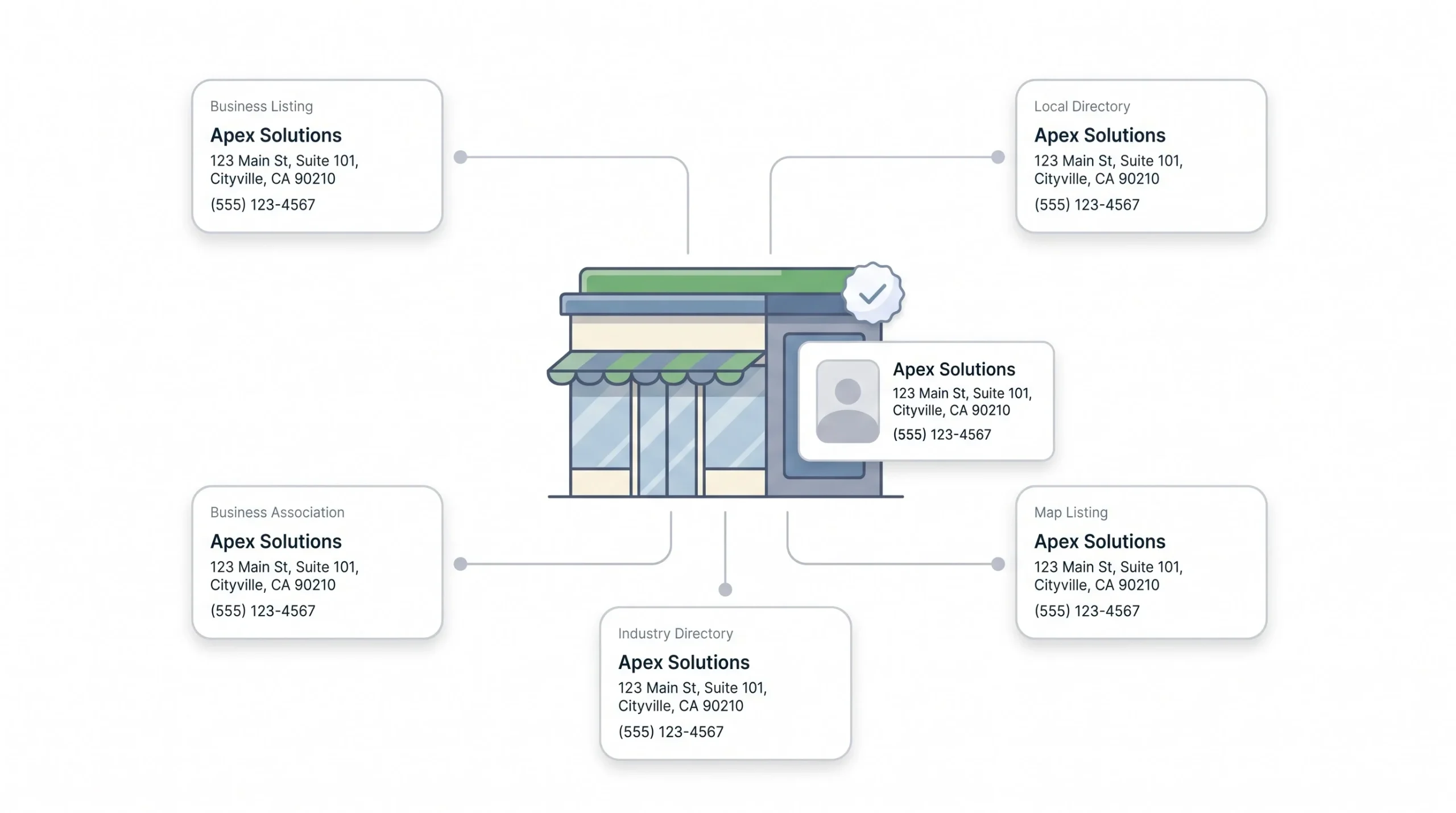
A citation is any online mention of your business name, address, and phone number, whether or not it links to your site. NAP consistency means that information matches exactly, every time, everywhere it appears. Sounds boring. It’s not optional if local search matters to your business.
The core places this shows up: your Google Business Profile, relevant industry directories, local platforms people actually use to find businesses in your area, and organizations like chambers of commerce if you’re part of one. If your address is listed one way on your website and a slightly different way on a directory, that inconsistency chips away at the trust signal instead of building it.
Forums, Communities, and Q&A Platforms
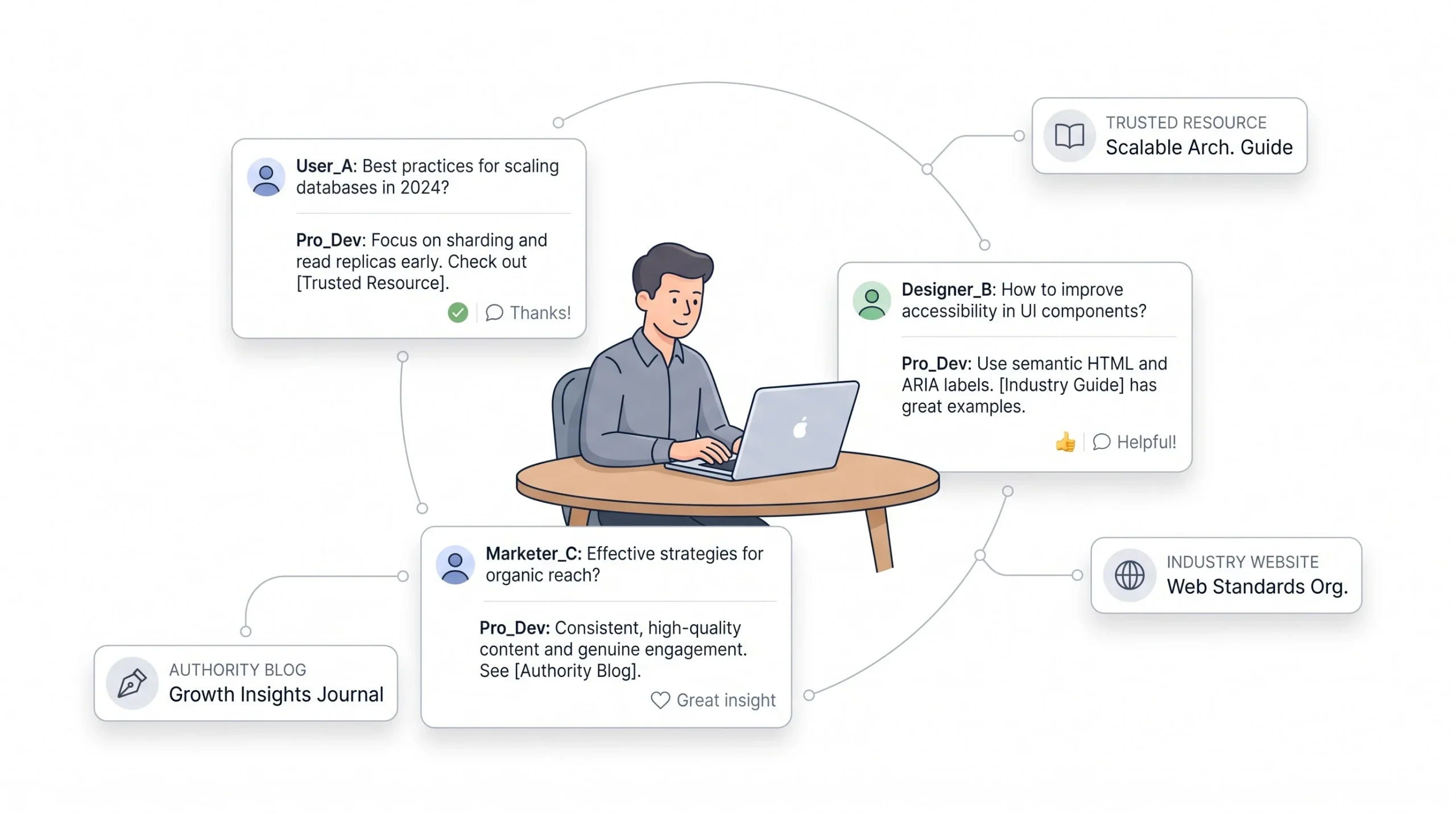
Reddit, Quora, niche forums specific to your industry. Genuine participation here, actually answering questions, actually adding value, is different from dropping a link and disappearing. Google has been giving more visibility to this kind of content in search results, which means the conversations happening in these spaces matter more than they used to.
Influencer and Partner Collaborations
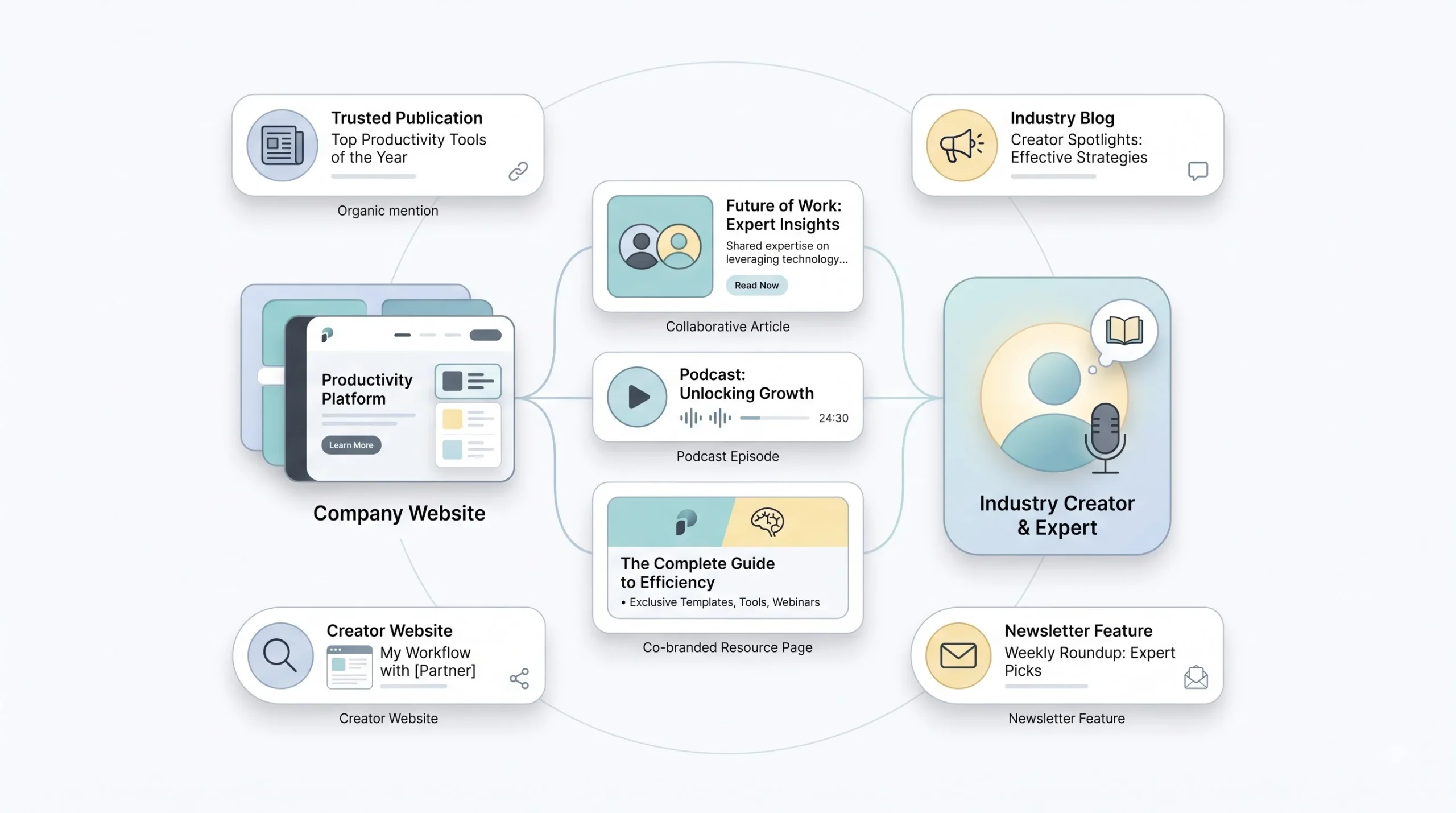
Co-marketing with a complementary brand, affiliate mentions, being included in an expert roundup post. These tend to be lower effort than a full digital PR campaign, and they often build both a link and real reach at the same time.
| Business type | Off-page signal that matters most |
|---|---|
| Local or service business | Reviews, citations, and Google Business Profile optimization |
| B2B SaaS | Digital PR, guest posts, LinkedIn thought leadership |
| Ecommerce | Influencer partnerships, product reviews, competitor backlink gap analysis |
| Content or media site | Linkable assets, journalist requests, community engagement |
E-E-A-T and Off-Page SEO
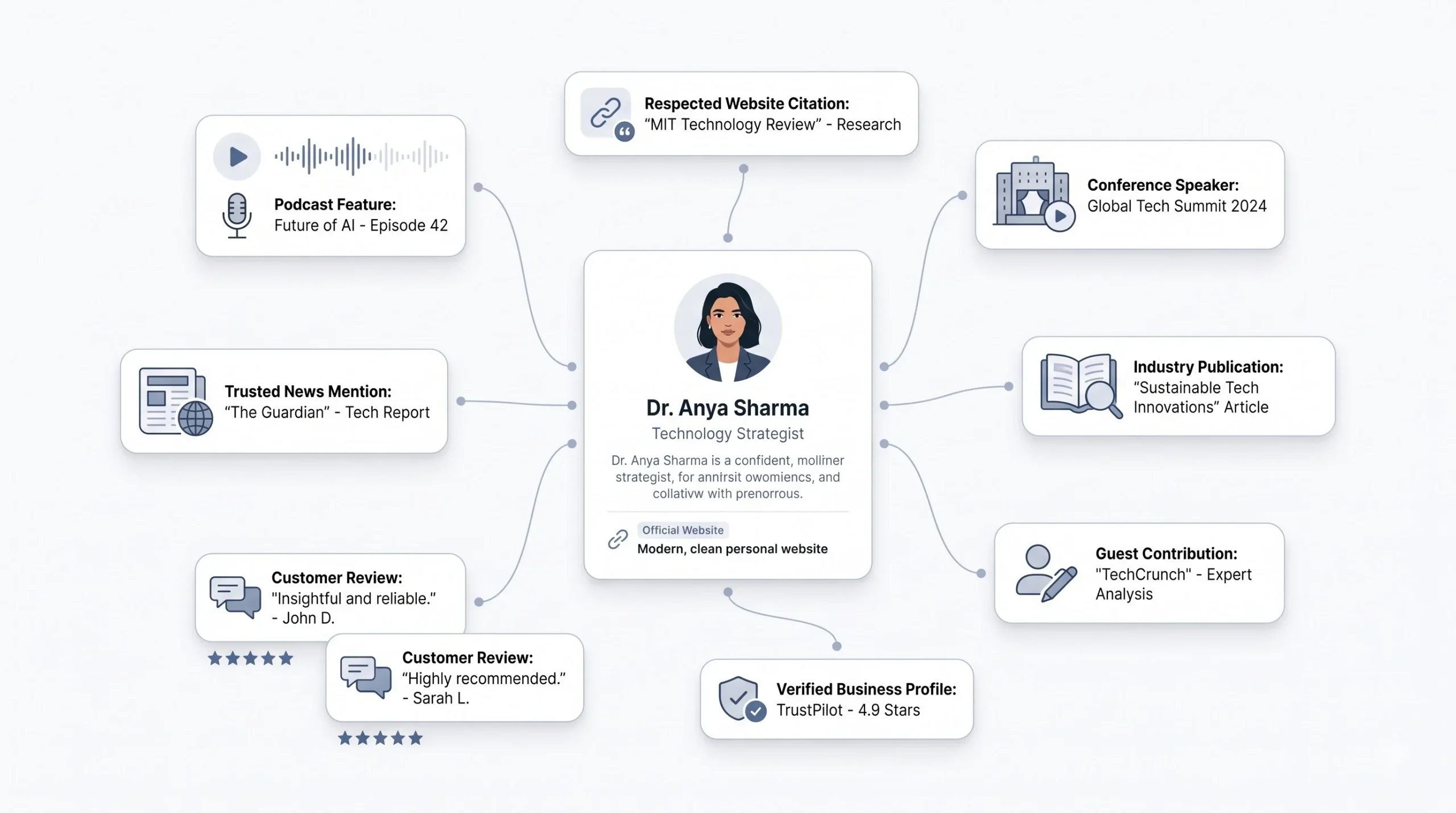
E-E-A-T shows up in nearly every SEO conversation now, and off-page is where most of it actually gets proven, not just claimed.
Experience gets built off-page through things like author bios that link out to real credentials, or case studies that get referenced by other sources as genuine first-hand accounts. Expertise comes through guest contributions on sites that already have credibility in your space, podcast appearances, speaking at events, anything that puts you in front of an audience that didn’t have to trust you first.
Authoritativeness is basically what backlinks from genuinely authoritative domains are built for. When other trusted sources cite you as the reference point, that’s authoritativeness in action. And trustworthiness comes from the more human-facing stuff: reviews, transparent and accurate business information, consistent NAP data, real social proof that isn’t manufactured.
Worth being honest about this too: E-E-A-T matters more in some niches than others. Finance, health, and legal content fall under what’s often called YMYL, Your Money Your Life, and Google holds that content to a noticeably higher trust bar because the stakes of bad information are higher. That doesn’t mean E-E-A-T is irrelevant outside those spaces. It just means the bar is set higher when the topic can genuinely hurt someone if the advice is wrong.
Something people get wrong about E-E-A-T specifically: they treat it like a checklist item, add an author bio, done. But E-E-A-T isn’t really a feature you add to a page. It’s closer to a reputation you build over time, across dozens of small signals that all point the same direction. One author bio doesn’t prove expertise. A pattern of that same person being cited, quoted, and referenced across independent sources does. That pattern only forms through consistent off-page work, not a one-time edit to your website.
Off-Page SEO for AI Search
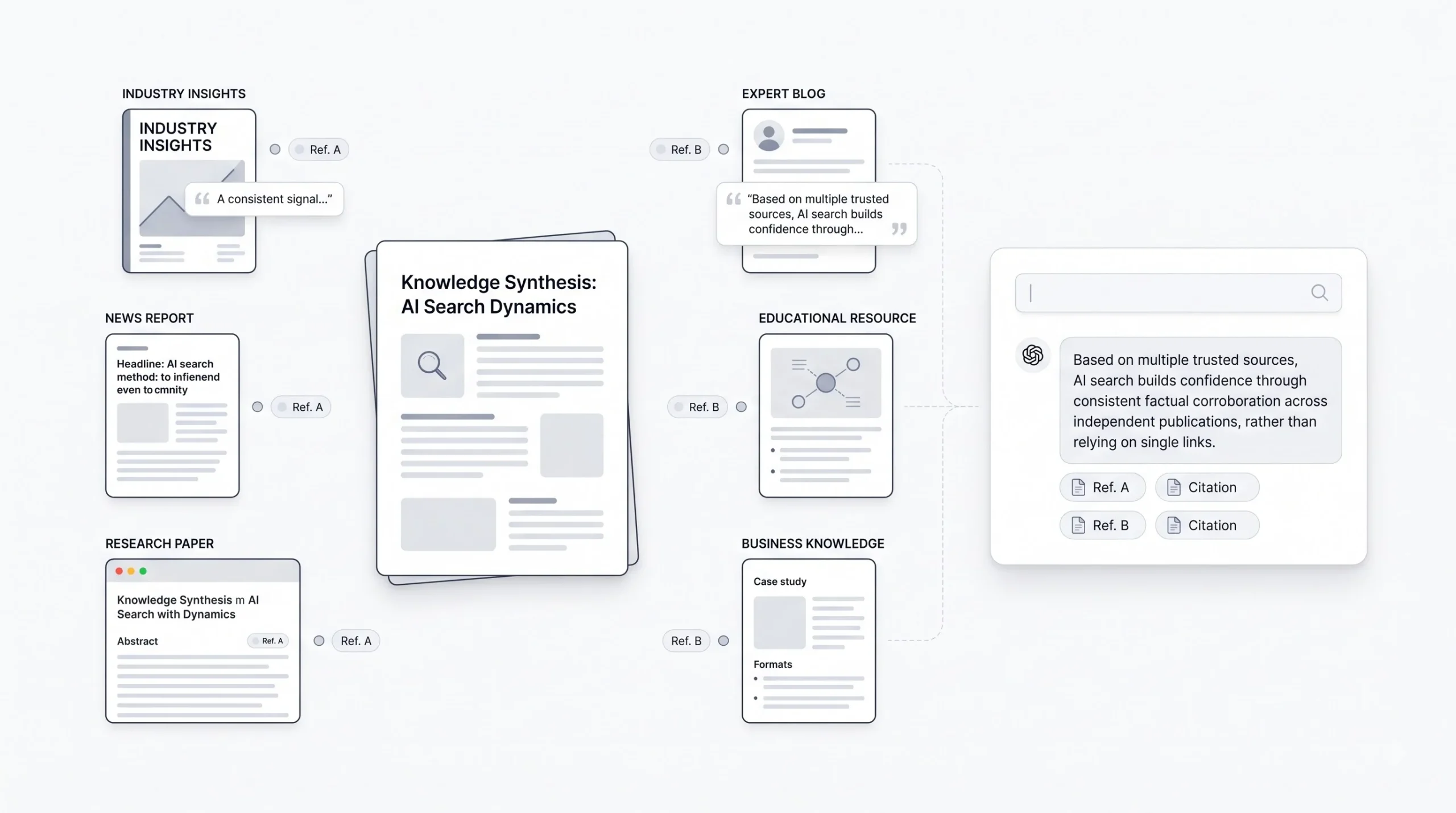
This is the part most guides on this topic barely touch, and it’s becoming one of the more important shifts happening right now.
AI-powered search tools, the kind that generate a direct answer instead of just a list of links, work differently than classic search. They’re leaning heavily on signals like how often you’re cited, how consistently your brand shows up across independent sources, and whether multiple unrelated places are saying the same thing about you. That’s corroboration. And corroboration is, at its core, an off-page signal.
Here’s the practical part. Being mentioned and cited across several independent sources increases the odds that an AI tool treats you as a trustworthy answer, even without a traditional backlink attached to every one of those mentions. That’s a meaningful shift from how classic SEO worked, where the hyperlink itself carried most of the weight.
This ties directly back to brand mention reclamation and digital PR, the same tactics already covered earlier in this post. The difference is the payoff has doubled. A mention that used to only help build general brand trust now also has a shot at getting you cited directly inside an AI-generated answer.
Ranking first in traditional Google search and being the source an AI tool pulls from when answering a question are becoming two related but distinct goals. Off-page authority is the thread connecting both of them, and it’s only going to matter more from here.
Nobody has this fully figured out yet, and it’s fair to be skeptical of anyone who claims they’ve cracked the exact formula. What’s clear enough to act on right now is the direction things are moving. Being the single source of information about something used to be enough. Being one of several independent, credible sources saying the same thing is starting to matter just as much, sometimes more. That’s a real shift in how visibility gets earned, and off-page work is the lever that actually moves it.
How to Audit Your Current Off-Page SEO
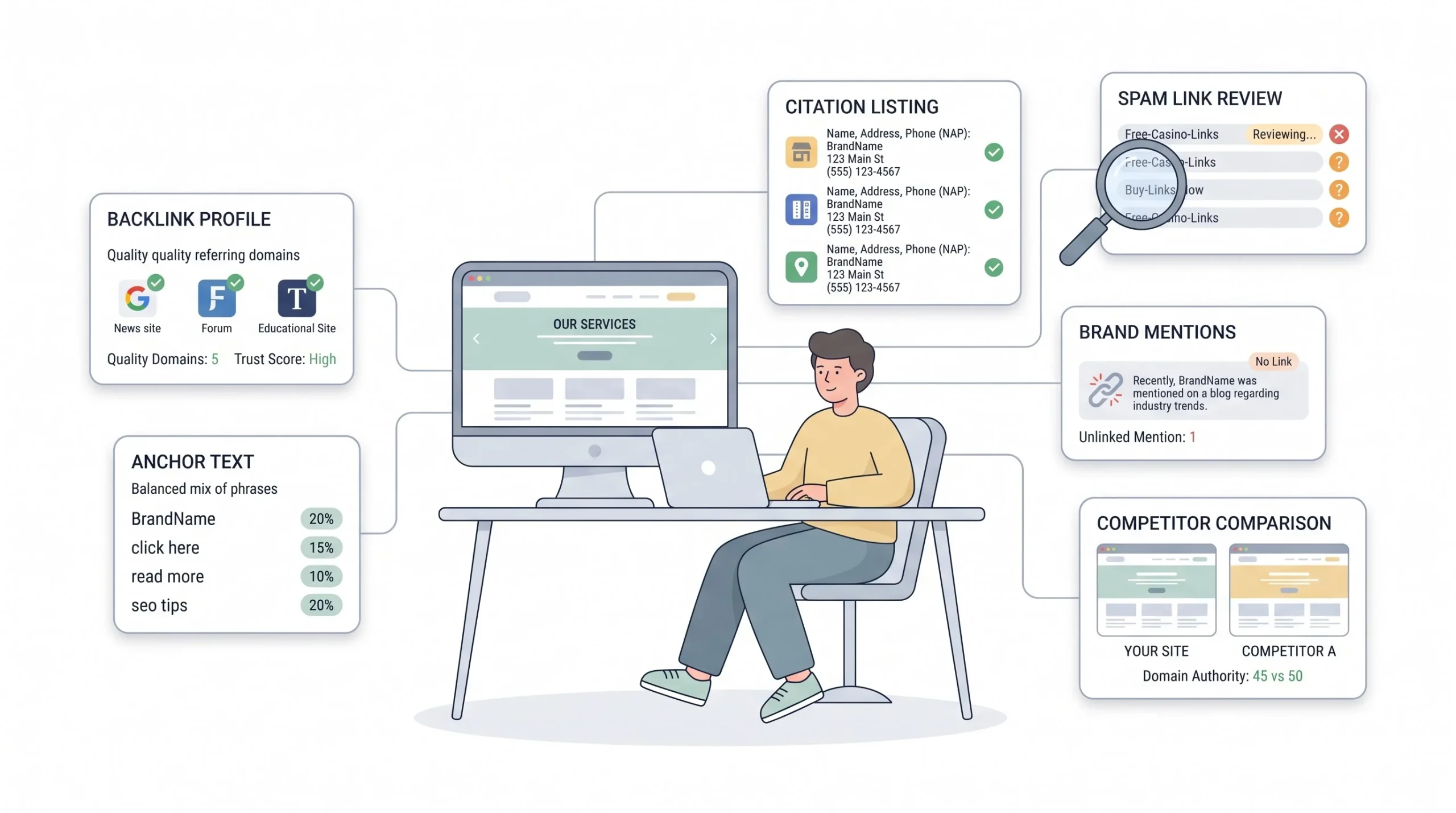
Before building anything new, it helps to know where things actually stand. This isn’t complicated, it just takes some patience.
Start by pulling your backlink profile using Google Search Console alongside a third-party tool, since neither one alone gives you the full picture. Look at your referring domain count and how diverse those domains actually are, not just the raw number of backlinks. Check your anchor text distribution for signs of over-optimization, too many exact-match keyword anchors is a warning sign worth taking seriously.
Go through and identify any toxic or spammy-looking links, but resist the urge to panic-disavow everything that looks slightly off. A disavow file should be a deliberate, careful decision, not a reflex. If local search matters to your business, audit your citations for NAP consistency across every directory and platform you’re listed on. Check for unlinked brand mentions you haven’t reclaimed yet. And finally, benchmark all of this against two or three real competitors, not aspirational ones ten times your size, actual competitors you’re realistically up against.
That last part matters more than people think. Comparing yourself to a competitor with a decade-long head start and a budget you don’t have just tells you what’s possible eventually, not what to do this quarter. Pick competitors close enough to your actual size and stage that their backlink profile gives you something realistic to aim at. Look at where their links are coming from, what kind of content earned them, and whether those same opportunities exist for you too. Most of the time, they do.
Running this audit once and never again defeats the purpose. Off-page profiles shift constantly. Links go dead, competitors gain ground, new spammy links occasionally attach themselves without your involvement. A quarterly check-in, at minimum, keeps you from being surprised six months down the line by a problem that could’ve been caught early.
Tools for Off-Page SEO
| Tool | Best for | Free tier? |
|---|---|---|
| Ahrefs | Backlink analysis, competitor gap analysis, content research | No, trial only |
| Semrush | All-in-one backlink audit, outreach, and tracking | No, trial only |
| Moz Link Explorer | Beginners, domain authority and spam score, unlinked mentions | Limited free access |
| Google Search Console | First-party backlink and mention data | Yes |
| BuzzStream or Pitchbox | Outreach campaign management at scale | No |
| Google Alerts | Free brand mention tracking | Yes |
None of these tools do the work for you. They surface opportunities and data. The outreach, the relationship building, the actual pitching, that part’s still on you.
If budget’s tight, and for a lot of small teams and solo operators it is, start with what’s free. Google Search Console plus Google Alerts covers first-party backlink data and brand mention tracking without spending a rupee. Once there’s actual budget to work with, a paid tool like Ahrefs or Semrush earns its cost back fast through competitor analysis alone, since seeing exactly where a competitor’s links come from saves weeks of guesswork. Don’t buy every tool on this list at once. Pick one that matches whatever phase of the ninety-day plan is currently in motion, and expand from there.
The 90-Day Off-Page SEO Action Plan
Off-page SEO doesn’t respond well to a scattered approach. It works better as a phased build, where each stage sets up the next one instead of everything happening at once.
| Phase | Days | Focus | Key actions |
|---|---|---|---|
| Foundation | 1 to 30 | Audit and cleanup | Backlink audit, Google Business Profile and citation cleanup, competitor benchmarking, brand mention tracking setup |
| Build | 31 to 60 | Active outreach | Create one or two linkable assets, broken link and resource page outreach, guest post pitches, review generation push |
| Scale | 61 to 90 | Compound and expand | Digital PR push, unlinked mention reclamation, community and forum presence, measure results and refine |
The first thirty days feel slow, and that’s normal. You’re mostly cleaning up and gathering information, not earning links yet. The middle phase is where the actual outreach starts, and this is where most people either commit or quietly give up because it’s slower and more uncertain than writing another blog post. The last phase is where things start compounding, assuming the first sixty days were done properly instead of rushed.
Worth saying plainly: ninety days is not the finish line. It’s the point where you should start seeing early signals, a few solid links, a handful of reclaimed mentions, maybe a small bump in referral traffic. Full ranking impact usually takes longer than that, because Google needs time to recrawl, reassess, and adjust. Anyone promising page-one rankings in ninety days from off-page work alone is either exaggerating or selling something. What ninety days should actually give you is proof the system works, momentum worth continuing, and a clearer sense of which tactics are actually working for your specific niche versus which ones sounded good in theory.
Conclusion
Off-page SEO isn’t a campaign you run once and check off a list. It’s ongoing reputation building, the kind that never really finishes because trust isn’t something you earn once and keep forever. It has to be maintained, added to, defended when something goes wrong.
Everything covered here, backlinks, mentions, reviews, E-E-A-T, even the shift toward AI search, points back to the same idea. Google, and increasingly AI tools built on top of search, are trying to figure out who deserves to be trusted. Off-page SEO is how you answer that question with evidence instead of just claiming it on your homepage. On-page content gets you in the conversation. Off-page authority is what gets you believed.
If you’re building out the rest of your SEO foundation, the on-page and technical sides of this same puzzle are just as important, and worth understanding with the same depth as everything covered here.
The people who get real results from off-page SEO aren’t the ones who found some secret tactic nobody else knows about. Every tactic in this post is public, documented, and used by thousands of people already. What separates good results from mediocre ones is consistency, patience, and actually doing the outreach instead of reading about it and moving on to the next article. Off-page SEO rewards the boring, repetitive work most people skip. Show up for it long enough, and it starts showing up for you too.
Frequently Asked Questions
What’s the difference between off-page SEO and link building?
Link building is one piece of off-page SEO, not the whole thing. Off-page covers everything happening outside your site that builds trust, backlinks, sure, but also reviews, social signals, brand mentions, local citations, PR coverage. Link building is the part that gets the most attention because it’s the most measurable, but treating the two as interchangeable means ignoring reviews, social proof, and mentions that also carry real weight.
How long does off-page SEO take to show results?
Longer than most people want to hear. Early signals, a handful of solid links, a bump in referral traffic, can show up within the first couple months if the outreach is consistent. Actual ranking movement usually takes longer, since Google needs time to recrawl and reassess trust signals. Anyone promising fast, dramatic ranking jumps from off-page work alone is either exaggerating the timeline or cutting corners somewhere that’ll cause problems later.
Is guest posting still effective in 2026?
Yes, but only the version done properly. Writing something genuinely useful for a site your actual audience reads still works well. Spinning generic content and dumping it on low-quality sites purely to grab a link stopped working a while back, and Google’s gotten sharper at spotting the pattern. The tactic isn’t dead. The lazy version of the tactic is.
How many backlinks do I need to rank?
There’s no fixed number, and anyone giving you an exact figure is guessing. What matters more than count is relevance, referring domain diversity, and the authority of the sites linking to you. Ten links from genuinely relevant, respected sites in your niche will outperform a hundred links from random low-quality domains almost every time.
What’s a good anchor text ratio?
A natural mix, weighted toward branded anchors like your company name, with generic anchors like “this guide” or “click here” making up a good chunk too, and only a small share using exact-match keyword phrases. If most of your backlinks use the same exact keyword phrase as anchor text, that pattern looks manufactured to Google, because it usually is.
Should I disavow toxic backlinks myself?
Not without a careful audit first. Panic-disavowing links that only look slightly off can strip away links that were actually helping you. Reserve the disavow tool for links that are clearly spammy, clearly manipulative, or clearly harmful, and treat it as a last resort rather than routine maintenance.
Does social media directly affect rankings?
Not directly, no. Social shares aren’t a confirmed ranking factor the way backlinks are. But social media drives discovery, and discovery leads to more people finding your content, and some of those people run websites, write newsletters, or cover your industry, and might link to you or mention your brand somewhere that does carry direct weight. It’s an indirect path, but a real one.
How does off-page SEO differ for local businesses?
Local businesses lean much more heavily on reviews, Google Business Profile optimization, and citation consistency than on chasing national-level backlinks. A plumber in Jaipur doesn’t need a link from a major international publication nearly as much as they need accurate NAP data across local directories and a steady stream of genuine, responded-to reviews. The fundamentals are the same, the priority order is different.
What counts as a toxic backlink?
Links from link farms, private blog networks, sites unrelated to your niche with no editorial standards, or domains that look built purely to sell links rather than publish real content. One or two odd-looking links rarely cause harm on their own. A large volume of them, especially with obviously manipulated anchor text, is what actually raises red flags.
Can I do off-page SEO without any budget?
Yes, slower, but yes. Broken link building, resource page outreach, unlinked brand mention reclamation, and responding to journalist requests all cost time rather than money. Paid tools speed up the research phase, but the actual outreach and relationship building underneath all of it doesn’t require a subscription to get started.
Do unlinked brand mentions actually help SEO?
Increasingly, yes. Google’s gotten better at recognizing brand mentions even without a hyperlink attached and treating consistent mentions as a trust signal. They’re also becoming more relevant for AI search tools, which lean on corroboration across independent sources rather than relying on hyperlinks alone. Reclaiming them into actual links is still worth doing, but the mention itself already carries some value before that happens.
How is off-page SEO different for AI search compared to Google search?
Classic Google search leans heavily on the hyperlink itself as a trust signal. AI-generated answers lean more on corroboration, whether multiple independent sources are saying the same thing about you, cited or not. The tactics overlap a lot, digital PR and mention reclamation help both, but AI search rewards being consistently referenced across many sources slightly more than it rewards a single powerful backlink.