


Somewhere in the last three or four years, AI stopped being a side experiment marketing teams played with on a Friday afternoon and became the thing running the actual campaign. Customer segmentation now happens through predictive models instead of a spreadsheet with age brackets in it. Ads get personalized in real time based on behaviour nobody manually reviewed. Content gets drafted by a language model before a human ever opens a blank document. Predictive analytics decides which leads a sales team calls first. Automated bidding decides how much a click is worth before a person even sees the auction happen. Chatbots handle the first, second, and sometimes third conversation a customer has with a brand. Recommendation engines decide what shows up on a homepage. Lead scoring quietly ranks who gets attention and who gets ignored. Email marketing systems decide who gets which subject line at which hour. All of that runs on AI now, mostly in the background, mostly without a person double-checking every decision.
That speed and scale is exactly why the ethical use of AI in marketing has become something teams can’t treat as an afterthought anymore. When a human marketer made a bad call, a poorly worded email, a badly targeted ad, the damage was usually contained to one campaign, one list, one mistake. When an algorithm makes a bad call, it makes that same mistake a million times before lunch. That’s the real shift here. It’s not that AI is more likely to be unethical than a person. It’s that AI is fast enough to turn a small ethical blind spot into a company-wide problem before anyone notices.
There’s a real tension sitting underneath all of this, and pretending it doesn’t exist doesn’t help anyone. Marketing teams are under constant pressure to hit numbers, more conversions, lower CPA, higher engagement, and AI is genuinely good at hitting those numbers. But the tactics that squeeze out short-term performance, aggressive tracking, manipulative personalization, opaque targeting, are exactly the tactics that erode the thing marketing is supposed to build in the first place: trust. Unethical AI use doesn’t just risk a fine or a bad headline. It quietly damages customer trust, brand reputation, personal privacy, consumer autonomy, and eventually the credibility of the whole business.
Here’s the idea worth holding onto through the rest of this guide: ethical AI isn’t about avoiding AI. Nobody’s suggesting marketing teams go back to manual segmentation and gut-feel targeting. It’s about using AI in a way that a marketer could explain openly to the customers it affects, without flinching.
What You Will Learn in This Guide
This guide covers what ethical AI in marketing actually means beyond the buzzword, why it’s become an urgent issue rather than a nice-to-have, the specific ethical challenges showing up across data privacy, bias, manipulation, misinformation, and copyright, the core principles a responsible AI marketing strategy should follow, how those principles apply differently across paid ads, content, email, social, SEO, influencer marketing, and customer service, and a practical framework for building governance, checklists, and culture around AI use inside a real marketing team.
What Is Ethical AI in Marketing?
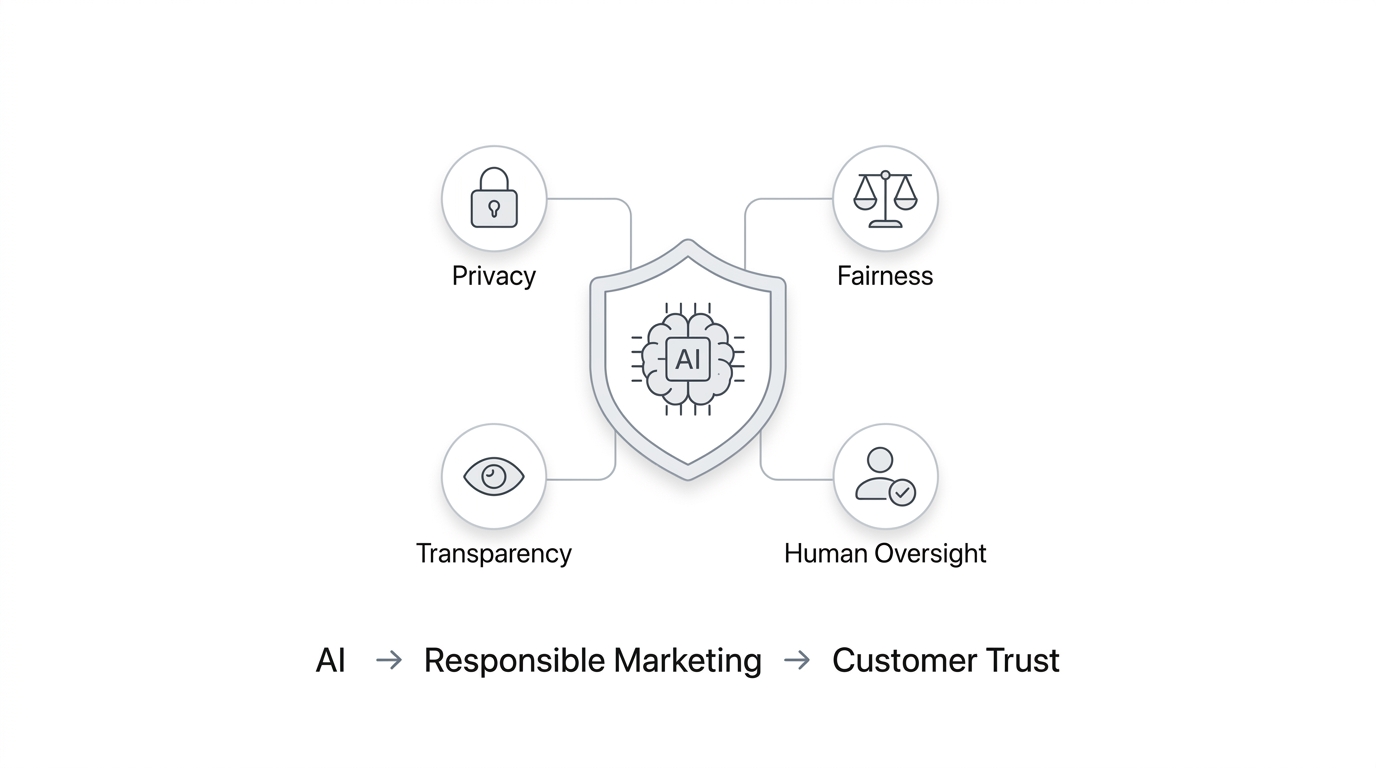
Ethical AI in marketing means using AI systems in ways that respect customer privacy, avoid manipulation and discrimination, stay transparent about when and how AI is influencing a customer’s experience, and keep a human accountable for the outcomes those systems produce. It’s a practical standard, not a philosophical one, and it shows up in specific, checkable decisions rather than vague good intentions.
Put simply, ethical AI in marketing is the responsible development, deployment, and ongoing monitoring of AI systems used to reach, understand, or influence customers. That means thinking about ethics at three separate points: when a tool gets built or selected, when it actually goes live in a campaign, and continuously after launch, since a model that behaved fine in testing can start behaving badly once it meets real-world data. A lot of teams stop at the first point and assume that’s enough. It isn’t. An AI system that was ethical on day one can drift into unfair or manipulative behavior six months later without anyone touching a single setting.
Why Ethics and Compliance Are Not the Same
This is the distinction that trips up more marketing teams than anything else in this whole topic. Legal compliance asks: is this allowed? Ethical responsibility asks: should we be doing this at all? Something can be perfectly legal and still genuinely problematic. Scraping every data point a browser will hand over, building a hyper-detailed behavioral profile on a customer, and using that profile to time an ad for the exact moment someone’s emotionally vulnerable, none of that is necessarily illegal in most places. But it’s manipulative, and customers who find out about it don’t care that it technically passed a legal review. Excessive data collection is the classic example: a company might have every legal right to collect location history, browsing patterns, and device fingerprints, but collecting all of it “because AI might need it someday” isn’t an ethical justification, it’s a hoarding habit dressed up as innovation.
The Core Principles of Ethical Marketing AI
There’s a set of principles that keeps showing up across every serious framework on this topic, and they’re worth naming upfront since the rest of this guide keeps coming back to them: transparency, privacy, consent, fairness, accountability, human oversight, security, accuracy, consumer autonomy, and inclusivity. None of these are new marketing concepts. What’s new is applying them to systems that make thousands of decisions per second instead of a person making one decision at a time.
Ethical AI vs. Traditional Marketing Ethics
Traditional marketing ethics dealt mostly with individual decisions: was this ad misleading, was this claim true, was this targeting fair. AI changes the risk profile because it multiplies whatever bias or blind spot exists in a system across every single interaction that system touches. A biased assumption baked into a traditional print ad affects however many people see that specific ad. The same bias baked into a targeting algorithm affects every single auction that algorithm runs, silently, at a scale no human team would catch without specifically looking for it. Automation doesn’t create new ethical categories. It amplifies the existing ones by a factor most marketing teams aren’t prepared for.
Why Ethical AI Has Become a Critical Marketing Issue
This isn’t a theoretical concern anymore. The reasons this topic moved from “nice to think about” to “actually urgent” are pretty concrete.
Rapid Adoption of Generative and Predictive AI
AI-powered marketing tools went from a curiosity to a default line item in most marketing budgets in a remarkably short window. Tools for content generation, predictive lead scoring, and automated ad optimization moved out of the experimentation phase and straight into daily workflows, often faster than internal policy or legal review could keep pace with. A lot of teams are running AI tools today that nobody formally approved, they just started using them because they worked.
Consumers Are Becoming More Aware of Data Use
Customers aren’t naive about tracking anymore. Years of headlines about data breaches, targeted ads that feel a little too accurate, and privacy scandals have made people genuinely wary of how their data gets used. Expectations around privacy have shifted from “I guess this is normal” to “wait, how do they know that about me,” and that shift changes how forgiving customers are when a brand’s AI use feels invasive.
AI Can Scale Both Good and Bad Marketing Practices
A single marketer making a targeting mistake affects one campaign. A biased model baked into an automated targeting system can quietly affect thousands or millions of users before anyone notices the pattern. That’s the core difference between a human mistake and an automated one: scale. The same automation that makes a great personalization strategy work brilliantly across a huge customer base can make a flawed one cause damage at the exact same scale.
Trust Is Becoming a Competitive Advantage
Transparency and brand trust are tightly linked now in a way they weren’t a decade ago. Customers increasingly reward brands that are upfront about how AI shapes their experience, and they punish brands that get caught being sneaky about it. Trust used to be a soft, hard-to-measure asset. It’s becoming something customers actively factor into which brands they stick with, especially once they’ve been burned once by a company that misused their data.
The Business Cost of Unethical AI
The consequences here are concrete, not abstract. Regulatory penalties are growing sharper as privacy laws mature. Lawsuits over discriminatory targeting or deceptive AI use are becoming more common. Reputation damage from a viral story about manipulative personalization can undo years of brand-building in a weekend. Customer churn follows naturally once trust breaks. Campaign performance actually suffers long-term, since manipulated or over-targeted audiences tend to disengage or actively avoid a brand. Platforms themselves are increasingly restricting accounts that violate their own AI and data policies. And any competitive advantage a company thought it was buying with aggressive AI tactics tends to evaporate once customers start comparing brands on trust instead of just price or convenience.
The Major Ethical Challenges of AI in Marketing
This is the heart of the whole topic, and it deserves real depth instead of a surface-level list.
Data Privacy and Consumer Surveillance
AI marketing systems run on data, and the appetite for that data keeps growing because more data generally means better predictions. First-party data, information collected directly through a brand’s own site, app, or purchase history, tends to be more transparent and easier to justify ethically than third-party data, which gets pulled together from sources a customer never directly interacted with. Behavioral tracking follows what someone clicks, scrolls past, or lingers on. Cross-platform data collection stitches together someone’s activity across multiple sites and apps into a single profile. Location and browsing data adds even more granularity, sometimes down to which specific store someone walked into last week. The risk with all of this isn’t any single data point, it’s the combination. Enough individually harmless data points stitched together can build a profile detailed enough to feel invasive, even if no single piece of it was collected illegally.
How Marketers Can Use Data Responsibly
The practical fix here starts with collecting only what’s actually necessary for the stated purpose, not everything a tracking script can technically grab. Explaining clearly how data gets used, in plain language, not buried in a ten-thousand-word privacy policy nobody reads. Establishing retention policies so data doesn’t sit around indefinitely once it’s served its purpose. And securing customer information properly, since a great privacy policy means nothing if the underlying data gets exposed in a breach six months later.
Lack of Transparency and Explainability
Customers generally have a reasonable expectation to know when AI is meaningfully shaping their experience, whether that’s the price they’re being shown, the content they’re being served, or the decision being made about their lead score. The problem is a lot of these systems are genuinely black boxes, even to the marketing teams using them, meaning nobody can fully explain why the algorithm made a specific decision. That’s a real issue in advertising, where targeting decisions happen invisibly, in recommendations, where a customer never sees why they’re being shown one product over another, in lead scoring, where a person might get deprioritized without ever knowing it happened, in pricing, where dynamic pricing models can charge different customers different amounts based on predicted willingness to pay, and in content personalization, where two people can see completely different versions of the same page without any indication that’s happening.
When Should Marketers Disclose AI Use?
There are specific moments where disclosure genuinely matters rather than being optional politeness. AI-generated content, especially anything resembling a personal opinion or expert claim, benefits from disclosure since readers reasonably assume a human wrote it unless told otherwise. AI-powered customer service should be clearly identified as automated rather than left ambiguous, since customers often behave and phrase requests differently when they know they’re talking to a bot versus a person. AI-generated advertising, particularly anything involving synthetic voices, faces, or testimonials, needs disclosure to avoid outright deception. And automated decision-making that meaningfully affects a customer, like being excluded from an offer or flagged as low-value, deserves some level of transparency about the fact that a system made that call.
Algorithmic Bias and Discrimination
Algorithmic bias happens when a model trained on historical data ends up reproducing, or even amplifying, the inequalities baked into that historical data. If past customer data reflects biased human decisions, who got approved for credit, who got shown certain job ads, who got excluded from certain housing listings, the algorithm learns those patterns as if they were neutral truth rather than historical bias. Real examples of this have shown up in hiring-related advertising, where certain job ads got shown disproportionately to one gender. Housing advertisements have faced similar scrutiny, with targeting systems effectively excluding certain demographic groups from seeing listings, which edges dangerously close to discriminatory practices regulators take seriously. Credit-related marketing carries similar risk, since financial products marketed unevenly across demographic lines can reinforce existing economic inequality. Demographic targeting in general requires extra caution precisely because it’s the category most likely to slide from reasonable segmentation into something that excludes people based on protected characteristics, intentionally or not.
How to Detect and Reduce AI Bias
Reducing bias starts with using diverse training data that actually reflects the full population a brand serves, not just the segment that historically converted best. Bias testing before launch, actively checking how a model performs across different demographic groups rather than assuming a single aggregate metric tells the whole story. Regular audits after launch, since a model that looked fair at launch can drift as it keeps learning from new data. Human review of outputs, especially for anything involving demographic targeting or exclusion. And direct performance comparison across demographic groups, checking whether conversion rates, exclusion rates, or pricing differ in ways that can’t be explained by anything other than the group itself.
Manipulative Personalization
There’s a real, meaningful line between personalization and manipulation, and it’s worth being honest about where that line sits instead of pretending all personalization is automatically fine. Personalization means showing someone something genuinely relevant based on their actual interests or needs. Manipulation means exploiting predictable psychological patterns to push someone toward a decision they wouldn’t otherwise make. Hyper-personalized advertising crosses into manipulation territory when it starts targeting emotional vulnerabilities specifically, like showing weight-loss ads to someone whose browsing pattern suggests body image struggles, or targeting financial products at someone whose behavior suggests they’re in debt distress. Behavioral prediction gets used to time offers for moments of lowered guard. Fear-based marketing uses AI-optimized messaging to amplify anxiety rather than address a genuine need. And urgency or scarcity messaging generated algorithmically, countdown timers, “only 2 left” messages, gets particularly dishonest when the AI is generating fake scarcity rather than reflecting real inventory constraints.
The Personalization Line Marketers Should Not Cross
A useful gut check here: relevant recommendations respect the customer’s autonomy, they make a choice easier without pushing it. Psychological exploitation removes that autonomy by targeting a vulnerability instead of a genuine interest. Convenience-based personalization, remembering someone’s size or reordering a past purchase, feels helpful. Surveillance-based personalization, referencing something a customer never explicitly told the brand, feels invasive even when it’s technically accurate. That gut reaction customers have, the “how did they know that” feeling, is usually a pretty reliable signal that a line got crossed.
AI-Generated Misinformation and Hallucinations
Generative AI tools produce confident, well-formatted, completely wrong information on a regular basis, and marketing teams publishing that content without checking it are the ones who end up owning the mistake. This risk shows up hardest in product claims, where an AI tool might generate a specific performance stat that was never actually tested. Health-related marketing carries serious risk here, since a hallucinated claim about a supplement or treatment can cause real harm and real legal exposure. Financial marketing carries similar weight, since incorrect numbers or misleading claims about returns can mislead customers into decisions with real financial consequences. Technical content and statistics get fabricated constantly by generative tools, complete with fake-sounding but plausible source citations. And here’s the part that matters most: marketers remain fully responsible for anything published under their brand, regardless of whether a human or an AI tool drafted the original sentence. “The AI wrote it” has never been an acceptable excuse to a regulator, a customer, or a journalist.
Human Fact-Checking Requirements
Every AI-generated claim needs verification against a real source before it goes live. Statistics need to be checked against the original data, not just trusted because they look specific and confident. Claims about product performance, health, or finance need extra scrutiny given the real-world stakes. Sources cited by an AI tool need to actually be checked, since AI systems have a well-documented habit of inventing citations that sound completely real but don’t exist. And every piece of AI-generated copy needs a human review pass before publication, no exceptions, regardless of how good the tool’s track record has been so far.
Intellectual Property and Copyright Concerns
Generative AI content creation raises genuine, unresolved questions about ownership and originality that marketing teams need to take seriously rather than assume away. Training data concerns exist because many generative models were trained on copyrighted material without explicit permission from the original creators, which puts the legal status of some outputs in a genuinely gray area. Copyright ownership of AI-generated content itself remains legally unsettled in a lot of jurisdictions, meaning a brand publishing AI-generated creative might not actually hold clear rights to it. Using a competitor’s content, or a specific named artist’s style, as a prompt raises separate ethical and legal questions about derivative work. Unauthorized reproduction becomes a real risk when a generative tool outputs something too close to existing copyrighted material. And image and video generation tools specifically carry heightened risk here, since they can produce output that closely resembles a real artist’s identifiable style or a real photographer’s actual work.
Responsible AI Content Creation
The safer path involves using licensed assets and tools with clear, documented training data policies rather than the cheapest or most powerful option available. Avoiding the generation of content that closely copies an identifiable creator’s distinct style or work. Maintaining genuine human originality in the strategic and creative decisions behind a piece of content, using AI to execute rather than to originate the core idea. And reviewing every generated output specifically for similarity to existing copyrighted work before it goes anywhere near a live campaign.
Deepfakes, Synthetic Media, and Deceptive Advertising
This is the sharpest edge of the whole topic. AI-generated faces used in testimonials that never happened. Synthetic voices reading scripts a real person never said. Fake testimonials attributed to people who don’t exist, or worse, real people who never actually said those words. AI-generated influencers presented as authentic without disclosure. Manipulated product demonstrations that show a product performing better than it actually does in reality. Every one of these crosses from creative use of AI into outright deception the moment a customer reasonably believes they’re seeing something real when they’re not.
Why Disclosure Matters
Avoiding deceptive representation isn’t just an ethical nicety, in a growing number of jurisdictions it’s becoming a legal requirement, particularly around synthetic testimonials and AI-generated spokespeople. Clearly identifying synthetic content when it’s used, even in cases where disclosure isn’t strictly mandated yet, protects a brand from the reputational fallout of getting caught hiding it, which tends to be far worse than the original use of synthetic media would have been on its own.
Automation Without Human Oversight
Fully automated marketing decisions, run without any human checkpoint, create a specific kind of risk: the system can make confidently wrong decisions at scale before anyone notices something’s off. AI making decisions based on flawed assumptions baked into its training data will keep making that same flawed decision indefinitely unless someone catches it. Campaign automation errors, a budget rule gone wrong, a targeting parameter misconfigured, can burn through significant spend in hours if nobody’s watching. Automated customer communication mistakes, a chatbot giving incorrect information, an automated email going out with the wrong personalization token, can damage individual customer relationships in ways that are hard to walk back once they’ve landed in someone’s inbox.
The Human-in-the-Loop Model
The practical answer here is keeping humans actively supervising the decisions that matter most. Strategy should stay firmly human-led, since AI executes tactics but doesn’t set direction. Approval processes should require a human sign-off before high-stakes campaigns go live, not just a glance at a dashboard after the fact. Sensitive decisions, anything touching demographic targeting, pricing, or exclusion, need mandatory human review regardless of how well the system has performed historically. Crisis management absolutely requires human judgment, since an automated system has no ability to recognize it’s operating inside a PR crisis and adjust accordingly. And high-impact customer interactions, the ones that could seriously help or seriously damage a relationship, deserve a human checkpoint before an algorithm handles them unsupervised.
Ethical Principles Every AI-Powered Marketing Strategy Should Follow
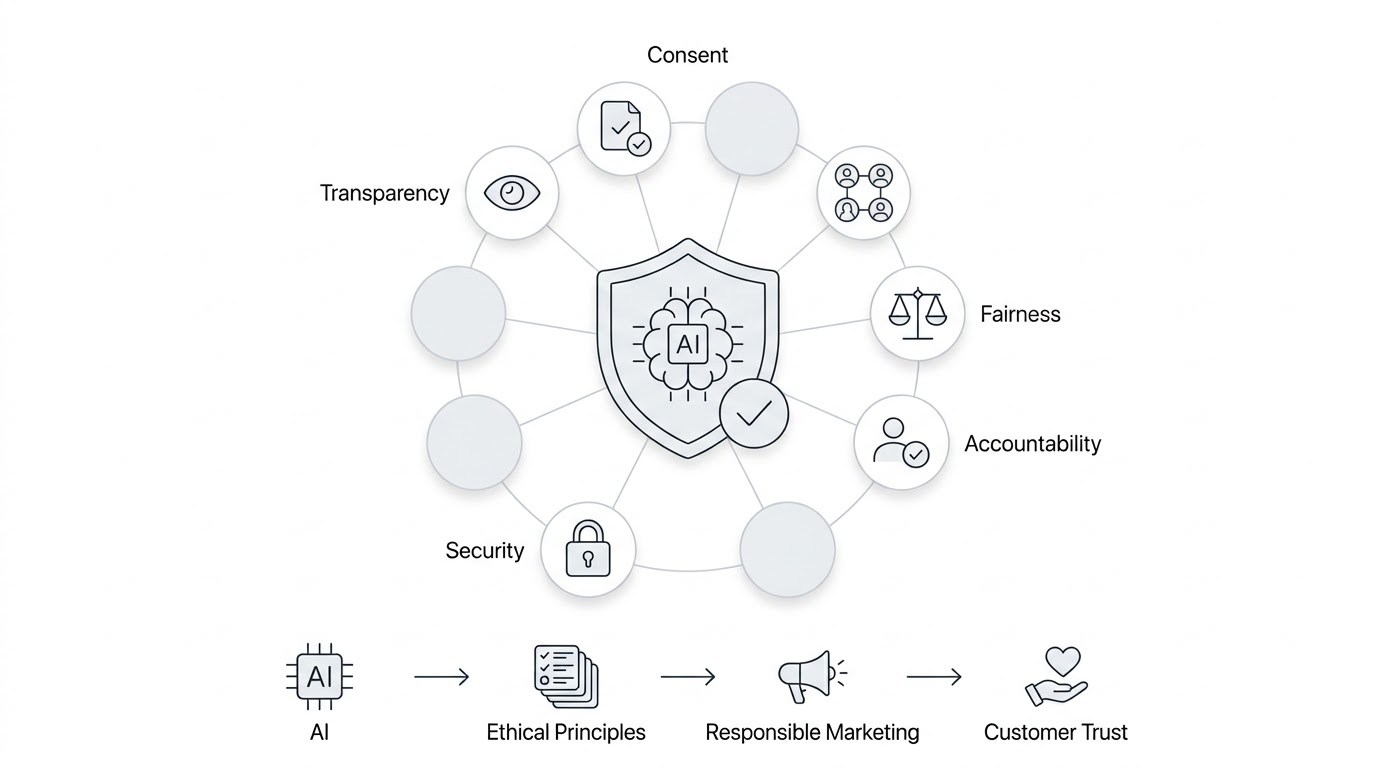
These ten principles form the practical backbone of ethical use of AI in marketing, and treating them as a checklist rather than an abstract value statement is what actually makes them useful.
1. Transparency
Tell customers, in plain language, when AI is meaningfully shaping their experience, whether that’s a personalized price, a targeted ad, or an automated recommendation. Explaining an automated process doesn’t require a technical breakdown of the model, it just requires honesty that a process exists and roughly what it’s doing.
2. Informed Consent
Get genuine, informed permission before collecting or using someone’s personal data, and make that consent mechanism clear rather than confusing. A pre-checked box buried in a cookie banner technically counts as “consent” under some interpretations, but it fails the spirit of the principle badly.
3. Data Minimization
Collect what’s actually necessary for the specific purpose at hand, not everything a tracking pixel or SDK is technically capable of grabbing. “Collect everything because the AI might need it eventually” is a data-hoarding habit dressed up as forward planning, and it’s exactly the kind of practice that turns into a liability the moment a breach or regulation forces a reckoning.
4. Fairness and Non-Discrimination
Test models across the actual range of audiences they’ll affect, not just the aggregate performance number. Monitor for unequal outcomes across demographic groups on an ongoing basis, since fairness at launch doesn’t guarantee fairness six months later once the model has kept learning from new data.
5. Accountability
Assign clear, specific responsibility for every AI system in use, meaning a named person or team, not a vague “the algorithm decided.” Blaming the algorithm for a bad outcome is a dodge, not an explanation, and it doesn’t hold up with regulators, customers, or journalists.
6. Human Oversight
Define explicitly when human intervention is mandatory versus when a system can operate independently. Establish clear escalation processes so that when something looks wrong, there’s an actual person whose job it is to catch it and act.
7. Accuracy and Reliability
Validate AI-generated information before it goes anywhere near a customer, whether that’s a content claim, a statistic, or a personalized recommendation. Build fact-checking procedures into the workflow as a required step, not an optional one that gets skipped when deadlines get tight.
8. Security
Protect customer data with real technical safeguards, not just a privacy policy that says the right things. Control access to AI systems so only the people who genuinely need it can touch sensitive data or adjust live models. Avoid exposing confidential business or customer information through prompts fed into third-party AI tools that may retain or train on that input.
9. Consumer Autonomy
Give people meaningful choices, not fake ones. A genuine opt-out that’s easy to find and use respects autonomy. A buried, deliberately confusing opt-out technically exists but functionally doesn’t. Avoid coercive personalization that manufactures pressure rather than presenting a genuine, honest option.
10. Inclusivity and Accessibility
Make sure AI-driven experiences actually work for the full range of people a brand serves, not just the segment that resembles the historical training data most closely. Consider language differences, disability accommodations, cultural context, and demographic variation as core design requirements, not an afterthought handled during a later accessibility audit.
Ethical Use of AI in Marketing Across Different Marketing Channels
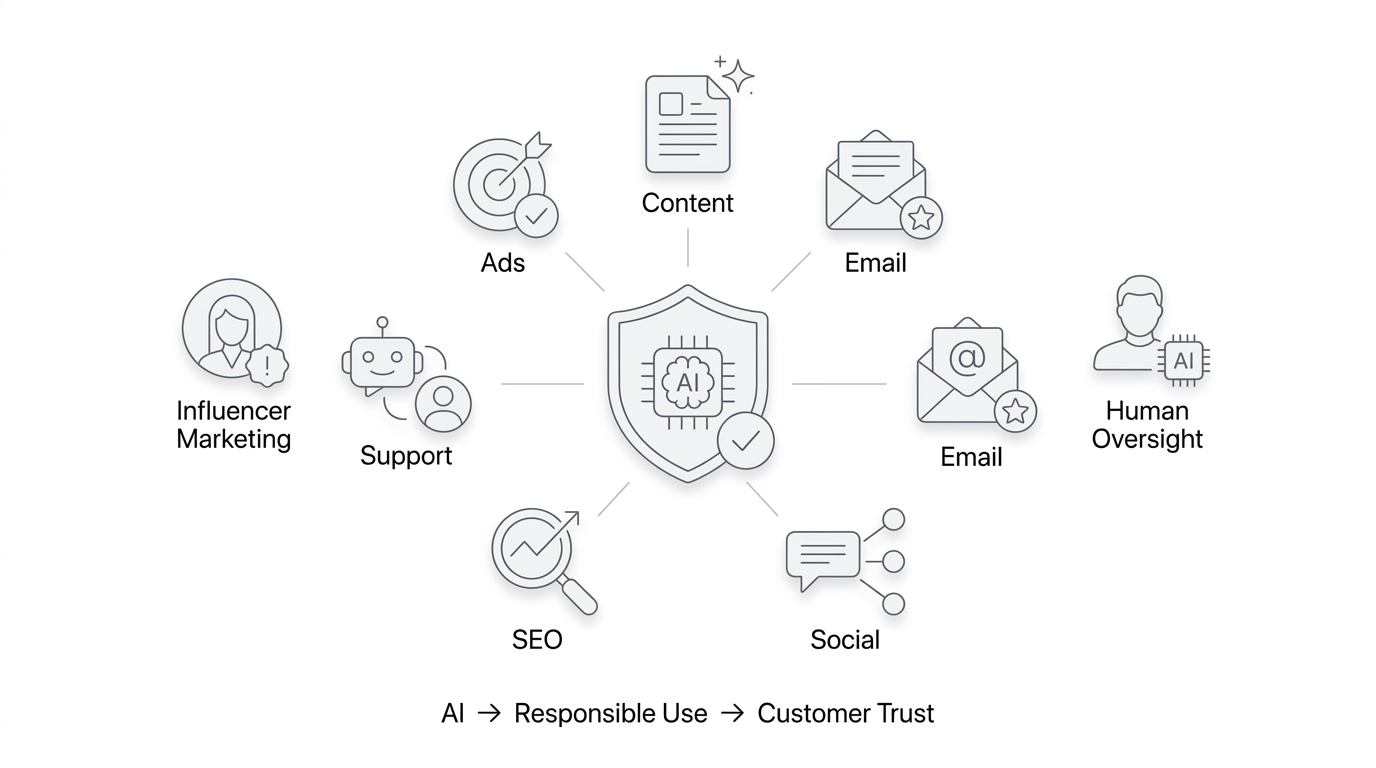
The ethical use of AI in marketing looks different depending on the channel, since each one carries its own specific risks and its own specific fixes.
AI in Paid Advertising
Automated targeting, smart bidding, AI-generated ad copy, lookalike audiences, and predictive audiences all run on behavioral and demographic data, which makes paid ads one of the highest-risk channels for both privacy overreach and discriminatory exclusion. The ethical concern here centers on targeting and exclusion specifically, since an algorithm optimizing purely for conversion likelihood can end up systematically excluding certain demographic groups from seeing housing, credit, or employment-related ads, which crosses from smart targeting into legally and ethically serious territory.
Responsible AI Practices for Paid Ads
Review targeting parameters specifically for demographic exclusion patterns rather than just conversion performance. Avoid using AI-optimized lookalike audiences built from a seed list that itself reflects historical bias. Keep a human reviewing campaigns that touch sensitive categories like housing, credit, employment, or health before they go live, regardless of how well the automated system has performed elsewhere.
AI in Content Marketing
Blog writing, content ideation, content optimization, and AI-generated images and videos have become standard parts of a lot of content workflows. The risk here is publishing low-quality or misleading content at a volume no editorial team can realistically fact-check line by line, which is exactly what happens when a team treats AI output as finished copy rather than a first draft.
Maintaining Human Expertise and Originality
The fix is treating AI as a drafting tool, not a subject-matter expert. Every factual claim needs a human who actually knows the topic checking it before publication. Original insight, the thing that actually differentiates content from a competitor’s AI-generated version of the same topic, has to come from a person with real experience, not from the model itself.
AI in Email Marketing
Predictive segmentation, automated personalization, send-time optimization, and AI-generated subject lines have made email genuinely more effective, but they’ve also made it easier to cross into intrusive territory without meaning to.
Avoiding Intrusive Personalization
Referencing behavior a customer never explicitly shared with the brand, mentioning a specific product they looked at on a different site, for instance, feels invasive rather than helpful. Sticking to personalization based on data the customer knowingly provided or clearly interacted with directly keeps this channel on the right side of the line.
AI in Social Media Marketing
Automated posting, social listening, AI-generated captions, sentiment analysis, and chatbot replies have automated a huge chunk of day-to-day social management. The risk shows up when automated engagement starts behaving indistinguishably from a real person without disclosure, or when sentiment analysis gets used to detect and exploit emotional states rather than just measure brand perception.
Risks of Automated Social Engagement
Automated replies that mimic a real person too closely can mislead followers about who they’re actually talking to. Social listening data used to detect emotionally vulnerable moments for targeting purposes crosses the same manipulative line discussed earlier in this guide, just on a different channel.
AI in SEO
Keyword research, content optimization, search intent analysis, internal linking, and AI-assisted content production have reshaped how SEO teams work day to day. The ethical concern here is quality dilution, publishing high volumes of thin, AI-generated content purely to capture search traffic without providing real value to the person searching.
Ethical SEO and Search Quality
Content produced primarily to manipulate rankings rather than genuinely help the reader tends to underperform anyway once search engines catch up, but the deeper issue is that it erodes trust with actual readers who land on thin, unhelpful pages. Prioritizing genuine usefulness over pure keyword coverage keeps SEO work aligned with both ethics and long-term performance.
AI in Influencer Marketing
Influencer identification, audience analysis, and fraud detection tools have made it easier to spot fake followers and engagement pods, which is genuinely a positive use of AI in this space. The ethical risk shows up specifically with AI-generated influencers, virtual personalities presented as authentic voices without clear disclosure that they’re not real people.
Authenticity and Disclosure
Audiences generally respond fine to virtual influencers once they know that’s what they’re looking at. The problem is deception, not the existence of synthetic personas themselves. Clear, upfront disclosure keeps this practice on the ethical side of the line.
AI in Customer Service
AI chatbots, automated recommendations, customer segmentation, and sentiment detection have become the first line of most customer service operations. The concern here is straightforward: customers need to know when they’re talking to a bot, and they need an easy way out of that conversation when the bot can’t actually help.
When Customers Should Be Able to Reach a Human
Any interaction involving a complaint, a sensitive account issue, a request that the bot clearly isn’t equipped to handle, or simple frustration expressed by the customer should have a fast, obvious path to a real person. Trapping a frustrated customer in an automated loop is one of the fastest ways to turn a minor issue into a public complaint.
How to Use Generative AI Responsibly in Marketing
Generative AI specifically deserves its own section here, since it’s the category most marketing teams have adopted fastest and thought through least carefully.
Establish Clear AI Usage Guidelines
Every team using generative AI needs internal policy covering which tools are actually approved for use, what uses are explicitly prohibited, what data restrictions apply to prompts, when human review is mandatory before publishing, and when disclosure to customers or audiences is required. Without this written down somewhere, different people on the same team end up making wildly different calls about what’s acceptable.
Never Enter Sensitive Customer Data Into Unapproved AI Tools
This one deserves blunt language: personal information, financial details, passwords, confidential business data, and customer databases should never get typed into a consumer-grade AI tool that wasn’t specifically vetted and approved for that kind of input. A lot of tools retain and potentially train on whatever gets pasted into them, which means sensitive data can end up somewhere it was never supposed to go, permanently, without any way to pull it back.
Fact-Check AI-Generated Content
A reliable review workflow looks something like this: generate the draft, verify every factual claim against a real source, edit for accuracy and voice, get formal approval from someone accountable for the content, publish, and then monitor for any issues that surface after the fact. Skipping any one of these steps, especially the verify step, is how hallucinated statistics end up published under a brand’s name.
Maintain Human Creativity
AI works best as an assistant that handles drafting and iteration speed, not as a replacement for the strategic thinking behind a campaign. Human storytelling still lands differently than generated copy. Brand voice, the specific personality a company has built over years, doesn’t come from a model, it comes from people who understand the brand deeply. Original insight, the thing that actually makes content worth reading, still requires a human perspective the AI doesn’t have access to.
Label AI-Generated Content When Appropriate
Disclosure matters most when a reasonable person would assume a human created something without being told otherwise, particularly for anything resembling personal opinion, expert analysis, or a testimonial. Avoiding deceptive synthetic content isn’t about labeling every single AI-assisted sentence, it’s about not letting audiences believe something is more human or more authentic than it actually is.
Protect Brand Voice and Reputation
Establishing clear brand guidelines that a generative tool can actually be prompted against, building a library of approved prompts that consistently produce on-brand output, and maintaining a human editorial review step keeps generative AI output from drifting into generic, off-brand territory that damages the consistency a brand has spent years building.
AI Marketing and Consumer Privacy: What Marketers Need to Know
Privacy sits at the center of nearly every ethical concern already covered in this guide, which makes it worth addressing directly and specifically.
What Types of Data Do AI Marketing Systems Use?
AI marketing systems typically draw on demographic data (age, location, general profile information), behavioral data (clicks, scrolls, time spent), transactional data (purchase history, order value), website activity (pages visited, session length), engagement data (email opens, ad interactions), device data (device type, operating system), and location-related data (city-level or more granular positioning depending on permissions granted). Each category carries a different level of sensitivity, and treating all of them as equally low-risk is a mistake plenty of teams make.
First-Party Data and Responsible Personalization
First-party data, collected directly through a brand’s own properties with the customer’s knowledge, tends to provide a more transparent and defensible foundation for personalization than third-party data pulled together from sources the customer never directly interacted with. Permission-based personalization, built on data someone knowingly provided, generally feels appropriate to customers in a way that surveillance-based personalization doesn’t.
Privacy by Design
Building privacy into a system from the start, rather than bolting it on after a problem surfaces, means practicing data minimization from day one, applying purpose limitation so data collected for one reason doesn’t quietly get repurposed for another, setting real access controls so only people who need specific data can reach it, establishing retention policies that actually get enforced rather than just documented, and maintaining genuine security standards throughout the entire data lifecycle.
Giving Consumers Meaningful Choices
Real opt-outs that are easy to find and actually work, not buried three menus deep. Preference centers that let customers control specifically what kind of personalization they’re comfortable with, rather than an all-or-nothing toggle. Data access and deletion mechanisms where legally applicable, giving people a genuine path to see and remove what’s been collected about them. And privacy notices written in plain, readable language instead of dense legal text designed to be skimmed past rather than understood.
AI Marketing Regulations and Compliance Considerations
This section is high-level context, not legal advice, and any specific compliance question deserves review from an actual legal or privacy professional rather than a blog post.
Why AI Regulation Matters to Marketers
Marketing AI sits directly at the intersection of privacy law, consumer protection law, advertising regulation, and general data protection rules, which means a single AI-powered campaign can potentially trigger obligations under several different regulatory frameworks simultaneously depending on where the audience is located.
Major Regulatory Areas Marketers Should Monitor
At a high level, marketers should keep an eye on the EU’s GDPR, which governs data processing broadly across Europe, the newer EU AI Act, which specifically addresses risk categories for AI systems, the CCPA and CPRA in California, which give consumers specific rights over their personal data, India’s Digital Personal Data Protection framework, which is reshaping data handling requirements for businesses operating in India, along with general advertising disclosure requirements and broader consumer protection laws that vary significantly by jurisdiction.
Data Protection and AI
The core requirements that show up across most of these frameworks involve lawful processing of data, meaning a legitimate legal basis for collecting and using it, genuine consent where required, purpose limitation so data doesn’t get used beyond what it was collected for, and real data security standards protecting whatever gets collected.
AI Transparency Requirements
A growing number of frameworks specifically address automated decision-making, requiring disclosure when a significant decision affecting a person was made by an algorithm rather than a human. AI disclosure requirements are tightening around synthetic media and AI-generated content specifically. And consumer rights around AI, the ability to know how a decision was made or to request human review of it, are expanding in several jurisdictions.
Why Compliance Should Be Built Into AI Workflows
Legal review works best as a built-in step in the AI workflow, not a final check tacked on right before launch when it’s too late to meaningfully change course. High-risk use cases specifically, anything touching sensitive categories or automated decisions with real consequences for individuals, deserve direct collaboration with legal and privacy teams from the planning stage onward, not just a rubber stamp at the end.
Editorial note: because regulations in this space evolve quickly, verify current requirements against official regulatory sources before publishing anything based on this section, and keep a “last reviewed” date visible on any compliance-related content.
How to Build an Ethical AI Marketing Framework
This is where the guide moves from principles into something a team can actually implement.
Step 1: Identify Every AI Use Case
Build a real inventory covering every AI tool in active use, its specific purpose, what data it touches, what output it produces, what decision it actually influences, and who owns it internally. Most teams are surprised by how long this list turns out to be once someone actually sits down and builds it.
Step 2: Classify AI Risk
Sort each use case into a risk category. Low risk covers things like brainstorming headlines, where a bad output just gets discarded with no real consequence. Medium risk covers customer segmentation, where a flawed model could misallocate marketing spend or unfairly deprioritize certain groups. High risk covers automated decisions that directly affect consumers, like credit-related offers, exclusionary targeting, or pricing decisions, where a mistake has real, direct consequences for a real person.
Step 3: Define Data Boundaries
Get specific about what data an AI system is allowed to access, what data must stay restricted regardless of how useful it might theoretically be, and exactly who inside the organization has permission to touch that data or adjust how the system uses it.
Step 4: Establish Human Approval
Define clearly what AI can do fully independently without a human checkpoint, what requires review before it goes live, and what categories of decision AI should never make independently under any circumstances, regardless of how well it’s performed historically.
Step 5: Test for Bias and Accuracy
Run pre-launch testing before any AI system touches real customers. Test performance specifically at the audience level, not just in aggregate. Validate outputs for accuracy before trusting them in production. Run direct bias checks comparing outcomes across demographic groups rather than assuming a good overall number means everything underneath it is fair too.
Step 6: Create an Audit Trail
Document, for every significant AI-driven decision, which model or tool was used, what prompt or input drove the output, what data source fed into it, which human reviewed and approved it, what the final decision was, and when it happened. This isn’t bureaucratic overhead for its own sake, it’s the difference between being able to explain a decision later and having no idea what happened when something goes wrong.
Step 7: Monitor After Deployment
Track performance continuously rather than treating launch as the finish line. Monitor customer complaints specifically for patterns that might indicate an AI-driven issue. Review unexpected outcomes as they surface rather than dismissing them as noise. Reassess models on a regular schedule, since drift happens gradually and rarely announces itself.
Step 8: Update the Framework
AI tools keep evolving, new capabilities show up constantly and old assumptions stop applying. Regulations keep evolving too, often faster than internal policy can keep pace with. And consumer expectations shift as well, what felt acceptable a year ago can start to feel invasive as awareness around AI and data use keeps growing. A framework built once and never revisited stops being useful within a year, sometimes less.
Practical Ethical AI Checklist for Marketers
A framework is only useful if it turns into something a team actually checks before hitting publish, so here’s the practical version.
Before Using an AI Tool
Is the tool actually approved through internal review, not just something someone started using because it was convenient? What specific data does it process, and does that match what’s actually necessary for the task? Does the vendor have documented, verifiable security practices? Is customer data being shared with the vendor in any way, and if so, under what terms? And is the specific use case actually appropriate for AI, or is this a decision that genuinely needs a human?
Before Launching an AI Campaign
Is the targeting fair across the audiences it will actually reach, not just efficient at hitting a conversion number? Is the level of personalization appropriate, or does it start to feel invasive once you imagine explaining it directly to the customer? Are the claims in the campaign actually accurate and verified? Is AI disclosure required for this specific piece of content or interaction? And has an actual human reviewed the full campaign before it goes live?
After Launch
Are customers responding negatively in ways that suggest something feels off, even if performance numbers look fine? Are there early signs of bias showing up in who’s engaging, converting, or being excluded? Are the AI outputs still accurate, or has something started drifting since launch? Are privacy concerns emerging in customer feedback or support tickets? Is the system producing any results that genuinely surprise the team running it?
Quick “Stop and Review” Questions
A short set of gut-check questions worth running before anything ambiguous goes live: would this be comfortable to explain directly to the customers it affects? Would the team be comfortable if this specific process became public knowledge, written up in a news article? Could this practice disadvantage a specific group of people, even unintentionally? Is more data being collected here than the task actually requires? And is there a specific, named human accountable for how this turns out?
Common Mistakes Marketers Make When Using AI
Most ethical problems in AI marketing don’t come from bad intentions. They come from these specific, repeated mistakes.
Treating AI Output as Fact
Generative tools produce confident hallucinations, incorrect statistics, and fabricated sources constantly, and treating that output as verified truth without checking is one of the most common and most avoidable mistakes teams make.
Feeding Sensitive Data Into AI Tools
Pasting customer information or confidential company data into an unapproved AI tool, often just to save time drafting something, creates a data exposure risk that’s hard to undo once it’s happened.
Automating Everything
Removing human oversight entirely, assuming the AI has been reliable enough so far to run unsupervised, tends to lead to poor customer experiences the moment the system encounters a situation it wasn’t trained to handle well.
Using AI Without Disclosure
Synthetic testimonials, AI-generated personas, and AI-generated media presented as authentic without any disclosure crosses from smart automation into outright deception, and it tends to get discovered eventually.
Ignoring Bias
Assuming an algorithm is automatically objective simply because it’s math rather than a human opinion is a common and costly misunderstanding. Algorithms trained on biased historical data reproduce that bias with total confidence.
Prioritizing Conversion Over Consumer Well-Being
Manipulative personalization and excessive targeting might lift short-term conversion numbers, but they trade long-term trust for short-term performance, which is rarely a good trade once the full cost becomes visible.
Failing to Monitor AI Systems
Models and their outputs change over time as they keep learning from new data, and ethical risks that didn’t exist at launch can emerge months later if nobody’s actively watching for them.
Real-World Examples of Ethical and Unethical AI Marketing
Concrete examples make this whole topic easier to apply than abstract principles alone.
Example 1: AI-Powered Product Recommendations
The ethical version of this looks like relevant recommendations based on data a customer knowingly provided, clear communication about how those recommendations get generated, and genuine user controls to adjust or turn off personalization. The unethical version looks like excessive tracking that stitches together data from sources the customer never knowingly interacted with, feeding recommendations that feel manipulative rather than helpful.
Example 2: AI-Generated Advertising
Responsible use here means human review of every AI-generated ad before it launches, fact-checking any claims the ad makes, and disclosure where the ad involves synthetic elements like generated voices or visuals that a reasonable viewer might mistake for real footage.
Example 3: AI Customer Service
Good practice means clearly identifying a chatbot as a chatbot from the first interaction, not letting a customer assume they’re talking to a person, paired with an easy, fast path to reach a real human the moment the automated system can’t genuinely help.
Example 4: AI Audience Targeting
Responsible targeting means actively avoiding discriminatory exclusion, particularly around housing, credit, and employment categories, and regularly testing actual campaign delivery data to confirm the algorithm isn’t quietly excluding specific demographic groups.
Example 5: AI-Generated Influencer or Testimonial
The responsible approach clearly discloses the synthetic nature of a virtual influencer or AI-generated spokesperson upfront. What should never happen under any circumstances is fabricating a testimonial and attributing it to a genuine customer experience that never actually took place.
Note: when publishing content based on real-world cases, use verified, well-sourced examples rather than invented scenarios, since fabricated case studies undermine the credibility of the exact point being made about honesty.
Ethical AI vs. AI-First Marketing: Finding the Right Balance
There’s a meaningful difference between a team that uses AI well and a team that’s chasing AI for its own sake, and understanding that difference matters.
AI Should Augment Marketers, Not Remove Accountability
AI performs specific tasks efficiently: sorting data, generating drafts, predicting likely outcomes. Humans remain responsible for the decisions and consequences that follow, regardless of how much of the execution got automated. “The system decided” is never an acceptable final answer when something goes wrong.
Efficiency Should Not Come at the Cost of Trust
An AI-first approach tends to follow a simple path: automation leads to scale, scale leads to speed. An ethical AI approach adds steps that actually matter: automation leads to human oversight, oversight leads to transparency, transparency builds trust, and trust is what produces sustainable growth rather than a short-term spike that collapses once customers catch on.
Responsible AI Can Improve Marketing Performance
This isn’t purely a cost of doing the right thing. Responsible AI use tends to build better customer relationships over time, produce better data quality since customers are more willing to share accurate information with brands they trust, reduce reputational risk that could otherwise wipe out months of gains overnight, and support more sustainable personalization that customers actually welcome instead of resent.
How Marketing Teams Can Create an Ethical AI Culture
Policy documents alone don’t change behavior. Culture does, and it needs to be built deliberately.
Train Marketing Employees
Real training here covers AI literacy, understanding roughly how these systems work and where they tend to fail. Privacy awareness, knowing what data is sensitive and why. Prompt safety, understanding what should never get typed into an AI tool. Bias awareness, recognizing what biased output looks like before it goes live. And fact-checking habits, treating verification as a default step rather than an optional extra.
Create an AI Governance Team
A genuinely useful governance group usually pulls in representatives from marketing, legal, privacy, IT and security, data science, and leadership, since AI decisions touch all of those areas and a group built entirely from one department tends to miss blind spots the others would catch.
Develop an Internal AI Policy
A working policy document needs to cover approved tools specifically by name, clear data rules about what can and can’t be input into those tools, defined review requirements before publication, disclosure rules for customer-facing AI use, and an explicit list of prohibited use cases the team has agreed are off-limits.
Encourage Employees to Report AI Risks
Build a genuinely clear, low-friction reporting channel for anyone on the team who notices something that feels off, whether that’s biased output, a privacy concern, or a tool being misused. Punishing or dismissing employees who raise legitimate concerns just teaches everyone else to stop raising them, which is exactly how small problems turn into big ones.
Review AI Vendors Carefully
Evaluate any AI vendor on their actual security practices, privacy commitments, data retention policies, whether and how they train their models on customer input, general compliance posture, and how transparent they’re willing to be about all of the above. A vendor that’s evasive about these questions is telling you something important on its own.
The Future of Ethical AI in Marketing
This space is still moving fast, and a few directions are becoming pretty clear.
More Regulation and Governance
Regulatory oversight of AI in marketing is only going to increase from here, not level off. Organizational accountability requirements are tightening alongside it, meaning documentation and audit trails that felt optional a couple of years ago are becoming closer to mandatory in practice.
Greater Demand for AI Transparency
Customers are going to keep wanting more visibility into how AI shapes their experience, not less, as awareness of these systems keeps growing across the general public.
Privacy-Centered Personalization
The broader industry is shifting toward permission-based data strategies, built on data customers knowingly and willingly provide, rather than the surveillance-heavy approaches that dominated the last decade.
AI Agents and Autonomous Marketing
Looking ahead, autonomous campaign optimization, AI agents managing entire workflows with minimal human input, fully automated customer interactions, and dynamic personalization that adjusts in real time are all becoming more realistic and more common, which makes the human oversight principles covered throughout this guide more important, not less.
Why Human Judgment Will Become More Valuable
As execution keeps getting automated, the things that stay firmly human, strategy, creativity, ethical judgment, genuine empathy, and real accountability, become the actual differentiator between marketing teams. The tactical work is increasingly a commodity. The judgment behind it isn’t.
Conclusion
The core principles running through this whole guide come down to a short list: AI use in marketing should be transparent, fair, privacy-conscious, secure, accurate, and consistently human-supervised. None of that is a one-time checklist to complete and forget. Ethical AI is a continuous process, since models drift, regulations shift, and customer expectations keep evolving, which means the work of staying ethical doesn’t end at launch, it starts there.
Marketers remain accountable for every AI-assisted decision a system makes on their behalf, whether that’s a targeting choice, a piece of generated content, or an automated customer interaction. That accountability isn’t a burden to minimize, it’s actually the thing that turns responsible AI use into a genuine competitive advantage rather than just a compliance checkbox to tick off before launch.
The best AI marketing strategy isn’t the one that automates the most. It’s the one that creates the most value while protecting the trust customers place in the brand using it.
Frequently Asked Questions
What is ethical AI in marketing?
Ethical AI in marketing means using AI systems in ways that respect customer privacy, avoid bias and manipulation, stay transparent about when AI is influencing a customer’s experience, and keep a human accountable for the outcomes, rather than just whatever a system technically allows.
Why is ethical AI important in marketing?
It matters because unethical AI use, invasive tracking, biased targeting, manipulative personalization, damages customer trust and brand reputation at the same scale and speed that AI operates at, which means small ethical blind spots can turn into large-scale problems very quickly.
What are the biggest ethical concerns with AI marketing?
The biggest concerns include data privacy and excessive surveillance, lack of transparency around how AI shapes customer experiences, algorithmic bias that reproduces historical discrimination, manipulative personalization that exploits emotional vulnerabilities, and AI-generated misinformation published without proper fact-checking.
How can marketers use AI without violating privacy?
Focus on first-party data collected with clear customer knowledge, practice data minimization by only collecting what’s genuinely necessary, offer real and easy-to-use opt-out mechanisms, and build privacy protections into systems from the start rather than adding them after a problem surfaces.
Should marketers disclose AI-generated content?
Yes, particularly when a reasonable audience would otherwise assume a human created the content, especially for anything resembling personal opinion, testimonials, expert claims, or synthetic media like AI-generated voices or faces.
Can AI create biased marketing campaigns?
Yes, since AI models trained on historical data can reproduce and even amplify existing biases from that data, which has led to documented issues with discriminatory ad delivery in categories like housing, credit, and employment.
How can marketers prevent AI bias?
Prevention involves using diverse and representative training data, running bias testing before launch, conducting regular audits after deployment, maintaining human review of outputs, and directly comparing performance across different demographic groups rather than relying on a single aggregate metric.
Is AI-generated content ethical?
AI-generated content is ethical when it’s fact-checked before publishing, doesn’t misrepresent its origin when disclosure genuinely matters, respects copyright and intellectual property boundaries, and still involves real human oversight and original strategic thinking behind it.
Who is responsible when AI makes a marketing mistake?
The marketing team and organization deploying the AI system remain responsible, not the algorithm itself. Accountability needs a named human or team behind every AI-driven decision, since “the system decided” isn’t an acceptable answer to customers, regulators, or the media.
What data should marketers avoid putting into AI tools?
Personal customer information, financial data, passwords, confidential business data, and full customer databases should never go into unapproved AI tools, since many tools retain or train on submitted input in ways that are difficult or impossible to reverse.
How does AI affect consumer trust?
AI can build trust when it’s used transparently, respects privacy, and delivers genuinely relevant experiences, or it can erode trust quickly when customers discover manipulative personalization, excessive tracking, or deceptive synthetic content, and that erosion tends to happen faster than trust gets rebuilt.
What are the best practices for responsible AI marketing?
Best practices include maintaining transparency about AI use, minimizing data collection to what’s genuinely necessary, testing for bias regularly, keeping human oversight on sensitive decisions, fact-checking all AI-generated content, and building a documented internal policy that the whole team actually follows.