

If you’ve ever sat down to write content for a website and got stuck wondering “wait, is this a blog post or should this actually be a landing page?” you’re not alone. Honestly, this confusion trips up a lot of people, even ones who’ve been running websites for years. Someone builds a “landing page” that reads like a diary entry. Someone else writes a “blog post” packed with five CTAs and a pricing table shoved in the middle. Neither works the way it should, and the reason usually comes down to one thing: nobody stopped to figure out the difference between a blog post, article, and landing page before hitting publish.
This mix-up isn’t just a semantic annoyance either. It actually costs you traffic, conversions, and sometimes both at once. Google treats these three content types very differently. A landing page built like a blog post will struggle to convert because visitors expect a decision-making page, not a 2,000-word story. A blog post dressed up like a landing page, stuffed with sales language and a hard pitch in paragraph two, will bounce readers who came looking for information, not a pitch. And an article that reads like a casual blog post loses the authority and trust signals that make articles worth linking to in the first place.
So why does this happen so often? Mostly because businesses treat “content” as one big bucket. Marketing teams get told to “write some content for the website” without anyone defining what kind. Freelance writers get briefs that say “blog post” when the client actually wants a sales page. And plenty of small business owners just copy whatever their competitor is doing, without asking whether that competitor even knows the difference themselves.
By the end of this guide, you’ll know exactly what separates a blog post, an article, and a landing page. Not just the dictionary definition, but the actual mechanics: how each one is structured, what job each one does for your SEO strategy, when to use which format, and how they all work together inside a real content funnel. We’ll walk through real examples using the same topic (email marketing) written three different ways, so you can see the difference side by side instead of just reading about it in theory.
What You Will Learn in This Guide
- What actually defines a blog post, an article, and a landing page, beyond just “length” or “topic”
- How search intent changes which format you should be using
- How Google treats each content type differently for ranking purposes
- When to use a blog post, when to use an article, and when a landing page is the only right answer
- How these three formats work together in a content marketing funnel
- Real mistakes businesses make when they mix these formats up
- A side-by-side case study showing one topic written as all three formats
- Tools that make writing and optimizing each format easier
Quick Comparison: Blog Post vs Article vs Landing Page
Before we go deep into each one, here’s the fast version. This is the table you’ll want to bookmark.
| Feature | Blog Post | Article | Landing Page |
|---|---|---|---|
| Purpose | Educate and attract organic traffic | Inform, analyze, build authority | Convert visitors into leads or customers |
| SEO Goal | Long-tail keyword rankings | Topical authority, backlinks | Ranking for commercial or local intent |
| Conversion Goal | Soft CTA (newsletter, related post) | Minimal or none | Hard CTA (buy, book, sign up) |
| Writing Style | Conversational, practical | Formal, research-backed | Persuasive, benefit-driven |
| Length | 1,000–3,000 words typically | 1,500–4,000 words typically | 300–1,500 words typically |
| CTA | Soft, secondary | Rare or absent | Primary focus, often repeated |
| Update Frequency | Frequently refreshed | Occasionally updated | Rarely changed once optimized |
| Internal Linking | Heavy, links to other blog posts and pages | Moderate, links to sources and related articles | Minimal, focused only on conversion path |
| Search Intent | Informational | Informational, sometimes navigational | Commercial or transactional |
| Best For | SEO growth, topic clusters | Authority, E-E-A-T, backlinks | Ads, campaigns, direct sales |
Keep this table in mind as you read. Every section below expands on exactly why these differences exist and what they mean for your actual content strategy.
What Is a Blog Post?
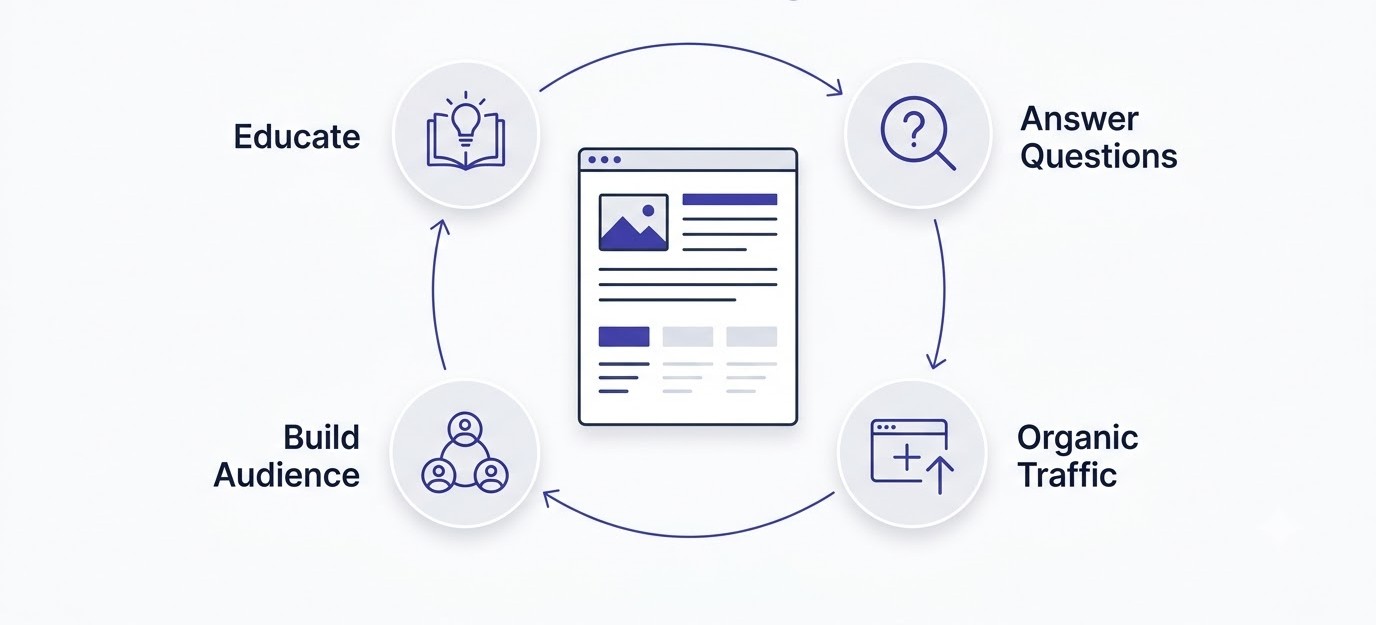
A blog post is a piece of website content published on a regular schedule, usually written to educate readers, answer a specific question, or share a perspective, with the underlying goal of attracting organic search traffic and building a relationship with an audience over time.
Definition and What Actually Qualifies
Look, not everything published under a “/blog/” URL is automatically a blog post in the strategic sense. A real blog post has a specific job: it targets a keyword or a question someone is actually searching, and it answers that question in a way that’s genuinely useful, not just filler wrapped around a product mention.
Blogging started as personal online journaling back in the late 90s and early 2000s. People wrote about their lives, their opinions, whatever was on their mind that week. Business blogging evolved from that but flipped the purpose. Instead of “here’s what I think,” it became “here’s what you need to know.” That shift is exactly why blog posts today read less like diaries and more like practical guides. The personal voice stuck around (that’s why blog posts still use “you” and first-person language), but the intent behind them changed completely.
Evolution of Blogging Into a Strategic SEO Format
Modern blog posts are shaped by two forces: what Google’s algorithm rewards and what readers actually want when they type a question into a search bar. Google’s Helpful Content System, which rolled out its updates across recent years, specifically targets content written primarily for search engines instead of people. That means the blog posts ranking today aren’t the keyword-stuffed 300-word posts from a decade ago. They’re comprehensive, they answer follow-up questions before the reader even asks them, and they’re written by people who actually understand the topic.
Main Purpose of a Blog Post
Educate. A blog post exists to teach the reader something they didn’t know before they clicked. If someone finishes reading and still doesn’t understand the topic better than when they started, the post failed at its one job.
Solve a specific problem. The best-performing blog posts target a narrow, specific problem. Not “marketing tips” but “why your email open rate drops after the first campaign.” Specificity is what makes a post rank and what makes readers trust the site enough to come back.
Build trust over time. One blog post rarely converts anyone into a customer. But ten blog posts on related topics, all genuinely useful, start building the kind of trust that makes someone eventually buy from you instead of a competitor they’ve never heard from twice.
Attract long-tail organic traffic. Blog posts are how most websites capture the huge volume of long-tail searches (three, four, five-word queries) that individually don’t get much search volume but collectively add up to the majority of a site’s organic traffic.
Common Structure of a Blog Post
Most well-performing blog posts follow a predictable skeleton, and there’s a reason for that: it works for both readers and search engines.
- Title: Usually includes the primary keyword and a clear promise of what the reader will get
- Introduction: Sets up the problem and tells the reader what’s coming
- Table of contents: Especially useful for longer posts, and it helps Google understand the page structure
- Main sections (H2s and H3s): Break the topic into digestible, scannable chunks
- FAQs: Answer related questions that didn’t fit naturally into the main body
- CTA: Usually soft, like “subscribe to our newsletter” or “check out our related guide on X”
Types of Blog Posts You’ll See Most Often
There isn’t just one kind of blog post. Different formats work for different goals:
How-to guides and tutorials walk readers through completing a specific task step by step. These tend to rank well because they match “how do I” search queries directly.
List posts (“10 email marketing tools for small teams”) are easy to skim and tend to get shared more because they’re structured for quick consumption.
Beginner guides target people who are new to a topic entirely. These usually have high search volume but also high competition, since everyone wants to rank for “beginner’s guide to X.”
Case studies show real results from real work. These build credibility in a way generic advice can’t, because they include actual numbers and outcomes.
Comparison posts (“Mailchimp vs Constant Contact”) capture commercial investigation intent, meaning readers who are close to a decision but still comparing options.
Opinion posts share a specific point of view on an industry trend. These work well for building a personal or brand voice, though they generally rank for less search volume than practical guides.
Industry news posts cover recent developments in a niche. These need to be published fast to catch search interest while it’s active.
Product roundups and checklists round out the list, giving readers quick-reference content they’re likely to bookmark or share.
SEO Benefits of Blog Posts
Blog posts are the backbone of most SEO strategies, and here’s specifically why. Keyword targeting works best in blog format because you can create dozens of posts, each one targeting a different long-tail variation of your core topics, without repeating content. Featured snippets overwhelmingly favor blog-style content because Google’s snippet algorithm looks for clear, direct answers formatted in lists, tables, or short paragraphs, exactly what a well-structured blog post provides. Internal linking opportunities multiply with every blog post you publish, since each new post is another chance to link back to your cornerstone content and landing pages. Topical authority builds through volume and depth of coverage. A site with 50 blog posts covering every angle of “email marketing” looks far more authoritative to Google than a site with 3 pages mentioning it in passing. And long-tail traffic compounds. Individually, long-tail keywords don’t bring huge traffic, but stacked across dozens of posts, they often outperform a handful of high-competition head terms.
Advantages of Blog Posts
They’re relatively fast to produce compared to in-depth articles. They scale well, meaning you can publish frequently without exhausting your core topics. They build long-term organic traffic that keeps working after you’ve moved on to other projects. And they create endless internal linking opportunities that strengthen your entire site’s SEO.
Limitations of Blog Posts
They rarely convert on their own. Most readers aren’t ready to buy when they land on a blog post; they’re still in research mode. They also require consistency; a blog that publishes once every four months loses momentum and relevance fast. And low-quality blog posts, the kind written just to hit a publishing quota, can actually hurt a site’s overall authority under Google’s current quality systems.
Real-World Examples of Strong Blog Posts
HubSpot’s blog is the textbook example: practical, specific, updated regularly, and structured almost entirely around answering search queries directly. Backlinko’s posts go deep on single topics (their guide to on-page SEO factors runs thousands of words) and rank for competitive terms because of that depth. Both show the same pattern: specific problem, thorough answer, soft CTA at the end.
What Is an Article?
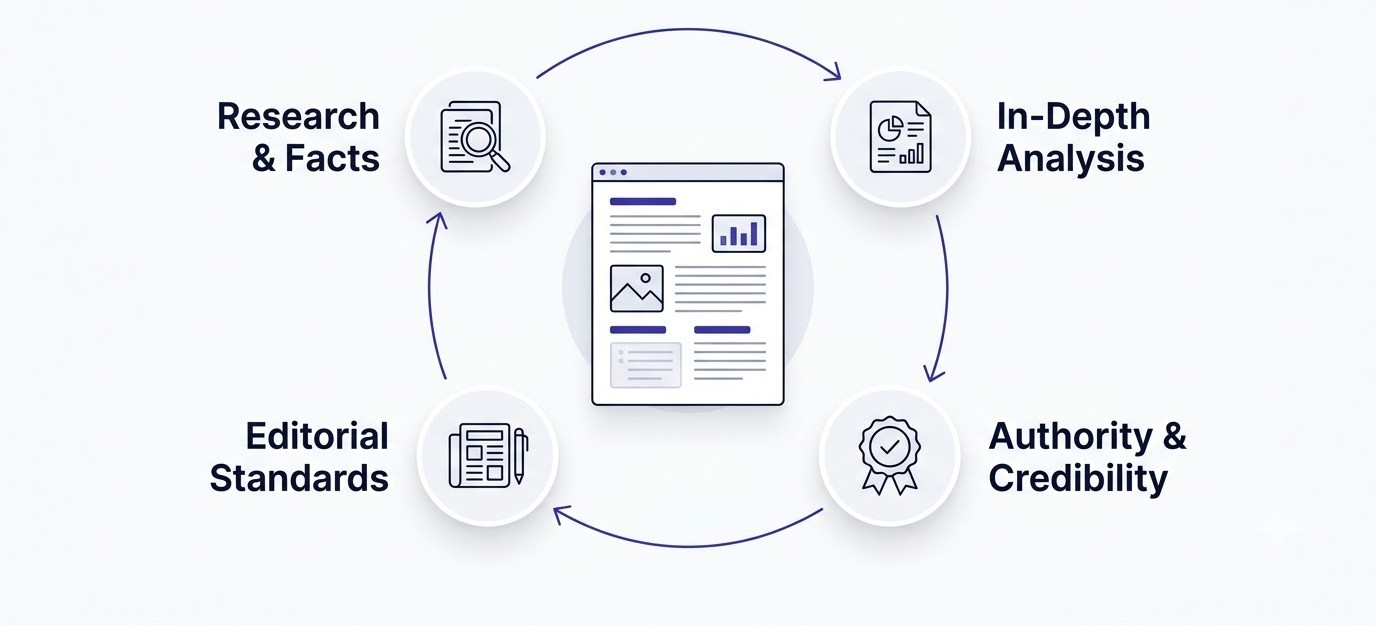
An article is a piece of researched, fact-based content, often written in a more formal or journalistic tone, designed to inform or analyze a topic in depth rather than sell something, and it’s the format most associated with authority, credibility, and editorial standards.
Definition Across Different Contexts
The word “article” gets used loosely, so let’s separate the actual categories. Traditional journalism articles report on events with a focus on facts, sources, and objectivity. Editorial articles offer analysis or opinion from a publication’s staff, still grounded in research but with more voice. Online articles, the kind you’ll find on business websites and digital publications, blend journalistic structure with SEO awareness. Academic articles follow strict citation and peer-review standards, way more rigorous than anything you’ll publish on a company site. Magazine articles sit somewhere in between, often longer-form and narrative-driven, built around a central thesis rather than a keyword.
For most businesses writing content today, “article” usually means something closer to online articles and thought leadership pieces: researched, credible, less promotional than a blog post, and written to build authority rather than immediately drive traffic to a purchase.
Primary Objectives of an Article
Inform. Articles exist primarily to give readers accurate, well-researched information on a topic, not to nudge them toward a purchase decision.
Analyze. Where a blog post might just explain “how to do X,” an article often goes further, examining why something works, what the data shows, or what different experts and sources say about a topic.
Report. News and industry articles document what happened, when, and why it matters, sourced from verifiable facts rather than opinion.
Research-driven. Good articles cite sources, reference studies, and back up claims with evidence instead of just assertions.
Educate at depth. Articles tend to go deeper into complexity than blog posts, assuming a reader who already has some baseline knowledge and wants the fuller picture.
Characteristics That Set Articles Apart
Articles carry a formal tone. You won’t usually see “yeah, here’s the thing” in a well-written article the way you might in a casual blog post. They’re fact-based, built on verifiable claims rather than personal anecdotes. They’re research-backed, often citing named sources, studies, or data points rather than relying on general statements. They’re less promotional, meaning a well-written article rarely pitches a product directly; the goal is credibility, not conversion. And they carry higher authority signals, which is exactly why other sites are more likely to link to a well-researched article than to a casual blog post.
Types of Articles, Explained in More Depth
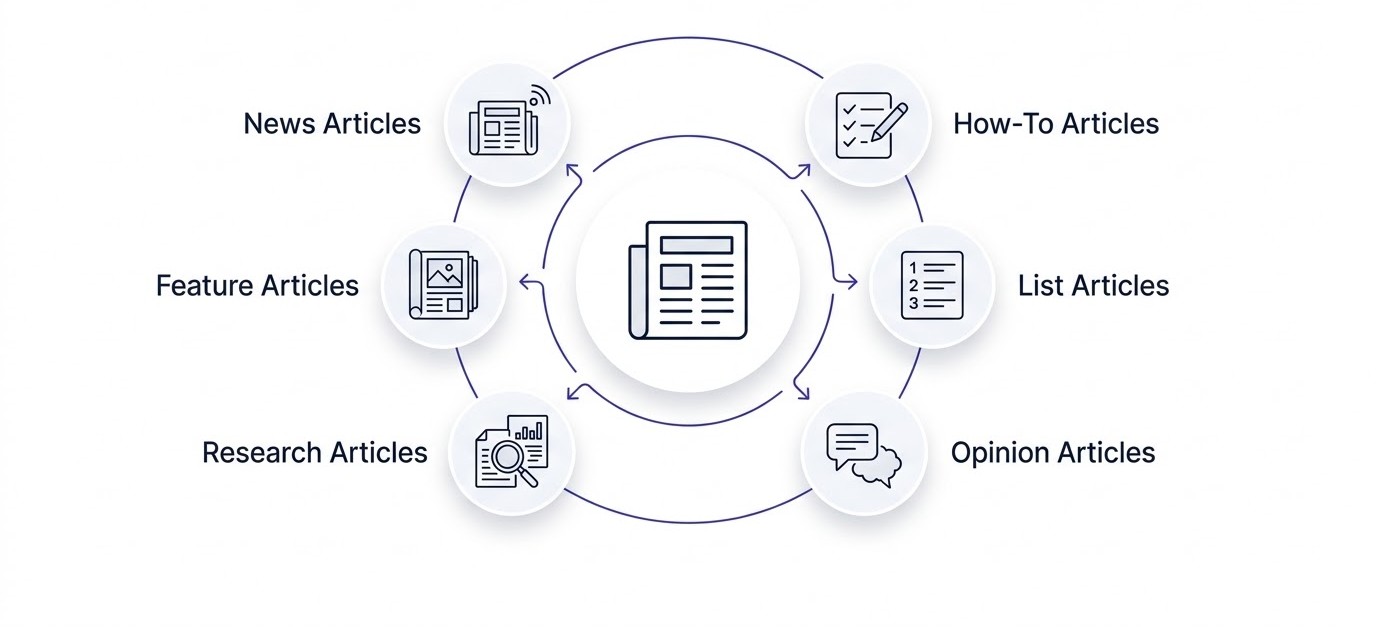
Here’s the thing about “article” as a category, it’s actually a container for a bunch of pretty different formats, and each one plays a different role depending on what a business or publication is trying to achieve. Let’s break each one down properly.
News Articles
These are built for speed. When something happens in an industry, a product launch, a regulatory change, a company shutting down, news articles exist to report it fast, before the story goes cold. The writing style stays lean on purpose: short paragraphs, facts up front, minimal interpretation. You won’t see much personality here. The whole point is getting accurate information out quickly, not building a personal voice. News articles also tend to have a short shelf life. They’re valuable in the days right after publishing, then they mostly serve as a historical record. If you’re writing these for a business blog, think product updates, funding announcements, partnership news, stuff people are actively searching for right when it happens.
Editorial Articles
This is where a publication or a specific writer gets to have an opinion, but it’s not just a rant. Editorial pieces are still grounded in research and facts, they just layer a clear point of view on top of that foundation. Think of it as “here’s what happened, and here’s what I think it means.” A good editorial doesn’t just state an opinion, it earns it by walking the reader through evidence first. This format works well when a company wants to comment on an industry shift, like a new regulation or a major competitor’s move, without it reading like a neutral news report. The voice matters more here than in straight news writing.
Feature Articles
Feature articles go deep on one subject, and “deep” is the operative word. These often involve actual interviews, original reporting, maybe even fieldwork, not just desk research pulled from other sources. A feature might profile a person, unpack a trend over months of reporting, or explore an issue from multiple angles. They take longer to produce because you’re not just summarizing what’s already out there, you’re adding something new to the conversation. For a business, a feature article might mean interviewing customers about how they solved a specific problem, or profiling an expert in the space. The reporting itself is the value, not just the writing.
Research Articles
These are built entirely around original data. A company runs its own survey, pulls internal usage data, or commissions a study, then publishes the findings as an article. This format has become huge in B2B and SaaS content marketing specifically because original data is one of the few things competitors genuinely can’t copy. You can rewrite someone’s opinion piece in your own words, but you can’t fake their survey results. Research articles tend to earn backlinks like nothing else, because journalists and other writers need something to cite, and “we surveyed 500 marketers and found X” is exactly the kind of citable fact that gets linked to again and again.
Thought Leadership Pieces
These are personal by design. Usually written in first person, usually carrying a strong, specific point of view, thought leadership exists to position one person, or sometimes a brand, as someone worth listening to on a given topic. The goal isn’t neutral reporting, it’s “here’s what I’ve learned from doing this work, and here’s why I think most people are getting it wrong.” This format works best when the writer actually has real experience to draw from. A thought leadership piece from someone who’s never done the work reads hollow fast. Readers can tell the difference between someone who’s lived through the problem and someone who’s just theorizing about it.
Opinion Articles
Opinion pieces argue a specific position, and unlike editorials, they’re usually clearly labeled as perspective rather than something trying to pass as neutral coverage. The writer picks a side and defends it. What separates a good opinion article from just noise is that it still needs to be grounded, you’re not just saying “I think X,” you’re building a case for why X is true, addressing the counterargument, and backing claims with something real. These work well for controversial or actively debated topics within an industry, where taking a clear stance actually adds value instead of just restating the obvious.
Industry Reports
These are the heavyweights. Industry reports compile data and trends into one comprehensive resource, often pulling from multiple sources, sometimes combined with a company’s own research. Because they take so much work to put together and carry so much value, they’re frequently gated behind an email signup, the classic “download the full report” lead magnet. A good industry report doesn’t just dump data, it interprets it, points out what’s changed year over year, and gives readers something they can actually act on. These tend to become reference material other people cite for months or years after publishing, which makes them one of the highest-ROI content formats when done well.
Structure of a Well-Built Article
- Headline: Clear and specific, often less keyword-stuffed than a blog title, prioritizing credibility over search volume
- Lead: The opening paragraph that summarizes the core point, following the classic journalism principle of putting the most important information first
- Body: Organized logically, building the argument or explanation section by section
- Evidence: Data, quotes, statistics, or named sources that back up the claims made
- Sources: Citations or links to where the information came from
- Conclusion: Ties the analysis together without introducing new claims
The SEO Role Articles Play
Articles do different SEO work than blog posts, and this is where a lot of people get confused. Articles build authority rather than volume. E-E-A-T (Experience, Expertise, Authoritativeness, Trustworthiness) is Google’s framework for evaluating content quality, and well-researched articles are exactly the format that satisfies it best, especially when they’re written by someone with real credentials on the topic. Backlinks come more naturally to articles than blog posts because other writers and journalists cite original research and well-sourced analysis far more often than they cite a listicle. And topical expertise signals strengthen when a site publishes articles that go deeper than surface-level blog content on the same subjects.
Advantages of Articles
They earn more backlinks because they’re citable. They build stronger domain authority over time. They position a brand or individual as a genuine expert rather than just another company selling something. And they age better; a well-researched article stays relevant longer than a trend-driven blog post.
Limitations of Articles
They take longer to produce because research takes time. They generate far fewer conversions directly. And they require actual subject-matter depth; you can’t fake expertise in an article the way you sometimes can in a quick how-to blog post.
Real-World Examples of Strong Articles
Ahrefs’ data-driven studies (like their analysis of how many websites rank without backlinks) work as articles because they present original research most sites can’t replicate. The New York Times’ industry coverage follows classic journalism structure, lead first, evidence throughout, minimal promotional language. Both earn citations because they’re built on something solid, not opinion dressed up as fact.
What Is a Landing Page?
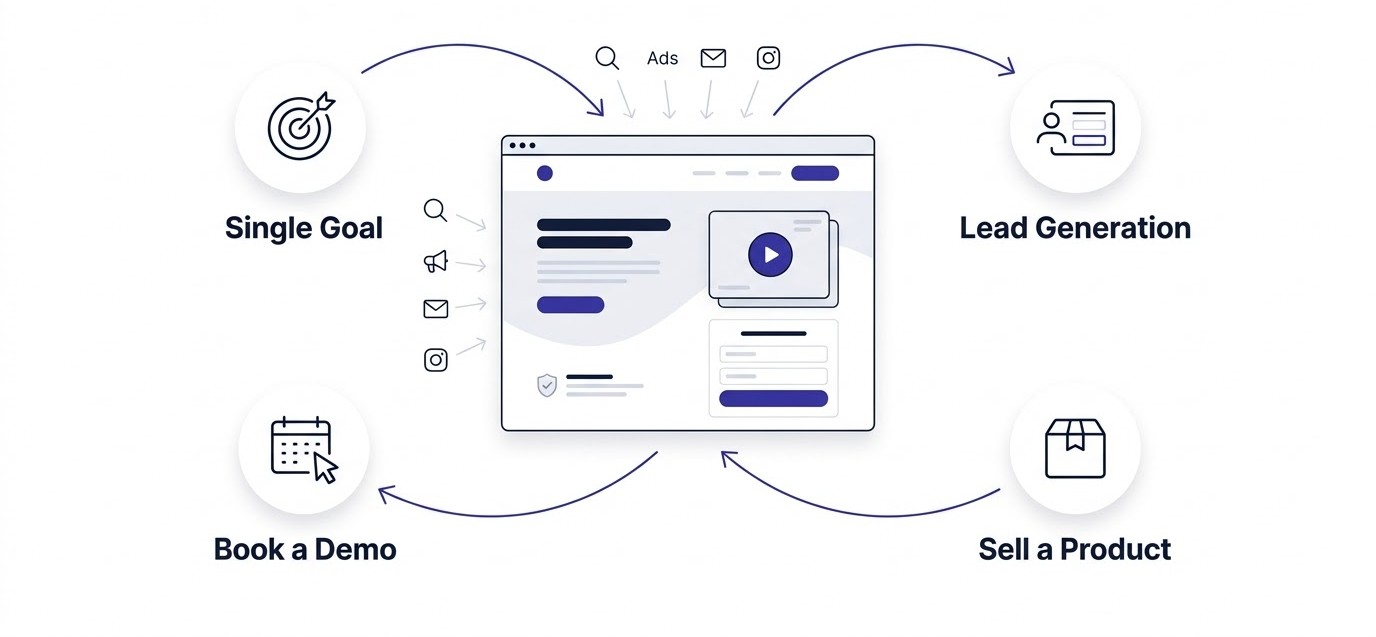
A landing page is a standalone webpage built around a single, specific conversion goal, whether that’s generating a lead, selling a product, or getting someone to book a demo, and unlike a blog post or article, it isn’t trying to educate broadly; it’s trying to move one specific type of visitor toward one specific action.
Definition and Core Function
A landing page is a dedicated conversion page. It exists for one job, and everything on it should push toward that job. Landing pages are frequently campaign-specific, built to match the exact messaging of a Google Ads campaign, an email sequence, or a social media promotion. They’re standalone webpages, meaning they usually aren’t part of the main site navigation and don’t link out to a dozen other pages the way a blog post does. That’s intentional. Every distraction on a landing page is a chance for the visitor to leave without converting.
Purpose: Why Landing Pages Exist
Generate leads. Most B2B landing pages exist purely to capture an email address or phone number in exchange for something valuable, a guide, a free trial, a consultation.
Sell products. E-commerce and direct-to-consumer brands use landing pages to make the sale directly, often skipping the usual product page format for something more persuasive and focused.
Book demos. SaaS companies live and die by demo bookings, and landing pages built specifically around “book a demo” convert far better than a general homepage would.
Collect emails. Lead magnets (free templates, checklists, mini-courses) get their own landing pages because a focused page converts better than burying the offer inside a blog post.
Encourage sign-ups. Free trials, webinars, newsletters, all of these rely on landing pages designed around a single sign-up action.
Core Components of a Landing Page
Hero section: The first thing visitors see, and it needs to communicate the offer within seconds.
Strong headline: Usually benefit-driven rather than keyword-driven, answering “what’s in it for me” immediately.
Benefits: What the visitor actually gains, not just a feature list.
Features: The specifics of what’s being offered, but always tied back to a benefit.
Social proof: Testimonials, customer counts, review scores, anything that reduces the visitor’s hesitation.
Trust badges: Security certifications, payment logos, industry certifications, small details that reduce perceived risk.
CTA: The single action you want the visitor to take, repeated at multiple points on the page.
Contact form: Kept as short as possible; every extra field reduces conversion rate.
Types of Landing Pages
Lead generation pages trade something valuable for contact information.
Click-through pages warm up a visitor before sending them to a purchase page, common in higher-priced or more complex sales.
Sales pages go straight for the purchase, often longer and more persuasive than other landing page types.
Webinar registration pages focus entirely on getting a sign-up for a scheduled event.
Product launch pages build anticipation and capture early interest before a full release.
SaaS landing pages typically push toward a free trial or demo, tailored to a specific use case or industry.
Local service landing pages target a specific city or region, common for contractors, law firms, and healthcare providers.
Event landing pages handle registration and information for conferences or in-person events. App download pages are optimized entirely around getting a visitor to hit “install.”
SEO Considerations for Landing Pages
Here’s something a lot of people get wrong:
landing pages absolutely can rank on Google, but they don’t rank the same way blog posts do.
Local SEO landing pages rank well for city or region-specific searches, especially when paired with proper local business schema and Google Business Profile optimization.
PPC landing pages aren’t usually built with organic ranking as the goal at all; they’re designed to match ad copy and convert traffic that’s already paying to arrive.
Organic landing pages, the ones meant to rank without ad spend, need more content depth than a typical short landing page, which is why some businesses build hybrid pages that combine landing page persuasion with blog-post-level information.
Advantages of Landing Pages
They convert far better than blog posts or articles because everything on the page pushes toward one action. They’re measurable; you can track exact conversion rates, something much harder to isolate on a blog post. And they’re flexible for testing; A/B testing headlines, CTAs, and layouts on a landing page produces clear, actionable data fast.
Limitations of Landing Pages
They rarely rank organically without significant content depth added. They can feel disconnected from the rest of a site if not linked properly. And a poorly written landing page with weak copy can actually hurt conversion rates more than having no dedicated page at all, since it wastes paid traffic.
Real-World Examples of Strong Landing Pages
Unbounce’s own landing pages practice what they preach: single CTA, minimal navigation, heavy social proof. Webflow’s product landing pages balance persuasive copy with just enough SEO structure to rank for some branded and feature-specific searches. Both show the same principle: strip away everything that isn’t pushing toward the conversion goal.
The Difference Between a Blog Post, Article, and Landing Page: Side-by-Side Breakdown
Now that you’ve seen each format individually, here’s where it actually clicks. The difference between a blog post, article, and landing page isn’t really about length or topic. It’s about what job the page is doing and what the reader expects when they land on it.
Purpose Comparison
A blog post’s purpose is to educate and build a relationship over time. An article’s purpose is to inform and establish authority through research. A landing page’s purpose is to convert, full stop. If you remember nothing else from this guide, remember this: match the format to the job, not the other way around.
Search Intent Comparison
Informational intent (“what is email marketing”) matches blog posts and articles best, since the searcher wants to learn, not buy. Navigational intent (“Mailchimp login”) doesn’t really apply to any of these three formats; it’s its own category entirely. Commercial intent (“best email marketing tools for small business”) sits in a gray zone; comparison blog posts work here, but so do well-built landing pages if the searcher is close to a decision. Transactional intent (“email marketing services near me” or “sign up for Mailchimp”) is landing page territory almost exclusively.
SEO Comparison
Blog posts have the highest ranking potential for long-tail, informational keywords because Google favors depth and specificity for these queries. Articles rank well for competitive, authority-driven terms and earn the backlinks that lift a site’s overall domain strength. Landing pages rank narrowest, typically for local or highly specific commercial terms, and usually need significantly more content added to compete organically at all.
Internal linking strategy differs too. Blog posts link outward constantly, to other posts, to landing pages, to resources. Articles link more selectively, mostly to sources and closely related content. Landing pages link minimally on purpose, since every outbound link is a chance for the visitor to leave before converting.
Conversion Comparison
Blog posts use soft CTAs: “subscribe,” “read more,” “check out our related guide.” Articles often skip CTAs almost entirely, prioritizing credibility over selling. Landing pages use hard CTAs: “buy now,” “book a demo,” “start your free trial,” repeated multiple times down the page.
Writing Style Comparison
Blog posts read conversationally, like a knowledgeable friend explaining something. Articles read more formally, like a well-informed reporter or analyst. Landing pages read persuasively, every sentence built to move the reader one step closer to converting.
Content Length Comparison
There’s no universal rule, but typical ranges look like this: blog posts run 1,000 to 3,000 words depending on topic complexity. Articles often run 1,500 to 4,000 words, especially research-heavy pieces. Landing pages run shorter, usually 300 to 1,500 words, though some high-ticket sales pages run much longer when they need to overcome significant buyer hesitation.
Update Frequency Comparison
Blog posts get updated most frequently, since search algorithms and industry information shift constantly. Articles get updated occasionally, mostly when new data becomes available. Landing pages get updated rarely once they’re converting well, since businesses tend to avoid touching something that’s already working, though testing new headlines or offers is common.
Reader Journey and Funnel Stage Comparison
This is the piece that ties everything together. Blog posts sit at TOFU (top of funnel), where readers are just becoming aware of a problem. Articles sit closer to MOFU (middle of funnel), where readers are evaluating options and want deeper, credible information. Landing pages sit at BOFU (bottom of funnel), where the reader already knows what they want and just needs the final push to act.
When Should You Use a Blog Post?
Use a blog post when your goal is organic SEO growth, brand awareness, or answering the specific questions your audience is already searching for, especially early in their decision-making process.
Ideal Scenarios for Blog Content
Blog posts work best for content marketing efforts aimed at long-term traffic growth rather than immediate sales. They’re the primary engine for organic SEO, since search engines reward sites that consistently publish specific, useful content. They build brand awareness by putting your expertise in front of people who haven’t heard of you yet. They’re the natural format for answering questions, since most blog posts exist to match a specific search query directly. And they build thought leadership over time, especially when a specific person at the company consistently shares genuine insight rather than generic advice.
Best Industries for Blog Content
SaaS companies rely heavily on blogs to capture searches related to the problems their software solves, not just the software itself. Healthcare providers use blogs to answer patient questions and build trust before someone books an appointment. Education platforms use blogging to demonstrate teaching quality and cover topics students are actively searching. Marketing agencies blog constantly, partly because it’s expected, and partly because it directly demonstrates their skill. Finance brands use blogs to simplify complex topics and build trust around money decisions, which people research heavily before committing to. Real estate agents and agencies blog about local markets, buying guides, and neighborhood information to capture local search intent. E-commerce brands use blogs to answer product-related questions and capture searches that happen before someone’s ready to buy.
When Should You Use an Article?
Use an article when your goal is building topical authority, earning backlinks, or presenting original research and analysis that a simple blog post format can’t properly support.
Best Use Cases for Article Content
Research-driven content works best as an article because it needs the space and formal tone to present data properly. Industry insights pieces, the kind that break down trends or shifts in a market, carry more weight in article format than as a casual blog post. Editorial publications naturally require article structure since that’s the format their audience expects. A corporate knowledge base benefits from article-style writing when covering complex, technical, or policy-related topics that need precision over casual tone. And news websites, obviously, run almost entirely on article format, since that’s the entire point of the medium.
When Should You Use a Landing Page?
Use a landing page when you have one specific conversion goal and traffic that’s already warmed up enough to act, whether that traffic comes from paid ads, email campaigns, or a specific offer.
Best Situations for Landing Pages
Google Ads campaigns need matching landing pages, not homepages, because Google’s Quality Score rewards message match between ad copy and landing page content. Facebook Ads work the same way; sending paid social traffic to a generic page tanks conversion rates. A product launch deserves its own landing page to build focused anticipation rather than diluting attention across the main site. Lead magnets (free guides, templates, checklists) need dedicated pages so the offer stays the sole focus. Webinars require registration pages built entirely around getting the sign-up, with no distractions. Consultation bookings convert far better through a focused landing page than through a general contact page. Demo requests for SaaS products need the same focused treatment. And local SEO campaigns benefit from location-specific landing pages that combine conversion focus with enough local content depth to actually rank.
Which Content Type Is Best for SEO?
There’s no single winner here, and honestly, anyone who tells you one format is “best for SEO” across the board doesn’t fully understand how Google evaluates different query types.
Google’s Perspective on Content Types
Google’s Helpful Content System doesn’t favor blog posts over articles or landing pages inherently. It favors content that matches search intent and demonstrates real expertise, regardless of format. Search intent alignment is the actual deciding factor: if someone’s searching to learn, a landing page won’t rank no matter how well-optimized it is, and if someone’s searching to buy, a 3,000-word blog post won’t either. User experience matters across all three formats: fast load times, mobile responsiveness, and clear structure affect rankings regardless of whether it’s a post, article, or landing page. E-E-A-T signals get evaluated differently depending on format; articles are judged heavily on expertise and sourcing, while landing pages are judged more on trust signals like reviews, security certifications, and transparent business information. Content quality is universal: thin, generic content ranks poorly in any format.
Ranking Potential Compared
Blog posts have the broadest ranking potential because they can target thousands of long-tail variations across a site. Articles have strong ranking potential specifically for competitive, authority-driven terms, often outranking blog posts on head terms because of their backlink profile. Landing pages have the narrowest organic ranking potential, typically limited to branded terms, local terms, or highly specific commercial searches, unless significant content is added to support ranking.
Which Content Type Converts Better?
Landing pages win this comparison by a wide margin, and that’s by design, not accident.
Comparing Conversion Goals
If your goal is traffic, blog posts win easily. If your goal is leads, landing pages built around a specific offer outperform blog posts significantly, though blog posts can generate leads too when paired with strong lead magnets. If your goal is sales, landing pages are almost always the right format, especially for higher-consideration purchases. If your goal is email subscribers, dedicated landing pages for lead magnets convert better than a generic newsletter signup buried in a blog sidebar. And if your goal is demo bookings, a focused landing page will consistently outperform sending traffic to a general “contact us” page.
Conversion Optimization Tips That Actually Work
CTA placement matters more than most people realize; a CTA above the fold plus one at the end of the page typically outperforms a single CTA buried mid-page. Trust signals, like customer counts, review scores, and security badges, reduce hesitation at exactly the moment a visitor is deciding whether to convert. Copywriting focused on benefits rather than features consistently converts better, since visitors care about outcomes, not specifications. Social proof, especially specific testimonials with real names and results rather than vague praise, builds credibility fast.
Can a Blog Post Become a Landing Page?
Yes, sometimes, but it requires deliberately restructuring the content, not just adding a CTA button to an existing post.
Pros of Hybrid Blog-Landing Pages
Hybrid pages can rank organically like a blog post while still converting like a landing page, which is genuinely valuable for competitive niches where pure landing pages struggle to rank at all. They also work well for high-consideration purchases where visitors need substantial information before they’re ready to convert.
Cons of Hybrid Blog-Landing Pages
They’re harder to write well, since balancing informational depth with persuasive focus takes real skill. They also tend to convert at a lower rate than a pure landing page, since the extra content naturally introduces more chances for the visitor to get distracted or leave before reaching the CTA.
Examples of Hybrid Content Done Right
Long-form sales pages for online courses often blend blog-style education with landing page persuasion, walking readers through the problem, the solution, and the offer in one continuous piece. SaaS comparison pages sometimes work this way too, informing the reader about the category while steering them toward one specific product by the end.
Can an Article Be Used for SEO?
Yes, but it takes a strategic approach that balances editorial integrity with search visibility, since over-optimizing an article can strip away the authority that made it valuable in the first place.
Balancing Editorial Integrity and Search Visibility
The trick is optimizing around the edges without compromising the substance. Adding metadata, proper title tags and meta descriptions, helps articles get found without changing the actual writing. Schema markup, especially Article schema, helps Google understand and potentially feature the content in rich results. Internal links to related articles and blog posts keep the SEO value flowing through the site without turning the article itself into a sales pitch.
Can Landing Pages Rank on Google?
Yes, landing pages can rank, but only when they’re built with enough depth and the right technical foundation, which most short, ad-focused landing pages simply don’t have.
Ranking Factors for Landing Pages
Content depth matters; a landing page with 150 words of vague copy has almost no chance of ranking organically, no matter how well it converts paid traffic. Search intent alignment is critical; landing pages rank best for commercial and transactional queries, not informational ones. Internal linking from blog posts and articles pointing to the landing page signals relevance and authority to Google. Backlinks to landing pages are rarer than backlinks to blog content, but local business landing pages often earn them through directory listings and local partnerships. UX and Core Web Vitals (load speed, interactivity, visual stability) affect landing page rankings just as much as any other page type, arguably more, since landing pages are often built with heavy tracking scripts and marketing tools that can slow things down.
How Blogs, Articles, and Landing Pages Work Together
None of these three formats should exist in isolation. The real power shows up when they work together as a system, guiding a visitor from first discovering your brand all the way to converting.
The Content Marketing Funnel Explained
Awareness stage: Use blog posts. This is where you capture people who are just realizing they have a problem, searching broad, informational queries.
Consideration stage: Use articles. Once someone knows they have a problem, they start researching solutions more seriously, and that’s where in-depth, credible articles do their best work.
Decision stage: Use landing pages. By the time someone’s ready to choose a specific solution, they need a focused page that makes the decision easy, not another 2,000-word explainer.
A Practical Content Strategy Framework
Step 1: Build topic clusters with blog posts. Start broad, covering every angle of your core topics through multiple, specific posts that link back to a central pillar page.
Step 2: Publish authoritative articles. Layer in research-backed, deeper content that earns backlinks and builds credibility around your most important topics.
Step 3: Create optimized landing pages. Build focused conversion pages for your core products or services, matched to the specific search intent and campaigns driving traffic to them.
Step 4: Connect everything with internal linking. Blog posts should link to related articles and to relevant landing pages. Articles should link to supporting blog content and, where natural, to landing pages. Landing pages should link sparingly, mostly to build trust (case studies, testimonials) rather than send visitors away.
Step 5: Measure performance using analytics. Track organic traffic and keyword rankings for blog posts, backlinks and authority metrics for articles, and conversion rate for landing pages. Each format needs its own success metric, not one blended number.
Industry Examples of This Funnel in Action
SaaS companies typically run blog posts for feature-related and use-case searches, articles for industry trend analysis, and landing pages for each pricing tier or specific integration. Healthcare providers combine educational blog content about symptoms and conditions with appointment booking landing pages, connected through clear internal links. E-commerce brands use buying guides (blog posts) linked directly to relevant product pages (which function like landing pages) to capture research-stage shoppers and guide them toward purchase. Digital marketing agencies run SEO-focused blogs that funnel readers toward dedicated service landing pages once trust is established. Real estate businesses pair location-specific landing pages with supporting blog content on market trends, giving both search engines and buyers the full picture.
Case Study: One Topic, Three Formats
Let’s make this concrete. Take the topic “email marketing” and see how it changes shape depending on the format.
Blog Post Version: “10 Email Marketing Tips for Beginners”
Objective: Capture beginner-level searches and build topical authority around email marketing basics.
Structure: Numbered list format, each tip explained with a practical example.
CTA: Soft, something like “want more tips like this? Subscribe to our newsletter.”
SEO strategy: Targets long-tail, beginner-focused keywords with high search volume and lower competition.
Conversion focus: Minimal; the goal is traffic and trust, not immediate sales.
Target audience: People new to email marketing, likely small business owners handling marketing themselves.
Article Version: “The Evolution of Email Marketing: Trends, Research, and Best Practices”
Objective: Establish authority and earn backlinks by presenting original analysis and data.
Structure: Formal, research-driven, citing statistics and industry shifts over time.
CTA: Minimal to none; the focus stays on credibility.
SEO strategy: Targets competitive, authority-building terms and aims for citations from other sites.
Conversion focus: Indirect; builds trust that supports conversions elsewhere on the site.
Target audience: Marketing professionals and decision-makers researching the space seriously.
Landing Page Version: “Email Marketing Services for Small Businesses”
Objective: Convert visitors who already know they want help with email marketing into paying customers.
Structure: Hero section with a clear value proposition, benefits, testimonials, pricing, and a strong CTA.
CTA: Hard and repeated, “get a free consultation” or “start your free trial.”
SEO strategy: Targets transactional and local terms like “email marketing services near me.”
Conversion focus: Everything on the page.
Target audience: Business owners ready to hire help, not looking to learn.
Same topic. Three completely different jobs. That’s the whole point.
Best Practices for Each Content Type
Choosing the right content type is only the first step. To achieve your business goals, you also need to create each type of content using proven best practices. A well-written blog post can fail if it’s poorly structured, an authoritative article can lose credibility without proper research, and a landing page can generate little to no conversions if its messaging is unclear.
Understanding how to optimize each content type ensures you maximize traffic, engagement, trust, and conversions.
Blog Post Best Practices
Focus on user intent above everything else; know exactly what question the reader is trying to answer before you write a single word. Cover topics comprehensively rather than skimming the surface, since thin content struggles to rank in the current SEO environment. Use visuals like screenshots, charts, or diagrams to break up text and clarify complex points. And optimize specifically for featured snippets by answering key questions directly and clearly near the top of relevant sections.
Article Best Practices
Cite credible sources for every major claim, since unsupported statements undermine the authority an article is supposed to build. Provide original insights rather than just summarizing what’s already been said elsewhere. Maintain editorial quality throughout, meaning consistent tone, careful fact-checking, and clean structure. And build topical authority by covering a subject with genuine depth rather than surface-level coverage.
Landing Page Best Practices
Stick to one clear goal per page; a landing page trying to sell three different things converts worse than three separate focused pages. Lead with a strong headline that communicates the core benefit immediately. Write persuasive copy that focuses on outcomes, not just features. Include social proof wherever possible, since trust signals directly influence conversion rates. Keep distractions minimal by removing unnecessary navigation and links. And prioritize fast loading speed, since even small delays measurably hurt conversion rates on high-intent pages.
Tools to Create Better Content
Having the right tools makes a real difference in execution, regardless of which content type you’re building.
SEO Tools
Google Search Console shows exactly which queries are already bringing traffic to your site, which is invaluable for spotting content gaps. Google Analytics 4 tracks user behavior across all three content types, helping you see where visitors drop off. Ahrefs and Semrush both offer keyword research and competitor analysis that inform which topics deserve blog posts versus articles versus landing pages. Screaming Frog crawls your site to catch technical SEO issues that could be holding back rankings on any page type.
Writing Tools
Grammarly catches grammar and clarity issues across drafts. ChatGPT can help with brainstorming and outlining, though final content should always be reviewed and rewritten for genuine human voice and accuracy. Hemingway Editor flags overly complex sentences, which is especially useful for landing page copy that needs to read fast and clear.
Landing Page Builders
Unbounce, Leadpages, Instapage, Elementor, and Webflow all let marketers build and test landing pages without needing a developer for every change, which matters when you’re running multiple campaign variations.
Heatmaps and CRO Tools
Hotjar and Microsoft Clarity show exactly how visitors interact with a page, scroll depth, click patterns, where attention drops off, which is essential data for improving landing page conversion rates over time.
Conclusion
At the end of the day, the difference between a blog post, article, and landing page comes down to one question: what do you want this specific page to do? Blog posts build awareness and long-term organic traffic by answering the questions your audience is already searching. Articles build credibility and authority through research-backed depth that earns trust and backlinks. Landing pages convert, plain and simple, by stripping away distraction and focusing entirely on one action.
None of these formats is inherently better than the others. They’re just built for different jobs, and the businesses that grow fastest online are usually the ones that stop treating “content” as one generic bucket and start matching the right format to the right stage of the reader’s journey. A visitor searching “what is email marketing” needs a blog post. Someone researching industry trends before a big decision needs an article. Someone ready to sign up needs a landing page, not another 2,000-word explainer standing between them and the CTA button.
So here’s the actual takeaway: go audit your website right now. Pull up your last ten published pages and ask honestly whether each one is doing the job it’s supposed to do, or whether it’s a blog post pretending to be a landing page, or a landing page trying too hard to educate instead of convert. Fix the mismatches first. That single audit will probably do more for your traffic and conversions than publishing ten new pieces of content ever could.
Frequently Asked Questions
Is a blog post the same as an article?
No. A blog post is typically more casual, conversational, and focused on SEO-driven, practical information, while an article is more formal, research-backed, and focused on building authority through credible analysis. They can overlap in length and depth, but the tone and underlying purpose usually differ.
Can a landing page have a blog?
Yes, though it’s technically a separate section of the site rather than part of the landing page itself. Many businesses link from their blog to relevant landing pages to guide readers from informational content toward a conversion point, which strengthens the overall content funnel.
Which ranks better on Google, a blog post or a landing page?
Blog posts generally rank better for informational search queries because Google favors depth and educational value for those searches. Landing pages can rank, but usually only for commercial or local intent queries, and typically need more content depth than a standard short landing page to compete organically.
Should every business have all three content types?
Most businesses benefit from having all three, but the exact mix depends on goals and resources. A local service business might rely heavily on landing pages and light blogging, while a SaaS company might invest heavily in all three to support a longer, more complex sales cycle.
Can a landing page be indexed by Google?
Yes, landing pages can be indexed and ranked just like any other webpage, as long as they aren’t blocked by robots.txt or a noindex tag. Some businesses intentionally noindex campaign-specific landing pages meant only for paid traffic, since duplicate or overly promotional pages can sometimes create SEO issues if left fully indexed.
How long should a blog post be?
There’s no fixed number, but most well-performing blog posts land somewhere between 1,000 and 3,000 words, depending on how much genuine depth the topic requires. The right length is whatever fully answers the reader’s question and covers related follow-up questions, no more padding, no less substance.
Are articles better than blog posts for earning backlinks?
Generally yes. Articles, especially ones built around original research, data, or expert analysis, tend to earn more backlinks than blog posts because other writers and journalists find them more citable. Blog posts can still earn links, particularly comprehensive guides, but articles typically have a stronger natural pull for external references.
Can I use the same content on both a blog post and a landing page?
It’s not recommended. Duplicating content across formats confuses both readers and search engines about which page should rank for a given query, and it wastes the unique strengths each format offers. Repurpose the core ideas, but rewrite the structure and tone to match the format’s actual purpose.
Do landing pages need SEO?
Yes, especially if you want any organic traffic beyond paid campaigns. Landing pages need proper title tags, meta descriptions, clean URL structure, and enough content depth to signal relevance to Google, even though their primary goal remains conversion rather than ranking.
What is the difference between a webpage and a landing page?
Every landing page is a webpage, but not every webpage is a landing page. A general webpage (like a homepage or an about page) usually serves multiple purposes and includes standard site navigation. A landing page is built around one specific, singular conversion goal, often with minimal or no standard navigation to keep visitors focused on that one action.
Can blog posts generate sales directly?
They can, but usually indirectly. Blog posts build trust and awareness that eventually lead to a purchase, but the sale typically happens after the reader has moved further down the funnel, often through a landing page, email sequence, or direct outreach that follows their initial blog visit.
How many CTAs should a landing page have?
Most well-converting landing pages repeat the same CTA two to four times throughout the page, once above the fold, once after the main benefits section, and once at the very end. The key is repeating the same action consistently rather than offering multiple competing calls to action, which can confuse visitors and lower conversion rates.
Are blog posts good for lead generation?
They can be, especially when paired with a strong lead magnet like a free template, checklist, or guide offered within or at the end of the post. On their own, without a specific offer, blog posts tend to generate awareness more than direct leads.
Should articles include target keywords?
Yes, but more subtly than blog posts. Articles should still include relevant keywords naturally within headlines and body text to support discoverability, but the primary focus should remain on accuracy, depth, and credibility rather than keyword density.
What’s the best content type for local SEO?
Landing pages built specifically for a city or service area tend to perform best for local SEO, especially when paired with proper local business schema, Google Business Profile optimization, and location-specific content. Blog posts covering local topics (like neighborhood guides) can support this strategy but usually work best as a complement to, not a replacement for, dedicated local landing pages.