


Here’s what nobody tells you when you start a blog: publishing content is easy. Publishing content that actually pulls people to your website, week after week, without you begging for shares in every group chat you’re part of, that’s a different game entirely. Most people confuse the two. They write a post, hit publish, post it on LinkedIn once, and then wonder why the traffic graph looks like a flat line with the occasional twitch.
Honestly, that’s not a content problem. That’s a strategy problem. You can write genuinely good stuff and still get zero traffic if there’s no plan behind what you’re writing, who it’s for, and where it fits into a bigger picture. Two blogs can publish the exact same number of posts in a year, and one ends up with a steady stream of visitors while the other stays invisible, and the difference almost never comes down to writing talent. It comes down to whether there was a plan behind the calendar or whether the calendar was the plan.
This guide walks through exactly how to build that plan from scratch, no fluff, no “just be consistent” advice that means nothing when you’re staring at a blank content calendar. By the end, you’ll know what a real content marketing strategy looks like and how to build one that’s actually built to bring traffic in, not just fill up a blog archive.
What Is a Content Marketing Strategy (And Why “Just Post Content” Doesn’t Work)
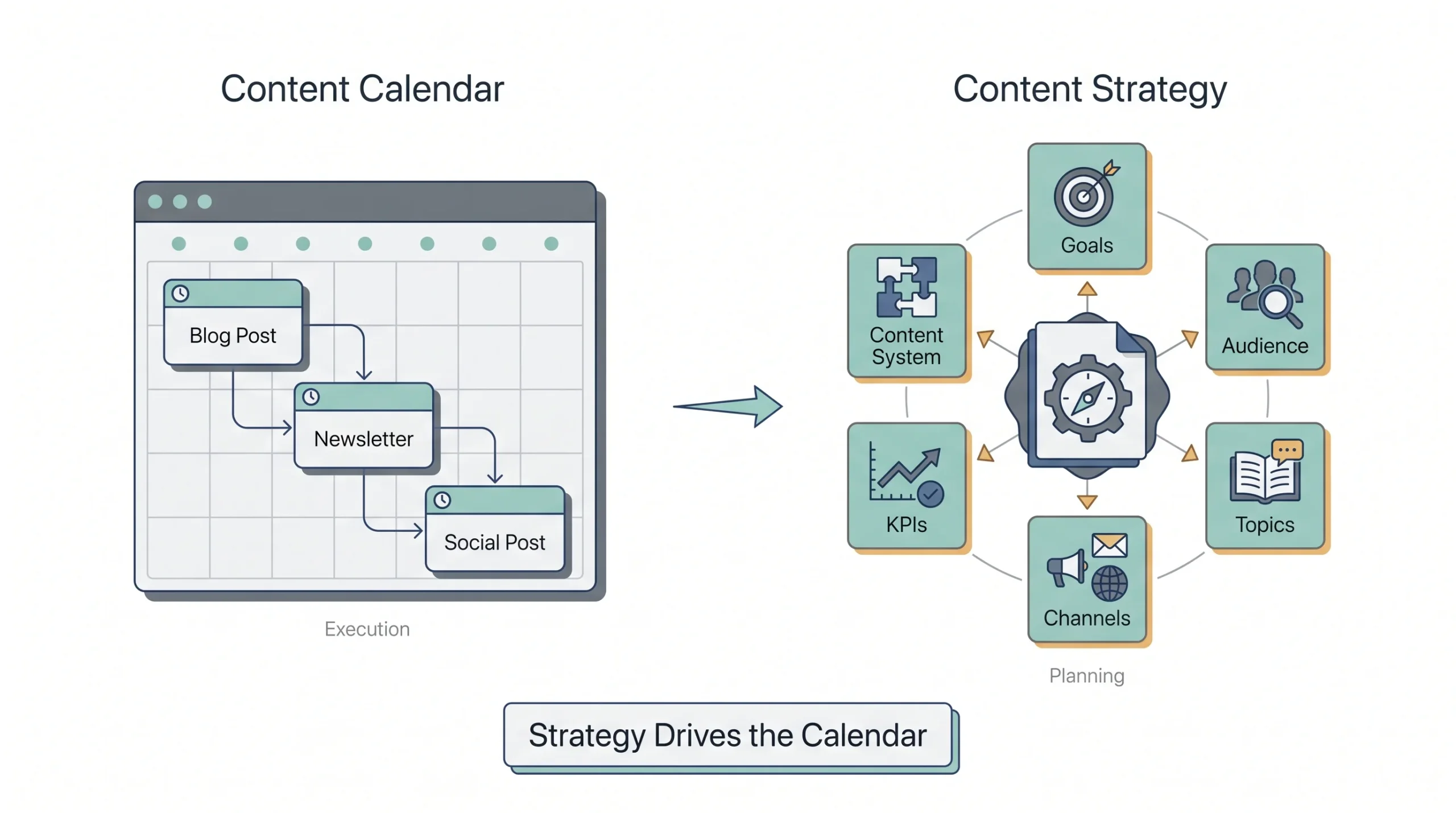
A lot of people mix up a content calendar with a content strategy, and that mix-up is probably the single biggest reason content marketing fails for small businesses and solo bloggers. A content calendar is just a schedule. It tells you Monday is the SEO post, Wednesday is the newsletter, Friday is the Instagram carousel. That’s it. It doesn’t tell you why you’re writing about those topics, who’s supposed to read them, or what happens after someone lands on the page.
A content strategy is the reasoning behind the calendar. It answers the questions that come before scheduling anything: What are we trying to achieve? Who exactly are we writing for? What topics actually move the needle for that audience? What format works best for each one? Where does this content live once it’s published, and how does it connect to everything else on the site? And how do we know, three months from now, whether any of it worked?
Skip that thinking, and you end up with a blog that’s technically active but strategically empty. Posts sit in isolation. Nothing links to anything else. There’s no clear success metric beyond “did anyone read it.” That’s the trap. Look at the difference laid out plainly:
| Content Calendar | Content Marketing Strategy |
|---|---|
| Lists dates and titles | Defines goals and audience first |
| Reactive, filled week to week | Planned around funnel stages |
| No clear success metric | Tied to measurable KPIs |
| Content lives in isolation | Content links and builds on itself |
A content calendar tells you when to post. A content marketing strategy tells you why you’re posting it in the first place.
The core pieces of a real strategy are goals, audience, topics, format, channels, cadence, and measurement. Miss any one of those and the whole thing gets shaky. Miss two or three and you’re basically just guessing with extra steps.
Define Your Content Marketing Goals (Traffic vs. Leads vs. Brand Awareness)
Here’s something that trips up a lot of beginners: “drive traffic” isn’t automatically the right goal for every piece of content, and sometimes it’s not even the right goal for the blog as a whole. Traffic feels like the obvious win because it’s visible, it’s a number that goes up, and it’s easy to screenshot. But traffic that doesn’t convert into anything is just a vanity number sitting in an analytics dashboard.
Broad topics with high search volume will absolutely bring in visitors. Something like “what is content marketing” gets searched a ton. But the people searching that phrase could be students, competitors doing research, or curious folks with zero intent to buy anything from you. Compare that to a narrower topic like “content marketing strategy for a 3-person marketing team,” which gets searched way less, but the person typing that in is probably actually building a team and actually needs help. Lower volume, higher intent. That’s the trade-off, and it’s one almost nobody explains clearly before throwing beginners into keyword research.
So the first real step isn’t picking topics. It’s deciding what the content is supposed to do for the business. Increase awareness? Get more qualified leads? Support sales conversations? Once that’s locked in, everything downstream gets easier to decide.
A useful way to frame this is a SMART goal. Not “get more traffic” but something like: “Increase organic blog traffic by 25% over the next quarter by publishing two SEO-optimized pillar posts per month.” Specific, measurable, tied to a timeline. That sentence alone will save weeks of confused planning later.
Here’s the part that’s easy to miss though. Goals shouldn’t just live at the blog level, they should apply per piece of content too. Before writing a single word, it helps to answer one question: what is this specific post supposed to do once it’s live? Not every post needs to convert. Not every post needs to rank number one. Some posts exist purely to get the brand in front of new eyes, some exist to nurture someone who’s already interested, some exist to close the deal. Writing every post as if it’s supposed to do all three at once is how you end up with content that does none of them particularly well, a how-to guide that suddenly pivots into a sales pitch halfway through, annoying the reader who just wanted the answer to their question.
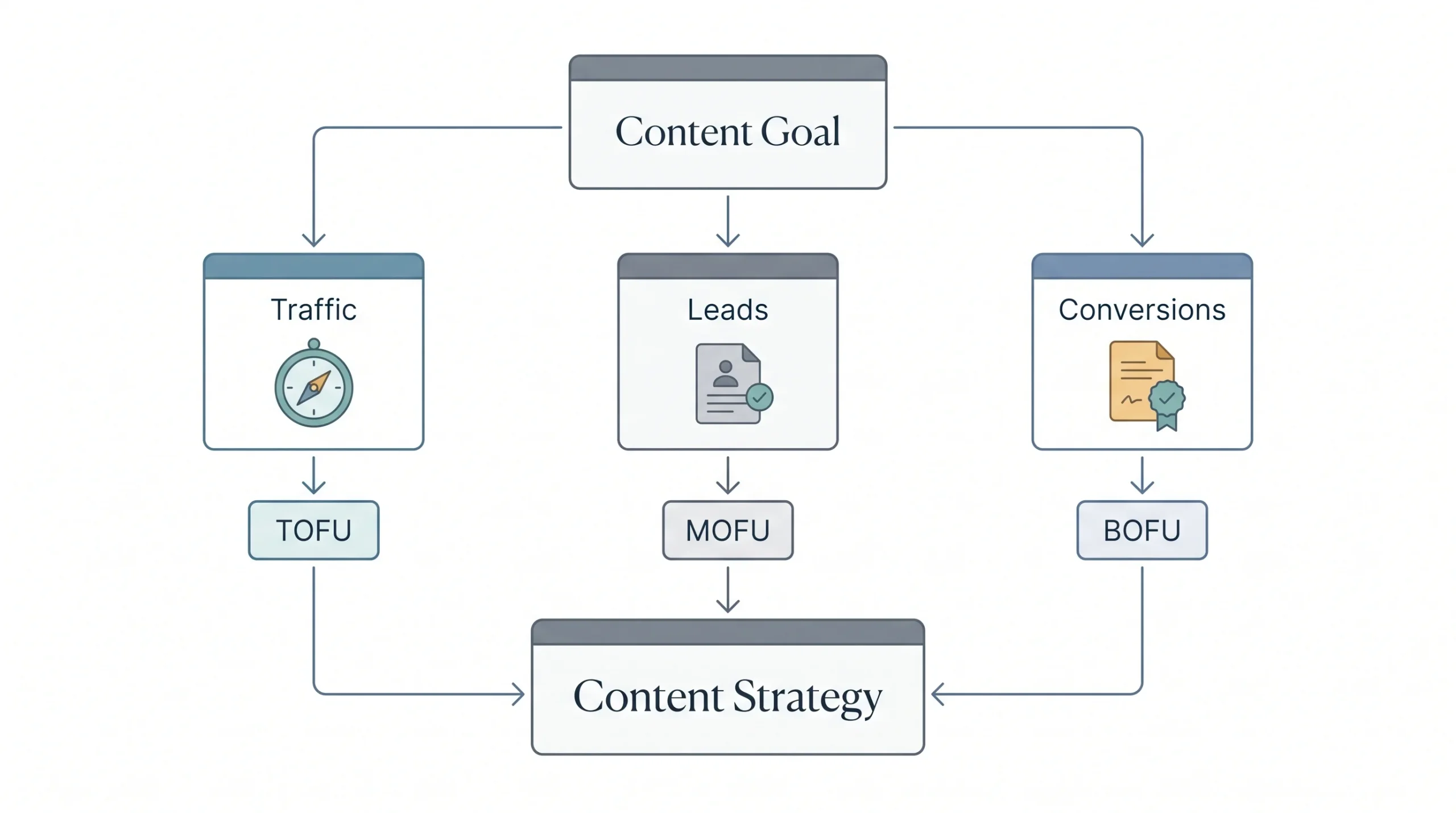
This is also where the funnel comes in, and it’s worth understanding early because it shapes almost every decision after this point. Content isn’t one-size-fits-all across the buyer journey. What works at the top doesn’t work at the bottom, and vice versa.
| Funnel Stage | Primary Goal | Example Content Type |
|---|---|---|
| TOFU (Top) | Traffic & awareness | Broad how-to guides, listicles |
| MOFU (Middle) | Engagement & trust | Comparison posts, case studies |
| BOFU (Bottom) | Conversion | Product-led content, demos, pricing guides |
TOFU content is the stuff designed to get found. It’s broad, it’s educational, it doesn’t push a sale, it just answers a question people are already searching for. MOFU content goes deeper. It’s for someone who already knows the topic and is now comparing options or trying to figure out if this approach even fits their situation. BOFU is for someone close to a decision. They don’t need convincing that the category matters anymore, they need reasons to pick you specifically.
If a business only writes TOFU content, they’ll get traffic but struggle to convert any of it. If they only write BOFU content, they’ll convert well but never get discovered in the first place because nobody’s searching “buy our product now” phrases. Balance across stages is the whole point.
Research and Understand Your Target Audience
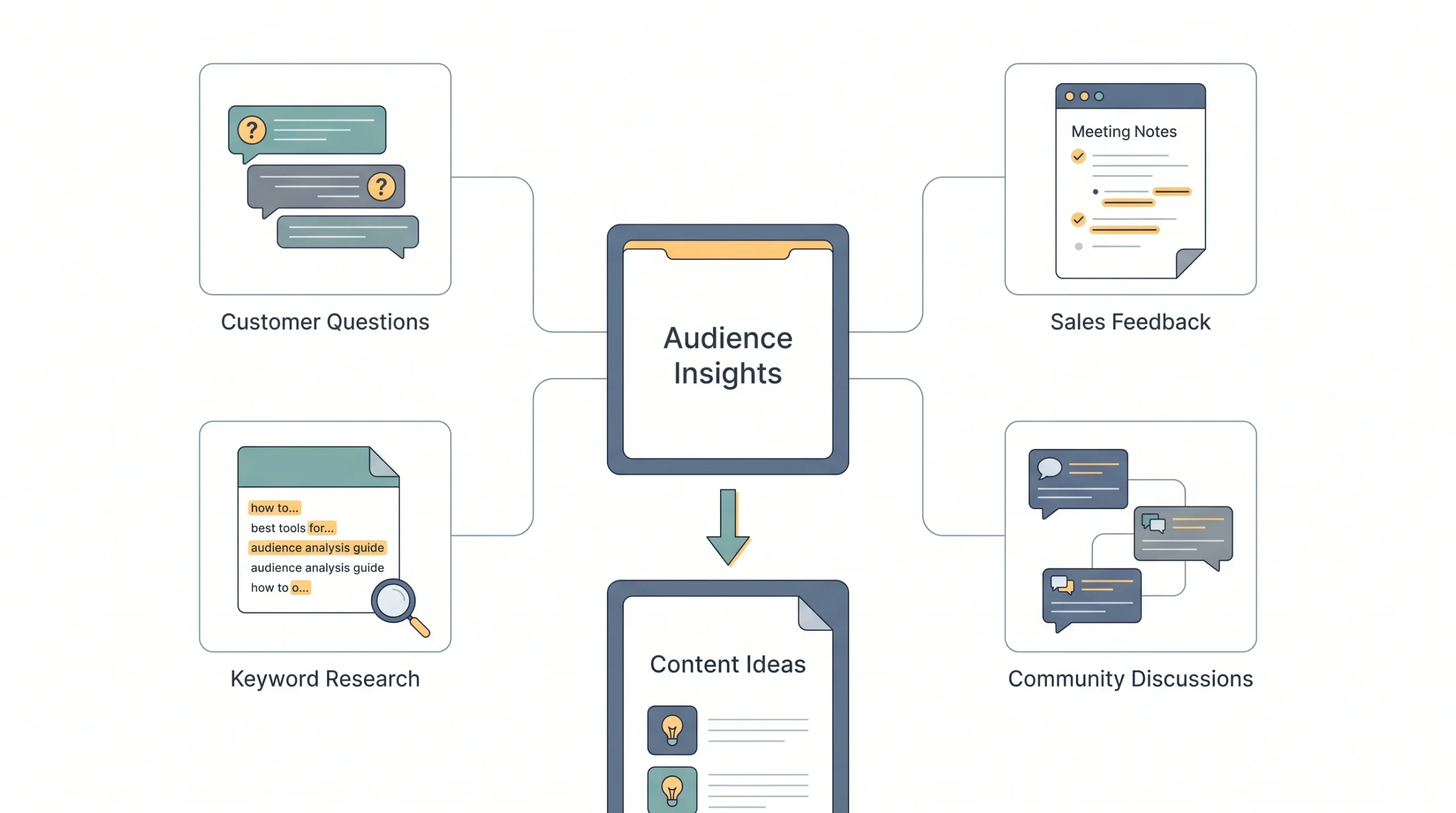
Once the goal is set, the next question is who exactly this content is for. And “everyone interested in marketing” is not an answer, that’s avoiding the question. Real audience research means going and finding out what actual people are struggling with, not guessing based on assumptions.
The good news is this data is usually sitting around already, mostly unused. Customer support tickets are a goldmine because they show, word for word, what confuses people or frustrates them. Sales call notes work the same way if there’s a sales team involved. Comment sections on competitor blogs and YouTube videos reveal what people are asking that isn’t being answered well. And keyword research itself is basically a giant list of real questions people are typing into Google, which makes it one of the most honest sources of audience insight out there.
From there, building a rough persona helps keep writing focused. It doesn’t need to be some elaborate document with a fake name and a stock photo. It just needs the basics: what stage of the business or career this person is at, what they’re trying to accomplish, what’s stopping them, and what kind of language they use to describe their problem.
Pain points deserve special attention here because they’re the anchor for almost every good topic idea. A pain point is the specific, frustrating obstacle someone is dealing with right now, not the broad category they’re interested in. “I don’t know how to grow my blog” is vague. “I’ve published 40 posts and my traffic hasn’t moved in six months” is a pain point. The second one is way easier to write a genuinely useful post around, and it’s the kind of specific frustration that gets people to actually click and read.
There’s also a habit worth building early: actually reading the language people use, not paraphrasing it into marketing-speak. If someone in a forum says “I feel like I’m shouting into a void with my blog,” that phrase is more useful for a headline or an intro than anything a brainstorming session would come up with. People searching Google aren’t typing polished sentences either, they’re typing exactly what’s bothering them, in their own words. The closer the content mirrors that language, the more it feels like it was written for that one specific reader instead of a generic audience nobody can quite picture.
One more thing worth being honest about, audience research isn’t a one-time task that gets checked off and forgotten. The person reading a blog in its first year is often different from the person reading it two years later, especially once the content starts attracting more advanced readers alongside the beginners. Revisiting this research periodically keeps the content from drifting out of sync with who’s actually showing up.
Audit Your Existing Content (If You Have Any)
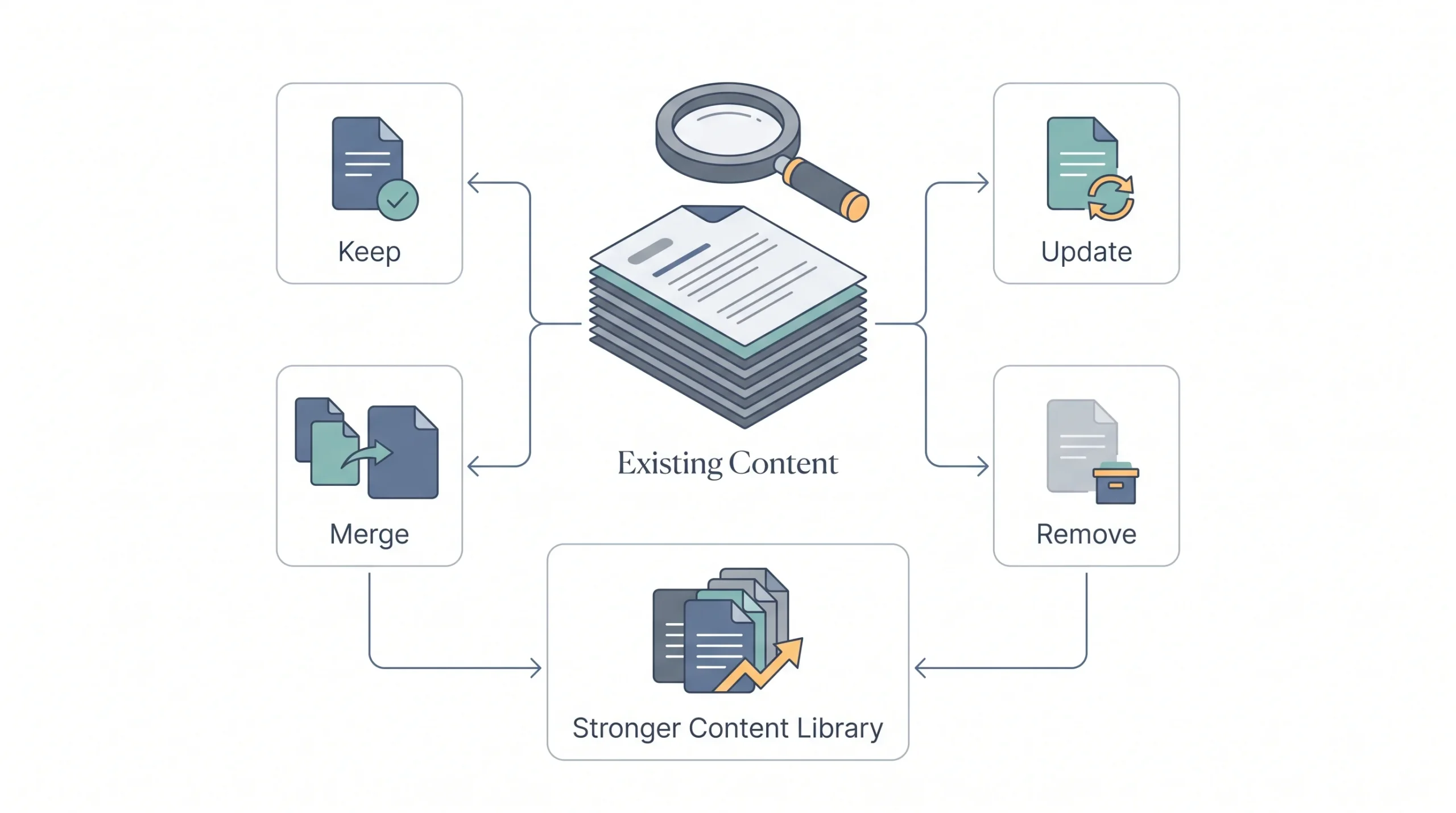
If there’s already a blog with posts published, skip ahead without doing this step and it’ll cost time later. A content audit is exactly what it sounds like: going through everything that’s already live and figuring out what’s working, what’s dead weight, and what’s worth touching up.
Brand new blogs can skip this section entirely, there’s nothing to audit yet. But for anyone who’s been publishing for a while, this step usually turns up surprises. Old posts that quietly rank well and just need a refresh instead of a full rewrite. Posts that never got any traction and are probably better off merged into something bigger or removed altogether. Duplicate topics that are competing against each other in search instead of working together.
A simple spreadsheet does the job here. Nothing fancy needed.
| Audit Column | What to Record |
|---|---|
| URL / Title | Page identifier |
| Funnel Stage | TOFU / MOFU / BOFU |
| Traffic (last 90 days) | From analytics |
| Ranking Keyword | Primary keyword it ranks for |
| Action | Keep / Update / Merge / Remove |
Once that table’s filled out, patterns show up fast. Maybe most of the traffic is coming from three posts and everything else is dead weight. Maybe there’s zero MOFU content and the whole blog is TOFU, which explains why traffic’s fine but nothing converts. That’s the kind of thing you only catch by actually looking.
It’s also worth flagging cannibalization while doing this, which is when two or more posts are targeting basically the same keyword and quietly competing against each other in search results instead of one of them ranking strongly. This happens more often than people expect, especially on blogs that have been running for a while without any central topic planning. Merging those overlapping posts into one stronger piece usually performs better than leaving them to fight it out separately.
And don’t skip the boring part of this step either, actually opening old posts and reading them again. Sometimes a post looks fine on the audit spreadsheet, decent traffic, ranking okay, but the information inside is outdated or the advice no longer holds up. Those posts are quiet liabilities. They’re technically working but slowly losing trust with anyone who reads past the first section and realizes it’s stale.
Competitor and Content Gap Analysis
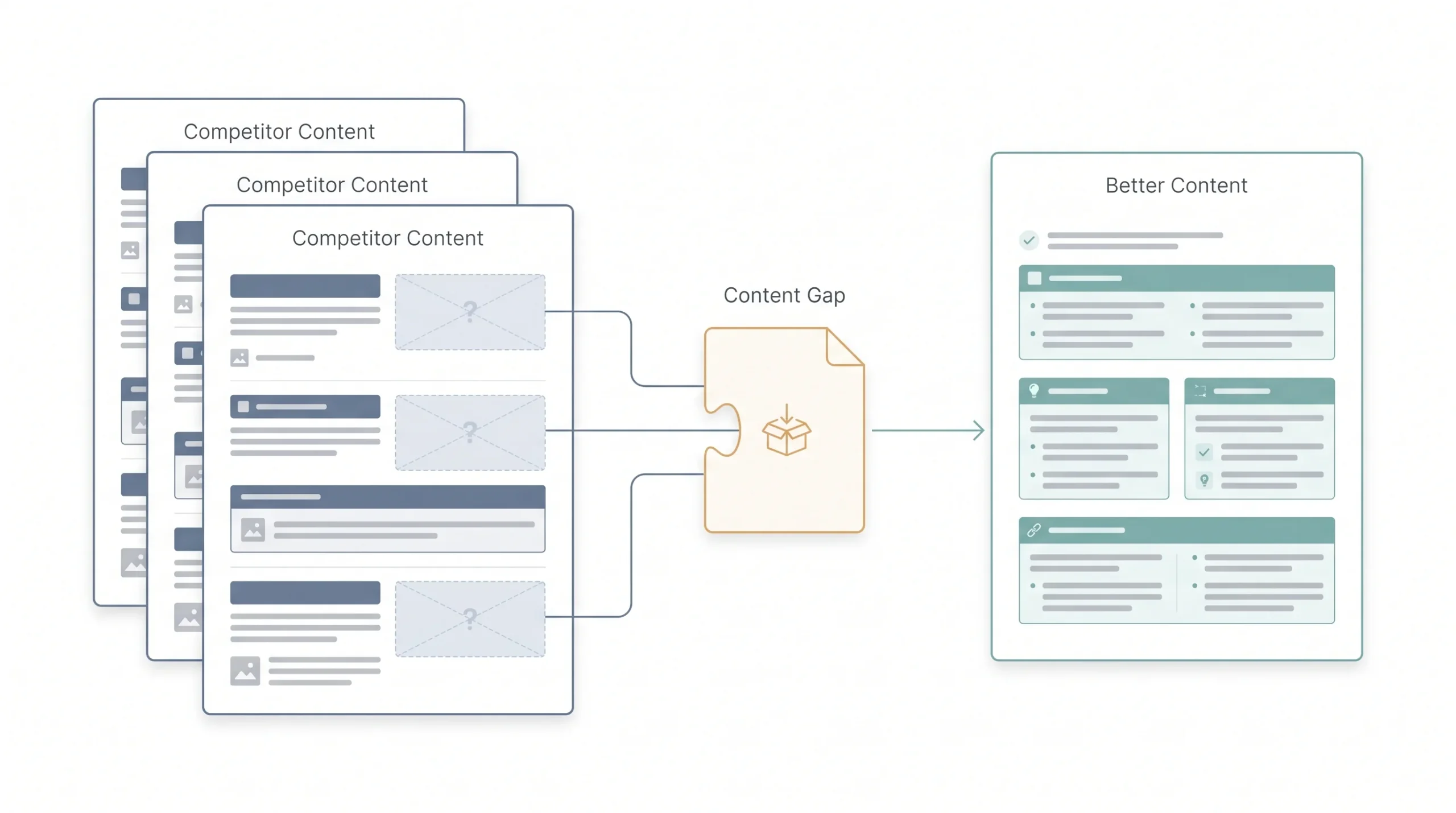
This step gets skipped constantly, and it’s honestly one of the more useful ones. The idea is simple: find the content that’s already ranking well for topics relevant to the business, then figure out what it’s missing.
Look at what competitors have published on a given topic and ask a few direct questions. Is the information outdated? Does it skip over a question that readers clearly still have, based on the comments or the “people also ask” boxes on Google? Is the formatting a mess, walls of text with no headers, no examples, nothing that makes it easy to scan? Is there a specific angle nobody’s covered yet, like a beginner’s version of an otherwise advanced topic, or a version tailored to a specific industry or audience size?
Every gap found this way turns directly into a topic idea, and it’s usually a stronger idea than something pulled out of thin air, because it’s based on what’s already proven to attract search traffic, just not served well yet.
The comment sections and “people also ask” boxes deserve extra attention here, more than most beginners give them. Those questions are basically free research handed over by the search engine itself, showing exactly what people are still confused about even after reading the top-ranking content. If three different competing posts all skip a question that keeps showing up in “people also ask,” that’s not a coincidence, that’s a gap sitting there waiting to be filled properly.
This step also helps avoid a trap that’s easy to fall into: writing a post just because a competitor wrote one, without checking if there’s actually room to do it better. Matching a competitor topic for topic without a clear angle rarely works, since the existing post already has whatever authority and backlinks it built up over time. The goal isn’t to copy what’s ranking, it’s to find the specific place where what’s ranking is falling short.
Build Your Topic and Keyword List
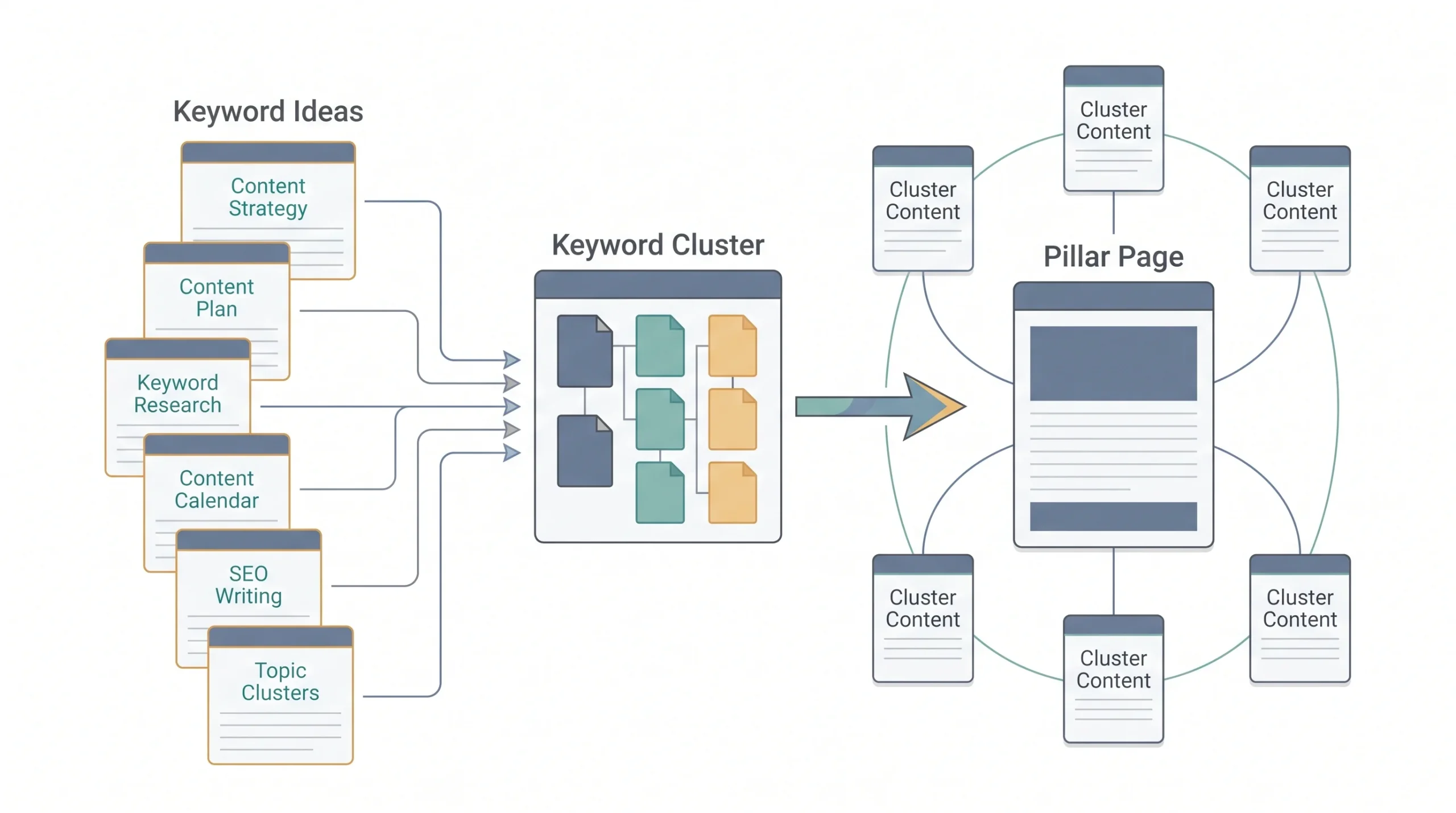
This is where the strategy starts turning into an actual list of things to write. Keyword research is the backbone of it, but it’s worth understanding a couple of concepts before diving in, because guessing keywords blind wastes a lot of writing effort.
Search volume tells you roughly how many people are searching a term each month. Higher volume means more potential traffic, but usually more competition too. Keyword intent matters just as much, maybe more. A search is informational if someone’s trying to learn something, like “what is a content strategy.” It’s commercial if they’re comparing options, like “best content marketing tools for small teams.” And it’s transactional if they’re ready to act, like “hire a content marketing agency.” Writing an informational post to try and capture transactional intent (or the other way around) is a mismatch that tanks engagement even if the post ranks.
Then there’s keyword clustering, which is where a lot of beginners waste effort without realizing it. Instead of writing five separate, nearly identical posts for keywords like “content marketing strategy,” “how to build a content strategy,” and “content strategy plan,” those get grouped under one strong pillar post that covers the topic thoroughly, with related subtopics either folded in or spun off as supporting cluster posts that link back to the pillar.
One pillar post plus 6–10 supporting cluster posts, all internally linked, usually beats 10 disconnected blog posts targeting the same topic area.
That’s the structure that actually compounds over time. Instead of ten weak, unlinked posts fighting each other, there’s one strong hub surrounded by supporting content that all points traffic back to the center.
Building the actual list is more of a filtering process than a brainstorm. Start broad, pull every keyword and question remotely connected to the core topic, then filter down based on relevance to the audience defined earlier and the goal set at the very start. A high-volume keyword that doesn’t match the audience’s actual intent isn’t worth chasing just because the number looks good. Better to have thirty tightly relevant topics than three hundred loosely related ones that’ll never get written anyway.
It’s also worth keeping a running list instead of treating this as a one-time exercise done before launch. New questions show up constantly, in comments, in support tickets, in casual conversations with customers. The topic list should stay a living document, added to whenever a genuinely good idea shows up, not something built once and never touched again.
Choose the Right Content Formats and Channels
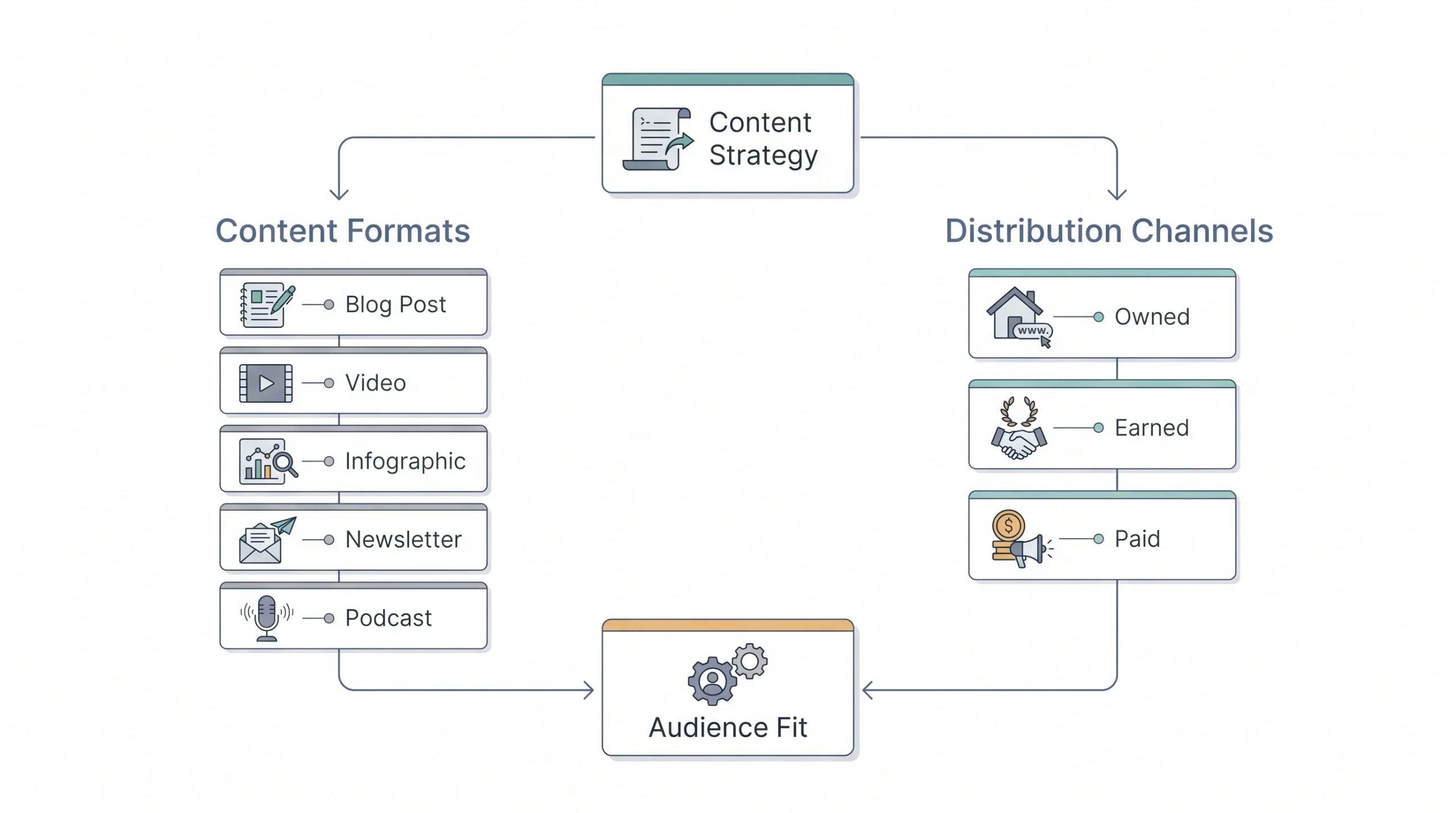
Blog posts aren’t the only option, and honestly, for some audiences, they’re not even the best one. Format should follow where the audience already spends time and how they prefer to consume information, not personal preference for writing over filming, or vice versa.
Video works well for topics that benefit from being shown rather than explained, and it tends to get shared more on social platforms. Infographics are strong for data-heavy or process-heavy topics because they’re easy to share and they attract backlinks from other sites looking for a visual to embed. Email newsletters are underrated because they go straight to people who already opted in, no algorithm standing in the way. Podcasts take more effort to produce but build a level of trust that’s hard to get from a blog post alone, since people are literally spending 30-40 minutes listening to a voice.
| Format | Best For | Effort Level |
|---|---|---|
| Blog posts | SEO, long-term organic traffic | Medium |
| Video | Engagement, social shares | High |
| Infographics | Shareability, backlinks | Medium |
| Email newsletters | Retention, repeat traffic | Low–Medium |
| Podcasts | Trust-building, niche audiences | High |
Before committing to a channel, it’s worth thinking in terms of owned, earned, and paid, a distinction that comes up again later in the distribution section. Owned channels are things fully controlled, like the website and email list. Earned means other people or platforms sharing the content on their own. Paid is exactly what it sounds like, money spent to get in front of an audience. A strong content strategy usually leans on all three, not just one.
One thing worth being honest about, more formats isn’t automatically better. Trying to run a blog, a podcast, a YouTube channel, and a daily social presence all at once with limited time or a small team usually means everything ends up mediocre instead of one or two things being genuinely strong. Better to pick one or two formats that match both the audience’s habits and the team’s actual production capacity, get those working well, then expand once there’s bandwidth for it. A blog paired with an email newsletter is a solid starting combination for most beginners, low effort relative to video or podcasting, and both formats support the SEO and retention goals from earlier sections directly.
Create an Editorial/Content Calendar
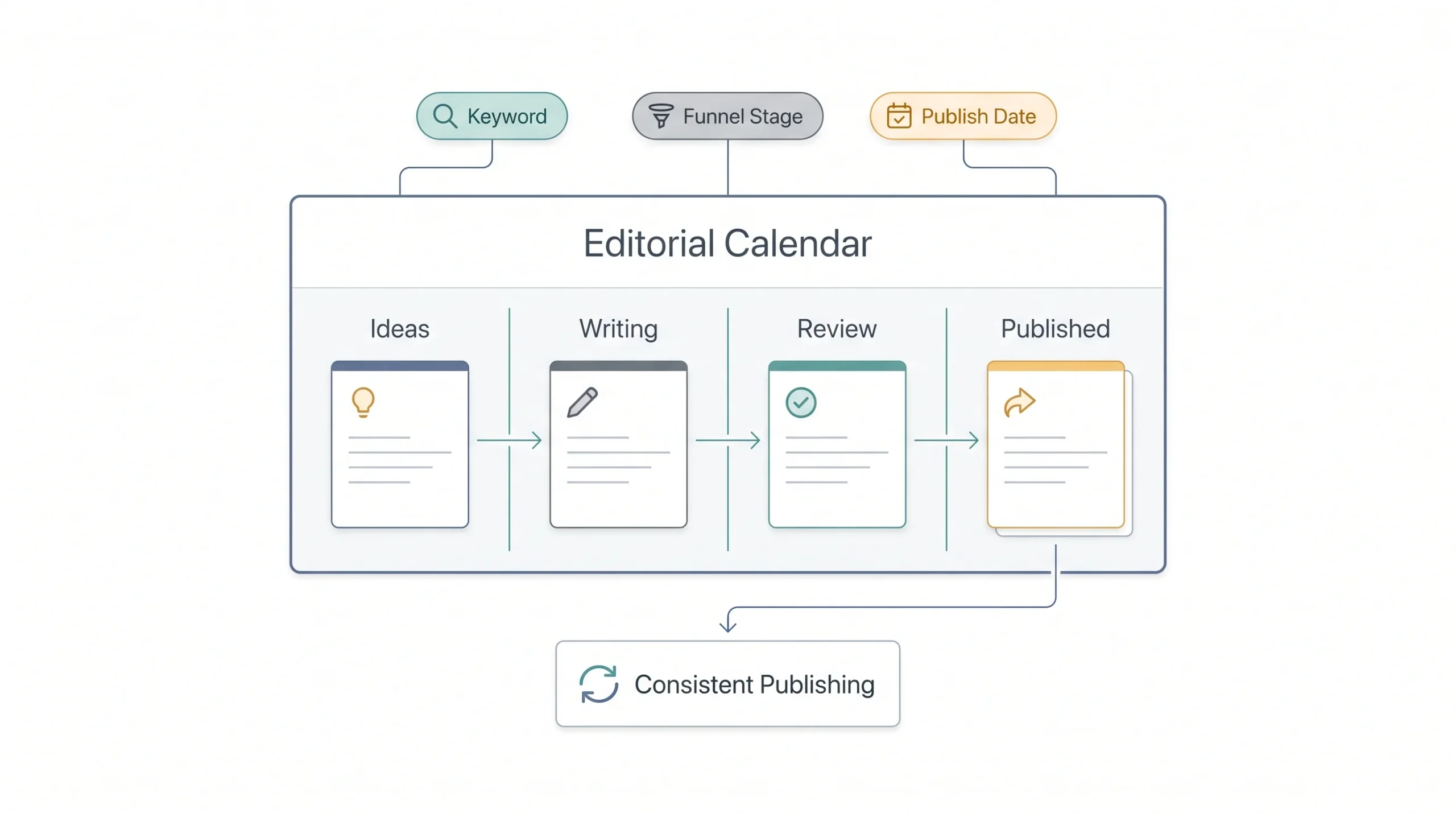
Once there’s a topic list, it needs to turn into something that actually gets produced. This is where the editorial calendar comes in, and it’s genuinely just a planning tool, not a strategy on its own (worth repeating since that confusion is exactly where this whole guide started).
A useful calendar tracks more than just a date and title. It should include the target keyword for that post, which funnel stage it belongs to, the format, who’s responsible for writing and editing it, the due date, the planned publish date, and its current status. That last part matters more than people think, because “in progress” for three weeks straight is a sign something’s stuck.
Cadence should match actual capacity, not ambition. A solo blogger publishing one deeply researched pillar post every two weeks will outperform someone burning out trying to hit four posts a week with thin content. Consistency matters more than volume, and consistency only happens when the workload is realistic.
| Team Size | Realistic Cadence |
|---|---|
| Solo blogger | 1–2 posts/month |
| Small team (2–3) | 4–6 posts/month |
| Agency/in-house team | 8+ posts/month |
There’s also a sequencing decision that gets overlooked, which order to publish topics in. It’s tempting to write whatever feels most interesting first, but there’s a stronger approach: publish the pillar post before the cluster posts that support it, so there’s already something for internal links to point to. Writing cluster posts first means going back and adding links later, which happens less often than it should once the momentum of publishing new content takes over. Planning the sequence upfront saves that cleanup work.
Write Content That’s Actually Optimized for Search and Readers
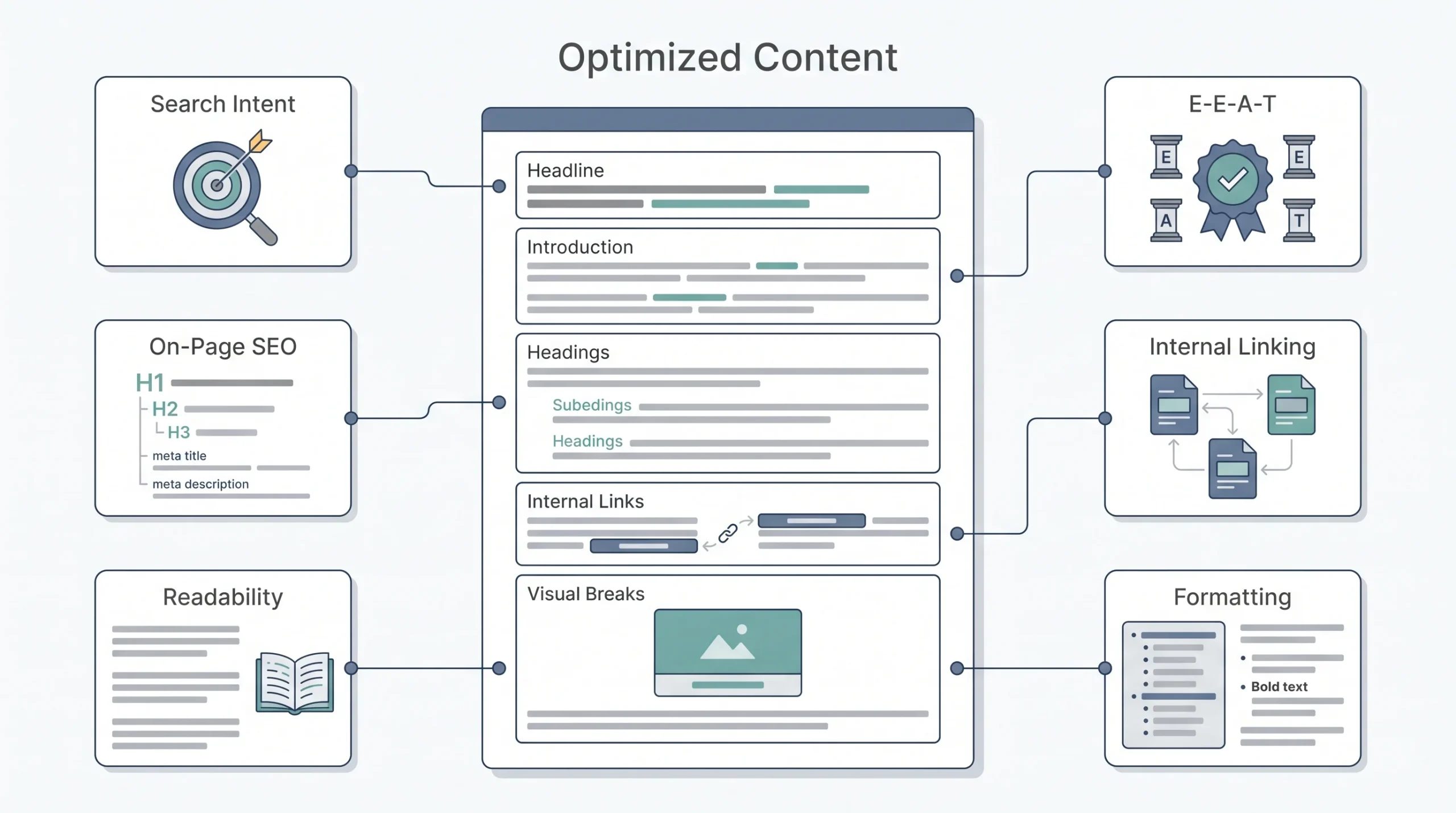
This is the part where most of the actual traffic gets earned or lost, so it’s worth slowing down here. Writing content that ranks and content that reads well are not two separate jobs, they’re the same job done right.
Matching search intent comes first. If someone searches a question expecting a quick, direct answer and the post buries that answer under 800 words of backstory, they’ll bounce, and Google notices that behavior over time. Structure the post so the answer or the core value shows up early, then expand from there.
On-page SEO is the technical layer underneath the writing. Titles should include the focus keyword naturally, ideally near the front. Meta descriptions should be clear and specific enough that someone scanning search results actually wants to click. Headers should be structured logically, not just bolded text pretending to be a header, but actual H2s and H3s that break the content into scannable sections. Internal linking matters a lot here too, connecting a post to related cluster content (like the pillar-and-cluster structure from earlier) helps both readers and search engines understand how the content fits together. Image alt text should describe the image accurately, which helps accessibility and gives search engines more context.
Readability matters just as much as the technical SEO side, maybe more, because a post that ranks but nobody finishes reading isn’t doing its job. Short paragraphs, clear headers, and a logical flow from one section to the next keep people on the page longer. Nobody wants to read a wall of text on their phone during a coffee break.
There’s also a trust layer worth understanding, often referred to as E-E-A-T (experience, expertise, authoritativeness, trustworthiness). In plain terms, it means writing content that shows real, first-hand understanding of the topic instead of vague generalizations pulled from other blog posts. Naming specific examples, being upfront about what actually works versus what’s just commonly repeated advice, that’s what separates content that builds authority from content that just fills space.
The compounding effect kicks in through internal linking between cluster posts. When posts across a funnel-stage series link to each other consistently, each new post published adds a little more strength to the whole cluster, not just to itself. That’s a big part of why the pillar-and-cluster approach beats one-off posts long term.
It’s worth slowing down on headline writing too, since it’s doing double duty, it has to work for search engines and it has to make an actual human want to click when they see it on a results page next to nine other options. A headline that’s stuffed with keywords but reads awkwardly loses clicks even if it technically ranks. A headline that’s catchy but has nothing to do with what people are searching gets clicks that bounce immediately, which hurts more than it helps over time. The best headlines usually just state the value plainly. “How to Create a Content Marketing Strategy That Drives Traffic” works because it says exactly what the post delivers, nothing clever needed.
Length matters less than people assume, and it gets misunderstood constantly. There’s no magic word count that guarantees ranking. What actually matters is whether the post covers the topic thoroughly enough that a reader doesn’t need to go somewhere else afterward. Sometimes that takes 800 words, sometimes it takes 4,000. Padding a post to hit an arbitrary number hurts more than it helps, since readers notice filler content fast and leave.
Formatting deserves its own mention separately from readability, because they’re related but not identical. Readability is about sentence and paragraph structure. Formatting is about how the page looks when someone lands on it, whether there’s a clear visual hierarchy, whether important points are easy to spot at a glance, whether there’s a table or a pull quote breaking up a long stretch of text where one’s genuinely useful. A wall of unbroken text scares readers off before they even start reading the first sentence, no matter how good that sentence is.
Repurpose and Atomize Content for Maximum Reach
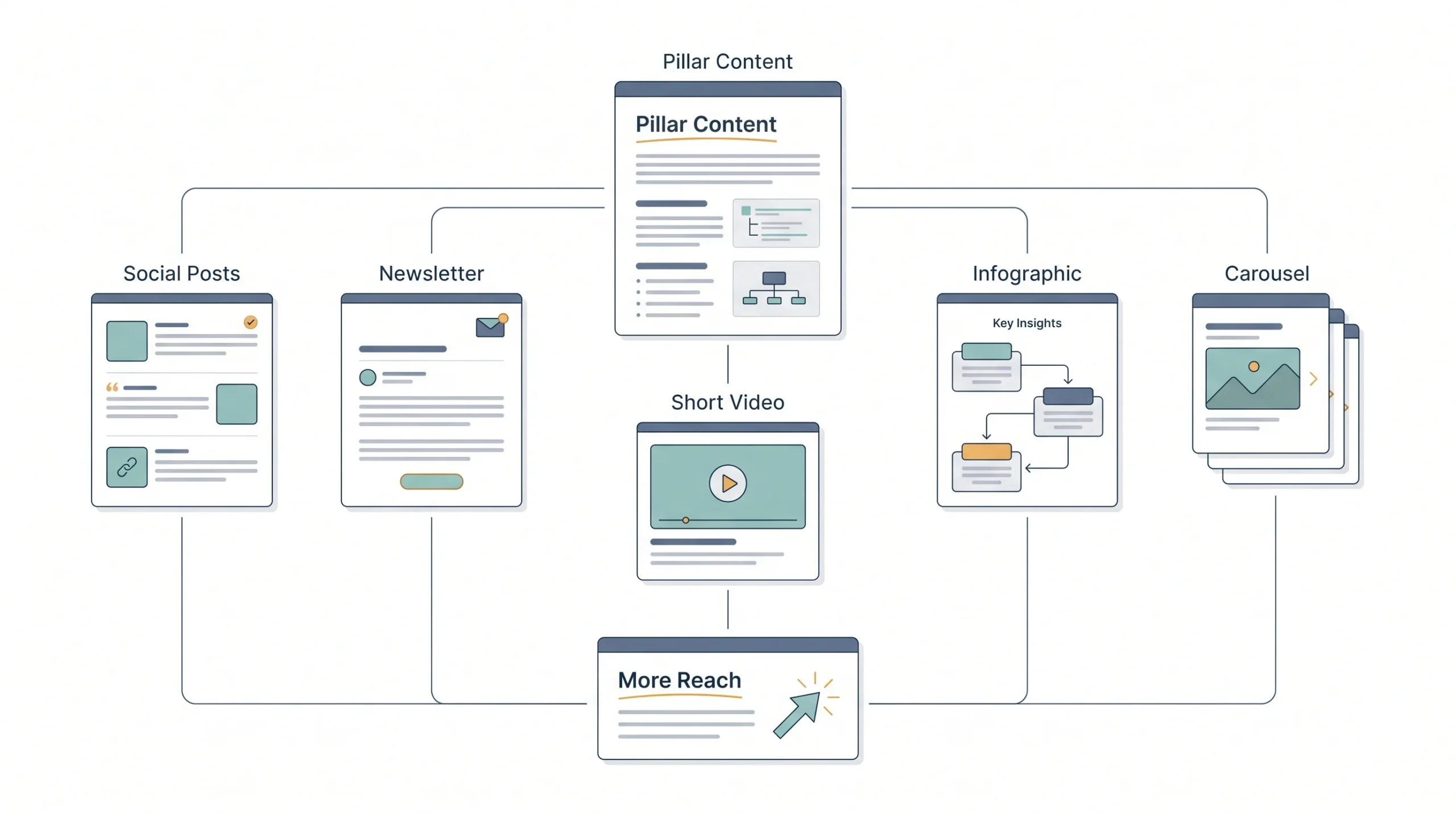
This step gets skipped by almost everyone, which is honestly a little baffling given how much extra reach it creates for basically no extra research work. Content atomization means taking one solid, long-form piece and breaking it into smaller pieces that live on different platforms.
A single pillar post can become a handful of social posts pulling out individual tips, a few email newsletter sections spread across weeks, a short video walking through one section of the post, an infographic summarizing the key steps, and a LinkedIn carousel breaking the framework into slides. None of that requires new research. It’s the same core ideas, reshaped for different formats and different platforms where different segments of the audience actually hang out.
The traffic benefit here is real and often underestimated. Instead of one blog post generating traffic from one channel (organic search), the same content investment now has multiple entry points bringing people back to the original piece. That’s a much better return on the time spent writing it in the first place.
A practical way to build this into the workflow is to plan the atomized pieces at the same time the original post gets outlined, not as an afterthought once it’s already published. While writing a section on, say, keyword clustering, it’s easy to flag it in the moment as a good standalone social post or a strong quote for the newsletter. Doing that flagging during the writing process takes a few extra minutes. Going back through a finished 6,000-word post later to find repurposing angles takes a lot longer, and it’s usually the step that gets skipped when time is tight.
Distribute and Promote Your Content
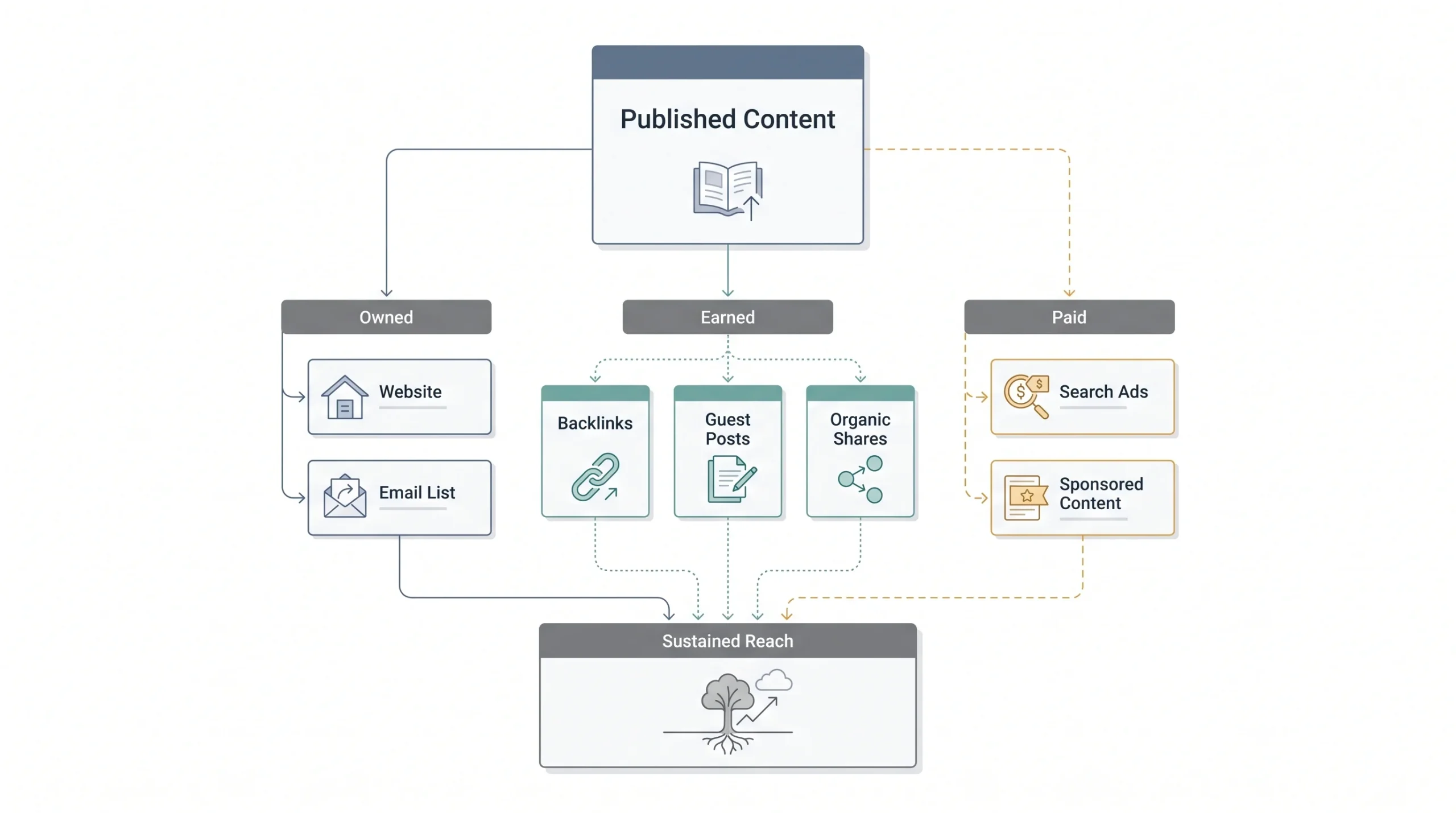
Publishing something is not the same as distributing it, and this is exactly where “just share it on social media” falls apart as advice. It’s not specific enough to be useful. Distribution works better when it’s broken into three clear categories.
| Channel Type | Examples | Traffic Timeline |
|---|---|---|
| Owned | Email list, website, app notifications | Immediate, but capped by audience size |
| Earned | Backlinks, PR, guest posts, shares | Slower, compounding, higher trust |
| Paid | Search ads, social ads, sponsored content | Immediate, stops when spend stops |
Owned channels are the fastest to activate because there’s no gatekeeper, just an email list or a website with existing traffic. The limitation is obvious though, it’s capped by however big that audience already is. Earned channels take longer to build, things like backlinks from other sites, guest posts, or organic shares, but they compound. A backlink earned today keeps sending traffic a year from now without any extra work. Paid channels are the fastest of all, but the traffic stops the second the budget does.
Paid traffic buys attention. Owned and earned traffic build an asset. A content strategy that leans entirely on paid distribution isn’t really a content strategy, it’s a media buying plan with extra steps.
A healthy distribution mix usually leans on owned and earned as the backbone, with paid used strategically to boost specific pieces, not as the entire plan.
Measure What’s Working (KPIs by Funnel Stage)
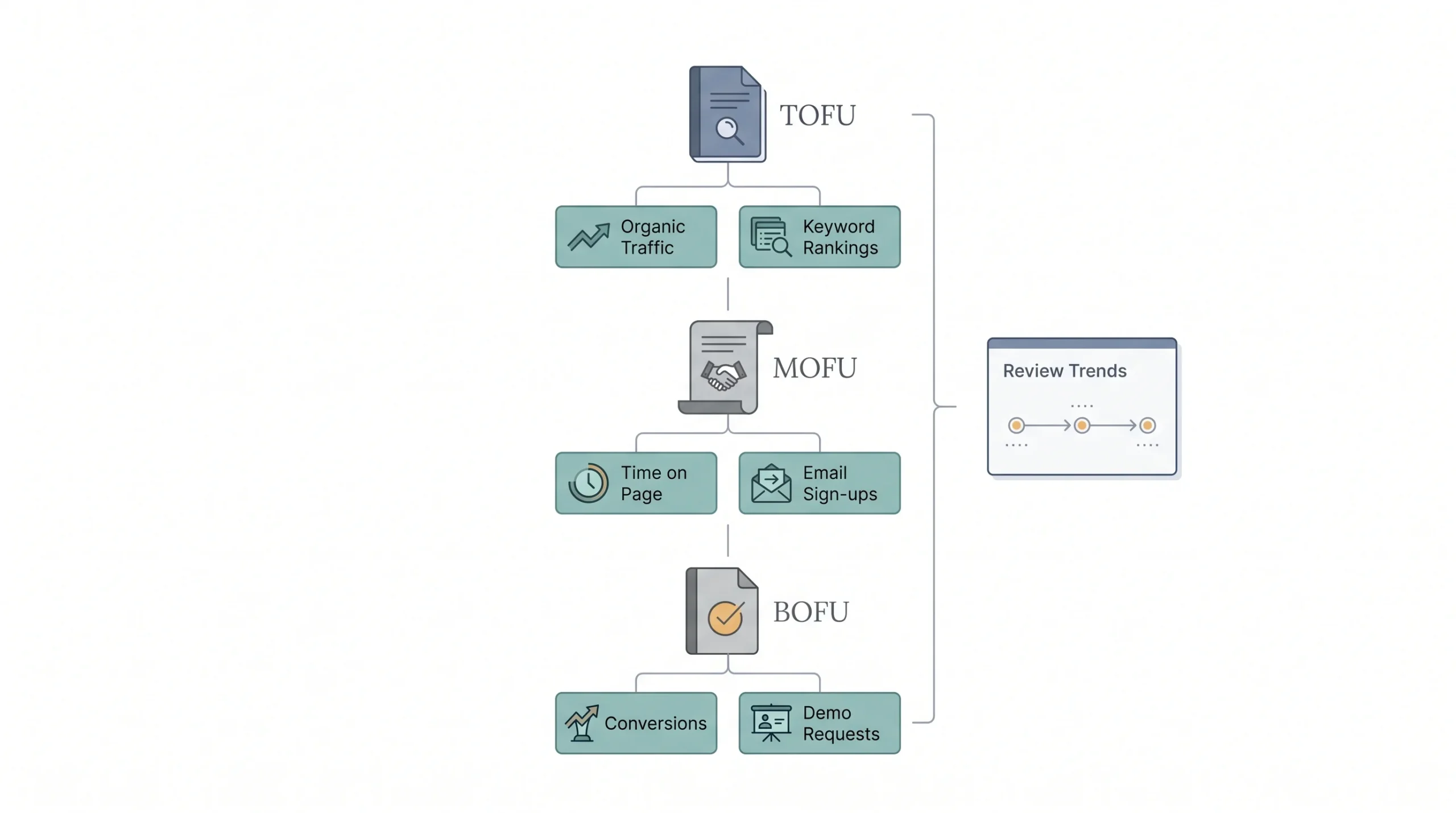
Here’s a mistake that happens a lot: tracking one generic metric, usually pageviews, and calling that “measuring success.” Pageviews tell almost nothing about whether the content is actually doing its job, because the job changes depending on where that piece sits in the funnel.
Going back to the TOFU/MOFU/BOFU structure from earlier, each stage has different metrics that actually matter.
| Funnel Stage | Key Metrics |
|---|---|
| TOFU | Organic traffic, impressions, new users, keyword rankings |
| MOFU | Time on page, scroll depth, email sign-ups, return visits |
| BOFU | Conversion rate, demo requests, assisted conversions |
TOFU content should be judged on visibility, is it getting found, is it ranking, is it pulling in new visitors who’ve never been to the site before. MOFU content should be judged on engagement, are people sticking around, scrolling through, signing up for something. BOFU content should be judged on direct business impact, actual conversions, demo requests, sales assisted by that content along the way.
Tools like Google Analytics and Search Console handle most of the tracking here, and UTM parameters on shared links make it possible to see exactly which distribution channel is actually sending traffic that sticks around, versus one that just inflates a pageview count and leaves.
The real skill isn’t collecting these numbers, it’s reading them honestly. A post with huge traffic but zero conversions might be a great TOFU piece doing exactly its job, not a failure. A post with low traffic but a high conversion rate might be a quietly excellent BOFU piece that shouldn’t be judged by the same standard as the traffic-driving stuff.
It helps to set a review cadence for this instead of only checking numbers when something feels off. A monthly check makes sense for fast-moving metrics like traffic and rankings, since search results shift often enough that monthly tracking catches problems early. A quarterly check works better for the bigger picture questions, like whether the content mix across funnel stages is still balanced, or whether the goals set at the very start of this whole process still match where the business actually is now. Businesses change direction, priorities shift, and a content strategy that isn’t revisited periodically will keep chasing goals that stopped mattering months ago.
One more thing worth saying plainly: not every number needs to go up every single month. Traffic dips happen, sometimes because of seasonality, sometimes because of a search algorithm update that has nothing to do with content quality. Reacting to every short-term dip by scrapping the strategy is its own kind of mistake. The metrics matter most as a trend over a few months, not as a single snapshot.
Tools to Support Your Content Marketing Strategy
None of this requires an expensive tech stack to get started, but having the right tool for each part of the process makes the whole thing move faster.
| Category | Example Tools |
|---|---|
| Keyword & topic research | Google Keyword Planner, Ahrefs, SEMrush |
| Content creation | Google Docs, Grammarly, Canva |
| SEO optimization | Yoast, Surfer SEO, Google Search Console |
| Distribution & social | Buffer, Hootsuite, Mailchimp |
| Analytics | Google Analytics 4, Looker Studio |
Start with whatever’s free or already available and add specialized tools as the content operation grows. A solo blogger doesn’t need an enterprise SEO suite on day one, that’s an easy way to burn budget on tools before there’s even content worth optimizing.
Google Search Console deserves a special mention here since it’s free and it’s arguably the single most useful tool on this list for anyone just starting out. It shows exactly which queries are already bringing traffic, which pages are close to ranking on page one but not quite there, and where technical issues might be quietly holding a post back. Most of the audit and measurement work covered earlier in this guide can be done with nothing more than Search Console and a spreadsheet, no paid subscription required.
Conclusion
Traffic was never really about publishing more. It’s about publishing the right things, in the right order, with a reason behind each one. Everything covered here, the goals, the audience research, the topic clusters, the formats, the distribution, the measurement, all of it exists to turn a blog from a pile of disconnected posts into something that actually compounds over time.
None of this is a one-time setup either. Revisit it every few months, not because something broke, but because audiences shift, search behavior shifts, and last quarter’s plan probably isn’t this quarter’s plan anymore. Start with the goal, work through the framework one piece at a time, and the traffic follows from there, not the other way around.
Frequently Asked Questions
How long does it take for a content marketing strategy to show results?
Organic traffic growth from a content strategy is slow at the start. Most new content takes a few months to gain any real search visibility, and it usually takes longer than that to build up enough of a cluster for compounding traffic to kick in. Anyone expecting a spike within weeks is going to be disappointed, this is a long game by nature.
How much content should a beginner publish per month?
Less than most people assume, and more consistently than most people manage. One or two well-researched, properly optimized posts a month, published on a predictable schedule, will outperform a burst of ten rushed posts followed by three months of silence.
What’s the difference between content strategy and content marketing?
Content marketing is the actual activity, creating and publishing content to attract and engage an audience. Content strategy is the plan that guides that activity, the goals, audience research, topic decisions, and measurement that make the marketing effort actually work instead of just producing content for the sake of it.
Do I need a content strategy if I only post on social media?
Yes, honestly maybe even more so, since social platforms move fast and reward consistency and clear positioning. Posting randomly on social without a plan for what topics to cover, who it’s for, and what happens after someone engages is the same mistake as blogging without a strategy, just on a faster timeline.
How often should I update old content?
Anything ranking well but starting to slip, or anything covering a topic that changes over time (tools, pricing, statistics, platform features), should get reviewed roughly every six months to a year. Updating an existing post that already has some authority behind it is usually faster and more effective than writing something brand new from scratch.
Do I need a big budget to run a content marketing strategy?
Nope. The core of this whole framework, goal-setting, audience research, topic clustering, writing, and internal linking, costs nothing but time. Paid tools speed some of it up, sure, but a spreadsheet and Google Search Console can carry a beginner surprisingly far. Budget becomes more relevant once distribution scales up, especially if paid promotion gets added to the mix, but it’s not a requirement to get started.
Should I focus on quantity or quality when I’m just starting out?
Quality, every time, especially early on. A handful of thorough, well-researched pillar posts that actually solve a real problem will outperform a large volume of thin, rushed content. Search engines and readers both respond to depth over time. Volume matters more once there’s already a base of strong pillar content to build cluster posts around, not before.
Can a content marketing strategy work without a blog?
Yes, but it’s harder to sustain long-term traffic growth without one. A blog gives content a permanent home that keeps ranking in search over time, something social platforms don’t offer since posts fade out of feeds within days. Social, video, and email can absolutely be the primary formats, but pairing them with a blog, even a lightly maintained one, gives the strategy a stronger foundation for compounding organic traffic.
How do I know if my content strategy is actually working?
Look at the KPIs tied to each funnel stage, covered earlier in this guide, and track them over a few months instead of week to week. Rising organic traffic and improving keyword rankings on TOFU content, growing email sign-ups and time on page on MOFU content, and real conversions on BOFU content are the honest signals. If none of those are moving after a reasonable stretch of consistent publishing, it’s worth revisiting the audience research and topic selection steps rather than just publishing more of the same.
What’s the biggest reason content marketing strategies fail?
Usually it’s inconsistency paired with no clear goal. A strategy gets built with good intentions, a few posts go out, then life gets busy and publishing slows down or stops. Without a defined goal and a realistic cadence set from the start, there’s nothing pulling the effort back on track once it stalls. The strategies that actually work aren’t the most sophisticated ones, they’re the ones that keep showing up, month after month, tied to a goal that’s still relevant.