


Ever notice how the same creator seems to be everywhere at once? A LinkedIn post on Monday, a Reel on Tuesday, a thread on Wednesday, and somehow a newsletter on Thursday that ties it all together. Feels like they’ve got a team of twenty people behind them. Most of the time, they don’t. They’ve got one good idea and a system for stretching it across every platform their audience actually hangs out on. That’s it. That’s the whole trick.
Content repurposing isn’t some new-age marketing hack. It’s just refusing to let a good idea die after one post. You made something worth saying once, so why say it exactly once and move on? Most brands and creators are sitting on a graveyard of content that got maybe two hundred views and then vanished into a feed, never to be seen again, even though the idea inside it was genuinely solid. That’s not a content problem. That’s a distribution problem, and it’s fixable.
The other thing worth saying up front, this isn’t about pretending you’re everywhere when you’re actually nowhere. Bad repurposing looks exactly like that: the same tired screenshot dumped on five platforms with a caption that reads like it was written for none of them in particular. Good repurposing looks like someone who actually understands each platform enough to say the same true thing five different ways. One version sounds like advice from a colleague. Another sounds like a quick tip your friend texts you. Same idea underneath, completely different delivery on top.
This post walks through what repurposing actually means, why it matters more now than it did five years ago, how to figure out what’s even worth repurposing in the first place, and a real framework for turning one piece of content into a dozen platform-specific ones without it feeling like copy-paste laziness. By the end, there’s an actual system here, not just a vague sense that “we should probably be doing more with our content.”
What Content Repurposing Actually Means
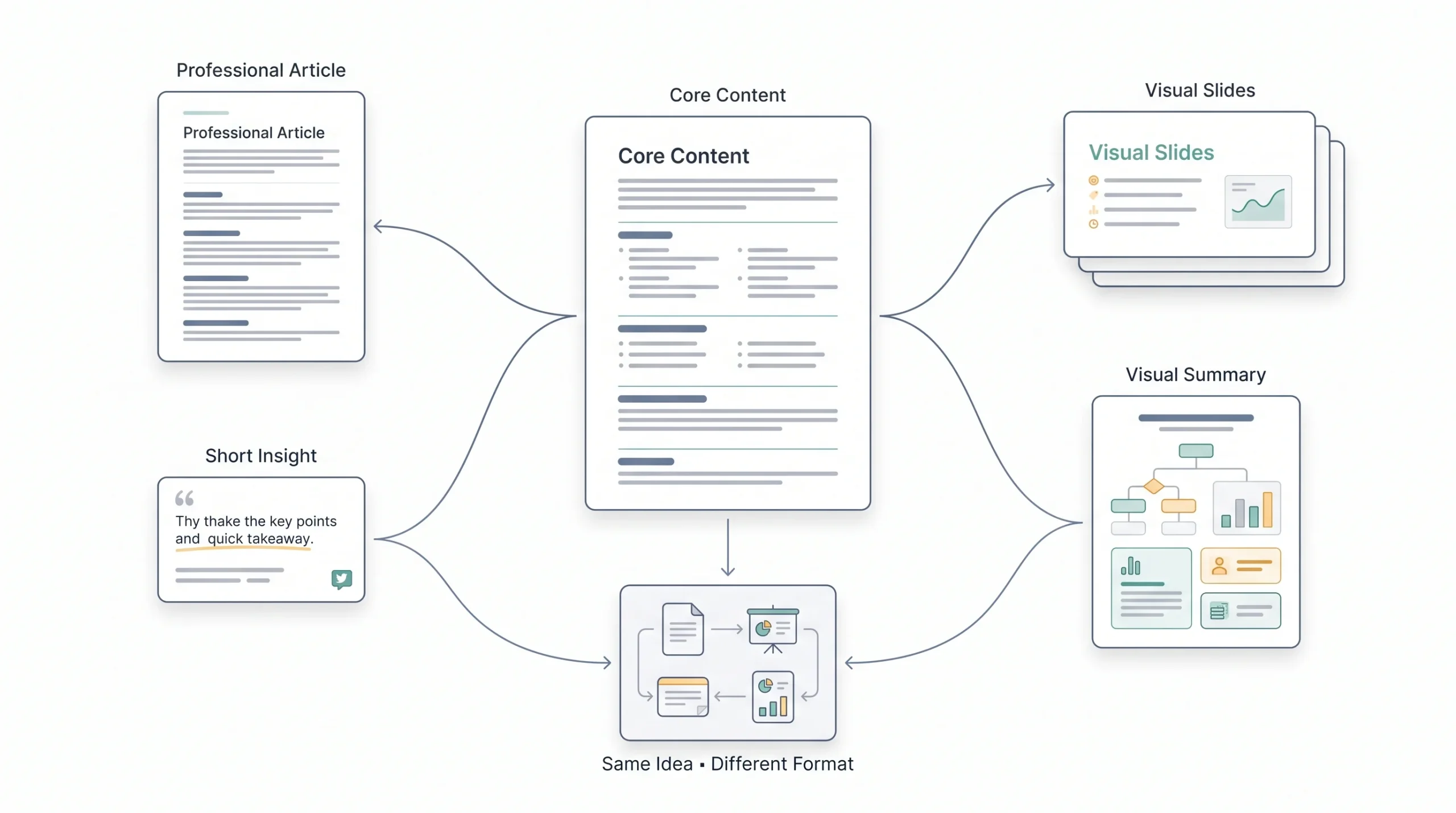
Content repurposing means taking one piece of content you already made and reshaping it into new formats for different platforms. A blog post becomes a LinkedIn carousel. A podcast episode becomes six short clips. A case study becomes a thread, an email, and a Pinterest graphic. Same core idea, different packaging for different rooms.
Here’s where most people mess it up though. They confuse repurposing with reposting. Reposting is taking the exact same asset and slapping it on another platform, unchanged. Same image, same caption, same everything, just posted to Instagram and Twitter and LinkedIn on the same afternoon. That’s not repurposing. That’s just spam with a scheduling tool behind it.
Repurposing is different because it respects the platform. It says, okay, this idea works, but LinkedIn audiences want the professional framing with data up front, while Instagram wants the visual hook and the personality. Same core message, wrapped differently because the room is different. Think about how you’d tell a work story to your manager versus how you’d tell it to your college roommate. Same event, completely different delivery. That’s repurposing in a nutshell.
And then there’s recycling, which is the laziest cousin of the two. Recycling is just republishing old content as-is because you ran out of ideas, with zero adaptation and zero regard for whether it’s even still relevant. Nobody’s out here doing intentional recycling on purpose. But plenty of teams accidentally do it because they’re rushed, and the results always show. Engagement tanks. People can tell.
So when this post talks about repurposing, it means the real thing: taking a validated idea and rebuilding it for the platform it’s landing on, respecting the format, the audience, and the pace of that platform.
Here’s a small example to make it concrete. Say there’s a blog post about how to write better email subject lines, and one section of that post breaks down a specific test where shorter subject lines outperformed longer ones by a wide margin. That single section can become a LinkedIn post that opens with the actual numbers and adds a short opinion about why brevity wins. It can become an Instagram carousel with one slide per insight from that test. It can become a single, sharp tweet with just the headline stat and a one-line reaction. None of these are the blog post copied over. Each one is the same underlying finding, rebuilt for how people actually read on that specific platform.
That’s the difference that matters. Reposting asks nothing of you beyond hitting a scheduling button. Repurposing asks you to actually think about the person scrolling LinkedIn on a work laptop versus the person swiping through Instagram Stories on their phone at night. Those are different mental states, different attention spans, different expectations. Ignore that difference and the content falls flat no matter how good the original idea was.
Repurposing isn’t doing less work. It’s refusing to do the same work twice.
Why Repurpose Content (The Real Business Case)
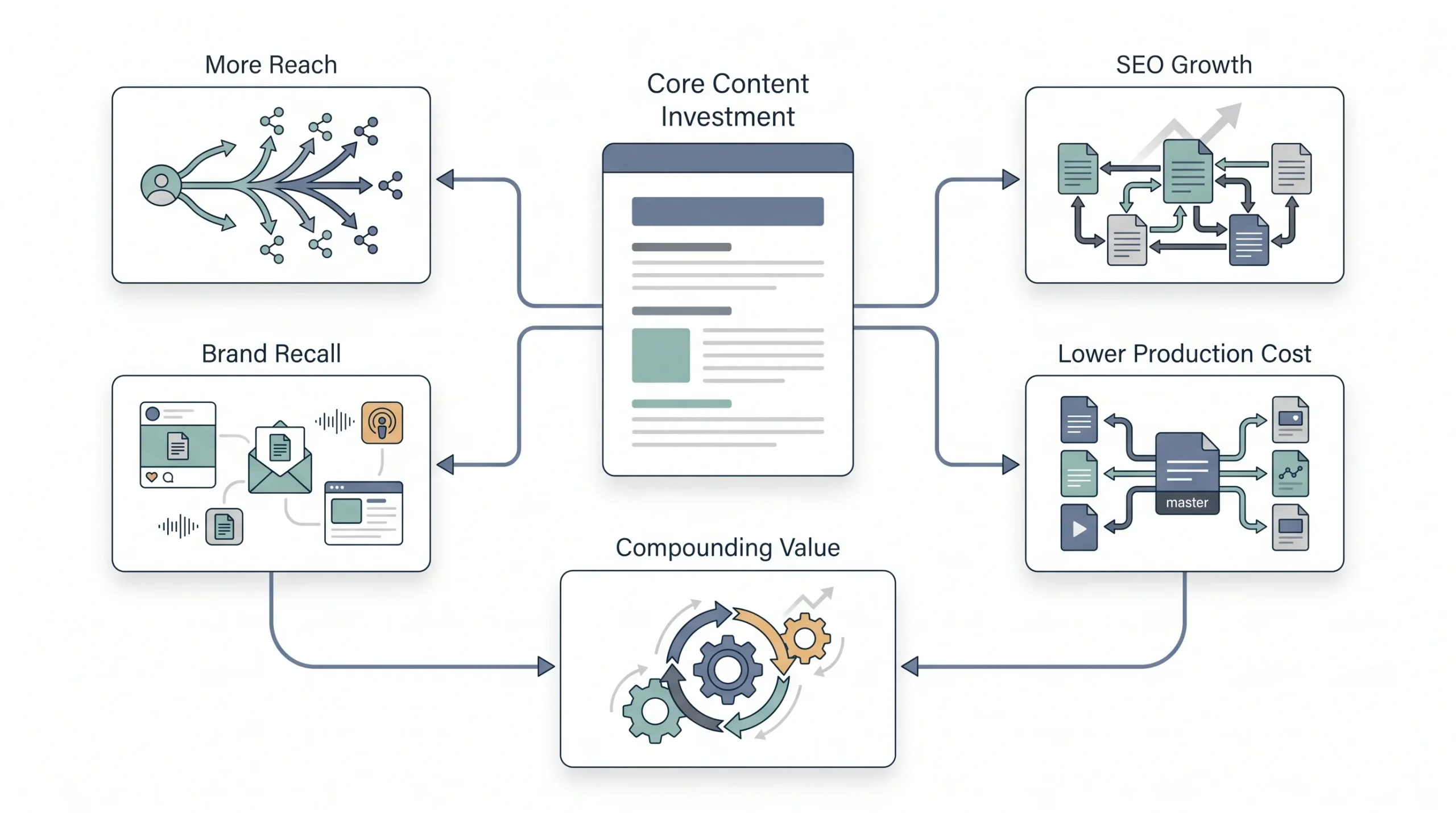
Here’s the honest reason repurposing matters: creating content from scratch every single time is brutally expensive. Not just in money, in time and mental energy too. A solid blog post can take anywhere from four to ten hours once you count research, writing, editing, and design. Now imagine doing that same amount of original work for LinkedIn, Instagram, YouTube, email, and Pinterest separately, every week. That’s not a content strategy, that’s a burnout strategy.
Repurposing flips that math. You do the heavy lifting once, on the piece that deserves it, and then you spend a fraction of that time adapting it for five more channels. The research is already done. The idea is already proven. You’re just changing the wrapper.
There’s also the reach problem nobody talks about enough. An audience isn’t sitting in one place waiting around. Some of them are scrolling Instagram on their lunch break. Some are reading long-form stuff on a blog late at night, coffee in hand, actually willing to spend fifteen minutes on something. Some only ever open their email inbox and never touch social media at all, and they’d never even know a great blog post existed unless it landed in their inbox with a decent subject line. Publishing in only one format means only reaching the slice of the audience that happens to prefer that exact format, which, realistically, is never the whole audience.
Think about a team of five people. One only checks LinkedIn during work hours and ignores everything else. One is glued to Instagram every evening and hasn’t opened a marketing email in months. One reads blogs obsessively but has muted every social notification. If a company only ever published blog posts, it would fully reach exactly one of those five people, guessing generously. Repurposing across platforms means all five of them eventually run into the same core idea, just wearing a different outfit depending on where they bumped into it.
Then there’s the SEO angle, and this one’s underrated. When you repurpose a blog post into a video and embed that video back into the original post, people stick around longer. Google notices that. Dwell time and engagement signals feed back into how your page ranks. A blog post that only exists as text is leaving ranking potential on the table.
Message reinforcement matters too. There’s an old marketing idea called the rule of seven, the theory that people need to see your message multiple times before it actually sticks or converts. One post on one platform gets forgotten in a scroll. The same core idea showing up on LinkedIn, then in an email, then as an Instagram carousel a week later, that builds recall. People start recognizing your brand’s point of view because they’ve bumped into it more than once.
And honestly, repurposing protects against platform volatility. Algorithms change constantly, and not always in ways that get announced ahead of time. A platform that was driving huge traffic last year might be a ghost town this year, and there’s rarely a warning before it happens. A channel that used to reward long captions might suddenly favor short ones. A platform that used to push organic reach hard might quietly throttle it in favor of paid promotion. If the entire strategy leans on one channel, one algorithm update away is disaster territory. Spreading the best ideas across multiple formats and platforms means never being fully dependent on any single one of them staying friendly.
There’s also a compounding effect that shows up over time and doesn’t get talked about enough. Every repurposed piece that links back to the original source adds another entry point into that content. Instead of one blog post with one URL that people either find or don’t, there’s now a case study email, a LinkedIn carousel, a Pinterest pin, and a thread, each one a separate doorway back to the same core asset. Someone who never reads blogs might click through from a carousel. Someone who skips social entirely might read the email version. The original piece ends up working way harder for the same amount of upfront effort, just because it’s got more paths leading back to it.
None of this means repurposing is free. Adapting content well still takes real thought and real time. But it’s a fraction of what starting from scratch costs, and the return, in reach, in SEO, in message recall, in resilience against algorithm shifts, adds up fast once it’s running as a system instead of a one-off effort.
| Factor | New Content | Repurposed Content |
|---|---|---|
| Time to produce | High, usually several hours per piece | Low to medium, mostly adaptation work |
| Research needed | Full research cycle every time | Minimal, the idea is already validated |
| Risk (unproven idea) | Higher, no signal on whether it’ll land | Lower, you’re building on something that already worked |
| SEO value | Creates a new signal from scratch | Reinforces and extends an existing asset |
What’s Worth Repurposing (Decision Framework)
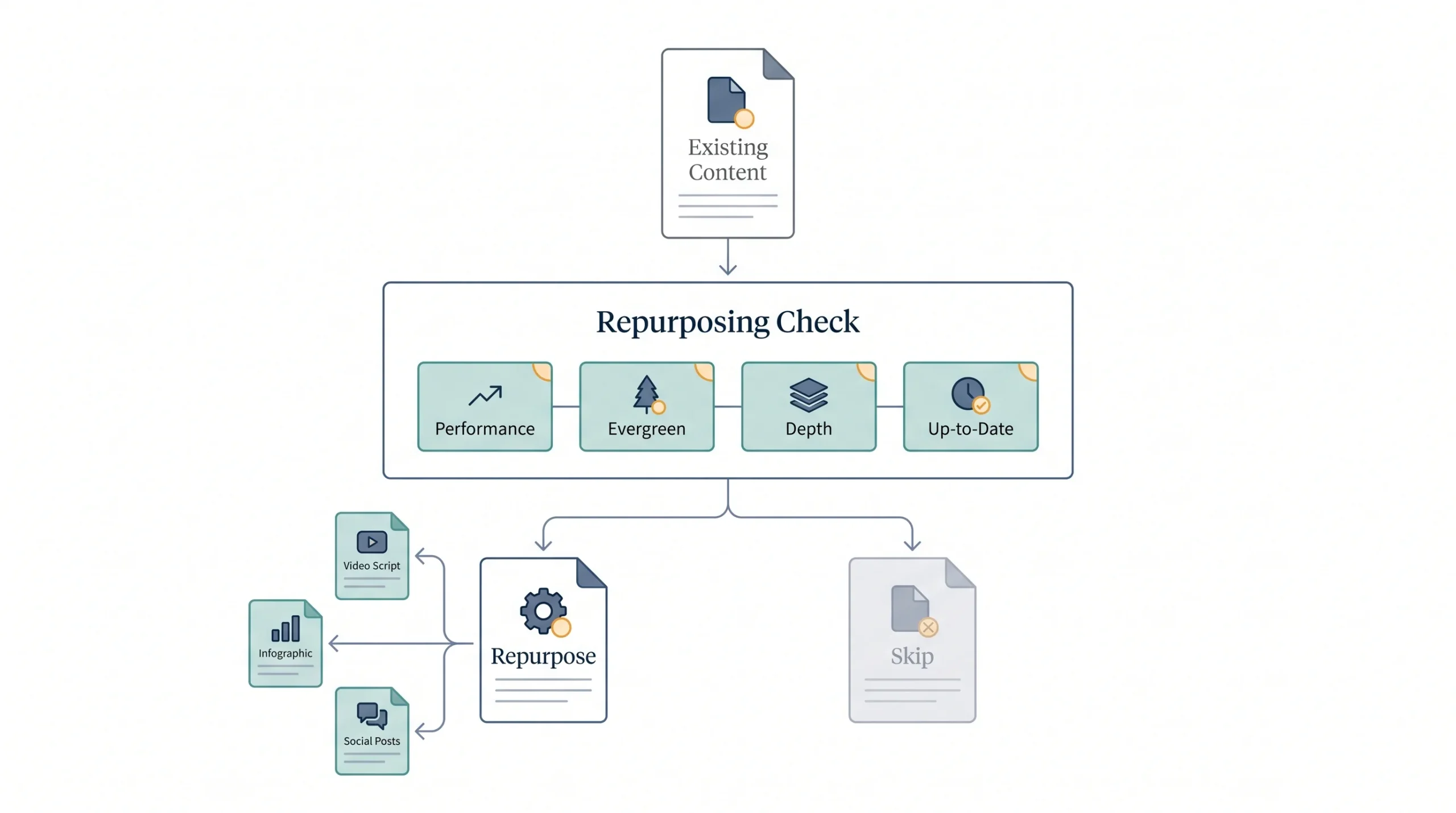
Not everything you’ve ever published deserves a second life. Honestly, most of it doesn’t. Repurposing everything indiscriminately just multiplies mediocre content across more platforms, and that’s worse than doing nothing.
So how do you actually decide? Look at performance first. If a blog post pulled in way more traffic than your average, or a LinkedIn post got shared way more than usual, that’s a signal. People already told you they cared about this idea. That’s your shortlist.
Next, think about whether the content is evergreen or tied to a specific moment. A guide on “how to set up a Google Ads campaign” is going to be useful in eight months. A post reacting to a platform update from last Tuesday is not. Trend-based content, meme formats, anything riding a specific audio trend or a news cycle, that stuff has a shelf life measured in days. Repurposing it three months later just looks confused, like you’re reacting to something nobody remembers anymore.
Depth matters too. Can this piece actually be split into smaller pieces without losing what made it good? A thin 400-word post that barely scratches the surface of a topic doesn’t have enough meat to become five different assets. But a detailed guide, a case study with real numbers, a webinar recording, those are dense enough to carve into a dozen usable pieces.
| Content Type | Repurpose? | Why |
|---|---|---|
| High-performing blog post | Yes | Already proven there’s demand for the idea |
| Trending or meme-based post | No | Loses all context once the trend passes |
| Evergreen how-to guide | Yes | Stays useful for months, sometimes years |
| One-off announcement | No | Tied to a specific moment in time |
| Webinar or podcast episode | Yes | Long and dense enough to split into many pieces |
Before repurposing anything, run it through three quick questions. Did this perform well the first time, or is it just something that felt good to write? Will it still make sense to someone reading it three months from now? And is there enough substance here to actually pull three or four smaller pieces out of it? If the answer is no to more than one of those, leave it alone and go find something better.
There’s a fourth thing worth checking too, and it’s easy to overlook: does this content still reflect what’s actually true right now? A guide to a platform’s ad settings from eighteen months ago might read fine on the surface, but if the platform redesigned its dashboard since then, repurposing it just spreads outdated advice further. Nobody wants to be the account confidently posting a screenshot of a button that no longer exists. Worth a quick sanity check before pulling anything from the archive, especially anything tied to specific tools, platforms, or pricing.
It’s also worth resisting the temptation to repurpose something just because it’s sitting right there and easy to grab. The content sitting in a drafts folder isn’t automatically worth a second life just because turning it into five pieces feels productive. Volume for its own sake isn’t the goal here. A handful of genuinely strong repurposed pieces will outperform a dozen mediocre ones every single time, and they’ll take less total effort too, since nobody’s editing and re-editing a weak idea trying to make it work across formats it was never going to work in.
The Content Repurposing Framework (Pillar to Pieces to Platforms)
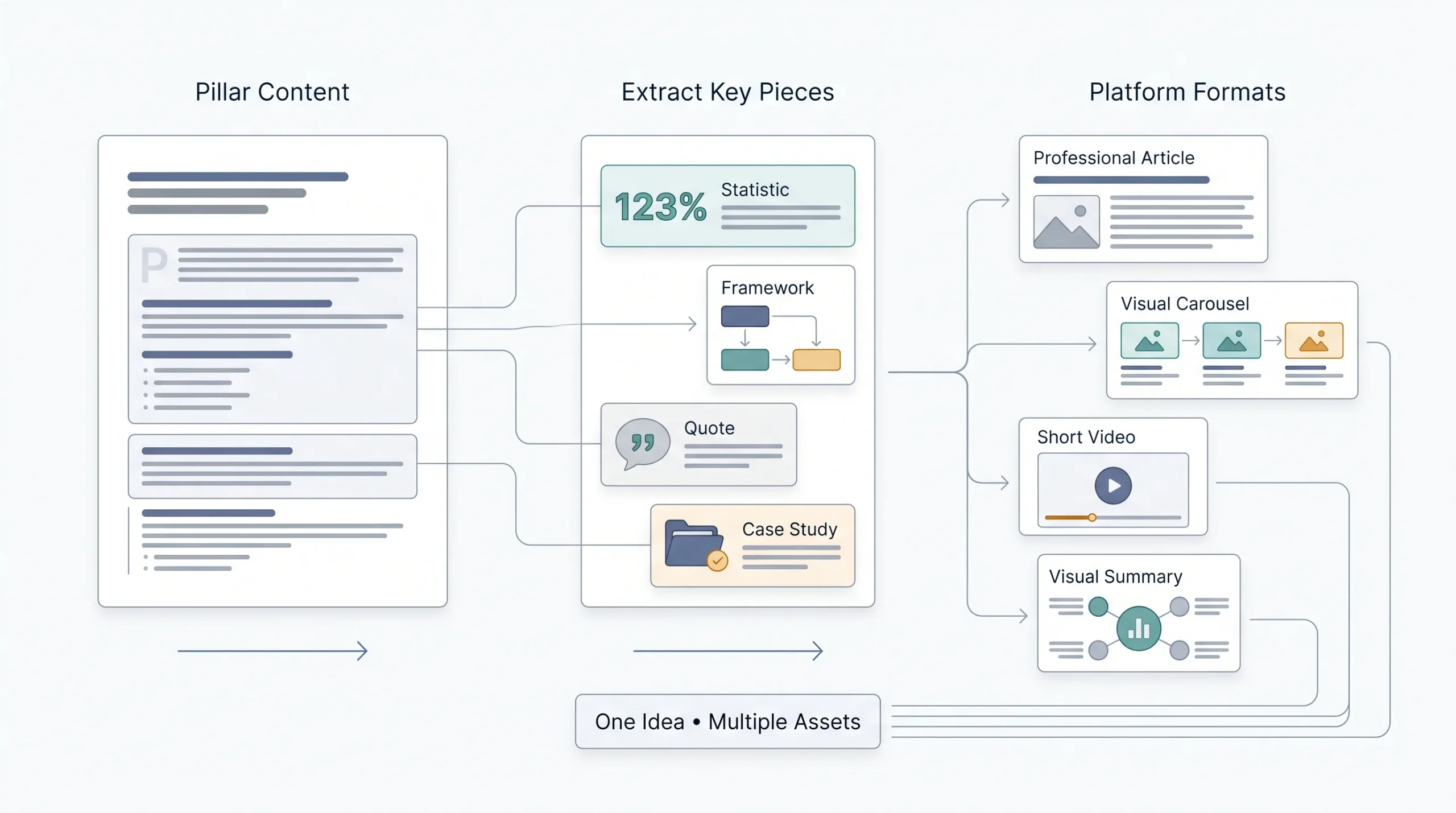
Once you know what’s worth repurposing, you need an actual system, not just vibes. The simplest version of this is called Pillar to Pieces to Platforms, and honestly the name explains most of it already.
Step one is picking your pillar. This is the anchor asset, the piece with enough depth to carry everything else. Usually it’s a long blog post, a webinar recording, a detailed case study, or a podcast episode. It needs to already show real expertise or an original point of view, not just a rehash of what ten other blogs already said. If the pillar is thin, everything built from it will be thin too.
Step two is extraction. This is where you go through the pillar and pull out the pieces worth reusing: the standout stats, the quotable lines, the step-by-step frameworks, the mini case studies buried inside a bigger post, the specific numbers that make people stop scrolling. Think of this like mining. You’re not moving the whole mountain, you’re pulling out the gold that’s actually in it.
Step three is matching those pieces to platforms. Not every piece fits every platform. A dense statistic works great as an X post or a Pinterest graphic. A step-by-step process works well as a LinkedIn carousel. A personal story or behind-the-scenes moment fits Instagram Stories better than it fits a formal LinkedIn post. This is the part people skip, and it’s the part that actually matters most. Matching the piece to the platform’s natural behavior is what separates repurposing from just dumping the same content everywhere.
Picture it like butchering an animal, honestly. Nobody serves the whole cow on one plate. There’s steak, ground meat, ribs, all different cuts pulled from the same source, each one suited to a completely different meal. That’s the mindset shift that makes this framework click. The pillar isn’t the thing you publish and forget. It’s raw material.
A quick worked example helps here. Say the pillar is a webinar recording on running a local SEO campaign, forty-five minutes long. Extraction means going through that recording and pulling out the moment where the host explains why Google Business Profile posts matter more than people think, the specific stat mentioned about review response times affecting local rankings, the three-step process laid out for auditing a listing, and a slightly blunt comment made about a common mistake businesses make with their categories. Four extracted pieces from one recording, and none of them required creating anything new. They were already sitting inside the pillar, just buried in forty-five minutes of audio nobody outside the live attendees ever heard.
From there, matching to platforms is mostly common sense once the pieces are actually laid out in front of someone. The stat becomes a quick graphic for Pinterest or a single sharp post on X. The three-step process becomes a LinkedIn carousel, since that format handles sequential steps well. The blunt comment about the common mistake becomes a short-form video clip, because it’s got personality and a strong opinion, which plays well on video. None of that required inventing new content. It required actually watching or reading the pillar closely enough to notice what was worth pulling out.
This is also where a lot of teams get lazy and just clip the intro of a video because it’s the easiest part to grab, instead of digging into the middle where the actually interesting stuff usually lives. The best moments in a webinar or podcast rarely happen in the first ninety seconds. They happen when someone gets specific, tells a real story, or says something a little contrarian. That’s the part worth extracting, even if it takes longer to find.
The Repurposing Matrix, Content Type by Platform
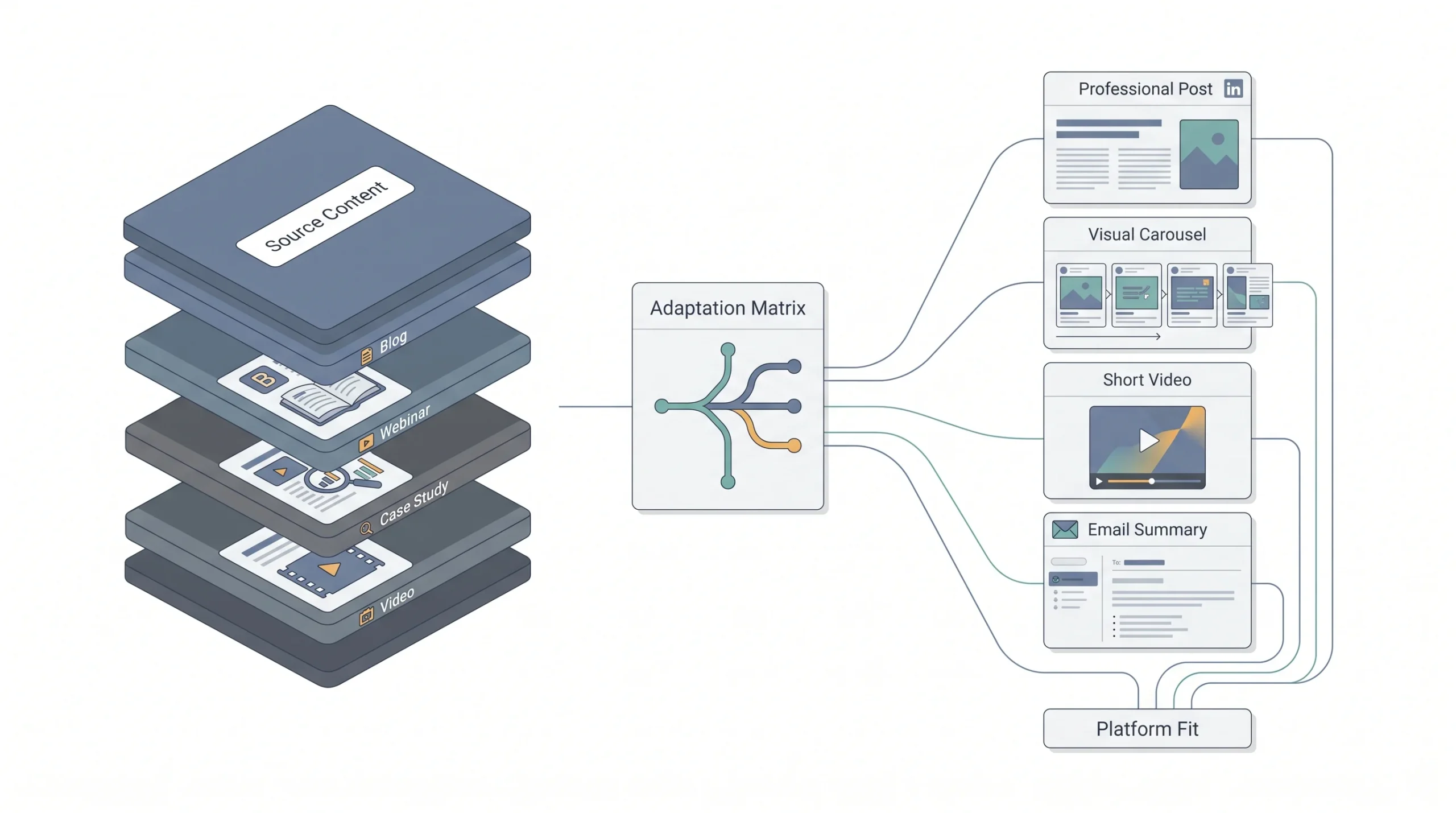
This is the part worth bookmarking. Here’s what one solid blog post, webinar, case study, or video can actually turn into once you break it apart by platform.
| Original Format | X (Twitter) | YouTube/Shorts | ||||
|---|---|---|---|---|---|---|
| Blog post | Carousel breaking down the main points, or a native article version | Carousel or a quote graphic pulling the strongest line | Thread walking through the argument step by step | Talking-head short covering the core idea in under 60 seconds | Newsletter excerpt with a link back to the full post | Infographic pin summarizing the key steps |
| Webinar or podcast | Clip with a written insight or takeaway attached | Reel using a strong audio moment from the recording | Thread built from the best quotes said during the session | Highlight reel cutting together the sharpest moments | Recap email summarizing what was covered | Quote graphic from a memorable line |
| Case study | Results-focused post with real numbers | Before-and-after carousel showing the transformation | Stat-heavy thread walking through the results | Explainer video breaking down what was done and why it worked | Case study email sent to a relevant segment | Stat-focused pin highlighting the outcome |
| Long-form video | Written summary post pulling the main argument | Cut-downs as Reels, each covering one point | Thread of the key points made in the video | Shorts pulled from the strongest 30 to 60 second segments | Video recap email with a link to watch | Thumbnail-style pin linking back to the video |
Read this table left to right when planning. Start with what already exists (the row), then look across for what it can realistically become on each platform (the columns). Not every original piece needs to hit every platform, and forcing it usually backfires. A dense case study makes a great LinkedIn post and a solid thread, but it might not translate well to Pinterest unless there’s a clean visual stat sitting inside it worth pulling out. Trying to force a Pinterest pin out of content that has no visual angle just produces a weak, generic graphic that nobody saves.
The table also works in reverse, which is useful during planning sessions. Sometimes the question isn’t “what can this blog post become,” it’s “we need a LinkedIn carousel this week, what do we already have that fits that format.” Scan down the LinkedIn column, and suddenly there’s a shortlist: a blog post, a webinar, a case study, all valid raw material for that one asset. That reverse lookup saves a lot of time compared to staring at a blank content calendar wondering what to post.
One more thing worth noting. This table assumes a reasonably deep, well-researched original piece. A thin 500-word blog post is not going to yield the same number of usable pieces as a 3,000-word guide backed by real data. The matrix shows what’s possible, not what’s guaranteed. The depth of the source material still does most of the heavy lifting here.
Platform-by-Platform Breakdown
Knowing the matrix is one thing. Actually understanding how each platform behaves, and what its audience expects, is what makes the repurposed content land instead of falling flat.
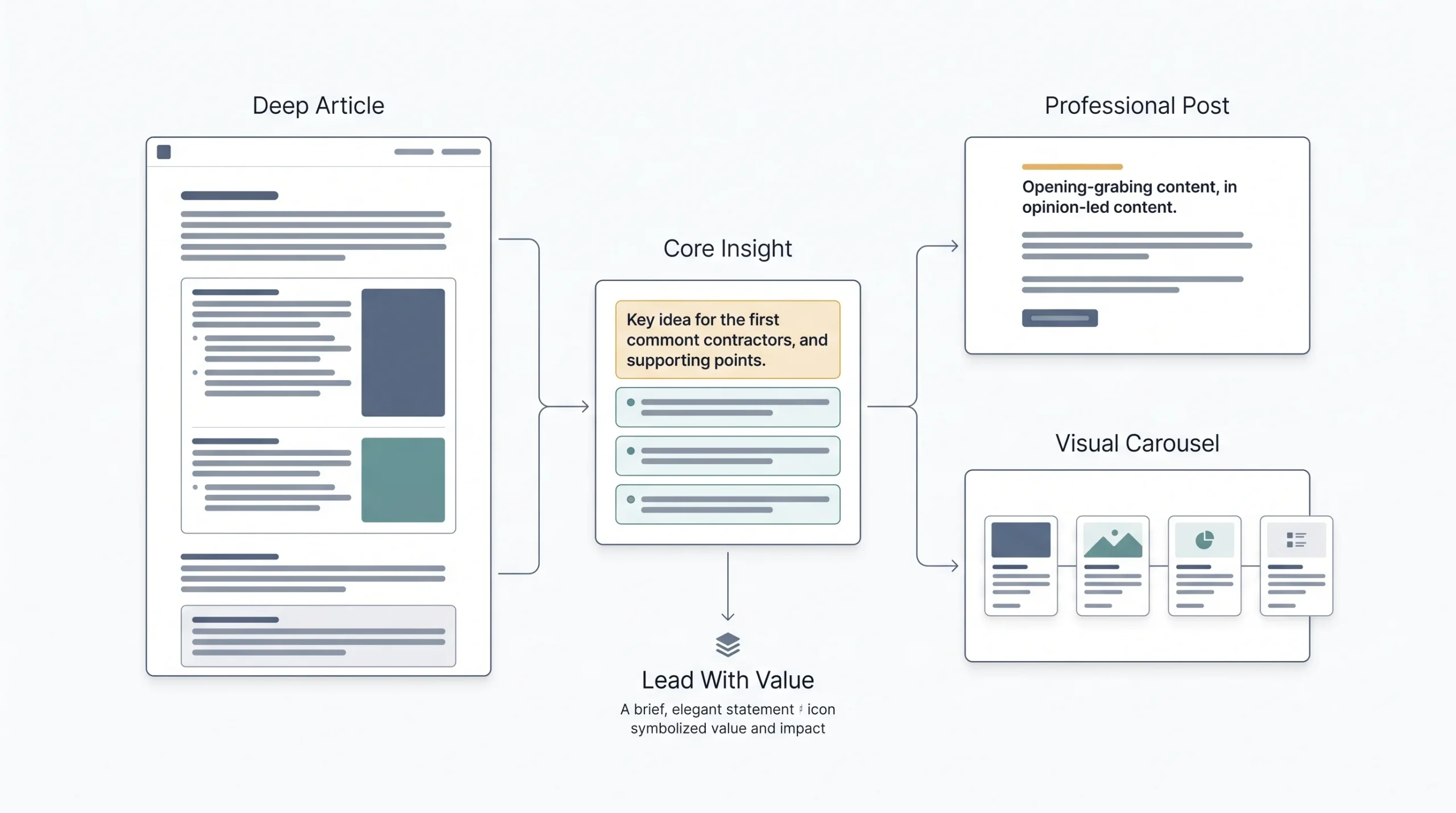
LinkedIn rewards content that sounds like a real professional thinking out loud, not a press release. Text-heavy posts do well here, especially ones that open with a strong first line since that’s all people see before they click “see more.” Carousels also perform well because they let you break a bigger idea into digestible slides without losing the professional tone.
When repurposing a blog post for LinkedIn, pull out the core argument and lead with it. Don’t bury the point five paragraphs in like you might on a blog. LinkedIn audiences are scanning fast, often during a work break, so the payoff needs to come early.
One thing to avoid on LinkedIn: over-polishing everything into corporate speak. The posts that actually get engagement usually sound like a person talking, with some opinion or friction in them, not a sanitized company statement. A post that says “we’re excited to share our latest insights on industry trends” gets scrolled past in half a second. A post that opens with “most companies get their onboarding email sequence completely backwards, and here’s why” makes someone stop.
Timing matters more on LinkedIn than people give it credit for too. Posts published early on a weekday morning tend to catch people during their first scroll of the day, before the feed gets crowded with everyone else’s content. Weekend posts on LinkedIn generally see less engagement simply because fewer people are checking a professional platform on a Saturday. None of this is a hard rule, but it’s worth factoring in when scheduling repurposed LinkedIn content rather than posting whenever it happens to be ready.
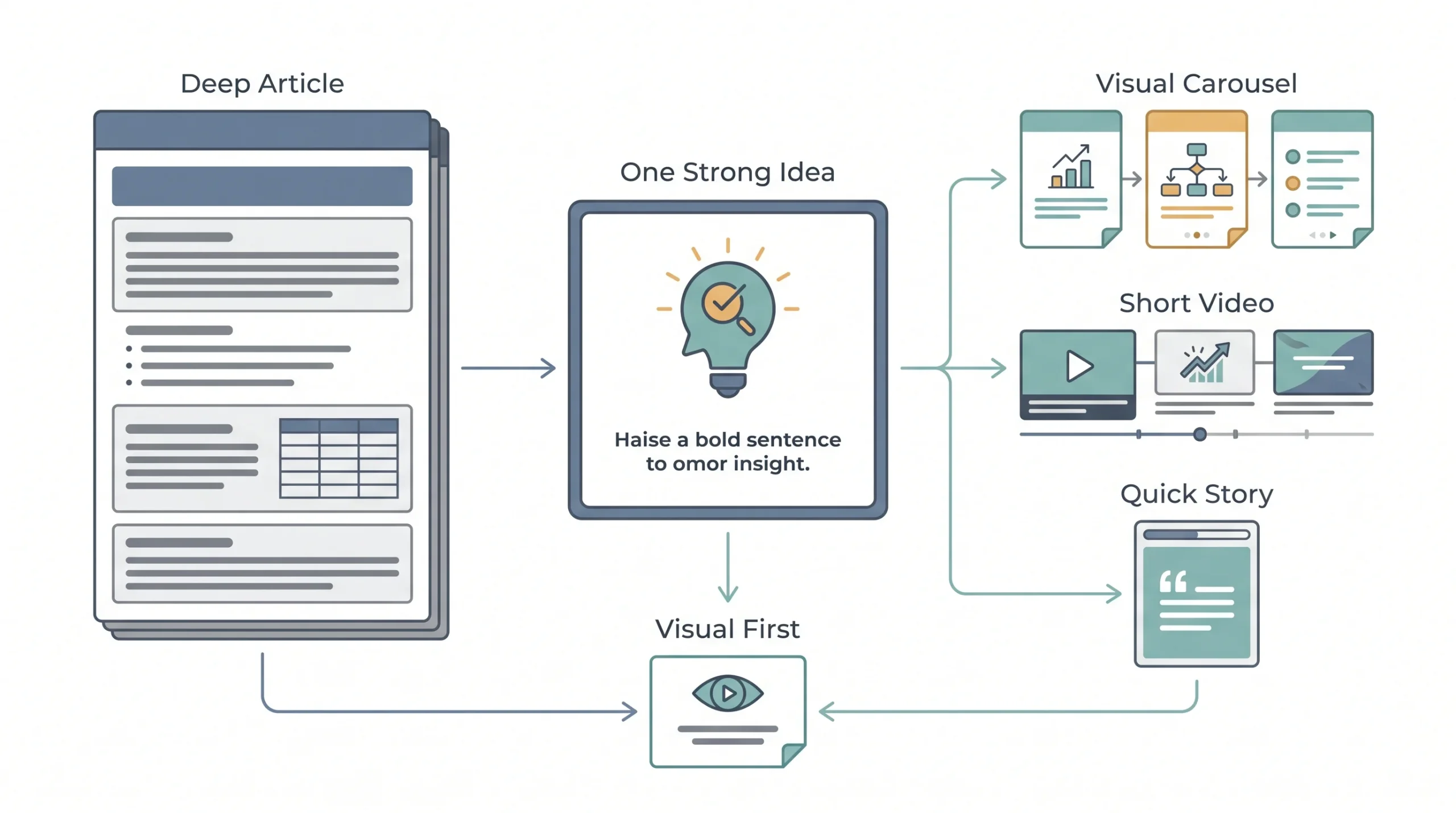
Instagram is visual first, always. Even a great idea will underperform here if the visual doesn’t stop the scroll. Carousels work well for breaking down tips or steps. Reels work well for anything with a hook in the first two seconds and movement or a strong voiceover. Stories are for the looser, more casual stuff, behind-the-scenes moments, polls, quick reactions.
When repurposing a blog post here, don’t try to cram the whole argument into one caption. Pick the single strongest point and build a carousel or Reel around just that. Save the rest for another post later.
The mistake to avoid on Instagram is treating it like a billboard. A static image with a long, dense caption rarely performs the way a well-shot Reel or a clean carousel does. The format matters as much as the message.
Captions on Instagram still matter, just not the way they do on LinkedIn. The first line needs to earn a tap on “more,” since that’s all that shows before it gets cut off. After that, captions can go longer if there’s genuinely more to say, but the visual asset is doing the heavy lifting for engagement, not the text underneath it. Hashtags have lost a lot of the power they used to have here too. A handful of relevant ones is plenty. Stuffing thirty hashtags into a caption doesn’t move the needle the way it once did, and it reads as dated to anyone paying attention.
X (formerly Twitter)
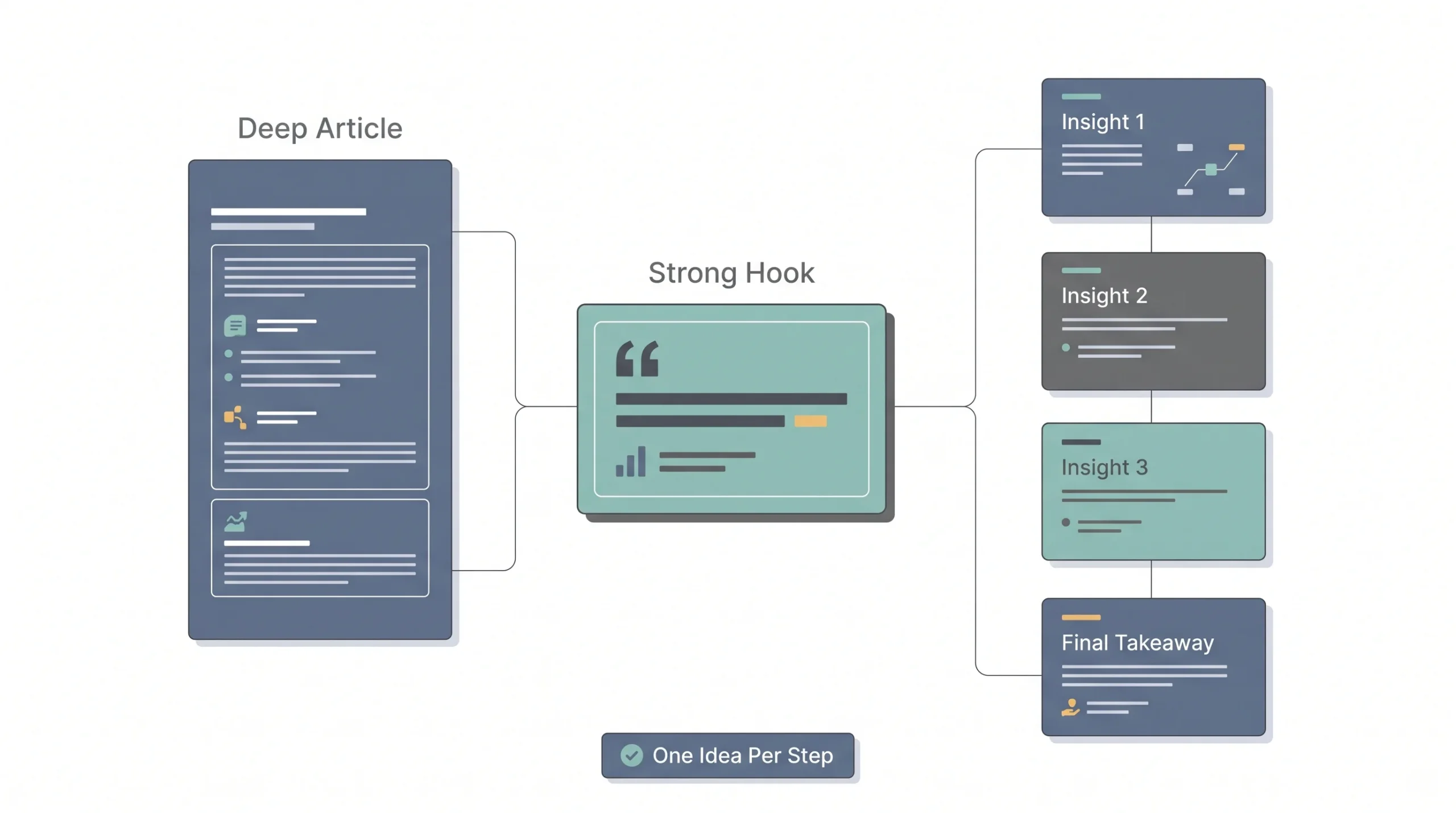
X moves fast and rewards directness. Threads work well for walking someone through an idea step by step, especially if each tweet in the thread can stand alone as a decent point on its own. Single posts work well for a sharp opinion, a strong stat, or a quotable line pulled straight from a bigger piece.
When repurposing for X, resist the urge to write like you’re writing a blog post with line breaks. The tone here is more conversational, more reactive, closer to how people actually talk. A thread that reads like five paragraphs chopped into pieces feels off. A thread that reads like someone explaining something to a friend, one point at a time, works much better.
The thing to avoid on X is over-explaining. This platform punishes wordiness. If a point takes three sentences on LinkedIn, it probably needs to take one sentence here.
The first tweet in a thread carries almost all the weight. It’s the only part most people see before deciding whether to tap and read the rest, so it needs to work as a standalone hook, not just a title slapped on top of the thread. “Here’s a thread about content repurposing” gets ignored. “Most brands repurpose content wrong, and it’s costing them reach” gets read. The difference is specificity and a hint of tension, not just a topic announcement.
YouTube Shorts and TikTok
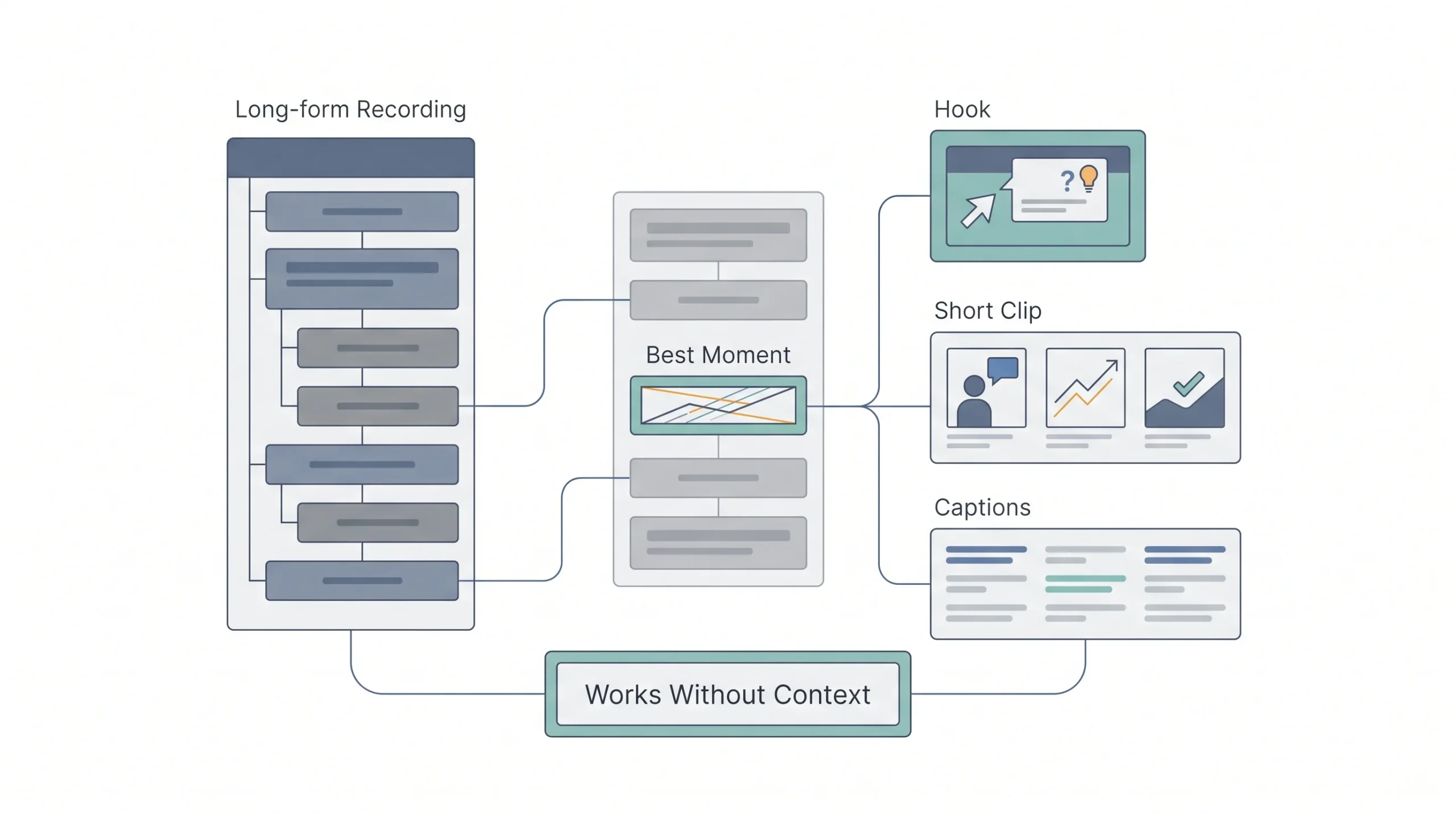
Short-form video lives and dies by the first three seconds. If there’s no hook immediately, people scroll past. Webinar clips, podcast highlights, and quick talking-head explainers all work well here, as long as they get to the point fast and don’t waste time on setup.
When repurposing longer video or audio content, look for the moment where something genuinely interesting or surprising was said, and build the clip around that exact moment, not the introduction leading up to it.
Avoid uploading a clip that’s clearly cut mid-thought or that assumes the viewer already has context from the longer piece. Every short-form clip needs to make sense completely on its own.
Captions matter more here than on almost any other format, since a huge share of people watch with the sound off, especially in the first few seconds before deciding whether to turn audio on at all. A clip without burned-in text loses a big chunk of its potential audience before it even gets a fair shot. Tools like Descript auto-generate these captions, which saves a lot of manual work, though it’s worth a quick proofread since auto-captions still get names and niche terms wrong fairly often.
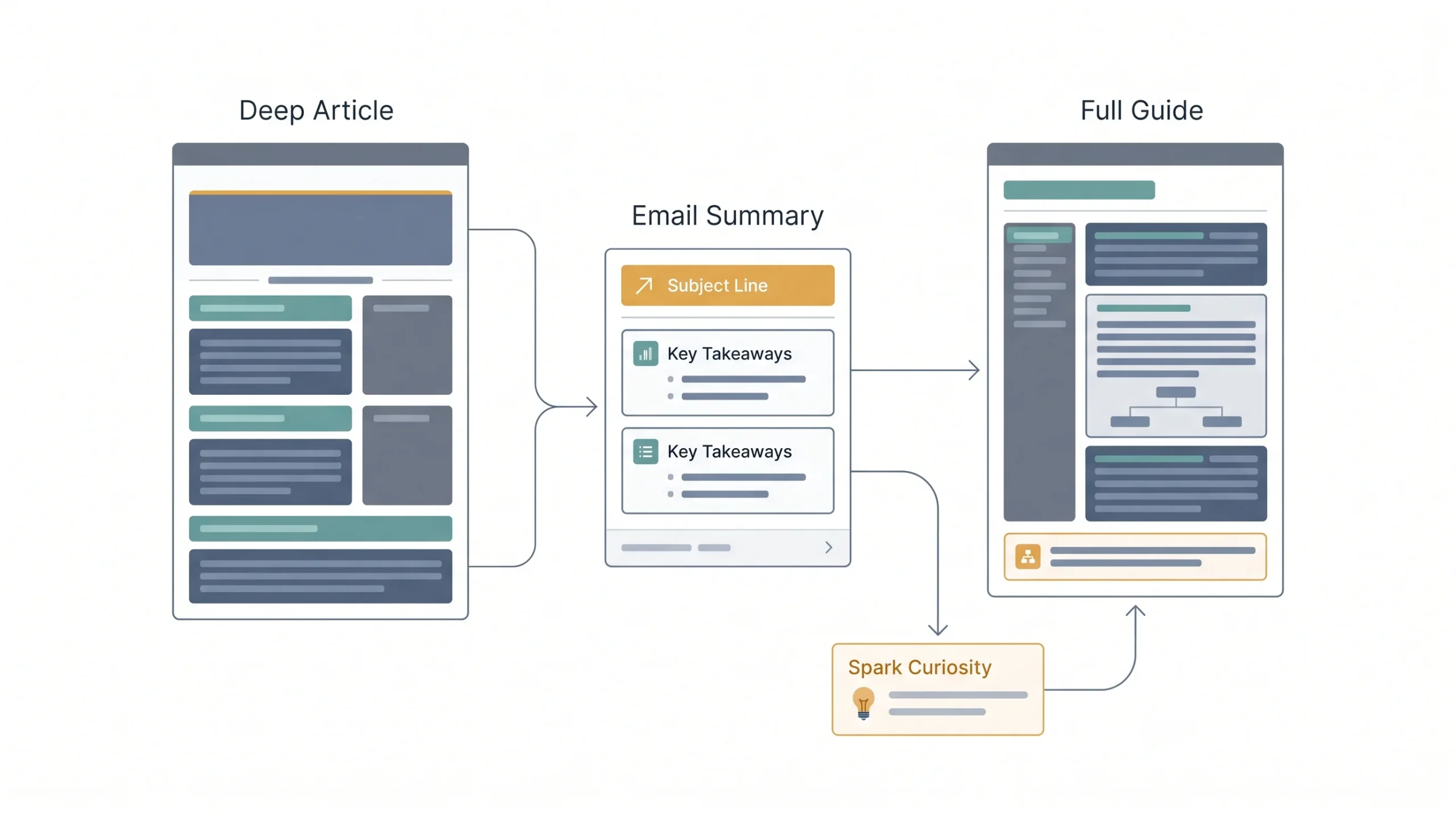
Email is the most direct, least crowded channel most brands have, and it’s often the most underused for repurposing. A blog post becomes a recap email with the main takeaways and a link to read the full thing. A case study becomes an email sent specifically to a segment who’d care about that exact outcome.
The tone here can be more personal than any other platform. People opted in to hear from you directly, so email is a good place to write like you’re talking to one person, not a broad audience.
Avoid just pasting the entire blog post into the email body. Nobody wants to scroll through six paragraphs in their inbox. Give the highlights, make the value clear fast, and let the link do the rest of the work.
Subject lines deserve real attention here too, since that single line decides whether the email gets opened at all. A subject line pulled straight from the blog’s headline often underperforms compared to one that teases a specific, curiosity-driving detail from inside the post. “Our new guide on content repurposing” is forgettable. “The one repurposing mistake that makes content look like spam” gets opened.

Pinterest is part visual platform, part search engine, which makes it a strange but useful place for repurposed content. Infographics, stat-based graphics, and how-to style pins tend to perform best because people are actively searching for solutions here, not just passively scrolling.
When repurposing, pull the clearest, most visual piece of information from the original content, a step-by-step process, a striking stat, a before-and-after, and design it as a clean, readable graphic.
The mistake to avoid on Pinterest is using a generic stock-photo style pin with barely any information on it. Pins that actually get saved and clicked usually have real, specific value visible right on the image itself, not just a pretty background and a vague title.
Pinterest also behaves more like a search engine than a social feed, which changes how repurposed content should be titled and described. Someone isn’t following an account and waiting for updates the way they might on Instagram. They’re typing a search query, something like “content calendar template” or “how to grow on LinkedIn,” and pins that use that same specific language in their title and description show up more reliably in results. Repurposing for Pinterest means thinking about what someone would type into a search bar, not just what sounds catchy.
| Platform | Content Style | Ideal Length | Best Repurposed Format |
|---|---|---|---|
| Professional, text-heavy, opinionated | Medium-length posts or 6 to 10 slide carousels | Blog post turned into a carousel or native article | |
| Visual first, personality driven | Short captions, 15 to 30 second Reels | Stats or quotes turned into a carousel or Reel | |
| X | Conversational, fast, direct | Threads of 5 to 10 tweets, or single sharp posts | Blog sections turned into a thread |
| YouTube Shorts/TikTok | Short-form video, hook-driven | Under 60 seconds | Webinar or podcast clips |
| Direct, personal, value-first | Scannable, a few short paragraphs | Blog post turned into a recap or newsletter | |
| Visual, search-driven | Clean, information-dense graphics | Stats or how-tos turned into pins |
Step-by-Step Repurposing Workflow
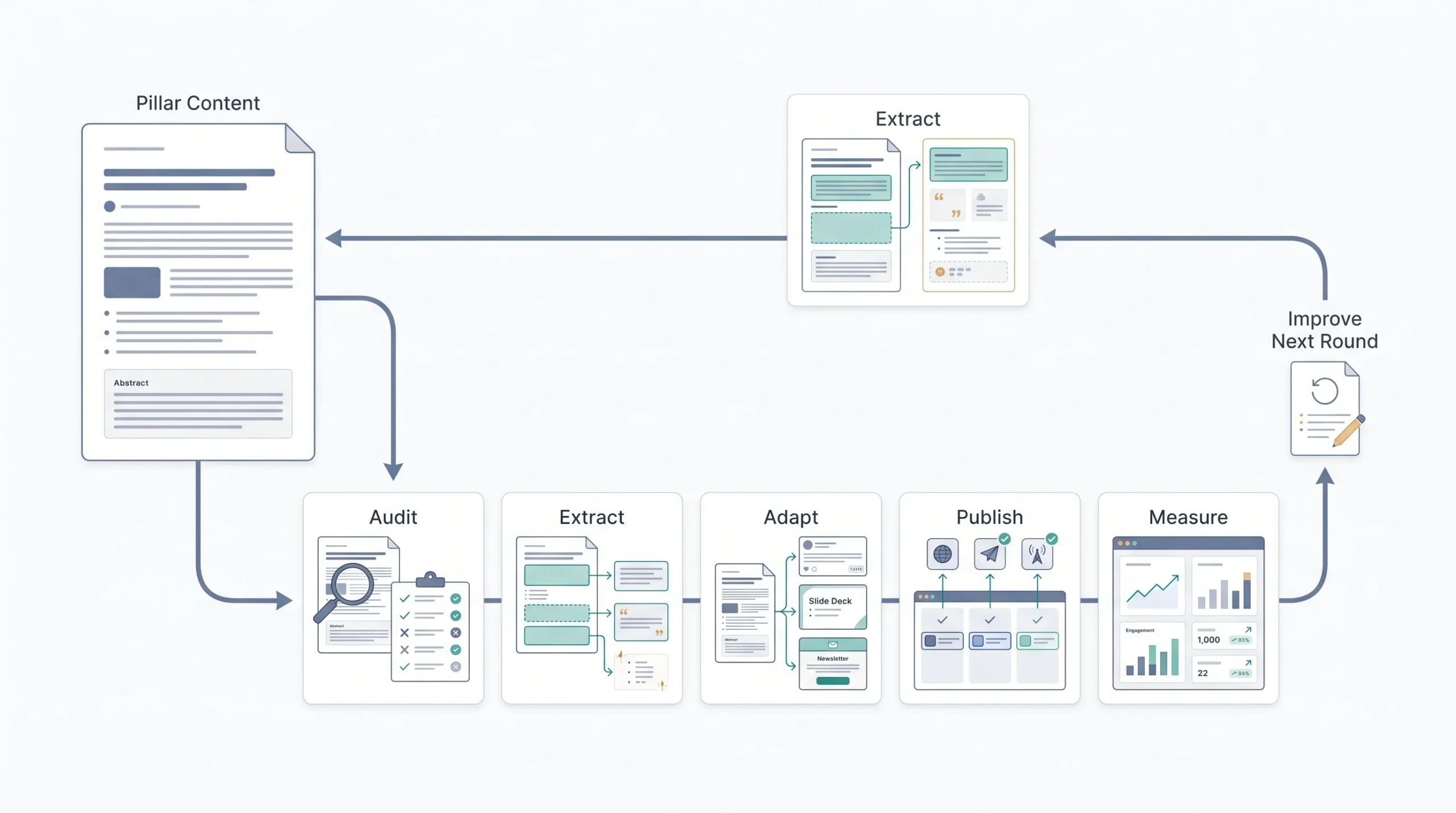
Here’s the actual process, start to finish, walked through with one real piece of content so none of this stays theoretical. Say the source is a blog post on running a local SEO audit. Seven steps, and every one of them earns its place.
Step 1: Run a content audit. Pull up everything already published, blog posts, videos, webinars, case studies, and check the numbers next to each one, not just gut feeling. Traffic, average time on page, shares, comments, whatever data is actually available. For the local SEO post, maybe it’s sitting at triple the average traffic of other posts published that same month, and it’s still getting steady search visits six months later. That’s not a lucky post. That’s a pillar candidate, and the numbers just told you so instead of you guessing.
Step 2: Tag and categorize by theme. Group everything around the core pillars a brand actually covers, SEO, paid ads, content strategy, whatever the real buckets are. This step matters because patterns only show up once things are grouped. Maybe there are four other pieces that already touch on local SEO in some way, an old Google Business Profile post, a review-management guide, a couple of client case studies. Seeing them side by side shows there’s already a real appetite for this topic, which makes the local SEO audit post an even stronger pick to build around.
Step 3: Break the piece into atomic parts. This is where the real extraction work happens, and it’s worth doing slowly instead of rushing it. Read back through the local SEO post and physically write down, in a doc or a spreadsheet, every individual piece worth pulling out on its own. Maybe that’s the specific stat about review response time affecting local rankings, the five-point audit checklist buried in the middle of the post, a short anecdote about a client whose visibility doubled after fixing their business categories, and one particularly blunt line about how most businesses ignore their Google Business Profile until something breaks. Four separate, reusable pieces, none of them requiring a single new sentence of original writing.
Step 4: Match each piece to a platform. Now line those four pieces up against the repurposing matrix from earlier. The five-point checklist is a natural LinkedIn carousel, since it’s sequential and fits the slide format well. The stat about review response times works as a sharp X post or a Pinterest graphic, since it’s punchy and visual on its own. The client anecdote fits Instagram, maybe as a Reel with the host talking through what happened. The blunt line about ignored Google Business Profiles works as a hook for a short-form video. Nothing here got forced. Each piece landed somewhere because it actually fit, not because every platform needed to be checked off a list.
Step 5: Adapt tone and format for each platform, not just the wrapper. This is the step that separates real repurposing from a copy-paste job, and it’s worth doing properly rather than rushing through it. The LinkedIn carousel version of the checklist should read like a professional walking a colleague through a process, calm and specific. The Instagram Reel script for the client story should sound like someone excitedly telling a friend what just happened, way more casual, way more personal. Same underlying facts in both, completely different voice on top. Writing both versions back to back, rather than days apart, makes it much easier to keep them distinct instead of accidentally letting one voice bleed into the other.
Step 6: Schedule and stagger the releases. Don’t publish the blog Monday and then dump the carousel, the Reel, and the X post all within the same afternoon. Spread them out. Blog Monday, LinkedIn carousel Wednesday, the client story Reel the following Monday, the X post sometime in between whenever it fits naturally. Staggering keeps each piece feeling like its own moment instead of one obvious content dump that makes people scroll past everything because it all showed up at once.
Step 7: Track performance and feed it back into the next round. Once everything’s live, actually check how each piece did a week or two later. Maybe the client story Reel massively outperformed the carousel, which says something about this specific audience wanting more personal, story-driven content and less checklist content on video. That’s not a one-time observation to file away and forget. It should directly shape what gets pulled out and prioritized from the next pillar piece.
If there’s one step to protect when time is tight, it’s step five, the tone adaptation. Everything else can be slightly rushed and the final content still holds up okay. Skip the tone adaptation, though, and every platform ends up sounding like a slightly reworded version of the same LinkedIn post, and audiences who follow a brand across more than one platform notice that fast.
Ownership matters here too, since this workflow tends to fall apart when it’s treated as one person’s job start to finish. The audit and extraction steps, one and three, work best when whoever wrote the original piece handles them, since they already know it well enough to spot what’s worth pulling out without re-reading everything three times. The platform-matching and tone-adaptation steps, four and five, work better with a second set of eyes, ideally someone who actually spends real time on that specific platform. A writer who lives on LinkedIn adapting something for X might get the format right but miss the tone entirely, while someone who’s actually active on X will instinctively know how blunt or casual it needs to be. Splitting the workflow this way, even informally between two people, tends to produce noticeably better results than one person trying to sound equally native on every platform at once.
| Step | What Happens | Who’s Best Suited For It |
|---|---|---|
| 1. Content audit | Pull performance data on existing content | Whoever owns content strategy or analytics |
| 2. Tag and categorize | Group content by theme to spot patterns | Content or strategy lead |
| 3. Break into atomic parts | Extract quotes, stats, steps, stories | Original writer of the piece |
| 4. Match to platforms | Assign each piece to the platform it fits | Content or strategy lead, using the matrix |
| 5. Adapt tone and format | Rewrite each piece in that platform’s voice | Someone active on that specific platform |
| 6. Schedule and stagger | Space out publishing so it doesn’t look like a dump | Whoever manages the content calendar |
| 7. Track and feed back | Review performance, adjust the next round | Whoever owns reporting or analytics |
Building a Repurposing Calendar or System
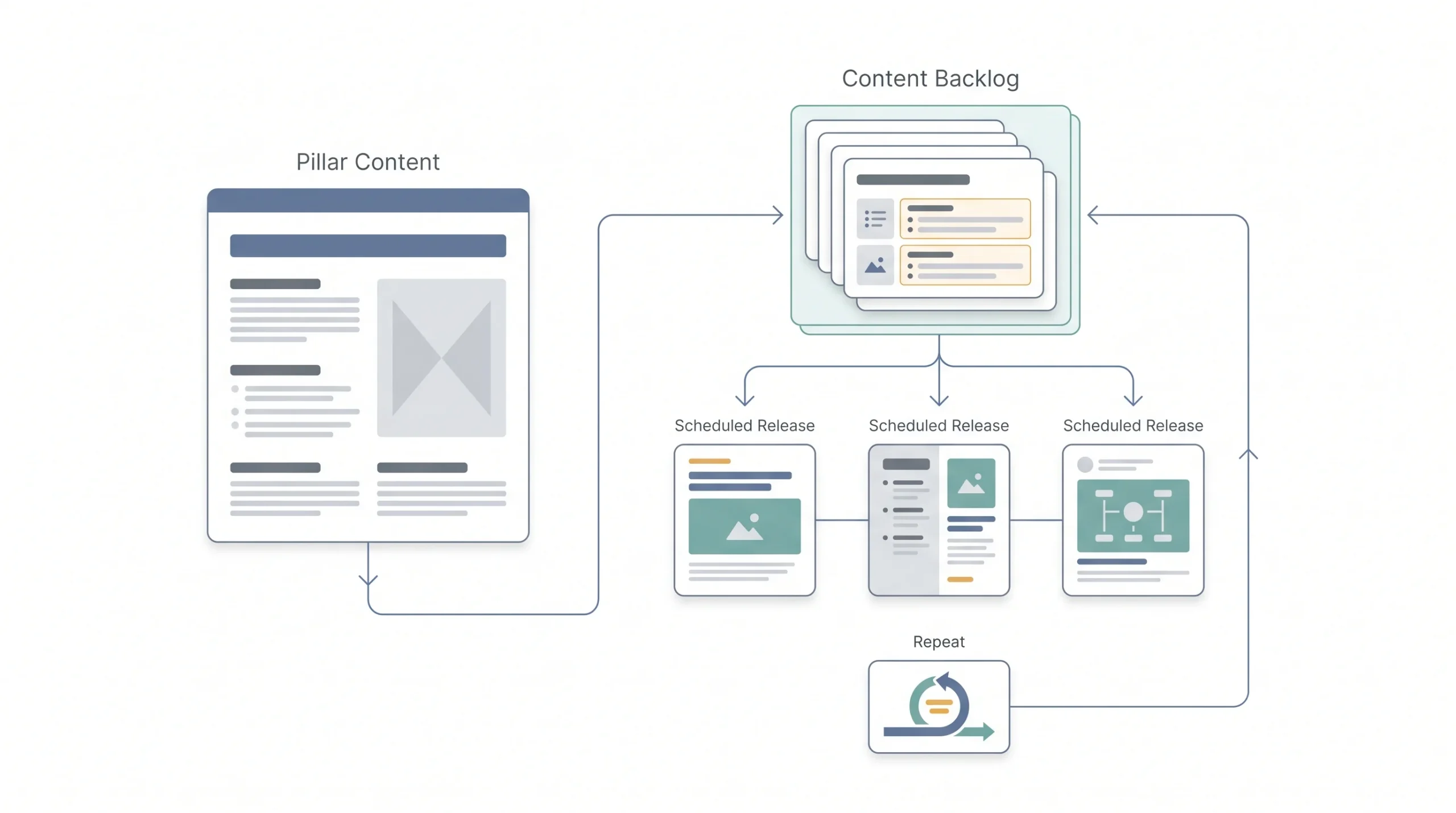
A one-off repurposing effort is fine, but the real value shows up when it’s a repeatable system, something running in the background every week or month without needing to be reinvented each time.
A simple starting cadence: one strong pillar piece per week or two weeks, depending on capacity, broken into a set number of pieces spread across the following two weeks. This keeps a steady drip of content across every platform without requiring constant new ideas.
| Day | Platform | Asset |
|---|---|---|
| Day 1 | Blog | Publish the pillar post |
| Day 2 | Carousel summarizing the main points | |
| Day 4 | Quote graphic pulling the strongest line | |
| Day 6 | X | Thread walking through the core argument |
| Day 8 | Newsletter recap with a link to the full post | |
| Day 10 | Infographic pin covering the key steps | |
| Day 12 | YouTube Shorts | Short video covering the single biggest takeaway |
This kind of calendar doesn’t need to be rigid. Some weeks a pillar piece might only generate three or four solid pieces instead of six. That’s fine. The point of the system is consistency, not forcing every single piece of content to hit every single platform no matter what.
It also helps to think in terms of a rolling backlog instead of starting from zero every week. Once a few pillar pieces have been through the extraction process, there’s usually a small stockpile of atomic pieces sitting around unused, a stat that didn’t fit anywhere last time, a quote that got cut for space. Keeping a running list of these, even something as simple as a spreadsheet with columns for the piece, its source, and which platforms it hasn’t hit yet, means there’s rarely a scramble to find something to post. The backlog does the thinking in advance, so a slow week doesn’t turn into a missed posting day.
Batching also makes a real difference here. Sitting down once a week to extract pieces from a pillar and draft five or six platform versions in one focused session tends to produce better, more consistent output than trying to write each piece fresh on the day it’s due. The mental switching cost of jumping between “LinkedIn voice” and “Instagram voice” and “email voice” throughout a scattered week adds up fast. Doing it all in one sitting, while the source material is still fresh, usually takes less total time and produces tighter writing.
Tools for Content Repurposing
Tools don’t replace the thinking behind good repurposing, but the right ones make the process faster.
Design tools handle the visual side, things like carousels, quote graphics, and Pinterest pins. Canva is the most common one people reach for because it’s fast and has templates for basically every platform’s dimensions.
Video clipping tools handle pulling short clips out of longer recordings, adding captions, and trimming down webinars or podcasts into usable short-form video. Descript is a common choice here because it lets you edit video by editing the transcript, which speeds things up a lot compared to scrubbing through timelines manually.
AI-assisted repurposing tools have gotten a lot more useful lately. Some platforms, like Semrush’s Content Toolkit, let you paste in a blog URL and generate platform-specific versions of that content directly, which cuts down the manual extraction work significantly. These tools aren’t perfect and still need a human pass to fix tone and catch anything that sounds off, but they’re a genuinely useful starting point instead of starting from a blank page every time.
Scheduling and distribution tools handle the staggering part of the workflow, letting you queue up posts across platforms in advance instead of manually posting everything the day it’s due.
None of these tools do the strategic thinking. They speed up execution once the strategy and the matrix are already figured out. Skipping the strategy and jumping straight to a tool usually just produces faster, more generic content, which isn’t the goal here. A tool can chop a webinar into ten clips in minutes, but it can’t tell which of those ten moments is actually the interesting one worth building a whole post around. That judgment call still needs a human who understands the audience and the platform.
Worth saying too, nobody needs every category of tool from day one. A small team just starting to build out a repurposing system is usually better off picking one design tool and one scheduling tool, getting comfortable with the workflow manually for a few weeks, and only adding an AI-assisted tool or a dedicated video clipper once the process itself is solid. Layering tools on top of a workflow that doesn’t exist yet just adds complexity without adding output.
Measuring Repurposing ROI
Tracking whether repurposing is actually working means looking at more than just likes.
Engagement rate per platform shows whether the adapted version is landing with that specific audience, not just getting ignored in the feed. Saves and shares matter more than surface-level likes because they signal someone found real value worth keeping or passing along. Click-through rate back to the original source shows whether the repurposed piece is successfully pulling people deeper into the full asset, which is often the actual goal behind repurposing a blog post into smaller pieces in the first place.
| Metric | What It Tells You | What To Do Next |
|---|---|---|
| Engagement rate | Whether the format and tone landed with that platform’s audience | Repeat similar formats if it worked, adjust tone if it didn’t |
| Saves and shares | Whether people found real value worth keeping or passing along | Prioritize repurposing similar topics or formats going forward |
| Click-through to source | Whether the piece is driving people back to the full asset | Strengthen the call to action if this number is low |
| Comments and replies | Whether the content sparked actual conversation | Lean into topics that consistently generate discussion |
Over time, patterns show up. Certain topics consistently get more replies. Certain formats consistently get more saves. Certain platforms quietly underperform no matter what gets posted there. That data should shape what gets repurposed next and where, instead of treating every platform as equally worth the effort every single time.
It’s worth checking this data on a set schedule rather than obsessing over it after every single post. A monthly review, looking back at everything repurposed over the past few weeks, tends to surface real patterns better than reacting to how any one individual post performed. One quiet LinkedIn post doesn’t mean LinkedIn stopped working. A pattern of the last six LinkedIn posts all underperforming compared to their Instagram counterparts, that’s a signal worth acting on, maybe by shifting more effort toward Instagram or rethinking the LinkedIn approach entirely.
And it’s fine if a platform never becomes a top performer for a specific brand. Not every channel fits every audience. A B2B software company might find X drives almost no meaningful engagement no matter how well the threads are written, while LinkedIn and email carry almost all the weight. That’s not a failure of the repurposing process, that’s just useful information about where the actual audience lives, and it should shape where future effort goes.
Conclusion
Repurposing content across platforms isn’t about pumping out more content for the sake of volume. It’s about respecting the work that already went into something good and giving it a fair shot to reach the people who never saw it the first time around. The blog post that took six hours to write deserves more than one single appearance before it disappears into the archive. Build the pillar, pull out the pieces, match them to the right platforms, adapt the tone for each one, and let the data guide what gets repurposed next. That’s the whole system, and once it’s running, it stops feeling like extra work and starts feeling like the obvious way to do things.
Frequently Asked Questions
Is repurposing content bad for SEO?
No, and honestly it tends to help more than hurt when it’s done right. The risk only shows up if the exact same block of text gets published as a standalone page in more than one place, which can create duplicate content issues. Repurposing across social platforms, email, and video doesn’t carry that risk since those aren’t indexed the same way blog pages are. And when a repurposed video or graphic gets embedded back into the original post, it usually increases time on page, which is a positive signal, not a negative one.
How often should content be repurposed?
There’s no fixed number that works for every brand, but a reasonable starting point is one strong pillar piece every one to two weeks, broken into five or six smaller pieces spread across the following two weeks. Going faster than that usually means digging into weaker source material, which produces weaker repurposed content. Slower than that and the repurposing muscle never really builds into a habit.
What’s the actual difference between repurposing and reposting?
Reposting is publishing the exact same asset, unchanged, across multiple platforms. Repurposing is taking the core idea from that asset and rebuilding it for how each platform’s audience actually consumes content, different format, different tone, sometimes a completely different length. Reposting takes five minutes and usually looks like it. Repurposing takes real thought and usually performs better because of it.
Can old, outdated content still be repurposed?
Sometimes, but check it carefully first. If the core idea is still accurate and just needs a quick update, like a stat that’s shifted slightly or a tool that’s changed its interface, it’s often worth refreshing before repurposing. If the entire premise is outdated, a platform feature that no longer exists, pricing that’s changed completely, it’s better to leave it alone or rewrite it from scratch rather than repurpose something that’ll spread outdated advice further.
How much content can realistically come out of one blog post?
It depends heavily on how deep the original piece is. A well-researched 2,000 to 3,000 word guide can usually yield somewhere between six and twelve smaller pieces once it’s properly broken down, stats, quotes, steps, and stories all pulled out separately. A shorter, thinner post might only yield two or three usable pieces, and forcing more out of it just produces weak, generic content.
Does every piece of content need to go on every platform?
No, and trying to force that usually backfires. Some pieces are naturally visual and belong on Pinterest or Instagram. Some are naturally data-heavy and belong on LinkedIn or X. Matching the piece to the platform it actually fits matters far more than hitting every single channel with every single asset.
What’s the biggest mistake people make when repurposing content?
Copy-pasting the same caption and image across every platform without adjusting anything. It’s the fastest way to make repurposing look lazy, and audiences who follow a brand across more than one platform notice immediately when the same post shows up everywhere in the exact same form.
Should repurposed content link back to the original piece?
Usually, yes, especially when the original is a blog post or a long-form video. Linking back drives traffic to the source, supports SEO, and gives people a way to go deeper if the shorter version caught their interest. The exception is standalone platform-native content, like a quick tip video, where a link isn’t necessary because the piece was never meant to send anyone anywhere else.
How do you know if a piece of content is worth repurposing in the first place?
Check three things before committing the time. Did it perform noticeably better than average when it first published? Will it still make sense to someone reading it a few months from now? And is there enough depth in it to actually pull three or four separate pieces out, not just one thin summary? If it’s a no on more than one of those, it’s probably not worth the effort.
Can AI tools handle content repurposing on their own?
They can speed up parts of the process, especially the initial extraction and drafting of platform-specific versions. But they still need a human pass afterward to fix tone, catch anything that reads generically, and make the final call on which extracted piece is actually worth publishing. Treating AI tools as a first draft generator works well. Treating them as the final step usually produces content that sounds close to right but never quite lands.
Is there a right order to repurpose content in, or does it not matter?
It helps to go from highest-effort to lowest-effort platforms while the source material is still fresh in mind. Drafting the LinkedIn carousel or the video script first, while all the context from the original piece is fully loaded, tends to produce better output than coming back to it days later and having to re-read the whole thing again. Quick, low-effort pieces like a single X post or a Pinterest pin can be knocked out afterward without needing the same depth of re-familiarization.
Does repurposed content need to be published on the same day the original goes live?
No, and it’s usually better if it isn’t. Spacing repurposed pieces out over the following one to two weeks keeps each one feeling like its own moment instead of an obvious, coordinated dump that makes the whole effort look mechanical rather than intentional.