
Look, most ads fail before anyone even sees the product. Not because the offer is bad. Not because the price is wrong. They fail because the copy sitting between the customer and the “buy now” button is boring, generic, or trying to say too much at once. You’ve seen it. Everyone has. Ad after ad that says “quality service” and “best prices” and “customer satisfaction guaranteed” and none of it means anything because it could be pasted onto literally any business on the planet.
Here’s the thing nobody tells you when you start running ads: the product barely matters in that first three seconds. What matters is whether the words in front of someone’s face make them stop scrolling. That’s it. That’s the whole battle. You can have the best SaaS tool ever built, the most comfortable mattress, the cheapest flight deals, if your headline doesn’t grab someone mid-scroll, none of that matters because they’ll never find out.
So why does this happen so much? Honestly, because most people writing ads are writing like they’re filling out a form. Name, feature, benefit, CTA, done. That’s not persuasion, that’s a spec sheet. Persuasive copywriting is a completely different skill than “writing.” You can be a great novelist and still write terrible ad copy, because ad copy isn’t about beautiful sentences it’s about triggering a decision in someone’s brain in under two seconds, usually while they’re half-watching a video, standing in line at Target, or scrolling in bed at midnight.
And the cost of getting this wrong keeps climbing. CPCs on Google Ads have gone up in basically every major vertical over the last few years. Meta ad costs jump every Q4 like clockwork. If your copy isn’t converting, you’re not just losing sales you’re literally burning cash every single day the campaign runs. That’s the part that should scare you a little. A weak headline isn’t a stylistic issue. It’s a line item on your P&L.
Ad copy touches every corner of digital marketing now. Google Search Ads. Facebook and Instagram feed and story ads. LinkedIn sponsored content (which, let’s be honest, has its own weird tone that most people get wrong). YouTube pre-rolls. Display banners nobody reads but somehow still convert when done right. Native ads dressed up to look like articles. Email subject lines and preview text, which are really just ad copy wearing a different hat. Every one of these formats has its own rules, its own character limits, its own audience psychology — but they’re all built on the same bones.
This guide is going to walk through those bones. What ad copy actually is and how it’s different from every other kind of writing you might already be good at. Why it matters more now than it did five years ago. The psychology running underneath every ad that actually works. The individual pieces that make up high-converting copy headline, hook, value prop, proof, offer, CTA. A step-by-step process you can actually follow instead of just staring at a blank Google Doc. The classic frameworks (AIDA, PAS, BAB, and a handful of others) with real examples, not just the acronym soup. Over a hundred fill-in-the-blank formulas you can steal today. Real ad examples across platforms and industries. The emotional triggers that actually move people to act. The mistakes that quietly kill conversion rates. How copy needs to shift depending on the platform you’re running it on. Where AI fits into all this (and where it really, really doesn’t). How to test and improve what you’ve written instead of guessing forever. And a checklist to run through before you hit publish, because you will forget something otherwise. Everyone does.
What You Will Learn in This Guide
- What separates ad copy from every other type of writing, and why that distinction actually matters
- The psychological stages every buyer moves through before they click
- How to build a headline, hook, and CTA that don’t sound like everyone else’s
- A repeatable step-by-step writing process instead of relying on random inspiration
- The proven frameworks (AIDA, PAS, BAB, FAB, 4Ps, and more) with real-world examples
- Over 150 ready-to-use ad copy formulas grouped by category
- Real ad copy examples across Google, Facebook, Instagram, LinkedIn, and more
- The emotional triggers that quietly drive most buying decisions
- Common mistakes that tank conversion rates, and how to fix them
- Platform-specific rules for writing copy that fits where it’s shown
- Where AI genuinely helps with ad copy, and where it falls flat
- How to test your copy properly instead of guessing which version “feels” better
- A pre-publish checklist so you don’t launch a campaign with a typo in the headline (it happens more than you’d think)
What Is Ad Copy?
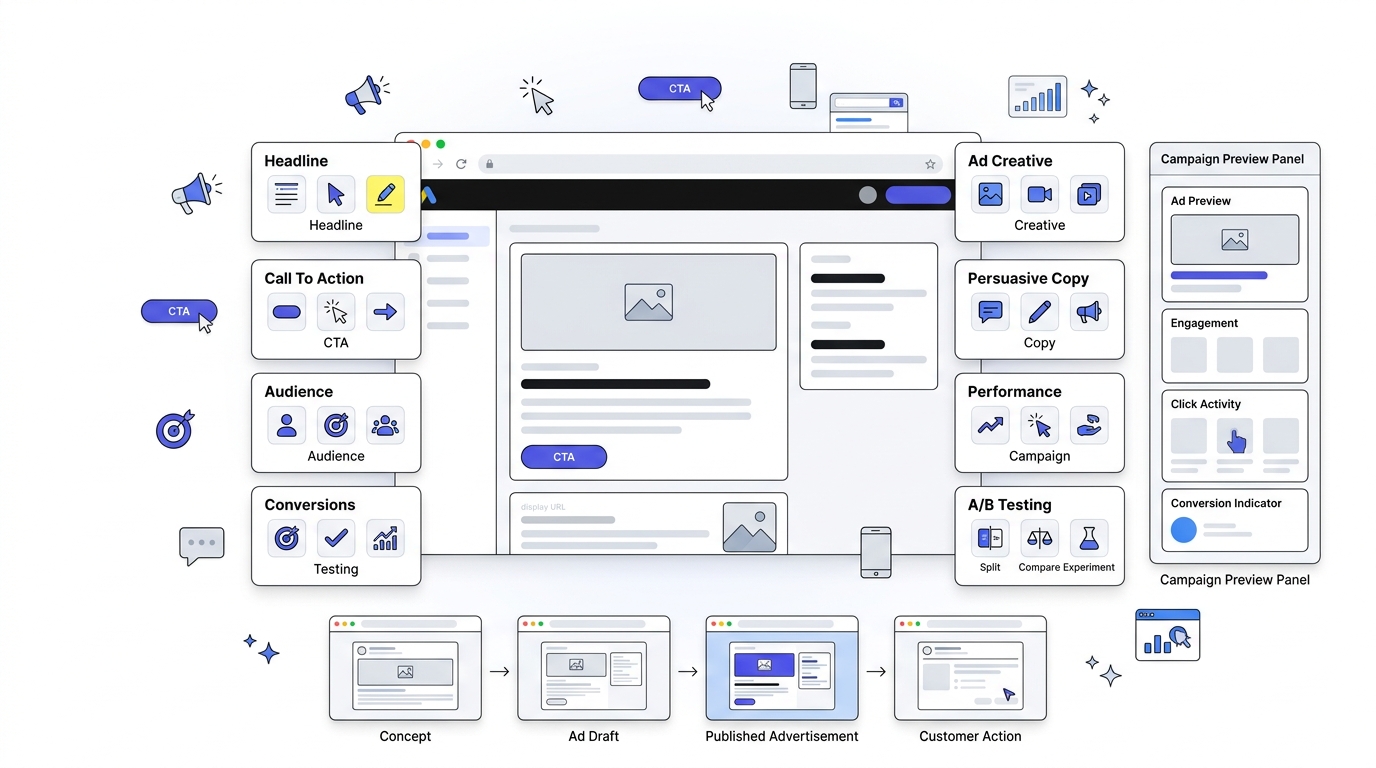
Ad copy is the actual text inside a paid advertisement — the words designed to get someone to click, call, sign up, or buy, usually within a few seconds of seeing them. That’s the whole job. Not to inform. Not to entertain, although it can do both of those things along the way. To move someone to act.
People spend absurd amounts of money on this. Companies pour six and seven figures into agencies just to get a headline right, because the difference between a headline that converts at 2% and one that converts at 4% isn’t small it’s literally double the revenue on the exact same budget. That’s why copywriters who are genuinely good at this get paid what they get paid. It’s not decoration. It’s the lever.
Here’s where people get confused, though they think “I’m a good writer” automatically means “I can write good ads.” Nope. Not even close. Blog content wants to educate and rank on Google, so it’s long, structured, and patient. Website copy needs to build trust across an entire visit, so it can breathe a little. Landing page copy has one job too, but it gets way more real estate — paragraphs, testimonials, FAQs, the whole nine yards — to convince someone who already clicked. Sales copy, like long-form sales letters, has the luxury of time; someone reading a 3,000-word sales page has already committed some attention. Ad copy has none of that luxury. It’s judged in under three seconds, competing against literally everything else on someone’s screen.
| Type | Primary Goal | Typical Length | Reader’s Mindset |
|---|---|---|---|
| Blog Content | Educate, build authority, rank in search | 1,500–3,000+ words | Searching for an answer, patient |
| Website Copy | Build trust across the whole site | Varies by page | Browsing, comparing |
| Landing Page Copy | Convert an already-interested visitor | 500–2,000 words | Already clicked, evaluating |
| Sales Copy | Persuade over a longer format | 1,000–5,000+ words | Reading with intent, weighing a decision |
| Ad Copy | Stop the scroll, drive an immediate click | 5–90 words | Distracted, unaware, judging in seconds |
See the pattern? Every format down that list gets less time and less patience from the reader. Ad copy sits at the bottom, which is exactly why it’s the hardest one to get right, even though it’s the shortest.
Why Great Ad Copy Matters More Than Ever
Ten years ago you could run a mediocre ad and still get decent results because there just wasn’t that much competition bidding on the same keywords or the same audience segments. That world is gone. Google Ads auctions are more competitive across nearly every industry than they were even three years back, and Meta’s ad library is packed with brands all fighting for the same eyeballs in the same feed.
Attention spans haven’t magically expanded to compensate either if anything they’ve shrunk. People scroll Instagram at a pace where an ad has maybe half a second to register as “worth stopping for” before their thumb keeps moving. And here’s the brutal part: people have gotten really good at ignoring ads. Banner blindness is real. Most people can spot “this is an ad” before they even read a word of it, and the second that recognition kicks in, 90% of them are gone.
Then you’ve got AI. Every business now has access to tools that can spit out ad copy in ten seconds. Which sounds great until you realize it means the internet is now flooded with copy that all sounds the same — same structure, same “unlock,” same “discover,” same exclamation-point energy. That sameness is actually an opportunity if you’re paying attention, because copy that sounds like an actual human wrote it, with a specific point of view, now stands out just by being different.
None of this changes without emotional persuasion doing the heavy lifting. Facts inform. Emotion moves. A stat about how much money someone could save is useful, sure, but “imagine never worrying about your electric bill again” is the thing that actually gets clicked on. Rising costs plus rising competition plus shrinking attention plus AI sameness that’s the environment you’re writing in now. Copy that used to be “good enough” doesn’t cut it anymore.
How Ad Copy Actually Works
Every person who buys something goes through stages, whether they realize it or not. Awareness — they don’t even know your product exists yet, or don’t know they have the problem you solve. Attention, something catches their eye for a second. Interest — they’re curious enough to keep reading or watching. Desire now they actually want it, not just find it interesting. Trust — they believe you can actually deliver what you’re claiming. Action — they click, buy, sign up, call.
Most ad copy fails because it tries to jump straight from Attention to Action and skips everything in between. “Buy now, 50% off!” might grab a second of attention, but if there’s no interest built, no desire created, and zero trust established, that CTA is just noise. Nobody clicks “buy now” on a brand they’ve never heard of with zero context. Well, almost nobody.
This is where cognitive bias comes in, and honestly, this is the part that separates people who are “fine” at copy from people who are genuinely good at it. Curiosity is one of the strongest pulls in human psychology — an open loop that the brain wants closed. “The one mistake killing your ad CTR” makes people want to know what the mistake is, even if they weren’t thinking about CTR five seconds ago. FOMO works because loss feels heavier than gain “only 12 left” hits differently than “we have plenty in stock.” Social proof works because humans are herd animals whether we like admitting it or not “Join 40,000 marketers” reduces perceived risk just by existing. Authority works because we default to trusting expertise. “As featured in Forbes” borrows credibility instantly. Reciprocity works because when you give someone something free, they feel a pull to give something back, even if it’s just their email address. Scarcity works alongside FOMO but hits differently — it’s about supply, not time. “Only 3 rooms left at this price” versus “sale ends tonight” are cousins, not twins.
Take two headlines for the exact same online course:
“Learn Digital Marketing Online”
versus
“How I Went From $0 to $10K/Month Freelancing (Without a Marketing Degree)”
The first one is a description. The second one triggers curiosity, uses a specific number (which reads as more credible than a round one, weirdly), and removes an objection (“without a degree”) before it’s even raised. Same product. Wildly different pull.
The Anatomy of High-Converting Ad Copy
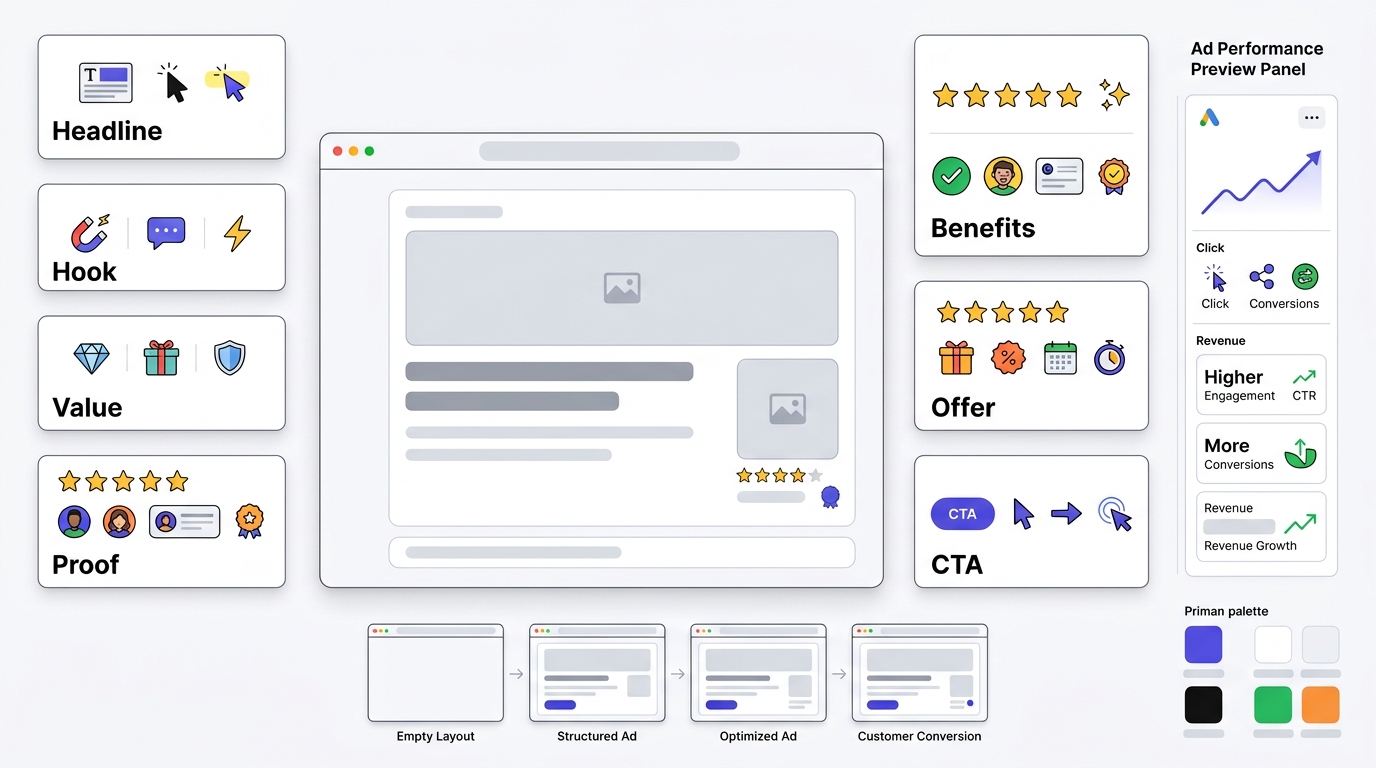
Every strong ad is built from a handful of components stacked on top of each other. Miss one and the whole thing wobbles.
Headline
The headline is doing one job and one job only: stop the scroll. It’s not there to explain your product. It’s there to buy you the next three seconds. “Software for Small Business Accounting” describes. “Stop Doing Your Books at Midnight” stops. See the difference? One is a label. The other is a moment someone actually recognizes from their own life.
Common mistakes here: being too clever and sacrificing clarity, being too safe and sacrificing any pull at all, or trying to cram the entire value prop into the headline instead of trusting the rest of the ad to do its job.
Primary Hook
The hook is what keeps someone reading after the headline landed. This is usually where you name the exact problem someone’s dealing with, in language that sounds like it came from their own head, not a marketing department. “You’ve tried five apps and none of them stuck” is a hook. It works because the reader thinks “wait, how did you know that.”
Value Proposition
Every value prop, whether it’s stated directly or implied, is answering three silent questions in the reader’s head: Why you specifically, and not one of your ten competitors? Why now, instead of putting this off another six months? Why this particular product, and not some other solution to the same problem? If your copy doesn’t answer at least two of those, the reader’s brain quietly files you under “maybe later,” which is really just “never.”
Benefits
This is the one everyone knows about and still gets wrong constantly. Features describe the product. Benefits describe the reader’s life after they have it. “1TB of cloud storage” is a feature. “Never lose another family photo again” is the benefit sitting right behind it. People don’t buy 1TB of storage. They buy peace of mind about their kid’s baby pictures. Always translate the feature into what it actually changes for the person.
Proof
Claims are cheap. Anyone can say “the best.” Proof is what makes a claim believable: testimonials from real (or realistic) customers, star ratings, hard numbers (“used by 12,000 dentists”), before-and-after case studies. Proof is the thing that quiets the skeptical voice in someone’s head that’s whispering “yeah right.”
Offer
This is the concrete deal on the table. A discount. A bonus thrown in. A guarantee that removes the risk of trying. A free trial. A limited-time window. A strong offer can rescue mediocre copy. Weak or vague copy paired with no real offer rarely converts, no matter how nice the sentences are.
Call-to-Action
Weak CTA: “Learn More.” It’s fine. It’s forgettable. It asks nothing of the reader emotionally.
Strong CTA: “Start Your Free 14-Day Trial No Card Required.” It’s specific, it removes friction (no card needed), and it tells the reader exactly what happens next.
The difference between those two lines, run at scale across a big ad budget, is genuinely thousands of dollars.
Step-by-Step Process to Write Ad Copy That Converts
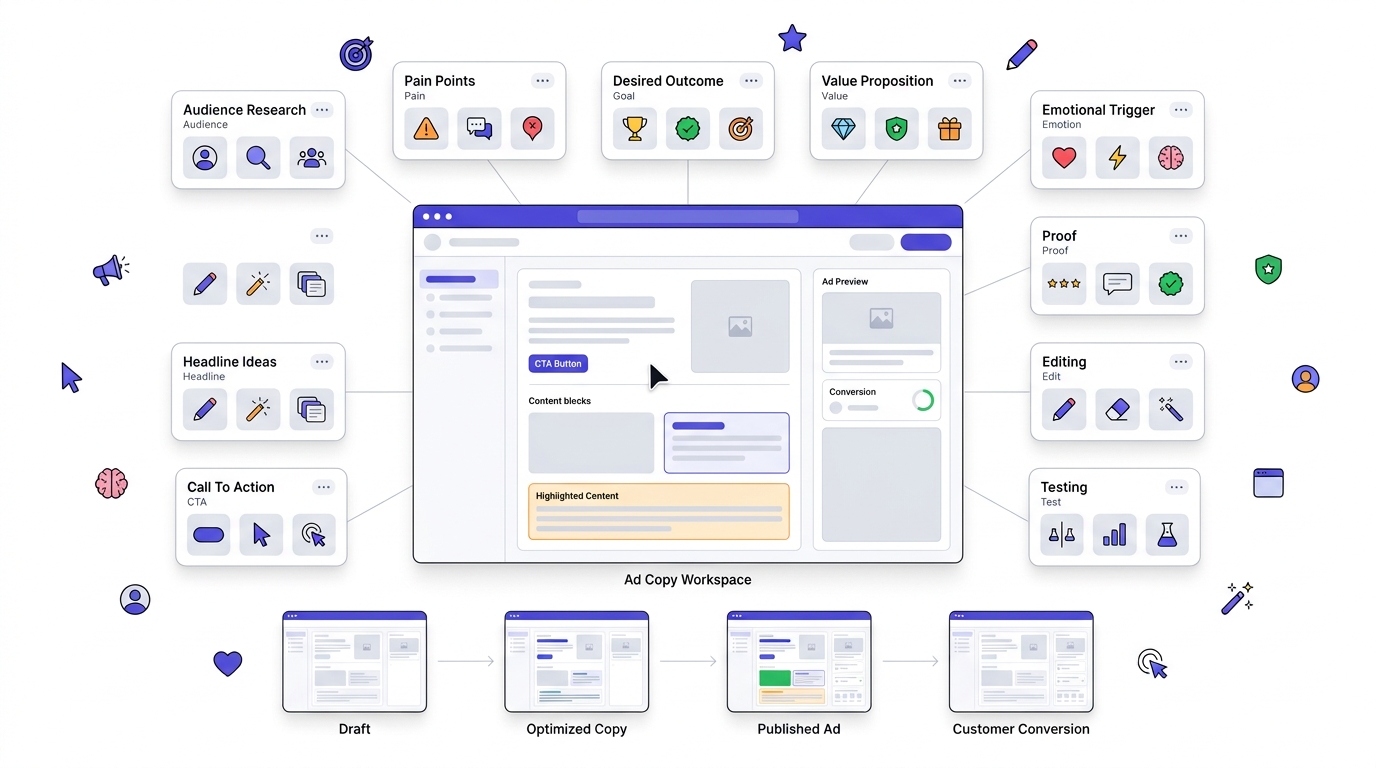
Step 1: Know your audience — actually know them, not “women 25-45 interested in fitness.”
Read reviews on competitor products, especially the 3-star ones, because that’s where people are honest about what half-worked. Lurk in relevant subreddits or Facebook groups. Do a handful of actual customer interviews if you can swing it — five real conversations will teach you more than a week of guessing. Look at what competitors are already running in the Meta Ad Library; if an ad’s been running for months, it’s probably working.
Step 2: Identify pain points.
Not “I want a better productivity app.” More like “I’ve downloaded six to-do apps and abandoned all of them within a week because they’re too complicated to actually use.” Specificity is everything here.
Step 3: Understand desired outcomes.
What does life look like on the other side of buying this? Not “loses weight.” More like “can finally play basketball with their kid without getting winded in the first five minutes.”
Step 4: Create a powerful value proposition.
A decent formula: “We help [specific audience] achieve [specific outcome] without [common pain point].” Example: “We help freelance designers land retainer clients without cold-pitching on LinkedIn.”
Step 5: Choose one emotional angle. Just one.
Fear, greed, status, convenience, trust, curiosity, security, and belonging. Pick the one that fits your audience best and commit. Ads that try to hit five emotions at once end up hitting none of them.
Step 6: Write multiple headlines.
Ten minimum, honestly. The first three or four you write will usually be the most obvious, generic versions of the idea. The good ones show up around headline seven or eight, once you’ve exhausted the boring options.
Step 7: Support with proof.
Drop in the specific number, the real testimonial, the case study detail that makes the claim land.
Step 8: Write the CTA.
Be specific about what happens the second they click.
Step 9: Edit ruthlessly.
Cut every word that isn’t doing work. If a sentence sounds fine but doesn’t move the reader closer to clicking, it goes.
Step 10: Test continuously.
Your first version is a guess dressed up as a final draft. Treat it that way.
Proven Ad Copywriting Frameworks
AIDA: Attention, Interest, Desire, Action. The granddaddy of them all, and still solid because it maps almost exactly onto the psychological stages covered earlier. Best for cold audiences who’ve never heard of you.
Example: “Tired of paying $200/month for software you barely use? (Attention) Most teams only touch 20% of their tools’ features. (Interest) Imagine cutting your software spend in half without losing a single feature you actually need. (Desire) See your savings in 60 seconds — free audit tool below. (Action)”
PAS: Problem, Agitate, Solve. This one’s brutal in a good way. You name the problem, you press on it a little so it actually stings, then you offer relief.
Example: “Your website looks fine on your laptop. But 68% of your visitors are on mobile — and on their phones, your buttons are cut off and your checkout is broken. Every day you wait, you’re losing sales you’ll never know about. Fix it in one afternoon with our mobile audit tool.”
BAB: Before, After, Bridge. Paints the “before” reality, then the “after” reality, then positions your product as the bridge between them.
Example: “Before: spending 3 hours a week manually creating invoices. After: invoices auto-generated and sent while you sleep. The bridge: our invoicing software, free for your first 30 days.”
FAB: Feature, Advantage, Benefit. More tactical, often used in product-focused ads where you’re stacking multiple reasons to buy.
Example: “Built-in AI writing assistant (Feature) means you never stare at a blank page (Advantage) so you can publish 3x more content without hiring extra writers (Benefit).”
4Ps: Picture, Promise, Proof, Push. Paint a picture of the outcome, promise it’s achievable, back it with proof, push toward action.
Example: “Picture waking up to sales notifications instead of checking them yourself all day. We promise you’ll set up your first automated funnel in under an hour. 4,200 store owners already have. Start your free trial now.”
QUEST: Qualify, Understand, Educate, Stimulate, Transition. A bit more layered, often used in longer-form native ads or advertorials where you have more room to breathe.
Before-After-Bridge: Functionally similar to BAB above, sometimes treated as its own separate approach depending on which agency’s playbook you’re reading — same core mechanic either way.
Problem-Agitate-Solve: Same family as PAS, sometimes written out with the “Agitate” step split into two beats: naming the surface problem, then digging into the deeper cost of not solving it.
ACCA: Awareness, Comprehension, Conviction, Action. You make them aware of an issue, help them understand why it matters, build conviction that a solution exists, then push to action. Works well for more complex, higher-consideration purchases like B2B software or financial products, where a single emotional jab isn’t enough to close the deal.
150+ High-Converting Ad Copy Formulas
Grouped by category so you can just grab-and-adapt. Fill in the brackets with your specifics.
Curiosity: “The [thing] nobody talks about” / “What [competitor/industry] doesn’t want you to know” / “I tried [thing] for 30 days — here’s what happened” / “The weird trick that [outcome]” / “Why [common belief] is dead wrong” / “This [X] changed everything for us”
Benefits: “[Outcome] in [timeframe]” / “Get [result] without [pain point]” / “[Number] ways to [outcome]” / “Finally, a [product category] that actually [does the thing]” / “[Outcome], guaranteed”
Urgency: “Ends tonight at midnight” / “Only [X] hours left” / “Doors close [date]” / “Last chance to [benefit]” / “Price goes up [date] — lock in now”
Scarcity: “Only [X] spots left” / “Limited to the first [X] customers” / “While supplies last” / “[X] left in stock” / “Not restocking after this batch”
Fear: “Don’t make this mistake with your [thing]” / “This is silently costing you [amount]” / “If you’re still doing [old way], you’re losing [outcome]” / “The hidden risk in your [thing]”
Authority: “As seen in [publication]” / “Built by former [credible role]” / “The method top [industry] use” / “[X] years of [expertise]”
Trust: “No credit card required” / “Cancel anytime” / “[X]-day money-back guarantee” / “Trusted by [number] customers since [year]”
Results: “From [before state] to [after state] in [timeframe]” / “[X]% increase in [metric]” / “How [customer] achieved [result]”
Numbers: “[X] people already switched” / “Save $[amount] a year” / “[X] out of [Y] users saw [result]”
Offers: “Get [X]% off today only” / “Buy one, get one free” / “Free [bonus] with every order” / “[X] free, then $[price]”
Questions: “Still paying for [thing] you don’t use?” / “Tired of [pain point]?” / “What if [outcome] took half the time?”
Contrarian: “Everyone tells you [common advice]. Here’s why that’s wrong” / “Stop doing [common practice]” / “[Popular belief] is a myth”
Social Proof: “Join [X] happy customers” / “Rated [X] stars by [number] reviewers” / “[Number] businesses trust us with [thing]”
Storytelling: “It started with [struggle]…” / “We built this after [origin story]” / “[Customer name] almost gave up until…”
CTA: “Start free today” / “Claim your spot” / “Get instant access” / “See it in action” / “Try it risk-free”
That’s well over 150 combinations once you swap in real specifics for each bracket, and you’ll notice most of them can be mixed together — a curiosity headline paired with a results-based subhead paired with a scarcity CTA is a completely normal, effective combo.
Ad Copy Examples That Actually Convert
Google Search Ads
- Headline: “Late Tax Filing? File in 15 Min.” Description: “Avoid IRS penalties. Simple online filing, backed by real CPAs. Start free.”
- Headline: “Dentist Near You — Same Day Appts” Description: “Emergency and routine care. Most insurance accepted. Book online now.”
- Headline: “Learn Spanish in 6 Months” Description: “Real conversations, not flashcards. 30-day free trial, no card needed.”
Facebook Ads
- “I used to dread laundry day. Now it’s 20 minutes and I actually enjoy it. Here’s what changed.” (paired with product image)
- “68% of small businesses overpay on shipping and don’t even know it. Find out in 2 minutes — free calculator below.”
- “We built the coffee maker we always wanted and couldn’t find. 4,800 five-star reviews later, here it is.”
Instagram Ads
- “POV: your skincare routine finally works” (paired with visual before/after)
- “The $9 candle that sold out 4 times this year”
- “Not sponsored. Just obsessed. Link in bio.”
LinkedIn Ads
- “Your sales team is spending 40% of their week on admin work instead of selling. Here’s how to fix that.”
- “We helped a 12-person agency triple its pipeline in 90 days. No extra headcount.”
- “Stop losing candidates to slow hiring processes. See how [Company] cut time-to-hire by 60%.”
Ecommerce Product Ads: “The jeans that actually fit. 200,000+ pairs sold, 4.8 stars.” / “Sold out 3 times in 2024. Back in stock — for now.”
SaaS Ads: “Cut your reporting time from hours to minutes. Free 14-day trial.” / “The project management tool your team will actually use (we promise).”
Local Business Ads: “Best pizza in [neighborhood], according to 900+ Google reviews.” / “Same-day plumbing repairs. Call before 6pm, we’re there today.”
Real Estate Ads: “3 homes just listed under $400K in [area] — see them before they’re gone.” / “Thinking of selling? Get your home’s value in 60 seconds, free.”
Coaching Ads: “I went from burnt out to fully booked in 4 months. Here’s the exact system.” / “Free masterclass: how to land your first 3 clients this month.”
B2B Lead Generation Ads: “Download the 2026 benchmark report — see how your industry compares.” / “See why 500+ CFOs switched from spreadsheets to [Product].”
Emotional Triggers That Increase Conversions
Fear works when there’s a real cost to inaction — missing a deadline, losing money, falling behind competitors. Curiosity works when you create a gap between what someone knows and what they want to know. Hope works in categories like health, finance, and self-improvement, where people are buying a better version of their future. Achievement taps into people’s desire to hit a goal — think fitness apps with streaks and badges. Trust matters most in high-price or high-risk purchases; nobody buys a $3,000 mattress from a brand they’ve never heard of without some serious trust signals first. Belonging works because humans want to be part of something — “join the community” language leans on this hard. Security is the quiet cousin of fear, more about stability than danger — insurance ads live here. Status is why luxury brands barely mention features at all; they’re selling how owning the thing makes you look. Exclusivity works alongside status — “invite only,” “members only.” And urgency plus scarcity, which get lumped together but aren’t quite the same thing — one’s about time running out, the other’s about supply running out — both push people off the fence.
A practical example: a $40 skincare serum ad leaning on hope and achievement (“wake up to visibly smoother skin in 14 days, or your money back”) will usually outperform the same product pitched purely on ingredients (“contains 2% niacinamide and hyaluronic acid”). The ingredients matter for credibility, sure, but they’re not what gets the click.
How to Write Ad Copy for Different Advertising Platforms
Google Ads — Headlines are capped at 30 characters each (you can add up to 15), descriptions at 90 characters (up to 4). Lead with the strongest headline first since Google doesn’t always show all of them. Keyword relevance in the headline helps your Quality Score, which lowers your CPC — so it’s not just about persuasion here, it’s also mechanically tied to what you pay.
Facebook Ads — Primary text up top, but people barely read past the first line or two before it gets cut off with “See More.” Front-load your strongest hook in that first sentence. Headline underneath the image is short and should reinforce, not repeat.
Instagram Ads — Visual-first platform, so copy needs to feel native to the feed, less “ad-like.” Captions can run longer here than on Facebook, but the first line still has to earn the “more” click.
LinkedIn Ads — More formal tone works better, but “formal” doesn’t mean boring or full of jargon. Data points, case studies, and outcomes-focused headlines perform well because the audience is there to solve work problems, not to be entertained.
YouTube Ads — The first 5 seconds are everything, since that’s the skip window. Verbal hook needs to match whatever’s happening on screen, or people bail immediately.
TikTok Ads — Copy needs to feel like it came from a creator, not a brand. Overly polished ad copy gets scrolled past instantly here; rougher, more native-sounding language performs better.
Display Ads — Very limited space, so it’s headline plus maybe one supporting line. Visual usually does more heavy lifting than the copy itself.
Native Ads — Designed to look like editorial content, so headlines should read more like an article title than a sales pitch — think “5 Signs Your Roof Needs Replacing” instead of “Buy a New Roof Today.”
Email Ads — Subject line is your headline, preview text is your subhead. Both together decide whether the email even gets opened.
Amazon Ads — Product title and bullet points function as your ad copy here. Lead with the strongest benefit and the most important keyword in the first several words, since Amazon’s search and mobile display both truncate long titles.
AI vs Human Ad Copywriting
AI is genuinely useful for speed — knocking out ten headline variations in thirty seconds when you’re stuck staring at a blank page, or generating a first-draft structure you can then rework. It’s decent at grammar cleanup, at reformatting copy for different character limits across platforms, and at brainstorming angles you hadn’t considered.
Where it falls flat is originality and specificity. AI-generated copy tends to default to the same handful of patterns — “unlock,” “elevate,” “discover,” “game-changing” — because it’s trained on the average of everything, and the average of everything reads like nothing at all. It also doesn’t know your customer’s actual language unless you feed it real research first — actual quotes from reviews, actual phrases from customer interviews.
The best approach honestly isn’t AI versus human, it’s AI as a first draft, human as the editor. Feed it real customer language and specific research instead of vague prompts like “write ad copy for a fitness app.” Then go through and rip out anything that sounds like it could belong to any other brand. Keep the brand voice consistent by giving the AI actual examples of tone you want, not just instructions. Combine the speed of AI with the judgment of a human who actually knows the audience, and that’s when it works.
How to Test and Improve Your Ad Copy
A/B testing means running two (or more) versions of an ad against each other and letting real data decide the winner instead of guessing based on which one “feels” better in a meeting.
The metrics that actually matter: CTR tells you if your hook is working. Conversion rate tells you if the whole ad, landing page included, is doing its job start to finish. CPA tells you what each customer actually costs you. ROAS tells you the return relative to spend, which is really the number that matters most to whoever’s approving the budget. Quality Score on Google Ads affects how much you pay per click for the same position. Bounce rate and scroll depth on the landing page tell you if the ad’s promise matches what people find when they land — a mismatch here kills conversions even with great ad copy, because people feel bait-and-switched.
Variables worth testing, one at a time whenever possible: headlines first, since they have the biggest impact on whether anyone even reads further. Then CTA wording. Then the images or video paired with the copy. Then the offer itself. Then length — short and punchy versus longer and more explanatory. Then the emotional angle — fear versus curiosity versus social proof, run head-to-head.
Test one variable at a time when you can. Change five things at once and you’ll have a winner but no idea why it won, which means you can’t repeat the win on your next campaign.
Ad Copy Checklist Before Publishing
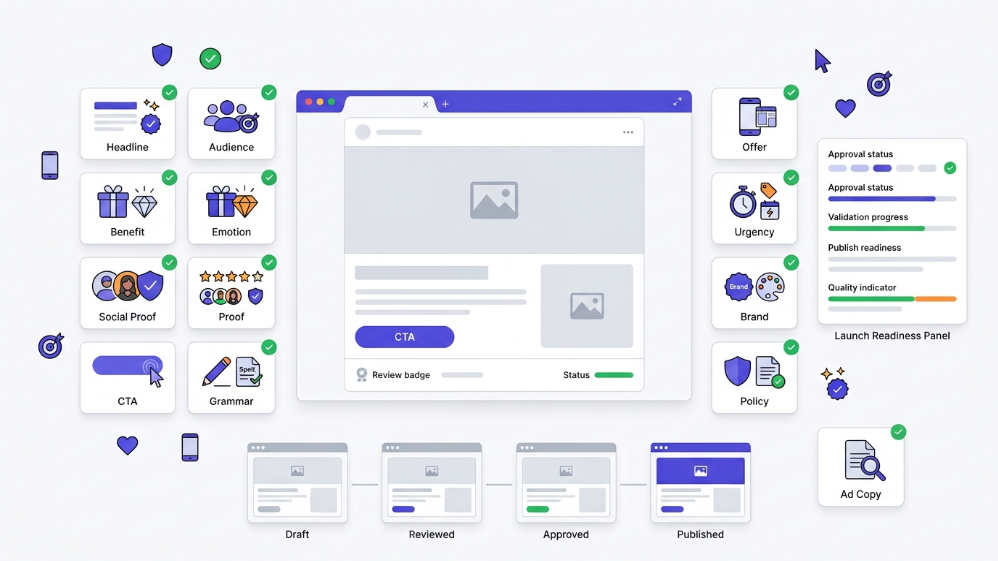
Before publishing: check for a hooking headline, one clear benefit, a specific audience, an emotional trigger, real proof, a strong CTA, clean grammar, mobile readability, a clear offer, genuine urgency, brand-matching voice, relevant keywords, and platform compliance. Five minutes now saves wasted ad spend later.
Strong headline that hooks instead of describes
This is the difference between “Running Shoes For Sale” and “Your Knees Will Thank You After Mile 5.” One’s a label. The other’s a moment someone recognizes. If you can swap your headline onto a competitor’s product with zero edits, it’s not hooking anyone — it’s just describing a category.
Clear, singular benefit front and center
Pick one. Just one. I know your product does six great things, but an ad trying to sell all six ends up selling none of them. The reader’s brain can hold one idea in the three seconds you’ve got. Save the other five benefits for the landing page.
Written for one specific audience, not “everyone”
“Everyone” copy is copy that speaks to no one. An ad written for “busy moms juggling three kids and a part-time job” will always outperform one written for “parents,” because the specific version makes the actual busy mom feel like you’re reading her mind.
At least one emotional trigger baked in
Facts inform, emotion moves — that’s not fluffy advice, it’s just how people actually decide things. Fear, curiosity, belonging, status, whatever fits — but there needs to be something in there besides a spec sheet.
Some form of proof or social validation
Claims are free. Anyone can say “the best.” A number, a review, a rating, a case study detail — that’s what quiets the “yeah right” voice in someone’s head before they click away.
A clear, specific call-to-action
“Learn More” is a shrug. “Start Your Free 14-Day Trial — No Card Required” tells the reader exactly what happens next and removes a reason to hesitate. Vague CTA, vague results.
Grammar and spelling actually checked, not skimmed
This one sounds basic until you’re the brand running a headline with a typo for three days because nobody proofread before hitting launch. It happens more than people admit. A typo in a headline especially reads as sloppy, and sloppy kills trust instantly.
Reads and displays cleanly on mobile
Over half your traffic is probably on a phone. If your copy wraps into three lines, gets cut off mid-sentence, or just looks cluttered on a small screen, you’re losing conversions you’ll never even know you lost, because nobody complains — they just scroll past.
Offer is clear and easy to understand at a glance
If someone has to reread your ad to figure out what they’re actually getting, you’ve already lost them. “20% off your first order” beats “unlock exclusive savings” every single time, because one is instantly understood and the other makes people work for it.
Urgency or scarcity included where it’s genuinely true
Key word: genuinely. “Sale ends tonight” that’s been running for three months trains people to stop believing your urgency at all, and that skepticism bleeds into everything else you say. Fake scarcity is a short-term trick that costs you long-term trust.
Matches your brand’s actual voice
An ad that sounds nothing like your website, your emails, or your support team creates a weird disconnect the second someone clicks through. Consistency is part of what builds trust across the whole funnel, not just the ad itself.
Relevant keywords included where the platform rewards it
Mostly a Google Ads thing — keyword relevance in your headline can actually improve your Quality Score, which lowers what you pay per click. So on search platforms, this isn’t just about persuasion, it’s tied directly to your cost.
Compliant with the platform’s ad policies
The one everyone forgets until their ad gets rejected the night before a launch. Every platform has rules around claims, restricted categories, before/after imagery, certain wording in health or finance niches. Check this before you’re scrambling to fix it with your campaign already scheduled to go live.
That’s the whole list with teeth on it. Run through it before every launch — takes five minutes and saves you from the stuff that quietly tanks performance without ever showing up as an obvious red flag in your dashboard
Conclusion
None of this works if you skip the audience research and just start typing what sounds clever to you. Effective ad copy comes from actually understanding the person on the other end of the screen — their exact words, their real frustrations, what they’re secretly hoping changes about their situation. Clever wording without that foundation is just decoration on an empty box.
The ads that actually convert combine a handful of things working together: a headline that stops the scroll instead of describing the product, a value proposition that answers why now and why you, benefits translated from features instead of just listed, proof that makes the claims believable, an offer with real weight behind it, and a CTA that tells the reader exactly what happens the second they click.
And none of it is one-and-done. The businesses seeing the best numbers aren’t the ones who wrote one perfect ad and walked away — they’re testing constantly, watching what the data actually says instead of what they assumed would win, and refreshing copy before fatigue sets in rather than after CTR has already tanked.
Take the frameworks here, take the formulas, take the examples, and actually use them on your next campaign. Write ten headlines instead of one. Test the CTA you’re not sure about instead of guessing. Small changes compound fast in ad copy — a headline swap that bumps CTR by even one point can mean thousands of extra dollars in revenue over a quarter, off the same ad spend. That’s the whole game.
Frequently Asked Questions
What is ad copy?
Ad copy is the written text inside a paid ad meant to get someone to take an action — click, buy, sign up — usually within seconds of seeing it.
What makes ad copy convert?
A strong hook, a clear benefit, real proof, an emotional trigger, and a specific call-to-action, all aimed at one audience instead of trying to please everyone.
How long should ad copy be?
Depends entirely on the platform. Google headlines are capped around 30 characters. Facebook primary text gets cut off after the first line or two before “See More.” Native ads can run a bit longer. Shorter is usually safer unless you have a specific reason to go long.
What is the difference between ad copy and sales copy?
Ad copy has seconds to earn a click. Sales copy has an already-engaged reader and much more room to build a full case across paragraphs.
Which ad copywriting framework is best?
Depends on the situation. AIDA works well for cold audiences who don’t know you yet. PAS works well when there’s a clear, painful problem to agitate. BAB works well for transformation-style products. There’s no single “best” — it’s about matching the framework to the audience and the offer.
How do beginners write ad copy?
Start by writing down the exact words customers use to describe their problem — pull these from reviews or forums. Then match one of the frameworks above to structure it. Write ten headline variations minimum before picking a favorite.
How many CTAs should an ad have?
One. Multiple CTAs split attention and usually lower conversion rate because the reader has to decide between options instead of just acting.
How often should ad copy be updated?
Watch for ad fatigue — when CTR starts dropping and CPC starts climbing on the same creative that’s been running a while, that’s your signal. For active campaigns, refreshing copy every couple of weeks to a month is common, though it varies by budget and audience size.
Can AI write effective ad copy?
It can write a decent first draft fast, especially when fed real customer language. It struggles with originality and specificity on its own, so it works best as a starting point a human then edits and sharpens.
What is the ideal headline length?
Short enough to read in under two seconds. On Google, that’s dictated by the 30-character limit. On social platforms, aim for something that reads clean on a phone screen without wrapping into three lines.
What emotions drive the highest conversions?
Fear, curiosity, and belonging tend to be the strongest across most categories, though it depends heavily on what you’re selling — a $3,000 mattress leans on trust, a limited sneaker drop leans on status and scarcity.
How do I write Google Ads that get clicks?
Include the keyword in the headline when it fits naturally, lead with the strongest benefit or offer, and make sure the description backs up the headline instead of repeating it.
How do I improve Facebook ad copy?
Front-load your strongest line, since most of your text gets cut off before “See More.” Write like you’re talking to one specific person scrolling their feed, not addressing a crowd.
Should I use emojis in ads?
Depends on your brand and audience. They can add personality and break up text on social platforms, but overusing them, especially in more formal categories like B2B or finance, can undercut credibility.
How many headlines should I test?
At minimum three to five per ad set. Ten is better if you have the volume to actually get statistically meaningful data on each variation.
What is the biggest ad copywriting mistake?
Talking about the brand instead of the customer. “We’ve been around for 20 years” doesn’t move anyone. “You’ll never miss a payment deadline again” does.
What metrics indicate good ad copy performance?
CTR shows if the hook works. Conversion rate shows if the full ad-to-landing-page experience holds up. CPA and ROAS show if it’s actually profitable, not just popular.
How do I write ad copy for B2B audiences?
Lean on outcomes and data over emotion-heavy language. Case studies, specific numbers, and clear ROI framing tend to outperform flashy hooks in B2B, since the buyer is usually justifying the purchase to someone else internally.
What role does social proof play in ad copy?
It reduces perceived risk. A stranger’s positive experience, in the form of a review, a rating, or a customer count, makes a claim feel believable instead of just self-promotional.
How can I reduce ad fatigue with better copy?
Rotate in fresh angles instead of just tweaking a word or two — try a different emotional trigger, a different proof point, or a different framework entirely, rather than recycling the same structure with minor edits.