

Imagine two restaurants on the same street. Both serve great food. Both have websites that appear on Google when someone searches ‘best restaurant in the area.’ But one restaurant appears as the third result on the page, and the other as the ninth.
Same street. Same quality. Same Google. But one gets most of the traffic and the other barely gets noticed.
This is the reality of search engine positioning, and understanding it is one of the most important concepts in all of SEO. It is not enough to appear on Google. Where you appear, your exact position in the search results determines how much traffic you actually receive.
Search engine positioning is the practice of improving and tracking the specific position your web pages occupy in search engine results pages (SERPs) for your target keywords. It is the art and science of climbing higher in those results and staying there.
In this comprehensive guide, you will learn exactly what search engine positioning means, why it matters so much more than most beginners realise, how Google determines where to place each result, what factors you can influence to improve your positions, and the strategies and tools professionals use to climb the rankings.
Whether you are a complete beginner hearing this term for the first time, or a business owner trying to understand why your website is not getting the traffic it deserves, this guide will give you a thorough, clear, and actionable understanding.
| 📘 What You Will Learn in This Guide
What search engine positioning means and how it differs from simply ‘ranking’ Why position matters so dramatically (the traffic data will surprise you) How Google decides where to place each result The key factors that determine your position How SERP features like AI Overviews and featured snippets affect positioning Step-by-step strategies for improving your search positions How to track and measure your positioning over time Local search positioning explained Common mistakes that hurt your positions Tools every SEO practitioner uses to monitor and improve positioning Answers to the most common beginner questions |
What Is Search Engine Positioning?
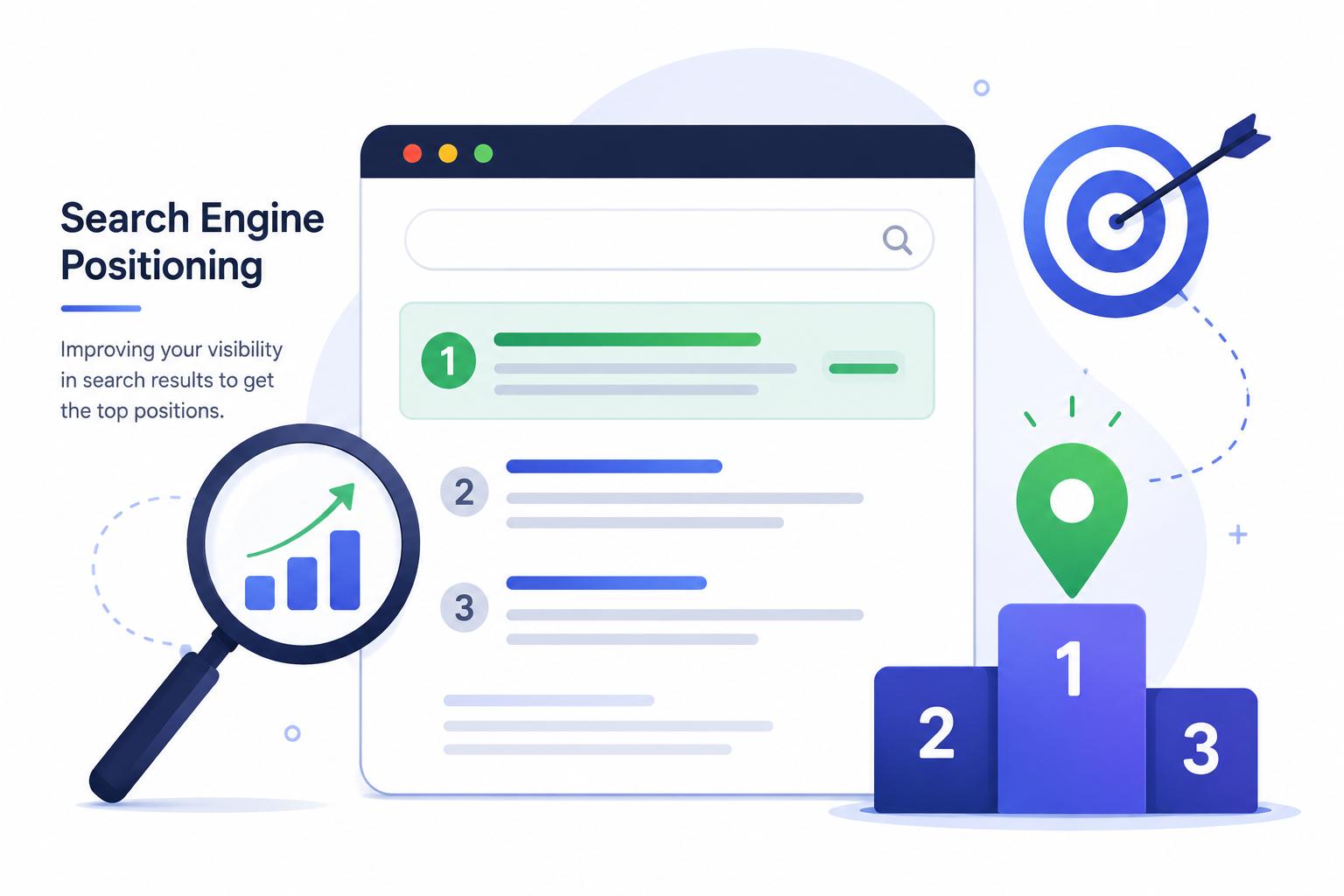
Search engine positioning refers to the specific location, the numbered position that a web page occupies in search engine results for a given keyword or search query.
When you search for something on Google, the results you see are listed in a specific order. Position #1 is the first organic result. Position #2 is the second. Position #10 is the last result on the first page. Position #11 is the first result on page two, and so on.
Search engine positioning is about where your pages appear in that ordered list. It is the precise measurement of your visibility in organic search results for the keywords that matter to your business.
The Difference Between Ranking, Positioning, and Visibility
These three terms are closely related but have distinct meanings. Many beginners use them interchangeably, but understanding the differences is important for setting clear SEO goals.
| Term | What It Means | Example |
| Ranking | Your page appears in search results for a keyword, regardless of where | Your page ‘ranks’ for ‘digital marketing course’ even at position #52 |
| Positioning | The specific position number your page holds for a keyword | Your page is positioned at #8 for ‘digital marketing course’ |
| Visibility | A broader measure of how often and prominently your site appears across many searches | Your site has strong visibility in the digital marketing niche overall |
You might hear someone say, ‘my page ranks for that keyword,’ but if it ranks at position #47, it is effectively invisible. Positioning is what matters in practice. The goal is not just to rank; it is to rank as high as possible.
Think of it this way: in a race, finishing is called ‘placing.’ But whether you place first, fifth, or fiftieth determines whether you get a medal, a participation ribbon, or no recognition at all. SEO ranking is finishing the race. Search engine positioning is your place on the podium.
Why Positioning Is the Real Measure of SEO Success
Many beginners celebrate when they ‘rank’ for a keyword without checking what position that ranking is at. But ranking at position #48 brings almost zero traffic. Ranking at position #4 can bring hundreds of visitors per month. Ranking at position #1 can transform a business.
Search engine positioning is the number that truly determines your SEO return on investment. Every improvement in position, even moving from #6 to #4, can meaningfully increase your organic traffic. Every drop in position, even from #3 to #5, can noticeably reduce it.
This is why professional SEO practitioners track positioning meticulously, set position-based targets (e.g., ‘get our three core service pages into the top 5’), and judge the success of their work by position improvements, not just by whether a page ‘ranks’ at all.
Why Does Search Engine Position Matter So Much?
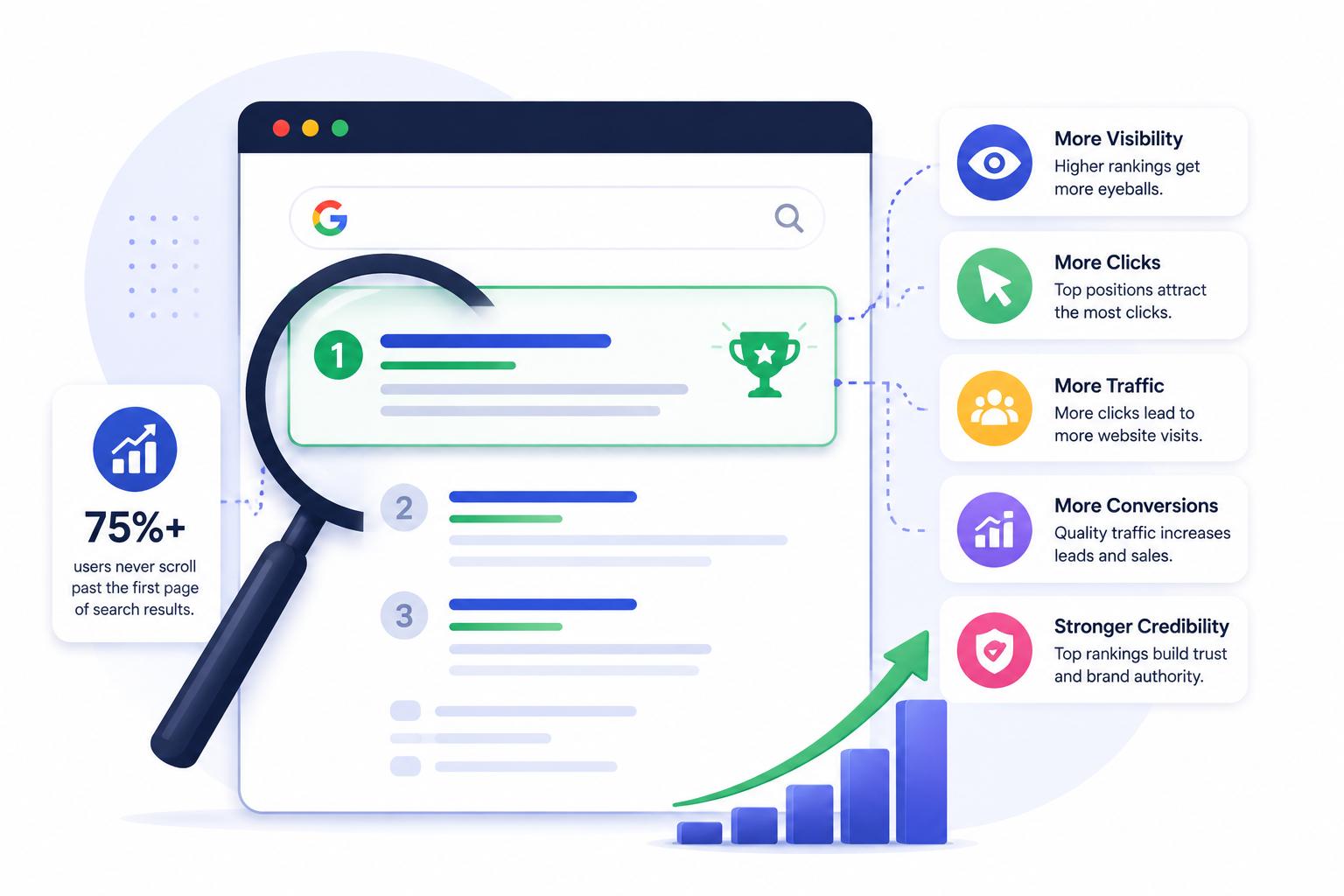
The importance of search engine positioning comes down to a single, powerful truth: the higher your position, the exponentially more traffic you receive. The relationship between position and traffic is not linear; it is steeply curved in favour of the top results.
Let us look at the data.
Click-Through Rates by Position: The Numbers That Change Everything
Multiple large-scale studies of Google click-through rates consistently show the same dramatic pattern. Here is a representative breakdown of what the research shows:
| SERP Position | Avg. Click-Through Rate | Share of Page 1 Traffic | Monthly Visits (1,000 searches/mo) |
| #1 | ~27.6% | ~30% of all page 1 clicks | ~276 visits |
| #2 | ~15.8% | ~17% | ~158 visits |
| #3 | ~11.0% | ~12% | ~110 visits |
| #4 | ~8.1% | ~9% | ~81 visits |
| #5 | ~6.3% | ~7% | ~63 visits |
| #6 | ~4.7% | ~5% | ~47 visits |
| #7 | ~3.5% | ~4% | ~35 visits |
| #8 | ~2.6% | ~3% | ~26 visits |
| #9 | ~2.1% | ~2% | ~21 visits |
| #10 | ~1.9% | ~2% | ~19 visits |
| Page 2 (#11+) | <1% | <1% | <10 visits |
Take a moment to absorb those numbers. For a keyword searched 1,000 times per month:
- Position #1 earns around 276 visitors per month
- Position #5 earns only around 63, less than a quarter of position #1
- Position #10 earns only around 19, less than 7% of what position #1 earns
- Page two earns fewer than 10 visitors essentially nothing
And for a keyword searched 10,000 times per month, position #1 means roughly 2,760 monthly visitors. Position #10 means 190. The same website, the same keyword, but a 14x difference in traffic simply because of 9 positions.
This is why search engine positioning is the central obsession of professional SEO. Every position gained is a measurable, meaningful increase in traffic, leads, and revenue.
The ‘First Page or Nothing’ Reality
Notice that page two earns less than 1% of clicks. Effectively, if your page is not on page one of Google, it does not exist for that keyword from a practical traffic perspective.
Studies have shown that 75% of searchers never click past the first page of results. Some research puts this figure even higher for mobile searches, where users are even less likely to scroll extensively.
This is why many SEOs say: ‘The best place to hide a dead body is page two of Google.’ It sounds dramatic, but the data backs it up. Page one is the goal and the top three positions on page one are the prize.
| 📊 The Top 3 Rule
The top 3 organic positions receive approximately 55% of ALL clicks on a results page. Positions #1 through #5 receive approximately 67% of all organic clicks. This means positions #6 through #10 share only about 15% of remaining clicks combined. Reaching the top 3 is not just better than positions #4-10. It is fundamentally different. |
How Google Determines Search Engine Positions
Understanding how Google decides where to place each result is the foundation of any positioning improvement strategy. If you know what Google values, you can give Google more of it.
Google uses a complex, machine-learning-driven algorithm that evaluates hundreds of signals to determine positioning. No one outside Google knows the exact formula, and even within Google, no single person controls it. But through decades of research, testing, and analysis, the SEO community has developed a strong understanding of the most important factors.
Here is a deep look at the key determinants of search engine positioning:
1. Relevance – Does Your Page Match the Query?
The first question Google asks about any page is: is this relevant to what the user searched for? Relevance is determined by analysing the content of your page against the words and meaning of the search query.
This goes far beyond simply having the keyword appear on the page. Google uses sophisticated natural language processing (NLP) to understand the meaning and context of both the query and the page. A page about ‘running shoes’ is relevant to the query ‘best trainers for a marathon’ even though the exact phrase is not present because Google understands the semantic relationship.
Relevance is the price of entry. Without it, no amount of authority or technical optimisation will help. Every page on your website should be built around a specific, clear topic, and the content must comprehensively address that topic.
2. Search Intent – Does Your Page Satisfy What the User Actually Wants?
Search intent is one of the most important and most misunderstood positioning factors. It refers to the underlying reason behind a search and what the user is actually trying to accomplish.
Google has become extraordinarily good at inferring intent, and it rewards pages that fully satisfy that intent above pages that are merely relevant to the keyword. There are four main types of search intent:
- Informational: ‘how does solar energy work’ – the user wants to learn
- Navigational: ‘YouTube studio login’ -the user wants to reach a specific site
- Commercial: ‘best accounting software for small business’ – the user is researching before buying
- Transactional: ‘buy iPhone 17 online’ – the user wants to take action now
A beautiful, well-written informational article will not rank for a transactional keyword whose SERP is dominated by product pages because it does not match what the user wants, regardless of its quality. Always match your content format and approach to the intent behind the keyword.
| 📝 Intent Mismatch: A Common Positioning Killer
Keyword: ‘best yoga mat’ Intent: Commercial investigation the user wants a comparison and recommendations before buying. SERP: Dominated by ‘Top 10 Best Yoga Mats’ articles and product comparison pages. Mistake: A yoga studio writes a blog post titled ‘Why Yoga Mats Are Important for Your Practice’. Result: Even if the article is excellent and the studio has strong authority, it will not rank for this keyword. The intent is a product comparison, not a general article about mat importance. Fix: Create a dedicated ‘Best Yoga Mats’ comparison article with reviews, pros/cons, and recommendations. |
3. Content Quality and Depth
Once relevance and intent are established, Google evaluates the quality and comprehensiveness of your content. High-quality content answers the user’s query completely, leaving no important questions unanswered, while remaining accurate, well-organised, and easy to read.
Google’s quality guidelines use the concept of E-E-A-T (Experience, Expertise, Authoritativeness, Trustworthiness) to evaluate content quality. Pages that demonstrate genuine expertise, real-world experience, and a trustworthy editorial standard are rewarded with stronger positioning.
Depth matters. A 300-word article that superficially touches on a topic will almost always be outpositioned by a 2,500-word article that covers it thoroughly, provided both are well-written and genuinely helpful. However, length alone is not the metric. A concise, perfectly targeted 800-word page can outrank a padded, repetitive 4,000-word page if it more precisely satisfies the user’s query.
4. Backlink Profile and Domain Authority
Backlinks from other websites pointing to yours are one of the most powerful signals Google uses to determine positioning, particularly for competitive keywords. When reputable, relevant websites link to your page, they are effectively endorsing it as a trustworthy and authoritative source.
Google interprets backlinks as votes of confidence. The more high-quality votes a page receives, the more authority it carries and the higher it can position in competitive search results.
Two key metrics matter here:
- Page-level authority: How many quality backlinks point to the specific page you are trying to rank?
- Domain-level authority: How many quality backlinks point to your website as a whole? A strong domain lifts all pages within it.
For a brand new website targeting competitive keywords, building backlink authority is often the biggest challenge and the primary bottleneck to better positioning. No amount of on-page optimisation will overcome a significant authority gap against well-established competitors.
5. Page Experience and Core Web Vitals
Google’s Page Experience signals assess how pleasant and functional a page is to use completely separately from its content. These include:
- Largest Contentful Paint (LCP): How quickly the main content loads. Target: under 2.5 seconds.
- Interaction to Next Paint (INP): How quickly the page responds when a user taps a button or clicks a link. Target: under 200ms.
- Cumulative Layout Shift (CLS): How much the page layout shifts around while loading. Target: under 0.1.
- Mobile-friendliness: Does the page work perfectly on smartphones?
- HTTPS: Is the connection secure?
- No intrusive interstitials: Are there aggressive pop-ups that block content immediately on load?
While page experience signals are not the primary positioning factor (content and authority still dominate), they can be a tiebreaker between pages of similar quality, and poor scores can create a ceiling that prevents otherwise good pages from reaching their full positioning potential.
6. On-Page SEO Signals
On-page SEO refers to the signals within your page that help Google understand its topic and relevance. Key on-page signals include:
- Title tag: The HTML title of the page is one of the strongest on-page positioning signals. Include your target keyword naturally.
- H1 heading: The main visible heading of the page. Should clearly indicate the page topic.
- Meta description: Not a direct ranking signal, but affects click-through rate, which influences positioning.
- Heading structure (H2, H3): Subtopics organised with appropriate headings help Google understand the full scope of your content.
- Keyword usage: Natural, contextual use of the target keyword and semantically related terms throughout the content.
- Internal links: Links from other pages on your site pointing to this page, and links from this page to other relevant content.
- Image alt text: Descriptive alt text helps Google understand the context of images.
- URL structure: Clean, descriptive URLs (e.g., /what-is-seo/) rather than cryptic ones (/p?id=247).
7. User Engagement Signals
Google uses a variety of signals to infer how well a page satisfies users after they click on it. While Google does not disclose exactly which engagement signals it uses or how much weight they carry, the general principle is: pages that users find helpful get rewarded, and pages that frustrate users get deprioritised.
Relevant engagement signals include:
- Dwell time: How long a user stays on your page before returning to the SERP. Longer generally signals satisfaction.
- Pogo-sticking: When a user clicks your result, immediately returns to Google, and clicks a competitor’s result, a strong negative signal that your page did not satisfy them.
- Scroll depth: How far down the page users scroll (indicating engagement with the content).
- Return visits and direct navigation: Users who bookmark your site or return directly are a trust signal.
8. Freshness and Content Currency
For certain types of queries, particularly news, current events, trend-based topics, and rapidly evolving fields, Google gives significant positioning weight to how recently content was published or updated. A guide to ‘best smartphones of 2026’ published in 2026 will outposition an identical guide from 2023.
Even for evergreen topics, regularly updating content to keep it accurate and current sends a positive freshness signal and helps maintain strong positioning over time. This is why professional SEO practitioners treat content maintenance not just content creation as an ongoing priority.
How SERP Features Affect Search Engine Positioning
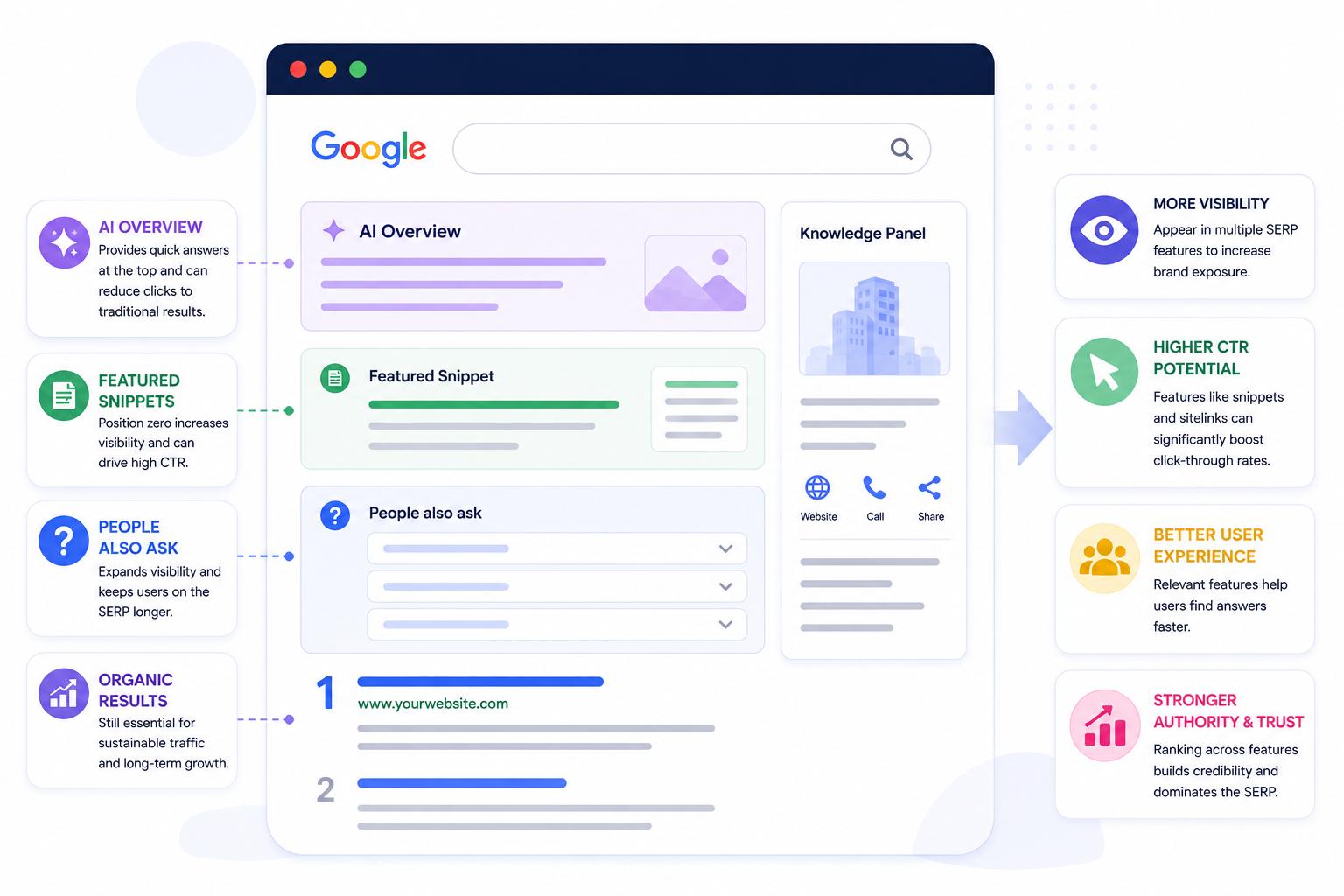
Modern SERPs contain far more than a simple list of ten organic results. Featured snippets, AI Overviews, People Also Ask boxes, Local Packs, and other features dramatically change the positioning landscape and create both opportunities and challenges that every beginner must understand.
AI Overviews and ‘Above Position #1’
Google AI Overviews now appear at the very top of SERPs for many informational queries above paid ads and above the #1 organic result. They are generated by Google’s AI using information synthesised from multiple trusted web pages.
From a positioning perspective, this means the traditional #1 organic position is no longer the very top of the page. Content may rank at position #1 while still appearing below an AI Overview that pushes everything downward. This has led some SEO professionals to argue that appearing as a cited source within an AI Overview is the new ‘position zero.’
For your positioning strategy, this means:
- Being cited in AI Overviews is highly valuable; it places your brand at the very top of the SERP even if your organic position is #3 or #4.
- AI Overviews can reduce click-through rates for position #1 pages on informational queries where users find their answer in the overview.
- The strategy to earn AI Overview citations (authoritative, well-structured content) is the same as the strategy to rank well organically.
Featured Snippets – Position Zero
A featured snippet is the highlighted answer box that appears above organic position #1, hence the term ‘Position Zero.’ It pulls a direct answer from a specific web page, displays it prominently, and links back to the source.
Earning a featured snippet for a keyword effectively moves you to the very top of organic results even if your regular organic position is #4 or #5. This is one of the most impactful positioning improvements available, and it does not require being ranked at #1.
Research shows that featured snippets typically receive click-through rates of 20–30% for their queries, often significantly higher than the standard #1 organic result on the same page. This means a page ranked #4 that earns the featured snippet will almost always receive more traffic than the page ranked #1 without one.
| 💡 How to Earn Featured Snippet Position Zero
Target question-based keywords: ‘what is…’, ‘how to…’, ‘why does…’, ‘difference between…’ Structure your content with a clear question as an H2 or H3 heading. Write a direct, concise answer immediately below the heading, ideally 40–60 words for paragraph snippets. For step-by-step snippets, use a numbered list immediately after the heading. For comparison snippets, use a well-formatted table. Your page must already rank on page one. Google only pulls snippets from pages it already positions highly. |
People Also Ask – Horizontal Positioning Expansion
People Also Ask (PAA) boxes appear throughout SERPs and display expandable questions with short answers pulled from web pages. Unlike the featured snippet (one box, one source), multiple PAA boxes can appear on a single SERP, and each can pull from a different page.
This means a single well-structured page can earn multiple PAA placements on the same SERP, appearing several times on the same results page at different positions. This horizontal expansion of your SERP presence is a powerful positioning strategy often overlooked by beginners.
The Local Pack – A Separate Positioning System
For location-based searches, Google shows a Local Pack a map with three local business listings, usually at the very top of the SERP, above organic results. The Local Pack operates on an entirely separate positioning system from organic results.
A business can rank #1 in the Local Pack while having no significant organic rankings, or vice versa. Local Pack positioning is determined by different factors (Google Business Profile optimisation, reviews, local citations, proximity) than organic positioning.
For any business serving a specific geographic area, Local Pack positioning is often more important than organic positioning; it is where the most visibility and the most clicks occur for local searches.
Sitelinks – Expanding Your Positioning Footprint
When Google displays sitelinks under a website’s main result, additional links to inner pages, it dramatically expands the physical space that the website’s result occupies on the SERP. This effectively ‘owns’ more of the page, pushing competitors further down and increasing click probability.
Sitelinks are most commonly shown for branded searches and cannot be directly forced. However, a well-structured website with clear navigation and strong internal linking makes them more likely to appear.
Strategies to Improve Your Search Engine Positioning
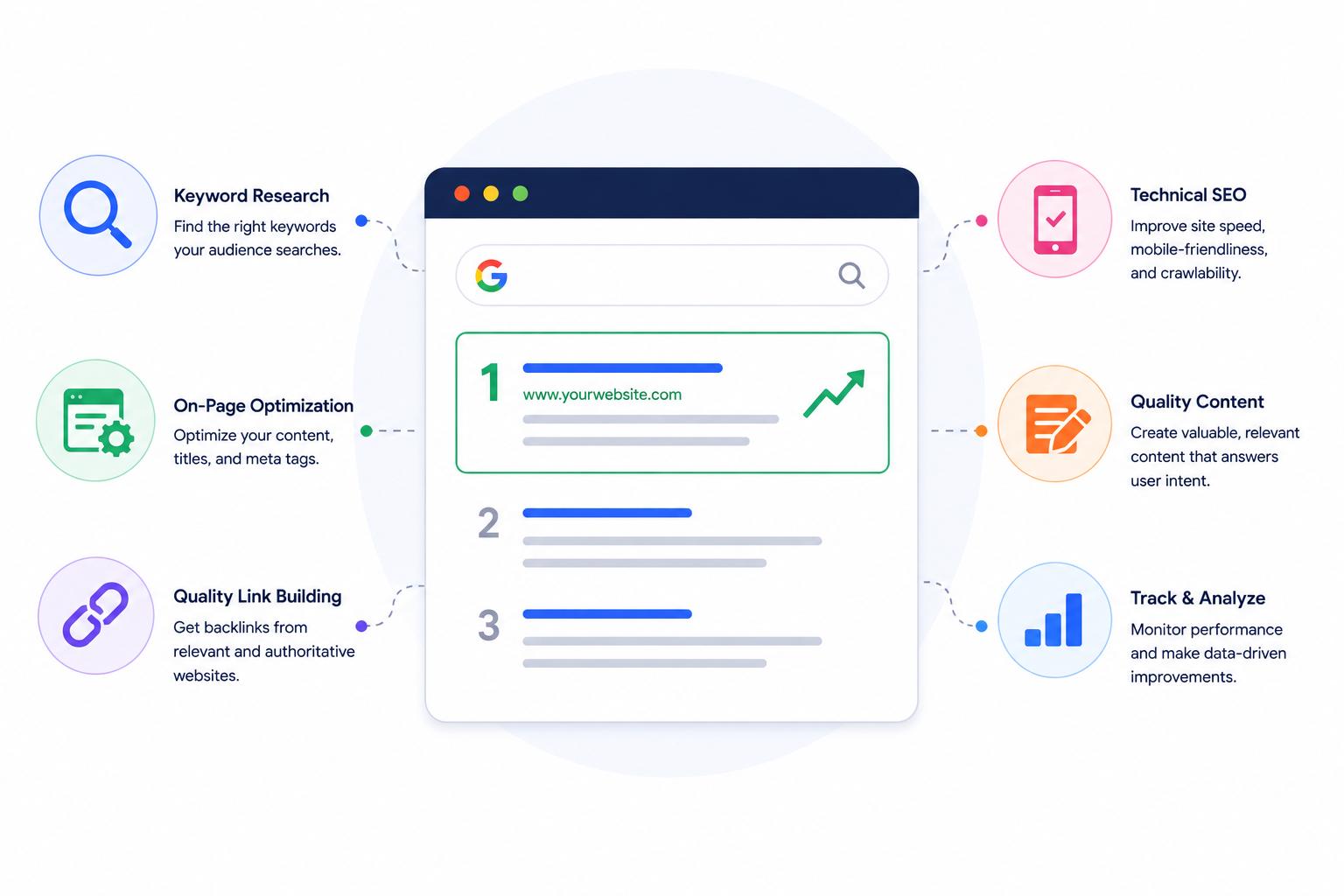
Now that you understand what determines positioning, let us focus on what you can actually do to improve it. These strategies are ordered roughly by impact and by the timeline within which they produce results.
Strategy 1: Conduct Thorough Keyword Research First
Every positioning improvement starts with choosing the right keyword to target. Before investing time in content creation and optimisation, you need to understand three things about your target keyword:
- Search volume: How many people search for this keyword per month? A keyword with 50 monthly searches is a very different opportunity from one with 5,000.
- Keyword difficulty: How strong are the pages currently ranking for this keyword? Competing against domain authority giants on a brand-new website is a recipe for failure.
- Search intent: What does the user actually want when they search this? Your content must match the dominant intent to compete.
A common and costly mistake is to target highly competitive keywords too early. A new website should start with ‘long-tail keywords‘- specific, lower-competition phrases where positioning improvements are achievable within months rather than years. As domain authority grows, broader, more competitive keywords become realistic targets.
| 📝 Choosing Achievable Keywords: A Framework
Situation: A new digital marketing blog launching in 2026. Unrealistic early target: ‘digital marketing’ Keyword difficulty: 85/100, dominated by HubSpot, Neil Patel, Wikipedia. Years of authority-building required. Realistic early target: ‘what is content marketing for small businesses‘ Keyword difficulty: 28/100, moderate search volume, more specific audience, achievable with quality content within 3-6 months. Rule of thumb: Target keywords with a difficulty score below 30-40 for a new or low-authority website. Use difficulty scores from tools like Ahrefs or Semrush to guide your decisions. |
Strategy 2: Create Content That Definitely Answers the Query
The most powerful positioning strategy is also the simplest to state: create the best possible page for your target keyword. Not just a good page the definitive resource that leaves the user with nothing more to search for.
This means:
- Covering every aspect of the topic the user would reasonably expect to find on the best page about this subject
- Answering the main query clearly and early; do not bury the answer under paragraphs of preamble
- Addressing the follow-up questions users typically have (mine the PAA boxes for these)
- Using clear headings so users can navigate to the specific section they need
- Including relevant examples, analogies, data, and visuals that make the content more useful and engaging
- Keeping it accurate, up-to-date, and written in clear, plain language appropriate for your audience
A useful mental test: after reading your page, does the user need to go back to Google to search for more information about this topic? If yes, your page is not yet comprehensive enough.
Strategy 3: Optimise On-Page SEO Signals
Once your content is excellent, on-page SEO signals ensure Google correctly understands what your page is about and for whom. Key optimisations:
- Title tag: Include your primary keyword naturally in the title. Keep it under 60 characters. Make it compelling; it is your organic advertisement.
- H1 heading: Your page should have exactly one H1, clearly stating the main topic.
- H2/H3 subheadings: Organise subtopics with clear headings. Include secondary keywords and related phrases naturally.
- First 100 words: Mention your target keyword early in the content, ideally within the first paragraph.
- Keyword density: Use your target keyword and related terms naturally throughout. Do not stuff; write for the reader.
- URL: Keep it short, descriptive, and keyword-inclusive (e.g., /search-engine-positioning/).
- Meta description: Write a compelling 150-160 character summary that improves click-through rates.
- Image alt text: Describe images accurately with relevant keywords where natural.
- Internal links: Link from and to related pages on your website to strengthen relevance signals and pass authority.
Strategy 4: Build High-Quality Backlinks
For competitive keywords, backlink authority is often the most important and most difficult positioning factor to improve. Pages ranking in the top 3 for competitive keywords almost always have significantly more high-quality backlinks than pages ranking below them.
The most sustainable and effective link-building strategies are:
- Create link-worthy content: Original research, comprehensive guides, free tools, data-driven studies, and unique insights naturally attract links from other websites. This is called ‘linkbait’ in the SEO industry.
- Guest posting: Write articles for reputable publications in your industry. Include a contextual link back to your website.
- Digital PR: Reach out to journalists and bloggers covering your industry with newsworthy stories, data, or expert commentary.
- Broken link building: Find broken links on relevant websites and suggest your content as a replacement.
- Resource page outreach: Find websites with ‘resources’ or ‘links’ pages in your niche and suggest your content for inclusion.
- Unlinked brand mentions: Find places where your brand is mentioned without a link, and ask for the link to be added.
| ⚠️ What to Avoid When Building Links
Buying links from link farms or private blog networks (PBNs). Google’s Penguin algorithm targets these and can penalise your entire site. Exchanging links in large-scale reciprocal schemes (‘I link to you if you link to me’ at scale). Getting links from completely irrelevant websites; relevance of the linking site matters enormously. Using automated link-building tools that generate hundreds of links quickly; these almost always violate Google’s guidelines. One high-quality link from a relevant, respected website is worth more than 500 low-quality links combined. |
Strategy 5: Improve Page Speed and Core Web Vitals
Technical performance improvements may not always produce dramatic positioning jumps on their own, but poor scores can create a ceiling that prevents you from reaching your full potential, and they are often the difference between competing pages of otherwise similar quality.
Start by measuring your current Core Web Vitals scores using Google PageSpeed Insights or the Core Web Vitals report in Google Search Console. Focus on the pages that:
- Already rank on page one or page two; technical improvements here can push them into higher positions
- Have significant organic traffic potential; the ROI is highest for high-volume keywords
- Show ‘Poor’ or ‘Needs Improvement’ scores in Search Console; these are your quick wins
Common technical improvements that produce the most significant speed gains: compress and resize images, implement lazy loading, use a content delivery network (CDN), eliminate render-blocking JavaScript, and upgrade to faster hosting.
Strategy 6: Update and Refresh Existing Content
Many SEO practitioners focus almost entirely on creating new content while neglecting their existing pages. This is a missed opportunity. Updating existing content that already ranks but has dropped in position is often faster and more cost-effective than creating something entirely new.
A structured content refresh involves:
- Adding new information that has emerged since the original publication date
- Expanding sections that are thinner than what competing pages now offer
- Updating statistics, examples, and tool recommendations to reflect the current year
- Improving the structure and readability based on user engagement data
- Adding new internal links to recently published related content
- Updating the publication date after substantive revisions
Google tends to reward fresh, updated content, particularly for competitive queries where multiple pages of similar quality are competing for position. A well-executed content refresh can produce meaningful positioning improvements within weeks.
Strategy 7: Build Topical Authority
Google increasingly rewards websites that demonstrate deep, comprehensive expertise across an entire topic area, not just individual pages that target isolated keywords. This concept is known as Topical Authority.
A website that publishes thorough, interconnected content covering every aspect of a subject sends strong signals to Google: this is an expert source on this topic. And Google is increasingly inclined to position expert sources above generalists.
Building topical authority involves creating a content hub structure:
- A central pillar page covering the broad topic comprehensively (like this guide)
- Cluster pages covering every important subtopic in depth, each one linking back to the pillar page
- Consistent internal linking between all related pages to create a tightly interwoven topic cluster
- Breadth of coverage: addressing every question your audience has about the topic
When Google sees a website with deep, comprehensive coverage of a subject, all pages well-linked and mutually reinforcing, it begins to treat that website as an authority on the topic. This benefits not just individual pages but the entire cluster. Positioning improves across all related keywords simultaneously as topical authority builds.
Strategy 8: Optimise for Featured Snippets and PAA
Rather than only trying to climb from position #4 to position #1, consider whether you can earn a featured snippet, effectively jumping to Position Zero from a lower organic position. For many question-based keywords, this is achievable and produces a greater traffic impact than climbing a few organic positions.
The systematic approach to featured snippet targeting:
- Identify keywords in your current rankings (positions #2–#10) that show a featured snippet in the SERP.
- Search each keyword yourself and note the format of the existing snippet paragraph, list, or table.
- Find or create a page on your website that targets this keyword.
- Add a question-formatted H2 or H3 heading that mirrors the query.
- Write a direct, concise answer in the exact format Google is displaying (paragraph/list/table).
- Publish or update the page and monitor position changes in Search Console.
Local Search Engine Positioning
For businesses serving a specific geographic area restaurants, clinics, law firms, plumbers, gyms, retail shops local search positioning is often the most important form of positioning in SEO.
Local search results look different from standard organic results, and they are determined by different factors. Understanding the two types of local positioning is essential for any local business owner.
Local Pack Positioning (Google Maps Results)
The Local Pack, the map with three business listings that appears for location-based searches, is the most prominent feature in local SERPs. Ranking in the top three of the Local Pack is the primary goal for most local businesses.
Local Pack positioning is determined primarily by:
- Relevance: How well your Google Business Profile and website match the search query. Does your business do what the user is searching for?
- Proximity: How physically close is your business to the searcher? Proximity is a major, though not exclusive factor. Being close to the city centre helps for city-wide searches.
- Prominence: How well-known and trusted is your business? Determined by review quantity and quality, backlinks, citations (mentions of your business name, address, phone number across the web), and your overall online presence.
Improving your Local Pack positioning requires a specific Local SEO strategy:
- Claim and fully optimise your Google Business Profile: Complete every section, upload photos, keep hours accurate, post regular updates.
- Earn positive reviews: Actively ask satisfied customers for Google reviews. Respond to all reviews, positive and negative.
- Build consistent citations: Ensure your business Name, Address, and Phone number (NAP) are consistent across all directories (JustDial, Sulekha, Yelp, your industry associations, local chambers of commerce, etc.).
- Add your business to relevant local and industry directories.
- Create location-specific content on your website (e.g., a dedicated page for each city or area you serve).
- Earn local backlinks from local news sites, community organisations, and local blogs.
Organic Local Positioning
Beneath the Local Pack, standard organic results appear for local searches and positioning here follows the same principles as regular organic SEO, with additional weight given to location signals.
Key strategies for organic local positioning include:
- Create dedicated location pages: If you serve multiple cities, create a high-quality, unique page for each location, not thin, templated pages with the city name swapped in.
- Use local schema markup: Implement LocalBusiness Schema on your website to help Google understand your location, hours, and services.
- Target local keywords: Include city and area names naturally in your title tags, headings, and content.
- Earn local backlinks: Links from local newspapers, community websites, and local business associations carry strong local positioning signals.
| 📝 Local Positioning in Action: A Dental Clinic
City: Bangalore. Business: Smile Dental Clinic. Search: ‘dentist in Bangalore’ Goal: Appear in the Local Pack top 3 AND on page 1 of organic results. Local Pack strategy: Fully optimised Google Business Profile with 150+ reviews averaging 4.7 stars, consistent NAP across 20+ directories, regular posts and photos. Organic strategy: Dedicated ‘Dentist in Bangalore’ landing page with 1,200 words of unique content, embedded Google Map, local schema markup, and 8 local backlinks. Result after 6 months: Local Pack position #2. Organic position #4 for ‘dentist Bangalore’. Monthly calls from Google: 85. Monthly website organic visits: 340. |
How to Track Your Search Engine Positioning
If you cannot measure your positioning, you cannot improve it. Tracking keyword positions over time is one of the fundamental ongoing activities of SEO. Here is how to do it properly:
Google Search Console (Free – Start Here)
Google Search Console is the first and most important positioning tool every website owner should use. It is free and provides direct data from Google about how your website appears in search.
The Performance report in Search Console shows you:
- Which queries are bringing impressions and clicks to your site
- Your average position for each query over your chosen date range
- Your click-through rate for each query, helping identify titles and descriptions that need improvement
- Which pages are receiving traffic, and which queries trigger each page
Limitation: Search Console shows average positions over time, but does not track daily position changes or allow you to track specific target keywords proactively. For that, you need a dedicated rank tracker.
Ahrefs Rank Tracker
Ahrefs’ Rank Tracker allows you to add any keywords you want to monitor, and it tracks your daily or weekly position for each keyword. It shows position history as a graph, allows comparison against competitors on the same keywords, and can track positions by location, essential for local SEO monitoring.
The Keyword Overview section also shows a SERP overview for any keyword at any time: who is ranking, at what position, with what authority and traffic data.
Semrush Position Tracking
Semrush’s Position Tracking tool is similarly powerful. You can set up campaigns for specific websites and keyword lists, receive weekly email reports showing position changes, and see a visibility score that aggregates your positioning across all tracked keywords into a single metric, useful for tracking overall SEO progress.
Semrush also provides a ‘SERP Features’ column showing whether your tracked keywords trigger featured snippets, PAA boxes, or local packs, helping you identify which SERP features to target.
Moz Pro Rank Tracker
Moz Pro offers keyword rank tracking with daily or weekly updates, competitor comparison, and the ability to filter by location and device type. Moz’s proprietary Page Authority and Domain Authority scores alongside ranking data make it easy to assess whether positioning goals are realistic given your current authority levels.
Free Rank Checking Tools
For beginners not yet ready to invest in paid tools, several free options provide basic position data:
- Google Search Console Performance report (free, essential, but shows averages, not daily snapshots)
- Ubersuggest (limited free tier – shows keyword positions)
- SERPWatcher by Mangools (limited free tier)
- Manual incognito search: Simply searching your keywords in incognito mode and counting your position is slow for large keyword lists but free and always accurate
| 📋 Positioning Tracking Best Practices
Track a focused list of 20-50 target keywords, not hundreds. Quality over quantity in tracking. Check positions weekly, not daily. Daily fluctuations are normal noise; weekly trends are meaningful signals. Track both desktop and mobile positions separately; they often differ significantly. Track competitor positions for the same keywords to understand relative progress. Set up position change alerts (available in Ahrefs and Semrush) to be notified of significant drops immediately. Correlate position changes with traffic changes in GA4 to confirm your rank tracker data with real traffic impacts. Review your tracked positions monthly as part of a structured SEO reporting process. |
How Long Does It Take to Improve Search Engine Positioning?
This is one of the most common questions in SEO and one of the hardest to answer definitively, because it depends on many variables. But understanding the general timeframes helps set realistic expectations and avoid the frustration that causes many beginners to abandon SEO too early.
| Scenario | Typical Timeframe for Meaningful Position Improvement | Key Dependencies |
| New website, low-competition keywords | 3–6 months | Content quality, basic technical SEO |
| New website, medium-competition keywords | 6–12 months | Content quality + initial link building |
| Established website, low-competition keywords | 1–3 months | On-page optimisation, intent matching |
| Established website, medium-competition keywords | 3–6 months | Content improvement + link building |
| Any website, high-competition keywords | 12–24+ months | Sustained authority building, excellent content |
| Featured snippet targeting (existing page 1 result) | 2–8 weeks | Content restructuring for snippet format |
| Local Pack positioning | 2–6 months | GBP optimisation, reviews, citations |
These are generalised ranges; actual results vary widely based on your industry, your competitors’ investment in SEO, your website’s existing authority, the quality of your work, and Google’s own volatility. These numbers assume consistently high-quality SEO work throughout the period.
Why SEO Positioning Takes Time
Several factors explain why positioning improvements take months rather than days:
- Google needs to crawl and index new or updated content; this can take days to weeks for less-crawled sites.
- Building backlink authority is a slow, organic process; quality links are earned over time, not acquired overnight.
- Google’s algorithm runs continuously, but major re-ranking events (broad core updates) happen several times a year, meaning your improvements may not fully register until the next major update.
- Trust and authority accumulate slowly a brand-new website is inherently less trusted than a site with years of history and links.
- User engagement signals build over time as traffic grows; pages need visitors to generate the engagement data that reinforces their positioning.
The most important mindset for search engine positioning: think in months and years, not days and weeks. Beginners who expect overnight results and abandon their strategy after two months are precisely the people whose competitors will eventually outrank them because those competitors stayed consistent.
Common Positioning Mistakes Beginners Make
Mistake 1: Targeting Keywords That Are Too Competitive
The most common and most damaging mistake in search engine positioning is choosing the wrong keywords to target. Beginners often aim for the highest-volume, most obvious keywords in their niche, which are inevitably the most competitive, dominated by large, established websites with years of authority.
A new digital marketing blog trying to rank at position #1 for ‘digital marketing’ is competing against HubSpot, Neil Patel, and Wikipedia. This is not a positioning battle it is a mismatch. Instead, target specific long-tail keywords where the competition is achievable. Build authority over time, then progressively target more competitive terms.
Mistake 2: Optimising for the Wrong Intent
Creating content that does not match the dominant search intent for a keyword is one of the fastest ways to guarantee poor positioning regardless of how excellent the content is. Google will not position a comprehensive guide at the top of a SERP dominated by product pages, or vice versa. Always analyse the SERP before creating content. Match your content type and format to what Google clearly considers appropriate for that query.
Mistake 3: Treating Positioning as a One-Time Task
Search positions are not permanent. Competitors are publishing new content, building new links, and improving their pages every day. Google’s algorithm updates can shift rankings overnight. A page that earns position #2 today needs ongoing attention to maintain it: updating content, earning new links, improving engagement signals, or it will gradually slip as competitors overtake it.
Mistake 4: Ignoring Positioning Data
Many website owners invest in content creation but never track their keyword positions. Without position data, you cannot know which pages are improving, which are declining, which keywords are close to page one (and worth a targeted push), or whether your overall SEO strategy is working. Set up Google Search Console at minimum, and a dedicated rank tracker as soon as budget allows.
Mistake 5: Focusing Only on Position Without Considering Click-Through Rate
A page ranked at position #3 with a click-through rate of 3% may actually receive less traffic than a page ranked at position #6 with a CTR of 8% if the position #6 page has a more compelling title and meta description, or rich results like star ratings. Never focus on position alone; always track and optimise CTR alongside position.
Mistake 6: Keyword Cannibalisation
Keyword cannibalisation occurs when multiple pages on your own website target the same keyword, causing them to compete against each other in Google’s ranking process. Instead of one strong page, you have two or three weak ones. Google may split its ranking signals between them, leaving none positioned as well as a single, consolidated page would be.
The fix: audit your content for cannibalisation regularly. Where multiple pages target the same keyword, consolidate them into one comprehensive resource or clearly differentiate their keyword targets.
Mistake 7: Building Low-Quality Backlinks
In the rush to build authority and improve positioning, many beginners turn to link schemes: buying links, exchanging links at scale, or using services that promise hundreds of links quickly. These tactics can trigger algorithmic or manual penalties that tank positioning across your entire website, sometimes by hundreds of positions overnight. The only safe, sustainable approach to link building is earning high-quality, relevant links through genuine content and outreach.
Conclusion
Search engine positioning is the clearest, most direct measure of whether your SEO is working. Rankings tell you if you are in the game. Positioning tells you if you are winning.
Every improvement in position, even moving from #7 to #4, is a measurable, meaningful step toward more traffic, more leads, and more business. And every position you hold is also one your competitor does not hold. Positioning is competitive by nature, which is why consistency, quality, and patience are the defining traits of successful SEO.
Here is what you now understand after reading this guide:
- Search engine positioning is the specific numbered location your page occupies in search results, and it determines the vast majority of your organic traffic.
- The difference between position #1 and position #5 is not incremental; it is exponential. The top 3 results receive more than half of all clicks.
- Positioning is determined by relevance, search intent, content quality, backlinks, page experience, on-page signals, and user engagement.
- SERP features like featured snippets, AI Overviews, and Local Packs create positioning opportunities beyond the standard organic list.
- Improving your positioning requires targeted keyword strategy, excellent content, on-page optimisation, quality link building, and technical performance.
- Positioning takes time think in months, not days and requires ongoing maintenance to hold once earned.
- Tracking your positions using Google Search Console and a dedicated rank tracker is non-negotiable.
Frequently Asked Questions
What is search engine positioning in simple words?
Search engine positioning is the specific position, the number your web page occupies in Google’s search results for a particular keyword. Position #1 is the top result, position #10 is the last result on page one, and anything beyond page one is effectively invisible. SEO positioning is the work of moving your pages to as high a position as possible.
What is the difference between SEO ranking and search engine positioning?
‘Ranking’ means your page appears in search results for a keyword even if it is at position #87. ‘Positioning’ refers to the specific position number. You can rank for a keyword and receive almost no traffic if your position is too low. The goal of SEO is not just to rank but to achieve the best possible position, ideally in the top 3 organic results.
How does Google decide which position to give a page?
Google evaluates hundreds of signals simultaneously to determine positioning. The most important include: how relevant the page is to the query, whether it matches the user’s search intent, the quality and comprehensiveness of the content, how many high-quality backlinks point to the page, the page’s load speed and user experience scores (Core Web Vitals), and user engagement signals like dwell time and bounce rate.
What is a good search engine position?
Positions #1, #2, and #3 are excellent; they receive the vast majority of clicks. Position #1 alone receives roughly 27% of all clicks for a keyword. Positions #4 through #7 are good and deliver meaningful traffic. Positions #8 through #10 are passable but receive significantly reduced traffic. Anything below page one (position #11+) delivers almost no organic traffic and should be considered a work in progress.
How long does it take to reach position #1 on Google?
It depends enormously on the keyword’s competitiveness, your website’s existing authority, and the quality of your SEO work. For low-competition keywords, a well-optimised new page on an established website might reach the top 3 within 1–3 months. For highly competitive keywords, reaching position #1 might take 12–24 months of sustained SEO work or may never be achievable against dominant incumbent sites. Focus on what is achievable given your current authority level.
Can I pay Google to improve my organic position?
No. Organic search positions cannot be purchased. Google Ads (paid search) allows you to pay to appear at the top of the page in the ‘Sponsored’ section, but this does not affect your organic position at all. Organic positioning is earned entirely through SEO content quality, authority, and technical excellence, not by paying Google.
Why does my position keep changing?
Search positions fluctuate constantly; this is entirely normal. Google runs thousands of algorithm updates per year. Competitors are continuously publishing new content, building links, and optimising their pages. User behaviour patterns shift. These factors cause positions to fluctuate day to day and week to week. What matters is the overall trend over weeks and months, not daily movements. Use weekly or monthly data to assess positioning progress.
What is Position Zero?
Position Zero refers to a featured snippet, the highlighted answer box that appears above all organic results on the SERP, including the #1 organic result. It is called Position Zero because it sits above the traditionally numbered positions. Earning Position Zero for a keyword can dramatically increase your click-through rate and is achievable from organic positions as low as #5 or #6.
Does social media affect search engine positioning?
Social media signals are not direct Google ranking factors; a post going viral on Instagram does not directly improve your organic position. However, social media can indirectly improve positioning by increasing the visibility of your content, driving more visitors to your website, and creating opportunities for journalists and bloggers to discover your content and link to it, which does directly affect positioning.
What is the Local Pack and how do I rank in it?
The Local Pack is the map-plus-three-businesses feature that appears at the top of Google results for location-based searches. Ranking in the Local Pack is determined by Local SEO signals: optimising your Google Business Profile, earning positive reviews, building consistent local citations (your business name, address, and phone number appearing consistently across directories), and your proximity to the searcher. It operates as a separate system from organic ranking.
How do I track my search engine positions for free?
Google Search Console (completely free) is the best free tool for position tracking. The Performance report shows your average position for every query driving traffic to your site, along with click data and CTR. Its limitations are that it shows averages over time rather than daily snapshots, and you can only track keywords already sending impressions to your site. For more comprehensive tracking, paid tools like Ahrefs or Semrush are recommended.
What is keyword cannibalisation and how does it hurt positioning?
Keyword cannibalisation occurs when multiple pages on your website target the same keyword, causing them to compete against each other in Google’s ranking algorithm. Instead of one strong page consolidating all relevance and link authority signals, you have several weaker pages splitting those signals. The result is that none of your pages positions as well as a single, comprehensive page would. Fix it by consolidating competing pages or clearly differentiating their keyword targets.