
You want more people to find your business on Google. You have heard the terms SEO and SEM thrown around in digital marketing conversations. You know they both involve search engines. But every time someone tries to explain the difference, things get confusing fast.
You are not alone. SEO and SEM are two of the most frequently confused terms in digital marketing, and that confusion is understandable. They share the same arena (search engines), they both aim for the same outcome (more visibility and traffic), and they often get lumped together under the vague umbrella of ‘search marketing.’
But they are fundamentally different in how they work, what they cost, how long they take, and what kind of results they produce. Choosing between them, or knowing how to combine them, can be the difference between a search strategy that transforms your business and one that drains your budget without delivering sustainable results.
This guide explains both SEO and SEM from scratch. You will learn exactly what each term means, how each one works, where they overlap, and most importantly, which approach is right for your specific situation and goals. We will go deep enough that you genuinely understand the ‘why’ behind each strategy, not just the dictionary definitions.
| 📘 What You Will Learn in This Guide
What SEO and SEM each mean, clear definitions, no jargon How organic search works vs. how paid search works A detailed comparison across every important dimension The full breakdown of how Google Ads (SEM) actually works The real costs of SEO and SEM, including hidden ones When to use SEO, when to use SEM, and when to use both Common myths and misconceptions that beginners have about both Real-world scenarios showing which strategy wins for different business types How to build a search strategy that combines both channels intelligently Answers to the most common beginner questions |
First, Let’s Define Both Terms Clearly
Before comparing the two, it is important to have a rock-solid understanding of what each term actually means. Many beginners carry slightly wrong mental models of SEO and SEM and those small misunderstandings lead to big strategic mistakes.
What Is SEO?
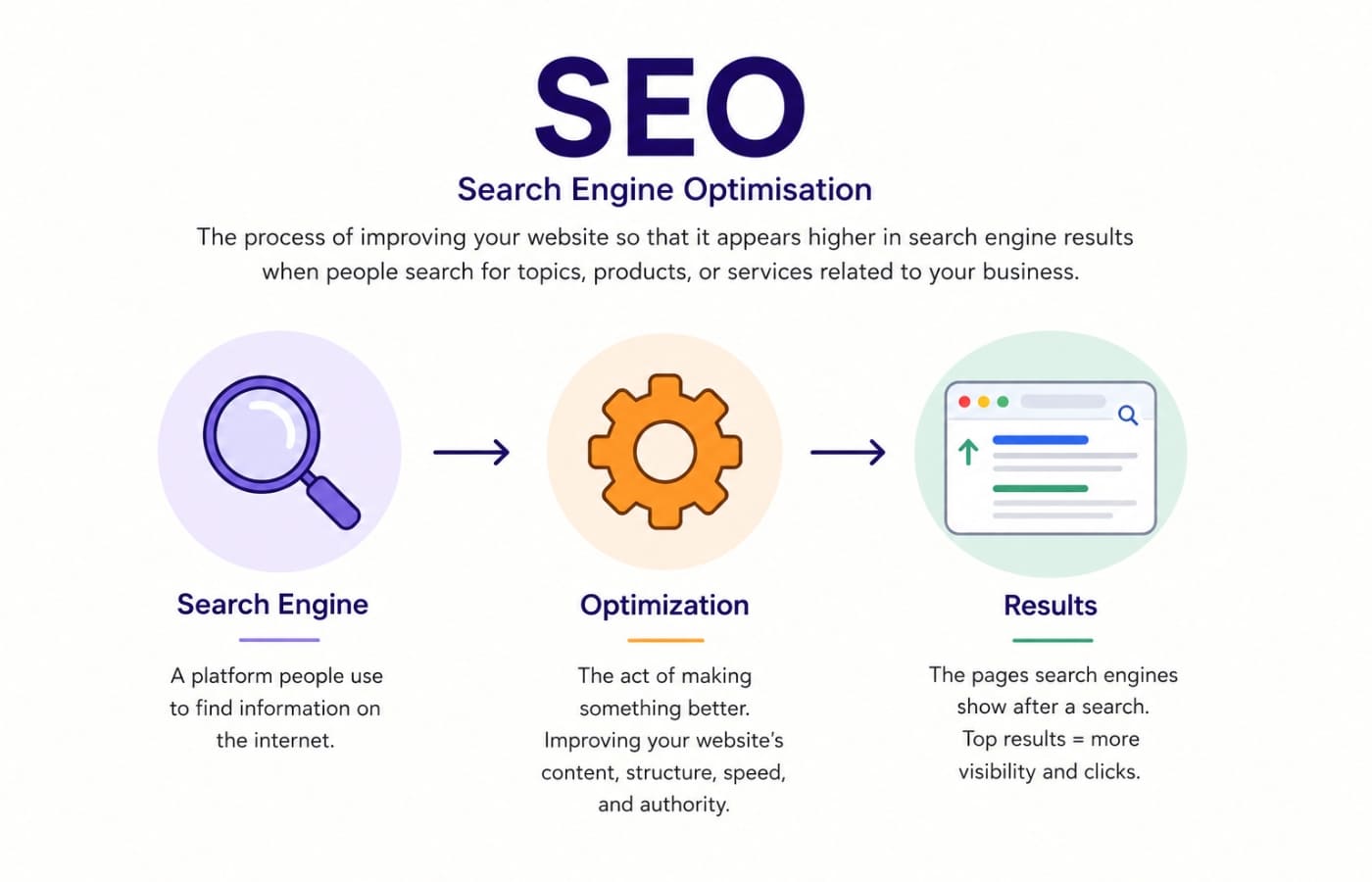
SEO stands for Search Engine Optimization. It is the practice of improving your website, its content, structure, speed, and authority so that search engines like Google rank your pages higher in organic (unpaid) search results.
The word ‘organic’ is key here. Organic results are the listings that appear in Google because the algorithm decided they are the best answers to the search query, not because anyone paid to be there. When your page ranks organically at position #1, Google chose it based entirely on merit.
SEO involves work in three main areas:
- On-Page SEO: What is on your pages: content quality, keyword optimisation, heading structure, internal linking, meta tags.
- Off-Page SEO: What happens outside your pages primarily building backlinks from other reputable websites that signal your authority and trustworthiness.
- Technical SEO: The underlying health of your website: page speed, mobile-friendliness, crawlability, indexability, Core Web Vitals.
SEO is a long-term strategy. Results typically take months to materialise. But once achieved, organic rankings can drive consistent, free traffic for years, compounding in value over time.
A Note on Terminology: Where the Confusion Comes From
It is worth knowing that the definition of SEM has shifted over time, and this is a major source of confusion.
Originally, ‘SEM’ was a broad umbrella term that included both paid and organic search marketing. SEO was considered a subset of SEM. Many older textbooks and some marketers still use SEM in this broad sense.
In modern usage, however, and this is now the dominant convention in the industry, SEM specifically refers to paid search advertising. When a digital marketer today says ‘we are running an SEM campaign,’ they almost always mean Google Ads (PPC). SEO and SEM are now treated as two distinct, parallel disciplines.
Throughout this guide, we use the modern definition: SEO = organic search optimisation; SEM = paid search advertising.
How SEO Works: The Organic Path to Visibility
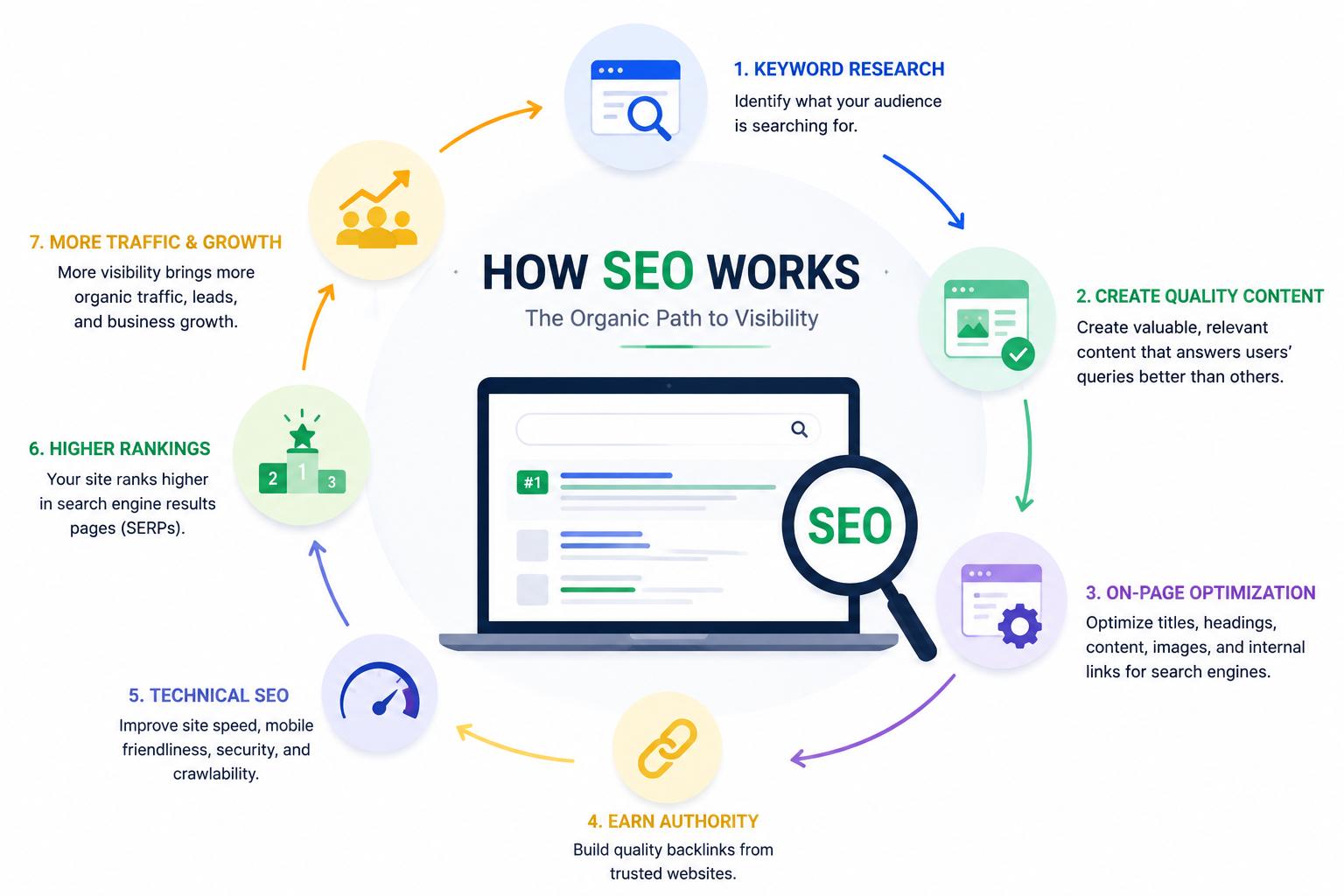
To appreciate the comparison between SEO and SEM, you need to understand how each one actually works under the hood. Let us start with SEO.
The SEO Process: Building Organic Authority Over Time
SEO works by making your website the best possible answer to the queries your audience is searching for. Google’s job is to find and reward the most helpful, authoritative, and trustworthy pages on the web. Your job in SEO is to be that page.
Here is how the organic ranking process works:
- Google discovers your page: Googlebot crawls the web following links. If your page has internal links pointing to it (or you have submitted a sitemap), Googlebot will eventually find it.
- Google indexes your page: After crawling, Google analyses your content and stores it in its index, a database of all known web pages, organised by topic and relevance.
- A user searches a relevant query: When someone searches a term related to your page’s topic, Google retrieves all indexed pages relevant to that query.
- Google ranks the results: Using hundreds of algorithm signals content quality, backlinks, page experience, search intent matching Google orders the results and displays them in the SERP.
- Your page appears at a position: Based on all the signals, your page appears at a specific organic position. Position #1 means Google considers yours the best available answer.
- Users click and visit: Searchers see your result and click through to your page. You receive free organic traffic.
The ongoing work of SEO is continuously improving these signals: creating better content, earning more backlinks, fixing technical issues, improving page speed, and building overall domain authority. Over months and years, these improvements compound, lifting rankings across many pages and keywords simultaneously.
The Key Organic Ranking Signals
Google evaluates hundreds of factors, but the most impactful for organic SEO positioning are:
- Content quality and comprehensiveness: Does your page genuinely answer the query better than alternatives?
- Search intent matching: Does your page give the user exactly what they are looking for in the right format?
- Backlink authority: How many high-quality, relevant external websites link to your page?
- E-E-A-T: Does your content demonstrate real Experience, Expertise, Authoritativeness, and Trustworthiness?
- Core Web Vitals: Does your page load fast, respond quickly, and stay visually stable?
- Mobile-friendliness: Does your page work perfectly on smartphones?
How SEM Works: The Paid Path to Instant Visibility
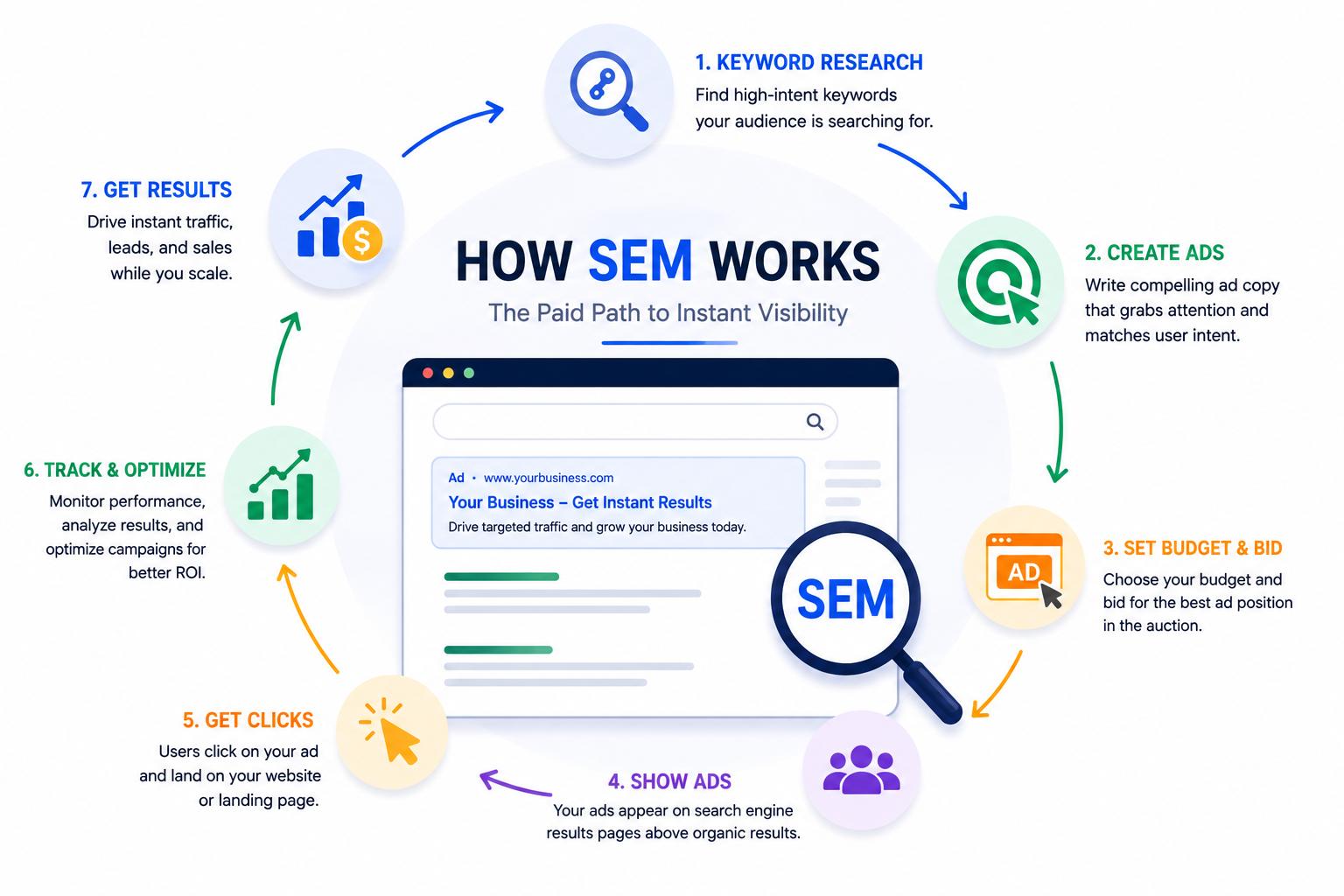
SEM through Google Ads operates on a fundamentally different mechanism from SEO. Rather than earning a position through content quality and authority over months, you purchase a position through an auction system, and it can happen within hours of setting up your campaign.
The Google Ads Auction: How It Works
Every time someone performs a Google search, Google runs a split-second auction to determine which ads to show, in what order, and at what cost. Understanding this auction is the key to understanding SEM.
Contrary to what many beginners assume, the highest bidder does not simply win the top ad position. Google uses a more nuanced system called Ad Rank to determine ad placement:
Ad Rank = Bid Amount × Quality Score × Expected Impact of Ad Extensions
Bid Amount: The maximum amount you are willing to pay per click for a given keyword. You set this in your Google Ads campaign.
Quality Score: A score from 1 to 10 (10 being best) that Google assigns based on the relevance and quality of your ad, your landing page experience, and your expected click-through rate. A high Quality Score can allow you to win a higher position while actually paying less than a competitor with a lower Quality Score but a higher bid.
Expected Impact of Ad Extensions: Ad extensions are additional pieces of information you can add to your ad (phone numbers, links to specific pages, location, price, etc.). Using relevant extensions improves your ad’s expected performance and boosts Ad Rank.
The actual cost you pay per click (your Cost Per Click, or CPC) is determined by the Ad Rank of the advertiser just below you, divided by your Quality Score plus a penny. This means that improving your Quality Score directly reduces how much you pay per click.
| 📝 Google Ads Auction: A Simplified Example
Keyword: ‘digital marketing course online’ Advertiser A: Bids ₹80/click, Quality Score: 4/10 → Ad Rank = 320 Advertiser B: Bids ₹60/click, Quality Score: 8/10 → Ad Rank = 480 Advertiser C: Bids ₹100/click, Quality Score: 2/10 → Ad Rank = 200 Result: Advertiser B wins the top position despite bidding LESS than Advertiser C because their Quality Score is so much higher. Key lesson: In Google Ads, relevance and quality can outperform raw budget. A well-crafted, highly relevant ad can win premium positions more cost-efficiently than a competitor throwing money at low-quality ads. |
The Structure of a Google Ads Campaign
Understanding how Google Ads campaigns are structured helps demystify SEM for beginners. A Google Ads account is organised into three levels:
Campaign level: The top level where you set the overall budget, campaign type (search, display, shopping, video, etc.), geographic targeting, and bidding strategy.
Ad Group level: Within each campaign, ad groups organise related keywords together. Each ad group should focus on a tightly themed set of keywords and contain ads specifically written for those keywords.
Keyword and Ad level: The individual keywords you are bidding on, and the specific ads that will show for those keywords. Each keyword can have different match types controlling how broadly it triggers your ads.
Keyword Match Types in Google Ads
One of the most important SEM concepts beginners need to understand is keyword match types how precisely a search query must match your keyword for your ad to be triggered:
| Match Type | How It Works | Example Keyword | Triggers For | Does NOT Trigger For |
| Broad Match | Most flexible. Google shows your ad for related searches, synonyms, and conceptually related queries | digital marketing course | ‘online marketing classes’, ‘learn marketing online’, ‘marketing certification’ | Completely unrelated searches |
| Phrase Match | Ad shows for searches containing your keyword phrase, in order, with words before/after | “digital marketing course” | ‘best digital marketing course’, ‘digital marketing course in Mumbai’ | ‘marketing digital course’ (wrong order) |
| Exact Match | Ad shows only for searches that match your keyword almost exactly | [digital marketing course] | ‘digital marketing course’, ‘digital marketing courses’ | ‘best digital marketing course’, ‘online marketing class’ |
Choosing the right match types is critical for SEM efficiency. Broad match can generate unexpected traffic and wasted spend if not carefully monitored with negative keywords (keywords you explicitly exclude). Exact match gives maximum control, but limits reach. Most campaigns use a mix of all three.
What a Google Ad Looks Like
A standard Google search ad contains:
- Headline: Up to 3 headlines of up to 30 characters each, the blue clickable text users see first
- Display URL: A customisable URL shown in the ad (usually your domain + a keyword path)
- Description: Up to 2 descriptions of up to 90 characters each, the summary text below the headline
- Ad Extensions: Optional additions like site links, callouts, phone numbers, location info, and price snippets
Writing compelling ads is a skill in itself. A strong headline and description directly affect your click-through rate, which in turn affects your Quality Score and ultimately how much you pay per click. Great SEM practitioners are as skilled at ad copywriting as they are at bidding strategy.
SEO vs SEM: The Complete Side-by-Side Comparison
Now that you understand how each channel works, let us compare them across every dimension that matters for making a strategic decision. This is the most important section for anyone trying to decide where to invest.
| Dimension | SEO (Organic Search) | SEM (Paid Search) |
| Cost Structure | No cost per click; investment is in content, tools, and time (or agency fees) | Pay-per-click: every visitor costs money; cost scales directly with traffic |
| Time to Results | 3–12+ months to meaningful organic traffic | Near-instant: ads can go live within hours and generate clicks the same day |
| Traffic Longevity | Long-term rankings persist even after you stop actively working | Short-term traffic stops completely the moment your budget is paused |
| Click-Through Rate | Higher CTR for most queries; users trust organic results more | Lower CTR: ads are clearly labelled ‘Sponsored’; many users deliberately skip them |
| Competitive Barrier | High barrier to entry authority and content quality take years to build | Low barrier to entry any business with budget can appear at the top immediately |
| Scalability | Scales with domain authority each new piece of content compounds existing rankings | Scales with budget more spend = more traffic, but cost per click can rise with competition |
| ROI Timeline | Low initial ROI, very high long-term ROI | High initial ROI possible, but diminishing returns as costs rise; stops when budget ends |
| Audience Trust | High organic results perceived as unbiased recommendations | Lower: users are aware these are paid placements |
| Targeting Precision | Moderate you can target keywords but cannot set demographic parameters beyond content angle | Very high target by keyword, location, device, time of day, demographics, interests, and more |
| Measurability | Measured through Search Console and GA4; full attribution possible but complex | Highly measurable: Google Ads tracks every impression, click, and conversion with precision |
| Algorithm Dependency | Subject to Google algorithm updates; rankings can shift | Subject to bid competition and Quality Score changes, but you control the budget |
| Best Use Case | Long-term brand building, sustainable growth, high-intent evergreen traffic | Rapid market entry, promotions, seasonal campaigns, testing new markets, immediate lead generation |
| Required Skills | Content writing, keyword research, technical SEO, link building | Ad copywriting, bidding strategy, landing page optimisation, conversion tracking |
| Ongoing Work Required | Yes: content creation, link building, technical maintenance | Yes: campaign monitoring, bid adjustments, ad testing, budget management |
The Real Cost of SEO vs SEM: What Beginners Often Misunderstand
Cost is almost always the first question beginners ask. ‘Is SEO free?’ and ‘Is SEM expensive?’ The honest answers are more nuanced than most simple explanations suggest.
The True Cost of SEO
SEO is often described as ‘free’, and in one sense, this is accurate. You do not pay Google for organic rankings. There is no cost per click for organic traffic. But to say SEO is free is misleading.
Building strong organic rankings requires significant investment in:
- Content creation: Writing comprehensive, well-researched articles takes serious time or money if you hire writers or an agency. A single high-quality pillar page might take 20–40 hours to research, write, and optimise properly.
- SEO tools: Professional tools like Ahrefs or Semrush cost ₹10,000–₹25,000 or more per month. These are nearly essential for keyword research, competitor analysis, rank tracking, and auditing.
- Technical work: Fixing technical SEO issues, site speed, structured data, and crawl errors often requires developer time, which carries a cost.
- Link building: Earning high-quality backlinks through outreach, digital PR, or guest posting requires significant time investment or agency fees if outsourced.
- Agency or consultant fees: If you hire an SEO professional or agency, expect to invest ₹30,000–₹3,00,000+ per month depending on scope and market.
| 📊 The Real SEO Investment Reality
A professional SEO campaign for a small business typically costs ₹20,000–₹80,000/month in agency or consultant fees. Results begin to appear in months 3–6, with full ROI often not visible for 12+ months. However, once rankings are established, the marginal cost of traffic approaches zero, unlike paid search. The long-term cost per visitor from SEO is almost always lower than from paid search, often dramatically so after year two. |
The True Cost of SEM
SEM costs are highly transparent; you can see exactly what you are paying per click. But beginners often underestimate the total cost of running effective paid search campaigns.
Costs in SEM include:
- Click costs (CPC): The actual cost per click varies enormously by industry and keyword competitiveness. Highly competitive industries (legal, finance, insurance, healthcare) can see CPCs of ₹200–₹2,000 or more per click in India. Competitive global markets can exceed $50–$100 per click.
- Management fees: If you hire an agency or specialist to manage your Google Ads campaigns, expect to pay 15–25% of ad spend as management fees on top of the ad spend itself.
- Landing page development: Effective SEM requires dedicated, well-designed landing pages. Generic pages perform poorly and increase your cost per conversion.
- Testing budget: Effective SEM requires A/B testing ads, bidding strategies, and landing pages. This means spending money on variations that may not perform well initially.
The most common SEM mistake is treating the click cost as the only cost. The real metric that matters is Cost Per Acquisition (CPA): how much you spend in total advertising costs to generate one customer or lead. CPA includes not just the click cost but also the conversion rate of your landing page.
| 📝 CPA Calculation: Why Your Conversion Rate Matters More Than Your CPC
Scenario A: CPC = ₹50, Landing page conversion rate = 2% Cost per lead = ₹50 ÷ 0.02 = ₹2,500 per lead Scenario B: CPC = ₹80, Landing page conversion rate = 8% Cost per lead = ₹80 ÷ 0.08 = ₹1,000 per lead Scenario B has a 60% HIGHER click cost but costs 60% LESS per lead because the landing page converts four times better. Lesson: Investing in a high-converting landing page is often the single highest-ROI activity in SEM. Never optimise click costs in isolation. |
Which Is More Cost-Effective? The Long-Term View
The honest answer depends entirely on your timeframe and goals. Here is a useful mental model:
In the short term (0–6 months): SEM almost always delivers faster and more predictable ROI. You can turn it on and start getting measurable results within days. SEO in this period is largely an investment with no immediate return.
In the medium term (6–18 months): SEO begins to deliver returns, and the cost per organic visitor starts declining. SEM costs continue to scale with traffic. The curves begin to cross.
In the long term (18+ months): A well-executed SEO strategy typically produces dramatically lower cost per visitor than paid search, often by a factor of 5–10x. The organic rankings you have earned continue to deliver traffic at near-zero marginal cost.
When to Use SEO: The Right Scenarios for Organic Search
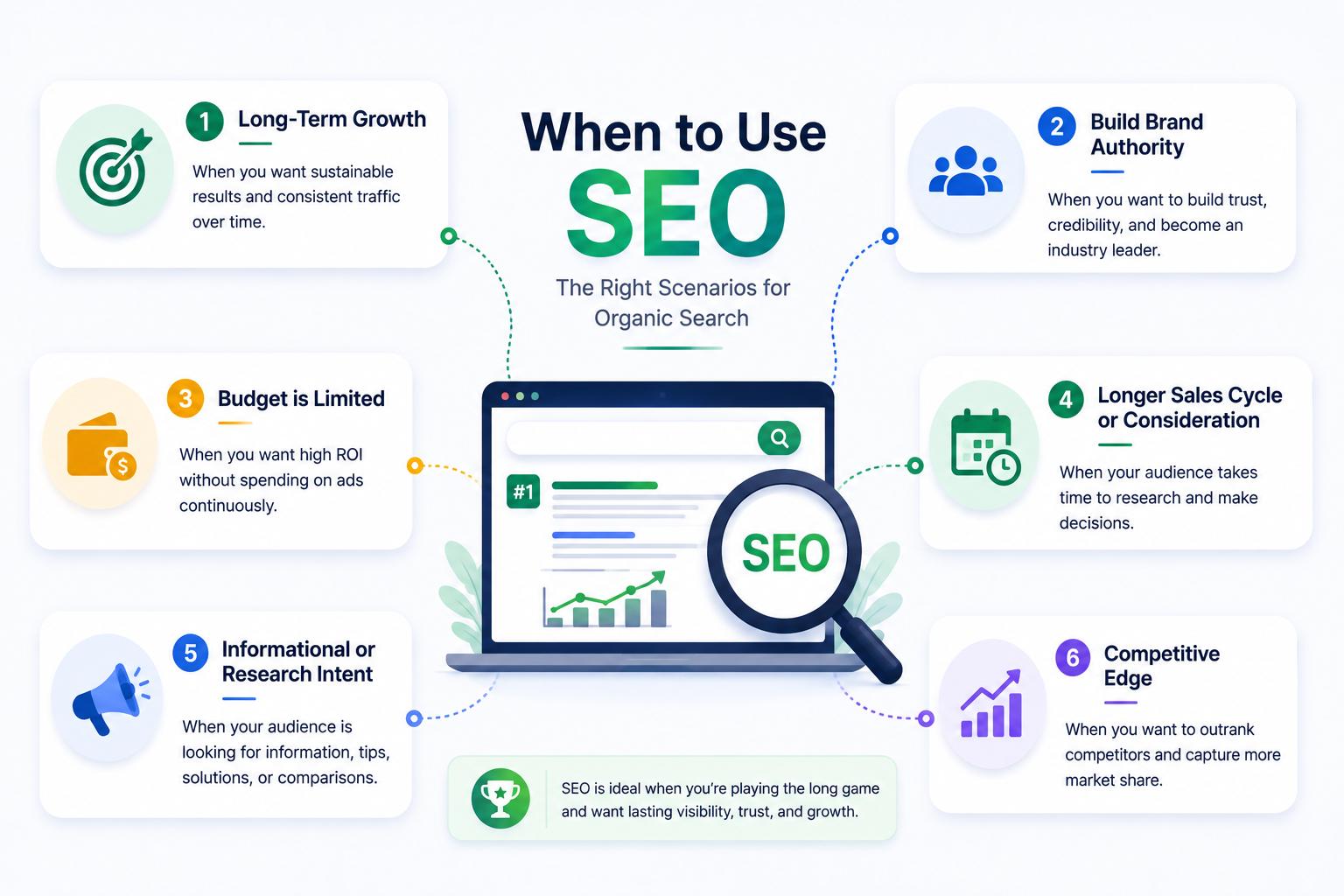
SEO is not the right strategy for every situation or every moment. Understanding when it is the ideal choice helps you invest resources efficiently.
SEO Is Your Best Investment When…
- You are building a long-term business and need a sustainable, compounding traffic source that does not require ongoing per-click spend.
- Your target keywords have high search volume and strong commercial value, making the long-term organic traffic worth the upfront investment.
- Your audience naturally searches for information related to your product or service before buying; content-driven SEO nurtures them through the decision process.
- You are building a content-based brand: a blog, educational resource, news site, or thought leadership platform where organic visibility is the core business model.
- You are in a market where paid advertising is extremely expensive, making organic traffic the only cost-effective channel at scale.
- Your business has a long sales cycle, where customers need significant research and education before purchasing. Content-driven SEO is ideal for these high-consideration purchases.
- You want to build brand authority and credibility; organic rankings are trusted signals of authority that paid ads cannot replicate.
SEO Is Less Ideal When…
- You need immediate results: a new product launch, a time-sensitive promotion, or a rapidly closing market window. SEO simply cannot deliver in weeks.
- You are testing a new business idea before investing months in SEO; use SEM to quickly validate whether people will pay for what you offer.
- Your market or product changes rapidly; SEO content has a lag; SEM allows you to pivot messaging overnight.
- You are entering a market dominated by extremely high-authority competitors. This does not mean avoid SEO entirely, but be realistic about the timeline.
When to Use SEM: The Right Scenarios for Paid Search
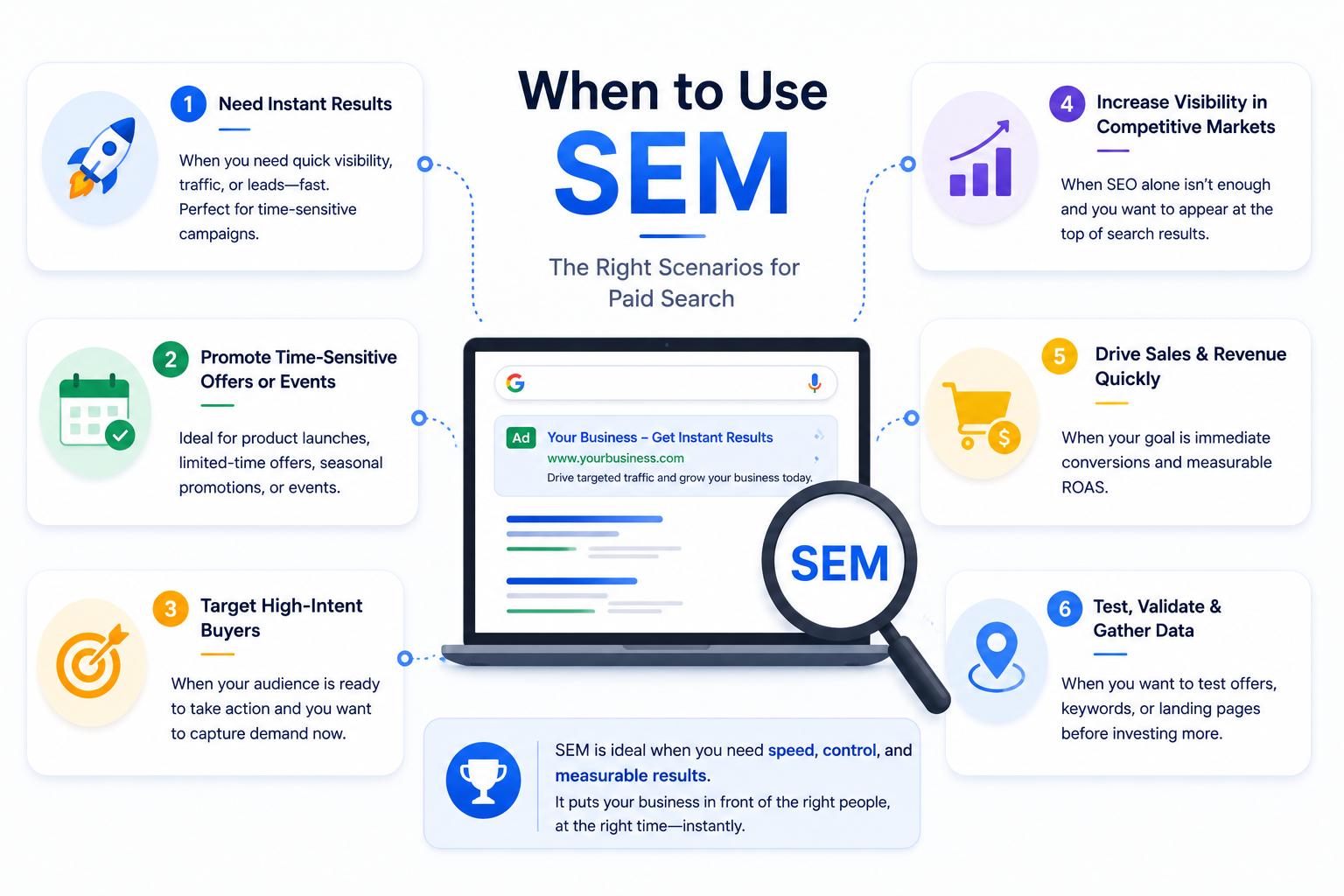
Paid search is an incredibly powerful tool in the right circumstances. Here is when it is genuinely the best choice and when it can drain budgets without producing sustainable results.
SEM Is Your Best Investment When…
- You need immediate traffic and cannot wait for SEO to build new business launches, time-sensitive promotions, or gap-filling while SEO authority develops.
- You want to validate a new product, service, or market before committing to a long-term SEO strategy. SEM lets you test quickly and cheaply.
- Your business is highly seasonal; run ads during peak periods (festive seasons, end of financial year, etc.) when your customers are most ready to buy.
- You operate in a market where your competitors are aggressively advertising; not advertising means ceding the top of the page to them for high-intent searches.
- Your product or service has a high customer lifetime value; if each customer is worth ₹50,000 or ₹5,00,000, a high CPA can still be extremely profitable.
- You want to target very specific audience segments with precision. Google Ads demographic, geographic, device, and time-of-day targeting is far more granular than SEO.
- You are running specific campaigns, limited-time offers, new product announcements, or location-specific promotions that would not make sense as permanent SEO content.
SEM Is Less Ideal When…
- Your budget is very limited, and you cannot afford to sustain ad spend long enough to optimise campaigns. Underfunded SEM campaigns rarely perform well; the algorithm needs data (clicks, conversions) to optimise, which requires spending.
- You are selling a low-margin product in a competitive market; if your profit per sale is ₹200 and a competitor is paying ₹150 per click, the economics simply do not work.
- You have no landing page or conversion infrastructure; clicks without high-converting destination pages are wasted spend.
- You want to build long-term brand equity through search; paid ads disappear when the budget stops; they do not compound the way organic authority does.
The Most Powerful Strategy: Using SEO and SEM Together
The most sophisticated and successful digital marketing strategies do not treat SEO and SEM as competitors; they treat them as complements. Used together intelligently, they create a search presence far stronger than either channel could achieve alone.
Here is how combining SEO and SEM creates synergies that neither strategy achieves independently:
SEM Data Accelerates SEO Strategy
Running a Google Ads campaign gives you immediate, high-quality keyword performance data. You can see exactly which keywords drive clicks, which drive conversions, and what Cost Per Acquisition looks like all within weeks, rather than waiting months for organic data to accumulate.
This SEM data is invaluable for SEO planning. Keywords that convert well in paid search are almost certainly worth investing in for organic SEO. Keywords that receive high impressions but few conversions may indicate that searcher intent does not match your offer, saving you from investing months of SEO effort in the wrong direction.
SEO Reduces Long-Term SEM Dependence
As your organic rankings grow, you can gradually reduce paid spend on keywords where you rank strongly or shift that budget toward keywords where you have no organic presence yet. This creates a natural progression: SEM fills the gaps while SEO builds authority, and over time, organic rankings progressively take over from paid spend.
Dominating the SERP Together
For your most important keywords, appearing in both the paid results (top of page) AND the organic results (#1–3 positions) creates a dominant SERP presence. Your brand occupies multiple positions simultaneously, increasing total click capture and creating the impression of market leadership. Even users who skip the ads will see your organic listing; even users who skip organic listings may click your ad.
Paid Can Protect Branded Traffic
Even when you rank #1 organically for your own brand name, competitors can bid on your brand name in Google Ads and appear above you in the paid results. Bidding on your own brand name is inexpensive (high Quality Score, low competition) and ensures that paid ads do not divert your branded traffic to competitors.
Real-World Scenarios: SEO, SEM, or Both?
Theory is useful. Real-world examples are even more useful. Here is how different types of businesses should think about the SEO vs SEM decision:
Scenario 1: A New E-Commerce Store Launching This Month
The business: An online store selling handmade leather bags, launching today with no existing web presence.
SEO strategy: Start immediately, publish category and product pages with keyword-optimised content, begin building backlinks, and create a blog covering leather care, fashion styling, and bag buying guides. But expect 6–9 months before meaningful organic traffic arrives.
SEM strategy: Launch Google Shopping ads and search ads immediately targeting ‘handmade leather bags India’, ‘genuine leather handbag online’, and similar purchase-intent queries. This drives immediate sales while SEO builds.
Recommendation: Both, with heavy initial SEM. Use paid ads to generate revenue while SEO authority develops. Allocate 60% of marketing budget to SEM and 40% to SEO/content in year one. Shift toward 30/70 by year two as organic rankings build.
Scenario 2: A Local Dental Clinic
The business: A dental practice in Pune serving local patients, with a basic website and zero current Google presence.
SEO strategy: Local SEO is the priority. Optimise the Google Business Profile, earn reviews, build local citations, and create location-specific content. Target keywords like ‘dentist in Pune’, ‘teeth whitening Pune’, ‘dental implants Pune’. Local SEO results can appear within 2–4 months.
SEM strategy: Run Google Ads targeting local search terms, particularly for high-value treatments (implants, orthodontics, teeth whitening). Use location targeting to reach only Pune searchers. Call extensions are essential; local service businesses often convert better on phone calls than form submissions.
Recommendation: Both, but prioritise Local SEO. The Local Pack organic results for dental clinics drive the majority of calls in most markets. SEM is a useful supplement for specific high-value treatment promotions while Local SEO builds.
Scenario 3: A B2B SaaS Company
The business: A project management software company targeting SMEs across India.
SEO strategy: Build a content hub targeting informational and commercial keywords throughout the buyer journey: ‘best project management software for small teams’, ‘how to improve team productivity’, ‘project management tips for SMEs’. Educational content builds authority and captures prospects early in the decision process.
SEM strategy: Target high-intent, bottom-funnel keywords: ‘project management software pricing’, ‘Trello alternative India’, ‘team task management tool’. Retarget website visitors who explored pricing or features pages but did not convert.
Recommendation: Both with balanced investment. Content-driven SEO is essential for B2B brands building long-term authority. SEM is critical for capturing high-intent searches where prospects are ready to evaluate options. SEM retargeting for warm audiences is particularly high-ROI for SaaS.
Scenario 4: A Personal Finance Blog
The business: An independent blog about personal finance and investing for young professionals in India.
SEO strategy: SEO is the entire business model. Target informational keywords with strong search volume: ‘how to invest in mutual funds India’, ‘best tax saving investments 2026’, ‘SIP vs lump sum investment’. Build E-E-A-T through author credentials, accurate data, and comprehensive guides.
SEM strategy: Minimal or none in most cases. Blogs monetised through AdSense, affiliate marketing, or courses rarely have the margins to sustain significant paid search spend. The exception might be promoting a specific paid course or tool through targeted ads.
Recommendation: SEO only (with possible occasional SEM for specific product promotions). Content-driven organic traffic is the right foundation for a blog business model.
Common Myths and Misconceptions About SEO and SEM
Both SEO and SEM are surrounded by persistent myths that lead beginners to make costly mistakes. Let us clear them up directly.
Myth 1: ‘Running Google Ads Helps My Organic Rankings’
False. Google Ads (SEM) and organic search (SEO) are completely separate systems. Spending money on Google Ads has zero direct impact on your organic search positions. Google keeps a strict separation between its ad business and its search algorithm if paying for ads boosted organic rankings, it would fundamentally compromise the integrity of search results.
This myth persists partly because businesses that invest heavily in paid ads also tend to invest in professional websites and quality content, and those things do help organic SEO. But the ads themselves are not the cause.
Myth 2: ‘SEO Is a One-Time Project’
False. SEO is never finished. Your competitors are publishing new content, building new links, and improving their websites every day. Google updates its algorithm thousands of times per year. Search volumes and user behaviours shift. A page that ranks #1 today can drop to #8 in six months if it receives no ongoing maintenance.
Treating SEO as a project with a completion date is one of the most expensive mistakes a business can make. Effective SEO is an ongoing programme of content creation, link building, technical maintenance, and content refreshing.
Myth 3: ‘SEM Is Too Expensive for Small Businesses’
Not necessarily true. Google Ads has no minimum spend requirement; you can run campaigns on a ₹500/day budget. What matters is whether the economics work for your specific business. A local plumber spending ₹15,000/month on highly targeted local ads who gains 5 new customer calls at ₹3,000 each is achieving excellent ROI.
SEM becomes expensive when campaigns are poorly managed: wrong match types, irrelevant traffic, low-quality landing pages, and no conversion tracking. Well-managed SEM campaigns can work effectively for even small budgets in the right markets.
Myth 4: ‘Users Ignore Paid Ads’
Mostly false for purchase-intent searches. While it is true that users are generally more likely to click organic results for informational queries (where they are researching, not buying), multiple studies show that for high-intent transactional queries ‘buy iPhone 17’, ‘book hotel in Goa’, ‘plumber emergency call’ a significant proportion of users click on ads, particularly when the ad is highly relevant and well-written.
Ad-blindness is real for banner ads and display advertising, but search ads that appear for exactly what a user is searching for have much higher relevance and therefore much higher engagement.
Myth 5: ‘SEO Takes Too Long SEM Is Better’
This myth usually comes from impatience rather than analysis. SEM is faster; that is true and important. But ‘faster’ does not mean ‘better’ in every context. A business that invests in SEO for 18 months and builds strong organic rankings can enjoy years of profitable organic traffic at near-zero marginal cost, while a competitor who only ever ran paid ads must continue paying for every visitor indefinitely.
The right question is not ‘which is better?’ but ‘which is right for my timeline and goals?’ In many cases, the correct answer is to use SEM while SEO builds, then progressively shift the balance as organic rankings mature.
Myth 6: ‘I Need a Huge Budget to Compete in Google Ads’
False. Hyper-targeted, well-managed campaigns can compete effectively with larger advertisers through superior targeting and Quality Scores. A small business with a highly specific, locally targeted campaign and a well-optimised landing page can achieve excellent results, often outperforming larger competitors with bloated, poorly targeted campaigns.
Relevance and quality, not budget size, determine success in Google Ads. A Quality Score of 9/10 on a modest budget will often outperform a Quality Score of 3/10 on a large budget.
Measuring Success: Key Metrics for SEO and SEM
Both SEO and SEM require careful measurement, but they use different metrics and measurement approaches. Here is what to track for each:
Key SEO Metrics
| Metric | What It Measures | Where to Track It |
| Organic Traffic | Visitors arriving via unpaid search results | Google Analytics 4 |
| Keyword Rankings | Position of your pages for target keywords | Google Search Console, Ahrefs, Semrush |
| Click-Through Rate (CTR) | % of searchers who click your result | Google Search Console |
| Impressions | How often your pages appear in search results | Google Search Console |
| Domain Authority / Rating | Overall strength of your backlink profile | Ahrefs (Domain Rating), Moz (Domain Authority) |
| Referring Domains | Number of unique sites linking to you | Ahrefs, Semrush |
| Organic Conversion Rate | % of organic visitors who complete a goal | Google Analytics 4 |
| Core Web Vitals Scores | Page experience performance | Google Search Console, PageSpeed Insights |
Key SEM Metrics
| Metric | What It Measures | Where to Track It |
| Impressions | How often your ad was shown | Google Ads |
| Clicks | Number of times your ad was clicked | Google Ads |
| Click-Through Rate (CTR) | % of impressions that resulted in a click | Google Ads |
| Cost Per Click (CPC) | Average amount paid per click | Google Ads |
| Quality Score | Google’s rating of ad relevance and quality (1-10) | Google Ads |
| Conversion Rate | % of ad clicks that result in a desired action | Google Ads + GA4 |
| Cost Per Acquisition (CPA) | Total cost to acquire one customer/lead | Google Ads |
| Return on Ad Spend (ROAS) | Revenue generated per rupee of ad spend | Google Ads + GA4 |
| Impression Share | % of eligible impressions you are capturing vs. competitors | Google Ads |
Conclusion
The most important insight from this guide is right there in the subheading: for most businesses with serious growth ambitions, the SEO vs SEM question is a false dilemma. It is not either/or; it is both, in the right proportion, at the right time.
SEO and SEM are different tools designed for different jobs. A carpenter does not choose between a hammer and a saw; they use both, knowing each is right for specific tasks. The same logic applies to search marketing.
Here is the strategic summary:
- Use SEO when you are building for the long term, want compounding organic traffic, need to build brand authority, or are in a market where paid advertising is too expensive at scale.
- Use SEM when you need immediate results, are launching a new product or campaign, want to test a market before committing to long-term SEO, or need precise audience targeting.
- Use both when you want to dominate your search landscape, generating immediate paid visibility while organic authority builds into a sustainable, cost-efficient long-term traffic engine.
The businesses that win in search are not those that chose the ‘right’ channel in some abstract debate. They are the ones that understood both channels deeply, deployed them intelligently based on their specific goals and timelines, and stayed consistent long enough for compounding returns to take effect.
That understanding starts here, and it deepens with every campaign you run, every piece of content you create, and every ranking improvement you achieve.
Frequently Asked Questions
What is the main difference between SEO and SEM?
SEO (Search Engine Optimization) focuses on earning unpaid, organic traffic by improving your website’s relevance, authority, and technical quality. SEM (Search Engine Marketing) focuses on buying paid traffic through ads, primarily Google Ads, where you pay each time someone clicks. SEO builds lasting rankings over time; SEM delivers immediate but temporary visibility for a fee.
Is SEO free?
SEO does not involve paying Google for placement; in that sense, organic traffic is free. However, achieving good organic rankings requires significant investment in content creation, SEO tools, link building, and technical improvements. The investment is in work rather than clicks, but it is not without cost. The key distinction is that the cost is primarily upfront; once rankings are established, the ongoing traffic is essentially free.
Can I do SEO and SEM at the same time?
Absolutely, and it is often the most effective approach. Running both simultaneously allows you to get immediate traffic from paid search while SEO authority builds. SEM data also helps you identify which keywords perform best, informing your SEO strategy. As organic rankings improve, you can reduce SEM spend on those keywords and redirect budget elsewhere.
Which is better for a new business: SEO or SEM?
For most new businesses, both are beneficial, but the priority depends on urgency and budget. If you need immediate results (e.g., revenue to fund operations), SEM is the right starting point. If you have a 12+ month runway and are building a long-term brand, starting SEO immediately while running targeted SEM is ideal. The worst approach is to only run SEM and never invest in SEO, leaving you permanently dependent on paid traffic.
How much does SEM cost in India?
Google Ads costs in India vary widely by industry and keyword competitiveness. Costs per click can range from ₹5–₹20 for low-competition local keywords to ₹200–₹1,500 or more for competitive financial, legal, or education keywords. Monthly ad budgets for meaningful results typically range from ₹15,000 for very local/niche campaigns to several lakhs for competitive national campaigns. Add agency management fees of 15–25% of ad spend if you hire a professional.
Does SEM affect SEO rankings?
No. Running Google Ads has zero direct impact on your organic search rankings. Google maintains a strict separation between its paid advertising system and its organic search algorithm. However, running ads can indirectly support SEO by driving initial traffic to your website, increasing brand awareness that leads to more branded searches, and helping you identify high-performing keywords to target organically.
What is Quality Score in Google Ads and why does it matter?
Quality Score is Google’s rating (1–10) of the relevance and quality of your keywords, ads, and landing pages. A higher Quality Score results in better ad positions and lower costs per click. Google rewards relevance. Improving Quality Score involves aligning your keywords tightly with your ad copy, and ensuring your landing page directly delivers what the ad promises.
Can small businesses compete in Google Ads against large competitors?
Yes, through smart targeting and superior relevance. Large competitors often run broad, inefficient campaigns. A small business with highly targeted keywords, excellent Quality Scores, and a well-optimised landing page can outperform larger competitors on specific queries. Focus on long-tail, specific keywords and local targeting to find cost-effective opportunities where budget constraints matter less.
How long does it take for SEO to work?
For low-competition keywords on an established website, meaningful ranking improvements can occur within 1–3 months. For competitive keywords, expect 6–12 months of consistent effort before significant organic traffic materialises. Brand-new websites typically need 6–9 months to build enough domain authority to rank for anything competitive. The timeline depends heavily on keyword competitiveness, your existing domain authority, the quality of your content, and how actively you build backlinks.
What is PPC and how does it relate to SEM?
PPC stands for Pay-Per-Click, a pricing model where you pay each time a user clicks your ad. SEM (Search Engine Marketing) via Google Ads uses PPC as its pricing mechanism. The terms are often used interchangeably in practice, though technically SEM is the broader strategic discipline and PPC is the specific pricing model it uses. All Google Ads search campaigns are PPC campaigns.