
Look, if you’ve been posting on Instagram for more than a month, you’ve probably said “the algorithm hates me” at least once. Maybe out loud. Maybe just in your head while staring at a reel that got 43 views when your last one got 40,000. Nope, that’s not the algorithm being cruel. That’s the algorithm doing exactly what it’s built to do, and most people just don’t understand the rules of the game they’re playing.
Here’s the thing nobody tells you upfront: there is no single “Instagram algorithm.” That phrase gets thrown around like it’s one machine sitting somewhere deciding your fate. It’s not. It’s a stack of different AI systems, each one trained for a different job, each one scoring your content differently depending on where it’s being shown. The system that decides what shows up in someone’s main feed is not the same system deciding what plays in Instagram Reels, and neither of those is the system running Explore or Search. They talk to each other, sure, but they’re not one brain.
And honestly, the biggest shift by 2026 isn’t some secret ranking trick. It’s that Instagram has gotten much better at figuring out what actually keeps a person on the app happy, not just what makes them tap a heart. Meta has said for years that engagement bait tactics like “comment YES if you agree” get suppressed, and by now their systems are good enough to catch subtler versions of the same trick too. So chasing vanity metrics, the stuff that looks good on a screenshot but doesn’t hold anyone’s attention, is a losing strategy. The platform wants people to leave a session feeling like their time was well spent. That’s the whole game now.
This guide is for creators grinding on Reels, businesses trying to turn followers into customers, personal brands building authority, influencers managing multiple content pillars, agencies running client accounts, and ecommerce brands trying to make Instagram an actual sales channel. Whatever seat you’re in, the mechanics underneath are the same. What changes is how you apply them.
By the end of this, you’ll understand what Instagram actually looks at before it shows your content to anyone, which signals matter more than others in 2026, how each surface (Feed, Reels, Stories, Explore, Search) ranks things differently, and what specific moves actually increase reach instead of just feeling productive.
What You Will Learn in This Guide
- How Instagram’s recommendation systems actually process and rank your content
- The real ranking signals that matter in 2026, not the outdated 2019 advice still floating around
- Why each surface (Feed, Reels, Stories, Explore, Search) has its own separate scoring logic
- Which metrics predict reach better than likes or follower count
- How Instagram is quietly becoming a search engine, and what that means for your captions
- The content formats performing best right now and how to allocate your effort across them
- Practical, specific tactics to increase reach without gaming the system
- The myths that are still wasting people’s time in 2026
- Mistakes that quietly tank your reach without you noticing
- How to actually measure whether your strategy is working
What Is the Instagram Algorithm?
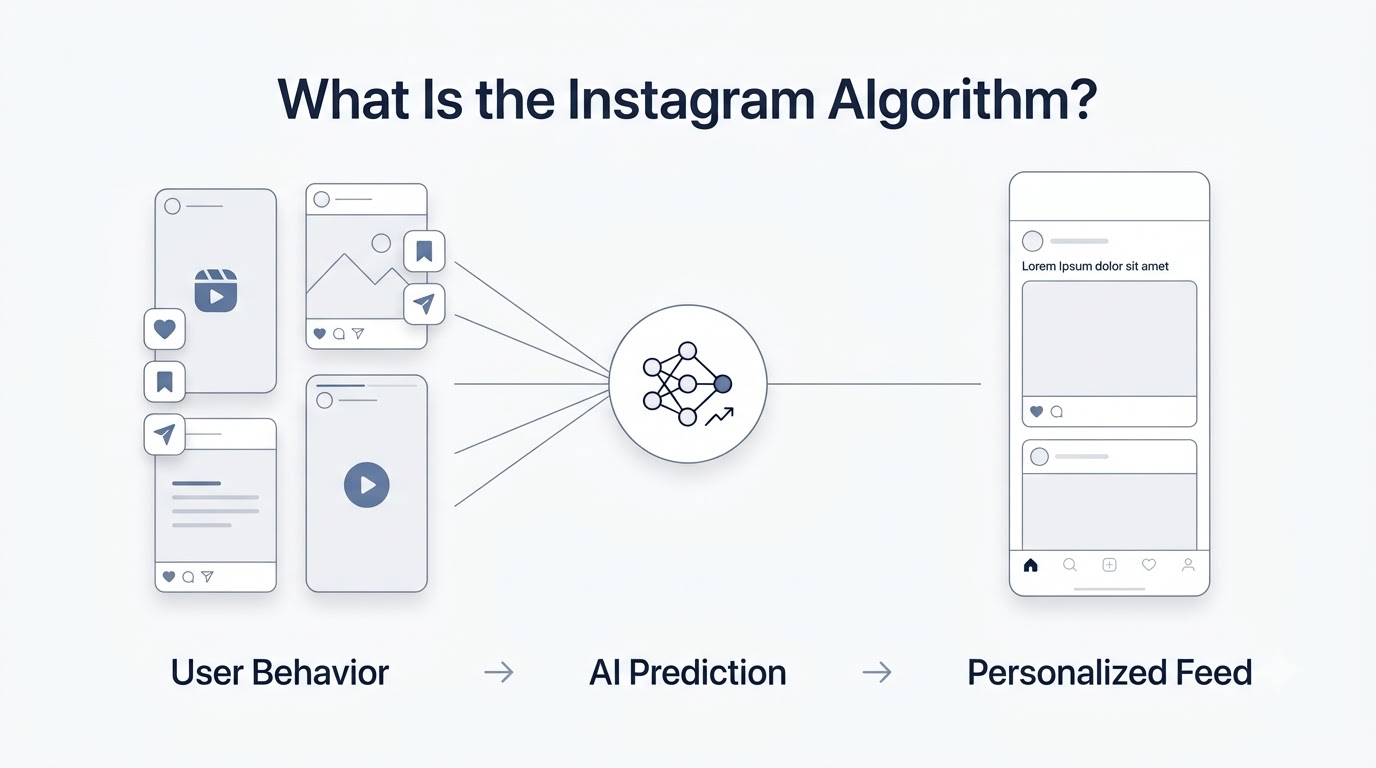
The Instagram algorithm is really a collection of machine learning models that predict how likely you are to enjoy a piece of content, then rank what you see based on that prediction. It’s not sorting by time anymore, and it hasn’t been for years. Every post, reel, and story you see was chosen because a model calculated a probability score for you specifically, based on your behavior, and decided you’d probably like it.
Think of it less like a librarian organizing books by date and more like a very attentive waiter who’s been watching what you order for months and now just brings you stuff you’re likely to enjoy before you even ask. That’s closer to how it actually functions.
Is There Only One Instagram Algorithm?
Nope. This is where most advice online gets it wrong. People say “beat the algorithm” like it’s a single opponent, but Instagram runs separate ranking systems for Feed, Reels, Stories, Explore, and Search. Each one has its own priorities.
The Feed algorithm leans heavily on relationship signals, stuff like how often you DM someone or comment on their posts. The Reels algorithm barely cares about your relationship with the creator at all; it’s almost entirely about whether you watch the video and how long you stick around. Explore is built to introduce you to accounts you’ve never interacted with, based on interest matching. Search behaves more like Google now, matching keywords and intent rather than just hashtags.
So when someone says “I optimized for the algorithm,” the real question is: which one? A caption that helps you show up in Search might do nothing for your Reels reach. A carousel that performs well in Feed might flop in Explore. You have to think about them separately.
How Instagram’s AI Has Evolved (2016–2026)
It’s worth knowing the timeline because it explains why so much old advice is dead wrong now.
Back in 2016, Instagram switched from a chronological feed to an engagement-based one, and creators lost their minds about it. That was the first big shift: recency stopped being the main sorting factor.
Through 2018 and 2019, the system leaned heavily on raw engagement rate, likes and comments relative to followers. This is where the whole “post at the right time to catch your followers online” advice came from, and honestly, it made more sense back then.
2020 brought the AI recommendation era in a bigger way, with Instagram pushing more non-follower content into Explore and feed based on interest prediction rather than just who you followed.
2021 and 2022 were the Reels-first years. Instagram was chasing TikTok hard, and short-form video got an artificial boost in distribution because Meta wanted creators making Reels, period.
2023 introduced a much stronger interest graph, essentially mapping topics and niches at a granular level so the system could match content to people who care about that specific thing, not just broad categories like “fitness” or “food.”
2024 and 2025 pushed AI content understanding further, meaning the system got better at actually parsing what’s inside a video or image (objects, scenes, audio, text overlays) instead of relying mostly on captions and hashtags.
By 2026, we’re in a search-first optimization phase. Instagram wants to be somewhere people go to search for things, not just scroll passively. That’s a meaningful shift, and it’s why Instagram SEO matters more now than it ever has.
How Instagram Actually Decides What You See
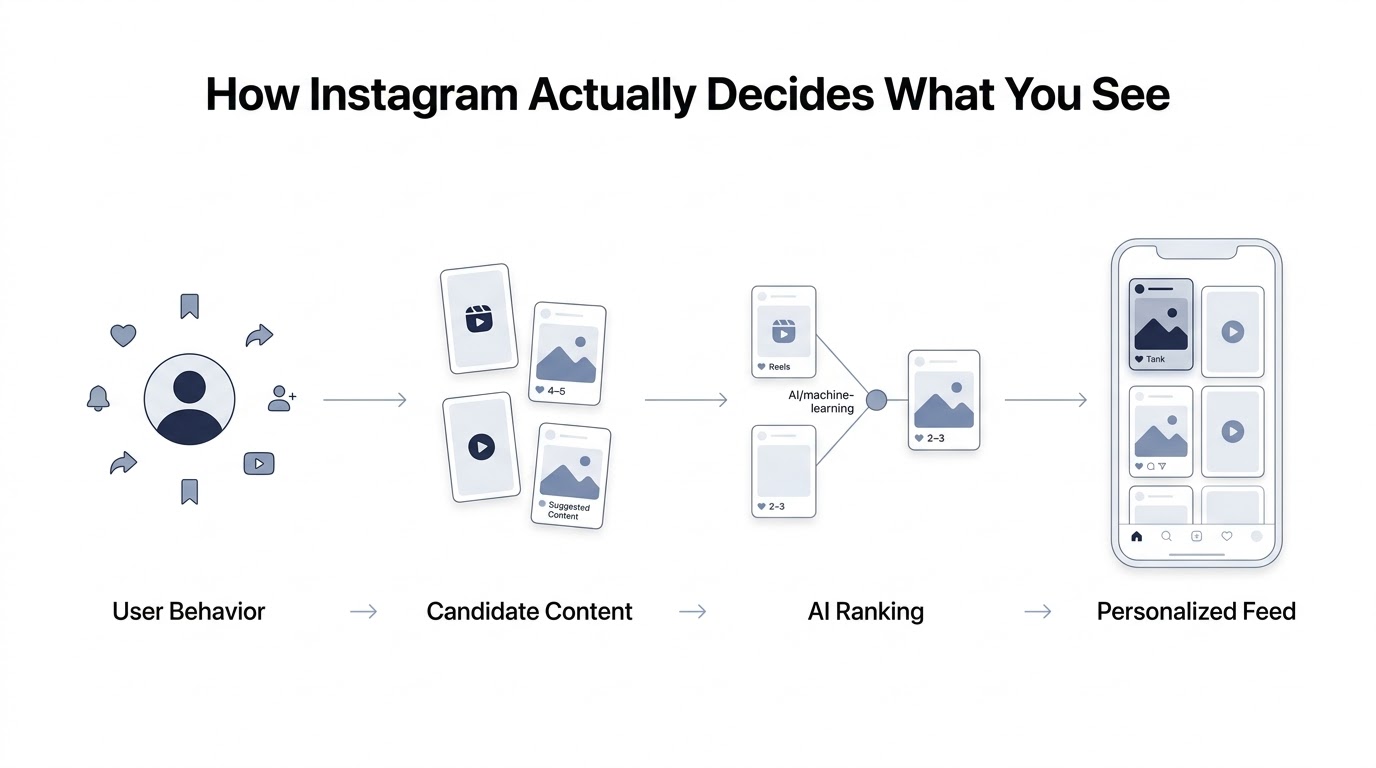
Instagram no longer shows posts in simple chronological order. In 2026, the platform uses advanced artificial intelligence (AI) and machine learning models to predict which content each user is most likely to enjoy, engage with, and spend time viewing.
Every time you open Instagram, its AI analyzes thousands of possible posts, Reels, Stories, and recommendations before deciding what appears first. The system considers your previous interactions, viewing habits, interests, relationships, device behavior, and current activity to personalize your feed.
Content Collection Stage
Before Instagram ranks anything, it first has to gather a pool of possible content to show you. This pool comes from several sources: posts from accounts you follow, suggested content based on your interests, recommended creators similar to ones you already engage with, Meta ads (which run through a separate auction system), and Explore recommendations pulled from your broader interest graph.
This stage matters because it sets the ceiling. If your content never makes it into someone’s candidate pool in the first place, no amount of ranking optimization saves you. This is why reaching non-followers depends so heavily on Instagram’s interest-matching, not just your existing audience.
Candidate Selection
Once Instagram has thousands of possible pieces of content that could theoretically be shown to a user, it narrows that list down using lightweight filtering models. These aren’t the deep, expensive prediction models yet, they’re faster, cheaper systems designed to quickly cut a massive pool down to a manageable one, maybe a few hundred candidates, before the heavier ranking work happens.
This is basically Instagram’s way of not burning enormous computing power running full predictions on every single post that exists. It filters by relevance signals first (has this user shown interest in similar content, similar creators, similar topics) and only passes the more promising candidates forward.
AI Ranking Stage
This is where the real scoring happens. Instagram runs the surviving candidates through prediction models that estimate the probability of dozens of different actions: will this user watch the whole video, will they like it, will they comment, will they share it to a friend, will they save it, will they visit the profile, will they follow, or on the negative side, will they hide it, report it, or scroll past it in under a second.
Each of these probabilities gets weighted differently depending on the surface. In Reels, watch time and completion probability carry enormous weight. In Feed, save and share probability tend to matter more. The model spits out a composite score for each candidate, specific to that user, at that moment.
Final Feed Assembly
After scoring, Instagram assembles the actual feed or Reels queue you see, blending ranked content with some diversity rules so you’re not shown ten posts from the same account in a row, mixing in ads at controlled intervals, and adjusting based on session context (how long you’ve been scrolling, what you’ve already seen today).
Here’s the simple version of the whole pipeline:
User Behavior → AI Prediction → Ranking Score → Feed Placement
Every single piece of content you see today went through that loop. If you remember nothing else from this section, remember that loop, because it explains basically everything downstream.
The Core Ranking Signals Instagram Uses in 2026
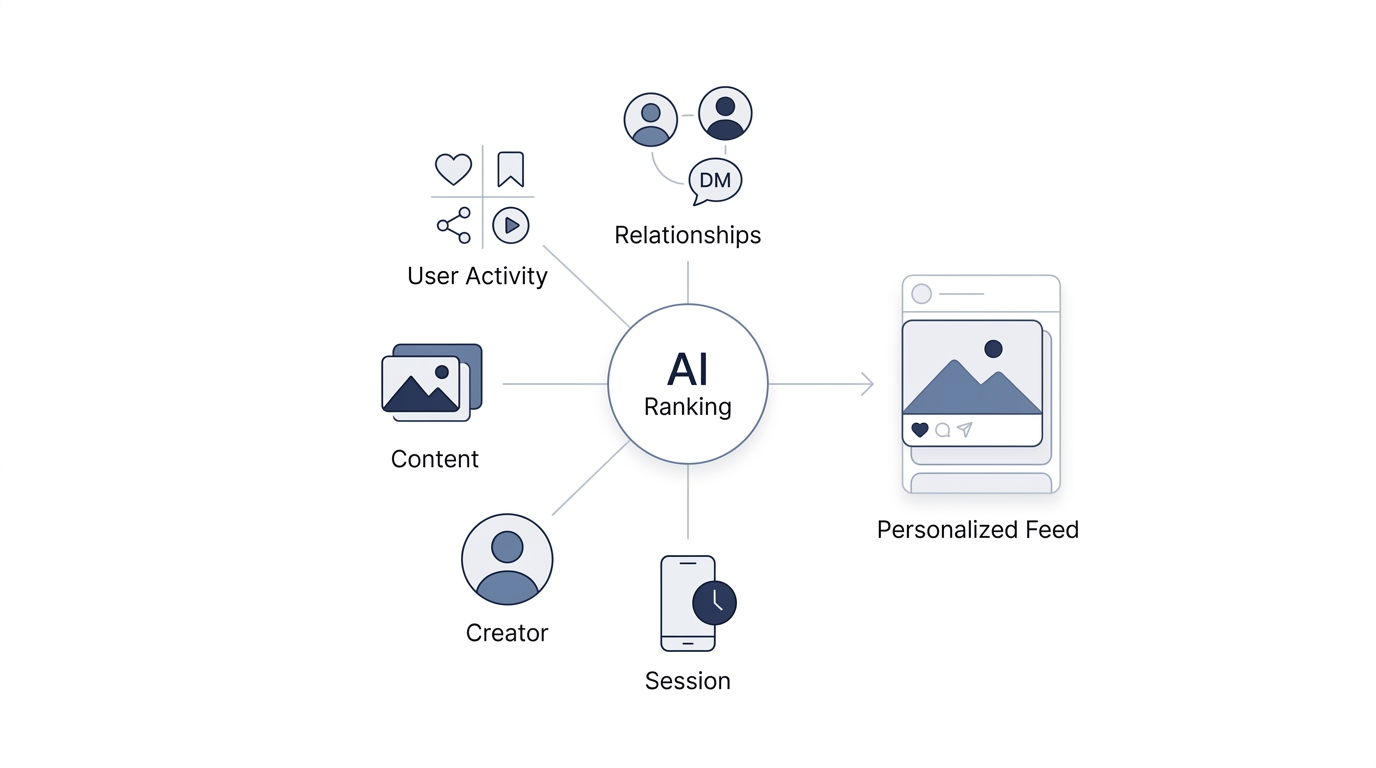
Instagram’s AI evaluates hundreds of ranking signals before displaying content. While Meta doesn’t disclose every factor, several signals consistently have the strongest influence.
User Activity Signals
These are the direct actions a person takes: likes, saves, shares, comments, watch time, replays, story interactions, and profile visits. Not all of these carry equal weight anymore. Likes are the weakest positive signal in 2026 because they take almost zero effort and don’t reliably predict whether someone actually valued the content. Saves and shares require more intent, so they carry more weight. Watch time and replays matter enormously for video because they directly measure attention, which is the resource Instagram is actually trying to protect and allocate well.
Relationship Signals
Instagram still cares a lot about who you actually talk to. DMs exchanged with someone, being tagged in their posts, having them in your Close Friends list, frequent interaction history, and shared interest overlap all push their content higher in your Feed specifically. This is why Feed still favors people you already have a relationship with, even as Reels and Explore lean toward pure interest-matching regardless of relationship.
If you’ve ever wondered why your best friend’s mediocre selfie shows up before a stunning photo from an account you don’t interact with much, this is why. Relationship signals are doing real work in Feed ranking.
Content Signals
This bucket covers topic relevance (does this match what the user cares about), originality (is this a repost or something new), freshness (how recently was it posted), visual quality, caption quality, audio choice, hashtags, geolocation, and increasingly, Instagram’s own AI understanding of what’s literally inside the content.
That last one deserves attention. By 2026, Instagram’s computer vision and audio recognition systems can identify objects, scenes, text on screen, and even the mood of a piece of content without relying purely on what you wrote in the caption. This means you can’t fake relevance with keyword-stuffed captions if the actual content doesn’t match. The system checks.
Creator Signals
Consistency, expertise, authority, community engagement, and account health all factor into how Instagram treats an account overall, not just individual posts. An account that posts sporadically and then vanishes for three weeks gets treated with more caution than one with a steady rhythm. Account health also covers stuff like whether you’ve had recent violations, spammy behavior flags, or a pattern of using and then deleting engagement bait.
Authority is built over time through consistent topical focus. An account that posts about five unrelated topics doesn’t build the same authority signal as one that stays tightly focused on a niche, because Instagram’s models struggle to build a confident interest profile for scattered accounts.
Session Signals
This one gets ignored constantly in the algorithm conversation, but it matters a lot. Instagram adjusts what it shows based on the user’s mood inferred from recent behavior, device type, how much time they seem to have available in that session, and what they were doing right before opening the session.
Someone scrolling at 11pm on a weeknight gets shown different content than someone opening the app for two minutes between meetings. Someone who just watched five cooking reels in a row is more likely to see a sixth. This is why the exact same post can perform wildly differently depending on when it’s published and who happens to be scrolling at that moment.
How Each Instagram Surface Has Its Own Algorithm
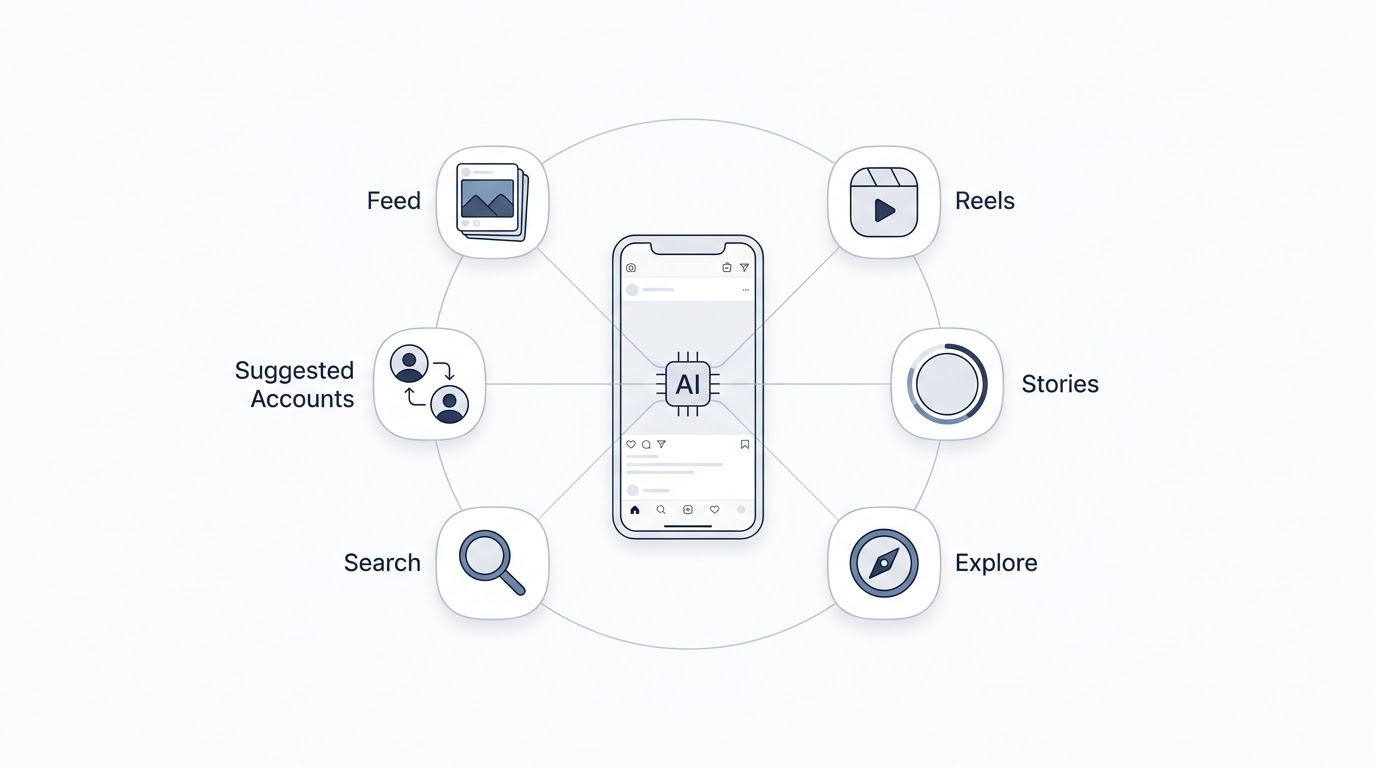
Instagram doesn’t rely on a single algorithm. Instead, every surface has its own ranking system designed for different user behaviors.
Instagram Feed Algorithm
The Feed algorithm ranks posts from accounts you follow, plus a growing mix of suggested content, based heavily on relationship signals and save/share probability. Fresh posts get a temporary visibility boost in the first hour or two, essentially a trial run to gauge early engagement before deciding how far to push it. If that early window performs well, Instagram extends distribution further. If it flops, reach dies fast.
Carousels have a real advantage in Feed because they naturally extend session time. Someone swiping through six slides spends more time with your content than someone glancing at one image, and that extra time is a strong positive signal. Save rate is probably the single most underrated Feed metric right now. When someone saves a post, they’re telling Instagram “I want to come back to this,” which is a much stronger intent signal than a like.
Best practice here: design your first slide or image to earn the swipe, and build your later slides around information dense enough that people actually want to save it for reference. A carousel that’s just six slightly different versions of the same photo doesn’t do this. A carousel that breaks down five specific data points, one per slide, does.
Instagram Reels Algorithm
Reels operates almost entirely on attention metrics. Watch time and completion rate are the two heaviest signals, followed closely by loop rate (does someone watch it, then watch it again without scrolling away), replays, shares, and sends (someone DMing your reel to a friend).
Audio choice still matters, though less than it did in 2022 when trending sounds gave you an automatic boost. Now it’s more about whether the audio fits the content and whether Instagram’s own trend-detection system has flagged that sound as currently gaining traction in your niche specifically, not just globally.
Originality gets checked hard here. Instagram can detect reposted or lightly edited content pulled from TikTok (the ones with the visible TikTok watermark are an instant reach killer, by the way) and suppresses it compared to native content.
Retention matters so much because it’s the cleanest, hardest-to-fake signal Instagram has. Anyone can buy likes. Nobody can fake someone actually watching 30 seconds of a 32-second video. That’s why your hook, the first one to three seconds, determines more about your reach than almost anything else you do.
Instagram Stories Algorithm
Stories rank based on story order priority, meaning accounts you interact with frequently show up first in the story tray. Replies, reactions, poll participation, and sticker engagement (tapping a quiz, sliding an emoji slider) all push your Close Friends and regular story viewers to keep seeing your stories at the front of the line.
Story frequency has a ceiling effect worth knowing about. Posting 15 stories a day doesn’t mean 15x the reach; it usually means declining view-through rate as people start skipping through your story ring faster. Somewhere in the 3 to 8 stories per day range tends to hold attention better for most accounts, though this varies by niche.
Using interactive stickers (polls, questions, quizzes) is one of the most reliable ways to boost your story ranking specifically, because Instagram treats sticker interaction as a strong positive relationship signal, similar in weight to a DM reply.
Instagram Explore Algorithm
Explore exists specifically to show people content from accounts they don’t follow. It works through interest matching (comparing your engagement history to content topics), similar accounts logic (if you engage with Creator A, you’re shown Creator B who has a similar audience overlap), engagement prediction, and topic clustering that groups content into fine-grained interest categories.
Getting into Explore consistently requires your content to perform above-average with your existing audience first. Instagram uses that initial performance as a signal of quality before expanding distribution outward to non-followers with similar interest profiles. This is why a post that flops with your own audience almost never makes it into Explore, no matter how good it might theoretically be for a wider audience.
Instagram Search Algorithm
Search has become one of the biggest opportunities in 2026 because most creators still ignore it entirely. Instagram Search now behaves closer to a real search engine, matching keywords in captions, alt text, bio, and even spoken audio (yes, Instagram can transcribe and index what’s said in your video) against what people type into the search bar.
Instagram SEO means treating your captions like you’d treat a blog post: using the actual words people search for, not just clever wordplay. Profile optimization matters too: your username, your name field (which is searchable text, unlike your username), your bio, and your account category all feed into whether you show up when someone searches a relevant term.
Alt text is a quietly powerful lever here. Most people either skip it or leave Instagram’s auto-generated version, which is often generic. Writing specific, keyword-relevant alt text describing what’s actually in the image helps both search ranking and accessibility.
Instagram Suggested Accounts
Instagram recommends creators to follow based on overlap with accounts a user already follows, engagement pattern similarity, and topic clustering. Showing up in “Suggested for You” is largely a byproduct of consistent topical focus and strong engagement rate relative to your follower count, not something you can directly optimize for beyond doing the fundamentals well.
Instagram AI Recommendation System Explained
Instagram’s recommendation engine is powered by deep learning models trained on billions of interactions across the platform.
Machine Learning Models
Instagram runs multiple specialized models rather than one general model. There’s a model estimating watch time probability, another estimating like probability, another for comment probability, another for negative actions like hiding or reporting. These get combined into a final ranking score, weighted differently per surface, as covered earlier.
Interest Prediction
Instagram builds an interest profile for every user based on what they’ve engaged with, how long they watched, what they’ve searched, and even what they’ve screenshotted (yes, that’s a signal too). This profile isn’t static; it shifts in near real-time as your behavior changes within a session.
Behavioral Modeling
Beyond just interests, Instagram models behavioral patterns: when you’re typically active, how you tend to engage (are you a liker, a saver, a lurker who never engages but watches everything), and how your behavior compares to similar users. This modeling is how the system can predict your reaction to content you’ve never seen before with reasonable accuracy.
Similar User Clustering
Instagram groups users into clusters based on shared behavior and interest patterns. If you’re in a cluster of people who engage heavily with home renovation content, and someone else in that cluster starts engaging with a particular creator’s DIY content, that creator’s future posts become more likely to get shown to you too, even before you’ve ever interacted with them directly.
Content Embeddings
Every piece of content gets converted into a mathematical representation, an embedding, that captures its topic, style, and characteristics in a form the AI can compare against other content and against user interest profiles. This is how Instagram can match a video about “budget kitchen remodel ideas” to someone whose profile suggests home improvement interest, even if that exact phrase never appears anywhere in the caption.
Recommendation Loops
Here’s a practical example of how this all plays together. Say you post a reel about air fryer recipes. It performs well with your existing followers in the first two hours (strong watch time, several saves). Instagram’s models register this as a quality signal and expand distribution to a cluster of users who’ve engaged with similar cooking content but don’t follow you. If watch time holds up with that new group, distribution expands again, wider clusters, then potentially Explore. If it drops off with the new group, the loop stops there. That’s the recommendation loop in action, and it’s why the first couple hours after posting matter so much.
The Most Important Instagram Ranking Factors in 2026
Ranked from highest impact to lower impact, based on how heavily these actually influence distribution across surfaces.
Watch Time
This is the single biggest factor for any video content in 2026. Instagram cares less about whether someone watched your reel and more about how much of it they watched, and whether they watched it more than once. If your average watch time is low relative to your video length, distribution slows down fast, regardless of your like count.
Completion Rate
Closely tied to watch time but distinct: the percentage of viewers who make it to the end. A 15-second reel with a 90% completion rate will usually outperform a 60-second reel with a 30% completion rate, even though the second one technically has more total watch seconds. Length isn’t the goal; finishing the video is.
Saves
Saves signal genuine value. Someone saving your post means they think it’s worth revisiting, which Instagram interprets as a strong quality signal that predicts continued engagement value over time, not just a one-time reaction.
Shares
Sharing a post to someone else’s DM or story is one of the strongest signals there is, because it means the content was good enough that someone wanted another specific person to see it. This is a much stronger endorsement than a public like.
Comments
Comments still matter, but not all comments are equal anymore. Instagram’s language models can distinguish between a genuine, substantive comment and a low-effort or engagement-bait response. Longer, more specific comments carry more ranking weight than one-word reactions.
Profile Visits
When someone watches your content and then goes to check out your profile, that’s a strong signal of interest that predicts future follow behavior, and it boosts how Instagram treats your account for that user going forward.
Follows
A new follow gained directly from a piece of content is a strong positive signal, though it happens less often than saves or shares because following requires more commitment.
DMs
Content that generates DM conversations, either about the content itself or triggered by it, carries real weight because it’s a strong relationship signal that predicts continued engagement.
Repeat Views
Someone watching your content, leaving, and coming back to watch it again (or rewatching your profile’s grid) tells Instagram the content has lasting value, not just a momentary reaction.
Negative Signals
Hide, report, skip, and unfollow are the flip side, and they’re weighted heavily against you. A single hide doesn’t tank your reach, but a pattern of hides relative to your reach tells Instagram this content, or this account, isn’t landing well with the audience it’s being shown to, and distribution gets pulled back fast. Report is the harshest of these and can trigger both reach suppression and manual review. Skip (scrolling past a reel in under a second or two) is a softer but very real negative signal that compounds if your hook isn’t strong enough to earn the first couple seconds of attention.
How Instagram Measures Content Quality
Instagram evaluates content quality using both AI analysis and user behavior.
Original Content
Instagram’s systems check for originality using content matching technology that compares your upload against existing content, including reposts pulled from other platforms. Original content gets prioritized distribution over reposted material, even when the repost is technically allowed.
High Resolution
Blurry, low-resolution uploads (especially screen recordings or downloaded-then-reuploaded videos with visible compression artifacts) get treated as lower quality signals. Exporting directly from your camera roll or editing app at full resolution rather than downloading from another platform first makes a measurable difference.
Editing Quality
This isn’t about needing professional editing software. It’s about pacing, clean cuts, avoiding dead air, and making sure the visual and audio elements feel intentional rather than sloppy. A well-paced phone-shot reel outperforms a poorly paced professionally-shot one more often than people expect.
Caption Value
Captions that add genuine context, a story, a specific insight, a clear call to action, perform better than captions that are just a string of hashtags or a single emoji. Longer captions aren’t automatically better, but empty ones leave real value on the table, especially for Search ranking.
Educational Content
Content that teaches something specific tends to earn higher save rates because people bookmark information they want to reference later. This is one of the most reliable content types for building save-driven reach.
Entertainment Value
Content that genuinely entertains earns strong watch time and share rates because people want their friends to experience the same reaction they had. Entertainment and education aren’t mutually exclusive either; the strongest performing content in 2026 often blends both.
Authenticity
Instagram’s ranking systems, and honestly its users too, have gotten fatigued by overly polished, obviously staged content. Accounts that show real process, real mistakes, real behind-the-scenes moments tend to build stronger engagement patterns over time than accounts chasing a flawless aesthetic.
Community Value
Content that sparks genuine discussion in the comments, questions, disagreement, people tagging friends, builds a community signal that Instagram rewards with continued distribution, because it indicates the content is generating real conversation, not just passive consumption.
Instagram SEO in 2026
Instagram has been quietly turning itself into a search engine, and most people still haven’t adjusted their strategy around it. A huge percentage of Gen Z users now use Instagram search the way older generations use Google, searching for restaurant recommendations, product reviews, tutorials, and more, directly inside the app.
Keyword Research
Start by actually typing relevant terms into Instagram’s search bar and seeing what autocompletes. That’s real search demand data, straight from the source. Look at what’s ranking for those terms already and note the gap between what’s ranking and what searchers probably actually want.
Username Optimization
Your username is searchable and weighted, so if you’re a name that doesn’t include any topical keywords, you’re missing free search visibility. This doesn’t mean stuffing your username with keywords in a spammy way, but a username that reflects your niche does real work.
Name Field Optimization
The “Name” field (different from username) is one of the most overlooked SEO levers on the platform. Unlike your username, this field allows spaces and is heavily weighted in search matching. If you’re a fitness coach, having your niche reflected here (not just your personal name) genuinely helps.
Caption SEO
Write your first sentence like it needs to answer the search intent directly, because it often does. Include the actual terms people would type when looking for content like yours, worked naturally into the sentence rather than crammed in as a keyword list at the bottom.
Alt Text
As mentioned earlier, custom alt text describing the actual content of your image or video, using natural, specific language, helps both search ranking and accessibility. This takes maybe fifteen extra seconds per post and almost nobody does it properly.
Hashtags
Hashtags still function as a categorization signal, just a much weaker one than in 2019. Use them for topical relevance (a handful of specific, niche-relevant tags) rather than treating them as a reach hack. Broad, oversaturated hashtags like #love or #instagood do essentially nothing for discovery anymore.
Location Tags
Tagging a specific, relevant location helps with local discovery, especially for businesses. This matters a lot more for local accounts (restaurants, gyms, local services) than for broad content creators, but it’s underused across the board.
Topic Selection
Staying within a consistent topical lane helps Instagram’s models build a confident understanding of what your account is about, which directly improves both search ranking and recommendation matching.
Search Intent
Think about what someone typing a given search term actually wants to walk away with. Someone searching “best budget skincare” wants specific product names and price points, not a vague lifestyle post. Content that satisfies real intent gets favored in search results.
Semantic Relevance
Instagram’s language models understand related concepts, not just exact keyword matches. You don’t need to repeat the exact same phrase five times; using related terms and concepts naturally throughout your caption helps the system understand the full context of what you’re posting about.
How Different Content Formats Perform
Each Instagram content format serves a different purpose within the platform’s ecosystem.
Reels
Highest reach potential of any format right now, especially for reaching non-followers, because Instagram is still actively pushing short-form video distribution. Engagement potential is strong for watch time and shares specifically, less so for comments compared to carousels. Best use case: top-of-funnel discovery and reaching new audiences. Recommended frequency: 3 to 5 per week for most accounts trying to grow.
Carousels
Strong engagement potential, particularly for saves and comments, because the format naturally invites people to slow down and read through multiple slides. Reach potential is more moderate than Reels but tends to convert better among people who do see it. Best use case: educational content, breakdowns, storytelling across slides. Recommended frequency: 2 to 4 per week.
Single Images
Lowest reach potential of the visual formats in 2026, honestly. They still have a place for high-impact photography, product shots, or quick announcements, but they don’t get the same distribution push as video or carousels. Best use case: quick updates, strong standalone visuals. Recommended frequency: sparingly, as a supplement rather than a core format.
Stories
Reach potential is limited to your existing audience plus whoever discovers you through story features, but engagement potential (through stickers and replies) is high and directly strengthens relationship signals for your Feed and Reels performance too. Best use case: daily connection, behind-the-scenes, direct polls and questions. Recommended frequency: 3 to 8 per day.
Live Videos
Reach potential varies a lot but going live does notify your engaged followers directly, which is real, unpaid distribution most formats don’t get. Engagement potential is high for real-time interaction. Best use case: Q&As, launches, building direct community connection. Recommended frequency: weekly or biweekly, consistency matters more than frequency here.
Collaborative Posts
Using the Collab feature effectively doubles your reach potential because the post appears natively in both accounts’ followers’ feeds and counts engagement toward both accounts. Best use case: partnerships, cross-promotion with complementary (not competing) accounts. Recommended frequency: as opportunities arise, quality over volume.
Broadcast Channels
Reach is limited to subscribers but engagement and loyalty run deep since it’s a more intimate, direct communication format. Best use case: nurturing your most engaged audience, exclusive updates. Recommended frequency: a few times a week, low pressure.
Notes
Small reach footprint, visible mostly to close connections in DMs, but useful for quick engagement bumps and staying top of mind. Best use case: casual, personality-driven quick thoughts. Recommended frequency: whenever relevant, low effort.
Threads Integration
Cross-posting relevant content to Threads and linking activity between the two platforms is increasingly factored into Meta’s broader account health and reach signals. Best use case: extending conversation-driven content and text-based takes. Recommended frequency: as a natural extension of your Instagram content, not a separate content burden.
How to Increase Instagram Reach in 2026
Growing reach requires aligning content with Instagram’s ranking signals rather than trying to “beat” the algorithm.
Create Better Hooks
You have about one to three seconds before someone decides to keep watching or scroll past. That’s not an exaggeration, that’s roughly what the data shows. Your hook needs to either promise a specific payoff, create a visual pattern interrupt, or open mid-action rather than with a slow intro. “Here’s why your Instagram reach dropped last week” beats “Hey guys, so today I wanted to talk about…” every single time.
Improve Retention
Cut anything that doesn’t move the content forward. Dead air, slow zooms with nothing happening, repeated points, all of it kills watch time. Watch your own content back and genuinely ask where you’d personally lose interest, then cut that part.
Encourage Saves
Structure content so it’s genuinely useful to revisit: a checklist, a step-by-step breakdown, specific numbers or names people would want to reference later. Explicitly saying “save this for later” in the caption does actually work, but only if the content earns it.
Increase Shares
Content that makes someone think “my friend needs to see this” gets shared. That usually means it’s either extremely relatable, genuinely surprising, or directly useful to a specific type of person the viewer knows.
Use Carousels Strategically
Front-load your first slide with the strongest hook, since that’s the only slide guaranteed to be seen. Build later slides with a clear, logical progression so people feel pulled to keep swiping rather than dumping information randomly.
Publish Consistently
Consistency builds the account-level trust signals covered earlier. This doesn’t mean posting every single day is required, but it does mean picking a realistic rhythm and sticking to it rather than posting in bursts and going silent for weeks.
Post at the Right Time
This matters less than it used to because of how much content gets distributed beyond your immediate followers now, but posting when your specific audience is active still gives you a stronger initial engagement window, which feeds the recommendation loop covered earlier. Check your own account’s audience activity data rather than trusting generic “best time to post” charts, since your specific audience matters more than a global average.
Reply Quickly
Responding to comments within the first hour or two after posting reinforces relationship signals and keeps the conversation active longer, which extends the window Instagram uses to judge initial performance.
Use Collaboration Features
As covered above, Collab posts genuinely extend reach beyond what either account could achieve alone. Partner with accounts that share your audience’s interests but aren’t direct competitors.
Optimize Every Caption
Treat every caption as both a search opportunity and a retention tool. Open with something that earns attention, include natural keywords for search, and close with a clear next step, whether that’s a question, a save prompt, or a link to more.
Build Communities
Accounts that foster real back-and-forth in comments and DMs build the relationship signals that compound over time. Answering comments with real substance instead of a generic emoji reply builds an audience that engages more consistently, which every future post benefits from.
Instagram Algorithm Myths Debunked
Instagram shadowban: There’s no secret “shadowban” flag silently killing your reach for no reason. What actually happens is reach naturally fluctuates based on content quality and engagement patterns, and sometimes accounts genuinely do get temporarily restricted for violating guidelines, but that’s a known, specific action, not a mysterious permanent curse.
Hashtags are dead: Not dead, just far less powerful than they were. They still provide topical categorization value, just don’t expect them to single-handedly drive reach the way they did in 2018.
Business accounts get less reach: This isn’t true and never really was backed by solid evidence. Business accounts get access to analytics and features personal accounts don’t, and any perceived reach difference usually comes down to content quality, not account type.
Posting daily guarantees growth: Posting low-quality content daily can actually hurt you more than posting quality content three times a week, because low watch time and weak engagement on frequent low-effort posts drag down your account-level signals.
Buying followers works: It actively hurts you. Bought followers don’t engage, which tanks your engagement rate relative to follower count, a ratio Instagram absolutely factors into how it treats your account.
Deleting posts hurts reach forever: Deleting a specific underperforming post doesn’t create some lasting account-wide penalty. It’s a normal action creators take regularly.
Editing captions reduces reach: Minor caption edits after posting don’t meaningfully hurt reach. What can hurt reach is deleting and reposting the same content repeatedly, which can read as spammy behavior.
External links kill engagement: Links in bio or in Stories don’t carry some hidden reach penalty the way people assume. Content quality still drives the outcome far more than the presence of a link.
Long captions hurt performance: Caption length itself isn’t a ranking factor. What matters is whether the caption is genuinely engaging or just padding for the sake of length.
AI-generated content is automatically penalized: Instagram doesn’t blanket-penalize content just because AI tools were used somewhere in the process (editing, captions, even AI-generated visuals). What gets penalized is low-quality, low-value, or clearly spammy content, regardless of whether AI was involved in making it.
Instagram Algorithm Tips for Different Types of Accounts
Different account types benefit from different algorithm strategies.
Business Accounts
Lean into Instagram Search optimization hard, since a large chunk of business discovery now happens through search rather than passive scrolling. Use the Name field for your core service keyword, keep your bio specific about what you offer, and post content that answers real customer questions.
E-commerce Brands
Product-focused Reels showing the item in actual use outperform static product shots by a wide margin. Tag products directly in posts and Reels to shorten the path from discovery to purchase, and use carousels for detailed product breakdowns that earn saves from people comparing options.
Local Businesses
Location tagging and consistent local keyword use in captions matter significantly more here than for other account types. Encourage customer tags and check-ins, since local relationship signals compound distribution within your geographic area.
Personal Brands
Consistency of topic and voice builds the authority signal covered earlier faster than almost anything else. Show real process and behind-the-scenes moments; audiences build stronger relationship signals with personal brands that feel authentic rather than polished.
Coaches
Educational carousels and short-form breakdowns of specific frameworks build save-driven reach efficiently. Use Stories heavily for direct, personal connection since coaching businesses depend on trust built over repeated touchpoints.
Agencies
Case-study style content (specific results, specific numbers) performs well for search and for building credibility. Balance client work highlights with genuine educational content that doesn’t just read as self-promotion.
SaaS Companies
Tutorial-style Reels showing the product solving a specific, narrow problem work better than broad brand-awareness content. Use Search optimization around the specific pain points your product solves, since people search Instagram for solutions, not just entertainment.
B2B Companies
Carousel breakdowns of industry insights and data tend to earn stronger engagement than typical B2C content styles. Comments and DMs matter more here since B2B relationships often start as a conversation before converting.
Influencers
Diversify across Reels and Stories to balance reach (Reels) with relationship depth (Stories). Watch your negative signal rate closely (hides, unfollows) since audience fit matters as much as raw follower count for long-term reach health.
Creators
Focus tightly on a specific niche rather than trying to cover everything, since topical consistency compounds your authority and recommendation matching over time. Treat retention and hook quality as your top priority metric above all else.
Instagram Content Strategy That Works with the Algorithm
Successful creators build systems rather than relying on viral moments.
Content Pillars
Pick three to five core content pillars, specific topics or formats you return to repeatedly, rather than posting whatever comes to mind. This gives Instagram’s models a clear, confident picture of what your account is about, which strengthens every recommendation signal covered earlier.
Posting Frequency
Find a rhythm you can sustain for months, not weeks. A realistic 3-4 posts per week sustained consistently outperforms an unsustainable daily streak that collapses after three weeks.
Content Calendar
Planning content a few weeks ahead lets you balance formats intentionally (mixing Reels, carousels, and Stories) rather than defaulting to whatever’s easiest in the moment, which usually skews too heavily toward one format.
Educational Posts
These build save-driven reach and long-term authority. Aim for content that teaches one specific, actionable thing rather than a vague overview.
Entertainment Posts
These build watch time and share-driven reach. Don’t be afraid to mix these in even on a primarily educational account; pure education without any entertainment value tends to plateau.
Community Posts
Polls, questions, and direct asks for opinions build relationship and comment signals efficiently. These don’t need heavy production, they just need genuine curiosity about your audience’s answers.
Promotional Posts
Keep these to a small percentage of your total content (most successful accounts stay under 20%), since a feed that’s constantly selling trains both your audience and Instagram’s engagement-prediction models to expect less value.
User-Generated Content
Resharing genuine customer or fan content builds community signal and social proof simultaneously, and it’s a low-effort way to keep your content calendar full without sacrificing authenticity.
Repurposing Content
Turning one strong piece of long-form content into multiple formats (a carousel breakdown, a short Reel clip, a Story series) multiplies your reach opportunities without multiplying your workload proportionally.
Analytics Review Process
Set a weekly or biweekly rhythm to actually review what’s working. Look past likes: check watch time, save rate, and where your reach is actually coming from (followers vs. non-followers) to understand what’s genuinely driving growth versus what just feels productive.
How to Measure Instagram Success Beyond Likes
Reach and impressions tell you how many people saw your content and how many times it was shown total, which matters for awareness goals. Watch time and average watch duration tell you whether your video content is actually holding attention, which is the truest quality signal for video. Saves and shares tell you how much genuine value people found in your content. Profile visits and website clicks tell you whether your content is driving people toward deeper interest in your brand, not just passive consumption.
Follower quality (engagement rate relative to follower count) matters more than raw follower count for almost every real business goal. Engagement rate gives you a comparable metric across posts and time periods. Conversion rate, leads generated, and revenue attribution are the metrics that actually matter for businesses, and too many accounts obsess over reach numbers that never translate to any of these.
Which metrics matter depends entirely on your goal. If you’re building brand awareness, prioritize reach and impressions. If you’re building community, prioritize comments, saves, and DMs. If you’re driving sales, prioritize website clicks, conversion rate, and revenue attribution specifically, and treat likes as basically irrelevant to that goal.
Instagram Analytics: Metrics That Matter Most
Follower count alone no longer reflects success. Instagram’s analytics provide deeper insights into how content performs.
Reach vs Impressions
Reach counts unique accounts that saw your content; impressions count total views including repeats. A high impression-to-reach ratio can actually be a good sign, it means people are watching your content more than once, which ties back to the repeat-views signal covered earlier.
Retention Graphs
If you have access to a retention or drop-off graph for your Reels, study exactly where people leave. A sharp drop at the three-second mark points to a hook problem. A gradual decline throughout points to a pacing problem.
Follower Growth
Track growth relative to reach, not in isolation. Strong reach with weak follower growth suggests your content is interesting to a broad audience but not compelling enough to make people want more of it specifically from you.
Content Performance
Compare posts against your own account average, not against viral outliers from other accounts. What “good” looks like varies enormously by niche and audience size.
Audience Insights
Review who’s actually engaging: their activity times, their broader interests, their demographics. This should directly shape your content calendar and posting schedule rather than relying on generic advice.
Conversion Tracking
For business accounts, connect Instagram activity to actual outcomes wherever possible, using link tracking, promo codes, or direct attribution tools, so you know which content types are actually driving revenue, not just attention.
A/B Testing Your Content
Test genuinely different hooks, formats, and posting times deliberately rather than randomly. Change one variable at a time so you can actually learn something from the comparison instead of just guessing at what worked.
Instagram Algorithm Changes to Watch Beyond 2026
AI-generated content detection is going to keep getting more sophisticated, which means the gap between “using AI tools to help create content” and “posting obviously low-effort AI slop” is going to matter more, not less. Recommendation improvements will likely keep narrowing the gap between what Explore, Search, and Feed show, blending them further into a single, deeply personalized discovery experience.
Multi-modal AI understanding, systems that grasp video, audio, and text together as one unified signal rather than separate inputs, is only going to get more precise, which reinforces that faking relevance in a caption without matching content won’t work going forward. Search-driven discovery will likely keep expanding as more people use Instagram the way they’d use a search engine for recommendations and reviews.
Personalized feeds will keep getting narrower and more specific, meaning broad, generic content faces a harder road while specific, niche-focused content gets easier to distribute to the right audience. Voice and visual search are worth watching closely; being able to search Instagram by describing an image or speaking a query changes what “discoverable” content even needs to look like.
Shopping evolution continues to tighten the loop between discovery and purchase, especially for ecommerce brands. Creator monetization signals, how Instagram identifies and supports creators building sustainable income, will likely keep influencing distribution decisions in subtle ways. Cross-platform content recommendations, factoring in activity across Meta’s broader ecosystem (Threads, Facebook) into Instagram’s own ranking, is a trend worth watching as Meta continues unifying its platforms behind the scenes.
Conclusion
None of this is about tricking a machine into liking you. Instagram’s ranking systems in 2026 are built to figure out, with real precision, whether people genuinely enjoy your content, and then to show it to more people who’ll probably feel the same way. That’s the whole loop. Watch time, saves, shares, and genuine comments aren’t algorithm hacks, they’re just honest signals of whether what you made was actually worth someone’s time.
So chasing likes and follower counts while ignoring retention and save rate is optimizing for the wrong scoreboard. Focus on the content people finish watching, come back to, and send to a friend, and the reach follows from there. It always has.
If you’re serious about growing, treat this like an ongoing experiment, not a one-time setup. Watch your retention graphs, test different hooks, notice what actually earns saves versus what just gets a quick like, and adjust every few weeks based on what the data is actually telling you, not on whatever growth hack is trending this month.
Frequently Asked Questions
How does the Instagram algorithm work in 2026?
Instagram uses multiple separate machine learning systems, one for each surface like Feed, Reels, Stories, Explore, and Search, that predict how likely you are to engage with a piece of content based on your past behavior, then rank what you see accordingly. It’s not one algorithm but a coordinated set of prediction models working together.
What is the biggest ranking factor on Instagram?
Watch time and completion rate are currently the strongest ranking factors for video content, since they measure genuine attention rather than a low-effort tap. For non-video content, save rate carries the most weight because it signals real, lasting value to the viewer.
Does posting every day improve reach?
Not automatically. Posting low-quality content daily can actually hurt your account-level signals more than posting quality content three or four times a week. Consistency in a sustainable rhythm matters more than raw frequency.
Do hashtags still work in 2026?
Hashtags still provide a light topical categorization signal, but they’re far weaker than they were in 2018 or 2019. Use a handful of specific, relevant hashtags for context rather than expecting them to drive significant reach on their own.
How does the Reels algorithm work?
The Reels algorithm ranks content almost entirely based on attention metrics: watch time, completion rate, replays, loop rate, shares, and sends. Relationship with the creator matters far less here than it does in the main Feed.
What increases Instagram engagement?
Strong hooks that earn the first few seconds of attention, content structured to encourage saves and shares, responding quickly to comments, and using interactive Story stickers all reliably increase engagement across a well-rounded strategy.
Can you reset the Instagram algorithm?
There’s no official “reset” button or hidden trick that wipes your account’s history with the algorithm. What actually happens is your account’s signals naturally shift over time as your recent content performance changes, so a strong run of well-performing posts genuinely does improve how your future content gets distributed.
Why did my Instagram reach suddenly drop?
Sudden reach drops usually come from a combination of weaker recent content performance (lower watch time or engagement rate), a shift in posting consistency, negative signals like hides or reports accumulating, or a broader algorithm update affecting your niche or format. Reviewing your recent retention data is the fastest way to diagnose which factor is at play.
Does Instagram favor original content?
Yes. Instagram’s content-matching systems actively detect reposted material, including content pulled from other platforms with visible watermarks, and suppress its distribution compared to original, native uploads.
Does deleting posts affect the algorithm?
Deleting a single underperforming post doesn’t create a lasting penalty on your account. What can raise flags is a repeated pattern of deleting and reposting the same content, which can read as spammy or manipulative behavior to the system.
What is the best time to post on Instagram?
The best time depends on when your specific audience is most active, which you can check directly in your account’s analytics rather than relying on generic global charts. Posting when your audience is online gives your content a stronger initial engagement window, which helps early in the recommendation loop.
How many hashtags should I use?
There’s no strict rule, but most accounts do well using a smaller number, roughly three to eight specific, relevant hashtags rather than maxing out the limit with broad, generic tags that add little topical value.
Do business accounts get lower reach?
No, this is a myth without solid supporting evidence. Business accounts get access to additional analytics and features, and any perceived reach gap usually comes down to content quality and posting consistency, not the account type itself.
Does Instagram SEO matter?
Yes, significantly more than most creators realize. Instagram increasingly functions like a search engine, matching keywords in captions, alt text, bios, and even spoken audio against what people actively search for inside the app.
How long does it take for the algorithm to recognize good content?
Instagram evaluates new content within a short initial window, typically the first hour or two, based on early engagement performance with your existing audience. If that window performs well, distribution expands outward gradually; if it underperforms, reach tends to plateau quickly.